While I work on this week’s posts, enjoy this wonderful documentary from the series Shakespeare Uncovered, about the great Shakespeare play, hosted by Joseph Fiennes, who played Romeo and Shakespeare in the film “Shakespeare In Love.” It talks about where the play comes from, and examines why this 400 year old love story endures. For you teachers, I’ve also included a great series of lesson plans that accompany the video
Here’s my special analysis of Romeo and Juliet full of analysis, famous quotes, famous artwork, and a few neato facts! Play Of the Month: Romeo and Juliet
Those of you who read my post for Much Ado About Nothing will probably remember that I made a post like this one last year. I created a fake playlist of songs that I though the protagonists, Benedick and Beatrice, might want to hear during moments of the play. Well, since this year our Romeo and Juliet focuses greatly on the influence of technology in everyday life, I felt it would be appropriate to make another playlist.
For those of you who didn’t read the older post, this is a game!
The way it works is I provide you with a list of the events that happen to Romeo, and then a fake ipod Playlist screen. This screen has a group of songs that I chose because I feel Romeo might want them as part of his ‘internal soundtrack.’ So if Romeo is feeling sad at a particular moment, you look at the playlist and try to pick a song that would match his mood. Yesterday I did Romeo’s playlist and today I’ll do Juliet’s.
Anyway, enough gabbing. LET’S PLAY!
Part I: Events that Happen To Juliet (In Chronological Order)
Like a dutiful daughter, Juliet promises to meet Paris at the Capulet ball.
Juliet is immediately stuck with true love when she dances with Romeo.
Caught up in love and passion Juliet kisses Romeo at her balcony and pledges to be with him forever.
After sneaking off to Friar Lawrence’s cell, Juliet secretly marries Romeo.
Juliet anxiously awaits her first night with Romeo as a married woman.
After spending one last tender night with her Romeo, Juliet tries to keep him by her side, even though she knows he has to leave.
Juliet defies her father by refusing to marry Paris and he threatens to disown her.
Terrified and repulsed by the idea of marrying Paris, Juliet visits Friar Lawrence’s cell, begging him to either help her or let her die.
Haunted by Tybalt’s memory, Juliet reluctantly takes Friar Lawrence’s potion to make herself seem dead. She is taken to her family’s crypt.
Awakened from her sleep and seeing her husband Romeo dead, Juliet stabs herself.
Epilogue: Through Julie’s death, her father reconciles with Montegue.
Part II- The playlist- try to match these songs with the events above.
So now you know the rules, enjoy the game. Send your answers to us by leaving a comment below or by emailing us at openairshakespearnrv@gmail.com. If you have other suggestions for the playlist, let us know and we’ll make a new one!
Have fun!
A few weeks ago I created a fake playlist of songs that I though the protagonists, Benedick and Beatrice, might want to hear during moments of the play. So I decided to do another one for R&J!
For those of you who didn’t read the older post, this is a game!
The way it works is I provide you with a list of the events that happen to Romeo, and then a fake ipod Playlist screen. This screen has a group of songs that I chose because I feel Romeo might want them as part of his ‘internal soundtrack.’ So if Romeo is feeling sad at a particular moment, you look at the playlist and try to pick a song that would match his mood. Today is Romeo’s playlist and tomorrow I’ll do Juliet’s.
Anyway, enough gabbing. LET’S PLAY!
Part I: Events that Happen To Romeo (In Chronological Order)
Romeo is distraught because Rosalind will not give in to his romantic advances
Romeo is disappointed when he finds out that the Montegues and the Capulets have been fighting again.
Benvolio convinces Romeo to get over himself and go crash the party at the Capulet’s.
Romeo dances at the Capulet Ball and is immediately stuck with true love.
Romeo realizes with horror that his true love is a Capulet; his family’s enemy.
Determined to seize the moment, Romeo climbs the orchard wall under Juliet’s balcony and risks death to talk to her.
Having already plotted with the Friar and Nurse, Romeo secretly marries Juliet
Romeo attempts to break up a fight between his friend Mercutio, and his new cousin, Tybalt.
Full of rage after Tybalt kills Mercutio, Romeo challenges Tybalt to a duel and wins.
Romeo is once again distraught and full of self-hatred for killing Tybalt. He hides in Friar Lawrence’s cell, and thinks about what he has done.
Romeo sneaks once again into Juliet’s room and spends one last tender night with her before he has to leave for Mantua.
Hearing that Juliet has died, Romeo is once again full of rage for the whole of humanity. He resolves to go back to Verona and die by Juliet.
Feeling strangely at peace, Romeo bids farewell to his beloved Juliet, drinks a poison, and dies.
Epilogue: Through Romeo’s death, his father reconciles with Capulet.
Part II- The playlist- Try to match these songs with the events above.
So now you know the rules, enjoy the game. Send your answers to us by leaving a comment below or by emailing me here:
Just wanted to let you know that I’ll be extending Romeo and Juliet for the next two weeks because it’s the start of the school year, and I still have plenty more to say about this play. So for the moment, here’s the list of posts I’ve done so far:
In this section, I review a Shakespeare book, movie, or TV show that I feel has some kind of value, either as an interpretation of Shakespeare, or a means to learn more about the man and his writing.
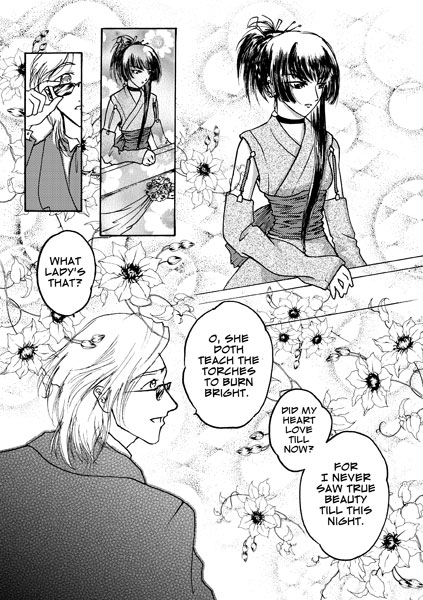
Official Wallpaper from “Manga Shakespeare: Romeo and Juliet.”
Basic Details:
Name: The Manga Shakespeare: Romeo and Juliet
Media: Comic book, with accompanying website
Ages: Young adult/ Teen.
Premise: A slick, clever interpretation of Shakespeare that pares down the story and uses Japanese-inspired Manga comic book design to bring to life the violence and youthful energy of Romeo and Juliet. It transposes the story to a Tokyo suburb with two katana-wielding rival versions of the Capulets and Montegues.
Sample Images
My reaction: I think this is a very clever and very exciting way to get young people interested in Shakespeare. The pictures help bring the emotions out with great clarity and the storytelling is very condensed and clever. In addition, the website has helpful resources for Shakespeare newbie’s.
Recommendation: I’d recommend this book to all teens and high-school students and fans of Shakespeare.
Poster for a production of “Romeo and Juliet,” that I worked on in 2012.
When I say that the story of Romeo and Juliet is timeless, I mean that the story’s roots go back almost to the beginnings of time. According to Sigmund Freud in Beyond the Pleasure Principle, the desire for love is inexplicably tied to the desires for creation, and destruction. These contradictory forces live deep in the human psyche, which explains why stories of doomed love have been re-interpreted throughout history. What follows is a short history of the stories that inspired Shakespeare, so you can see how this archetypal story has evolved into the one we still read today.
Ancient Sources
When Shakespeare was going to school in the late 1560s, Elizabethan boys were expected to read ancient Greek and Roman writers, who wrote many of the classical love stories listed below. We know that Shakespeare remembered of all these stories because he gives a brief homage to them in Ac II, Scene iv of Romeo and Juliet:
MERCUTIO
Now is he [Romeo] for the numbers that Petrarch flowed in: Laura to his lady was but a kitchen-wench; marry, she had a better love to be-rhyme her; Dido a dowdy; Cleopatra a gipsy; Helen and Hero hildings and harlots; Thisbe a grey eye or so, but not to the purpose.
Mercutio’s opinion of these old love stories is that they are based on a false concept of true love, when in fact, love for Mercutio is merely lust and obsession.
Hero and Leander
Author– Unknown (traditional Greek Myth)
Date Of Composition 1400- 300 BC (approx)
Plot– Hero, a prophetess of Aphrodite loves Leander, a young man from the other side of her temple across a river called the Hellespond. As a priestess, Hero is supposed to remain a virgin, but Leander convinces her to make love to him, and visits her several times by swimming across the Hellespond. Their affair comes to a tragic end when on one stormy night, Leander is overcome by the waves and drowns on his journey to be with his beloved Hero. Consumed with grief, Hero throws herself off the temple tower to be with him.
Moral– love (or at least lust), destroys and kills.
Plot– Paris, the prince of Troy abducts and ravishes Helen, the queen of Sparta in Greece, leading to a 10 year war between the Greeks and the Trojans. This war divides everyone in both countries, even the gods, leading to the question of whether love is more important to loyalty to one’s country or family.
Moral– Ambiguous- The Greeks fight the Trojans bravely, but only to destroy Troy. Whereas the Trojans are often more sympathetic than the Greeks, but their decision to protect Paris and Helen’s adulterous affair is very unwise. The characters in this story strive to answer the question of what is the most important thing in life- desire for power, fame, to protect one’s home, or love?
Authors– Various, including the French bards Thomas and Beroul
Date of Composition– somewhere around the 12th century AD.
Plot– Similar to the Trojan War story, but in a medieval context: a young English knight named Tristan meets the heroine, a princess from Ireland, who is engaged to his country’s king. Their passion is instant and fiery, (sometimes it is the result of a love potion they accidentally drank), but it also forces them to make a terrible choice- If Tristan carries off Isolde, he will be disobeying his king, destroying a peaceful alliance, and forcing England and Ireland to go to war. However, it is clear from the beginning that Isolde does not love the one-eyed English king, and if she marries him, Isolde will be miserable her whole life. Tristan fights gallantly to protect both Isolde and her honor and it puts Tristan, the king, and Isolde into a torturous love triangle, which usually ends with Tristan and the king fighting to the death.
Morals–
Arranged marriages ruin everything,
love is like a drug,
“Bros before, [you know-what].”
Note– This story was also the root of the story of Lancelot in the Arthur myths. In the version created by Thomas Mallory in the 15th century, Lancelot falls in love with Queen Guineveere, and betrays King Arthur, whom he loves like a father. Lancelot’s adultery eventually destroys the fellowship of the Round Table, and allows Arthur’s wicked bastard son Mordred to kill Arthur and ruin Camelot.
Here is a brief timeline of the narrative sources dating from 1530-1580 that Shakespeare used to create his own masterpiece. As you can see, they differ considerably from the ancient sources in plot, and overall morals.
Timeline Of the Narrative Sources of Romeo and Juliet:
Romeo and Giulietta
Author– Luigi Da Porto in his novel Historia novellamente ritrovata di due nobili amanti (“Newly found story of two noble lovers”
Date of Composition- 1530
Background– Da Porto was a soldier and a brilliant story writer. Some claim that he based his tale on an earlier story, while some claim he based it on his falling in love with a girl at a masked ball. In any case, Da Porto was the first to set the story in Verona, created the characters of Mercutio and Benvolio, and also the first author to change the context of the story into two warring households, rather than great empires or kingdoms. This small change helps the audience sympathize with the lovers more, since they are not guilty of treason or adultery.
Plot– Two noble houses, the Montecchi and the Cappelletti are at war. The hero Romeo meets Giulietta at a Carnival ball, which makes him forget about an unrequited love he has for an unnamed girl (the name Rosalind is Shakespeare’s invention). The two lovers have several liasons over a much longer period than in Shakespeare’s play at Guilietta’s chamber window. Also, although they are married in secret and Romeo is banished just as in Shakespeare’s version, the character he kills is not related to Guilietta. However, the plot device of the sleeping potion and Romeo’s suicide is also consistent with Shakespeare’s version of the story.
Romeus and Juliet
Author– Matteo Bandello’s in his story Novelle, (translated into English) by Arthur Brooke in 1587.
Date of Composition– 1554, (translated in 1562, re-printed 1587)
Background– Bandello adapted Da Porto’s version of the story and developed the supporting characters, adding The Nurse, the Friar and the Apothecary, and developing Benvolio (without giving him a name).
Plot– This plot is almost exactly the same as Shakespeare’s play,but it does reveal some narrative details that Shakespeare omits. Bandello’s poem reveals the origin of the Capulet/ Monegue feud, as well as the ultimate fates of the surviving characters.
Moral– Like many other interpretations, the author (or at least the translator) seem to be struggling with the Christian taboo of premarital sex, which to some extent condemns the protagonists. In the English translation by Arthur Brooke, the Preface makes it very clear that Brooke is not condoning Romeus’ premarital sex or his blatant disregard for his parents’ authority. Brooke claims that the story is intended to show the actions of bad people being punished for their actions:
The good man’s example biddeth men to be good, and the evil man’s mischief warneth men not to be evil. To this good end serve all ill ends of ill beginnings. And to this end, good Reader, is this tragical matter written, to describe unto thee a couple of unfortunate lovers, thralling themselves to unhonest desire; neglecting the authority and advice of parents and friends; conferring their principal counsels with drunken gossips and superstitious friars (the naturally fit instruments of unchastity); attempting all adventures of peril for th’ attaining of their wished lust – (Brooke, Romeus and Juliet )
On the other hand, at the end of the poem, Bandello describes Romeus and Juliet’s love (or at least Brooke’s translation), as: “so perfect, sound, and so approvéd love,” which suggests that the author at least approve of the lover’s actions. One can almost imagine Italian passion fighting with English morality in the dueling pens of Brooke and Bandello. It was up to Shakespeare to try and resolve this conflict in his own version.
Romeo and Juliet
Author– William Shakespeare
Date of Composition 1593 (approximately)
Plot– One of the most interesting things about Shakespeare’s play is that he develops the characters of Mercutio, the Nurse, and Friar Lawrence, but deliberately omits certain plot elements such as why the feud began between the Capulets and Montegues, and what happened to The Apothecary, Nurse, and Friar Lawrence after the Prince found out about the lovers’ suicides. This effectively makes the Capulet/Montegue feud seem pointless, which allows the audience to focus more on the lovers. On the other hand, Shakespeare also compresses the time Romeo and Juliet know each other from 9 months as in Brooke’s version to 5 days, making the love affair seem even more rash. These changes in plot make the story much less a morality tale about morally wrong love, and more about the war between creative and destructive love that play in the human psyche.
Moral– As we’ve seen, most interpretations of the story condemn the lovers as rash, foolish, and adulterous. Shakespeare refuses to condemn or condone. That is Shakespeare’s great gift for storytelling- he doesn’t give us clear answers because he knows life is more complicated than that. He merely provides two sides of an issue and lets the reader sort it out for themselves.
How did Shakespeare get away with ripping off material this old? You’d think that, since every English schoolboy knew this story for over 1000 years, nobody would see this play since there would be no surprises. The answer is that Shakespeare writes primarily for characters, not plot. He infuses old characters like Romeo and Juliet with a new language that makes them more complete, more modern, and more timeless. That’s why stories like R&J, which was already known to Shakespeare’s audiences, are still entertaining and compelling, even after you read it 100 times, and see hundreds of different productions.
I hope this short history of the sources of Romeo and Juliet allows you to ponder the complex theories behind love and lust that authors have struggled to explain in the history of this story. Each age debates the values of love and whether it’s worth fighting or dying or killing for. Perhaps the best thing about Shakespeare’s version is that it tries to provide the most complete summary of the question, without giving us an answer, allowing us to marvel at how complex it is.
Here is the last post on my series of 3 which examines the importance question of why should we read or see this play? In the last post I argued that, although the play is sometimes billed as a moral story, the characters engage in really reprehensible behavior- premarital sex, muder, and whining about their teenage problems. So the question is, if the play isn’t a moral parable, what can we gain from reading it?
Reason # 3- The Play Shows Truths About
the Human Condition.
Even though the play’s characters frequently do rash and sometimes foolish things, this only serves to make them more complex and realistic. The truth is, we all do foolish things when in love, and they all dramatically effect our lives, (sometimes for better or for worse).
The point is that the qualities we demonstrate when we’re in love, reveal who we truly are. Romeo is foolish, obsessed with his lover, sometimes selfish, and hot-blooded. He is also tender, caring, utterly without deceit or pretense, and committed to his beloved at any cost.
I believe this is why we really need to keep reading and watching this play. As Judy Dench said in the film “Shakespeare In Love,” the play shows the very truth and nature of love, not just the budding romances or passionate affairs, but dark obsessions, painful separations, family bonds, and even, “glooming peace,” as the Prince says at the end of the play. Shakespeare shows them all, not judging one to be better or worse, but demonstrating the feelings and the actions that arise in reaction to the powerful force of love.
So when you read this play, try to look beyond the peculiar language, the old-fashioned type and the flowery poetry. Inside you might see a reflection of yourself, what Shakespeare called, “the mirror up to nature.”
I just saw on the “Tonight Show” a clip where Ira Glass from NPR retracts his statement on Twitter a week ago that “Shakespeare sucks,” after seeing a production of Shakespeare In the Park. Glass said to Jimmy Fallon that he immediately caught heat on the internet “Apparently Shakespeare has a huge internet presence.” To that i say, “Good job Shakespeare nerds!” As Fallon pointed out, Shakespeare is a rallying symbol to all smart people, and that’s why we need to defend him.







 The Shakespearean Student