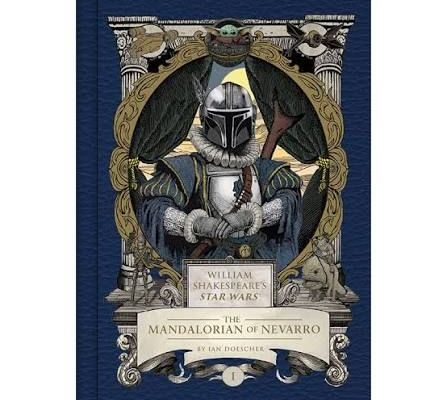
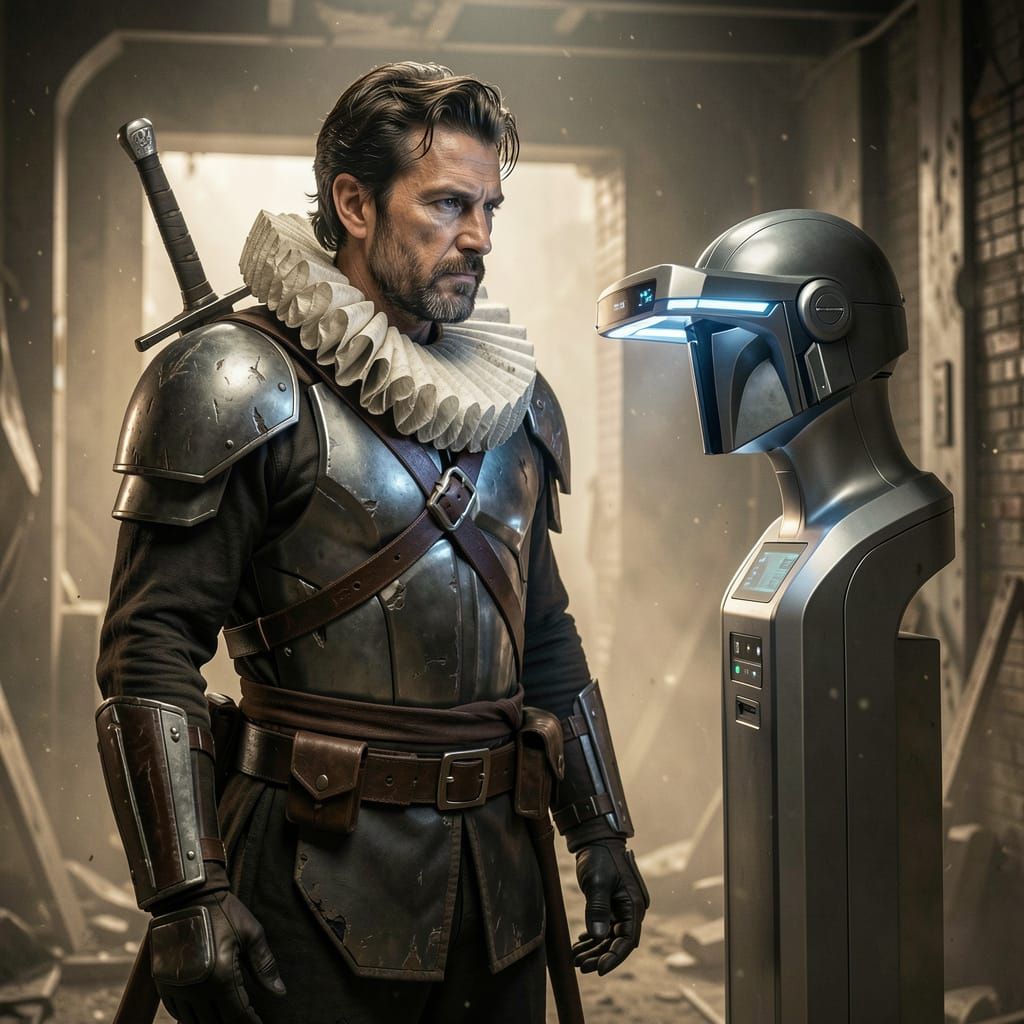
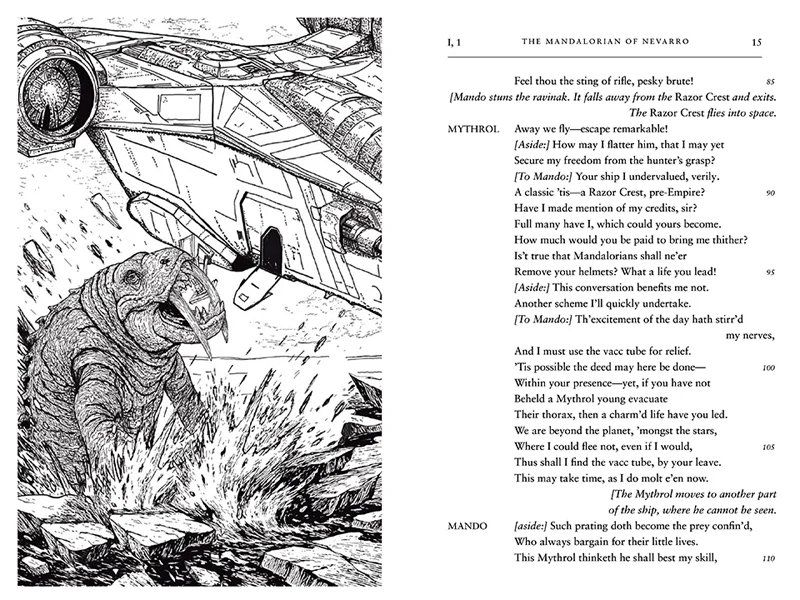
With the upcoming release of The Mandalorian and Grogo, I knew there would be lots of tie-in Star Wars merchandise capitalizing on it. What I didn’t expect, was that, after a six year hiatus, playwright Ian Doescher has once again taken up his quills and lightsabers to dramatize the next installment in the Shakespearean Star Wars cannon, The Mandalorian of Nevarro.
What Is William Shakespeare’s Star Wars?
William Shakespeare’s Star Wars is a series of parody plays written by Ian Doescher that takes the prose screenplays of the Star Wars story and transforms them into Elizabethan verse. Last time, I mentioned how much I loved the cheeky references to Shakespeare and Star Wars, and how Doescher adapts the cinematic quality into Elizabethan drama very well. In my podcast, I also emphasized the way Doescher gives each character verbose Shakespearan language that works very well for radio and theater:
I’ve written reviews about Mr Doescher’s versions of the original trilogy, but I never expected him to cover the Disney Plus shows, bit he proved me wrong, and by all accounts, this edition lives up to its predecessors.
Interview with Ian Doescher about “The Mandalorian of Nevarro”
What We Know
I haven’t gotten a copy yet of the full play, so this will be less of a review and more of a prediction and a fun speculation about how Mr Doescher will handle everyone’s favorite green foster child and Beskar- clad dad.
When your main character is, quite frankly, one of the most non-theatrical Star Wars protagonists in existence, forcing that character to come out of his shell and give him that Shakespearean flair was always going to be a test. – Nate Manning, Star Wars News.net
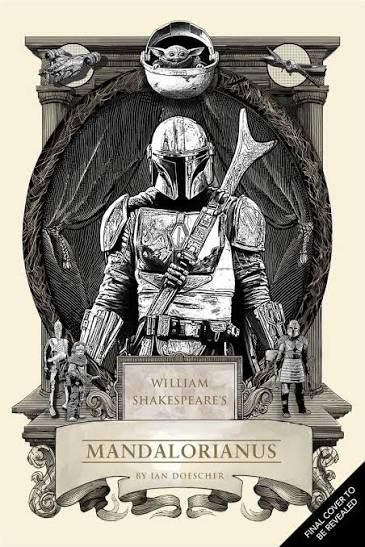
The Mandalorian of Nevarro is a two part series that, like the other William Shakespeare’s Star Wars books, adapts the prose text of episodes 1-4 into Shakespeare’s verse. According to Wookiepedia, the series was originally titled Mandalorius, which is probably a pun on Shakespeare’s play Coriolanus
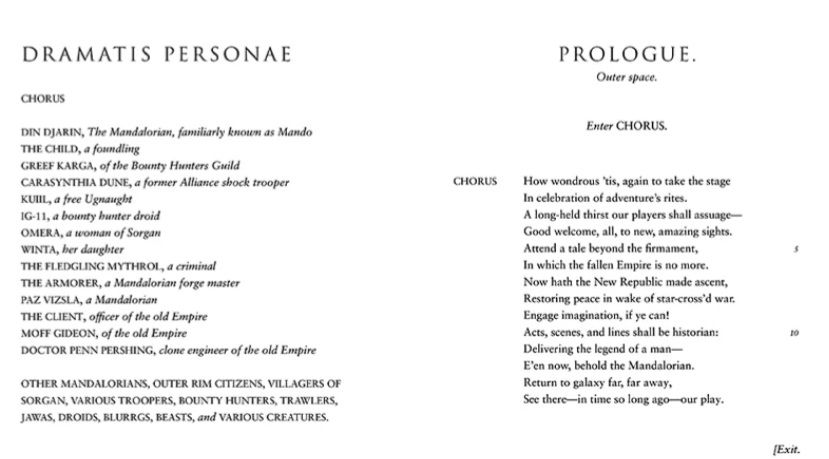
Prologue and Dramatis Personae for “The Mandalorian of Nevarro”
What We Can Guess
One thing I am very curious about is how far Doescher adapted Coriolanus for Mandolorian. As you might have read in my review for Coriolanus, one reason why the play isn’t as popular as some of Shakespeare’s other tragedies is simply that its hero is not very compelling. Coriolanus is not as articulate or wise as Hamlet, nor does his journey form a cohesive arc like Macbeth or Othello. He seems to flit between loving Rome and hating it, between peace and war, with little agency or understanding of what is happening to him, and even less insight. He is mainly a maddeningly inscrutable man, almost as if he was wearing a mask.
With all this in mind, I can honestly understand why Doescher might choose the Roman general Caius Martius Coriolanus as a model for Jinn Jaran, (assuming that the final play does in fact do so). Like Coriolanus, Mando is a lone warrior in a fragile republic, who goes from planet to planet with nothing but his ship, and his rigid code of behavior to guide him. Therefore it makes total sense that Doescher would use Coriolanus as a model to emulate when adapting The Mandalorian.
With all due respect to Shakespeare, what makes Mando a more interesting character from Coriolanus us that he has a compelling Arc. He starts as a solitary bounty hunter to a surrogate father who finds meaning when he adopts a child. It’s like his helmet and armor are metaphors for the uncaring, uncompromising person he was. Over the course of the series, as Mando becomes a better man and a better father, he is forced to remove his armor and form real relationships.
What I Hope
I hope this adaptation uses Shakespeare’s ability to conjure images and feelings when telling Mando’s story, but only time will tell.
Let me begin with a special shout out to Jesse Buckley, the first Irish woman to win an Oscar for her portrayal of Shakespeare’s wife Anne ‘Agnes’ Hathaway in the movie Hamnet.
I promise I will write a full review soon, but for now here’s a behind the scenes look at the film:
In addition, here’s a link to my post on how Shakespeare depicts Irish culture in his plays
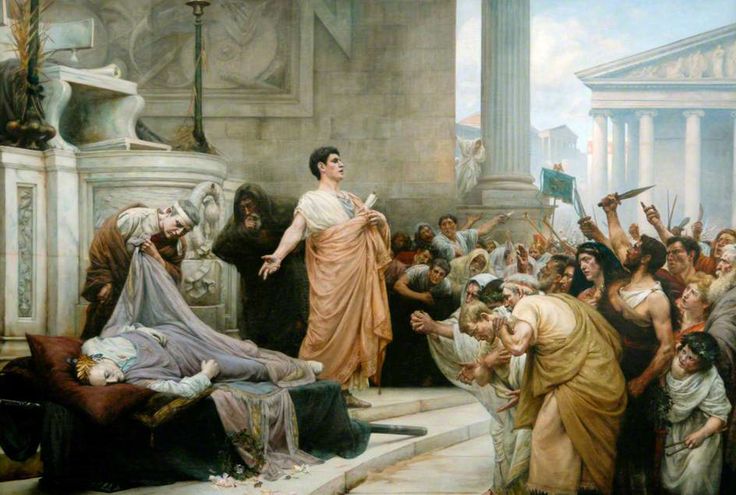
And finally, today is the anniversary of Marcus Brutus’ attempt to win over the Roman crowd, attempting to justify his tyrannicide. Here’s a scene from HBO’s Rome, in which Brutus surrenders to Caesar after the Battle of Pharsellus. In this scene, Caesar is played by Irish actor, Ciarán Hinds.
Concept: To explore the plot, characters, and themes of Shakespeare’s Julius Caesar while also gaining an insight into Ancient Roman history and culture.
Student Description: Delve into the passionate speeches of Brutus and Antony in Shakespeare’s Julius Caesar, which led a whole country to revolution.
Parent Description Using self-paced online activities, and a helpful handout, your child(ren) will analyze the rhetoric and persuasive power in two speeches from Shakespeare’s “Julius Caesar.” The course will also cover the culture of Ancient Rome, and the circumstances that led to Julius Caesar’s assasination, which inadvertently led to the birth of the Roman Empire.
Course Organizaiton (the class is divided into 4 parts that students can complete at their own pace over a week-long period
Each lesson will have:
“That Is the Question” (Essential Question)
Lesson Objectives
Set the Scene (Background and context)- 1-3 slides
The Players (biography) 1-3 slides
Go Deeper (Webquest)
Explore military life and the lives of women in Rome using my blog and other websites as a guide.
Post 3 things you learned to the Outschool page or send a photo of your completed handout.
Words, Words Words (Vocabulary, famous lines)
A Taste of Your Quality (Independant Project)
Show us your mettle (Test)
So each class should be 14-15 slides long.
Outline
Class I- Background on Caesar and Roman Culture
That is the Question:
Why did Brutus feel Julius Caesar had to die?
What was the aftermath?
Can one person’s speech effect an entire nation?
Lesson Objectives
To provide historical and political context to explain why Julius Caesar was assassinated, and how his death inadvertantly created the Roman Empire.
To explain the Rhetorical Triangle, the building blocks of persuasive speech.
To go through the story of Julius Caesar focusing on the effect of the speeches.
To study the famous “Friends, Romans Countrymen” speech.
To contrast this speech with some more recent political speeches and you think critically about:
Brutus- Podcast episode. I posit in this episode that Brutus is
Words, Words, Words-
Traitor
Republic
Dictator
Revolution
Ethos
Pathos
Logos
Rhetoric
Colossus
Aeneus
A Taste Of Your Quality:
(Independent work): We’ll examine a painting of Brutus’ ancestor Lucius and learn why Brutus values Rome more than even family.
Show Us Your Mettle:
Quizzes on Brutus
Class 3- Antony and Brutus’ Dueling Speeches
(c) Hartlepool Museums and Heritage Service; Supplied by The Public Catalogue Foundation
That Is the Question
After Caesar’s Death, his friend Marc Antony held a funeral for him where he gives the famous “Friends, Romans, Countrymen” speech. How did Antony’s speech affect the crowd?
Brutus has a speech where he explains why he killed Caesar. What does he say, and how effectively does he say it?
Antony was secretly plotting to take power for himself, and get Brutus and Cassius killed. How did he do it?
Do speeches have the power to change a nation?
Learning Objectives
To explain the Rhetorical Triangle, the building blocks of persuasive speech.
To study the famous “Friends, Romans Countrymen” speech, as well
To look at these speeches and get you to think critically about:
We’ll talk about the consequences of violent revolutions and how Julius Caesar has inspired some of the greatest speeches in political history.
-Patrick Henry
– Gettysburg Address
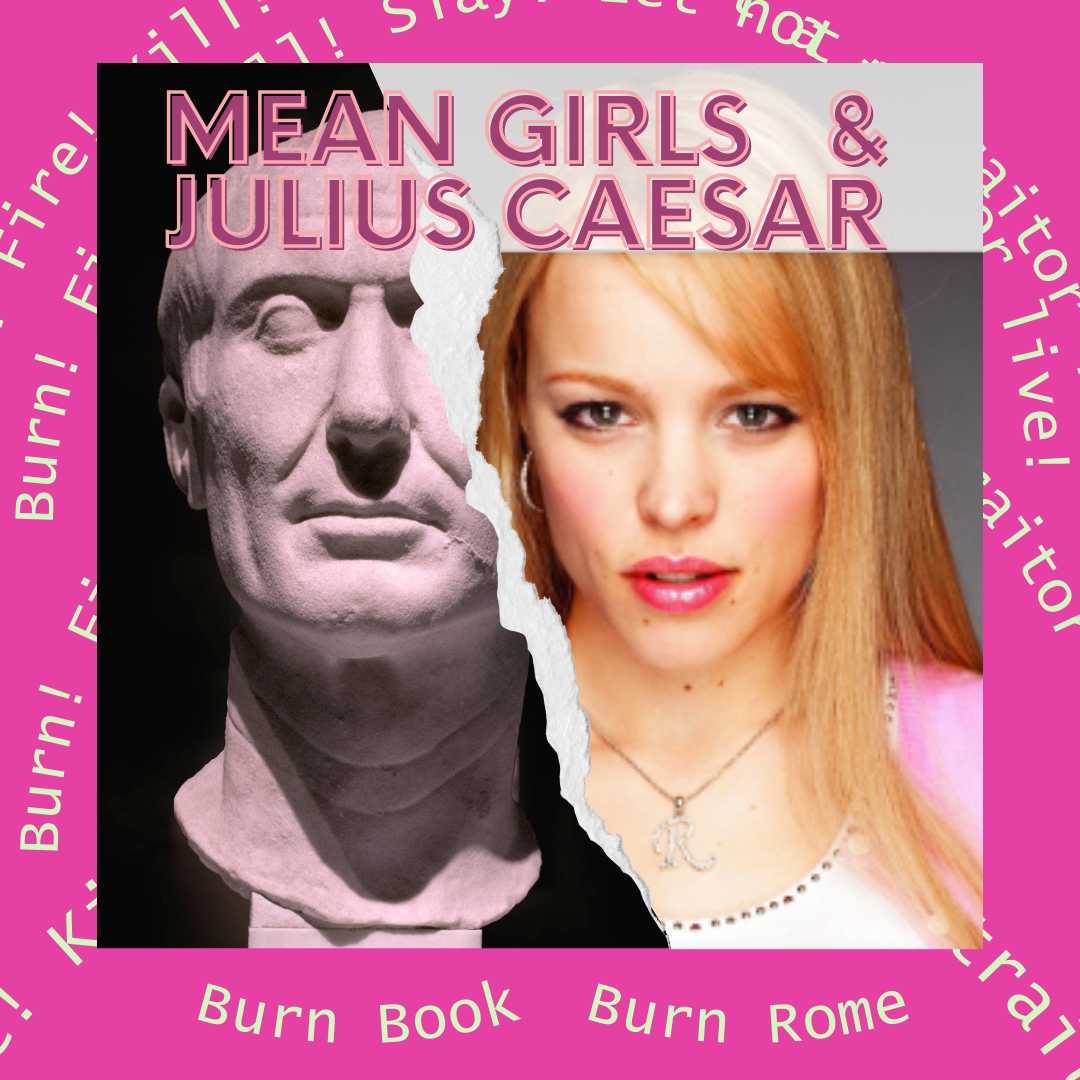
– Mean Girls
That Is the Question
How have people interpreted the play “Julius Caesar” in America?
Does this play promote violence?
What kind of violent speech do we deal with in politics today?
Learning Objectives
To show the link between American History and Julius Caesar
To address the controversy and the misconception that the play promotes violent assassination.
To end on a cautionary note people must think critically about what they hear in politics and not make rash decisions based on appeals to fear.
Setting the Scene- US History
America was founded using the principles of republican government that Ancient Rome used- with a senate, and a series of checks and balances to ensure no one has too much power.
America was founded in a violent revolution, and some of our country’s early leaders used Brutus as an inspiration- to overcome a tyrannical king.
In later years, however, some people have forgotten what happened to Brutus
Today, we are often bombarded with speech that encourages fear and anger and we must think critically when we hear such speech in whatever forum- Roman, or Reddit.
The Players (use my JC lecture?)
Patrick Henry
Abraham Lincoln
John Wilkes Booth
Donald Trump
Go Deeper
-Watch the Caesar Video
– How does the play promote nonviolence?
– How did Brutus’ assassination fail to save the Roman Republic?
“Welcome Spirit, How Camest Thou hither?” The sources for Puck
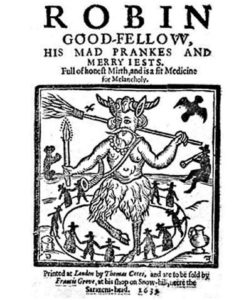
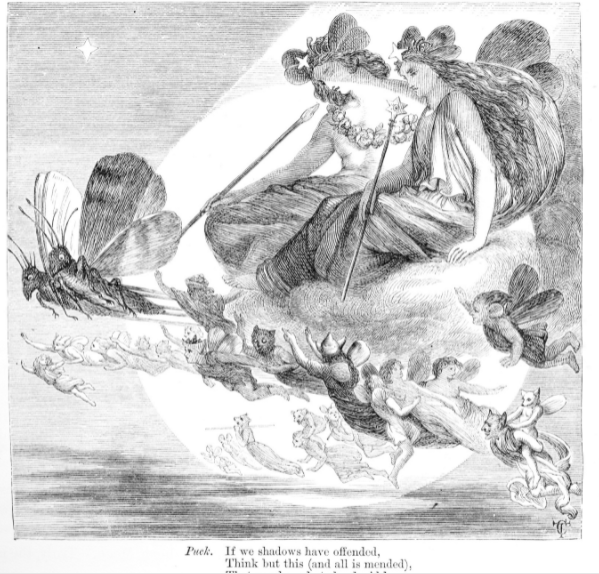
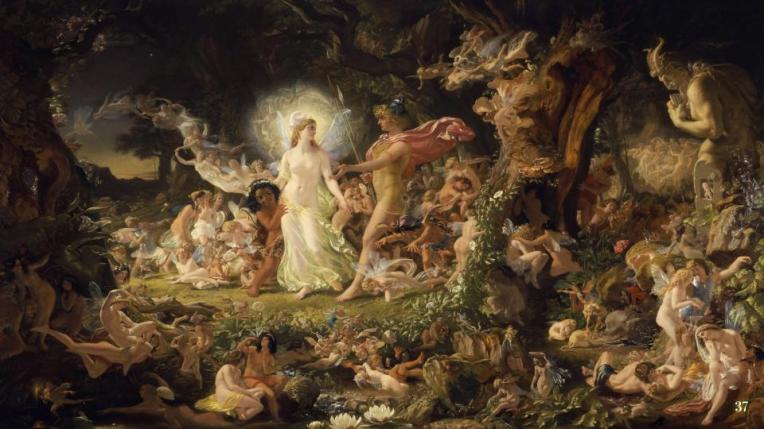
Puck, in medieval English folklore, a malicious fairy or demon. In Old and Middle English the word meant simply “demon.” In Elizabethan lore he was a mischievous, brownielike fairy also called Robin Goodfellow, or Hobgoblin. As one of the leading characters in William Shakespeare’s Midsummer Night’s Dream, Puck boasts of his pranks of changing shapes, misleading travelers at night, spoiling milk, frightening young girls, and tripping venerable old dames. The Irish pooka, or púca, and the Welsh pwcca are similar household spirits.
Shakespeare also took inspiration from English poet Edmund Spencer, who visited Ireland in the 1590s and adapted the folklore he picked up into his opera The Fairy Queen, which Shakespeare adapted into A Midsummer Night’s Dream
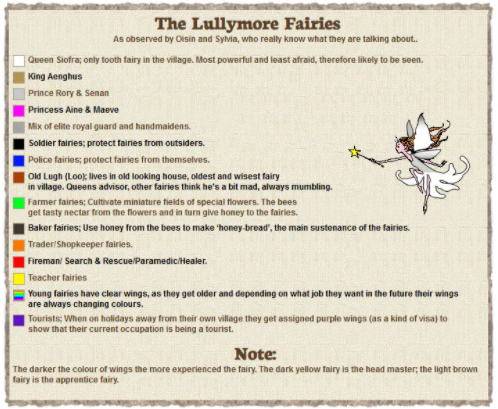
Types of fairies you can “spot” at the Lullymore Park in Ireland:
Puck/Robin’s Dual Nature
The old stories tell that Fairies are magical creatures who live in hollow places in the earth. Some are benevolent and help give rain and pleasant weather to the Earth, Like the king and Queen of the fairies, Oberon and Titania:
And the mazed world, By their [the tides] increase, now knows not which is which: And this same progeny of evils comes From our debate, from our dissension; We are their parents and original.
— Titania, (Queen of the Faries), A Midsummer Night’s Dream Act II, Scene i.
Titania in this speech shows great concern for nature, humanity, and the planet. She believes it is the responsibility of fairies, particularly herself and her husband Oberon, to control the elements and keep humans and fairies safe. Some fairies, however, are cruel and enjoy playing tricks on mortals, just like Puck in A Midsummer Night’s Dream, or Queen Mab in Romeo and Juliet.
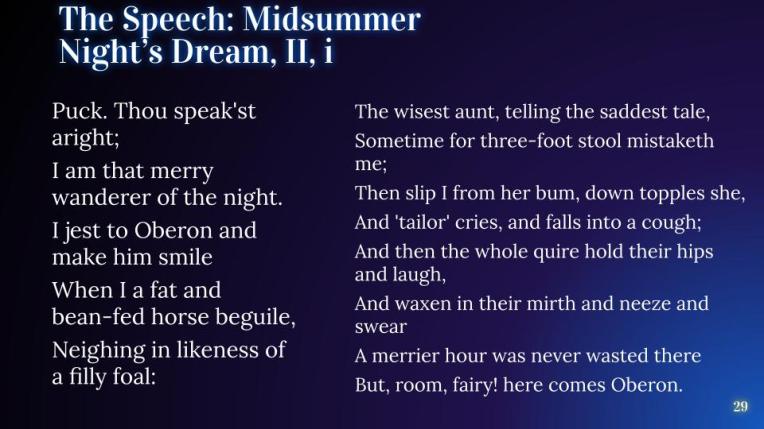
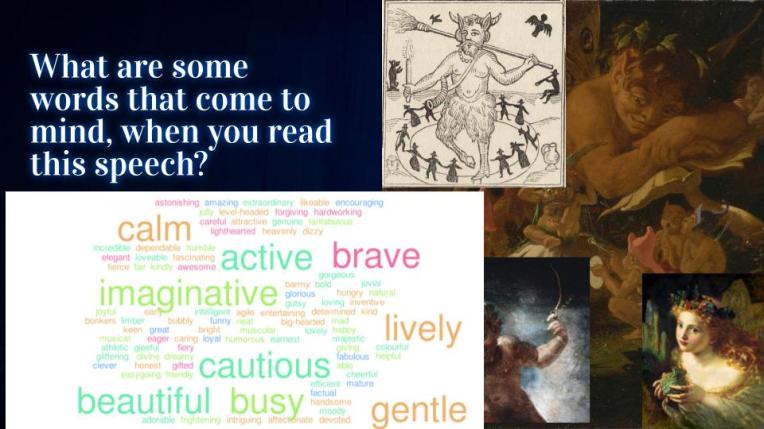
Close reading of Puck’s speech (MND II, i)
Close reading of Puck’s speech (MND II, i)
Close reading of Puck’s speech (MND II, i)
Close reading of Puck’s speech (MND II, i)
Close reading of Puck’s speech (MND II, i)
.
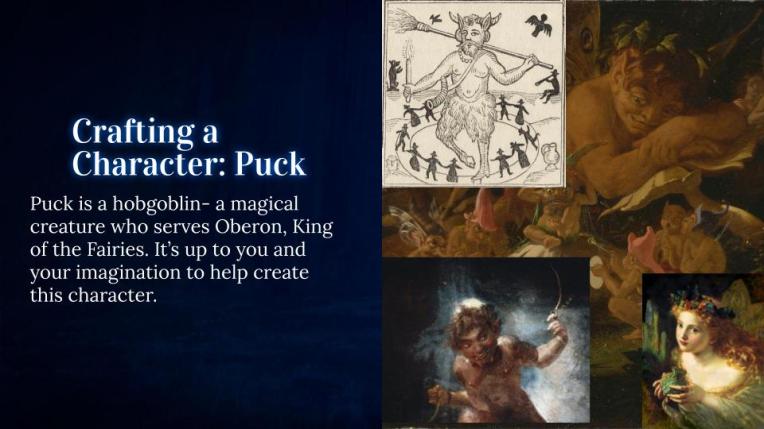
This is a short analysis I created of the tricks Puck plays on people in A Midsummer Night’s Dream, as part of my acting course on Ouschool.com. Note the different ways Puck is portrayed in photos as a satyr, a rotund elf, and sometimes as an almost- demon like figure.
Punishments or contracts with fairies formed a significant part of Goodfellow’s purpose on earth. While he could issue good fortune and support, this was always at the cost of those involved. As Reginald Scot commented, Goodfellow had a ‘standing fee’ of a ‘mess of white bread and milk’, which he expected after supporting housewives with their chores. If his payment was forgotten, Goodfellow was believed to steal from the home that owed him, often stealing grain and milk from the dairy.
Abigail Sparkes, Historic UK.com
Performing Puck
Because Puck is not human, and somewhat ambiguous in the text, an actor can play Puck in many different ways. Generally speaking, actors tend to explore Puck’s attitude toward humans, their love of mischief, and how to translate that physically and vocally
Puck. My mistress with a monster is in love. Near to her close and consecrated bower, While she was in her dull and sleeping hour, A crew of patches, rude mechanicals, Were met together to rehearse a play The shallowest thick-skin of that barren sort, Who Pyramus presented, in their sport Forsook his scene and enter’d in a brake When I did him at this advantage take, An ass’s nole I fixed on his head:
Anon his Thisbe must be answered, And forth my mimic comes. So, at his sight, away his fellows fly; And, at our stamp, here o’er and o’er one falls; He murder cries and help from Athens calls. I led them on in this distracted fear, And left sweet Pyramus translated there: When in that moment, so it came to pass, Titania waked and straightway loved an ass!
Since Halloween is right around the corner, I’d like to give a shout-out to my friend Jeff Chips, whose Pittsburg-based theater company Steel City Shakespeare, is currently producing a theatrical version of “Dracula.”
I’ve interviewed Mr. Chips in the past. His company specializes in fast-paced, physical, and clever interpretations of the classics with a deep love for Pittsburgh.
Interview with Jeff Chips, director of Steel City Shakespeare
Dracula and Shakespeare
Although we usually associate Dracula with books and movies, the gothic horror story actually has a long theatrical history, that is inexplicably intertwined with Shakespeare. Bram Stoker, the author of the book, began his writing career as a theater critic for the fabled Lyceum Theater in London:
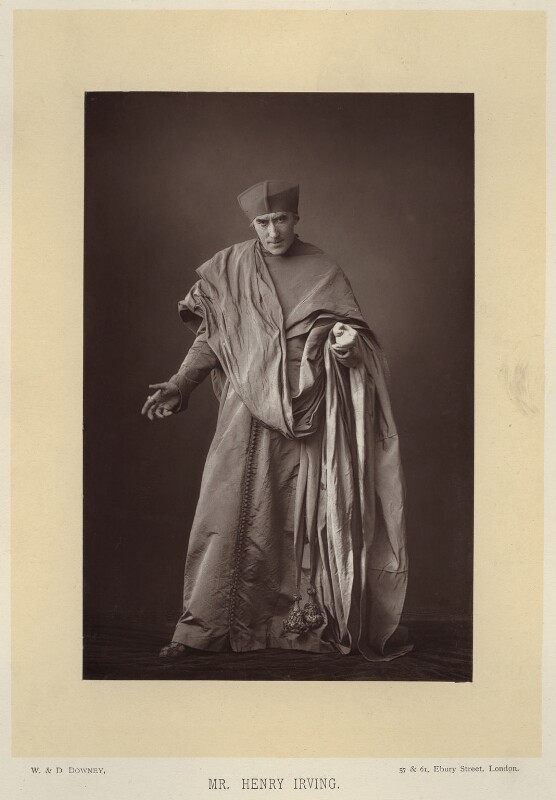
Working on a review for Hamlet in1873, Stoker came to the attention of Sir Henry Irving, one of the most celebrated actor-managers of the 19th century, famous for playing Shylock, Cardinal Woolsey, and many others. According to gossip of the time, Stoker and Irving were extremely close, and Stoker might have even based part of Dracula’s character on Sir Henry.
Folger Shakespeare collection: Henry Irving and Bram Stoker
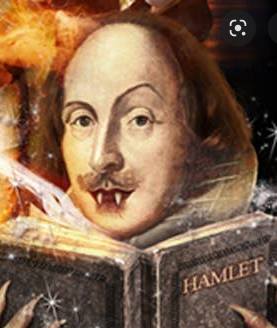
Dracula is a character with a profound ability to bewitch the mind. Like Richard III, he is a seducer, in spite of his repellant personality. Like Macbeth, Dracula romanticizes Death, as well as the creatures of the night. And like Shakespeare himself, Dracula is immortal and has appeared and re-appeared in every form of media in popular culture. Perhaps Stoker owes more to Shakespeare than he does to Sir Henry.
If you go see this production, leave me a comment either on my website, or my Twitter page (@Shakestud). I’d love to know what you think of Steel City Shakespeare! Click the link below to buy tickets:
Basics Of Stage Combat: Students will learn the basics of safely enacting a fight onstage, in preparation for a Shakespeare play. We will also learn about the history of sword fighting in the military and the duel.
Trailer for Basics of Stage Combat.
My daughter really enjoyed taking this class. She was actually able to use her sabre and try out her routine on her father. Paul is quite knowledgeable about Shakespeare and made the class really fun by teaching a fight scene from Romeo and Juliet. It is amazing watching her practice with Paul over Zoom. I hope Paul will have. more combat classes, it is a different way to learn Shakespeare.
IB, Parent
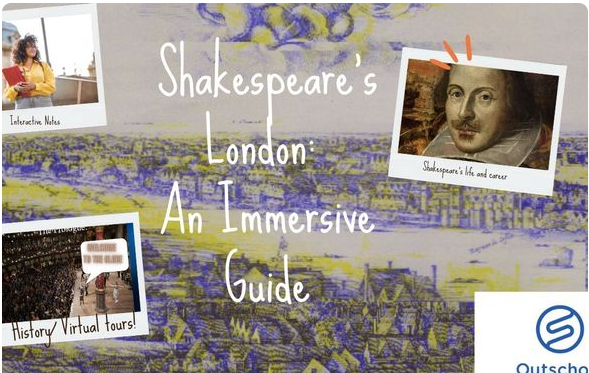
An Interactive Guide To Shakespeare’s London (New Class)
A virtual tour of Shakespeare’s London will get kids to interact with the culture of Elizabethan England.
Class Experience
To teach kids about the Elizabethan era and the background of Romeo and Juliet, The Instructor will interact with the class (via pre-recorded videos), pretending to be Shakespeare. The class, pretending to be actors in Romeo and Juliet, will get a virtual tour of The Globe Theater, Hampton Court Palace, and a virtual visit to an Elizabethan doctor's office. This activity is an immersive way for them to learn about the period, how it relates to the world of the play, and how Shakespeare changed theater.

The class will take the form of a guided WebQuest activity.  First, the students will get a worksheet that has a series of fill-in-the-blanks about Elizabethan society (below). The students will fill out this worksheet based on a Nearpod and in conjunction with a website I’ve made, https://sites.google.com/nebobcats.org/visit-to-elizabethan-london/home?authuser=0
Both the Nearpod and each webpage will have a virtual tour, a video, and text explaining some aspects of Elizabethan life. Before they go to each location, I will give a short introduction via prerecorded video:
Wizard Science
In this one-hour course, your child will discover the enchanting world of science through a series of magical experiments. Learn about such topics as Astronomy, Static Electricity, chemistry, and optical illusions.
In this one-hour course, students will learn and play games that will explore the history behind Christmas traditions. We will also discuss the themes, characters, and famous quotes from Shakespeare’s play “Twelfth Night.”
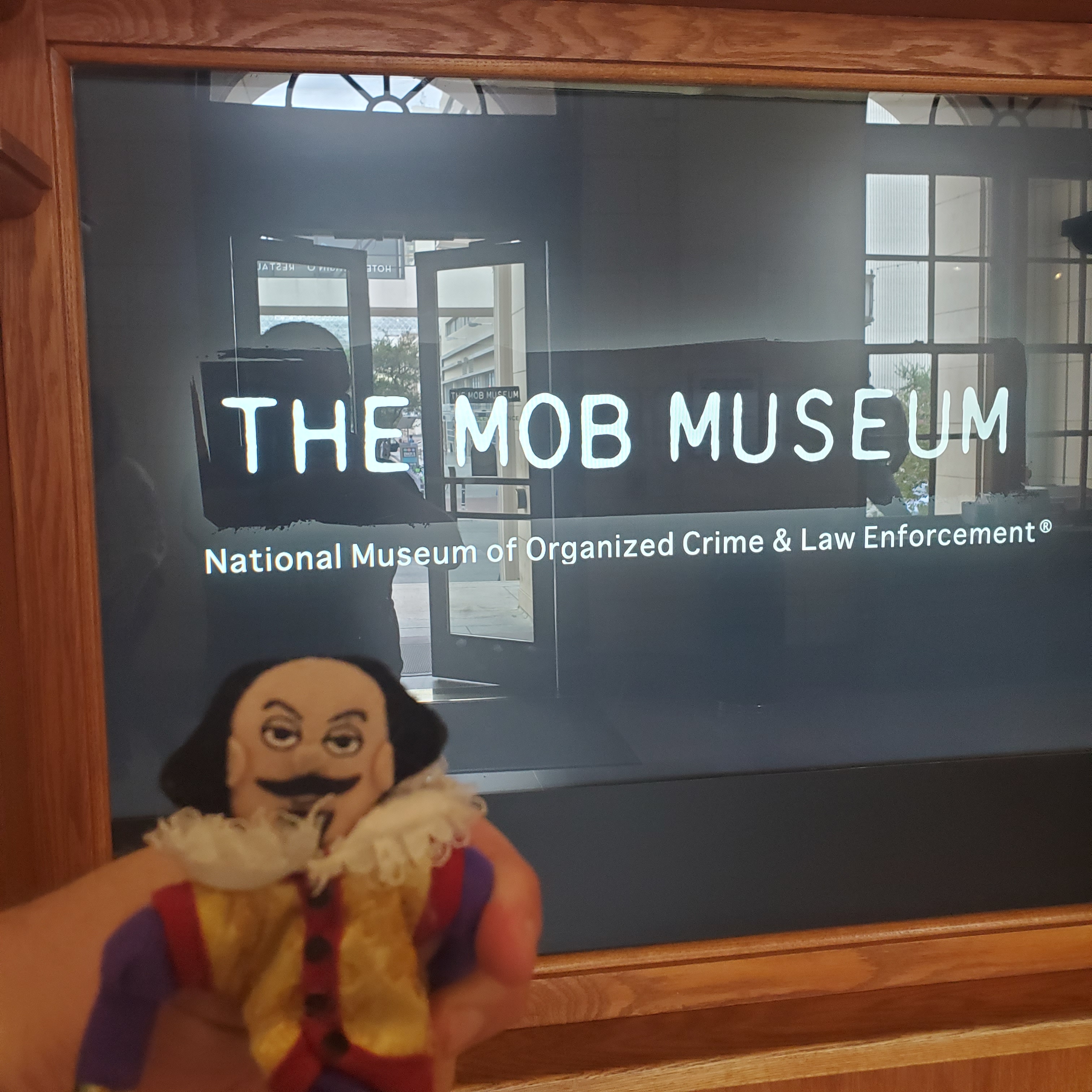
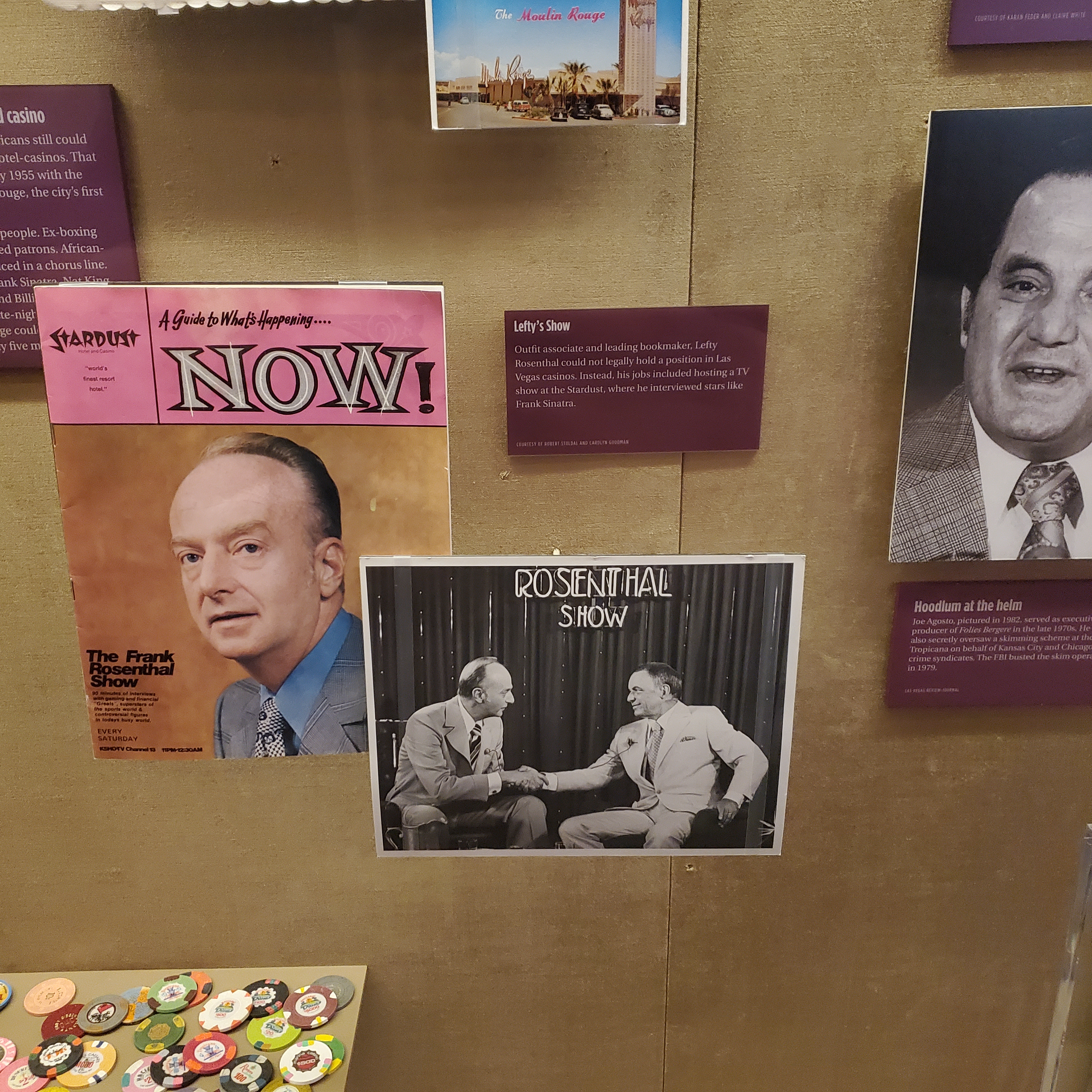
Last month, I took a short vacation to Las Vegas, where, as some of you know, I went to Area 15 and the Omega Mart Exhibit. I also visited the Las Vegas Mob Museum. I’ve been fascinated by the mob for years. The Mob (AKA The Outfit), has within its many threads a potent combination of corruption, seduction vice, and violence all hidden behind the veneer of honorable men who do what they feel they have to to protect their families and their communities.
Not surprisingly, while at the museum, I saw parallels between the history of organized crime and Shakespeare, specifically his most popular history play about a powerful family that takes over the crown of England in a brutal turf war, and then one of its most feared soldiers bribes, intimidates, and murders his way to the top; Richard III.
A Protection Racket: Feudalism vs. La Cosa Nostra
The structure of the mafia paralleled the feudal system. In a world where a police force didn’t offer much protection for marginalized communities, the mafia thrived by offering protection for these communities, (especially to immigrants and people of color in the 19th and early 20th century).
Much earlier than that, the feudal system of the middle ages, which started to crumble after Richard’s reign ended, was designed specifically so poor peasants could get protection from wealthy landowners after the fall of the Roman Empire. These lords offered the protection of their knights to these peasants i. Return for labor and a percentage of their income working the field. Like the mafia, these peasants paid tributes to their lords and these lords demanded loyalty. In the museum, there’s an interactive video where you can become a ‘made man,’ which means become an official member of a mafia crew. Like a king knighting a lord, this ceremony meant pledging your life to your superiors, and being at their beck and call no matter what. In addition, like medieval knights, mafiosos were not allowed to murder other made men without permission from their capo or boss.
However benevolent they might appear, In both cases the Dons and the medieval lords were extorting their underclass. Failing to pay tribute to their lords would cause the peasants to lose their lands, and any disloyalty to the mafia would be severely punished. These powerful, violent thugs used their private armies to intimidate the weak into giving them what they wanted.
Part II: The Two Families
To thoroughly explain the parallels between the Wars of the Roses and the mob, I need to make clear that Richard iii is more than just the story of one man’s rise to power, although there are also mafia stories that fit this mold such as Scarface, White Heat, and the real-life story of Al Capone.
As this hilarious “weather report” from “Horrible Histories,” makes clear, during the Wars of the Roses two powerful families, (each with a claim to the English crown) fought each other in a brutal turf war. As Shakespeare characterizes in his play Henry VI, Part III, the battles between the houses of York and Lancaster shook England like a mighty storm, and for a while it was hard to tell who would prevail:
Henry VI. This battle fares like to the morning's war,
When dying clouds contend with growing light,
What time the shepherd, blowing of his nails,1105
Can neither call it perfect day nor night.
Now sways it this way, like a mighty sea
Forced by the tide to combat with the wind;
Now sways it that way, like the selfsame sea
Forced to retire by fury of the wind:1110
Sometime the flood prevails, and then the wind;
Now one the better, then another best;
Both tugging to be victors, breast to breast,
Yet neither conqueror nor conquered:
So is the equal of this fell war.
Henry VI, Act II, Scene i
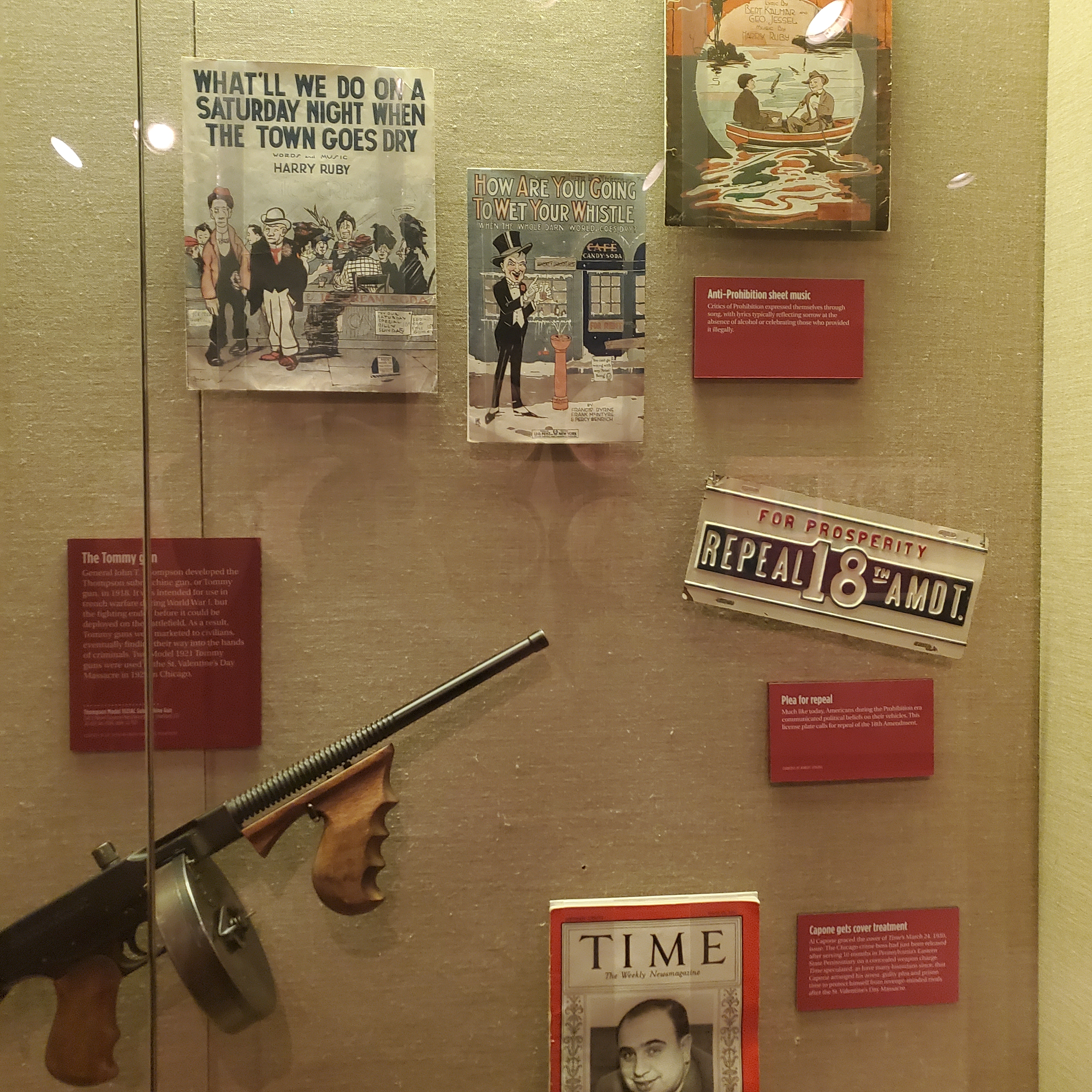
During the Wars of the Roses, it was King Henry’s incompetence and mental illness that gave the Yorkists the ability to challenge the House of Lancaster for the crown. In the 1920s, the passage of the 18th amendment, (which made alcohol illegal, and thus a profitable commodity for organized crime), that allowed the mob to rise to unheard-of power through illegally buying, distributing, and selling alcohol. As the photo and subsequent video shows, Prohibition largely led to the rise in organized crime in America, especially in Chicago. During Prohibition, the Italian Sough-side Gang fought for control of Chicago’s bootlegging trade and subsequently destroyed their competition from the Irish gangs through corruption, intimidation, and violence.
The Don rises- Richard Vs. Al Capone
Opening Scene from Ian Mckellen’s 1995 movie of Richard III.
Like the Italian and Irish gangs In Prohibition-era Chicago, the Yorkist and Lancastrian armies battled for the English throne. As Ian McKellen’s excellent movie (set in the 1930s) shows, Richard was instrumental in destroying the leading Lancastrians at the Battle of Tewkesbury, including Prince Edward and King Henry.
In Chicago, the most feared mobster soldier was Al Capone, who many scholars believe was responsible for killing off high ranking members of the Irish gang during the infamous St. Valentines Day Massacre, where the gang members were ‘arrested’ by South Side gangsters disguised as cops. As the Irish stood against the wall with their hands behind their heads, the phony cops pulled out Tommy guns from their coats and let out a hail of bullets on their unsuspecting quarry.
In Shakespeare’s play, the only Lancastrian to survive the war is Queen Margaret, wife to the murdered King Henry, and mother to the slaughtered Prince Edward. In this scene from Al Pacino’s “Looking For Richard,” she curses Richard for his cruel slaughters. It’s not surprising that Pacino was so drawn to Richard II that he starred in and directed this film. After all, Pacino is famous for playing mafia characters who slaughter their way to the top.
Once Capone killed the competition, he ruled a multimillion-dollar empire of bootleggers and maintained that empire through corruption, intimidation, and by constantly playing innocent, just like Richard himself.
Hypocrisy, Corruption and hidden violence
“Men in general judge more by the sense of sight than by the sense of touch, because everyone can see, but few can test by feeling. Everyone sees what you seem to be, few know what you really are; and those few do not dare take a stand against the general opinion.”
Niccolo Machiavelli
Both Richard III and mobsters are masters of double-speak, that is, seeming to say one thing and meaning something else. Look at this passage where Richard talks about killing his nephew, then denies it:
Richard III (Duke of Gloucester). I say, without characters, fame lives long. [Aside] Thus, like the formal vice, Iniquity, I moralize two meanings in one word.
Las Vegas: The town that bedded and abetted the mob.
Photos from the museum that shows how the mob-controlled most of the Vegas casinos and skimmed casino profits illegally.
After Al Capone’s demise and the repeal of Prohibition, the mafia found another vice to capitalize on: gambling. As the video below indicates, using their connections with the Teamsters Union and midwestern bookmakers, the mob in the midwest financed, built, and run almost every casino in Las Vegas, including The StarDust and the Hassienda. Once the casinos were built, the mob extorted millions of dollars from the casinos every month!
The profits from the casinos bought the mob even more power and influence, but this skim depended on making sure the bosses controlled their underlings, and defended their casinos from cheaters and snitches, which is why they defended their casinos through intimidation and violence.
Murders in The White tower and the city of sin.
A series of quotes from Las Vegas Mobsters
“Simple, plain, Clarence. I do love thee so, that I shall shortly send thy soul to Heaven.”
—Richard III, Act I, Scene i
When Richard of Gloucester starts his quest to become king, he begins by convincing his brother King Edward to execute his other brother George. Richard bribes the murderers to kill George before the king can reverse the death sentence. Richard has thus eliminated another obstacle in his way, and gained two loyal followers who will do anything for his gold.
Richard hires two murderers to kill the duke of Clarence (Nigel Hawthorne).
The mafia dealt the same way with traitors, stool pigeons, and anyone who tried to challenge the bosses. Look at this tour of the Mafia museum, where the grandson of the gangster Meyer Lansky starts by reminiscing about the glamourous lifestyle of Las Vegas mobsters, but the tour quickly takes a dark turn as Lansky II talks about how his grandfather ordered brutal executions for anyone who crossed The Las Vegas Outfit.
Exterior of the Mafia Museum
It was an enormously interesting trip going to the Mafia Museum, and if you can get out to Las Vegas, be sure to visit, (don’t forget the password to visit the speakeasy bar in the basement!) It was eye-opening for me how prevalent the sort of corrupt protection racket that started in the middle ages and continued into most of the 20th century helped define The Wars of the Roses and the mafia. As long as the strong prey on the weak and the law can’t protect everyone equally, these kinds of violent thugs will be lurking in the shadows, waiting for a shot at the crown.
Since July is my month to celebrate Shakespeare’s Henry V, I’d like to talk about one of the most celebrated versions of the play, Kenneth Branaugh’s Academy Award Winning film from 1989.
The Concept
Clip from Sir Laurence Olivier’s Henry V (1944)
Like many directors trying to re-adapt an old story, Branaugh began by looking at Sir Laurence Olivier’s 1944 movie version of Henry V, deliberately inverting a lot of Olivier’s choices.
Olivier’s version has a framing device where the audience watches the play in a movie-set recreation of the Globe Theater, (since Henry V was probably the first play ever performed when the Globe originally opened in 1599). For the first 30 minutes, you are not watching a movie but a filmed play, albeit one where your fellow audience members are dressed in costumes from 1599.
Olivier as King Henry stands on a reconstruction of The Globe Theater in his 1944 film.
While watching the play within a movie, and seeing ‘audience members’ clap and cheer for Henry, and boo and hiss the French, you get a keen sense of the theatrical illusion of the play, and its importance to English patriotism in 1599. This makes sense since the film itself was commissioned by Winston Churchill to help raise morale during the D-day invasion in 1944.
While Olivier’s film is theatrical and patriotic, Branaugh’s is cinematic and introspective. His film opens on an empty movie set with the Chorus (Derek Jacobi), giving us a tour of the set. He laments that, even with all the cinematic wizardry of modern movies, this movie cannot capture the true glory of Henry V.
Derek Jacobi as the Chrous in Henry V
Branaugh’s performance as the titular king is also quite different from Olivier’s. While Olvier is jovial and charismatic, Branaugh’s King Henry switches between cold and calculating, to intensely passionate. This isn’t to say that his acting is bad; but that Branaugh’s King Henry is a self-conscious actor. The king changes his performance to suit the scenario he’s in: diplomatic and calculating in the throne room, demented and violent on the battlefield, calm and confident with his troops, and pious and merciful in victory.
When I studied the play in college, my teacher posited whether Henry V is a Machiavellian king, and I think Branaugh’s certainly is, in that he knows kingship is a job; one that requires the king to constantly playing roles to get what he wants from people- love, awe, respect, or fear. He’s so good at acting, he even teaches his soldiers how to act like fearesome warriors in his famous “Once More Unto The Breach” speech.
Branaugh in King Henry V
What really sets Branaugh’s movie apart from Olivier’s is the way he handles battles. Again, Olivier in 1944 wanted to raise morale during WW2, when British soldiers were actually invading France to supplant a tyrant. Branaugh in 1989, had seen the world’s response to the Vietnam War, and the decades-long violence in his home country of Ireland. Therefore his version literally takes a dim view of war in general.
Branaugh’s world is not colorful or cheerful- the council scenes are full of candlelit shadows. Branaugh’s fireside chat with his soldiers is a smoky, shadowy look into the terror of men who know they must fight and die tomorrow. Look at the excellent performance of Michael Williams (Judy Dench’s late husband), who takes the king to task while looking at the campfire, almost as if he can see the fires of hell, coming for the English:
King Henry (Branaugh), talks in disguise to the soldier Williams (Michael Williams)
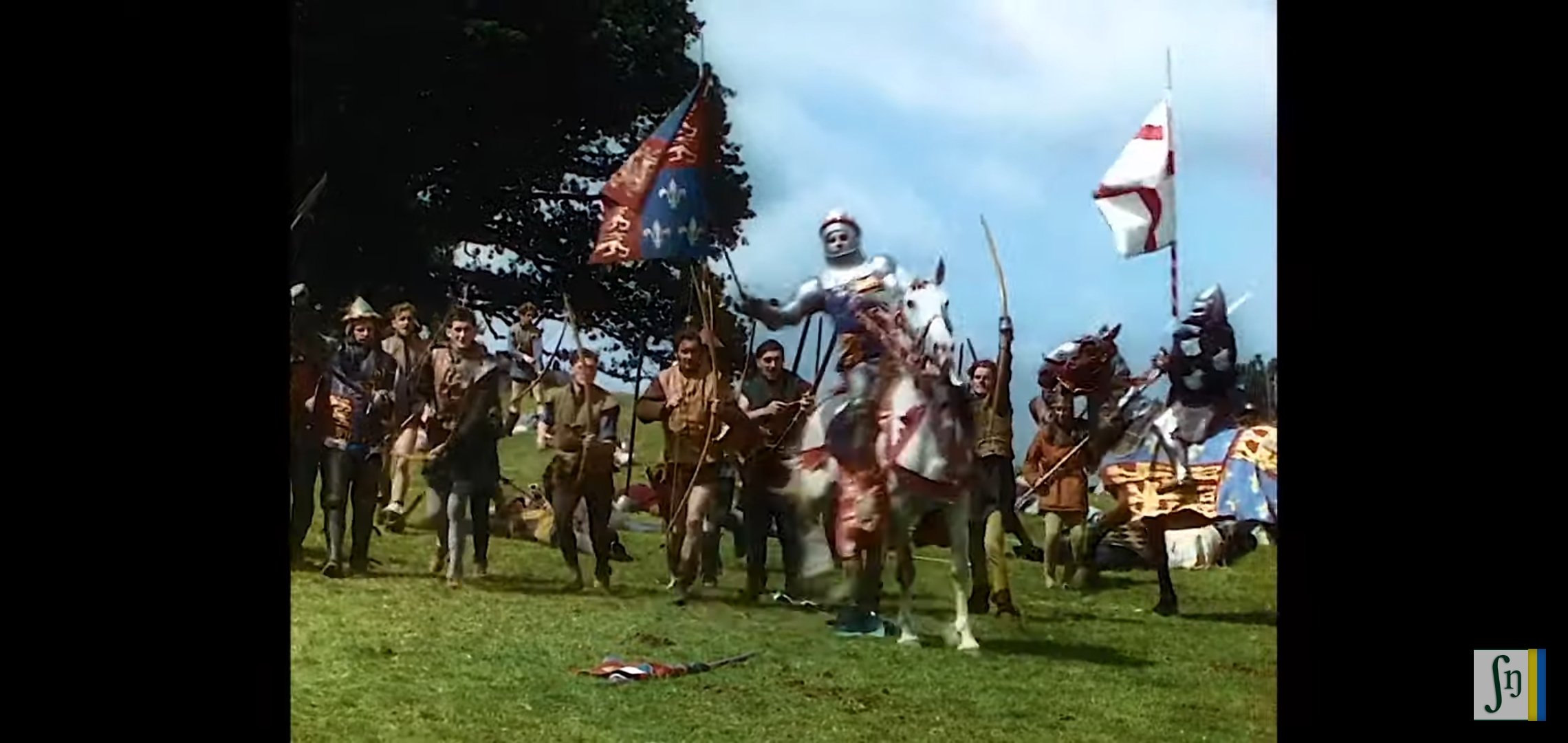
Comparison between Olivier’s 1944 version, and Branaugh’s 1989 movie portrayals of the Battle of Agincourt.
The most striking difference between the two films is how both directors stage The Battle of Agincourt. Olivier’s is a sun-kissed charge on white horses. Branaugh’s is a grimy, mud-stained mess, overcast with a fog of moral ambiguity. Even though the English win, they are meant to question whether or not they have been fighting for a worthy cause. Even after the King proclaims victory for God and country, and the music swells with the gorgeous notes of Non Nobis Dominine (composed and sung by Patrick Doyle), Branaugh has a long tracking shot of all the bodies slain on both sides in the battle. This is the film in a nutshell- a wonderfully acted, exciting, cleverly done thrill ride, that still pulls back and shows the inherently grim and destructive nature of war, that defiles all it touches.
Non Nobis scene from Henry V
The Plot Of the Play
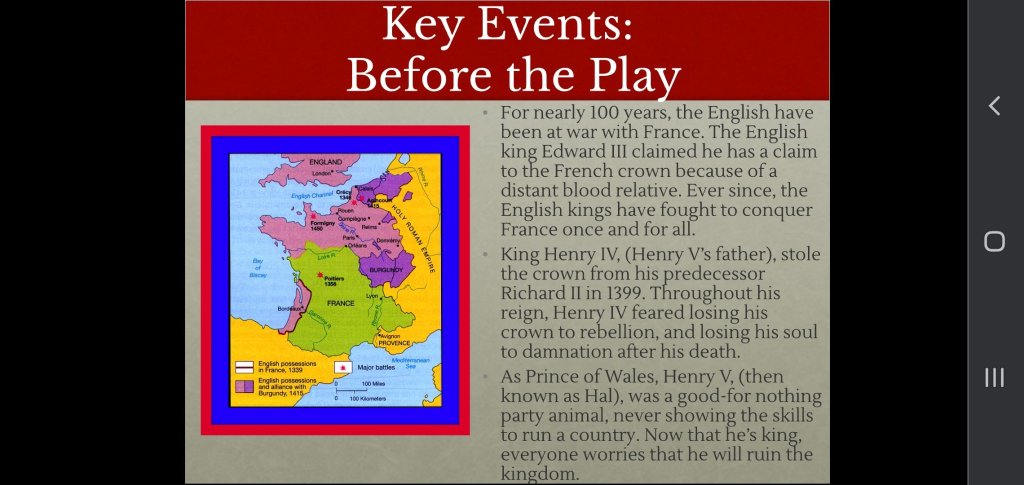
King Henry takes the throne in 1413 after his father dies. No one thinks he will run the country effectively.
The Dauphin (the French Prince) provokes Henry into declaring war with France, (thus allowing him to claim the right of his predecessor, King Edward III).
Henry fends off the French at Harfleur, despite the fact that they are shooting at him with cannons.
Henry’s army starts getting sick. Henry decides to start heading back to Calais
The French raise a massive army and it marches towards Agincourt. Mountjoy the French herald warns Henry he will be annihilated and urges him to pay the French a ransom if he is captured. Henry refuses and marches his troops to battle the French at Agincourt.
Against all odds, Henry’s army defeats the French at Agincourt, with only about 30 English deaths, and over 10,000 French.
Henry and the French King make peace, and the play ends on a joyous celebration of peace and matrimony, though the Chorus also reminds us that once King Henry dies, his son will lose France and England will be torn apart by civil war.
Historical Context
My Favorite Moments
I love Branaugh’s performance and his take on the Battle of Agincourt, but I’d be remiss if I didn’t mention some of the other performances and moments of the play.
Armed Ultimatum: In this wonderful scene, we first see the overconfidence of the French, especially the hot-tempered Dauphin (Michael Maloney), who admits that he deliberately goaded Henry into declaring war because he wishes to personally fight with King Henry. His father the King, (played by Paul Scoffield) is a timid, melancholic individual, (historians often called him Charles the Mad), and he seems like an easily manipulated monarch, ripe for conquest by King Henry. We then see the imposing figure of the Duke of Exeter (Brian Blessed), who comes in full plate armor to warn the French that though the French outnumber the English, the English are a hardy and powerful people, and that King Henry will not stop until all of France is his.
Supporting Cast
Branaugh mainly casts his movies out of his Renaissance Acting theater troupe, which is why in almost all his movies you see familiar faces like Brian Blessed, Derek Jakobi, Richard Clifford, Richard Easton Michael Maloney, Paul Gregory and Geraldine McEwan. As someone who’s seen all of Branaugh’s Shakespeare movies, I get the curious sensation that I know these people, trust them, and find myself rooting for them since I saw them in other roles. Maybe Branaugh hoped his longtime viewers would be concerned for the lives of his “Band of Brothers.”
Welcome additions include Micheil Williams as Williams, as well as his wife Judy Dench as Mistress Quickly. These actors are just as home playing grubby common English peasants as they are playing kings and queens.
Emma Thompson and Geraldine McEwan sparkle onscreen as the French Princess Katherine and her maid Alice. The first time I saw the film, their French was so good, I didn’t believe it was really them! Likewise, the awkward wooing scene between Thompson and Branaugh (who were married at the time) is so charming, you forget all the violence and atrocities that happened on both sides earlier, and giddily enjoy their romantic banter.
My Reaction
In short, Branaugh created, at least for now, the definitive Henry V for our times. It is a world where war is not glamorous and rarely just. Where common men die and rich men survive, though they must carry their sins on their back,( just as Branaugh carries the young boy played by Christian Bale). Yet it is also a story about the power of great leaders overcoming adversity, caring for their subjects, and doing the best they can to bring peace and stability to their people.
Bonus: Here’s an interview with Branaugh about the process of creating the film:
Branaugh in an interview with Bobbie Wygant in 1989.
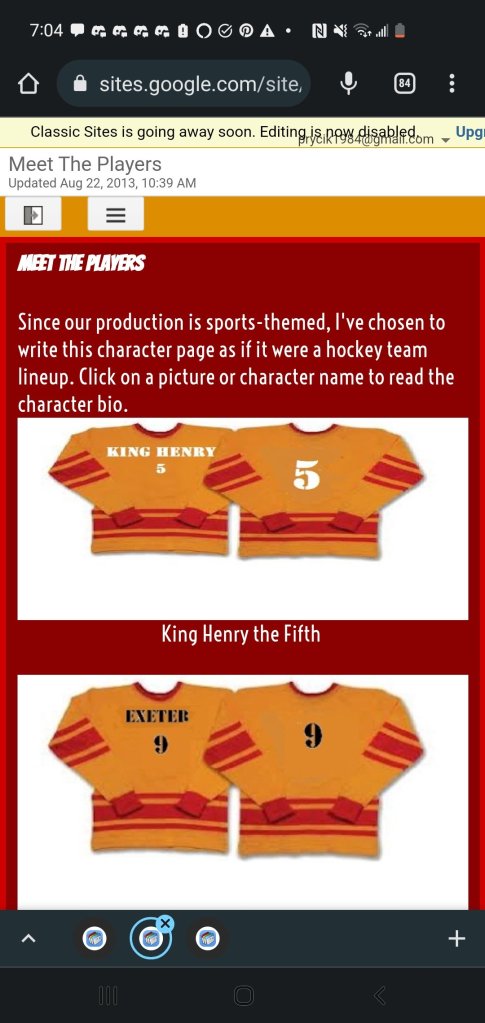
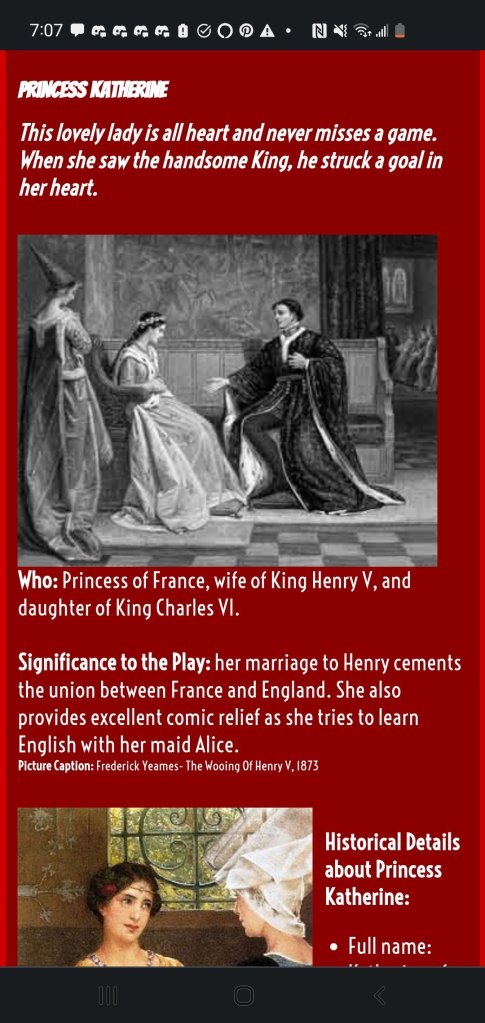
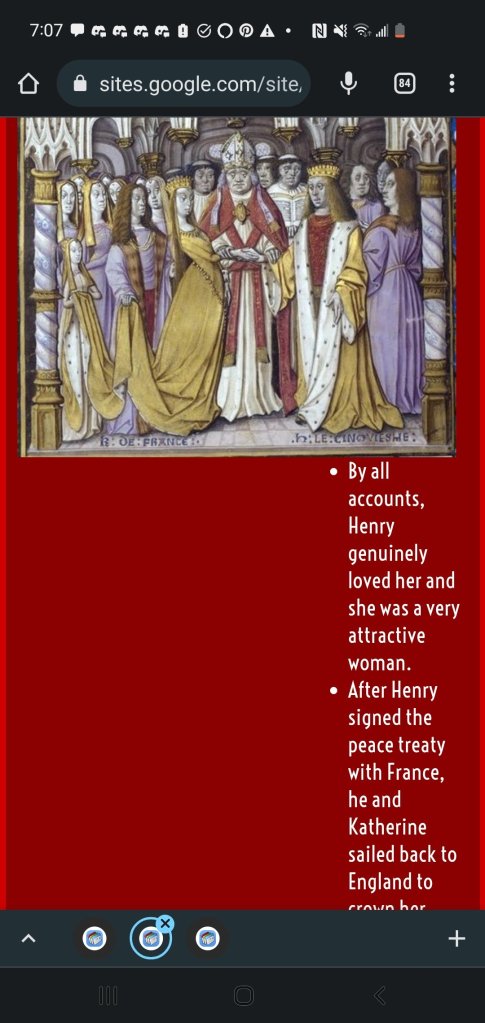
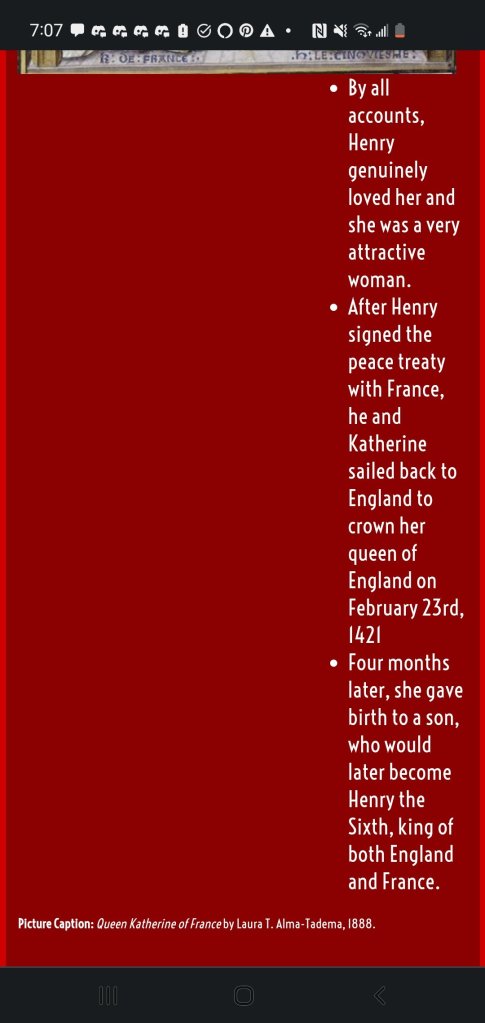
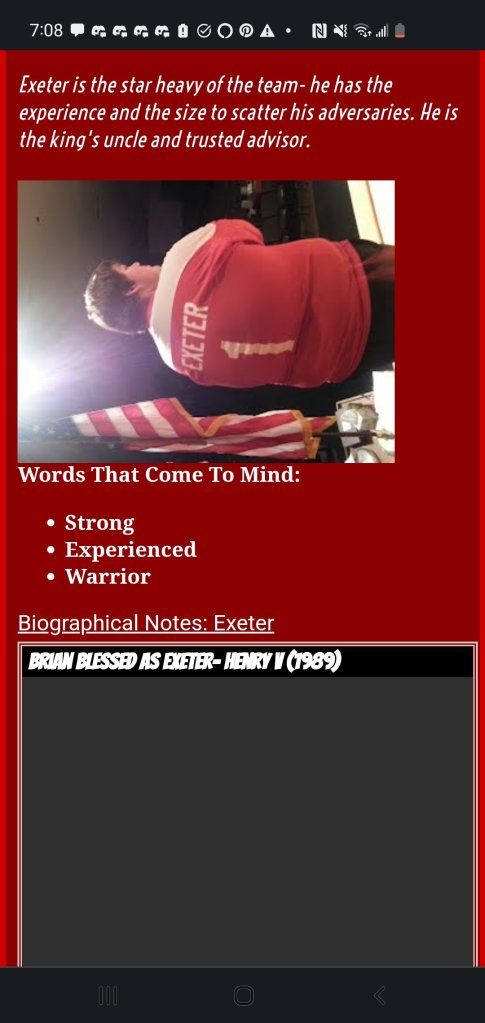
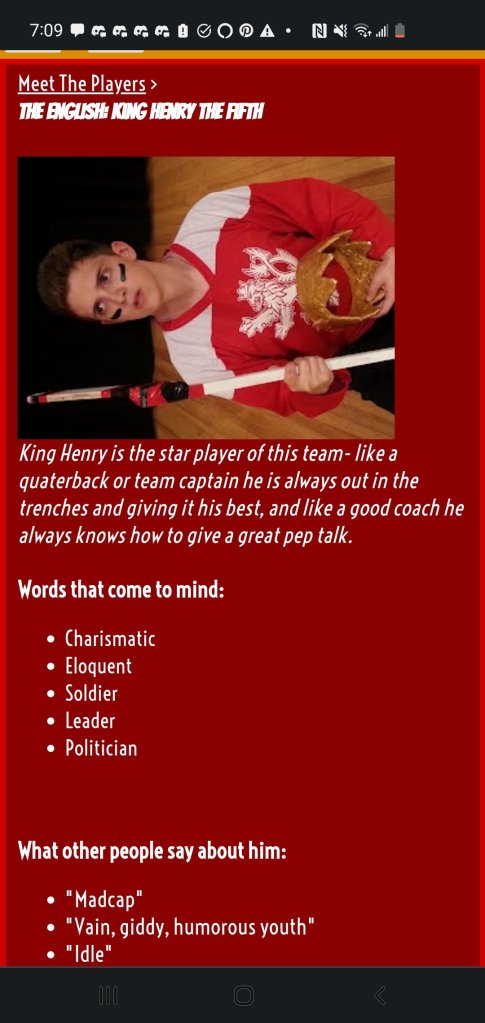
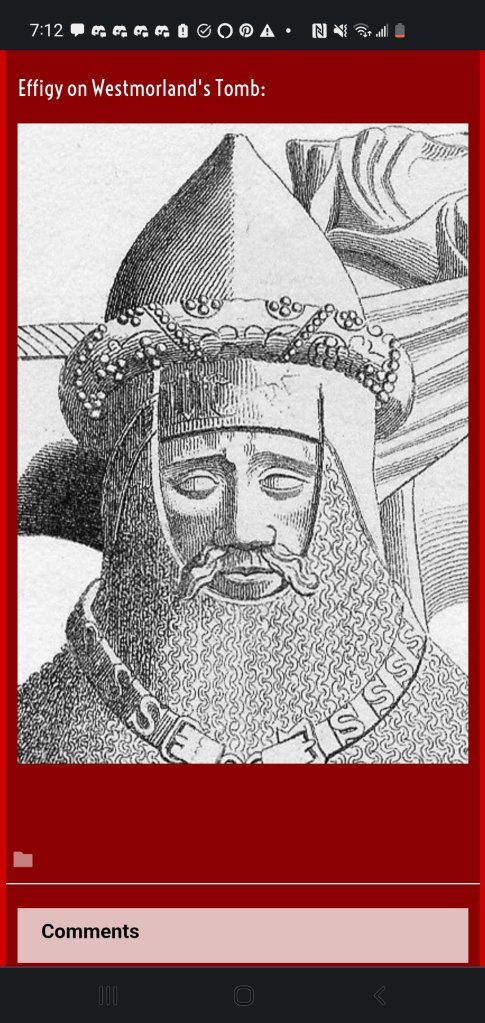
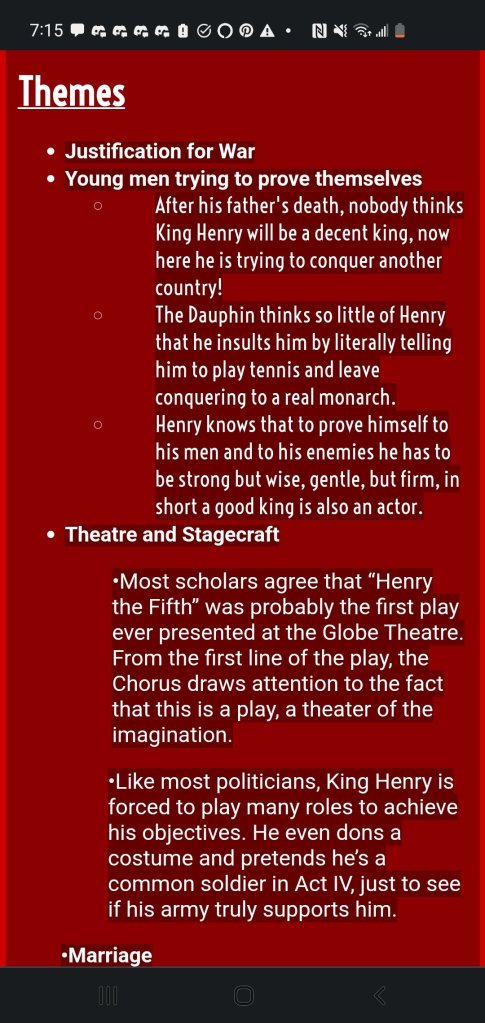
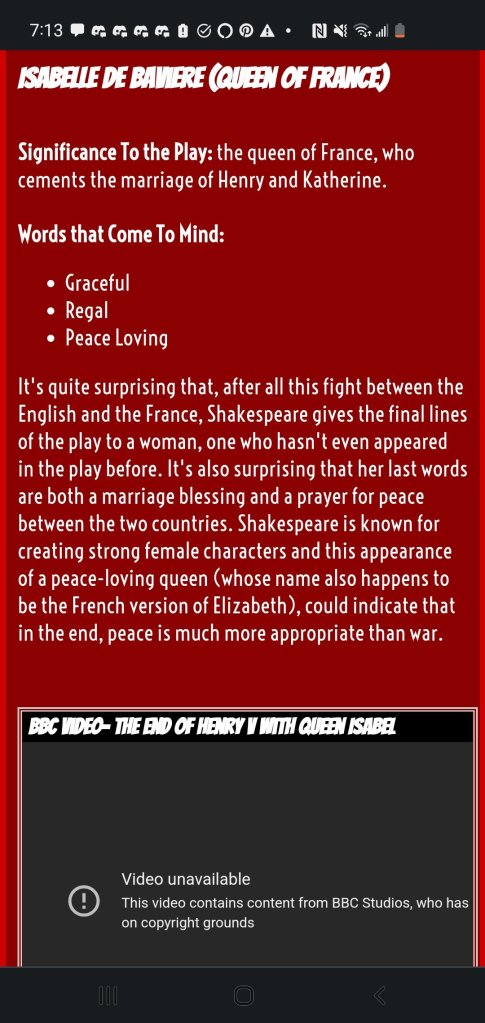
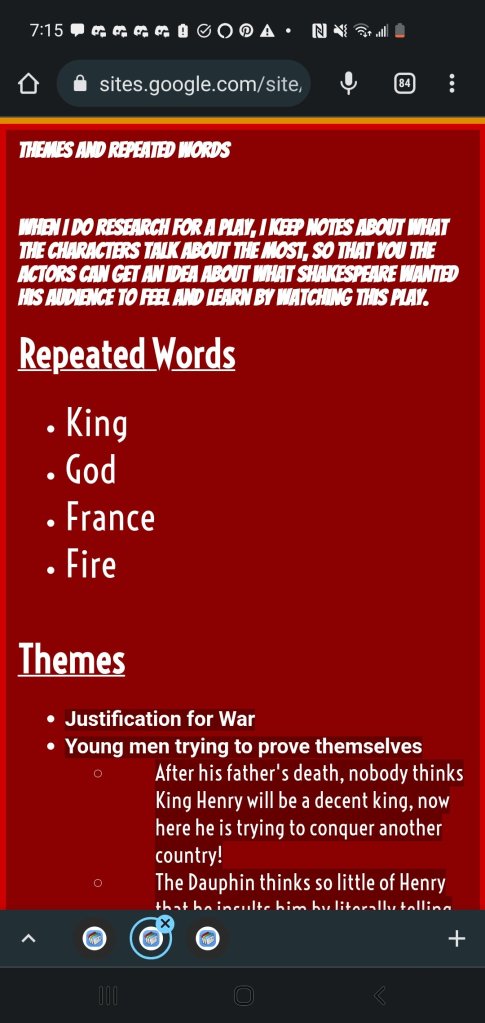
In 2012, I was text coach for a high school production of “Henry the Fifth,” directed by Sara Landis. Below is a series of photos, videos, and character information about the production, and the play itself.