On August 25th, 2026, the world lost an incredible performer. Notable for his film roles in Clue,Muppet Treasuren Island It, the Rocky Horror Picture Show, as well as countless voice-over roles in film, TV, and audiobooks, Mr Curry had an incredible onstage personality and a versitile, commanding voice that landed itself well to slimy villains, megalomaniacal tyrants, and delicate fey characters.
If you’re familiar with his work, you probably won’t be surprised that Curry was a classically trained stage actor with equally impressive credits onstage. He originated the role of Mozart in Amedeus, played Gilbert and Sullivan’s Pirate King to great acclaim, and won numerous theater awards on both sides of the Atlantic.
For a while, I’ve wanted to honor this great performer, but I couldn’t find a way to do it on this platform. That is until I found this:
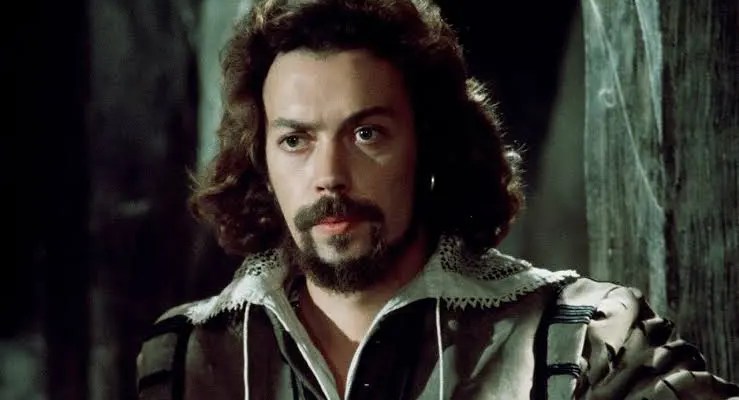
This was a 1978 British TV mini series about the life of Shakespeare, with Mr Curry as the title character. This is why I will provide a series of summaries of these episodes and discuss how Mr Curry adds to the mythos and historiography of Shakespeare
Episode 1: Dead Shepherd
We’re all dying, for poets it just comes earlier
Christopher Marlowe
We begin with Hamnet, no not Shakespeare’s ill-fated son, but Hamnet Sadler, Shakespeare’s friend from Stratford (and his son’s godfather). The fish-out-of water from Stratford has come to pass along messages (and a roasted chicken) to Shakespeare. As he delivers it, Shakespeare boasts about his success as an actor, performing in Doctor Faustus and winning the acclaim of both his fellow actors and the public. The problem is… this tale is a lie; Shakespeare is just a horse valet for the theater, while the brash and flamboyant Christopher Marlowe (Ian McShane), is the greatest playwright in London…for now.
The title refers to how Shakespeare falls in love with theater at first sight, and how London immediately falls in love with his talents.
Tim Curry on Playing Shakespeare
He’s a kind of ambitious country boy who learns fast” driven by the intense, fast-paced survival energy of the Elizabethan age.
Curry’s Shakespeare is full of energy and bravado. This is best demonstrated in the scene where he gets out of a cart full of straw, jumps up to the rafters of the Globe, jumps onstage, recites Faustus, and sings! He has a fiery energy and you can see how this Shakespeare is a man of ambitious energy, yet still possessed of an idealistic soul.
Ian McShane by contrast, is witty and world-weary with a dangerous edge. He has fallen out of love with theater; more interested in court intrigue. This leads him to spy for the Queen like an Elizabethan James Bond. Unlike Bond however, Marlowe is brutally murdered by agents from his own government! While all the London theater mourns his loss, his death also sets the stage for Shakespeare’s meteoric rise as the premier poet of England.
I’ll continue reviewing each subsequent episode on this page and also my podcast. Stay tuned!
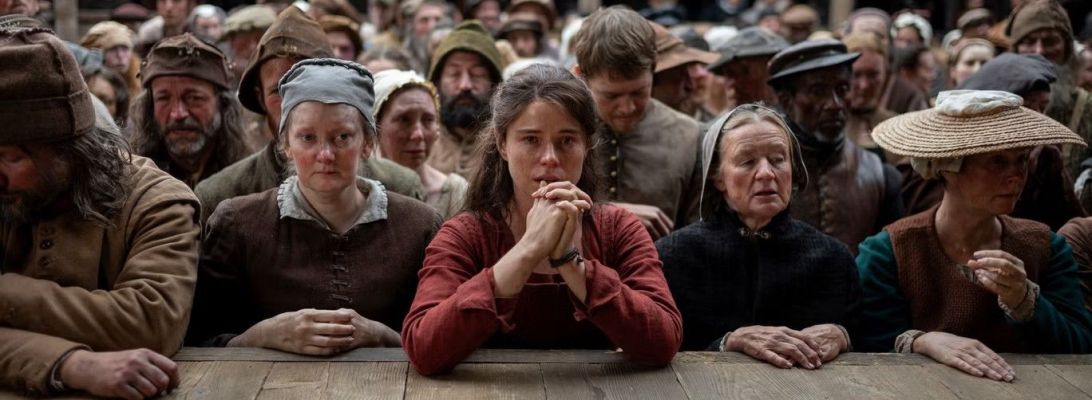
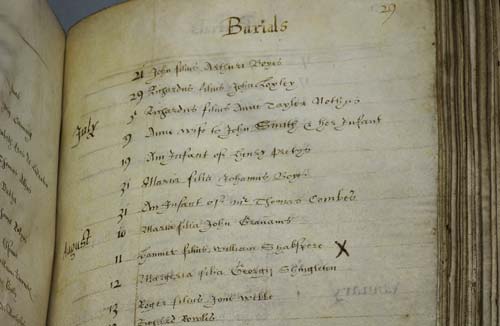
On August 11th, 1596, Shakespeare lost his only son.
Burial Registry of Hamnet Shakespeare
This very day, 2026. I sat down to watch the movie about him. I will compile my thoughts into a complete review in a while, but for now, let’s just say, it was absolutely incredible.
Biography of Hamnet
Just like his famous father, we know very little about the life of Hamnet Shakespeare. Since infant mortality rates were high, we don’t know his exact birthday, only that he was baptized on February 2nd, 1582. Like most 11-year old boys, he probably had started going to school at the King Edward Grammer School, the same as his father. This means he spent long hours away from his parents learning to read and write in Latin and Greek. When he was home, he lived with his mother, his two sisters, and his grandparents in the house of Henley Street.
O’Farrel portrays the boy Hamnet as sensitive and somewhat lonely. The movie captures this
1589-1596
Never mind what I know. You must go.” She pushes at his chest, putting air and space between them, feeling his arms slide off her, disentangling them. His face is crumpled, tense, uncertain. She smiles at him, drawing in breath. “I won’t say goodbye,” she says, keeping her voice steady. “Neither will I.” “I won’t watch you walk away.” “I’ll walk backwards,” he says, backing away, “so I can keep you in my sights.” “All the way to London?” “If I have to.” She laughs. “You’ll fall into a ditch. You’ll crash into a cart.” “So be it.
O’Farrell
The novel portrays Anne Shakespeare realizing that her husband is stifled and unhappy living with his parents in Stratford, and so she suggests to his father that he go to London to ‘expand the family business,’ though in reality, she wants him to go to make his fortune and find more fulfilling work.
A glover will only ever want the skin, the surface, the outer layer. Everything else is useless, an inconvenience, an unnecessary mess. She thinks of the private cruelty behind something as beautiful and perfect as a glove.
Hamnet
The Plague
He wants to tear down the sky, he wants to rip every blossom from that tree, he wishes to take a burning branch and drive that pink-clad girl and her nag over a cliff, just to be rid of them, to clear them all out of his way. So many miles, so much road stands between him and his child, and so few hours left.
Hamnet
In the book, the plague germs that infect Judith and later Hamnet, lie inside a box with some glass beads that the Shakespeare’s ordered from Italy to decorate a pair of fancy gloves.
Hamnet’s Death
He can feel Death in the room, hovering in the shadows, over there beside the door, head averted, but watching all the same, always watching. It is waiting, biding its time. It will slide forward on skinless feet, with breath of damp ashes, to take her, to clasp her in its cold embrace, and he, Hamnet, will not be able to wrest her free.
Hamnet
In the novel, Hamnet somehow takes the plague away from his sister and dies in her place. Though it is hardly conclusive, I do find it interesting that Shakespeare stopped writing comedies about twins for another four years after Hamnet’s death, until he wrote Twelfth Night, which unlike earlier comedies like The Comedy of Errors, has a pair of twins mourning each other’s apparent death. They seem to share one soul, and one tries to resurrect the other, like Viola mourning her brother by, (in a sense), becoming her brother.
What should I do in Ilyria? My brother is in Elysium
Viola- “Twelfth Night”, Act I, Scene ii.
ELIZABETHAN FUNERAL CUSTOMS
In the book, Anne makes a winding sheet for her son. This was a cloth of linen or wool that was wrapped around dead bodies, since at the time, coffins were re-used. This must have been a somber and deeply upsetting activity for Anne.
The act of making a winding sheet was a sort of sad family responsibility, a way of ensuring that your loved ones die with dignity, and Anne clearly takes the task of making one very seriously.
The Aftermath Of Hamnet’s Death (Spoilers)
The Women of Hamnet
The most unique thing about this novel is how it shows the interdependence of women in Elizabethan society. Since Shakespeare spends most of the novel away from Anne, her support system mostly comes from Will’s mother Mary, as well as Anne’s daughters, her sister, and all the other women of the town. Nowadays we do most of our socialization online and barely know our own neighbors, but in the 1590s, especially for women, community was a way of building strength where women got through things like childbirth, loss, the managing of households, and many other difficulties through their relationships with other women. This video below shows the kinds of home remedies that women would share and later write down during the Tudor period:
Other Mysteries Solved
Once Hamnet dies, Will buys her a new house, New Place so she isn’t forced to live with his parents and no longer has to live in the house where her son died. But Will’s success comes with a price- he still has to leave for London. he offers to move them there but Agnes won’t hear of it. This solves the riddle of why Shakespeare commuted between town and country for his entire career- she knows the plague that took her son literally came from London, and she won’t risk losing her daughteras well. She probably also sees London like another woman that took her husband away as well, and therefore refuses to look it in the face.
It is no matter,” she pants, as they struggle there, beside the guzzling swine. “I know. You are caught by that place, like a hooked fish.” “What place? You mean London?” “No, the place in your head. I saw it once, a long time ago, a whole country in there, a landscape. You have gone to that place and it is now more real to you than anywhere else. Nothing can keep you from it. Not even the death of your own child. I see this,” she says to him, as he binds her wrists together with one of his hands, reaching down for the bag at his feet with the other. “Don’t think I don’t.”
O’Farrell, Hamnet.
The Shakespeares’ Marriage after Hamnet
The ugly truth that O’Farrell highlights in Hamnet is that it must have been very hard for the Shakespeares to endure Hamnet’s death, especially since Will was probably not there when it happened, and probably didn’t stay around long after burying his son.
Hamnet and Shakespeare
Raising the Dead
Hamlet, here, on this stage, is two people, the young man, alive, and the father, dead. He is both alive and dead. Her husband has brought him back to life, in the only way he can. As the ghost talks, she sees that her husband, in writing this, in taking the role of the ghost, has changed places with his son. He has taken his son’s death and made it his own; he has put himself in death’s clutches, resurrecting the boy in his place. “O horrible! O horrible! Most horrible!” murmurs her husband’s ghoulish voice, recalling the agony of his death.
O’Farrell, “Hamnet”
References
Journals
Bray, Peter. “Men, loss and spiritual emergency: Shakespeare, the death of Hamnet and the making of Hamlet.” Journal of Men, Masculinities and Spirituality, vol. 2, no. 2, June 2008, pp. 95+. Gale Literature Resource Center, link.gale.com/apps/doc/A189052376/LitRC?u=pl9286&sid=bookmark-LitRC&xid=ea79f235. Accessed 20 Apr. 2023.
Period Documents
Document-specific information Creator: Holy Trinity Church, Stratford-upon-Avon Title: Parish Register of Holy Trinity Church, Stratford-upon-Avon Date: 1558-1776 Repository: The Shakespeare Birthplace Trust, Stratford-upon-Avon, UK Call number and opening: DR243/1: Baptismal register, fol. 22v View online bibliographic record
Two Gentlemen Of Verona is probably Shakespeare’s first comedy, maybe even his first play. A lot of the plot devices and themes Shakespeare explores in later plays were first set down in Two Gentlemen.
The Plot
Two Gentlemen Of Verona is about two best friends, Valentine and Proteus, who start out as young men yearning for adventure and to seek their fortune in Milan. As you might have guessed from his name, Valentine finds love instead of fortune, and so does his friend Proteus. What makes the play unique is that Proteus falls in love with Valentine’s betrothed Silvia, forsaking his faithful sweetheart Julia. The two virtuous girls support each other and fight to stop Proteus from sabotaging their relationships. In the end though, Valentine forgives Proteus and Valentine takes him back, which makes the play a little controversial for modern audiences.
The Concept
What happens in Milan, stays in Milan! Shakespeare’s gleefully silly comedy is set in 1940’s Las Vegas, where love and friendship are put to the test. A charming adventure navigating a love triangle, betrayal, disguises, an escape into the forest, and a dog. -Quoted from the official program.
The play is set in 1940s Las Vegas, which works well with the theme of young, impressionable men trying to make their fortunes in a place where luck can change in an instant. Proteus goes from a lover and loyal friend to a liar and traitor. Meanwhile, Valentine’s luck changes from a favored gentleman at court, to a banished vagabond.
The performances had the air of a 1940s classic comedy, with a lot of stylized slapstick and over-the top characters. It echoes the work of Laurel and Hardy or Abbot and Costello, which I feel was a wise choice- even if the audience couldn’t understand a word of the dialogue, they could still be entertained by the actors’ over-the top comedy.
Free Shakespeare In the Park
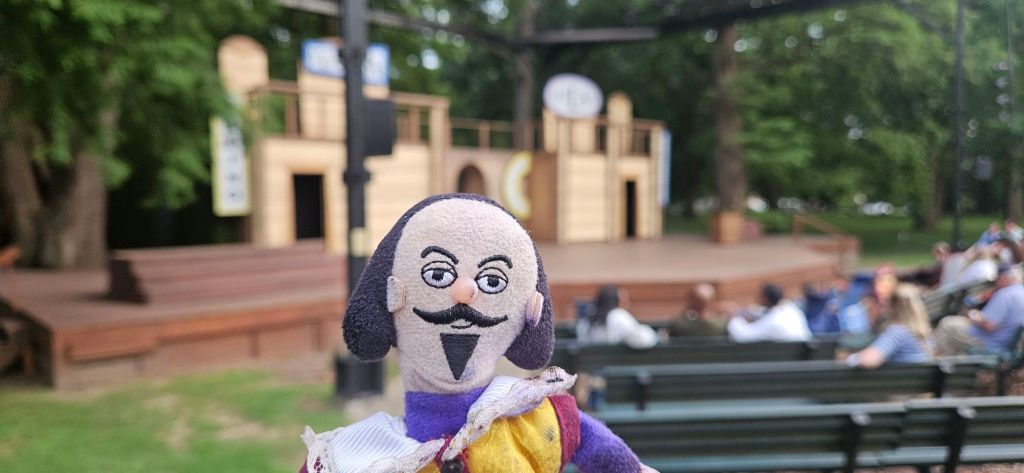
The set of “Two Gentlemen Of Verona”
This was my first KY Shakespeare production, and I enjoyed the overall vibe a lot. According to kyShakespeare.com, the company is enjoying its 66th year of being the longest running, non-ticketed Shakespeare festival in the United States. The company prides itself as being accessible, inclusive, anti-racist, and generally committed to welcoming all people to enjoy their shows. From what I saw from my seat on a balmy day in Olmstead Park, Kentucky Shakespeare is doing a great job accomplishing its goals. I saw people from many different walks of life come by, laugh at the jokes, clap and cheer, and have a good time.
The Cast
The cast has a great grasp of Shakespeare’s language and comic timing. Like I said before, the cast performed as if they were in a 1940s classic comedy, which helps sells some of the absurd moments in the play. That said, across the board, the actors also knew how to deliver the serious moments of the play with grace and pathos.
Crystian Wiltshire (Proteus)
As you read earlier, Proteus’ character commits some very questionable actions- betraying his friend and forsaking his girlfriend for no good reason. In order to make the audience feel even a tiny amount of sympathy for him, would require an actor with charm, and a great sense of humor. Fortunately, Chrystian Wiltshire brings both of these qualities, as well as a great deal of skill. His Proteus is basically a young, naive fool, who never considers the long term consequences of his actions. One gets the impression that by the end of the play, he will learn his lesson and become a better man. Still, I heard a few people booing when Valentine forgave him at the end of the play. It’s a testament to Mr Wiltshire’s performance that he inspired such an emotional response from the audience.
Justin Jackson (Valentine) Obviously, anyproduction of Two Gentlemen depends upon the actors playing the title characters. The play’s central tension is Proteus changing from a lover to a liar and Valentine from a libertine to a lover. Fortunately, Mr Jackson is a great foil for Mr Wiltshire as Proteus. He excellently portrays the change of Valentines heart. At the beginning of the play he is charming and devil-may-care. If you haven’t read the play before, you might expect that Valentinemight be the real liar and cheat from the way he teases Proteus about his lovesick behavior. But, once he meets Silvia, Valentine is utterly sincere and his smarmy looks are replaced by a rock solid earnestness. Jackson expertly conveys this startling metamorphosis with his powerful voice, imposing height, and dashing good looks. I wish I could see him in a tragic role like Hamlet or Brutus, but with his masterful portrayal of Valentine, I’m sure he’ll have many more memorable performances in the future.
Kate Drury (Julia) I hope I have established by now that the main idea Shakespeare conveys in this play is that people transform when they fall in love, and neither the exterior nor interior man (or woman), resembles who they were. This is especially true with Julia, who starts out as a simpering, childish girl who tears up Proteus’s love letter to prove that she is not in love, but then agonizes over her cruel destruction of the note. This speech could seem cloyingly sweet or annoying in the wrong hands, but Miss Drury pulls it off to great effect.
Even more impressive is the transformation Julia undergoes in Act 2, where she disguises herself as a man and faces many dangers to find and confront Proteus. She even has the heart to befriend Silvia, the woman Proteus forsakes her for. The childish Julia from Act I might not understand that Proteus is unfaithful, not the virtuous Silvia, but Kate effortlessly shows Julia’s wisdom to see that Silvia never entices Proteus, and scolds his behavior on behalf of Julia herself. It’s rare to see an Elizabethan playwright portray a female friendship that is mature and genuine, but Shakespeare manages to do so, and the actresses mirror this relationship flawlessly.
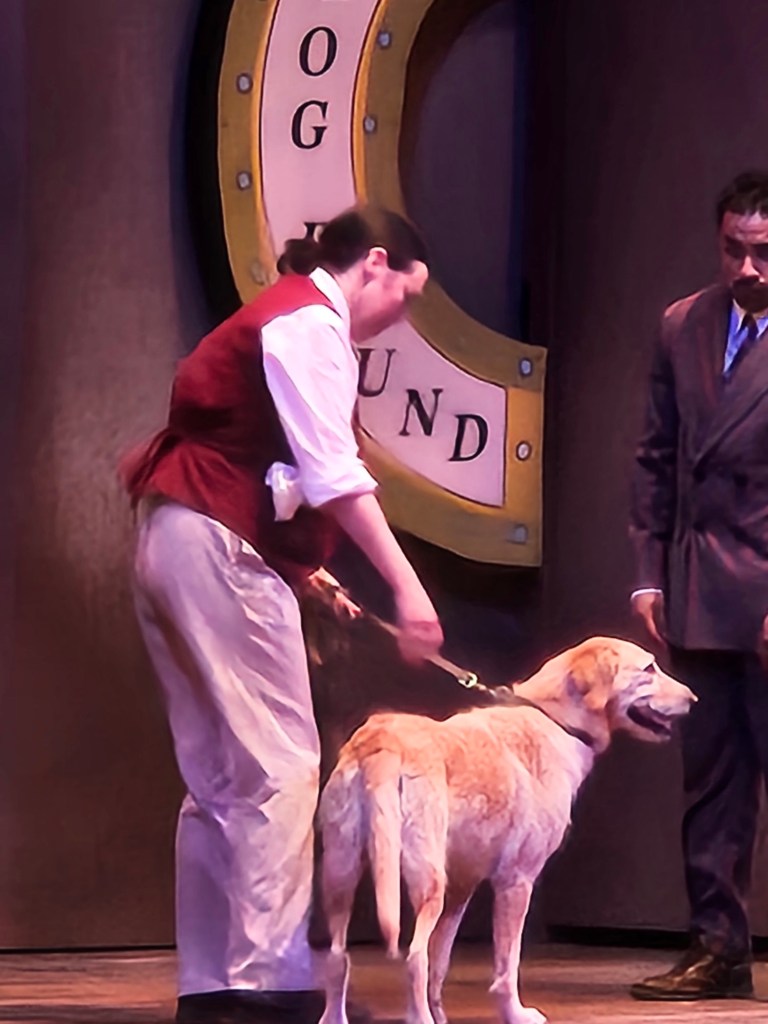
Tilly as CrabbetheDog
For most people in the audience, the true star of the show was Tilly as Crabbe the dog. When my kids and I took our seats, my son’s immediate question was “When is the dog coming?” To be fair, Tilly is very cute and never once breaks character.
Tilly the Golden Retriever as Crabbe 1Tilly the Golden Retriever as Crabbe 2Tilly the Golden Retriever as Crabbe 3
My Reaction
I tried my best to separate my feelings about Two Gentlemen Of Verona from the production. As I mentioned earlier, as Shakespeare’s first comedy, many of his more famous works are actually derived from this one. For instance, we have an Italian hero who visits his beloved by night, whose love is denied and he is banished from Verona, (sound familiar?) We also have a heroine who disguises herself as a boy, (a device which Shakespeare employs at least six times), a comic servant, a maid, pirates, a foppish suitor, and a bit where the heroine secretly obtains her beloved’s ring. As a hardcore Shakespeare fan, seeing these repeated devices and characters was a little tedious after recognizing them from other plays. I also felt that the dialogue should have been edited a little bit more- the play was about 2 1/2 hours which I felt was a little too long. That said, the skill of the actors and thecreativeuse of the setting helped make Two Gentlemen Of Verona an enjoyable experience for all.
In conclusion, I can see why people like this play and I too enjoy it, despite its questionable subtext.
If you like this analysis, you might be interested in signing up for my Outschool Course on Shakespeare’s Comedies. Link down below. Share this class with a friend and you will get $20 USD off! You’ll also get $20 USD when you sign up with your link and take their first class!
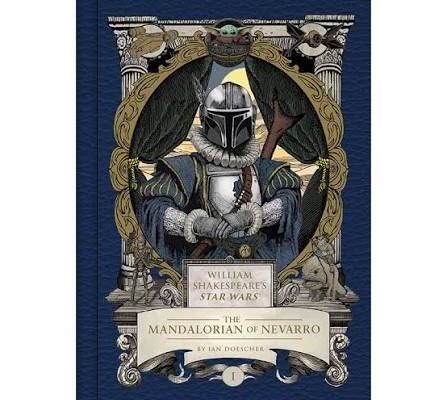
With the upcoming release of The Mandalorian and Grogo, I knew there would be lots of tie-in Star Wars merchandise capitalizing on it. What I didn’t expect, was that, after a six year hiatus, playwright Ian Doescher has once again taken up his quills and lightsabers to dramatize the next installment in the Shakespearean Star Wars cannon, The Mandalorian of Nevarro.
What Is William Shakespeare’s Star Wars?
William Shakespeare’s Star Wars is a series of parody plays written by Ian Doescher that takes the prose screenplays of the Star Wars story and transforms them into Elizabethan verse. Last time, I mentioned how much I loved the cheeky references to Shakespeare and Star Wars, and how Doescher adapts the cinematic quality into Elizabethan drama very well. In my podcast, I also emphasized the way Doescher gives each character verbose Shakespearan language that works very well for radio and theater:
I’ve written reviews about Mr Doescher’s versions of the original trilogy, but I never expected him to cover the Disney Plus shows, bit he proved me wrong, and by all accounts, this edition lives up to its predecessors.
Interview with Ian Doescher about “The Mandalorian of Nevarro”
What We Know
I haven’t gotten a copy yet of the full play, so this will be less of a review and more of a prediction and a fun speculation about how Mr Doescher will handle everyone’s favorite green foster child and Beskar- clad dad.
When your main character is, quite frankly, one of the most non-theatrical Star Wars protagonists in existence, forcing that character to come out of his shell and give him that Shakespearean flair was always going to be a test. – Nate Manning, Star Wars News.net
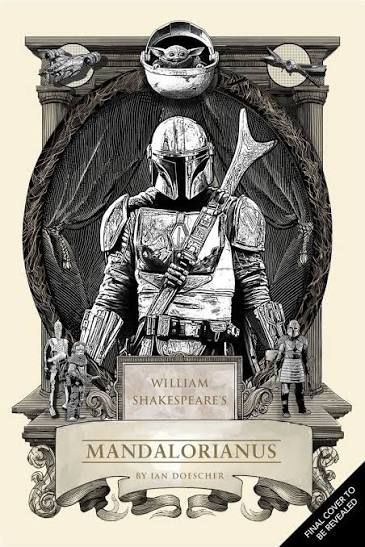
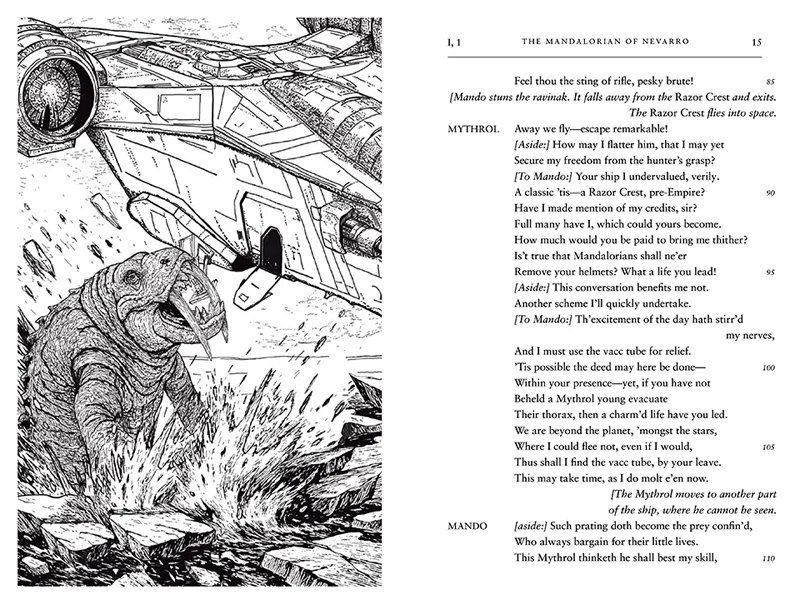
The Mandalorian of Nevarro is a two part series that, like the other William Shakespeare’s Star Wars books, adapts the prose text of episodes 1-4 into Shakespeare’s verse. According to Wookiepedia, the series was originally titled Mandalorius, which is probably a pun on Shakespeare’s play Coriolanus
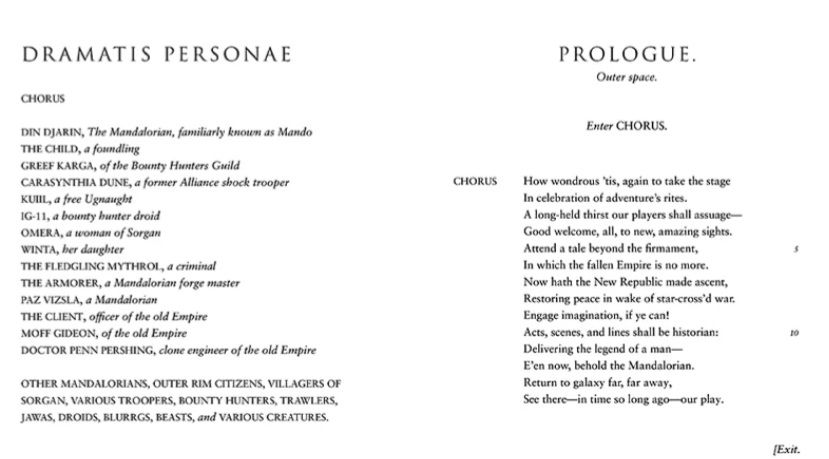
Prologue and Dramatis Personae for “The Mandalorian of Nevarro”
What We Can Guess
One thing I am very curious about is how far Doescher adapted Coriolanus for Mandolorian. As you might have read in my review for Coriolanus, one reason why the play isn’t as popular as some of Shakespeare’s other tragedies is simply that its hero is not very compelling. Coriolanus is not as articulate or wise as Hamlet, nor does his journey form a cohesive arc like Macbeth or Othello. He seems to flit between loving Rome and hating it, between peace and war, with little agency or understanding of what is happening to him, and even less insight. He is mainly a maddeningly inscrutable man, almost as if he was wearing a mask.
With all this in mind, I can honestly understand why Doescher might choose the Roman general Caius Martius Coriolanus as a model for Jinn Jaran, (assuming that the final play does in fact do so). Like Coriolanus, Mando is a lone warrior in a fragile republic, who goes from planet to planet with nothing but his ship, and his rigid code of behavior to guide him. Therefore it makes total sense that Doescher would use Coriolanus as a model to emulate when adapting The Mandalorian.
With all due respect to Shakespeare, what makes Mando a more interesting character from Coriolanus us that he has a compelling Arc. He starts as a solitary bounty hunter to a surrogate father who finds meaning when he adopts a child. It’s like his helmet and armor are metaphors for the uncaring, uncompromising person he was. Over the course of the series, as Mando becomes a better man and a better father, he is forced to remove his armor and form real relationships.
What I Hope
I hope this adaptation uses Shakespeare’s ability to conjure images and feelings when telling Mando’s story, but only time will tell.
With summer break approaching, why not give your kids the gift of learning Shakespeare in a low-key, no-pressure scenario? I have classes on Shakespeare’s life, Romeo and Juliet, and my celebrated Stage Combat class! Sign up now for all the fun on Outschool.com!
Shakespeare and Star Wars
Class Description: Using self-paced online activities, your child(ren) will compare the plot and characters of Star Wars to Shakespeare’s plays. We will also discuss Shakespeare’s writing by looking at “William Shakespeare’s Star Wars” by Ian Doescher.
Romeo and Juliet Murder Mystery
Course Description: A flexible schedule class that teaches kids the plot and characters of “Romeo and Juliet,” in the context of a detective story where you solve the mystery of the young lovers’ deaths.
Course Descriptions
How to Write Like Shakespeare: Learn the basics of iambic pentameter, sonnet form, and Shakespeare’s dramatic structure, and practice writing Shakespearean speeches.
Let me begin with a special shout out to Jesse Buckley, the first Irish woman to win an Oscar for her portrayal of Shakespeare’s wife Anne ‘Agnes’ Hathaway in the movie Hamnet.
I promise I will write a full review soon, but for now here’s a behind the scenes look at the film:
In addition, here’s a link to my post on how Shakespeare depicts Irish culture in his plays
And finally, today is the anniversary of Marcus Brutus’ attempt to win over the Roman crowd, attempting to justify his tyrannicide. Here’s a scene from HBO’s Rome, in which Brutus surrenders to Caesar after the Battle of Pharsellus. In this scene, Caesar is played by Irish actor, Ciarán Hinds.
With awards season in full swing, there has been a lot of controversy over two stories that Shakespeare had a great influence over- Hamnet, based on the novel of the same name, and Guillermo Del Toro’s adaptation of Frankenstein. Despite getting five golden globe nominations, Frankenstein went home with a hand emptier than the monster floating off on an iceberg. Meanwhile, Hamnet took the best actress and best picture award, and is poised for an Oscar nomination.
I’ll review Hamnet at a later date. What I want to do now is discuss the influence Shakespeare and other Renaissance writers had on the classic 1818 novel, and how well Del Toro hints at the story’s Renaissance roots.I would argue that, although rooted in the 10th century Romantic world, Frankenstein has many Shakespearean and Early Modern influences, notably Dr Faustus by Christopher Marlowe, and The Tempest by Shakespeare
In 1818, a young woman named Mary Wolstonecraft, heard from her friend, a Swiss doctor, about a prominent experiment called galvanism and was faced with the terrifying prospect that man might someday be able to resurrect the dead, (a feat that had only successfully been done by God). When Mary Shelley wrote the novel Frankenstein she redefined the Faustus story and made it about Man not taking responsibility for the consequences of his actions, and also a warning to progress for its own sake without compassion without reason without wisdom. As we shall see, Shelly was a trailblazer in turning the Faustian wizard into the mad scientist.
The Morality Tale
Faustus is one of the oldest and most quintessential German stories. A morality tale medieval in its origins, it also is loosely based on a real person- a real scholar named Doctor John foustis and this story was influential on forming German cultural identity. The story itself has inspired countless authors, some German and some merely influenced by German culture and it’s very interesting to trace the way that it’s being used And how the the trope of the Faustian bargain has influenced Germany America and and England other Anglo sects and countries so the story of Faustus is Medieval in origin but he became extremely popular when English playwright Christopher Marlowe Shakespeare’s contemporary and rival wrote it down in his play of Dr. Faustus
What’s interesting about this interpretation is that you could easily see it as Faustus Rejects from the beginning the notion of divine grace he believes that he cannot that he is either unwilling or unable to believe that he is beloved by God and therefore he turns to satanic poworse it’s somewhat ambiguous why he does this one possible interpretation is that Faustus might actually be a that faustis like Marlow might be a possible gay man and is convinced that he is an abomination under the Lord and therefore he might as well indulge in satanic activities.
Whatever the reason the play does a great job of showing the struggle of Faustus as he is presented several times with the chance to repent, and actively refuses it every single time.
“Tutors Not So Careful”
In Marlowe’s version, Faustus studies at the University of vittenburg in Germany, whicb also boasts other notable allumni- Prince Hamlet which Shakespeare would later write in his own play Hamlet Prince of Denmark. The prince broods over whether the creature he has seen return from the dead is actually a devil, sent to destroy him.
Shelley admits that a lot of her as a source for that her sources for Shakespeare her sources for Frankenstein included Shakespeare in The Tempest. Though Doctor Frankenstein his book is not a is Swiss not German he is educated at the University of english stat in Germany where he learns organic chemistry and acquires the ambition to do with the alchemists and conjurors of faustis day failed to do namely create the elixir of life.
“Graves, at my command, Hath waked their sleepers”
One big trope in Frankenstein is the danger of man crossing over into God’s domain- that from the beginning of time there has been a knowledge that God deliberately kept from humankind. In Frankenstein, this takes the form of scientific knowledge, but in Shakespeare, it is magic. In Macbeth, the title character is tempted by witches to know his destiny and is punished severely for it. Remember that when Shakespeare wrote the play, King James presided over hundreds of witch hunts and wrote a book on how to identify witches.
In The Tempest, Shakespeare gives us a more ambiguous look at magic where the magician Prospero has the power to create storms, conjure up spirits, and like Frankenstein, raise the dead:
 I have bedimm'd
The noontide sun, call'd forth the mutinous winds,
And 'twixt the green sea and the azured vault
Set roaring war: to the dread rattling thunder2065
Have I given fire and rifted Jove's stout oak
With his own bolt; the strong-based promontory
Have I made shake and by the spurs pluck'd up
The pine and cedar: graves at my command
Have waked their sleepers, oped, and let 'em forth
By my so potent art. The Tempest, Act V, Scene i.
Even though Prospero is the protagonist and he faces no consequences for his magic, for some reason he chooses to abandon it. It’s almost as if Shakespeare was anticipating Frankenstein by having a proto mad scientist character give up his art before it is too late:
 But this rough magic
I here abjure, and, when I have required
Some heavenly music, which even now I do,
To work mine end upon their senses that
This airy charm is for, I'll break my staff,2075
Bury it certain fathoms in the earth,
And deeper than did ever plummet sound
I'll drown my book.
Prospero, Act V, Scene i.
“This thing of Darkness”
“You taught me language, and my profit in’t is I know how to curse!”
“Cursed, cursed creator! Why did I live? Why, in that instant, did I not extinguish the spark of existence which you had so wantonly bestowed? I know not; despair had not yet taken possession of me; my feelings were those of rage and revenge. I could with pleasure have destroyed the cottage and its inhabitants and have glutted myself with their shrieks and misery.
Shelly, Chapter 16
If you’ve never read the book Frankenstein, you might be surprised to learn that unlike Boris Karloff’s grunting silent monster, in the novel the Monster is actually intelligent and well-spoken. One thing I enjoyed about Guillermo Del Toro’s version is that the Monster gets time to tell his tale. As we in the audience get to know him, the notion of who is the true Monster and who is truly human becomes as murky as the subterranean lair the doctor chains his creation within. He engages in intellectual debates with his creator and demands to know why Frankenstein chose to abandon him.
My abhorrence of this fiend cannot be conceived. When I thought of him I gnashed my teeth, my eyes became inflamed, and I ardently wished to extinguish that life which I had so thoughtlessly bestowed. When I reflected on his crimes and malice, my hatred and revenge burst all bounds of moderation.
With the holidays approaching, why not give your kids the gift of learning Shakespeare in a low-key, no-pressure scenario? I have classes on Shakespeare’s life, Romeo and Juliet, and my celebrated Stage Combat class! Sign up now for all the fun on Outschool.com!
Shakespeare and Star Wars
Class Description: Using self-paced online activities, your child(ren) will compare the plot and characters of Star Wars to Shakespeare’s plays. We will also discuss Shakespeare’s writing by looking at “William Shakespeare’s Star Wars” by Ian Doescher.
Romeo and Juliet Murder Mystery
Course Description: A flexible schedule class that teaches kids the plot and characters of “Romeo and Juliet,” in the context of a detective story where you solve the mystery of the young lovers’ deaths.
Course Descriptions
How to Write Like Shakespeare: Learn the basics of iambic pentameter, sonnet form, and Shakespeare’s dramatic structure, and practice writing Shakespearean speeches.