Locrine is an Elizabethan play, first published in 1595, whose author is, sadly, lost to history. The title page says the play was “Newly set forth, corrected, and overseen, by W.S.” As you might expect, scholars and theater practitioners have eagerly tried to prove that this means the play was written, (or at least revised), by Shakespeare. So far, no proof has been found.
“Historical” Context
Notes on the Trojan War
The play is a tragedy based on the founding of Britain. Over 2,000 years ago, a father and his three sons flee the destroyed Troy, tame the wild landscape of England, and become its first kings. After his father’s death, the eldest son, Locrine, must defend his land from barbarian invaders with the help of his brothers.
Semi-mythical characters
Brutus of Troy
Brutus is the patriarch of the Britons who, according to legend, was descended from Aeneas the sole survivor of the infamous Trojan War. Brutus preserves the legacy of Troy by founding a new city in Britain, Troynovant (New Troy), and establishing his three sons as heirs to his kingdom.
Camber, Brutus’ young son
Albanact
Albanact is the great warrior whom Brutus puts in charge of Scotland. He has his hands full defending Britain against the Scithian invaders.
Camber
Camber is given Cambria, (modern day Wales)
Illustration of King Locrine from the Genealogical Chronicle of the Kings of England to Edward IV (c. 1461)
Locrine is Brutus’ eldest son, and as such he is crowned king over all Britain. According to legend, Locrine changes the capital of England from New Troy, to Locrindom, which then became London.
The Plot
Title page illustration from Locrine, 1709
The prologue
Prologue describes Prometheus’ punishment as a tragedy, and his gift is a blessing. Prometheus also warns that Zeus will be overthrow if he succumbs to his desire for Thetis
Ate the Goddess of revenge introduces the play, making it very clear that this is the fall of the royal house of Brutus.
As the play continues, we see Brutus die, leaving his kingdom to his children
4. Humber is humbled- the villainous emperor Humber tries to conquer Britain. Many battles and many tears ensure
Locrine is conquered- without giving too much away, Locrine is defeated in battle by his former wife, Gwendoline. It’s possible that, since the play was written in the last few years of the Elizabethan era, that the writer of Locrine chose Gwendolyn to be a stand in for Queen Elizabeth herself.
Gwendoline, legendary Queen regent of Britain.
A Senecan Tragedy
Locrine probably isn’t a Shakespearean play- it’s characters communicate mainly in operatic speeches that are full of passionate feelings. Plays like this are called Senecan Tragedies, based on the ancient Roman playwright Seneca.
As I mentioned in my podcast, these speeches are fun to give, but it’s a challenge to deliver them in a way that connects with an audience.
Humber’s monologue from Locrine
Dumb Shows
To illustrate key moments of the play, each act begins with a dumb show, a short pantomime which usually involves some kind of animal. For instance, when Humber defeats Brutus’ son Albanact, there is a dumb show where a crocodile kills a fish, echoing how Humber (who carries a crocodile on his shield), deceived and murdered Albanact.
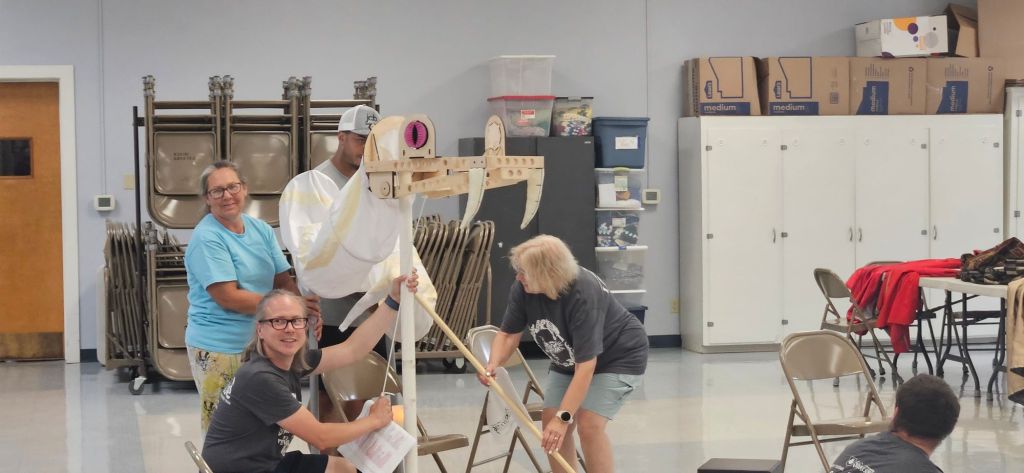
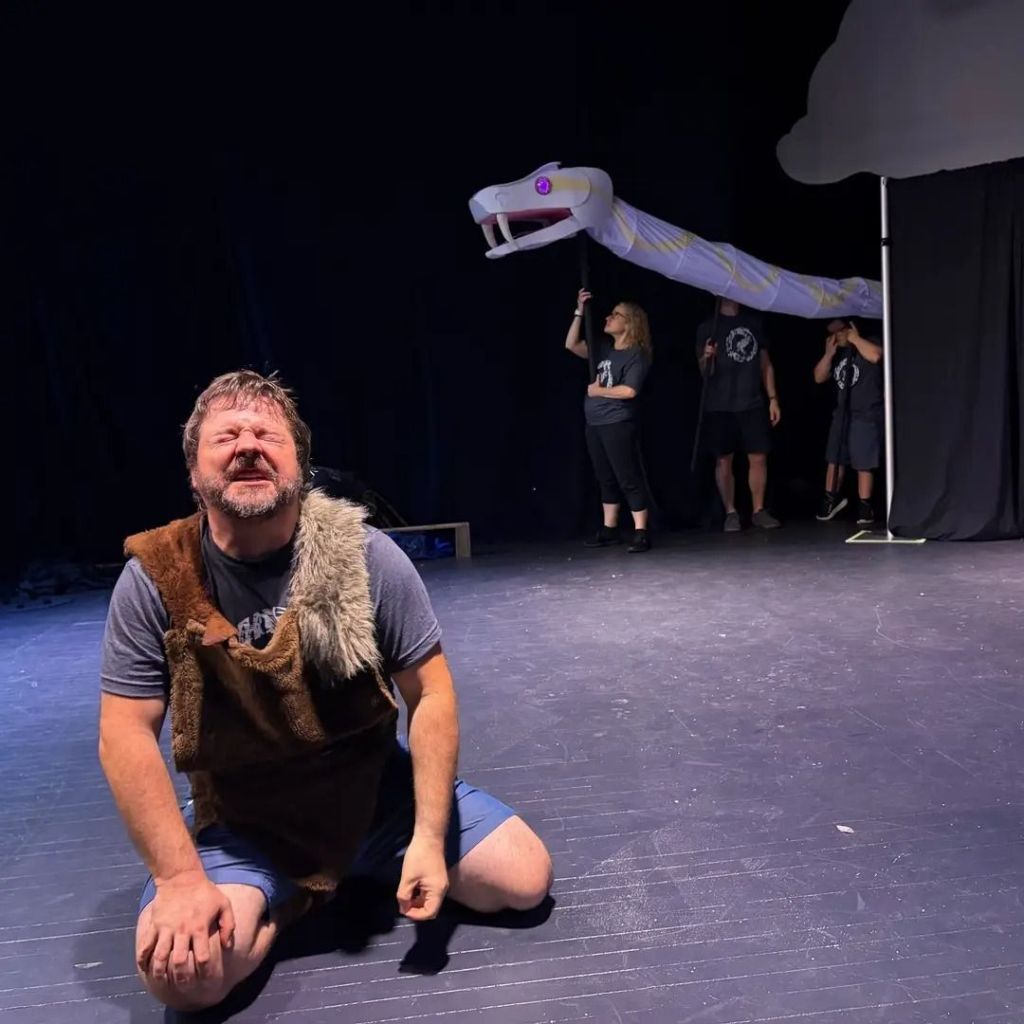
Our version of Locrine chooses to use puppets instead of real animals, most notably crows and vipers. The Mexican folktales that we intertwine with the text of Locrine mention a beautiful serpent named Kwinim Tsan, which represents the power of nature.
Our team works on the great serpent puppet
Our Interpretation
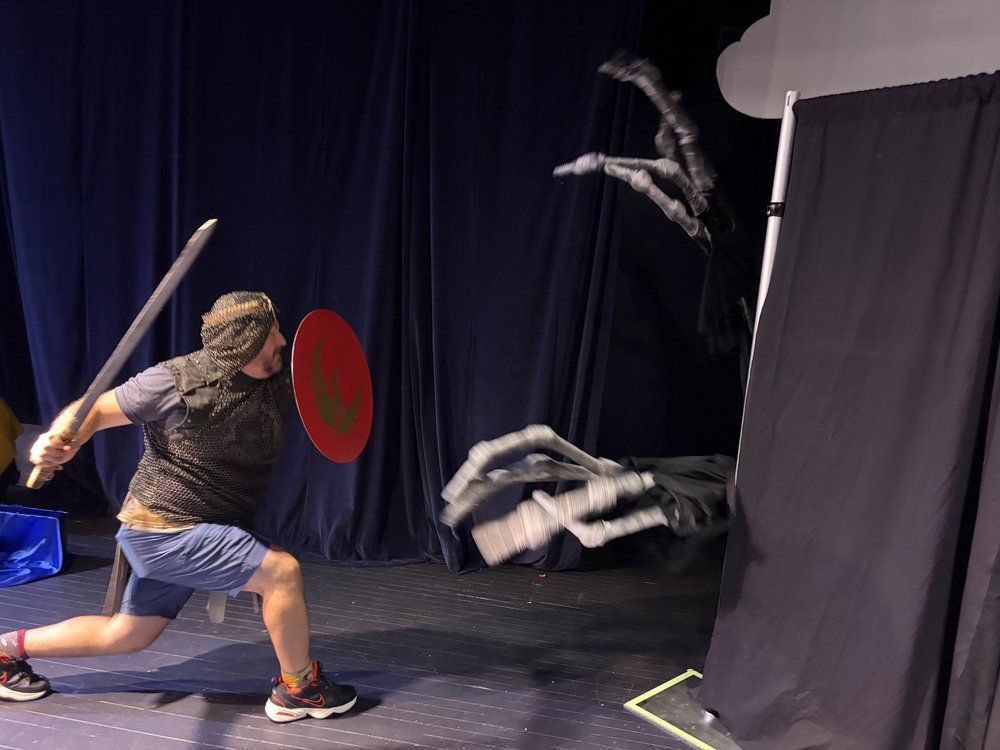
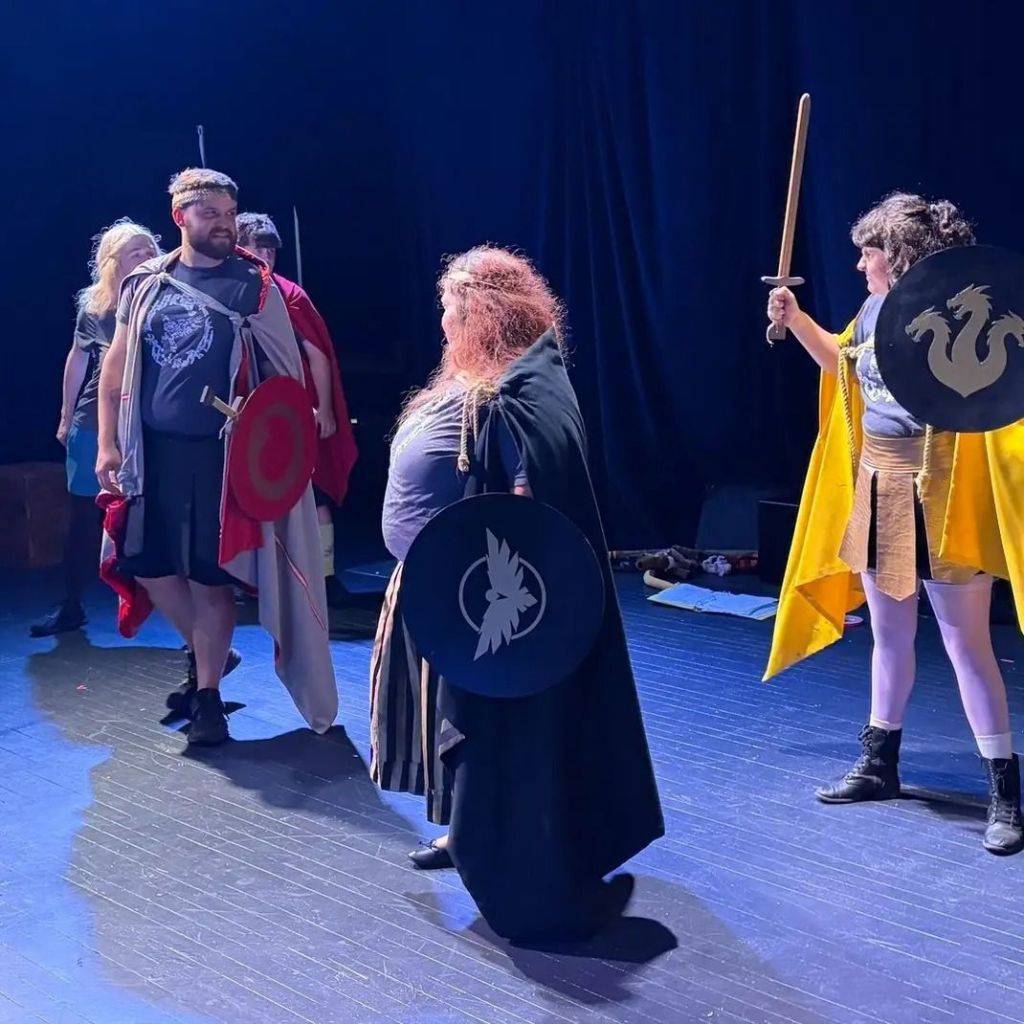
Humber is humbled in the wilderness Gwendoline rallies the troopsBrutus fights the giant Gogmagog Gwendolyn confronts LocrineA massive battle between Locrine’s forces and Gwendolyn’sThe indigenous story of how the crow became black.Cast photo
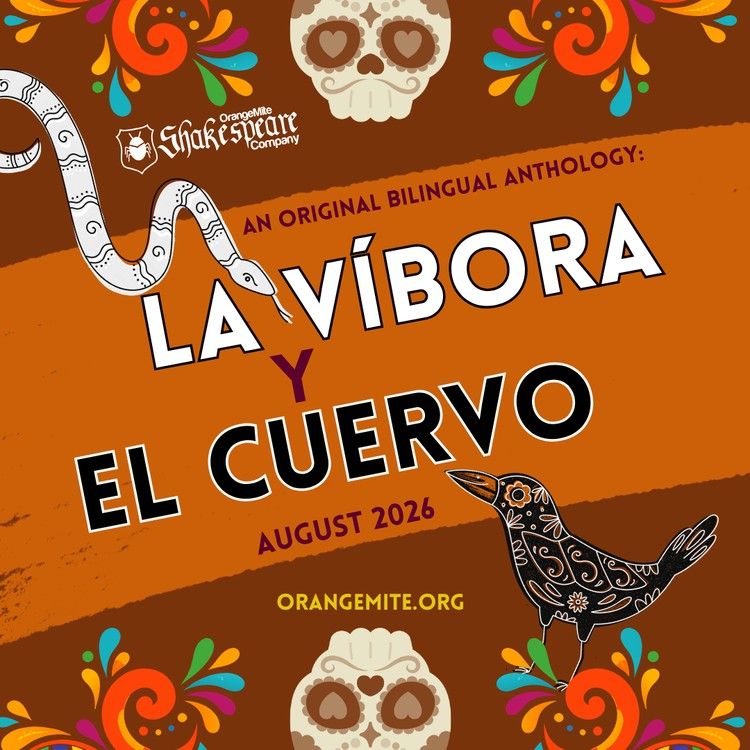
Our production, Víbora y cuervo: Locrine and Other Tales, pairs this origin myth with other origin myths to explore their power and purpose in our world. Orangemite.org
Poster for Orange Mite’s 2026 production of Locrine and Other Tales
Well, there you go, Hope you enjoyed this overview of the play Locrine. If you like this review, you might like to see the show itself. Click here to purchase tickets:
Two Gentlemen Of Verona is probably Shakespeare’s first comedy, maybe even his first play. A lot of the plot devices and themes Shakespeare explores in later plays were first set down in Two Gentlemen.
The Plot
Two Gentlemen Of Verona is about two best friends, Valentine and Proteus, who start out as young men yearning for adventure and to seek their fortune in Milan. As you might have guessed from his name, Valentine finds love instead of fortune, and so does his friend Proteus. What makes the play unique is that Proteus falls in love with Valentine’s betrothed Silvia, forsaking his faithful sweetheart Julia. The two virtuous girls support each other and fight to stop Proteus from sabotaging their relationships. In the end though, Valentine forgives Proteus and Valentine takes him back, which makes the play a little controversial for modern audiences.
The Concept
What happens in Milan, stays in Milan! Shakespeare’s gleefully silly comedy is set in 1940’s Las Vegas, where love and friendship are put to the test. A charming adventure navigating a love triangle, betrayal, disguises, an escape into the forest, and a dog. -Quoted from the official program.
The play is set in 1940s Las Vegas, which works well with the theme of young, impressionable men trying to make their fortunes in a place where luck can change in an instant. Proteus goes from a lover and loyal friend to a liar and traitor. Meanwhile, Valentine’s luck changes from a favored gentleman at court, to a banished vagabond.
The performances had the air of a 1940s classic comedy, with a lot of stylized slapstick and over-the top characters. It echoes the work of Laurel and Hardy or Abbot and Costello, which I feel was a wise choice- even if the audience couldn’t understand a word of the dialogue, they could still be entertained by the actors’ over-the top comedy.
Free Shakespeare In the Park
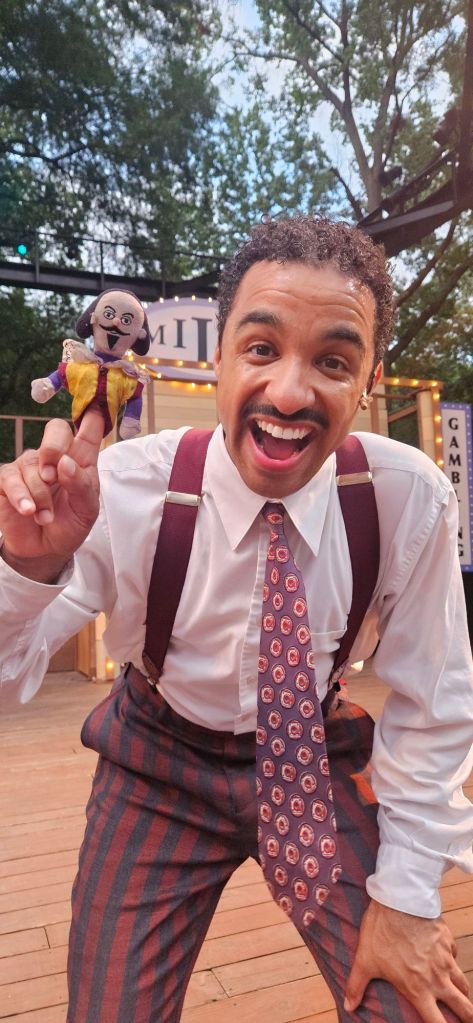
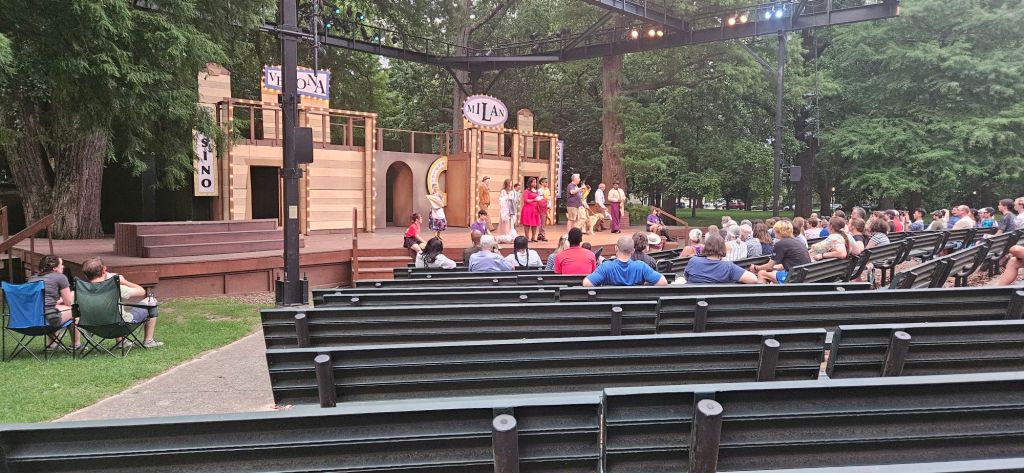
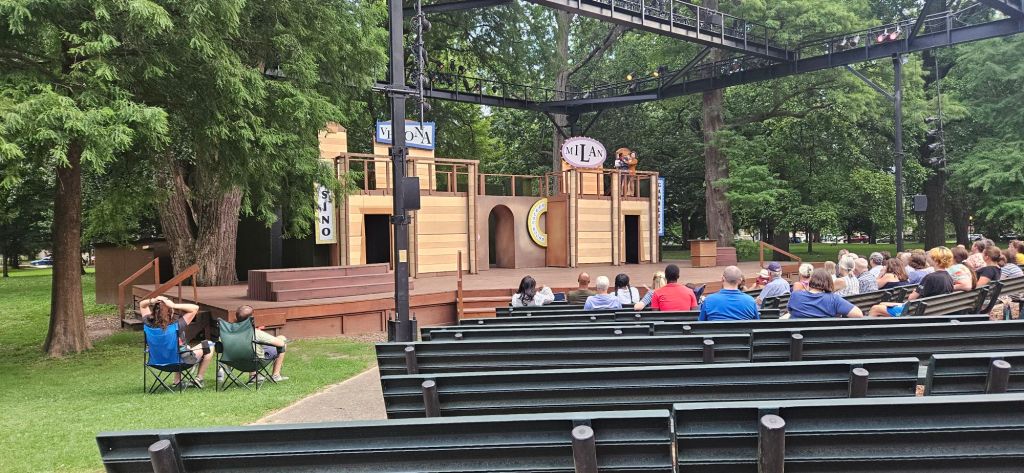
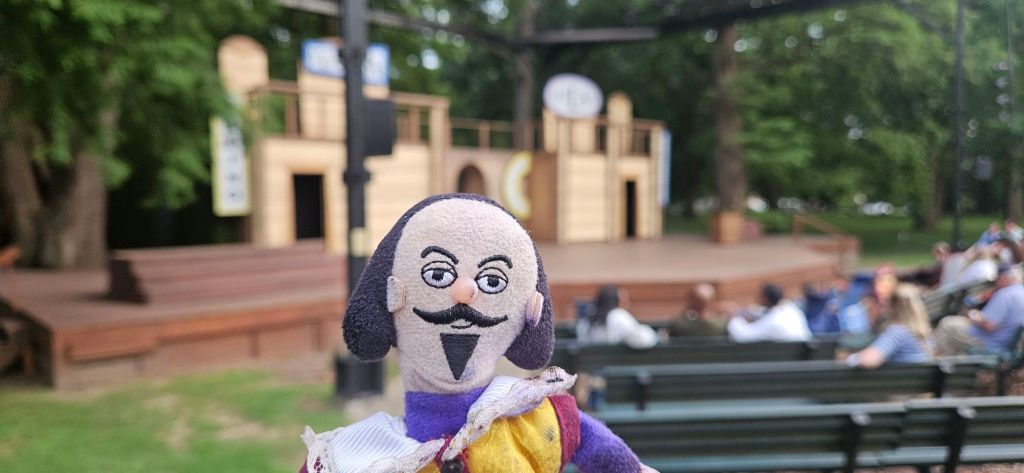
The set of “Two Gentlemen Of Verona”
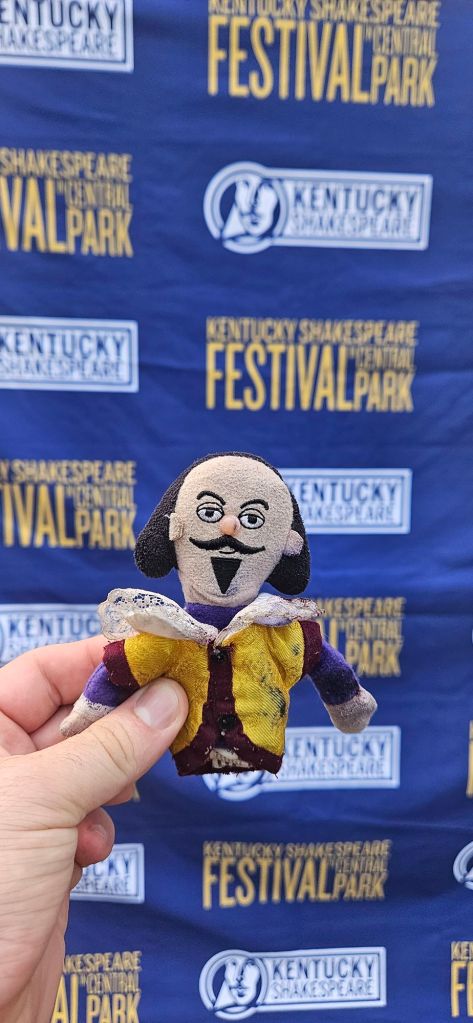
This was my first KY Shakespeare production, and I enjoyed the overall vibe a lot. According to kyShakespeare.com, the company is enjoying its 66th year of being the longest running, non-ticketed Shakespeare festival in the United States. The company prides itself as being accessible, inclusive, anti-racist, and generally committed to welcoming all people to enjoy their shows. From what I saw from my seat on a balmy day in Olmstead Park, Kentucky Shakespeare is doing a great job accomplishing its goals. I saw people from many different walks of life come by, laugh at the jokes, clap and cheer, and have a good time.
The Cast
The cast has a great grasp of Shakespeare’s language and comic timing. Like I said before, the cast performed as if they were in a 1940s classic comedy, which helps sells some of the absurd moments in the play. That said, across the board, the actors also knew how to deliver the serious moments of the play with grace and pathos.
Crystian Wiltshire (Proteus)
As you read earlier, Proteus’ character commits some very questionable actions- betraying his friend and forsaking his girlfriend for no good reason. In order to make the audience feel even a tiny amount of sympathy for him, would require an actor with charm, and a great sense of humor. Fortunately, Chrystian Wiltshire brings both of these qualities, as well as a great deal of skill. His Proteus is basically a young, naive fool, who never considers the long term consequences of his actions. One gets the impression that by the end of the play, he will learn his lesson and become a better man. Still, I heard a few people booing when Valentine forgave him at the end of the play. It’s a testament to Mr Wiltshire’s performance that he inspired such an emotional response from the audience.
Justin Jackson (Valentine) Obviously, anyproduction of Two Gentlemen depends upon the actors playing the title characters. The play’s central tension is Proteus changing from a lover to a liar and Valentine from a libertine to a lover. Fortunately, Mr Jackson is a great foil for Mr Wiltshire as Proteus. He excellently portrays the change of Valentines heart. At the beginning of the play he is charming and devil-may-care. If you haven’t read the play before, you might expect that Valentinemight be the real liar and cheat from the way he teases Proteus about his lovesick behavior. But, once he meets Silvia, Valentine is utterly sincere and his smarmy looks are replaced by a rock solid earnestness. Jackson expertly conveys this startling metamorphosis with his powerful voice, imposing height, and dashing good looks. I wish I could see him in a tragic role like Hamlet or Brutus, but with his masterful portrayal of Valentine, I’m sure he’ll have many more memorable performances in the future.
Kate Drury (Julia) I hope I have established by now that the main idea Shakespeare conveys in this play is that people transform when they fall in love, and neither the exterior nor interior man (or woman), resembles who they were. This is especially true with Julia, who starts out as a simpering, childish girl who tears up Proteus’s love letter to prove that she is not in love, but then agonizes over her cruel destruction of the note. This speech could seem cloyingly sweet or annoying in the wrong hands, but Miss Drury pulls it off to great effect.
Even more impressive is the transformation Julia undergoes in Act 2, where she disguises herself as a man and faces many dangers to find and confront Proteus. She even has the heart to befriend Silvia, the woman Proteus forsakes her for. The childish Julia from Act I might not understand that Proteus is unfaithful, not the virtuous Silvia, but Kate effortlessly shows Julia’s wisdom to see that Silvia never entices Proteus, and scolds his behavior on behalf of Julia herself. It’s rare to see an Elizabethan playwright portray a female friendship that is mature and genuine, but Shakespeare manages to do so, and the actresses mirror this relationship flawlessly.
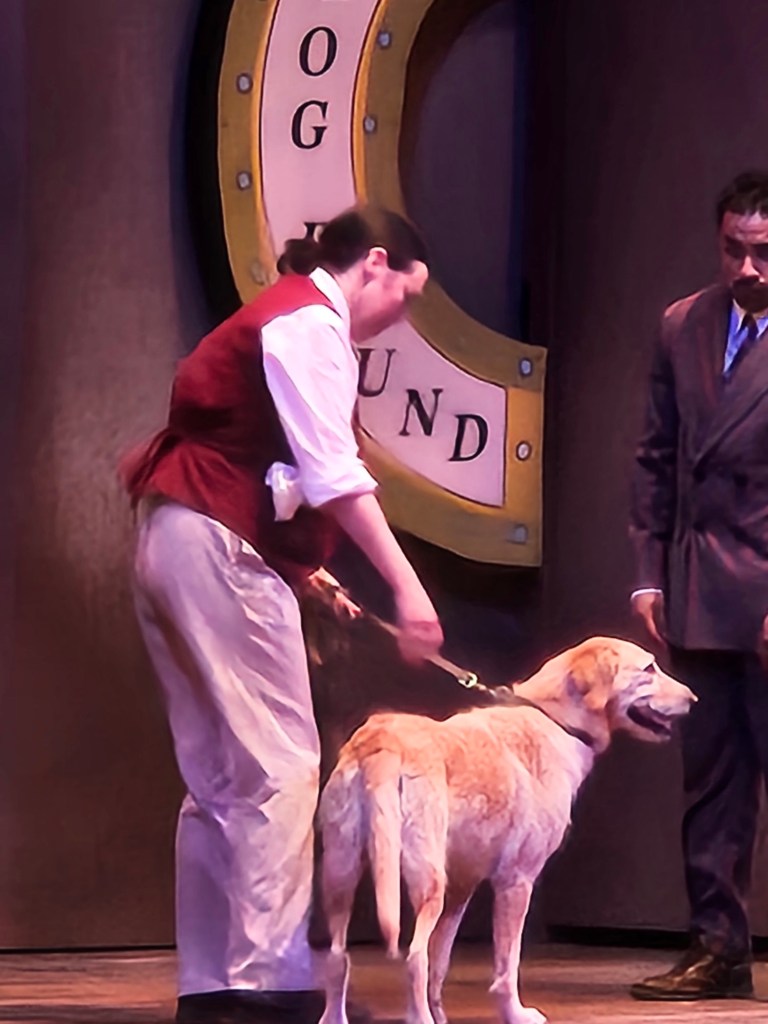
Tilly as CrabbetheDog
For most people in the audience, the true star of the show was Tilly as Crabbe the dog. When my kids and I took our seats, my son’s immediate question was “When is the dog coming?” To be fair, Tilly is very cute and never once breaks character.
Tilly the Golden Retriever as Crabbe 1Tilly the Golden Retriever as Crabbe 2Tilly the Golden Retriever as Crabbe 3
My Reaction
I tried my best to separate my feelings about Two Gentlemen Of Verona from the production. As I mentioned earlier, as Shakespeare’s first comedy, many of his more famous works are actually derived from this one. For instance, we have an Italian hero who visits his beloved by night, whose love is denied and he is banished from Verona, (sound familiar?) We also have a heroine who disguises herself as a boy, (a device which Shakespeare employs at least six times), a comic servant, a maid, pirates, a foppish suitor, and a bit where the heroine secretly obtains her beloved’s ring. As a hardcore Shakespeare fan, seeing these repeated devices and characters was a little tedious after recognizing them from other plays. I also felt that the dialogue should have been edited a little bit more- the play was about 2 1/2 hours which I felt was a little too long. That said, the skill of the actors and thecreativeuse of the setting helped make Two Gentlemen Of Verona an enjoyable experience for all.
In conclusion, I can see why people like this play and I too enjoy it, despite its questionable subtext.
If you like this analysis, you might be interested in signing up for my Outschool Course on Shakespeare’s Comedies. Link down below. Share this class with a friend and you will get $20 USD off! You’ll also get $20 USD when you sign up with your link and take their first class!
The Child is locked within that room, alack! Too high to fly and the doors are far too thick Perhaps this console I can disarm or hack O Fate! Thou play'st upon me yet another trick. To enter I must show this Droid my face A thing most vile, against my holy creed. Methinks I hear The Armorer's voice 'cross space: "This is the way of Mandalore, take heed." This is MY WAY, MY QUEST, MY SACRIFICE Behold my face, thou cold and lifeless sentry. A few seconds shame should thee suffice Open the gate! Let me have present entry!

Strange, up to now, my face hath been my mystery My Grogu's life is far more dear to me.
Enjoy this video trailer and a podcast episode to see some of the ways I’ve traveled to a Galaxy Far Far Away, with Shakespeare’s ghost as my Jedi Master:
With summer break approaching, why not give your kids the gift of learning Shakespeare in a low-key, no-pressure scenario? I have classes on Shakespeare’s life, Romeo and Juliet, and my celebrated Stage Combat class! Sign up now for all the fun on Outschool.com!
Shakespeare and Star Wars
Class Description: Using self-paced online activities, your child(ren) will compare the plot and characters of Star Wars to Shakespeare’s plays. We will also discuss Shakespeare’s writing by looking at “William Shakespeare’s Star Wars” by Ian Doescher.
Romeo and Juliet Murder Mystery
Course Description: A flexible schedule class that teaches kids the plot and characters of “Romeo and Juliet,” in the context of a detective story where you solve the mystery of the young lovers’ deaths.
Course Descriptions
How to Write Like Shakespeare: Learn the basics of iambic pentameter, sonnet form, and Shakespeare’s dramatic structure, and practice writing Shakespearean speeches.
Let me begin with a special shout out to Jesse Buckley, the first Irish woman to win an Oscar for her portrayal of Shakespeare’s wife Anne ‘Agnes’ Hathaway in the movie Hamnet.
I promise I will write a full review soon, but for now here’s a behind the scenes look at the film:
In addition, here’s a link to my post on how Shakespeare depicts Irish culture in his plays
And finally, today is the anniversary of Marcus Brutus’ attempt to win over the Roman crowd, attempting to justify his tyrannicide. Here’s a scene from HBO’s Rome, in which Brutus surrenders to Caesar after the Battle of Pharsellus. In this scene, Caesar is played by Irish actor, Ciarán Hinds.
Today is the Ides o fMarch, a day that history still bewares, because of the infamous day when armed, violent conspirators went to the Senate and attempted to overthrow elected rulers. For obvious reasons, this put me in mind of the heinous actions of another group of conspirators stormed another Senate and tried to overthrow a stable republic.
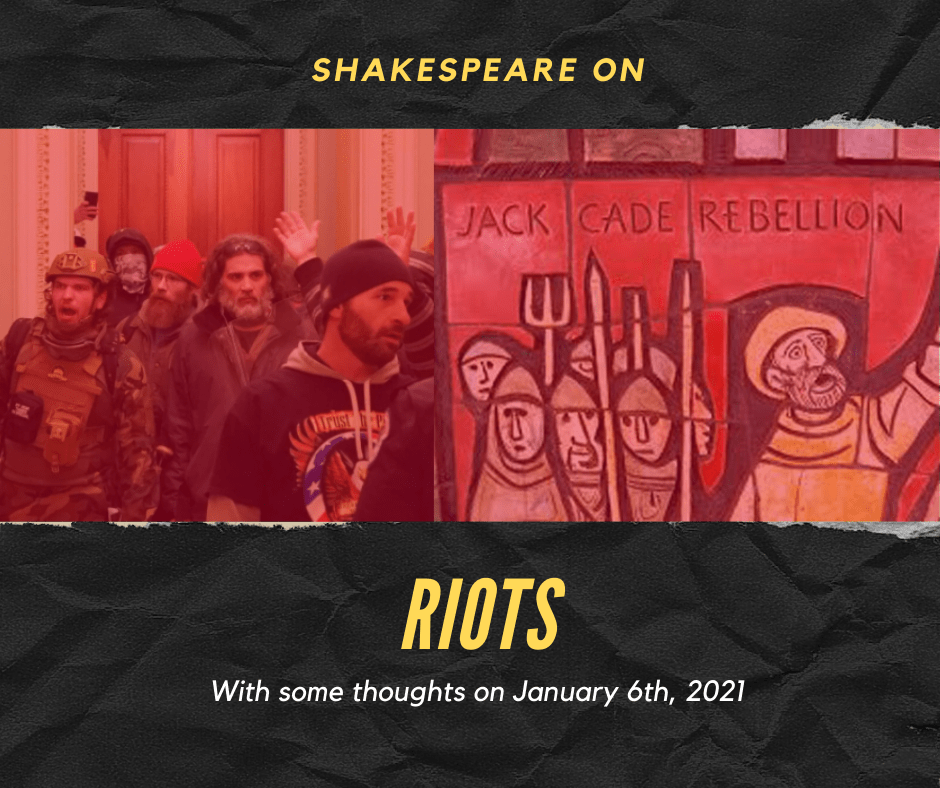
January 6th, 2021 (which, coincidently, was Twelfth Night, one of my favorite Shakespeare-themed holidays), was a tragedy for multiple reasons. The protestors broke windows, destroyed furniture, defaced statues, broke into both chambers of Congress, and probably would have harmed lawmakers, in a violent protest of both the US presidential election and the Senate vote in Georgia that week.
Let me be clear, this was sedition and treason and everyone involved should be prosecuted to the full extent of the law. Anyone who says otherwise is blatantly attacking our cherished democracy, and spitting in the face of the rule of law. Unfortunately, Republicans in both chambers have been unwilling to condemn their actions for fear of alienating their base. If this is what the Republican party has come to, the party doesn’t deserve the name. A republic protects the right of the people to elect its representatives and dedicates itself to the peaceful transition of power. Left unchallenged, groups like this will bring anarchy and tyranny to our country.
How do I know this? Because it happened before. Shakespeare has long dramatized real historic events where people rise up against their governments (for better or worse). In all cases, whether protesting a famine, a war, or a cruel tyrannical usurper, the riots never accomplish anything except bringing chaos and bloodshed. Sometimes these ignorant rioters are goaded by charismatic powerful figures, but these upper-class characters are only exploiting the rioters, using their violence as a way to get power for themselves. So, let’s examine the language, tactics, and effects of rioters in three of Shakespeare’s plays: Julius Caesar, Henry VI Part III, and Sir Thomas More:
Example 1: Julius Caesar
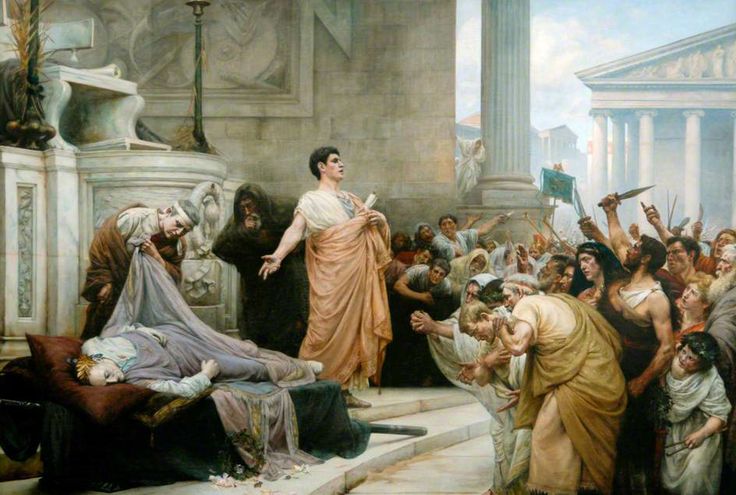
(c) Hartlepool Museums and Heritage Service; Supplied by The Public Catalogue Foundation
As I covered before in my “Friends, Romans, Countrymen,” post, during Antony’s famous funeral speech, he galvanizes the Roman crowd, first to mourn Caesar, then to revenge his death. How do they do this? By burning the houses of the conspirators and rioting in the street. They even kill a man just because he has the same name as one of the conspirators:
What does this violence accomplish? Nothing. Caesar is still dead. Brutus is still alive (though on the run). Antony merely wished to punish Brutus, and get the mob to hate him while he secretly cheats them out of their money. In Act Four, Antony becomes the de facto ruler of Rome because he leveraged his performance at the funeral, and uses his newfound powers to take money away from the citizens that Caesar promised to give them in his will. He manipulated them for his own purposes and duped them for political power.
Example 2: Jack Cade in Henry VI, Part ii.
Henry VI is the only king in English history to be crowned twice, deposed twice, and buried twice (Saccio 91). As the play begins, King Henry has already lost France, lost his mind, and lost the respect of his people. Around 1455, John Hardyng wrote a contrast between Henry’s father and himself. He laments that Henry the Fifth died so soon and then exhorts Henry to keep the quarrelsome lords in his government from warring among themselves.
Withstand, good lord, the outbreak of debates. And chastise well also the rioters Who in each shire are now confederates Against your peace, and all their maintainers For truly else will fall the fairest flowers Of your great crown and noble monarchy Which God defend and keep through his mercy.
(Excerpt from Harding’s Chronicle, English Historical Documents, 274).
Henry’s political ineptness was why Richard of York challenged his claim to the throne. Though Richard had little legal claim as king, he believed himself to be better than Henry.
In Shakespeare’s play Henry VI, Part ii, York tries to get the people’s support by engineering a crisis that he can easily solve. York dupes a man named Jack Cade to start a riot in London and demand that the magistrates crown Cade as the true king.
Biography of Richard, Duke of York, who challenged King Henry VI for his right to be king.
York and Cade start a conspiracy theory that Cade is the true heir to the throne and the royal family suppressed his claim and lied about his identity. Cade starts calling himself John Mortimer, a distant uncle of the king whom York himself admits is long dead:
The Royal National Theater’s production of Henry VI, Parts II, and 7. Jack Cade appears at about the 7-minute mark.
And this fell tempest shall not cease to rage Until the golden circuit on my head, Like to the glorious sun's transparent beams, Do calm the fury of this mad-bred flaw. And, for a minister of my intent, I have seduced a headstrong Kentishman, John Cade of Ashford, To make commotion, as full well he can, Under the title of John Mortimer.
Just like Cade and his rebels, the January 6th rioters were motivated by lies and conspiracies designed to crush their faith in their legitimate ruler. Even more disturbing, these rioters are pawns in the master plan of a corrupt political group. York doesn’t care that Cade isn’t the real king; he just wants to use Cade’s violence as an excuse to raise an army, one that he can eventually use against King Henry himself.
15th century woodcut from the War Of the Roses.
Similar to York’s lies and conspiracy-mongering, many Republicans have refused to accept the legitimacy of Joe Biden’s election, and some are actual proponents of Q Anon conspiracies!
A lot of Republicans deserve blame for fanning the flames of rebellion on January 6th, but arguably former President Trump deserves most of the blame. Even Rush Limbaugh admitted that Trump spread a huge amount of conspiracy theories without believing in any of them. He does this because he wants Americans to be afraid of imaginary threats that he claims he can solve. What’s easier to solve than a problem that doesn’t exist? Much like York, Trump tried to hold onto power by pressuring his supporters to pressure the Capital, feeding them lies about election fraud, and a secret democratic Satanic cult. Thus radicalized, they resolved to do what Cade’s mob did: “Kill all the lawyers.” Unfortunately, there are a lot of lawyers in the Senate.
As Dick the Butcher points out, most people don’t actually believe Cade is truly John Mortimer, they are just so angry at the king and the oppressive English government, that they are willing to follow him in a violent mob to take their vengeance upon the monarchy. This is why they try Lord Saye and execute him just for the crime of reading and writing! Similarly, the mob attacking the capital was made up of die-hard conspiracy adherents, and people just angry at the Democratic Party.
Like I said before, Cade and his mob is just a pawn in the machinations of York. Eventually the king’s enforcer, Lord Clifford convinces most of them to abandon Cade, and Cade himself dies a humiliating death- on the run from the law and starving, Cade is murdered by a farmer after trying to steal some food. After Joe Biden became the 46th President, many of the conspiracy group Q-Anon, who had many prominent members in the January 6th riot, began to disbelieve and abandon the conspiracies of the group. However, as this news story shows, some Q-Anon supporters are die-hard adherents and will never abandon their conspiracy theories, and some, like York’s supporters, are being recruited by other extreme groups. Sadly, as York shows, sometimes a riot is a rehearsal for another riot. In Shakespeare’s Henry VI, Part III, York finally amasses an army and challenges the Lancastrians in all-out war. Hopefully, the US government will hunt down and arrest these violent insurrectionists before they have the chance to do the same.
Example 3: Sir Thomas More
In the unfinished play “Sir Thomas More, a racist mob again attempts to attack London. This time they have no political pretenses; they want to lynch immigrants who they believe are taking English jobs. As I said in my “Who Would Shakespeare Vote For?” post, More’s speech is a perfect explanation of why this behavior cheapens and denigrated a country’s image, and weakens its ability to command respect from the rest of the world. Last time I posted a video of Sir Ian McKellen speaking this speech, but this time.. well just watch:
In many ways, Medieval Times is a campy, theme park-esque place. Don’t get me wrong, I love this place, and both Puppet Shakespeare and I enjoyed it immensely. From a historical perspective, however, Medieval Times has more in common with Disney Land than British history. That said, it still contains a nod to this ancient culture that praised and highly ritualized the concept of judicial combat.
The Court
You are cast as a lord or lady, representing a fantasy kingdom (which corresponds to the color of the crown you wear). I was fortunate to get the Red crown for Valentines Day, and was seated right next to the King and Queen (more on that later). The hall was decorated with colored banners and each kingdom was introduced with trumpets and flags. The feast was a celebration of the uniting of all the surrounding kingdoms under the King and Queen. As the king and queen came out, everyone cheered and the royals toasted each kingdom and praised and thanked them all for their service to the crown. The monarchs then promised each lord and lady there a greater reward with sports, games, spectacles, and of course, the feast itself.
Feudalism
Map of the kingdoms in England during the Wars of the Roses
As I mentioned in my Game of Thrones post, a king’s main job was to unite all the lords in the land and get them swear fealty to him, binding the whole country under the crown. It was King Henry VI’s failure to keep the lords in line that resulted in the civil war known as the Wars of the Roses. Feasts like the one in Medieval Times, were essentially propaganda to keep the lords allied with the king. They demonstrated the power of the king and communicated loudly and clearly that the lands would be stronger together, as opposed to endless war. So, this kind of pageantry was political as well as entertaining, and the king and queen’s dialogue preserves the purpose of this kind of feast, which as a history nerd, I deeply appreciated.
Court Sport
While we waited for the feast, the knights entertained the court with displays of their skills and strength. They rode towards the quintain and hit it with their lances, threw spears at a target, and even their horses got a chance to trot without riders, showing how well trained they were.
The knights practice throwing spears at the target
The Joust
Shakespeare’s Pericles, Prince Of Tyre has a very elaborate and detailed depiction of how jousts worked in the Medieval and Renaissance eras. Shakespeare knew that the joust was the ultimate display of skill, chivarly, and the ideals of courtly love. Knights were portrayed as romantic heroes who fought for a simple favor from a lady such as a rose or handkerchief and each one defined himself by his strict code of honor and virtue. All these traditions are hightlighted in the scene where Pericles fights in a tournament to gain the love of the princess Taisa:
Enter A pavilion for the [p]reception of King, Princess, Lords, &c.
[Enter SIMONIDES, THAISA, Lords, and Attendants]
Simonides. Are the knights ready to begin the triumph? First Lord. They are, my liege;750 And stay your coming to present themselves. Simonides. Return them, we are ready; and our daughter, In honour of whose birth these triumphs are, Sits here, like beauty's child, whom nature gat For men to see, and seeing wonder at.755 [Exit a Lord]
Thaisa. It pleaseth you, my royal father, to express My commendations great, whose merit's less. Simonides. It's fit it should be so; for princes are A model which heaven makes like to itself:760 As jewels lose their glory if neglected, So princes their renowns if not respected. 'Tis now your honour, daughter, to explain The labour of each knight in his device. Thaisa. Which, to preserve mine honour, I'll perform.765 [Enter a Knight; he passes over, and his Squire] presents his shield to the Princess] Simonides. Who is the first that doth prefer himself? Thaisa. A knight of Sparta, my renowned father; And the device he bears upon his shield770 Is a black Ethiope reaching at the sun The word, 'Lux tua vita mihi.' Simonides. He loves you well that holds his life of you. [The Second Knight passes over]
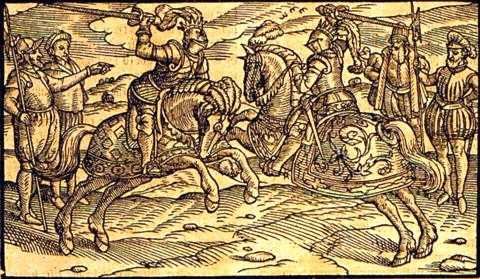
Chivalric ideals aside, the joust also had a practical purpose- it was a way for knights to train for war, an a way for them to win fame, money, and good reputations at court. As you can see in the photos above, the knights were separated by a wooden barrier called “the tilt wall.” Each knight was identified by the colorful designs on their banners, shields, and the blanket draped over the horse. Once the king or marshal threw down the warder, the knights charged headfirst at their opponents, armed with shields, lances, and full armor. Knights scored points for breaking lances and shields or by knocking other knights off their horses. Naturally, to create the most impressive display possible, all the knights at Medieval Times fell off their horses and no lances broke.
First, and most important, was the Joust Royal, or "tilting," in which mounted knights armed with lances charged at their opponents across a barrier. This was followed by a "tourney" in which mounted knights ran at each other without a tilt barrier (as pictured here).> Combatants armed with spears and swords also fought on foot over a barrier Best, Michael. "Chivalry and Duels." Internet Shakespeare Editions, University of Victoria, 28 Sept. 2016, ise.uvic.ca/Foyer/citing. Accessed 30 Sept. 2016.
The Lance
The video above is from Weapons That Made Brittain, in which historian and reinactor Mike Loads, explains with vivid details, how Knights learned how to master the art of the Lance, and how the Lance became one of the most important weapons of the knight.
Duels
In the climax of the evening, the knights stopped fighting for sport, and started fighting for power! The Green Knight (as green with envy as his armor and horse), suddenly refused to dismount from his horse and began striking knights left and right. He then challenged the leadership of the king, threatening to rebel from the kingdom, along with his fellow knights! The king then decided to choose a champion to fight the Green Knight to the death! The Red Knight, (who as I mentioned before, represented my kingdom, and threw a rose as a favor to my family), picked up the glove of the envious Green Knight, thus signifying that he would be the champion, and fight for the fate of the kingdom!
Why the Green Knight?
Illustration from Sir Gawain and the Green Knight, 14th century.
At the hall door comes a frightening figure, He must have been taller than anyone in the world: From the neck to the waist so huge and thick, And his loins and limbs so long and massive, That I would say he was half a giant on earth. But more than anything His color amazed them: A bold knight riding, The whole of him bright green.Sir Gawain and the Green Knight
In most (but not all) interviews and clips I’ve seen, the Green Knight is the bad guy- the one Knight whom almost everyone is supposed to root against. When I got home, I wondered why this was. After all, isn’t the black knight usually associated with villainy? My personal theory is that this is a subtle reference to the classic medieval story, Sir Gawain and the Green Knight. The eponymous Knight is supernaturally strong and able to even survive decapitation! He serves in the story, as the ultimate test for our young hero, Sir Gawain. I think the writers of Medieval Times definitely did their homework, making this Knight the antagonist.
The duel began on horses, but quickly changed to single combat on foot. They fought with axes, maces, and of course swords.
Even though dueling was a bloody and dangerous pastime, it has a long history that even kings couldn’t erase. Back in Anglo-Saxon times, private disputes, (such as the murder of one’s father) could be settled through means of a duel. In this period, England was occupied by the Danes, (which we would now call Vikings), and several Viking practices of judicial combat survive. For example, the Hólmgangan, an elaborate duel between two people who fight within the perimeter of a cloak. These kinds of fights continued throughout medieval Europe and, like Medieval Times Shakespeare knew their devastating dramatic potential.
At the end of Shakespeare’s Hamlet, the revenge cycle between Hamlet, Leartes, and Fortinbras, comes to a close using a duel. Hamlet has murdered Leartes’ father but Hamlet did not intentionally kill him. This kind of legal dispute would certainly have been settled with a duel in Saxon times. This is one reason why Leartes scorns Hamlet’s offer of forgiveness at the beginning of the scene, and instead trusts in the outcome of the fight to prove his cause. Hamlet and Leartes begin fighting officially under the terms of a friendly fencing match, but it becomes clear early on that at least in the mind of Leartes, this is actually a blood-combat. Laertes is demanding blood for the death of his father, and like the Green Knight, his fight will decide the fate of the Danish throne.
Hamlet. Come for the third, Laertes! You but dally. Pray you pass with your best violence; I am afeard you make a wanton of me.
[Laertes wounds Hamlet; then] in scuffling, they change rapiers, [and Hamlet wounds Laertes].
[Laertes falls.]
By the Renaissance, dueling was highly controlled by traditions of honor and fair play. As Laertes admits, poisoning Hamlet and fighting him to the death without his knowledge would be considered treason, and highly dishonorable. The Green Knight does every possible thing to make the audience see him as the villain with his lack of courtesy, dirty tricks, and disdain for the king and queen. He is so dishonorable that, even Americans, who have nothing but disdain for monarchy and in real life, value independence and self-sovereignty, would rather take the side of the monarch and his stooge the Red Knight over the Green Knight, just because he refuses to play fair.