If Shakespeare Wrote 9 to 5

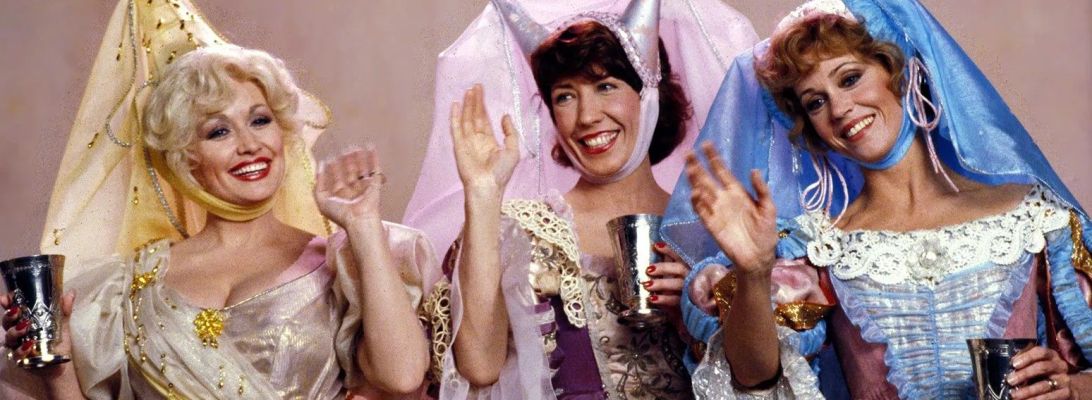
Happy 9/25! If you’ve never watched the 1980 movie 9 to 5 before, it’s a wonderful classic comedy, and of course, it’s a great way to honor the incomparable Dolly Parton, who played Dora Lee. Today I’d like to discuss the plot and themes of this movie, and compare them to classic Shakespearean comedy.

9 to 5 Music Video

The Plot

  1. Three unappreciated women in the workplace, Violet, Dora Lee, and Judy, hate their boss, a sexist, lying, hypocritical bigot. He not only rules the workplace as a tyrant, he is especially cruel to the women in the office- paying them less than their male counterparts, taking credit for their hard work, harassing the young and pretty ones, and firing them whenever he feels like it.
  2. It gets so bad that our three protagonists imagine elaborate fantasies where they not only kill him in over-the top Shakespearean ways, they also tell him off with delightfully theatrical language.
  3. Through a series of misunderstandings, the boss threatens to arrest all three of them for trying to kill him in real life. They then kidnap him and force him to stay home. Because Hart is so loathsome to deal with, the women take over the office without anyone noticing his absence! The office culture improves, productivity rises, and of course, everyone is treated equally and paid fairly. When Hart escapes and returns to the office, his boss is so happy with the women’s improvements, they promote him out of the office and he is never seen again!

Themes

The themes of 9 to 5 are truly universal, and it should never be described as a ‘chick comedy’- the same dehumanizing nature of capitalism and the unfair concentration of wealth is something everyone with a job can relate to. Just look at the lyrics of Dolly’s song:

In spite of the upbeat tune, Dolly hits on some serious grievances that working people have had since Shakespeare’s day and even older

  1. Unequal distribution of labor.
  2. Little chance for advancement
  3. Constant anxiety of being fired or demoted.

The Politics of 9 to 5

Women taking over male institutions for comedic purposes is not new- in the ancient Greek comedy Lysistrata,  women take over the Acropolis- mocking the pointless fighting of the Peloponnesian War. Like all comedies, you can see it from two sides- From a liberal lens, the men are so dumb and so obsessed with us that women could easily solve this conflict. From a conservative lens, you could see it as a cruel satire – things have gotten so bad that even a woman could do a better job than the men in power. Likewise- 9 to 5 works both as a progressive ode to women in the workplace, a universal condemnation of unbridled 80s capitalism, and a conservative absurdist look at work- stay in your lane, work up the ladder and eventually you’ll get noticed.

I bring this up because that’s how Shakespeare wrote his comedies, criticising institutions but not outright rejecting them. In addition, Shakespeare lived in a time of economic revolution- he saw workers directly rebel against corrupt local lords during the Diggers Revolt of the early 1600. Though their efforts never succeeded in his time, the Diggers inspired the democratic form of free enterprise that America was built upon. After all, monopoly is very close to monarchy.

Sexual Politics

Sexism is a theme in Shakespearean comedy, especially in Measure For Measure, the play in which a corrupt man in a position of authority, tries to take advantage of a nun. Angelo, the antagonist of the play represents how in patriarchal society, Sexual Assault and inequality is extremely prevalent, and very hard to fight against. I’ll discuss this further in my podcast later this week. For now, let’s just say that there is a direct link between Measure For Measure, 9 To 5, and the #metoo era.

Jane Fonda calls Hart a “wart on Humanity”, 1980

The Characters

Violet (Lilly Tomlin)

Violet, a senior supervisor and Hart’s second in command, is a woman trying to succeed in a man’s world. Of the three leads, she seems the least traditionally feminine- she has no husband, wears dark clothes, minimal makeup and jewelry, and devotes herself to her work, and has given her time, energy, and creativity to the job. The cruel irony is, even though she subverts her femininity, she’s never seen as anything other than “Hart’s girl.” She’s passed up for promotions, Hart steals her ideas and takes the credit, and even though she is a senior supervisor, Hart forces her to get him his coffee as if she has nothing better to do. Violet is a scathing critique of corporate culture, and she dreams in her fantasy to take Hart’s coffee, and give him a taste of his own toxic medicine. 

Violet’s Shakespearean counterpart is Viola from Twelfth Night. To succeed in a man’s world, Viola disguises herself as a man and gets a job. She is quickly rewarded and noticed once she hides her identity as a woman. This must have been extremely subversive for the 1600s.

If we compare Violet’s “I’m not a girl,” speech with Viola’s “In faith, they are as true of heart as we,” both speeches show a woman who is asking for equality.

  1. Viola. Ay, but I know—
  • Orsino. What dost thou know?
  • Viola. Too well what love women to men may owe:
    In faith, they are as true of heart as we.
    My father had a daughter loved a man,
    As it might be, perhaps, were I a woman,
    I should your lordship.
  • Orsino. And what’s her history?
  • Viola. A blank, my lord. She never told her love,
    But let concealment, like a worm i’ the bud,
    Feed on her damask cheek: she pined in thought,
    And with a green and yellow melancholy
    She sat like patience on a monument,
    Smiling at grief. Was not this love indeed?
    We men may say more, swear more: but indeed
    Our shows are more than will; for still we prove
    Much in our vows, but little in our love.

Both speak of suffering in silence, waiting for a man to notice them. In Viola’s case, she wants her boss, Duke Orsino to realize she’s a woman and fall in love with her, while Violet wants to be treated as a grown woman and an employee. Both speeches are about a man who is blinded by his preconceived notions of what a woman is, and the women eloquently shatter them.
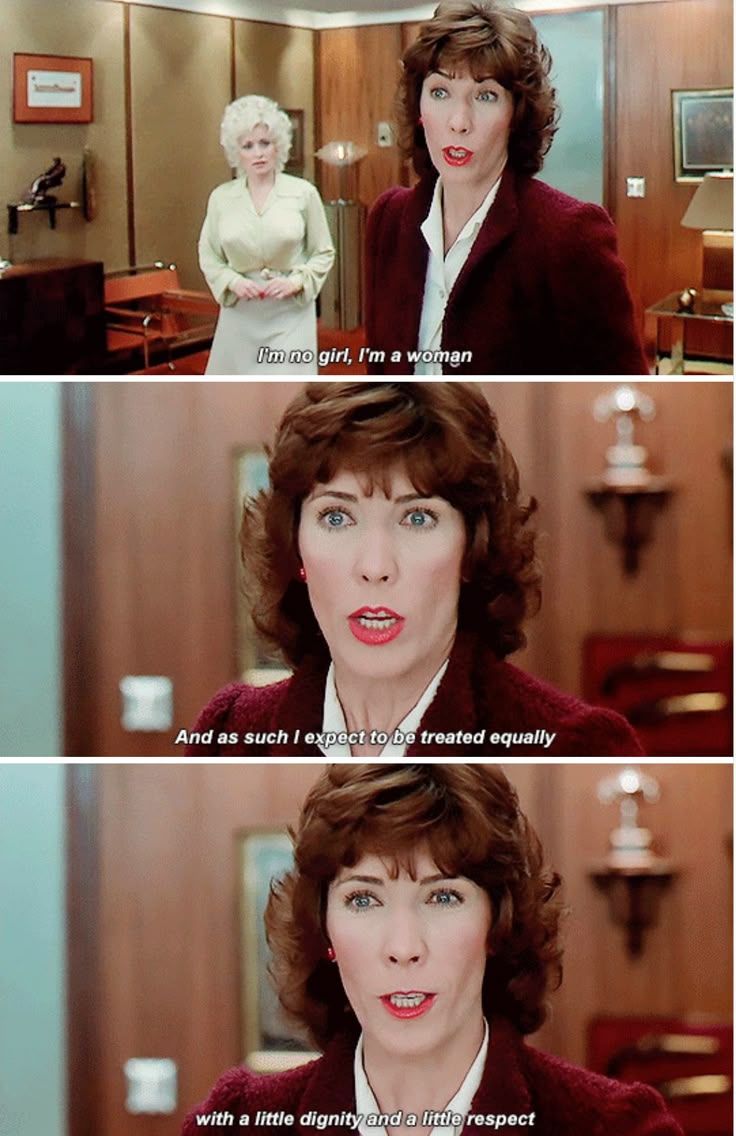
VIOLET: You gave that promotion to Bob Enright instead of me? I trained him for God’s sake! Oh, so it’s the old boys club. I’m going, but before I do, I have one more thing to say. Don’t you ever refer to me as your ‘girl’ again. I am no girl. I am a woman. W-O-M-Y-N! I’m not your wife, your mother or your mistress. I’m your employee and I expect to be treated equally, with a little dignity and a little respect! Oh, come off it, Doralee. Everyone knows you and Mr. Hart are having an affair.

Violet represents the best of working women, and the worst of how they are treated.

Dora Lee (Dolly Parton)

Dolly Parton as Dora Lee

At first glance, Dora Lee seems like a naive blond country bumpkin. She also appears, (as Violet alluded to earlier), to be having an inappropriate relationship with her boss. In reality, she is another victim of Hart’s cruelty. Because she’s Hart’s secretary, he feels entitled to a relationship with her, (even though both Dora Lee and Hart are married). Even worse, Hart openly flirts and leers at Dora Lee and makes up excuses to ogle and pinch and harass her. Why does she put up with this? First, because she knows how this kind of behavior is encouraged in all workplaces. This is why in her revenge fantasy, Dora Lee subjects Hart to the same kind of harassment that she has endured, before hog tying him like the sexist pig he is!

As you might have guessed, Dora Lee’s Shakespeare avatar is Isabella- the nun from “Measure For Measure” in Shakespeare’s darkest comedy, Isabella is a nun who tries to plead for clemency to an unjust judge. He then offers a horrific quid pro quo bargain- he will pardon her brother and save him from execution, but only if she sleeps with him.

Ha! Little honor to be much believed,
And most pernicious purpose! Seeming, seeming!
I will proclaim thee, Angelo; look for't:
Sign me a present pardon for my brother,
Or with an outstretch'd throat I'll tell the world aloud
What man thou art.

While Isabella threatens to tell the world on Angelo, Dora Lee favors a more… aggressive approach:

Dora Lee confronts Hart

DORALEE: What! You’ve been telling everyone I’m sleeping with you! That explains why everyone’s been treating me like a dime store floozy! They all think I’m banging the boss! And you love it, don’t you. It gives you some sort of cheap thrill, like knocking over pencils and picking up papers. I’ve put up with your grabbing and chasing me around the desk, ‘cause I need this job, but this is the last straw! I’ve got a gun out there in my purse and up to now I’ve been forgiving and forgetting ’cause that’s the way I was brought up but I swear, if you say another word about me, I’ll get that gun of mine. And I’ll change you from a rooster to a hen with one shot!

Like Isabella, Dora Lee’s speech emphasizes her Christianity, (note the use of the term: “forgiving and forgetting”) but unlike the nun, Dora Lee makes it clear in no uncertain terms that she NEED NOT, SHOULD NOT, and WILL NOT put up with Hart’s behavior.

Judy Bernly (Jane Fonda)

Judy is the new girl at the company. In addition to being an important fish-out-of water character who helps explain the plot to the audience, Judy has the most dynamic arc in the movie. She starts as a divorcee with no home, no job experience, and no husband. Her vulnerability makes Hart eager to take advantage of her, like he did Dora Lee. Fortunately, Violet and Dora Lee warn Judy and she quickly makes friends with them.

Judy fantasizes about hunting down her cruel boss.

Because of her kind nature, Judy is disgusted by Hart’s callousness and cruelty. This is why her fantasy for doing away with Hart paints her as a fearless hunter, scaring him and destroying him, like he did poor meek creatures whose heads he mounts on his office wall:

Judy grows from being a broken woman to a strong, valuable ally whose kindness is seen as a strength, not a weakness. Her husband even comes back and tries to get back together with her and, for the first time, Judy stands up for herself and says no. She had an easy out- become a wife and mother again, but finds strength from her friends and realizes she deserves better than him. By the end of the film, she becomes the heart of the team.

    To conclude my Analysis, let’s look at the scene at the bar between all three women:
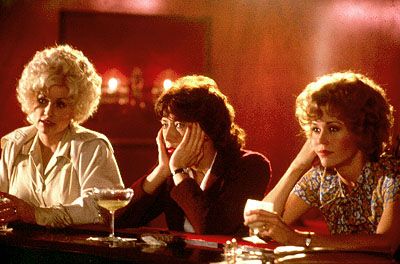
    V: What a rat.

    D: What a liar.

      J: What a creep.

    D: To think he told everybody

    I was sleeping with him…

    J: It’s so unfair. Just so unfair.

    V: Twelve years of service,

    and he shoots me down.

    J: We’ve got to do something. He can’t treat people like that.

    V: Do? What’s to do? Quit?

    D: – I can’t quit.

    V: – It’s the same all over.

    J: Look, couldn’t we just all get together and complain?

    V: – Complain to who?

    Let’s face it- We’re in a pink-collar ghetto.

    J: Let’s have another drink.

    And this: 

    1. To whom should I complain? Did I tell this,

    Who would believe me? O perilous mouths,

    That bear in them one and the self-same tongue,

    Either of condemnation or approof;

    Bidding the law make court’sy to their will:

    Hooking both right and wrong to the appetite,

    To follow as it draws!

    First off, let’s address the obvious parallels- both Dora Lee and Isabella have been assaulted and harassed and the man’s defense is exactly the same: “no one will believe you.” Both women know that in a patriarchial society society, both the offender and the judge allow this kind of culture of sexual abuse, which leads to a vicious cycle. As Violet points out, all companies have the same attitude towards women, which means that even if they quit, they’ll just find another Hart if they go work someplace else.
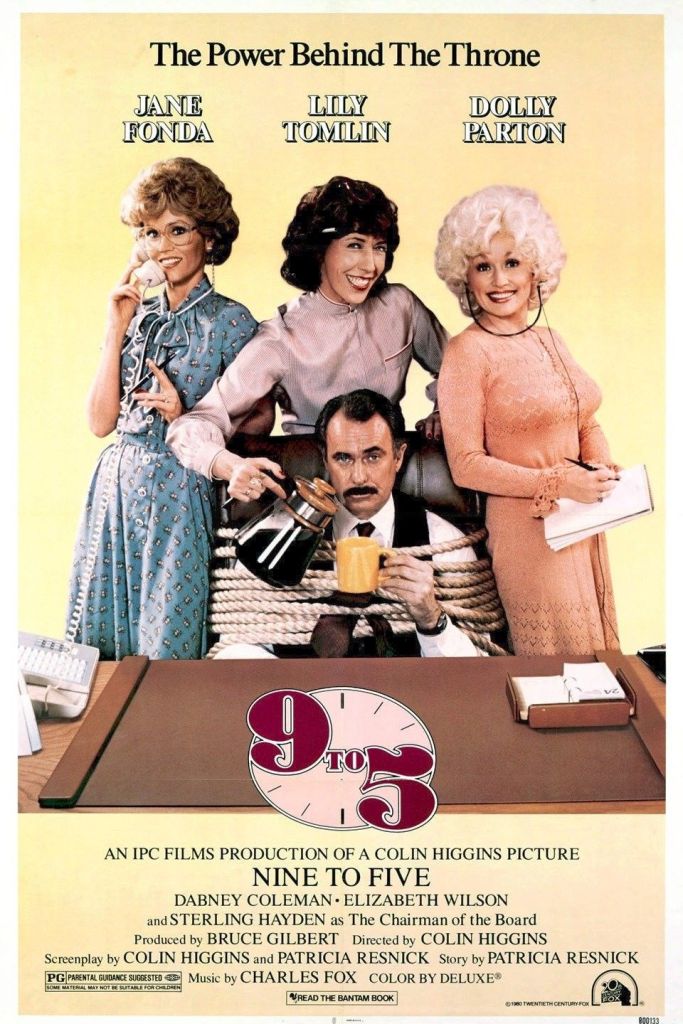
    What Shakespeare doesn’t mention is that Hart’s view of women is intertwined with his attitude towards his employees- female and male. He has no interest in them other than as objects to improve his wealth and status, which is also true in most companies. Violet’s phrase “pink collar ghetto” refuses to the all-too common practice of putting women  

    WWSD- not much- I think I’ve emphasized that the themes, characters, and clever satire of 9 to 5 perfectly parallel Shakespearean comedies like Measure For Measure, Twelfth Night, and others. Nevertheless, the fact that the same issues workers in general and women in particular are just as prevalent in Shakespeare’s day as in 1980, and today, means we have quite a way to go to have a truly egalitarian a workplace, so hopefully some of you will watch the movie and get inspired to change the world like Violet, Judy, and Dora Lee!

    Crafting A Character: Brutus from Locrine

    You might have read my previous post about Locrine and Humber from that play. Well, today I will continue this series by discussing the other character I play, the mythical founder of Britain, King Brutus.

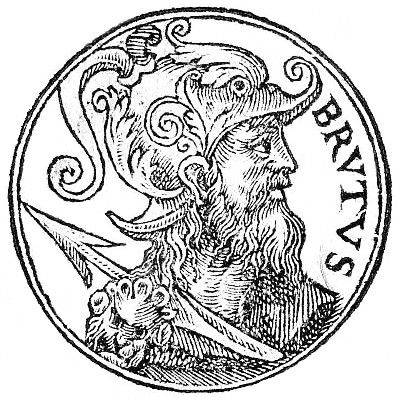
    Brutus of Troy

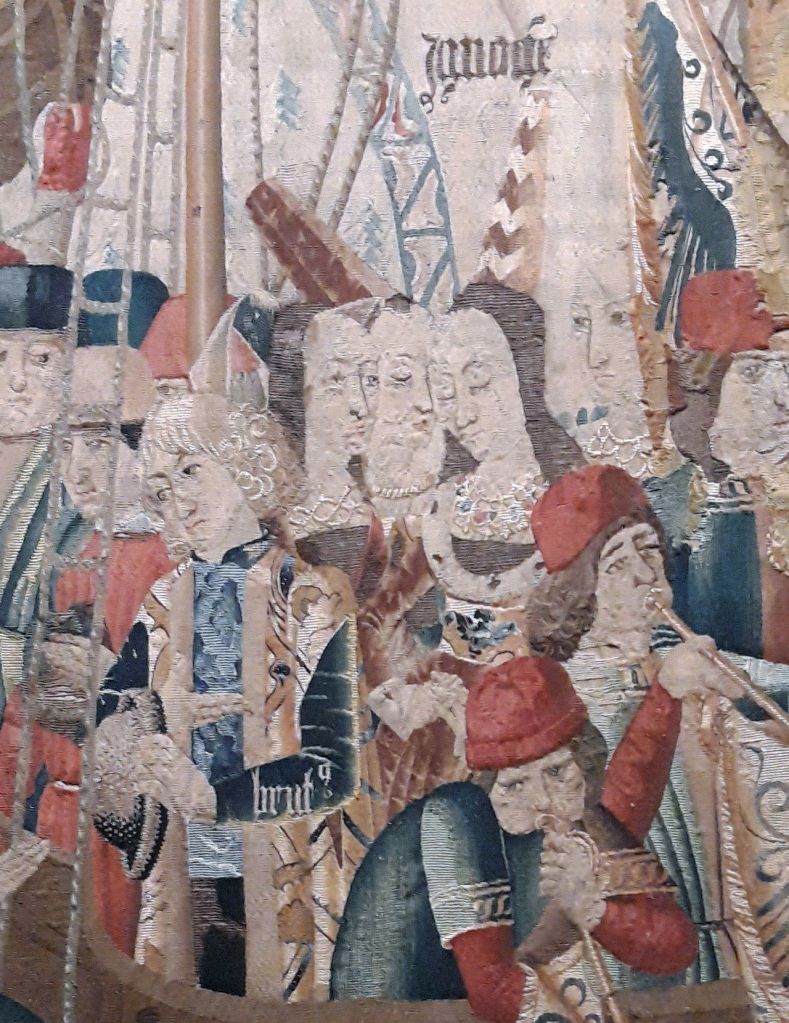
    Now before you ask- NO, THIS IS NOT Marcus Brutus, the man who stabbed Julius Caesar. This Brutus actually lived before said conspirator, around the year 11000 BC. Writers like Geoffrey of Monmouth, writing after the Norman Conquest of England, recorded the story of Brutus as a way of getting the British people on board with a single king uniting all of the kingdoms of England.

    According to Monmouth (who clearly had an influence on the writer of Locrine), Brutus was the grandson of Aeneas, the sole survivor of the infamous Trojan War. Like the ancient Greek legends of Perseus or Hercules, Brutus is exiled from Italy for accidentally killing his father, and must then create a new empire in Britain.

    Brutus! there lies beyond the Gallic bounds
    An island which the western sea surrounds,
    By giants once possessed; now few remain
    To bar thy entrance, or obstruct thy reign.
    To reach that happy shore thy sails employ;
    There fate decrees to raise a second Troy,
    And found an empire in thy royal line,
    Which time shall ne’er destroy, nor bounds confines  – Diana’s speech to Brutus

    Historia Regum Britanniae by Geoffrey of Monmouth, c1136

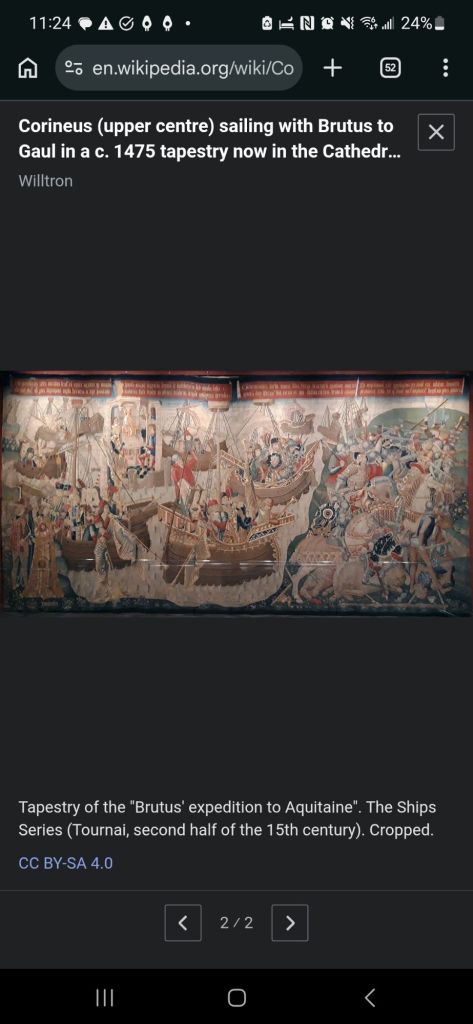
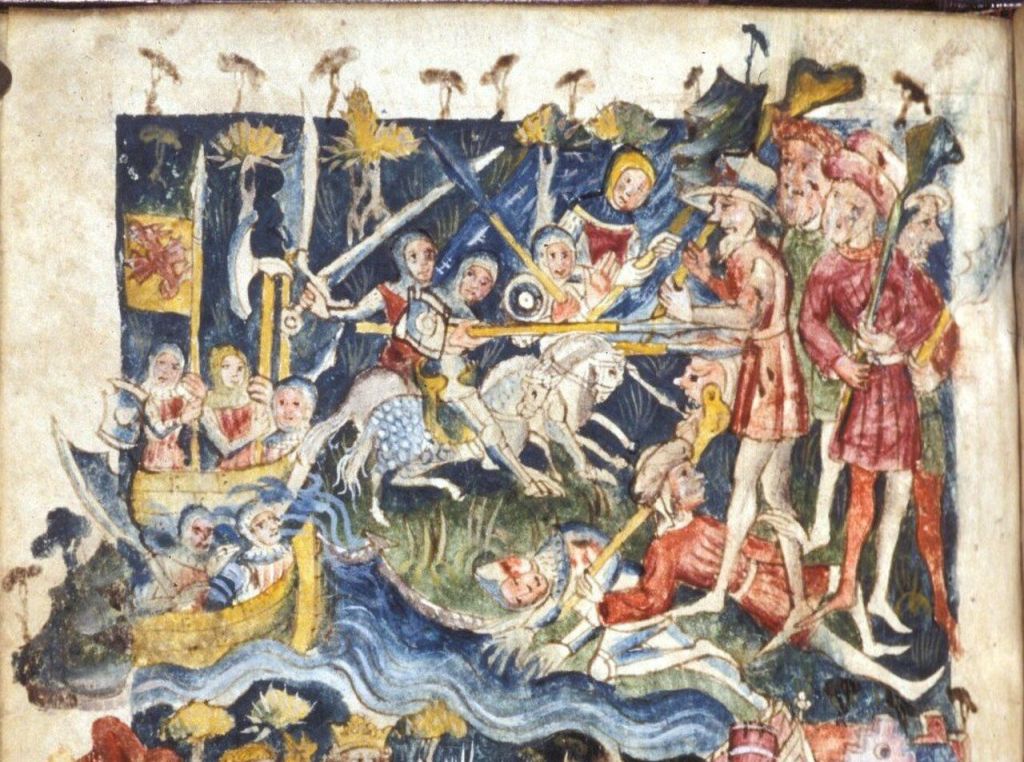
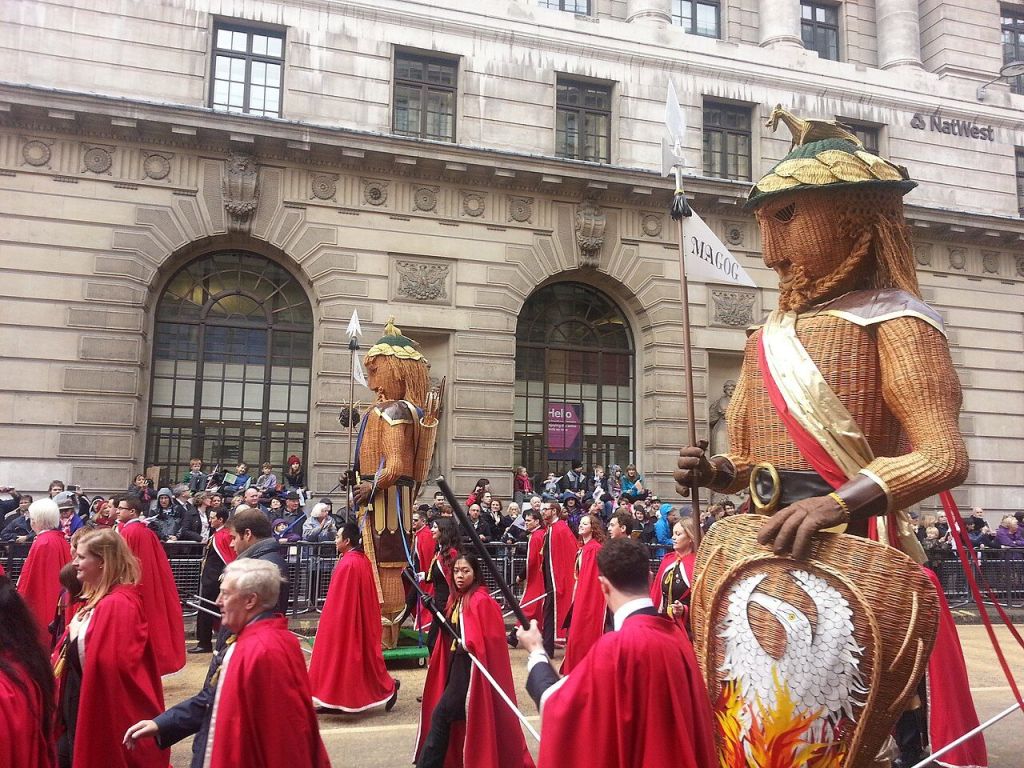
    To secure his empire, Brutus must tame the savage giants that rule the untamed wilderness of Britain, in a mythical battle that is still celebrated to this day.

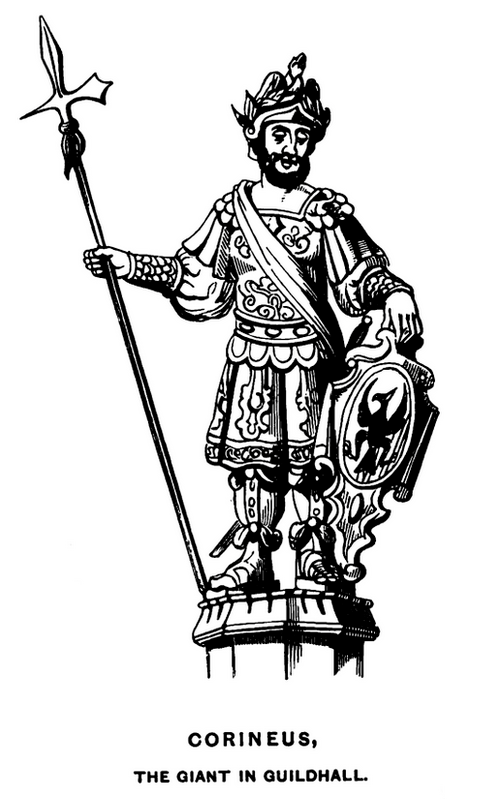
    At the beginning of the encounter, Corineus and the giant, standing, front to front, held each other strongly in their arms, and panted aloud for breath, but Goëmagot presently grasping Corineus with all his might, broke three of his ribs, two on his right side and one on his left. At which Corineus, highly enraged, roused up his whole strength, and snatching him upon his shoulders, ran with him, as fast as the weight would allow him, to the next shore, and there getting upon the top of a high rock, hurled down the savage monster into the sea; where falling on the sides of craggy rocks, he was torn to pieces, and coloured the waves with his blood- Monmouth

    Function in the Play

    1. Legacy of Troy- As I mentioned before, Brutus establishes the link between ancient Troy, and the founding of Britain.

    The island was then called Albion,[9] and inhabited by none but a few giants. Notwithstanding this, the pleasant situation of the places, the plenty of rivers abounding with fish, and the engaging prospect of its woods, made Brutus and his company very desirous to fix their habitation in it. They therefore passed through all the provinces, forced the giants to fly into the caves of the mountains, and divided the country among them according to the directions of their commander. After this they began to till the ground and build houses, so that in a little time the country looked like a place that had been long inhabited. At last Brutus called the island after his own name Britain, and his companions Britons; for by these means he desired to perpetuate the memory of his name.

    2. Corineus’ Brother In Arms

    Like a lot of characters in Shakespeare’s history plays, Brutus has a loyal second in command, Corineus, the mythical founder of the kingdom of Cornwall. After Brutus dies, Corineus is a sort of Lord Protector, lending his council and military experience to Locrine and his brothers:

    The name of their commander was Corineus, a modest man in matters of council, and of great courage and boldness, who, in an encounter with any person, even of gigantic stature, would immediately overthrow him, as if he were a child. When they understood from whom he was descended, they joined company with him and those under his government, who from the name of their leader were afterwards called the Cornish people, and indeed were more serviceable to Brutus than the rest in all his engagements. – Historia Regum Britanniae by Geoffrey of Monmouth, c1136

    1. Patriarch– Brutus’ sons become the first kings of England, (Locrine), Scotland (Albanact), and Wales (Camber).

    During these transactions, Brutus had by his wife Ignoge three famous sons, whose names were Locrin, Albanact, and Kamber. These, after their father’s death, which happened in the twenty-fourth year after his arrival, buried him in the city which he had built, and then having divided the kingdom of Britain among them, retired each to his government.

    1. King Lear Right after Brutus’ story in Monmouth’s chronicle comes the ancient story of King Lear, the same story Shakespeare would later adapt into his own play. Like Lear, Brutus has to divide his kingdom, but unlike Lear, he does not try to test his children’s loyalty.

    Locrin, the eldest, possessed the middle part of the island, called afterwards from his name, Loegria. Kamber had that part which lies beyond the river Severn, now called Wales, but which was for a long time named Kambria; and hence that people still call themselved in their British tongue Kambri. Albanact, the younger brother, possessed the country he called Albania, now Scotland. After they had a long time reigned in peace together, Humber, king of the Huns, arrived in Albania, and having killed Albanact in battle, forced his people to fly to Locrin for protection.

    Our Interpretation

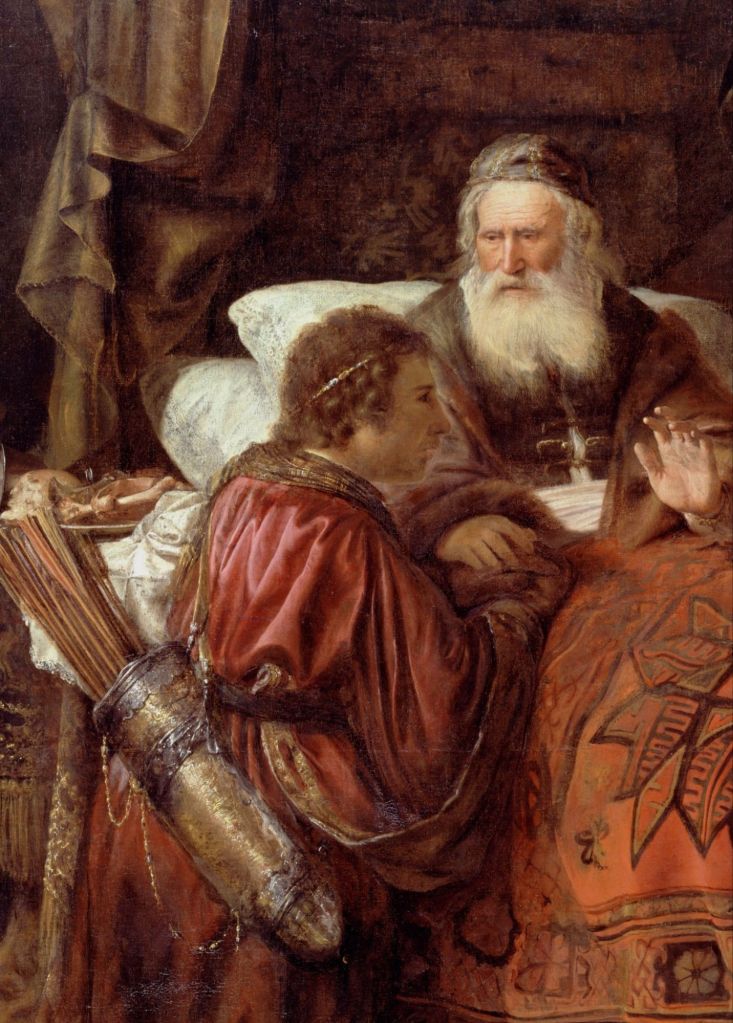
    Isaac blesses Jacob

    Those who sought to deface our memory,
    wipe the name of Trojans from the earth
    Those did I captivate with this mine arm.
    And in this Isle at length I placed you.
    – Locrine, Act I.i

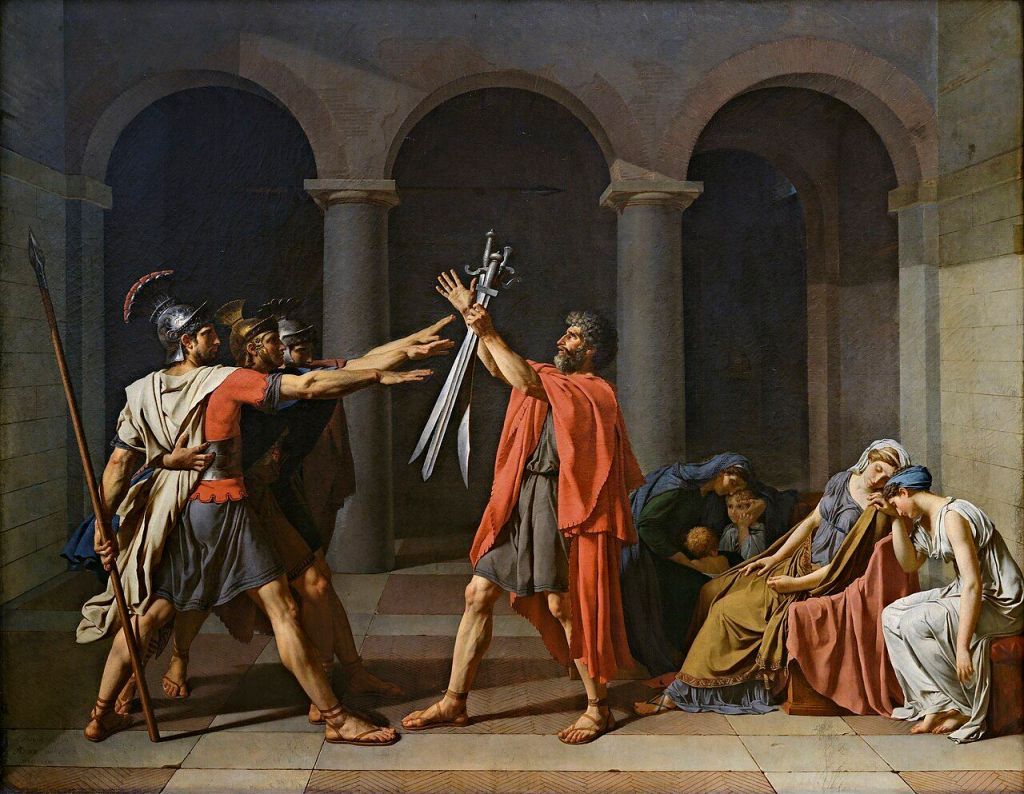
    I see Brutus as an intimidating king like Hamlet’s Father (before he became a ghost). I also see him as similar to an Old Testament patriarch like Moses or Isaac- he was led by a god to the promised land, and gave it to his children, who must now protect and defend it.

    Oath of the Horatii by Jaques Louis David
    1. Colonizer

    On the other hand, one could also see Brutus as a colonizer- he takes land that wasn’t his and overthrows the natural order. This is a dimension that is not explored in the original story, but our version highlights it.

    Playing Brutus

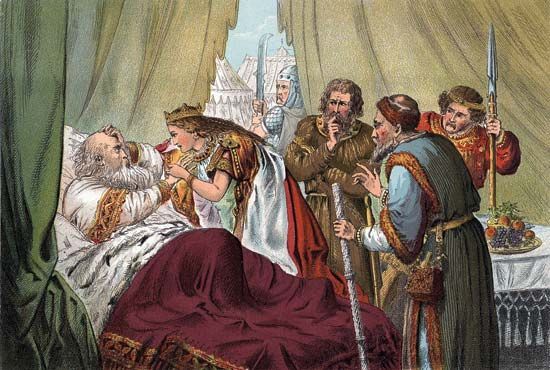
    1. Look and physicality– For such a mythic figure, I tried to play Brutus with as much strength and gravity as possible, at least at first. While he is being introduced and fighting giants, I tried to make him a soldier and King in his prime. After a while though, we see Brutus on his death bed, and I play him as frail and shaky; struggling to keep his kingdom together, as he also struggles to stay alive.
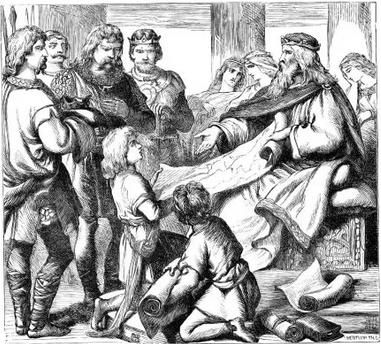
    2. As Brutus ages, I had him divest himself of his armor as he divests his kingdom- to CAMBER, he gives his shield. To Albanact, he gives his sword, and to Locrine, he gives his crown.
    1. Verse

    It’s interesting that most of Brutus’ lines are in Trochaic, rather than iambic verse, which could be a way to emulate older forms of verse, but I also suspect that it is designed to emphasize Brutus’ commands.

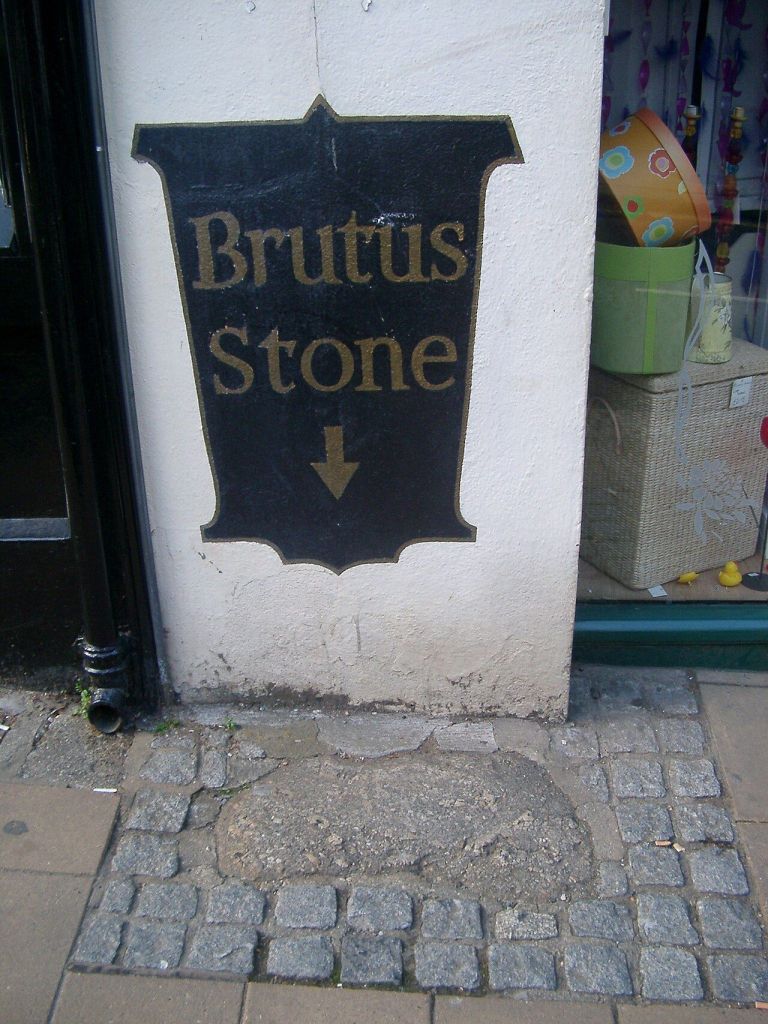
    From Troy to Totnes – The Tale of the Brutus Stone

    Then now, my son, thy part is on the stage,
    For thou must bear the person of a King.
    [Puts the Crown on his head.]
    Locrine, stand up, and wear the regal Crown,
    Cherish and love thy new betrothed wife.
    Locrine, Act I.i

    Well, there you go, Hope you enjoyed this overview of the play Locrine. If you like this review, you might like to see the show itself. Click here to purchase tickets:

    Crafting A Character: Humber from Locrine

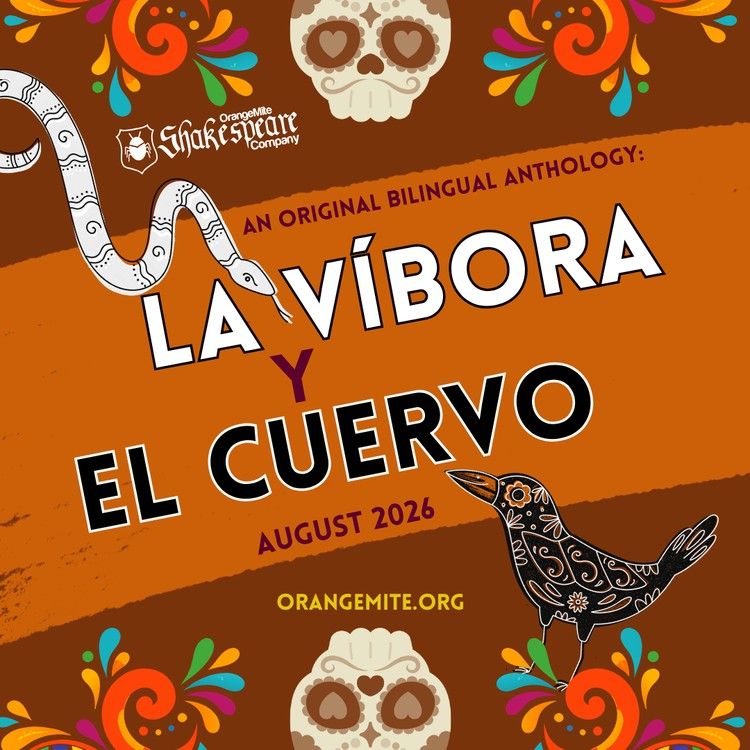
    I’m pleased to announce that I will be playing Humber, the Scithian Emperor who tried to conquer England, in a very special adaptation of Locrine in August of 2026.

    What is Locrine?

    Locrine is an Elizabethan play, first published in 1595, whose author is, sadly, lost to history. The play is a mythologized history of the founding of Britain, which the play calls New Troy.

    Our Interpretation

    Our version of Locrine is a hybrid between the original play, and stories from the indigenous people of Mexico in the huasteca region. Our director chose to reinterpret Humber as an existential threat to the natural world of Mexico- a threat to the people and the environment, who is defeated not just by Locrine’s army, but by the forces of nature themselves.

    Myth vs History

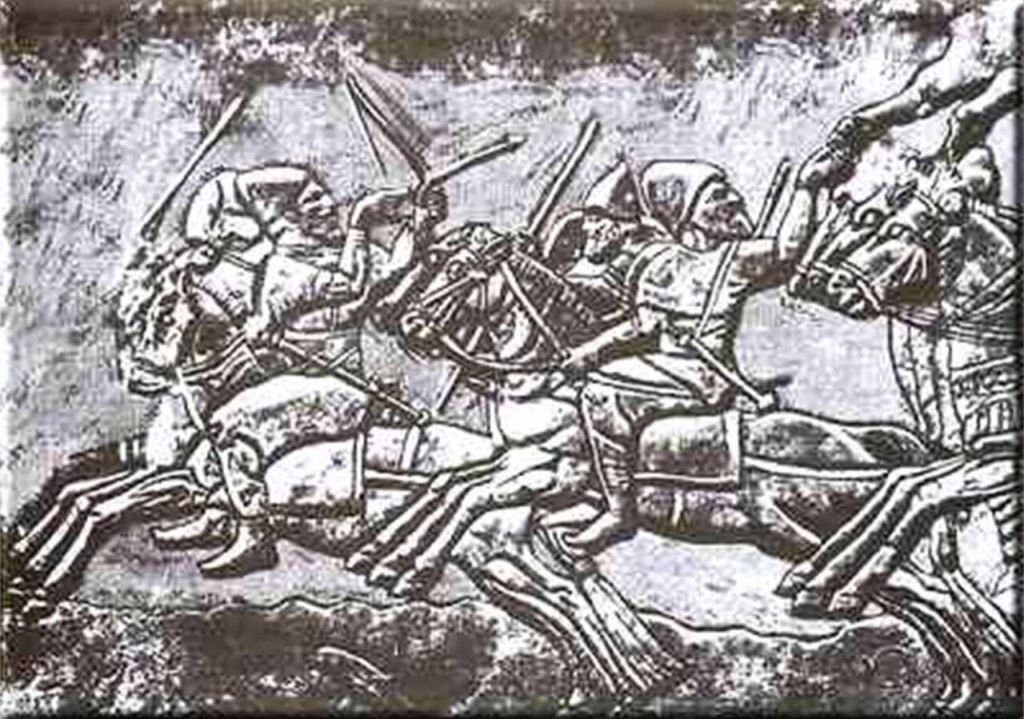
    Ancient Scithian horse warriors
    1. The Scythian Emperor- Scythia was originally modern day Iran, but many Scithian tribes also lived in places like Ukraine and Russia. They were nomads who primarily used their skills in mounted warfare to conquer regional fifedoms, organized under a single emperor.

    Function Within the Play

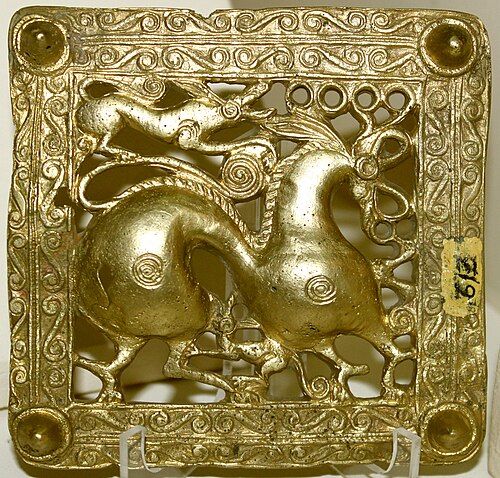
    Ancient golden Scithian belt buckle
    1. Ravisher of Nature- as Humber tries to conquer the people of England, he also destroys the natural world.
    2. Usurper/ Conqueror of the Britains- in our version of Locrine, Humber’s war to conquer Britain is analogous to the European colonizers who fought to dominate America such as the French, the Dutch, and of course, the Spanish.

    We are retired with joyful victory. The slaughtered trojans squeltering in their blood, infect the air with their carcasses, and are a prey for every ravenous bird.

    Locrine, Act 2 Scene 6


    Playing Humber

    Right now, I am playing Humber as a narcissist, a man who, at his core, is deeply insecure but tries to overcompensate it by acting like an invincible monarch- one who fills the void in his soul with land, slaves, possessions, and gold. He is good at persuading people and inspiring them to fight for him, but he cares for no one but himself.


    High on a bank by Nilus’ boistrous streams,
    Fearfully sat the Egyptian Crocodile,
    Dreadfully grinding in her sharp long teeth
    The broken bowels of a silly fish.
    [A crocodile swims across the stage, eating a
    fish.]
    His back was armed against the dint of spear,
    With shields of brass that shined like burnished gold;
    And as he stretched forth his cruel paws,
    A subtle Adder, creeping closely near,
    Thrusting his forked sting into his claws,
    Privily shed his poison through his bones.
    So Humber, having conquered Albanact,
    Doth yield his glory unto Locrine’s sword.
    Mark what ensues, and you may easily see,
    That all our life is but a Tragedy. –Locrine, Act III prologue.

    A snake struggling with an alligator, eventually gets the upper hand, or coil.

    In the play, Humber is compared to a fearsome predator- a crocodile, which was actually the sigil  on his shield. I took inspiration from the animal, and used a serpentine physicality when playing him. I also decided to give myself a crocodile smile- I keep my head down, stared my enemies in the eye, and then- struck!

    Gloucester’s show
    Beguiles him as the mournful crocodile
    With sorrow snares relenting passengers- Henry VI, Part II.

    Inspirations

    From History-

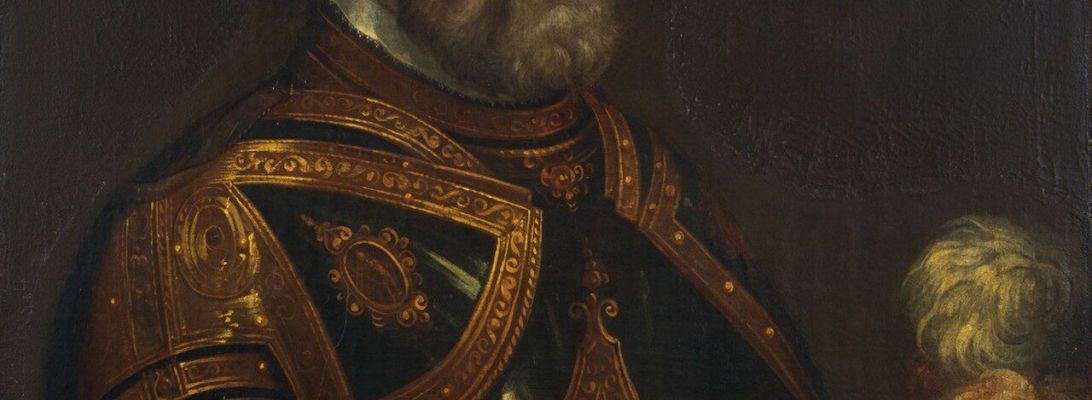
    Again, Locrine is not a history play and Humber, as far as we know, was not a real person. Rather than a legitimate chronicle, Locrine is a mythologized history of the founding of Britain. The Scithians never actually invaded Britain, (although some early chronicles claim that the Saxons were descended from them). Our version of Locrine conflates the foundation of Britain with the conquest of America, (specifically the struggle between English colonists and the Spanish conquistadors,) and there is one man who has come to symbolize the ruthless might and lust for gold that the Spanish had in the early conquest of the American continent more than any other Conquistador- Hernan Cortez,  governor of New Spain, and conqueror of the Mexican empire.

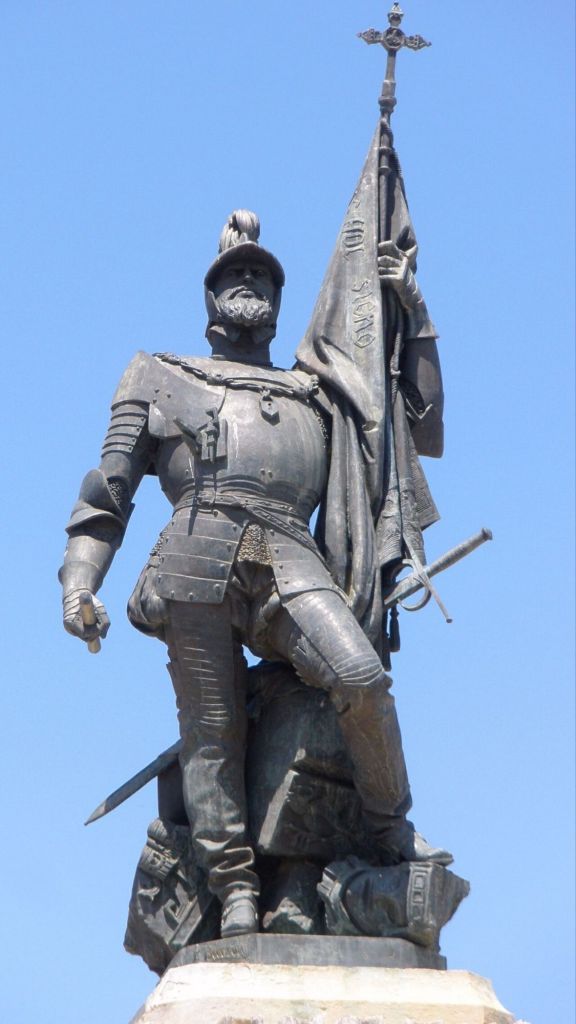
    Statue of Cortez. Notice the broken Aztec statue under his foot.

    We Spaniards know a sickness of the heart that only gold can cure- Hernan Cortez (allegedly)

    Cortez was a man of insatiable greed and lust for power. He was born a minor noble with a gift for diplomacy and exceptional courage. He eventually slaughtered thousands of the Mexican people, supplanted their ruler Montezuma, and razed their capital city of Tenochtitlán, rebranding it as Mexico City, capital of the New Spanish empire.

    Mural on the Battle of Centla and the conquest of Tabasco, by Homero Magaña Arellano.

    Like Humber, Cortez was more of an administrator than a soldier, but nevertheless, he did lead his army successfully against the native people in several key battles, where they used their cavalry and cannons to devastating effect. He also ravished hundreds of Indigenous women who sired his illegitimate children- like our Humber, he lusted for women in addition to gold.

    Cortez was careful to appear pious to his soldiers and respectful to the native people he encountered, but this was a calculated act designed to get loyalty and obedience from the people around him. According to his biography, Cortez had a zero-tolerance policy for blasphemy, and told his soldiers to respect the native Mexica. Again, Cortez’s real goal was to keep his men loyal to their “pious” commander and to make the people trust him…while he robbed them blind. Talk about crocodile tears.

    Cortez’s victories allowed him to build palaces for himself to rule over the Mexica, as well as a royal charter for himself, and of course, GOLD.

    The Spaniards appeared to be much delighted, they seized upon the gold like monkeys, their faces flushed. For clearly their thirst for gold was insatiable; they starved for it; they lusted for it; they wanted to stuff themselves with it as if they were pigs. They went about fingering handling the streamers of gold, passing them back and forth, grabbing them one to the other babbling, talking gibberish among themselves. – Bernardino de Sahagún

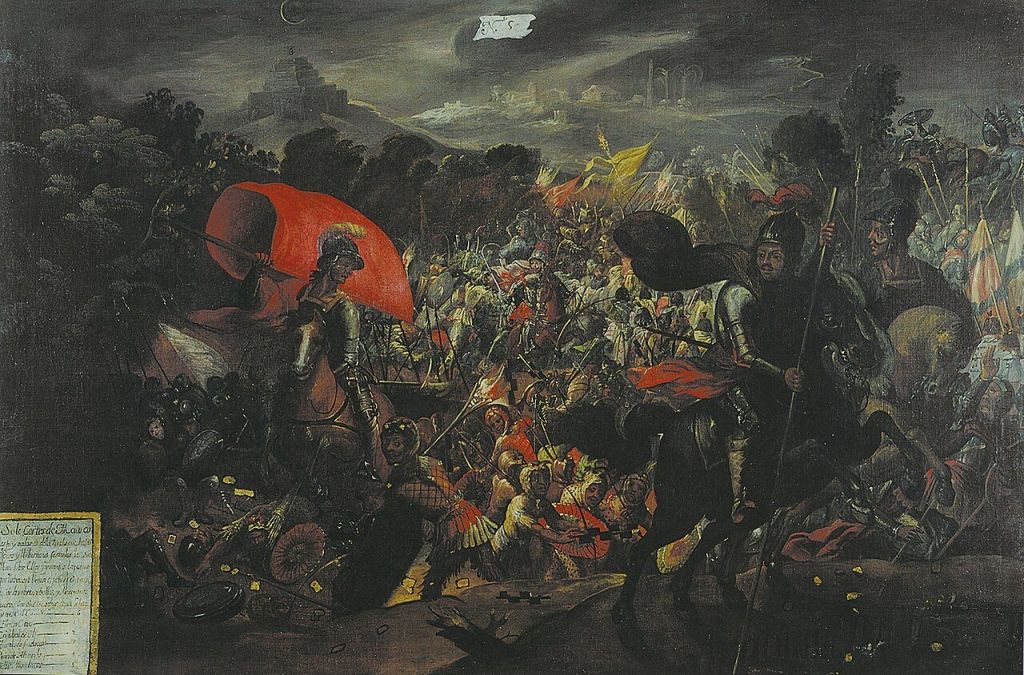
    In Locrine, Humber is defeated offstage and forced to starve to death in a desert wilderness. To fill in the blanks, I looked at events from Cortez’s life and death. The real Cortez died of dysentary in 1547, but I like to imagine Humber- Cortez being chased away by Locrine’s army, similar to his narrow escape from Tenochtitlán during the famous Noche Triste (30 June – 1 July 1520)

    Cortez and his soldiers narrowly escape Tenochtitlán

    From Shakespeare-

    Shakespeare rarely writes characters who are wholy evil, so for the first three acts, I mainly thought of another Sythian conqueror- Christopher Marlowe’s Tamborlaine. He is not so

    much a man as a force of nature, eager to kill, conquer, and take power and riches from the natural world.

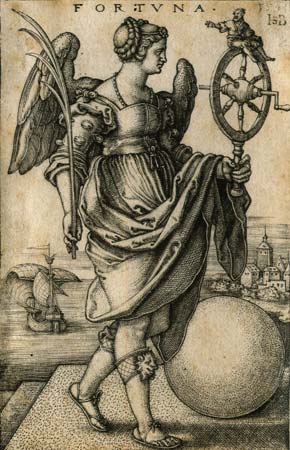
    The Roman Goddess Fortuna, with her wheel and orb.

    In the later acts of Locrine however, Humber is… well humbled ater losing the war, losing his son, and losing his wife. His laments for his son bear a striking resemblance to Titus Andronicus.

    Humber speech III, Scene 5, performed by One Woman Shakespeare

    Verse

    At the end of his life, Humber reverts to a primitive shadow of his former self- Humber is forced to hide in desert caves, and live on berries and roots. His cruel, bitter laments and desire to cast himself into the sea is almost perfect parallel to Shakespeare’s Timon of Athens.

    Timon in the cave

    What basilisk was hatched in this place,
    Where everything consumed is to nought?
    What fearful Fury haunts these cursed groves,
    Where not a root is left for me to eat?
    Hath fell Alecto, with invenomed blasts,
    Breathed forth poison in these tender plains?
    What, not a root, no fruit, no beast, no bird,
    To nourish Humber in this wilderness?
    My very entrails burn for want of drink,
    These foul accursed groves afford no meat,
    The gods, hard-hearted gods, yield me no meat.
    Was ever land so fruitless as this land?
    Was ever soil so barren as this soil?
    No, even the climate of the torrid zone
    Brings forth more fruit than this accursed grove

    In Conclusion

    Humber is a great deal of fun- he’s a cartoon-like villain at first, but after he loses to Locrine, he seems more human, longing to be reunited with his son. Even though he’s not the main character, he has a tragic character’s arc. In short, he’s great to play, and I hope he’ll be great to watch!

    Sources

    https://lostplays.folger.edu/Estrild

    https://orangemite.org/laviborayelcuervo

    https://historum.com/t/cort%C3%A9s-and-the-conquest-of-mexico.184401/?utm_source=google&utm_medium=organic

    Sonnet inspired by the Mandolorian

    The Child is locked within that room, alack!
    Too high to fly and the doors are far too thick
    Perhaps this console I can disarm or hack
    O Fate! Thou play'st upon me yet another trick.
    To enter I must show this Droid my face
    A thing most vile, against my holy creed.
    Methinks I hear The Armorer's voice 'cross space:
    "This is the way of Mandalore, take heed."
    This is MY WAY, MY QUEST, MY SACRIFICE
    Behold my face, thou cold and lifeless sentry.
    A few seconds shame should thee suffice
    Open the gate! Let me have present entry!

    Strange, up to now, my face hath been my mystery
    My Grogu's life is far more dear to me.

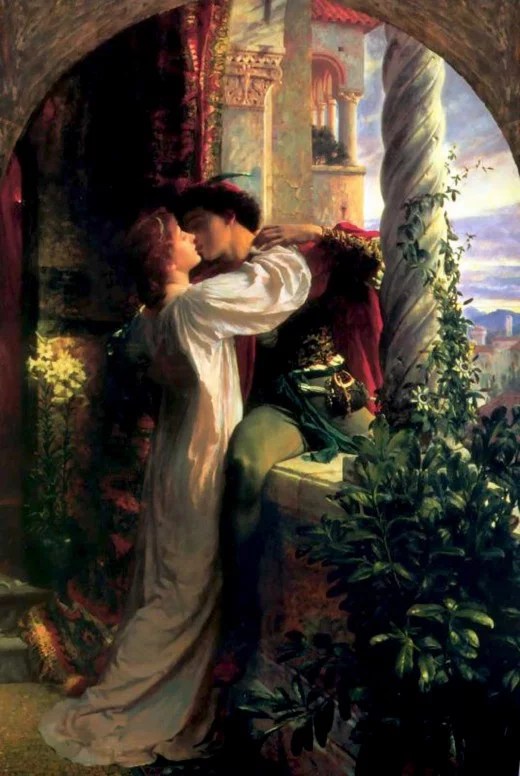
    Is Romeo and Juliet Overrated?

    What’s a classic book that you think is overrated?

    As a big Shakespeare nerd, I love all of Shakespeare’s plays, but even I have to admit some of them have been overhyped and over sold. In fact, I basically started my Shakespeare Club because I wanted my students to read more than this one Shakespeare Play. While I love the poetry and the characters, even I acknowledge the flaws of Romeo and Juliet

    1. The hype around it- People see this story as the ideal love story, which it definitely is not. Shakespeare isn’t trying to put these lovers on a pedestal, he’s trying to show how hard it is for love to flourish in such a toxic, violent world. The feud between the Capulets and Montegues ruins everything and makes Romeo and Juliet make rash, foolish choices.
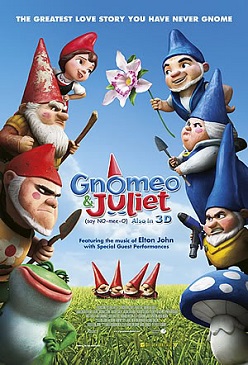
    &Juliet
    1. The creepy age gap- Juliet is only 13 years old in the play. This was a deliberate choice on Shakespeare’s part to make us all wonder if the romance is actually a good idea
    1. The ridiculously short timeline- the play only takes place over six days! As I mentioned in an earlier post, this was another deliberate choice by Shakespeare to  make the action more intense.
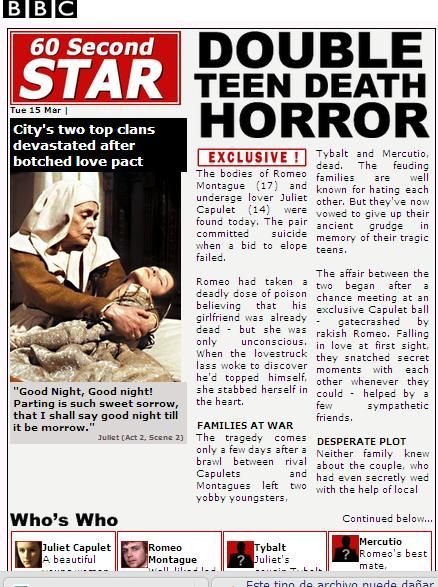
    Fake news report for Romeo and Juliet’s deaths.
    1. There are better plays- I would argue that plays like Hamlet do a better job capturing the experience of young people, and Julius Caesar has more cultural and historical value. That said, this play has still resonated with people for 400 years so, overhyped or not, it still has value!

    If you enjoyed this post, please consider signing up for my online courses on Romeo and Juliet

    Get $10 off my class “Romeo and Juliet: Why Do We Still Read This Play?” with coupon code HTHES4KG1E10 until May 23, 2026. Get started at

    https://outschool.com/classes/romeo-and-juliet-why-do-we-still-read-this-play-wAhPqsrx

    and enter the coupon code at checkout.

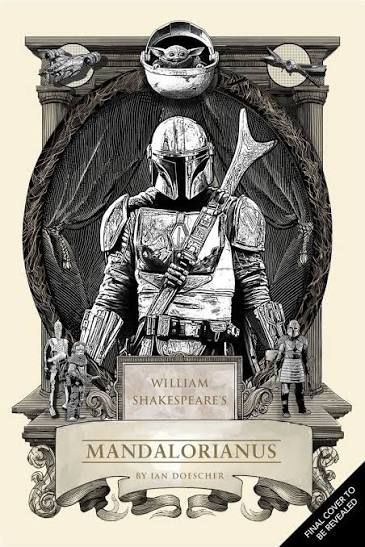
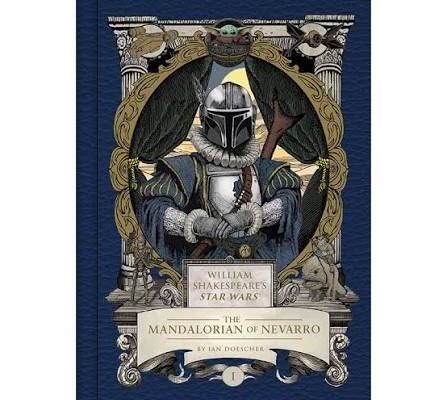
    Review – ‘William Shakespeare’s Star Wars: The Mandalorian of Nevarro’

    Happy May 4th Everyone!

    With the upcoming release of The Mandalorian and Grogo, I knew there would be lots of tie-in Star Wars merchandise capitalizing on it. What I didn’t expect,  was that, after a six year hiatus, playwright Ian Doescher has once again taken up his quills and lightsabers to dramatize the next installment in the Shakespearean Star Wars cannon, The Mandalorian of Nevarro.

    What Is William Shakespeare’s Star Wars?

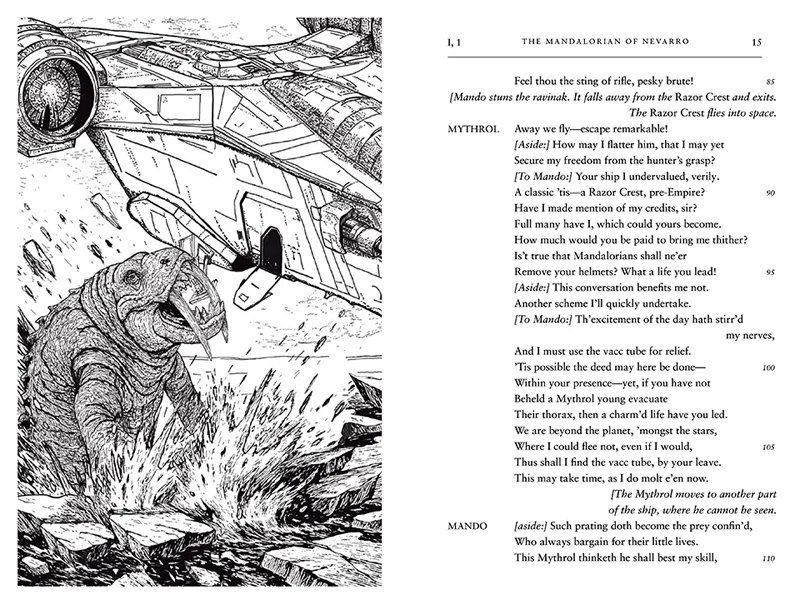
    William Shakespeare’s Star Wars is a series of parody plays written by Ian Doescher that takes the prose screenplays of the Star Wars story and transforms them into Elizabethan verse. Last time, I mentioned how much I loved the cheeky references to Shakespeare and Star Wars, and how Doescher adapts the cinematic quality into Elizabethan drama very well. In my podcast, I also emphasized the way Doescher gives each character verbose Shakespearan language that works very well for radio and theater:

    I’ve written reviews about Mr Doescher’s versions of the original trilogy, but I never expected him to cover the Disney Plus shows, bit he proved me wrong, and by all accounts, this edition lives up to its predecessors.

    https://www.starwarsnewsnet.com/2026/04/review-william-shakespeares-star-wars-the-mandalorian-of-nevarro-reimagines-mando-in-a-worthy-retelling-of-the-series.html

    Interview with Ian Doescher about “The Mandalorian of Nevarro”

    What We Know

    I haven’t gotten a copy yet of the full play, so this will be less of a review and more of a prediction and a fun speculation about how Mr Doescher will handle everyone’s favorite green foster child and Beskar- clad dad.

    When your main character is, quite frankly, one of the most non-theatrical Star Wars protagonists in existence, forcing that character to come out of his shell and give him that Shakespearean flair was always going to be a test. – Nate Manning, Star Wars News.net

    The Mandalorian of Nevarro is a two part series that, like the other William Shakespeare’s Star Wars books, adapts the prose text of episodes 1-4 into Shakespeare’s verse. According to Wookiepedia, the series was originally titled Mandalorius, which is probably a pun on Shakespeare’s play Coriolanus

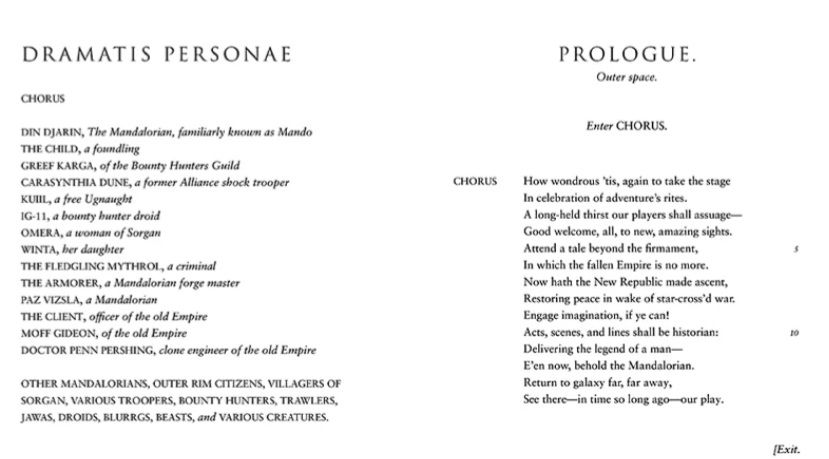
    Prologue and Dramatis Personae for “The Mandalorian of Nevarro”

    What We Can Guess

    One thing I am very curious about is how far Doescher adapted Coriolanus for Mandolorian. As you might have read in my review for Coriolanus, one reason why the play isn’t as popular as some of Shakespeare’s other tragedies is simply that its hero is not very compelling. Coriolanus is not as articulate or wise as Hamlet, nor does his journey form a cohesive arc like Macbeth or Othello.  He seems to flit between loving Rome and hating it, between peace and war, with little agency or understanding of what is happening to him, and even less insight. He is mainly a maddeningly inscrutable man, almost as if he was wearing a mask.

    With all this in mind, I can honestly understand why Doescher might choose the Roman general Caius Martius Coriolanus as a model for Jinn Jaran, (assuming that the final play does in fact do so). Like Coriolanus, Mando is a lone warrior in a fragile republic, who goes from planet to planet with nothing but his ship, and his rigid code of behavior to guide him. Therefore it makes total sense that Doescher would use Coriolanus as a model to emulate when adapting The Mandalorian.

    With all due respect to Shakespeare, what makes Mando a more interesting character from Coriolanus us that he has a compelling Arc. He starts as a solitary bounty hunter to a surrogate father who finds meaning when he adopts a child. It’s like his helmet and armor are metaphors for the uncaring, uncompromising person he was. Over the course of the series, as Mando becomes a better man and a better father, he is forced to remove his armor and form real relationships.

    What I Hope

    I hope this adaptation uses Shakespeare’s ability to conjure images and feelings when telling Mando’s story, but only time will tell.

    May the Forth Be With Thee!

    Mando

    Crafting A Character: Portia (Wife of Brutus

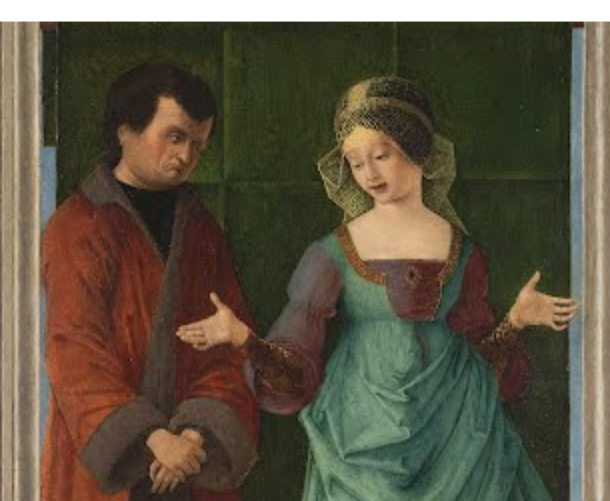
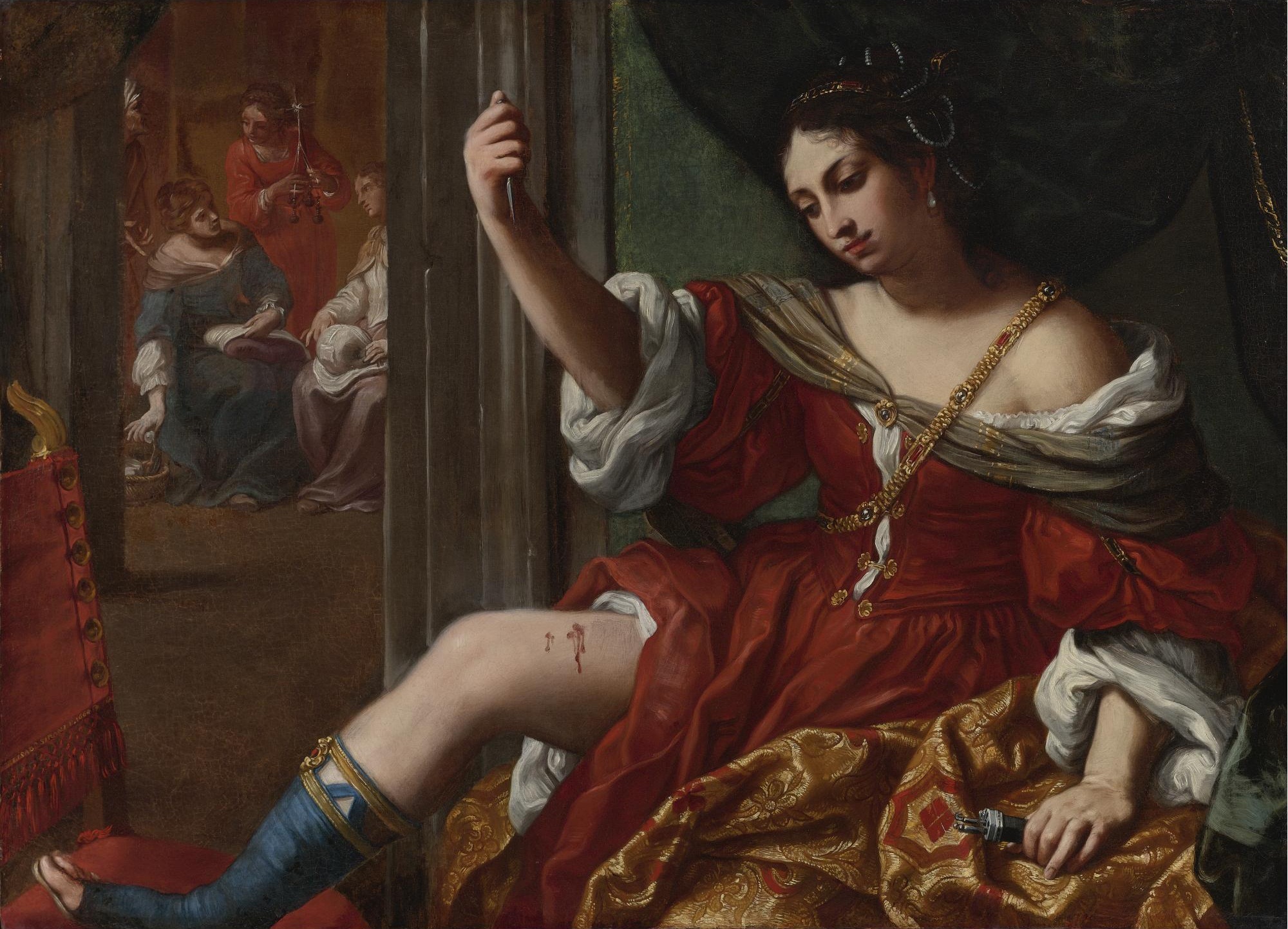
    Portia (Or Porcia), was the wife of Marcus Brutus. Many ancient writers emphasize her courage, beauty, and devotion to her husband and Rome. Many painters and illustrators have chosen to depict her as a model of courage and grace.

    Porcia, as has been said, was a daughter of Cato, and when Brutus, who was her cousin, took her to wife, she was not a virgin; she was, however, still very young, and had by her deceased husband⁠17 a little son whose name was Bibulus. A small book containing memoirs of Brutus was written by him, and is still extant. 4 Porcia, being of an affectionate nature, fond of her husband, and full of sensible pride, did not try to question her husband about his secrets until she had put herself to the following test. 5 She took a little knife, such as barbers use to cut the finger nails, and after banishing all her attendants from her chamber, made a deep gash in her thigh, so that there was a copious flow of blood, and after a little while violent pains and chills and fever followed from the wound. 6 Seeing that Brutus was disturbed and greatly distressed, in the height of her anguish she spoke to him thus: 7 “Brutus, I am Cato’s daughter, and I was brought into thy house, not, like a mere concubine, to share thy bed and board merely, but to be a partner in thy joys, and a partner in thy troubles. 8 Thou, indeed, art faultless as a husband; but how can I show thee any grateful service if I am to share neither thy secret suffering nor the anxiety which craves a loyal confidant? 9 I know that woman’s nature is thought too weak to  p155 endure a secret; but good rearing and excellent companion­ship go far towards strengthening the character, 10 and it is my happy lot to be both the daughter of Cato and the wife of Brutus. Before this I put less confidence in these advantages, but now I know that I am superior even to pain.” 11 Thus having spoken, she showed him her wound and explained her test; whereupon Brutus, amazed, and lifting his hands to heaven, prayed that he might succeed in his undertaking and thus show himself a worthy husband of Porcia. Then he sought to restore his wife. -Plutarch, Life of Brutus

    https://portiacatonis.weebly.com

    She tried to conceal her distress, but a certain painting betrayed her, in spite of her noble spirit hitherto. 3 Its subject was Greek, — Andromache bidding farewell to Hector; she was taking from his arms their little son, while her eyes were fixed upon her husband. 4 When Porcia saw this, the image of her own sorrow presented by it caused her to burst into tears, and she would visit it many times a day and weep before it. 5 And when Acilius, one of the friends of Brutus, recited the verses containing Andromache’s words to Hector,

    “But, Hector, thou to me art father and honoured mother

    And brother; my tender husband, too, art thou,”

    Brutus smiled and said: 6 “But I, certainly, have no mind to address Porcia in the words of Hector,

    ‘Ply loom and distaff and give orders to thy maids,’⁠23

    for though her body is not strong enough to perform such heroic tasks as men do, still, in spirit she is valiant in defence of her country, just as we are.” This story is told by Porcia’s son, Bibulus.

    https://artsandculture.google.com/asset/portia-and-brutus/qQH7qtdFwf6xeA?hl=en&ms=%7B%22x%22%3A0.5%2C%22y%22%3A0.2668803418803419%2C%22z%22%3A8%2C%22size%22%3A%7B%22width%22%3A2.1891025641025643%2C%22height%22%3A0.6672008547008548%7D%7D

    Portia marks a turning point in Shakespeare’s Roman female characters as we we go from more ‘traditional’ female characters, to ones who exemplify masculine virtues. Instead of women being subordinates to men’s affairs and keeping out of religion, politics, and the affairs of Roman society, Portia is a character who demands respect, and to share her husband’s dangers. Some ancient sources suggested possibly Portia might have been the one who inspired Brutus to kill Caesar, (more on that later), but in any case Portia is not a character who is subordinate to men, but who demands to be treated as a Roman citizen.

    Playing Portia