On August 25th, 2026, the world lost an incredible performer. Notable for his film roles in Clue,Muppet Treasuren Island It, the Rocky Horror Picture Show, as well as countless voice-over roles in film, TV, and audiobooks, Mr Curry had an incredible onstage personality and a versitile, commanding voice that landed itself well to slimy villains, megalomaniacal tyrants, and delicate fey characters.
If you’re familiar with his work, you probably won’t be surprised that Curry was a classically trained stage actor with equally impressive credits onstage. He originated the role of Mozart in Amedeus, played Gilbert and Sullivan’s Pirate King to great acclaim, and won numerous theater awards on both sides of the Atlantic.
For a while, I’ve wanted to honor this great performer, but I couldn’t find a way to do it on this platform. That is until I found this:
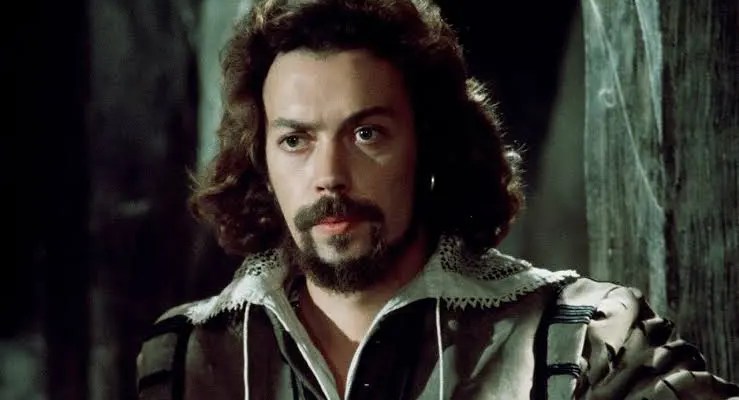
This was a 1978 British TV mini series about the life of Shakespeare, with Mr Curry as the title character. This is why I will provide a series of summaries of these episodes and discuss how Mr Curry adds to the mythos and historiography of Shakespeare
Episode 1: Dead Shepherd
We’re all dying, for poets it just comes earlier
Christopher Marlowe
We begin with Hamnet, no not Shakespeare’s ill-fated son, but Hamnet Sadler, Shakespeare’s friend from Stratford (and his son’s godfather). The fish-out-of water from Stratford has come to pass along messages (and a roasted chicken) to Shakespeare. As he delivers it, Shakespeare boasts about his success as an actor, performing in Doctor Faustus and winning the acclaim of both his fellow actors and the public. The problem is… this tale is a lie; Shakespeare is just a horse valet for the theater, while the brash and flamboyant Christopher Marlowe (Ian McShane), is the greatest playwright in London…for now.
The title refers to how Shakespeare falls in love with theater at first sight, and how London immediately falls in love with his talents.
Tim Curry on Playing Shakespeare
He’s a kind of ambitious country boy who learns fast” driven by the intense, fast-paced survival energy of the Elizabethan age.
Curry’s Shakespeare is full of energy and bravado. This is best demonstrated in the scene where he gets out of a cart full of straw, jumps up to the rafters of the Globe, jumps onstage, recites Faustus, and sings! He has a fiery energy and you can see how this Shakespeare is a man of ambitious energy, yet still possessed of an idealistic soul.
Ian McShane by contrast, is witty and world-weary with a dangerous edge. He has fallen out of love with theater; more interested in court intrigue. This leads him to spy for the Queen like an Elizabethan James Bond. Unlike Bond however, Marlowe is brutally murdered by agents from his own government! While all the London theater mourns his loss, his death also sets the stage for Shakespeare’s meteoric rise as the premier poet of England.
I’ll continue reviewing each subsequent episode on this page and also my podcast. Stay tuned!
You might have read my previous post about Locrine and Humber from that play. Well, today I will continue this series by discussing the other character I play, the mythical founder of Britain, King Brutus.
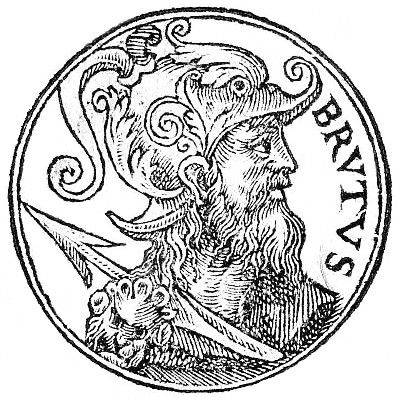
Brutus of Troy
Now before you ask- NO, THIS IS NOT Marcus Brutus, the man who stabbed Julius Caesar. This Brutus actually lived before said conspirator, around the year 11000 BC. Writers like Geoffrey of Monmouth, writing after the Norman Conquest of England, recorded the story of Brutus as a way of getting the British people on board with a single king uniting all of the kingdoms of England.
According to Monmouth (who clearly had an influence on the writer of Locrine), Brutus was the grandson of Aeneas, the sole survivor of the infamous Trojan War. Like the ancient Greek legends of Perseus or Hercules, Brutus is exiled from Italy for accidentally killing his father, and must then create a new empire in Britain.
Brutus! there lies beyond the Gallic bounds An island which the western sea surrounds, By giants once possessed; now few remain To bar thy entrance, or obstruct thy reign. To reach that happy shore thy sails employ; There fate decrees to raise a second Troy, And found an empire in thy royal line, Which time shall ne’er destroy, nor bounds confines – Diana’s speech to Brutus
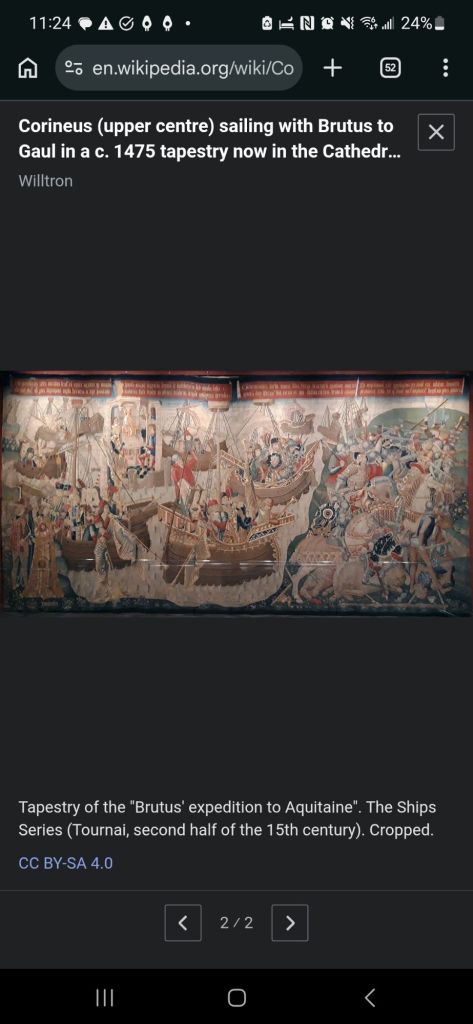
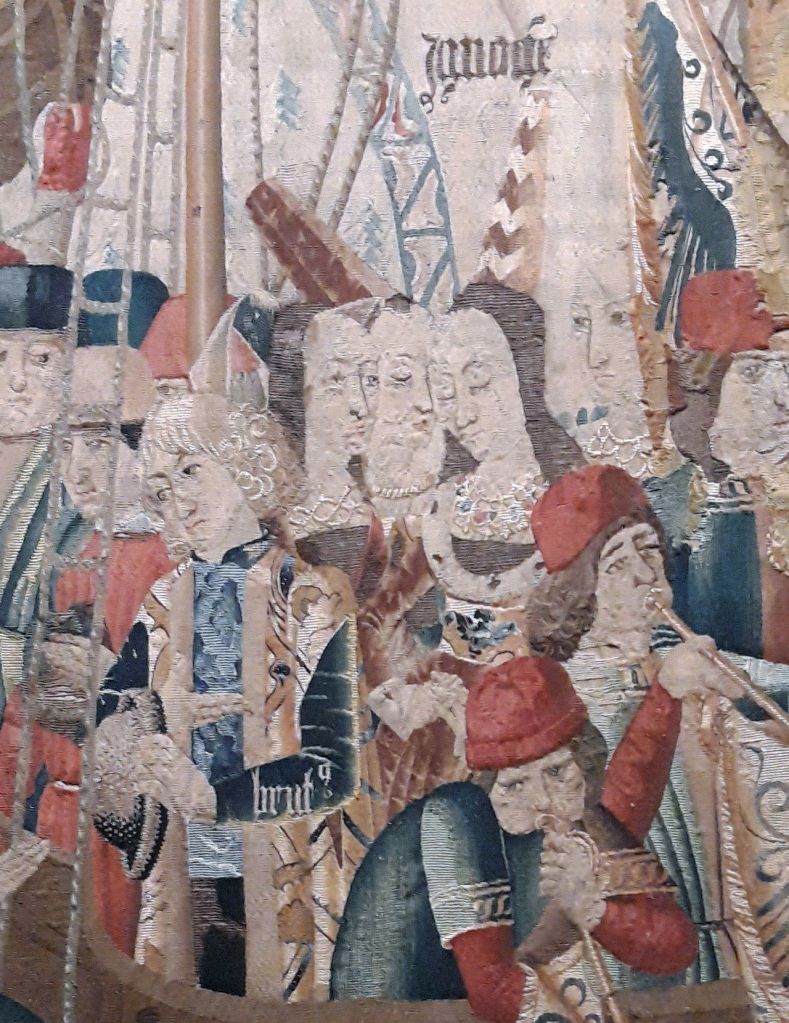
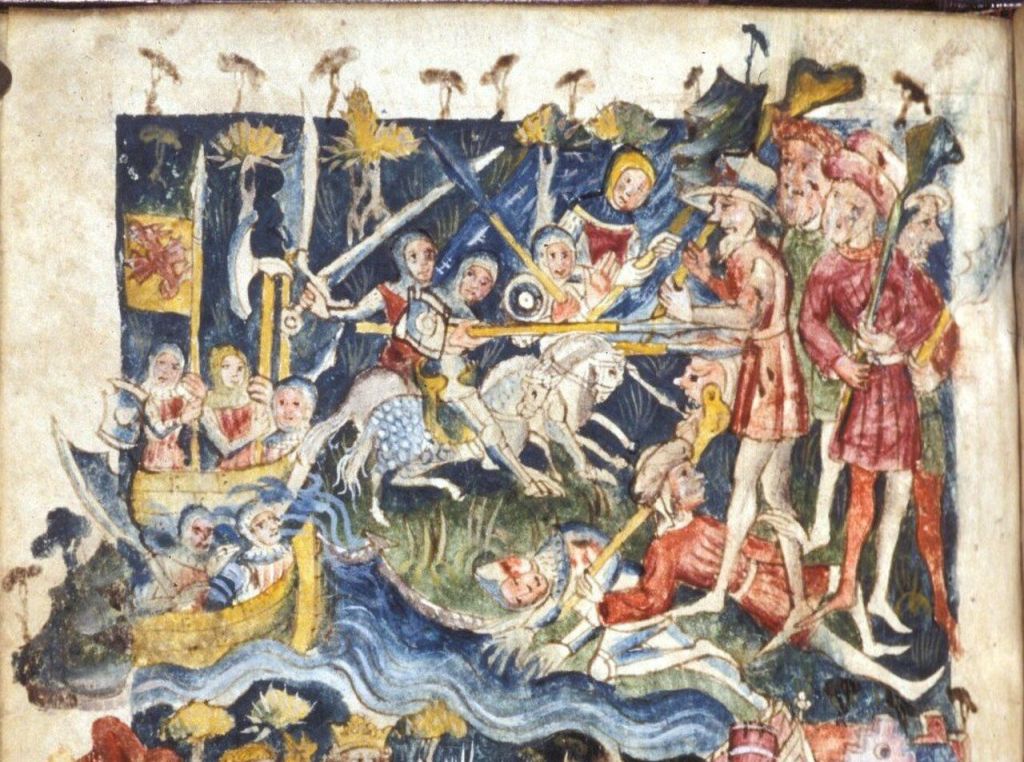
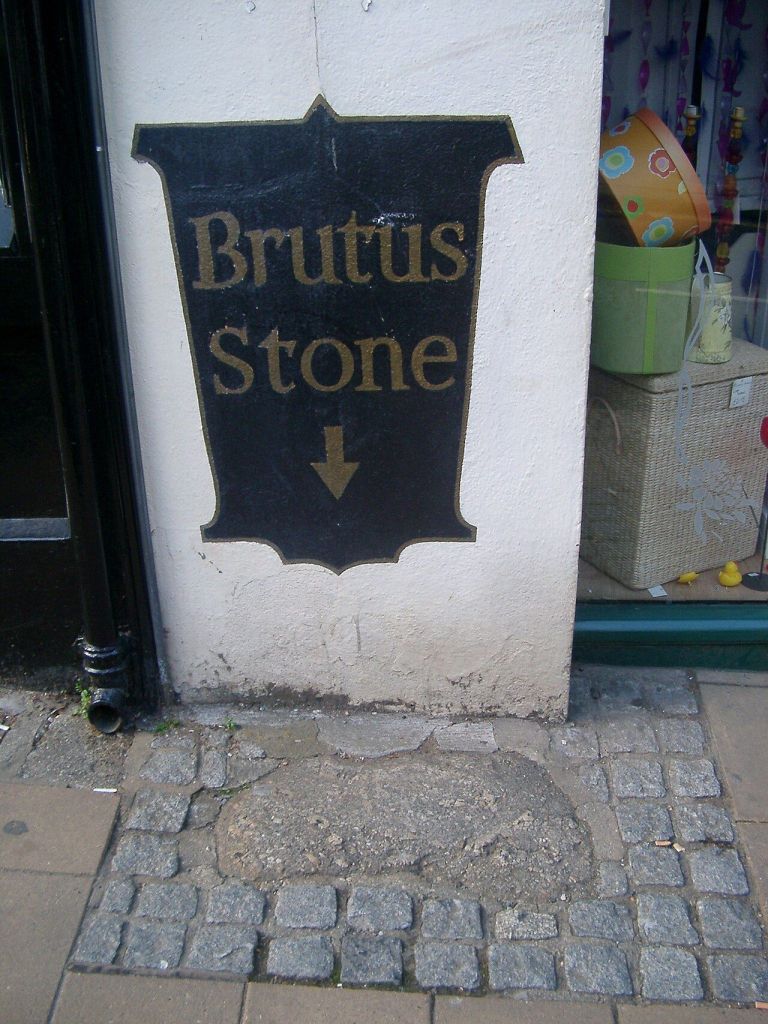
Detail of Brutus and his wife Imogen, sailing from Greece to England.Brutus battles the giants The so-called Brutus stone in Totnes
To secure his empire, Brutus must tame the savage giants that rule the untamed wilderness of Britain, in a mythical battle that is still celebrated to this day.
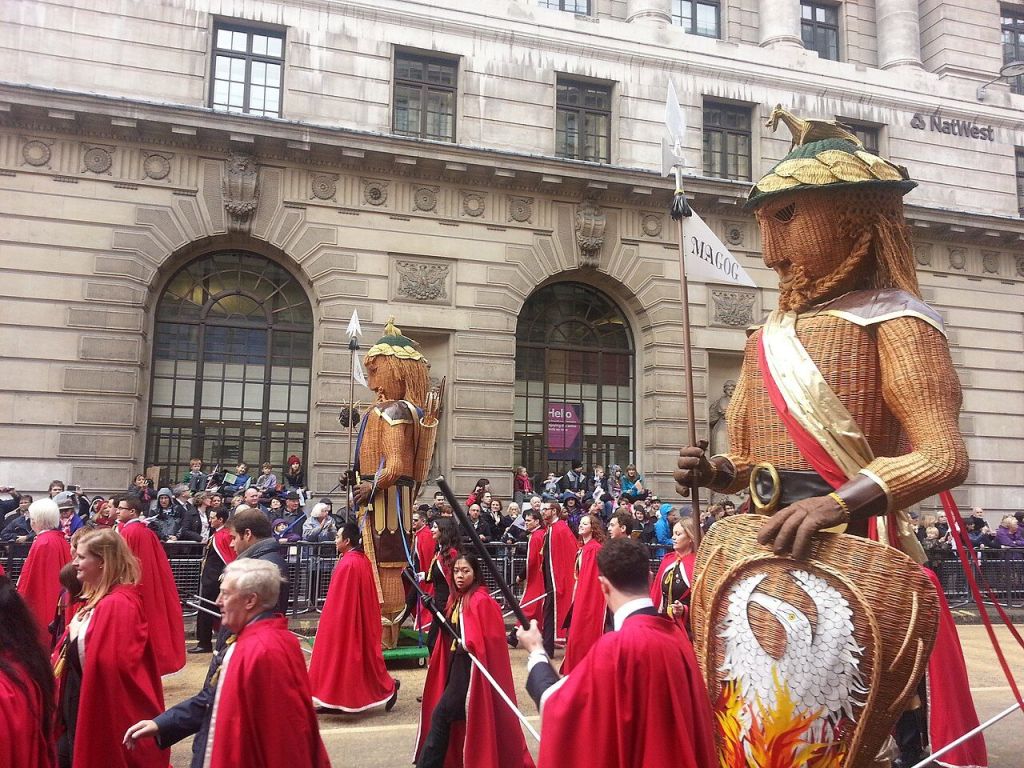
Illustration of Gogmagog Montage of the giant Gogmagog, whom Brutus’ general Corineus slew
At the beginning of the encounter, Corineus and the giant, standing, front to front, held each other strongly in their arms, and panted aloud for breath, but Goëmagot presently grasping Corineus with all his might, broke three of his ribs, two on his right side and one on his left. At which Corineus, highly enraged, roused up his whole strength, and snatching him upon his shoulders, ran with him, as fast as the weight would allow him, to the next shore, and there getting upon the top of a high rock, hurled down the savage monster into the sea; where falling on the sides of craggy rocks, he was torn to pieces, and coloured the waves with his blood- Monmouth
Function in the Play
Legacy of Troy- As I mentioned before, Brutus establishes the link between ancient Troy, and the founding of Britain.
The island was then called Albion,[9] and inhabited by none but a few giants. Notwithstanding this, the pleasant situation of the places, the plenty of rivers abounding with fish, and the engaging prospect of its woods, made Brutus and his company very desirous to fix their habitation in it. They therefore passed through all the provinces, forced the giants to fly into the caves of the mountains, and divided the country among them according to the directions of their commander. After this they began to till the ground and build houses, so that in a little time the country looked like a place that had been long inhabited. At last Brutus called the island after his own name Britain, and his companions Britons; for by these means he desired to perpetuate the memory of his name.
2. Corineus’ Brother In Arms
Like a lot of characters in Shakespeare’s history plays, Brutus has a loyal second in command, Corineus, the mythical founder of the kingdom of Cornwall. After Brutus dies, Corineus is a sort of Lord Protector, lending his council and military experience to Locrine and his brothers:
The name of their commander was Corineus, a modest man in matters of council, and of great courage and boldness, who, in an encounter with any person, even of gigantic stature, would immediately overthrow him, as if he were a child. When they understood from whom he was descended, they joined company with him and those under his government, who from the name of their leader were afterwards called the Cornish people, and indeed were more serviceable to Brutus than the rest in all his engagements. – Historia Regum Britanniae by Geoffrey of Monmouth, c1136
Patriarch– Brutus’ sons become the first kings of England, (Locrine), Scotland (Albanact), and Wales (Camber).
During these transactions, Brutus had by his wife Ignoge three famous sons, whose names were Locrin, Albanact, and Kamber. These, after their father’s death, which happened in the twenty-fourth year after his arrival, buried him in the city which he had built, and then having divided the kingdom of Britain among them, retired each to his government.
Illustration of King Locrine from the Genealogical Chronicle of the Kings of England to Edward IV (c. 1461)Camber- Brutus’ middle sonAlbanact, son of Brutus of TroyGwendoline, legendary Queen regent of Britain.
King Lear Right after Brutus’ story in Monmouth’s chronicle comes the ancient story of King Lear, the same story Shakespeare would later adapt into his own play. Like Lear, Brutus has to divide his kingdom, but unlike Lear, he does not try to test his children’s loyalty.
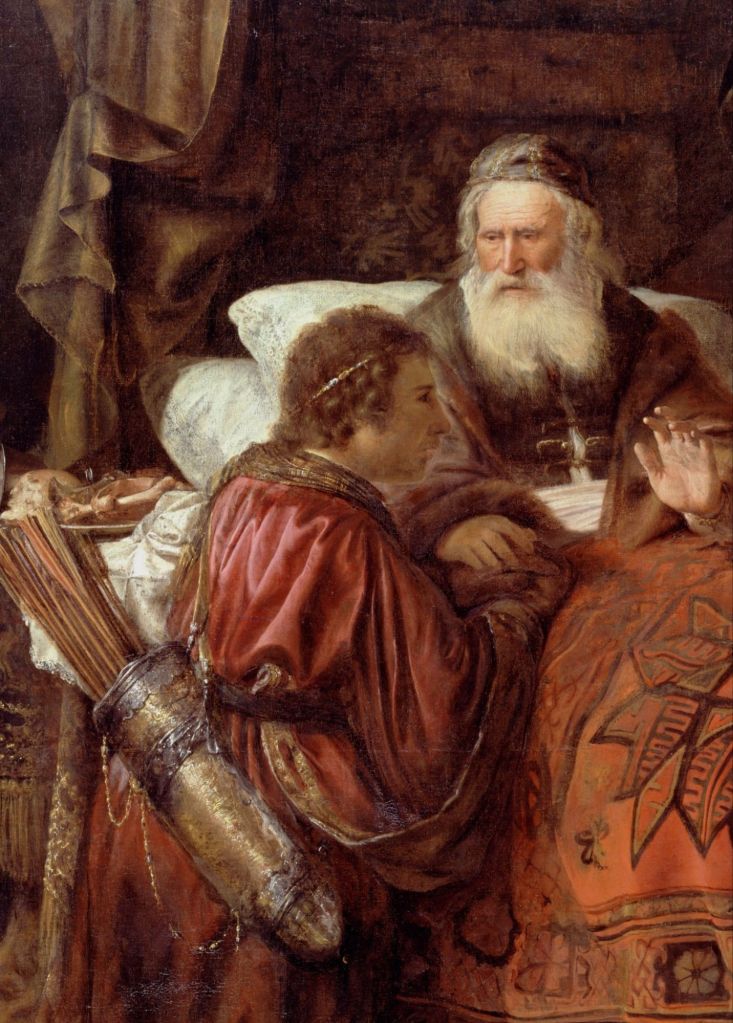
Isaac gives Jacob his blessing
Locrin, the eldest, possessed the middle part of the island, called afterwards from his name, Loegria. Kamber had that part which lies beyond the river Severn, now called Wales, but which was for a long time named Kambria; and hence that people still call themselved in their British tongue Kambri. Albanact, the younger brother, possessed the country he called Albania, now Scotland. After they had a long time reigned in peace together, Humber, king of the Huns, arrived in Albania, and having killed Albanact in battle, forced his people to fly to Locrin for protection.
Our Interpretation
Isaac blesses Jacob
Those who sought to deface our memory, wipe the name of Trojans from the earth Those did I captivate with this mine arm. And in this Isle at length I placed you. – Locrine, Act I.i
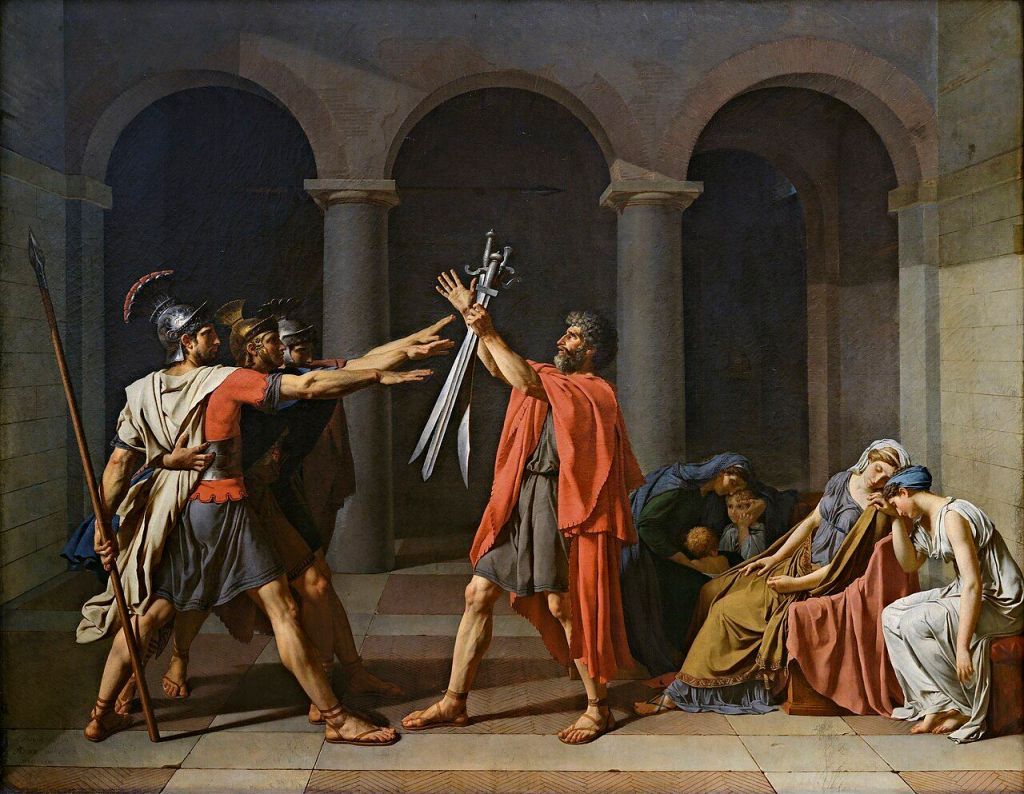
I see Brutus as an intimidating king like Hamlet’s Father (before he became a ghost). I also see him as similar to an Old Testament patriarch like Moses or Isaac- he was led by a god to the promised land, and gave it to his children, who must now protect and defend it.
Oath of the Horatii by Jaques Louis David
Colonizer
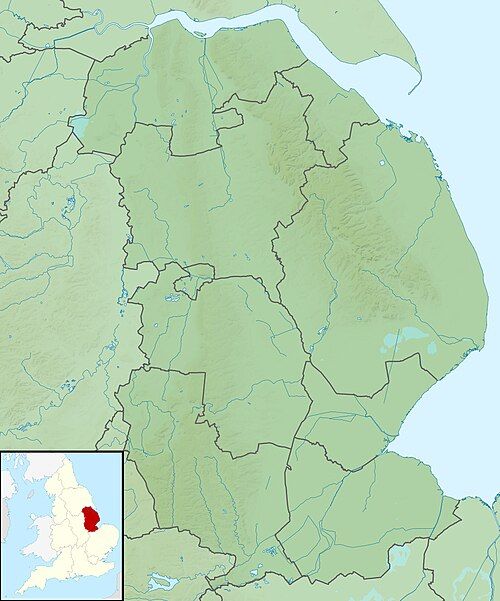
Map of Cornwall
On the other hand, one could also see Brutus as a colonizer- he takes land that wasn’t his and overthrows the natural order. This is a dimension that is not explored in the original story, but our version highlights it.
Playing Brutus
Look and physicality– For such a mythic figure, I tried to play Brutus with as much strength and gravity as possible, at least at first. While he is being introduced and fighting giants, I tried to make him a soldier and King in his prime. After a while though, we see Brutus on his death bed, and I play him as frail and shaky; struggling to keep his kingdom together, as he also struggles to stay alive.
As Brutus ages, I had him divest himself of his armor as he divests his kingdom- to CAMBER, he gives his shield. To Albanact, he gives his sword, and to Locrine, he gives his crown.
Verse
It’s interesting that most of Brutus’ lines are in Trochaic, rather than iambic verse, which could be a way to emulate older forms of verse, but I also suspect that it is designed to emphasize Brutus’ commands.
Then now, my son, thy part is on the stage, For thou must bear the person of a King. [Puts the Crown on his head.] Locrine, stand up, and wear the regal Crown, Cherish and love thy new betrothed wife. Locrine, Act I.i
Well, there you go, Hope you enjoyed this overview of the play Locrine. If you like this review, you might like to see the show itself. Click here to purchase tickets:
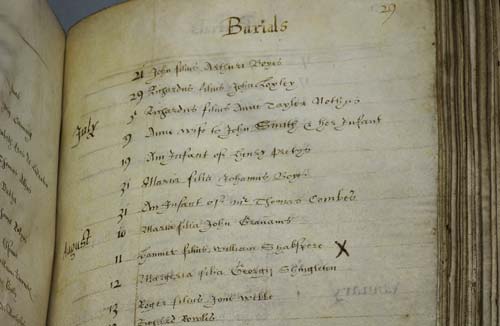
On August 11th, 1596, Shakespeare lost his only son.
Burial Registry of Hamnet Shakespeare
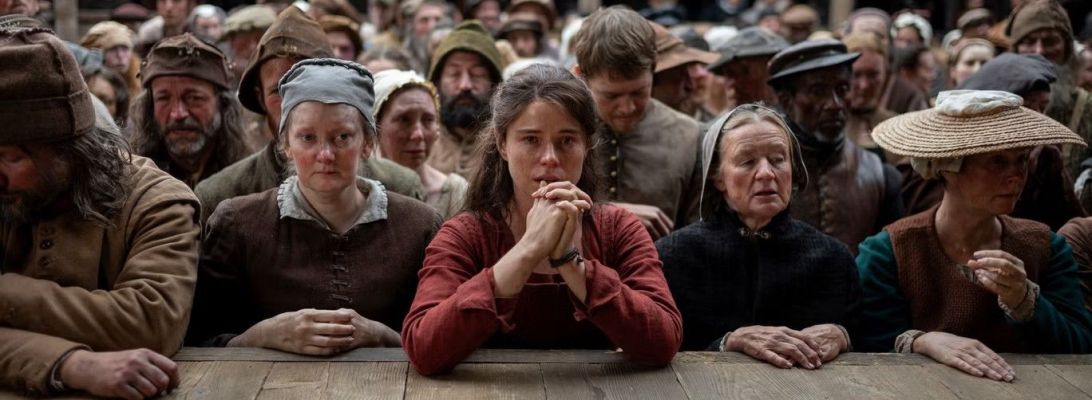
This very day, 2026. I sat down to watch the movie about him. I will compile my thoughts into a complete review in a while, but for now, let’s just say, it was absolutely incredible.
Biography of Hamnet
Just like his famous father, we know very little about the life of Hamnet Shakespeare. Since infant mortality rates were high, we don’t know his exact birthday, only that he was baptized on February 2nd, 1582. Like most 11-year old boys, he probably had started going to school at the King Edward Grammer School, the same as his father. This means he spent long hours away from his parents learning to read and write in Latin and Greek. When he was home, he lived with his mother, his two sisters, and his grandparents in the house of Henley Street.
O’Farrel portrays the boy Hamnet as sensitive and somewhat lonely. The movie captures this
1589-1596
Never mind what I know. You must go.” She pushes at his chest, putting air and space between them, feeling his arms slide off her, disentangling them. His face is crumpled, tense, uncertain. She smiles at him, drawing in breath. “I won’t say goodbye,” she says, keeping her voice steady. “Neither will I.” “I won’t watch you walk away.” “I’ll walk backwards,” he says, backing away, “so I can keep you in my sights.” “All the way to London?” “If I have to.” She laughs. “You’ll fall into a ditch. You’ll crash into a cart.” “So be it.
O’Farrell
The novel portrays Anne Shakespeare realizing that her husband is stifled and unhappy living with his parents in Stratford, and so she suggests to his father that he go to London to ‘expand the family business,’ though in reality, she wants him to go to make his fortune and find more fulfilling work.
A glover will only ever want the skin, the surface, the outer layer. Everything else is useless, an inconvenience, an unnecessary mess. She thinks of the private cruelty behind something as beautiful and perfect as a glove.
Hamnet
The Plague
He wants to tear down the sky, he wants to rip every blossom from that tree, he wishes to take a burning branch and drive that pink-clad girl and her nag over a cliff, just to be rid of them, to clear them all out of his way. So many miles, so much road stands between him and his child, and so few hours left.
Hamnet
In the book, the plague germs that infect Judith and later Hamnet, lie inside a box with some glass beads that the Shakespeare’s ordered from Italy to decorate a pair of fancy gloves.
Hamnet’s Death
He can feel Death in the room, hovering in the shadows, over there beside the door, head averted, but watching all the same, always watching. It is waiting, biding its time. It will slide forward on skinless feet, with breath of damp ashes, to take her, to clasp her in its cold embrace, and he, Hamnet, will not be able to wrest her free.
Hamnet
In the novel, Hamnet somehow takes the plague away from his sister and dies in her place. Though it is hardly conclusive, I do find it interesting that Shakespeare stopped writing comedies about twins for another four years after Hamnet’s death, until he wrote Twelfth Night, which unlike earlier comedies like The Comedy of Errors, has a pair of twins mourning each other’s apparent death. They seem to share one soul, and one tries to resurrect the other, like Viola mourning her brother by, (in a sense), becoming her brother.
What should I do in Ilyria? My brother is in Elysium
Viola- “Twelfth Night”, Act I, Scene ii.
ELIZABETHAN FUNERAL CUSTOMS
In the book, Anne makes a winding sheet for her son. This was a cloth of linen or wool that was wrapped around dead bodies, since at the time, coffins were re-used. This must have been a somber and deeply upsetting activity for Anne.
The act of making a winding sheet was a sort of sad family responsibility, a way of ensuring that your loved ones die with dignity, and Anne clearly takes the task of making one very seriously.
The Aftermath Of Hamnet’s Death (Spoilers)
The Women of Hamnet
The most unique thing about this novel is how it shows the interdependence of women in Elizabethan society. Since Shakespeare spends most of the novel away from Anne, her support system mostly comes from Will’s mother Mary, as well as Anne’s daughters, her sister, and all the other women of the town. Nowadays we do most of our socialization online and barely know our own neighbors, but in the 1590s, especially for women, community was a way of building strength where women got through things like childbirth, loss, the managing of households, and many other difficulties through their relationships with other women. This video below shows the kinds of home remedies that women would share and later write down during the Tudor period:
Other Mysteries Solved
Once Hamnet dies, Will buys her a new house, New Place so she isn’t forced to live with his parents and no longer has to live in the house where her son died. But Will’s success comes with a price- he still has to leave for London. he offers to move them there but Agnes won’t hear of it. This solves the riddle of why Shakespeare commuted between town and country for his entire career- she knows the plague that took her son literally came from London, and she won’t risk losing her daughteras well. She probably also sees London like another woman that took her husband away as well, and therefore refuses to look it in the face.
It is no matter,” she pants, as they struggle there, beside the guzzling swine. “I know. You are caught by that place, like a hooked fish.” “What place? You mean London?” “No, the place in your head. I saw it once, a long time ago, a whole country in there, a landscape. You have gone to that place and it is now more real to you than anywhere else. Nothing can keep you from it. Not even the death of your own child. I see this,” she says to him, as he binds her wrists together with one of his hands, reaching down for the bag at his feet with the other. “Don’t think I don’t.”
O’Farrell, Hamnet.
The Shakespeares’ Marriage after Hamnet
The ugly truth that O’Farrell highlights in Hamnet is that it must have been very hard for the Shakespeares to endure Hamnet’s death, especially since Will was probably not there when it happened, and probably didn’t stay around long after burying his son.
Hamnet and Shakespeare
Raising the Dead
Hamlet, here, on this stage, is two people, the young man, alive, and the father, dead. He is both alive and dead. Her husband has brought him back to life, in the only way he can. As the ghost talks, she sees that her husband, in writing this, in taking the role of the ghost, has changed places with his son. He has taken his son’s death and made it his own; he has put himself in death’s clutches, resurrecting the boy in his place. “O horrible! O horrible! Most horrible!” murmurs her husband’s ghoulish voice, recalling the agony of his death.
O’Farrell, “Hamnet”
References
Journals
Bray, Peter. “Men, loss and spiritual emergency: Shakespeare, the death of Hamnet and the making of Hamlet.” Journal of Men, Masculinities and Spirituality, vol. 2, no. 2, June 2008, pp. 95+. Gale Literature Resource Center, link.gale.com/apps/doc/A189052376/LitRC?u=pl9286&sid=bookmark-LitRC&xid=ea79f235. Accessed 20 Apr. 2023.
Period Documents
Document-specific information Creator: Holy Trinity Church, Stratford-upon-Avon Title: Parish Register of Holy Trinity Church, Stratford-upon-Avon Date: 1558-1776 Repository: The Shakespeare Birthplace Trust, Stratford-upon-Avon, UK Call number and opening: DR243/1: Baptismal register, fol. 22v View online bibliographic record
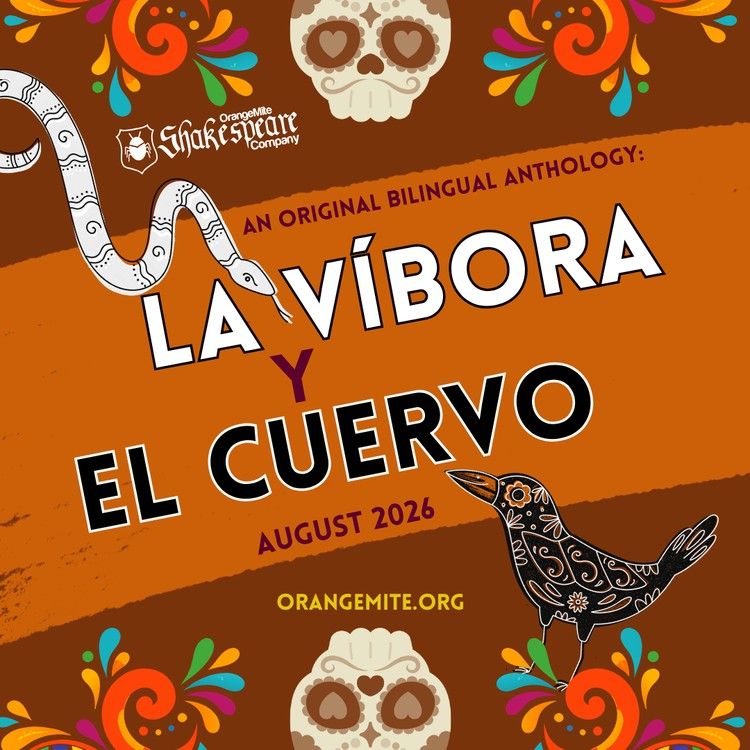
I’m pleased to announce that I will be playing Humber, the Scithian Emperor who tried to conquer England, in a very special adaptation of Locrine in August of 2026.
What is Locrine?
Locrine is an Elizabethan play, first published in 1595, whose author is, sadly, lost to history. The play is a mythologized history of the founding of Britain, which the play calls New Troy.
Our Interpretation
Our version of Locrine is a hybrid between the original play, and stories from the indigenous people of Mexico in the huasteca region. Our director chose to reinterpret Humber as an existential threat to the natural world of Mexico- a threat to the people and the environment, who is defeated not just by Locrine’s army, but by the forces of nature themselves.
Myth vs History
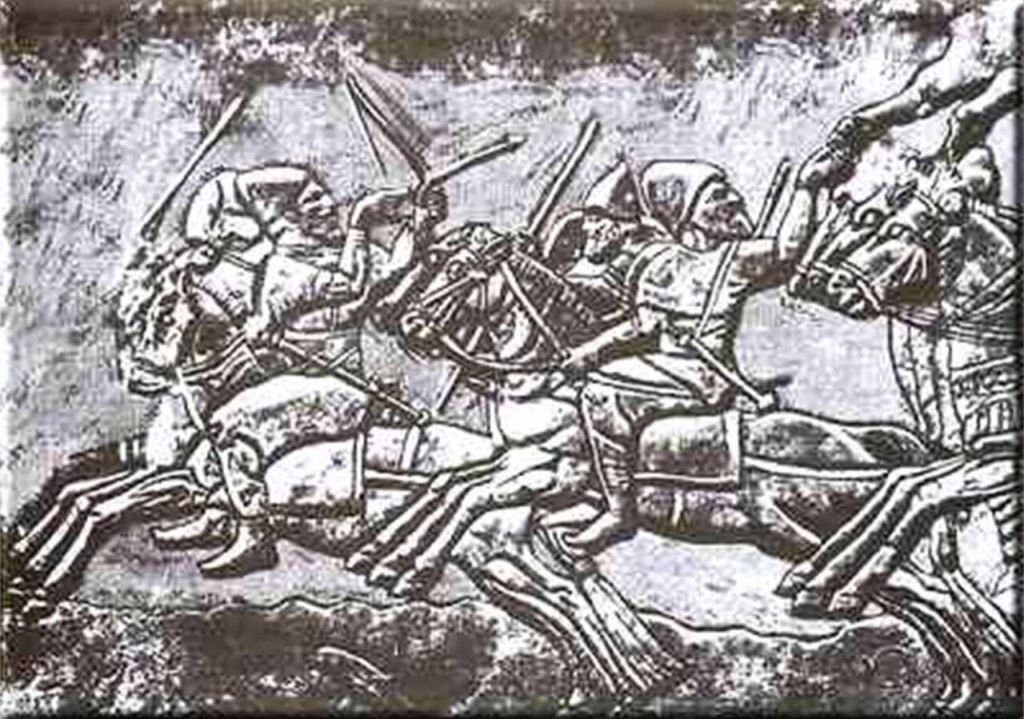
Ancient Scithian horse warriors
The Scythian Emperor- Scythia was originally modern day Iran, but many Scithian tribes also lived in places like Ukraine and Russia. They were nomads who primarily used their skills in mounted warfare to conquer regional fifedoms, organized under a single emperor.
Function Within the Play
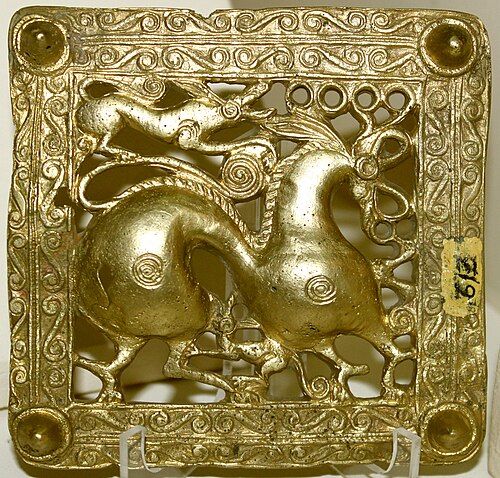
Ancient golden Scithian belt buckle
Ravisher of Nature- as Humber tries to conquer the people of England, he also destroys the natural world.
Usurper/ Conqueror of the Britains- in our version of Locrine, Humber’s war to conquer Britain is analogous to the European colonizers who fought to dominate America such as the French, the Dutch, and of course, the Spanish.
We are retired with joyful victory. The slaughtered trojans squeltering in their blood, infect the air with their carcasses, and are a prey for every ravenous bird.
Locrine, Act 2 Scene 6
Playing Humber
Right now, I am playing Humber as a narcissist, a man who, at his core, is deeply insecure but tries to overcompensate it by acting like an invincible monarch- one who fills the void in his soul with land, slaves, possessions, and gold. He is good at persuading people and inspiring them to fight for him, but he cares for no one but himself.
High on a bank by Nilus’ boistrous streams, Fearfully sat the Egyptian Crocodile, Dreadfully grinding in her sharp long teeth The broken bowels of a silly fish. [A crocodile swims across the stage, eating a fish.] His back was armed against the dint of spear, With shields of brass that shined like burnished gold; And as he stretched forth his cruel paws, A subtle Adder, creeping closely near, Thrusting his forked sting into his claws, Privily shed his poison through his bones. So Humber, having conquered Albanact, Doth yield his glory unto Locrine’s sword. Mark what ensues, and you may easily see, That all our life is but a Tragedy. –Locrine, Act III prologue.
A snake struggling with an alligator, eventually gets the upper hand, or coil.
In the play, Humber is compared to a fearsome predator- a crocodile, which was actually the sigil on his shield. I took inspiration from the animal, and used a serpentine physicality when playing him. I also decided to give myself a crocodile smile- I keep my head down, stared my enemies in the eye, and then- struck!
Gloucester’s show Beguiles him as the mournful crocodile With sorrow snares relenting passengers- Henry VI, Part II.
Inspirations
From History-
Again, Locrine is not a history play and Humber, as far as we know, was not a real person. Rather than a legitimate chronicle, Locrine is a mythologized history of the founding of Britain. The Scithians never actually invaded Britain, (although some early chronicles claim that the Saxons were descended from them). Our version of Locrine conflates the foundation of Britain with the conquest of America, (specifically the struggle between English colonists and the Spanish conquistadors,) and there is one man who has come to symbolize the ruthless might and lust for gold that the Spanish had in the early conquest of the American continent more than any other Conquistador- Hernan Cortez, governor of New Spain, and conqueror of the Mexican empire.
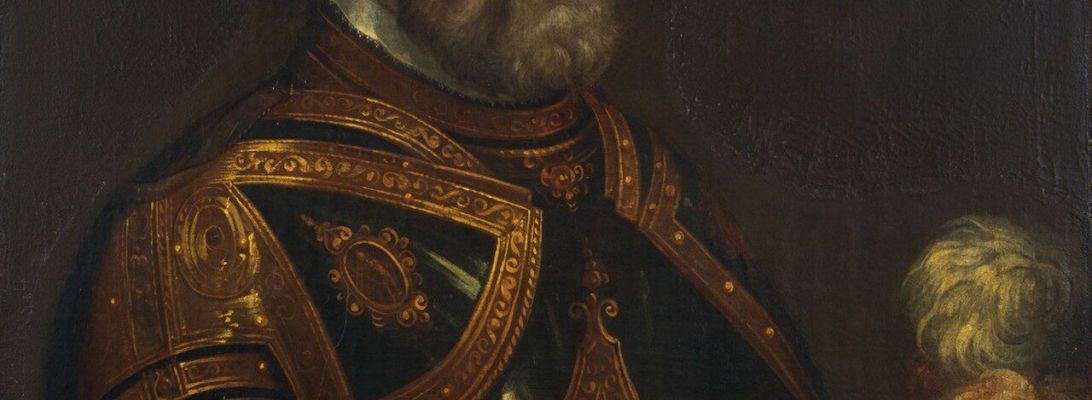
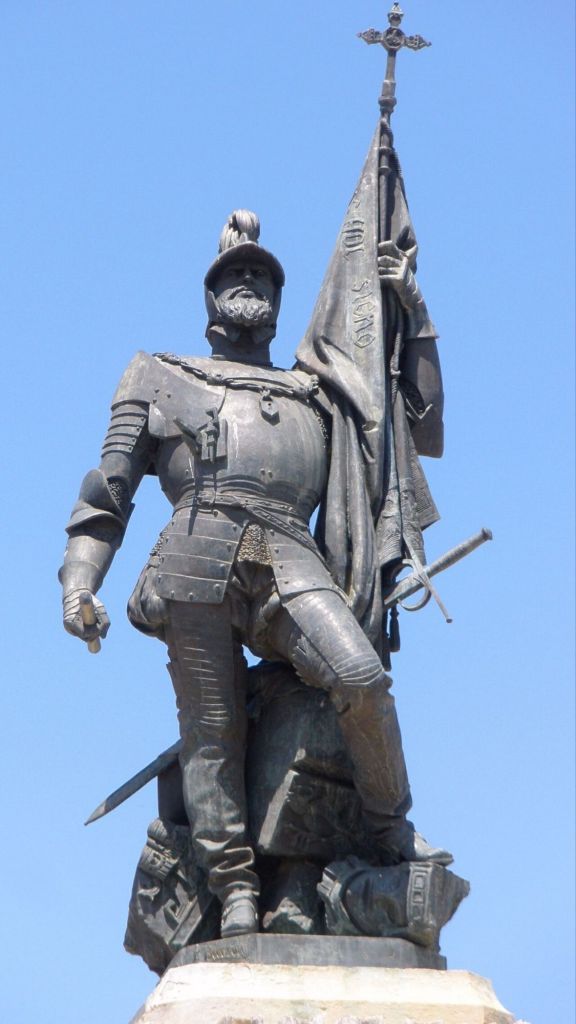
Statue of Cortez. Notice the broken Aztec statue under his foot.
We Spaniards know a sickness of the heart that only gold can cure- Hernan Cortez (allegedly)
Cortez was a man of insatiable greed and lust for power. He was born a minor noble with a gift for diplomacy and exceptional courage. He eventually slaughtered thousands of the Mexican people, supplanted their ruler Montezuma, and razed their capital city of Tenochtitlán, rebranding it as Mexico City, capital of the New Spanish empire.
Mural on the Battle of Centla and the conquest of Tabasco, by Homero Magaña Arellano.
Like Humber, Cortez was more of an administrator than a soldier, but nevertheless, he did lead his army successfully against the native people in several key battles, where they used their cavalry and cannons to devastating effect. He also ravished hundreds of Indigenous women who sired his illegitimate children- like our Humber, he lusted for women in addition to gold.
Cortez was careful to appear pious to his soldiers and respectful to the native people he encountered, but this was a calculated act designed to get loyalty and obedience from the people around him. According to his biography, Cortez had a zero-tolerance policy for blasphemy, and told his soldiers to respect the native Mexica. Again, Cortez’s real goal was to keep his men loyal to their “pious” commander and to make the people trust him…while he robbed them blind. Talk about crocodile tears.
Cortez’s victories allowed him to build palaces for himself to rule over the Mexica, as well as a royal charter for himself, and of course, GOLD.
The Spaniards appeared to be much delighted, they seized upon the gold like monkeys, their faces flushed. For clearly their thirst for gold was insatiable; they starved for it; they lusted for it; they wanted to stuff themselves with it as if they were pigs. They went about fingering handling the streamers of gold, passing them back and forth, grabbing them one to the other babbling, talking gibberish among themselves. – Bernardino de Sahagún
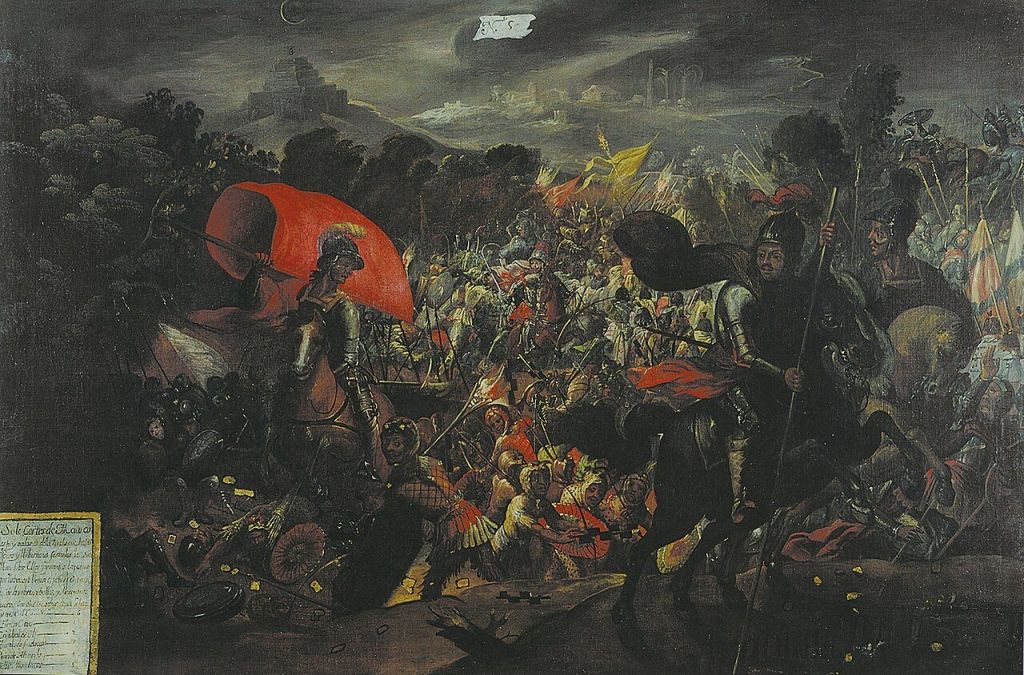
In Locrine, Humber is defeated offstage and forced to starve to death in a desert wilderness. To fill in the blanks, I looked at events from Cortez’s life and death. The real Cortez died of dysentary in 1547, but I like to imagine Humber- Cortez being chased away by Locrine’s army, similar to his narrow escape from Tenochtitlán during the famous Noche Triste (30 June – 1 July 1520)
Cortez and his soldiers narrowly escape Tenochtitlán
From Shakespeare-
Shakespeare rarely writes characters who are wholy evil, so for the first three acts, I mainly thought of another Sythian conqueror- Christopher Marlowe’s Tamborlaine. He is not so
much a man as a force of nature, eager to kill, conquer, and take power and riches from the natural world.
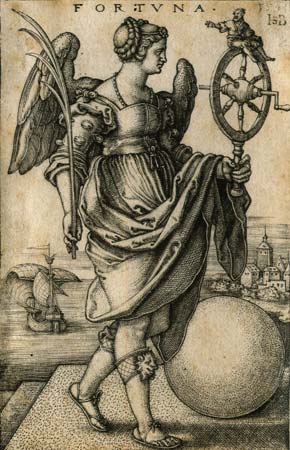
The Roman Goddess Fortuna, with her wheel and orb.
In the later acts of Locrine however, Humber is… well humbled ater losing the war, losing his son, and losing his wife. His laments for his son bear a striking resemblance to Titus Andronicus.
Humber speech III, Scene 5, performed by One Woman Shakespeare
Verse
At the end of his life, Humber reverts to a primitive shadow of his former self- Humber is forced to hide in desert caves, and live on berries and roots. His cruel, bitter laments and desire to cast himself into the sea is almost perfect parallel to Shakespeare’s Timon of Athens.
Timon in the cave
What basilisk was hatched in this place, Where everything consumed is to nought? What fearful Fury haunts these cursed groves, Where not a root is left for me to eat? Hath fell Alecto, with invenomed blasts, Breathed forth poison in these tender plains? What, not a root, no fruit, no beast, no bird, To nourish Humber in this wilderness? My very entrails burn for want of drink, These foul accursed groves afford no meat, The gods, hard-hearted gods, yield me no meat. Was ever land so fruitless as this land? Was ever soil so barren as this soil? No, even the climate of the torrid zone Brings forth more fruit than this accursed grove
In Conclusion
Humber is a great deal of fun- he’s a cartoon-like villain at first, but after he loses to Locrine, he seems more human, longing to be reunited with his son. Even though he’s not the main character, he has a tragic character’s arc. In short, he’s great to play, and I hope he’ll be great to watch!
With summer break approaching, why not give your kids the gift of learning Shakespeare in a low-key, no-pressure scenario? I have classes on Shakespeare’s life, Romeo and Juliet, and my celebrated Stage Combat class! Sign up now for all the fun on Outschool.com!
Shakespeare and Star Wars
Class Description: Using self-paced online activities, your child(ren) will compare the plot and characters of Star Wars to Shakespeare’s plays. We will also discuss Shakespeare’s writing by looking at “William Shakespeare’s Star Wars” by Ian Doescher.
Romeo and Juliet Murder Mystery
Course Description: A flexible schedule class that teaches kids the plot and characters of “Romeo and Juliet,” in the context of a detective story where you solve the mystery of the young lovers’ deaths.
Course Descriptions
How to Write Like Shakespeare: Learn the basics of iambic pentameter, sonnet form, and Shakespeare’s dramatic structure, and practice writing Shakespearean speeches.
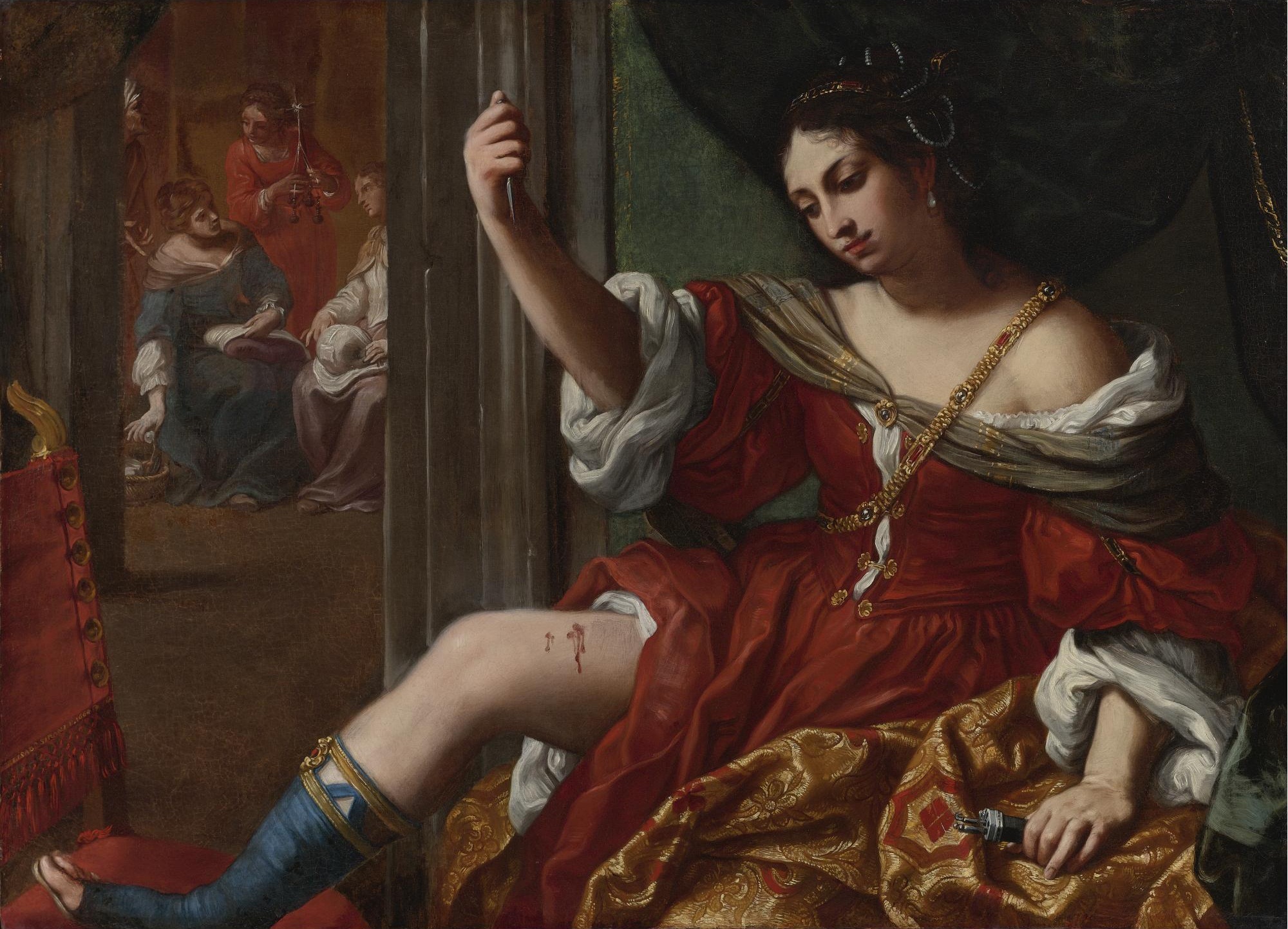
Elisabetta Sirani, Portia Wounding her Thigh, 1664, oil on canvas, 101 x 138 cm (Collezioni d’Arte e di Storia della Fondazione della Cassa di Risparmio, Bologna)The suicide of Porcia, Pierre Mignard. Museum of Fine Arts of Rennes, 1650.
Portia (Or Porcia), was the wife of Marcus Brutus. Many ancient writers emphasize her courage, beauty, and devotion to her husband and Rome. Many painters and illustrators have chosen to depict her as a model of courage and grace.
Porcia, as has been said, was a daughter of Cato, and when Brutus, who was her cousin, took her to wife, she was not a virgin; she was, however, still very young, and had by her deceased husband17 a little son whose name was Bibulus. A small book containing memoirs of Brutus was written by him, and is still extant. 4 Porcia, being of an affectionate nature, fond of her husband, and full of sensible pride, did not try to question her husband about his secrets until she had put herself to the following test. 5 She took a little knife, such as barbers use to cut the finger nails, and after banishing all her attendants from her chamber, made a deep gash in her thigh, so that there was a copious flow of blood, and after a little while violent pains and chills and fever followed from the wound. 6 Seeing that Brutus was disturbed and greatly distressed, in the height of her anguish she spoke to him thus: 7 “Brutus, I am Cato’s daughter, and I was brought into thy house, not, like a mere concubine, to share thy bed and board merely, but to be a partner in thy joys, and a partner in thy troubles. 8 Thou, indeed, art faultless as a husband; but how can I show thee any grateful service if I am to share neither thy secret suffering nor the anxiety which craves a loyal confidant? 9 I know that woman’s nature is thought too weak to p155 endure a secret; but good rearing and excellent companionship go far towards strengthening the character, 10 and it is my happy lot to be both the daughter of Cato and the wife of Brutus. Before this I put less confidence in these advantages, but now I know that I am superior even to pain.” 11 Thus having spoken, she showed him her wound and explained her test; whereupon Brutus, amazed, and lifting his hands to heaven, prayed that he might succeed in his undertaking and thus show himself a worthy husband of Porcia. Then he sought to restore his wife. -Plutarch, Life of Brutus
She tried to conceal her distress, but a certain painting betrayed her, in spite of her noble spirit hitherto. 3 Its subject was Greek, — Andromache bidding farewell to Hector; she was taking from his arms their little son, while her eyes were fixed upon her husband. 4 When Porcia saw this, the image of her own sorrow presented by it caused her to burst into tears, and she would visit it many times a day and weep before it. 5 And when Acilius, one of the friends of Brutus, recited the verses containing Andromache’s words to Hector,
“But, Hector, thou to me art father and honoured mother
And brother; my tender husband, too, art thou,”
Brutus smiled and said: 6 “But I, certainly, have no mind to address Porcia in the words of Hector,
‘Ply loom and distaff and give orders to thy maids,’23
for though her body is not strong enough to perform such heroic tasks as men do, still, in spirit she is valiant in defence of her country, just as we are.” This story is told by Porcia’s son, Bibulus.
Portia marks a turning point in Shakespeare’s Roman female characters as we we go from more ‘traditional’ female characters, to ones who exemplify masculine virtues. Instead of women being subordinates to men’s affairs and keeping out of religion, politics, and the affairs of Roman society, Portia is a character who demands respect, and to share her husband’s dangers. Some ancient sources suggested possibly Portia might have been the one who inspired Brutus to kill Caesar, (more on that later), but in any case Portia is not a character who is subordinate to men, but who demands to be treated as a Roman citizen.
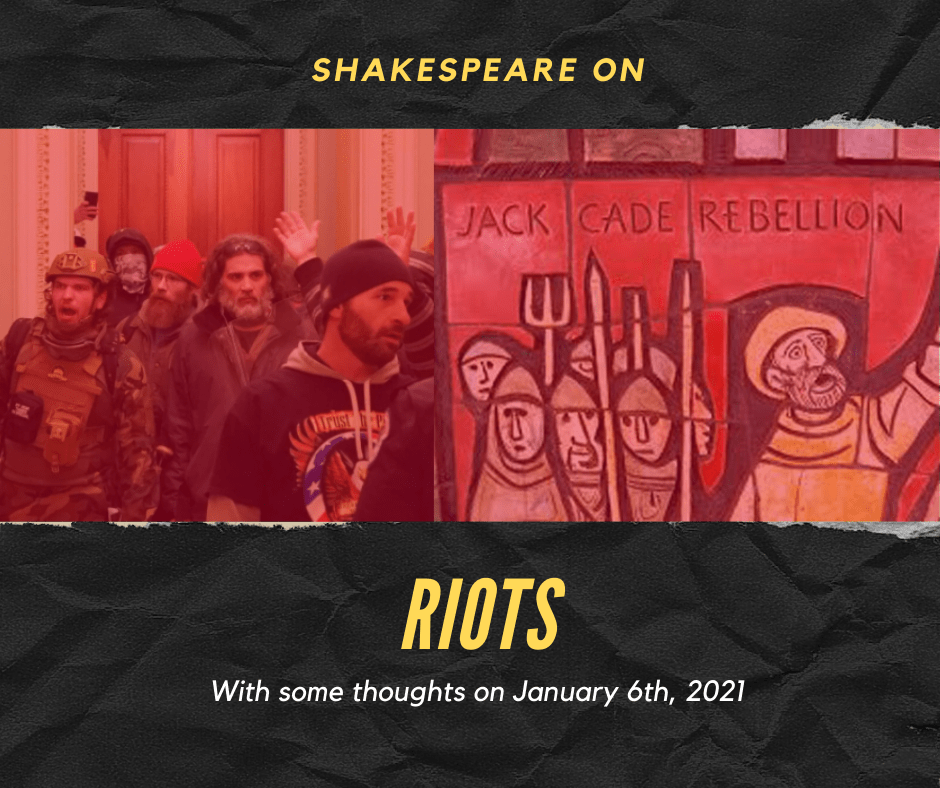
Today is the Ides o fMarch, a day that history still bewares, because of the infamous day when armed, violent conspirators went to the Senate and attempted to overthrow elected rulers. For obvious reasons, this put me in mind of the heinous actions of another group of conspirators stormed another Senate and tried to overthrow a stable republic.
January 6th, 2021 (which, coincidently, was Twelfth Night, one of my favorite Shakespeare-themed holidays), was a tragedy for multiple reasons. The protestors broke windows, destroyed furniture, defaced statues, broke into both chambers of Congress, and probably would have harmed lawmakers, in a violent protest of both the US presidential election and the Senate vote in Georgia that week.
Let me be clear, this was sedition and treason and everyone involved should be prosecuted to the full extent of the law. Anyone who says otherwise is blatantly attacking our cherished democracy, and spitting in the face of the rule of law. Unfortunately, Republicans in both chambers have been unwilling to condemn their actions for fear of alienating their base. If this is what the Republican party has come to, the party doesn’t deserve the name. A republic protects the right of the people to elect its representatives and dedicates itself to the peaceful transition of power. Left unchallenged, groups like this will bring anarchy and tyranny to our country.
How do I know this? Because it happened before. Shakespeare has long dramatized real historic events where people rise up against their governments (for better or worse). In all cases, whether protesting a famine, a war, or a cruel tyrannical usurper, the riots never accomplish anything except bringing chaos and bloodshed. Sometimes these ignorant rioters are goaded by charismatic powerful figures, but these upper-class characters are only exploiting the rioters, using their violence as a way to get power for themselves. So, let’s examine the language, tactics, and effects of rioters in three of Shakespeare’s plays: Julius Caesar, Henry VI Part III, and Sir Thomas More:
Example 1: Julius Caesar
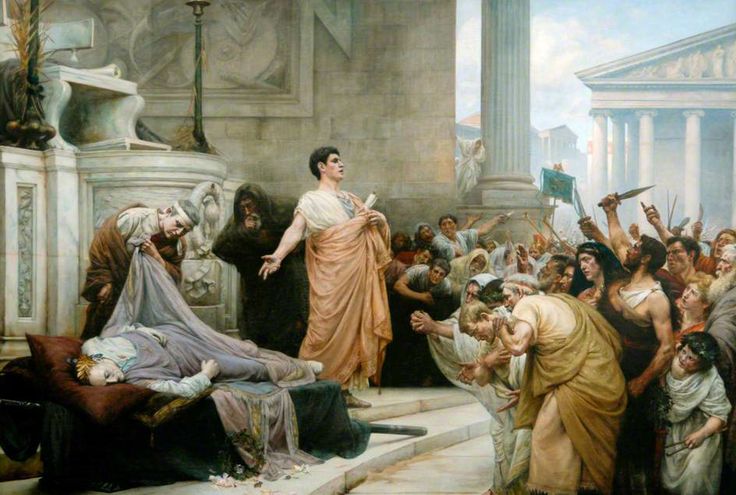
(c) Hartlepool Museums and Heritage Service; Supplied by The Public Catalogue Foundation
As I covered before in my “Friends, Romans, Countrymen,” post, during Antony’s famous funeral speech, he galvanizes the Roman crowd, first to mourn Caesar, then to revenge his death. How do they do this? By burning the houses of the conspirators and rioting in the street. They even kill a man just because he has the same name as one of the conspirators:
What does this violence accomplish? Nothing. Caesar is still dead. Brutus is still alive (though on the run). Antony merely wished to punish Brutus, and get the mob to hate him while he secretly cheats them out of their money. In Act Four, Antony becomes the de facto ruler of Rome because he leveraged his performance at the funeral, and uses his newfound powers to take money away from the citizens that Caesar promised to give them in his will. He manipulated them for his own purposes and duped them for political power.
Example 2: Jack Cade in Henry VI, Part ii.
Henry VI is the only king in English history to be crowned twice, deposed twice, and buried twice (Saccio 91). As the play begins, King Henry has already lost France, lost his mind, and lost the respect of his people. Around 1455, John Hardyng wrote a contrast between Henry’s father and himself. He laments that Henry the Fifth died so soon and then exhorts Henry to keep the quarrelsome lords in his government from warring among themselves.
Withstand, good lord, the outbreak of debates. And chastise well also the rioters Who in each shire are now confederates Against your peace, and all their maintainers For truly else will fall the fairest flowers Of your great crown and noble monarchy Which God defend and keep through his mercy.
(Excerpt from Harding’s Chronicle, English Historical Documents, 274).
Henry’s political ineptness was why Richard of York challenged his claim to the throne. Though Richard had little legal claim as king, he believed himself to be better than Henry.
In Shakespeare’s play Henry VI, Part ii, York tries to get the people’s support by engineering a crisis that he can easily solve. York dupes a man named Jack Cade to start a riot in London and demand that the magistrates crown Cade as the true king.
Biography of Richard, Duke of York, who challenged King Henry VI for his right to be king.
York and Cade start a conspiracy theory that Cade is the true heir to the throne and the royal family suppressed his claim and lied about his identity. Cade starts calling himself John Mortimer, a distant uncle of the king whom York himself admits is long dead:
The Royal National Theater’s production of Henry VI, Parts II, and 7. Jack Cade appears at about the 7-minute mark.
And this fell tempest shall not cease to rage
 Until the golden circuit on my head,
 Like to the glorious sun's transparent beams,
 Do calm the fury of this mad-bred flaw.
 And, for a minister of my intent,
 I have seduced a headstrong Kentishman,
 John Cade of Ashford,
 To make commotion, as full well he can,
 Under the title of John Mortimer.
Just like Cade and his rebels, the January 6th rioters were motivated by lies and conspiracies designed to crush their faith in their legitimate ruler. Even more disturbing, these rioters are pawns in the master plan of a corrupt political group. York doesn’t care that Cade isn’t the real king; he just wants to use Cade’s violence as an excuse to raise an army, one that he can eventually use against King Henry himself.
15th century woodcut from the War Of the Roses.
Similar to York’s lies and conspiracy-mongering, many Republicans have refused to accept the legitimacy of Joe Biden’s election, and some are actual proponents of Q Anon conspiracies!
A lot of Republicans deserve blame for fanning the flames of rebellion on January 6th, but arguably former President Trump deserves most of the blame. Even Rush Limbaugh admitted that Trump spread a huge amount of conspiracy theories without believing in any of them. He does this because he wants Americans to be afraid of imaginary threats that he claims he can solve. What’s easier to solve than a problem that doesn’t exist? Much like York, Trump tried to hold onto power by pressuring his supporters to pressure the Capital, feeding them lies about election fraud, and a secret democratic Satanic cult. Thus radicalized, they resolved to do what Cade’s mob did: “Kill all the lawyers.” Unfortunately, there are a lot of lawyers in the Senate.
As Dick the Butcher points out, most people don’t actually believe Cade is truly John Mortimer, they are just so angry at the king and the oppressive English government, that they are willing to follow him in a violent mob to take their vengeance upon the monarchy. This is why they try Lord Saye and execute him just for the crime of reading and writing! Similarly, the mob attacking the capital was made up of die-hard conspiracy adherents, and people just angry at the Democratic Party.
Like I said before, Cade and his mob is just a pawn in the machinations of York. Eventually the king’s enforcer, Lord Clifford convinces most of them to abandon Cade, and Cade himself dies a humiliating death- on the run from the law and starving, Cade is murdered by a farmer after trying to steal some food. After Joe Biden became the 46th President, many of the conspiracy group Q-Anon, who had many prominent members in the January 6th riot, began to disbelieve and abandon the conspiracies of the group. However, as this news story shows, some Q-Anon supporters are die-hard adherents and will never abandon their conspiracy theories, and some, like York’s supporters, are being recruited by other extreme groups. Sadly, as York shows, sometimes a riot is a rehearsal for another riot. In Shakespeare’s Henry VI, Part III, York finally amasses an army and challenges the Lancastrians in all-out war. Hopefully, the US government will hunt down and arrest these violent insurrectionists before they have the chance to do the same.
Example 3: Sir Thomas More
In the unfinished play “Sir Thomas More, a racist mob again attempts to attack London. This time they have no political pretenses; they want to lynch immigrants who they believe are taking English jobs. As I said in my “Who Would Shakespeare Vote For?” post, More’s speech is a perfect explanation of why this behavior cheapens and denigrated a country’s image, and weakens its ability to command respect from the rest of the world. Last time I posted a video of Sir Ian McKellen speaking this speech, but this time.. well just watch:
With the holidays approaching, why not give your kids the gift of learning Shakespeare in a low-key, no-pressure scenario? I have classes on Shakespeare’s life, Romeo and Juliet, and my celebrated Stage Combat class! Sign up now for all the fun on Outschool.com!
Shakespeare and Star Wars
Class Description: Using self-paced online activities, your child(ren) will compare the plot and characters of Star Wars to Shakespeare’s plays. We will also discuss Shakespeare’s writing by looking at “William Shakespeare’s Star Wars” by Ian Doescher.
Romeo and Juliet Murder Mystery
Course Description: A flexible schedule class that teaches kids the plot and characters of “Romeo and Juliet,” in the context of a detective story where you solve the mystery of the young lovers’ deaths.
Course Descriptions
How to Write Like Shakespeare: Learn the basics of iambic pentameter, sonnet form, and Shakespeare’s dramatic structure, and practice writing Shakespearean speeches.
So, why Ghostbusters? Well, as William Shakespeare’s Star Wars has shown, it’s not only fun to adapt popular stories into Shakespearean parodies, it can also be educational. I knew I wanted to do a short play for my school’s fall festival, but I didn’t think to do “Ghostbusters” until I saw the final joke in the Simpson’s parody of Hamlet, where Homer says: “Son, [Hamlet] is not only a great play, but also became a great movie, called Ghostbusters!”
This joke got me thinking- Hamlet has a comic scene where the prince and his two friends are running around the stage away from a ghost, one that refuses to speak to them and then terrifies them. This reminds me of the moment where the ghost of the librarian shushes the heroes, and becomes a hideous creature:
The librarian in Ghostbusters is similar to the Ghost of Hamlet’s Father.
From this realization. I took it as a personal challenge to adapt Ghostbusters into a one-act stage play with as much Shakespearean dialogue as possible.
My Process
Re-writing the script of a movie into a Shakespeare text required me to overhaul the story of Ghostbusters, as well as retrofitting Shakespearean lines and speeches from Hamlet, Macbeth, Henry IV & Henry V. I knew I wanted to freely cut-and-paste from Shakespeare, as if he’d written the original Ghostbusters. The result is a sort of stitched together blanket of Shakespeare lines, lines adapted from Ghostbusters, and some lines I created myself.
The Outline
Like I said, I kept the story limited to how the four Ghostbusters learn that ghosts are real, become professional ghost catchers, and then receive a call from a damsel in distress (Ms. Dana Barrett), who allows them to become heroes by defeating the ghost that has possessed her. I also decided to use the commercial in the movie as a framing device:
In my version, the Ghostbusters start by doing a commercial that then becomes a flashback where the heroes recap everything that has happened to them over the past week. I then ended the play by joking referring to the play as “A very long commercial.”
Scenes I Included/ Scenes I Cut
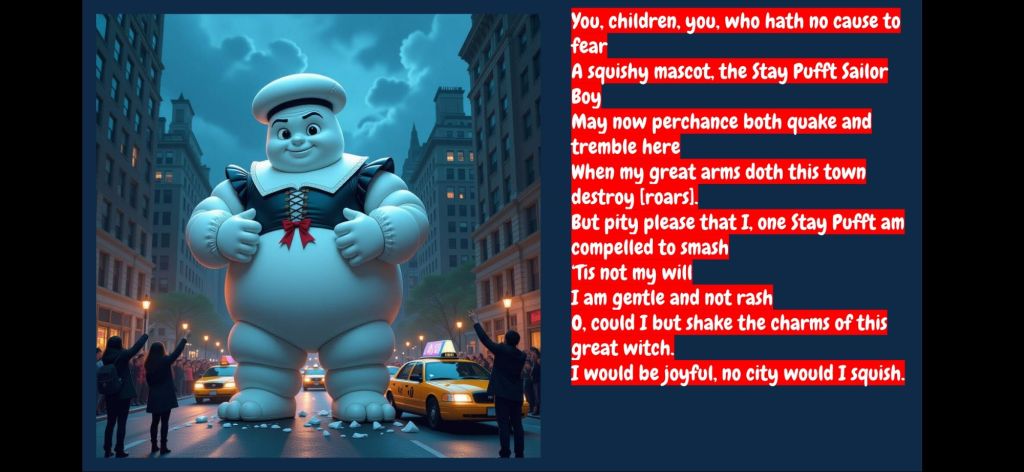
I only had 30 minutes allocated for my show, so I knew I’d have to pare down the story to its bare bones. This meant I had to eliminate a lot of subplots and characters and condense several scenes. As much as I love Walter Peck, Dean Jaeger, Louis Tully, Janine Melnitz, and the guy who gets electrocuted, they are not absolutely essential to the plot, so I cut them from my version. I also combined the characters of Dana and Gozer, eliminating the two terror dogs and limiting the antagonists to Gozer and the Stay Pufft Marshmallow Man. So I watched the film a few times, and created an outline of just 7 scenes.
Character Models
One thing I’ve said again and again is that Shakespeare’s characters are all based on archetypes that we see everywhere throughout literature, theater, and yes, movies. While I was watching Ghostbusters, I tried to find the Shakespearean archetypes that match the best with the characters in the movie:
Ray Stantz- Hamlet from Hamlet– Ray is a bookish man who is obsessed with death and with the occult, which makes him very much like the scholarly Prince Hamlet. He’s also a man on a mission to try and understand the supernatural and help keep it from destroying our world. Dr. Venkman describes him as “The heart of the Ghostbusters”, and that humorous heart gets him into trouble sometimes.
Egon Spangler- Horatio from Hamlet If Ray is the heart of the team, Egon is the brain. He is the no-nonsense scientist who provides the team with data and equipment to help them fight ghosts effectively, much like how Horatio reports to Hamlet that his father’s ghost has returned from the grave.
Dr. Venkman– Sir John Falstaff/ King Henry V
Dana Barret- Ophelia from Hamlet
Gozer– Hecate from Macbeth
The Stay Pufft Marshmallow Man- Snug the Joiner from A Midsummer Night’s Dream
Sneak Peak
Here’s one of the scenes I wrote, with the original scene for context
[The ghostbusters climb the stairway to the penthouse, where Gozer is sitting in a cloud. They have been going for a while and are clearly tired]. Venkman: Though I have not known fair Dana long, I know she must be a virtuous maid. Ascend this penthouse tower and let’s rescue she! Like to the Knights of ancient chivalry! Egon: These apparitions whizzing in the air Give so much light that I may read by them. [They reach the top and behold Gozer] Ray: I am resolved to speak to Gozer. This is the latest parle we will admit. Gozer: Art thou a god? Ray: Nay. Gozer: Then perish, half-man! Winston: Enough Ray of thy diplomacy! Speak, thou proton pack for me! [He fires, then the rest join in] Gozer disappears Venkman: The sky hath bubbles as the water hath, and she be one of them! Gozer [in Voice Over]: Sub creatures! Hark! Tis time! Pick the Destructor’s form Be it a Goblin damned or angel bright! Tornado or a earthy bright Or greatest Monkey with an appetite! Winson: Our thoughts contain the form that seals our doom? Then make them blank as a new-made room! [They all gesture to their heads as if pushing thoughts out] Gozer: Thy choice is made. Prepare to meet thy doom! Venkman: Nay! I chose nothing Winston: Nor I! Egon: Nor I [Pause] All: Ray? Ray: Twas not my fault! It popped into my mind Venkman: What? What hast popped in? Egon: LOOOK!!!