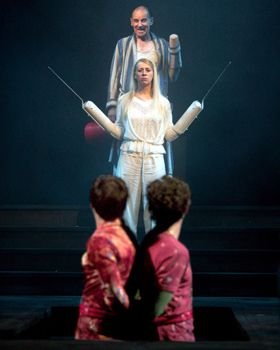
Resources for Teachers and Students: A Visit To Elizabethan London

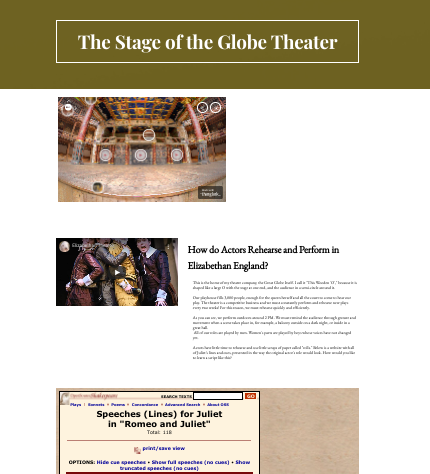
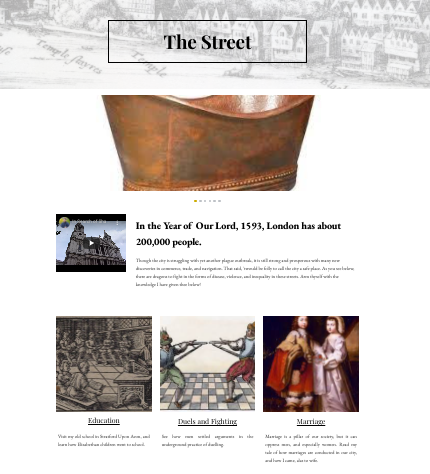
I’m working on several educational projects at the moment and I’m proud to share this one with you. It’s what I call a virtual tour of Shakespeare’s London. The teacher I’m working with said she wanted to teach the kids about the culture of Elizabethan London as he was writing Romeo and Juliet. Naturally with the pandemic a field trip was out of the question, (for multiple reasons), but I wanted to create a visually interesting tour of the places Shakespeare knew and worked and try to imagine his perspective and how that might have informed the characters and themes of Romeo and Juliet.

So I created this: a website written as if Shakespeare himself is taking you on a tour of his London in the year 1593, the year where, as far as we know, he had just completed writing Romeo and Juliet. 1593 was also the middle of another outbreak of Bubonic Plague. It has virtual tours of Shakespeare’s Globe Theater, Hampton Court Palace, Shakespeare’s Grammar School, and a quiz where you can pretend you’re in the Elizabethan doctor’s office.

For the class I’m helping, the students will fill out a worksheet as they navigate the website so they learn from the material at their own pace. If you’re interested, leave a comment and I’ll post the worksheet so you can use it in your classroom.

My hope is that this website can be a resource for anyone trying to connect with Romeo and Juliet and trying to learn from the culture of Elizabethan London. Shakespeare was a product of his time and his experiences must have had an influence on what he wrote. Even if they didn’t, they certainly influenced the people who saw the play and he knew that it would. So I hope it can help you understand a little bit more about the world of this famous play, and the context of the world that created it.

Close Reading: To Be Or Not To Be

For Shakespeare’s Birthday, I thought I would discuss his most famous speech what is arguably his greatest play. Hamlet, Prince of Denmark was written in 1600, the pinnacle/ middle of Shakespeare’s career, after Julius Caesar but before Macbeth.

David Tennent as Hamlet. Royal Shakespeare Company, 2010.

To Be Or Not To Be has intrigued and mystified people for centuries. It is full of ambiguous imagery, haunting images, and solemn contemplative ideas. I’m going to try and break the speech down first like an intellectual argument, but I will also give you some of my interpretation of Hamlet’s thoughts and feelings. Shakespeare’s genius is creating a speech that gives plenty for the reader to interpret,, but it’s up to the reader to decide what’s happening in the speech.

Just a refresher of the plot:

1. The king has died and been seen as a ghost 

2. He tells his son Hamlet that he was murdered by his brother Claudius, who killed him to become king and marry Hamlets mother, Gertrude.

Hamlet is trying to determine if the ghost is telling the truth and if so, how can Hamlet revenge the death of his father?

The speech occurs right in the middle of the play. Hamlet has been acting strange and the king is worried. He hides behind a tapestry right before Hamlet enters. He then delivers this famous and highly cryptic speech:

Ham. To be, or not to be, that is the Question:
Whether 'tis Nobler in the minde to suffer
The Slings and Arrowes of outragious Fortune,
Or to take Armes against a Sea of troubles,
And by opposing end them: to dye, to sleepe
No more; and by a sleepe, to say we end
The Heart-ake, and the thousand Naturall shockes
That Flesh is heyre too? 'Tis a consummation
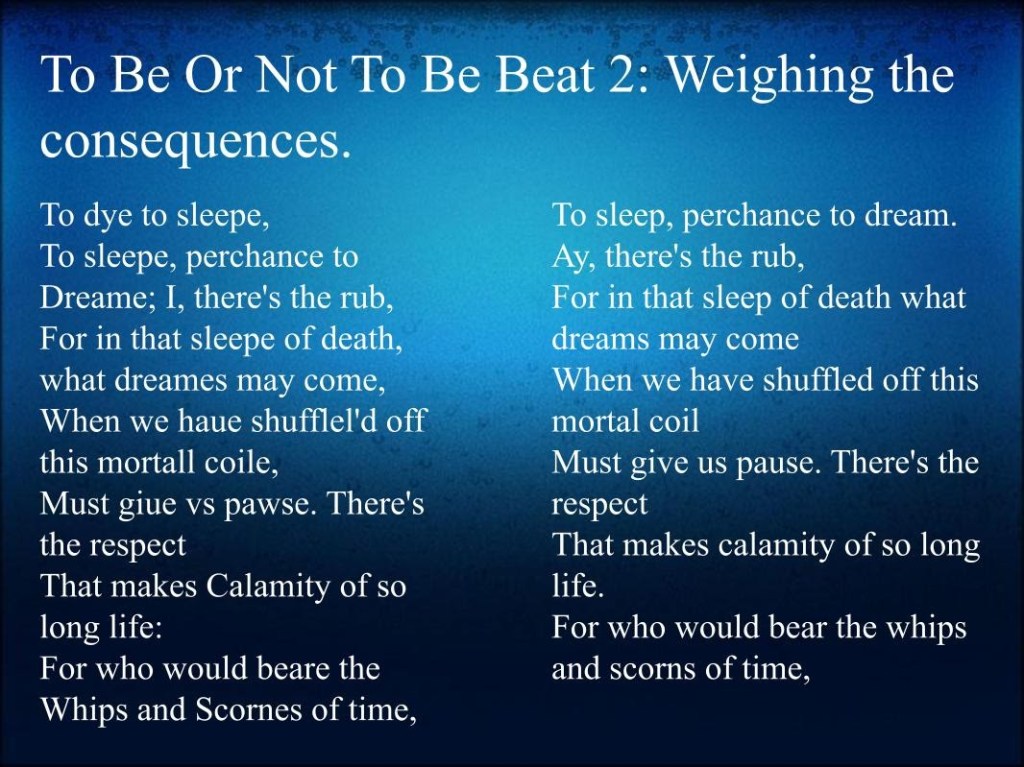
Deuoutly to be wish'd. To dye to sleepe,
To sleepe, perchance to Dreame; I, there's the rub,
For in that sleepe of death, what dreames may come,
When we haue shufflel'd off this mortall coile,
Must giue vs pawse. There's the respect
That makes Calamity of so long life:
For who would beare the Whips and Scornes of time,
The Oppressors wrong, the poore mans Contumely,
The pangs of dispriz'd Loue, the Lawes delay,
The insolence of Office, and the Spurnes
That patient merit of the vnworthy takes,
When he himselfe might his Quietus make
With a bare Bodkin? Who would these Fardles beare
To grunt and sweat vnder a weary life,
But that the dread of something after death,
The vndiscouered Countrey, from whose Borne
No Traueller returnes, Puzels the will,
And makes vs rather beare those illes we haue,
Then flye to others that we know not of.
Thus Conscience does make Cowards of vs all,
And thus the Natiue hew of Resolution
Is sicklied o're, with the pale cast of Thought,
And enterprizes of great pith and moment,
With this regard their Currants turne away,
And loose the name of Action. Soft you now,

Now before I talk about the context of the speech, I want to deconstruct it as an intellectual argument. Hamlet is grappling with something huge, and he is weighing the consequences of his potential actions. Remember, Hamlet is a prince, but he is also a college student, so he turns his choice into an intellectual argument.

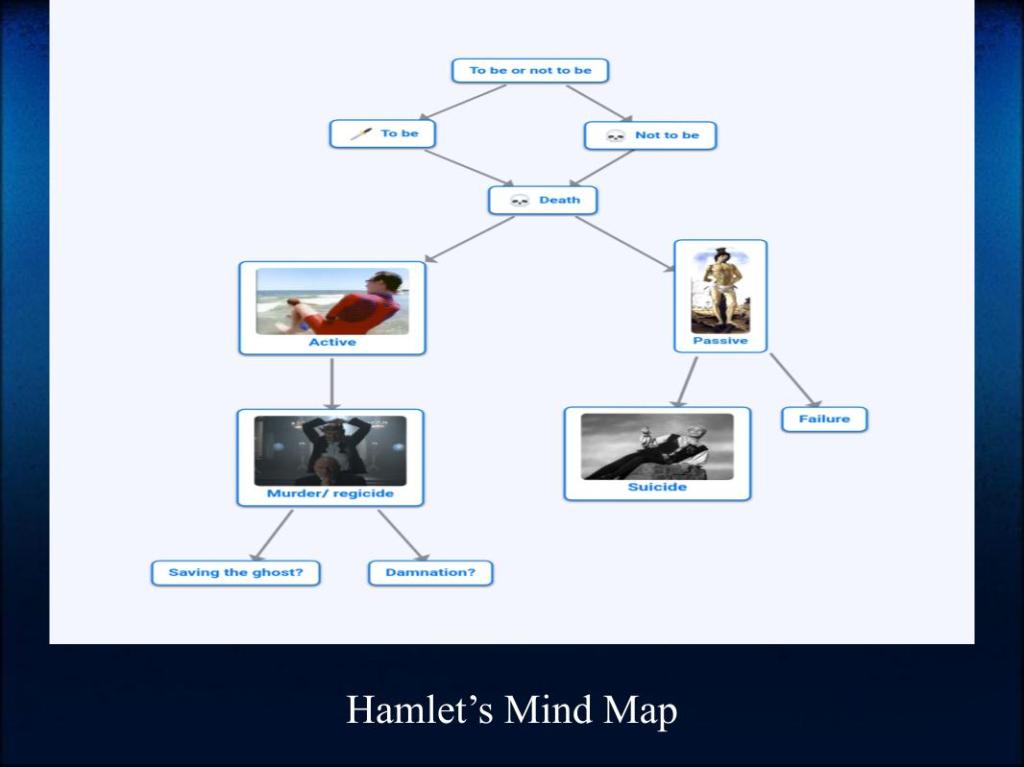
  • If you look at the speech as an argument, it hinges on two points- to be or not to be.
  • One is passive and one is active 
  • Both actions are potentially lethal, as evidenced by the two metaphors Hamlet describes later.

Contrary to popular belief, I believe that this speech is not just about suicide. It’s about the choice between suicide and murder, (in this case killing Claudius).

Three Speeches- Macbeth, and Hamlet 

Lets discuss the two central images at the start of this speech. One is active- fighting (“taking arms”), and one is passive (“to suffer…”). Both choices have a similar outcome- death. No one can fight the sea, and arrows are just as lethal.

Let’s look at the speech again, and turn it into a series of beats using the conjunctions “and, but, and or,” The speech has 6 beats. What he’s thinking about or feeling is open to interpretation, but the argument definitely changes at these points. First the thesis:

  • This beat sets up the two options (murder and suicide).  Why do I think this? Because it’s similar to two other speeches: https://youtu.be/nq3hcs1yFKw

https://youtu.be/NZSF5r9KEWE

It’s worth noting that about the same time, Shakespeare wrote three great soliloquis; Hamlet’s “To Be Or Not To Be,” Macbeth’s “If It Were Done,” and Brutus’ “It must be by his death.” All three speeches have some notable commonalities:

  • All three speeches are in passive voice; the would be murderer wishes he didn’t have to kill someone, but wants the victim dead nonetheless.
  • Refuse to mention the name of the man who will die.
  • Refuse to say ‘murder’
  • Personify death in abstract terms.

When I noticed the commonalities between the speeches, I came to realize that all of them are about murder, not just suicide. I think Hamlet alone contemplates suicide as well as murder, possibly because unlike Brutus and Macbeth, Hamlet is not at all sure he’s doing the right thing.


Beat 1 The Nerve:  Hamlet is working himself up for something; either murder or suicide. It’s ambiguous which one he starts with, and largely depends upon the actor’s interpretation.


Beat 2 The Consequences
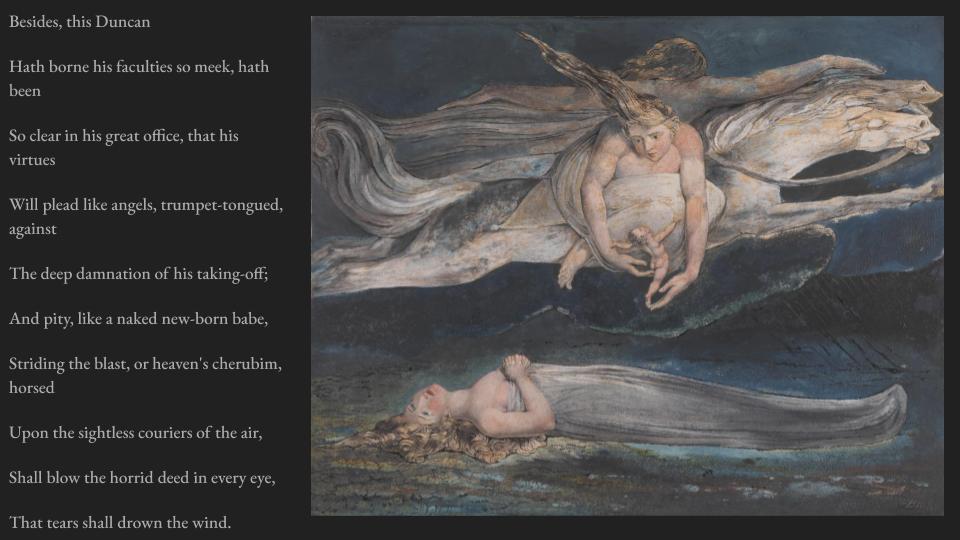
Whether Hamlet kills the king or himself, either way he could die and when he does, his soul will have to answer for his actions. This is similar to Macbeth, who worries that his foul murder will be exposed and judged by “Heaven’s cherubim, horses upon the sightless couriers of the air.”

“PITY,” by William Blake, alongside the text of Macbeth’s soliloquy from Act I, Scene 7.

“There’s the rub”- there’s the catch.

“Coil” refers to a snake skin. The line characterizes death as shedding an earthly body, something that seems all too easy to do. It’s an uncomfortable image because it makes death look all too easy. It also calls to mind the story of Gilgamesh, who had a flower that would grant him immortality, but a snake stole it, which is why snakes cam shed their skin, seemingly growing young again forever.

Beat 3: Smothering In Surmise: https://youtu.be/gFG91lXgNcs

This beat is where Hamlet seems smothered in his frustrations with life.. Rather than making a decision, he’s sidetracked with a laundry list of universal problems. His energy seems up, but it’s unclear why.

When I performed this portion of the speech, I realized that everything Hamlet refers to, Claudius has done: he has oppressed and wronged the kingdom, he has delayed the law, and he has hindered Hamlet’s love for Ophelia by letting Polonius deny Hamlet’s access to her. Perhaps the laundry list is designed to psych him up- listing all the reasons Claudius deserves to die, (without tipping him off).

Beat 4: The Downward Spiral

Once again Hamlet is thwarted by the concept of Death and divine judgment. He seems to imply that everyone is scared into compliance with the threat of death.

The Conclusion:

Hamlet’s conclusion is that he has no conclusion. He can’t kill himself because his conscience tells him that God is against it, and he cannot kill Claudius because of fear of death or damnation.

When he says “The native hue of resolution,” he means red, (as in blood), is curtailed, cut off by the very thought of Deaths pale scythe. 

Interpretations:

Mel Gibson plays Hamlet as a sort of man in mourning. He is as close to the action movie hero as Hamlet gets with his large, imposing physique and brutal looking medieval sword:

Speaking of action heroes, the whole movie Last Action Hero has a reoccurring motif of nodding to Hamlet. The avenging hero archetype is the prototype for every action movie, every superhero, (and most kung fu), and it began with Shakespeare’s Hamlet. This is  why it’s hilarious that Schwarzeneger portrays him in Last Action Hero- the movie is a loving parody of every single action star since the original- Hamlet.

Why Else might Hamlet be so cryptic?

Not all versions are about suicide or murder 

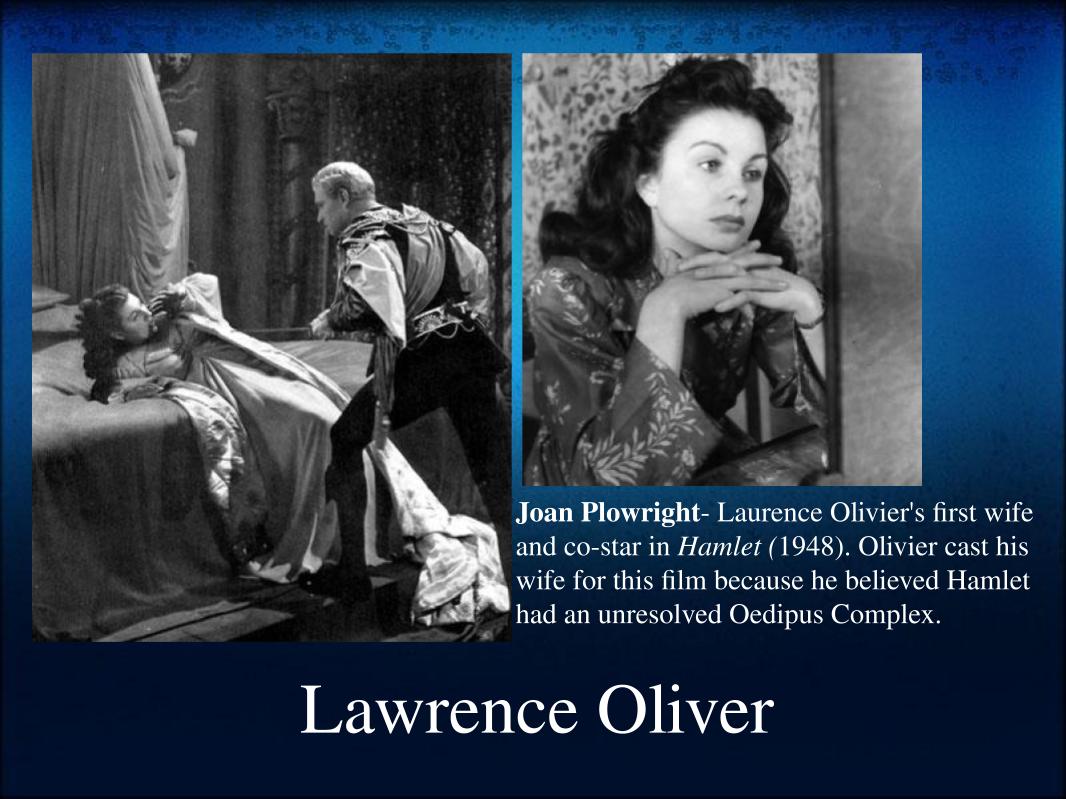
Lawrence Olivier believed that Hamlet has an Oedipus complex, and therefore has an unconscious desire to murder his father and sleep with this mother, which is why he considered himself unworthy to avenge his father’s death. In Olivier’s To Be, you can almost see his Hamlet aroused by his own Oedipal fantasies and then recoiling with disgust right before he says the line: “Perchance to dream.”

Kenneth Branaugh’s Hamlet centers  around court intrigue. In contrast with Oliver’s Gothic Elsinore, his is bright and baroque, but it’s full of two way mirrors. Half the film is either large shots with lots of people watching public performances  or POV shots of people being watched.

Branaugh’s interpretation of “To Be,” focuses on the possibility that Hamlet knows that Claudius is watching him through the  two way mirror- he frightens him, puzzles, him, but in the end, never gives Claudius a clue as to his true intentions.

Murder or suicide? 

the speech is not only famous for its universality but its evocative imagery, clear (albeit cryptic) construction, and heightened circumstances.

Shakespeare is able to give us a complete character without giving everything away, which allows anyone to reinterpret the character their own way. That is why Shakespeare’s characters endure.

New TV Adaptation Of Romeo and Juliet

PBS is going to show (and hopefully stream), the National Theater’s production of Romeo and Juliet Friday, to help celebrate William Shakespeare’s birthday.

The production stars Jessie Buckley as Juliet, and Josh O’Connor as Romeo, who recently won a Golden Globe for his portrayal of the young Prince Charles

After playing another doomed lover whose family won’t allow him to be with the woman he wants, I look forward to seeing him bring his passion and skill to Shakespeare.

Jessie Buckley as Juliet, and Josh O’Connor as Romeo. National Theater, 2021

What Does Shakespeare Say About Ireland 🇮🇪?

Happy St. Patrick’s Day! The Emerald Isle has long been a source of illumination for poet’s pens and Shakespeare was no exception. The Bard of Avon is indebted to Mother Ireland not only for the inspiration he took, but sadly for the pain he gave her back.

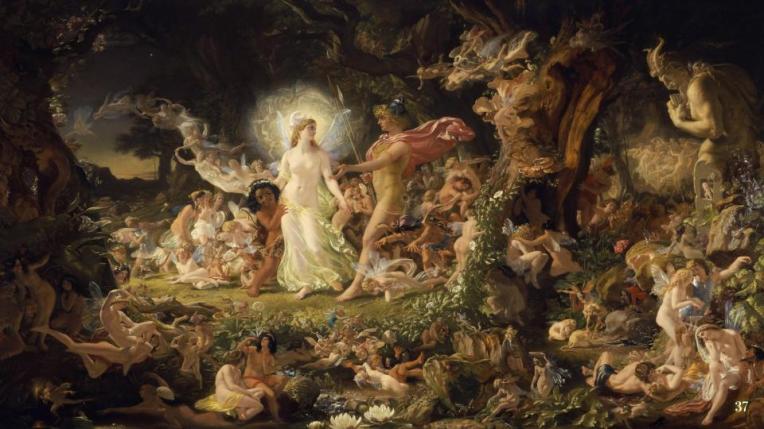
None of Shakespeare’s plays are set in Ireland, but he freely adapted elements from Irish folklore. English poet Edmund Spencer visited Ireland in the 1590s and adapted the folklore he picked up into his opera The Fairy Queen, which Shakespeare adapted into A Midsummer Night’s Dream

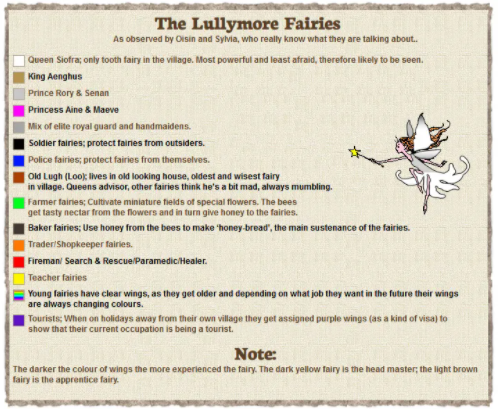
The Irish created and continue to tell many of the fairy legends and stories that we retell and adapt today. If you go to Lullymore park in Ireland, you can see a place that is essentially a “Fairy preserve.”

Types of fairies you can “spot” at the Lullymore Park in Ireland:

The old stories tell that Fairies are magical creatures who live in hollow places in the earth. Some are benevolent and help give rain and pleasant weather to the Earth, Like the king and Queen of the fairies, Oberon and Titania:

And the mazed world,
By their [the tides] increase, now knows not which is which:
And this same progeny of evils comes
From our debate, from our dissension;
We are their parents and original.

— Titania, (Queen of the Faries), A Midsummer Night’s Dream Act II, Scene i.

Titania in this speech shows great concern for nature, humanity, and the planet. She believes it is the responsibility of fairies, particularly herself and her husband Oberon, to control the elements and keep humans and fairies safe. Some fairies, however, are cruel and enjoy playing tricks on mortals, just like Puck in A Midsummer Night’s Dream, or Queen Mab in Romeo and Juliet.

.

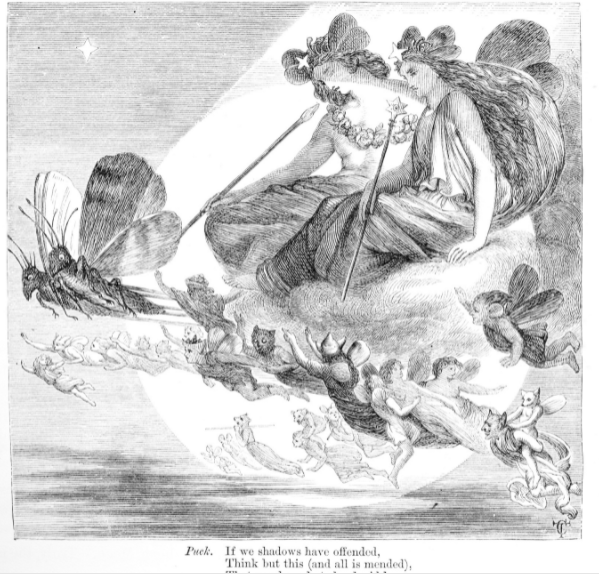
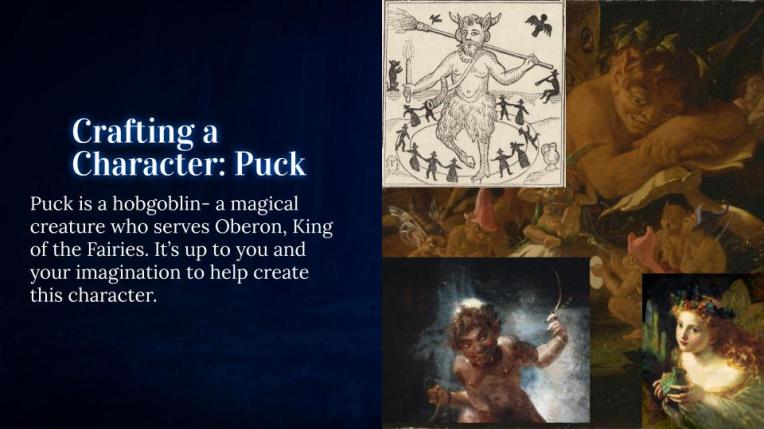
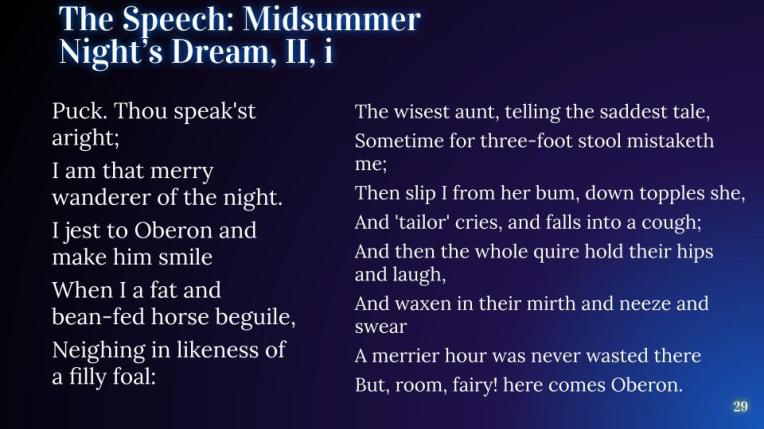
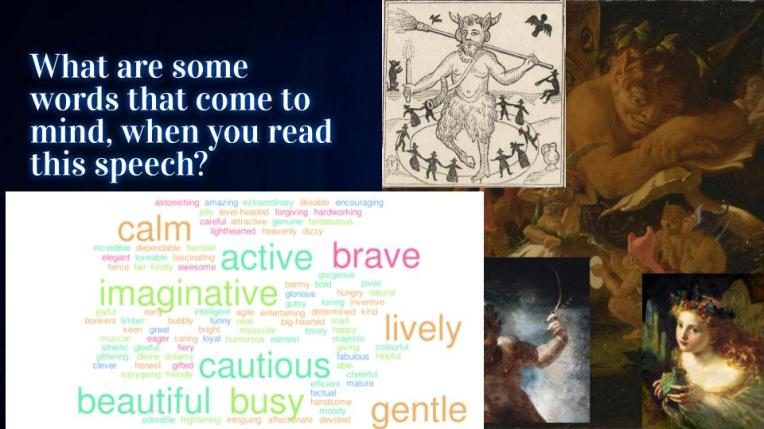
This is a short analysis I created of the tricks Puck plays on people in A Midsummer Night’s Dream, as part of my acting course on Ouschool.com. Note the different ways Puck is portrayed in photos as a satyr, a rotund elf, and sometimes as an almost- demon like figure.

Cringe-worthy Shakespeare: Shakespeare’s only Irish character, captain mcmorris in “Henry V”

When Shakespeare is racially insensitive towards people of color, the cringe-worthy writing is mercifully few and far between. With the exception of Aaron the Moor and Don Armada, there are only a few sporadic derogatory references to non-White Anglo-Saxon Protestants. Sadly though, Shakespeare might have permanently harmed the Irish through his character the Irish captain Macmorris in Henry the Fifth, his only Irish character.

According to The Irish Times, there is a longstanding stereotype that still exists in the British Isles that Irish people are violent, short-tempered, and essentially savages and Shakespeare might have invented this stereotype (or at least popularized it) when he wrote this scene from Henry the Fifth, Act III, Scene ii:

FLUELLEN
To the mines! tell you the duke, it is not so good
to come to the mines; for, look you, the mines is
not according to the disciplines of the war: the
concavities of it is not sufficient; for, look you,
the athversary, you may discuss unto the duke, look
you, is digt himself four yard under the
countermines: by Cheshu, I think a' will plough up
all, if there is not better directions.
GOWER
The Duke of Gloucester, to whom the order of the
siege is given, is altogether directed by an
Irishman, a very valiant gentleman, i' faith.
FLUELLEN
It is Captain Macmorris, is it not?
GOWER
I think it be.
FLUELLEN
By Cheshu, he is an ass, as in the world: I will
verify as much in his beard: be has no more
directions in the true disciplines of the wars, look
you, of the Roman disciplines, than is a puppy-dog.
Enter MACMORRIS and Captain JAMY
GOWER
Here a' comes; and the Scots captain, Captain Jamy, with him.
FLUELLEN
Captain Jamy is a marvellous falourous gentleman,
that is certain; and of great expedition and
knowledge in th' aunchient wars, upon my particular
knowledge of his directions: by Cheshu, he will
maintain his argument as well as any military man in
the world, in the disciplines of the pristine wars
of the Romans.
JAMY
I say gud-day, Captain Fluellen.
FLUELLEN
God-den to your worship, good Captain James.
GOWER
How now, Captain Macmorris! have you quit the
mines? have the pioneers given o'er?
MACMORRIS
By Chrish, la! tish ill done: the work ish give
over, the trompet sound the retreat. By my hand, I
swear, and my father's soul, the work ish ill done;
it ish give over: I would have blowed up the town, so
Chrish save me, la! in an hour: O, tish ill done,
tish ill done; by my hand, tish ill done!
FLUELLEN
Captain Macmorris, I beseech you now, will you
voutsafe me, look you, a few disputations with you,
as partly touching or concerning the disciplines of
the war, the Roman wars, in the way of argument,
look you, and friendly communication; partly to
satisfy my opinion, and partly for the satisfaction,
look you, of my mind, as touching the direction of
the military discipline; that is the point.
JAMY
It sall be vary gud, gud feith, gud captains bath:
and I sall quit you with gud leve, as I may pick
occasion; that sall I, marry.
MACMORRIS
It is no time to discourse, so Chrish save me: the
day is hot, and the weather, and the wars, and the
king, and the dukes: it is no time to discourse. The
town is beseeched, and the trumpet call us to the
breach; and we talk, and, be Chrish, do nothing:
'tis shame for us all: so God sa' me, 'tis shame to
stand still; it is shame, by my hand: and there is
throats to be cut, and works to be done; and there
ish nothing done, so Chrish sa' me, la!
JAMY
By the mess, ere theise eyes of mine take themselves
to slomber, ay'll de gud service, or ay'll lig i'
the grund for it; ay, or go to death; and ay'll pay
't as valourously as I may, that sall I suerly do,
that is the breff and the long. Marry, I wad full
fain hear some question 'tween you tway.
FLUELLEN
Captain Macmorris, I think, look you, under your
correction, there is not many of your nation--
MACMORRIS
Of my nation! What ish my nation? Ish a villain,
and a bastard, and a knave, and a rascal. What ish
my nation? Who talks of my nation?
FLUELLEN
Look you, if you take the matter otherwise than is
meant, Captain Macmorris, peradventure I shall think
you do not use me with that affability as in
discretion you ought to use me, look you: being as
good a man as yourself, both in the disciplines of
war, and in the derivation of my birth, and in
other particularities.
MACMORRIS
I do not know you so good a man as myself: so
Chrish save me, I will cut off your head.
GOWER
Gentlemen both, you will mistake each other.
JAMY
A! that's a foul fault.
A parley sounded
GOWER
The town sounds a parley.
FLUELLEN
Captain Macmorris, when there is more better
opportunity to be required, look you, I will be so
bold as to tell you I know the disciplines of war;
and there is an end.
Exeunt

Irish History and Shakespeare: The tempestous relationship between england and Ireland

The mayor and all his brethren in best sort,
Like to the senators of the antique Rome,
With the plebeians swarming at their heels,
Go forth and fetch their conquering Caesar in:
As, by a lower but loving likelihood,
Were now the general of our gracious empress,
As in good time he may, from Ireland coming,
Bringing rebellion broached on his sword,

Henry V, Act V Chorus

National Portrait Gallery painting of Robert Deveraux, 2nd Earl of Essex. Wikimedia Commons.
Robert Devereax, 2nd Earl of Essex (National Portrait Gallery)
Hugh, O’Neill, Earl of Tyronne

James Shapiro in his excellent book, A Year In The Life Of William Shakespeare, 1599, posits that contemporary affairs in Ireland might have inspired some of Shakespeare’s greatest plays in including Richard II, Henry V, and Julius Caesar. In 1594 the Earl of Tyrone began a rebellion in Ireland against the English, and in 1599, Queen Elizabeth dispatched the ambitious and chivalrous Earl of Essex to quell it. As you can see in the quote above, Shakespeare mentions Essex’s fight in his play of Henry V, which probably premiered at around the same time Essex was in Ireland.

The audience may have been watching Henry conquer France, but many would have been thinking about Elizabeth’s struggle to conquer Ireland.

BBC Radio 4 Extra – Shakespeare’s Restless World, Ireland: Failures in the Present – Transcript – Shakespeare’s Restless World – Programme 7

Though King Henry successfully conquered and united England and France, Essex failed spectacularly, and Elizabeth was deeply embarrassed by the whole scenario. She was also deeply alarmed by the popularity of Shakespeare’s tragedy Richard II, which shows onstage the deposing and killing of a king who had no children and failed to quell a rebellion in Ireland.

Elizabeth was worried about her subjects but she was also very worried about Essex overseas. Everyone, (including Shakespeare), remembered that 2,000 years ago, Julius Caesar went from him the Senate’s Consul General to dictator by amassing an army, then threatening to invade Rome under the pretense of helping to quell a foreign invasion. Caesar made his name by subjugating tribes in Gaul (modern-day France), and the Senate was worried that he would come home and use his army for a military coup. Look at the expressions on the faces of Cicero and Brutus when they see Caesar coming home in triumph in this scene from the HBO series Rome.

Elizabeth repeatedly attempted to curb Essex’s power while he was fighting in Ireland; she refused to give the Earl more troops for fear that he might be staging a potential coup. Her fears would later be proven right when in 1602, Essex attempted to head a rebellion and take the Crown for himself, but not before one of Essex’s friends commissioned Shakespeare’s company to portray the deposing and killing of King Richard II. Essex was trying to turn himself from a failed Henry V to a victorious Henry IV, and his queen into Richard II.

Left- deposition form the interrogation of Augustine Phillips, one of the actors in Shakespeare’s company about his company’s potential involvement with the Essex rebellion. Right- the hanging of Cinna the poet from Julius Caesar.

Shakespeare might have been inspired to write Julius Caesar after being an unwitting pawn in the political drama between Essex and the queen, and might have even created the character of Cinna the Poet as an analog for Shakespeare himself. In the play, Cinna the poet is mistaken for one of the conspirators by an angry mob and is murdered in the street. Perhaps Shakespeare created Cinna the Poet as a way of coping with the fear he must have had that people might mistake him for a radical, after his play Richard II briefly made him a walking target for those opposed to Essex’s rebellion. In any case, Julius Caesar eloquently documents the kind of anxiety of not knowing who could be trusted when it comes to politics, whether it be a populist warrior like Julius Caesar or Essex, or the Queen, privy council, or indeed Roman senate, and the whole thing started from a failed attempt to quell a rebellion in Ireland.

In summation, even though Shakespeare sets no plays in Ireland, Irish history and Irish culture are everywhere in his plays. England and Ireland are I are indeed separate islands but the cultural exchange between England and Ireland has inspired Shakespeare and many other great writers for centuries. After all Shakespeare’s most famous honorific, ‘the Bard of Avon’ comes from an ancient Irish tradition of semi-mystical poets, who in Irish folklore, were able to see the future and glimpse worlds that are unseen to ordinary mortals. What Shakespeare really felt about Ireland we don’t know but we do him but he does owe the Irish people a lot of thanks, and on this  Saint Patrick’s day, I honor their contribution to him and to him all the world

References:

Shapiro, James. A Year In the Life Of William Shakespeare, 1599. Chapter 6: Things Dying and Things Reborn.

https://www.bbc.co.uk/programmes/articles/3fLDRSY7r9rJhrVFWy99Mly/transcript-shakespeares-restless-world-programme-7

https://www.independent.ie/entertainment/theatre-arts/is-shakespeare-responsible-for-the-stage-irishman-34638347.html

https://www.irishtimes.com/culture/stage/what-ish-my-nation-shakespeare-s-irish-connections-1.2619173

Crafting a Character: Brutus

Happy Ides of March every one. I hope you have enjoyed all the posts for my Roman week. If I have time, I will try to post a few more, since I have not touched on Cymbaline or Titus Andronicus.This will not be an in depth character analysis. I won’t go into every scene and speech of Brutus’. My goal is to look at the history and the actions of Brutus in the play to show why he is such an amazing and ambigous character.

Marcus Brutus was born in 85 BC. Shakespeare’s source for the play, Plutarch’s lives of the Noble Greeks and Romans, mentions that his desire to kill Caesar might have been tied to his family: Brutus’ ancestor was Lucius Junius Brutus, the man who drove out the last king of Rome, and first consul. Below is the famous painting of Lucius foiling a plot to restore the monarchy, but to do so, he had to sentence his own sons to death:

Jaques Louis David, The Lictors Bring to Brutus the Bodies of His Sons, 1789.

https://www.khanacademy.org/humanities/monarchy-enlightenment/neo-classicism/v/david-the-lictors-returning-to-brutus-the-bodies-of-his-sons-1789

This was how seriously the Brutus family took defending the Roman Republic, they valued it even beyond their own family.

Brutus’ mother was Servilia, half sister of Caesar’s longtime critic, the senator Cato. He even married Cato’s daughter Portia! So you can see that once Caesar starts acting like a king, Brutus must have felt a tremendous amount of pressure from his Family to stay true to his Republican ideology. On the other hand, Servillia was actually Caesar’s mistress and Brutus owed his life to Caesar. After Brutus fought against Casesar, they reconciled after the Battle of Pharsalus in 48 BC:

Most of those who were taken alive Caesar incorporated in his legions, and to many men of prominence he granted immunity. One of these was Brutus, who afterwards slew him. Caesar was distressed, we are told, when Brutus was not to be found, but when he was brought into his presence safe and sound, was pleased beyond measure- Plutarch, retrieved from: http://penelope.uchicago.edu/Thayer/E/Roman/Texts/Plutarch/Lives/Caesar*.html

Despite his close ties to Caesar, Brutus chose to betray and assassinate him, so the question remains, why?

In the play and in Plutarch, Brutus is persuaded by Cassius Longinus, his brother in law and colleague in the Roman Senate. As you remember from my post on “Friends, Romans, Countrymen,” there are three basic kinds of persuasive speech, and Cassius uses all three:

1. Ethos “If you do know that I do fawn on men, and hold them hard, and after scandal them… then hold me dangerous.”

2. Logos- Cassius points out a series of embarrassing stories about Caesar that set up the following argument:

• Caesar is weak and frail

• Gods cannot be frail

• Why is Caesar treated like a god?

3. Pathos

• The people

• Fear of tyranny

• Brutus’ family honor- this is the real knife that kills any doubt Brutus had. Cassius reminds Brutus of his ancestor Lucius and how he would rather die than see a king in Rome again.

The soliloquy

Brutus. It must be by his death: and for my part,
I know no personal cause to spurn at him,

But for the general. He would be crown’d:
How that might change his nature, there’s the question.
It is the bright day that brings forth the adder;
And that craves wary walking. Crown him?—that;—
And then, I grant, we put a sting in him,
That at his will he may do danger with.
The abuse of greatness is, when it disjoins
Remorse from power: and, to speak truth of Caesar,
I have not known when his affections sway’d
More than his reason. But ’tis a common proof,
That lowliness is young ambition’s ladder,
Whereto the climber-upward turns his face;
But when he once attains the upmost round.
He then unto the ladder turns his back,
Looks in the clouds, scorning the base degrees
By which he did ascend. So Caesar may.
Then, lest he may, prevent. And, since the quarrel
Will bear no colour for the thing he is,
Fashion it thus; that what he is, augmented,
Would run to these and these extremities:
And therefore think him as a serpent’s egg
Which, hatch’d, would, as his kind, grow mischievous,
And kill him in the shell.

• This speech is a direct predecessor for “To be or not to be,” and Macbeth’s “If it were done,” soliloquy. https://youtu.be/IoDwXjKIenI

  • All three speakers are talking about murder and can’t bring themselves to say either the word murder, nor mention the name of the man who will die.

• All references to murder are in passive voice, as if Brutus wishes a lightning bolt would kill Caesar, so he doesn’t have to accept the responsibility of killing.

•Compared to Hamlet and Macbeth, Brutus’ text is flat, The speech depends on the actor to show the torment in his soul.

  • One question that the actor must answer for himself is, is Brutus really concerned for the well being of Rome, or does he want Caesar dead for another reason?

After the soliloquy, Brutus throws himself into the role of head conspirator: https://youtu.be/ibzqdoV-BcU https://youtu.be/ibzqdoV-BcU

You can see in this video that Brutus speaks eloquently about how just the cause is and how only Caesar will die. This illustrates that Brutus is well spoken but not pragmatic. As we all know, Marc Anthony eventually gets the crowd to turn on Brutus and will become part of the army that hunts him and Cassius down. The dramatic irony is what helps the argument that Brutus is the real tragic hero of this play.

The murder and its aftermath

The rest as they say, is history. On March 15th, 44 BC, Brutus and the conspirators stabbed Caesar 17 times. In the play, before Caesar dies, he utters the famous line, “Et tu, Brute? Then fall Caesar!”

The line stands out because it is the only time anyone in this Roman play speaks in Latin. Now, I have heard a compelling argument from Professor J. Rufus Fears, that this might actually be a misquote, and what Caesar really said will amaze you. As I have mentioned, Brutus’ mother was Caesar’s mistress and the two of them were very close. At the time of Caesar’s death he was 40, while Caesar was 16 years his senior. Why did Caesar forgive Brutus fighing against him? Is it not possible that what he actually said was: “Et tu, son?” That’s a question for directors and actors, but it does heighten Brutus’ emotional conflic. Much like his ancestor Lucius, Marcus Brutus is caught between his ideals and his family.

During the funeral, Brutus has a very well crafted speech where he lays out his reasons for killing Caesar. He sets himself up as the friend of Rome. This video from the Royal Shakespeare Company explores the techniques that Brutus uses to get the crowd on his side: https://youtu.be/nyPlvuv8SSk

After Antony makes his speech however, the mob burns Brutus’ house and even slaughters a man just because he shares a name with one of the conspirators. Brutus and Cassius take their armies and flee Rome, and prepare to take on Antony and Octavian. The adversity Cassius and Brutus go through pushes them together and they behave like brothers; they fight and reconcile constantly: https://youtu.be/K9EAxjVC22M

In a way, these men are two sides of the same coin: Cassius is fiery but pragmatic while Brutus is stoic and idealistic. It’s like a tragedy in and of itself that these men weren’t melded into one man with Brutus’ heart and Cassius’ mind.

Is Brutus A Traitor?

Unlike Macbeth, Shakespeare’s text leaves it ambiguous as to whether Brutus was right or wrong to kill Caesar. Even Antony, who leads an army against him, ends the play by calling Brutus “The noblest Roman of them all.” Shakespeare also gives us few clues to Brutus’ motivations other than the speech I quoted earlier. Mainly we have to go on Brutus’ actions and their consequences.

One moment that I think perfectly encapsulates the ambiguity of Brutus’ actions is the moment where he’s visited by Caesar’s ghost. In other tragedies like Macbeth and Richard III, the villain is tormented by the ghost or ghosts of people he murdered. The ghost serves as a manifestation of the murderer’s guilty conscience and torments him before his death. When Brutus sees Caesar, he does not follow this trope. He isn’t horrified, not struck by guilt, in fact, he wishes that the ghost would stay longer.

Julius Caesar by William Shakespeare

Julius Caesar book cover

MENU

In Act 4, why does Caesar’s ghost appear? I don’t understand why Caesar’s ghost shows up. I dont understand the significance of that scene.

Expert Answers info

JUANAMAC

eNotes educator

| CERTIFIED EDUCATOR

Shakespeare, as other Elizabethan writers, uses the idea of ghosts in his plays usually as a foreshadowing of events to come. In “Hamlet,” Hamlet has to deal with working out what to do with his father’s request for revenge, and also, whether the ghost is indeed his father. In “Macbeth“, Macbeth has to deal with the Ghost of Banquo showing up to dinner, literally haunting him. In “Richard III“, Richard deals with the ghosts of the men he has wronged right at the start of the play.

This haunting is significant also in “Julius Caesar“. The Ghost of Julius arrives on the eve of battle to literally haunt Brutus. Brutus had hoped that by killing Caesar he would enact change in Rome, however, the Roman Empire goes on, as does the reign of Caesar (albeit, a new Caesar).

As Brutus goes into battle, and the battle doesn’t go his way, he again turns to Julius Caesar, blaming him for the outcome of the battle,

O Julius Caesar, thou art mighty yet!
Thy spirit walks abroad, and turns our swords
In our own proper entrails. (5.3.94–96)

Shakespeare’s ghosts are visible to one person (as well as the audience, clearly) so those who react to the ghost are the ones who are supposed to learn from the arrival of the ghost, heeding the message from beyond the grave.

Enter the Ghost of CAESAR

How ill this taper burns! Ha! who comes here?
I think it is the weakness of mine eyes
That shapes this monstrous apparition.
It comes upon me. Art thou any thing?
Art thou some god, some angel, or some devil,
That makest my blood cold and my hair to stare?
Speak to me what thou art.

GHOST

Thy evil spirit, Brutus.

BRUTUS

Why comest thou?

GHOST

To tell thee thou shalt see me at Philippi.

BRUTUS

Well; then I shall see thee again?

GHOST

Ay, at Philippi.

BRUTUS

Why, I will see thee at Philippi, then.

Exit Ghost

Now I have taken heart thou vanishest.
Ill spirit, I would hold more talk with thee.

The ghost itself also resists the clearcut definition as a sign of a guilty conscience. It doesn’t accuse Brutus of murder, it doesn’t curse in fact, all the ghost says is that Brutus will see him at Philippi. Unlike Richard III or Macbeth, the ghost utters no curses or scare Brutus out of his mind.

The only conclusion that Brutus gleans is that his end is near. According to Dr. John Langdon, many Elizabethan ghosts serve as a shorthand to indicate that the play’s denouement is on its way. Brutus seems aware of this as well- he knows that if he sees a ghost, he’s likely to be one soon. Yet the reality of his impending death doesnt change Brutus; he doesn’t express remorse like Richard III or hopelessness like Macbeth, if anything his stocism and seeming world weariness makes him seem more like a hero like Hamlet during his “Not a whit, we defy augery,” speech. This passive embrace of fate is at the core Brutus and it illustrates how hard it is to truly decide if he is a villain or a hero.

Though Shakespeare wrote the character of Brutus as ambiguous, over the centuries many artists and cultures have passed judgment on Brutus. Dante in his book Inferno example places Brutus and Cassius in the lowest circle of Hell, who along with Judas Iscariot, are being forever devoured by Satan himself, imagined below in a medieval illustration as a three-headed beast. You can see the name Brut in the head on the right.

By contrast, during the French Revolution, many statesmen referred to Brutus as a hero for his noble attempt to destroy a corrupt monarchy.

One day men will be astonished by the fact that humanity in the eighteenth century was less advanced than in the time of Caesar. Then a tyrant was slain in the midst of the Senate with no formalities but thirty blows of a dagger and with no other law save the liberty of Rome Louis Antoine de Saint-Just, November 13th, 1792, (2 months before the execution of Louis XVI).
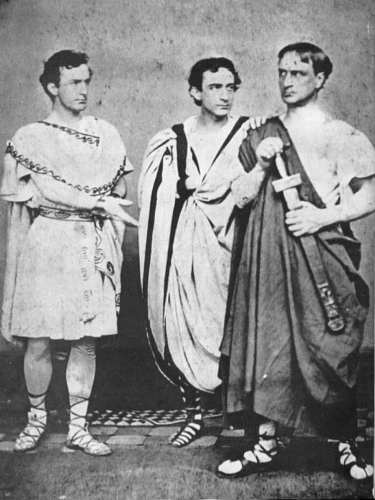
As I have written before, in the 20th and 21st centuries, America has a somewhat more complex relationship with the character of Brutus. On the one hand, America was founded on the principle of resisting tyranny; it’s even on the state flag of Virginia, which is why some early productions of the play make Brutus a hero. On the other hand, as you see above, rebels and traitors like John Wilkes Booth have also taken inspiration from Brutus. His father and brother’s middle name was Brutus and all three brothers performed in the play one year before John turned theater performance into American tragedy.

Like Brutus, Booth seemed amazed with the world’s reaction to his deed, for after he assassinated the president, he wrote this in his journal:

[W]ith every man’s hand against me, I am here in despair. And why; For doing what Brutus was honored for … And yet I for striking down a greater tyrant than they ever knew am looked upon as a common cutthroat.”

John Wilkes Booth, April 21, 1865.

The most recent controversy over Brutus’ actions is the 2017 Shakespeare in the Park production of Caesar directed by Oscar Eustis. As I wrote before, when portraying Caesar as an American president, it tends to anger the political party of his supporters, but the play shows how unplanned political violence can destabilize a country. In these productions, Brutus seems a bit of a well meaning dupe or an naive patsy acting out of fear. On the other hand in cultures that have suffered many violent uprisings, Brutus is a figure that is all to common in places like Uganda, Iran, and the Taliban controlled world: https://youtu.be/5HU8SA33j2w

Brutus is a great character because Shakespeare keeps enough of his motives in the dark to allow for new interpretations, but also showing a man with relatable desires and fears get swept up in a dangerous and unpredictable time.

Teaching Titus through creepy cooking

Titus Andronicus is one of the most bloody, disgusting plays in Shakespeare. As this infographic from the Royal Shakespeare Company shows, there are tons of deaths and some of them are even the result of cannibalism!
One way to capture the macabre nature of this play in the classroom, (which some scholars see as a horror comedy), is to characterize it through cooking, after all, revenge is a dish best served cold.

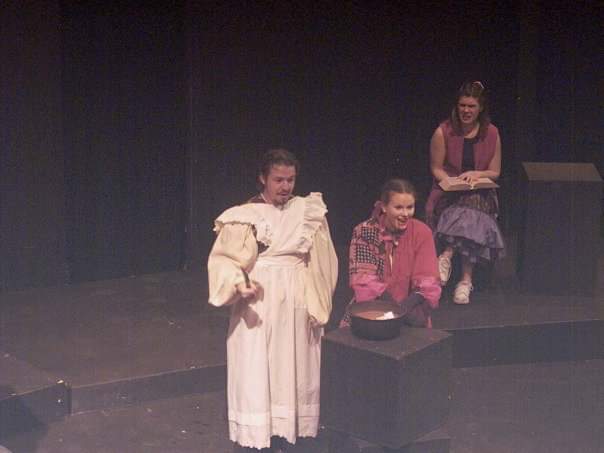
Me in costume as Titus Androgynous, a crazy cooking show host who butchers two people in the same manner as Titus

So here are some ghoulish gourmet dishes and revolting recipes that you can share with your students to help them get into this tragic tale of violence, revenge, and cooking:

Idea 1: recipe cards

Design a recipe card like the ones in cooking magazines based on Titus speech where he murders Chiron and Demetrius

Idea 2: Create a menu that summarizes the play:

Act I:

Starter: Caesar Salad, toad in the hole

As the play begins, Caesar has died and Saturnine wants to devour his father’s empire. Enjoy this light salad in anticipation of far more bloody feasts to come.https://youtu.be/UxZ5NOkRwj0

Act II Scene 3: Breakfast:

Lamb Benedict

Lamb Benedict recipe I found on Reddit

While on an early morning hunting trip, Bassianus is slaughtered like a lamb by his own nephews. Enjoy this sweet treachery with a golden egg in the hole.

Act II, Scene 4: Main course:

Roast venison with all the trimmings

“As the deer that hath some unrecuring wound.”

“She was washed and cut and trimmed.”

Titus compares his daughter to a deer or welkin, and in the play’s most barbaric scene, the emperor’s sons ravish her and cut out her tongue. They enjoy the cruel rape and mutilation just like two starving lions enjoying their prey.

Act V:

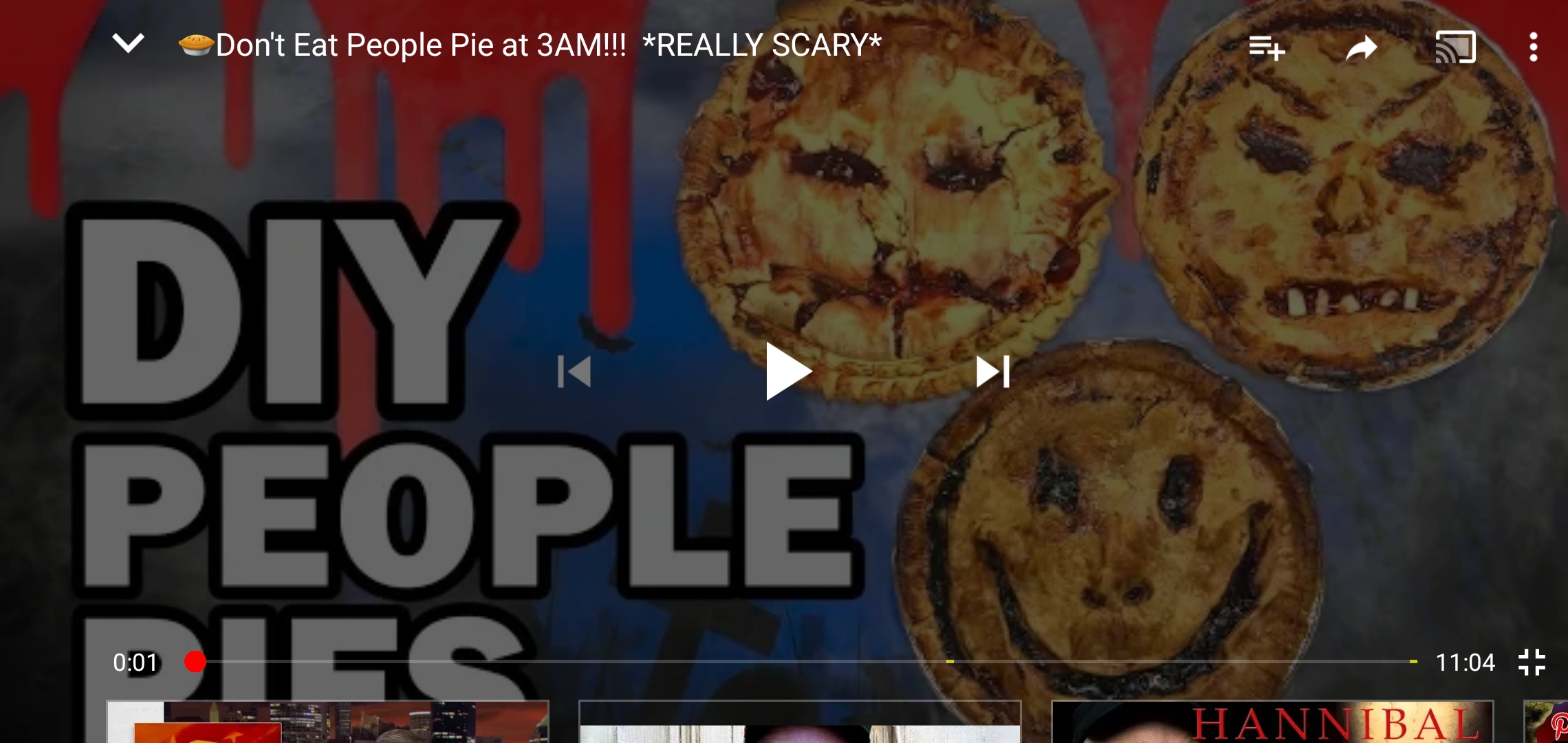
Just desserts: people pot pie.

“More stern and bloody than the centaur’s feast,” A truly unforgettable dessert for this feast of carnage. The cook, Titus, reinvents the term rich food by cooking two emperor’s sons into pies.

Served cold, like revenge!

“Set him breast deep in Earth and famish him.”

Idea 3: Real Titus foods inspired by my favorite Halloween diy recipes

1. Lavinia’s tongue and hands

• horrific Halloween punch with ice cold hand cubes: https://youtu.be/XLYwcX7Ud-E

• Bloody lady fingers https://pin.it/xbnfxcs4bxbhsq

2. Titus hand: Hot dog fingers for Titus’ hand.

https://pin.it/ofn6cotybnvn4n

Or this grisly appetizer: cheese hand in prosciutto

3.

People Pies:

There are many horrific pie recipes on the internet, but for a busy teacher on a budget, I’m adapting this one from the YouTube channel Threadbanger: https://youtu.be/E6U6xUl3A5M. Don’t show this video to your students because there’s far too much cursing. That said this recipe is very cheap and it’s easy. He used only store bought items and no fancy cooking techniques, which means if you choose to bake it as a classroom activity, even your students can help make it. Here are some tips from the video to get the most horrible ppeople pie you can make:

• Use red filling like cherry or strawberry for filling.

• Use excess dough for a nose.

• Cut out little pieces of apple to make teeth

• Cut holes for the eyes and mouth

• The bloodier, the better!

Bone appetit!

Scavenger Hunt For Shakespeare’s Birthday!

https://gsch.se/game/99ef58a585e547cf9120f602970dfc20/share/

I designed this on an app called “GooseChase”, appropriate since Shakespeare invented the term!

If you click on the link, you can do a great scavenger hunt where you upload pictures or answer trivia questions for points, and of course they are all related to Shakespeare. If you have the app on your phone, search for Shakespeare Birthday Scavenger Hunt and enter the code: 2BON2B (Get it, to be or not to be)! You can also use the code NLEGVM. Let me know if you like it or if you cannot access the link.

Happy Hunting!