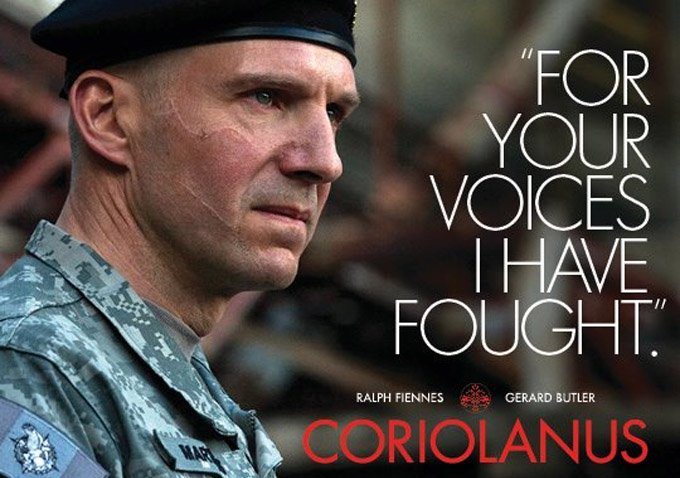
What is a Soldiers Due?

On this Memorial Day, I’m inspired by a quote to ponder what it really means to “Support Our Troops,” living and dead. The quote comes from an epilogue written for a 1778 performance of Shakespeare’s obscure Roman Tragedy, “Coriolanus:”

The most interesting thing about the play is how modern it is. One of his few plays that deals directly with the drama of democracy. And more than that, it deals with the seemingly modern phenomenon of officials undone by public opinion. So many of Shakespeare’s characters have to answer to their God or their king, or (as Coriolanus does), his family. Only rarely, do they answer to the people.

Kyle Kallgren: “Coriolanus- Universal Soldier” (2016)

https://www.nationaltheatre.org.uk/shows/nt-at-home-coriolanus

Play Summary

Coriolanus is one of Shakespeare’s strangest and most controversial plays. Its principal figure is a warrior, exemplary in his courage and single-minded dedication, who finds it difficult to adjust to life away from the battlefield. Refusing to compromise and contemptuous of anyone who does not live up to his exacting standards, Coriolanus, not long after being nominated for the high political office of consul, is cast into exile, accused of treason and ends up leading an army to invade and destroy Rome.

Warren Chernaik, Emeritus Professor of English in the University of London

What do we not owe soldiers?

Throughout the play, Coriolanus shows nothing but contempt for popular rule. This certainly suggests that he is aristocratic in his political views, but arguably he is much more militaristic. Remember that to be a Consul or any kind of high ranking position in the Senate, the senators all served in the army for a set term. Coriolanus respects the Senate more than the Assembly because the former is full of his fellow comrades in arms.

Coriolanus is first and last a soldier, and he represents a society run by the war machine. For centuries, authoritarians who rule through a cult of personality have propped up Caius Martius as an ideal of a military society. After all, it was Mussoluini who organized his fascist dictatorship around the Roman Empire, and the play Coriolanus was taught in literature classes during the Third Reich. They probably looked like Starship Troopers.

https://www.theguardian.com/stage/2020/mar/05/coriolanus-shakespeare-laurence-olivier-ralph-fiennes-ian-mckellan

So to recap, though we owe soldiers a lot for their courage and sacrifice, nobody owes them Blind obedience, because that is the root of fascism. Look at this actual excerpt from a literary textbook about Coriolanus that was given to children in Nazi Germany.

The poet deals with the problem of the peaople and its leader, he depicts the ture nature of the leader in contrast to the aimless masses; he shows a people led in a false manner, a false democracy, whose exponents yield to the wishes of the people for egotistical reasons. Above these weaklings towers the figure of the true hero and leader, Coriolanus, who would like ot guide the deceived people to its health in the same way as, in our days, Adolf Hitler would do with our beloved German Fatherland.

Martin Brunkhorst, “Shakespeare’s Coriolanus in Deutscher Bearbeitung. Quoted from Weida

So now that I’ve established what we don’t owe our soldiers, what do we owe them?

What do we owe our soldiers?

[  ] Honesty- why are you fighting? Is dying for one’s country worth it? Unlike Henry V, in which Shakespeare makes it very clear why the king is trying to conquer France, we don’t really understand why Rome wants to destroy the Volskies, and it seems somewhat arbitrary. I think one of the ways we sympathize with Coriolanus is that he never “asks the reason why; his is but to do and die,” as Tennyson puts it. He has one speech where he rallies the troops, but it just seems flat and hollow without a clear reason why the soldiers should risk their lives.


[  ] A chance to heal When he comes home to run for Consul, Coriolanus is required to show his battle scars to the people and refuses to stay in the room when the patricians talk about them. This could be interpreted as more arrogance where he is disgusted to be in the same room as common men, but I think there’s another aspect. I think Coriolanus has PTSD, and every time he sees or hears about his scars, his repressed memories bubble up to the surface and drown him in fear. His story is partially a story of how all soldiers need help to deal with the trauma they endure on a regular basis.


] Love for their courage and sacrifice. Whether the conflict is right or wrong men and women risked their lives for it, and that is worth compassion.
[  ] Good leaders. Coriolanus is a play where arguably nobody cares about the people. Coriolanus and the Patricians look down on them, and the tribunes see them as a means to gain power. With all this political in fighting who is really trying to make life better? Better for the starving Romans? Better for soldiers like Coriolanus? In a republican society like Rome, we owe it to our soldiers to participate in politics so men like Coriolanus aren’t sent to die on a whim. If we don’t use our voices, we are the common cry of curs that Coriolanus characterizes us as:

Compassion– in John Osborne’s version the title character goes mad from his trauma and of course, in Shakespeare’s version, he’s driven out of Rome and then killed by Aufidius. Even today, many soldiers suffer from poverty, sickness, life-altering injuries, and of course, PTSD. This Memorial Day, let’s all try to help ease the lives of the men and women who have suffered for us.

Sources:

SHAKESPEARE AND BRITISH OCCUPATION POLICY IN GERMANY, 1945-1949 by Katherine Elizabeth Weida B.A. (Washington College) 2011

https://www.bl.uk/shakespeare/articles/an-introduction-to-coriolanus

In search of Japan’s own Shakespeare | The Japan Times

https://www.japantimes.co.jp/culture/2016/04/23/books/book-reviews/search-japans-shakespeare/
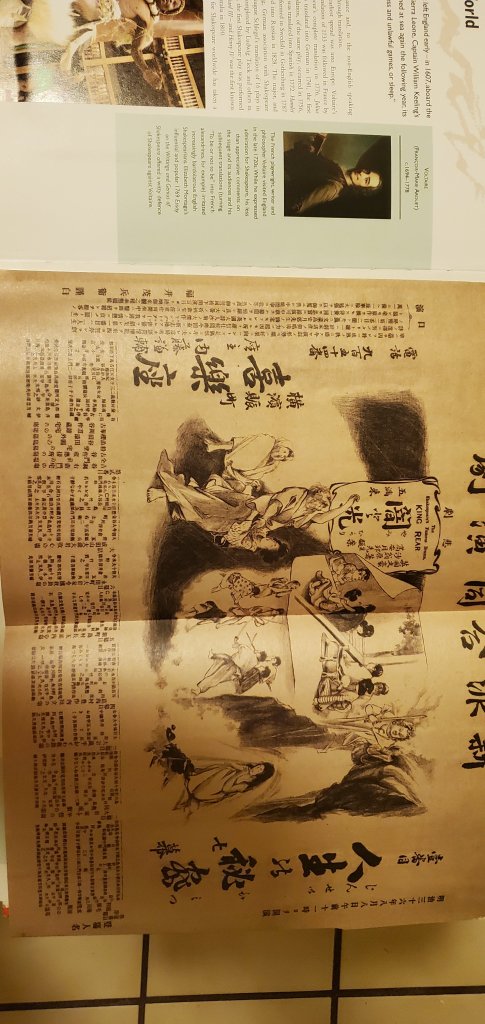
Reproduction of a 1908 Japanese production of King Lear

Similar to how China has embraced and to some degree appropriated Shakespeare, the Japanese have also been very big Shakespeare fans for the last 200 years. The Shakespeare society of Japan has been publishing scholarly articles and journals since the early 1960s, and as you can see, Japanese interpretations of Shakespeare have been popular since for over 100 years.

Shakespeare even has his own Japanese name: Sao. So the question is, though I truly believe that it is perfectly OK to take Shakespeare and translate him into other languages and reinterpret his work for other cultures’ sensibilities, is it OK to appropriate elements of Japanese culture to interpret Shakespeare for a western audience?

The First Englishman to Reach Japan

Hi everyone!

Since May is Asian Heritage Month, I thought I’d devote this week to the long and fascinating history of cultural exchange between Shakespeare and Asia. First, you can read my post on China and Shakespeare here: Chinese New Year post: China and Shakespeare

Secondly, I’d like to post a shoutout to fellow Shakespearean podcaster Cassidy Cash, who in her fascinating podcast That Shakespeare Life, she interviews a historian about the first contact between England and Japan; a sailor named William Adams who reached Japan in 1600, (the same year Shakespeare wrote about “The undiscovered country” in Hamlet). Adams helped build the first western ships in Japan, and helped start trade between Japan and the west:

My Top 10 Favorite Shakespeare/ Star Wars Actors

This list is not about skill or the talent of the actor. This is to honor the contributions of Shakespearean actors who also appeared in one of my favorite film series of all time: Star Wars

#10: Daisy Ridley

I should say at the outset, that I am judging these actors for their cumulative contributions to Shakespeare, so unfortunately that means the older actors have an advantage. This is very apparent with Daisy Ridley here. She has a fantastic voice and her acting is top-notch, so I have absolutely no doubt that if she chooses, she could become the next Helena Bonham Carter in a few decades. But for now, her most notable Shakespearean contribution is this film, Ophelia, which is a retelling of Hamlet, from the perspective of his long-suffering girlfriend:

Trailer for Ophelia starring Daisy Ridley, 2019.

#9: Ewan McGreggor

The Scottish actor, (and in my opinion, best part of the prequels), is a multi-talented star of stage and screen. Ewan actually complained that the script for Episode I was: “Not exactly Shakespeare.” He first came to prominence on stage playing Mark Renton in the dark comedy Trainspotting (whom he also played for the film). Like Daisy Ridley, however, aside from playing Iago to Chiwetel Ejiofor’s Othello, McGreggor hasn’t done much Shakespeare… at least for now.

#8: Andy Serkis

We normally associate the English actor Andy Serkis with physical acting and motion capture, after his roles as Snoke in Last Jedi, Caesar in Planet of the Apes, Kong in King Kong, and of course, Gollum in Lord of the Rings. However, before he became a one-man advocate for the art of motion capture, Mr. Serkis toured in a number of Shakespeare productions including The Winter’s Tale, King Lear (as the Fool), and like Ewan McGregor, Mr. Serkis has played the role of Iago (fitting for a man who played a treacherous hobbit, consumed by unnatural desire). The breadth of his film, theater, and digital work is why I placed him this high on the list.

#7: Peter Cushing

Most fans of Peter Cushing think of him as a horror icon, playing multiple roles for the famous Hammer Studios, with his classic portrayals of Dr. Frankenstein, Dr. Van Helsing in Dracula, and Sherlock Holmes among others. However, Mr. Cushing has a place in Shakespearean history for his performance in Laurence Olivier’s Hamlet, playing OSRIC! I kind of lost my mind when I realized that Cushing isn’t playing the Ghost, or the smiling, damned Claudius, or even the fiery Laertes, but Osric, the foppish sycophant who sucks up so hard to Hamlet, that the prince convinces him that it’s hot, and cold at the same time! Goes to show you how much range Cushing had, (even before he rose from the dead in Rogue One). He truly was, “Charming, to the last.”

#6 Christopher LEe

Like his longtime friend, Peter Cushing, Christopher Lee was also a horror star at the Hammer Studio, and his performances as Dracula are the stuff of legend. With his powerful deep voice, I was not surprised to learn Lee was a trained Shakespearean actor, and he was also in Olivier’s Hamlet, though as an uncredited spear-carrier. By the way, to those people who criticized his swordplay in Attack Of the Clones, I offer this contrary evidence:

#5 Max Von Sydow

The Sweedish-born actor is less known for Star Wars than for his classic roles in The Exorcist, Minority Report, Judge Dredd, and others, but he was in Force Awakens, so he still counts.

I wanted to talk about him here because Von Sydow has given many performances in Shakespeare and Shakespeare adjacent movies. First off, he played the Claudius figure in the atrocious Canadian Hamlet ‘comedy’ Strange Brew, one of the worst movies I’ve ever seen, but Von Sydow’s performance is one of the few watchable parts of the film.

More importantly, Von Sydow has specialized in playing wise, sage-like characters who stare into brave new worlds. First off, in Star Wars, he was the catalyst that helped start the rebellion against the First Order in The Force Awakens.

Von Sydow previously played a powerful sage as Shakespeare’s Prospero at the Old Vic in London in 1988, directed by Jonathan Miller:

‘Miller … used a mixed cast made up of white actors as the humans and black actors playing the spirits and creatures of the island. According to Michael Billington, “von Sydow’s Prospero became a white overlord manipulating a mutinous black Caliban and a collaborative Ariel keenly mimicking the gestures of the island’s invaders. The colonial metaphor was pushed through to its logical conclusion so that finally Ariel gathered up the pieces of Prospero’s abandoned staff and, watched by awe-struck tribesmen, fitted them back together to hold his wand of office aloft before an immobilized Caliban. The Tempest suddenly acquired a new political dimension unforeseen by Shakespeare’. Source: http://bufvc.ac.uk/shakespeare/index.php/title/av70946

In addition to playing Prospero onstage, Von Sydow has influenced many stage and screen productions of Hamlet due to his iconic portrayal of the knight Antonius Block in Ingmar Bergman’s The Seventh Seal:

Clip of the famous chess match between Von Sydow’s character and Death.

The whole movie is sort of a Hamlet spin-off, in that the title character has seen the pain and suffering of the world and is pondering the meaning of life, while constantly aware that Death is watching him and waiting to take him. The gothic atmosphere has influenced hundreds of productions from Olivier to Zefirelli. The film has even inspired parodies like Bill and Ted’s Bogus Journey, and Last Action Hero, which of course is a deconstruction of the action movie genre that acknowledges that its roots lie in Hamlet:

Ian McKellen as Death in “Last Action Hero”

Arguably what Bergmen and Von Sydow did with “Seventh Seal” was outline the courses of action that Hamlet considers in “To Be Or Not To Be,” namely whether to sit inactive, or to actively choose murder. Action heroes are basically men who deal with the fear of death, by inflicting death on ‘bad guys,’ yet however they try, Death gets them all in the end. Even Luke Skywalker, who escapes death many times, and begs his father and his master Yoda not to die, cannot change the inevitability of death.

Even the most powerful Jedis cannot avoid death.

#4: Julian Glover

Julian Glover in Empire Strikes Back

One of the smaller bit part actors in Star Wars is actually a very distinguished Shakespearean actor. Julian Glover, who played General Maximillian Veers in The Empire Strikes Back, (and later played Walter Donovan in Indiana Jones), spent many years at the Royal Shakespeare Company, and turned out some wonderful performances. If you watch this clip from the documentary In Search Of Shakespeare, you can see him perform as King Lear, and the Ghost of Hamlet’s Father.

#3: Sir Alec Guinness

https://www.theguardian.com/news/2000/aug/07/guardianobituaries.filmnews

To be honest, I don’t care much for Alec Guinness’ acting. He has a great presence and a subtle but clear delivery, (what do you expect for someone whose name is an anagram for “Genuine Class)? That said, I feel he’s never having any fun in his roles. It might also surprise you to learn that he didn’t like playing his most famous role:

ir Alec Guinness regretted playing Obi-Wan Kenobi in the original Star Wars trilogy. He called the dialogue “lamentable.” n fact, in his autobiography, he recounted a story in which a fan asked for an autograph and told Guinness that he had seen Star Wars more than 100 times. Guinness claims he gave the autograph on the condition that the fan never watch the movie again.

Buzzfeed- “6 Actors Who Regretted Taking A Role And 6 More Who Regretted NOT Taking One”
Photostage.co.uk - MERCHANT OF VENICE, THE - 1984 Chichester
Alec Guiness as Shylock in “The Merchant of Venice”

Even though I don’t enjoy Sir Alec Guinness in Star Wars or in Shakespeare, for the purposes of this list, he has done decades of work on stage and he has helped shaped modern Shakespearean acting, (for good or ill). But, don’t take my word for it, judge for yourself:

#2: Ian McDiarmid

Not only is this actor essential to the Star Wars universe, playing the diabolical Emperor Palpatine, Ian McDiarmid has made an indelible impression on the world of Shakespeare. He’s appeared onstage as Shylock, Timon Of Athens, and many others. He also served as Artistic Director for the Almeida Theater in England, helping to stage many other high profile productions of Shakespeare and other plays.

My favorite performance of his though, has got to be as the Porter in Trevor Nunn’s Macbeth. Since McDiarmid is actually Scottish, he was allowed to use his natural accent. He’s funny as the drunken comic relief, but there’s a wicked gleam in his eye. After seeing him as Palpitine, I wondered if he was actually Satan, coming up from Hell to greet King Duncan (since Macbeth is murdering him upstairs). Perhaps this is the real Devilish porter, ready to carry away the king’s soul. What do you think?

#1: James Earl Jones

Luke Skywalker Channels Hamlet in Funny, Rare 'Return of the Jedi' Photo
Exceprt from the documentary “How Shakespeare Changed My Life”

You probably saw this coming. Maybe this is some cultural bias since I’m American, but James Earl Jones is the pinnacle of American Shakespeareans, and we owe a lot to him and he himself owes a lot of his career to Shakespeare. Jones’ first ever film role in Stanley Kubrick’s Dr. Strangelove, came about after he and George C. Scott were both acting in “The Merchant Of Venice.” Kubrick saw the show and hired them both (Source: The Wall Street Journal).

The Lion King: Original Story by iamSketchH on DeviantArt

Since then, in addition to playing the voice of one of the most iconic villains of all time, (and the lion equivalent of Hamlet’s father), Jones has become one of the most beloved and acclaimed actors of our day, and his Shakespeare work is truly incredible. If you watch the documentary above, Mr. Jones talks about how he created his performances as King Lear and Othello, which were truly magnificent. In my opinion, James Earl Jones gave the best performance as Lear in the 2nd half of the 20th century, and his Othello was one for the ages.

Not only has his work onstage advanced the craft of acting, Jones has freely shared his knowledge and experience at colleges and universities around the country, including my own. I heard him talk plainly but eloquently about Shakespeare’s characters, his approach to race, and his insight into the plays that could only come from many years inhabiting some of Shakespeare’s most iconic characters. If you ever read this Mr. Jones, Thank you for being an inspiration on film, on stage, and in the classroom!

It’s not hard to see why so many actors have been drawn to Shakespeare and Star Wars. They are both drawn from epic myths that examine what it means to be human, to be part of a family, and to fight for what we believe in. Every actor on this list used their experience with Shakespeare to help bring these iconic Star Wars characters to life, and today I honor their contributions to The Great Globe, and A Galaxy Far Far Away.

Shakespearean tropes in Star Wars