Hamlet is a play that features a powerful noble family engaging in political and millitary intrigue. in Elizabethan England, clothes were of vital importance to denote a person’s status and wealth. The costumes also informed the movements and posture of the people that wore them.
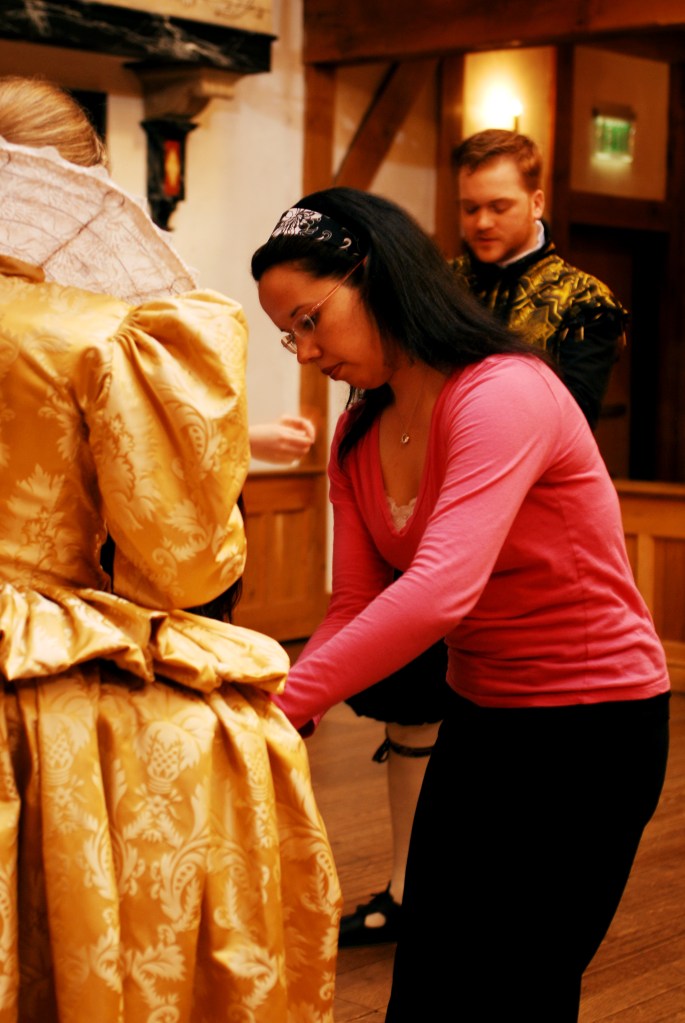
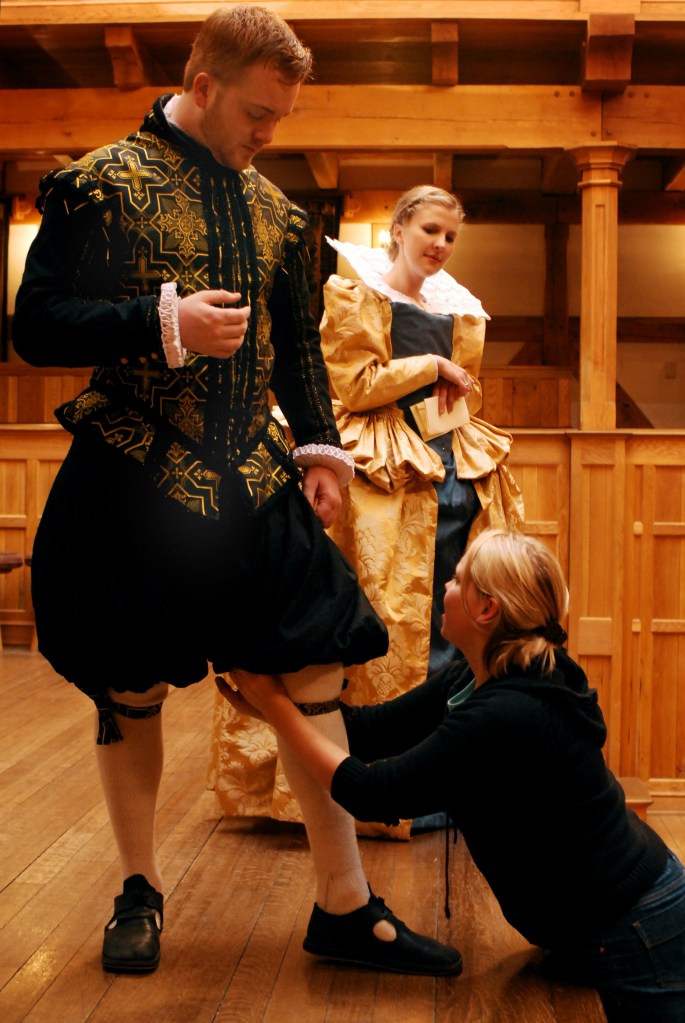
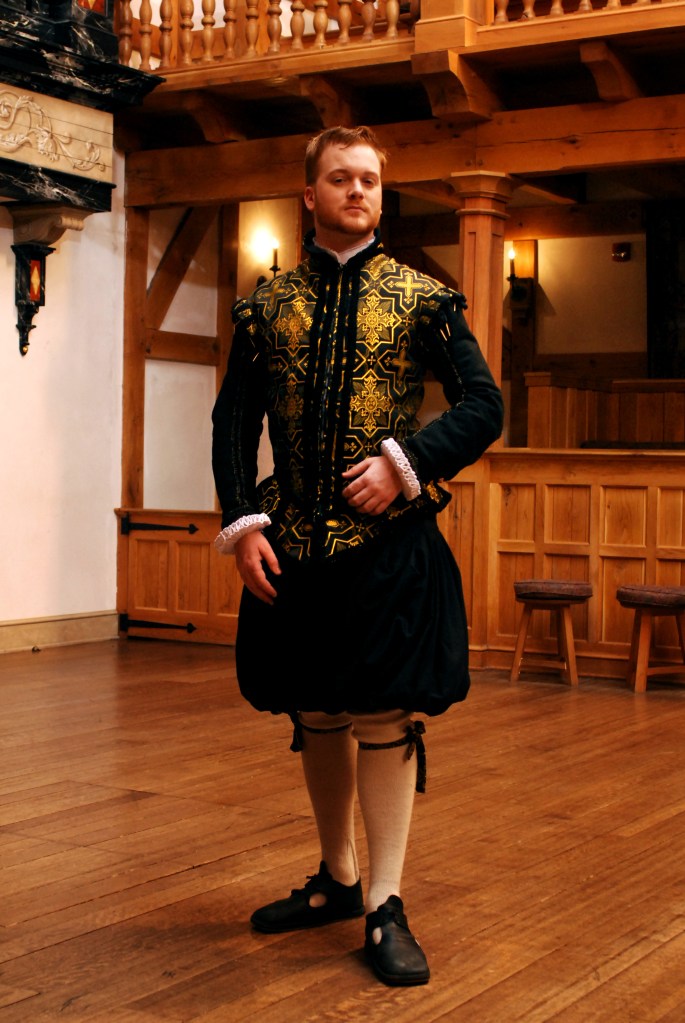
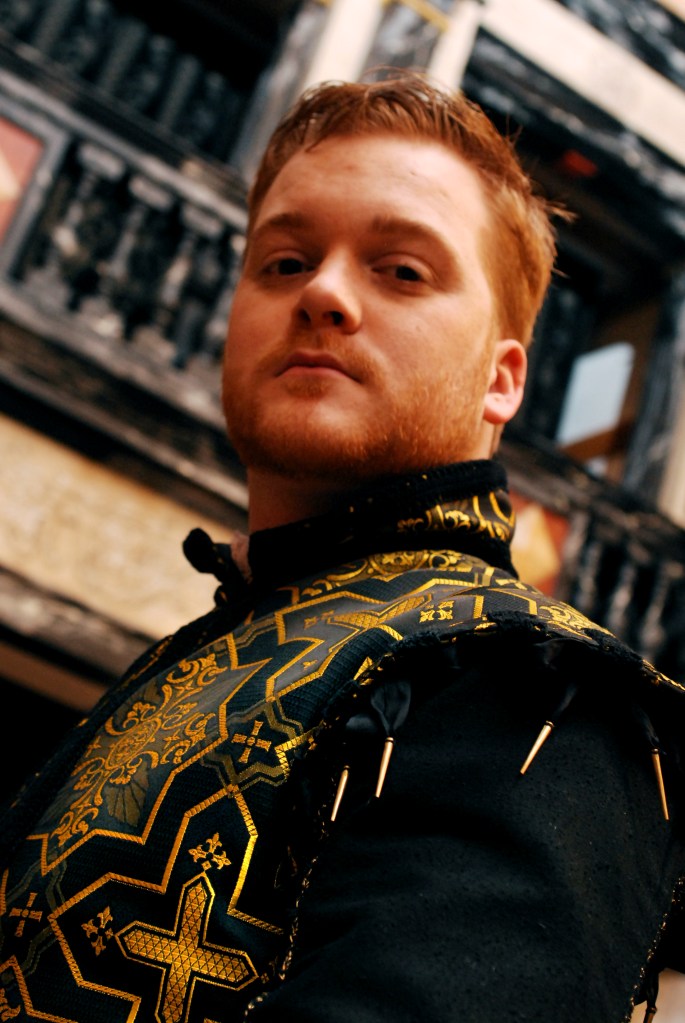
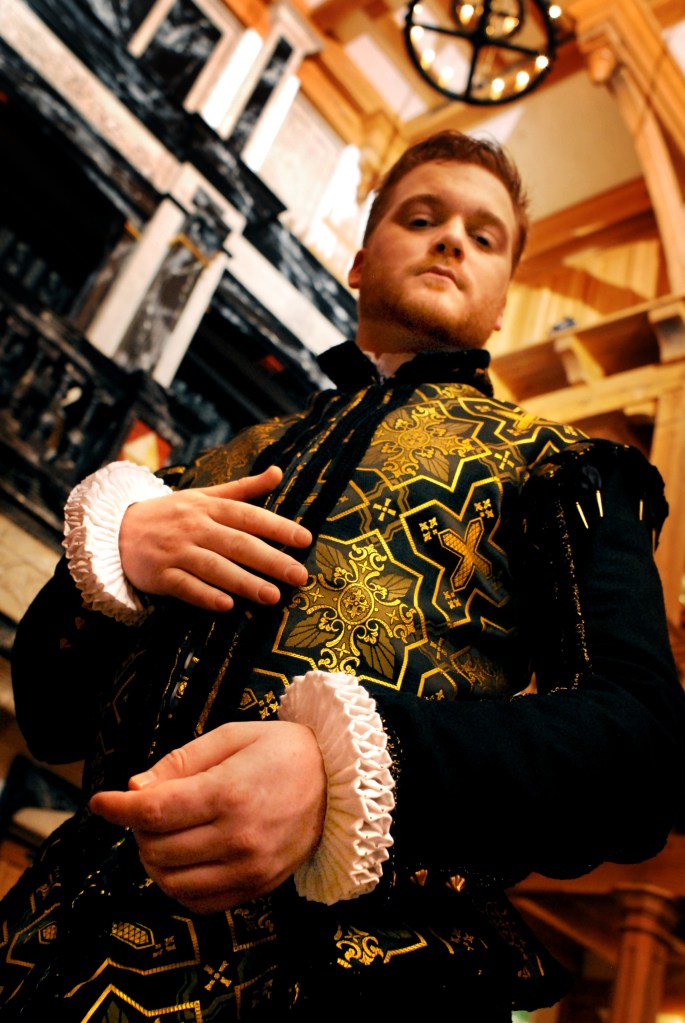
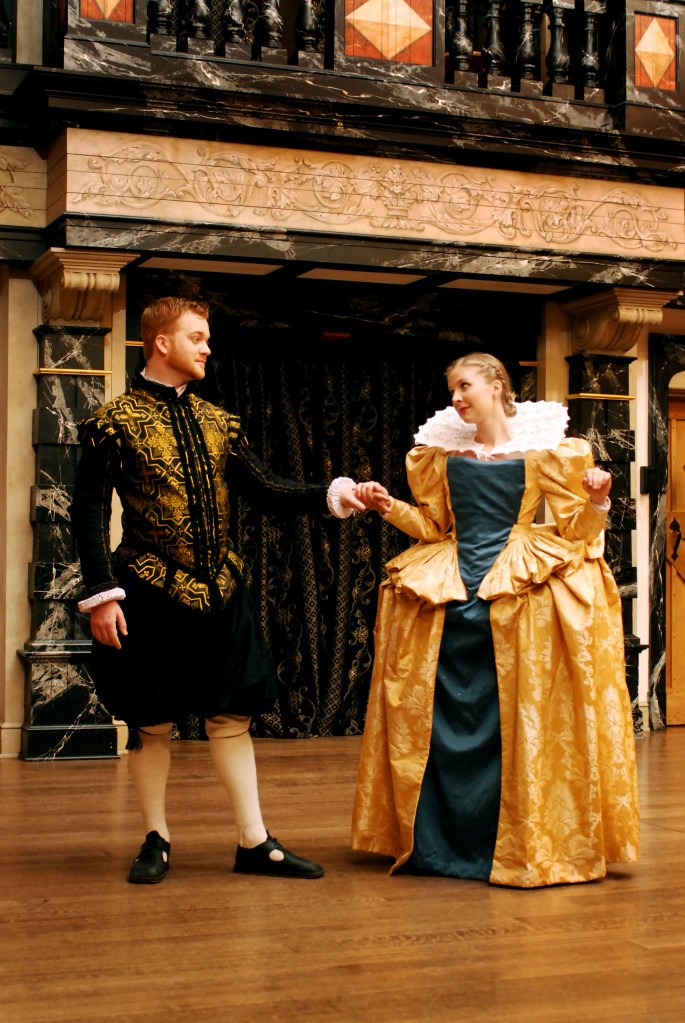
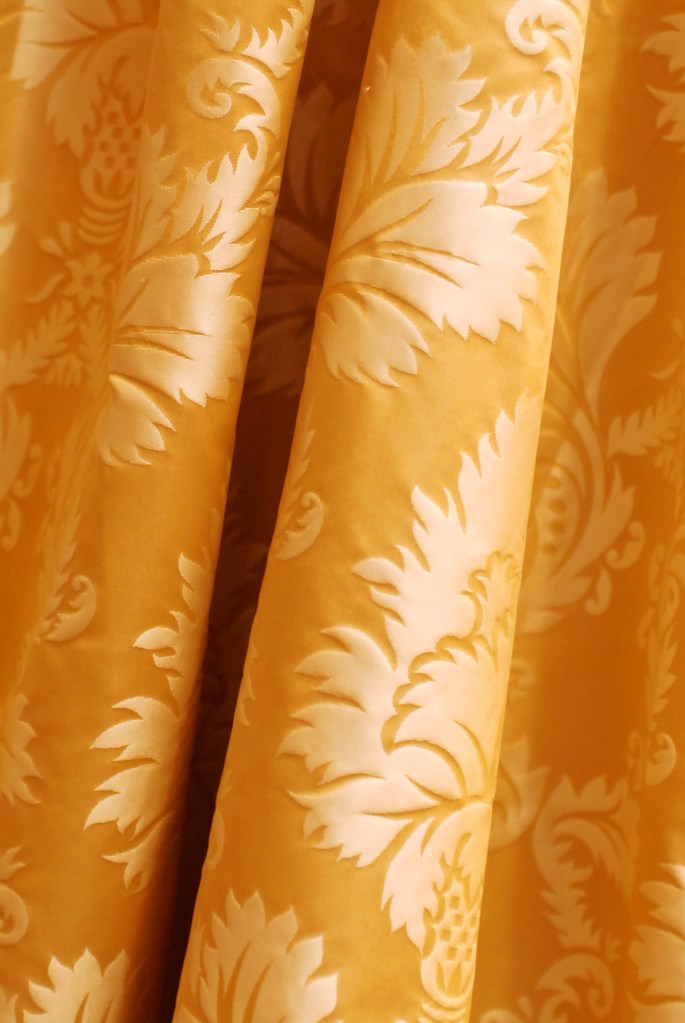
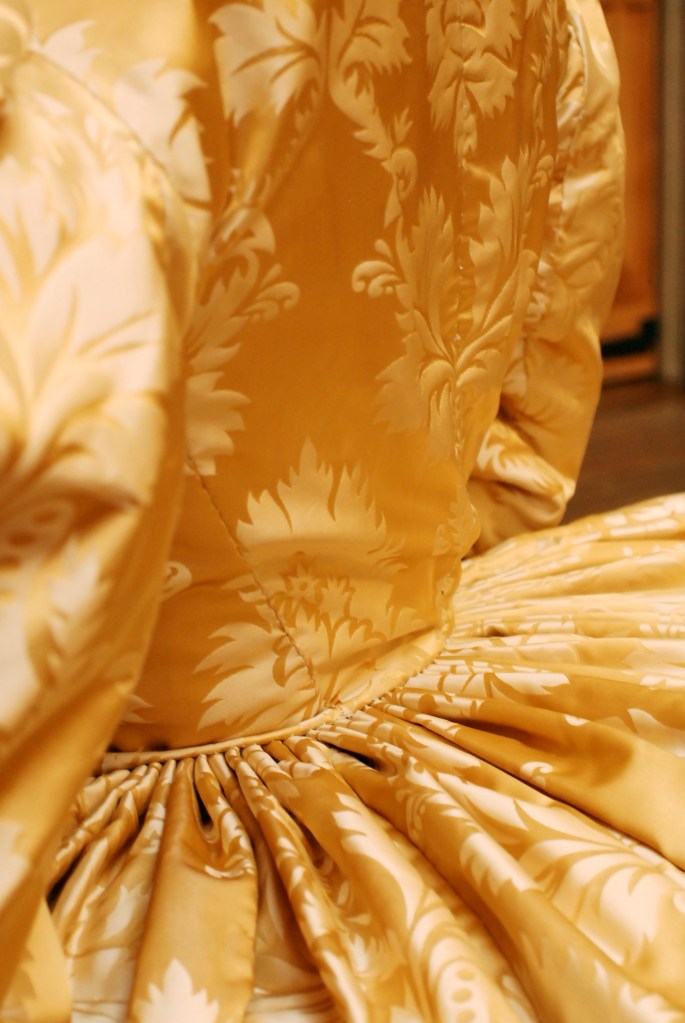
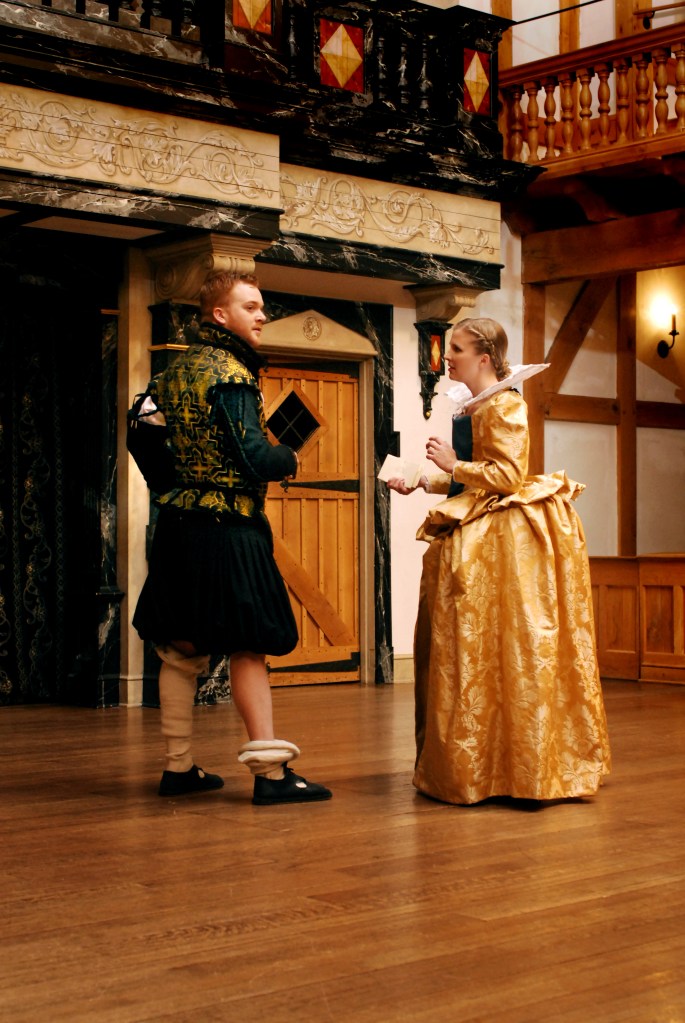
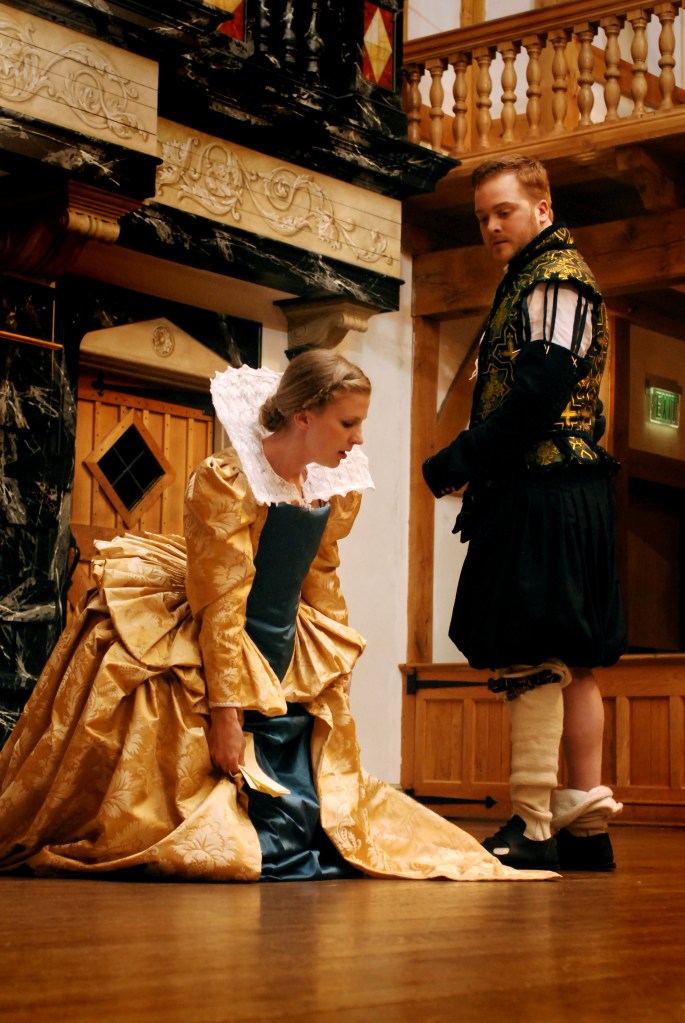
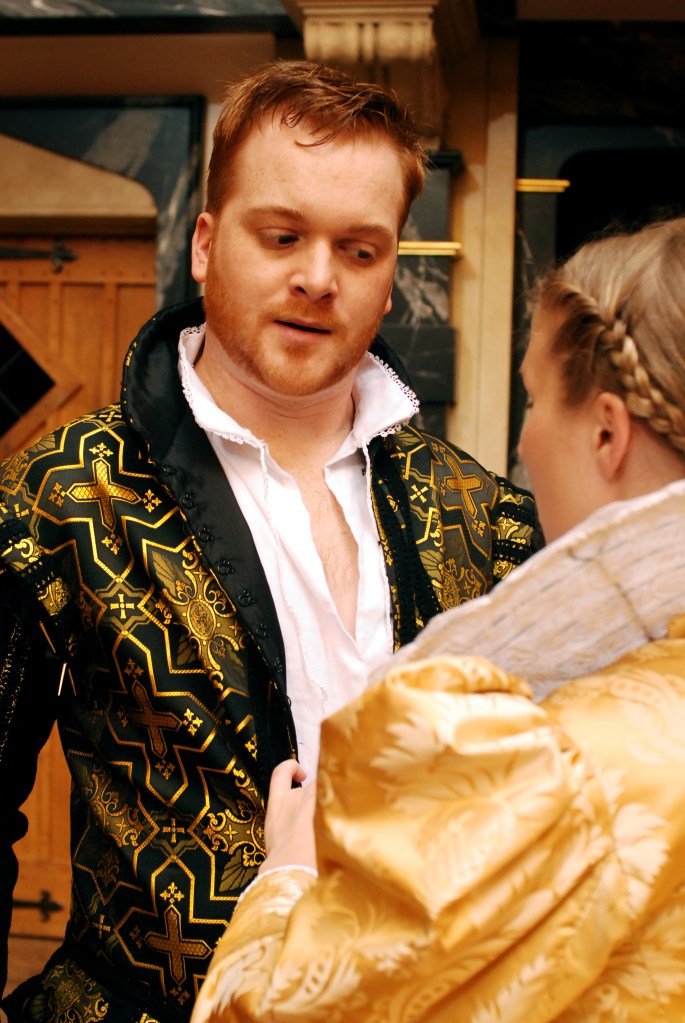
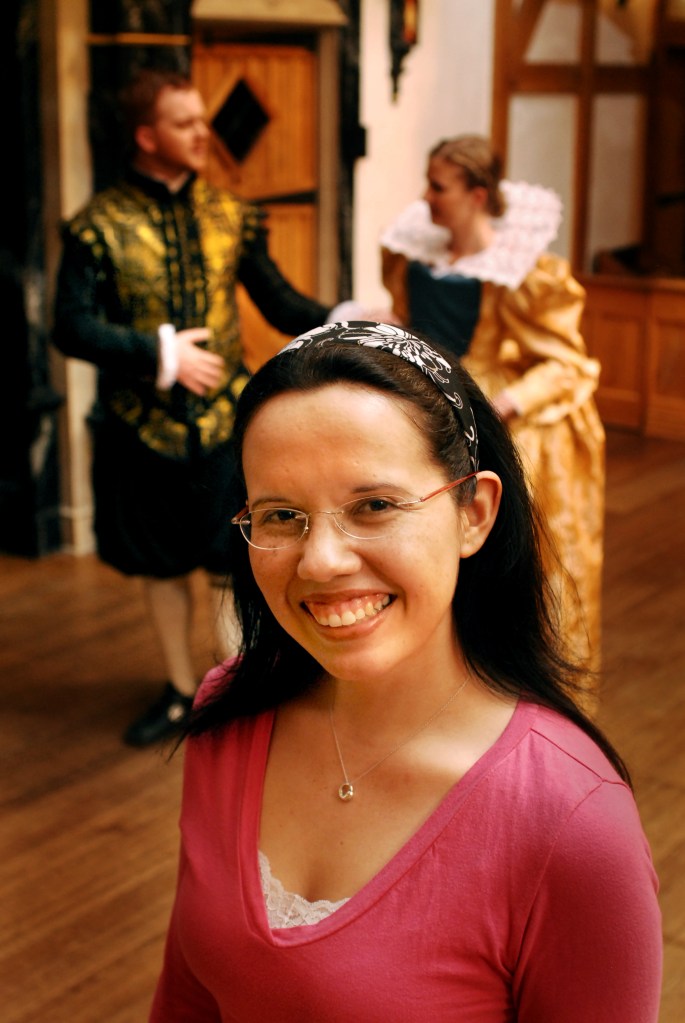
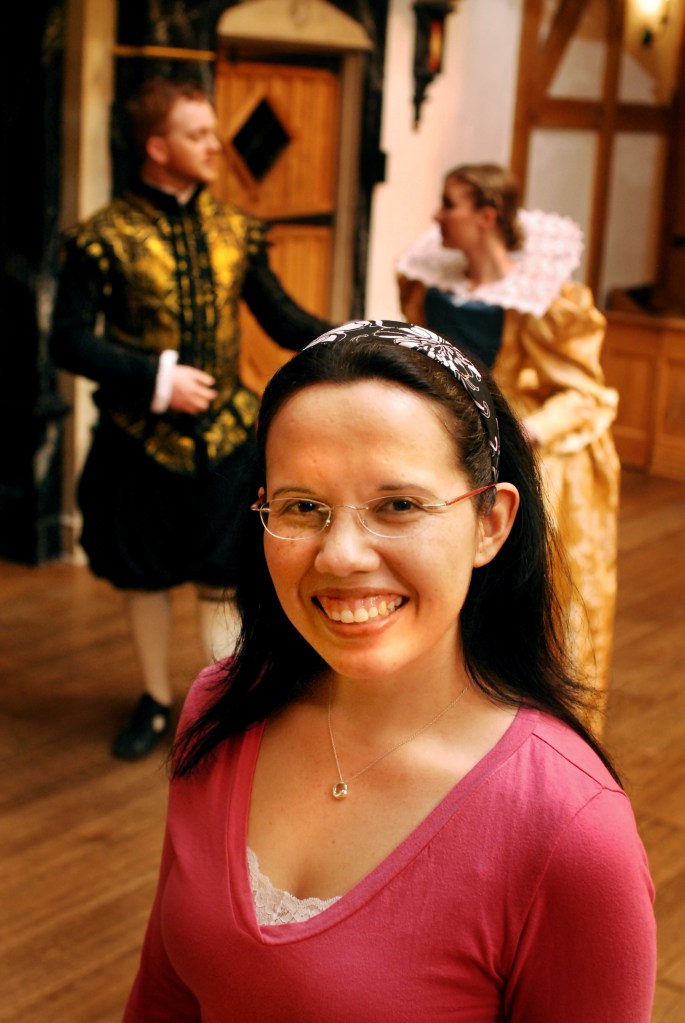
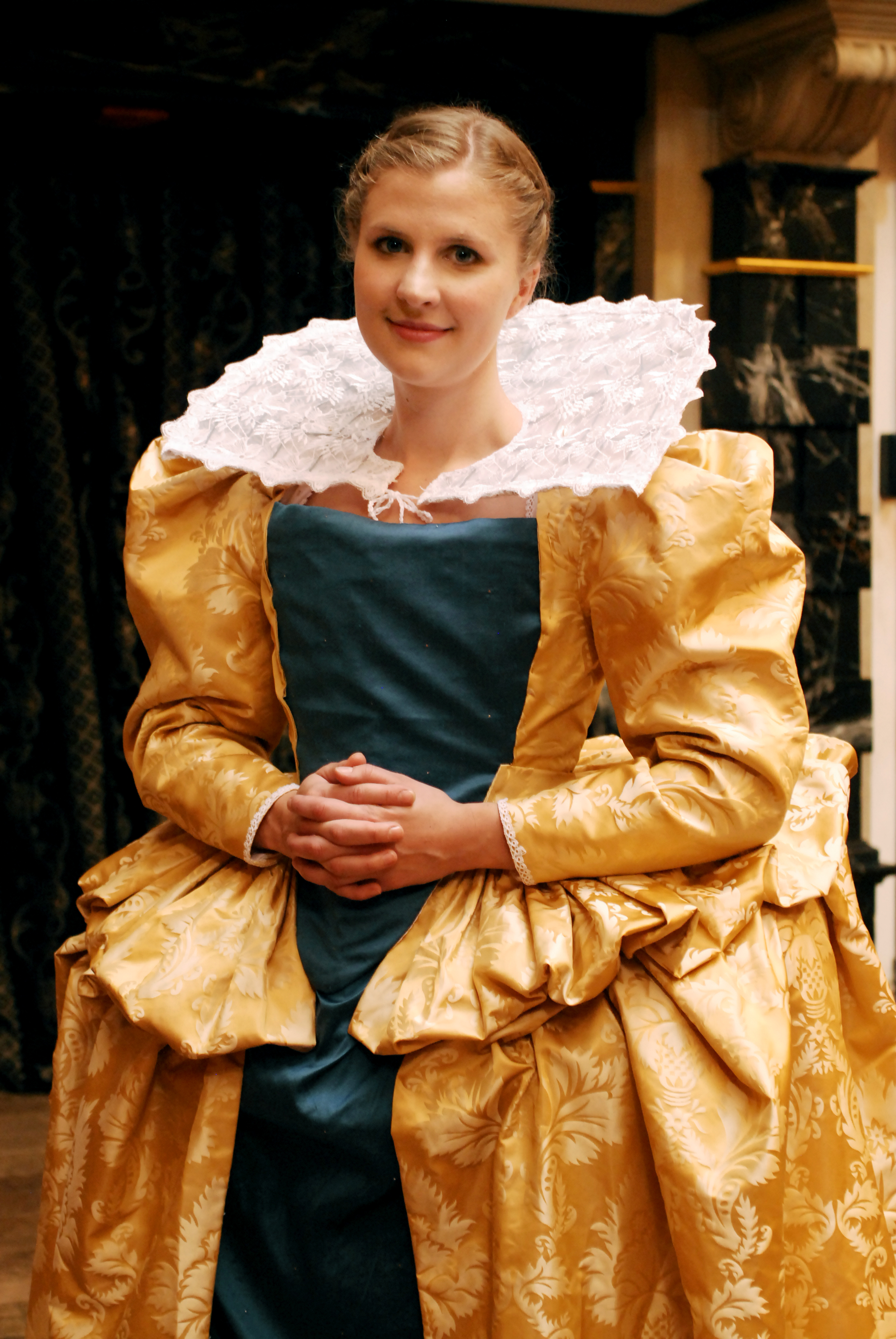
For this installment of this series on Elizabethan costumes, I am deeply privileged that in 2009, I filmed an MFA presentation by my friend and colleague Anna Gonzales. For her presentation at the Blackfriars Theater in Staunton VA, she created two authentic Elizabethan costumes from scratch, which took 900 hours!
In order to make these costumes as accurate as possible, Anna painstakingly researched Elizabethan fashions including period portraits, surviving records, and books of patterns that tailors later published in the mid-1600s. Sadly, no Elizabethan garments survive intact and no patterns. Elizabethan tailors probably felt no need to record their clothing patterns since almost everything they did was custom-made.
She then gave these costumes to two actors, Jeremiah and Dawn, and had them rehearse a short scene from Hamlet. As the video below shows, these costumes dramatically change not only how the actors look, but how they are able to move, which in turn, gives vital information as to how Elizabethan actors were able to perform onstage.
Garment References In Hamlet
‘Tis not alone my inky cloak, good mother,280 Nor customary suits of solemn black, Together with all forms, moods, shapes of grief ‘That can denote me truly. “
Hamlet, Act I, Scene ii.
Out of all of Shakespeare’s characters, Hamlet is the only one who is explicitly stated as wearing black. As Anna says in the thesis presentation, black was a very expensive color to make, so only a prince like Hamlet could afford a black cloak. In addition, his black clothing reflects that he is in mourning for his father. Given that Shakespeare’s company were middle-class artisans, it’s entirely possible that they only owned one black garment and made sure Hamlet was the one who wore it. Therefore, he may very well have been the only character who wears mourning clothes in Act I, Scene ii, thus making an uncomfortable divide between himself, and the court.
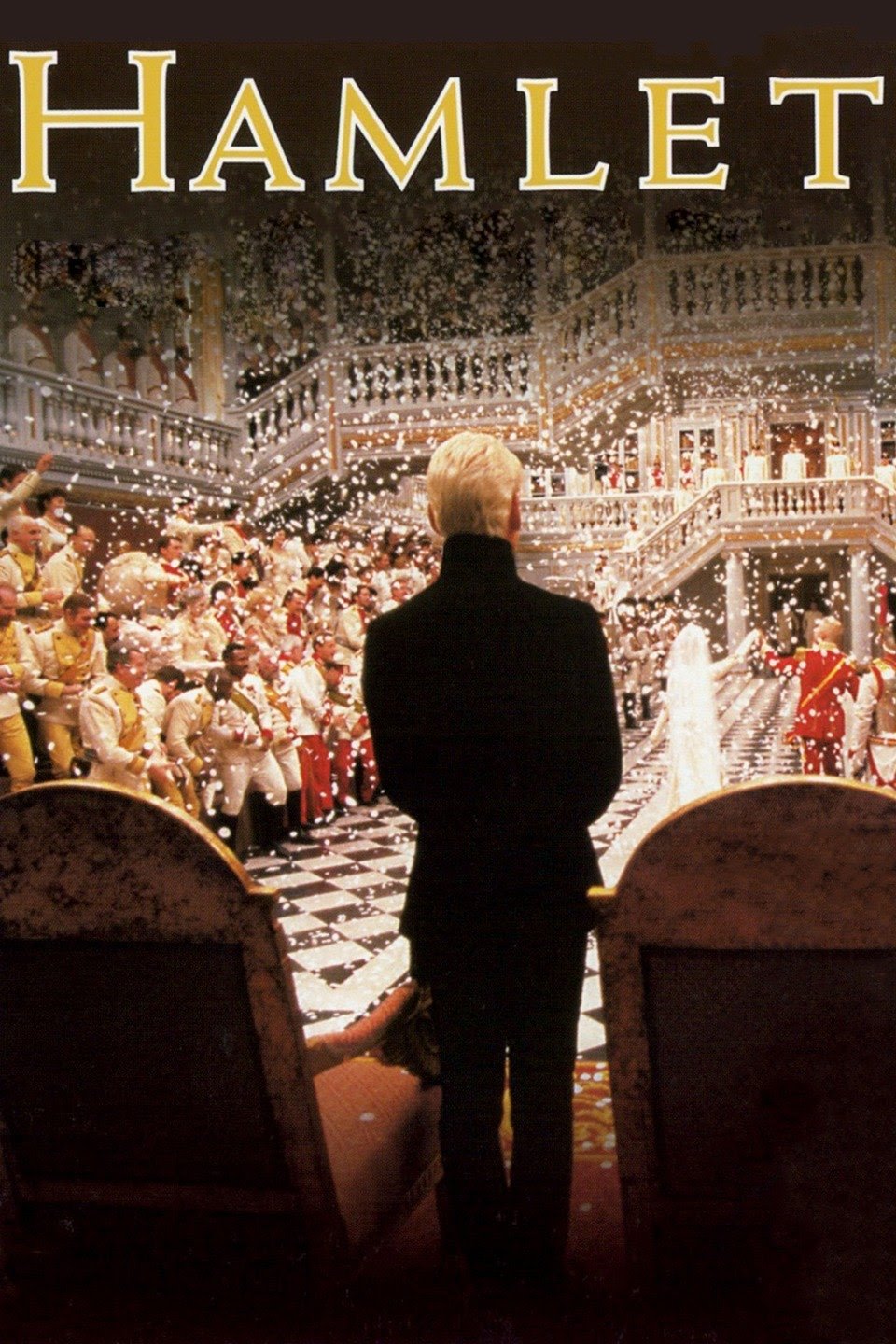
Kenneth Branaugh in Hamlet, Act I, Scene ii. Notice that Hamlet is the only character in black.
Polonius Costly thy habit as thy purse can buy, But not express’d in fancy; rich, not gaudy; For the apparel oft proclaims the man, And they in France of the best rank and station Are most select and generous, chief in that
Act I, Scene iii.
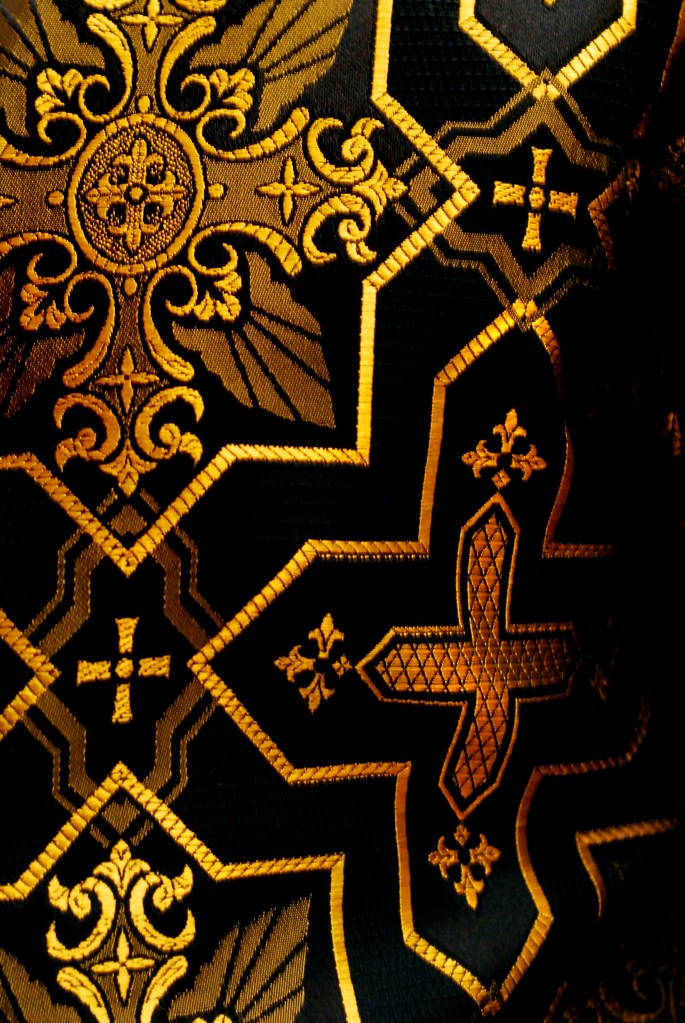
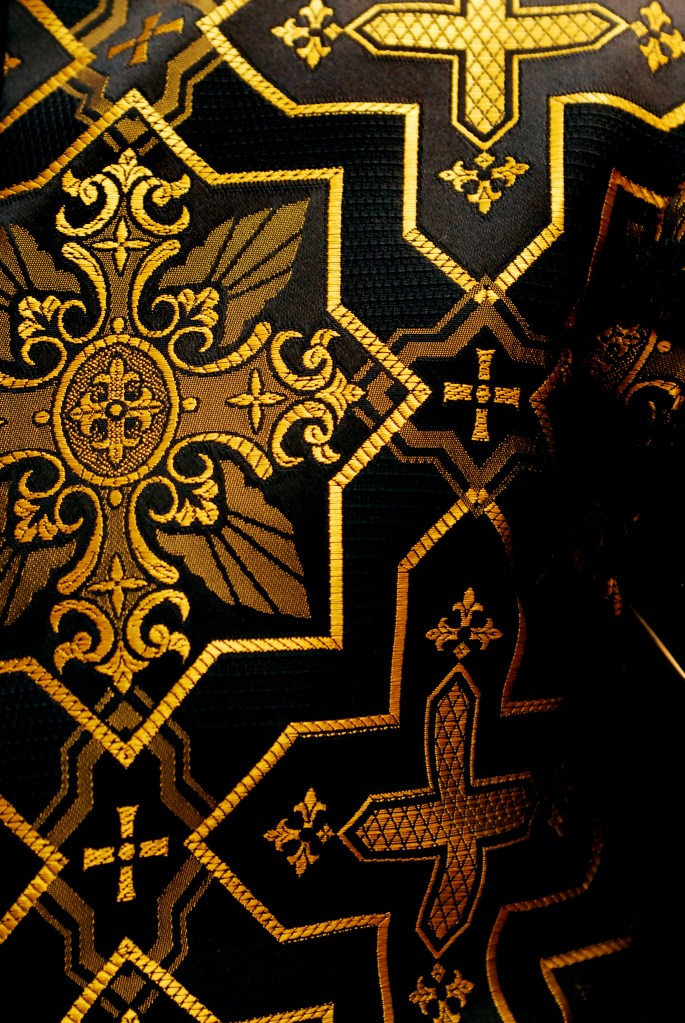
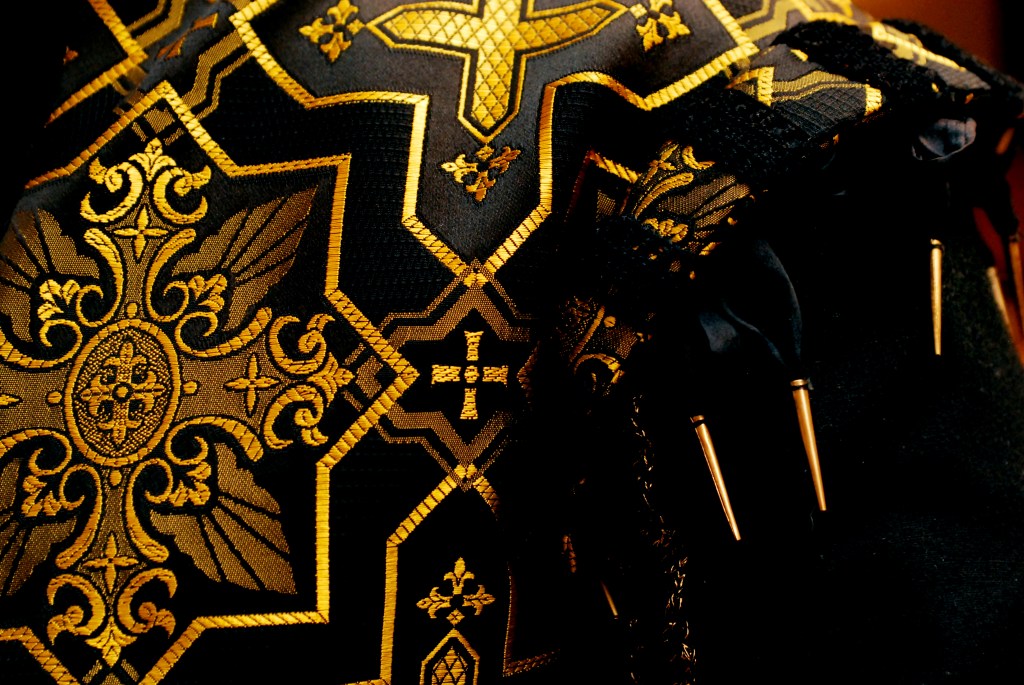
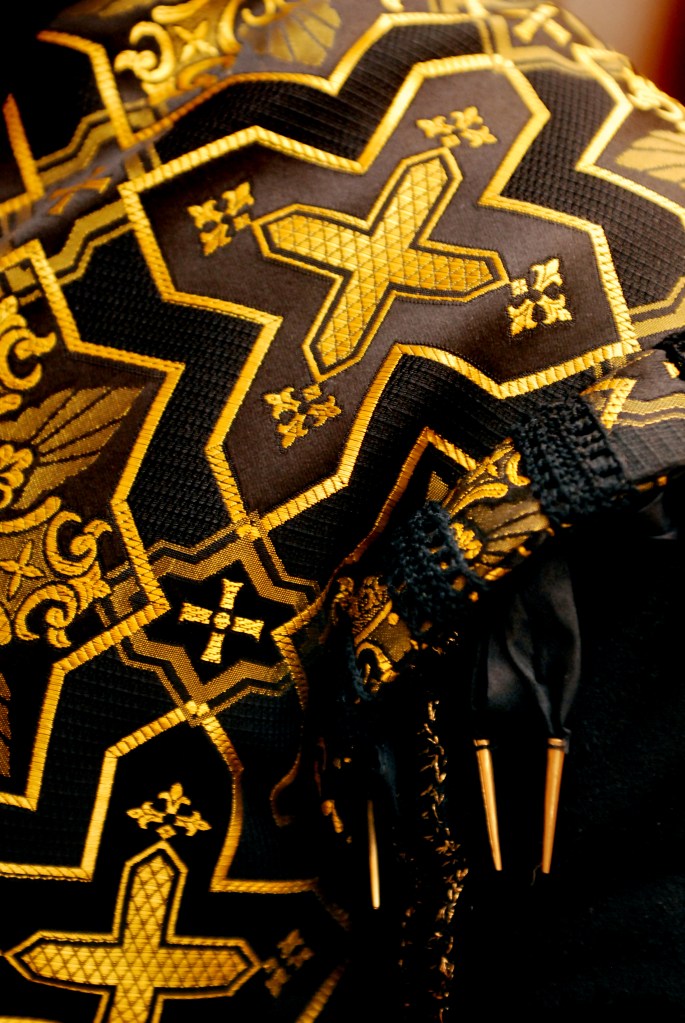
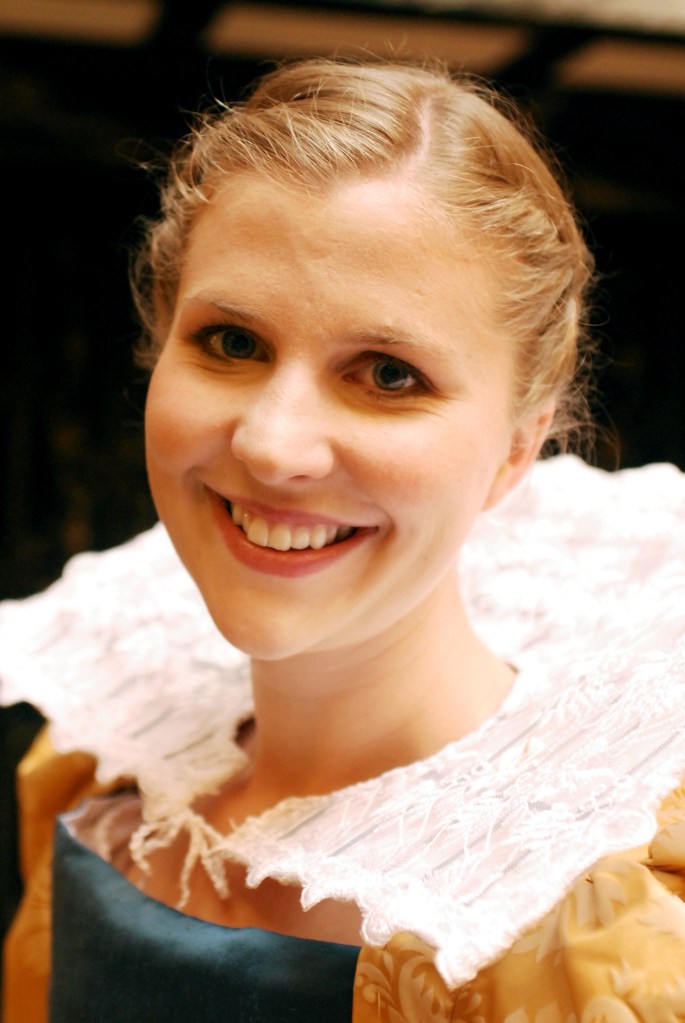
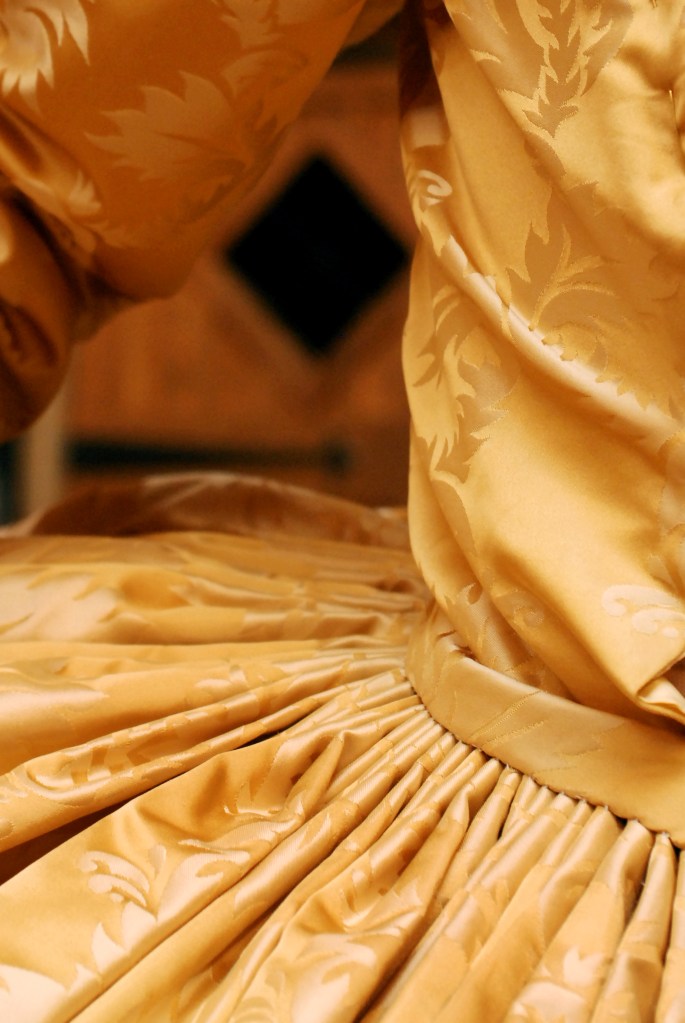
Close up on the starched cuffsClose up on the fine embroidered silk on Jeremiah’s Hamlet costumeClose up on the fine silk on the bustle
Ophelia. My lord, as I was sewing in my closet, Lord Hamlet, with his doublet all unbrac’d No hat upon his head, his stockings foul’d, Ungart’red, and down-gyved to his ankle; Pale as his shirt, his knees knocking each other, And with a look so piteous in purport As if he had been loosed out of hell To speak of horrors- he comes before me.
Act II, Scene i
“Early modern dressing was a social event,” that is, well to do men and women couldnt get dressed without the help of dressers, drapers milliners, haberdashers, and tailors.”
Anna Gonzalez
Gentlemen and Ladies Get Dressed
Scholars and Soldiers
Hamlet, (Michelle Terry) and the Ghost in the 2018 Globe Theater production.
The play opens with two soldiers strolling the battlement; then a ghost dressed in complete armor appears. Once Hamlet and all the other main characters die, the play ends with Fortinbras staging a violent coup. Therefore the soldiers’ costumes are very important for creating a mood.
In the 1590s, gunpowder made full plate armor unnecessary. Usually, soldiers only wore a padded coat, a helmet, and a breastplate. Higher ranking nobles who likely never saw combat would wear a gorget, a small armor collar to protect the chest. This video about the wars between early English settlers in America and Native Americans shows nicely the armor and weapons used by the English of this period (strong language ahead):
Elizabethan Fencing costumes
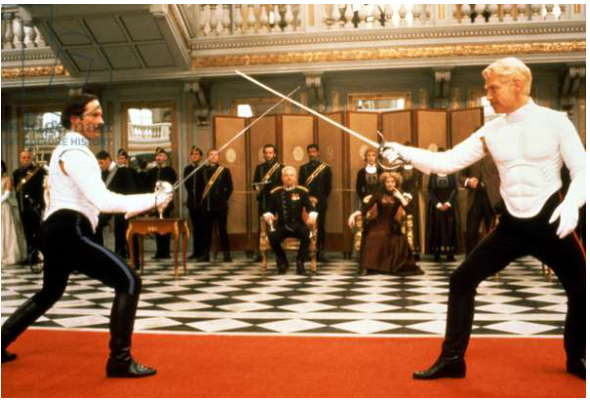
Image from Ein neu künstliches Fechtbuch im Rappier…, (artificial fencing book,) 1611. De La ToucheLes vrays principles de l’espée seule, 1670Hamlet (Kenneth Branaugh) duels with Laertes (Michael Maloney) in Branaugh’s 1996 film.
Most productions like Olivier’s and Branaughs have Hamlet and Laertes in outfits approximating modern fencing outfits, but in 1600, when the play was written, the attire of fencers was less sophisticated. According to Malcolm Fare, early fencers mainly wore padded doublets and sometimes cloaks; outfits similar to what they would normally wear.
It’s hard for me to be objective about this film. I watched it when I was 16, and it started my lifelong love affair with Shakespeare. For the vast majority of people, I feel this movie will not appeal- it’s Shakespeare, it’s set in the past, and it’s FOUR HOURS LONG! That said, I ADORE this movie, and I probably always will.
The Concept
There is a long tradition of actors directing and starring in Hamlet from Irving to Garrick to Olivier and Guilgud. It’s very much an actor’s play and since the lead part also orchestrates much of the action, it’s understandable that he or she would also want to direct.
Once Kenneth Branaugh started filming this film, he had already played the part onstage and as a radio play. Branaugh’s director, Derek Jacobi, was himself a celebrated and acclaimed Hamlet of the 1970s, and Branaugh would later cast him as Claudius in the film. So, once he approached making the film, Branaugh had lots of experience behind him.
Clip from the documentary “Discovering Hamlet” which shows the whole process of Branaugh’s 1990 production, directed by Derek Jacobi.
Much like Antony Sher, Branaugh was aware that any film he made, would probably be compared to Laurence Olivier’s 1948 film. Sir Laurence’s film was dark, gothic, focused on dark, Freudian psychological disorders, and was mostly a star vehicle for Olivier himself.
Short review of Olivier’s Hamlet, (1948).
Branaugh’s concept was to do an inverse of Olivier- his castle Elsinore is bright, more modern, set in a sort of Napoleonic era, with cannons, muskets, and soldiers with mutton chops. While Oliver’s film was a contemplative look at the protagonist’s mind, Branaugh’s film focuses on intrigue and court drama. One of my favorite features of the film is Branaugh’s use of a hall of doors that contain two-way mirrors. In this castle, you never know who’s watching you.
Original theatrical trailer
The setting
While most of the castle was shot at Shepperdon Studious in England, Branaugh filmed most of the exterior shots at Blenheim Palace, the home of the Duke of Marlborough, and Sir Winston Churchill:
Unlike every other Shakespeare movie, Branaugh chose not to cut a single line of Hamlet, which is why his version is four hours long. He chose to use the text of the second Quarto of 1603, the longest edition of the play.
I am deeply conflicted about this choice. On the one hand, the long run time makes it nearly impossible to show the whole movie in a classroom or a theater. On the other time, like Gone With the Wind or Dr. Zhivago, what Branaugh has done is created an epic full of lush settings, gorgeous music, and incredible performances that will at least always be remembered as an incredible artistic achievement.
The Cast
Hamlet is Shakespeare’s longest part and has 40% of the dialogue, which means Branaugh has the majority of the screen time. Yet, Branaugh isn’t the biggest star in the film. His casting choices emphasize the notion that, since anyone can enjoy Shakespeare, anyone can perform it too. With only two exceptions, I love every performance in the film. Here are some of my favorites:
Horatio is a rather thankless part, since mostly what he does is give Hamlet someone to talk to. In one production I saw, they did away with the part entirely and made the audience Horatio. That said, Farell does a beautiful job portraying Horatio’s patience, boundless empathy, and his slow discovery of these “carnal, bloody, and unnatural acts.” Just watch how heartbroken he is as he watches Hamlet slowly die:
Clip of Nick Farell as Horatio from Act V, Scene iii of Hamlet.Brian Blessed as “The Ghost”
Brian Blessed As “The Ghost”
As I said in my review of “Henry V,” Branaugh usually assigns the core of his cast to his Renaissance Acting Troupe. Accordingly, Branagh cast Brian Blessed as the Ghost of Hamlet’s Father. Brian already is a physically imposing man (he’s actually climbed Mount Everest), and we see through flashbacks that when he was alive, the former king was a powerful, warlike ruler, yet tender to his wife and son.
As the ghost, however, Blessed seems shaken to his core, which might be due to the pain he suffered as a result of the murder, or (as I mentioned in my Shakespeare On Ghosts Post), he might also suffer in the afterlife because Claudius killed him while he was sleeping. Seeing such a powerful man worn to a whisper and full of pain and fear, is a great way to spur Hamlet to his revenge.
Charlton Heston as the player king
When the company of players arrive in the middle of Act II, Scene ii, Hamlet is filled with joy and treats the Player King like an old friend and surrogate father. I’ve seen productions where the same actor plays the Ghost and the Player King, which helps drive this point home.
In the play, the Player King inspires Hamlet with a passionate speech. Hamlet muses how, while the Player is able to conjure emotion and tears when talking about the fictional Queen Hecuba, Hamlet has done nothing yet to revenge the Ghost. Then, thinking about the Player’s performance gives Hamlet the idea to stage a play-within-a-play, to test whether or not Claudius is guilty:
About, my brain! Hum, I have heard
That guilty creatures, sitting at a play,
Have by the very cunning of the scene1665
Been struck so to the soul that presently
They have proclaim'd their malefactions;
For murther, though it have no tongue, will speak
With most miraculous organ, I'll have these Players
Play something like the murther of my father1670
Before mine uncle. I'll observe his looks;
I'll tent him to the quick. If he but blench,
I know my course. Act II, Scene ii, lines 1663-1674
With all this in mind, The Player King is very important to Hamlet’s journey and Heston’s mighty delivery is inspiring and full of passion.
Robin Williams as Osric
Robin Williams as Osric
It seems like an insane idea; cast a stand-up comedian in a Shakespeare movie? Yet, in fact, the late Robin Williams was a classically-trained actor and studied at New York’s Julliard academy, so he must have done Shakespeare in the past.
Branaugh clearly loved working with Williams. Not only did he keep all of Osric’s lines (like all the other lines in the play), Branaugh gave Williams more to do, making him basically a second Horatio who cares for Laertes in the final act of the play.
Usually Osric is played as a classist-joke. He’s a sychophant, a social climber who, because he wasn’t born a noble, the nobles treat him as a suck-up and a fool. Williams gives Osric much more warmth and depth, in addition to his manic charm. Branaugh even gives him a tragic death, to make him stand out even more!
Kate Winslet as Ophelia
Five film versions of Ophelia compilation.
I summarize Ms. Winslet’s performance in one word: Heartbreaking. In Oliver’s version, she seems like an airhead, and Helena Bonham Carter plays the part as sort of a rebellious teenager. Winslet’s performance is just as if not even more tragic than Branaugh’s and it is truly heartbreaking to see her journey.
In the 1990 stage production of Hamlet, Jacobi decided to turn “To Be Or Not To Be” from a soliloquy into a speech that Hamlet says to Ophelia, which then plants into her mind the ideas of madness and suicide that she herself follows to their tragic conclusion. In Branaugh’s film, it seems very clear that he gave Winslet that same direction, (even though the speech is filmed like a soliloquy). Before “To Be” and the subsequent “Get Thee to A Nunnery” scene, Winslet’s Ophelia is happy, sweet, obedient to the men in her life, but still her own person. We see in flashbacks her sneaking off to be with Hamlet and she seems to enjoy her secret romance. Probably Branaugh pulled some ideas from her role in Titanic too. But Polonius and Laertes shut her down at every turn and keep her from being with Hamlet. Winslet shows beautifully Ophelia’s struggle to be an obedient daughter and Hamlet’s girlfriend.
In the “Get Thee To a Nunnery Scene,” it’s not clear whether Hamlet knows he’s being watched (at first), so when he speaks to her gently, he might be trying to get her to leave to protect her. But once Polonius audibly closes a door, Hamlet is full of mysogynistic fury. Again, he might be playing mad in order to deceive Claudius and Polonius, or he might be genuinely mad at Ophelia for going along with this attempt to spy on him, but in any case, It certainly breaks her heart, and Winslet plays that heartbreak with a great deal of skill and passion.
Billy Crystal as the Gravedigger
Billy Crystal as the Gravedigger
Again, it seems bizarre to cast an American comedian as a Shakespearean character, but Crystal did a great job making this 400 year old comic bit seem like he wrote it himself! Plus, Crystal listens very quietly and attentively during the “Alas Poor Yorrick” speech, and doesn’t pull focus.
Kenneth Branaugh as Hamlet
Even though this was a four-hour Shakespeare movie of a play I had not yet read, at 16 I was hooked by Branaugh’s performance. Like Olivier before him, Branaugh knows Shakespeare’s reputation as being boring and out-of-touch, so his film is full of violence, sex, and manic energy. This also comes across in his own performance. Branaugh lost weight and dyed his hair to appear younger and attractive (since he knows Hamlet is supposed to be just out of college). He fills the mad scenes with a dark and silly sense of humor, and he plays the angst of Hamlet in Act One very much like a grieving teenager, lashing out at his stepfather and his mother.
That said, Branaugh is also capable of great depth and gravitas in the soliloquies. I particularly love his delivery of “How All Occasions Do Inform Against Me…” soliloquy in Act IV.
The long tracking shot makes it look like Hamlet is expanding his worldview as he contemplates his role in the play, after failing to avenge his father’s death. It’s almost like this young man is growing up in the course of the movie; from a confused and angsty little rich kid, to a man who would make a good king if his life wasn’t tragically cut short.
For a more sober audience, Branaugh’s energy could probably be seen as annoying and lacking subtlety, but for 16 year old me- I ate it right up.
Notable Moments
Branaugh’s interpretation of “To Be Or Not To Be.” Every actor who takes on Hamlet frets over the problem of how to make this speech engaging and fresh. Fortunately, Branaugh did a great job of staging and delivering this speech for the screen. He uses the two-way mirrors brilliantly creating an atmosphere of suspense where Claudius and Polonius are watching this speech, but it’s not quite clear whether Hamlet knows they’re there. His delivery is hushed but intense. It seems like he’s trying to unnerve Claudius without letting him know Hamlet plans to murder him. Everything from the performance, to the filming, to the setting is iconic, and no matter what people think of the film, this version of the speech should be remembered as an achievement in and of itself.
2. Kate Winslet In “The Mad Scene” Just as “To Be Or Not To Be” is the test for any Hamlet, Ophelia’s greatest challenge is the Mad Scene, Act IV, Scene v. After her brother leaves, and her boyfriend is banished for murdering her father, Ophelia has nothing left to lose, except her mind. Many actresses play the mad scene as a chance for Ophelia to let loose, and explode with all the pent-up emotions she’s been repressing- rage, sexual desire, grief, etc. Winslet plays all of them and is very distinct when and why they hit. She refuses to let the men in the court touch her, except for Laertes, and seems disgusted by Claudius. With her brother, she seems to regress into a childlike state, pretending to hold flowers to give to him. The only lucid moment she has is when she quotes songs (simmilar to the Fool in King Lear), where she expresses sorrow that Hamlet abandoned her, grief for her father, and a nihilistic sadness that her life no longer matters, much like the frustration Hamlet expresses in “To Be Or Not to Be.”
Kate Winslet in the mad scene, (Act IV, v)
3. All of Act II, Scene ii. I found myself rewatching this scene, the longest scene in the play. It’s the scene where Polonius claims Hamlet is mad for Ophelia’s love, where Rosencrantz and Guildenstern spy on Hamlet, the Player King delivers his aforementioned speech, and Hamlet has his “O what a rogue and peasant slave am I” soliloquy.
Every performance is fast-paced and entertaining. Even Don Warrington, as the often-cut character of Voltimand, who only gives one long speech about how Fortinbras is totally NOT GOING TO INVADE DENMARK, captivated my ear with his beautiful voice. The drama keeps coming as new characters keep coming in and interacting with Hamlet, and his mood changes drastically throughout the scene; he’s silly and condescending to Polonius, jovial to the players, guarded and brooding to Rosencrantz and Guildenstern, and tortured and full of grief and remorse once he’s finally alone.
Branaugh actually starts the soliloquy with Hamlet taking a series of huge, heaving breaths as if performing for all of these people is truly exhausting. It’s almost like a movie within a movie, and everyone is wonderful in it.
4. The Duel As I detailed in my post on the duel at the end of Hamlet, there are three separate bouts which each have a different feeling- ranging from a sporting fencing match to a deadly blood combat. Branaugh shows the character shift of the duel incredibly well, with his use of music, choreography, and costume. First, the combatants meet before the king, dressed in their white fencing uniforms. Their fight is quick and agressive, but not yet tense or lethal. Then, once Gertrude takes the poisoned cup, the action stops. Claudius is frozen and his voice is only a whisper. Laertes starts to ramp up the tension as he prepares to really attack Hamlet, which he does by slashing his uncovered shoulder!
The climactic duel between Hamlet and Laertes, with Hamlet, finally taking revenge on Claudius (Derek Jacobi).
From this moment in the duel, all Hell brakes loose. Branaugh chases Michael Maloney all around the castle, not stopping until he grabs Laertes’ sword. Meanwhile, Osric shouts for help as Gertrude is dying near the throne. A string quartet ramps the music up up to a wild, whilrling low-pitched tremulo, with the violins playing pizzicato on top. Plucking their strings like the lethal poison that plucks all the characters’ lives.
My Reaction
Even though this film is long, I adore every scene. Branaugh’s boundless energy and endless love of Shakespeare translate through his direction and performance. At the same time, he lets the other actors shine and takes to heart the lessons of Olivier, Gielgud, Jakobi, and others to create a Hamlet that is epic in scale, beautiful to the eye, and timeless in its handling of the material. Clearly, Branaugh wanted this film to be his masterpiece, and whether you like it or not, it certainly is that.
My advice is If you choose to watch it yourself, read a summary of the play first, then watch the film. Also, take some breaks in between the scenes and watch it in chunks. I actually taped it off of live TV so I could watch it in segments.
If you like this analysis, you might be interested in signing up for my Outschool Course on Shakespeare’s Tragedies. I also have a class on Shakespeare’s writing where I analyze “To Be Or Not to Be:”
Though Shakespeare’s Hamlet is very much the story of a renaissance prince, it’s important to remember that the play’s sources date back to the Dark Ages. The anonymous “UR-Hamlet,” (later published in the early 1590s ), is based on an ancient legend about a prince who fights to the death to revenge his father’s murder. Shakespeare’s adaptation still contains a nod to this ancient culture that praised and highly ritualized the concept of judicial combat.
Back in Anglo-Saxon times, private disputes, (such as the murder of one’s father) could be settled through means of a duel. In this period, England was occupied by the Danes, (which we would now call Vikings), and several Viking practices of judicial combat survive. For example, the Hólmgangan, an elaborate duel between two people who fight within the perimeter of a cloak.
At the end of Shakespeare’s Hamlet, the revenge cycle between Hamlet, Leartes, and Fortinbras, comes to a close using a duel. Hamlet has murdered Leartes’ father but Hamlet did not intentionally kill him. This kind of legal dispute would certainly have been settled with a duel in Saxon times. This is one reason why Leartes scorns Hamlet’s offer of forgiveness at the beginning of the scene, and instead trusts in the outcome of the fight to prove his cause. Hamlet and Leartes begin fighting officially under the terms of a friendly fencing match, but it becomes clear early on that at least in the mind of Leartes, this is actually a blood-combat. He is demanding blood for the death of his father, as the Danes would have done during the Anglo Saxon times when Shakespeare’s source play of Hamlet was written.
What happens in the fight
Olivier’s Sword Fight in Act V, Scene iii (1948).
The sword fight at the end of Hamlet is surprising in many ways. First of all, it is much more choreographed than many of Shakespeare’s other fights which are usually dramatized on the page very simply with two words: “They fight.” In Hamlet by contrast, Shakespeare has a series of important and descriptive stage directions. Furthermore, the fight is divided into three distinct bouts or phrases, or if you like “mini fights.” Below is the full text of the fight. I shall then explain what happens in each phrase.
PHrase One
Shakespeare it very clear that Hamlet gets a normal fencing rapier, while Leartes gets a sharp one, they fight one fencing bout where Hamlet scores a point. This is the most “sportsman like” part of the fight:
Enter King, Queen, Laertes, Osric, and Lords, with other

Attendants with foils and gauntlets.

A table and flagons of wine on it.

Claudius. Come, Hamlet, come, and take this hand from me.
[The King puts Laertes' hand into Hamlet's.]

Hamlet. Give me your pardon, sir. I have done you wrong;
But pardon't, as you are a gentleman.
Laertes. I am satisfied in nature,
Whose motive in this case should stir me most
To my revenge. But till that time
I do receive your offer'd love like love,
And will not wrong it.3890
Hamlet. I embrace it freely,
And will this brother's wager frankly play.
Give us the foils. Come on.
Laertes. Come, one for me.
Hamlet. I'll be your foil, Laertes. In mine ignorance3895
Your skill shall, like a star i' th' darkest night,
Stick fiery off indeed.
Laertes. You mock me, sir.
Hamlet. No, by this hand.
Claudius. Give them the foils, young Osric. Cousin Hamlet,3900
You know the wager?
Hamlet. Very well, my lord.
Your Grace has laid the odds o' th' weaker side.
Claudius. I do not fear it, I have seen you both;
But since he is better'd, we have therefore odds.3905
Laertes. This is too heavy; let me see another.
Hamlet. This likes me well. These foils have all a length?
They Prepare to play.

Osric. Ay, my good lord.
Claudius. Set me the stoups of wine upon that table.3910
If Hamlet give the first or second hit,
Or quit in answer of the third exchange,
Let all the battlements their ordnance fire;
The King shall drink to Hamlet's better breath,
And in the cup an union shall he throw3915
Richer than that which four successive kings
In Denmark's crown have worn. Give me the cups;
And let the kettle to the trumpet speak,
The trumpet to the cannoneer without,
The cannons to the heavens, the heaven to earth,3920
'Now the King drinks to Hamlet.' Come, begin.
And you the judges, bear a wary eye.
Hamlet. Come on, sir.
Laertes. Come, my lord. They play.
Hamlet. One.3925
Laertes. No.
Hamlet. Judgment!
Osric. A hit, a very palpable hit.
Laertes. Well, again!
Claudius. Stay, give me drink. Hamlet, this pearl is thine;3930
Here's to thy health.
[Drum; trumpets sound; a piece goes off [within].]
Give him the cup.
Hamlet. I'll play this bout first; set it by awhile.
Phrase Two
Mel Gibson in “Hamlet” (1990)
Claudius. Come. [They play.] Another hit. What say you?3935
Laertes. [aside] And yet it is almost against my conscience.
Again, Hamlet gets the upper hand and scores a point. While his mother is celebrating his victory, she accidently drinks the poisoned cup that Claudius meant for Hamlet. Now Claudius is enraged, Laertes is angry because of losing the first two bouts, and Hamlet is blissfully unaware that he is in mortal danger.
Phrase Three
When Hamlet isn’t expecting it, Leartes wounds him with the poisoned sword. From there, the fight degenerates into a violent, bloody mess where Hamlet disarms Laertes, then stabs Leartes. After this, the Queen dies, and Hamlet kills Claudius:
Hamlet. Come for the third, Laertes! You but dally.3950 Pray you pass with your best violence; I am afeard you make a wanton of me.
Gertrude. No, no! the drink, the drink! O my dear Hamlet!3965 The drink, the drink! I am poison’d. [Dies.]
Hamlet. O villany! Ho! let the door be lock’d. Treachery! Seek it out.
[Laertes falls.]
Laertes. It is here, Hamlet. Hamlet, thou art slain;3970 No medicine in the world can do thee good. In thee there is not half an hour of life. The treacherous instrument is in thy hand, Unbated and envenom’d. The foul practice Hath turn’d itself on me. Lo, here I lie,3975 Never to rise again. Thy mother’s poison’d. I can no more. The King, the King’s to blame.
Hamlet. The point envenom’d too? Then, venom, to thy work. Hurts the King.
Claudius. O, yet defend me, friends! I am but hurt.
Hamlet. Here, thou incestuous, murd’rous, damned Dane, Drink off this potion! Is thy union here? Follow my mother. King dies.
God’s providence in Hamlet (or lack therEof)
It is telling that everyone dies in this scene, which indicates that the concept of providence seems somewhat ambiguous in this scene- yes, Claudius dies but so does Hamlet. In addition, Leartes dies justly for his own treachery as he claims, but he also tries to avoid damnation. Leartes is guilty of treason for killing Hamlet, but Hamlet is guilty of killing an old man and a young maid, so Leartes asks God to forgive Hamlet for two murders, while he has only committed one. Providence doesn’t seem clear which crimes are worse. Further, Providence fails to reveal the guilt or innocence of Queen Gertrude- did she know her second husband murdered her first? Did she support Hamlet’s banishment? Did she know the cup was poisoned, and is therefore guilty of suicide, or was she ignorant and punished by fate for her adultery and incest? Knowing the conventions of judicial combat help the reader understand the compex world of Hamlet, a world devoid of easy answers.
How Would I Stage the Fight?
Phrase 1 I want the two combatants to start en guarde, their blades touching, then there will be a series of attacks on the blade. Hamlet will advance and attack the low line of Leartes’ sword Hamlet will advance and attack the high line of Leartes’ sword Leartes will advance and beat attack the high line of Hamlet’s sword Leartes will advance and attack the low line of Hamlet’s sword
Hamlet performs a bind on Leartes’ sword, sending it off on a diagonal high line. Hamlet attacks Leartes leg and Leartes will react in mild pain.
Phrase 2 Leartes is no longer fighting in polite manner, so this will be the real fight where he’s actually going for targets Hamlet and Leartes come together and bow, Both go into en guarde and Osric signals the start of the fight. Hamlet attacks Leartes’ blade high Leartes attacks Hamlet’s blade low Leartes suddenly does a moulinet and attacks Hamlet’s right arm. Hamlet does a pass back and parries 3 Leartes attacks Hamlet’s Left Arm. Hamlet does another pass back and parries 4 Leartes cuts for Hamlet’s head. Hamlet passes back and does a hanging parry 6, which causes the sword to slide off. Hamlet ripostes, slips around Leartes’ ________side, and thrusts offline in suppination. He then flicks the sword, hiting the back of Leartes’ knee. Phrase 3 Concern- you need to have enough space for Hamlet to chase Leartes DS, and for Leartes to slice Hamlet with the forte of his sword. Before the bout is supposed to start, Hamlet walks toward the sword, point down to Leartes US L or USR “I am afeard you make a wanton of me” Leartes: “You mock me sir!” Hamlet: “No, by this hand” Hamlet presents his hand. Leartes places his sword on it, and slices it Leartes gives Hamlet a stomach punch Hamlet falls to his knees dropping the sword. If necessary, Hamlet can pull out a blood pack to put on his hand.
Leartes points his blade above Hamlet’s head, then brings it back, preparing to strike off Hamlet’s head. Leartes: “Have at you now” Hamlet ducks to the right, with his leg extended. Leartes Passes forward, trips on Hamlet’s leg. Hamlet does a slip and goes behind Leartes’ back. Hamlet rabbit punches Leartes on the back, picks up Leartes’ sword, noticing the blood on it Leartes slowly rises, then notices Hamlet with his sword, he quickly grabs Hamlet’s weapon Hamlet shoves Leartes DS into a corp a corp, then traps Leartes’ blade The two push each other for a while
Osric: “Nothing Neither way” Hamlet pushes Leartes downstage, then slices him across the back. Leartes stops DS, and falls to the ground
Murder of Claudius If Claudius is standing, we can have Horatio grab the king around the neck, Hamlet places the sword across Claudius’ stomach, and slices him. If Claudius is seated, Hamlet picks up the goblet with one hand, slices the king’s leg, then, (after establishing a good distance), Hamlet points the blade off line, just left of Claudius’ neck. Hamlet is giving Claudius a choice- drink or be stabbed. When Claudius chooses to drink, either Hamlet or Horatio can give him the cup. If Horatio gives it to Claudius, it might give him the idea to die later.
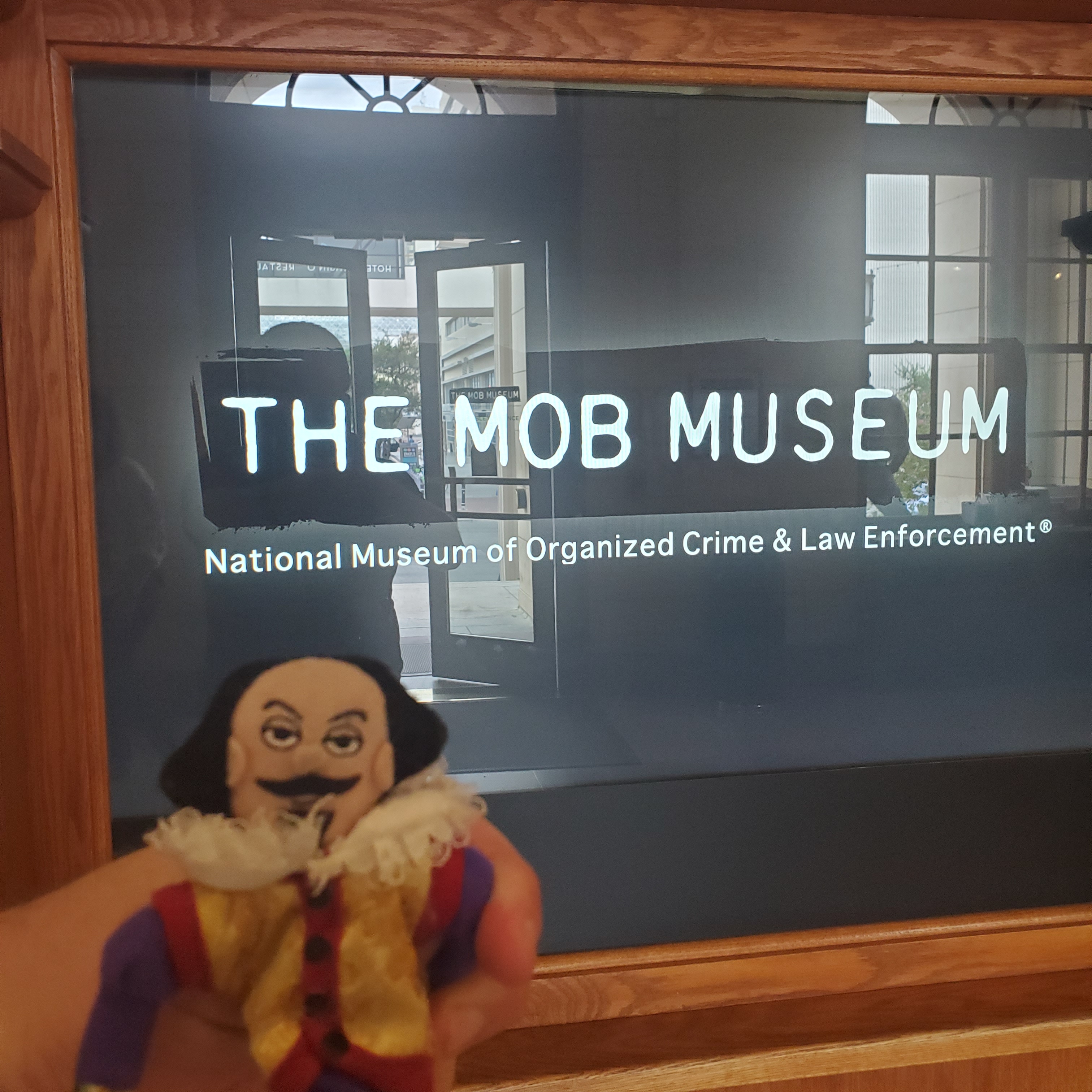
Last month, I took a short vacation to Las Vegas, where, as some of you know, I went to Area 15 and the Omega Mart Exhibit. I also visited the Las Vegas Mob Museum. I’ve been fascinated by the mob for years. The Mob (AKA The Outfit), has within its many threads a potent combination of corruption, seduction vice, and violence all hidden behind the veneer of honorable men who do what they feel they have to to protect their families and their communities.
Not surprisingly, while at the museum, I saw parallels between the history of organized crime and Shakespeare, specifically his most popular history play about a powerful family that takes over the crown of England in a brutal turf war, and then one of its most feared soldiers bribes, intimidates, and murders his way to the top; Richard III.
A Protection Racket: Feudalism vs. La Cosa Nostra
The structure of the mafia paralleled the feudal system. In a world where a police force didn’t offer much protection for marginalized communities, the mafia thrived by offering protection for these communities, (especially to immigrants and people of color in the 19th and early 20th century).
Much earlier than that, the feudal system of the middle ages, which started to crumble after Richard’s reign ended, was designed specifically so poor peasants could get protection from wealthy landowners after the fall of the Roman Empire. These lords offered the protection of their knights to these peasants i. Return for labor and a percentage of their income working the field. Like the mafia, these peasants paid tributes to their lords and these lords demanded loyalty. In the museum, there’s an interactive video where you can become a ‘made man,’ which means become an official member of a mafia crew. Like a king knighting a lord, this ceremony meant pledging your life to your superiors, and being at their beck and call no matter what. In addition, like medieval knights, mafiosos were not allowed to murder other made men without permission from their capo or boss.
However benevolent they might appear, In both cases the Dons and the medieval lords were extorting their underclass. Failing to pay tribute to their lords would cause the peasants to lose their lands, and any disloyalty to the mafia would be severely punished. These powerful, violent thugs used their private armies to intimidate the weak into giving them what they wanted.
Part II: The Two Families
To thoroughly explain the parallels between the Wars of the Roses and the mob, I need to make clear that Richard iii is more than just the story of one man’s rise to power, although there are also mafia stories that fit this mold such as Scarface, White Heat, and the real-life story of Al Capone.
As this hilarious “weather report” from “Horrible Histories,” makes clear, during the Wars of the Roses two powerful families, (each with a claim to the English crown) fought each other in a brutal turf war. As Shakespeare characterizes in his play Henry VI, Part III, the battles between the houses of York and Lancaster shook England like a mighty storm, and for a while it was hard to tell who would prevail:
Henry VI. This battle fares like to the morning's war,
When dying clouds contend with growing light,
What time the shepherd, blowing of his nails,1105
Can neither call it perfect day nor night.
Now sways it this way, like a mighty sea
Forced by the tide to combat with the wind;
Now sways it that way, like the selfsame sea
Forced to retire by fury of the wind:1110
Sometime the flood prevails, and then the wind;
Now one the better, then another best;
Both tugging to be victors, breast to breast,
Yet neither conqueror nor conquered:
So is the equal of this fell war.
Henry VI, Act II, Scene i
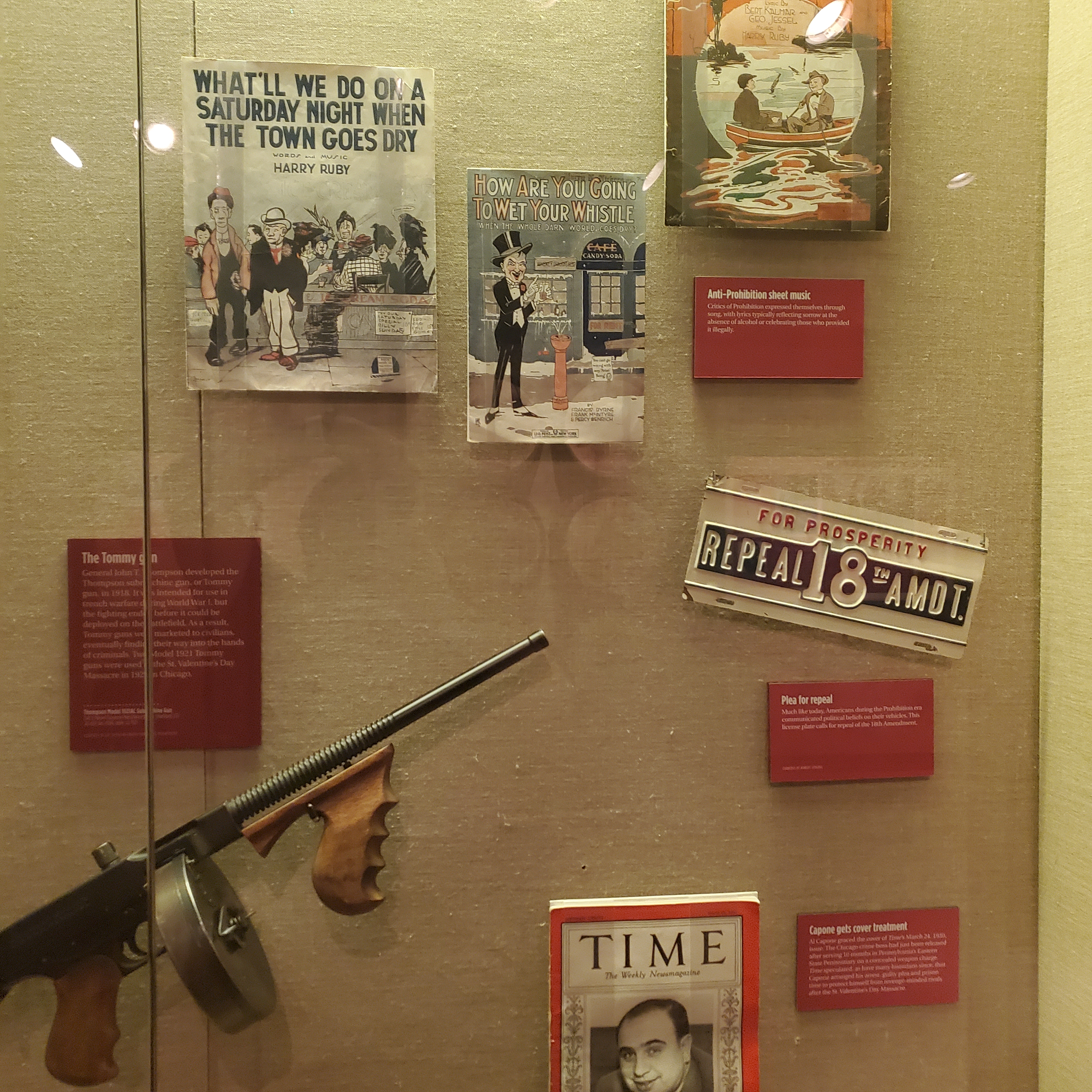
During the Wars of the Roses, it was King Henry’s incompetence and mental illness that gave the Yorkists the ability to challenge the House of Lancaster for the crown. In the 1920s, the passage of the 18th amendment, (which made alcohol illegal, and thus a profitable commodity for organized crime), that allowed the mob to rise to unheard-of power through illegally buying, distributing, and selling alcohol. As the photo and subsequent video shows, Prohibition largely led to the rise in organized crime in America, especially in Chicago. During Prohibition, the Italian Sough-side Gang fought for control of Chicago’s bootlegging trade and subsequently destroyed their competition from the Irish gangs through corruption, intimidation, and violence.
The Don rises- Richard Vs. Al Capone
Opening Scene from Ian Mckellen’s 1995 movie of Richard III.
Like the Italian and Irish gangs In Prohibition-era Chicago, the Yorkist and Lancastrian armies battled for the English throne. As Ian McKellen’s excellent movie (set in the 1930s) shows, Richard was instrumental in destroying the leading Lancastrians at the Battle of Tewkesbury, including Prince Edward and King Henry.
In Chicago, the most feared mobster soldier was Al Capone, who many scholars believe was responsible for killing off high ranking members of the Irish gang during the infamous St. Valentines Day Massacre, where the gang members were ‘arrested’ by South Side gangsters disguised as cops. As the Irish stood against the wall with their hands behind their heads, the phony cops pulled out Tommy guns from their coats and let out a hail of bullets on their unsuspecting quarry.
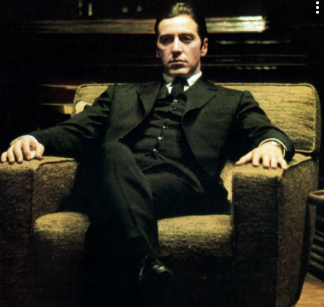
In Shakespeare’s play, the only Lancastrian to survive the war is Queen Margaret, wife to the murdered King Henry, and mother to the slaughtered Prince Edward. In this scene from Al Pacino’s “Looking For Richard,” she curses Richard for his cruel slaughters. It’s not surprising that Pacino was so drawn to Richard II that he starred in and directed this film. After all, Pacino is famous for playing mafia characters who slaughter their way to the top.
Once Capone killed the competition, he ruled a multimillion-dollar empire of bootleggers and maintained that empire through corruption, intimidation, and by constantly playing innocent, just like Richard himself.
Hypocrisy, Corruption and hidden violence
“Men in general judge more by the sense of sight than by the sense of touch, because everyone can see, but few can test by feeling. Everyone sees what you seem to be, few know what you really are; and those few do not dare take a stand against the general opinion.”
Niccolo Machiavelli
Both Richard III and mobsters are masters of double-speak, that is, seeming to say one thing and meaning something else. Look at this passage where Richard talks about killing his nephew, then denies it:
Richard III (Duke of Gloucester). I say, without characters, fame lives long. [Aside] Thus, like the formal vice, Iniquity, I moralize two meanings in one word.
Las Vegas: The town that bedded and abetted the mob.
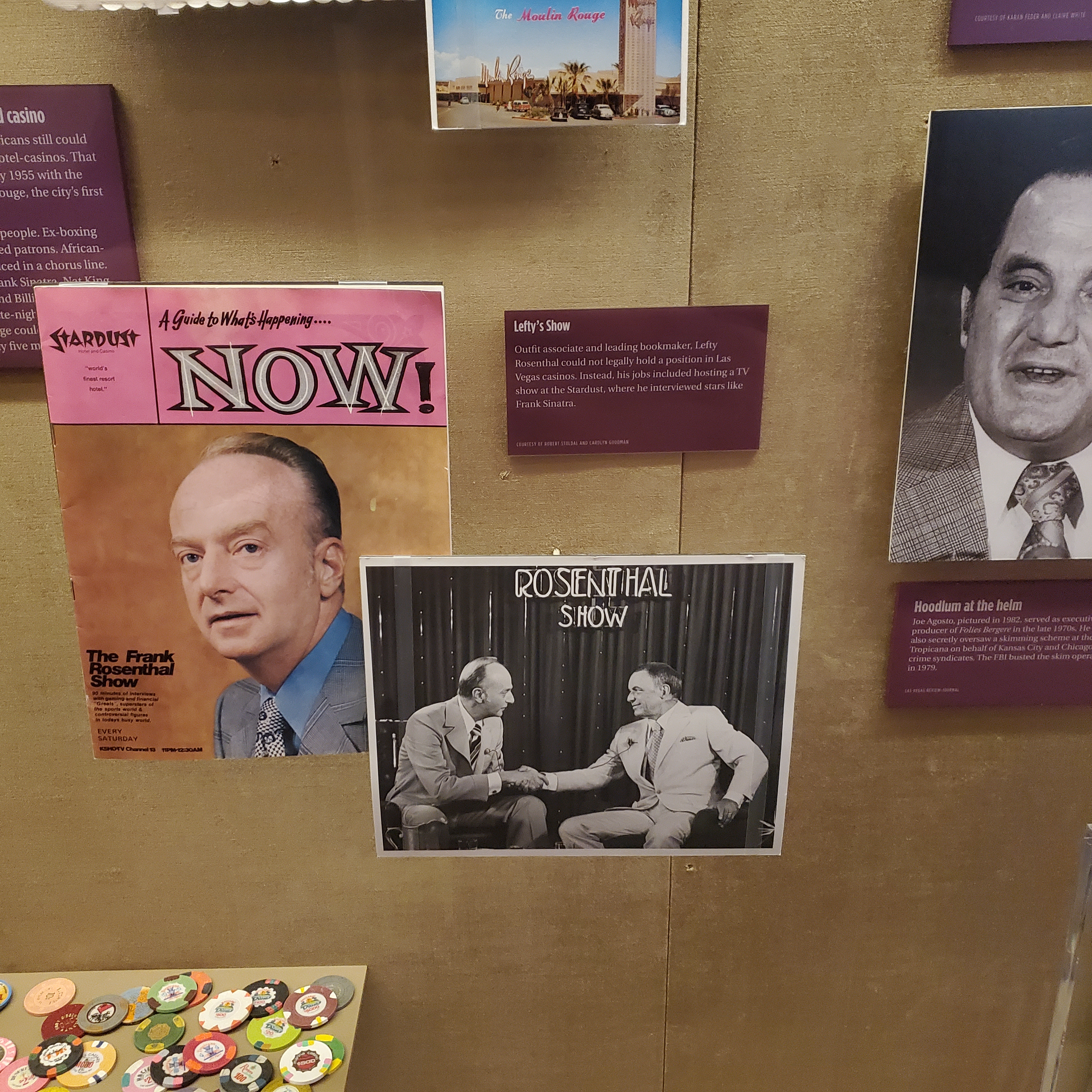
Photos from the museum that shows how the mob-controlled most of the Vegas casinos and skimmed casino profits illegally.
After Al Capone’s demise and the repeal of Prohibition, the mafia found another vice to capitalize on: gambling. As the video below indicates, using their connections with the Teamsters Union and midwestern bookmakers, the mob in the midwest financed, built, and run almost every casino in Las Vegas, including The StarDust and the Hassienda. Once the casinos were built, the mob extorted millions of dollars from the casinos every month!
The profits from the casinos bought the mob even more power and influence, but this skim depended on making sure the bosses controlled their underlings, and defended their casinos from cheaters and snitches, which is why they defended their casinos through intimidation and violence.
Murders in The White tower and the city of sin.
A series of quotes from Las Vegas Mobsters
“Simple, plain, Clarence. I do love thee so, that I shall shortly send thy soul to Heaven.”
—Richard III, Act I, Scene i
When Richard of Gloucester starts his quest to become king, he begins by convincing his brother King Edward to execute his other brother George. Richard bribes the murderers to kill George before the king can reverse the death sentence. Richard has thus eliminated another obstacle in his way, and gained two loyal followers who will do anything for his gold.
Richard hires two murderers to kill the duke of Clarence (Nigel Hawthorne).
The mafia dealt the same way with traitors, stool pigeons, and anyone who tried to challenge the bosses. Look at this tour of the Mafia museum, where the grandson of the gangster Meyer Lansky starts by reminiscing about the glamourous lifestyle of Las Vegas mobsters, but the tour quickly takes a dark turn as Lansky II talks about how his grandfather ordered brutal executions for anyone who crossed The Las Vegas Outfit.
Exterior of the Mafia Museum
It was an enormously interesting trip going to the Mafia Museum, and if you can get out to Las Vegas, be sure to visit, (don’t forget the password to visit the speakeasy bar in the basement!) It was eye-opening for me how prevalent the sort of corrupt protection racket that started in the middle ages and continued into most of the 20th century helped define The Wars of the Roses and the mafia. As long as the strong prey on the weak and the law can’t protect everyone equally, these kinds of violent thugs will be lurking in the shadows, waiting for a shot at the crown.
Today I’m going to talk about the unique costume challenges in dressing the cast for a production of Shakespeare’s history play, “Richard III.”
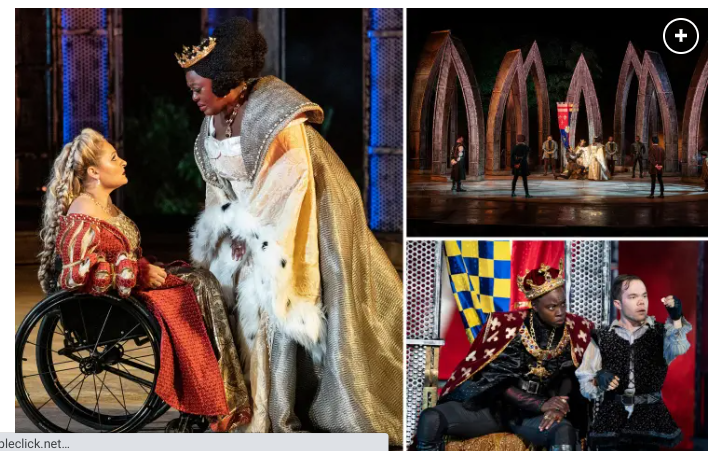
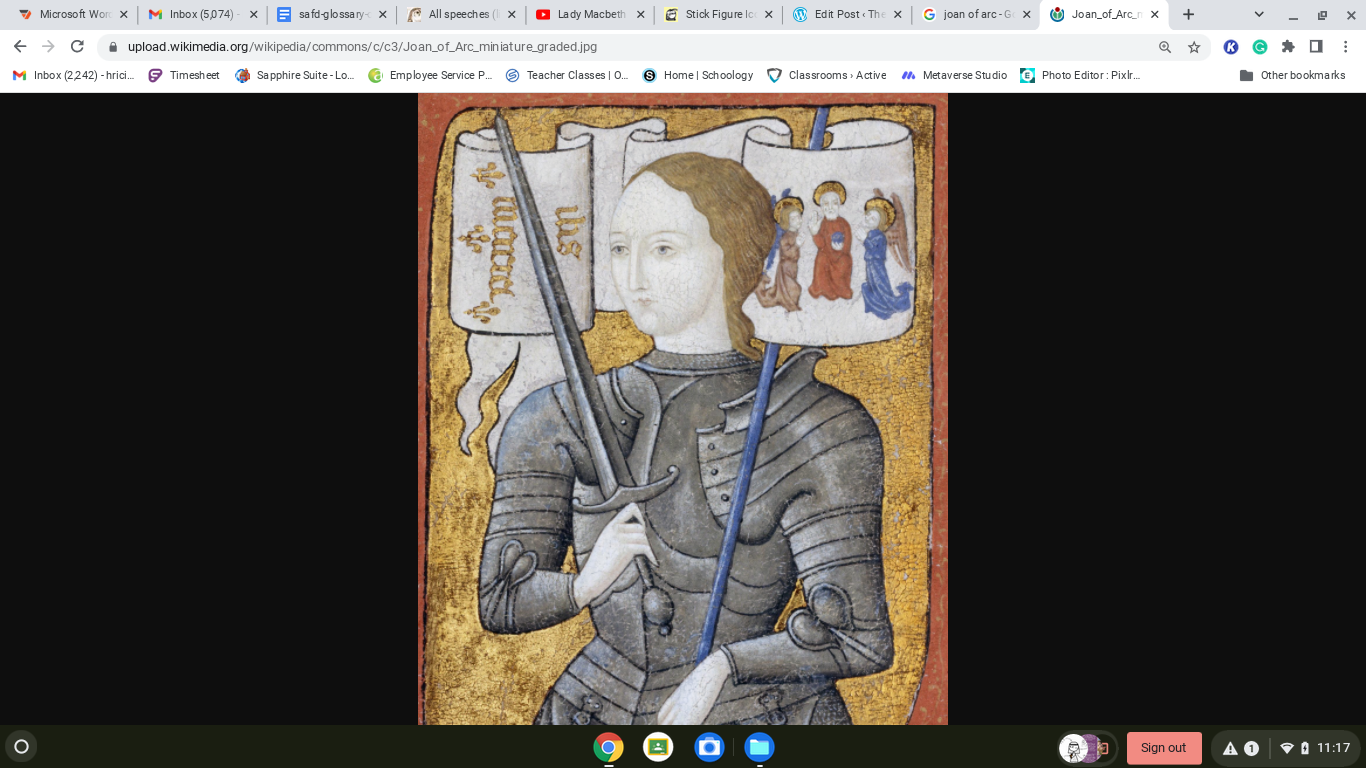
Antony Sher in the 1984 RSC production of Richard IIIConstance from King JohnProduction stills from the 2022 Public Theater production.Contempory drawing of Joan of ArcLaurence Olivier in his 1955 film “Richard III.”
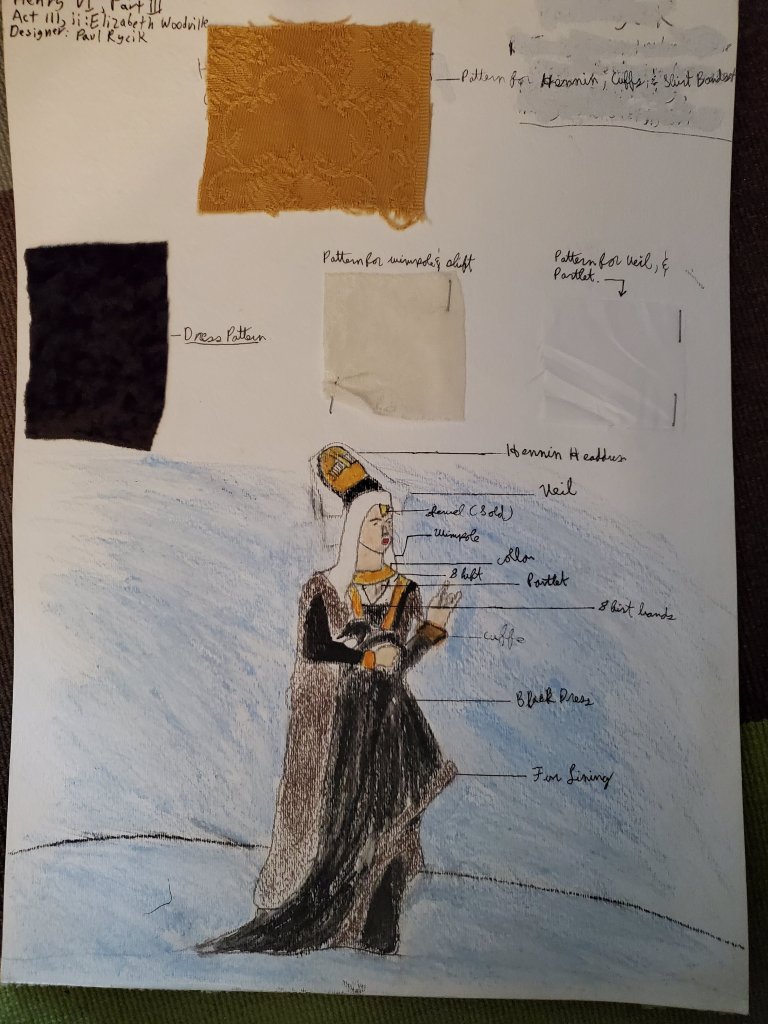
The play is set in 1483, a time period where, even though many European countries were at war, many nobles had sumptuous, more form-fitting clothes with fur, gold, leather, and other exotic fabrics. If you look at the sketch I did above, I gave Richard designs using velvet, leather, fur, and gold. After all, Richard is a powerful duke even before he takes the crown. For more information about this period, visit Fashion History.edu.
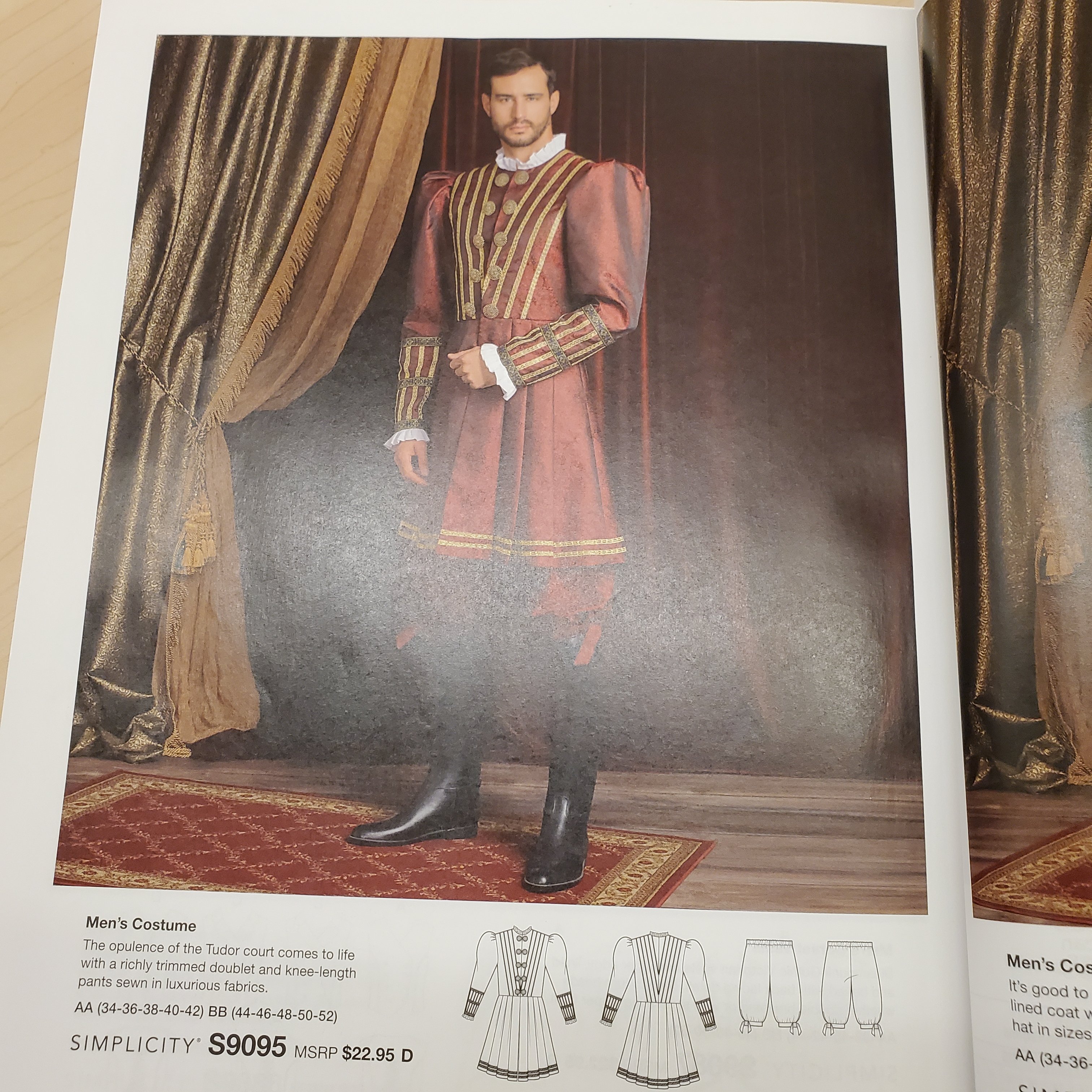
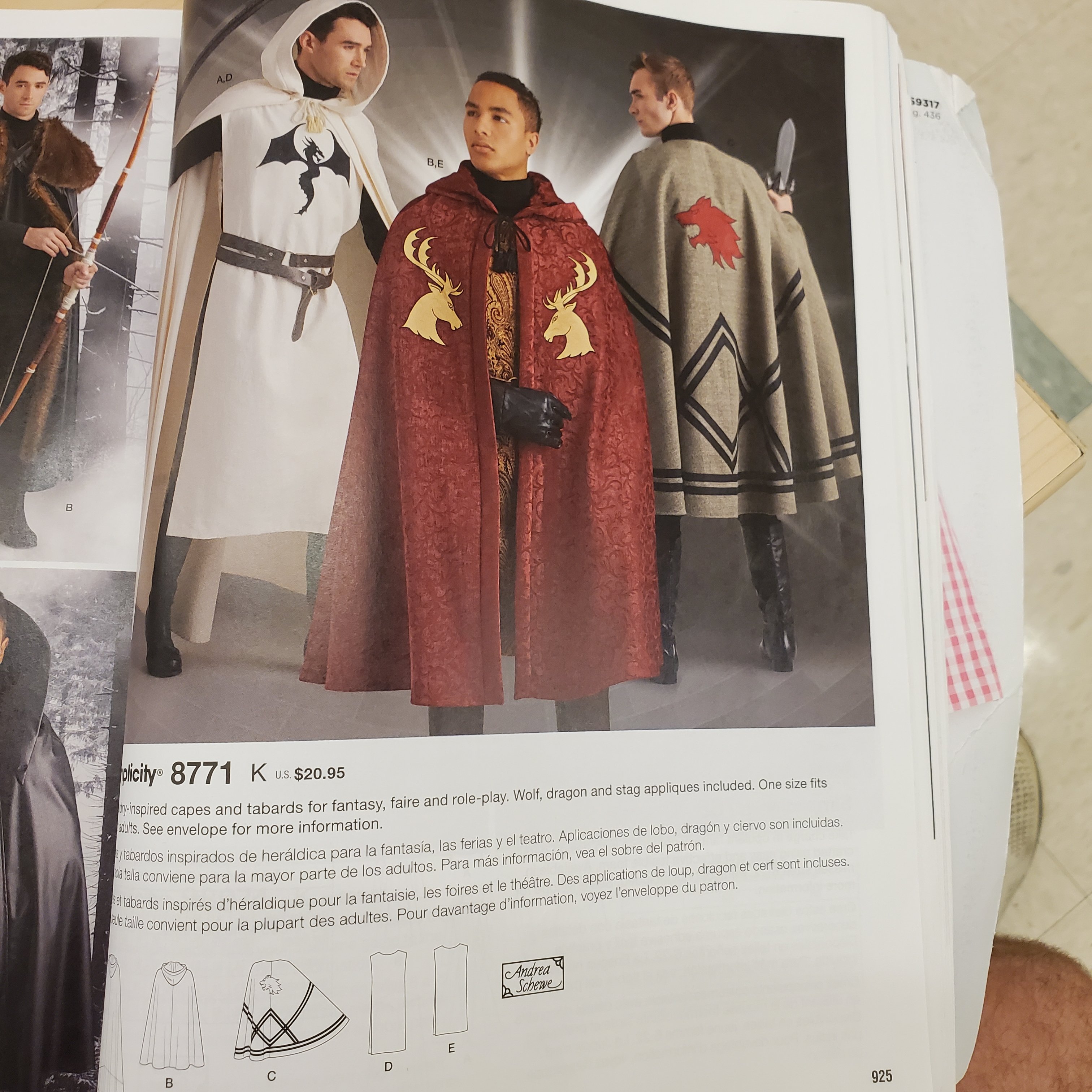
Further, if you’re interested in finding pre-made patterns of 15th century-inspired costumes, go to your fabric store and look for kits like the ones I photographed below.
My design was based on a drawing by the 19th century illustrator HC. Seleous, and the color were taken largely from Richard’s royal portrait in the National Portrait Gallery. I also used a royal portrait of Elizabeth Woodville, queen to Edward IV, (Richard’s brother).
Royal Portrait of Queen Elizabeth Woodville, 1437-1492.National Portrait of King Richard III.
Donning the Hump
Interestingly, x-ray photography has recently revealed that Richard’s alleged hump was added to his portrait after his death. In reality, the king only suffered from merely a curvature of the spine. Just like in Shakespeare’s play, the Tudor Chroniclers literally defaced Richard’s image to make him look like an evil, deformed maniac.
Costume designers are vital to help the actors realize the deformity when playing Richard III, and they have done so in many ways. Ian Holm wore a boot on his leg. John Harrel had a bowling ball fastened to his hand, and Antony Sher had a large hump in the center of his back, both a cloth one that was built into his clothes, and an elaborate makeup prosthetic for scenes where he was partially undressed. When I researched for my thesis, I consulted Sir Antony’s book “Year Of the King,” where the actor explained his research into real spinal deformities, and how he incorporated them into the performance. You can see how my actor Matthew figured out how the hump would impede his walk and other movements.
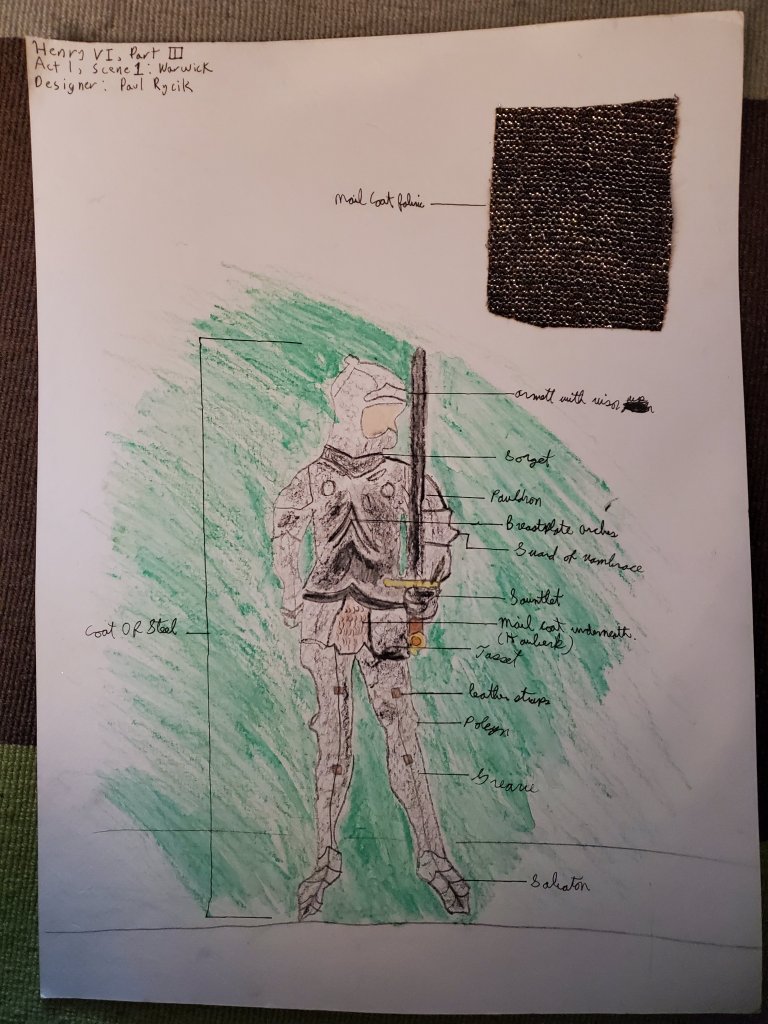
For the final battle between Richard and Richmond, one has to decide on the period and think carefully of the fitness of the actors. 1485 was at the height of the era of suits of armor, and many films have chosen to have Richard fight to the death, while encased in a heavy metal coat of plates.
Benedict Cumberbatch in the 2017 BBC TV mini-series “The Hollow Crown.”Design for a suit of armour for Henry Tudor
However, this has not always been the case. Ian McKellen had Richard fight in a gas mask in a 1940s British military uniform, driving around on a jeep that gets stuck once Richard utters his most famous line:
Richard III is a play about political intrigue, mafia-like turf-wars, and literal backstabbing and the clothes need to reflect this brutal and Machiavellian world. The costumer needs to help all the actors, not just Richard realize their place in the corrupt medieval political landscape of The Wars Of The Roses, as these characters go from an uneasy peace, to the last gasp of civil war.
Ian Mckellen in the 1995 movie version of Richard III.
Since July is my month to celebrate Shakespeare’s Henry V, I’d like to talk about one of the most celebrated versions of the play, Kenneth Branaugh’s Academy Award Winning film from 1989.
The Concept
Clip from Sir Laurence Olivier’s Henry V (1944)
Like many directors trying to re-adapt an old story, Branaugh began by looking at Sir Laurence Olivier’s 1944 movie version of Henry V, deliberately inverting a lot of Olivier’s choices.
Olivier’s version has a framing device where the audience watches the play in a movie-set recreation of the Globe Theater, (since Henry V was probably the first play ever performed when the Globe originally opened in 1599). For the first 30 minutes, you are not watching a movie but a filmed play, albeit one where your fellow audience members are dressed in costumes from 1599.
Olivier as King Henry stands on a reconstruction of The Globe Theater in his 1944 film.
While watching the play within a movie, and seeing ‘audience members’ clap and cheer for Henry, and boo and hiss the French, you get a keen sense of the theatrical illusion of the play, and its importance to English patriotism in 1599. This makes sense since the film itself was commissioned by Winston Churchill to help raise morale during the D-day invasion in 1944.
While Olivier’s film is theatrical and patriotic, Branaugh’s is cinematic and introspective. His film opens on an empty movie set with the Chorus (Derek Jacobi), giving us a tour of the set. He laments that, even with all the cinematic wizardry of modern movies, this movie cannot capture the true glory of Henry V.
Derek Jacobi as the Chrous in Henry V
Branaugh’s performance as the titular king is also quite different from Olivier’s. While Olvier is jovial and charismatic, Branaugh’s King Henry switches between cold and calculating, to intensely passionate. This isn’t to say that his acting is bad; but that Branaugh’s King Henry is a self-conscious actor. The king changes his performance to suit the scenario he’s in: diplomatic and calculating in the throne room, demented and violent on the battlefield, calm and confident with his troops, and pious and merciful in victory.
When I studied the play in college, my teacher posited whether Henry V is a Machiavellian king, and I think Branaugh’s certainly is, in that he knows kingship is a job; one that requires the king to constantly playing roles to get what he wants from people- love, awe, respect, or fear. He’s so good at acting, he even teaches his soldiers how to act like fearesome warriors in his famous “Once More Unto The Breach” speech.
Branaugh in King Henry V
What really sets Branaugh’s movie apart from Olivier’s is the way he handles battles. Again, Olivier in 1944 wanted to raise morale during WW2, when British soldiers were actually invading France to supplant a tyrant. Branaugh in 1989, had seen the world’s response to the Vietnam War, and the decades-long violence in his home country of Ireland. Therefore his version literally takes a dim view of war in general.
Branaugh’s world is not colorful or cheerful- the council scenes are full of candlelit shadows. Branaugh’s fireside chat with his soldiers is a smoky, shadowy look into the terror of men who know they must fight and die tomorrow. Look at the excellent performance of Michael Williams (Judy Dench’s late husband), who takes the king to task while looking at the campfire, almost as if he can see the fires of hell, coming for the English:
King Henry (Branaugh), talks in disguise to the soldier Williams (Michael Williams)
Comparison between Olivier’s 1944 version, and Branaugh’s 1989 movie portrayals of the Battle of Agincourt.
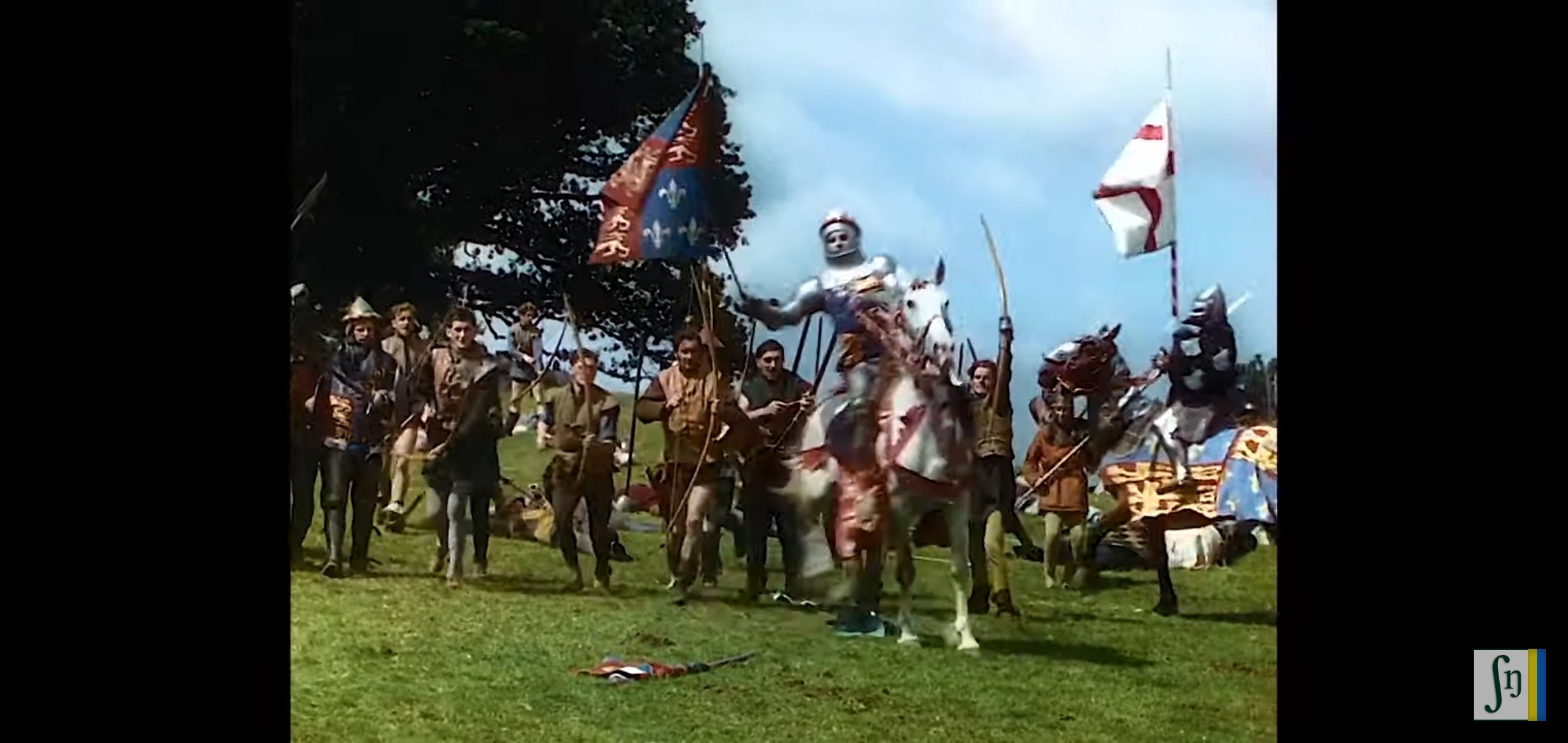
The most striking difference between the two films is how both directors stage The Battle of Agincourt. Olivier’s is a sun-kissed charge on white horses. Branaugh’s is a grimy, mud-stained mess, overcast with a fog of moral ambiguity. Even though the English win, they are meant to question whether or not they have been fighting for a worthy cause. Even after the King proclaims victory for God and country, and the music swells with the gorgeous notes of Non Nobis Dominine (composed and sung by Patrick Doyle), Branaugh has a long tracking shot of all the bodies slain on both sides in the battle. This is the film in a nutshell- a wonderfully acted, exciting, cleverly done thrill ride, that still pulls back and shows the inherently grim and destructive nature of war, that defiles all it touches.
Non Nobis scene from Henry V
The Plot Of the Play
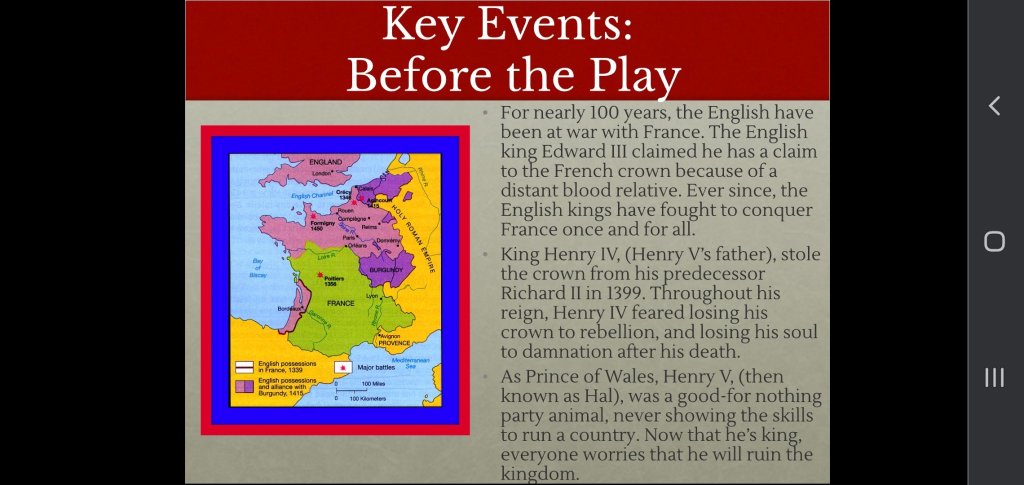
King Henry takes the throne in 1413 after his father dies. No one thinks he will run the country effectively.
The Dauphin (the French Prince) provokes Henry into declaring war with France, (thus allowing him to claim the right of his predecessor, King Edward III).
Henry fends off the French at Harfleur, despite the fact that they are shooting at him with cannons.
Henry’s army starts getting sick. Henry decides to start heading back to Calais
The French raise a massive army and it marches towards Agincourt. Mountjoy the French herald warns Henry he will be annihilated and urges him to pay the French a ransom if he is captured. Henry refuses and marches his troops to battle the French at Agincourt.
Against all odds, Henry’s army defeats the French at Agincourt, with only about 30 English deaths, and over 10,000 French.
Henry and the French King make peace, and the play ends on a joyous celebration of peace and matrimony, though the Chorus also reminds us that once King Henry dies, his son will lose France and England will be torn apart by civil war.
Historical Context
My Favorite Moments
I love Branaugh’s performance and his take on the Battle of Agincourt, but I’d be remiss if I didn’t mention some of the other performances and moments of the play.
Armed Ultimatum: In this wonderful scene, we first see the overconfidence of the French, especially the hot-tempered Dauphin (Michael Maloney), who admits that he deliberately goaded Henry into declaring war because he wishes to personally fight with King Henry. His father the King, (played by Paul Scoffield) is a timid, melancholic individual, (historians often called him Charles the Mad), and he seems like an easily manipulated monarch, ripe for conquest by King Henry. We then see the imposing figure of the Duke of Exeter (Brian Blessed), who comes in full plate armor to warn the French that though the French outnumber the English, the English are a hardy and powerful people, and that King Henry will not stop until all of France is his.
Supporting Cast
Branaugh mainly casts his movies out of his Renaissance Acting theater troupe, which is why in almost all his movies you see familiar faces like Brian Blessed, Derek Jakobi, Richard Clifford, Richard Easton Michael Maloney, Paul Gregory and Geraldine McEwan. As someone who’s seen all of Branaugh’s Shakespeare movies, I get the curious sensation that I know these people, trust them, and find myself rooting for them since I saw them in other roles. Maybe Branaugh hoped his longtime viewers would be concerned for the lives of his “Band of Brothers.”
Welcome additions include Micheil Williams as Williams, as well as his wife Judy Dench as Mistress Quickly. These actors are just as home playing grubby common English peasants as they are playing kings and queens.
Emma Thompson and Geraldine McEwan sparkle onscreen as the French Princess Katherine and her maid Alice. The first time I saw the film, their French was so good, I didn’t believe it was really them! Likewise, the awkward wooing scene between Thompson and Branaugh (who were married at the time) is so charming, you forget all the violence and atrocities that happened on both sides earlier, and giddily enjoy their romantic banter.
My Reaction
In short, Branaugh created, at least for now, the definitive Henry V for our times. It is a world where war is not glamorous and rarely just. Where common men die and rich men survive, though they must carry their sins on their back,( just as Branaugh carries the young boy played by Christian Bale). Yet it is also a story about the power of great leaders overcoming adversity, caring for their subjects, and doing the best they can to bring peace and stability to their people.
Bonus: Here’s an interview with Branaugh about the process of creating the film:
Branaugh in an interview with Bobbie Wygant in 1989.
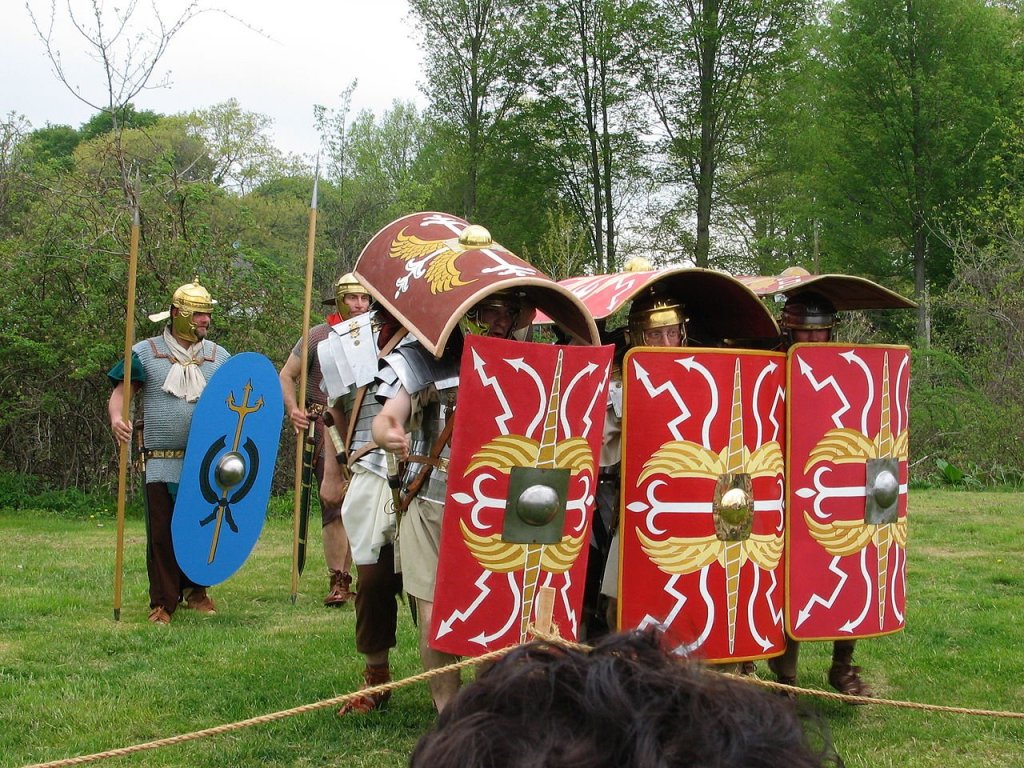
Now put your shields before your hearts, and fight With hearts more proof than shields
Coriolanus, Act 1, Scene iv.
Roman re-enactors demonstrate a testudo formation (The Tortoise). Wikimedia Commons.
Shakespeare uses the word “shield” over 30 times, often as a verb meaning ‘to protect.’ However, there are a few very important references to this ancient tool of defense, and constructing one can teach you a lot about the history of a culture, and that culture’s methods of waging war.
A Brief History of Shields
The seven-fold shield of Ajax cannot keep
The battery from my heart
Antony and Cleopatra, Act IV, Scene 14.
As the quote above from Antony and Cleopatra mentions, the shield has been around since the dawn of history, certainly since Roman times. The Romans prized their large shields called scuta, which they used in defensive formations as the soldiers crashed through their enemies’ defenses.
DIY Roman shieldA replica of an ancient Celtic shield.
In medieval times, Anglo-Saxons and Vikings used new and more sophisticated shield formations in some of the most important battles in early British history. This included the Battle of Hastings in 1066, which ended the Anglo-Saxon era when the English abandoned the protection of their shield wall to chase the Norman invaders, who then annihilated their forces and proclaimed their leader William of Normandy, the conqueror of all England.
In this excellent video, historian and fight choreographer Mike Loads traces the history of medieval shields and shows step-by-step how to make an authentic Anglo-Saxon shield!
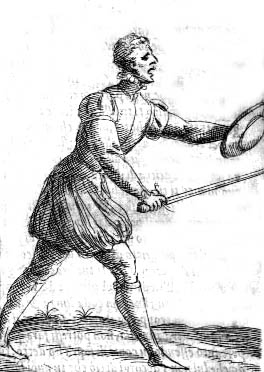
Illustration of a man fighting with a sword and buckler
Swashbuckling
[Enter SAMPSON and GREGORY, of the house of Capulet, armed with swords and buckles]
Shakespeare’s Romeo and Juliet begins with servants armed with swords and small shields called bucklers. These shields were designed to be used in single combat (duels) and were very light and agile. According to Mike Loads, young men would wear their swords and bucklers on their hips and make a loud racket as they walked through the streets. The shield proclaimed that they were armed and dangerous. This macho swaggering is the origin of the term “swashbuckling,” which is probably how these servants see themselves since they spend the first scene of the play trying to pick a fight.
What Is heraldry?
A series of heraldic devices from the Royal College of Arms.
Just as the sound of a buckler announced to the world that a young man was armed and ready to fight, the design on a nobleman’s shield announced his status, his house, and his family motto. The popular historical consensus is that once the medieval knight arrived on the battlefield, they started using their shields and tabards as a colorful display; one that made it clear that they were noble. In war, a knight or other nobleman could collect a hefty ransom if they captured another knight alive, so if you belonged to a rich noble house, your brightly decorated shield could save your life on a battlefield in more ways than one.
Each heraldic design would be registered in the College Of Arms, and many of them are still on record today. In Shakespeare’s Pericles, a group of knights presents their shields to King Simonides and his daughter Thaisa right before a joust and she reads their mottos. The shields are like the knight’s ID tags and help the princess know whom to award the prize money once the jousting is over:
Simonides. Are the knights ready to begin the triumph?
First Lord. They are, my liege;
And stay your coming to present themselves.
Simonides. Return them, we are ready; and our daughter,
In honour of whose birth these triumphs are,
[To Thaisa] 'Tis now your honour, daughter, to explain
The labour of each knight in his device.
Thaisa. Which, to preserve mine honour, I'll perform.
[Enter a Knight; he passes over, and his Squire]
presents his shield to the Princess]
Simonides. Who is the first that doth prefer himself?
Thaisa. A knight of Sparta, my renowned father;
And the device he bears upon his shield
Is a black Ethiope reaching at the sun
The word, 'Lux tua vita mihi.'
Simonides. He loves you well that holds his life of you.  Pericles, Act II, Scene ii.
How to make your own shield!
Since shields are an important part of Shakespeare’s plays, here’s how you can make a shield activity at home or in the classroom.
Making the basic shape
If you want to make a buckler, you need a round surface a little bigger than a dinner plate. You should be able to hold it and move it like an extension of your fist. If you want to make a basic 14th-century type shield like the ones I have below, cut out the familiar, ‘State of Ohio’ shape below. I made mine about 11 inches long, and 10 inches wide. I used cardboard but you can also use paper or wood or metal if you have real craftsperson talent.
Choosing a color and design
I got a lot of good information on how people chose designs for their shields by visiting English Herritage.org’s Guide to Heraldry: https://www.english-heritage.org.uk/guide-to-heraldry. The website has a lovely catalog of the colors and designs real knights and barons and lords used to make their shields/ coats of arms stand out. You can choose a simple background with a plant, animal, etc. in the foreground, or you can divide the shield into a cross, a diagonal line called a Fess, or a triangle called a chevron.
The Personal Touch
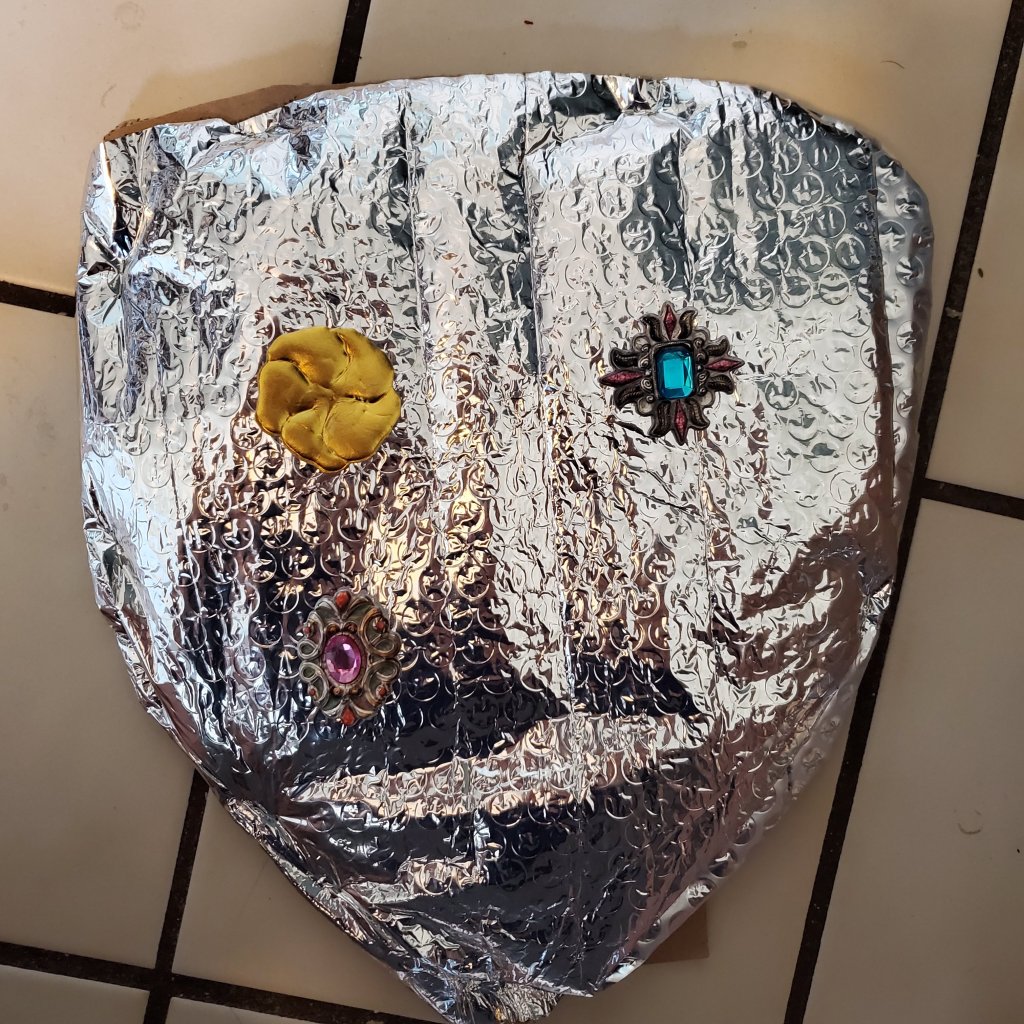
You need not be constrained by historical precedent in coming up with your shield. Like any canvas, the only limits on your shield design are your imagination. Check out these designs I made with my kids!
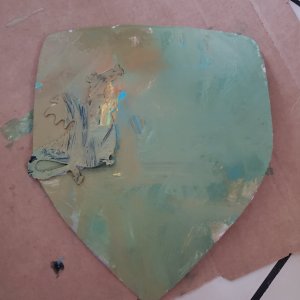
Henry V inspired shield.I wrapped this shield in heat-resistant blankets, and decorated it with stickers from the dollar store.My daughter paints an apple tree on her shield. Why not?My son used a stencil to make a dragon for his shield. We’re going to cover the dragon in glow0in-the dark paint.
Your Motto
Most mottos are single lines of text (usually in Latin), that illustrate what is important to the house that sports it. For example, Richard II’s motto was: “loyalté me lie,” (“Loyalty binds me.”). You could come up with a simple motto and Google Translate it into Latin or French, etc.
Regal coat of arms for King Richard III. Note the white boar, (Richard’s personal charge). Note also that he has combined the 3 red lions of the royal house of Plantagenet, with the blue and gold fleur de lis of the crown of France. Richard claims the throne of England and France and combining heraldic imagery is known as “marshaling.”
Now that you have your shield, with its own unique motto and design, it can be a useful tool to explain how people saw themselves in Shakespeare’s day. Nowadays we mainly see ourselves as individuals, but this kind of heraldry illustrates how knights, nobles and servants saw themselves mainly as part of a house, with its own values, its own traditions, and sometimes an us vs. them mentality against other houses.
This kind of household mentality is of course, at the core of Romeo and Juliet and the Wars of the Roses cycle of plays, and Shakespeare uses heraldry to illustrate this mentality. Look how the knights in the tournament scene from the 2013 film are dressed in their houses’ colors and the nobles and servants are also wearing those same colors:
Like sports fans who wear the jerseys of their favorite teams, shields and heraldry proclaim the allegiance of the servants and nobles who belong to powerful houses/ kingdoms. This kind of emblem can help students understand a piece of medieval and Renaissance history, and how that history shapes our own mentalities today.
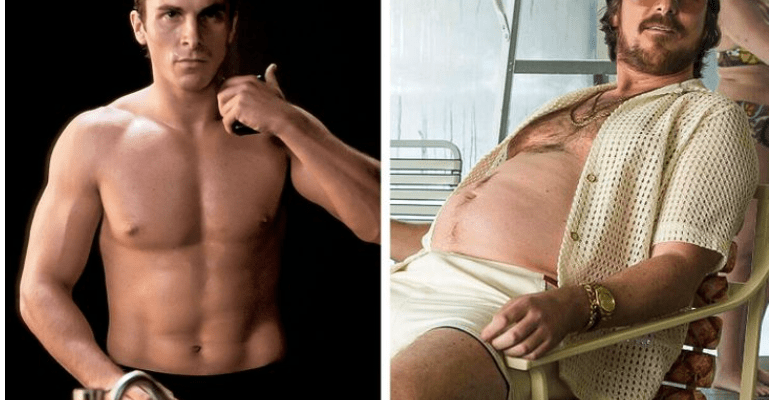
I’m going to be honest, I have a dad-Bod. I try to stay in shape by doing workouts at home and going to the gym, but recently it’s been a bit of a chore.
So like many of us this January, I’m trying to get in shape. So I decided to combine my love of Shakespeare,and make some workouts inspired by medieval Knights!
Screenshot of my Fighter App.
Every day I’ll do some kind of warrior workout 💪, whether it’s a Spartan Warrior workout from the app on my phone, this medieval knight workout I found online, or a rapier drill like the one below. I’ll also log my calories and try to stay away from processed foods and sugar. After all, King Henry didn’t eat them so I shouldn’t either.