Here is the last post on my series of 3 which examines the importance question of why should we read or see this play? In the last post I argued that, although the play is sometimes billed as a moral story, the characters engage in really reprehensible behavior- premarital sex, muder, and whining about their teenage problems. So the question is, if the play isn’t a moral parable, what can we gain from reading it?
Reason # 3- The Play Shows Truths About
the Human Condition.
Even though the play’s characters frequently do rash and sometimes foolish things, this only serves to make them more complex and realistic. The truth is, we all do foolish things when in love, and they all dramatically effect our lives, (sometimes for better or for worse).
The point is that the qualities we demonstrate when we’re in love, reveal who we truly are. Romeo is foolish, obsessed with his lover, sometimes selfish, and hot-blooded. He is also tender, caring, utterly without deceit or pretense, and committed to his beloved at any cost.
I believe this is why we really need to keep reading and watching this play. As Judy Dench said in the film “Shakespeare In Love,” the play shows the very truth and nature of love, not just the budding romances or passionate affairs, but dark obsessions, painful separations, family bonds, and even, “glooming peace,” as the Prince says at the end of the play. Shakespeare shows them all, not judging one to be better or worse, but demonstrating the feelings and the actions that arise in reaction to the powerful force of love.
So when you read this play, try to look beyond the peculiar language, the old-fashioned type and the flowery poetry. Inside you might see a reflection of yourself, what Shakespeare called, “the mirror up to nature.”
Most schools in the US and the UK study Romeo and Juliet at one time or another, so for this blog entry, I wanted to ask the question you might have asked at some point in your life:
“WHY DO WE HAVE TO READ THIS PLAY?”
I will answer this question in three posts, with three different responses, to try and make my answers as complete, and yet concise as possible: Reason #1: Shakespeare Himself Is Part Of the Educational Establishment.
From the beginning of American education, Shakespeare has influenced education. What follows is a brief history that hopefully helps explain why, even though he was born in England, Shakespeare is as American as it gets.
Prologue: Life Imitates Art
The first settlements in Virginia occurred in Shakespeare’s lifetime. After all, Virginia was named after Shakespeare’s ruler, the virgin queen Elizabeth. In 1609, a voyage to repopulate the Jamestown Settlement in Virginia hit a terrible storm and was shipwrecked in an island in the Bermudas. The survivors wrote down their story in a book called A Discovery of the Bermudas, Otherwise Called the Isle Of Devilsin 1610, which could have inspired Shakespeare to write The Tempest. Shakespeare wasn’t ignorant of the New World; he references America in The Comedy Of Errors, so it’s not impossible that Shakespeare based his last great play on this “Brave New World.”
The Beginning Of Shakespeare In American Education
In England during the 18th and 19th centuries, Shakespeare was considered a way of educating people in the Greco-Roman tradition, since his plays were based on such Roman authors as Plautus, Seneca, Plutarch, and Ovid (Saccio). Romeo & Juliet is a perfect example of Shakespeare borrowing from the older western traditions- he took the plot and characters from an Italian Renaissance story recorded in Mateo Bandello’s Novelle (1554). The concept of forbidden love though, is much older. Like many Renaissance stories, Romeo and Juliet has roots that go all the way back to the Trojan war, which according to Greek mythology, started with a man from Troy who dared to love a woman from his city’s mortal enemy. Our founding fathers were schooled in this tradition and they helped transplant Shakespeare to the new world.
Shakespeare Comes to America:
Picture of the first ever edition of Shakespeare printed in America, the 1795 Hopkinson Edition by Bioren and Madan
Our country’s early settlers were Puritans and Quakers, who disapproved of theatre in general and tried to have it banned. Nevertheless, many of the founding fathers loved Shakespeare and enjoyed reading his plays ; John Adams and Thomas Jefferson took a pilgrimage to Shakespeare’s birthplace, and George Washington even staged some of his plays (Behn). Even though he was an English playwright, most early Americans were quick to adopt Shakespeare as their own .
Shakespeare In the Classroom
In the 1830s, Shakespeare first appeared in American textbooks as something called “The McGuffey Reader,” a book that contained short snippets of text ranging from old nursery rhymes, to passages from Nathanial Hawthorne. In this sample, you can see that there is one passage from Shakespeare called: “Shylock: the pound of flesh” listed in the table of contents.
At the same time, going to Shakespearean plays and owning copies of Shakespeare’s works became more and more popular in the post Civil War period. As Mark Twain mentions in The Adventures of Huckelberry Finn, productions of Shakespeare were common to early settlers, which is why Twain writes the So-called Duke and Dauphin characters, who pose as actors and perform a perfectly awful rendition of a soliloquy:
To be, or not to be; that is the bare bodkin That makes calamity of so long life; For who would fardels bear, till Birnam Wood do come to Dunsinane, But that the fear of something after death Murders the innocent sleep, Great nature’s second course, And makes us rather sling arrows of outrageous fortune Than fly to others that we know not of . . . (The Adventures of Huckleberry Finn by Mark Twain).
As this passage indicates, even people in rural towns on the Mississippi knew the basics of Shakespeare. In fact, by the mid-19thcentury, you were more likely to see a Bible and a copy of Shakespeare’s works in an American home, than any other book (Source: Lawrence Levine, “Shakespeare In America”). For another funny example of Shakespeare in this period, check out this clip from the film My Darling Clementine, where an old English Shakespearean actor performs for cowboys, which was a common practice during the gold rush.
Shakespeare Goes to Harvard
In the 1870s and 80s, Shakespeare became part of the curriculum of many colleges and universities like Harvard, since studying Shakespeare taught undergraduates the critical thinking skills they would use if they chose to study law or psychology. After the universities let Shakespeare in, high schools integrated Shakespeare into the curriculum to prepare students for college. This is why we study Shakespeare in most high schools today; according to a recent study, about 84% of American high schools are required to read Romeo and Juliet (Source: Hoffman, Jeremy The Western Canon In Today’s High Schools).
To sum up, the first reason we read this play is because it helps us broaden our minds and connect to the wisdom of the past. Also, a huge amount of our culture is inexplicably tied to Shakespeare.
Levine, Lawrence:”William Shakespeare in America”
from Highbrow/Lowbrow: The Emergence of Cultural Hierarchy in America, Harvard University Press, 1998.
Saccio, Peter. Lecture 1: “Shakespeare Then and Now.” Shakespeare: Comedies, Histories and Tragedies. The Teaching Company, 2001. CD. Dartmouth College.
Waterson, Sam (Narrator) et. all. “The Father of the Man in America: Shakespeare in Civic life and Education.” Shakespeare in American Life, (radio documentary). Produced by Richard Paul. Originally airing on Public Radio International (PRI) stations April 2007.Retrieved 21st of August, 2012 from http://www.shakespeareinamericanlife.org/education/episode.cfm
That’s all for now, stay tuned for later posts this week!
Well, today is the last day of July, so I wanted to go out with a bang!
First of all I finally finished my Play of the Month Page for Much Ado About Nothing, so that’s up for you. Also, I’m going to post three reviews of Shakespearean movies. So enjoy this last look at Much Ado, while I prepare for my new play of the month!
I was doing a little web searching today and came across this incredible link: You can read a review of the Globe Theater’s production of “Much Ado About Nothing,” and you can stream it online, (very useful for those of us who don’t live in London)! I’ve provided the link below:
While I’m at it, I would also like to mention that as July winds down, I’ll be giving you reviews of some of my favorite Shakespeare on film productions of Much Ado in the next two days, including the new movie version directed by Joss Whedon!
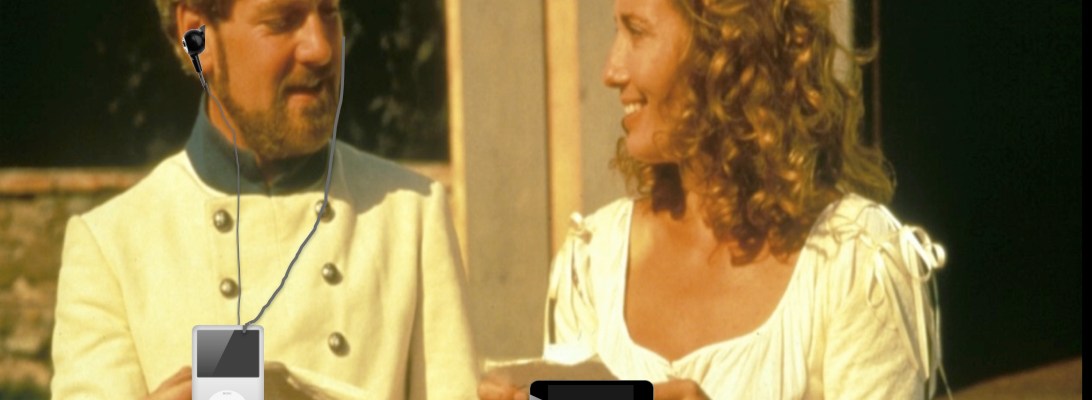
If you missed my earlier post, this week I’ve created a little game for you to play at home: you try to match up the songs that express a fictional character’s personality with the events that happen to him/her through the course of play. Yesterday I posted a playlist for Benedick from Shakespeare’s Much Ado About Nothing, and today I’m going to post one for Beatrice. Your mission is to read the events that happen to Beatrice below, and figure out which songs on the playlist below correspond to these events. If you want to suggest more songs, please leave a comment below and I’ll create an extended playlist for the end of the week! I’ll also post the correct results so you can see how well you did. Enjoy the game and, as Shakespeare said: “Play on!”
Paul Rycik 5/9/12
Events For Beatrice (Match these with the songs from the playlist below)
Benedick and Beatrice have a brief fling and break up before the play begins
Beatrice sees Benedick again at Leonato’s house and blows a flurry of words at him.
Beatrice advises Hero not to worry about her wedding, but instead tells her to “Dance out your answer.”
Beatrice dances with Benedick and pretends not to recognize him.
Beatrice overhears Margaret, Hero, and Ursula ‘secretly confessing’ Benedick’s love for Beatrice.
Beatrice is thunderstruck to discover that not only does Benedick love her, she loves him.
Beatrice is furious at Claudio’s treatment of Hero, and the way men in general treat women.
Beatrice challenges Benedick to prove his love to her by killing Claudio
After soul searching and after Benedick challenges Claudio, Beatrice is on the mend.
Having proved his worthiness to her like a chivalric soldier, Beatrice marries Benedick.
Today, June 24rth, is the ancient Roman festival of Fortuna, the goddess of luck and worldly fortunes. I’ve chosen to use this opportunity to explain a little bit about the concept of Fortune, which Shakespeare uses frequently in his tragedies. But first, a short musical interlude:
Does this song sound familiar? You’ve probably heard it underscored in hundreds of commercials, TV shows, maybe even in concerts, it’s a song composed by composer Carl Orff called “O Fortuna.”
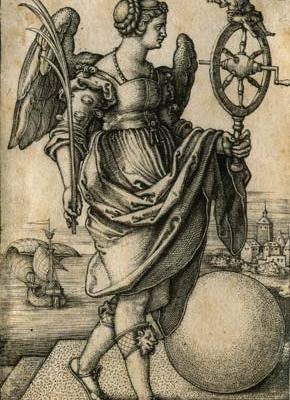
The Roman goddess Fortuna with her wheel and orb.
In Roman mythology, Fortuna was the goddess of luck, wealth, and fertility. If you listen to the lyrics of the song above, you can see that for centuries, people chose to represent Fortune as a fickle, changeable, and irresponsible goddess. Unfortunately, one of the reasons she’s personified as a woman is the long-held prejudice that women are weak, have frequent changes of mind and mood, and can’t commit to one person, (a view of women that I and Shakespeare believe to not be true). However, based on his writing he does seem to think Fortune fits these characteristics:
“I am Fortune’s fool” –Romeo and Juliet
O fortune, fortune! all men call thee fickle:If thou art fickle, what dost thou with him. That is renown’d for faith? Be fickle, fortune; For then, I hope, thou wilt not keep him long, But send him back. –Romeo and Juliet
“When Fortune means to men most good, She looks upon them with a threatening eye.” –King John
Out, out, thou strumpet, Fortune! All you gods,
In general synod ‘take away her power;
Break all the spokes and fellies from her wheel,
And bowl the round nave down the hill of heaven,
As low as to the fiends! -Hamlet
In Dante’s Inferno, Fortuna lives in the Underworld with Plutus the god of gold, helping to distribute the god’s wealth to people above ground. In the Middle ages she was an explanation for why some people have good luck, some have bad, and why luck frequently changes.
The Wheel of Fortune.
Fortuna’s most recognizable symbol is her wheel; the symbol of how luck can change; just when you think your life is perfect, the wheel turns and you find yourself on the bottom. Frequently in tragedy when things go wrong, the characters blame Fortune, such as when the Lord of Kent finds himself put in the stocks like a common thief and gripes: “Fortune good night, smile once more, turn thy wheel,” King Lear, Act II, Scene ii. And yes, the real game show was partially inspired by the goddess’ most famous symbol.
Fortuna In Tragedies
Shakespeare mentions fortune over 500 times in his plays and frequently in his tragedies. Characters in Shakespearean tragedy frequently single out Fortuna as the cause of their unhappiness and curse her as a liar and a strumpet. In a Christian society, it was a lot more appealing to blame a pagan goddess than a loving, Christian god, (which would probably be considered blasphemous). Now you see why she has become a popular scapegoat for misfortune in tragedy. At the same time, all tragedy raises questions about the nature of free will; how much of bad fortune is the result of fate, and how much is a direct result of the character’s bad choices? Edmund in King Lear laughs at the notion of any kind of fate, and accuses all of humanity of shirking responsibility in this speech:
EDMUND
This is the excellent foppery of the world, that, when we are sick in fortune,–often the surfeit of our own behavior,–we make guilty of our disasters the sun, the moon, and the stars: as if we were villains by necessity; fools by heavenly compulsion; knaves, thieves, and treachers, by spherical predominance; drunkards, liars, and adulterers, by an enforced obedience of planetary influence; and all that we are evil in, by a divine thrusting on: an admirable evasion of whoremaster man, to lay his goatish disposition to the charge of a star! (King Lear, Act I, Scene ii).
At the same time, the audience also knows that Edmund was cursed by Fortune from the beginning, since he is the illegitimate child of the Duke of Gloucester, which might prove exactly the opposite point of his speech. He may act like he is absolute in his free will, but his behavior and his violent end suggests otherwise. So when characters curse Fortune or Fortuna in Shakespeare’s plays, take a look at the language they use to characterize this abstract concept. The way we think about luck or fate helps shape our perspective of our own lives, and therefore how playwrights depict this mysterious goddess helps us see the possibilities of human choice, and maybe help us make better choices than the tragic men who slander her in these plays!
I realize Father’s day was last weekend, but I thought I’d like to cap off that week of posts with one final insight into Shakespearean fathers, only today they won’t be fictional! Today I’ll be sharing with you some details from the lives of William Shakespeare and his father, John Shakespeare. We’ve been talking about good, bad, and dad dads, so after reading this post, what do you think- were these men good fathers, or not?
-Bio of John Shakespeare c1530—to 1601
Ancestry-
Shakespeare Family Tree
John Shakespeare was born around the year 1530 (exact records no longer exist). He came from a long line of prominent farmers in Snitterfield, and moved to Stratford Upon Avon in Warwickshire, in the year 1557 John married Mary Arden, who also came from pretty posh country stock; records trace the Arden family back before the Norman conquest in 1066!
John and Mary’s children
Altogether, John and Mary had 8 children (see the family tree above.)
Sadly, their 2 eldest daughters Margaret and Anne died in infancy, making William the eldest child, and the son and heir of his father’s wealth.
William’s brother Edmund became an actor, while his sister Joan took over John’s old house.
Shakespeare was born in 1564 in a modest house on Henley Street, which still stands today!
The house on Henley Street, where Shakespeare was born in 1564. Click here to learn more about Shakespeare’s birthplace.
Mayor, Bailiff, Glover When John and Mary moved to Stratford, John established himself as a great fixture of the community- he started as the local glover, and rose to the highly respected office of town ale taster (no, I’m not kidding). At the height of his career, John became Mayor of Stratford, and an Alderman- a town counsilor who helped make decisions like whether or not to let local theater troupes come to town! Maybe John took his young son to watch the travelling players and helped inspire Will’s lifelong love of theater.
Teach Your Children Well Shakespeare got to go to one of the first ever public schools in England, where he learned English history, poetry, and the art of persuasive speech, everything he needed to become the great writer he would become.
Brogger not Blogger As I mentioned in my first post, Shakespeare’s dad had an illegal side business as a wool dealer. All wool was controlled by the English government, so selling it directly to people was a crime, and eventually John Shakespeare was caught. Fortunately, the fine he paid wasn’t enough to ruin him financially…yet.
Closet Catholic The biggest financial problem John Shakespeare faced was his religious beliefs. In 1757, archeologists unearthed a pamphlet where John confessed to be a secret Catholic in a society where the Church of England was the national religion. Scholar Michael Wood believes that John’s Catholicism led to financial ruin; he refused to go to Episcopal church and had to pay crippling fines every time he failed to appear.
John’s Descent At the same time, John’s debts kept mounting and he was afraid to go to the town council house for fear of more collectors, even though he was the mayor. The final blow came in 1576, when John was booted off the town council.
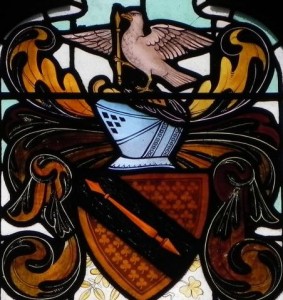
Son of Fortune John’s son William would eventually repair the family dignity when he became a success. In 1596, William made himself, and all the male members of his family gentlemen, by applying for a coat of arms. Below is a picture of Shakespeare’s family crest.
Shakespeare’s coat of arms, as depicted in the Folger Shakespeare Library window.
John Shakespeare died in 1601, shortly after his son’s play Hamlet was published. Willmight have honored his father’s memory by playing the Ghost of Hamlet’s father.
-Bio of William Shakespeare as a Father 1564-1616.
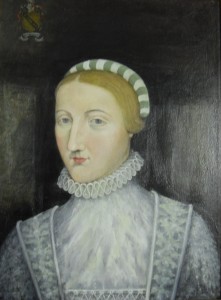
Oil reproduction by Roger Dunn of an alleged drawing of Anne Hathaway. Reproduced with Permission, Shakespeare’ Birthplace Trust. Click on the picture to find out more about this work of art!
Roger Dunn BA
Wedding Bells In 1582,Will married Anne Hathaway (not the Oscar winning actress from Les Miserables, although that one has shown some love for Shakespeare too. Based on the timeline, it’s very likely that Anne was already pregnant when William married her. Some claim that the Bard was basically in a “shotgun” marriage, but nobody has proven otherwise. We do know that he wrote a sonnet to her on their wedding day, click here to read it!
Shakespeare’s Children Shakespeare and Anne had three kids (Judith, Susanna, Hamnet) Susanna was born in 1583, while the twins were born 5 years later.
Hit the Road! Sometime around 1590, Shakespeare moved to London and must’ve gotten a job with a theater company. Unfortunately, no records survive between the birth of Shakespeare’s children, and his first success as a playwright in 1592, which is why scholars refer to this period as “The Lost Years.” It was probably a tough life for the Shakespeares, with the father away in the city while they were cooped up in Stratford with their grandparents.
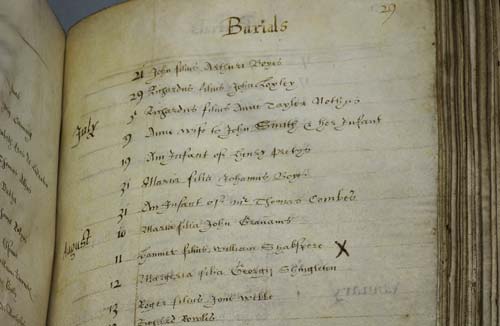
RIP Hamnet. Shakespeare’s only son died August 9th He was away in London at the time, and undoubtedly the news was a terrible shock.
Will’s daughters Shakespeare had two girls, Judith and Susanna. Naturally, it’s hard to tell anything about Shakespeare’s personal feelings, but looking at his plays and his future actions, Shakespeare must have really loved his girls. Many of his later plays explore the relationships between fathers and daughters, and as you’ve probably noticed, most of the fathers on my previous countdowns have at least 1 girl. Shakespeare was preoccupied with his daughter’s futures and helped them find husbands, Susanna Shakespeare was arrested for refusing to take protestant communion Susannah married Dr. John Hall, a respected puritan physician. She also bore William his only grandchild, Elizabeth Barnard (pictured below).
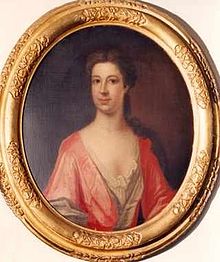
Elizabeth Hall, 1608-1680. Shakespeare’s granddaughter.
Will clearly loved his daughters, especially his daughter Susanna. His last 5 plays were about fathers trying their best to improve their daughter’s lives. In his will he gave his daughter Susannah 100 pounds of English money, as well as a dowry To his other daughter Judith he left 30 pounds, all of his silver, and permitted her to live in one of his houses on Henley street.
FMI:
by Michael Wood: A fantastic documentary/ book/ website, which looks at the life of William Shakespeare and his work. On this website is an interactive timeline that shows pictures of the places Shakespeare lived and worked, and the documents with his name on them: http://www.pbs.org/shakespeare/events/
Will In the World by Steven Greenblatt: A great biography of Shakespeare by a celebrated Harvard scholar and editor of tne Norton Shakespeare edition. Click here for a review: http://books.wwnorton.com/books/Will-in-the-World/.
So that ends my posts on Shakespeare and Father’s Day. Stay tuned for another post about a very interesting holiday!
Illustration of the Shakespeare family, wife and children, 1890.
Shakespeare himself was a father, and he frequently wrote about the dynamic between fathers and their children. There are many different types of fathers in Shakespeare’s 40 plus plays, and this week I’m ranking them in terms of three categories: Good Dads, Bad Dads, and “Dad Dads.” You’ve probably already read the “Worst Dad” post, so now we’re looking at the good, and the not so good. I used the following criteria when choosing the top 5 dads in each categories:
The Good Dads
Are supportive for their kids
Try to keep their children happy
Offer help and advice, especially on their children’s future.
Are willing to sacrifice themselves
They let their children become their own people.
The Bad Dads
Treat their children as property
Have little to no interest in their children
Put their children in danger
Subject their children to abuse
In some cases, they murder them!
The “Dad” Dads
Are basically good hearted, but they have some kind of flaw that prevents them from becoming really good parents.
In my view, are the most human, modern dads on the list.
I’ve chosen to award these dads a necktie, something every ok dad needs.
Now, onto the Dad Dads:
5. Aegean from The Comedy Of Errors. Aegean wonders around for 20 years looking for his lost children, which I call devoted parenting, but a little aimless and undisciplined. I therefore award Aegean two ties with little anchors on them, to remind him to stay in one place and wait for his sons to find him!
Alexandre Bida, “The death of Lord and John Talbott,” 1895
4. Lord Talbott from Henry the Sixth Part I. Talbott is the hero of the English fight against the French at the close of the Hundred Years War. He goes toe to toe with Joan of Arc on numerous occasions. He also raises a fine and valliant son, John Talbott who is also a warrior. The two die bravely in a siege against the French, rather than surrendering, or leaving the other to die. Talbott is clearly also devoted to his child, but his career choice doesn’t allow his son to grow up in a safe environment! I therefore award Talbott two ties with little English and French flags on them.
The Ghost of Hamlet’s Father by William Blake, 1806.
3. The Ghost Of Hamlet’s Father from Hamlet/ Portia’s Dad from Merchant Of Venice. Both these parents die before their plays begin, yet they still try to improve their children’s lives from beyond the grave! The Ghost helps Hamlet become king of Denmark, and Portia’s dad tries to help her find a good husband, (one who will love her for something besides her beauty or riches). Although these parents achieve their goals, waiting this long to help their kids seems a bit like absentee parenting! I therefore award these posthumous parents ties with little skulls on them.
2
. King Henry IV, from King Henry IV King Henry is the classic career dad, one who wants his son Hal (the future King Henry V), to follow in his footsteps. The two have a terrible fight when Henry thinks Hal is trying to steal his crown on his deathbed! Eventually though, father and son reconcile, and dad even gives the future king some last minute advice; if you fight a war with France it’ll help secure your crown, which Hal does and succeeds! I therefore award King Henry a tie with little crowns on it, hoping that nobody with a dagger ties tries to steal it when he’s sleeping!
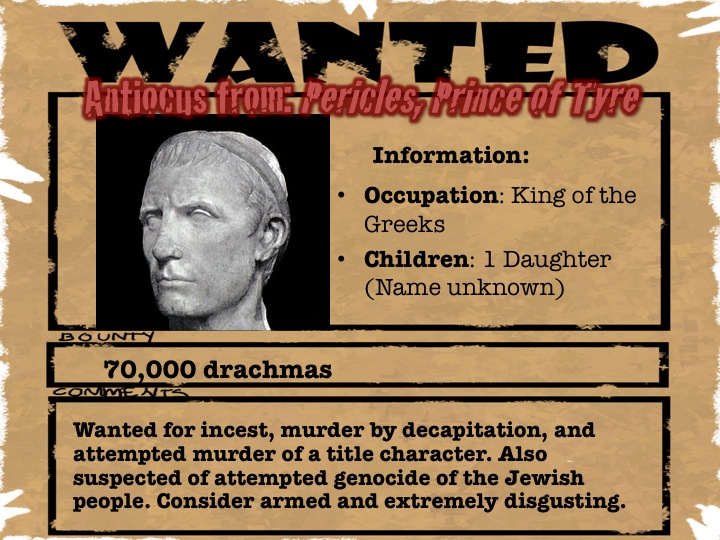
1. Prince Pericles from Pericles Pericles is another busy dad- King Antiocus tries to murder him, and he has to leave his own kingdom. Then he gets shipwrecked 3 times! In fact, his only daughter is born onboard a ship in the middle of a storm! Pericles raises the girl for a number of years, but then has to leave again, and guess what, he gets shipwrecked AGAIN! He eventually finds his daughter and they live happily ever after, but you kind of get the idea that Pericles is a little accident-prone, which keeps him from being on the Best Dads list. Sorry Pericles, but at least you get a tie with, what else, Boats on it! Maybe next Fathers Day, someone will get you a life preserver.
And now at Long LAST, the BEST Dads in Shakespeare!
Aaron fights to protect his baby child.
5. Aaron the Moor from Titus Andronicus. Ironically, one of the worst villains in Shakespeare is also one of the best fathers. Aaron is fiercely protective of his child, even threatening people at sword point if they dare come near his baby. He also plans out the child’s future and is willing to give his own life for a promise that Lucius will protect and nourish his son. He may be a monster to everyone else, but to his baby, Aaron is simply, a good dad!
4. The Old Shepherd from The Winter’s Tale. This character is a very mirror of generosity and kindness; not only does he take care of his son The Clown, he adopts a poor discarded child, the princess Perdita, with no obligation to do so. He raises her for 16 years and constantly brags about her to the entire town. She becomes a beautiful, wise, and modest girl who fills her adopted father with pride because of his good parenting. Even when Perdita meets her real father, she speaks of The Old Shepherd with real filial affection “Oh my poor father.”
3.
Lord Capulet, from Romeo and Juliet. I know this was a controversial choice, and I discuss my choice in detail on my podcast, but I’ll sum up my major arguments here:
Even though a lot of actors choose to have him smack Juliet around, there’s no mention of it in Shakespeare’s text. The most he ever does is threaten to strike her, but the stage directions never indicate he does it. Capulet is clearly more bark than bite.
From the very beginning of the play, Capulet has shown that he cares about Juliet, and wants her to marry for love, not money.
Lord Capulet hovers and frets constantly when Juliet tells him she will marry Paris, staying up late to plan the wedding! I ask you, does that sound like a tyrannical father? I wonder sometimes if Lord Capulet would’ve forgiven Juliet for marrying Romeo if she had just told him. In any case, based on my criteria above, Capulet is a good dad, bad tempered, yes, but fundamentally concerned for the welfare of his children.
3. Prospero fromThe Tempest I chose this high spot for Prospero mainly because he seems to have the most success of any other dad in the cannon. Like Pericles, he too is shipwrecked with his daughter, but Prospero stays with Miranda, raises her alone, teaches her everything she knows, and calls her an angel that helped preserve his life. Prospero cares so much for his daughter that he refuses to give into despair, even though he’s lost his wife, his dukedom, and his home.
Prospero also hatches a plan to get him and Miranda off the island, to get his dukedom back, and to get her married to a handsome prince name Ferdinand, and he succeeds with every one of these endeavors, even though it takes 12 years. Prospero gets extra points for his patience and his wisdom, but I have to admit he’s a bit of a control freak; he demands that Miranda listen to him and obey him no matter what, and he warns Ferdinand that there will be dire consequences if he dare try to do anything illicit with his daughter before the wedding. In addition, there’s no denying that Prospero is also acting out of self interest- he wants to become duke again, and he wants revenge against his enemies and that’s partially why he raises a tempest, (or a huge storm), instead of just sending a message back to Milan.
1.
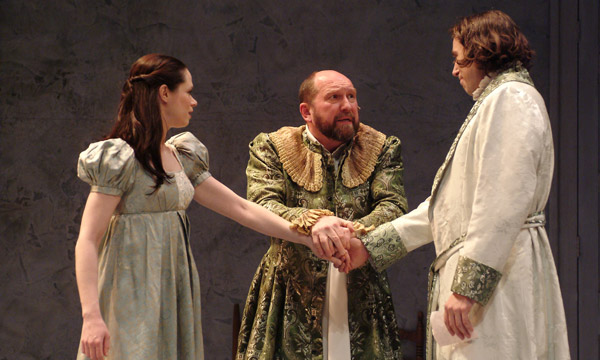
Simonides grants permission for Pericles to wed his daughter. Production shot from Mary Zimmerman’s 2006 production of “Pericles.”
King Simonedes from Pericles, Prince Of Tyre You might forget this character because he only has a short time onstage, but I defy anyone to come up with a better father. He’s kind, supportive, stable, funny, and has a wonderful relationship with his daughter Thaisa. Above all, Simonedes actually listens to his child and does everything in his power to help her when she decides she wants to marry Pericles. Also, like Prospero, Simonedes pretends to object to the marriage, but you kind of get the sense that, rather than testing the affection of the couple, he’s actually just playing a joke on them. You can hear a “gotcha” and a fatherly wink in the final line of the speech in Act II, where he pretends to object to their marriage:
Congratulations to all our fabulous fictional fathers! Thank you for reading, and see you soon!
Parenting is tough! Parents have to sacrifice so much to make sure their kids grow up happy, healthy, and prepared for life. Not everyone can do it, but if Shakespeare has taught us anything, it’s that there’s always someone doing a worse job than you. So for all you dads out there, enjoy this list of my top 5 worst dads in Shakespeare, lovingly made to remind you that whatever kind of father you are, at least you’re not these baddies!
If you’d like to listen along to my podcat about this topic while you read, here’s the latest episode here:
Do you agree with my list? Leave me a comment below! Tomorrow I’ll continue my list with the top 5 Dad Dads; guys who are good, but have modern problems that keep them from being truly great. Then we’ll take it home with the best of the best. Hope you enjoy them!