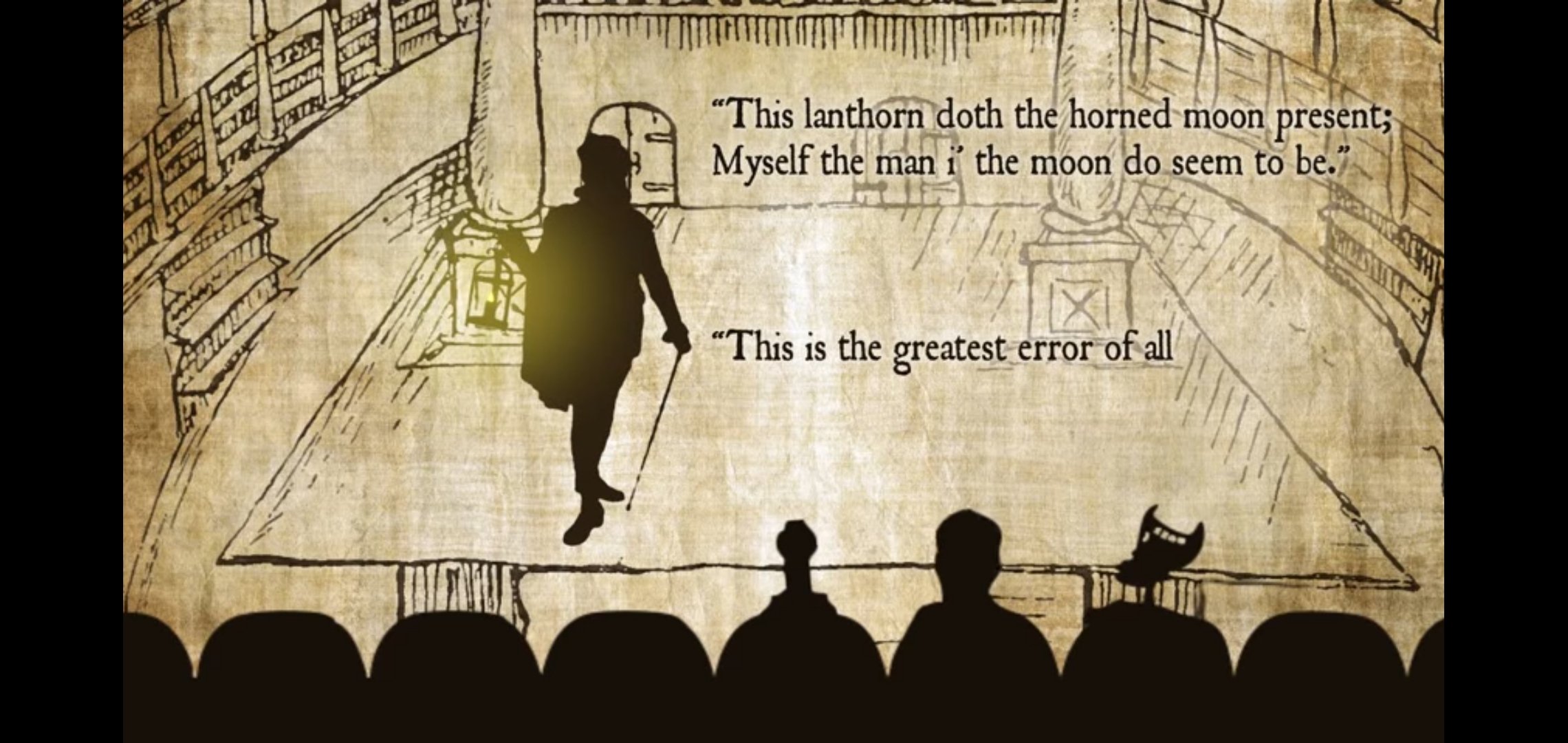
This Friday is the grand premiere of my new online class: “Shakespeare: The Lost Play,” where you discover who stole Shakespeare’s play. Below is the latest trailer.
Since I want as many people to play as possible, I’m creating a coupon: Get $10 off my class “Shakespeare’s Lost Play Mystery Game” with coupon code HTHES4OXNY10 until May 8, 2023. Get started at https://outschool.com/classes/shakespeares-lost-play-mystery-game-ny9HhlxI and enter the coupon code at checkout.
For Shakespeare’s birthday, I thought I’d re-visit one of my most popular posts, especially since the Royal Shakespeare Company is celebrating by putting on an adaptation of Maggie O’Farrell’s novel Hamnet:
RSC video of the first day of rehearsals for Hamnet
Biography of Hamnet
Just like his famous father, we know very little about the life of Hamnet Shakespeare. Since infant mortality rates were high, we don’t know his exact birthday, only that he was baptized on February 2nd, 1582. Like most 11-year old boys, he probably had started going to school at the King Edward Grammer School, the same as his father. This means he spent long hours away from his parents learning to read and write in Latin and Greek. When he was home, he lived with his mother, his two sisters, and his grandparents in the house of Henley Street.
O’Farrel portrays the boy Hamnet as sensitive and somewhat lonely, which makes sense, since he probably didn’t see his father for long periods of the year; Will Shakespeare spent much of the year writing, going on tour, and performing at the Globe- he commuted from London to Stratford for most of the year. He probably only came around during Lent, Christmas, and times of plague when the theaters were closed.
1589-1596
Never mind what I know. You must go.” She pushes at his chest, putting air and space between them, feeling his arms slide off her, disentangling them. His face is crumpled, tense, uncertain. She smiles at him, drawing in breath. “I won’t say goodbye,” she says, keeping her voice steady. “Neither will I.” “I won’t watch you walk away.” “I’ll walk backwards,” he says, backing away, “so I can keep you in my sights.” “All the way to London?” “If I have to.” She laughs. “You’ll fall into a ditch. You’ll crash into a cart.” “So be it.
O’Farrell
Hollar’s panorama of London, 1647
The novel portrays Anne Shakespeare realizing that her husband is stifled and unhappy living with his parents in Stratford, and so she suggests to his father that he go to London to ‘expand the family business,’ though in reality, she wants him to go to make his fortune and find more fulfilling work. Scholars have wondered for years how Shakespeare got his start in theater- as a man with children he was legally unable to become an apprentice, and as a glover’s son from Stratford, he didn’t know anyone in London. O’Farrell solves the mystery by making him start out as a costume maker and mender for a theater company, who later became a writer and actor.
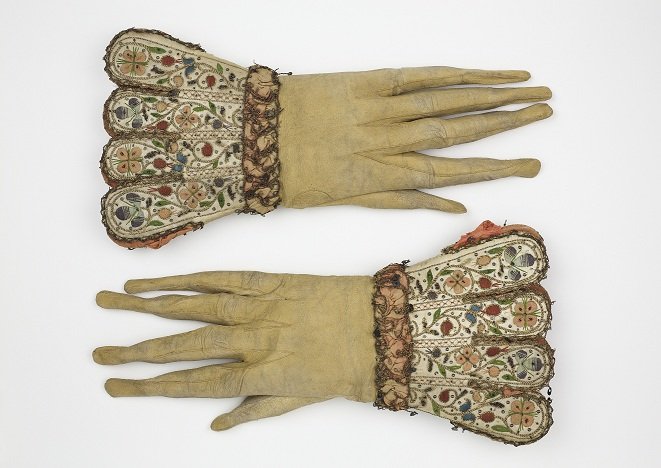
This idea of Shakespeare starting out as the company’s glove mender actually has some historical merit- records from the time confirm that many playwrights and actors were also local artisans. Men like John Webster, Richard Tarlton, Edward Kyneston, and even Richard Burbage were skilled drapers, textile merchants, haberdashers (men’s tailors) and ( like the Bottom in “A Midsummer Night’s Dream,”) some of these men were weavers-turned actors (Source: Anna Gonzales) So it’s entirely possible that Shakespeare started in London by selling gloves to theaters, before selling his plays.
When Will moved to London, he lived in a number of locations throughout the city, probably because it wasn’t a safe place. Theaters were located in the same districts as bear baiting and brothels, so Will probably had to move to get away from bad neighborhoods, as this video from The History Squad illustrates:
A glover will only ever want the skin, the surface, the outer layer. Everything else is useless, an inconvenience, an unnecessary mess. She thinks of the private cruelty behind something as beautiful and perfect as a glove.
Almost immediately after Will leaves, Anne is full of remorse. She knows his work in London will consume him and his success will make the distance between him and her even greater.
She walks back, more slowly, the way she came. How odd it feels, to move along the same streets, the route in reverse, like inking over old words, her feet the quill, going back over work, rewriting, erasing. Partings are strange. It seems so simple: one minute ago, four, five, he was here, at her side; now, he is gone. She was with him; she is alone. She feels exposed, chill, peeled like an onion.
The Plague
He wants to tear down the sky, he wants to rip every blossom from that tree, he wishes to take a burning branch and drive that pink-clad girl and her nag over a cliff, just to be rid of them, to clear them all out of his way. So many miles, so much road stands between him and his child, and so few hours left.
Hamnet
As I’ve said in previous posts, Shakespeare survived three epidemics of Plague; one in 1563, (before he was born), one in 1593, and one in 1603. In O’Farell’s novel, the germs that kill Hamnet came not from a massive outbreak, but a few germs that were transported in a box that his sister had the misfortune of opening. This frightful passage shows the grim tenacity and eve-present fear that, while England expanded and became more interconnected with the world, it also brought death and disease to and from the rest of Europe.
In the book, the plague germs that infect Judith and later Hamnet, lie inside a box with some glass beads that the Shakespeare’s ordered from Italy to decorate a pair of fancy gloves. As this video from National Geographic shows, trade routs then as now are prime spreaders of disease and even one ship that slips by can turn any box of goods into a Pandora’s Box, waiting for a poor unsuspecting girl like Judith to release it unto the world.
Hamnet’s Death
He can feel Death in the room, hovering in the shadows, over there beside the door, head averted, but watching all the same, always watching. It is waiting, biding its time. It will slide forward on skinless feet, with breath of damp ashes, to take her, to clasp her in its cold embrace, and he, Hamnet, will not be able to wrest her free.
Hamnet
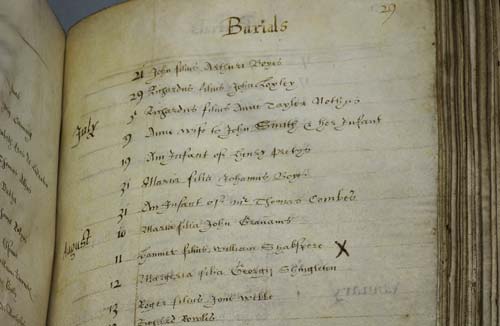
Burial Registry of Hamnet Shakespeare
In the novel, Hamnet somehow takes the plague away from his sister and dies in her place. Though it is hardly conclusive, I do find it interesting that Shakespeare stopped writing comedies about twins for another four years after Hamnet’s death, until he wrote Twelfth Night, which unlike earlier comedies like The Comedy of Errors, has a pair of twins mourning each other’s apparent death. They seem to share one soul, and one tries to resurrect the other, like Viola mourning her brother by, (in a sense), becoming her brother.
What should I do in Ilyria? My brother is in Elysium
Viola- “Twelfth Night”, Act I, Scene ii.
ELIZABETHAN FUNERAL CUSTOMS
In the book, Anne makes a winding sheet for her son. This was a cloth of linen or wool that was wrapped around dead bodies, since at the time, coffins were re-used. This must have been a somber and deeply upsetting activity for Anne.
J4W9B7 Woodcut Woman Spinning
As this quote from “The Evolution of the English Shroud” illustrates, the act of making a winding sheet was a sort of sad family responsibility, a way of ensuring that your loved ones die with dignity, and Anne clearly takes the task of making one very seriously.
The 16th-century shroud for the poor and lower middle classes was a large sheet that was gathered at the head and feet, and tied in knots at both ends, covering every part of the body. It resembled earlier Medieval practices and was a functional, yet modest way of preserving the deceased’s dignity. It was also economical, with very little cost involved, as the burial sheet was usually taken from the family home. At this point, linens dominated as the material of choice; after all, it was a biblical tradition as Jesus was wrapped in a linen cloth. Linen was also considered more fashionable than wool.
Coffin Works Archive
The Aftermath Of Hamnet’s Death (Spoilers)
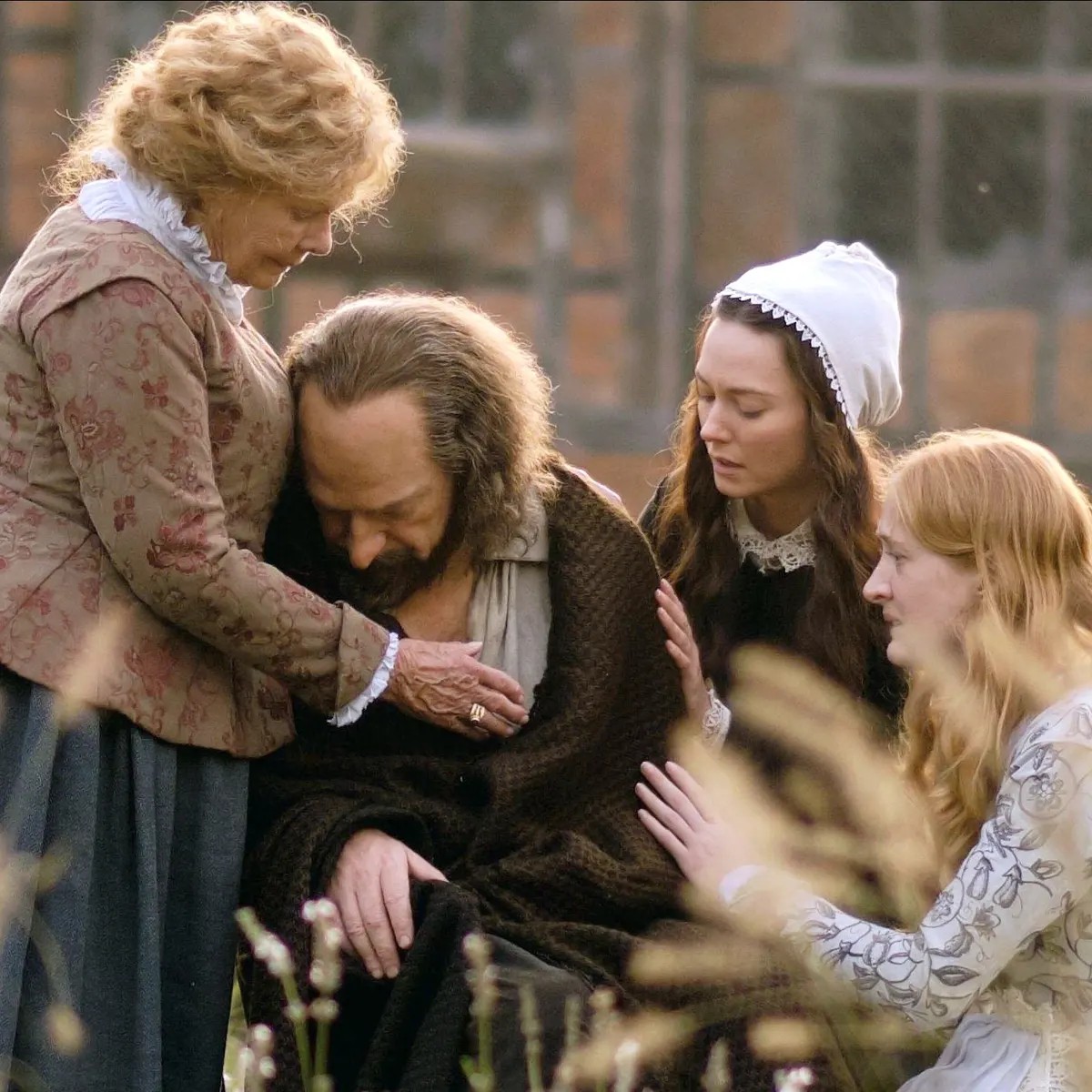
The Shakespeares in the 2011 film “All Is True,” starring Kenneth Branaugh as Will and Judy Dench as Anne Hathaway.
She discovers that it is possible to cry all day and all night. That there are many different ways to cry: the sudden outpouring of tears, the deep, racking sobs, the soundless and endless leaking of water from the eyes. That sore skin around the eyes may be treated with oil infused with a tincture of eyebright and chamomile. That it is possible to comfort your daughters with assurances about places in Heaven and eternal joy and how they may all be reunited after death and how he will be waiting for them, while not believing any of it. That people don’t always know what to say to a woman whose child has died. That some will cross the street to avoid her merely because of this. That people not considered to be good friends will come, without warning, to the fore, will leave bread and cakes on your sill, will say a kind and apt word to you after church, will ruffle Judith’s hair and pinch her wan cheek.
The Women of Hamnet
The most unique thing about this novel is how it shows the interdependence of women in Elizabethan society. Since Shakespeare spends most of the novel away from Anne, her support system mostly comes from Will’s mother Mary, as well as Anne’s daughters, her sister, and all the other women of the town. Nowadays we do most of our socialization online and barely know our own neighbors, but in the 1590s, especially for women, community was a way of building strength where women got through things like childbirth, loss, the managing of households, and many other difficulties through their relationships with other women. This video below shows the kinds of home remedies that women would share and later write down during the Tudor period:
Other Mysteries Solved
Once Hamnet dies, Will buys her a new house, New Place so she isn’t forced to live with his parents and no longer has to live in the house where her son died. But Will’s success comes with a price- he still has to leave for London. he offers to move them there but Agnes won’t hear of it. This solves the riddle of why Shakespeare commuted between town and country for his entire career- she knows the plague that took her son literally came from London, and she won’t risk losing her daughteras well. She probably also sees London like another woman that took her husband away as well, and therefore refuses to look it in the face.
It is no matter,” she pants, as they struggle there, beside the guzzling swine. “I know. You are caught by that place, like a hooked fish.” “What place? You mean London?” “No, the place in your head. I saw it once, a long time ago, a whole country in there, a landscape. You have gone to that place and it is now more real to you than anywhere else. Nothing can keep you from it. Not even the death of your own child. I see this,” she says to him, as he binds her wrists together with one of his hands, reaching down for the bag at his feet with the other. “Don’t think I don’t.”
O’Farrell, Hamnet.
The Shakespeares’ Marriage after Hamnet
I mean’, he says, ‘that I don´t think you have any idea what it is like to be married to someone like you.’ ‘Like me?’ ‘Someone who knows everything about you, before you even know it yourself. Someone who can just loo at you and divine your deepest secrets, just with a glance. Someone who can tell what you are about to say- and what you might not- before you say it. It is’ he says, ‘both a joy and a curse.
Hamnet
The ugly truth that O’Farrell highlights in Hamnet is that it must have been very hard for the Shakespeares to endure Hamnet’s death, especially since Will was probably not there when it happened, and probably didn’t stay around long after burying his son. It must have been catastrophic on his marriage, sort of like this tragic moment in the musical Hamilton, where the couple mourns the loss of their son, who died in a duel trying to defend his father’s honor.
Agnes is a woman broken into pieces, crumbled and scattered around. She would not be surprised to look down, one of these days, and see a foot over in the corner, an arm left on the ground, a hand dropped to the floor. Her daughters are the same. Susanna’s face is set, her brows lowered in something like anger. Judith just cries, on and on, silently; the tears leak from her and will, it seems, never stop. — How were they to know that Hamnet was the pin holding them together? That without him they would all fragment and fall apart, like a cup shattered on the floor?
Maggie O’Farrell, Hamnet
The Second Best Bed mystery
Though Anne is angry at Will for a while, she does eventually forgive him, as evidenced by another solved historical mystery. In Shakespeare’s will he gives his wife “My second-best bed, with the furniture,” which O’Farell explains, is their marriage bed. The best bed was the one they gave to guests and was therefore newer. In the book, Will offers to replace it after Hamnet dies, but Anne won’t hear of it; although she partially blames Will for Hamnet’s death, she still loves him and her love is stronger than her grief, as is her love for her surviving daughters.
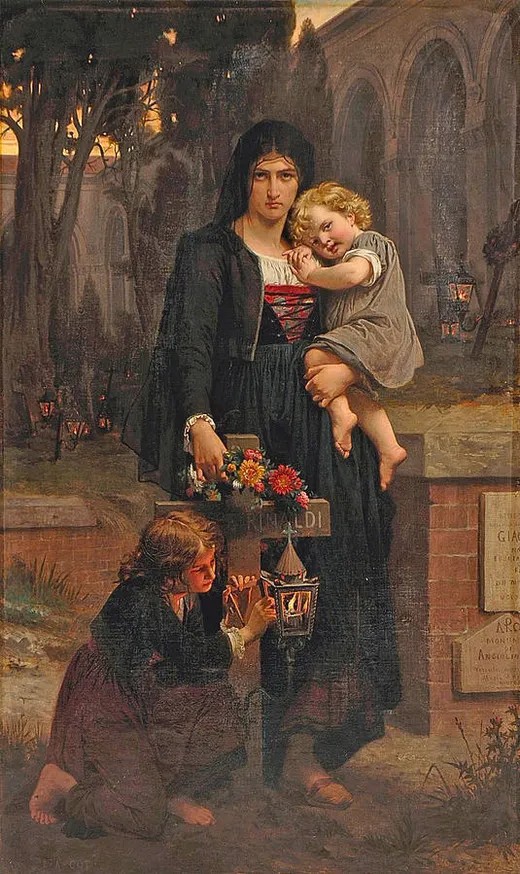
Sa Mere Avec Ses Deux Enfants A La Tombe Du Pere. / The Mother With Her Two Children at the Tomb of Her Father by Pierre Auguste Cot, 1870.
What is the word, Judith asks her mother, for someone who was a twin but is no longer a twin? Her mother, dipping a folded, doubled wick into heated tallow, pauses, but doesn’t turn around. If you were a wife, Judith continues, and your husband dies, then you are a widow. And if its parents die, a child becomes an orphan. But what is the word for what I am? I don’t know, her mother says. Judith watches the liquid slide off the ends of the wicks, into the bowl below. Maybe there isn’t one, she suggests. Maybe not, says her mother
Raising the Dead
Aran Murphy in the Abbey Theater’s production of Hamnet, a play not based on O’Farell’s novel.
At the end of the book, Shakespeare plays the Ghost of Hamlet’s father, and writes Hamlet as a tribute to his late son. We don’t know for a fact that the real William Shakespeare did this but Stratford legend says that Shakespeare played the Ghost of Hamlet’s father onstage, and this has captivated the imagination of authors and scholars alike. In any case, as Stephen Greenblatt says in his book Will In The World, Shakespeare’s father’s health faded around the same time that he wrote Hamlet. it must have been hard for Shakespeare to write a name that was one letter away from his son’s over and over again. Hamlet is Shakespeare’s longest play, and the titular character has over 40% of the dialogue, so it must have been haunting at the very least for Shakespeare to have to write his son’s name nearly 4,000 times.
Whatever he determined at the time, Shakespeare must have still
   been brooding in late 1600 and early 1601, when he sat down to
   write a tragedy whose doomed hero bore the name of his dead son.
   His thoughts may have been intensified by news that his elderly
   father was seriously ill back in Stratford, for the thought of his
   father's death is deeply woven into the play. And the death of his
   son and the impending death of his father--a crisis of mourning
   and memory--could have caused a psychic disturbance that helps to
   explain the explosive power and inwardness of Hamlet.
Greenblatt, 2004, p. 8)
In the book, Anne secretly goes to London to see Hamlet onstage and is overcome with emotion. Not only does Will play a ghost as tribute to his dying father, not only does he put his son’s name onstage, he directs the actor playing Hamlet to affect his own son’s mannerisms and gestures, to use theater to bring his son back from the dead. Anne is both appalled and moved by this act- Hamnet is dead, but his story is now immortal.
O’ Farrell has done a fantastic job of taking what little we know about the Shakespeare’s lives, infusing them with some clever inferences from the plays of Will Shakespeare, and finally fleshing them out with her own Shakespearean knowledge of the human heart- how it feels to bury someone, how it feels to go through trauma and what it’s like to be part of a family and to truly love someone, even though they often fail to properly love you back. As the end of the book implies, maybe Will didn’t intend to immortalize his son and share his powers of theatrical resurrection with the world, maybe this was just his way of apologizing to the love of his life. To try to make amends for the time he lost and to express a wish that he could give her son back to her, which in a way, he does:
Hamlet, here, on this stage, is two people, the young man, alive, and the father, dead. He is both alive and dead. Her husband has brought him back to life, in the only way he can. As the ghost talks, she sees that her husband, in writing this, in taking the role of the ghost, has changed places with his son. He has taken his son’s death and made it his own; he has put himself in death’s clutches, resurrecting the boy in his place. “O horrible! O horrible! Most horrible!” murmurs her husband’s ghoulish voice, recalling the agony of his death.
O’Farrell, “Hamnet”
References
Journals
Bray, Peter. “Men, loss and spiritual emergency: Shakespeare, the death of Hamnet and the making of Hamlet.” Journal of Men, Masculinities and Spirituality, vol. 2, no. 2, June 2008, pp. 95+. Gale Literature Resource Center, link.gale.com/apps/doc/A189052376/LitRC?u=pl9286&sid=bookmark-LitRC&xid=ea79f235. Accessed 20 Apr. 2023.
Period Documents
Document-specific information Creator: Holy Trinity Church, Stratford-upon-Avon Title: Parish Register of Holy Trinity Church, Stratford-upon-Avon Date: 1558-1776 Repository: The Shakespeare Birthplace Trust, Stratford-upon-Avon, UK Call number and opening: DR243/1: Baptismal register, fol. 22v View online bibliographic record
This is an interactive game that teaches the craft of Shakespeare’s writing and stagecraft in the form of an Elizabethan escape room. You must find the lost play of William Shakespeare before a mystery thief destroys it! Solve the clues and learn about Shakespeare’s writing and theater to uncover a historical mystery!
Course Description
In this fully online, fully interactive game, you play as a member of Shakespeare’s company. You’ve just discovered that someone has stolen Shakespeare’s new play “Love’s Labors Won,” and you need to find it before the show tonight! In the course of the game, you search the Globe Theater and Shakespeare’s study. Then a mysterious note reveals that someone has stolen the play! You must figure out who it is, and find the play before the thief burns it! Through the course of the game, you will learn about Shakespeare’s theater, the secrets of how he wrote some of his great plays and beautiful poetry, and the work of his contemporaries in a fun, interactive way.
The class is organized into four parts, based on four locations where you will search for the missing play:
Part I- Search the Theater
Part I- Search the theater (website/ Slides/ Jamboard) You learn the basic parts of an Elizabethan stage (Google slides) You label the parts of the theater (Google Forms) You do a virtual tour of the theater (via Globe Theater.com) Web quest- answer 3 questions about Shakespeare’s Globe: https://www.shakespearesglobe.com/ (handout) You search the tiring house (the backstage area of the Globe), and find the letter from the thief (Sites).
Part II- THe Crime
A video plays where the thief declares that he’s stolen Shakespeare’s play for money and revenge. After the video, you will learn about plays, printing, and theft in Shakespeare’s day through a series of Google Slides Activity- make a folio, quarto, and octavio with just a piece of paper (handout) Web Quest- answer 3 questions about how Shakespeare’s plays were printed and the first folio (Slides) Activity 2: make an actors’ scroll or roll the way that Elizabethans might use (video) Easter egg- find a pair of gloves in the print shop and answer questions.
You’ll gain new understanding of the types of plays Shakespeare wrote and their basic plot structure via Google Slides. You’ll then take a short quiz to confirm what you learned.
-Plot Structure You’ll learn about the basic structure of Elizabethan plays via Google Slides. A second set of slides will demonstrate the plot structure of Romeo &Juliet You’ll mix and match a series of plot elements to create your own Elizabethan play via Jamboard
Tragedy:
A hero is given some unwelcome news
He feels betrayed by those close to him
He agonizes about the ethics of killing someone close to him.
He kills someone (or banishes an honest man) and immediately falls into a downward spiral.
The hero does (this will be a mandatory choice)
Comedy:
The heroine disguises herself as a boy
A hero or heroine swears (s)he will never fall in love and immediately falls in love
The heroine pretends not to be interested in the hero, (but secretly loves him).
A loyal best friend is captured, sent to prison, or bewitched
The hero and heroine hate each other due to a series of misunderstandings.
The hero and heroine get married (this will be a mandatory choice).
History:
An ambitious young man arises to challenge the king for the throne.
The old king dies, (or is murdered)
A new king becomes king
Duels and or battles
Someone dies in battle
Someone is murdered, assassinated, or sentenced to death.
New King gets married
King and Queen reign peacefully (at least for now)
Romance ( if students pick this option, they can mix and match everything (except the main character dying)
Verse practice- You’ll learn about the verse Shakespeare wrote, through a series of slides and a jam board. Activity- You will be given a series of famous lines from plays and movies, (such as a quote from a Disney Movie, a Star Wars film, or a song). You will then determine if it is an iambic pentameter line (Google Slides). Easter egg- you find a second note from the thief (Google Sites).
Part IV- THe Tavern
You will look at a series of pictures and videos about Shakespeare’s contemporaries and try to figure out which of them stole the play. Through the handout, you will conclude who the thief is. You find a dagger in the tavern and take it. Outside the tavern, you will fight the thief in a short animation. GAME OVER.
THe FIrst Class starts April 28th, 2023. CLick here to register!
Shakespeare’s birthday is coming up! This is the week where I usually stop talking about individual plays, and talk about the man himself. Today I’d like to cover how he’s been portrayed in fiction. As you’ll see, with such a famous and at the same time mysterious figure like Shakespeare, there is a lot of leeway in terms of how you portray him. This list shows multiple interpretations of Shakespeare and at different stages (ages) of his life. Some are comic, some are tragic, but all are fascinating to discuss:
#10: Rhys Ivans (Anonymous, as The Earl Of Oxford).
Like I said in my podcast, I don’t believe Oxford was the real Shakespeare, and I have some issues with the character and his lack of humanity. That said, I do like the character they were going for- a tortured genius who has to create, in spite of himself, and it destroys him and his family.
#9: Hugh Laurie
I love what they do here- Shakespeare’s a temperamental artist who hates editors, but ultimately accepts that he has to put butts in seats. It’s very true-to-life and Rowan Atkinson and Hugh Laurie do a great job in this sketch!
#8: Kill Shakespeare Volume 2
Like I said in my full review, I really like the idea of an aging Shakespeare buckling under the pressures of being an icon. Bardolatry, the worship of Shakespeare as a literary god, has been a real thing in academic circles for at least the last 200 years and I think it really hampers first-time readers from even attempting to read Shakespeare. Since this comic is very much attempting to get people to do just that, it makes sense that they portray Shakespeare as a deeply flawed human who is trying his best, but not able to live up to his god-like persona.
#7 Matthew Baynton- Horrible Histories
Even though this history show for kids is also trying to make Shakespeare accessible for British schoolchildren, it actually takes the opposite approach for Shakespeare- make him cocky, self-assured, silly, and a bit of a schlamaazel, who like his own creation of Mercutio, talks too much and invariably gets himself into trouble.
#6: King Of Shadows
Cover of “King Of Shadows,” an excellent Young adult novel for anyone who loves Shakespeare.
“Nat, say hello to William Shakespeare”. They might as well have said, “Nat, say hello to GOD!”
-King Of Shadows
Again, most interpretations of Shakespeare are aware of and try to subvert the god-like status he has in our culture, which is why this YA novel attempts to humanize him, by having him interact with the hero, Nathan, a 20th-century child actor, go back in time and finds himself switching places with another Nathan Field, a real boy actor in Shakespeare’s company. Nathan then meets and befriends Shakespeare and the two form a father-son bond.
This book takes place just a few years after the death of Shakespeare’s own son, Hamnet, so this William Shakespeare has a son-shaped hole in his heart. It’s really heartwarming to see the two broken people form a family bond.
#5: Hamnet
As I said before, Shakespeare is not the main character of this novel; he pops in and out of the life of the real main character; his wife Anne, as he visits her at his parents’ home, and later when he sees her on periodic trips home from London. His characterization is entirely indirect. That said, we learn a ton about him through her perceptive eyes. We see his hatred of his abusive father, his frustration with being a glover’s son with no time to make a living in the theater. We see his ambition take hold as he travels to London, and at last, his contrite return to finally become a good husband after the death of his son. This Shakespeare is sort of a prodigal son, who searches for fame and fortune as a young man in the big city, but eventually comes to value his life at home. This solves the mystery of why Shakespeare never moved his family to London, why he retired in the early 1610s, and why his writings have nothing about his relationship with his family, his wife, or especially his son. This Shakespeare is scarred; trying to redeem himself from the sins of his past.
#3 Kenneth Branaugh- “All Is True”
This Shakespeare is at the end of the journey he took in “Hamnet.” He’s retired from theater, trying to pick up the pieces of his life in Stratford, and trying to reconcile his feelings for the fair-young-man (played by Ian McKellen), and his wife, (played by Judy Dench). It’s melancholic, but still funny in a dour way.
#3: Christian Borle- “Something Rotten”
Like I said in the review of the Broadway musical, Borle is the best part of this show. Like Matthew Baynton, he plays Shakespeare as a cocky young self-assured genius on the outside, but unlike Baynton, we see he has a deeper side underneath. As he sings in the incredibly catchy “Hard To Be the Bard,” Shakespeare is once again dealing with the problem of maintaining his success and is under a tremendous amount of pressure to crank out new and successful plays all the time. Even though he’s the antagonist, he’s more sympathetic than the heroes.
#2: Jacob Fiennes- “Shakespeare In Love”
I realize this movie has lost a lot of prestige over the years, thanks to the controversy over its loathsome producer, Harvey Weinstein. I realize that the film Shakespeare In Love might not have deserved best picture over films like Saving Private Ryan. That said, I still think it’s a fantastic movie and every single element from the sets to the costumes to the near-perfect casting, is top-notch, especially the casting of Jacob Fiennes as Shakespeare. This young, heartthrob Shakespeare hasn’t yet become the self-assured genius we see elsewhere on this list. He’s constantly out-classed by Christopher Marlowe, which is a very good choice because it helps us sympathize and root for this man, whom we all know will become a rich, successful genius, but hasn’t yet.
Fiennes also gives Shakespeare a very good arc- he’s a selfish dreamer like Bottom at the beginning and a sweet, sensitive man at the end. In the end, he writes for all the right reasons- supporting his family, immortalizing his love Lady Viola, and helping his friends and partners in the Chamberlain’s Men. Most of these Shakespeare are fairly static, but this movie gives him a great hero’s arc which allows us to like him and hope that his play is a success. As you can see in this alternate version of the final scene, Shakespeare makes a tearful goodbye to Viola, and sets about paying tribute to her in a play that will eventually become Twelfth Night. He also begins his lifelong partnership with Richard Burbage, who will go on to play Malvolio in that play, as well as Hamlet, Othello, and many others. It’s a satisfying conclusion to his arch, which like Viola, shows that Shakespeare is ready to take on a “brave new world” with a new sense of purpose.
#1: Dean Lennox Kelly From Dr. Who: The Shakespeare Code
Dr. Who (David Tennent) and Dr. Martha Jones ( Freema Agymann), are… disappointed when they meet Shakespeare in person in 1599.
Though this episode has an inauspicious start, Dean Lennox Kelly from this 2007 episode of Dr. Who finds a way to incorporate every aspect of every other Shakespeare on this list! He’s a cocky, self-assured showman on the outside who knows he’s a genius but is also a middle-class man of the people, playing to the groundlings. On the inside though, he is mourning the loss of his son and yearning for love, which is why he falls in love with Martha and (spoiler alert) makes her the Dark Lady of the sonnets. He also is clever enough to figure out what’s going on as three aliens try to manipulate him into using his gift of words to conjure the end of the world for them. Finally, he is still a hard-working writer and does occasionally doubt his own work:
Shakespeare: “To be or not to be”. Oh, that’s quite good.
10th Doctor: You should write that down
Shakespeare: I dunno… bit pretentious?
-The Shakespeare Code.
Again, the best thing about this Shakespeare is his arc- he drops his mask of genius and opens up to Martha and the Doctor, just like how the Doctor confides in Shakespeare how he is mourning the loss of his previous companion, Rose. In the end though, he draws strength in the memory of his son, and actually uses it to save the world!
Is this a historically accurate biopic? No. Is it a silly cartoon? Also no. The reason I ranked this episode the highest is because they managed to encompass the myth and the man of Shakespeare in a very compressed time, with tons of Shakespeare easter eggs, and historical references, and it was filmed in the real re-creation of Shakespeare’s own theater! Someday I’ll write a full review of this episode, but for now, I hope you’ve enjoyed this list, and are hungry for more Shakespeare’s Birthday Week content!
Just for fun, I found this superhero creator website, and decided to create a Shakespeare character from it:
I put the real Shakespeare’s coat of arms on his chest, and decided to use the same color scheme. Hence, the black cape, the black mask that looks like an eagle, (since in Shakespeare’s Cymbeline, the god Jupiter appears on an eagle. I also gave him yellow tights as a nod to Malvolio from Twelfth Night. I also kept colors that hint at Batman, since of course, Batman is partly inspired by Shakespeare’s Hamlet.
If I were to make a full comic book of this character, I’d probably make Shakespeare’s quill magic and either cover people with ink, or temporarily control their actions. He can also throw a wooden Globe at criminals and cram them inside it (an homage to the Prologue of Henry V.
I’d make Shakespeare a detective who can solve crimes because of his great storytelling abilities.
What do you think? Should I make a full comic of Shakespeare Man? Who should his nemesis be? And would this be something that you would enjoy seeing on this blog on a regular basis?
This is my new trailer for my fully online, fully immersive murder mystery game based on Shakespeare’s “Romeo and Juliet.” You play as a detective hired to solve the mystery of Juliet’s murder. You will piece together the plot and characters of Romeo and Juliet, but also use forensic science to identify clues, interrogate suspects, and examine the crime scene just like a real detective! Register now at Outschool.com SPECIAL OFFER: Get $5 off the murder mystery class with coupon code HTHESSQ76F5 until Apr 22, 2023. Get started at https://outschool.com/classes/romeo-a… and enter the coupon code at checkout.
As of right now, if you want to help support the work I do here and my podcast, you can sign up for monthly donations. I have a lot of new ideas for the podcast, but I can’t do them without your support, so please consider being a supporter now!
If you go to my podcast website, there’s now a button that says “Support this Podcast,” where you can choose your monthly rate of contribution, from $9.99 per month to as low as $1 per month! If enough people support this podcast, I’ll start taking requests and giving out rewards to my generous supporters. In short, if you support me, I’ll create content designed to your interests so you can feel that this is YOUR podcast.
Thanks for reading, and please consider donating today!