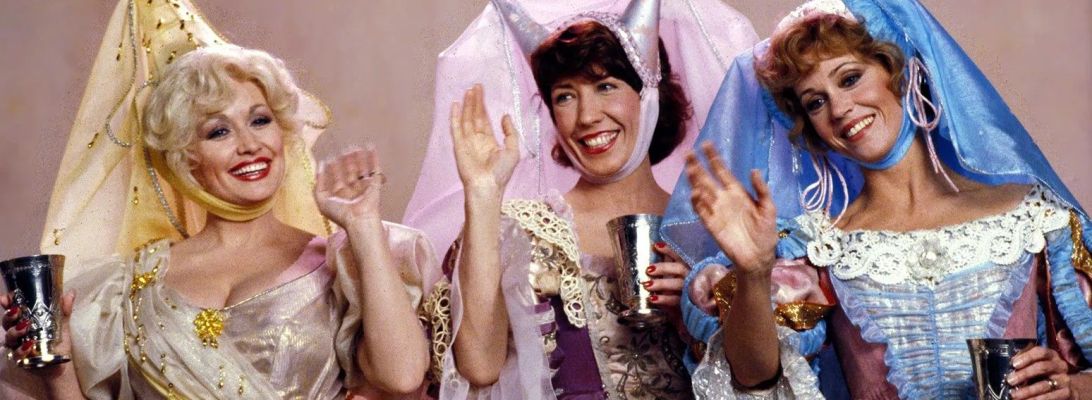
Happy 9/25! If you’ve never watched the 1980 movie 9 to 5 before, it’s a wonderful classic comedy, and of course, it’s a great way to honor the incomparable Dolly Parton, who played Dora Lee. Today I’d like to discuss the plot and themes of this movie, and compare them to classic Shakespearean comedy.
The Plot
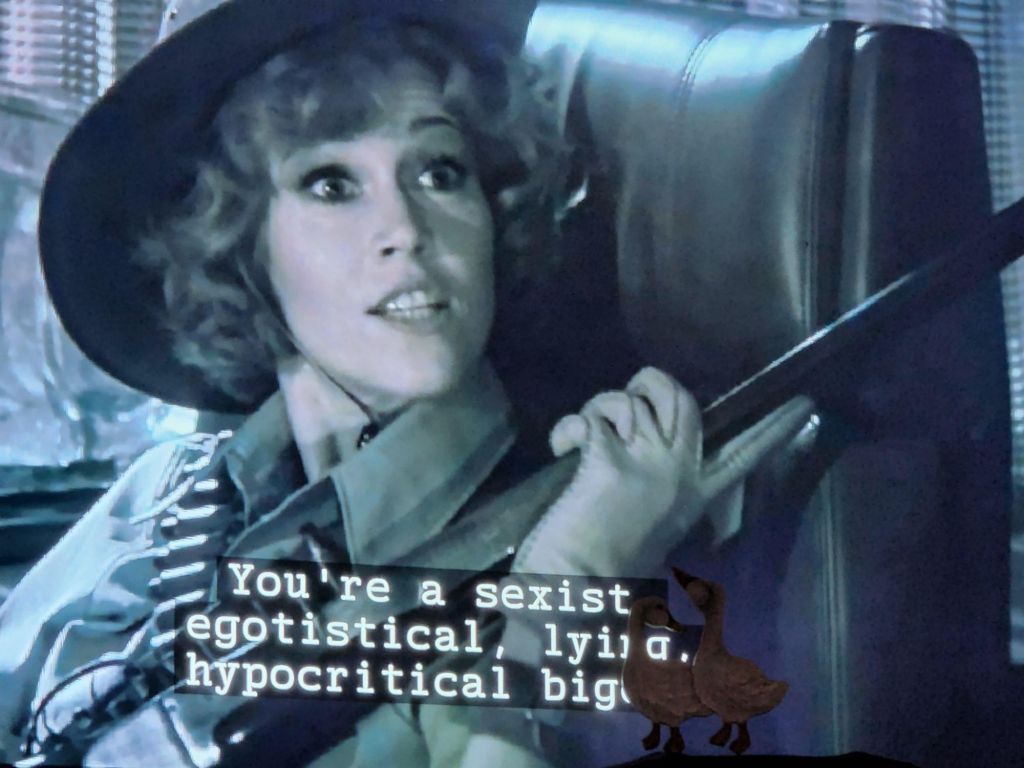
- Three unappreciated women in the workplace, Violet, Dora Lee, and Judy, hate their boss, a sexist, lying, hypocritical bigot. He not only rules the workplace as a tyrant, he is especially cruel to the women in the office- paying them less than their male counterparts, taking credit for their hard work, harassing the young and pretty ones, and firing them whenever he feels like it.
- It gets so bad that our three protagonists imagine elaborate fantasies where they not only kill him in over-the top Shakespearean ways, they also tell him off with delightfully theatrical language.
- Through a series of misunderstandings, the boss threatens to arrest all three of them for trying to kill him in real life. They then kidnap him and force him to stay home. Because Hart is so loathsome to deal with, the women take over the office without anyone noticing his absence! The office culture improves, productivity rises, and of course, everyone is treated equally and paid fairly. When Hart escapes and returns to the office, his boss is so happy with the women’s improvements, they promote him out of the office and he is never seen again!
Themes
The themes of 9 to 5 are truly universal, and it should never be described as a ‘chick comedy’- the same dehumanizing nature of capitalism and the unfair concentration of wealth is something everyone with a job can relate to. Just look at the lyrics of Dolly’s song:
In spite of the upbeat tune, Dolly hits on some serious grievances that working people have had since Shakespeare’s day and even older
- Unequal distribution of labor.
- Little chance for advancement
- Constant anxiety of being fired or demoted.
The Politics of 9 to 5
Women taking over male institutions for comedic purposes is not new- in the ancient Greek comedy Lysistrata, women take over the Acropolis- mocking the pointless fighting of the Peloponnesian War. Like all comedies, you can see it from two sides- From a liberal lens, the men are so dumb and so obsessed with us that women could easily solve this conflict. From a conservative lens, you could see it as a cruel satire – things have gotten so bad that even a woman could do a better job than the men in power. Likewise- 9 to 5 works both as a progressive ode to women in the workplace, a universal condemnation of unbridled 80s capitalism, and a conservative absurdist look at work- stay in your lane, work up the ladder and eventually you’ll get noticed.
I bring this up because that’s how Shakespeare wrote his comedies, criticising institutions but not outright rejecting them. In addition, Shakespeare lived in a time of economic revolution- he saw workers directly rebel against corrupt local lords during the Diggers Revolt of the early 1600. Though their efforts never succeeded in his time, the Diggers inspired the democratic form of free enterprise that America was built upon. After all, monopoly is very close to monarchy.
Sexual Politics
Sexism is a theme in Shakespearean comedy, especially in Measure For Measure, the play in which a corrupt man in a position of authority, tries to take advantage of a nun. Angelo, the antagonist of the play represents how in patriarchal society, Sexual Assault and inequality is extremely prevalent, and very hard to fight against. I’ll discuss this further in my podcast later this week. For now, let’s just say that there is a direct link between Measure For Measure, 9 To 5, and the #metoo era.
The Characters

Violet (Lilly Tomlin)
Violet, a senior supervisor and Hart’s second in command, is a woman trying to succeed in a man’s world. Of the three leads, she seems the least traditionally feminine- she has no husband, wears dark clothes, minimal makeup and jewelry, and devotes herself to her work, and has given her time, energy, and creativity to the job. The cruel irony is, even though she subverts her femininity, she’s never seen as anything other than “Hart’s girl.” She’s passed up for promotions, Hart steals her ideas and takes the credit, and even though she is a senior supervisor, Hart forces her to get him his coffee as if she has nothing better to do. Violet is a scathing critique of corporate culture, and she dreams in her fantasy to take Hart’s coffee, and give him a taste of his own toxic medicine.
Violet’s Shakespearean counterpart is Viola from Twelfth Night. To succeed in a man’s world, Viola disguises herself as a man and gets a job. She is quickly rewarded and noticed once she hides her identity as a woman. This must have been extremely subversive for the 1600s.
If we compare Violet’s “I’m not a girl,” speech with Viola’s “In faith, they are as true of heart as we,” both speeches show a woman who is asking for equality.
- Viola. Ay, but I know—
- Orsino. What dost thou know?
- Viola. Too well what love women to men may owe:
In faith, they are as true of heart as we.
My father had a daughter loved a man,
As it might be, perhaps, were I a woman,
I should your lordship. - Orsino. And what’s her history?
- Viola. A blank, my lord. She never told her love,
But let concealment, like a worm i’ the bud,
Feed on her damask cheek: she pined in thought,
And with a green and yellow melancholy
She sat like patience on a monument,
Smiling at grief. Was not this love indeed?
We men may say more, swear more: but indeed
Our shows are more than will; for still we prove
Much in our vows, but little in our love.
Both speak of suffering in silence, waiting for a man to notice them. In Viola’s case, she wants her boss, Duke Orsino to realize she’s a woman and fall in love with her, while Violet wants to be treated as a grown woman and an employee. Both speeches are about a man who is blinded by his preconceived notions of what a woman is, and the women eloquently shatter them.
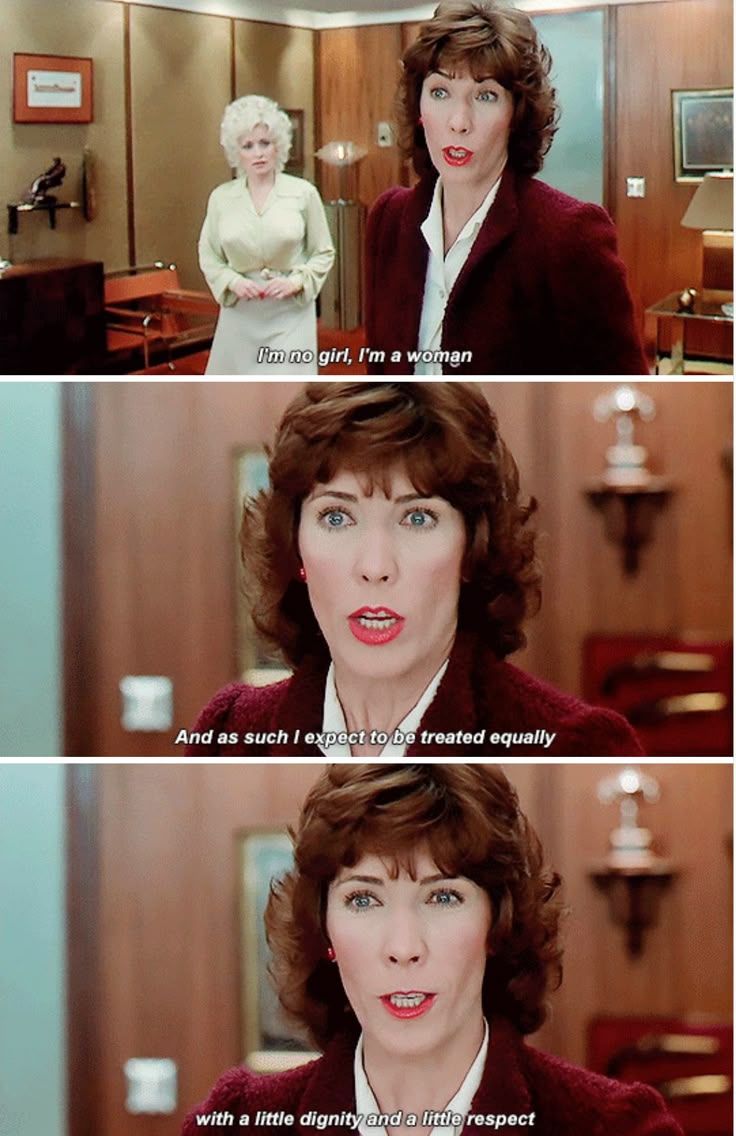
VIOLET: You gave that promotion to Bob Enright instead of me? I trained him for God’s sake! Oh, so it’s the old boys club. I’m going, but before I do, I have one more thing to say. Don’t you ever refer to me as your ‘girl’ again. I am no girl. I am a woman. W-O-M-Y-N! I’m not your wife, your mother or your mistress. I’m your employee and I expect to be treated equally, with a little dignity and a little respect! Oh, come off it, Doralee. Everyone knows you and Mr. Hart are having an affair.
Violet represents the best of working women, and the worst of how they are treated.
Dora Lee (Dolly Parton)
At first glance, Dora Lee seems like a naive blond country bumpkin. She also appears, (as Violet alluded to earlier), to be having an inappropriate relationship with her boss. In reality, she is another victim of Hart’s cruelty. Because she’s Hart’s secretary, he feels entitled to a relationship with her, (even though both Dora Lee and Hart are married). Even worse, Hart openly flirts and leers at Dora Lee and makes up excuses to ogle and pinch and harass her. Why does she put up with this? First, because she knows how this kind of behavior is encouraged in all workplaces. This is why in her revenge fantasy, Dora Lee subjects Hart to the same kind of harassment that she has endured, before hog tying him like the sexist pig he is!
As you might have guessed, Dora Lee’s Shakespeare avatar is Isabella- the nun from “Measure For Measure” in Shakespeare’s darkest comedy, Isabella is a nun who tries to plead for clemency to an unjust judge. He then offers a horrific quid pro quo bargain- he will pardon her brother and save him from execution, but only if she sleeps with him.
Ha! Little honor to be much believed,
And most pernicious purpose! Seeming, seeming!
I will proclaim thee, Angelo; look for't:
Sign me a present pardon for my brother,
Or with an outstretch'd throat I'll tell the world aloud
What man thou art.
While Isabella threatens to tell the world on Angelo, Dora Lee favors a more… aggressive approach:
DORALEE: What! You’ve been telling everyone I’m sleeping with you! That explains why everyone’s been treating me like a dime store floozy! They all think I’m banging the boss! And you love it, don’t you. It gives you some sort of cheap thrill, like knocking over pencils and picking up papers. I’ve put up with your grabbing and chasing me around the desk, ‘cause I need this job, but this is the last straw! I’ve got a gun out there in my purse and up to now I’ve been forgiving and forgetting ’cause that’s the way I was brought up but I swear, if you say another word about me, I’ll get that gun of mine. And I’ll change you from a rooster to a hen with one shot!
Like Isabella, Dora Lee’s speech emphasizes her Christianity, (note the use of the term: “forgiving and forgetting”) but unlike the nun, Dora Lee makes it clear in no uncertain terms that she NEED NOT, SHOULD NOT, and WILL NOT put up with Hart’s behavior.
Judy Bernly (Jane Fonda)
Judy is the new girl at the company. In addition to being an important fish-out-of water character who helps explain the plot to the audience, Judy has the most dynamic arc in the movie. She starts as a divorcee with no home, no job experience, and no husband. Her vulnerability makes Hart eager to take advantage of her, like he did Dora Lee. Fortunately, Violet and Dora Lee warn Judy and she quickly makes friends with them.
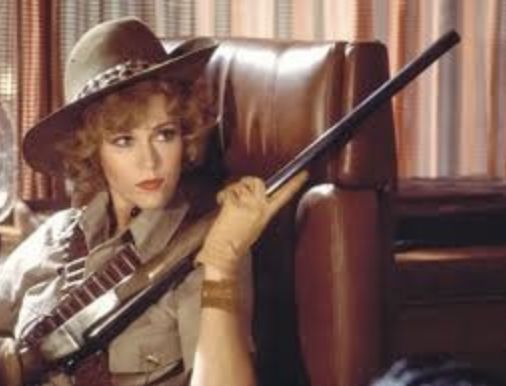
Because of her kind nature, Judy is disgusted by Hart’s callousness and cruelty. This is why her fantasy for doing away with Hart paints her as a fearless hunter, scaring him and destroying him, like he did poor meek creatures whose heads he mounts on his office wall:
Judy grows from being a broken woman to a strong, valuable ally whose kindness is seen as a strength, not a weakness. Her husband even comes back and tries to get back together with her and, for the first time, Judy stands up for herself and says no. She had an easy out- become a wife and mother again, but finds strength from her friends and realizes she deserves better than him. By the end of the film, she becomes the heart of the team.
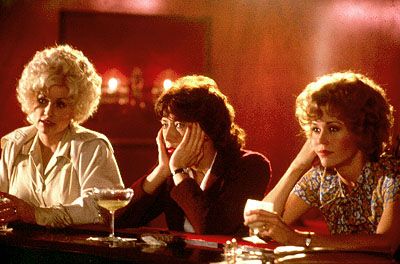
To conclude my Analysis, let’s look at the scene at the bar between all three women:
V: What a rat.
D: What a liar.
J: What a creep.
D: To think he told everybody
I was sleeping with him…
J: It’s so unfair. Just so unfair.
V: Twelve years of service,
and he shoots me down.
J: We’ve got to do something. He can’t treat people like that.
V: Do? What’s to do? Quit?
D: – I can’t quit.
V: – It’s the same all over.
J: Look, couldn’t we just all get together and complain?
V: – Complain to who?
Let’s face it- We’re in a pink-collar ghetto.
J: Let’s have another drink.
And this:
To whom should I complain? Did I tell this,
Who would believe me? O perilous mouths,
That bear in them one and the self-same tongue,
Either of condemnation or approof;
Bidding the law make court'sy to their will:
Hooking both right and wrong to the appetite,
To follow as it draws!
Measure For Measure, Act II, Scene 4
First off, let’s address the obvious parallels- both Dora Lee and Isabella have been assaulted and harassed and the man’s defense is exactly the same: “no one will believe you.” Both women know that in a patriarchial society society, both the offender and the judge allow this kind of culture of sexual abuse, which leads to a vicious cycle. As Violet points out, all companies have the same attitude towards women, which means that even if they quit, they’ll just find another Hart if they go work someplace else.
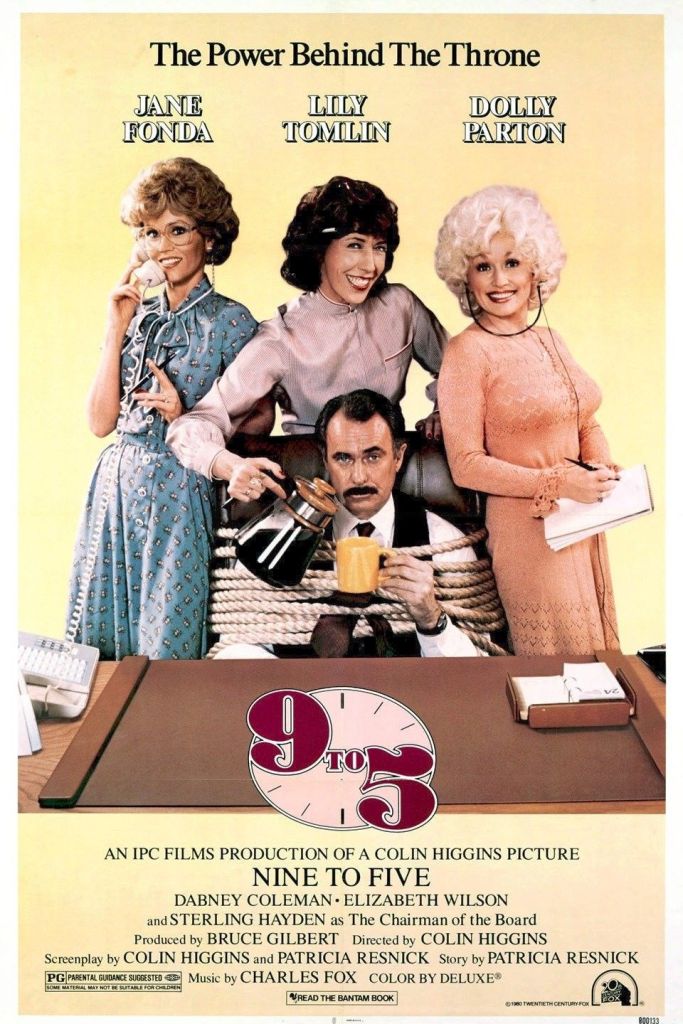
What Shakespeare doesn’t mention is that Hart’s view of women is intertwined (get it?) with his attitude towards his employees- female and male. He has no interest in them other than as objects to improve his wealth and status, which is also true in most companies. Violet’s phrase “pink collar ghetto” refuses to the all-too common practice of putting women in low-paying jobs with no chance for advancement.
What Would Shakespeare Do? not much- I think I’ve emphasized that the themes, characters, and clever satire of 9 to 5 perfectly parallel Shakespearean comedies like Measure For Measure, Twelfth Night, and others. Nevertheless, the fact that the same issues workers in general and women in particular are just as prevalent in Shakespeare’s day as in 1980, and today, means we have quite a way to go to have a truly egalitarian a workplace, so hopefully some of you will watch the movie and get inspired to change the world like Violet, Judy, and Dora Lee!