You might have read my previous post about Locrine and Humber from that play. Well, today I will continue this series by discussing the other character I play, the mythical founder of Britain, King Brutus.
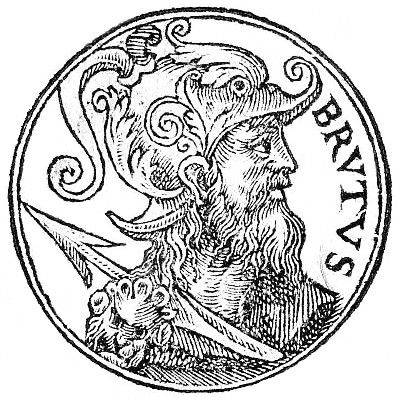
Brutus of Troy
Now before you ask- NO, THIS IS NOT Marcus Brutus, the man who stabbed Julius Caesar. This Brutus actually lived before said conspirator, around the year 11000 BC. Writers like Geoffrey of Monmouth, writing after the Norman Conquest of England, recorded the story of Brutus as a way of getting the British people on board with a single king uniting all of the kingdoms of England.
According to Monmouth (who clearly had an influence on the writer of Locrine), Brutus was the grandson of Aeneas, the sole survivor of the infamous Trojan War. Like the ancient Greek legends of Perseus or Hercules, Brutus is exiled from Italy for accidentally killing his father, and must then create a new empire in Britain.
Brutus! there lies beyond the Gallic bounds An island which the western sea surrounds, By giants once possessed; now few remain To bar thy entrance, or obstruct thy reign. To reach that happy shore thy sails employ; There fate decrees to raise a second Troy, And found an empire in thy royal line, Which time shall ne’er destroy, nor bounds confines – Diana’s speech to Brutus
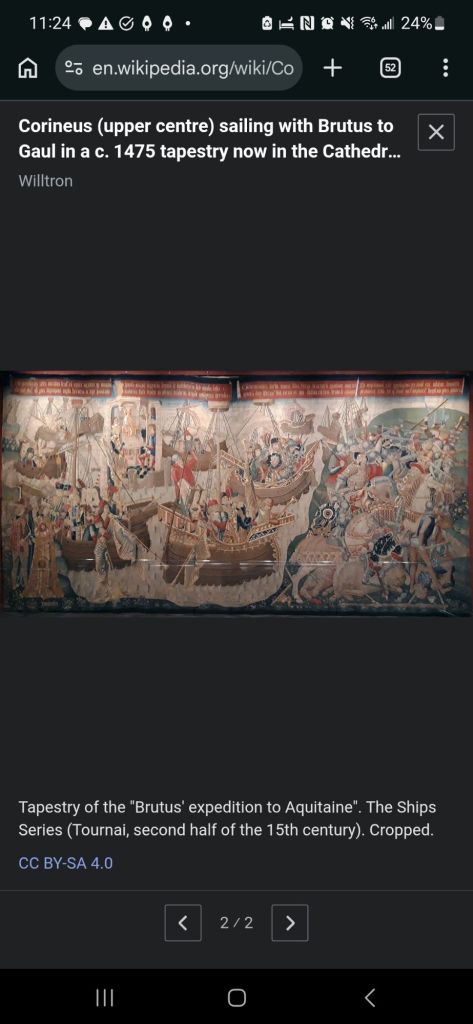
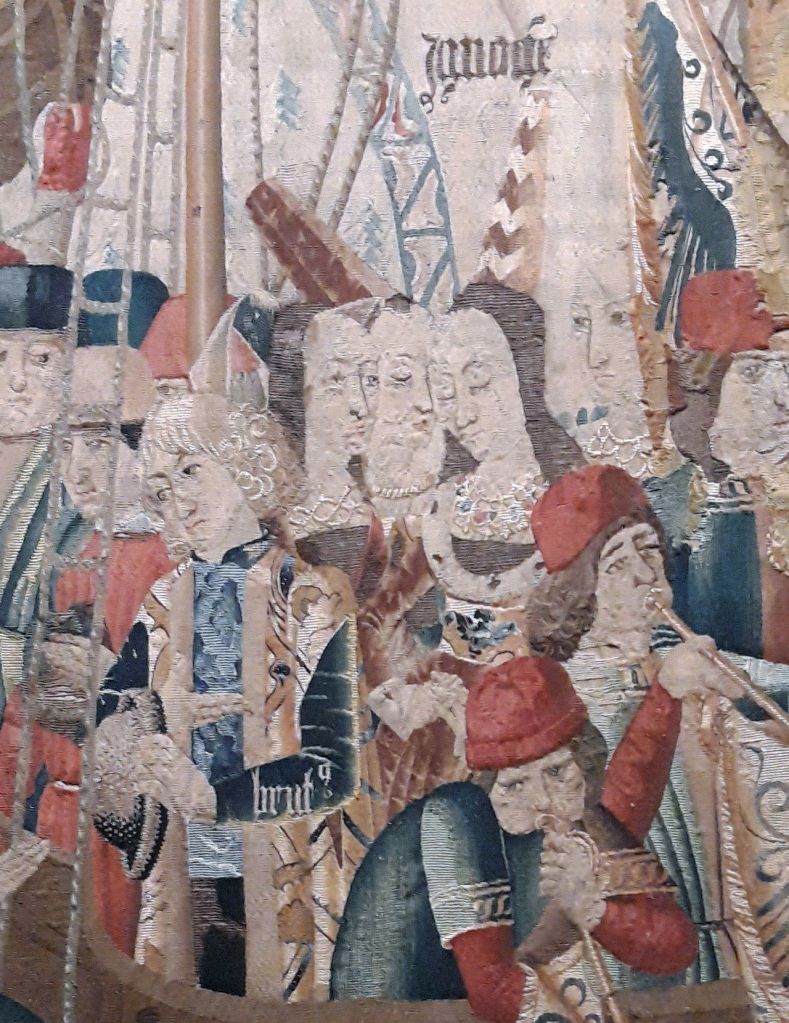
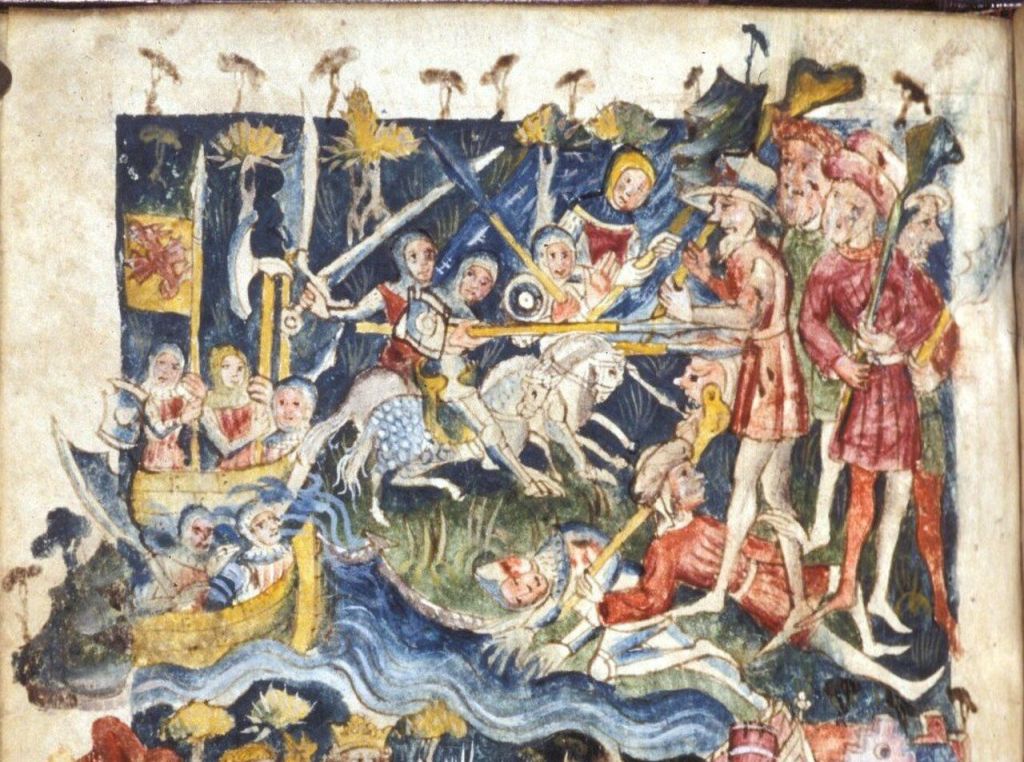
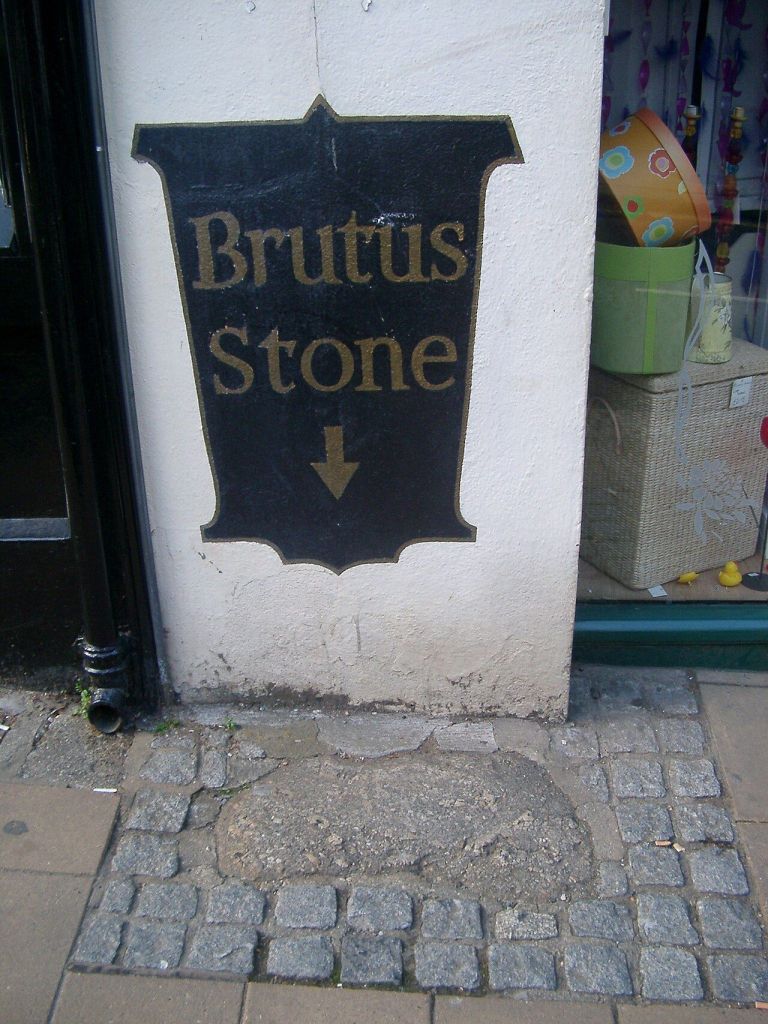
Detail of Brutus and his wife Imogen, sailing from Greece to England.Brutus battles the giants The so-called Brutus stone in Totnes
To secure his empire, Brutus must tame the savage giants that rule the untamed wilderness of Britain, in a mythical battle that is still celebrated to this day.
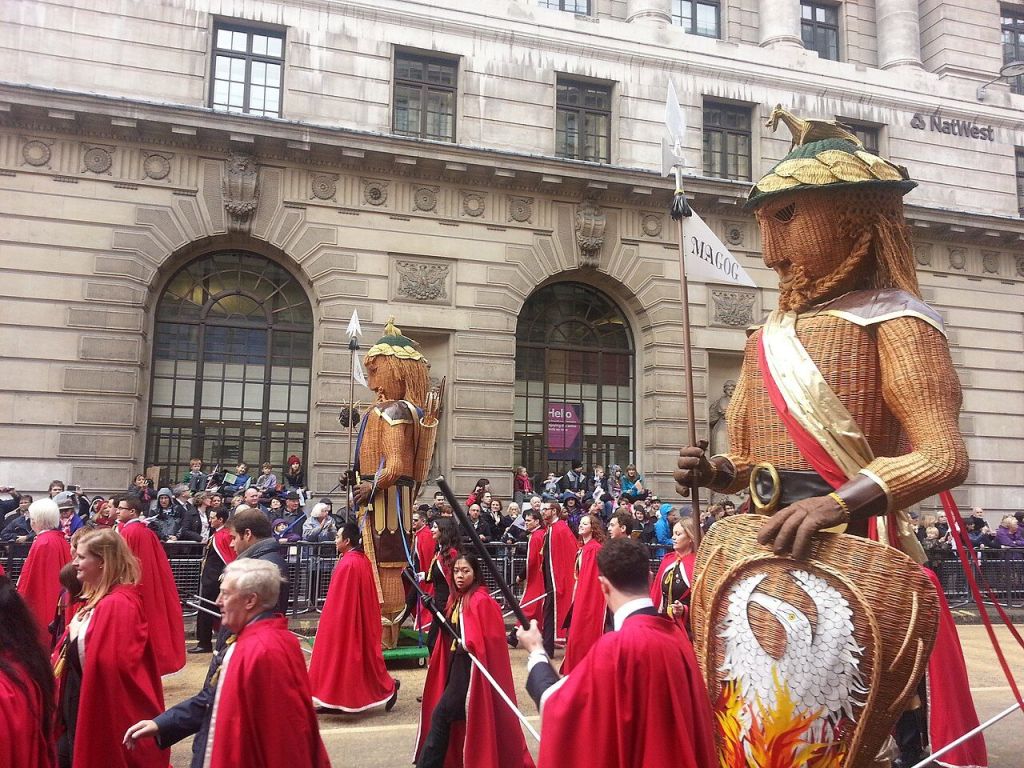
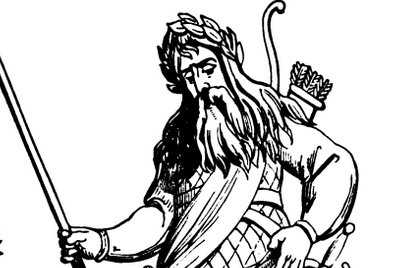
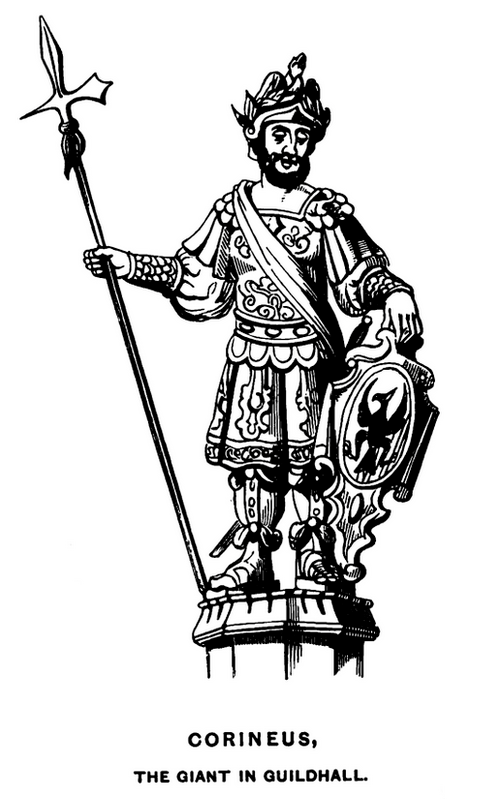
Illustration of Gogmagog Montage of the giant Gogmagog, whom Brutus’ general Corineus slew
At the beginning of the encounter, Corineus and the giant, standing, front to front, held each other strongly in their arms, and panted aloud for breath, but Goëmagot presently grasping Corineus with all his might, broke three of his ribs, two on his right side and one on his left. At which Corineus, highly enraged, roused up his whole strength, and snatching him upon his shoulders, ran with him, as fast as the weight would allow him, to the next shore, and there getting upon the top of a high rock, hurled down the savage monster into the sea; where falling on the sides of craggy rocks, he was torn to pieces, and coloured the waves with his blood- Monmouth
Function in the Play
Legacy of Troy- As I mentioned before, Brutus establishes the link between ancient Troy, and the founding of Britain.
The island was then called Albion,[9] and inhabited by none but a few giants. Notwithstanding this, the pleasant situation of the places, the plenty of rivers abounding with fish, and the engaging prospect of its woods, made Brutus and his company very desirous to fix their habitation in it. They therefore passed through all the provinces, forced the giants to fly into the caves of the mountains, and divided the country among them according to the directions of their commander. After this they began to till the ground and build houses, so that in a little time the country looked like a place that had been long inhabited. At last Brutus called the island after his own name Britain, and his companions Britons; for by these means he desired to perpetuate the memory of his name.
2. Corineus’ Brother In Arms
Like a lot of characters in Shakespeare’s history plays, Brutus has a loyal second in command, Corineus, the mythical founder of the kingdom of Cornwall. After Brutus dies, Corineus is a sort of Lord Protector, lending his council and military experience to Locrine and his brothers:
The name of their commander was Corineus, a modest man in matters of council, and of great courage and boldness, who, in an encounter with any person, even of gigantic stature, would immediately overthrow him, as if he were a child. When they understood from whom he was descended, they joined company with him and those under his government, who from the name of their leader were afterwards called the Cornish people, and indeed were more serviceable to Brutus than the rest in all his engagements. – Historia Regum Britanniae by Geoffrey of Monmouth, c1136
Patriarch– Brutus’ sons become the first kings of England, (Locrine), Scotland (Albanact), and Wales (Camber).
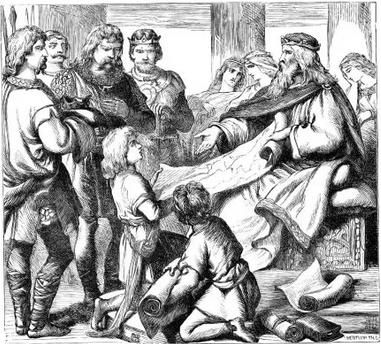
During these transactions, Brutus had by his wife Ignoge three famous sons, whose names were Locrin, Albanact, and Kamber. These, after their father’s death, which happened in the twenty-fourth year after his arrival, buried him in the city which he had built, and then having divided the kingdom of Britain among them, retired each to his government.
Illustration of King Locrine from the Genealogical Chronicle of the Kings of England to Edward IV (c. 1461)Camber- Brutus’ middle sonAlbanact, son of Brutus of TroyGwendoline, legendary Queen regent of Britain.
King Lear Right after Brutus’ story in Monmouth’s chronicle comes the ancient story of King Lear, the same story Shakespeare would later adapt into his own play. Like Lear, Brutus has to divide his kingdom, but unlike Lear, he does not try to test his children’s loyalty.
Isaac gives Jacob his blessing
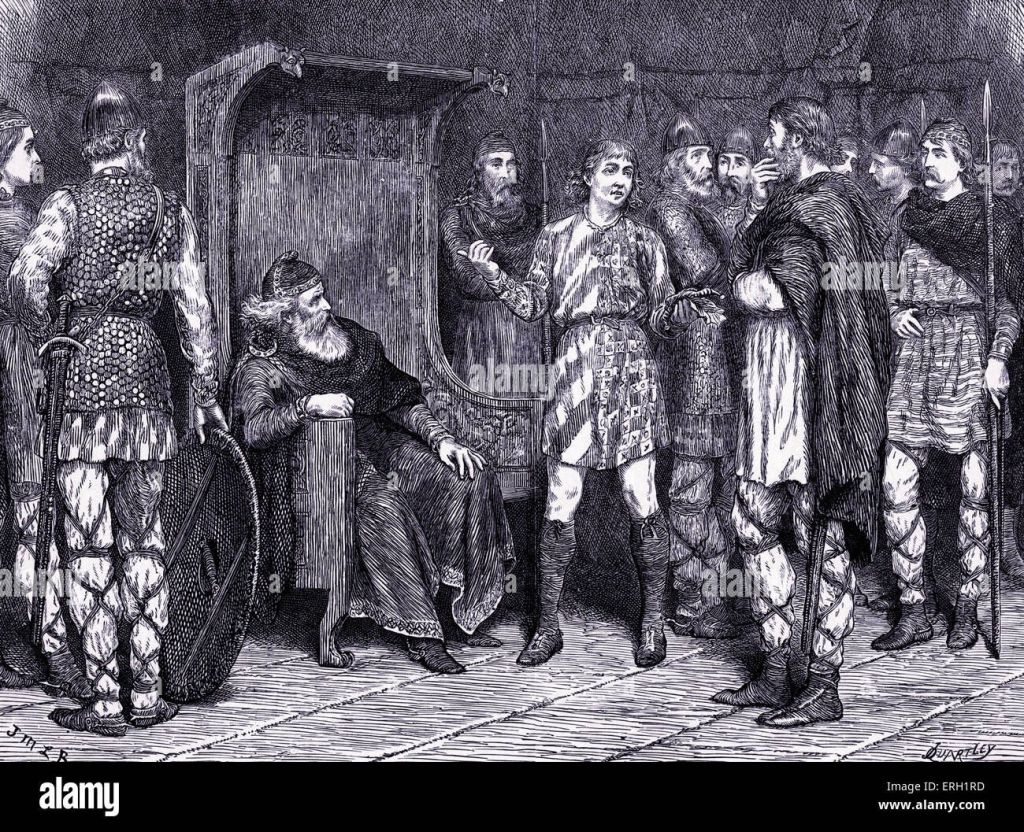
Locrin, the eldest, possessed the middle part of the island, called afterwards from his name, Loegria. Kamber had that part which lies beyond the river Severn, now called Wales, but which was for a long time named Kambria; and hence that people still call themselved in their British tongue Kambri. Albanact, the younger brother, possessed the country he called Albania, now Scotland. After they had a long time reigned in peace together, Humber, king of the Huns, arrived in Albania, and having killed Albanact in battle, forced his people to fly to Locrin for protection.
Our Interpretation
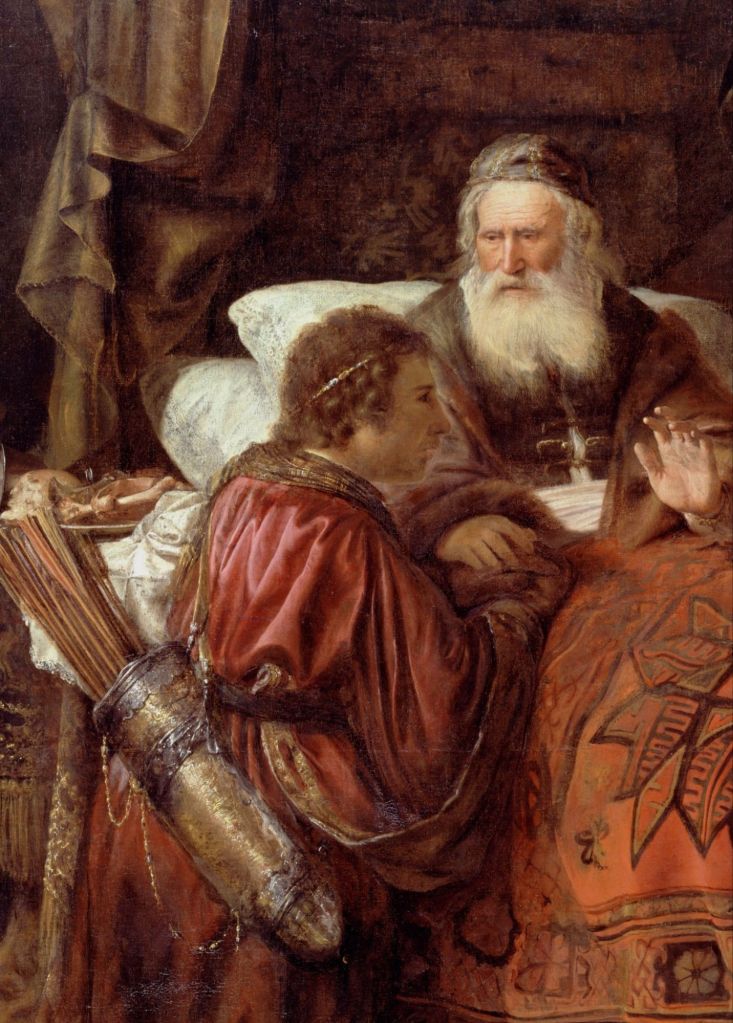
Isaac blesses Jacob
Those who sought to deface our memory, wipe the name of Trojans from the earth Those did I captivate with this mine arm. And in this Isle at length I placed you. – Locrine, Act I.i
I see Brutus as an intimidating king like Hamlet’s Father (before he became a ghost). I also see him as similar to an Old Testament patriarch like Moses or Isaac- he was led by a god to the promised land, and gave it to his children, who must now protect and defend it.
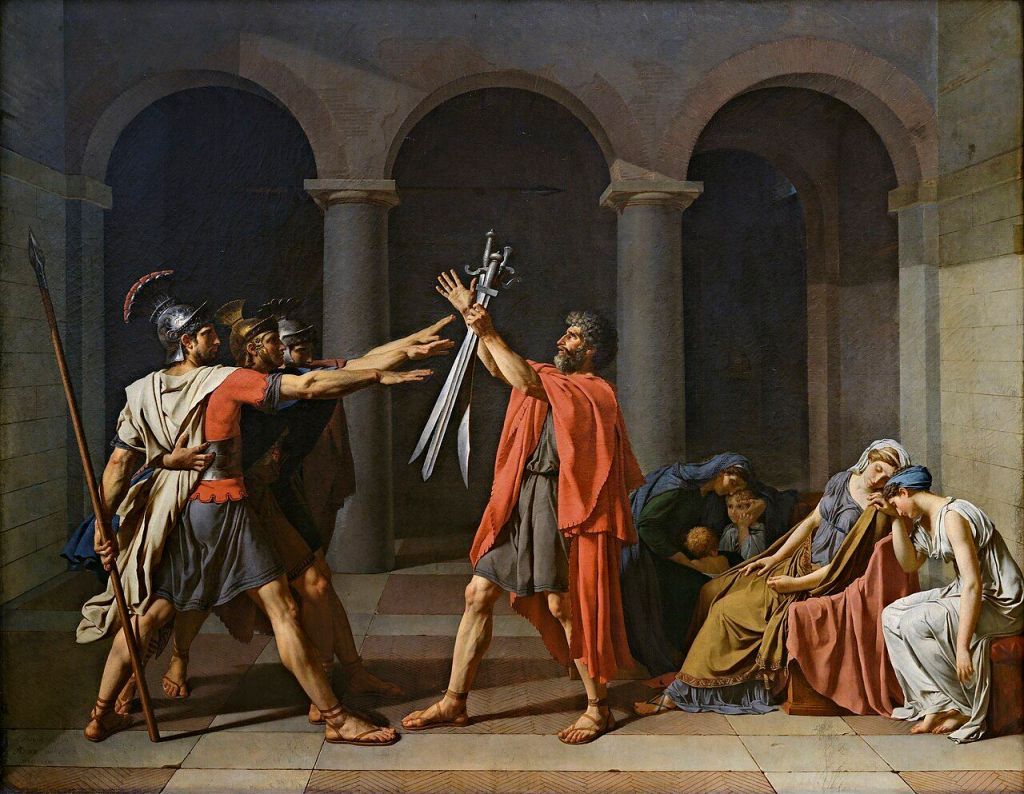
Oath of the Horatii by Jaques Louis David
Colonizer
Map of Cornwall
On the other hand, one could also see Brutus as a colonizer- he takes land that wasn’t his and overthrows the natural order. This is a dimension that is not explored in the original story, but our version highlights it.
Playing Brutus
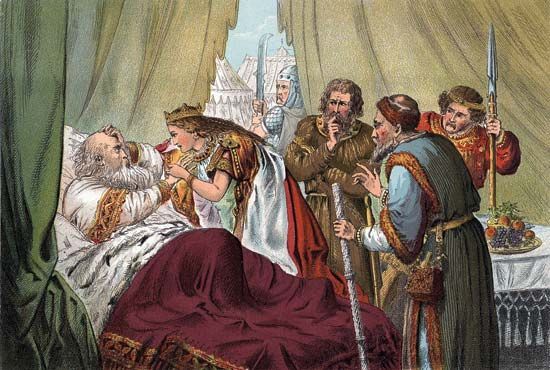
Look and physicality– For such a mythic figure, I tried to play Brutus with as much strength and gravity as possible, at least at first. While he is being introduced and fighting giants, I tried to make him a soldier and King in his prime. After a while though, we see Brutus on his death bed, and I play him as frail and shaky; struggling to keep his kingdom together, as he also struggles to stay alive.
As Brutus ages, I had him divest himself of his armor as he divests his kingdom- to CAMBER, he gives his shield. To Albanact, he gives his sword, and to Locrine, he gives his crown.
Verse
It’s interesting that most of Brutus’ lines are in Trochaic, rather than iambic verse, which could be a way to emulate older forms of verse, but I also suspect that it is designed to emphasize Brutus’ commands.
Then now, my son, thy part is on the stage, For thou must bear the person of a King. [Puts the Crown on his head.] Locrine, stand up, and wear the regal Crown, Cherish and love thy new betrothed wife. Locrine, Act I.i
Well, there you go, Hope you enjoyed this overview of the play Locrine. If you like this review, you might like to see the show itself. Click here to purchase tickets:
Since it’s Women’s History Month, and we just had the Ides of March last week, I thought it might be a good idea to analyze some of Shakespeare’s female characters in his Roman plays. I’ve talked a lot about the men in Julius Caesar, Titus, Andronicus, and Coriolanus, but haven’t examined the female characters much, so that’s what I’m going do discuss today.
Examining these characters is important because many are based on real Roman women, and Shakespeare’s sources reveal what Roman culture thought about women’s roles. This is particularly relevant to those of you reading this in the west because Roman culture influenced the Elizabethans and they set the foundation for our culture today. Feminist criticism has been much maligned, (and I’m certainly not an expert on feminism), but I do know this: it exists to question the values and conventions of our culture, so we can identify what works and what needs to change to build a more egalitarian society.
When it comes to Shakespeare female characters in general, he challenges the status quo, but also reinforces it: There’s always a character who challenges traditional gender roles like Katherine and Beatrice, but, (with the exception of Twelfth Night), for every one of these there’s also a Bianca or a Hero; characters who embody traditional famine roles and virtues of chastity, meekness, and yes, marriage and childbirth.
Nowhere is this more apparent than in Shakespeare’s Roman plays where there are always two female characters and they usually embody opposite views of women’s roles and a woman’s duty to her country and the men in their lives
1. Tamara from Titus Andronicus
Titus was Shakespeare’s first tragedy and his first Roman play. As we shall see, as Shakespeare went through his career we see a more nuanced view of women’s roles and a greater appreciation for women who disdain or challenge patriarchal society. The characters Lavinia and Tamara are perfect examples and counterexamples respectively of traditional feminine roles.
When we first meet her, Tamara is the queen of the Goths- an enemy tribe that Rome has just conquered. Everything about Tamara from her foreign upbringing, to her personality, is a counter-example of what Romans prize in women. She is portrayed as savage and bloodthirsty, motivated by revenge against Titus, (who in the first scene of the play, kills her eldest son. Tamara responds by masterminding the murder of all of Titus’ children. She is also sexually liberated and uses her sexuality to further her revenge. Tamara seduces the Emperor to get him on her side, and gets the Emperor to condemn Titus’ sons to death. Her adultery with Aaron is another way she uses her sexuality to get revenge; she brings ruin the monarchy by cuckolding the Emperor. Thus Tamara’s sexuality and bold personality is framed in the play as an existential threat to Rome itself.
Tamara’s chief and only virtue is her love for her children, as you can plainly see in this scene from the play. Her love for her son Alarbus is why she begs Titus for his life, and afterwards, when he sacrifices Alarbus, Tamara’s love for her son turns into deadly hate to Titus. It is her motherly devotion that makes Tamara simultaneously human, and inhuman. As the play progresses however, Tamara is referred to in increasingly inhuman and savage terms. She dresses up as the goddess Revenge to torment Titus, and after she dies, Lucius, the new Emperor (and Titus’ only surviving son), calls her a “ravenous tiger,” and calls for her body to be thrown to beasts, since “Her life was beast-like.” Tamara is unquestionably the villain- a femme-fatale and a threat to all the Roman characters, but especially Titus’ daughter Lavinia.
2. Lavinia from Titus Andronicus
For the entire play, Lavinia embodies traditional Roman female virtues, in that she is defined by the men in her life, and her chastity. The Romans actually invented the term castitas to refer to the female virtues of modesty and chastity, that is, only having sex with the man you are married to. Lavinia fits this mold perfectly. She’s a devoted daughter, wife, and sister. When we first meet her, she is a model of duty- greeting her father and asking for his blessing when he returns to Rome, and shedding tears for her brothers that were slain in the war:
In the cruelest and most barbaric scene in all of Shakespeare, Lavinia is raped by Tamara’s sons. Then, to keep her from identifying her attackers, they cut out her tongue and cut off her hands. The mutilation is grotesque, but for Titus, the Romans, and for the Elizabethans Shakespeare was writing for, the cruelest loss for Lavinia was the loss of her chastity. Now that she isn’t a virgin, Lavinia is marked with the opposite of chastity, incestum, or infamy. Even though the rape was not her fault, Lavinia is marked with shame. The Romans took unchastity extremely seriously; they used to punish it by throwing the adulteress to her death off the Tarpeian Rock. As you can see in this video, when a woman who was supposed to live chaste is even suspected of adultery, her very life is now in jeopardy:
When she loses her virginity, Lavinia becomes a silent creature of sadness. She is no longer a person, but a motivation for Titus’ revenge. Even if she hadn’t lost her tongue, she would still have little agency in the plot. This is why Titus kills her; to remove her incestum, and end her suffering. Lavinia embodies the the cruel truth that women had to face in ancient Rome- once they lose their virginity, they are already dead in the eyes of most of Roman society.
Lavinia’s death scene from Titus, 1999, directed by Julie Taymor.
3. Portia (Julius Caesar) If Shakespeare only wrote these two female characters, you might rightly assume that he was a vile sexist, who defines a women’s usefulness simply by her chastity or lack thereof, and who thinks the proper function of a woman is to be quiet, demure, chaste, and obedient. Thankfully Shakespeare created Portia in Julius Caesar, and she defies many of the stereotypes associated with women in Ancient Rome.
Portia marks a turning point in Shakespeare’s Roman female characters as we we go from more ‘traditional’ female characters, to ones who exemplify masculine virtues. Instead of women being subordinates to men’s affairs and keeping out of religion, politics, and the affairs of Roman society, Portia is a character who demands respect, and to share her husband’s dangers. Some ancient sources suggested possibly Portia might have been the one who inspired Brutus to kill Caesar, (more on that later), but in any case Portia is not a character who is subordinate to men, but who demands to be treated as a Roman citizen.
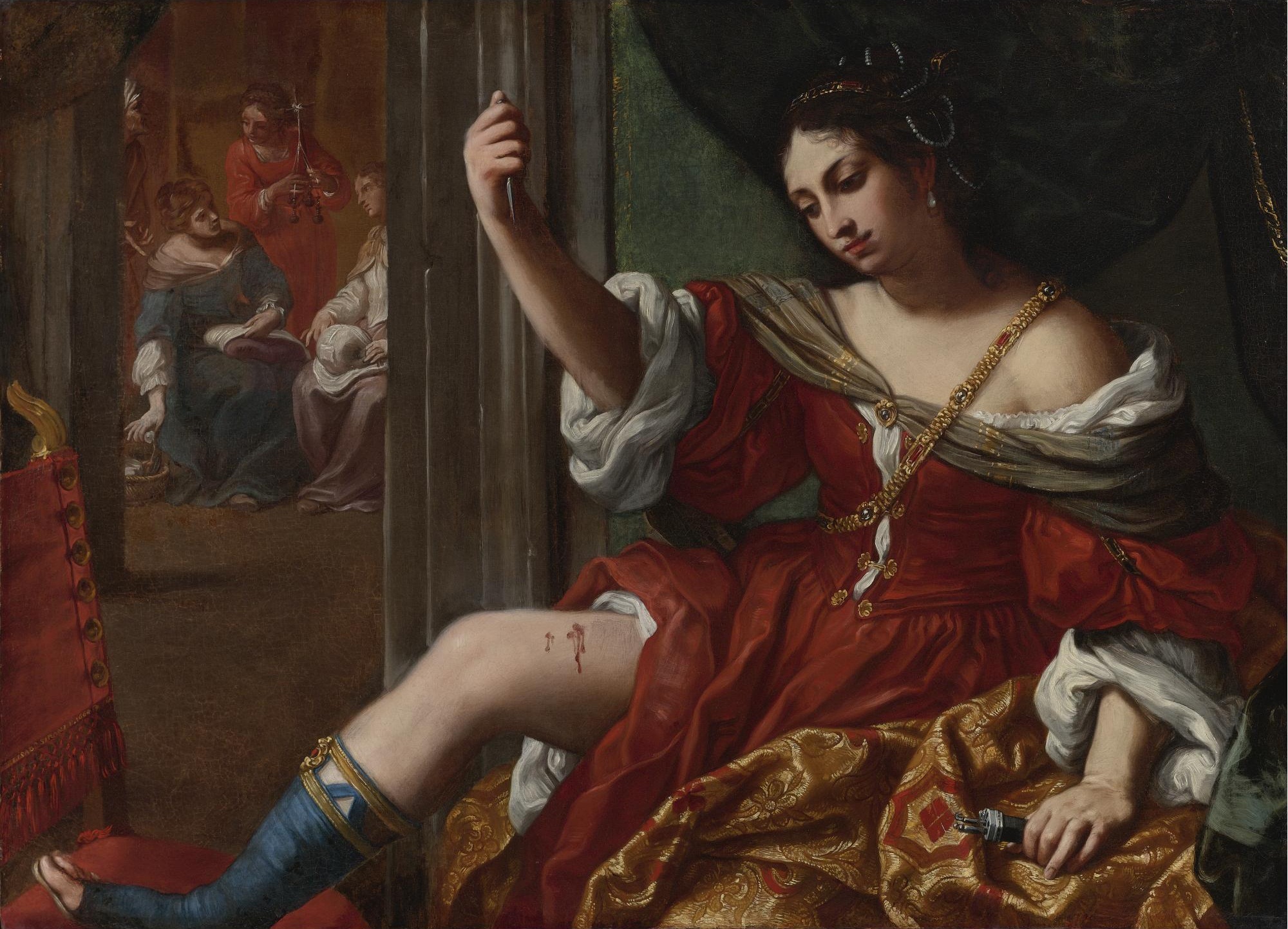
In one of the strangest passages of the play, Portia reveals that she has willingly injured herself by stabbing herself in the thigh. She does this as a way of establishing her tolerance for pain and her desire to be taken seriously by her husband:
Brutus. You are my true and honourable wife,
As dear to me as are the ruddy drops
That visit my sad heart
Portia. If this were true, then should I know this secret.
I grant I am a woman; but withal920
A woman that Lord Brutus took to wife:
I grant I am a woman; but withal
A woman well-reputed, Cato's daughter.
Think you I am no stronger than my sex,
Being so father'd and so husbanded?925
Tell me your counsels, I will not disclose 'em:
I have made strong proof of my constancy,
Giving myself a voluntary wound
Here, in the thigh: can I bear that with patience.
And not my husband's secrets?930
Brutus. O ye gods,
Render me worthy of this noble wife!
Romans have always had a connection with blood. Blood is a connection to duty; we owe our lives and our blood to Rome; the Gladiator whose blood honours the dead, the sacrifice of the enemy soldiers in Titus Andronicus, and the blood of the Roman soldier shed in service of the country. Rome is almost a culture that is built on blood. Portia in this gesture makes it clear that she is willing to shed blood just as much as her husband, who of course, will shed blood, (just not his own). In a way, Portia’s wound makes her more heroic than Brutus, because she is willing to suffer for the good of Rome, while Brutus kills for the good of Rome.
Shakespeare’s Roman characters, (male and female), extol the questionable virtue of the noble death. Historically when a Roman conspiracy failed, the conspirators had a choice; they could be paraded back to Rome humiliated and disgraced, or they could kill themselves and show defiance in the face of their conquerors. In some cases suicide was actually encouraged by the conquerors, as it meant that the threat was neutralized. In response, the conquerors would go easy on the wife and children.
Portia kills herself after Brutus is on the run. There could be two equally important reasons why she does this. First, she might be attempting to gain favor with the triumvirate by killing herself, (since she is complicit in the assassination), in the hopes that Anthony and a and Octavian will take pity on a Brutus’ children. It’s also possible that Portia kills herself because with the tide of battle turning, she might be next. Portia might be showing the same sort of resolve their husband later shows when he commits suicide to appease Caesar’s ghost and to defy his enemies the honor of capturing him.
Since Portia has a lot of her husband’s same virtues, the inevitable question I come to is to wonder what if; what if Shakespeare’s Brutus had a listened to Portia more,what might he have done?
The Lictors Bring to Brutus the Bodies of His Sons, Jacques Louis David, 1789.
This painting by Jacques Louis David depicts Brutus’ ancestor Junius Brutus. We see that he is utterly removed and stoic him in the face of death. He has ordered the execution of his own sons for trying to bring back the monarchy. In the background, Brutus’s wife and daughters are mourning the death of their son and brothers. Men like Brutus, with their Republican ideals, take little stock in the consequence of their actions.
One can only wonder if Brutus had had confided in Portia, would she have condemned his actions, or could she have led him to a more constructive path, that might have a prevented Brutus’ death, and maybe even stopped the coming days of the Empire?
Valumnia (Coriolanus) In Shakespeare’s later Roman tragedyCoriolanus, we again see a young, chaste woman and an older mother figure, but unlike in Titus, the older Volumnia is much more heroic than the young maid Virgilia. Both show loyalty to Rome and devotion to Coriolanus, but Volumnia is not only a hero, she is in many ways a complete inversion of the Roman mother trope.
Volumnia is fanatically devoted to Rome and its army and like her son. She finds war more beautiful than symbols of peace, especially those associated with motherhood. In Act I, Scene iii, she says that the breasts of the Trojan Queen Hecuba were not as lovely as her son’s forehead when it spit blood in battle. She is an inversion of the traditional motherly character; because of her devotion to Rome and her son, she is more outspoken than other women and not afraid to talk back to anyone who questions Rome. In a way she is more of Coriolanus’ general or his father than a traditional mother. Her love of Rome is inextricably tied to her love of her son. She raises her son to be a warrior for the Senate and the people of Rome, exhorting him to either return in glory, or die. Observe this passage where she tells Coriolanus’ wife that she was never proudest than when she sent her son off to war:
Volumnia: I pray you, daughter, sing; or express yourself in a
more comfortable sort: if my son were my husband, I
should freelier rejoice in that absence wherein he
won honour than in the embracements of his bed where
he would show most love. When yet he was but
tender-bodied and the only son of my womb, when
youth with comeliness plucked all gaze his way, when
for a day of kings' entreaties a mother should not
sell him an hour from her beholding, I, considering
how honour would become such a person. that it was
no better than picture-like to hang by the wall, if
renown made it not stir, was pleased to let him seek
danger where he was like to find fame. To a cruel
war I sent him; from whence he returned, his brows
bound with oak. I tell thee, daughter, I sprang not
more in joy at first hearing he was a man-child
than now in first seeing he had proved himself a
man.
Although Virgilia fits the bill of the modest, chaste, and loyal Roman housewife, Volumnia is framed as much more heroic. She even uses her mighty stoicism to save Rome! After Coriolanus rebels against Rome and joins the Volscis, Volumnia gets him to agree to make peace with Rome. She does this by kneeling before her own son; humiliating herself for the good of Rome. This act of self-humiliation changes Coriolanus’ mind. Observe how shocked Coriolanus (Ralph Fiennes) is when his mother (Vanessa Redgrave) kneels in this scene from the movie Coriolanus (directed by Ralph Fiennes in 2011).
4. Julia (Antony and Cleopatra) and with Cleopatra
With these final two examples, I’ve chosen two character who, (at face value), resemble Lavinia and Tamara. One is a dutiful, chaste Roman wife, related by blood to the Imperial family. Octavia was beloved throughout Rome for her chastity and kindness, and the citizens were outraged when her husband Marc Antony, abandoned her for Cleopatra, who was seen by many as a murderous, barbarous, lustful and an evil sorceress. However, Shakespeare paints a much more complex picture of Cleopatra, and though Octavia retains her chastity and is praised for her virtue, Cleopatra is unquestionably the star of the show, and ultimately commands more respect, awe, and even sympathy from the audience.
In Shakespeare’s play (and in real life), Cleopatra used her beauty as a propaganda tool. As I mentioned the Game of Thrones post, she deified herself in order to be taken seriously. In the 1st century AD, the system was very much rigged against female authority and so women had to resort to terrible measures in order to secure power for themselves.
If you look at the play again especially near the end, Cleopatra doesn’t come across as a femme fatale, she comes across as a woman who is trying to keep her Kingdom and her son Cesarian safe, and she will do anything to protect him. As the name suggests, Cesarean was Cleopatra’s love child of Julius Caesar, so the entire Roman world wanted him dead, because he was a threat to Octavian’s claim to the throne. To keep her son safe, Cleopatra seduces Marc Antony, hoping a powerful Roman alliance will keep her crown safe, and her son alive. Sadly for her, Octavian would stop at nothing to bring down all threats to his power, including Cesarian and Marc Antony. Arguably, the only reason he married Marc Antony to Octavia in the first place, was that he knew if Antony committed adultery, it would give Octavian the perfect excuse to raise an army and destroy Antony. Cleopatra got caught up in the political machinations of the most powerful and cunning man in the ancient world, and held him off as best she could.
Cleopatra struggles through the whole play to keep Antony, her people, and the situation in Rome under control. Antony never respects her as a queen and treats her like a jealous boyfriend, which is why they frequently get into fights.
However, after Antony’s suicide, the audience sees that Cleopatra also genuinely loved him back, and weeps for him as a wife, not an ally. Yet, quickly she regains her royal composure once Octavian threatens to take her back to Rome in chains. She decides to simultaneously deny Octavian the satisfaction, protect her son, and join her husband in the afterlife with her regal suicide:
Cleopatra: Give me my robe, put on my crown; I have
Immortal longings in me: now no more
The juice of Egypt's grape shall moist this lip:
Yare, yare, good Iras; quick. Methinks I hear
Antony call; I see him rouse himself
To praise my noble act; I hear him mock
The luck of Caesar, which the gods give men
To excuse their after wrath: husband, I come:
Now to that name my courage prove my title!
I am fire and air; my other elements
I give to baser life. So; have you done?
Come then, and take the last warmth of my lips.
Farewell, kind Charmian; Iras, long farewell.
[Kisses them. IRAS falls and dies]
Have I the aspic in my lips? Dost fall?
If thou and nature can so gently part,
The stroke of death is as a lover's pinch,
Which hurts, and is desired. Dost thou lie still?
If thus thou vanishest, thou tell'st the world
It is not worth leave-taking.
In conclusion, Shakespeare couldn’t go too far against the grain with challenging traditional patriarchal views of women, but in his Roman plays, we see characters who are simultaneously mothers and murderers, chaste and intelligent, citizens and devoted wives. I’m not trying to say that Shakespeare invented feminism, but I do believe his characters remind us that it is folly to try to box either gender into such stale old Roman categories as masculine or feminine. Perhaps we should all aspire to be like Cleopatra, whose infinite variety allowed her to succeed in a man’s world, while still being a wife, a mother, a lover, and a queen.
Parenting is tough! Parents have to sacrifice so much to make sure their kids grow up happy, healthy, and prepared for life. Not everyone can do it, but if Shakespeare has taught us anything, it’s that there’s always someone doing a worse job than you. So for all you dads out there, enjoy this list of my top 5 worst dads in Shakespeare, lovingly made to remind you that whatever kind of father you are, at least you’re not these baddies!
If you’d like to listen along to my podcat about this topic while you read, here’s the latest episode here:
Do you agree with my list? Leave me a comment below! Tomorrow I’ll continue my list with the top 5 Dad Dads; guys who are good, but have modern problems that keep them from being truly great. Then we’ll take it home with the best of the best. Hope you enjoy them!