Was Shakespeare Racist?

Was Shakespeare racist? When reading Othello by William Shakespeare, the only play he wrote where the hero is explicitly black, I truly feel like the Shakespearean student as opposed to the Shakespearean teacher. it’s a play that I find very difficult to get into, and very difficult to understand. Above all, the question I have is whether Othello is a positive or negative portrayal of a black man. So I am going to analyze the play, the prevailing views about race from Shakespeare’s time, and try to draw some conclusions about the play and its creator.

Disclaimer: I don’t advocate trying to speculate about how Shakespeare felt about anything. My real point in this post is to determine if the play Othello and its portrayal of people of color, has merit in today’s society, which is important to establish given the culture in which Shakespeare wrote it.

Part I: Black People And Shakespeare

By our standards, Shakespeare was probably racist. If you look at the ways black people are mentioned in documents of the period, the writers frequently describe black people with an air of otherness and superiority that shows little interest in the humanity of other races. In fact, one reason why the word “moor” is so problematic is that it basically referred to anyone not born in Europe. It could refer to people from Northern Africa, the Middle East, and even parts of Spain. Clearly, Europeans at the time weren’t interested in the particulars of their non-Caucasian neighbors’ culture and herritage.

“Portrait Of An African Man,” by Jan Mostaert, c. 1520

This is not to say that Shakespeare never knew any black people. Michael Wood in his book In Search Of Shakespeare estimates that there might have been several thousand black people in London alone. City registers mentions not only black people employed in the city, but even some of the first inter-racial marriages. Therefore, the notion of Othello marrying Desdemona would not have been unheard of even in 1601.

As an important note, the black people living in Europe at the time weren’t slaves. The transatlantic slave trade didn’t really get started in and America until the 1650s, and slavery was illegal in England at the time. Wood mentions that there were black dancers, black servants, and other free black people living in and around London (Wood 25). Dr. Matthieu Chapman wrote an excellent thesis back in 2010 about the possibility that some black people might even have been actors in Shakespeare’s company. Furthermore, scholars have wondered for centuries if the Dark Lady of the sonnets was Shakespeare’snon-Caucasian mistress.

In any case, it is likely based on what we know about the growing multiculturalism of England in the 17th century, that Shakespeare knew some black people, and might have worked along side them. Though Shakespeare probably knew black people though, it is impossible to know if they influenced his play Othello.

https://youtu.be/NsUoW9eNTAw

Though black people were allowed to live and work without bondage, their lives were highly precarious, and far from easy. In 1601, Sir Robert Cecil, Queen Elizabeth’s chief counselor, presented a plan to explel all black people from England (Wood 251). The Cecil Papers at Hatfield House details that:

The queen is discontented at the great numbers of ‘n—‘ and ‘blackamoores’ which are crept into the realm since the troubles between her highness and the King Of Spain, and are fostered here to the annoyance of her own people.

Cecil mentions that a great deal of black people living in London were former slaves freed from captured Spanish ships. Spain of course was Catholic and their king Phillip II had sent a vast armada against the English which helps underscore a major reason for the hostility against these formerly Spanish moors; the fear that, even though these people were baptized English Christians, they might secretly be traitors, sympathetic to the Spanish or to the great numbers of Muslims living in Spain. The English weren’t the only ones concerned. In 1609, the Spanish king expelled the Moors from Spain entirely, probably due to the high levels of Muslims in Spain. With this in mind, you can see how topical Othello was for its time, since it touched on many contemporary issues of race and politics.

One important thing to remember about Othello is that he is not only a black man in a predominantly white country, he is in all probability a converted Muslim who helps the Venetian army fight Muslim Turks. With this in mind, you can imagine how hard it must be for the people of Venice to trust him, and how hard it makes it for Othello to feel like a true Venetian.

A very high profile example of the mixture of admiration and anxiety towards Moors comes from 1600. Ambassador Abdul Guahid from Morocco, (himself a Moor), came to visit London to discuss a military plan to take the East and West Indes away from the Spanish. He stayed at the court for several months during which time, Shakespeare’s company performed for him and the court. To commemorate the visit, a writer called Leo the African presented the ambassador with a book called A Geographical History Of Africa, and he himself posed for a portrait, shown below.

Most scholars cite Guahid as one of the likely inspirations for Othello’s character. Some even suggest that Othello’s original costume and appearance might have been taken from Guahid. Although he was honored publicly, according to the documentary Shakespeare Uncovered, in private, courtiers were whispering about Guahid, hoping that he would leave England soon. Whether Guahid was Shakespeare’s inspiration for Othello, it is worth noting the admiration and anxiety that he put into the hearts of the English courtiers he visited, including probably, Shakespeare.

Account of the plays performed at court in 1605, including Othello

So when Shakespeare wrote Othello, the black population was growing, a noble moor was getting attention at court, and he might have been living and working around black people in his company, so he might have been trying to present a black character in a positive light based on his experiences. So what does the text of Othello say about black people, and what Shakespeare might have thought about them?

The dilemma anyone reading or performing Othello faces is the fact that he is both a noble general who loves his wife, and also a jealous savage murderer. As I have mentioned, Shakespeare might have known black actors and some claim that he had a mistress of color, but that doesn’t guarantee that he was aware of the oppression and degradation of the African people. So why did he choose to make the character black in the first place?

Part II: What does the play say about race?

Shakespeare’s source for Othello was an Italian short story by Giovanni Battista Giraldi. It has some small differences in plot, but Othello’s character is identical to Shakespeare’s, though he is never referred to by name; instead he is only called “The Moor.” Still, Giraldi mentions The Moor’s bravery, skill in battle, and initial reluctance to believe the devilish ensign who deceived him. Therefore Shakespeare emphasized all the positive qualities of his original source.

https://www.bl.uk/collection-items/cinthios-gli-hecatommithi-an-italian-source-for-othello-and-measure-for-measure

Othello is not presented as a savage person; we see him as somebody who comes from somewhere else. It is impossible to pin down exactly where he comes from because his descriptions of his past are very vague and sometimes seemingly contradictory. As Germaine Greer mentioned in the TV documentary Shakespeare Uncovered, what we do know is that he definitely assimilated into Venetian culture, presumably converted to Christianity from whatever religion he had, and rose through the ranks by fighting the Ottoman Turks. This means Othello is waging war against Muslims. What I am trying to construct here is to determine based on what we know about black people from Shakespeare’s time and what we know about stereotypes of foreigners and others and the journey of Othello, is his murderous jealous behavior, as a result of nurture, (which is to say Iago‘s devilish manipulation), or by nature. In other words, did Shakespeare write a racist play that condemns interracial marriages due to the barbarous nature of Moors?

Othello is not the only jealous character in the Shakespearean cannon; Claudio in Much Ado, Postumous in Cymbeline, and Leontes in The Winter’s Tale all accuse their wives of infidelity and all of them threatened to kill those unfortunate (and innocent women). This means that Shakespeare is not implying that jealousy is inherently connected to race. Looking at the text of Othello, one interpretation I can offer is that it is less about black people and more about how white people perceive them. Just like in Shakespeare’s source, very few people in the play call Othello by his name, they call him a term that defines him by his race. In addition, though Othello never talks explicitly about his race and is very cryptic about his life, plenty of characters make assumptions about what being a moor means:

“To the gross clasps of a lascivious Moor” – Iago 1.1.126)

“An extravagant and wheeling stranger / Of here and every where” – Rodrigo 1.1.136-137). [Scene Summary]

[Brabantio speaking to Othello] “To the sooty bosom / Of such a thing as thou — to fear, not to delight” (1.2.70-71).

One reason Iago is able to manipulate the people close to Othello is because he can manipulate the prejudices that they have about black people. He knows that they will believe anything he says, as long as it falls in line with their preconceptions. In addition, since Othello isn’t a native Venetian, Iago can manipulate Othello’s inexperience with Venetian society:

IAGO

197 Look to your wife; observe her well with Cassio;

201 I know our country disposition well;

202 In Venice they do let heaven see the pranks

203 They dare not show their husbands; their best conscience

204 Is not to leave’t undone, but keep’t unknown.

OTHELLO

205 Dost thou say so?

IAGO

206 She did deceive her father, marrying you;

207 And when she seem’d to shake and fear your looks,

208 She loved them most.

OTHELLO

208 And so she did.

IAGO

208. go to: An expression of impatience.

208 Why, go to then;

209. seeming: false appearance.

209 She that, so young, could give out such a seeming,

210. seal: blind. (A term from falconry). oak: A close-grained wood.

210 To seel her father’s eyes up close as oak,

211 He thought ’twas witchcraft—but I am much to blame;

212 I humbly do beseech you of your pardon

213 For too much loving you.

OTHELLO

213. bound: indebted.

213 I am bound to thee for ever.

IAGO

214 I see this hath a little dash’d your spirits. Othello, Act III, Scene iii.

Plenty of actors, scholars, and directors have made the case that Shakespeare’s plays aren’t racist, but they do have racist elements. In Othello’s case, the racism of other people destroys an otherwise honorable man.

https://youtu.be/gMZRP9hrbY4

The Murder: As a counter argument, though Othello is not the only jealous hero in Shakespeare, he is the only black one, and he is the only one who kills his wife onstage. Therefore, even if Othello is a positive black figure at first, his behavior at the end of the play does give an impression of a man who has become a savage murderer, and it is important for the audience to question how watching a white woman being murdered in her bed by a black man makes them feel, especially when everyone else in the play has said he is a barbaric, lustful, foreign beast.

Part III Production History
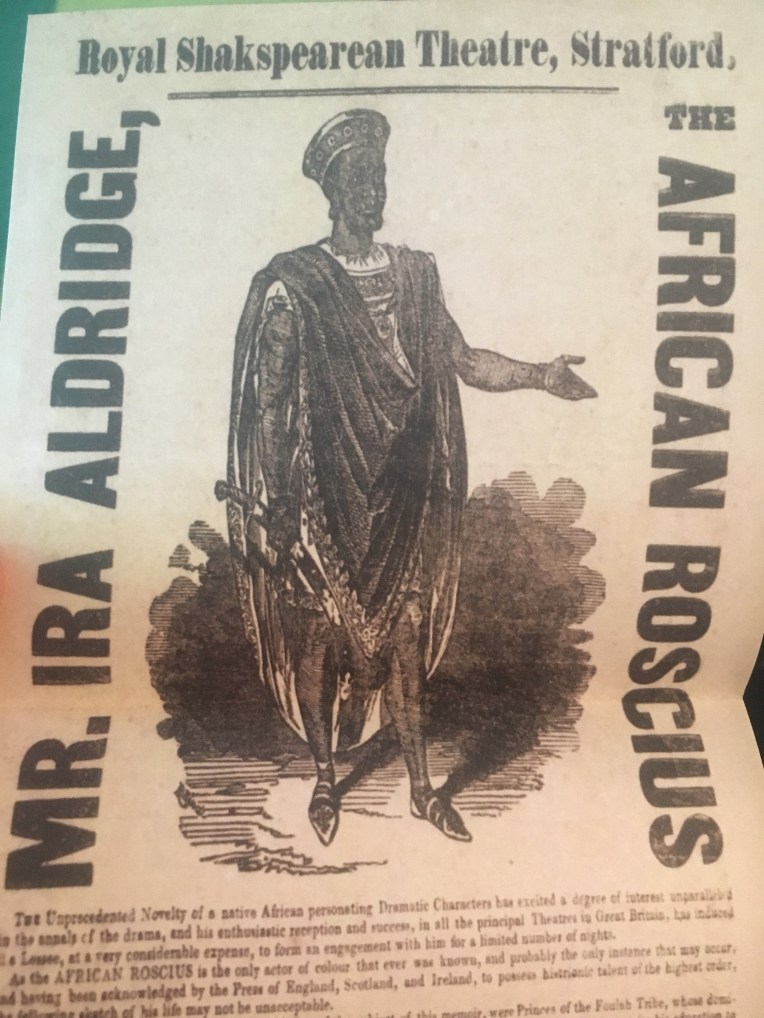
Although there’s a decent argument that Othello isn’t a racist play, it’s production history has been harrowed with racism. For 250 years the role wasn’t even played by black actors. Even on film, the first black man to play Othello was Laurence Fishburne in 1995.

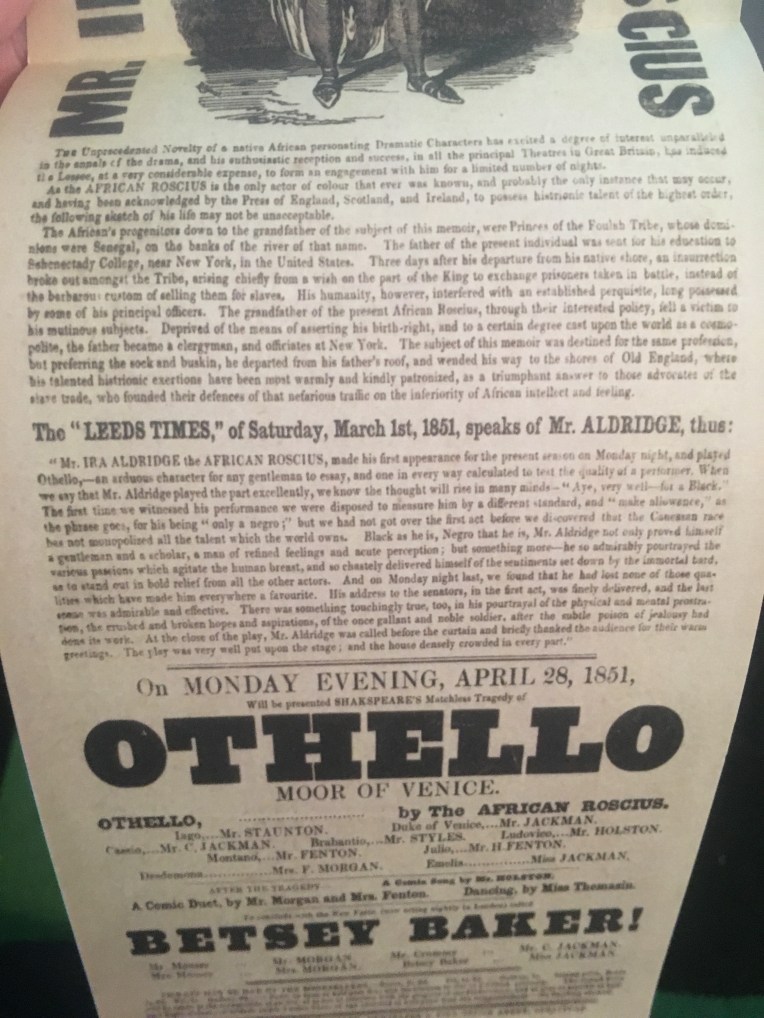
Going further back, the first genuine black actor to play Othello was Ira Adrige, an African American who moved to England in the mid 1800s. Above is a copy of the playbill for his celebrated touring performance of Othello in 1851, which inspired very powerful and polarized reactions: https://youtu.be/92Z-4eJj7Wo

Audiences have had incredibly powerful reactions to seeing real black actors in the role. Some have expressed disgust and racist hatred, (especially in the scenes with Desdemona), some have expressed praise, sometimes they have ignored the race issues entirely. Reportedly Joseph Stalin loved the play and participated enjoyed Othello’s strength and stoicism (Wood 254). Ultimately the context of a production often determines more of the audience reaction than the actors’ performances.

To end where I began, I’m well aware that it’s impossible to truly tell whether Shakespeare was racist, and it’s equally futile trying to pin down what he was saying about race when he wrote the part of Othello, but it is worth considering how the part is connected to changing views of race and racial relations. Ultimately it is up to the actors and director to decide whether Othello is a good man, a racist stereotype, or anything else. That is the beauty of Shakespeare’s complicated and compelling characters, they can translate beyond time, and maybe even race.

For an excellent discussion of this complex topic, click the link below: https://youtu.be/puMpPNtYxuw

: https://youtu.be/puMpPNtYxuw

◦ Sources:

Books:
TV:Shakespeare Uncovered: Othello
Magazines:

BBC News: Britain’s first black community in Elizabethan London. http://www.bbc.com/news/magazine-18903391

Web:

http://www.blackpast.org/perspectives/black-presence-pre-20th-century-europe-hidden-history

http://www.history.ac.uk/reviews/review/619

https://allpoetry.com/The-Dark-Lady-Sonnets-(127—154)

http://www.telegraph.co.uk/culture/theatre/william-shakespeare/9758184/Has-Shakespeares-dark-lady-finally-been-revealed.html

http://www.peterbassano.com/shakespeare

https://www.matthieuchapman.com/scholarship

Trump Family Attacks Shakespeare- Julius Caesar Protest

Donald Trump Jr tweeted two questions after the Julius Caesar play protest I posted over the weekend:

“When does art become political speech, and does it change things?”

I would like to try to answer these questions and by doing so, see if I can explain this fascinating moment in Shakespearean performance history.

Though this production raised new questions about art, and has raised passion from many people, it is not as radical as the protesters might think. Here is a list of historical points of reference to show you the many similarities between this protest and others throughout the history of Shakespearean performance:
1. This is not the first time a Shakespeare play has been seen as a spur to violence: In February of 1601, The Earl of Essex commissioned Shakespeare’s company to perform a scene of the deposing and killing of King Richard the Second one day before he attempted to overthrow queen Elizabeth, and make himself head of the English government.

Deposition by Augustine Phillips (one of Shakespeare’s actors), pleading that his company was innocent of treason.

Shakespeare’s company was exonerated, but Essex himself was tried convicted, and executed for high treason.

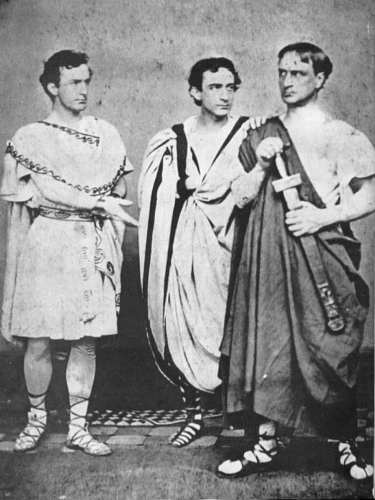
Similarly, when John Wilkes Booth assassinated President Lincoln in 1865, he had previously performed in Julius Caesar, and reportedly complained, (while on the run from the law), that “I am being hunted for what Brutus did so freely”

Source: New York Times Review. Now in both cases it is worth noting that Shakespeare’s play was not responsible for the death of a political figure, it was the people who interpreted his work that bear the responsibility themselves.

2. This play is also not the first time a director has portrayed Caesar as a contemporary president-

An Obama-like Caesar is murdered in The Acting Company’s 2012 production of “Caesar”

As many people have pointed out, in 2012 The Acting Company put on a production of Caesar with an Obama-esque version of the title character. No protests came from the left or right, though Caesar died in the exact same way- bloodily stabbed onstage. I would argue that these shows demonstrate that portraying Caesar as a contemporary figure does not itself incite violence. The audience knows that the figure of Caesar is simply meant as a link between Shakespeare and contemporary politics. This is how the director Oskar Eustis of the Shakespeare in the Park production defended himself against criticism of his staging: https://www.google.com/amp/s/mobile.nytimes.com/2017/06/13/theater/donald-trump-julius-caesar-oskar-eustis.amp.html

I frankly also find the disproportionate reaction to these two Caesars rather insulting. When Obama was in office, he got plenty of negative criticism that sometimes extended to threats of violence. If you click here you can see a threat by country music singer Ted Nugent who threatens to shoot the president with a machine gun. The double standard that threatening a president on the left has no consequences, but threatening a Republican president is worthy of scorn, derision, and its backers pulling their support, deeply hypocritical.

3. Thirdly, this is not the first time a Shakespeare play has depicted Trump negatively. If you look at the comments of my Trump villain post, a director mentioned his production of Henry the Sixth Part Two, in which an actor portrayed the character Jack Cade as Trump. Like Caesar, Cade also murdered in the course of the play. Clearly, portraying Donald Trump as a Shakespearean character is not what is unique here.

4. Though it is certainly true that the play depicts violence and the overthrow of a regime, it doesn’t endorse violence, and is not intended to glorify the murder of a president or even a demagogue like Caesar. As I will later discuss, this play can’t be an endorsement of violence, since everyone who commits violence is duly punished.

So why has this particular production, that uses a Caesar that resembles this president, gotten such a big reaction? Part of the issue admittedly is the timing. The protest specifically mentions the attempted murder of a GOP senator, which happened last week. It is only natural that, given this recent threat of violence, some would fear that this production might incite others to violence. Yet, as I said before, a thorough analysis of the play shows that it does not condone violence against a political leader.

Additionally, given today’s divisive political environment, it is understandable why an audience of right wing protesters might be concerned about this scene in which Caesar is murdered on stage. They may vey well think the play is wish fulfillment for those on the left, who might enjoy watching the bloody assassination of someone who is vey unpopular right now. However, let me emphatically point out that first of all, no one on the left has endorsed violence against Trump. If you look at the backlash to Kathy Griffin’s picture of herself holding a bloody makeshift Trump head, you can see that no one left or right has endorsed support for such a treasonous un-American act. Secondly, with regards to Caesar, the play’s message is actually nonviolent. When Brutus and Cassius kill Caesar, it starts a violent uprising that leads to anarchy, precisely the outcome the two Roman senators hoped to avoid. Seeing their designs fail would certainly discourage anyone attempting violence against a sitting authority figure.

Perhaps the best way I can prove this point is to remind everyone that Shakespeare himself lived in a monarchy. His theatre was strictly controlled by the government. If anyone in 1599 believed that Julius Caesar seemed to support the killing of queen Elizabeth, the play would have been burned and Shakespeare and his whole company would have been arrested and hanged.

https://youtu.be/Y7BtKlGGFKs

Also, people have criticized the murder of Caesar as “too realistic,” again believing that the gore is intended to glorify violence. In reality the violence of the murder is intended to incite revulsion and disgust. Look at Mark Antony’s reaction when he shows Caesar’s body to the crowd. https://youtu.be/tRceRJAz6_Q

I frankly think that the main reason why this production is getting bad press is because it’s a portrayal of President Trump, not Obama, not the historical Caesar, not Hitler, not even Trump before he was president, but the current president, that a group of people elected, and who believe that he supports their values.

I believe that the main reason Trump’s supporters are angry at this production is they feel an attack on him is an attack on them. The president’s supporters have shown repeatedly that they are willing to overlook almost anything to show their support of him. I imagine that they have no desire to see him as an autocrat and dictator, let alone entertain the notion that he might ever be taken down by his opponents.

The irony is that the real Caesar was a man of the people who died because his opponents thought he was an autocrat. The real Caesar helped create the modern calendar, gave money to the entire city, and according to Marc Antony, “When the poor hath cried, Caesar hath wept.” Trump is the exact opposite; he is a self-centered con artist who pretends to be a man of the people. As I predicted, after his inauguration, he has vowed to cut taxes on businesses like his own, put his family in positions of power, used diplomatic meetings and press conferences to sell his products, and obstructed justice when his FBI director tried to investigate him. With this in mind, it seems bizarre to claim that this production is designed to ridicule the right, since Trump is neither Julius Caesar, nor is he an embodiment of the political right. He only stands for his own interests. Therefore an attack on Trump is not an attack on conservative values.

So to go back to the beginning point, “When does art become political speech?” I would argue art always becomes political when it comments about our world, and this quality of art is essential for our society to function. We need a healthy dose of satire and critical thinking, and art can provide it to us. However, there is a difference between disagreeing with a play and openly shunning it onstage.

To address Mr. Trump’s second question, art doesn’t change things, people change things, so we need to temper our reactions, especially to art pieces like Julius Caesar. Remember, Caesar only died because people said he wanted to be king. Cinna the poet died because the mob said he should. This play warns us all to be careful and remain critical thinkers, or mob rule will result.

References

What depicting Julius Caesar as Donald Trump really means – CBS News

https://www.google.com/amp/s/www.theatlantic.com/amp/article/530037/

https://www.google.com/amp/s/mobile.nytimes.com/2017/06/12/theater/julius-caesar-shakespeare-donald-trump.amp.html

https://apple.news/AW6FmlDY3TEe4C97AG7UI4Q

Ted Nugent once said Obama should ‘suck on my machine gun.’ Now he wants to tone down ‘hateful rhetoric.’ – The Washington Post

View at Medium.com

https://apple.news/AE9eeH-L6TxeY1qJwq4Ur8w

Shakespeare’s Perfect Halloween Play

With just a few days left until Halloween, many of us will be anxious to put the candy bowl away, dim the lights, and watch a scary movie. I’d like to recommend my pic for the single best Shakespeare play for Halloween, and you might be surprised to learn which one it is:

It’s not Macbeth, despite its ghosts and witches, it’s not Hamlet, though it has a famous scene in a graveyard. In my opinion, the scariest, most horrific, most disturbing Shakespearean play is the ancient Roman revenge tragedy Titus Andronicus!

Titus Who?

Titus is the most violent, most outrageous play in the Shakespearean cannon and features murder, mutilation, cannibalism, (and even featured the first recorded trick or treating). It was also his first tragedy ever, written around 1590. Back in this period, Shakespeare’s theater was also the site of public executions and blood sports like Bear-baiting, so Shakespeare knew that gore sells. He also knew that people were reading the bloody tragedies of the Roman poet Seneca, so he created a play that out-does the Roman master of bloody violence!

So why have you not heard of it?

  • Too violent for school For most people, their first encounters with Shakespeare is in the classroom, and because of the violence in this play it’s definitely not appropriate for high school. The most famous atrocity in the play happens to Titus’ daughter, who is raped offstage. Then, to keep her from incriminating the men who raped her, the rapists cut off her hands and cut out her tongue. Quite a departure from the “Honey tongued” Shakespeare we see in the comedies and sonnets.
  • It’s vulgar: T.S. Eliot declared that Titus Andronicus is “one of the stupidest and most uninspired plays ever written.” For people who expect Shakespeare to be poetic and romantic, this play is a sad dissapointment.
  • It’s Over the top- People don’t just die in this play, they get butchered horror movie style! Some get stabbed and thrown in a pit, some get their limbs chopped off, one character is buried alive! Many scholars say that after one atrocity after another, the only way you can react to the horror onstage is to laugh. Look at this scene where the villain of the play, Aaron the Moor, confesses to a laundry list of hideous atrocities which he did just for the pleasure of being evil:

Scholars often compare the dark comedy of Titus to the films of Quentin Tarantino, who will murder his characters in grotesque, but funny ways. I won’t even give away the surprise ending where Titus and his daughter gets their revenge, but let’s just say that they would certainly agree with Tarantino that revenge is a dish, best served cold!

  • It might be racist As I mentioned in the clip above, the main villain of the play is a black man. Aaron, like Richard III is completely evil and unapologetic about it.  When I was studying Shakespeare in college, James Earl Jones, (Darth Vader himself) came to my school to talk about Shakespeare’s racially diverse characters. He argued though that nobody treats Aaron any differently until they learn about his heinous crimes and that the person who seems to hate Aaron’s blackness the most is himself. Look at this passage and see if you agree:

AARON

I go, Andronicus: and for thy hand

Look by and by to have thy sons with thee.
Aside Their heads, I mean.

O, how this villany
Doth fat me with the very thoughts of it!
Let fools do good, and fair men call for grace.
Aaron will have his soul black like his face (Titus, Act III, Scene 1).

Now the question to ask about Aaron and most of Shakespeare’s villains, is are they bad because they’re different (different race, differently abled, illegitimate birth), or did they become bad from people treating them badly?

Serious note– Even though productions often dramatize the violence and rape in Titus as over-the-top black comedy, this kind of rape and violence happens in real life, every day, particularly violence against women like Lavinia. One reason why this play is gaining popularity is sadly, that this kind of violence is more common in our current society with the shocking number of rapes committed in this country (1 in 5 women, according to the National Sexual Violence Resource Center), and the brutal murders in this play suggest many real-life atrocities such as Abu ghraib,

Plot summary and more at Schmoop.com

More at http://www.gradesaver.com/titus-andronicus/study-guide/summary

Review of Julie Taymor’s Titus

If you can’t get to the theater this Halloween and want to watch a production of Titus, you’re in luck: In 1999, Julie Taymor, famed director of the Broadway production of The Lion King, directed a film adaptation of Titus which I consider the single greatest Shakespearean film of all time. The movie captures the grotesque comedy of the play, while also visually showing the beauty of Shakespeare’s poetry. It also doesn’t get hung up on historical accuracy just because the play is set in Rome. Best of all, the cast in incredible: Anthony Hopkins, Jessica Langue, Alan Cumming, Harry Lennox and more. This cast knows how to do Shakespeare for the movies and their work shows in every scene. Interesting side note: Hopkins actually considered making this movie the last movie of his career, which explains his amazing glee and energy in the role of Titus. Below is a nice in-depth analysis of the film

Another good review comes from the French Shakespeare Society: https://shakespeare.revues.org/1558

And finally, a review from Roger Ebert: http://www.rogerebert.com/reviews/titus-2000

So that’s my two cents on Titus Andronicus. Happy Halloween everybody!

The Battle Of Bosworth

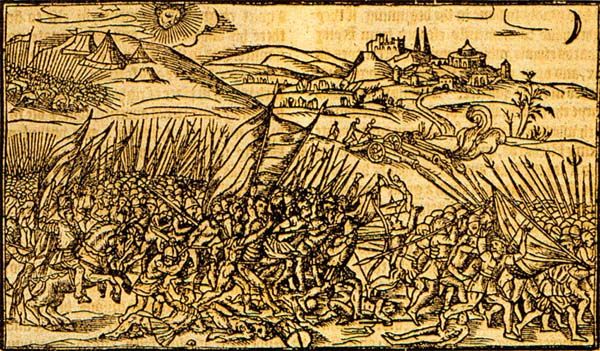
To begin wrapping up our Richard III month, I thought it might be appropriate to speak a little about the battle that ended the real Richard’s life, the Battle of Bosworth Field, August 22, 1485.

What does Shakespeare Say about the battle:

KING RICHARD III

Come, bustle, bustle; caparison my horse.

Call up Lord Stanley, bid him bring his power:
I will lead forth my soldiers to the plain,
And thus my battle shall be ordered:
My foreward shall be drawn out all in length,
Consisting equally of horse and foot;
Our archers shall be placed in the midst
John Duke of Norfolk, Thomas Earl of Surrey, Shall have the leading of this foot and horse. They thus directed, we will follow                    In the main battle, whose puissance on either side Shall be well winged with our chiefest horse. This, and Saint George to boot! 

What think’st thou, Norfolk?

NORFOLK

A good direction, warlike sovereign. 

Richard III, Act V, Scene iii.
This speech matches very well with what the chronicles mention about the battle. In those days the English archers were more deadly than their cavalry, so Richard probably wanted to pick off as many soldiers as possible with the archers, then mow the rest down with his charge toward Henry.

Contemporary Accounts, (courtesy of the Richard III Society). The most complete, and unbiased account I could find was Polydore Virgil, which is also likely the one from which Shakespeare got his information. You’ll notice that it mentions the long line of foot soldiers and horsemen, and the mention of the Duke of Norfolk commanding one of Richard’s forces.


‘The day after King Richard, well furnished in all things, drew his whole army out of their encampments, and arrayed his battle-line, extended at such a wonderful length, and composed of footmen and horsemen packed together in such a way that the mass of armed men struck terror in the hearts of the distant onlookers. In the front he placed the archers, like a most strong bulwark, appointing as their leader John, duke of Norfolk. To the rear of this long battle-line followed the king himself, with a select force of soldiers.‘Meanwhile … early in the morning [Henry Tudor] commanded his soldiery to set to arms, and at the same time sent to Thomas Stanley, who now approached the place of the fight, midway between the two armies, to come in with his forces, so that the men could be put in formation. He answered that Henry should set his own men in line, while he would be at hand with his army in proper array. Since this reply was given contrary to what was expected, and to what the opportunity of the time and greatness of the cause demanded, Henry became rather anxious and began to lose heart. Nevertheless without delay he arranged his men, from necessity, in this fashion. He drew up a simple battle-line on account of the fewness of his men. In front of the line he placed archers, putting the earl of Oxford in command; to defend it on the right wing he positioned Gilbert Talbot, and on the left wing in truth he placed John Savage. He himself, relying on the aid of Thomas Stanley, followed with one company of horsemen and a few foot-soldiers. For all in all the number of soldiers was scarcely 5,000, not counting the Stanleyites of whom about 3,000 were in the battle under the leadership of William Stanley. The king’s forces were at least twice as many.

‘Thus the battle-line on each side was arrayed. As soon as the two armies came within sight of each other, the soldiers donned their helms and prepared for the battle, waiting for the signal to attack with attentive ears. There was a marsh between them, which Henry deliberately left on his right, to serve his men as a defensive wall. In doing this he simultaneously put the sun behind him. The king, as soon as he saw the enemy advance past the marsh, ordered his men to charge. Suddenly raising a great shout they attacked first with arrows, and their opponents, in no wise holding back from the fight, returned the fire fiercely. When it came to close quarters, however, the dealing was done with swords.‘In the mean time the earl of Oxford, afraid that in the fighting his men would be surrounded by the multitude, gave out the order through the ranks that no soldier should go more than ten feet from the standards. 

Here’s a short infographic I made about the kinds of weapons people used during the Battle Of Bosworth.

When in response to the command all the men massed together and drew back a little from the fray, their opponents, suspecting a trick, took fright and broke off from the fighting for a while. In truth many, who wished the king damned rather than saved, were not reluctant to do so, and for that reason fought less stoutly. Then the earl of Oxford on the one part, with tightly grouped units, attacked the enemy afresh, and the others in the other part pressing together in wedge formation renewed the battle.

Royal Portrait of King Richard III, holding a broken sword.

While the battle thus raged between the front lines in both sectors, Richard learnt, first from spies, that Henry was some way off with a few armed men as his retinue, and then, as the latter drew nearer, recognised him more certainly from his standards. Inflamed with anger, he spurred his horse, and road against him from the other side, beyond the battle line. Henry saw Richard come upon him, and since all hope of safety lay in arms, he eagerly offered himself for this contest. In the first charge Richard killed several men; toppled Henry’s standard, along with the standard-bearer William Brandon; contended with John Cheney, a man of surpassing bravery, who stood in his way, and thrust him to the ground with great force; and made a path for himself through the press of steel.

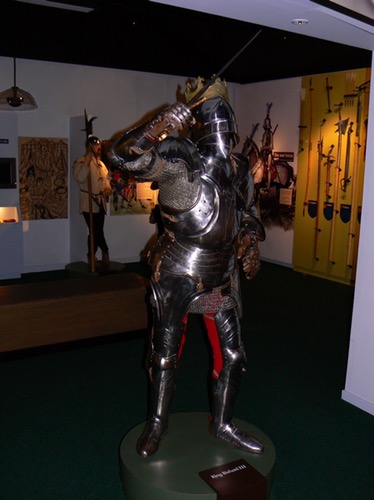
This is a re-construction of the kind of armor Richard might have worn into battle. Notice that the helmet has the crown ontop. Photo reprinted from the Bosworth Field museum

‘Nevertheless Henry held out against the attack longer than his troops, who now almost despaired of victory, had thought likely. Then, behold, William Stanley came in support with 3,000 men. Indeed it was at this point that, with the rest of his men taking to their heels, Richard was slain fighting in the thickest of the press. Meanwhile the earl of Oxford, after a brief struggle, likewise quickly put to flight the remainder of the troops who fought in the front line, a great number of whom were killed in the rout. Yet many more, who supported Richard out of fear and not out of their own will, purposely held off from the battle, and departed unharmed, as men who desired not the safety but the destruction of the prince whom they detested. About 1,000 men were slain, including from the nobility John duke of Norfolk, Walter Lord Ferrers, Robert Brackenbury, Richard Radcliffe and several others. Two days after at Leicester, William Catesby, lawyer, with a few associates, was executed. Among those that took to their heels, Francis Lord Lovell, Humphrey Stafford, with Thomas his brother, and many companions, fled into the sanctuary of St. John which is near Colchester, a town on the Essex coast. There was a huge number of captives, for when Richard was killed, all men threw down their weapons, and freely submitted themselves to Henry’s obedience, which the majority would have done at the outset, if with Richard’s scouts rushing back and forth it had been possible. Amongst them the chief was Henry earl of Northumberland and Thomas earl of Surrey. The latter was put in prison, whree he remained for a long time, the former was received in favour as a friend at heart. Henry lost in the battle scarcely a hundred soldiers, amongst whom one notable was William Brandon, who bore Henry’s battle standard. The battle was fought on the 11th day before the kalends of September, in the year of man’s salvation 1486, and the struggle lasted more than two hours.

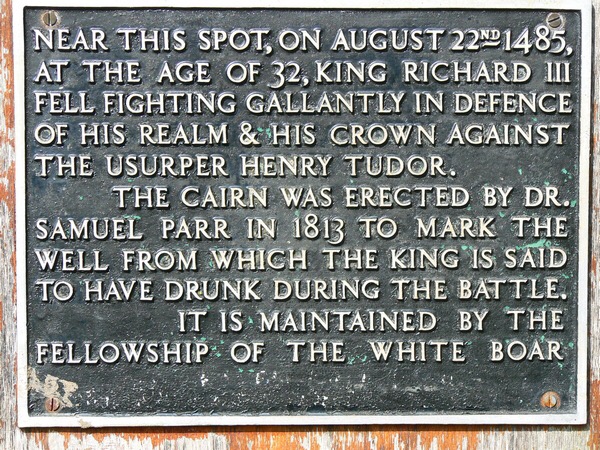
Plaque erected near a small well on Bosworth field, which Richard himself supposedly drank from.


‘The report is that Richard could have saved himself by flight. His companions, seeing from the very outset of the battle that the soldiers were wielding their arms feebly and sluggishly, and that some were secretly deserting, suspected treason, and urged him to flee. When his cause obviously began to falter, they brought him a swift horse. Yet he, who was not unaware that the people hated him, setting aside hope of all future success, allegedly replied, such was the great fierceness and force of his mind, that that very day he would make an end either of war or life. Knowing for certain that that day would either deliver him a pacified realm thenceforward or else take it away forever, he went into the fray wearing the royal crown, so that he might thereby make either a beginning or an end of his reign. Thus the miserable man suddenly had such an end as customarily befalls them that for justice, divine law and virtue substitue wilfulness, impiety and depravity. To be sure, these are far more forcible object-lessons than the voices of men to deter those persons who allow no time to pass free from some wickedness, cruelty, or mischief.


Immediately after gaining victory, Henry gave thanks to Almighty God with many prayers. Then filled with unbelievable happiness, he took himself to the nearest hill, where after he had congratulated his soldiers and ordered them to care for the wounded and bury the slain, he gave eternal thanks to his captains, promising that he would remember their good services. In the mean time the soldiers saluted him as king with a great shout, applauding him with most willing hearts. Seeing this, Thomas Stanley immediately placed Richard’s crown, found among the spoil, on his head, as though he had become king by command of the people, acclaimed in the ancestral manner; and that was the first omen of his felicity.’


-Polydore Virgil, c. 1500. Reprinted from the Richard III Society:

http://www.r3.org/richard-iii/the-battle-of-bosworth/bosworth-contemporary-tudor-accounts/ 
What most people can agree:

  • The battle took place on August 22nd, 1485 in a small field in Leicester.
  • Richard had about 70,000 troops, and Richmond had far fewer, aided mostly by French, Scot, and Welsh mercenaries.
  • Many of Richard’s people like the Earl Of Stanley betrayed him and turned sides.
  • Several sources record Richard wearing the crown in battle, which Henry Tudor immediately seized after he murdered Richard.
  • Richard fought bravely against Richmond, charging alone into combat and refusing to be rescued by his army. One account has Richard say: “This day I will die as king or win.” In another account, a lone Welshman killed the king’s horse, which probably was the origin of the line “A horse, a horse, my kingdom for a horse!”
  • Richard’s body was hacked to pieces, stripped naked, covered with a noose, and displayed at a poor local church for the citizens to mock at for two days. Even contemporary accounts allege that Henry treated his vanquished foe shamefully.
    Infographic of Richard’s post-battle wounds.

    Above- infographic of Richard’s battle wounds, courtesy of Lifescience.com

To conclude, even Shakespeare admits that Richard was a great commander, who lost the battle when his own soldiers betrayed him, and he was piteously murdered by the man who took over the crown from him. It’s a good thing that the real King Richard’s remains were discovered in 2012, and we now know more about the real man in addition to the myth.

RIP Richard.

The Elephant In the Room: The Real Richard III

Before we continue our exploration of Shakespeare’s “Richard the Third,” I would be remiss if I didn’t spend a little time talking a little about the real Richard   Plantagenet, Duke Of Gloucester and king of England from 1483-1485. I have to get this out of the way first and foremost: although “Richard III” is classified as a history play, most of the facts in it are untrue, or severely exaggerated. In this post I will try to separate the character from the man to try and make clear what Shakespeare changed from history and why.

First, a video bio I created:

The facts are these:

-He was a real English monarch who  reigned 1483-1485.

– Richard was the younger brother of King Edward IV, and helped his brother take the crown away from King Henry VI, in a series of battles known as The Wars Of the Roses.

– The battles got their name because Richard’s family (the House Of York), used a white rose as its symbol, while King Henry’s faction used a red rose.

– Like Ned Stark in Game of Thrones, Richard was the undesputed “Warden Of the North,” in charge of crushing a potential Scottish invasion.

– In April of 1483, Richard’s brother King Edward IV died. As Lord Protector of England, Richard was entrusted to take care of the country, and Edward’s two sons (the new heirs to the throne). In late May, Richard arrested three lords on suspicion of treason while he guided the two princes to London. Within one month, the two princes were publicly declared illegitimate by the Archbishop, thus making Richard the new king.

– Sometime during Richard’s two year reign, Edward’s sons disappeared.  Many believe they were murdered and Shakespeare’s sources named James Tyrrell and Michael Forrest as the murderers, acting under King  Richard’s orders. In 1674, the skeletons of two boys believed to be the princes were discovered in the Tower Of London. The remains were interred by King Charles II. So far, nobody has confirmed if the remains belong to the princes or what happened to the young boys.

-Richard was defeated and murdered by Henry Tudor, Earl of Richmond at the Battle Of Bosworth Field on August 22, 1485. His successor founded the House Of Tudor which included Henry VIII, Mary I, Edward VI, and Queen Elizabeth I.

-in 2015, historian Phillipa Langley discovered King Richard’s remains in a parking lot in Leicester

Few contemporary sources survive from Richard’s day, so it’s unknown whether Richard did kill the princes. Even more mysterious, although he did work to depose a king, oppress the Scots, and take the throne from Edward’s kids, some sources claim Richard was actually a just and good king. In the lack of facts, Richard’s legend continues to grow

Reality check

-After finding his skeleton, scientists discovered that Richard was not deformed, although he did have scoliosis. Thomas Moore added the hump, while Shakespeare added the withered arm.

– There is no physical evidence that Richard killed the two princes, and many others wanted them dead, including Henry Tudor himself!

-Richard also probably was a good king according to some contemporary accounts, as you can see in this video with Monty Python’s Terry Jones:

Why were the facts twisted?


– Remember, Richard was defeated by Henry Tudor, Queen Elizabeth’s grandfather, so there was no way Shakespeare or anyone else in Elizabethan England could get away with portraying him as a good king.

– Shakespeare’s main source was a history by Sir Thomas More, who was 12 at the time of Richard’s reign. More was Henry VIII’s royal chancellor, so he couldn’t afford to be nice to Richard either. More’s history set the groundwork for Shakespeare’s portrayal of Richard as a deformed monster.

The point is, people have known for centuries that Shakespeare’s Richard is no more true than the myth of Robin Hood. Even Laurence Olivier admits before his film even starts that this story has been “scorned in proof thousands of times.” Nevertheless, like Robin Hood, this story is part of the fabric of English society, and it still has value as a cautionary tale about corrupt governments, and how one man may lose his soul (and a horse) in pursuit of power and revenge.

Even today, people continue to gain power by manipulating fear, hatred, and religion, which is why we as a society need Shakespeare’s Richard. The play is so universal it was re interpreted in 2007 as “Richard III: an Arab tragedy.” Shakespeare’s Richard is so close to today’s dirty politicians that we have TV shows on both sides of the Atlantic inspired by him, (more on that later). And Richard himself is so compelling a character that centuries of great actors, cartoon characters, and even occasional rock stars have wanted to emulate him.
The lesson of the story is that a single demagogue can gain control of a corrupt system if we let him. Hitler, Saddam, Trump. It’s no accident that Olivier chose to play Richard right as the war was ending in Europe, and his popularity in that role rose exponentially after post war Britain saw the parallels between the “honey words” of Richard, which captivated England, to Hitler’s fiery rhetoric, which nearly destroyed it. The larger point through all four plays of Shakespeare’s history cycle, (not just “Richard III,”) is that greed and cruelty within one family can lead to chaos on a large scale, especially when it’s the royal family.

For more information:

Books:

  • The Daughter Of Time by Josephine Tey, 1951: This is the most famous book that sets down the case that Richard’s reign was maligned by history. In addition to having excellent research, it is also a compelling novel.
  • Shakespeare’s English Kings by Peter Saccio. To help students of Shakespeare separate fact from fiction, and get a sense of the lives of the men whose lives shaped Shakespeare’s history plays, Professor Saccio of Dartmouth College created a short, easy to read biography of all 10 of Shakespeare’s monarchs.

Websites:

The Richard III SocietyOfficial website of the society dedicated to preserving the memory of Richard III.

 Historic UK: Short biographies of English Monarchs

Leicester Cathedral’s Richard III Page: http://kingrichardinleicester.com See pictures and read about Richard’s final resting place, and how his remains were found, and re-interred.

Westminster Abbey- The tomb of most English kings and queens for over 1,000 years:

http://www.westminster-abbey.org/our-history/royals?start_rank=1 

Intro to Richard III

Hi everyone,

Introducing our new Play of the Month: Shakespeare’s dark history play about murder and corruption, Richard III. First, a short presentation I made that introduces the characters and themes of the play.


Second, a quick, funny summary of the play from the Reduced Shakespeare Company


And finally, this incredible animated version of the play, which looks like a stained-glass window come to life!

The Duelling Scene in Twelfth Night 

Here’s an article I origionally wrote for the Shakespeare Birthplace Trust about the famous and famously funny scene in Twelfth Night, where Toby tricks Viola in disguise to fight a duel with the cowardly Sir Andrew Aguecheek.

He Cannot By the Duello Avoid It

“He Cannot By the Duello Avoid It!” by Paul Rycik

Hello! To celebrate Shakespeare’s 449th birthday, I’d like to discuss the concept of judicial combat or licensed dueling. Most of Shakespeare’s aristocratic patrons would be intimately familiar with the arts of swordplay. Furthermore, Shakespeare as a trained actor would have studied fighting to accurately replicate it onstage. This is why Shakespeare takes many opportunities to mention dueling culture in his plays, especially within the comedies.

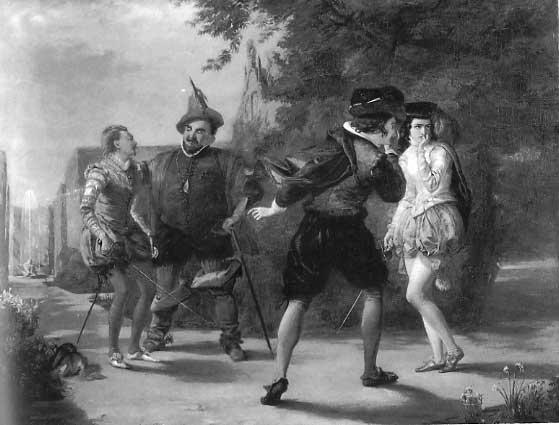
William Powell Frith, The Duel Scene from

Picture Caption: William Powell Frith, The Duel Scene from “Twelfth Night” (1843)

Shakespeare uses duel references to comic effect in plays such as Twelfth Night, in which Sir Toby Belch convinces the cowardly Sir Andrew to fight Viola, a woman disguised as a man. Both combatants are cowards, but according to the law of arms, both of them have to fight, though neither one wants to or knows how: “He cannot by the duello avoid it” Twelfth Night Act III, Scene iv.

A more serious example of duel culture occurs in “Much Ado About Nothing. In Act IV, Scene I, Claudio has accused his fiancée Hero of adultery in front of the whole town, thus dishonoring her. Her cousin Beatrice is so furious with Claudio, she claims that, were she a man “I would eat his heart in the marketplace!” Eventually, Beatrice convinces Claudio’s friend Benedick to challenge Claudio to a duel. This seems harsh at first, but when one considers the context of judicial combat, it becomes clear that Beatrice is actually being totally rational, and wishes Claudio’s death for an important purpose- to vindicate Hero.

Link: Beatrice (Catherine Tate) asks Benedick (David Tennant) to kill Claudio (Wyndham’s Theatre, 2011).

http://www.youtube.com/watch?v=bsG9O6yIpyk

In Elizabethan society, when a woman was accused of adultery, a champion could fight to the death on her behalf in a judicial combat. This is why Beatrice famously asks Benedick to kill Claudio in Act IV; if Benedick kills Claudio in a duel, Claudio’s death would prove by divine influence that he accused her falsely, and Hero would at last be free from shame. However, when she is left alone with Benedick, she is full of conflicting feelings of love for him, which is why at first she hesitates to ask for his help:

Benedick. Surely I do believe your fair cousin is wronged.

Beatrice. Ah, how much might the man deserve of me that would right her!

Benedick Is there no way to show such friendship?

Beatrice. A very even way, but no such friend.

Benedick. May a man do it?

Beatrice. It is a man’s office, but not yours, Much Ado About Nothing, IV.i

In the last line, Beatrice hints at the office of a champion to fight for a dishonored woman. As a nobleman, Benedick may legally challenge Claudio to a duel and vindicate Hero, but Beatrice also knows that she cannot ask him to fight his best friend. Nevertheless, Beatrice wishes someone would fight to repair Hero’s honor, and her pleas eventually convince Benedick to challenge Claudio.

Link: Benedick (David Tennant Challenges Claudio (Wyndham’s Theater, 2011)

http://www.youtube.com/watch?v=M7BaNrt9e04

In our century, the idea of dueling to vindicate a woman from adultery is somewhat lost in translation, but the idea of men standing up for what is right on behalf of a lady is at the heart of chivalry, and certainly speaks to us as strongly now as it did in 1599. Therefore an understanding of the concept behind this duel helps the actors and audience to appreciate the richness of Shakespeare’s characters and their attempts to do the right thing, even through questionable means.

This entry is part of series on duels and judicial combat, which I’m working on for the Blackfriars conference in Staunton Virginia. I look forward to bringing you more posts about the culture of duels and judicial combat, which so pervades the works of Shakespeare.

Bonus video if time: Me (Paul Rycik) performing Much Ado Act IV Scene I at the Blackfriars Playhouse in Staunton: http://www.youtube.com/watch?v=f69j8vIrycA

Below is the full scene Twelfth Night duel scene

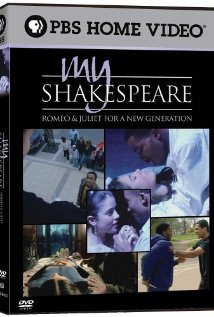
Shakespeare Review: My Shakespeare

On this page, I review a Shakespeare book, movie, or TV show that I feel has some kind of value, either as an interpretation of Shakespeare, or a means to learn more about the man and his writing. This post will introduce you to an incredible documentary, and in my view one of the best ways to encourage, excite, and challenge young people reading Romeo and Juliet Aptly titled, it is called, My Shakespeare.

  1. Name:My Shakespeare
  2. Year: 2004
  3. Director: Michael Waldman
  4. Ages:PG for frank discussions of violence, and occasional suggestive language.
  5. Media:Full length documentary, (available on Amazon and Netflix DVD)
  6. Recommendation: I’d recommend this to high school and college students, as well as all theater teachers and practitioners. A word of caution though- nearly everyone in the documentary speaks with various British accents (from posh London to poor Harlesden), and thus if you think your class might not be able to understand foreign accents, you might want a different version, or put on the subtitles.
  7. Premise: Director Patterson Joseph is a man on a mission- to prove that the people in his home town, (the poor, violence-ridden town of Harlesden England), that these same people can and will put on a production of Romeo and Juliet, in just four weeks. The cast has never acted before, and Patterson sometimes has to drag them kicking and screaming into rehearsals, but eventually they all learn that putting on a Shakespeare play can become an extremely personal experience. In the beginning, they are attempting Shakespeare, but by the end they live it. In between the action, there are interviews with Baz Luhrman, the celebrated director of the Leonardo Dicaprio film version of Romeo and Juliet back in 1996. Baz serves as a sort of chorus, explaining some of the challenges a director like Patterson will inevitably face as he and his actors bring the play to life.
  8. Repeated Ideas That Run Through the Documentary:
    1. You can do this- you can act, you can understand Shakespeare, you can finish something, you can show emotions, and you can direct.
    2. Shakespeare is able to tell stories that appeal to everyone, and here’s the proof.
    3. The best way to understand Shakespeare is to get on your feet and do it.
  9. Moments to watch for: Before I list my favorite moments in the documentary, I’d like to list the theatrical process by which Patterson and his company put on Romeo and Juliet. 
    • The Process Of Creating Romeo and Juliet:
      1. Auditions/ Improv Games (4 weeks to go)
      2. Table Work, where the actors read the script and talk about their characters.
      3. Paraphrasing the script and improv (9 days to go)
      4. Stage combat Rehearsals- prepping the fights.
      5. Opening Scene rehearsal on a basketball court.
      6. Vocal Rehearsal
      7. The Emotion Workshop (8 days to go) The actors try to tap into their own emotions to try and bring some real feelings into their parts.
      8. Death Scene Rehearsal in a Graveyard!
      9. Last minute changes (5 days to go)
      10. Globe theater rehearsal
      11. Nighttime Balcony Scene Rehearsal at the aptly named, “Shakespeare Road.”
      12. Tech Rehearsal at the Royal Academy Of Dramatic Arts.
      13. Speed Through Rehearsal/ The final rehearsal (1 day to go)
      14. Performance at the Royal Academy Of Dramatic Art
    • Now a look at some of my favorite parts of the documentary.
    1. The audition/ casting scene- In this scene you watch the future cast members explore the story of the play through improvisation, then you see their background through a series of headshots and dossiers. The whole cast is more diverse than any West End production: black, white, Christian, Muslim, young people and old people. Patterson’s casting choices alone makes this production fresh and relevant to our shrinking little world. A few cast members are refugees that came to England because of their countries’ own family feuds in Somalia and Afghanistan. Even more striking, Romeo and Juliet are very young- 18 and 22 respectively, which gives their love scenes an amazing truth and honesty. At first they think they have nothing in common with their characters, but in reality they have even more in common than most of us who read Romeo and Juliet.
    2. The table work scene where the cast learns about their characters You see Mustafa as Mercutio learn that Shakespeare can be funny, you see Jonathan as Romeo learn that some of Shakspeare’s words are still used today, and you see Muska just start to flirt with the idea of playing Juliet.
    3. Jonathan’s Story- Unlike most actors who have played Romeo, Jonathan Thomas has been in a real fight, and he describes it in brutal detail, even showing the scars he got from his stab wounds. Hearing his story gives his performance a truth and poignancy that I’ve never seen in any other version.
    4. The Balcony Scene Rehearsals- In this documentary the two leads perform the scene many times, in rehearsal where they talk about how hard it is to play love realistically, in Shakespeare’s Globe, where they see how it was done in Shakespeare’s day, in a modern balcony back in Harlesden, (on the appropriately named “Shakespeare Road,” and at last in the final performance. Few documentaries show just how hard it is to do a Shakespearean scene, particularly if it’s famous, and how many different ways a director and a pair of talented actors can play it and find new things each and every time.
    5. The scene where Patterson lets one of the actors go. Everyone in this production has to overcome obstacles, even the director; when one of his actors fails to perform, he simply has to drop the axe and recast one of his lead roles. Theater is hard work, and just like any job, the director has to take control and do what is necessary to make sure that the production is a success.
    6. Rehearsal at the Globe Theater On one very special day, the actors step onto the stage of the reconstructed Globe, and take a few tentative steps into the 1500s. Once in the space, they take to it like fish to water, playing with the audience, playing with projection, and their lines are infused with a special kind of energy that only arises from the boards of an Elizabethan stage. I found it interesting that when Jonathan was talking to Mark Rylance, the artistic director of the Globe, he asks what kind of man Shakespeare was, because he’s starting to see Shakespeare as a peer!
  1. My reaction: This documentary gives me hope every time I see it. Over and over again Patterson instills in his cast the idea of “Yes, you can,” yes, these people can understand Shakespeare, yes they can learn their lines, yes they can act, yes they can do something intelligent, and moving, and honest, and beautiful and what better play to bring that message across than Romeo and Juliet, which is full of youthful energy and excitement. My only complaint is the interviews with Baz Luhrman don’t really add much to the documentary side of things; Luhrman was really only there for name recognition, and he certainly knows less about Shakespeare than the RSC veteran Patterson. Nevertheless, the whole documentary Is nothing short of inspiring from beginning to end.
  2. Notable cast members
  1. Muska Khpal as Juliet. An 18 year- old Afghan refugee who came to England in 1996, without even speaking English, now playing one of the greatest characters in English literature! Like Juliet herself, Muska has very strict parents (who didn’t approve of her playing the part), and is at first is extremely shy towards Romeo, toward the play, and even the director, but when you hear her talk about her dream to return to Afghanistan and become a doctor, you can sense Juliet’s strength and independence.
  2. Jonathan Taylor 22 year-old Jonathan is a very charismatic and intelligent young man. After this production he became a professional actor. He speaks articulately about the experience of acting for the first time, reading Shakespeare for the first time, and even his own experiences with love and violence on the streets of Harlesden. He is also very talented and speaks the lines with an effortless panache. I found myself rooting for him the whole time, and the fact that I got to see this production spark his interest in acting and then to see him change and grow was truly inspiring.
  3. Mustafa as Mercutio Tiny, sparkle eyed Somali refugee. He is truly Mercurial- he frequently jokes and kids with the cast, yet at the same time, he is deathly serious when he talks about his life in Somalia- seeing people die in front of him. When he dies onstage, you know his performance is drawn from some real world experience.
  1. Grade: 5 Shakespeare globes.

Another Review: Films Media Group – “My Shakespeare: Romeo and Juliet for a New Generation:” http://www.films.com/ecTitleDetail.aspx?TitleID=20674&r=

Interview with the director, Joseph Patterson: http://www.theguardian.com/culture/2012/jul/01/shakespeare-and-me-paterson-joseph-julius-caesar