
New Podcast: “Crafting A Character: Brutus.”



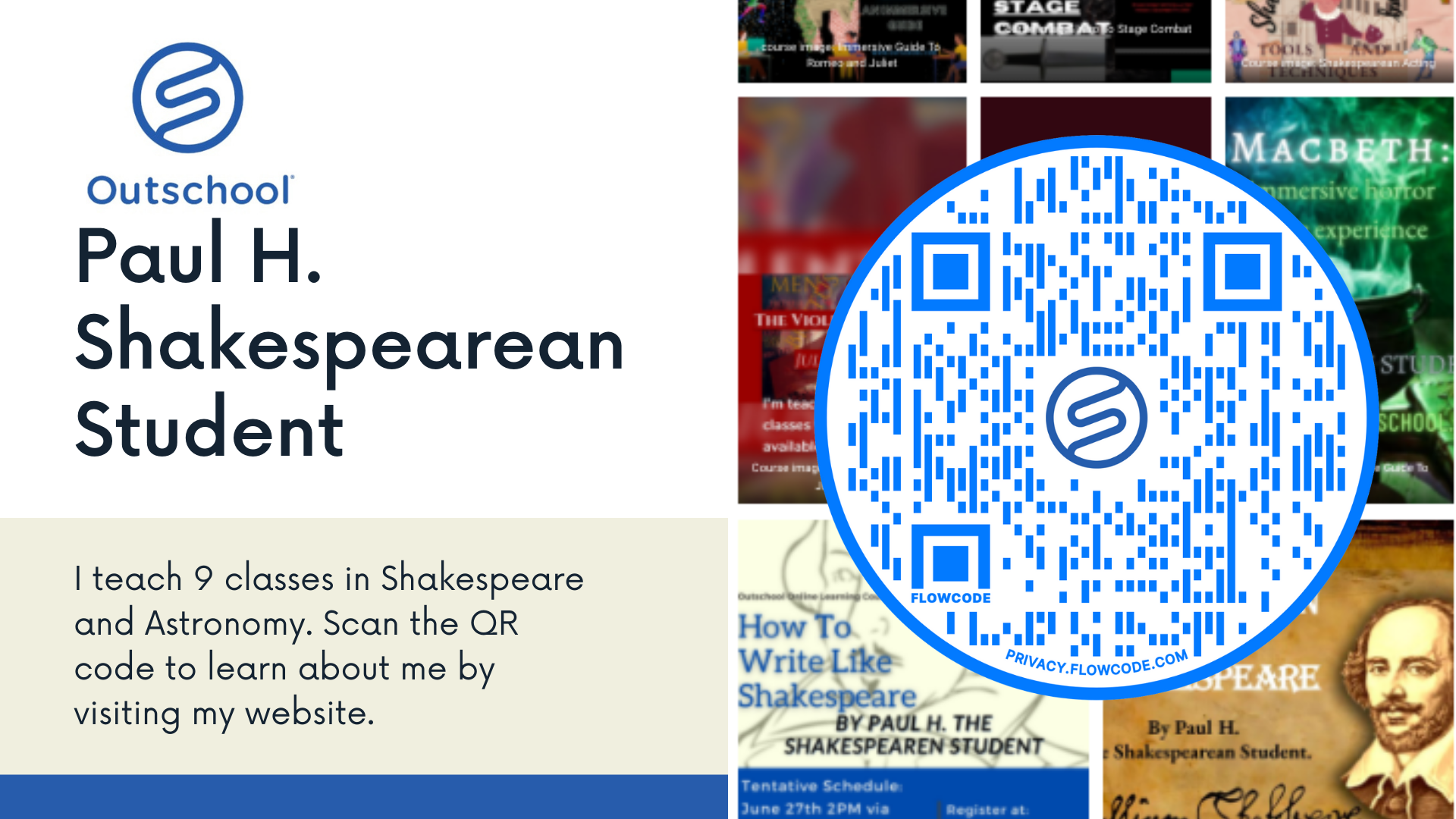
I’m beyond excited that I am able to offer three multiple week courses through Outschool for kids aged 6-12. If you scan the QR code below, you can see class descriptions and individual trailers. You can also check out the “My classes,” Page on this blog. I hope you and your family will join me this summer!


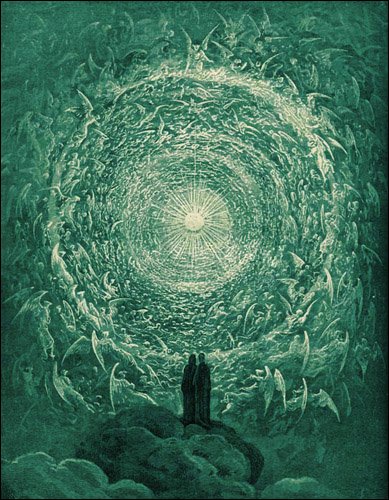


Since Easter and Passover are coming up, (and we are already in the middle of Rhamadan), I thought I’d examine Shakespeare’s depiction of other worlds both celestial and infernal. As the quote above says, philosophers and poets often wonder what greets us in the hereafter, so let me be your guide through Shakespeare’s poetic renderings of heaven and he’ll, accompanied by some gorgeous artwork from HC Selous, William Blake, and others.
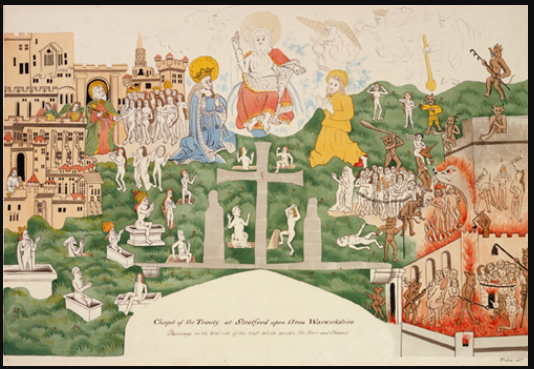
Shakespeare was no doubt interested in religion. He quotes from and alludes to the Bible many times in his plays. More importantly, he lived in a time when the national religion changed three times in just 4 years! When Henry VIII changed England to a protestant country, the religious identity of England completely changed:
This change was not just felt in monasteries, but in all English churches. King Henry decreed that certain Catholic traditions like Purgatory, indulgences, and praying to saints were idolatrous, and were therefore banned in the Church of England. So, when Shakespeare’s father was called to destroy the “idolatrous” images of the Last Judgement in the Guild Chapel of Stratford’s Holy Trinity Church, he had no choice but to comply. If you click on the link below, you can see a detailed description of the images that Shakespeare no doubt knew well in his family’s church, until his father was forced to literally whitewash them.
Like the images on the Stratford Guild chapel, the ideas of Catholic England didn’t disappear, they were merely hidden from view. Shakespeare refers to these Catholic ideas many times in his plays, especially in Hamlet, a play where a young scholar, who goes to the same school as Martin Luther, is wrestling with the idea of whether the ghost he has seen is a real ghost from purgatory, or a demon from hell, (as protestant churches preached in Shakespeare’s life).
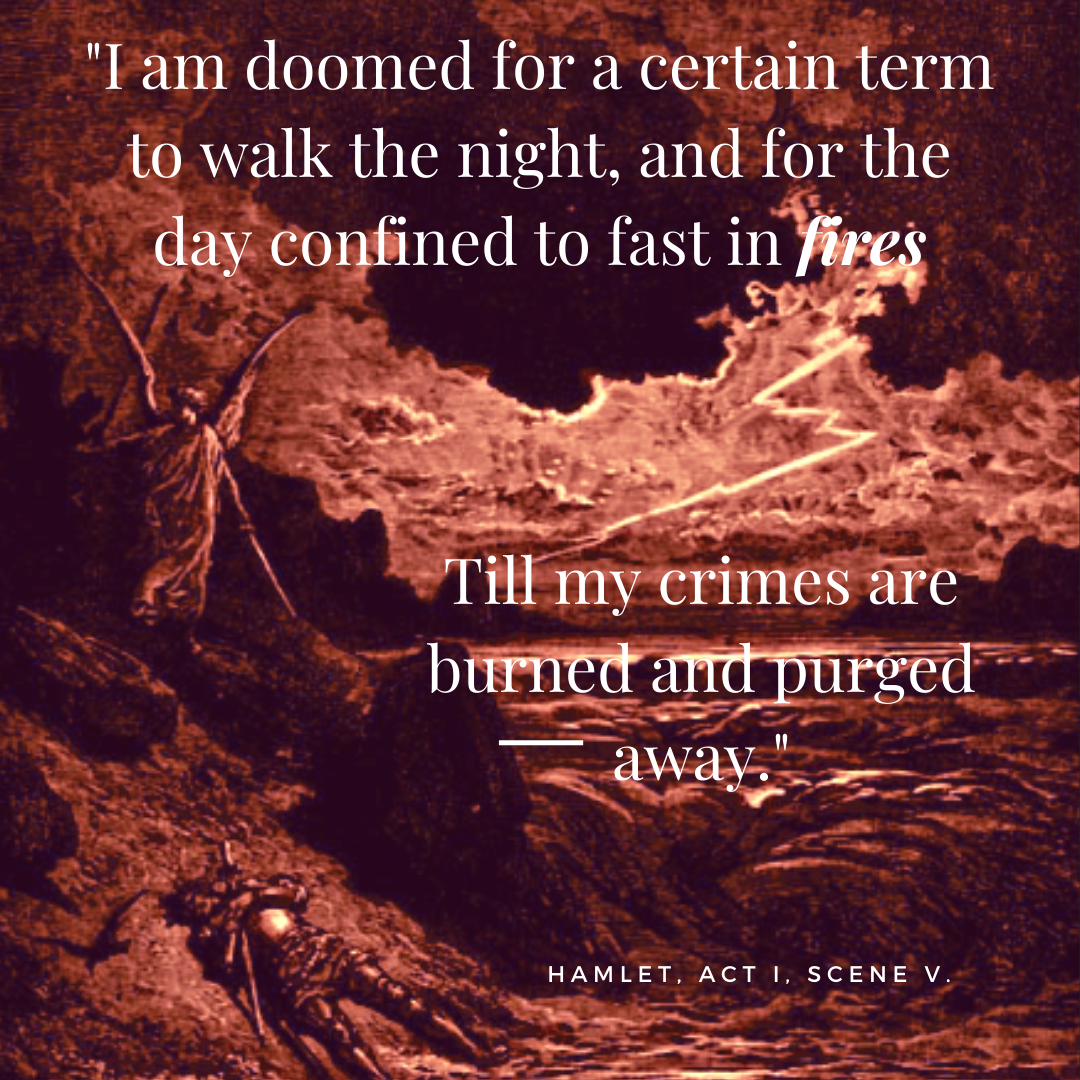
I’ve written before that the ghost of Hamlet’s father teases us with the possibility that he might be a soul in purgatory, the Catholic afterlife realm for those not evil enough for Hell, nor good enough for Heaven. At the height of their powers, monks and bishops sold prayers called indulgences that supposedly allowed a soul’s loved ones to buy them time out of purgatory, thus making them able to ascend to Heaven quicker. The image above is an illustration from Purgatorio, part of Dante’s Divine Comedy, where he visits the soul of
Buonconte da Montefeltro, who is languishing because he doesn’t yet have the strength to get out of purgatory and enter Heaven.
Of course, the Tudor monarchs Henry VIII and Elizabeth I abolished indulgences and proclaimed that purgatory itself didn’t exist, but ideas can’t die, and I feel that Shakespeare was at least inspired by the notion of purgatory, even if he didn’t believe in it himself.

(Horatio) Hamlet, Act I, Scene i.
As a young boy, William Shakespeare was entertained by medieval Mystery plays; amateur theater pieces performed by local artisans that dramatized great stories from the Bible. We know this because he refers to many of the characters in these mystery plays in his own work, especially the villains. King Herod is mentioned in Hamlet and many other plays in and many of Shakespeare’s villains seem to be inspired by the biblical Lucifer, as portrayed in Medieval Mystery Plays.
In this short video of the Yorkshire Mystery play “The Rise and Fall of Lucifer,” we see God (voiced by Sir Patrick Stewart), creating Lucifer as a beautiful angel, who then, dissatisfied with his place in God’s kingdom, is transformed into an ugly devil. At first, Lucifer mourns losing his place in Paradise, but then finds comfort by becomming God’s great antagonist.
Compare this character arc with Shakespeare’s Richard of Gloucester, who also blames his unhappiness on God, (since he feels his disability and deformity are a result of God’s curse). Richard is angry with God, nature, and society, so he wages against them all to become king.
“Then since the heavens hath shaped my body so, let Hell make crook’d my mind to answer it.”
Richard of Gloucester, Henry VI, Part III, Act III, Scene i.

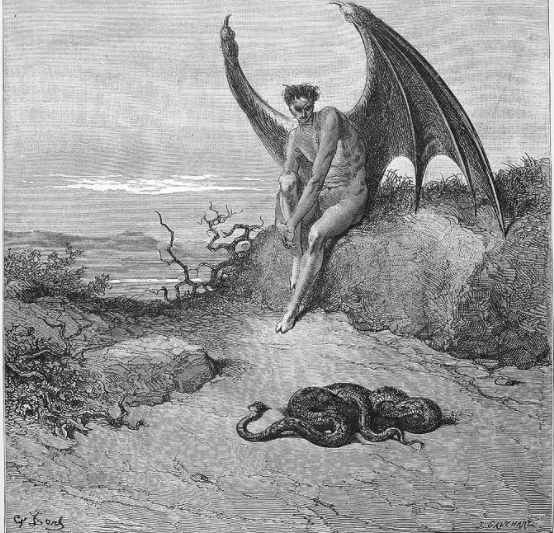
“All is not lost, the unconquerable will, and study of revenge, immortal hate, and the courage never to submit or yield.”
Lucifer― John Milton, Paradise Lost
Claudio. Ay, but to die, and go we know not where;
To lie in cold obstruction and to rot;
This sensible warm motion to become
A kneaded clod; and the delighted spirit
To bathe in fiery floods, or to reside
In thrilling region of thick-ribbed ice;
To be imprison’d in the viewless winds,
And blown with restless violence round about
The pendent world; or to be worse than worst
Of those that lawless and incertain thought Imagine howling: ’tis too horrible!
—Measure For Measure, Act III, Scene i
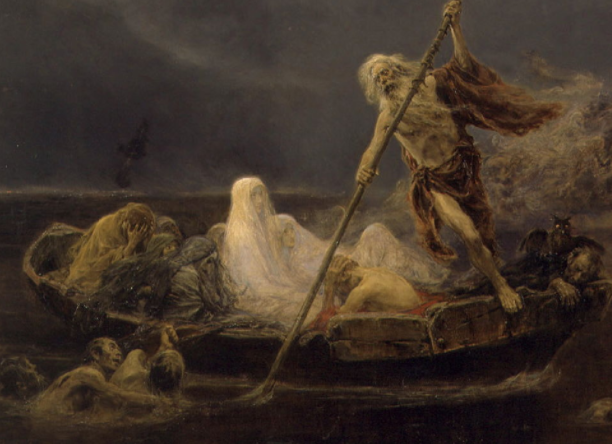
“Methought I crossed the meloncholy flood with that grim ferryman the poets write of, into the kingdom of perpetual night.”
— Richard III, Act I, Scene iv.

The heavens themselves, the planets and this centre
Observe degree, priority and place,
Insisture, course, proportion, season, form,
Office and custom, in all line of order;
And therefore is the glorious planet Sol
In noble eminence enthroned and sphered
Amidst the other; whose medicinable eye
Corrects the ill aspects of planets evil,
And posts, like the commandment of a king,
Sans cheque to good and bad: but when the planets
In evil mixture to disorder wander,
What plagues and what portents! what mutiny!
What raging of the sea! shaking of earth! Commotion in the winds! frights, changes, horrors,
Divert and crack, rend and deracinate
The unity and married calm of states
Quite from their fixure! O, when degree is shaked,
Which is the ladder to all high designs,
Then enterprise is sick!      - Troilus and Cressida, Act I, Scene iii.
https://folgerpedia.folger.edu/Idolatry:_Icons_and_Iconoclasm

I’m teaching a number of clases on poetry this National Poetry Month, and I wanted to make suggestion if you want to woo a sweetheart this poetry month but don’t know where to start. So here are some resources for you you use, and some links to some of my own work on the subject:
This website is very good at helping you organize your writing into small blocks, webs, charts, etc. This is really useful when you’re creating sonnets because it helps you set up your argument. You can even add pictures to think about the images you’re going to use in your poem!.

A MUST for any poet. This website allows you to find rhymes for any word.
https://www.poem-generator.org.uk/
This website is very fun and useful for teachers and students. You plug in various adjectives, verbs, and nouns and it does the rest. The sonnets aren’t great, but you do get a clear idea of how sonnets work, and that makes it very useful for students.

One of the best pieces of advice I can give to an aspiring poet is to read other poets and learn what you like. The Folger has a yearly competition of student sonnets which you can read on their website, and lots of handouts and info that teaches you about sonnet form, so check it out!
https://www.folger.edu/shakespeare-birthday-party-at-home/write-a-sonnet
If you want some one-on-one help with writing Elizabethan poetry, consider signing up for my online classes! I teach 2 classes on writing poetry and literary devices:
This class is a live brainstorming session where I’ll teach you to use the resources I’ve listed above to craft an Elizabethan sonnet of your very own! We’ll also discuss some of Shakespeare’s own sonnets, and the enduring mystery of the Dark Lady and the Fair Young Man.

https://outschool.com/classes/d9a6c17e-7ec2-4839-8337-152da6beaeb7/schedule#usMaRDyJ13
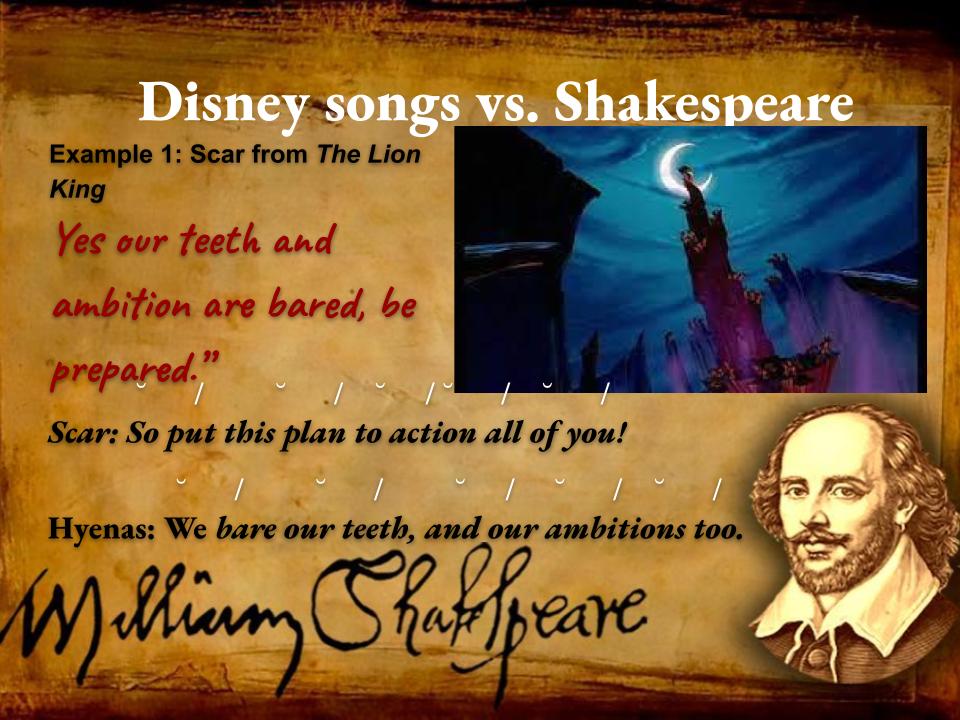
This class is a general intro to Shakespeare’s writing. I discuss the structure of his plays and poems, and I play a fun game where I rewrite some very famous lines in iambic pentameter:
So thanks for reading this list! I hope this helps you out, and if you do consider signing up for my class, I’m offering a special discount for the Love Poetry course: Get $5 off my class “Love Poetry- Shakespeare Style!” with coupon code HTHESVFDPO5 until May 5, 2022. Get started at https://outschool.com/classes/love-poetry-shakespeare-style-k8lL9yLK and enter the coupon code at checkout.
Let thy verse flow like a river, ye merry balladiers!

I just got approved by Outschool.com to teach a multi-week course on Shakespeare’s comedies!
Get $10 off my class “Shakespeare’s Comic Plays” with coupon code HTHESEJEL310 until May 1, 2022. Get started at https://outschool.com/classes/shakespeares-comic-plays-868BR5hg and enter the coupon code at checkout.






However, the Romans gave way before the good fortune of the man and accepted the bit, and regarding the monarchy as a respite from the evils of the civil wars, they appointed him dictator for life. This was confessedly a tyranny, since the monarchy, besides the element of irresponsibility, now took on that of permanence


Under these circumstances the multitude turned their thoughts towards Marcus Brutus, who was thought to be a descendant of the elder Brutus on his father’s side, on his mother’s side belonged to the Servilii, another illustrious house, and was a son-in‑law and nephew of Cato. 2 The desires which Brutus felt to attempt of his own accord the abolition of the monarchy were blunted by the favours and honours that he had received from Caesar. 3 For not only had his life been spared at Pharsalus after Pompey’s flight, and the lives of many of his friends at his entreaty, but also he had great credit with Caesar. 4 He had received the most honourable of the praetorships for the current year, and was to be consul three years later, having been preferred to Cassius, who was a rival candidate. 5 For Caesar, as we are told, said that Cassius urged the juster claims to the office, but that for his own part he could not pass Brutus by.105 6 Once, too, when certain persons were actually accusing Brutus to him, the conspiracy being already on foot, Caesar would not heed them, but laying his hand upon his body said to the accusers: “Brutus will wait for this shrivelled skin,”106 implying that Brutus was worthy to rule because of his virtue, but that for the sake of ruling he would not become a thankless villain. 7 Those, however, who p589 were eager for the change, and fixed their eyes on Brutus alone, or on him first, did not venture to talk with him directly, but by night they covered his praetorial tribune and chair with writings, most of which were of this sort: “Thou art asleep, Brutus,” or, “Thou art not Brutus.”107 8 When Cassius perceived that the ambition of Brutus was somewhat stirred by these things, he was more urgent with him than before, and pricked him on, having himself also some private grounds for hating Caesar;

So far, perhaps, these things may have happened of their own accord; the place, however, which was the scene of that struggle and murder, and in which the senate was then assembled, since it contained a statue of Pompey and had been dedicated by Pompey as an additional ornament to his p597 theatre, made it wholly clear that it was the work of some heavenly power which was calling and guiding the action thither.

Well, then, Antony, who was a friend of Caesar’s and a robust man, was detained outside by Brutus Albinus,110 who purposely engaged him in a lengthy conversation; 5 but Caesar went in, and the senate rose in his honour. Some of the partisans of Brutus took their places round the back of Caesar’s chair, while others went to meet him, as though they would support the petition which Tulliusº Cimber presented to Caesar in behalf of his exiled brother, and they joined their entreaties to his and accompanied Caesar up to his chair. 6 But when, after taking his seat, Caesar continued to repulse their petitions, and, as they pressed upon him with greater importunity, began to show anger towards one and another of them, Tullius seized his toga with both hands and pulled it down from his neck. This was the signal for the assault. 7 It was Casca who gave him the first blow with his dagger, in the neck, not a mortal wound, nor even a deep one, for which he was too much confused, as was natural at the beginning of a deed of great daring; so that Caesar turned about, grasped the knife, and held it fast. p599 8 At almost the same instant both cried out, the smitten man in Latin: “Accursed Casca, what does thou?” and the smiter, in Greek, to his brother: “Brother, help!”

9 So the affair began, and those who were not privy to the plot were filled with consternation and horror at what was going on; they dared not fly, nor go to Caesar’s help, nay, nor even utter a word. 10 But those who had prepared themselves for the murder bared each of them his dagger, and Caesar, hemmed in on all sides, whichever way he turned confronting blows of weapons aimed at his face and eyes, driven hither and thither like a wild beast, was entangled in the hands of all; 11 for all had to take part in the sacrifice and taste of the slaughter. Therefore Brutus also gave him one blow in the groin. 12 And it is said by some writers that although Caesar defended himself against the rest and darted this way and that and cried aloud, when he saw that Brutus had drawn his dagger, he pulled his toga down over his head and sank, either by chance or because pushed there by his murderers, against the pedestal on which the statue of Pompey stood. 13
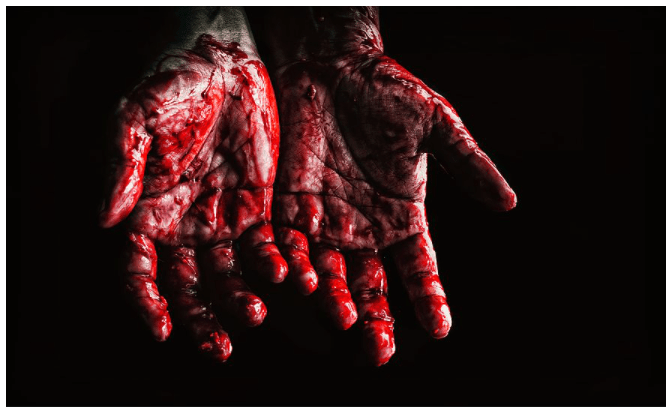
And the pedestal was drenched with his blood, so that one might have thought that Pompey himself was presiding over this vengeance upon his enemy, who now lay prostrate at his feet, quivering from a multitude of wounds. 14 For it is said that he received twenty-three; and many of the conspirators were wounded by one another, as they struggled to plant all those blows in one body.
-Plutarch’s Life Of Caesar


James Shapiro in his book 1599, addresses the common complaint that in the play that bears his name, Julius Caesar dies halfway through the play and has little time onstage to make a connection with the audience. The play is about tyrananicide, what causes it, what it looks like, and especially its aftermath. In a time when Jesuits and Catholic radicals threatened to assassinate Queen Elizabeth, Shakespeare wrote a powerful story about how fragile government systems can be; how striking the head off Rome leads to anarchy and sometimes tyranny.
 The Shakespearean Student