New Outschool Class: Shakespeare- The Lost Play

This is an interactive game that teaches the craft of Shakespeare’s writing and stagecraft in the form of an Elizabethan escape room. You must find the lost play of William Shakespeare before a mystery thief destroys it! Solve the clues and learn about Shakespeare’s writing and theater to uncover a historical mystery!

Course Description

In this fully online, fully interactive game, you play as a member of Shakespeare’s company. You’ve just discovered that someone has stolen Shakespeare’s new play “Love’s Labors Won,” and you need to find it before the show tonight! In the course of the game, you search the Globe Theater and Shakespeare’s study. Then a mysterious note reveals that someone has stolen the play! You must figure out who it is, and find the play before the thief burns it! Through the course of the game, you will learn about Shakespeare’s theater, the secrets of how he wrote some of his great plays and beautiful poetry, and the work of his contemporaries in a fun, interactive way.

The class is organized into four parts, based on four locations where you will search for the missing play:

Part I- Search the Theater

Part I- Search the theater (website/ Slides/ Jamboard)
You learn the basic parts of an Elizabethan stage (Google slides)
You label the parts of the theater (Google Forms)
You do a virtual tour of the theater (via Globe Theater.com)
Web quest- answer 3 questions about Shakespeare’s Globe: https://www.shakespearesglobe.com/ (handout)
You search the tiring house (the backstage area of the Globe), and find the letter from the thief (Sites).

Part II- THe Crime


A video plays where the thief declares that he’s stolen Shakespeare’s play for money and revenge.
After the video, you will learn about plays, printing, and theft in Shakespeare’s day through a series of Google Slides
Activity- make a folio, quarto, and octavio with just a piece of paper (handout)
Web Quest- answer 3 questions about how Shakespeare’s plays were printed and the first folio (Slides)
Activity 2: make an actors’ scroll or roll the way that Elizabethans might use (video)
Easter egg- find a pair of gloves in the print shop and answer questions.

https://www.shakespeare.org.uk/explore-shakespeare/blogs/shakespeare-100-objects-pair-gloves/

Part III: Write a New Play

You’ll gain new understanding of the types of plays Shakespeare wrote and their basic plot structure via Google Slides. You’ll then take a short quiz to confirm what you learned.

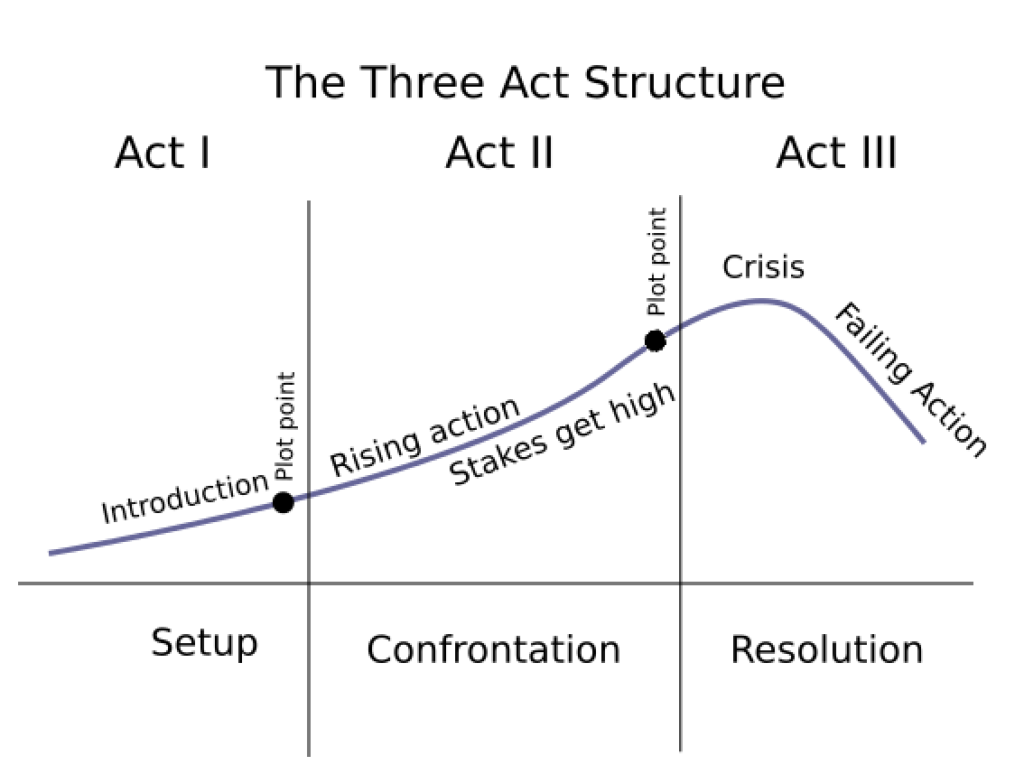
-Plot Structure
You’ll learn about the basic structure of Elizabethan plays via Google Slides.
A second set of slides will demonstrate the plot structure of Romeo &Juliet
You’ll mix and match a series of plot elements to create your own Elizabethan play via Jamboard

Tragedy:

  • A hero is given some unwelcome news
  • He feels betrayed by those close to him
  • He agonizes about the ethics of killing someone close to him.
  • He kills someone (or banishes an honest man) and immediately falls into a downward spiral.
  • The hero does (this will be a mandatory choice)

Comedy:

  • The heroine disguises herself as a boy
  • A hero or heroine swears (s)he will never fall in love and immediately falls in love
  • The heroine pretends not to be interested in the hero, (but secretly loves him).
  • A loyal best friend is captured, sent to prison, or bewitched
  • The hero and heroine hate each other due to a series of misunderstandings.
  • The hero and heroine get married (this will be a mandatory choice).

History:

  • An ambitious young man arises to challenge the king for the throne.
  • The old king dies, (or is murdered)
  • A new king becomes king
  • Duels and or battles
  • Someone dies in battle
  • Someone is murdered, assassinated, or sentenced to death.
  • New King gets married
  • King and Queen reign peacefully (at least for now)

Romance ( if students pick this option, they can mix and match everything (except the main character dying)

Verse practice-
You’ll learn about the verse Shakespeare wrote, through a series of slides and a jam board.
Activity- You will be given a series of famous lines from plays and movies, (such as a quote from a Disney Movie, a Star Wars film, or a song). You will then determine if it is an iambic pentameter line (Google Slides).
Easter egg- you find a second note from the thief (Google Sites).

Part IV- THe Tavern

You will look at a series of pictures and videos about Shakespeare’s contemporaries and try to figure out which of them stole the play. Through the handout, you will conclude who the thief is.
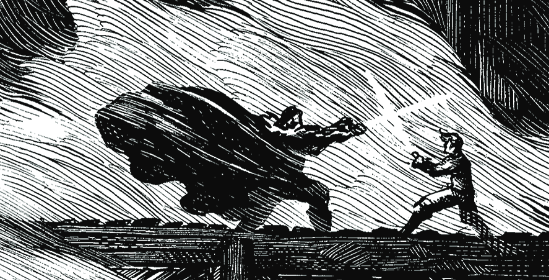
You find a dagger in the tavern and take it. Outside the tavern, you will fight the thief in a short animation. GAME OVER.

THe FIrst Class starts April 28th, 2023. CLick here to register!

Help Support my podcast

As of right now, if you want to help support the work I do here and my podcast, you can sign up for monthly donations. I have a lot of new ideas for the podcast, but I can’t do them without your support, so please consider being a supporter now!

If you go to my podcast website, there’s now a button that says “Support this Podcast,” where you can choose your monthly rate of contribution, from $9.99 per month to as low as $1 per month! If enough people support this podcast, I’ll start taking requests and giving out rewards to my generous supporters. In short, if you support me, I’ll create content designed to your interests so you can feel that this is YOUR podcast.

Thanks for reading, and please consider donating today!

Play Review: Othello 2007

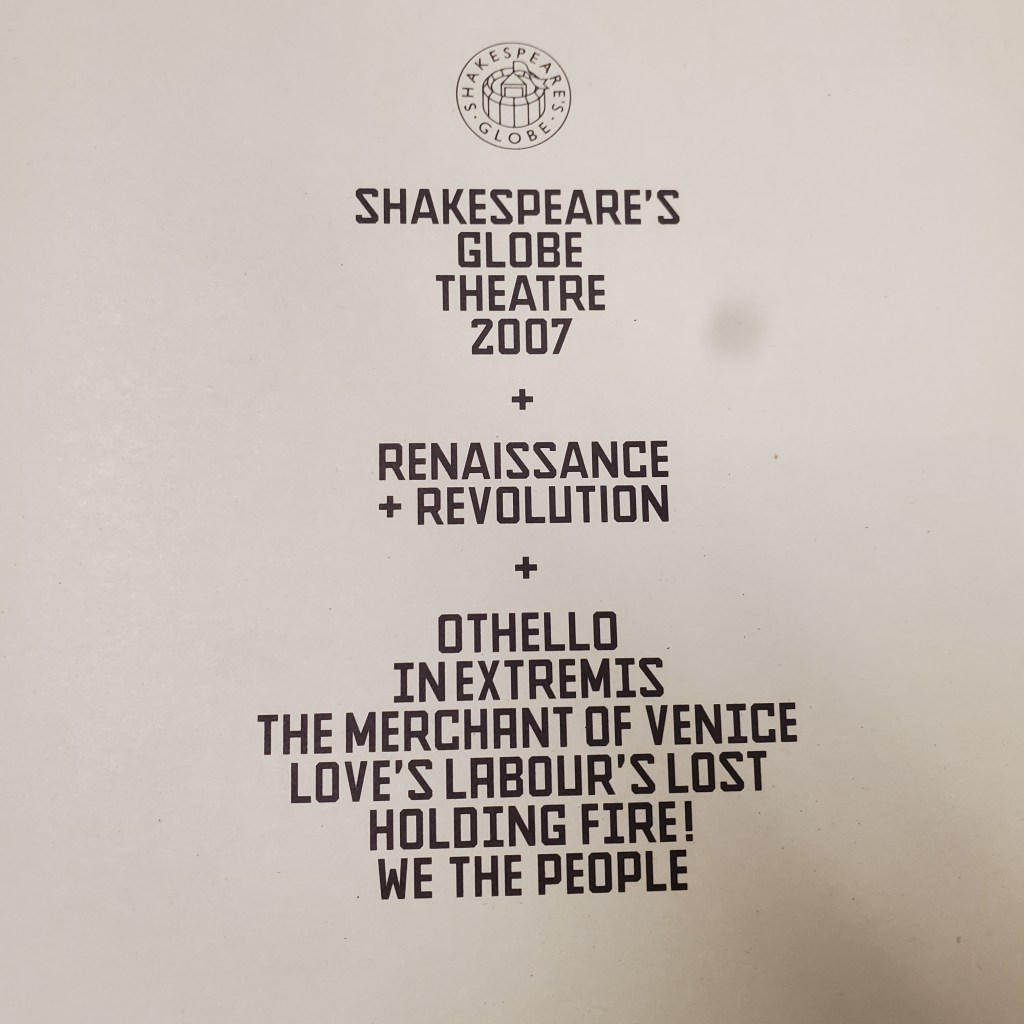
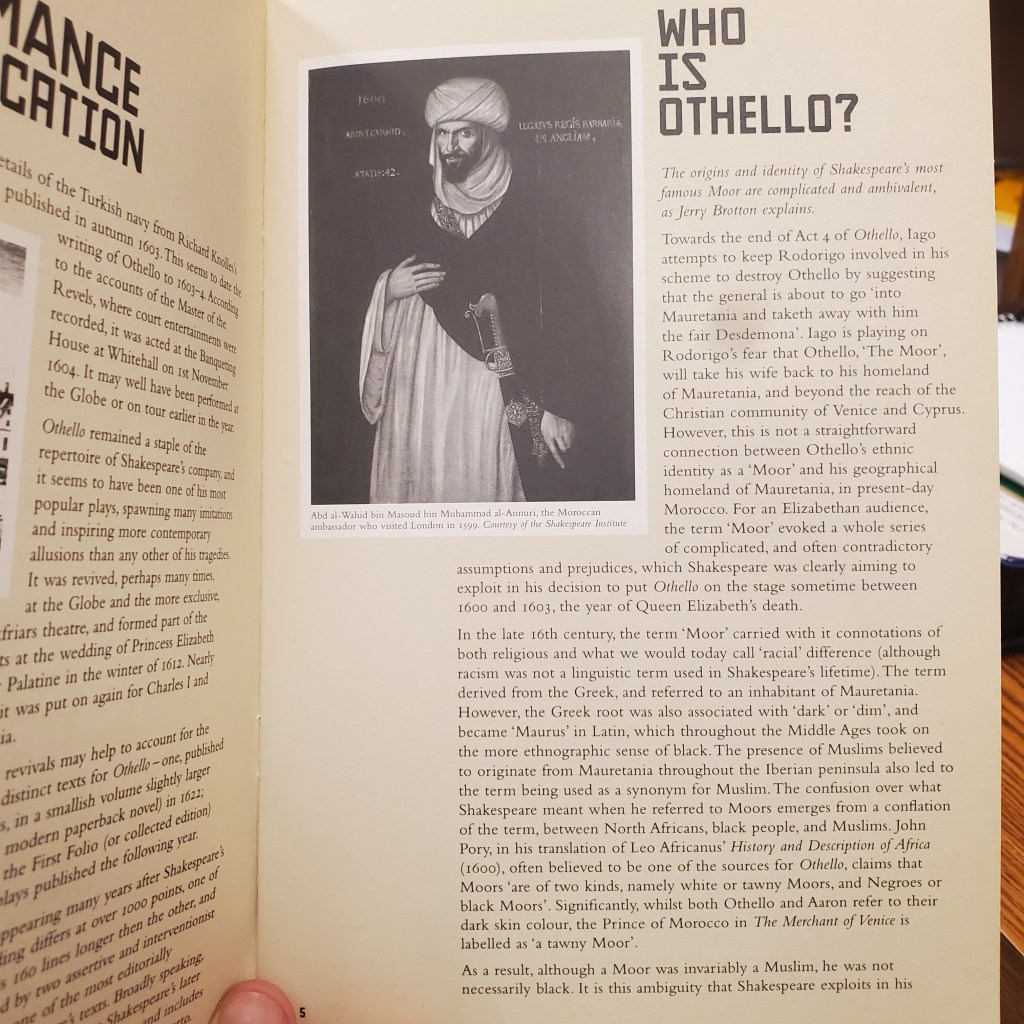
For Throwback Thursday, I’m talking about my first-ever experience going to the Globe Theater. Back in 2007, I saw a production of “Othello” starring Eamon Walker as Othello, and Tim McInerney as Iago. Below are some images from the excellent souvenir program I purchased:

The experience was very special to me I went to London for the second time with my classmates in a college theater class, many of whom I’d also performed with earlier that year in Romeo and Juliet. I got to see over 15 shows in London’s west end , but going to the Globe was definitely a highlight. It felt like a pilgrimage and the icing on the cake after studying Shakespeare’s plays all year long. It was also very serendipitous that the play we saw was Othello, since, as you can see in the video below, I noticed that Sam Wannamaker, the founder of the Globe, performed in the play himself as Iago:

THe concept

Again, since this was my first time seeing a play at the Globe, I appreciated that they played it straight- Elizabethan costumes, no bizarre staging. This felt very much like stepping back in time. Some critics in recent years say that all Globe Productions should be staged like this, and decry more experimental productions. I see an argument for both camps. The Globe is both a temple to Shakespeare’s life and work, and a modern theater that tries to push the boundaries of live performances, and I think this kind of variety is good. That said, I’m glad that every once in a while, they just let a Shakespeare play be classic.

The Cast

https://www.shutterstock.com/editorial/image-editorial/eamonn-walker–othello-zoe-tapper-desdemona-663679e

https://www.photostage.co.uk/shakespeare/othello/2007-shakespeare-s-globe.html

Eamonn Walker as Othello

Yes, this is one of the first ever Othellos I saw, and the first one I ever saw live, but Mr. Walker will always be one of my favorites. He really nails the complexities of Othello’s emotions- from powerful and stoic, to sweet and romantic, to rage-filled and abusive. I really felt for him and truly hated Iago for taking such a worthy person and turning him into a monster.

What Mr. Walker does incredibly well is show Othello’s journey to fight the simmering hatred and jealousy he feels towards Desdemona. You can see it in his face when Desdamona casually mentions that Cassio (the man Othello suspects is sleeping with his wife), has just been in the room with her.

I’ve heard critics claim that Mr. Walker’s voice is hard to hear, and I have to admit, his voice is a little hard to hear in an outdoor amphitheater like the Globe, but his physicality and his sublime characterizations of the role of Othello more than makeup for it. In addition, his great portrayal of Othello was also immortalized in a great TV (which I’ll talk about another time), which makes the aforementioned critique of his voice irrelevant.

In 2000, Mr. Walker starred in a made-for-TV movie modern-day Othello which has this heartbreaking scene at a restaurant (1:12:00- 1:15:00) where John Othello, (the first black police chief in England), talks about how his people left Africa, came to England and were given “Other men’s leavings.” He also makes it clear that for years he wanted to be white. This Othello is very clearly not healed from his generational trauma, and it comes out in violent ways: 

I honestly liked Tim McInerney less as Iago than in other roles, such as his film role in Ian McKellen’s Richard III. I thought his character voice was too gruff to be understood, and though his physicality is good, I didn’t get much of a sense of his concept for the character. As I’ve written before, Iago is a compelling part, but the actor has to have a clear objective to help us in the audience understand why he feels the need to destroy Othello.

These minor nitpicks aside, this was an excellent production, and I’m really pleased to retell my experience to you. Below are links to reviews and photo slideshows.

Adieu for now!

https://www.theguardian.com/stage/2007/may/26/theatre2

https://bbashakespeare.warwick.ac.uk/productions/othello-2007-shakespeares-globe-theatre-globe-theatre-bankside

Intro to Richard the Second

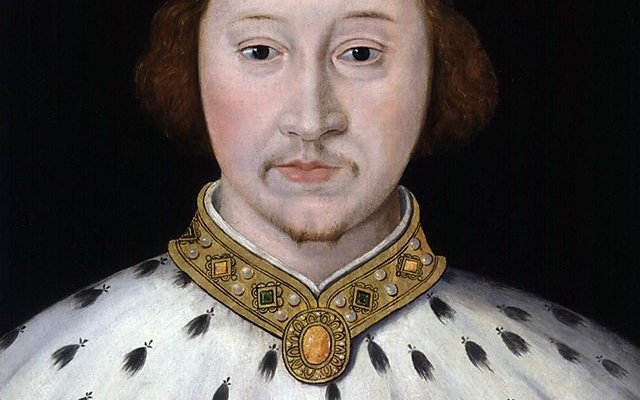
With the current political climate with leaders voluntarily giving up power and factions rising up within factions, I thought I might give you some historical perspective with Shakespeare’s play about a monarch who stole from his people, caused an insurrection, and whose supporters gave up their own power- Richard II.

Background presentation

Background info packet I created back in 2009.

Richard is a classic story of hubris. Richard literally believed he was appointed by god, and thus he could act with impunity. He, therefore, stole lands, taxed his people, and even gave land away to pay for his wars in Ireland. His actions offended his nobles, especially the house of Lancaster, who rose up and eventually deposed him. This play, therefore, has many lessons on how leaders cannot survive without their supporters, and nobles need to put the good of the people first.

Shakespeare’s version is not a dry chronicle with painstaking historical accuracy. For starters, every single line is in verse, and I don’t think even the real Richard spoke in iambic pentameter all the time. For a history play, this Richard has Shakespeare’s most poetic language:

Shakespeare’s Richard is full of self-pity, bewilderment, and a narcissistic desire for attention with a borderline God-complex. He even art-directs his own deposition with all the tragic solemnity of a passion play, casting himself as Christ, and everyone else as Pontius Pilate:

Shakespeare is very cogent about whether or not it was a good idea to depose Richard, especially since Queen Elizabeth was also an aging monarch who failed to produce an heir or quell a rebellion in Ireland (Shapiro: 1599). Nonetheless, the Queen was aware of the connection and famously declared: “I am Richard the Second, know ye not that?” Some productions have blatantly connected the two monarchs, and even dressed Richard as the Queen.

This play’s strength depends on the casting. Not much happens onstage except for lots of talking, planning, speechifying, and cursing. It depends on actors who can deliver these great lines with beauty but also sincerity:

Watch “Shakespeare Made You Die (Dumb Ways to Die Parody)” on YouTube

Tomorrow is the first session of my course on Shakespeaere’s tragedies! I’m so excited to teach this great group whom I’ve worked with before. To mark this occasion, I present this silly, catchy, and informative song about the tragic fates of Cleopatra, Juliet, Hamlet, and others.

Title page for my course on Shakespeare’s Tragedies

If you want to sign up for this course or request a private session, you can do so at http://www.outschool.com, or by scanning the QR code below:

The trailer for my course.

Thanks for reading and have a good weekend!

Watch “D E M O N O L O G Y” on YouTube

This book Demonology influenced Shakespeare’s Macbeth and Hamlet in ways I’ll get into later. It was written by King James himself, and it takes the form of a dialogue, that is, an intellectual conversation where the concept of witchcraft, sorcery, necromancy, etc is explained, debated, and questioned between two imaginary people.

In the video, Youtuber Andrew Rakich, known for his history series, Checkmate Linconites, (where he plays two characters who argue about the Civil War from a Union and Confederate perspective) has done a dramatic reading of the whole book in the accent of 1600s England. It’s part audio book, part history lesson, part linguistics lesson, and all great!

Here are some of my favorite quotes from the book:

Just like in Dr. Faustus, James theorizes that the Devil lets all so-called sorcerers and necromancers believe they have power over him, to deceive them later.

For as the humor of Melancholie in the selfe is blacke, heauie and terrene, so are the symptomes thereof, in any persones that are subject therevnto, leannes, palenes, desire of solitude: and if they come to the highest degree therof, mere folie and Manie:

Demonology, Chapter 1, p. 30,. Reprinted from Project Gutenberg

This passage echoes Hamlet’s description of his own meloncholy, and his fear that The Devil might be trying to use his melocholy to conjure up his father in order to damn him:

The spirit that I have seen
600   May be the devil, and the devil hath power
601   To assume a pleasing shape; yea, and perhaps
602   Out of my weakness and my melancholy,
603   As he is very potent with such spirits,

603. As . . . spirits: i.e., because he has great influence on those who have a temperament such as mine.
604   Abuses me to damn me. I’ll have grounds

604. Abuses: deludes.  If the Ghost is deceiving Hamlet about King Claudius’ guilt, and Hamlet kills him, Hamlet would be a murderer, and therefore damned.
605   More relative than this: the play’s the thing
606   Wherein I’ll catch the conscience of the king.

Hamlet, Act II, Scene ii, reprinted from Shakespeare Navigators.com.

For that is the difference betuixt Gods myracles and the Deuils, God is a creator, what he makes appeare in miracle, it is so in effect. As Moyses rod being casten downe, was no doubt turned in a natural Serpent: [pg 023]where as the Deuill (as Gods Ape) counterfetting that by his Magicians, maid their wandes to appeare so, onelie to mennes outward senses: as kythed in effect by their being deuoured by the other. For it is no wonder, that the Deuill may delude our senses, since we see by common proofe, that simple juglars will make an hundreth thinges seeme both to our eies and eares otherwaies then they are. Now as to the Magicians parte of the contract, it is in a word that thing, which I said before, the Deuill hunts for in all men.

Demonology, Chapter 6, p. 23

It’s very useful to conceptualize what the early Jacobeans thought the difference was between God and the Devil, and thus the difference between divine miracles and hellish charms. In James’ eyes, all magic and demonic arts were mere illusions, designed to play upon men’s senses and draw the intended victim into the Devil’s power. Obviously, since all of theater rests upon such illusion, it’s no wonder Shakespeare portrays magic onstage in his most popular works. In particular, this passage calls to mind the magic of Prospero, who is able to conjure spirits fo a while, but they all eventually dissolve:

PROSPERO
146   You do look, my son, in a mov’d sort,

146. mov’d sort: troubled state.
147   As if you were dismay’d: be cheerful, sir.
148   Our revels now are ended. These our actors,

148. revels: festivity, entertainment.
149   As I foretold you, were all spirits and
150   Are melted into air, into thin air:
151   And, like the baseless fabric of this vision,

151. baseless fabric: structure without a physical foundation.
152   The cloud-capp’d towers, the gorgeous palaces,
153   The solemn temples, the great globe itself,

153. the great globe itself: all the world, [and the theater] >>>
154   Yea, all which it inherit, shall dissolve

154. all which it inherit: all who live on it.
155   And, like this insubstantial pageant faded,

155. insubstantial: without material substance.
156   Leave not a rack behind. We are such stuff

156. rack: wisp of cloud driven before the wind.
157   As dreams are made on, and our little life
158   Is rounded with a sleep.

The Tempest, Act IV, Scene i.
A close reading into the most infamous 17th century manual for finding and persecuting witches and sorcerers.

 For although, as none can be schollers in a schole, & not be subject to the master thereof: so none can studie and put in practize (for studie the alone, and knowledge, is more perilous nor offensiue; and it is the practise only that makes the greatnes of the offence.) the cirkles and art of Magie, without committing an horrible defection from God: And yet as they that reades and learnes their rudiments, are not the more subject to anie schoole-master, if it please not their parentes to put them to the schoole thereafter; So they who ignorantly proues these practicques, which I cal the deuilles rudiments, vnknowing them to be baites, casten out by him, for trapping such as God will permit to fall in his hands: This kinde of folkes I saie, no doubt, ar to be judged the best of, in respect they vse no invocation nor help of him (by their knowledge at least) in these turnes, and so haue neuer entred themselues in Sathans seruice; Yet to speake truely for my owne part (I speake but for my selfe) I desire not to make so neere riding: For in my opinion our enemie is ouer craftie, and we ouer weake (except the greater grace of God) to assay such hazards, wherein he preases to trap vs.

Demonology Chapter 5, page 15.

It almost seems in this passage that James is covering his tracks against any detractors who might be wondering if he himself might be damned for knowing so much about witchcraft. Accordingly, he asserts that the knowledge of witchcraft is perfectly lawful, it’s the practice that damns the scholar.

Shakespeare: The Animated Tales- “Macbeth”

This is a 30 minute cartoon version of Macbeth originally produced for the BBC in 1992. It features Brian Cox  as the voice of Macbeth (before he was the voice of McDonald’s), and Zoë Wanamaker as Lady Macbeth (before she was a witch who teaches at Hogwarts).

I like the way it portrays the horror imagery of the play in sort of a European-manga animation hybrid. Admittedly, there are better ones in the series, but this one is still pretty neat.

DVD box art for “Shakespeare the Animated Tales.”

To check out other episodes in the series, view this playlist:

Great classes are available December 1st.

Scehdule

Class Descriptions:

Basics Of Stage Combat:  Students will learn the basics of safely enacting a fight onstage, in preparation for a Shakespeare play. We will also learn about the history of sword fighting in the military and the duel.

Trailer for Basics of Stage Combat.

My daughter really enjoyed taking this class. She was actually able to use her sabre and try out her routine on her father. Paul is quite knowledgeable about Shakespeare and made the class really fun by teaching a fight scene from Romeo and Juliet. It is amazing watching her practice with Paul over Zoom. I hope Paul will have. more combat classes, it is a different way to learn Shakespeare.

IB, Parent

An Interactive Guide To Shakespeare’s London (New Class)

A virtual tour of Shakespeare’s London will get kids to interact with the culture of Elizabethan England.

Class Experience

To teach kids about the Elizabethan era and the background of Romeo and Juliet, The Instructor will interact with the class (via pre-recorded videos), pretending to be Shakespeare. The class, pretending to be actors in Romeo and Juliet, will get a virtual tour of The Globe Theater, Hampton Court Palace, and a virtual visit to an Elizabethan doctor's office. This activity is an immersive way for them to learn about the period, how it relates to the world of the play, and how Shakespeare changed theater.

The class will take the form of a guided WebQuest activity.  First, the students will get a worksheet that has a series of fill-in-the-blanks about Elizabethan society (below). The students will fill out this worksheet based on a Nearpod and in conjunction with a website I’ve made, https://sites.google.com/nebobcats.org/visit-to-elizabethan-london/home?authuser=0 
Both the Nearpod and each webpage will have a virtual tour, a video, and text explaining some aspects of Elizabethan life. Before they go to each location, I will give a short introduction via prerecorded video:

Wizard Science

In this one-hour course, your child will discover the enchanting world of science through a series of magical experiments. Learn about such topics as Astronomy, Static Electricity, chemistry, and optical illusions.

What was Christmas like For Shakespeare?

In this one-hour course, students will learn and play games that will explore the history behind Christmas traditions. We will also discuss the themes, characters, and famous quotes from Shakespeare’s play “Twelfth Night.”