Watch “OMkara and the Indian Shakespeare” on Youtube
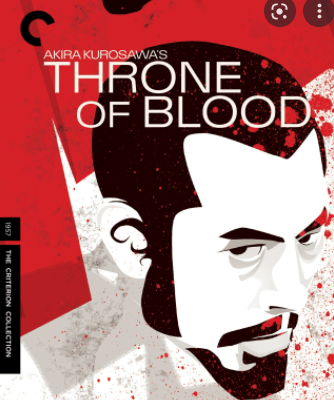
One of the most celebrated international film versions of Shakespeare comes from Japanese director Akira Kurasawa, (1910-1998). The innovative filmmaker is famous for combining Shakespeare with traditional forms of Japanese theater like Kabuki and Noh. Kurasawa’smost celebrated film was his film Throne of Blood, (1957), which was a fusion of Shakespeare’s Macbeth with Japanese Noh theater.
Here’s a short analysis of the film:
In 1978, a “holiday special’ was released under the Star Wars umbrella. Today it is universally panned as the worst Star Wars product ever conceived. It is tonally completely different from Star Wars and it spends most of its time either in a bar on Tatooine or on Kashik with Chewbacca’s family; characters we don’t know, can’t understand, and have no influence on the larger Star Wars Universe!
The only bright spot in this tragic black hole of a time-wasting special, (at least according to most of the internet), was that this special brought back the character of Boba Fett, the cool, anti-heroic bounty hunter who is constantly deceiving our heroes. As you can see, they changed the format into a cartoon, so that’s a little bizarre, but it was nice to see an old friend in this otherwise who’s who of lame new characters.
THIS WAS NOT A NEW IDEA, EVEN FOR 1978,
In around 1598 (allegedly), Queen Elizabeth the first asked William Shakespeare to write a comedy about Sir John Falstaff, the fat cowardly comic center of the Henry IV plays. The Queen wanted to see a comedy about Falstaff in love, which Shakespeare allegedly completed in a few short weeks.
Ant the result, was the Star Wars Holiday Special of the Shakespearean Cannon.

Unlike Henry IV, which is a complex history play about rebels going up against an empire (Henry IV claimed part of France so that counts :), Merry Wives a silly comedy set in the country town of Windsor. Just like the Holiday Special, Shakespeare’s comedy has a totally different tone than the other plays that feature Falstaff.
I think Shakespeare wisely didn’t try to make Falstaff a romantic figure- that would be absolute character assassination. What he does instead is take Falstaff’s ability to sweet-talk women and his penchant for thievery, and make the play about his attempts to seduce two virtuous housewives and steal their money. Just like how Boba Fett was not changed into a good-guy to pander to audiences (yet), but instead, Lucas made him a cunning deceiver who tries to sell out our heroes to Darth Vader.
Though Falstaff himself works within the context of the play, most of the new comic characters are very dated and not very funny. Dr. Caius and the Welshman are written with outrageous accents making them as incomprehensible as alien bit players in Star Wars. Frankly, I’d rather kiss a Wookie than listen to these losers try to woo Mistress Page’s daughter. It’s like Shakespeare cut and pasted the worst scenes from Taming Of The Shrew and added a French accent.
Even more boring are the scenes at the Garter Inn- a place that must’ve had significance for knights in the 1590s, but nowadays is somewhat forgettable, (like the Cantina, deal with it NERDS!)
The one really good part of the play is this scene in Act II, Scene I where Mistress Page and Mistress Ford simultaneously receive letters of “love,” (which really means ‘I want sex and your money), from Falstaff. The ladies are incensed for a couple of really good reasons:
A. It’s Falstaff- a fat, old, penniless knight who is well known as a drunk.
B. They’re already married, and he has the pudding guts to assume they’d betray their husbands.
C. If they were to cheat on their husbands, THEY WOULDN’T DO IT WITH FALSTAFF
D. The love poem he writes them is terrible. If he wanted these virtuous wives to cheat on their husbands for someone as completely undeserving as him, he could’ve at least put some effort into it!
I would also argue that the worst thing about the Holiday Special became the best thing about Merry Wives: the songs!
The most egregious change to the tone of Star Wars that the Holiday Special made was putting in a bunch of terrible musical performances by people like Jefferson Starship (get it?) to make the special more of a variety show with the Star Wars characters slapped on top of it like a sticker on a lunch box. Now we know what it sounds like when Princess Leia sings a song that clearly required a second draft:
Luckily for Shakespeare, instead of Jefferson Starship, he got opera composer Otto Nikoli, who saved this mostly terrible play by turning it into a charming opera! Look at this duet from Act I!
A lot of the more absurd plot points of Merry Wives work extremely well as musical comedy shtick, and Falstaff himself works very well as a big basso profundo
So if you go to see Merry Wives, know that it’s not a very good play by Shakespearean standards. It’s silly, kind of pointless, and not a very good addition to the story of Falstaff, but much like the Star Wars Holiday Special, it’s sure to make you laugh:


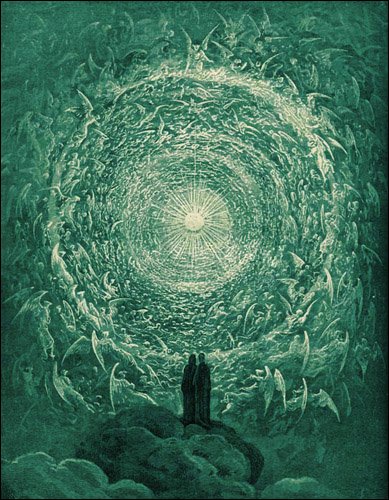
Since Easter and Passover are coming up, (and we are already in the middle of Rhamadan), I thought I’d examine Shakespeare’s depiction of other worlds both celestial and infernal. As the quote above says, philosophers and poets often wonder what greets us in the hereafter, so let me be your guide through Shakespeare’s poetic renderings of heaven and he’ll, accompanied by some gorgeous artwork from HC Selous, William Blake, and others.

Shakespeare was no doubt interested in religion. He quotes from and alludes to the Bible many times in his plays. More importantly, he lived in a time when the national religion changed three times in just 4 years! When Henry VIII changed England to a protestant country, the religious identity of England completely changed:
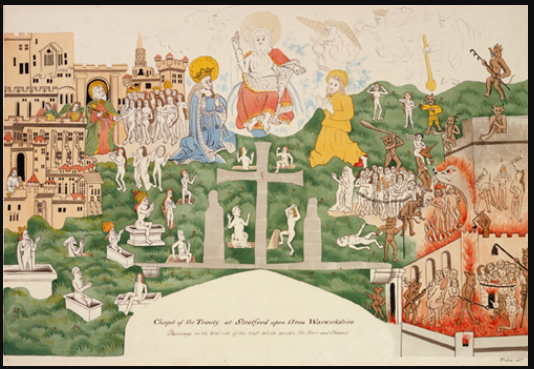
This change was not just felt in monasteries, but in all English churches. King Henry decreed that certain Catholic traditions like Purgatory, indulgences, and praying to saints were idolatrous, and were therefore banned in the Church of England. So, when Shakespeare’s father was called to destroy the “idolatrous” images of the Last Judgement in the Guild Chapel of Stratford’s Holy Trinity Church, he had no choice but to comply. If you click on the link below, you can see a detailed description of the images that Shakespeare no doubt knew well in his family’s church, until his father was forced to literally whitewash them.
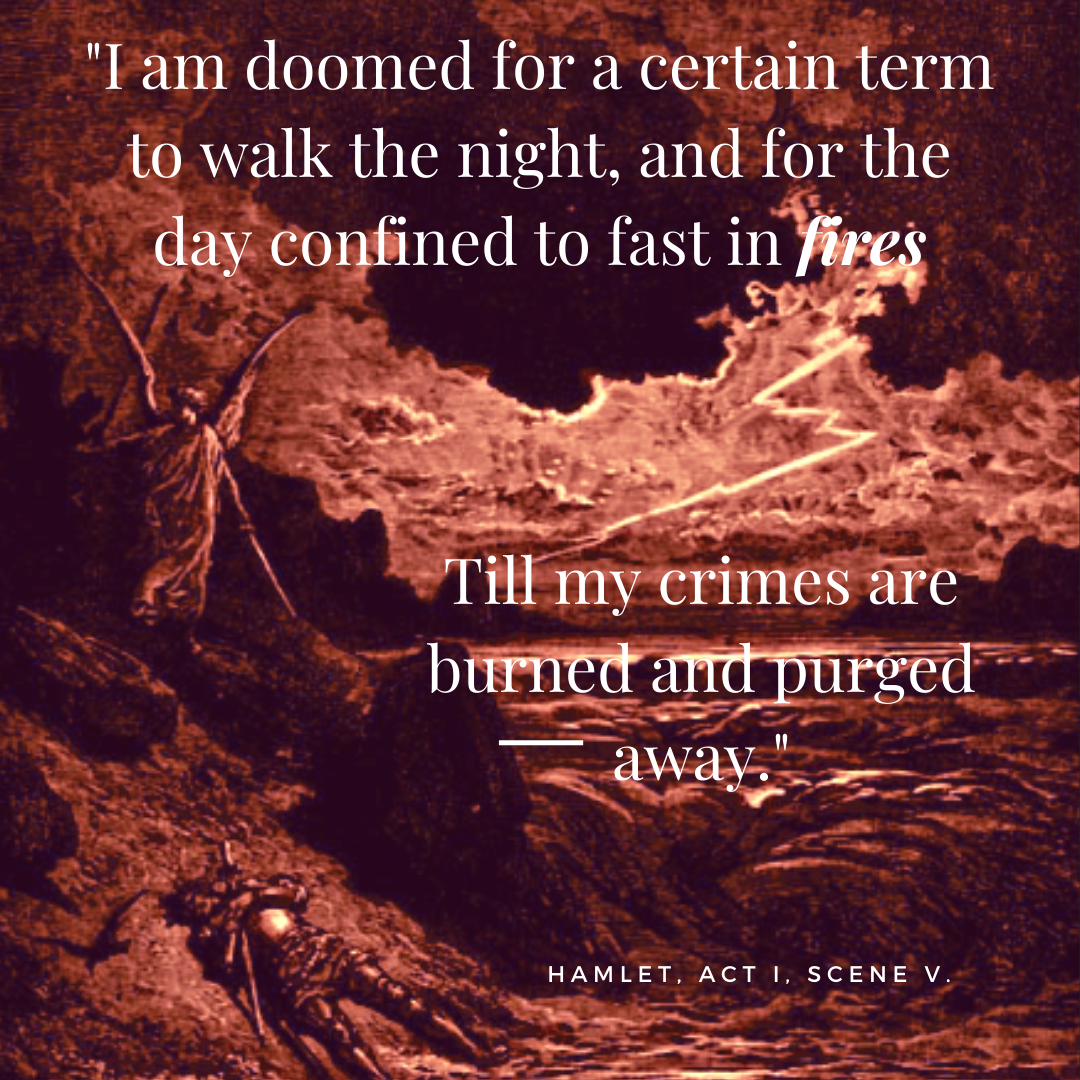
Like the images on the Stratford Guild chapel, the ideas of Catholic England didn’t disappear, they were merely hidden from view. Shakespeare refers to these Catholic ideas many times in his plays, especially in Hamlet, a play where a young scholar, who goes to the same school as Martin Luther, is wrestling with the idea of whether the ghost he has seen is a real ghost from purgatory, or a demon from hell, (as protestant churches preached in Shakespeare’s life).

I’ve written before that the ghost of Hamlet’s father teases us with the possibility that he might be a soul in purgatory, the Catholic afterlife realm for those not evil enough for Hell, nor good enough for Heaven. At the height of their powers, monks and bishops sold prayers called indulgences that supposedly allowed a soul’s loved ones to buy them time out of purgatory, thus making them able to ascend to Heaven quicker. The image above is an illustration from Purgatorio, part of Dante’s Divine Comedy, where he visits the soul of
Buonconte da Montefeltro, who is languishing because he doesn’t yet have the strength to get out of purgatory and enter Heaven.
Of course, the Tudor monarchs Henry VIII and Elizabeth I abolished indulgences and proclaimed that purgatory itself didn’t exist, but ideas can’t die, and I feel that Shakespeare was at least inspired by the notion of purgatory, even if he didn’t believe in it himself.

(Horatio) Hamlet, Act I, Scene i.
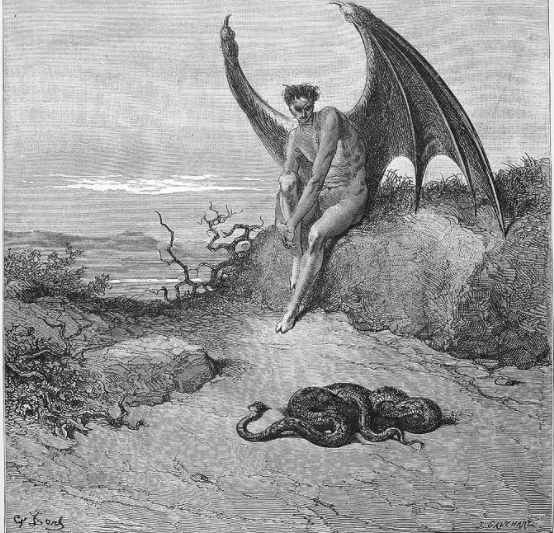
As a young boy, William Shakespeare was entertained by medieval Mystery plays; amateur theater pieces performed by local artisans that dramatized great stories from the Bible. We know this because he refers to many of the characters in these mystery plays in his own work, especially the villains. King Herod is mentioned in Hamlet and many other plays in and many of Shakespeare’s villains seem to be inspired by the biblical Lucifer, as portrayed in Medieval Mystery Plays.
In this short video of the Yorkshire Mystery play “The Rise and Fall of Lucifer,” we see God (voiced by Sir Patrick Stewart), creating Lucifer as a beautiful angel, who then, dissatisfied with his place in God’s kingdom, is transformed into an ugly devil. At first, Lucifer mourns losing his place in Paradise, but then finds comfort by becomming God’s great antagonist.
Compare this character arc with Shakespeare’s Richard of Gloucester, who also blames his unhappiness on God, (since he feels his disability and deformity are a result of God’s curse). Richard is angry with God, nature, and society, so he wages against them all to become king.
“Then since the heavens hath shaped my body so, let Hell make crook’d my mind to answer it.”
Richard of Gloucester, Henry VI, Part III, Act III, Scene i.


“All is not lost, the unconquerable will, and study of revenge, immortal hate, and the courage never to submit or yield.”
Lucifer― John Milton, Paradise Lost
Claudio. Ay, but to die, and go we know not where;
To lie in cold obstruction and to rot;
This sensible warm motion to become
A kneaded clod; and the delighted spirit
To bathe in fiery floods, or to reside
In thrilling region of thick-ribbed ice;
To be imprison’d in the viewless winds,
And blown with restless violence round about
The pendent world; or to be worse than worst
Of those that lawless and incertain thought Imagine howling: ’tis too horrible!
—Measure For Measure, Act III, Scene i

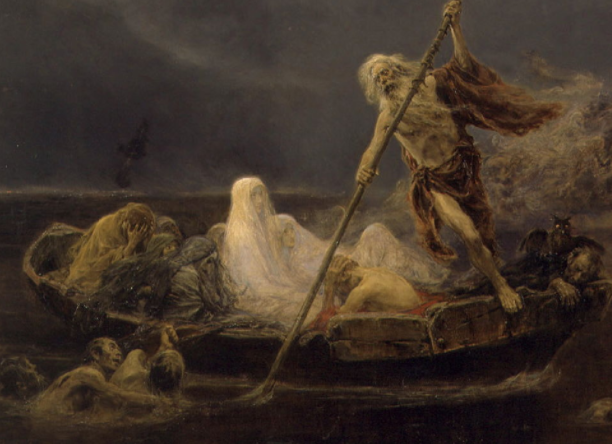
“Methought I crossed the meloncholy flood with that grim ferryman the poets write of, into the kingdom of perpetual night.”
— Richard III, Act I, Scene iv.

The heavens themselves, the planets and this centre
Observe degree, priority and place,
Insisture, course, proportion, season, form,
Office and custom, in all line of order;
And therefore is the glorious planet Sol
In noble eminence enthroned and sphered
Amidst the other; whose medicinable eye
Corrects the ill aspects of planets evil,
And posts, like the commandment of a king,
Sans cheque to good and bad: but when the planets
In evil mixture to disorder wander,
What plagues and what portents! what mutiny!
What raging of the sea! shaking of earth! Commotion in the winds! frights, changes, horrors,
Divert and crack, rend and deracinate
The unity and married calm of states
Quite from their fixure! O, when degree is shaked,
Which is the ladder to all high designs,
Then enterprise is sick! - Troilus and Cressida, Act I, Scene iii.
https://folgerpedia.folger.edu/Idolatry:_Icons_and_Iconoclasm
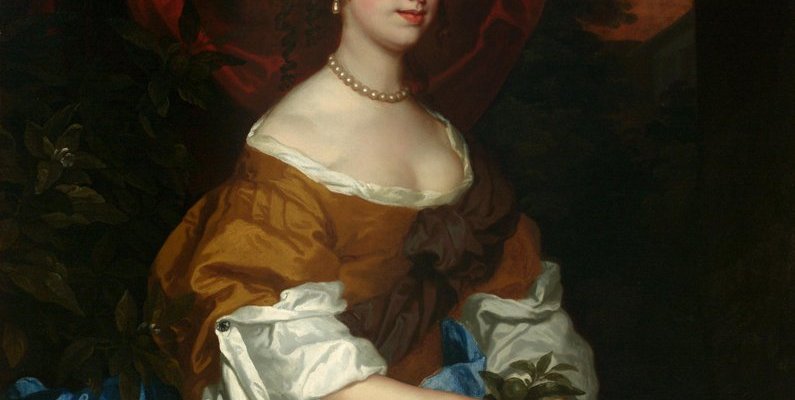
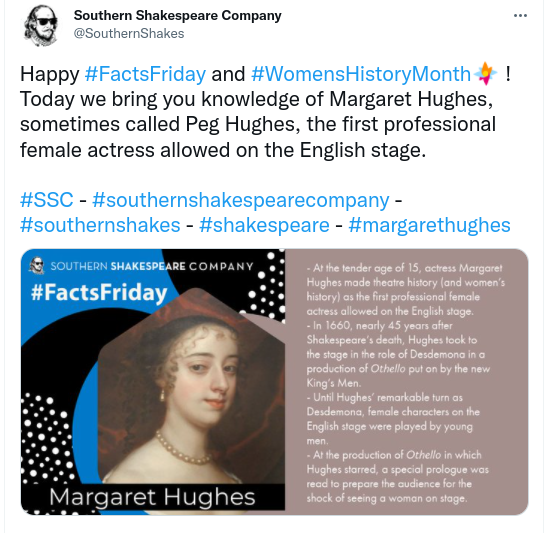
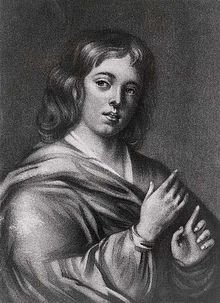
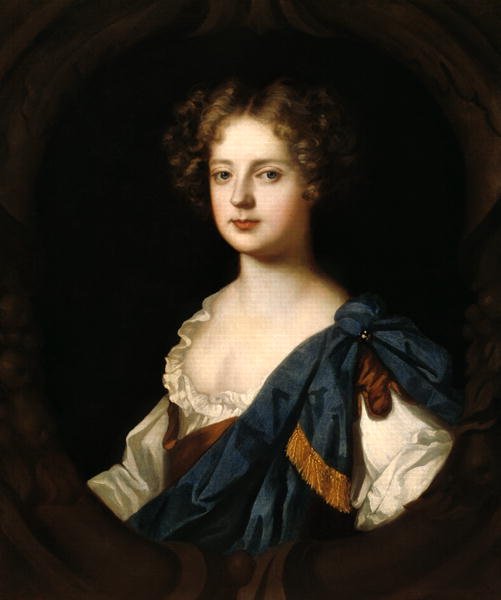
Since today is the last day of women’s history month I thought I’d talk about the historical first ever Shakespearean actress and first-ever English actress. Margaret Hughes (1630-1719), is credited as the first-ever English actress. She led a fascinating life and books, plays, and movies have immortalized her, including the 2004 film, Stage Beauty.
Although there is some debate among scholars as to whether the 1st actress in question was Margaret Hughe, she is the one who has been credited because of her performance as Desdemona in Othello during the reign of King Charles II.

Around 1660s Charles II formally allowed for public performances of women on English stages. Restoration audiences, craving entertainment after the enforced closure of theatres during the Puritan Interregnum, rejoiced. Others, particularly the successful male impersonators of women, were shocked and annoyed as they suddenly lost their celebrity status and were seen as freaks. The stage war that the appearance of actresses initiated resulted in an almost immediate reiteration of almost medieval misogyny and vituperative ostracism directed at any woman who dared to challenge the masculine reign on the English stage. The actresses themselves had to learn both how to act out femininity as seen through male playwrights’ eyes and how to maintain their celebrity status and the audiences’ adoration. This, however, meant more than ‘just’ displaying perfect acting skills and appearing in the best plays available. A successful actress needed to woo the audience, particularly its male members, with her body, or her sexuality in general. She likewise needed to accept, or even engender, vitriolic attacks on her reputation in public discourse and, if possible, utilise such bad publicity to her own advantage. As such, this chapter aims to present a link between medieval anxiety concerning public displays of femininity and the seemingly privileging introduction of the actress in the late seventeenth-century England. It will also present a synthetic image of celebrated actresses’ lives as seen through theatrical records as well as seventeenth-century pamphlets and poetry, proving true the contemporary saying that only lack of press is bad press.
Bronk, 23
What I’m going to do is give a few historical notes on Margaret Hughes and her portrayal of Desdemona in the production of Othello and then I’m going to simultaneously do a review of the movie that celebrates her life: Stage Beauty (which was also made into a play).
What Shakespeare In Love did for the 16th century, this movie does for the late 17th century: it is awash with beautiful costumes elegant sets and dazzling music. it is a visual feast and everybody in it is fantastic in their roles, especially Billy Crudup as Ned Kyneston, Richard Griffith as Sir Charles, Tom Wilkinson as Thomas Betterton, and of course, Claire Danes as Margaret Hughes.

Hughes is a costumes mender and dresser for Thomas Betterton’s theater company in London as she watches Ned Kyneston every night as he portrays Desdemona in Othello. Mrs. Hughes develops an admiration not only for his performance and skills but also forms romantic feelings for him. However, Mrs. Hughes isn’t content to keep watching Kyneston from the wings, and sneaks off after work to perform as Desdemona illegally at the Cockpit Tavern to packed houses. When Kyneston finds out, he is livid.
Kyneston constantly belittles, ignores, and underestimates Hughes through this film and is supremely arrogant to everyone, enjoying the notoriety he’s achieved as the premier female impersonator in London. However, after he offends King Charles (played by Rupert Everett), and his mistress, Nell Gwynn, (herself an aspiring actress), the King in retaliation, bans men from playing women, thereby making Kyneston seem like a degenerate, incapable of getting work. He sinks into alcoholism and depression, but finds comfort when Hughes finds him and nurses him back to health. The two then form a romantic bond.

In the third act twist of the movie, the actress playing Desdemona in Mr. Betterton’s theater is pregnant, so Margaret must take over her role. Kyneston sees an opportunity to regain respectability as an actor, so he demands to be given the role of Othello. In my favorite scene of the film, Kyneston rehearses the death scene of Othello, changing the acting style from over-the-top stylistic 17th century to very modern naturalistic portrayal:
The two actors perform a fantastic modern naturalistic portrayal of Othello before the king, and they both become respected actors who learn to respect each other.
Danes performs with wonderful real pathos as Hughes and Desdemona. In fact, all the performances are great, the the writing is top notch, and as I said the costumes and cinematography are phenomenal. It’s a very fun, slightly naughty romp through Restoration England, not unlike the flirtatious comedies of Behn and Wycherly.
Special merit goes to Billy Crudup, who had to completely transform his voice, gestures, and dialect for the film. He worked closely with a dialect coach, a physical acting coach, and the director Richard Eyre, who has worked in theater for over 20 years, and has a lot of experience with Shakespeare:
The film is not without flaws; there are some plot elements that are a bit dated and a bit unsettling. While it is true that the real Ned Kyneston was rumored to have relationships with both men and women, including famously, George Villiers, the Duke of Buckingham, who appears in the movie. Kyneston’s sexual identity is constantly shifting through the course of the movie, and it’s not handled very delicately. In the beginning of the film, Ned seems very firmly homosexual; his relationship with the Duke of Buckingham is played fairly respectfully, though Ned himself is hardly a positive portrayal of a gay or bisexualim man.
Even worse, when Buckingham rejects him, Crudup’s Kyneston seems to be coaxed by Hughes to become heterosexual, which he remains through the course of the movie. Now these actors have fantastic chemistry together, but it seems bizarre that Kyneston is all of a sudden changing his sexual identity at the same time he’s changing his style of performance. That doesn’t seem genuine, (at least in my experience), and it might be offensive to members of the LGBTQ community to assume that a man might think he’s one identity and then choose to be a heterosexual.
1 it is true that for hundreds of years it was considered socially unacceptable for women to play parts on the London stage although it was common practice in Italy and France and other countries
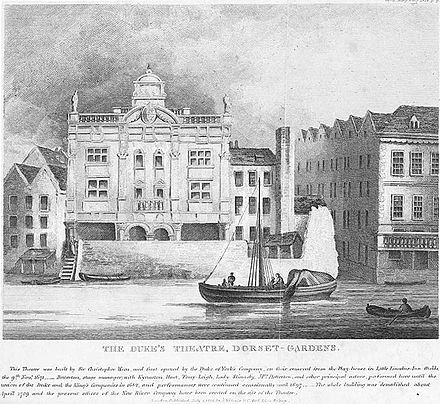
2. Ned Kynaston, Thomas Betterton, and of course Mrs. Hughes are real people who performed during the Restoration. However, they actually rarely worked together. Much like the Admiral’s Men and Chamberlain’s men in Shakespeare In Love, The Duke’s Company which is where Betterton worked, while Mrs. Hughed mainly performed in the rival King’s Company.

1. Katarzyna Bronk- No Press is Bad Press-Being an Actress in English Restoration. Stardom: Discussions on Fame and Celebrity Culture, 23-34, 2012. Retrieved online from: =related:YvjGsAEzxIoJ:scholar.google.com/&hl=en&as_sdt=0,39#d=gs_qabs&u=%23p%3DYvjGsAEzxIoJ
I apologize for not spending enough time on black history month this February.
If I do prove her haggard,
Though that her jesses were my dear heartstrings,
I’ld whistle her off and let her down the wind,
To pray at fortune. Haply, for I am black
Or for I am declined
Into the vale of years,—yet that’s not much—
She’s gone. I am abused; and my relief
Must be to loathe her.
Othello, Act III, Scene iii.
Psychologists say some men expect the worst of everyone, especially women. I would argue that Othello is an example of a man who has been threatened so often, he expects the worst of everyone, especially his wife, and this is why it’s so easy for Iago to manipulate him.
I don’t know what it’s like to be black in 21st century America let alone the trauma of Othello’s life, which was riddled with hardship such as being sold into Slavery, encountering Cannibals, and rising through the ranks of an army that doesn’t quite trust him. But based on the psychology of people who undergo trauma, the text of the play, and some details about Venetian life, I think looking at Othello through the perspective of trauma and toxic masculinity is an illuminating interpretation of the play.
I want to be clear that I am not saying domestic violence is condonable, or that being black has anything to do with abuse. What I am trying to say is that Othello is a play that in my view sheds a light on trauma, PTSD, toxic masculinity, and systemic oppression.
In the book Beyond Anger, psychologist Thomas J. Harbin illustrates just how easily a man can deceive himself with jealousy brought on by his own insecurities.
Angry men often believe that others do not approve of them, or think highly of them so more than likely when you assume you know what another is thinking you will assume that person is thinking negative thoughts about you more garbage yen when you For example and whenever [Othello] notices that his wife is not in a good mood, he asks “What’s wrong with you?” his wife usually says that nothing is wrong but [Othello] assumes that she is not telling the truth, and that she is actually angry with him. He then gets angry because he assumes she is blaming him for something that he didn’t do; the ‘garbage out’ mind reading is also frustrating to those around you friends coworkers and family can see that you are getting angry with them, but they have no idea why.
J. Thomas Harbin, “Beyond Anger,” 2018.
Actor Adrian Lester doesn’t think that the play is about race, but about the trauma of military society and according to Aryanna Thompson of George Washington University, he hoped the audience would see Othello as a soldier, not a black man, when he played the role at the National Theater in 2003, when England and America were engaged in military interventions in Iraq.
Though this interpretation works, I would argue that the exploitation of people of color is very much what the play is about, not just on stage but also in places like the military. “The play’s military context is short-lived, serving mainly as a framework for the intense private wars that follow. And in this emotional arena, Othello is far less secure.” Maybe Othello’s toxic insecurities come from being seen as disposable by the Venetian upper crust. Like Shylock before him, Othello is an alien in his own country and if he offends anyone, he will be crushed. He is then put in a dangerous situation where the troops have to hurry up and wait for the danger to find them, which is always a recipe for disaster as the clip above shows.
Maybe a lot of black people felt this feeling of cultural disposibility in the 1600s: listen to professor Thompson talk about the way black people were exploited in the Elizabethan and Jacobean era:
If you watched this clip, you might notice that for most of the history of the play, the draw has been seeing white actors ‘rise to the challenge’ of playing a black man. Sadly, Othello the character is not only exploited by characters in his own play, the role has been exploited as a novelty by theater companies for centuries. My point here is that I see merit to the question of whether or not this play deserves to be performed since from the beginning, it was designed to exploit blackness and the stereotypes of blackness by white actors.
Trauma makes abuse understandable but it doesn’t make it right. The cycle must be broken. Shakespeare’s gift here is to show how toxic masculinity is ultimately self destructive. Plus racial oppression and sexual repression leads everyone into tragedy.