Shakespeare On Dragons

Tonight is the Chinese New Year, beginning the Year of the Dragon. I’ve talked before about the fascinating relationship between Shakespeare and China, and I thought I’d illustrate it here by talking about a shared cultural mythology- the concept of dragons. Both Western and Eastern cultures use dragons in their myths, but as you’ll see, they have very different cultural meanings.

Quotes from Shakespeare About Dragons

Before thee stands this fair Hesperides,
With golden fruit, but dangerous to be touch’d;
For death-like dragons here affright thee hard:

Antiocus, Pericles

Sometimes we see a cloud that’s dragonish;
A vapour sometime like a bear or lion,
A tower’d citadel, a pendent rock,
A forked mountain, or blue promontory

Antony and Cleopatra

In Western myths, dragons are symbols of wrath and fierceness. In ancient Greek and Viking myths, dragons are often guards of treasure, (and sometimes in modern stories like Harry Potter). In the myth of Hercules, a multi-headed dragon guarded the golden apples of the Hesperides, (the apples that kept the gods young and immortal). King Antiochus wants to scare Pericles by comparing his daughter to the apples; if he fails to win her love, he’ll be devoured as Hercules almost was.

Coriolanus and Dragons

His CORIOLANUS is grown
from man to dragon: he has wings; he’s more than a
creeping thing.

Coriolanus

Shakespeare’s Roman general Coriolanus is frequently compared to a dragon in Shakespeare’s play. According to Dr. Peter Saccio of Dartmouth College, this is because the general is unable to relate to other humans- he is solitary, violent, jealous of his power and wealth, and prefers to strike first, then retreat from other people when the battle is won. This is why he utterly fails to get the Roman people to elect him consul in this scene from Ralph Fiennes’ movie. I find it ironic that Fiennes has played not only this character, (who is associated with dragons), but with Lord Voldemort, (who controls several large serpents), and also Francis Dollarhyde in the film Red Dragon:

Swift, swift, you dragons of the night, that dawning
May bare the raven’s eye! I lodge in fear;
Though this a heavenly angel, hell is here.

Cymbeline

Sometime he angers me
With telling me of the mouldwarp and the ant,
Of the dreamer Merlin and his prophecies,
And of a dragon and a finless fish,
A clip-wing’d griffin and a moulten raven,
A couching lion and a ramping cat,
And such a deal of skimble-skamble stuff
As puts me from my faith. 

Hotspur, Henry IV, Part I

A thousand hearts are great within my bosom;

Advance our standards, set upon our foes

Our ancient word of “courage,” fair Saint George,

Inspire us with the spleen of fiery dragons!

Richard III

St. George and the Dragon

In the medieval story of St. George, the titular knight defeats a dragon, which is basically a stand-in for Satan. George was seen as the ideal knight- virtuous, devoted to his cause, strong, and patriotic. His defeat of the dragon was an allegory for how knights should devote themselves to protecting their lords, ladies, and the innocent against evil. Therefore, it’s intentionally unsettling that Shakespeare has Richard III telling his soldiers to act not like the virtuous St. George, but like the cruel and violent dragon. Richard is Shakespeare’s most villainous king, so it makes sense in context that he would side with the dragon, and thus his defeat would seem even more like a triumph of good over evil. In addition, the real King Richard flew this flag with a dragon on it during the actual Battle of Bosworth Field.

Royal standard of Richard III, using the dragon of St. George

Peace, Kent!
Come not between the dragon and his wrath.

King Lear

Dragons and Chinese Culture

None of the animals is so wise as the dragon. His blessing power is not a false one. He can be smaller than small, bigger than big, higher than high, and lower than low.”

–Chinese scholar Lu Dian (AD 1042-1102)

Qualities of Dragons

Dragons didn’t have the negative connotations of Western myths. In China, they were symbols of good luck, strength, and success. They were also known to be proud and temperamental-sometimes kind but sometimes vengeful to people who didn’t show them proper respect. In a sense, the dragon was like the ancient Greek gods- they should be viewed with respect and gratitude as well as fear.

Zodiac

The Chinese calendar goes by a cycle of years, not months. It has 12 animals that represent various qualities and those qualities will characterize the coming year. So hopefully a year of a dragon will be a year marked with courage, good fortune, and justice.

IV. What would a Chinese Lear look like?

Looking at the quotes I showed you earlier, it’s interesting that King Lear calls himself a dragon, and it made me think- Lear is a powerful warlord who demands absolute loyalty from his children. Would a Chinese version of King Lear work?
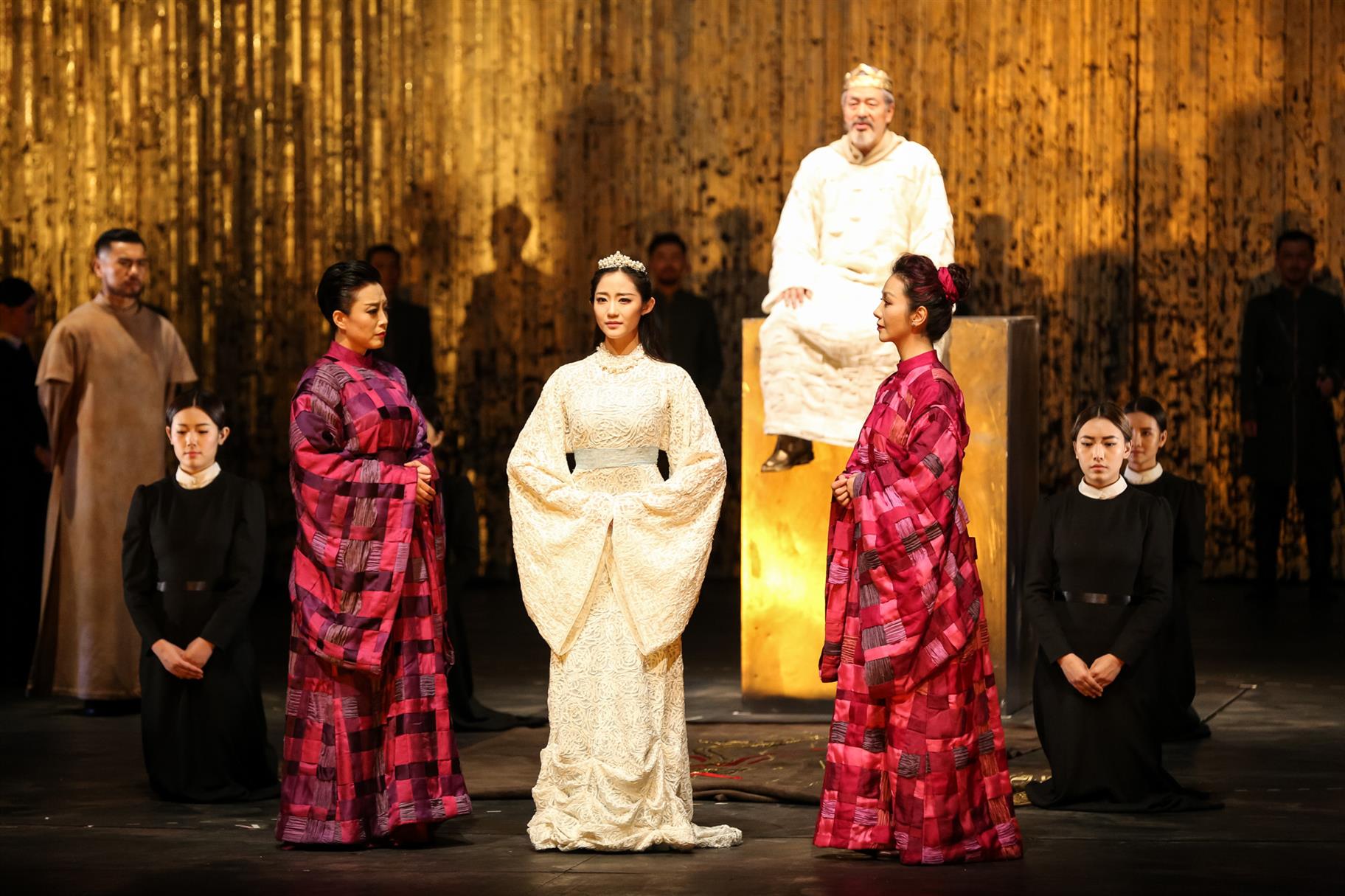
2017 Chinese Language production of “King Lear” at the Royal Shakespeare Company.

There was a Chinese production of King Lear back in 2017, where the translator and director traveled to the Royal Shakespeare Company in England and worked with the actors and directors of a London production to make their production gain insight into the characters’ motivations. However, I wonder how successfully they translated the Western ideas and values of the play for a Chinese audience. One of the reviews from China Daily.com describes the play like this:

Originating from old British legend, King Lear is one of Shakespeare’s four most famous tragedies. Through the internal disorder of the royal family, the rise and fall of King Lear’s fate and the final punishment of evil powers, Shakespeare expresses his optimistic views in the future of society, thereby adding the glory of strong idealism into his work.

ChinaDaily.com

The last word I would use to describe King Lear is “optimistic”. It is the only tragedy where not only does everyone die, but the entire future of the monarchy is in question. Nevertheless, reading about this production makes me interested in imagining my own version of King Lear, one that emphasizes Chinese values, but also questions them.

Many Chinese stories stress family loyalty, communalism, and respect for elders. You could portray King Lear as a story about the disastrous consequences of self-interest. After all, Regan and Goneril cast their father out and dismissed his followers, and it led their kingdom into civil war. In that version, Lear is like the Dragon King, who in Chinese folklore, was a powerful ruler of the seas, (giving new meaning to the lines “Blow winds, and crack your cheeks”). As a bonus, historically, many imperial Chinese rulers decorated their palaces with images of dragons, and the emperors themselves were associated with the creature, (especially during the Han Dynasty), so when Lear says “Come not between the dragon and his wrath,” In his mind, he literally is a dragon.
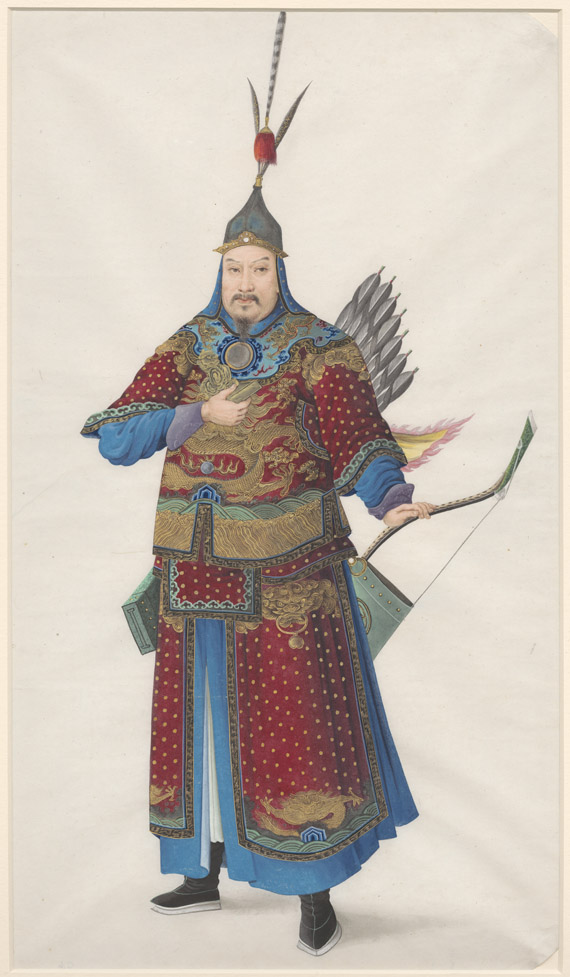
Han Dynasty watercolor print of a Han warrior whose clothing is embroidered with dragons.

In 1736, Jean-Baptiste Du Halde wrote about the Emperor: “His clothing is embroidered with dragons: they are his emblem, and only He can wear dragons with five claws – any infringement to this rule is punished severely.”

Cornell University: Emblems and Mascots of Rulers:
Chinese Imperial Dragon
s

That said, some dragons were associated with bad luck and ill omens. I’ve said before that Lear’s biggest flaw is that he fails to take time to examine himself or think about the consequences of his actions until it is too late. Maybe Lear thinks of himself as a benevolent dragon, but really is a bad man cursed with bad luck; he is not a dragon, he just has one on his back. So, in short, a Chinese re-imagining of King Lear could be a fascinating look at Chinese culture and give a fresh re-imagining of Shakespeare’s tragic story.

I hope you enjoyed this look into dragons in Shakespeare and Chinese culture. Joseph Campbell said that all cultures share and interpret archetypes to understand their own culture, but also to grasp what makes us all human. For whatever reason, every culture on Earth has some kind of large serpent- Chinese dragons, European dragons, The Aztec god Quetzalcoatl, the Viking Yormungand, even the Piasa of the native tribes of the Mississippi. and they can mean many different things to many different people, which means that we as humans are in some way tied to gether through all these dragon tales (no pun intended).
V. Sources

  1. https://www.kennedy-center.org/whats-on/explore-by-genre/young-audiences/2023-2024/dragon-kings-daughter/#:~:text=Chinese%20dragon%20mythology%2C%20martial%20arts,inspiring%20songs%20by%20Marcus%20Yi.
  2. https://www.historyskills.com/classroom/year-7/chinese-dragons/#:~:text=Another%20well%2Dknown%20legend%20involves,benevolent%2C%20divine%20force%20in%20nature.
  3. https://www.amnh.org/exhibitions/mythic-creatures/dragons/asian-dragons
  4. https://www.topchinatravel.com/china-guide/chinese-dragon-language.htm
  5. https://studycli.org/chinese-culture/chinese-dragons
  6. https://rmc.library.cornell.edu/AnimalLegends/exhibition/emblems/dragons.html#:~:text=Already%20a%20royal%20symbol%20in,and%20his%20brother%20Yan%20Di.

Is Percy Jackson Hamlet?

I’m really excited about the Disney Plus release of the Percy Jackson TV show. My family and I are really enjoying it and I think it’s a very good adaptation, (much more faithful than the previous movie versions). The tone is darker, the characters are better fleshed out, and also there’s a much more nuanced take on Percy’s character, which I believe is at the core of the series. The movie is essentially just a fetch quest where Percy is going from location A to location B looking for various magic items and fighting monsters. Movie Percy is a very static character but in the books and the show, they keep all of those journeys but also delve into his complicated relationship with the gods, his own insecurities growing up without a father, and his overwhelming feeling that this world of gods and mortals is fundamentally flawed and that he is the one to fix it.

“Families are messy. Immortal families are eternally messy. Sometimes the best we can do is to remind each other that we’re related for better or for worse…and try to keep the maiming and killing to a minimum.”

-Percy Jackson, The Sea of Monsters


In short, what makes the show great is that it emphasizes the elements of the book that make it a classic story of a young man who is trying to find his place in the world and complete the quest that his father set for him. Of course, once I started watching it, my Shakespeare Brain activated, and I immediately compared him to Shakespeare’s ultimate example of a hero trying to complete a quest given to him by an absent father- Hamlet.
So today I’ll Talk about why I think Percy Jackson is actually a descendant of Hamlet or rather that Hamlet and Percy Jackson are both descendants of the same common ancestor in Greek mythology and touch on what these classic stories can say to us today.

1. The Plot

AI Art I created of Percy Jackson. Nightcreator.com.

As I touched on earlier, there are some glaring similarities between the plots of Percy Jackson and Hamlet- we have a young man who has who hates his stepfather, who is deeply protective of his mother, who goes on a magical quest given to him by his father, (who cannot directly aid him because he’s not physically there). In Percy Jackson, his father is a god- the ancient Greek water god Poseidon, while Hamlet’s father is a ghost. Both heroes have to deal with treachery, uncover a plot, avert potential wars, and get caught up in great military and political power schemes. While Hamlet is trying to restore the rightful heir to the throne (himself), Percy is trying to avoid a war between the gods. Both heroes have stoic sidekicks- Hamlet has Horatio whereas Percy has Annabeth and his friend Grover the Satyr. Hamlet’s friend l Horatio is kind of like a combination of Annabeth’s intelligence and Grover’s kindness and empathy. Finally, both stories conclude in a duel (spoiler alert) where they fight against a near-impossible adversary, and in the end, succeed in their quest, although in Hamlet’s case, he does so at the cost of his own life.

The main difference between these stories is connected to tone and genre- Hamlet is a revenge play, and most Revenge tragedies end in the death of the avenger. Percy Jackson is an adventure quest so based on the conventions, he can succeed, survive, and go off to fight another day. Nevertheless, in terms of the broad outline, the plots are very similar. I would argue this is probably because Hamlet has its roots in many ancient mythological stories like Oedipus, Orestes, and of course, the Danish Viking myth of Amleth. I would argue that both Percy Jackson and Hamlet have a very clear direct common ancestor: the ancient Greek myth of …

2. A Common Ancestor- Perseus

https://prezi.com/btk3m_bamkmh/hamlets-monomyth/

As this funny cartoon illustrates, the plots of Percy Jackson and Hamlet can be seen as a modern incarnation of the Perseus myth, from the villainous stepfather to the hero’s protective feelings to the mother to the magical quest to get rid of a stepfather who takes away his birthright. These plot elements follow a very similar formula; as Jake also alluded to, all three of these stories are part of what writers and scholars like to call the monomyth or the “Hero’s journey,” a concept in mythology and storytelling that has inspired works such as Percy Jackson, Star Wars, and many others.

What Is the Monomyth?

Crash Course Mythology- The Monomyth

In 1949, scholar Joseph Campbell wrote a book called “The Hero With a Thousand Faces,” which posited that every culture has stories that fit into universal archetypes- that essentially all human cultures have unique stories, but also call to mind universal truths about humanity. He then distilled the common archetypes and plot tropes of these myths into something called “The monomyth” or “The Hero’s Journey,” a 17-step process that is at the core of many ancient myths, modern adventure stories, or revenge stories such as Hamlet. Below are some of the common tropes of the Hero’s Journey. When you see it spelled out like this, it is very clear that both Hamlet, Percy Jackson, and Perseus follow the Monomyth formula:

Infographic of the Monomyth from David R. Jolly.com

Part I: The Call To Adventure:

Where’s the glory in repeating what others have done?

The Lightining Thief

Every Greek hero starts with a call to adventure- Theseus finds his father’s sword and sets out to find him. Oedipus needs to lift the plague on Thebes, and Hamlet needs to find out why his father’s ghost has returned.

A Half-Blood of the eldest gods, Shall reach sixteen against all odds
And see the world in endless sleep
The Hero’s soul, cursed blade shall reap
A single choice shall end his days
Olympus to preserve or raze.

The Oracle- Sea of Mosters

Part II: Refusing the Call

If my life is going to mean anything, I have to live it myself.

The Lighting Thief

I won’t go looking for trouble. I usually don’t have to

Neither Hamlet nor Percy outright refuse to go on their quests, but both experience doubts. Percy, looking at how the gods have cursed and fought and betrayed each other, wonders whether or not they deserve his help:

Percy watches the story of the gods in the Tunnel of Love (Episode 5, Disney Plus 2024.)

Hamlet on the other hand, is so worried that the ghost is trying to deceive him into killing an innocent man, that he nearly kills himself in the most famous speech in all of Shakespeare.

Part III: Supernatural Aide

Supernatural Aid – A magical helper appears or becomes known

Go on with what your heart tells you, or you will lose all.

The Nereiads, Lighting Thief Chapter 17

Both Percy and Perseus get help from the gods- magical weapons, advice, etc. Hamlet gets the revelation from his father that his uncle killed him and how. What sets Hamlet apart from any number of myths is that, since there’s no tangible evidence that his father was there, Hamlet is not sure if his father helped him, or if he is going insane.

Suspecting and knowing are not the same.

-The Lighting Thief

Crossing the first threshold

In Perseus, the first threshold would be when he leaves Acrisius’ palace and sails to the island of Cerebos. In Percy Jackson, this would be when he leaves Yancy Academy and goes to Camp Half-Blood, and in Hamlet, it would be when he meets the ghost.

My fate cries out, and makes each petty artery in this body as hardy as the Nemian Lion’s mane. Still am I called!

Hamlet, Act I, Scene iii.

Belly of THe BEast

There’s always a part of the story when a character feels they are in too deep. Sometimes it’s a literal belly of the beast- Pinocchio and the whale, Luke Skywalker and the Sarlaac pit, Frodo when he reaches Mordor, and Agent K in Men In Black when he literally gets eaten by the Bug. In Percy Jackson, it would definitely be when he journeys to Hades, like many Greek heroes like Orpheus or Hercules.

I’d love to tell you I had some deep revelation on my way down, that I came to terms with my own mortality, laughed in the face of death, et cetera.

The truth? My only thought was: Aaaaggghhhhh!.

Usually, the belly of the beast occurs near the climax of the story- the ultimate test of the hero’s courage and resolve. For Hamlet, this would be the duel with Laertes- he’s in a situation where Claudius has total control of what he does.

“You weren’t able to talk sense into him?”
“Well, we kind of tried to kill each other in a duel to the death.”
“I see. You tried the diplomatic approach.” (The Sea of Monsters)

I’ll get into a deeper summary of the steps of the Hero’s journey on my podcast later this month, but to summarize, the Hero’s Journey is essentially a story of growth, maturity, and enlightenment. It’s not a coincidence that all three of these heroes are young men who leave home and then return to confront an evil stepfather or uncle. Campbell regarded the Hero’s journey as a metaphor for young men growing up, learning about themselves, gaining confidence in themselves and their abilities, and taking their rightful place in society by displacing a corrupt older authority figure. This is also why these stories often resonate with young people, and why storytellers like Disney often use the Hero’s Journey as a template for children’s movies.

These universal stories of growing up, maturity, and a life worth living have always inspired people and even though the stories have different purposes and the plots take different forms, the core of what makes them universal remains the same.

Close Reading: Viola’s “I Left No Ring With Her” Soliloquy

For my Shakespeare club, I’m coaching two young actors on Viola’s celebrated soliloquy in Act II, Scene ii.I thought I’d share some of that work with you. In this speech, Viola has an epiphany; the lady she was sent to woo on her master Orsino’s behalf LOVES HER!

The Text

VIOLA

I left no ring with her: what means this lady?
Fortune forbid my outside have not charm’d her!
She made good view of me; indeed, so much,
That sure methought her eyes had lost her tongue,
For she did speak in starts distractedly.
She loves me, sure; the cunning of her passion
Invites me in this churlish messenger.
None of my lord’s ring! why, he sent her none.
I am the man: if it be so, as ’tis,
Poor lady, she were better love a dream.
Disguise, I see, thou art a wickedness,
Wherein the pregnant enemy does much.
How easy is it for the proper-false
In women’s waxen hearts to set their forms!
Alas, our frailty is the cause, not we!
For such as we are made of, such we be.
How will this fadge? my master loves her dearly;
And I, poor monster, fond as much on him;
And she, mistaken, seems to dote on me.
What will become of this? As I am man,
My state is desperate for my master’s love;
As I am woman,–now alas the day!–
What thriftless sighs shall poor Olivia breathe!
O time! thou must untangle this, not I;
It is too hard a knot for me to untie!

Exit

Twelfth Night, Act II, Scene ii, lines 648-672.

The Given Circumstances

Viola has spent an unspecified amount of time disguised as a man. She has just tried (unsuccessfully) to woo Countess Olivia on behalf of her employer, Duke Orsino. Olivia seemed intrigued by her in her disguise as “Cesario,” and refused to hear any more words about Orsino, but asked Viola to come see her again. The Countess then sent her messenger Malvolio to give Viola a ring, which he claims she tried to give to Olivia as a gift. At first, Viola is confused and upset by the accusation, but slowly realizes that the ring is actually a gift for her; in fact, it’s a love token.

Traditional Interpretations

I think the comedy depends on how Viola reacts to the realization that Olivia loves her. I’ve seen some Violas that are embarrassed, some that are a little frightened (after all, hell hath no fury like a woman scorned), and others with sad sympathy. Viola is a good person, so she can’t laugh at the lovesick countess, but she can have a wry laugh at herself and how her disguise has caused all this trouble; making her unable to confess her love to him, while at the same time making Olivia think she is a handsome young man.

Michelle Terry In the Globe Theater (2021)

Michelle Terry as Viola in the 2021 production of “Twelfth Night”

Michelle Terry is very matter-of-fact in her portrayal. She doesn’t pause, she doesn’t drag out the lines. In fact, she seems more annoyed and scandalized than anything else. The comedy comes mainly from her gestures and movements as she talks to the audience as if they were one of her gal-pals- venting her frustration with this ridiculous situation.

 Michelle Terry excels as Viola, straight-faced, tormented, only occasionally raising a conspiratorial eyebrow at the audience. 

https://www.theguardian.com/stage/2021/aug/08/twelfth-night-review-shakespeares-globe-theatre

Judy Dench in the RSC TV show “Playing Shakespeare” is very sympathetic to “Poor Olivia, ” and plays the speech with a romantic sentimentality. She’s focused on Olivia, and feels awful for the false hope she’s given her.

Both these interpretations are valid, and they’re a good baseline for two sides of Viola’s personality- the sensitive genteel duke’s daughter who is sympathetic to Olivia, and the down-to-earth funny one who is willing to disguise herself as a boy to survive.

Literary Devices

Imagery

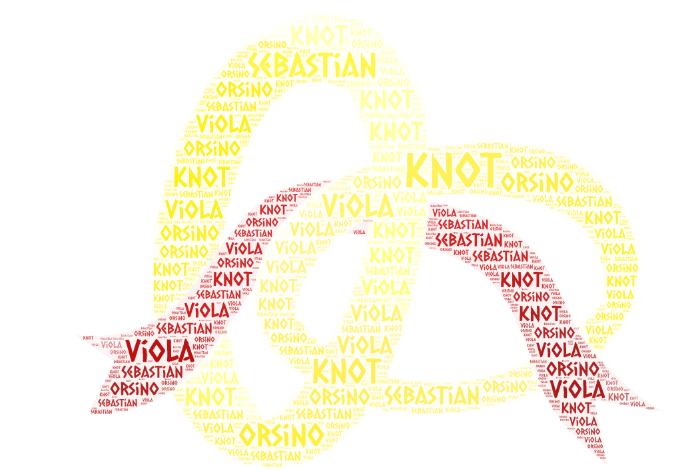
The main image here is the image of the knot- a central image of how convoluted this love triangle is.

Verse

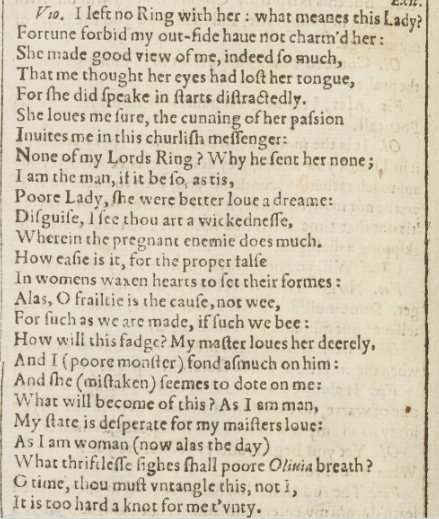
First Folio Reprint from The Boldlien Library.
I left no Ring with her: what meanes this Lady?
Fortune forbid my out‑side haue not charm'd her:
[650]
She made good view of me, indeed so much,
That me thought her eyes had lost her tongue,
For she did speake in starts distractedly.
She loues me sure, the cunning of her passion
Inuites me in this churlish messenger:
[655]
None of my Lords Ring? Why he sent her none;
I am the man, if it be so, as tis,
Poore Lady, she were better loue a dreame:
Disguise, I see thou art a wickednesse,
Wherein the pregnant enemie does much.
[660]
How easie is it, for the proper false
In womens waxen hearts to set their formes:
Alas, O frailtie is the cause, not wee,
For such as we are made, if such we bee:
How will this fadge? My master loues her deerely,
[665]
And I (poore monster) fond asmuch on him:
And she (mistaken) seemes to dote on me:
What will become of this? As I am man,
My state is desperate for my maisters loue:
As I am woman (now alas the day)
[670]
What thriftlesse sighes shall poore Oliuia breath?
O time, thou must vntangle this, not I,
It is too hard a knot for me t'vnty.

It’s interesting to note that (in the First Folio text), the verse alternates between being regular, and using a run-on technique called enjabment, where the thoughts continue after the end of the lines, starting with lines three and four. Ironically, when Viola says that Olivia was distracted and confused when she visited her, her own thoughts are disjointed and fragmentary as she reaches the inevitable conclusion that Olivia is infatuated with Viola in her disguise.

Viola’s Emotional Journey

In the book “Shakespeare’s First Texts” by Neil Freeman he describes how the Folio prints the speech in four distinct sections. Freeman hypothesizes that Shakespeare organized this speech into four phrases that chart the stages of emotions Viola goes through:

Each stage has its own easily identifiable quality, reflecting the growing steps of Viola’s journey in what for her is a huge struggle not only to comprehend, but also to deal with the enormous complications of the dreadful love triangle- the potential results of which are now becomming only too clear.

Freeman, 175.

Stage 1: Introduction

In the first three and a half sentences, Viola goes through the facts- she gave no ring to Olivia, Olivia was eying her, and half paying attention to what Viola was saying. The phrase ends with Viola’s conclusion that Olivia must be in love with her.

Stage 2: Complications

The sentences are of very irregular length- sometimes six words per line, sometimes a few as four. According to Freeman, the irregularity of the verse shows how Viola’s emotions are getting the better of her. Viola could be gasping with remorse over the pain she’s caused Olivia, or shocked at how easily she was taken in by Viola’s disguise.

Stage 3: Crisis/ Catharsis

Each line of this section mentions the people in this love triagle: “My master,” “And I,” “And She,” etc. Viola might be thinking about the possible outcomes to this situation- getting fired, getting discovered, getting married, etc.

Stage 4: Summary: “O Time, Thou Must Untangle This, Not I.”

Like Hamlet before her and Macbeth after her, Viola ends her soliloquy by saying she has no conclusion. She has no idea how to solve this problem, but can only hope that Time will provide a solution.

Audience Interaction

As I said, this is a soliloquy, which is to say, a speech where the character is solo or alone onstage. Some people think this means that the characters are talking to themselves, but I firmly disagree with this notion. One reason why Shakespeare writes soliloquies is because they allow a character to share their thoughts and feelings with the audience. They are the ancestors of every aria or solo in opera and musical theater, and every Disney Princess/ Villain song. I’ve even said before that there are some similarities between Viola and a famous Disney Princess:

Resources:

Illustrations

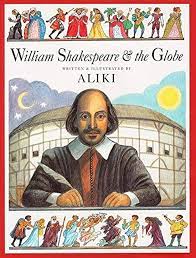
Book Review: William Shakespeare and the Globe

Video Book Review:

Content: 

This is a story of two boys, centuries apart, but united by their love of theater in general, and the Globe Theater in particular. The first is William Shakespeare, whose story Aliki tells from his birth, to his boyhood days, to his rise to prominence in the theater. The second is Sam Wannamaker, the man who spearheaded the project of re-building the Globe Theater from 1949 to the first performance of the Globe in June of 1997. 

Aliki tells this story in the format of an Elizabethan play, dividing it into five acts. Acts I-4 tell the story of Shakespeare’s life while Act V focuses on Sam Wannamaker pursuing his dream. The book concludes with a chronology of Shakespeare’s plays, and a table of his most famous words and expressions, illustrated with adorable characters.

Illustrations: Medium and Style of Illustration

Like many of her books, Aliki’s illustrations are layered and detailed. She uses ink pen outlines to draw her characters, but then fills them in with bright, vibrant colors. She then painstakingly shades them using the crosshatching technique, to create textures that are complex but have a hand-drawn almost impressionistic feel. The characters aren’t ultra-realistic, and the color palette is limited mainly to bright primaries and warm browns, making it look like a child’s box of crayons or colored pencils. This book is designed to appeal to children with its hand-drawn quality. 

Format:

Cover- The cover makes the subject of the book clear to the audience. We see Shakespeare and Globe Theater, but also illustrated moments from his plays. This helps establish that this is not only a biography, it is an introduction to Shakespeare’s plays and poems as well.

Front Matter: The book opens with four pages of quotes from Shakespeare’s plays illustrated with fairies, pipers, and Elizabethan men and women. There is no half-title, no frontispiece and no Half title verso.

Title page verso (copyright page) In the center of the copyright page is an Illustration of Shakespeare standing atop a globe, over the famous lines: “All the world’s a stage, and all the men and women merely players.”  Below the quote in very small letters is the copyright date, a short summary, the ISBN data, card catalog information, and the typography information.

Title Page The title is laid out on a white background with a thin black border. Below the title is an image of a boy (presumably Sam Wanamaker), assembling a paper model of Shakespeare’s globe, with a portrait of Shakespeare in the background. This helps establish that this biography focuses on both Shakespeare and Wanamaker, and makes the reader excited to see the real Globe brought to life in full illustration.

Table of Contents As stated before, the book is organized like an Elizabethan play, so rather than Chapter 1, etc. the book has five Acts with 1-4 scenes in them. Each chapter in the table of contents is labeled with a description that sets the scene; either a location (like London, Stratford, The Globe), or what will happen in the scene (such as “Building” or “Uncovering”). The table then details four appendices that are part of the back matter. 

Preface:  The Preface is referred in the book as an aside, (an Elizabethan theater term meaning something spoken between a character and the audience). This preface acknowledges that, because of the lack of surviving historical information on William Shakespeare, Aliki, like many Shakespearean biographers, has to use some guesswork to fill out the narrative of his life. A second preface (referred to as a Prologue), introduces the story of the book, (namely the lives of Will Shakespeare and Sam Wanamaker). This preface mimics how in Shakespeare’s plays, a prologue would tell the audience what would happen before the narrative started.

Back Matter/ Appendices: There are four appendices in the back matter- A table of Shakespeare’s collected works, a timeline of the book’s events from 1564-1999,  an illustrated list of Shakespearean words and expressions, and finally a list of Shakespearean sites to visit in London and Shakespeare’s home town of Stratford Upon Avon. These appendices show the reader that Shakespeare has an important role in history and in the English language, and encourage the reader to learn more about him. 

Value As an Educational Tool

This story not only tells Shakespeare’s life, it also introduces the reader to his plays and his influence on the English language through the illustrations and frequent Shakespearean quotations. The reader also gains an insight into Elizabethan life and culture by following Will’s journey from Stratford to London. Finally, by juxtaposing Shakespeare’s life with Sam Wannamaker’s, the reader sees Shakespeare through Sam’s eyes as he works his whole life to restore Shakespeare’s Globe to its former glory. The reader develops a love of Shakespeare, (or at least an empathetic respect), and may feel empowered to read more about Shakespeare, see his plays or maybe even become a Shakespearean artist in the future. In short, Aliki’s book brings the world of Shakespeare to young readers in a way that is beautiful to look at, full of insight, and with enough supplemental materials to encourage them to learn more.

Overall Impression:

Like Prospero’s magic in The Tempest, this story is magically told- it is not intended to create a totally realistic representation of Elizabethan life, but to give an exciting, colorful impression of Will’s life and work to the reader. Due to the scant historical details of Will’s life, Aliki chose not to do a standard biography, but, like Shakespeare’s own history plays, to tell a historically authentic story, rooted in truth that brings a time and a place to life, while portraying it an exciting and visually appealing way.

Citation:

Aliki. (2000). William Shakespeare & the Globe. HarperCollins Publishers. 

Crafting a Character: Puck

“Welcome Spirit, How Camest Thou hither?” The sources for Puck

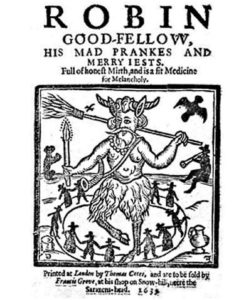
Puck, in medieval English folklore, a malicious fairy or demon. In Old and Middle English the word meant simply “demon.” In Elizabethan lore he was a mischievous, brownielike fairy also called Robin Goodfellow, or Hobgoblin. As one of the leading characters in William Shakespeare’s Midsummer Night’s Dream, Puck boasts of his pranks of changing shapes, misleading travelers at night, spoiling milk, frightening young girls, and tripping venerable old dames. The Irish pooka, or púca, and the Welsh pwcca are similar household spirits.

Britannica, The Editors of Encyclopaedia. “puck”. Encyclopedia Britannica, 21 Apr. 2016, https://www.britannica.com/topic/puck-fairy. Accessed 18 July 2023.

Shakespeare also took inspiration from English poet Edmund Spencer, who visited Ireland in the 1590s and adapted the folklore he picked up into his opera The Fairy Queen, which Shakespeare adapted into A Midsummer Night’s Dream

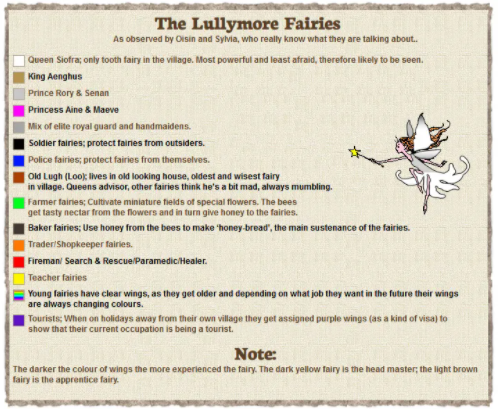
Types of fairies you can “spot” at the Lullymore Park in Ireland:

Puck/Robin’s Dual Nature

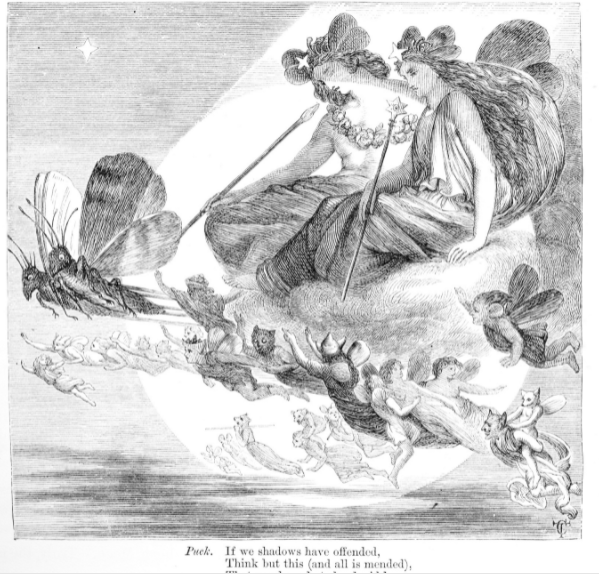
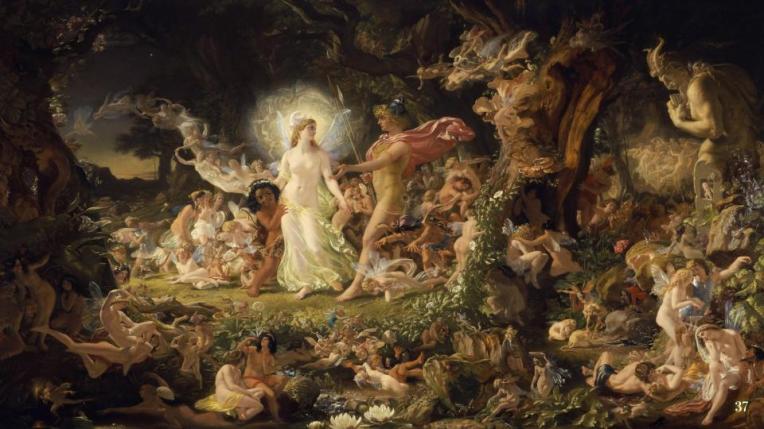
The old stories tell that Fairies are magical creatures who live in hollow places in the earth. Some are benevolent and help give rain and pleasant weather to the Earth, Like the king and Queen of the fairies, Oberon and Titania:

And the mazed world,
By their [the tides] increase, now knows not which is which:
And this same progeny of evils comes
From our debate, from our dissension;
We are their parents and original.

— Titania, (Queen of the Faries), A Midsummer Night’s Dream Act II, Scene i.

Titania in this speech shows great concern for nature, humanity, and the planet. She believes it is the responsibility of fairies, particularly herself and her husband Oberon, to control the elements and keep humans and fairies safe. Some fairies, however, are cruel and enjoy playing tricks on mortals, just like Puck in A Midsummer Night’s Dream, or Queen Mab in Romeo and Juliet.

.

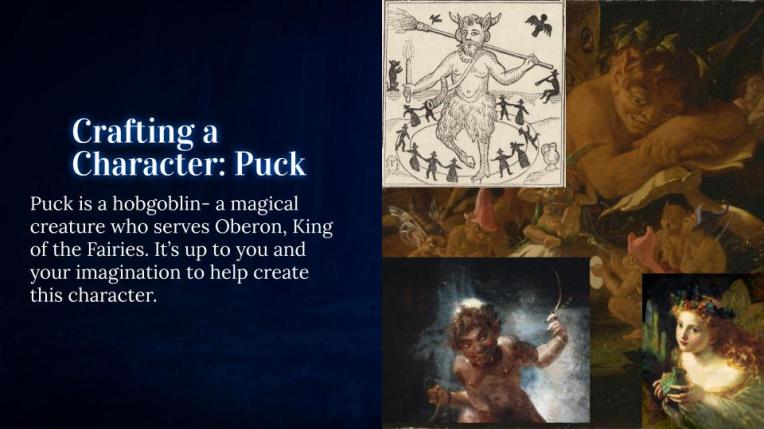
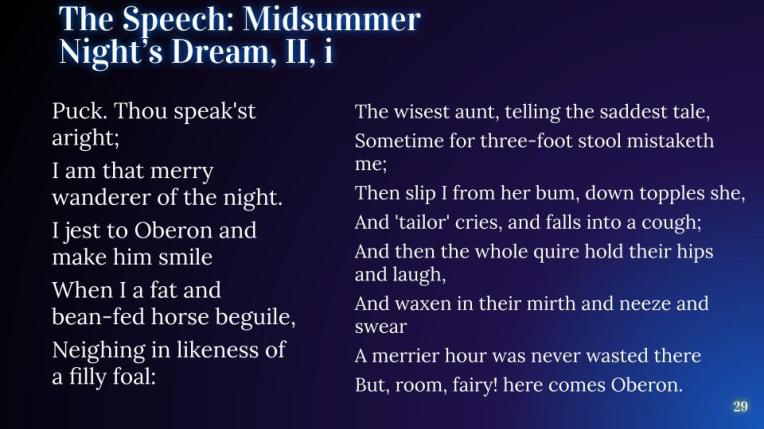
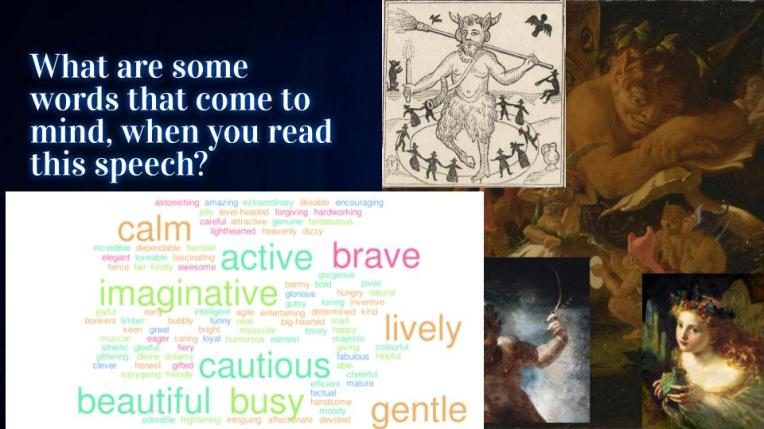
This is a short analysis I created of the tricks Puck plays on people in A Midsummer Night’s Dream, as part of my acting course on Ouschool.com. Note the different ways Puck is portrayed in photos as a satyr, a rotund elf, and sometimes as an almost- demon like figure.

Punishments or contracts with fairies formed a significant part of Goodfellow’s purpose on earth. While he could issue good fortune and support, this was always at the cost of those involved. As Reginald Scot commented, Goodfellow had a ‘standing fee’ of a ‘mess of white bread and milk’, which he expected after supporting housewives with their chores. If his payment was forgotten, Goodfellow was believed to steal from the home that owed him, often stealing grain and milk from the dairy.

Abigail Sparkes, Historic UK.com

Performing Puck

Because Puck is not human, and somewhat ambiguous in the text, an actor can play Puck in many different ways. Generally speaking, actors tend to explore Puck’s attitude toward humans, their love of mischief, and how to translate that physically and vocally

Puck. My mistress with a monster is in love.
Near to her close and consecrated bower,
While she was in her dull and sleeping hour,
A crew of patches, rude mechanicals,
Were met together to rehearse a play
The shallowest thick-skin of that barren sort,
Who Pyramus presented, in their sport
Forsook his scene and enter’d in a brake
When I did him at this advantage take,
An ass’s nole I fixed on his head:

Anon his Thisbe must be answered,
And forth my mimic comes.
So, at his sight, away his fellows fly;
And, at our stamp, here o’er and o’er one falls;
He murder cries and help from Athens calls.
I led them on in this distracted fear,
And left sweet Pyramus translated there:
When in that moment, so it came to pass,
Titania waked and straightway loved an ass!

slideshare id=52829293&doc=randj-150916030030-lva1-app6891]

References:

Shapiro, James. A Year In the Life Of William Shakespeare, 1599. Chapter 6: Things Dying and Things Reborn.

https://www.bbc.co.uk/programmes/articles/3fLDRSY7r9rJhrVFWy99Mly/transcript-shakespeares-restless-world-programme-7

https://www.independent.ie/entertainment/theatre-arts/is-shakespeare-responsible-for-the-stage-irishman-34638347.html

https://www.irishtimes.com/culture/stage/what-ish-my-nation-shakespeare-s-irish-connections-1.2619173

Help Support my podcast

As of right now, if you want to help support the work I do here and my podcast, you can sign up for monthly donations. I have a lot of new ideas for the podcast, but I can’t do them without your support, so please consider being a supporter now!

If you go to my podcast website, there’s now a button that says “Support this Podcast,” where you can choose your monthly rate of contribution, from $9.99 per month to as low as $1 per month! If enough people support this podcast, I’ll start taking requests and giving out rewards to my generous supporters. In short, if you support me, I’ll create content designed to your interests so you can feel that this is YOUR podcast.

Thanks for reading, and please consider donating today!

Close Reading: Lady Macbeth “Come You Spirits.”

For commentary: http://www.bbc.co.uk/arts/yourpaintings/paintings/ideal-portrait-of-lady-macbeth-97937

For the final class of my course on Shakespeare’s Tragedies, I’m coaching two young actors on a pair of tragic speeches I’ve selected, and I thought I’d share some of that work with you. The first is a speech by Lady Macbeth that comes from Act I, Scene v. In this speech, Lady Macbeth prays to dark spirits to make her cold and remorseless, so that she can convince her husband to kill the king, and take the throne.

The Text

Lady Macbeth
The raven himself is hoarse
That croaks the fatal entrance of Duncan
Under my battlements. Come, you spirits390
That tend on mortal thoughts, unsex me here,
And fill me from the crown to the toe top-full
Of direst cruelty! make thick my blood;
Stop up the access and passage to remorse,
That no compunctious visitings of nature395
Shake my fell purpose, nor keep peace between
The effect and it! Come to my woman’s breasts,
And take my milk for gall, you murdering ministers,
Wherever in your sightless substances
You wait on nature’s mischief! Come, thick night,400
And pall thee in the dunnest smoke of hell,
That my keen knife see not the wound it makes,
Nor heaven peep through the blanket of the dark,
To cry ‘Hold, hold!’ Macbeth, Act I, Scene v, Lines 388-403.

The Given Circumstances

Lady Macbeth has just received a letter from her husband. That letter informs her the witches prophesied he would be king. Soon after she’s finished reading it, another messenger, (hoarse and out of breath), tells her that King Duncan will be staying at her castle tonight! Lady Macbeth immediately sees this as the perfect opportunity to make her husband king, by plotting to murder Duncan as he sleeps under her roof.

Traditional Interpretations

I’ve seen at least six productions of “Macbeth” and when it comes to this scene I think the main interpretations I see are either that Lady Macbeth is gleefully evil, or highly sexual. While it is true that she is praying to dark spirits, and her language when she speaks to Macbeth is sexually charged, I feel that these are not the only options when playing this character.

Francis McDormad

I love the regal poise of Francis in this 2021 movie. She is utterly in control and has absolutely no qualms about murder. I get the sense that she’s more praying to Mercury to get her to speak daggers to her husband, instead of to Lucifer to help her use one. She even has knives coming out of her ears (look at those earings!) This Lady Macbeth doesn’t seem evil in the sense of a cartoon villain. She’s just a woman in a violent society who believes that regicide is an acceptable way to sieze power. I think in this world, might makes right.

By contrast, Judy Dench in the 1979 RSC production is also very human. Her spirits are like… well spirits. You get the sense that she’s taking a swig of liquid courage to get her to go through with these actions which SHE KNOWS ARE WRONG.

Literary Devices

Imagery

“The Triple Hecate,” by William Blake, 1794.

Ravens in Greek and Norse myths were birds of prophecy and associated with the goddess of magic, Hecate (who appears in the play in Act IV). Ravens often appeared to announce deaths or execution. The speech is also full of imagery that rejects traditionally ‘feminine’ virtues. Lady Macbeth seems to associate womanhood with kindness, mercy, pity, and remorse and thus attempts to shed her femininity to accomplish her cruel objective of killing Duncan.

Verse

The Rauen himselfe is hoarse,
That croakes the fatall entrance of Duncan
Vnder my Battlements. Come you Spirits,
That tend on mortall thoughts, vnsex me here,
And fill me from the Crowne to the Toe, top-full
Of direst Crueltie: make thick my blood,
Stop vp th'accesse, and passage to Remorse,
That no compunctious visitings of Nature
Shake my fell purpose, nor keepe peace betweene
Th'effect, and hit. Come to my Womans Brests,
And take my Milke for Gall, you murth'ring Ministers,
Where-euer, in your sightlesse substances,
You wait on Natures Mischiefe. Come thick Night,
And pall thee in the dunnest smoake of Hell,
That my keene Knife see not the Wound it makes,
Nor Heauen peepe through the Blanket of the darke,
To cry, hold, hold. Macbeth, Act I, Scene v, First Folio Reprint from Internet Shakespeare Editions.

It’s interesting to note that (in the First Folio text) this speech is only three sentences long. It is a constant build up of energy with only three stops. In addition, Shakespeare puts the most important words, at the end of each line. Almost every line ends with something Lady M wants to kill, such as Duncan, or wants to kill within herself (peace, remorse, nature, Woman(hood). The verse also has commands strewn about in the beginnings and ends of lines. The question is, how confident does Lady Macbeth feel while giving them?

Questions to consider

One of the biggest questions I have with this play is why Lady Macbeth and her husband want to be king and queen anyway? After all, Shakespeare has written plenty of plays that detail how hard and stressful (uneasy) it is to be king. Plus, Macbeth is already a trusted lord and friend of the king, why would he want to damn himself to get a job he knows isn’t his to take? I think that, especially now in the 21st century, it’s very important to have a coherent motive for why the Macbeths are willing to kill for the crown.

Our Interpretation

Looking over the text, my actress sensed a deep loneliness in Lady Macbeth and a haunted feeling that makes her seem desperate to change her life. I thought about how insomnia and paranoid fears are repeated motifs in the play, as well as character traits found in both Macbeth and later Lady Macbeth. Then I thought- Macbeth is a soldier; his wife has probably had to spend years wondering if he is going to come home and imagining what kind of terrible death he might suffer on the battlefield While the king sits safely at home. Perhaps she sees killing the king as a form of revenge for all the fear and sleepless nights she’s experienced, and an attempt to protect her husband from war, by safely placing him on the throne. Maybe she sees this as the only way to make sure her beloved husband never dies in battle. Therefore, instead of watching an evil woman become more evil, you’re watching a good woman, (with good intentions), damn herself for love, which I would argue is a much more active and dynamic choice.

Resources:

https://myshakespeare.com/macbeth/act-1-scene-5

The Origins of King Lear

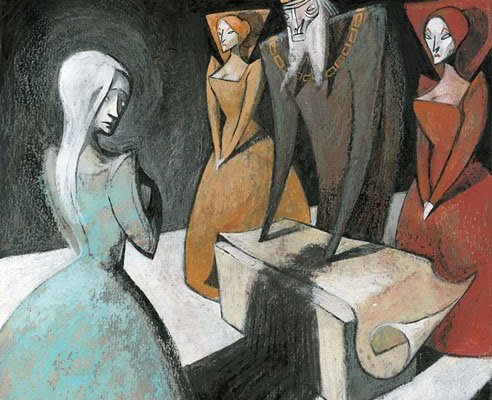
Shakespeare’s King Lear is an age old tale. Like Cinderella it has been reinterpreted throughout time and in many different cultures. Here are a few interesting highlights in the old legend and how it got to Shakespeare in the 1600s.

The Princess Who Loved Her Father More Than Salt

This is an old folktale from my favorite podcast, Journey With Story, which starts with the Cordelia/ Lear plot of a foolish king who banishes his honest daughter. Then through extraordinary circumstances it becomes a Cinderella story. I think at some point these two stories were one and the same until they diverged and one became a story about an absent father and a wicked stepmother, while the other became about a wicked father and a dead mother.

https://www.sacred-texts.com/neu/eng/boeb/boeb05.htm

The ancient ballad of King Leir

The ancient ballad of King Leir, which helped inspire Shakespeare. It serves as a cautionary tale against flattery, and it places equal blame on Lear and his daughters:

And calling to remembrance then
His youngest daughters words,
That said the duty of a child
Was all that love affords:
But doubting to repair to her,
Whom he had banish'd so,
Grew frantick mad; for in his mind
He bore the wounds of woe:

Which made him rend his milk-white locks,
And tresses from his head,
And all with blood bestain his cheeks,
With age and honour spread.
To hills and woods and watry founts
He made his hourly moan,
Till hills and woods and sensless things,
Did seem to sigh and groan.

Even thus possest with discontents,
He passed o're to France,
In hopes from fair Cordelia there,
To find some gentler chance;
Most virtuous dame! which when she heard,
Of this her father's grief,
As duty bound, she quickly sent
Him comfort and relief

The characters of Gloucester and his children, Kent, and the Fool are absent in this ballad, but unlike the fairy tale above, both Lear and Cordelia die in each other’s arms.

The Annonymous History of King Leir, (first published c. 1594)

The anonymous history of King Lear, written shortly before Shakespeare

This play was written for Shakespeare’s rival acting company The Queen’s Men around 1590). Since the Queen was patronizing the company, most of their plays were government-funded propeganda. For instance, it was the Queen’s men who first did a tragedy of the wicked King Richard III.

Michael Wood. In Search Of Shakespeare, 2002.

If you watch the first 20 minutes of the documentary above, you will see that Wood and many other scholars believe Shakespeare must have worked for the Queen’s men, or at least performed their scripts, since they did their own versions of King Lear, Richard III, King John, and Henry V.

Screenshot from Internet Shakespeare Editions’ reprint of King Lear https://internetshakespeare.uvic.ca/doc/Leir_M/index.html

However Shakespeare got a hold of The Queen’s Men’s scripts, he didn’t adhere to them rigidly. Their King Lear follows the fairy-tale / history format of having Cordelia be banished, disguise herself as a peasant (like Cap ‘O Rushes in the earlier version), and eventually she is restored to her rightful place. Shakespeare’s version must have been a MASSIVE shock to anyone who read these old tales and ballads. In Shakespeare’s version, everyone dies and there is no guarantee that the kingdom will survive. Every other tragedy ends with a new king or emperor to take over the kingdom but Lear leaves the audience with a sense of apocolypse; that Lear’s madness and Edmund’s machinations have doomed England and all these characters’ lives will be erased by Time.

As pessimistic as Shakespeare’s Lear is, it does seem more true to life than the previous versions. Perhaps this is because of a legal case from 1603 that might have inspired Shakespear to adapt the story: In 1603, two daughters tried to have their father declared insane. By an astonishing coincidence, the third daughter, who protested, happened to be named Cordelia! Perhaps Shakespeare, (who had three children and was preparing to retire), might have been inspired by this case and worried he might suffer the same fate.

Did Shakespeare use visual effects?

Stagecraft has a fascinating and interesting history. The way we portray spectacle on stage has changed a lot since the advent of television and movies, which utilize computers and animatronics, etc. to create impossible things that could never be is shown live. In a way, the pre-recorded nature of film and TV gives theater practitioners an advantage because the more clever they are with their stagecraft, the more impressive it is for the simple fact that it is live- happening right now in front of an audience.

What I want to do with this post is to speculate whether, with the technology of the time, if Shakespeare could have used some kind of visual spectacle to portray otherworldly creatures, such as the ghosts in Hamlet and Macbeth

The conventional wisdom

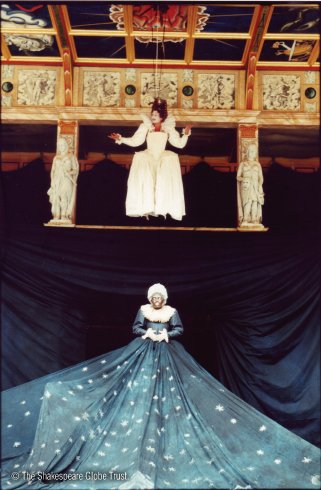
Contemporary accounts of the Globe theater mention two trap doors, one in the ceiling for angels and gods, and one in the floor for ghosts or devils.

Most books I’ve read on Elizabethan stagecraft say that the theaters of this era were very minimalistic in design. They had trap doors, they had galleries, they had a primitive flying rig, and they had music and some simple sound effects, but most of the experience was watching the actors, their costumes, their bodies, and hearing their voices hence ‘audience’- audio, “To hear.”

Professor Stephen Greenblatt of Harvard University explains the way the ghost probably haunted the Globe Theater in 1600.

We are told there wasn’t much visual representation of spectacle and fantasy on Shakespeare’s stage, which which is is odd because there are some pretty fantastical elements in his plays, especially Hamlet and Macbeth, where the former calls for a ghost and the latter calls for a ghost, witches, and a literal goddess to appear on stage. How may one ask, was this achieved back in Shakespeare’s day, the late 1590s and the early 1600s? The conventional wisdom is that the ghosts in Hamlet and the ghost in Macbeth came through a trap door in the stage known as Hell.

If you’re you go to the Globe now you can see this actual trap door being used. It used a primitive pully system to open up in the middle of the floor. The ghost would ascend to the stage through a small step ladder. Hamlet’s father’s ghost is described as wearing a suit of armor and being very pale. Banquo’s ghost is described as having long hair dappled with blood.

Banquo’s ghost appears during a banquet in Macbeth’s honor. Based on this hypothesis it’s likely that a banqueting table was brought out into the middle of a stage to conceal the ghost, to make it more of a surprise when it ascends onstage through the trap door, but the effect to modern taste would be rather dull. However impressive the performance, this cannot stand up to the stunning nature of visual effects using computer technology, motion capture, et cetera. I wanted to see if there are any Elizabethan theatrical illusions that would still have been accessible to Shakespeare back in the 1590s.

Idea #1: A Smoke-monster ghost?

My research began with this video from the YouTube History Channel Atun-Shei Films, where the author traces the history of film, (both as photography and film as a projection). He cites at the start, an incident in 1536 where a supposed necromancer appeared to conjure a ghost for an unsuspecting rube. According to The Lives Of the Necromancers, the solution was achieved by creating huge clouds of smoke within the theater space, (which was the Colosseum) and then using a primitive camera obscure to project a frightening image Into this space.

Sketch for an early camera obscura, dated 1544 by Leonardo Da Vinci.

Camera Obscura is a term is it Latin for dark chamber the principal had been discovered for century had existed for centuries bit is for centuries but only in the 1530s this was the 1st recorded example of it being used to create a theatrical illusion.

The question is, could Shakespeare’s company have performed the same illusion with the technology of the day? Honestly, I find it rather unlikely that Shakespeare’s audience would’ve put up with huge clouds of smoke in a wooden amphitheater. Still, the fact remains that primitive projection technology existed back in Shakespeare’s day, which means a director could reasonably implement it in a production of Hamlet or Macbeth, even under the constraints of Original Practices.

Banquo’s ghost in Macbeth

So the question remains, is there a visually striking way to represent the ghosts that could actually work in Shakespeare’s theater. My first idea is…

Idea 1: Glow In the Dark Paint

Paul Scoffield as The Ghost in Hamlet (1990, dir. Franco Zefirelli). Notice that he appears to glow pale blue.

Glow-in-the-dark paint wasn’t invented until 1908, but there are some rocks that naturally glow such as hackmanite and phosphorus.

https://www.sciencealert.com/scientists-have-figured-out-how-this-natural-stone-glows-in-the-dark/amp

Theoretically, Shakespeare’s company could have crushed this rock into a powder and made it into a paint that glowed onstage. There is precedent for this- in The Hound Of the Baskervilles, Sherlock Holmes discovers that the terrifying ghost-hound is merely a large dog painted with phosphorescent paint:

In mere size and strength it was a terrible creature which was
lying stretched before us. It was not a pure bloodhound and it
was not a pure mastiff; but it appeared to be a combination of
the two–gaunt, savage, and as large as a small lioness. Even
now in the stillness of death, the huge jaws seemed to be dripping
with a bluish flame and the small, deep-set, cruel eyes were ringed
with fire. I placed my hand upon the glowing muzzle, and as I
held them up my own fingers smouldered and gleamed in the darkness.

“Phosphorus,” I said.

“A cunning preparation of it,” said Holmes, sniffing at the dead
animal. 

Doyle, Part IV.

Though this paint would potentially make a terrifying effect, this would be impossible at an outdoor theater during the day. This makes it unlikely that Shakespeare used glow-in-the-dark paint at the Globe, as most of the performances took place in the afternoon. That said, both Hamlet and were written just at the point in which Shakespeare’s company was in the process of acquiring an indoor theater, the Blackfriars.

The Blackfriars and Shakespeare’s stagecraft

Almost all of these ideas would depend on Shakespeare having access to a theatre in which he could control the lighting. As you can see, the Blackfriars was lit with candles and its indoor nature meant that performances weren’t dependent on sunlight. Greg Doran, former director of the Royal Shakespeare Company has theorized in the past that maybe while his company was preparing to move into the Blackfriars, Shakespeare was changing his material to make it both literally and figuratively darker.

In the reconstructed Blackfriars, (where I studied and interned for three years), there is a trap-door and flying rig like the Globe, so the conventional trap-door ghost can and has been utilized there. I would also argue that in the Blackfriars unlike the Globe, there was a chance for more variety of theatrical illusions- perhaps a smoke projection, magic lantern, or even…

Idea 3: A Pepper’s ghost

A Peppers Ghost is a stage illusion that dates back to the 19th century. It uses the principle of refracted light to project the image of a ghost on top of a piece of glass. This image will appear translucent and could be very impressive to an audience at the Blackfriars! As you can see in the diagram below, the actor could be under the stage in the trap door standing in front of a mirror, and the glass sheet could be used to project his image to the audience. The only concern would be that this could limit the blocking of the other actors, and it might not make the ghost visible to the audience members in the upper galleries, but it would still be an impressive visual effect that uses scientific principles known in the 17th century.

Pepper's ghost diagram
Pepper’s ghost diagram.

Pepper’s Ghost illusions are still used frequently in theme parks, trade shows, and concerts where singers interact with “holograms.” As a special Halloween treat, (or trick as the case may be), I’ve included a video that will allow you to make your own Pepper’s ghost at home. If you choose to make one, leave me a comment!

So, in conclusion, though we are taught that Shakespeare’s theater often reveled in simplistic theatrical designs, I personally think that there is more room to explore low-tech theatrical illusions like these, especially at companies like the Globe Theater and the American Shakespeare Company, which pride themselves on using Shakespeare’s original staging practices. Live theater has dodged giving up its ghost for 2,000 years by exploring the limits of live theater through movement, voice, story, music, and yes spectacle. I think theater practitioners, even Original Practitioners should keep innovating new kinds of spectacular means to keep creating fresh interpretations of Shakespeare, that still keep within the spirit of the play’s original time and place.

Bonus: If you want to learn more about the stage illusions of Shakespeare’s company, click here to listen to That Shakespeare Life Podcast with Cassidy Cash. In this episode, she interviews theater professor Frank Mohler, who describes how thunder and flying effects were done in the 17th century, using records of the period, and his own experimentation.