

movies
Review: Kenneth Branaugh’s Henry V

Since July is my month to celebrate Shakespeare’s Henry V, I’d like to talk about one of the most celebrated versions of the play, Kenneth Branaugh’s Academy Award Winning film from 1989.
The Concept
Like many directors trying to re-adapt an old story, Branaugh began by looking at Sir Laurence Olivier’s 1944 movie version of Henry V, deliberately inverting a lot of Olivier’s choices.
Olivier’s version has a framing device where the audience watches the play in a movie-set recreation of the Globe Theater, (since Henry V was probably the first play ever performed when the Globe originally opened in 1599). For the first 30 minutes, you are not watching a movie but a filmed play, albeit one where your fellow audience members are dressed in costumes from 1599.

While watching the play within a movie, and seeing ‘audience members’ clap and cheer for Henry, and boo and hiss the French, you get a keen sense of the theatrical illusion of the play, and its importance to English patriotism in 1599. This makes sense since the film itself was commissioned by Winston Churchill to help raise morale during the D-day invasion in 1944.
While Olivier’s film is theatrical and patriotic, Branaugh’s is cinematic and introspective. His film opens on an empty movie set with the Chorus (Derek Jacobi), giving us a tour of the set. He laments that, even with all the cinematic wizardry of modern movies, this movie cannot capture the true glory of Henry V.
Branaugh’s performance as the titular king is also quite different from Olivier’s. While Olvier is jovial and charismatic, Branaugh’s King Henry switches between cold and calculating, to intensely passionate. This isn’t to say that his acting is bad; but that Branaugh’s King Henry is a self-conscious actor. The king changes his performance to suit the scenario he’s in: diplomatic and calculating in the throne room, demented and violent on the battlefield, calm and confident with his troops, and pious and merciful in victory.
When I studied the play in college, my teacher posited whether Henry V is a Machiavellian king, and I think Branaugh’s certainly is, in that he knows kingship is a job; one that requires the king to constantly playing roles to get what he wants from people- love, awe, respect, or fear. He’s so good at acting, he even teaches his soldiers how to act like fearesome warriors in his famous “Once More Unto The Breach” speech.
What really sets Branaugh’s movie apart from Olivier’s is the way he handles battles. Again, Olivier in 1944 wanted to raise morale during WW2, when British soldiers were actually invading France to supplant a tyrant. Branaugh in 1989, had seen the world’s response to the Vietnam War, and the decades-long violence in his home country of Ireland. Therefore his version literally takes a dim view of war in general.
Branaugh’s world is not colorful or cheerful- the council scenes are full of candlelit shadows. Branaugh’s fireside chat with his soldiers is a smoky, shadowy look into the terror of men who know they must fight and die tomorrow. Look at the excellent performance of Michael Williams (Judy Dench’s late husband), who takes the king to task while looking at the campfire, almost as if he can see the fires of hell, coming for the English:
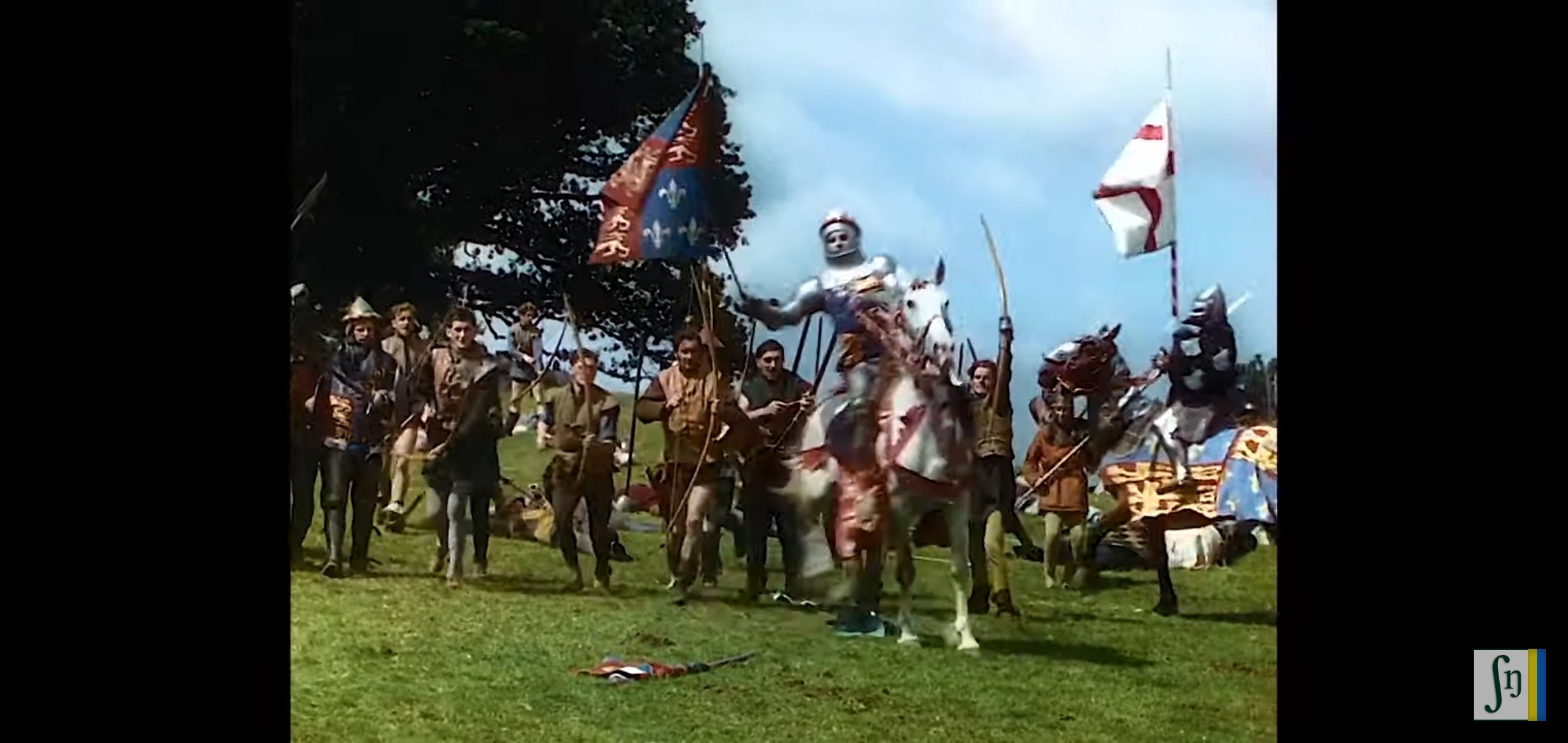

The most striking difference between the two films is how both directors stage The Battle of Agincourt. Olivier’s is a sun-kissed charge on white horses. Branaugh’s is a grimy, mud-stained mess, overcast with a fog of moral ambiguity. Even though the English win, they are meant to question whether or not they have been fighting for a worthy cause. Even after the King proclaims victory for God and country, and the music swells with the gorgeous notes of Non Nobis Dominine (composed and sung by Patrick Doyle), Branaugh has a long tracking shot of all the bodies slain on both sides in the battle. This is the film in a nutshell- a wonderfully acted, exciting, cleverly done thrill ride, that still pulls back and shows the inherently grim and destructive nature of war, that defiles all it touches.
The Plot Of the Play
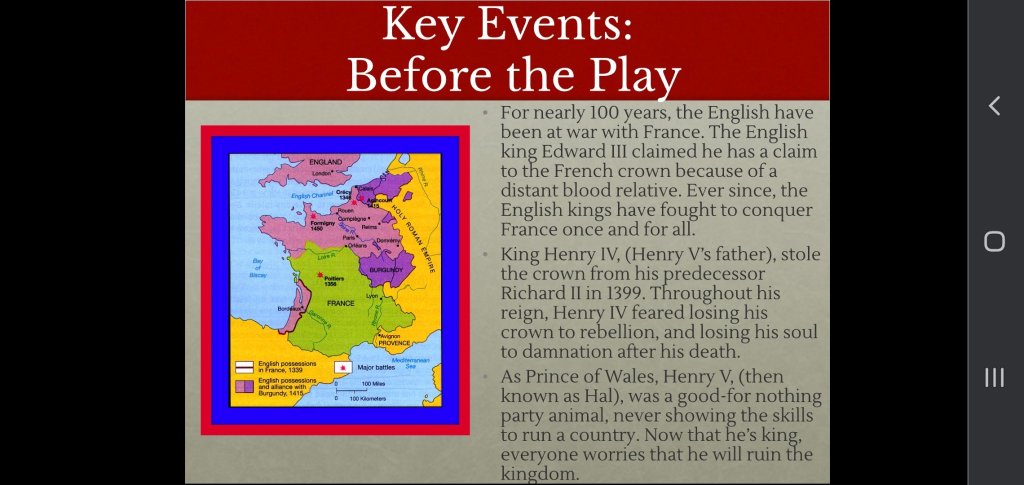
- King Henry takes the throne in 1413 after his father dies. No one thinks he will run the country effectively.
- The Dauphin (the French Prince) provokes Henry into declaring war with France, (thus allowing him to claim the right of his predecessor, King Edward III).
- Henry fends off the French at Harfleur, despite the fact that they are shooting at him with cannons.
- Henry’s army starts getting sick. Henry decides to start heading back to Calais
- The French raise a massive army and it marches towards Agincourt. Mountjoy the French herald warns Henry he will be annihilated and urges him to pay the French a ransom if he is captured. Henry refuses and marches his troops to battle the French at Agincourt.
- Against all odds, Henry’s army defeats the French at Agincourt, with only about 30 English deaths, and over 10,000 French.
Henry and the French King make peace, and the play ends on a joyous celebration of peace and matrimony, though the Chorus also reminds us that once King Henry dies, his son will lose France and England will be torn apart by civil war.
Historical Context
My Favorite Moments
I love Branaugh’s performance and his take on the Battle of Agincourt, but I’d be remiss if I didn’t mention some of the other performances and moments of the play.
- Armed Ultimatum: In this wonderful scene, we first see the overconfidence of the French, especially the hot-tempered Dauphin (Michael Maloney), who admits that he deliberately goaded Henry into declaring war because he wishes to personally fight with King Henry. His father the King, (played by Paul Scoffield) is a timid, melancholic individual, (historians often called him Charles the Mad), and he seems like an easily manipulated monarch, ripe for conquest by King Henry. We then see the imposing figure of the Duke of Exeter (Brian Blessed), who comes in full plate armor to warn the French that though the French outnumber the English, the English are a hardy and powerful people, and that King Henry will not stop until all of France is his.
Supporting Cast
Branaugh mainly casts his movies out of his Renaissance Acting theater troupe, which is why in almost all his movies you see familiar faces like Brian Blessed, Derek Jakobi, Richard Clifford, Richard Easton Michael Maloney, Paul Gregory and Geraldine McEwan. As someone who’s seen all of Branaugh’s Shakespeare movies, I get the curious sensation that I know these people, trust them, and find myself rooting for them since I saw them in other roles. Maybe Branaugh hoped his longtime viewers would be concerned for the lives of his “Band of Brothers.”
Welcome additions include Micheil Williams as Williams, as well as his wife Judy Dench as Mistress Quickly. These actors are just as home playing grubby common English peasants as they are playing kings and queens.
Emma Thompson and Geraldine McEwan sparkle onscreen as the French Princess Katherine and her maid Alice. The first time I saw the film, their French was so good, I didn’t believe it was really them! Likewise, the awkward wooing scene between Thompson and Branaugh (who were married at the time) is so charming, you forget all the violence and atrocities that happened on both sides earlier, and giddily enjoy their romantic banter.
My Reaction
In short, Branaugh created, at least for now, the definitive Henry V for our times. It is a world where war is not glamorous and rarely just. Where common men die and rich men survive, though they must carry their sins on their back,( just as Branaugh carries the young boy played by Christian Bale). Yet it is also a story about the power of great leaders overcoming adversity, caring for their subjects, and doing the best they can to bring peace and stability to their people.
Bonus: Here’s an interview with Branaugh about the process of creating the film:
May the Fourth Be WIth thee- here’s why Falstaff is like Boba Fett
In 1978, a “holiday special’ was released under the Star Wars umbrella. Today it is universally panned as the worst Star Wars product ever conceived. It is tonally completely different from Star Wars and it spends most of its time either in a bar on Tatooine or on Kashik with Chewbacca’s family; characters we don’t know, can’t understand, and have no influence on the larger Star Wars Universe!
The only bright spot in this tragic black hole of a time-wasting special, (at least according to most of the internet), was that this special brought back the character of Boba Fett, the cool, anti-heroic bounty hunter who is constantly deceiving our heroes. As you can see, they changed the format into a cartoon, so that’s a little bizarre, but it was nice to see an old friend in this otherwise who’s who of lame new characters.
THIS WAS NOT A NEW IDEA, EVEN FOR 1978,
In around 1598 (allegedly), Queen Elizabeth the first asked William Shakespeare to write a comedy about Sir John Falstaff, the fat cowardly comic center of the Henry IV plays. The Queen wanted to see a comedy about Falstaff in love, which Shakespeare allegedly completed in a few short weeks.
Ant the result, was the Star Wars Holiday Special of the Shakespearean Cannon.

Unlike Henry IV, which is a complex history play about rebels going up against an empire (Henry IV claimed part of France so that counts :), Merry Wives a silly comedy set in the country town of Windsor. Just like the Holiday Special, Shakespeare’s comedy has a totally different tone than the other plays that feature Falstaff.
I think Shakespeare wisely didn’t try to make Falstaff a romantic figure- that would be absolute character assassination. What he does instead is take Falstaff’s ability to sweet-talk women and his penchant for thievery, and make the play about his attempts to seduce two virtuous housewives and steal their money. Just like how Boba Fett was not changed into a good-guy to pander to audiences (yet), but instead, Lucas made him a cunning deceiver who tries to sell out our heroes to Darth Vader.
Though Falstaff himself works within the context of the play, most of the new comic characters are very dated and not very funny. Dr. Caius and the Welshman are written with outrageous accents making them as incomprehensible as alien bit players in Star Wars. Frankly, I’d rather kiss a Wookie than listen to these losers try to woo Mistress Page’s daughter. It’s like Shakespeare cut and pasted the worst scenes from Taming Of The Shrew and added a French accent.
Even more boring are the scenes at the Garter Inn- a place that must’ve had significance for knights in the 1590s, but nowadays is somewhat forgettable, (like the Cantina, deal with it NERDS!)
The one really good part of the play is this scene in Act II, Scene I where Mistress Page and Mistress Ford simultaneously receive letters of “love,” (which really means ‘I want sex and your money), from Falstaff. The ladies are incensed for a couple of really good reasons:
A. It’s Falstaff- a fat, old, penniless knight who is well known as a drunk.
B. They’re already married, and he has the pudding guts to assume they’d betray their husbands.
C. If they were to cheat on their husbands, THEY WOULDN’T DO IT WITH FALSTAFF
D. The love poem he writes them is terrible. If he wanted these virtuous wives to cheat on their husbands for someone as completely undeserving as him, he could’ve at least put some effort into it!
I would also argue that the worst thing about the Holiday Special became the best thing about Merry Wives: the songs!
The most egregious change to the tone of Star Wars that the Holiday Special made was putting in a bunch of terrible musical performances by people like Jefferson Starship (get it?) to make the special more of a variety show with the Star Wars characters slapped on top of it like a sticker on a lunch box. Now we know what it sounds like when Princess Leia sings a song that clearly required a second draft:
Luckily for Shakespeare, instead of Jefferson Starship, he got opera composer Otto Nikoli, who saved this mostly terrible play by turning it into a charming opera! Look at this duet from Act I!
A lot of the more absurd plot points of Merry Wives work extremely well as musical comedy shtick, and Falstaff himself works very well as a big basso profundo
So if you go to see Merry Wives, know that it’s not a very good play by Shakespearean standards. It’s silly, kind of pointless, and not a very good addition to the story of Falstaff, but much like the Star Wars Holiday Special, it’s sure to make you laugh:
Intro to Richard III
Hi everyone,
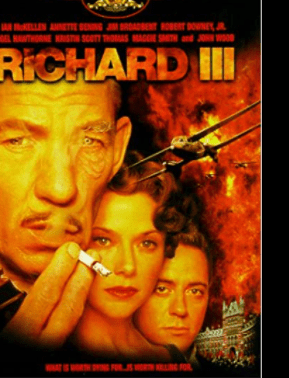
Introducing our new Play of the Month: Shakespeare’s dark history play about murder and corruption, Richard III. First, a short presentation I made that introduces the characters and themes of the play.
Second, a quick, funny summary of the play from the Reduced Shakespeare Company
And finally, this incredible animated version of the play, which looks like a stained-glass window come to life!
Crafting A Character: Malvolio

The venerated Shakespearean actor, Sir Antony Sher, once said with frustration while he was acting at the RSC that, “even the best Feste is less funny than the worst Malvolio.” I actually have a rare insight into these two roles since I’ve played them both! So allow me if you will to present you with some insights I’ve gained into these two characters that are very much polar opposites. Although they are as different as night and day, they form the central comic premise of the whole play, and have some truly hilarious moments!
 Me. as Malvolio, Wooster. High School 2002
I played Malvolio when I was a senior in high school; he was my first principal Shakespearean role. My director chose to set the play in the 1940s and he re-purposed the kingdom of Illyria as the Hotel Illyria, with Malvolio as the concierge or lead butler in charge of all the hotel maids and other housekeepers. This not only made the play more accessible to a 2002 audience, it also really helped me understand Malvolio’s role: he is first and foremost a snob who is obsessed with efficiency and pleasing his mistress Olivia (in this version the owner of the hotel). I would soon also discover that, although Malvolio is certainly snobby and can be a bit of a killjoy, he also has qualities that make him appealing to everyone who has ever felt put down or bullied, and that’s what makes him a complex and endearing character today.
 Richard Briars as Malvolio
Some notes on the character: Malvolio’s name means “unsatisfied desire”- somebody who aspires to be what he is not. I find the relationship between Feste and Malvolio interesting because the two are partially defined by how each one is unlike the other. Feste is a clown, hired by the nobles to help them have a good time. He is described as “a merry fellow who cares for nothing.” In other words, Feste never takes anything seriously, except making a living with his jokes and songs. Malvolio is the exact opposite- he is also a servant, but he is a steward, in charge of running the Countess Olivia’s household. As such, he is obsessed with efficiency, commanding respect, and pleasing his mistress through his obsequious manner.
Like the Joker and Batman, both characters live according to an opposing viewpoint; Feste is a chaotic, happy-go-lucky sort, while Malvolio has a strict code of behavior which he expects everyone to follow. Their opposing world views bring them into conflict every time they meet. Plus, in most productions Feste is wearing brightly colored clown apparel or “motley wear,” while Malvolio is dressed in black. I’m not saying Malvolio is anywhere near as cool as Batman, but Malvolio can be just as sanctimonious. His journey is how he goes from being the trusted household servant, to a raving madman, to at last the Spectre at the feast at Olivia’s wedding.
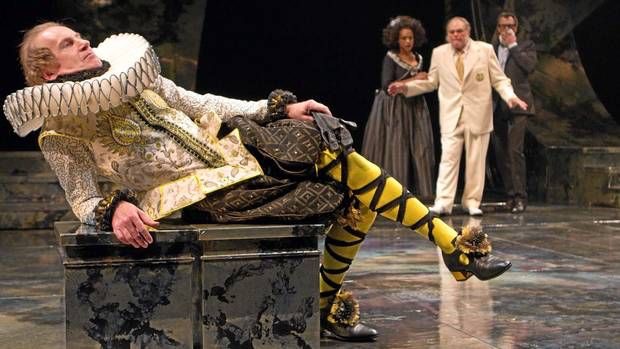
I think the appeal of the character, which balances out the aforementioned snobbery, is that Malvolio is also a nerd: he dreams of becoming a count, he tries to make friends, but he does so by working far too hard at his job and not knowing how to fit in. This is why we inevitably feel sorry for him at the end of the play when he begs to know why his tormentors have locked him in a dark room, treated him like a lunatic, and made him think his lady was in love with him only to utterly destroy his hopes. The balance between the Nerd and the Snob that makes Malvolio a universal and complex part, and that’s why some of history’s greatest actors have played it!
Prepping for the Role: Alec Guinness, Laurence Olivier, Patrick Stewart, Donald Sinden, Nigel Hawthorne, Richard Briars, Steven Fry- these are just some of the names of actors who have played this part over the years. The first actor to play the role was Shakespeare’s leading actor, Richard Burbage, who also played Richard III, Hamlet, and Macbeth. Here’s a sample from Burbage’s famous eulogy, which mentions some of his most famous parts:
A Funeral Elegy
On the Death of the Famous Actor, Richard Burbage,
He’s gone, and with him what a world are dead,
Friends, every one, and what a blank instead!
Tyrant Macbeth, with unwash’d, bloody hand,
We vainly now may hope to understand.
Brutus and Marcius henceforth must be dumb,
For ne’er thy like upon the stage shall come,
Vindex is gone, and what a loss was he!
Frankford, Brachiano, and Malevole.
One big decision that every Shakespearean actor needs to make is how to approach their role in a different way. To be honest, I was kind of a thief with my Malvolio- one of the first things I did was read a book by actor Sir Donald Sinden where he talks about how he delivered Malvolio’s first line, which occurs in Act I, Scene iii:
Olivia. What think you of this fool, Malvolio? doth he not mend?
Malvolio. Yes, and shall do till the pangs of death shake him:
infirmity, that decays the wise, doth ever make the 365
better fool (Act I, Scene v).

Sinden described his first line as a snobby “nyess,” as if he were simultaneously bored and embarrassed by Feste’s jokes. The director told me to act around Feste as if I were the villain in a Charlie Chaplin movie- basically to bully Feste and make him feel very small with my lines, in order to justify the revenge Feste innevitably takes on him. Like any character in Shakespeare, this is only one way to play the role, so you don’t have to agree with me.
The Gulling Scene
Malvolio’s most famous scene is called “The Gulling Scene,” the scene in which he’s tricked into thinking Olivia is in love with him. This is the moment where Malvolio goes from being a respectable prudish servant, into a raving madman. He enters full of dreams and plans to become “Count Malvolio” and creates an elaborate fantasy of what his life would be like if he married the Countess.
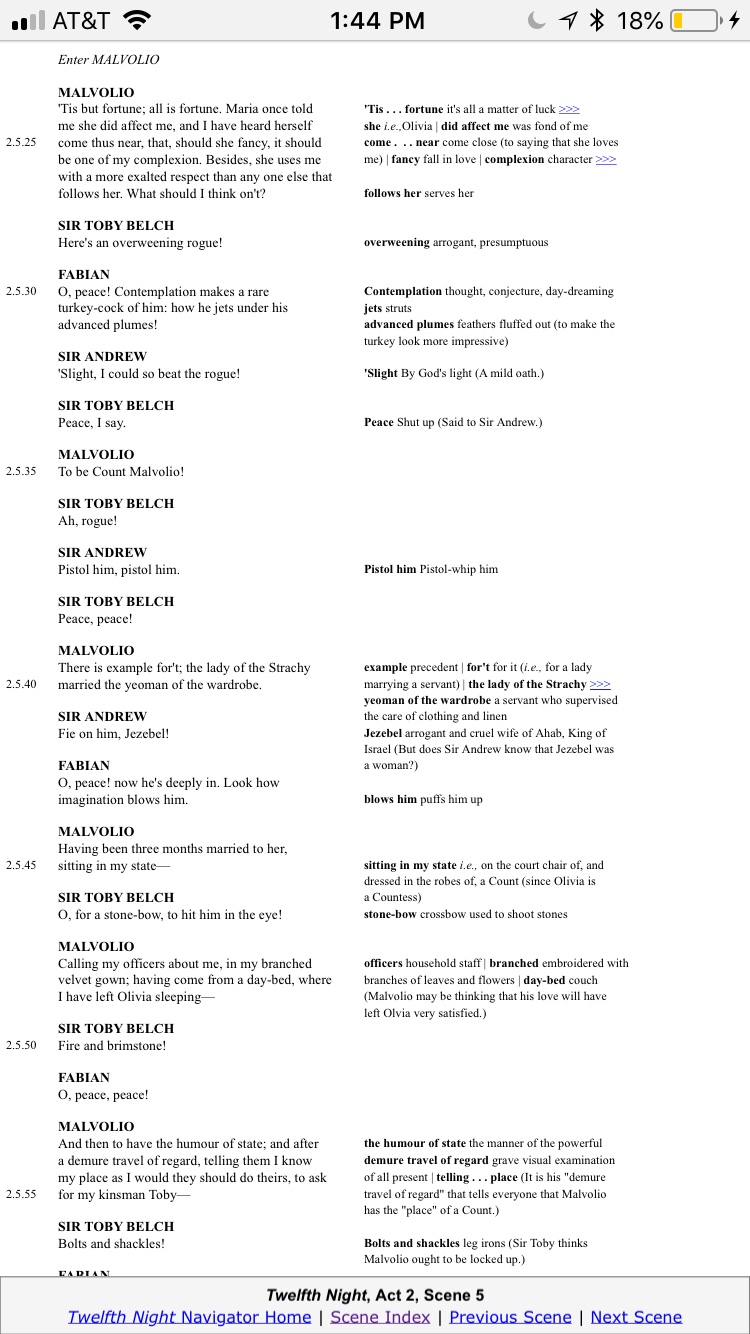
Act II Scene v. From Shakespeare Navigators.com
No sooner does Malvolio compete his fantasy of marrying Olivia, when lo and behold, a letter from her suddenly appears! Of course, the audience knows it’s all a trap and even worse, Sir Toby, Sir Andrew, and a boy named Fabian are watching him! It’s a moment of exquisite comedy that’s nearly impossible to get wrong.
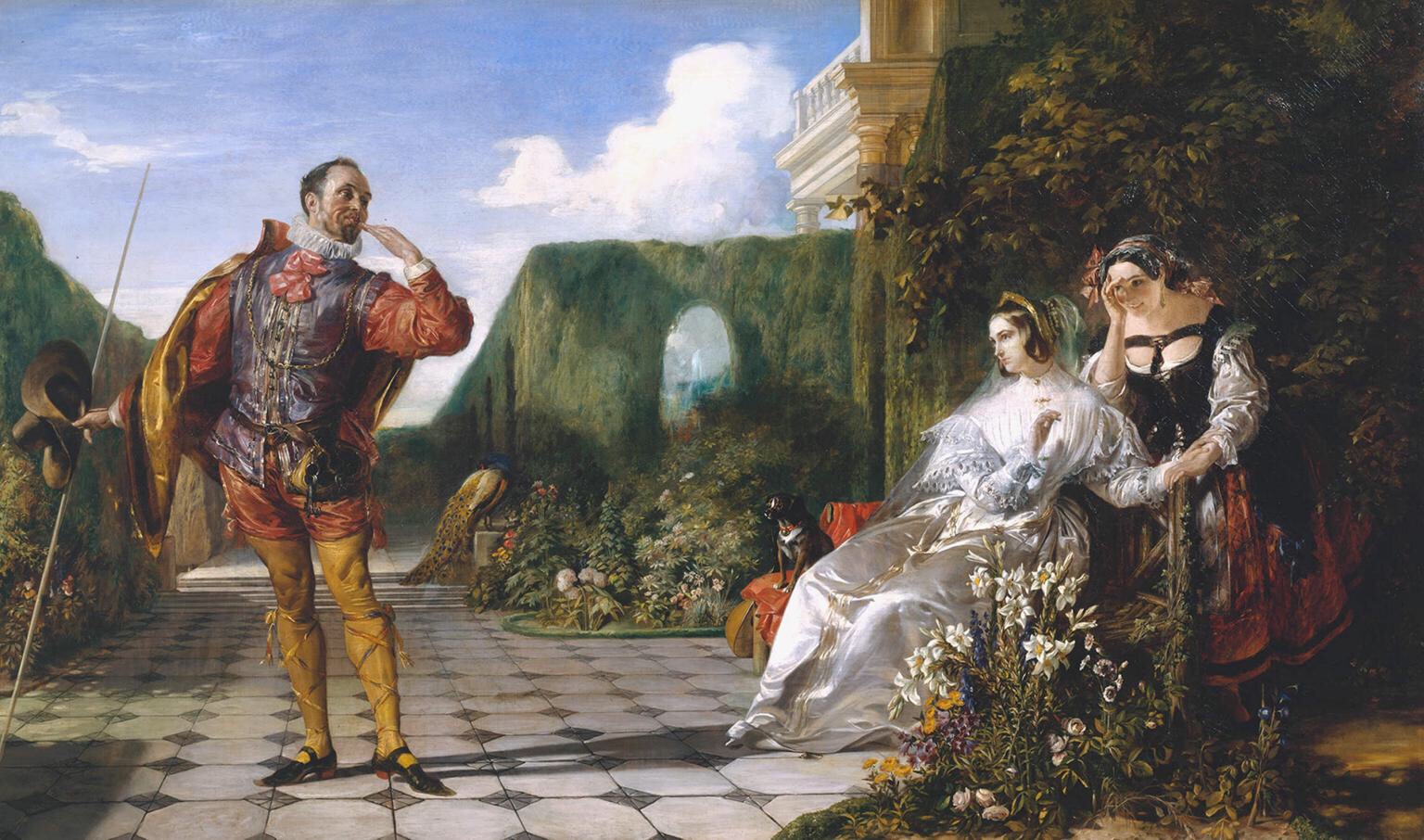
Malvolio and the Countess, 1840 by Daniel Maclise
One question I had when I did the scene was whether Malvolio really loves Olivia, or just loves her riches and her title. As a high schooler, I chose to believe that he really does have a crush on Olivia, but is too socially awkward to tell her. Having the letter is a chance to make his feelings known, which Malvolio can get very genuinely excited about! On the other hand, as you can see above, Malvolio might just be greedy to make himself even more respected and admired, and to have the power to throw out the likes of Sir Toby, Sir Andrew, and Maria. Malvolio’s revenge fantasy is also fun to watch, since we know he’ll be punished for it later.

Part of the fun involved in the scene is that it’s basically a “play within a play,” a device that Shakespeare used to great effect in Hamlet, A Midsummer Night’s Dream, Love’s Labor’s Lost, and both parts of Henry the Fourth. I think it’s the charm of seeing a character as he really is, Malvolio shows you his fantasies and creates a whole world in the middle of the orchard. Meanwhile, you feel complicit as you watch the people watching him, who could just as easily be part of your audience.Workshop on Twelfth Night and Bullying
On the other hand, the scene has also been called an example of bullying, since Sir Toby and Maria are using the letter to manipulate then humiliate Malvolio. Remember, Malvolio dresses like a fool and act like a fool in front of Olivia in Act III because he believes it will please the Coubtess. Basically Toby and Maria are Catfishing Malvolio, which can seriously hurt psychologically, as anyone who has been deceived over the internet knows. Plus, it ruins Malvolio’s reputation as you can see in this clip:
Again, as a teenager, I could certainly relate to a man making a fool of himself in a vain attempt to impress a girl. Seeing a man lose his head over a girl and then have her break his heart over a prank, is in some ways truly terrible to watch; even Olivia agrees by the end of the play that the joke has gone too far.
Malvolio. Madam, you have done me wrong,
Notorious wrong.
Olivia. Have I, Malvolio? no.
Malvolio. Lady, you have. Pray you, peruse that letter.
You must not now deny it is your hand:
Write from it, if you can, in hand or phrase;
Or say ’tis not your seal, nor your invention:
You can say none of this: well, grant it then
And tell me, in the modesty of honour,
Why you have given me such clear lights of favour,
Bade me come smiling and cross-garter’d to you,
To put on yellow stockings and to frown 2550
Upon Sir Toby and the lighter people;
And, acting this in an obedient hope,
Why have you suffer’d me to be imprison’d,
Kept in a dark house, visited by the priest,
And made the most notorious geck and gull
That e’er invention play’d on? tell me why!
Olivia. Alas, Malvolio, this is not my writing,
Though, I confess, much like the character
But out of question ’tis Maria’s hand.
And now I do bethink me, it was she 2560
First told me thou wast mad; then camest in smiling,
And in such forms which here were presupposed
Upon thee in the letter. Prithee, be content:
This practise hath most shrewdly pass’d upon thee;
But when we know the grounds and authors of it, 2565
Thou shalt be both the plaintiff and the judge
Of thine own cause.
That’s the tragic part of Malvolio’s journey. We’ve all known a Malvolio, and we’ve all been him from time to time. That’s what makes him such an enduring character.
Announcing The Best Fathers In the Shakespearean Cannon

Announcing The Best and Worst Fathers In the Shakespearean Cannon
Podcast Link: https://www.buzzsprout.com/45002/282555-the-shakespearean-student-episode-5-the-best-dads-in-the-shakespearean-cannon
Shakespeare himself was a father, and he frequently wrote about the dynamic between fathers and their children. There are many different types of fathers in Shakespeare’s 40 plus plays, and this week I’m ranking them in terms of three categories: Good Dads, Bad Dads, and “Dad Dads.” You’ve probably already read the “Worst Dad” post, so now we’re looking at the good, and the not so good. I used the following criteria when choosing the top 5 dads in each categories:
The Good Dads
- Are supportive for their kids
- Try to keep their children happy
- Offer help and advice, especially on their children’s future.
- Are willing to sacrifice themselves
- They let their children become their own people.
The Bad Dads
- Treat their children as property
- Have little to no interest in their children
- Put their children in danger
- Subject their children to abuse
- In some cases, they murder them!
The “Dad” Dads
- Are basically good hearted, but they have some kind of flaw that prevents them from becoming really good parents.
- In my view, are the most human, modern dads on the list.
- I’ve chosen to award these dads a necktie, something every ok dad needs.
Now, onto the Dad Dads:
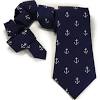
5. Aegean from The Comedy Of Errors. Aegean wonders around for 20 years looking for his lost children, which I call devoted parenting, but a little aimless and undisciplined. I therefore award Aegean two ties with little anchors on them, to remind him to stay in one place and wait for his sons to find him!

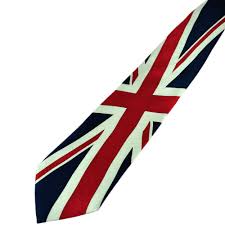
4. Lord Talbott from Henry the Sixth Part I. Talbott is the hero of the English fight against the French at the close of the Hundred Years War. He goes toe to toe with Joan of Arc on numerous occasions. He also raises a fine and valliant son, John Talbott who is also a warrior. The two die bravely in a siege against the French, rather than surrendering, or leaving the other to die. Talbott is clearly also devoted to his child, but his career choice doesn’t allow his son to grow up in a safe environment! I therefore award Talbott two ties with little English and French flags on them.


3. The Ghost Of Hamlet’s Father from Hamlet/ Portia’s Dad from Merchant Of Venice. Both these parents die before their plays begin, yet they still try to improve their children’s lives from beyond the grave! The Ghost helps Hamlet become king of Denmark, and Portia’s dad tries to help her find a good husband, (one who will love her for something besides her beauty or riches). Although these parents achieve their goals, waiting this long to help their kids seems a bit like absentee parenting! I therefore award these posthumous parents ties with little skulls on them.


2

. King Henry IV, from King Henry IV King Henry is the classic career dad, one who wants his son Hal (the future King Henry V), to follow in his footsteps. The two have a terrible fight when Henry thinks Hal is trying to steal his crown on his deathbed! Eventually though, father and son reconcile, and dad even gives the future king some last minute advice; if you fight a war with France it’ll help secure your crown, which Hal does and succeeds! I therefore award King Henry a tie with little crowns on it, hoping that nobody with a dagger ties tries to steal it when he’s sleeping!

1. Prince Pericles from Pericles Pericles is another busy dad- King Antiocus tries to murder him, and he has to leave his own kingdom. Then he gets shipwrecked 3 times! In fact, his only daughter is born onboard a ship in the middle of a storm! Pericles raises the girl for a number of years, but then has to leave again, and guess what, he gets shipwrecked AGAIN! He eventually finds his daughter and they live happily ever after, but you kind of get the idea that Pericles is a little accident-prone, which keeps him from being on the Best Dads list. Sorry Pericles, but at least you get a tie with, what else, Boats on it! Maybe next Fathers Day, someone will get you a life preserver.

And now at Long LAST, the BEST Dads in Shakespeare!

5. Aaron the Moor from Titus Andronicus. Ironically, one of the worst villains in Shakespeare is also one of the best fathers. Aaron is fiercely protective of his child, even threatening people at sword point if they dare come near his baby. He also plans out the child’s future and is willing to give his own life for a promise that Lucius will protect and nourish his son. He may be a monster to everyone else, but to his baby, Aaron is simply, a good dad!
4. The Old Shepherd from The Winter’s Tale. This character is a very mirror of generosity and kindness; not only does he take care of his son The Clown, he adopts a poor discarded child, the princess Perdita, with no obligation to do so. He raises her for 16 years and constantly brags about her to the entire town. She becomes a beautiful, wise, and modest girl who fills her adopted father with pride because of his good parenting. Even when Perdita meets her real father, she speaks of The Old Shepherd with real filial affection “Oh my poor father.”
3.
Lord Capulet, from Romeo and Juliet. I know this was a controversial choice, and I discuss my choice in detail on my podcast, but I’ll sum up my major arguments here:
- Even though a lot of actors choose to have him smack Juliet around, there’s no mention of it in Shakespeare’s text. The most he ever does is threaten to strike her, but the stage directions never indicate he does it. Capulet is clearly more bark than bite.
- From the very beginning of the play, Capulet has shown that he cares about Juliet, and wants her to marry for love, not money.
- Lord Capulet hovers and frets constantly when Juliet tells him she will marry Paris, staying up late to plan the wedding! I ask you, does that sound like a tyrannical father? I wonder sometimes if Lord Capulet would’ve forgiven Juliet for marrying Romeo if she had just told him. In any case, based on my criteria above, Capulet is a good dad, bad tempered, yes, but fundamentally concerned for the welfare of his children.

3. Prospero from The Tempest I chose this high spot for Prospero mainly because he seems to have the most success of any other dad in the cannon. Like Pericles, he too is shipwrecked with his daughter, but Prospero stays with Miranda, raises her alone, teaches her everything she knows, and calls her an angel that helped preserve his life. Prospero cares so much for his daughter that he refuses to give into despair, even though he’s lost his wife, his dukedom, and his home.
Prospero also hatches a plan to get him and Miranda off the island, to get his dukedom back, and to get her married to a handsome prince name Ferdinand, and he succeeds with every one of these endeavors, even though it takes 12 years. Prospero gets extra points for his patience and his wisdom, but I have to admit he’s a bit of a control freak; he demands that Miranda listen to him and obey him no matter what, and he warns Ferdinand that there will be dire consequences if he dare try to do anything illicit with his daughter before the wedding. In addition, there’s no denying that Prospero is also acting out of self interest- he wants to become duke again, and he wants revenge against his enemies and that’s partially why he raises a tempest, (or a huge storm), instead of just sending a message back to Milan.
1.
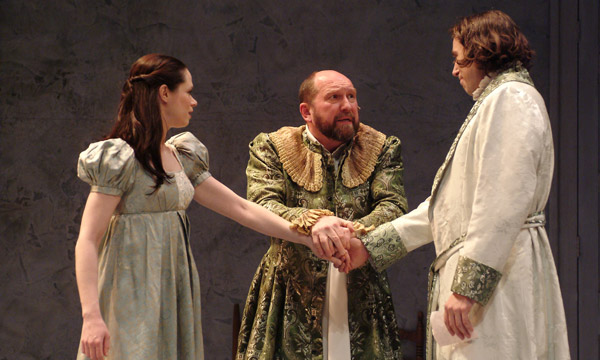
King Simonedes from Pericles, Prince Of Tyre You might forget this character because he only has a short time onstage, but I defy anyone to come up with a better father. He’s kind, supportive, stable, funny, and has a wonderful relationship with his daughter Thaisa. Above all, Simonedes actually listens to his child and does everything in his power to help her when she decides she wants to marry Pericles. Also, like Prospero, Simonedes pretends to object to the marriage, but you kind of get the sense that, rather than testing the affection of the couple, he’s actually just playing a joke on them. You can hear a “gotcha” and a fatherly wink in the final line of the speech in Act II, where he pretends to object to their marriage:
Congratulations to all our fabulous fictional fathers! Thank you for reading, and see you soon!

