The Origins of King Lear

Shakespeare’s King Lear is an age old tale. Like Cinderella it has been reinterpreted throughout time and in many different cultures. Here are a few interesting highlights in the old legend and how it got to Shakespeare in the 1600s.

The Princess Who Loved Her Father More Than Salt

This is an old folktale from my favorite podcast, Journey With Story, which starts with the Cordelia/ Lear plot of a foolish king who banishes his honest daughter. Then through extraordinary circumstances it becomes a Cinderella story. I think at some point these two stories were one and the same until they diverged and one became a story about an absent father and a wicked stepmother, while the other became about a wicked father and a dead mother.

https://www.sacred-texts.com/neu/eng/boeb/boeb05.htm

The ancient ballad of King Leir

The ancient ballad of King Leir, which helped inspire Shakespeare. It serves as a cautionary tale against flattery, and it places equal blame on Lear and his daughters:

And calling to remembrance then
His youngest daughters words,
That said the duty of a child
Was all that love affords:
But doubting to repair to her,
Whom he had banish'd so,
Grew frantick mad; for in his mind
He bore the wounds of woe:

Which made him rend his milk-white locks,
And tresses from his head,
And all with blood bestain his cheeks,
With age and honour spread.
To hills and woods and watry founts
He made his hourly moan,
Till hills and woods and sensless things,
Did seem to sigh and groan.

Even thus possest with discontents,
He passed o're to France,
In hopes from fair Cordelia there,
To find some gentler chance;
Most virtuous dame! which when she heard,
Of this her father's grief,
As duty bound, she quickly sent
Him comfort and relief

The characters of Gloucester and his children, Kent, and the Fool are absent in this ballad, but unlike the fairy tale above, both Lear and Cordelia die in each other’s arms.

The Annonymous History of King Leir, (first published c. 1594)

The anonymous history of King Lear, written shortly before Shakespeare

This play was written for Shakespeare’s rival acting company The Queen’s Men around 1590). Since the Queen was patronizing the company, most of their plays were government-funded propeganda. For instance, it was the Queen’s men who first did a tragedy of the wicked King Richard III.

Michael Wood. In Search Of Shakespeare, 2002.

If you watch the first 20 minutes of the documentary above, you will see that Wood and many other scholars believe Shakespeare must have worked for the Queen’s men, or at least performed their scripts, since they did their own versions of King Lear, Richard III, King John, and Henry V.

Screenshot from Internet Shakespeare Editions’ reprint of King Lear https://internetshakespeare.uvic.ca/doc/Leir_M/index.html

However Shakespeare got a hold of The Queen’s Men’s scripts, he didn’t adhere to them rigidly. Their King Lear follows the fairy-tale / history format of having Cordelia be banished, disguise herself as a peasant (like Cap ‘O Rushes in the earlier version), and eventually she is restored to her rightful place. Shakespeare’s version must have been a MASSIVE shock to anyone who read these old tales and ballads. In Shakespeare’s version, everyone dies and there is no guarantee that the kingdom will survive. Every other tragedy ends with a new king or emperor to take over the kingdom but Lear leaves the audience with a sense of apocolypse; that Lear’s madness and Edmund’s machinations have doomed England and all these characters’ lives will be erased by Time.

As pessimistic as Shakespeare’s Lear is, it does seem more true to life than the previous versions. Perhaps this is because of a legal case from 1603 that might have inspired Shakespear to adapt the story: In 1603, two daughters tried to have their father declared insane. By an astonishing coincidence, the third daughter, who protested, happened to be named Cordelia! Perhaps Shakespeare, (who had three children and was preparing to retire), might have been inspired by this case and worried he might suffer the same fate.

Intro to King Lear

Lear at its core is a play about growing older, and not just for its title character. Goneril and Regan learn their father is a lousy dad and learn to stand up to him. Edgar learns about the cruelty of the world and how to deceive his enemies.


Plot Summary

Lear, a king in pre-Christian England, is too old to rule, so he decides to divide his kingdom among his three daughters. He then tells them he will give the the kingdom to the one who loves him most.

Lear’ youngest daughter Cordelia, refuses to flatter her father, so she banishes her. He also banishes the Earl of Kent, who warns the king that his actions are foolish and rash. Finally, Lear demands that, although he resigns his kingdom, his daughters call him king and agree to house him and his knights in their castle.

Lear is not the only rash old man who is blind to his true danger. His friend the Duke of Gloucester has a bastard son named Edmund, who schemes to usurp his father’s lands and marry into Lear’s family. Edmund frames his legitamite brother Edgar which forces him to disguise himself as the mad beggar Poor Tom

After his daughters refuse to house him and his knights, Lear goes stark-raving mad. He runs out into a storm on the heath, wishing the Earth were struck flat and all mankind was destroyed. He is soon cared for by his Fool, and Kent, disguised as a commoner named Caius.

Duels, wars, tears, and oblivion follow.

Dramaturgy Website: American Shakespeare Center

Contemporary Parallels:

“Empire” (TV Series 2015-2020)

Empire Cast - Original Soundtrack from Season 1 of Empire - Amazon.com Music
Poster for Empire with Lucius and Cookie, and their three sons Jamal

Succession (HBO- 2018- present)

https://www.telegraph.co.uk/tv/2018/08/02/succession-hbos-new-dramais-king-lear-modern-media-age/

This scene from “Brave”

“Slings and Arrows,” Season three

Slings and Arrows, Season 3

“Ran” by Akira Kurasawa-

Encanto (2021): Click here to read my post about Encanto and Lear

Videos

More Posts

Shameless Plug

I’ll be playing Kent in King Lear October 22nd, 1PM EST. It’ll be streamed on Discord and live on YouTube here:

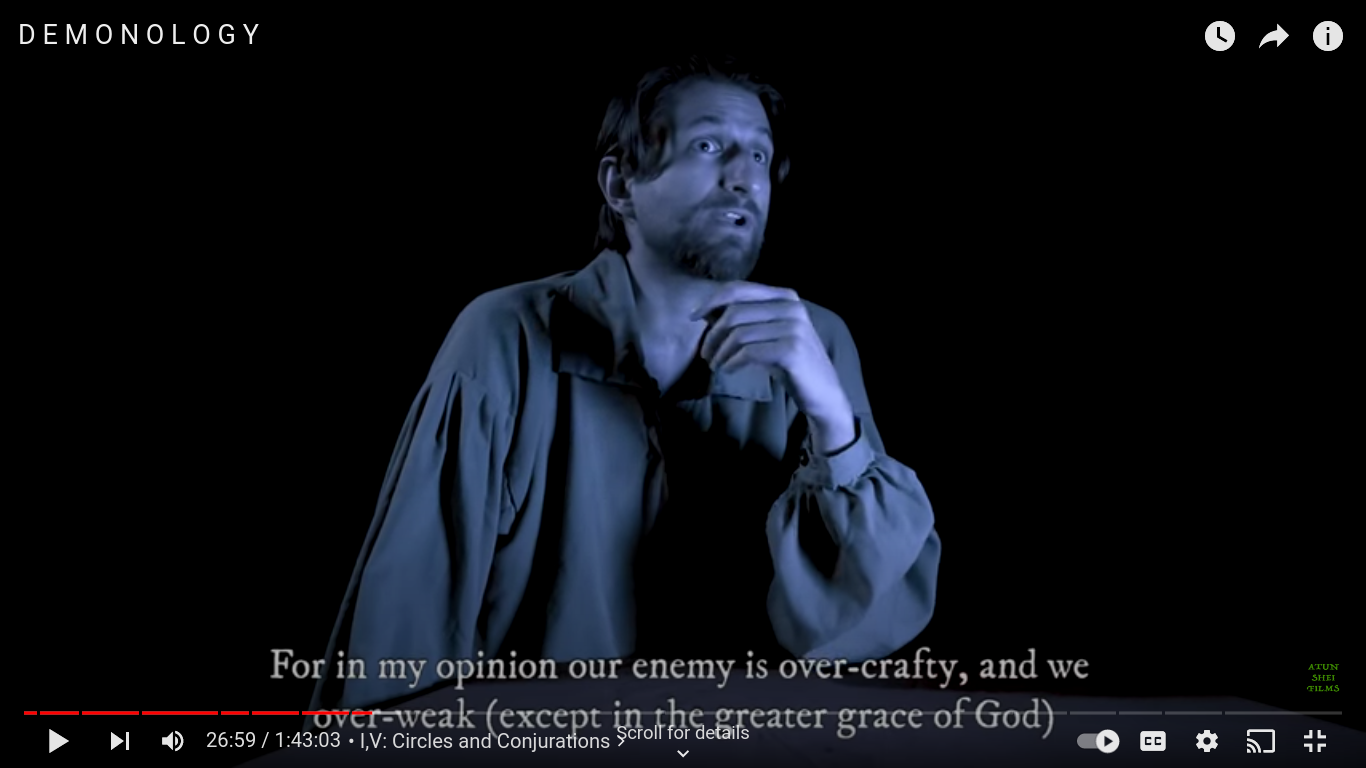
Watch “D E M O N O L O G Y” on YouTube

This book Demonology influenced Shakespeare’s Macbeth and Hamlet in ways I’ll get into later. It was written by King James himself, and it takes the form of a dialogue, that is, an intellectual conversation where the concept of witchcraft, sorcery, necromancy, etc is explained, debated, and questioned between two imaginary people.

In the video, Youtuber Andrew Rakich, known for his history series, Checkmate Linconites, (where he plays two characters who argue about the Civil War from a Union and Confederate perspective) has done a dramatic reading of the whole book in the accent of 1600s England. It’s part audio book, part history lesson, part linguistics lesson, and all great!

Here are some of my favorite quotes from the book:

Just like in Dr. Faustus, James theorizes that the Devil lets all so-called sorcerers and necromancers believe they have power over him, to deceive them later.

For as the humor of Melancholie in the selfe is blacke, heauie and terrene, so are the symptomes thereof, in any persones that are subject therevnto, leannes, palenes, desire of solitude: and if they come to the highest degree therof, mere folie and Manie:

Demonology, Chapter 1, p. 30,. Reprinted from Project Gutenberg

This passage echoes Hamlet’s description of his own meloncholy, and his fear that The Devil might be trying to use his melocholy to conjure up his father in order to damn him:

The spirit that I have seen
600   May be the devil, and the devil hath power
601   To assume a pleasing shape; yea, and perhaps
602   Out of my weakness and my melancholy,
603   As he is very potent with such spirits,

603. As . . . spirits: i.e., because he has great influence on those who have a temperament such as mine.
604   Abuses me to damn me. I’ll have grounds

604. Abuses: deludes.  If the Ghost is deceiving Hamlet about King Claudius’ guilt, and Hamlet kills him, Hamlet would be a murderer, and therefore damned.
605   More relative than this: the play’s the thing
606   Wherein I’ll catch the conscience of the king.

Hamlet, Act II, Scene ii, reprinted from Shakespeare Navigators.com.

For that is the difference betuixt Gods myracles and the Deuils, God is a creator, what he makes appeare in miracle, it is so in effect. As Moyses rod being casten downe, was no doubt turned in a natural Serpent: [pg 023]where as the Deuill (as Gods Ape) counterfetting that by his Magicians, maid their wandes to appeare so, onelie to mennes outward senses: as kythed in effect by their being deuoured by the other. For it is no wonder, that the Deuill may delude our senses, since we see by common proofe, that simple juglars will make an hundreth thinges seeme both to our eies and eares otherwaies then they are. Now as to the Magicians parte of the contract, it is in a word that thing, which I said before, the Deuill hunts for in all men.

Demonology, Chapter 6, p. 23

It’s very useful to conceptualize what the early Jacobeans thought the difference was between God and the Devil, and thus the difference between divine miracles and hellish charms. In James’ eyes, all magic and demonic arts were mere illusions, designed to play upon men’s senses and draw the intended victim into the Devil’s power. Obviously, since all of theater rests upon such illusion, it’s no wonder Shakespeare portrays magic onstage in his most popular works. In particular, this passage calls to mind the magic of Prospero, who is able to conjure spirits fo a while, but they all eventually dissolve:

PROSPERO
146   You do look, my son, in a mov’d sort,

146. mov’d sort: troubled state.
147   As if you were dismay’d: be cheerful, sir.
148   Our revels now are ended. These our actors,

148. revels: festivity, entertainment.
149   As I foretold you, were all spirits and
150   Are melted into air, into thin air:
151   And, like the baseless fabric of this vision,

151. baseless fabric: structure without a physical foundation.
152   The cloud-capp’d towers, the gorgeous palaces,
153   The solemn temples, the great globe itself,

153. the great globe itself: all the world, [and the theater] >>>
154   Yea, all which it inherit, shall dissolve

154. all which it inherit: all who live on it.
155   And, like this insubstantial pageant faded,

155. insubstantial: without material substance.
156   Leave not a rack behind. We are such stuff

156. rack: wisp of cloud driven before the wind.
157   As dreams are made on, and our little life
158   Is rounded with a sleep.

The Tempest, Act IV, Scene i.
A close reading into the most infamous 17th century manual for finding and persecuting witches and sorcerers.

 For although, as none can be schollers in a schole, & not be subject to the master thereof: so none can studie and put in practize (for studie the alone, and knowledge, is more perilous nor offensiue; and it is the practise only that makes the greatnes of the offence.) the cirkles and art of Magie, without committing an horrible defection from God: And yet as they that reades and learnes their rudiments, are not the more subject to anie schoole-master, if it please not their parentes to put them to the schoole thereafter; So they who ignorantly proues these practicques, which I cal the deuilles rudiments, vnknowing them to be baites, casten out by him, for trapping such as God will permit to fall in his hands: This kinde of folkes I saie, no doubt, ar to be judged the best of, in respect they vse no invocation nor help of him (by their knowledge at least) in these turnes, and so haue neuer entred themselues in Sathans seruice; Yet to speake truely for my owne part (I speake but for my selfe) I desire not to make so neere riding: For in my opinion our enemie is ouer craftie, and we ouer weake (except the greater grace of God) to assay such hazards, wherein he preases to trap vs.

Demonology Chapter 5, page 15.

It almost seems in this passage that James is covering his tracks against any detractors who might be wondering if he himself might be damned for knowing so much about witchcraft. Accordingly, he asserts that the knowledge of witchcraft is perfectly lawful, it’s the practice that damns the scholar.

Shakespeare: The Animated Tales- “Macbeth”

This is a 30 minute cartoon version of Macbeth originally produced for the BBC in 1992. It features Brian Cox  as the voice of Macbeth (before he was the voice of McDonald’s), and Zoë Wanamaker as Lady Macbeth (before she was a witch who teaches at Hogwarts).

I like the way it portrays the horror imagery of the play in sort of a European-manga animation hybrid. Admittedly, there are better ones in the series, but this one is still pretty neat.

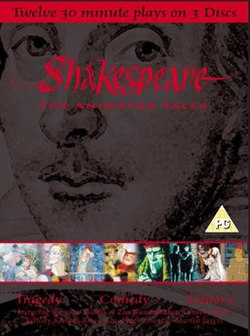
DVD box art for “Shakespeare the Animated Tales.”

To check out other episodes in the series, view this playlist:

Great classes are available December 1st.

Scehdule

Class Descriptions:

Basics Of Stage Combat:  Students will learn the basics of safely enacting a fight onstage, in preparation for a Shakespeare play. We will also learn about the history of sword fighting in the military and the duel.

Trailer for Basics of Stage Combat.

My daughter really enjoyed taking this class. She was actually able to use her sabre and try out her routine on her father. Paul is quite knowledgeable about Shakespeare and made the class really fun by teaching a fight scene from Romeo and Juliet. It is amazing watching her practice with Paul over Zoom. I hope Paul will have. more combat classes, it is a different way to learn Shakespeare.

IB, Parent

An Interactive Guide To Shakespeare’s London (New Class)

A virtual tour of Shakespeare’s London will get kids to interact with the culture of Elizabethan England.

Class Experience

To teach kids about the Elizabethan era and the background of Romeo and Juliet, The Instructor will interact with the class (via pre-recorded videos), pretending to be Shakespeare. The class, pretending to be actors in Romeo and Juliet, will get a virtual tour of The Globe Theater, Hampton Court Palace, and a virtual visit to an Elizabethan doctor's office. This activity is an immersive way for them to learn about the period, how it relates to the world of the play, and how Shakespeare changed theater.

The class will take the form of a guided WebQuest activity.  First, the students will get a worksheet that has a series of fill-in-the-blanks about Elizabethan society (below). The students will fill out this worksheet based on a Nearpod and in conjunction with a website I’ve made, https://sites.google.com/nebobcats.org/visit-to-elizabethan-london/home?authuser=0 
Both the Nearpod and each webpage will have a virtual tour, a video, and text explaining some aspects of Elizabethan life. Before they go to each location, I will give a short introduction via prerecorded video:

Wizard Science

In this one-hour course, your child will discover the enchanting world of science through a series of magical experiments. Learn about such topics as Astronomy, Static Electricity, chemistry, and optical illusions.

What was Christmas like For Shakespeare?

In this one-hour course, students will learn and play games that will explore the history behind Christmas traditions. We will also discuss the themes, characters, and famous quotes from Shakespeare’s play “Twelfth Night.”

Special Discount for My online “Macbeth” course

Since “Macbeth” is my Play of the Month, I’m offering a discount for my online class on the play. You can get $5 off my class “Macbeth: An Immersive Learning Experience” with coupon code HTHES6G3YH5 until Nov 4, 2022. Get started at https://outschool.com/classes/macbeth-an-immersive-learning-experience-xGKHeHgH and enter the coupon code at checkout.

To learn more about the class, watch the trailer above, and read my description of the escape room:

How did Hamlet’s Father Die?

I’m helping to direct a young actor playing Hamlet and we’re going over the “O That This Too Too Solid Flesh” speech. Going over the text, it occurred to me: what happened to Hamlet’s father?

Shakespeare makes it clear that Claudius poisoned Hamlet’s father with a vial of poison that he put in the king’s ear:

Sleeping within my orchard,
My custom always of the afternoon,
Upon my secure hour thy uncle stole,
With juice of cursed hebona in a vial,
And in the porches of my ears did pour
The leperous distilment; whose effect
Holds such an enmity with blood of man
That swift as quicksilver it courses through
The natural gates and alleys of the body. Hamlet, Act I, Scene v, lines 796-805.

The Ghost calls the poison “cursed hebannon,” which fis a poison that Shakespeare made up. Interestingly, Shakespeare’s original source for Hamlet makes no reference to poisoning, but that the king was stabbed in front of his own court. I think Shakespeare might have changed this simply because Queen Elizabeth was concerned about assassination herself, and Shakespeare didn’t want to make it look like he approved of assassination. Then again, maybe he changed it so that the murder didn’t seem like a repeat of Julius Caesar, (which Shakespeare’s company performed the year before Hamlet, (Source: New York Times, 1982).

The Ghost describes how, when the poison went through his ear canal, he experienced violent swelling, sores, and unimaginable pain. He actually compares himself to Lazarus, Jesus’ friend in the Bible who died of leprosy.

And with a sudden vigour it doth posset
And curd, like eager droppings into milk,
The thin and wholesome blood. So did it mine;
And a most instant tetter bark’d about,
Most lazar-like, with vile and loathsome crust
All my smooth body. Hamlet, Act I, Scene v, lines 807-811.

Detail from “The Raising of Lazarus” by Rembrandt c. 1630

Sadly, Leprosy is still prevalent in third world countries so its symptoms are still very well understood: CONTENT WARNING: DISTURBING IMAGES IN THIS VIDEO

The poison is made up, but could such a poison actually exist? I found a wonderful article from the Journal of ENT (Ear, Nose, and Throat), where the author John Riddington Young posits the kinds of real-world poisons that might have this horrific effect on Hamlet’s father.

What actual poison was used? Shakespeare states, “the juice of cursed Hebenon” [6] but sadly, there is no such drug. Did he mean hemlock, or perhaps henbane? Laurence Olivier actually substitutes the name hemlock in his 1948 film. Belladonna, aconite and nicotine have all been suggested, but the most likely culprit is taxine from the yew tree. It is a deadly poison and its Old English name was heben. Shakespeare would certainly have known of it; he says in Richard II, archers bend ‘their bows of doubly fatal Eugh’ [7] (implying that apart from the arrows killing foes, there is an intrinsic toxicity in the wood).

JOHN RIDDINGTON YOUNG:
“History of ENT – Murder most foul, strange and unnatural”

I found a case study of a real case of Yew poisoning that emphasizes that it is incredibly fast-acting, “Fast as quicksilver”, that it can be misdiagnosed as another poison (like a snake bite, as Claudius later claims), and that it has no known antidote, the perfect way to kill a king:

. The taxine alkaloids (for example, taxine A, 2-deacetyltaxine A, isotaxine B, 1-deoxytaxine B) derived from p-dimethylaminohydroxycinnamic acid are the effective poisons of the yew [1]. In chemical terms, the compound is structurally related to veratrine, and the presence of an unsaturated lactone group makes this group of alkaloids similar to digitalis. Poisoning with the latter may be falsely diagnosed during a toxicological examination. Cardiac disturbances after intoxication by yew are ascribed mainly to the alkaloids paclitaxel and taxine B, affecting sodium/calcium permeability in cells [2]. The taxine alkaloid is absorbed through the digestive tract very rapidly, and the signs of poisoning manifest themselves after 30 to 90 minutes. An infusion made from 50 to 100g of needles is considered to be fatal [35], as no antidote is known.

Vališ, M., Kočí, J., Tuček, D. et al. Common yew intoxication: a case report. J Med Case Reports 8, 4 (2014). https://doi.org/10.1186/1752-1947-8-4

So if you are playing Hamlet, in addition to the sadness and anger you feel after losing your father, you could also feel revulsion and pity at the painful, disgusting and cowardly way he was murdered. Truly, “MOST FOUL STRANGE AND MOST UNNATURAL.”