The Duelling Scene in Twelfth Night 

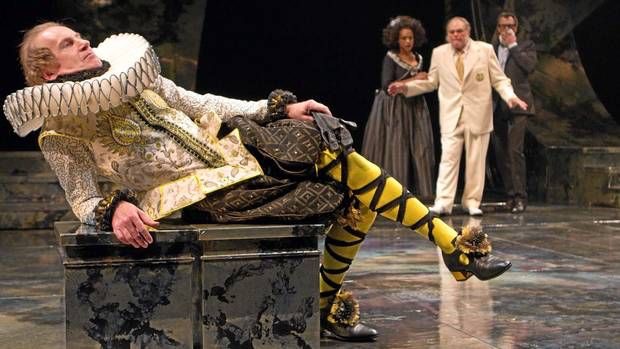
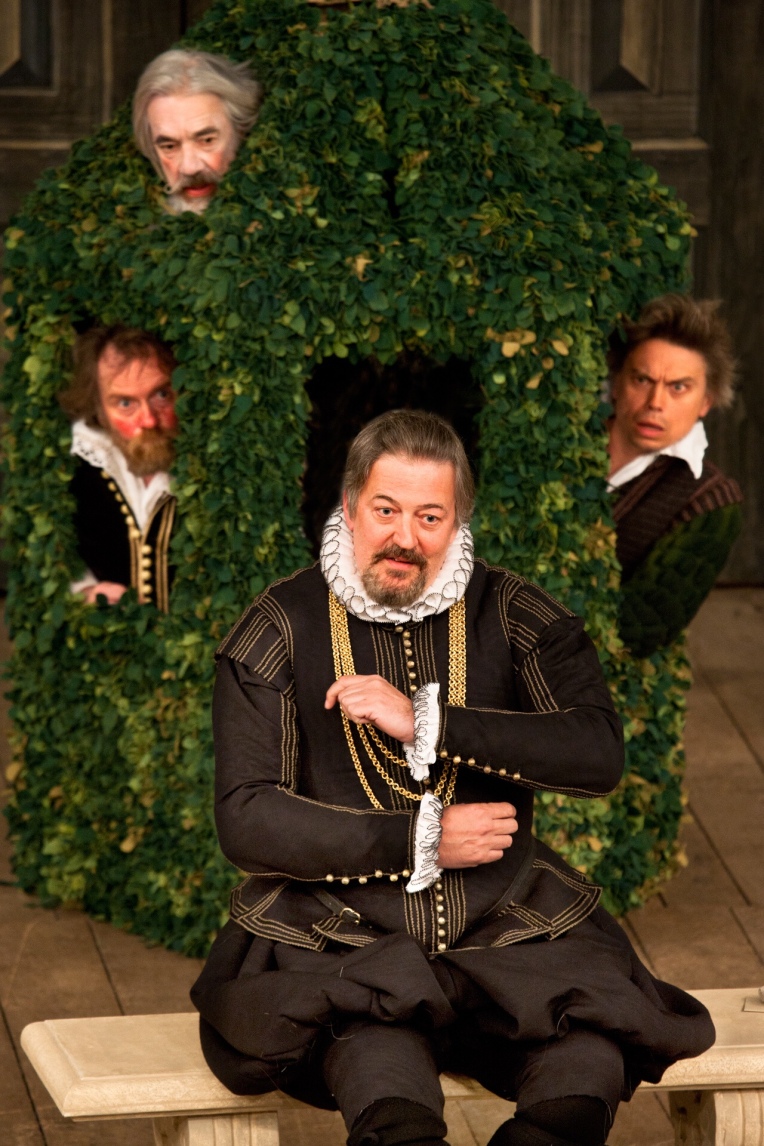
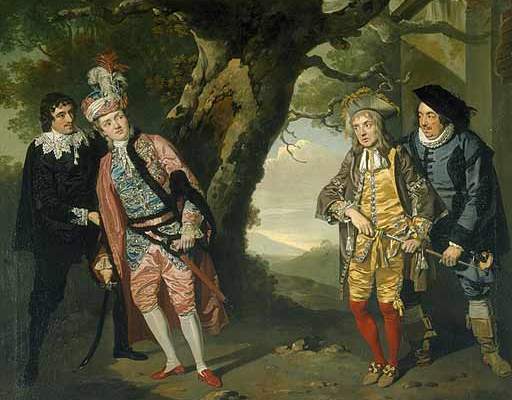
Here’s an article I origionally wrote for the Shakespeare Birthplace Trust about the famous and famously funny scene in Twelfth Night, where Toby tricks Viola in disguise to fight a duel with the cowardly Sir Andrew Aguecheek.

He Cannot By the Duello Avoid It

“He Cannot By the Duello Avoid It!” by Paul Rycik

Hello! To celebrate Shakespeare’s 449th birthday, I’d like to discuss the concept of judicial combat or licensed dueling. Most of Shakespeare’s aristocratic patrons would be intimately familiar with the arts of swordplay. Furthermore, Shakespeare as a trained actor would have studied fighting to accurately replicate it onstage. This is why Shakespeare takes many opportunities to mention dueling culture in his plays, especially within the comedies.

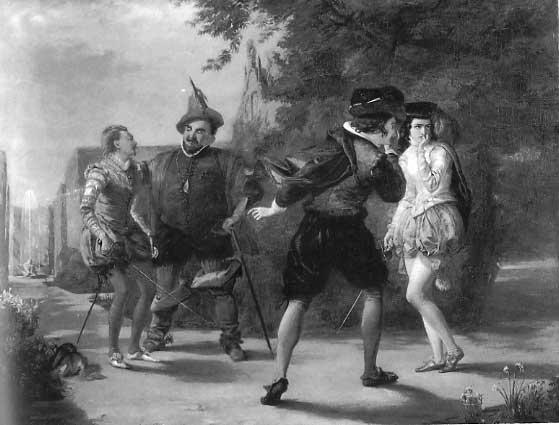
William Powell Frith, The Duel Scene from

Picture Caption: William Powell Frith, The Duel Scene from “Twelfth Night” (1843)

Shakespeare uses duel references to comic effect in plays such as Twelfth Night, in which Sir Toby Belch convinces the cowardly Sir Andrew to fight Viola, a woman disguised as a man. Both combatants are cowards, but according to the law of arms, both of them have to fight, though neither one wants to or knows how: “He cannot by the duello avoid it” Twelfth Night Act III, Scene iv.

A more serious example of duel culture occurs in “Much Ado About Nothing. In Act IV, Scene I, Claudio has accused his fiancée Hero of adultery in front of the whole town, thus dishonoring her. Her cousin Beatrice is so furious with Claudio, she claims that, were she a man “I would eat his heart in the marketplace!” Eventually, Beatrice convinces Claudio’s friend Benedick to challenge Claudio to a duel. This seems harsh at first, but when one considers the context of judicial combat, it becomes clear that Beatrice is actually being totally rational, and wishes Claudio’s death for an important purpose- to vindicate Hero.

Link: Beatrice (Catherine Tate) asks Benedick (David Tennant) to kill Claudio (Wyndham’s Theatre, 2011).

http://www.youtube.com/watch?v=bsG9O6yIpyk

In Elizabethan society, when a woman was accused of adultery, a champion could fight to the death on her behalf in a judicial combat. This is why Beatrice famously asks Benedick to kill Claudio in Act IV; if Benedick kills Claudio in a duel, Claudio’s death would prove by divine influence that he accused her falsely, and Hero would at last be free from shame. However, when she is left alone with Benedick, she is full of conflicting feelings of love for him, which is why at first she hesitates to ask for his help:

Benedick. Surely I do believe your fair cousin is wronged.

Beatrice. Ah, how much might the man deserve of me that would right her!

Benedick Is there no way to show such friendship?

Beatrice. A very even way, but no such friend.

Benedick. May a man do it?

Beatrice. It is a man’s office, but not yours, Much Ado About Nothing, IV.i

In the last line, Beatrice hints at the office of a champion to fight for a dishonored woman. As a nobleman, Benedick may legally challenge Claudio to a duel and vindicate Hero, but Beatrice also knows that she cannot ask him to fight his best friend. Nevertheless, Beatrice wishes someone would fight to repair Hero’s honor, and her pleas eventually convince Benedick to challenge Claudio.

Link: Benedick (David Tennant Challenges Claudio (Wyndham’s Theater, 2011)

http://www.youtube.com/watch?v=M7BaNrt9e04

In our century, the idea of dueling to vindicate a woman from adultery is somewhat lost in translation, but the idea of men standing up for what is right on behalf of a lady is at the heart of chivalry, and certainly speaks to us as strongly now as it did in 1599. Therefore an understanding of the concept behind this duel helps the actors and audience to appreciate the richness of Shakespeare’s characters and their attempts to do the right thing, even through questionable means.

This entry is part of series on duels and judicial combat, which I’m working on for the Blackfriars conference in Staunton Virginia. I look forward to bringing you more posts about the culture of duels and judicial combat, which so pervades the works of Shakespeare.

Bonus video if time: Me (Paul Rycik) performing Much Ado Act IV Scene I at the Blackfriars Playhouse in Staunton: http://www.youtube.com/watch?v=f69j8vIrycA

Below is the full scene Twelfth Night duel scene

How to Throw Your  Own  12th Night Party  

Part One: The Invitation:Tradition says the 12th night does not actually start until nightfall on January 5th; it’s the celebration of the night when the wise men finally got to Bethlehem, so make sure you you’re clear on that in the invitation. If you need help on designing clever 12th night invitations, view my previous post on creating Valentine’s Day cards!Part Two: The FeastTraditionally celebrated with, (as Sir Toby puts it), “cakes and ale,” there’s a lovely recipe for a 12 night cake below.Picture/ recipe is available here: Jane Austin.com: Twelfth Night cakeA Twelfth Night cake is basically a fruitcake stuffed with spices and dried fruit, that symbolizes of the three kings that came from the orient to Bethlehem all those years ago. One game you can play with your guests is putting a bean in the center of the cake. Tradition holds that whoever finds the bean has good luck for the coming year.The alternative version favored in France and Switzerland, is made of puff pastry, egg, and rum. Here’s a recipe I found on food.com: Swiss Twelfth night cakeMusicSinging is a big part of 12th night as evidenced in this scene where sir Toby, Mariah and Sir Andrew start singing songs: Act II Scene III I have taken the liberty of putting down all the songs from 12th night and some YouTube clips of my favorite renditions.Hold Thy Peace, Thou Knave (Shakespeare Songbook)O Mistress Mine (2011)Come Away Death(2014 Shakepeare in the Park SoundtrackHey Robin, Jolly Robin ( Shakespeare Birthplace)I Am Gone Sir (Stratford Shakespeare Festival 2011)The Wind and Rain (Alabama Shakespeare Festival)Games
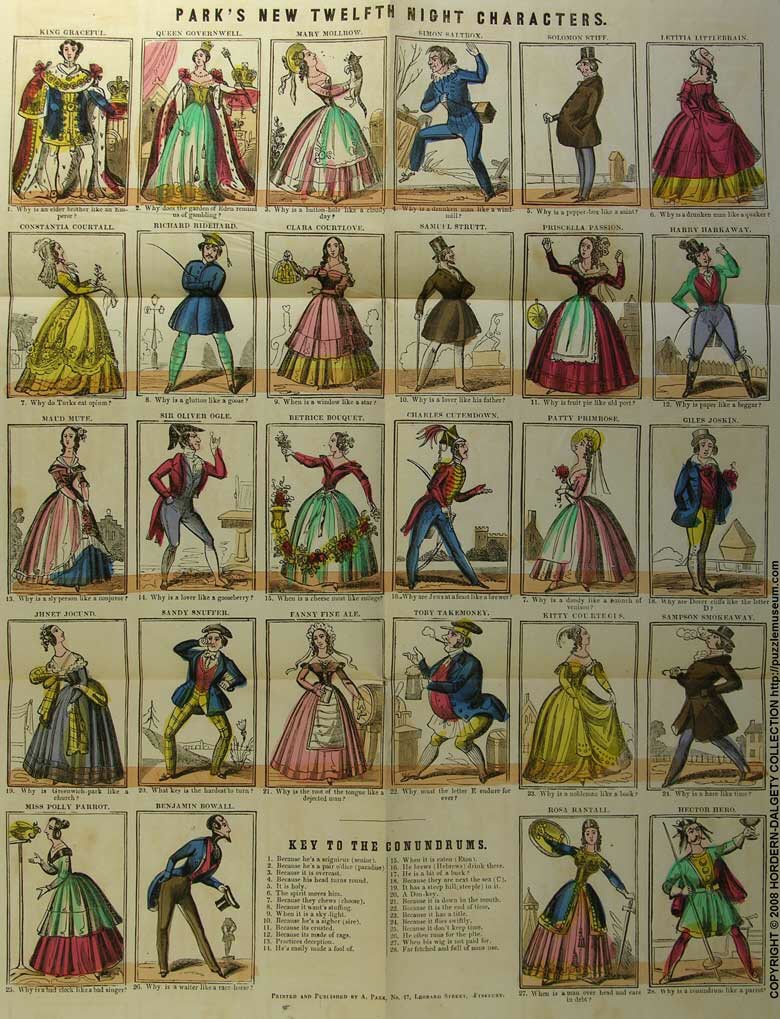
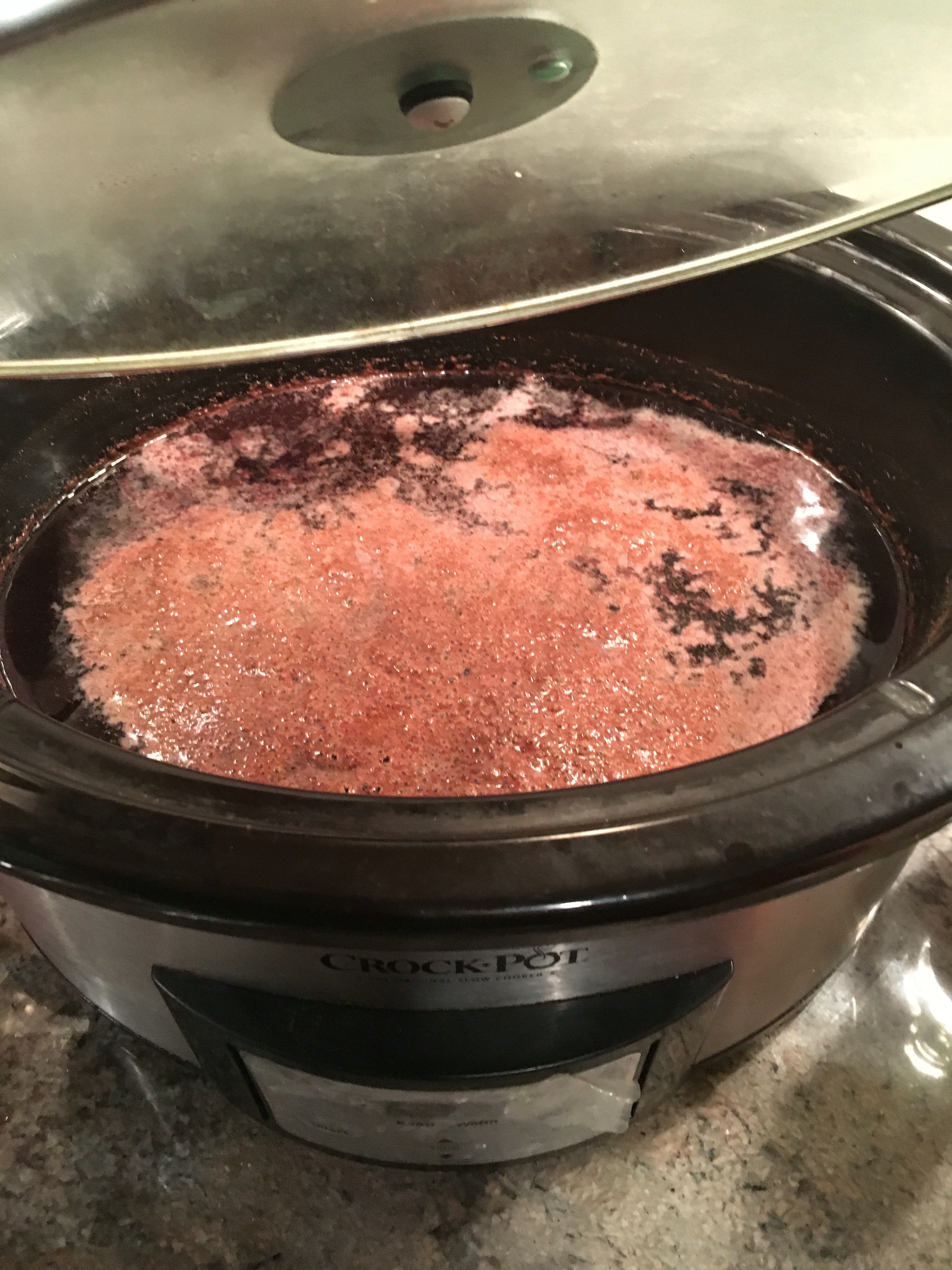
As I’ve mentioned in my previous posts one big part of the Christmas season was appointing a lord of misrule, and ancient tradition that goes back even before Christian times. In the play 12th night Feste basically serves as Lord Of Misrule; he presides over all the games and songs in the house, and he helps Sir Toby baffle Malvolio. In real life a Lord of Misrule presided over each Twelfth Night celebration, choosing which games and dances everyone would engage in.Most early Twelfth Night celebrations included a masked ball. In the 18th century, merrymakers engaged in a sort of role playing game, where they drew a character based on a popular archetype like the soldier Charles Cuttemdown or Beatrice Bouquet, and had to act like that character the rest of the night. Finally, a holiday that encourages you to LARP!Wassail.As I mentioned in my previous post wassail was the quintessential winter beverage and 12 night was not an exception. In this post you can see some photos of me actually making wassail myself in accordance with a trip up recipe I found on the food from the food network’s Alton Brown.Alton Brown Wassail recipe I didn’t have Madeira wine so I substituted port, but otherwise I used all the ingredients he mentioned in the recipe.Like I said in the previous post, Wassail is derived from an old word meaning “lamb’s wool,” and you can see why when you see the frothy mixture on top.I served this wassail to my in laws on Christmas night, and the only complaint I got was that the weather was a little too hot to enjoy it. I can personally attest that wassail warms you right down to your toes, which is great if you’ve been out caroling in 17th century England, but indoors during the hottest Christmas on record, it was a little uncomfortable- I was already wearing shorts and I was still too hot. My advice is- if you get a white Christmas, enjoy your wassail, but if it’s 60 degrees outside, stick to ale or Madeira, or some other kind of spicy spirit that you can serve
Well, that’s my advice, happy Twelfth Night everyone!Update: I’ve adapted the material from this post into an interactive, multimedia online class for kids aged 13-18! It will cover Elizabethan Christmas traditions and the plot and themed of Twelfth Night. You can register now at Outschool.com!Sources:Brownie Locks.com- History of Twelfth Night Catholic Encyclopedia: Feast of Fools
Jane Austin.com: Twelfth Night Celebrations
Lost Past Remembered: Twelfth night Why Christmas.com: the Twelve Days of Christmastime Project Britain: Twelfth Night http://projectbritain.com/Xmas/twelfth.htm

Christmas For Shakespeare Part III: Performing for Queen Elizabeth 

Merry Christmas Eve everyone! Today I will be talking about how Shakepeare’s two royal patrons, Queen Elizabeth I and James I celebrated this holiday!

We have surviving records that prove Shakespeare and his troupe performed at Christmas during the reigns of Queen Elizabeth and King James I. The buildings still exist so we can imagine what Shakespeare’s performancesal at court might have looked like. What follows is a bit of historical detective work, with a nice holiday flavor to boot.

How did Good Queen Bess celebrate Christmas?

Like her predecessor Henry VIII, Her Majesty Elizabeth accepted presents from the nobles on New Year’s Day instead of Christmas morning. From all over the kingdom, people would bring the best and most extravagant presents to the queen, hoping to gain her favor at court. Take a look at this true case of what her favorite courtier, Robert Dudley gave the queen for Christmas in 1588:

Dudley gives Queen Elizabeth a wristwatch
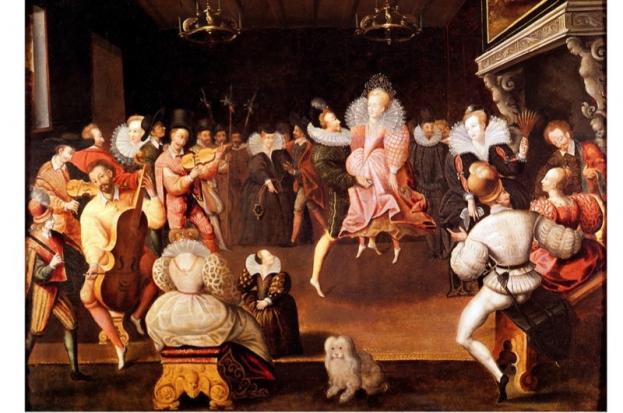
Unlike her dad however, Elizabethan Christmas was a more elaborate affair than a week of sitting and feasting. Yes, Gloriana had elaborate feasts, but she preferred to impress her nobles and visiting dignitaries with dances, jousts, and plays. She was an accomplished dancer and poet, and she loved court masques.

A masque is sort of like a combination masked ball and performance art piece. The nobles would put on costumes and masks and enact a historical or mythological event, like “the Golden Age Restored,” a masque Ben Johnson wrote for Twelfth Night in 1616. The intent was to flatter the queen and her court, as well as having a good time. Of course, Liz still made time on the dance floor for Shakepeare’s company!

.

How the plays were performed:

The plays would be in a large empty hall like the banquet hall or dance hall. Probably the tables would be removed from the feasting, then the dancing would begin. At around 10PM, the actors would take their places. There might be a makeshift tiring house, which was mainly just a curtain that the actors could hide behind to wait for their entrances.
The queen or King would be sitting on a throne on a raised platform so that she or he could be clearly seen by the actors and the audience.
Which plays did They Perform?

In 1594 The Lord Chamberlain’s Men played before the Queen at Greenwich Palace. Alas, we don’t know which plays they performed this time. What follows is a list of the plays we do know Shakepeare’s company played at Christmas.

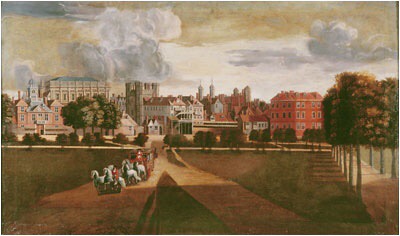
Whitehall Palace by Dankerts, 1675.

Love’s Labors Lost– 1597 at Whitehall palace. This time we know which play they performed before the Queen, because it’s listed right on the title page. I suspect that printing where the play was performed was designed to fire the imagination of the people who bought it. If you couldn’t be at court to see Shakespeare’s play, you could at least read his words and imagine you were there.

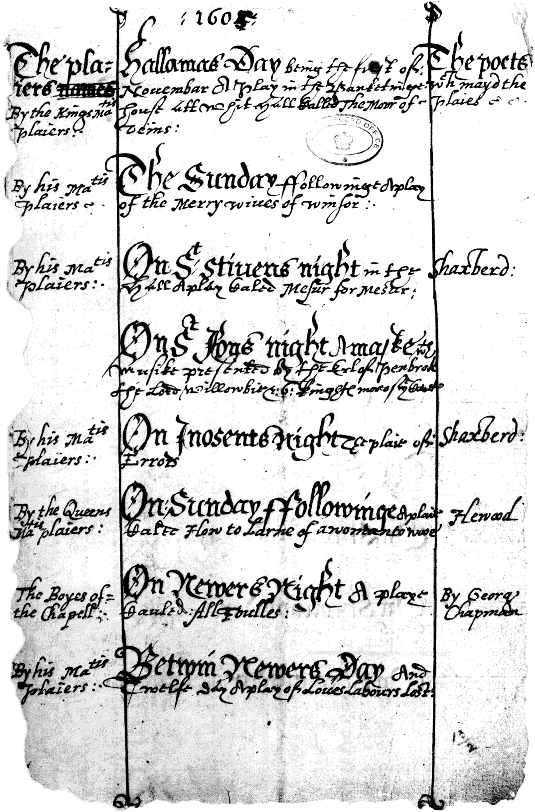
James I invited Shakepeare’s company to perform at Hampton Court many times. Below is an account of the plays for the Christmas holiday in 1603. Notice that Shakepeare’s name is spelled “Shaxberd.”

Here’s a list of some more plays we know Shakepeare’ performed at Christmas:

  1. Midsummer Nights Dream- 1603 on New Years Day, Hampton Court.
  2. Measure for Measure on Boxing Day 1603, Hampton Court.
  3. King Lear on Boxing Day 1606.
  4. Twelfth Night- Candlemas (Feb 2nd 1602).
  5. Twelfth Night 1618 and 1619 (location unknown).

Below is an episode of the incredible documentary “In Search of Shakepeare.” The first twelve minutes show what Christmas might have been like at Hampton Court in 1603, the first year of King James’ reign.

In Search of Shakespeare: For All Time

James loved plays and masques even more than Liz, which is why he employed one of the greatest scenic artists of all time, Inigo Jones, to come up with extravagant stage designs and costumes for plays and masques. James’ Queen Anne Of Denmark performed in quite a few masques herself. James also treated the Christmas season as a time of charity, which might have inspired some of the lines in King Lear, which was performed ‘on the feast of Steven’ 1606:

“Poor naked wretches… who soer you are. I have taken too little care of this.” -King Lear, Act III, scene I (The Storm Scene).

We can recall the contrast between King Lear and Good King Wenceslas. In the scene I quoted earlier, Lear laments that he hasn’t been more charitable to the poor, now that he himself feels cold and homeless.

The Christmas season would carry on until oh January 6, aka Twelfth Night. This was the day when, according to Christian tradition, the Three Wise Men finally got to Bethlehem and delivered their presents. Shakespeare’s play Twelfth Night is all about celebrations of feasting, fools and clowns, and of course, epiphanies.

If you liked this post, please consider signing up for my new online class, “What Was Christmas Like For William Shakespeare?” I’ll go further into the traditions of Elizabethan Christmas and add some insight into Shakespeare’s play “Twelfth Night.” Register now at Outschool.com!

The Shakepearean Student

Sources: http://www.unofficialroyalty.com/columnists/the-laird-othistle/will-shakespeare-at-christmas-court/

http://home.hiwaay.net/~paul/shakespeare/revels/revelsacct1.html

http://www.timetravel-britain.com/articles/christmas/jacobean.shtml

http://www.shakespeare-online.com/theatre/theroyalpalaces.html

http://internetshakespeare.uvic.ca/m/lifetimes/society/court%20life/festivals.html

FMI look at “The Christmas Revels”

Visions Of Lady Macbeth

One of the greatest icons of female villainy, Lady Macbeth has been portrayed onstage by our greatest actresses, and immortalized in many alluring and terrifying works of art. Here are some of my favorites:

Ellen Terry as Lady Macbeth 1889 John Singer Sargent 1856-1925 Presented by Sir Joseph Duveen 1906 http://www.tate.org.uk/art/work/N02053
Ellen Terry as Lady Macbeth 1889 John Singer Sargent 1856-1925 Presented by Sir Joseph Duveen 1906. Tate Modern Gallery: http://www.tate.org.uk/art/work/N02053. More Info Here.
For commentary: http://www.bbc.co.uk/arts/yourpaintings/paintings/ideal-portrait-of-lady-macbeth-97937
An Ideal Portrait of Lady Macbeth by John Francis Dicksee, 1870. View gallery information here: http://www.the-athenaeum.org/art/detail.php?ID=190776
FMI: http://en.wahooart.com/@@/8Y3AD3-Henry-Fuseli-(Johann-Heinrich-F%C3%BCssli)-Lady-Macbeth-with-the-Daggers
“Lady Macbeth and the Daggers” by Henry Fuseli, 1812. Tate Modern Gallery: 

http://www.tate.org.uk/art/artworks/fuseli-lady-macbeth-seizing-the-daggers-t00733 

http://collections.vam.ac.uk/item/O1068192/lady-macbeth-watercolour-cattermole-george/
Lady Macbeth observes King Duncan  by George Cattermole, 1850. Victoria and Albert Museum: 

http://collections.vam.ac.uk/item/O1068192/lady-macbeth-watercolour-cattermole-george/

http://www.louvre.fr/oeuvre-notices/lady-macbeth-somnambule
Johann Heinrich Fuseili, “Lady Macbeth Sleepwalking Scene.”(1741). Louve Museum in Paris: 

http://www.louvre.fr/oeuvre-notices/lady-macbeth-somnambule

http://aworldelsewhere-finn.blogspot.com/2012/03/dante-gabriel-rossetti-death-of-lady.html
The Death of Lady Macbeth by Dante Gabriel Rossetti (c. 1875). Gallery info here: 

http://aworldelsewhere-finn.blogspot.com/2012/03/dante-gabriel-rossetti-death-of-lady.html 

Happy St. Crispin’s Day/ Battle of Agincourt Day

Good evening everyone!

Today is the 600th anniversary of the Battle of Agincourt, one of the greatest victories in English history, where King Henry the Fifth and his 5,000 troops, fought and won against the French, who outnumbered them 5 to 1! Why is this important? Well, in Shakespeare’s history play Henry the Fifth, he gives the king the greatest pep-talk speech of ALL TIME!

This speech is so awesome, it’s cool even when a 5-year old does it!

So you may be wondering, what is Agincourt, and what is St. Crsipin’s Day?

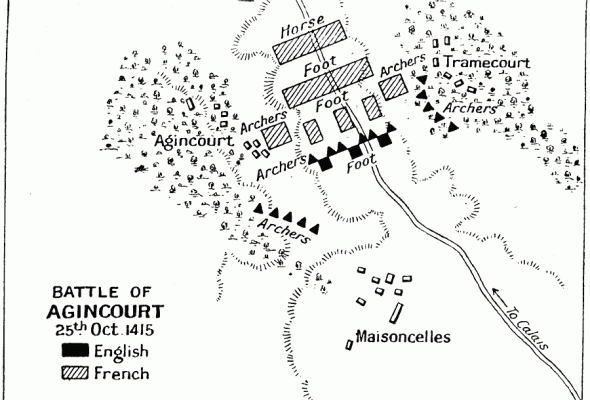
Well Agincourt is a castle in France where on October 25th, 1415, King Henry fought a decisive battle that helped him conquer all of France. For more info on the battle, click here to read this article from the Telegraph.

Contemporary drawing of the Battle of Agincourt.

As for St. Crispin, I wrote about him before when I was working on a high-school production of “Henry the Fifth,” which you can read about here. Long story short- he was the patron saint of SHOEMAKERS!

And finally, a funny take on the battle from my favorite kid’s show, “Horrible Histories.”

See you tomorrow!

Paul

A Few More Updates

Hi folks!

I’ve now finished my work on Romeo and Juliet, and this October, I’m taking a little time to talk about two of Shakespeare’s spookiest plays- Macbeth, and Julius Caesar. Right now, the Royal Shakespeare Company is putting on a very inventive production of the play, and I’d like to talk a little about this interpretation. You can read about it here: http://www.telegraph.co.uk/culture/theatre/theatre-reviews/9317659/Julius-Caesar-Royal-Shakespeare-Theatre-Stratford-upon-Avon-review.html 

You can read my analysis of Julius Caesar here.

Here are some posts I’ve got waiting in the wings:

  1. A spooky Shakespeare Stories related to Julius Caesar, and the assassination of President Lincoln!
  2. Analysis of the speeches in Julius Caesar (podcast, hopefully).
  3. Play of the Month for Macbeth.
  4. Explanation of the curse of Macbeth.
  5. Review of “Haunt Me Still,” the sequel to “Interred WIth Their Bones” by Jennifer Lee Carrel.

Stay tuned!

A Few Quick Updates

Hi everyone!

I know it’s been a while, but I’ve been moving into my new place so it’s been hard to find time for blogging. Anyway, some exciting Shakespeare news out in cyberspace, and I’d like to report on some of the ones that make me really excited!

    1. Sir Kenneth Branaugh, Shakespearean actor, director, and founder of the Renaissance Theater company, is putting on a series of productions, including a production of “The Winter’s Tale” with…. DAME JUDY DENCH! This production will be broadcast in theaters around the country, look for theaters in your area! Here is the official trailer:https://embed.theguardian.com/embed/video/culture/video/2015/sep/10/kenneth-branaghs-the-winters-tale-watch-the-trailer-video

    2. There is a new movie version of Shakespeare’s “Macbeth” coming out in the next few months, starring Michael Fassbender (now he and Ian McKellen have shared 2 big film roles!) 
    3. 60 minute Shakespeare
      Title pages of books in the 60 Second Shakespeare series.

      For teachers, there are now condensed versions of Shakespeare plays that might be easier for some students to read: http://www.fivestarpublications.com/shakespeare/sixty.html 

    4. You might have heard of this trend of actors speaking lyrics to pop songs like Shakespearean actors. I’d like to say that, for the record, most good Shakespearean actors know not to talk like prissy weirdos, but that this is absolutely hilarious, especially the one for Gangam Style! http://mashable.com/2015/09/24/15-second-shakespeare/?utm_cid=mash-com-fb-main-link#a6zKE_iemmqn 

Ok, that’s it for now. Tune in for a new podcast, new play of the month, and some new reviews.

Shakespeare Review: My Shakespeare

On this page, I review a Shakespeare book, movie, or TV show that I feel has some kind of value, either as an interpretation of Shakespeare, or a means to learn more about the man and his writing. This post will introduce you to an incredible documentary, and in my view one of the best ways to encourage, excite, and challenge young people reading Romeo and Juliet Aptly titled, it is called, My Shakespeare.

  1. Name:My Shakespeare
  2. Year: 2004
  3. Director: Michael Waldman
  4. Ages:PG for frank discussions of violence, and occasional suggestive language.
  5. Media:Full length documentary, (available on Amazon and Netflix DVD)
  6. Recommendation: I’d recommend this to high school and college students, as well as all theater teachers and practitioners. A word of caution though- nearly everyone in the documentary speaks with various British accents (from posh London to poor Harlesden), and thus if you think your class might not be able to understand foreign accents, you might want a different version, or put on the subtitles.
  7. Premise: Director Patterson Joseph is a man on a mission- to prove that the people in his home town, (the poor, violence-ridden town of Harlesden England), that these same people can and will put on a production of Romeo and Juliet, in just four weeks. The cast has never acted before, and Patterson sometimes has to drag them kicking and screaming into rehearsals, but eventually they all learn that putting on a Shakespeare play can become an extremely personal experience. In the beginning, they are attempting Shakespeare, but by the end they live it. In between the action, there are interviews with Baz Luhrman, the celebrated director of the Leonardo Dicaprio film version of Romeo and Juliet back in 1996. Baz serves as a sort of chorus, explaining some of the challenges a director like Patterson will inevitably face as he and his actors bring the play to life.
  8. Repeated Ideas That Run Through the Documentary:
    1. You can do this- you can act, you can understand Shakespeare, you can finish something, you can show emotions, and you can direct.
    2. Shakespeare is able to tell stories that appeal to everyone, and here’s the proof.
    3. The best way to understand Shakespeare is to get on your feet and do it.
  9. Moments to watch for: Before I list my favorite moments in the documentary, I’d like to list the theatrical process by which Patterson and his company put on Romeo and Juliet. 
    • The Process Of Creating Romeo and Juliet:
      1. Auditions/ Improv Games (4 weeks to go)
      2. Table Work, where the actors read the script and talk about their characters.
      3. Paraphrasing the script and improv (9 days to go)
      4. Stage combat Rehearsals- prepping the fights.
      5. Opening Scene rehearsal on a basketball court.
      6. Vocal Rehearsal
      7. The Emotion Workshop (8 days to go) The actors try to tap into their own emotions to try and bring some real feelings into their parts.
      8. Death Scene Rehearsal in a Graveyard!
      9. Last minute changes (5 days to go)
      10. Globe theater rehearsal
      11. Nighttime Balcony Scene Rehearsal at the aptly named, “Shakespeare Road.”
      12. Tech Rehearsal at the Royal Academy Of Dramatic Arts.
      13. Speed Through Rehearsal/ The final rehearsal (1 day to go)
      14. Performance at the Royal Academy Of Dramatic Art
    • Now a look at some of my favorite parts of the documentary.
    1. The audition/ casting scene- In this scene you watch the future cast members explore the story of the play through improvisation, then you see their background through a series of headshots and dossiers. The whole cast is more diverse than any West End production: black, white, Christian, Muslim, young people and old people. Patterson’s casting choices alone makes this production fresh and relevant to our shrinking little world. A few cast members are refugees that came to England because of their countries’ own family feuds in Somalia and Afghanistan. Even more striking, Romeo and Juliet are very young- 18 and 22 respectively, which gives their love scenes an amazing truth and honesty. At first they think they have nothing in common with their characters, but in reality they have even more in common than most of us who read Romeo and Juliet.
    2. The table work scene where the cast learns about their characters You see Mustafa as Mercutio learn that Shakespeare can be funny, you see Jonathan as Romeo learn that some of Shakspeare’s words are still used today, and you see Muska just start to flirt with the idea of playing Juliet.
    3. Jonathan’s Story- Unlike most actors who have played Romeo, Jonathan Thomas has been in a real fight, and he describes it in brutal detail, even showing the scars he got from his stab wounds. Hearing his story gives his performance a truth and poignancy that I’ve never seen in any other version.
    4. The Balcony Scene Rehearsals- In this documentary the two leads perform the scene many times, in rehearsal where they talk about how hard it is to play love realistically, in Shakespeare’s Globe, where they see how it was done in Shakespeare’s day, in a modern balcony back in Harlesden, (on the appropriately named “Shakespeare Road,” and at last in the final performance. Few documentaries show just how hard it is to do a Shakespearean scene, particularly if it’s famous, and how many different ways a director and a pair of talented actors can play it and find new things each and every time.
    5. The scene where Patterson lets one of the actors go. Everyone in this production has to overcome obstacles, even the director; when one of his actors fails to perform, he simply has to drop the axe and recast one of his lead roles. Theater is hard work, and just like any job, the director has to take control and do what is necessary to make sure that the production is a success.
    6. Rehearsal at the Globe Theater On one very special day, the actors step onto the stage of the reconstructed Globe, and take a few tentative steps into the 1500s. Once in the space, they take to it like fish to water, playing with the audience, playing with projection, and their lines are infused with a special kind of energy that only arises from the boards of an Elizabethan stage. I found it interesting that when Jonathan was talking to Mark Rylance, the artistic director of the Globe, he asks what kind of man Shakespeare was, because he’s starting to see Shakespeare as a peer!
  1. My reaction: This documentary gives me hope every time I see it. Over and over again Patterson instills in his cast the idea of “Yes, you can,” yes, these people can understand Shakespeare, yes they can learn their lines, yes they can act, yes they can do something intelligent, and moving, and honest, and beautiful and what better play to bring that message across than Romeo and Juliet, which is full of youthful energy and excitement. My only complaint is the interviews with Baz Luhrman don’t really add much to the documentary side of things; Luhrman was really only there for name recognition, and he certainly knows less about Shakespeare than the RSC veteran Patterson. Nevertheless, the whole documentary Is nothing short of inspiring from beginning to end.
  2. Notable cast members
  1. Muska Khpal as Juliet. An 18 year- old Afghan refugee who came to England in 1996, without even speaking English, now playing one of the greatest characters in English literature! Like Juliet herself, Muska has very strict parents (who didn’t approve of her playing the part), and is at first is extremely shy towards Romeo, toward the play, and even the director, but when you hear her talk about her dream to return to Afghanistan and become a doctor, you can sense Juliet’s strength and independence.
  2. Jonathan Taylor 22 year-old Jonathan is a very charismatic and intelligent young man. After this production he became a professional actor. He speaks articulately about the experience of acting for the first time, reading Shakespeare for the first time, and even his own experiences with love and violence on the streets of Harlesden. He is also very talented and speaks the lines with an effortless panache. I found myself rooting for him the whole time, and the fact that I got to see this production spark his interest in acting and then to see him change and grow was truly inspiring.
  3. Mustafa as Mercutio Tiny, sparkle eyed Somali refugee. He is truly Mercurial- he frequently jokes and kids with the cast, yet at the same time, he is deathly serious when he talks about his life in Somalia- seeing people die in front of him. When he dies onstage, you know his performance is drawn from some real world experience.
  1. Grade: 5 Shakespeare globes.

Another Review: Films Media Group – “My Shakespeare: Romeo and Juliet for a New Generation:” http://www.films.com/ecTitleDetail.aspx?TitleID=20674&r=

Interview with the director, Joseph Patterson: http://www.theguardian.com/culture/2012/jul/01/shakespeare-and-me-paterson-joseph-julius-caesar