Here is the last post on my series of 3 which examines the importance question of why should we read or see this play? In the last post I argued that, although the play is sometimes billed as a moral story, the characters engage in really reprehensible behavior- premarital sex, muder, and whining about their teenage problems. So the question is, if the play isn’t a moral parable, what can we gain from reading it?
Reason # 3- The Play Shows Truths About
the Human Condition.
Even though the play’s characters frequently do rash and sometimes foolish things, this only serves to make them more complex and realistic. The truth is, we all do foolish things when in love, and they all dramatically effect our lives, (sometimes for better or for worse).
The point is that the qualities we demonstrate when we’re in love, reveal who we truly are. Romeo is foolish, obsessed with his lover, sometimes selfish, and hot-blooded. He is also tender, caring, utterly without deceit or pretense, and committed to his beloved at any cost.
I believe this is why we really need to keep reading and watching this play. As Judy Dench said in the film “Shakespeare In Love,” the play shows the very truth and nature of love, not just the budding romances or passionate affairs, but dark obsessions, painful separations, family bonds, and even, “glooming peace,” as the Prince says at the end of the play. Shakespeare shows them all, not judging one to be better or worse, but demonstrating the feelings and the actions that arise in reaction to the powerful force of love.
So when you read this play, try to look beyond the peculiar language, the old-fashioned type and the flowery poetry. Inside you might see a reflection of yourself, what Shakespeare called, “the mirror up to nature.”
On Tuesday I posted an article about why schools are required to read “Romeo and Juliet.” I’d like to continue with another answer that is not quite as good, but has shaped the course of the play’s history.
Romeo and Juliet: Why Do We Have To Read This Play?
Answer # 2: We still read it because at one time, Romeo and Juliet was considered to be good for ‘moral instruction.’
In the 1770s, Shakespeare’s plays were read aloud, not as dramatic literature, but moral lectures to teach people about jealousy or love or ambition (Source: This American Life). Shakespeare was considered by many to be “The best judge of human nature,” as the dedication page says on the 1753 edition of Romeo and Juliet. This 18th century concept continued into the 19th, as evidenced in this painting, The Reconciliation Of the Capulets and Montegues, 1854.
“The Reconciliation of the Capulets and Montegues ” by Frederick Leighton, 1856.
Notice how in this picture, we see Romeo and Juliet as the lightest objects in the play, while their parents are directly center, holding hands. The “glooming peace” starts with the window, reflects off the dead lovers, and inspires the parents.
To readers and playgoers in the genteel age of the 18th and 19th centuries, Romeo and Juliet seem to champion love and peaceful co-existence, making the play seems to be a good play to teach young people. There is evidence in the play that supports this idea that Shakespeare was judging the youthful Romeo and Juliet to be morally superior to their parents. Shakespeare describes their parent’s hate as a canker or a parasite, sucking the life out of a flower, the feud has infected so much of Romeo and Juliet’s world, that it makes it impossible for their love to take root. In response, the young fight with their peaceful love to save the destructive world that their parents have created, and die as a sacrifice to true love. Looking at it this way, Romeo and Juliet take on a Christ-like status, dying to redeem their parent’s sins, which certainly would have appealed to the predominantly Christian audiences of the 18th and 19th centuries.
This approach does have its problems though:
Problem #2: The Language is FILTHY! When people like David Garrick adapted Romeo and Juliet, he cut all of Sampson and Gregory’s dirty jokes, and most of Mercutio’s. Even audiences today might be shocked to learn that one passage in Romeo and Juliet is still considered by modern standards to be PG-13:Problem #1: Although he dies nobly, Romeo also engages in many immoral behaviors, including his attempts to seduce Rosalind at the start of the play, his hot-blooded murder of Tybalt, and his purchase of illegal drugs from the Apothecary.
Mercutio:
Now will he sit under a medlar tree,
And wish his mistress were that kind of fruit
As maids call medlars, when they laugh alone.
Romeo, that she were, O, that she were
An open a**, thou a poperin pear!
Romeo and Juliet, Act II, Scene ii
I won’t go into what Mercutio is actually talking about when he mentions the pear-like medlars, which women used to joke about when they were alone. Suffice it to say that if you ever believed that Shakespeare ennobles us because he only speaks in proper, age-appropriate language, I can only say that you are:
Problem #3: Nobody ever thinks in this play!
Claire Danes from “Romeo and Juliet” (1996) holds a gun to her head, and threatens suicide rather than marrying Paris.
Even though their parent’s feud is morally wrong, neither Romeo nor Juliet try to deal with it in a lasting, practical way, but instead try to run away from the problem. As Peter Saccio says in his lecture on Shakespearean tragedy, this approach is highly flawed: “Romeo and Juliet cannot live outside the social strata that their parents have created,” which means that they can’t run away forever or their lives will literally waste away. However lovely Romeo and Juliet’s love is, it blinds their judgement too.
Even Friar Lawrence acts rashly as this wonderful video demonstrates:
Problem #4: The parents, (especially Lord Capulet), are also terrible moral figures-
As you can see in this lovely video from the BBC, Capulet attempts to fix his daughter up with an arranged marriage to manipulate the Prince to favor the Capulets. When Juliet refuses, Capulet reacts violently and threatens to disown her and hit her. Hardly an example of proper fatherly devotion.
Looking at all these examples, one could make the argument that Romeo and Juliet is a better example of immoral behavior. One could even argue that the tragic death of the two lovers was just the natural consequence of their hasty, overly passionate affair.
As dubious as the morals in this play are, they can and have been used to construct several moral arguments, such as arguments against pre-marrital sex, or arguments to pursue peace, or arguments for young people to be wiser in relationships. Each one is legitimate and Shakespeare gives each one its time to shine.
Not only is it the first day of this month, it’s also a Shakespearean holiday! According to this passage from “Romeo and Juliet,” today is Juliet’s Birthday!
NURSE: Even or odd, of all days in the year,
Come Lammas Eve at night shall she be fourteen.
–Romeo and Juliet, Act I, Scene ii.
Lammas Eve, is a pagan holiday, also known as Lughnasa, a Celtic holiday traditionally held on August 1st, or the midway point between the summer solstice and the Equinox. It was a day celebrating harvests and the beginning of fall, and was celebrated through eating wheat, drinking wine and burning a giant wicker man in effigy, (the inspiration of the film of the same name, and the festival of Burning Man). By the way, not everyone appreciates this holiday, click here to see what I mean.
There is also another significance to Juliet’s birthday. It makes her a Leo, a star sign traditionally associated with the Sun. So, when Romeo calls her “The Sun,” there is a literal connection to her birth. Shakespeare makes many allusions to astrology in Romeo and Juliet, as a metaphor for fate.
In the next few days I’ll be talking about what these allusions mean and how they help people understand the play.
Well, today is the last day of July, so I wanted to go out with a bang!
First of all I finally finished my Play of the Month Page for Much Ado About Nothing, so that’s up for you. Also, I’m going to post three reviews of Shakespearean movies. So enjoy this last look at Much Ado, while I prepare for my new play of the month!
I was doing a little web searching today and came across this incredible link: You can read a review of the Globe Theater’s production of “Much Ado About Nothing,” and you can stream it online, (very useful for those of us who don’t live in London)! I’ve provided the link below:
While I’m at it, I would also like to mention that as July winds down, I’ll be giving you reviews of some of my favorite Shakespeare on film productions of Much Ado in the next two days, including the new movie version directed by Joss Whedon!
This was without a doubt, the most incredible theater experience I’ve ever had. It was scary, interactive, exciting, clever, sexy, and even a little disturbing, but without a doubt it was incredible, original, and true Shakespearean theater.
Before you read the review though, a word of caution-
WARNING: this is a production where, the less you know about it, the better your experience will be. I will provide a basic outline of the production, and give you an insight into what I experienced, but I would urge you to see the show yourself without any preconceptions, so if you want to keep the mystery going that surrounds this production, I suggest you stop reading…
RIGHT
NOW.
Alright, if you’ve chosen to keep reading, that means you want to know more, so more I shall give you. Going from the general to the specific, I’m going to talk a bit about what the show is, then describe the experience a bit, and then offer some tips for people who have never gone before.
Sleep No More is not the traditional kind of theater- there is no proscenium, no stage, no seats, and only one platform. It’s what theater teachers like my wife call “Experiential Theater.” The way she explains it, it’s theater that exists as an event. Rather than sitting and watching, you actively follow the action and you can get so close to the actors you can, (and sometimes will), touch them.
The play was conceived by an English company called Punchdrunk Theater Company, who took over an old 6 story warehouse on West 27th Street in New York City, and turned it into a fictional hotel/bar called the “McKittrick Hotel.” The play, (which is done entirely without dialogue), is a re-imagination of both Macbeth, and the novel Rebecca by Daphne Du Maurier, set in the 1930s. The audience is admitted on the ground floor and are permitted to go freely through the 6 floor set and watch the actors perform. Different actors perform on different floors and interact with other actors at different times, and the audience may watch any scene or actor they wish.
The title of the play comes from this passage from Macbeth:
The Experience
As I said before, this a very freeing and very active kind of theater. The only division between you and the actors is that you will wear a face mask. Your role is basically to be an anonymous spectator at an event that unfolds before you, an event full of madness, sex, murder, and mayhem. I would describe it as sort of like living in the strange orgy scene in Eyes Wide Shut, or that scene in The Shining where Shelly Duvall runs through rooms of the hotel and keeps seeing bizarre sights.
From the moment you enter the incredibly detailed hotel, you know you are in a place that was dangerous, dark, and chaotic. You wonder if the people are crazy, or if the building itself is crazy.
As an audience member, you set the pace of your experience as you wonder through the hotels’ infirmary, library, parlor, bath, ballroom, balcony, patio, and dark forest (masterfully designed by Alexandria Challer). Eventually the actors will find you and you choose whether to follow them or wait for something else to come along. When I first entered the hotel, I spent a few minutes looking at the set- reading a hotel guest list, or examining a jar in the pantry, or staring at animal carcasses in the trophy room. Eventually though, I found a story unfold before me, and I rushed to follow it.
Because none of the actors talk, this play is not Macbeth, unless you want it to be, it is not Rebecca by Daphne Du Maurier, unless you want it to be. YOU determine what your experience is. The great, (and famously crazy) theater theorist Antonin Artaud once said, “Text is a prison.” If that’s true, then Sleep No More has set its actors free: their movements convey the story through mime, ballet, gestures, and occasional words. This freedom from the restrictions of text means that it’s up to you to truly piece a story together, and you will find that story can alter, change, and sometimes disappear into mist.
How is This Story Macbeth? (Spoilers Ahead)
One of the most common complaints I read online from people who saw the show is that they didn’t understand the connection between Sleep No More and Macbeth. I don’t want to give too much away because I feel that part of the fun in this production is trying to figure out the connection yourself, but I will provide you with a few scenes to look for, to give you some clues on how to connect this physical theater piece with Shakespeare’s play:
Scenes to look for:
In the bedchamber on the 3rd floor, there is a bathtub on a small platform. On the steps leading up to the tub I saw a letter that contains this text from Shakespeare:
They met me in the day of success: and I have
learned by the perfectest report, they have more in
them than mortal knowledge. When I burned in desire
to question them further, they made themselves air,
into which they vanished. Whiles I stood rapt in
the wonder of it, came missives from the king, who
all-hailed me ‘Thane of Cawdor;’ by which title,
before, these weird sisters saluted me, and referred
me to the coming on of time, with ‘Hail, king that
shalt be!’ This have I thought good to deliver
thee, my dearest partner of greatness, that thou
mightst not lose the dues of rejoicing, by being
ignorant of what greatness is promised thee. Lay it
to thy heart, and farewell.
–Macbeth
This was the first definite evidence I had that the performance was inspired by Shakespeare besides the title of the play. A woman in a beautiful ball gown entered and read the note, pacing the whole time. Suddenly a handsome, red headed man came in. Like the Macbeths in Shakespeare, the body language between these two was hot and fierce; at times passionate and sexual, at times violent and animalistic. Lady Macbeth uses her body and her caresses to tempt her husband to murder, as the one in Shakespeare seduces him with her words. He trembles, turns away, brushes her off. Then, when she persists they struggle- clawing and slapping, even throwing each other across the bed, but in the end, exhausted, he slumps. She, victorious, leaves the room, looking like a queen already.
2. Alone in his room, Macbeth contemplates his dire murder. He leaves the warmth of the bedchamber and enters a dark, moon-lit forrest with a few gravestones. I followed him out into the forrest, knowing that what he does now will probably be an interpretation of Macbeth’s two most famous soliloquies: “If It Were Done When Tis Done” (Act I, Scene vii), and the famous Dagger Speech from Act II, Scene ii. Since the actor didn’t talk, he had to convey Macbeth’s inner torture with his body. I saw him going up to a statue of the Virgin Mary, beating his fists and chest against the hard stone. It was clear to me that this symbolized Macbeth’s struggle between morality and desire. He staggered away from the statue and stopped at a stone pathway that led back to the bedroom. Macbeth then put his hands on the stones, lifted his body up pull-up like, and kicked his legs in a futile attempt of motion. I immediately thought of Macbeth’s line:
I have no spur To prick the sides of my intent, but only Vaulting ambition, which o’erleaps itself And falls on the other (Macbeth I,vii).
It was clear that the actor was showing how Macbeth cannot bring himself to kill, yet is too ambitious to let go of the desire to kill and this is what manifested in his tortured body. He then turned toward me and the other audience members and I saw his expression change. He looked around, worried, even frightened, as if he saw something he couldn’t believe. It wasn’t clear to me at first, but now I’m pretty sure that he was looking at the dagger from his famous soliloquy, and it was US. He ran from the forrest, and we charged after him like a swarm of angry bees! We found him in a corridor on the 2nd floor, where he again hoisted his body up against an old fireplace, inverting himself with his legs sticking up, and his head below, like an upside down cross. He then stretched his hands out and waved them frantically. Two frightened audience members took them and helped him hoist himself down. When Macbeth got to his feet, he proceeded to a darkly lit chamber where another man lay sleeping…
3. In a small bar on the 1st floor, I saw Macbeth with two women and one man. They all wore black lipstick and had crazed and hungry looks in their eyes. The music sped up to a crazed pace and the movements erupted into a terrifying orgy of sights and sounds. A strobe light pulsed showing me glimpses of the frightening spectacle, which included the two women stripping their clothes, the man putting on the head of a goat, and one of the women pulling out an infant covered with blood, and holding it in triumph over Macbeth’s head. At this moment I realized that these gruesome creatures must be the witches, and that they were foretelling Macbeth’s destiny as they do in Act IV. They also brought out a tree, which signified the prophesy that Macbeth will never be vanquished until Birnam Wood walks to Dunsinane Hill. To be honest, I don’t remember much after that, I was probably still in shock!
4. Back in the forrest, I encountered a small brick structure that looked like a tower, with a woman looking out of it expectantly. She beckoned me to come inside. When I did, I saw that she was dressed in a nurses’ uniform, and she was looking at a doctor with concern. Inside the tower was a small operating room with a circular table in the center, and two rows of seats above it. The doctor was injecting some kind of drug into his arm, which made it twitch in spasms. The two of them walked into the forrest and through a door into a room that looked like a small train station with platforms and travel posters on the walls. Lady Macbeth was there, wondering aimlessly. I instantly identified this moment as the famous sleepwalking scene, where Lady Macbeth contemplates the crimes to which she has become accessory. Usually the actress conveys her guilt by washing imaginary blood off her hands, but in this case she chose to interact with people, specifically, ME. She held out her hands to me, I took them. She looked into my eyes with a haunted look on her face. Then she whispered in my ear: “The thane of Fife had a wife, and she was beautiful.” I could see that this woman felt alone and afraid, with no one to talk to. She was no longer the powerful figure throwing her husband across the bed. This was what had driven her mad, and her madness allowed her to see me and the rest of us in the audience. She looked upon us with looks of disgust and terror, as if we were the ghosts of the people she killed, and ran away somewhere we couldn’t follow. We never saw her again (until the ghostly finale).
Those were just a few pieces that I witnessed. I won’t give away how it ended, but I will tell you that the show ended in a dining room on a tableau that reminded me of a cross between Da Vinci’s The Last Supper, and the banquet scene of Macbeth.
When I talked to my wife, (who also came to the show, but was in a different audience group from me), she told me that there were many other scenes that were clearly inspired by Rebecca; she encountered a woman that she figured out was the ghoulish housekeeper Ms Danvers. She also had an intense meeting with the long-suffering Mrs. DeWinter, who gave her a locket and told her to keep it always. Finally, my wife revealed to me the startling fact that (Spoiler Alert), the same woman who plays the infamous Rebecca, dressed in a red flowing gown, also becomes Hecate, the goddess of black magic in Macbeth!
These performances are athletic, well thought-out, and incredibly nuanced. If you take some time to familiarize yourself with the stories of Macbeth and Rebecca, you can understand how the actors are interpreting the stories through dance, mime, and interactions with the set, props, and occasionally, the audience themselves.
I’d now like to conclude this review with my own pieces of advice for those of you who choose to see the show:
Yes, wear comfy shoes. Almost everyone will tell you to bring comfortable shoes and they’re right- if you don’t want to lose the thread of a story, you have to be quick. Macbeth in particular is fast and nimble as a tiger, and you have to run fast to keep up with him.
Find a person that interests you. I think some people make the mistake of staying in one place too long and ignoring the actors. This is physical theater, so try to find an actor to follow.
Pretend you are a ghost if it helps Remember, murder and insanity are here, and you have a chance to see what it looks like and how it moves. Look right into the actor’s eyes and embrace your power to haunt these lost souls. Don’t be afraid to get close to them, and stay there as long as possible.
If you do read Macbeth or Rebecca beforehand, it can be useful to memorize a few lines or moments and look for them in the performance. I can tell you for a fact that these actors meticulously planned their performances to give physical life to these two great works of literature. Look for a gesture, a glance, or a prop that jogs your memory and puts you into this hybrid world of Shakespeare and Du Maurier.
The actors can sense if you are interested in interacting with them. If you seem scared or apprehensive, they will respect your space and not get close to you, but if you show them you are brave enough, they will extend a hand, or come toward you and give you a theater experience you will never forget.
Leave your loved ones behind. Nothing was more fun to me than talking about my experience with my wife after the show and piecing our nights together. Even though the same show was going on the whole time, we saw different people, to different rooms, and had very different reactions.
If an actor disappears, don’t wait for them. Sometimes you’ll follow an actorrl and they’ll duck into a corridor, or go behind a locked door, or a sentinel in a black mask will block your path. Now the story is over, and you are alone. Now you must choose again where to go, and try and uncover the sense of this horror.
If you get to go to the 6th floor, consider yourself very lucky. Only a few people get to see it. My wife said she saw one person go up there. He was on an elevator with a small group. As they reached the top floor, a hotel porter let him off, then extended an arm, to indicate no one else would be admitted. Even the man’s girlfriend was blocked by the porter, who then explained, “This experience is best undertaken, alone.”
Well, I hope this whetted your appetite somewhat. Like I said this show is incredible, and very different from the kind of theater we generally think of, and that’s what makes it engaging and exciting. However, there is violence, nudity, and gruesome imagery onstage so it is definitely not for children. If you are interested in learning more, you can visit the Sleep No More website: www.sleepnomore.com/
I’m waiting until tonight to finish my “Sleep No More” review, which as you may know, is a highly inventive, experiential interpretation of Shakespeare’s “Macbeth.” I heard from some people who had seen the show that one of their biggest problems was that they themselves weren’t familiar with the play, so here’s a quick summary from one of my favorite YouTube channels: “Thug Notes!” (PG-13 Language alert)
As promised, here is my review of the hot new Broadway musical “Something Rotten.”
Me posing in front of a colorful banner for “Something Rotten”
My reaction: I went into this show with the hope that it would be a witty, whimsical, musical salute to both Shakespeare and musicals, and it certainly was , but to my mind as a Shakespearean fan, I felt like it didn’t quite live up to its full potential. Yes it’s entertaining, yes it has some great acting and great performances, yes it boasts some glistening songs and scores of jokes, but the plot is a little recycled, the characters are hard to like at times, and the balance of Shakespeare and musicals is pretty tipped to one side.
The Theater
Something Rotten is entertaining from the moment you walk up to the door of the St. James Theater: I was greeted by colorful Elizabethan cartoon figures who voiced their take on the show via speech bubbles: “Song and dance at the same time? Blasphemous!” As I walked up the stairs to my seat in the Mezannine, I saw all kinds of Shakespearean merchandise in the lobby from magnets to T-Shirts, to signature candy bars and drinks, including one called “The Bloody Bard.” This raised my hopes that this show would show some love to Shakespeare in addition to musicals.
View from the audience of the curtain for “Something Rotten.”
As I took my seat, I gasped at the enormity before me: a huge Greek proscenium opening on a Pantheon like dome, complete with two painted muses on the ceiling, and three chandeliers that would tempt any Phantom of the Opera to deploy upon the audience. Below the dome was the set; an impressive recreation of an Elizabethan playhouse with its thatched roof, wooden galleries, and the banners that announce the start of the show. Once the lights dimmed, the orchestra began with trumpet and the ping of an old fashioned Tambor drum, which slowly evolved into the raucous jazzy tune “Welcome To the Renaissance.” The show had begun, and I was smiling already.
The Plot
As I’ve stated before, the premise is pretty simple. Two brothers, Nick and Nigel Bottom, (Brian D’Arcy James and John Cariani respectively), are struggling writers who are trying to make it in theater in London, constantly out classed by Shakespeare (Christian Borle), who used to be an actor in their company. Nick angrily curses out Shakespeare in song in the hilarious number: “God I Hate Shakespeare.”
Shakespeare is a flamboyant and stupendously successful writer with a leather doublet, killer abs, and a cocky smile. He knows he’s the best there is, and shows off by giving extravagant parties and poetry readings, complete with colored lights and pyrotechnics! Shakespeare also has an annoying habit of stealing lines and ideas from other writers; the second he looks at Portia he says, “Good name,” hinting at his use of her name for the heroine of The Merchant Of Venice. Borle is fantastic in his Shakespeare strut, and plays the Shakespeare rockstar persona to the hilt.
Both the Bottom brothers secretly envy Shakespeare; Nick for his money and success, Nigel for his skill at writing beautiful poetry. Nick worries how to make a living as a playwright, especially since he is also supporting his brother and his wife Beatrice (played excellently by Heidi Blickenstaff). Bea urges him not to worry and assures him that she is strong enough to get a job and help ease the burden of supporting his family in the song: “Right Hand Man,” (a wonderful satire of contemporary gender politics). “It’s 1595, we have a woman on the throne,” Beatrice tells her husband, “By 1600 a woman will be exactly as equal as a man.”
Nick doesn’t want his wife to have to work for him, but he can’t get out from under Shakespeare’s shadow. Desperate to turn his luck around, Nick pays a soothsayer (Brad Oscar) to tell him the future of musical theater. Oscar goes into a raucous musical number, “A Musical,” that “invents,” and parodies almost every musical of the last 50 years from A Chorus Line, to Rent, complete with an upbeat tune and kick-lines!
Bottom becomes convinced that he will create the great new musical that will rival Shakespeare’s plays in popularity, and he gets his brother and the Soothsayer to write it. He now imagines that for once, “Bottom’s Gonna Be On Top!”
Nigel Bottom, Nick’s brother, is an aspiring poet who dreams of creating a play that will show beauty and truth. Nigel’s poems put love in the heart of Portia, who adores both his poems, and Nigel himself. The only problem is her father Brother Jeremiah (Brooks Ashmanskas), is a Puritan, (as well as a closet homosexual). Jeremiah despises theater, and by extension, Nigel. The pair secretly meet to allow their love, and their love of poetry to blossom. They also have a wonderful duet, “We See The Light,” where they imagine getting Brother Jeremiah to believe in their love, which turns from tender Elizabethan ballad into a catchy Gospel tune.
I don’t want to give too much away but, in the end, the Bottom family and Shakespeare strike a deal- Shakespeare will still rule theater in England while the Bottoms get to be on top at last in America, where their new musicals will become the theater of the future.
If you already have seen the show, here are some Shakespeare jokes you might have missed:
The title “Something Rotten,” refers to a line from Hamlet where the guard Marcellus declares: “Something is rotten in the state of Denmark.”
The name Nick Bottom comes from one of Shakespeare’s characters; in A Midsummer Night’s Dream, he is an actor in an amateur theater troupe, who is magically transformed into a man with the head of a donkey. Through the play and the musical there are jokes about what an ass Bottom is both literally and figuratively.
The two female characters are also named after Shakespearean heroines: Beatrice, Bottom’s strong-willed wife is from Much Ado About Nothing, while Nigel’s sweetheart Portia appears in The Merchant of Venice, as does the Jewish moneylender Shylock.
In many of Shakespeare’s comedies women dress up as men to take on their jobs, just as Beatrice does for her husband Nick.
The villainous puritans who try to shut down Nick and Nigel’s musical are based on a real life religious group who did eventually pull down all the playhouses in London, and ban theater altogether. Fortunately for Shakespeare, they didn’t succeed in destroying the theater until 30 years after he was dead.
The brothers’ home land of Cornwall probably echoes that of the brothers Edmund and Edgar in Shakespeare’s tragedy of King Lear.
Many people have accused Shakespeare of stealing his work from other people over the years, and of course, this musical makes it one of his defining characteristics. I’ve written about this in the past, but to sum up my arguments- Shakespeare adapted, he didn’t steal.
The beautiful song: “To Thine Own Self Be True,” is a direct quote from Shakespeare’s play Hamlet; a bit of fatherly advice from Lord Polonius to Leartes.
(Spoiler Alert) Toby Belch, Shakespeare’s non-de-plume as he spies on Nick Bottom, is named after another of the real Shakespeare’s characters- a fat drunken knight from the play Twelfth Night.
The line “Son of York,” comes from Shakespeare’s Richard III.
(Spoiler alert) Ironically, in Shakespeare’s play of Merchant it is Portia, not Beatrice who disguises herself as a male lawyer and saves the heroes from death in the courtroom with her famous “The Quality Of Mercy Is Not Strained” speech, though Beatrice does so in Something Rotten.
(Spoiler Alert) The judge in the courtroom whom Shakespeare promises not to make fun of is named Falstaff, named after Shakespeare’s most celebrated comic character- another fat, drunken knight who has no moral code whatsoever!
(Spoiler alert) When the brothers are banished and sent to America with Shylock, this parodies a historical event in 1751, where a troupe of actors mounted one of the first ever theatrical productions in America, which happened to be Shakespeare’s Merchant of Venice.
This musical is a wonderful and entertaining show, but as I said before, I feel that some of it didn’t quite live up to my own expectations. I’ve decided to list my criticisms as a list so that you can choose to read or ignore it. After all, this is only my opinion, and I want you to make up your own mind.
I would argue that plot-wise, Something Rotten is basically The Producers set in 1595. The Bottom brothers who struggle to produce a play are quite obviously lifted from Mel Brooks’ Bialistock and Blume, and the fact that Brad Oscar, (who was in that musical), has such a big part in Something Rotten, is a dead giveaway. Plus the final scene that culminates in a courtroom is very derivative of the climax of The Producers. I feel that for a musical that bills itself as “A Very New Musical,” the creators belie this statement by ripping off one of the most popular musical of this century.
This is a small point, but I believe that there are far more musical jokes in Something Rotten than Shakespeare jokes. This could just have been my own experience, (surrounded as I was by high-school aged musical theater geeks), but I thought that the torrent of musical theater puns and quotes was simply too much. The audience ate it up and laughed so fast that I couldn’t hear a lot of the other jokes. I wish that the jokes were a little more spaced out, and that the balance was a little more toward Shakespeare instead of musicals.
The roles for women are small and the roles for minorities are nearly nonexistent- the only black actor is a minstrel (played superbly by Michael James Scott), who only gets one song, “Welcome To the Renaissance,” and doesn’t have any influence on the plot whatsoever. In Shakespeare’s plays, fools and minstrels were essential to understanding the plot and often helped comment on the action, so I thought not using his talent more was a huge missed opportunity. Likewise, Bea and Portia are great characters, but I wanted to see more of them in the play, and it would have been nice if they got a scene together.
Although Shakespeare is the antagonist, I found his scenes were the best, which arguably caused sort of a problem. I feel the writers couldn’t really pick a lane in terms of making it clear whom to root for- Bottom or Shakespeare. In many ways Nick Bottom is a jerk- he ignores his wife, he ridicules his brother, and his jealousy to Shakespeare (though understandable) is highly unappealing. By contrast, Shakespeare might be an egomaniac and a thief, but as he says in “It’s Hard to Be the Bard,” he’s just trying to live up to the adoration that his fans demand of him. The Bard is arguably more sympathetic because he is constantly trying to live up to his image as a genius. Like a lot of artists from Mozart to Bob Dylan, to Picasso, to George Lucas, Borle’s Shakespeare worries that he’s piqued too soon, and has nothing more to offer his public. Bottom never offers to help Shakespeare or ask him for advice on how to become a better writer, he just tries to steal Shakespeare’s success and justifies it with his insatiable jealousy. At least Max Bialistock was nice to Leo Bloom and encouraged him to follow his heart’s desire of being a producer, but Nick never even does that for Nigel. In short, I found it hard to enjoy the character of Nick Bottom, (who was supposed to be the hero), when he is never given an opportunity to be likable. Once again, Bottom is overshadowed by the Bard, but this time it’s his own fault.
Although I was a little disappointed with these issues, the show is incredibly entertaining, well-acted, and has great catchy songs. I certainly would recommend it to any musical theater fan with at least a touch of Shakespeare in their soul!
Stay tuned for a review of one of the greatest Shakespeare adaptations I’ve ever seen, the experiential theater piece, “Sleep No More.”
Shakespeare himself was a father, and he frequently wrote about the dynamic between fathers and their children. There are many different types of fathers in Shakespeare’s 40 plus plays, and this week I’m ranking them in terms of three categories: Good Dads, Bad Dads, and “Dad Dads.” You’ve probably already read the “Worst Dad” post, so now we’re looking at the good, and the not so good. I used the following criteria when choosing the top 5 dads in each categories:
The Good Dads
Are supportive for their kids
Try to keep their children happy
Offer help and advice, especially on their children’s future.
Are willing to sacrifice themselves
They let their children become their own people.
The Bad Dads
Treat their children as property
Have little to no interest in their children
Put their children in danger
Subject their children to abuse
In some cases, they murder them!
The “Dad” Dads
Are basically good hearted, but they have some kind of flaw that prevents them from becoming really good parents.
In my view, are the most human, modern dads on the list.
I’ve chosen to award these dads a necktie, something every ok dad needs.
Now, onto the Dad Dads:
5. Aegean from The Comedy Of Errors. Aegean wonders around for 20 years looking for his lost children, which I call devoted parenting, but a little aimless and undisciplined. I therefore award Aegean two ties with little anchors on them, to remind him to stay in one place and wait for his sons to find him!
Alexandre Bida, “The death of Lord and John Talbott,” 1895
4. Lord Talbott from Henry the Sixth Part I. Talbott is the hero of the English fight against the French at the close of the Hundred Years War. He goes toe to toe with Joan of Arc on numerous occasions. He also raises a fine and valliant son, John Talbott who is also a warrior. The two die bravely in a siege against the French, rather than surrendering, or leaving the other to die. Talbott is clearly also devoted to his child, but his career choice doesn’t allow his son to grow up in a safe environment! I therefore award Talbott two ties with little English and French flags on them.
The Ghost of Hamlet’s Father by William Blake, 1806.
3. The Ghost Of Hamlet’s Father from Hamlet/ Portia’s Dad from Merchant Of Venice. Both these parents die before their plays begin, yet they still try to improve their children’s lives from beyond the grave! The Ghost helps Hamlet become king of Denmark, and Portia’s dad tries to help her find a good husband, (one who will love her for something besides her beauty or riches). Although these parents achieve their goals, waiting this long to help their kids seems a bit like absentee parenting! I therefore award these posthumous parents ties with little skulls on them.
2
. King Henry IV, from King Henry IV King Henry is the classic career dad, one who wants his son Hal (the future King Henry V), to follow in his footsteps. The two have a terrible fight when Henry thinks Hal is trying to steal his crown on his deathbed! Eventually though, father and son reconcile, and dad even gives the future king some last minute advice; if you fight a war with France it’ll help secure your crown, which Hal does and succeeds! I therefore award King Henry a tie with little crowns on it, hoping that nobody with a dagger ties tries to steal it when he’s sleeping!
1. Prince Pericles from Pericles Pericles is another busy dad- King Antiocus tries to murder him, and he has to leave his own kingdom. Then he gets shipwrecked 3 times! In fact, his only daughter is born onboard a ship in the middle of a storm! Pericles raises the girl for a number of years, but then has to leave again, and guess what, he gets shipwrecked AGAIN! He eventually finds his daughter and they live happily ever after, but you kind of get the idea that Pericles is a little accident-prone, which keeps him from being on the Best Dads list. Sorry Pericles, but at least you get a tie with, what else, Boats on it! Maybe next Fathers Day, someone will get you a life preserver.
And now at Long LAST, the BEST Dads in Shakespeare!
Aaron fights to protect his baby child.
5. Aaron the Moor from Titus Andronicus. Ironically, one of the worst villains in Shakespeare is also one of the best fathers. Aaron is fiercely protective of his child, even threatening people at sword point if they dare come near his baby. He also plans out the child’s future and is willing to give his own life for a promise that Lucius will protect and nourish his son. He may be a monster to everyone else, but to his baby, Aaron is simply, a good dad!
4. The Old Shepherd from The Winter’s Tale. This character is a very mirror of generosity and kindness; not only does he take care of his son The Clown, he adopts a poor discarded child, the princess Perdita, with no obligation to do so. He raises her for 16 years and constantly brags about her to the entire town. She becomes a beautiful, wise, and modest girl who fills her adopted father with pride because of his good parenting. Even when Perdita meets her real father, she speaks of The Old Shepherd with real filial affection “Oh my poor father.”
3.
Lord Capulet, from Romeo and Juliet. I know this was a controversial choice, and I discuss my choice in detail on my podcast, but I’ll sum up my major arguments here:
Even though a lot of actors choose to have him smack Juliet around, there’s no mention of it in Shakespeare’s text. The most he ever does is threaten to strike her, but the stage directions never indicate he does it. Capulet is clearly more bark than bite.
From the very beginning of the play, Capulet has shown that he cares about Juliet, and wants her to marry for love, not money.
Lord Capulet hovers and frets constantly when Juliet tells him she will marry Paris, staying up late to plan the wedding! I ask you, does that sound like a tyrannical father? I wonder sometimes if Lord Capulet would’ve forgiven Juliet for marrying Romeo if she had just told him. In any case, based on my criteria above, Capulet is a good dad, bad tempered, yes, but fundamentally concerned for the welfare of his children.
3. Prospero fromThe Tempest I chose this high spot for Prospero mainly because he seems to have the most success of any other dad in the cannon. Like Pericles, he too is shipwrecked with his daughter, but Prospero stays with Miranda, raises her alone, teaches her everything she knows, and calls her an angel that helped preserve his life. Prospero cares so much for his daughter that he refuses to give into despair, even though he’s lost his wife, his dukedom, and his home.
Prospero also hatches a plan to get him and Miranda off the island, to get his dukedom back, and to get her married to a handsome prince name Ferdinand, and he succeeds with every one of these endeavors, even though it takes 12 years. Prospero gets extra points for his patience and his wisdom, but I have to admit he’s a bit of a control freak; he demands that Miranda listen to him and obey him no matter what, and he warns Ferdinand that there will be dire consequences if he dare try to do anything illicit with his daughter before the wedding. In addition, there’s no denying that Prospero is also acting out of self interest- he wants to become duke again, and he wants revenge against his enemies and that’s partially why he raises a tempest, (or a huge storm), instead of just sending a message back to Milan.
1.
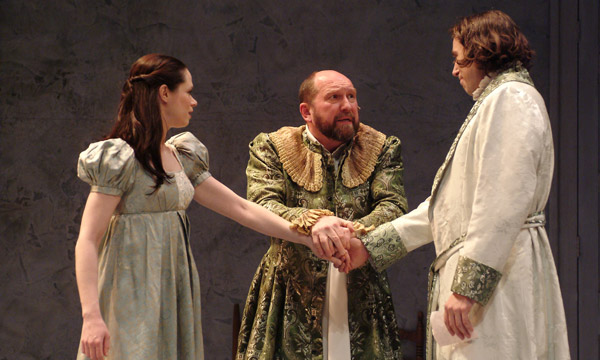
Simonides grants permission for Pericles to wed his daughter. Production shot from Mary Zimmerman’s 2006 production of “Pericles.”
King Simonedes from Pericles, Prince Of Tyre You might forget this character because he only has a short time onstage, but I defy anyone to come up with a better father. He’s kind, supportive, stable, funny, and has a wonderful relationship with his daughter Thaisa. Above all, Simonedes actually listens to his child and does everything in his power to help her when she decides she wants to marry Pericles. Also, like Prospero, Simonedes pretends to object to the marriage, but you kind of get the sense that, rather than testing the affection of the couple, he’s actually just playing a joke on them. You can hear a “gotcha” and a fatherly wink in the final line of the speech in Act II, where he pretends to object to their marriage:
Congratulations to all our fabulous fictional fathers! Thank you for reading, and see you soon!