I know it’s been a while, but I’ve been moving into my new place so it’s been hard to find time for blogging. Anyway, some exciting Shakespeare news out in cyberspace, and I’d like to report on some of the ones that make me really excited!
There is a new movie version of Shakespeare’s “Macbeth” coming out in the next few months, starring Michael Fassbender (now he and Ian McKellen have shared 2 big film roles!)
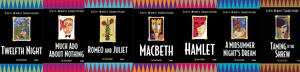
Title pages of books in the 60 Second Shakespeare series.
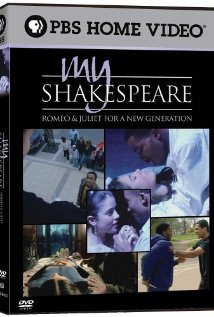
On this page, I review a Shakespeare book, movie, or TV show that I feel has some kind of value, either as an interpretation of Shakespeare, or a means to learn more about the man and his writing. This post will introduce you to an incredible documentary, and in my view one of the best ways to encourage, excite, and challenge young people reading Romeo and Juliet Aptly titled, it is called, My Shakespeare.
Name:My Shakespeare
Year: 2004
Director: Michael Waldman
Ages:PG for frank discussions of violence, and occasional suggestive language.
Media:Full length documentary, (available on Amazon and Netflix DVD)
Recommendation: I’d recommend this to high school and college students, as well as all theater teachers and practitioners. A word of caution though- nearly everyone in the documentary speaks with various British accents (from posh London to poor Harlesden), and thus if you think your class might not be able to understand foreign accents, you might want a different version, or put on the subtitles.
Premise: Director Patterson Joseph is a man on a mission- to prove that the people in his home town, (the poor, violence-ridden town of Harlesden England), that these same people can and will put on a production of Romeo and Juliet, in just four weeks. The cast has never acted before, and Patterson sometimes has to drag them kicking and screaming into rehearsals, but eventually they all learn that putting on a Shakespeare play can become an extremely personal experience. In the beginning, they are attempting Shakespeare, but by the end they live it. In between the action, there are interviews with Baz Luhrman, the celebrated director of the Leonardo Dicaprio film version of Romeo and Juliet back in 1996. Baz serves as a sort of chorus, explaining some of the challenges a director like Patterson will inevitably face as he and his actors bring the play to life.
Repeated Ideas That Run Through the Documentary:
You can do this- you can act, you can understand Shakespeare, you can finish something, you can show emotions, and you can direct.
Shakespeare is able to tell stories that appeal to everyone, and here’s the proof.
The best way to understand Shakespeare is to get on your feet and do it.
Moments to watch for: Before I list my favorite moments in the documentary, I’d like to list the theatrical process by which Patterson and his company put on Romeo and Juliet.
The Process Of Creating Romeo and Juliet:
Auditions/ ImprovGames (4 weeks to go)
Table Work, where the actors read the script and talk about their characters.
Paraphrasing the script and improv (9 days to go)
Stage combat Rehearsals- prepping the fights.
Opening Scene rehearsal on a basketball court.
Vocal Rehearsal
The Emotion Workshop (8 days to go) The actors try to tap into their own emotions to try and bring some real feelings into their parts.
Death Scene Rehearsal in a Graveyard!
Last minute changes (5 days to go)
Globe theater rehearsal
Nighttime Balcony Scene Rehearsal at the aptly named, “Shakespeare Road.”
Tech Rehearsal at the Royal Academy Of Dramatic Arts.
Speed Through Rehearsal/ The final rehearsal (1 day to go)
Performance at the Royal Academy Of Dramatic Art
Now a look at some of my favorite parts of the documentary.
The audition/ casting scene- In this scene you watch the future cast members explore the story of the play through improvisation, then you see their background through a series of headshots and dossiers. The whole cast is more diverse than any West End production: black, white, Christian, Muslim, young people and old people. Patterson’s casting choices alone makes this production fresh and relevant to our shrinking little world. A few cast members are refugees that came to England because of their countries’ own family feuds in Somalia and Afghanistan. Even more striking, Romeo and Juliet are very young- 18 and 22 respectively, which gives their love scenes an amazing truth and honesty. At first they think they have nothing in common with their characters, but in reality they have even more in common than most of us who read Romeo and Juliet.
The table work scene where the cast learns about their characters You see Mustafa as Mercutio learn that Shakespeare can be funny, you see Jonathan as Romeo learn that some of Shakspeare’s words are still used today, and you see Muska just start to flirt with the idea of playing Juliet.
Jonathan’s Story- Unlike most actors who have played Romeo, Jonathan Thomas has been in a real fight, and he describes it in brutal detail, even showing the scars he got from his stab wounds. Hearing his story gives his performance a truth and poignancy that I’ve never seen in any other version.
The Balcony Scene Rehearsals- In this documentary the two leads perform the scene many times, in rehearsal where they talk about how hard it is to play love realistically, in Shakespeare’s Globe, where they see how it was done in Shakespeare’s day, in a modern balcony back in Harlesden, (on the appropriately named “Shakespeare Road,” and at last in the final performance. Few documentaries show just how hard it is to do a Shakespearean scene, particularly if it’s famous, and how many different ways a director and a pair of talented actors can play it and find new things each and every time.
The scene where Patterson lets one of the actors go. Everyone in this production has to overcome obstacles, even the director; when one of his actors fails to perform, he simply has to drop the axe and recast one of his lead roles. Theater is hard work, and just like any job, the director has to take control and do what is necessary to make sure that the production is a success.
Rehearsal at the Globe Theater On one very special day, the actors step onto the stage of the reconstructed Globe, and take a few tentative steps into the 1500s. Once in the space, they take to it like fish to water, playing with the audience, playing with projection, and their lines are infused with a special kind of energy that only arises from the boards of an Elizabethan stage. I found it interesting that when Jonathan was talking to Mark Rylance, the artistic director of the Globe, he asks what kind of man Shakespeare was, because he’s starting to see Shakespeare as a peer!
My reaction: This documentary gives me hope every time I see it. Over and over again Patterson instills in his cast the idea of “Yes, you can,” yes, these people can understand Shakespeare, yes they can learn their lines, yes they can act, yes they can do something intelligent, and moving, and honest, and beautiful and what better play to bring that message across than Romeo and Juliet, which is full of youthful energy and excitement. My only complaint is the interviews with Baz Luhrman don’t really add much to the documentary side of things; Luhrman was really only there for name recognition, and he certainly knows less about Shakespeare than the RSC veteran Patterson. Nevertheless, the whole documentary Is nothing short of inspiring from beginning to end.
Notable cast members
Muska Khpal as Juliet. An 18 year- old Afghan refugee who came to England in 1996, without even speaking English, now playing one of the greatest characters in English literature! Like Juliet herself, Muska has very strict parents (who didn’t approve of her playing the part), and is at first is extremely shy towards Romeo, toward the play, and even the director, but when you hear her talk about her dream to return to Afghanistan and become a doctor, you can sense Juliet’s strength and independence.
Jonathan Taylor 22 year-old Jonathan is a very charismatic and intelligent young man. After this production he became a professional actor. He speaks articulately about the experience of acting for the first time, reading Shakespeare for the first time, and even his own experiences with love and violence on the streets of Harlesden. He is also very talented and speaks the lines with an effortless panache. I found myself rooting for him the whole time, and the fact that I got to see this production spark his interest in acting and then to see him change and grow was truly inspiring.
Mustafa as Mercutio Tiny, sparkle eyed Somali refugee. He is truly Mercurial- he frequently jokes and kids with the cast, yet at the same time, he is deathly serious when he talks about his life in Somalia- seeing people die in front of him. When he dies onstage, you know his performance is drawn from some real world experience.
While I work on this week’s posts, enjoy this wonderful documentary from the series Shakespeare Uncovered, about the great Shakespeare play, hosted by Joseph Fiennes, who played Romeo and Shakespeare in the film “Shakespeare In Love.” It talks about where the play comes from, and examines why this 400 year old love story endures. For you teachers, I’ve also included a great series of lesson plans that accompany the video
Here’s my special analysis of Romeo and Juliet full of analysis, famous quotes, famous artwork, and a few neato facts! Play Of the Month: Romeo and Juliet
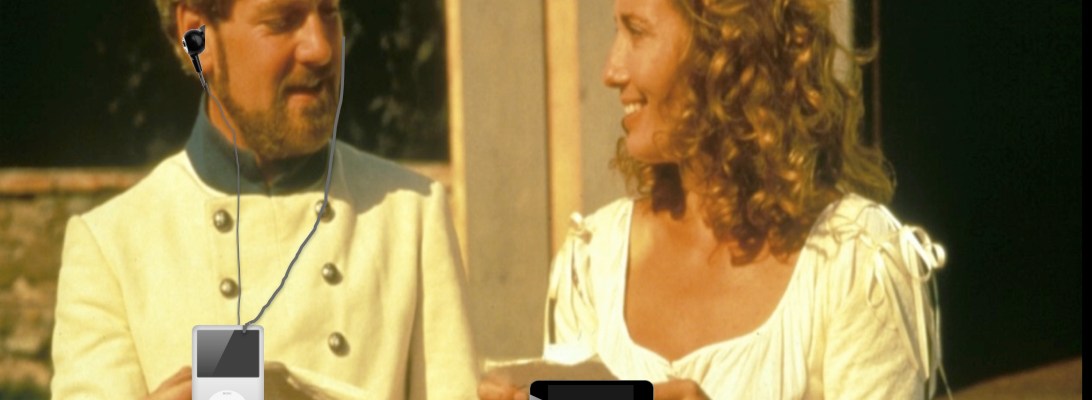
Those of you who read my post for Much Ado About Nothing will probably remember that I made a post like this one last year. I created a fake playlist of songs that I though the protagonists, Benedick and Beatrice, might want to hear during moments of the play. Well, since this year our Romeo and Juliet focuses greatly on the influence of technology in everyday life, I felt it would be appropriate to make another playlist.
For those of you who didn’t read the older post, this is a game!
The way it works is I provide you with a list of the events that happen to Romeo, and then a fake ipod Playlist screen. This screen has a group of songs that I chose because I feel Romeo might want them as part of his ‘internal soundtrack.’ So if Romeo is feeling sad at a particular moment, you look at the playlist and try to pick a song that would match his mood. Yesterday I did Romeo’s playlist and today I’ll do Juliet’s.
Anyway, enough gabbing. LET’S PLAY!
Part I: Events that Happen To Juliet (In Chronological Order)
Like a dutiful daughter, Juliet promises to meet Paris at the Capulet ball.
Juliet is immediately stuck with true love when she dances with Romeo.
Caught up in love and passion Juliet kisses Romeo at her balcony and pledges to be with him forever.
After sneaking off to Friar Lawrence’s cell, Juliet secretly marries Romeo.
Juliet anxiously awaits her first night with Romeo as a married woman.
After spending one last tender night with her Romeo, Juliet tries to keep him by her side, even though she knows he has to leave.
Juliet defies her father by refusing to marry Paris and he threatens to disown her.
Terrified and repulsed by the idea of marrying Paris, Juliet visits Friar Lawrence’s cell, begging him to either help her or let her die.
Haunted by Tybalt’s memory, Juliet reluctantly takes Friar Lawrence’s potion to make herself seem dead. She is taken to her family’s crypt.
Awakened from her sleep and seeing her husband Romeo dead, Juliet stabs herself.
Epilogue: Through Julie’s death, her father reconciles with Montegue.
Part II- The playlist- try to match these songs with the events above.
So now you know the rules, enjoy the game. Send your answers to us by leaving a comment below or by emailing us at openairshakespearnrv@gmail.com. If you have other suggestions for the playlist, let us know and we’ll make a new one!
Have fun!
Most schools in the US and the UK study Romeo and Juliet at one time or another, so for this blog entry, I wanted to ask the question you might have asked at some point in your life:
“WHY DO WE HAVE TO READ THIS PLAY?”
I will answer this question in three posts, with three different responses, to try and make my answers as complete, and yet concise as possible: Reason #1: Shakespeare Himself Is Part Of the Educational Establishment.
From the beginning of American education, Shakespeare has influenced education. What follows is a brief history that hopefully helps explain why, even though he was born in England, Shakespeare is as American as it gets.
Prologue: Life Imitates Art
The first settlements in Virginia occurred in Shakespeare’s lifetime. After all, Virginia was named after Shakespeare’s ruler, the virgin queen Elizabeth. In 1609, a voyage to repopulate the Jamestown Settlement in Virginia hit a terrible storm and was shipwrecked in an island in the Bermudas. The survivors wrote down their story in a book called A Discovery of the Bermudas, Otherwise Called the Isle Of Devilsin 1610, which could have inspired Shakespeare to write The Tempest. Shakespeare wasn’t ignorant of the New World; he references America in The Comedy Of Errors, so it’s not impossible that Shakespeare based his last great play on this “Brave New World.”
The Beginning Of Shakespeare In American Education
In England during the 18th and 19th centuries, Shakespeare was considered a way of educating people in the Greco-Roman tradition, since his plays were based on such Roman authors as Plautus, Seneca, Plutarch, and Ovid (Saccio). Romeo & Juliet is a perfect example of Shakespeare borrowing from the older western traditions- he took the plot and characters from an Italian Renaissance story recorded in Mateo Bandello’s Novelle (1554). The concept of forbidden love though, is much older. Like many Renaissance stories, Romeo and Juliet has roots that go all the way back to the Trojan war, which according to Greek mythology, started with a man from Troy who dared to love a woman from his city’s mortal enemy. Our founding fathers were schooled in this tradition and they helped transplant Shakespeare to the new world.
Shakespeare Comes to America:
Picture of the first ever edition of Shakespeare printed in America, the 1795 Hopkinson Edition by Bioren and Madan
Our country’s early settlers were Puritans and Quakers, who disapproved of theatre in general and tried to have it banned. Nevertheless, many of the founding fathers loved Shakespeare and enjoyed reading his plays ; John Adams and Thomas Jefferson took a pilgrimage to Shakespeare’s birthplace, and George Washington even staged some of his plays (Behn). Even though he was an English playwright, most early Americans were quick to adopt Shakespeare as their own .
Shakespeare In the Classroom
In the 1830s, Shakespeare first appeared in American textbooks as something called “The McGuffey Reader,” a book that contained short snippets of text ranging from old nursery rhymes, to passages from Nathanial Hawthorne. In this sample, you can see that there is one passage from Shakespeare called: “Shylock: the pound of flesh” listed in the table of contents.
At the same time, going to Shakespearean plays and owning copies of Shakespeare’s works became more and more popular in the post Civil War period. As Mark Twain mentions in The Adventures of Huckelberry Finn, productions of Shakespeare were common to early settlers, which is why Twain writes the So-called Duke and Dauphin characters, who pose as actors and perform a perfectly awful rendition of a soliloquy:
To be, or not to be; that is the bare bodkin That makes calamity of so long life; For who would fardels bear, till Birnam Wood do come to Dunsinane, But that the fear of something after death Murders the innocent sleep, Great nature’s second course, And makes us rather sling arrows of outrageous fortune Than fly to others that we know not of . . . (The Adventures of Huckleberry Finn by Mark Twain).
As this passage indicates, even people in rural towns on the Mississippi knew the basics of Shakespeare. In fact, by the mid-19thcentury, you were more likely to see a Bible and a copy of Shakespeare’s works in an American home, than any other book (Source: Lawrence Levine, “Shakespeare In America”). For another funny example of Shakespeare in this period, check out this clip from the film My Darling Clementine, where an old English Shakespearean actor performs for cowboys, which was a common practice during the gold rush.
Shakespeare Goes to Harvard
In the 1870s and 80s, Shakespeare became part of the curriculum of many colleges and universities like Harvard, since studying Shakespeare taught undergraduates the critical thinking skills they would use if they chose to study law or psychology. After the universities let Shakespeare in, high schools integrated Shakespeare into the curriculum to prepare students for college. This is why we study Shakespeare in most high schools today; according to a recent study, about 84% of American high schools are required to read Romeo and Juliet (Source: Hoffman, Jeremy The Western Canon In Today’s High Schools).
To sum up, the first reason we read this play is because it helps us broaden our minds and connect to the wisdom of the past. Also, a huge amount of our culture is inexplicably tied to Shakespeare.
Levine, Lawrence:”William Shakespeare in America”
from Highbrow/Lowbrow: The Emergence of Cultural Hierarchy in America, Harvard University Press, 1998.
Saccio, Peter. Lecture 1: “Shakespeare Then and Now.” Shakespeare: Comedies, Histories and Tragedies. The Teaching Company, 2001. CD. Dartmouth College.
Waterson, Sam (Narrator) et. all. “The Father of the Man in America: Shakespeare in Civic life and Education.” Shakespeare in American Life, (radio documentary). Produced by Richard Paul. Originally airing on Public Radio International (PRI) stations April 2007.Retrieved 21st of August, 2012 from http://www.shakespeareinamericanlife.org/education/episode.cfm
That’s all for now, stay tuned for later posts this week!
Well folks, it’s a new month, and that means a new play, and since August is also the beginning of the new school year, I’ve decided to make August’s Play of the Month—- Romeo and Juliet! Many of us study this play in school, a lot of us write papers, and some of us even perform in it, so I’m going to give you Romeo and Juliet commentary, artwork, analysis, and comedy ALL MONTH LONG! So to start, let me take this opportunity to help familiarize you with the plot.
Well, today is the last day of July, so I wanted to go out with a bang!
First of all I finally finished my Play of the Month Page for Much Ado About Nothing, so that’s up for you. Also, I’m going to post three reviews of Shakespearean movies. So enjoy this last look at Much Ado, while I prepare for my new play of the month!
If you missed my earlier post, this week I’ve created a little game for you to play at home: you try to match up the songs that express a fictional character’s personality with the events that happen to him/her through the course of play. Yesterday I posted a playlist for Benedick from Shakespeare’s Much Ado About Nothing, and today I’m going to post one for Beatrice. Your mission is to read the events that happen to Beatrice below, and figure out which songs on the playlist below correspond to these events. If you want to suggest more songs, please leave a comment below and I’ll create an extended playlist for the end of the week! I’ll also post the correct results so you can see how well you did. Enjoy the game and, as Shakespeare said: “Play on!”
Paul Rycik 5/9/12
Events For Beatrice (Match these with the songs from the playlist below)
Benedick and Beatrice have a brief fling and break up before the play begins
Beatrice sees Benedick again at Leonato’s house and blows a flurry of words at him.
Beatrice advises Hero not to worry about her wedding, but instead tells her to “Dance out your answer.”
Beatrice dances with Benedick and pretends not to recognize him.
Beatrice overhears Margaret, Hero, and Ursula ‘secretly confessing’ Benedick’s love for Beatrice.
Beatrice is thunderstruck to discover that not only does Benedick love her, she loves him.
Beatrice is furious at Claudio’s treatment of Hero, and the way men in general treat women.
Beatrice challenges Benedick to prove his love to her by killing Claudio
After soul searching and after Benedick challenges Claudio, Beatrice is on the mend.
Having proved his worthiness to her like a chivalric soldier, Beatrice marries Benedick.










 The Shakespearean Student