I just saw on the “Tonight Show” a clip where Ira Glass from NPR retracts his statement on Twitter a week ago that “Shakespeare sucks,” after seeing a production of Shakespeare In the Park. Glass said to Jimmy Fallon that he immediately caught heat on the internet “Apparently Shakespeare has a huge internet presence.” To that i say, “Good job Shakespeare nerds!” As Fallon pointed out, Shakespeare is a rallying symbol to all smart people, and that’s why we need to defend him.
On Tuesday I posted an article about why schools are required to read “Romeo and Juliet.” I’d like to continue with another answer that is not quite as good, but has shaped the course of the play’s history.
Romeo and Juliet: Why Do We Have To Read This Play?
Answer # 2: We still read it because at one time, Romeo and Juliet was considered to be good for ‘moral instruction.’
In the 1770s, Shakespeare’s plays were read aloud, not as dramatic literature, but moral lectures to teach people about jealousy or love or ambition (Source: This American Life). Shakespeare was considered by many to be “The best judge of human nature,” as the dedication page says on the 1753 edition of Romeo and Juliet. This 18th century concept continued into the 19th, as evidenced in this painting, The Reconciliation Of the Capulets and Montegues, 1854.
“The Reconciliation of the Capulets and Montegues ” by Frederick Leighton, 1856.
Notice how in this picture, we see Romeo and Juliet as the lightest objects in the play, while their parents are directly center, holding hands. The “glooming peace” starts with the window, reflects off the dead lovers, and inspires the parents.
To readers and playgoers in the genteel age of the 18th and 19th centuries, Romeo and Juliet seem to champion love and peaceful co-existence, making the play seems to be a good play to teach young people. There is evidence in the play that supports this idea that Shakespeare was judging the youthful Romeo and Juliet to be morally superior to their parents. Shakespeare describes their parent’s hate as a canker or a parasite, sucking the life out of a flower, the feud has infected so much of Romeo and Juliet’s world, that it makes it impossible for their love to take root. In response, the young fight with their peaceful love to save the destructive world that their parents have created, and die as a sacrifice to true love. Looking at it this way, Romeo and Juliet take on a Christ-like status, dying to redeem their parent’s sins, which certainly would have appealed to the predominantly Christian audiences of the 18th and 19th centuries.
This approach does have its problems though:
Problem #2: The Language is FILTHY! When people like David Garrick adapted Romeo and Juliet, he cut all of Sampson and Gregory’s dirty jokes, and most of Mercutio’s. Even audiences today might be shocked to learn that one passage in Romeo and Juliet is still considered by modern standards to be PG-13:Problem #1: Although he dies nobly, Romeo also engages in many immoral behaviors, including his attempts to seduce Rosalind at the start of the play, his hot-blooded murder of Tybalt, and his purchase of illegal drugs from the Apothecary.
Mercutio:
Now will he sit under a medlar tree,
And wish his mistress were that kind of fruit
As maids call medlars, when they laugh alone.
Romeo, that she were, O, that she were
An open a**, thou a poperin pear!
Romeo and Juliet, Act II, Scene ii
I won’t go into what Mercutio is actually talking about when he mentions the pear-like medlars, which women used to joke about when they were alone. Suffice it to say that if you ever believed that Shakespeare ennobles us because he only speaks in proper, age-appropriate language, I can only say that you are:
Problem #3: Nobody ever thinks in this play!
Claire Danes from “Romeo and Juliet” (1996) holds a gun to her head, and threatens suicide rather than marrying Paris.
Even though their parent’s feud is morally wrong, neither Romeo nor Juliet try to deal with it in a lasting, practical way, but instead try to run away from the problem. As Peter Saccio says in his lecture on Shakespearean tragedy, this approach is highly flawed: “Romeo and Juliet cannot live outside the social strata that their parents have created,” which means that they can’t run away forever or their lives will literally waste away. However lovely Romeo and Juliet’s love is, it blinds their judgement too.
Even Friar Lawrence acts rashly as this wonderful video demonstrates:
Problem #4: The parents, (especially Lord Capulet), are also terrible moral figures-
As you can see in this lovely video from the BBC, Capulet attempts to fix his daughter up with an arranged marriage to manipulate the Prince to favor the Capulets. When Juliet refuses, Capulet reacts violently and threatens to disown her and hit her. Hardly an example of proper fatherly devotion.
Looking at all these examples, one could make the argument that Romeo and Juliet is a better example of immoral behavior. One could even argue that the tragic death of the two lovers was just the natural consequence of their hasty, overly passionate affair.
As dubious as the morals in this play are, they can and have been used to construct several moral arguments, such as arguments against pre-marrital sex, or arguments to pursue peace, or arguments for young people to be wiser in relationships. Each one is legitimate and Shakespeare gives each one its time to shine.
Most schools in the US and the UK study Romeo and Juliet at one time or another, so for this blog entry, I wanted to ask the question you might have asked at some point in your life:
“WHY DO WE HAVE TO READ THIS PLAY?”
I will answer this question in three posts, with three different responses, to try and make my answers as complete, and yet concise as possible: Reason #1: Shakespeare Himself Is Part Of the Educational Establishment.
From the beginning of American education, Shakespeare has influenced education. What follows is a brief history that hopefully helps explain why, even though he was born in England, Shakespeare is as American as it gets.
Prologue: Life Imitates Art
The first settlements in Virginia occurred in Shakespeare’s lifetime. After all, Virginia was named after Shakespeare’s ruler, the virgin queen Elizabeth. In 1609, a voyage to repopulate the Jamestown Settlement in Virginia hit a terrible storm and was shipwrecked in an island in the Bermudas. The survivors wrote down their story in a book called A Discovery of the Bermudas, Otherwise Called the Isle Of Devilsin 1610, which could have inspired Shakespeare to write The Tempest. Shakespeare wasn’t ignorant of the New World; he references America in The Comedy Of Errors, so it’s not impossible that Shakespeare based his last great play on this “Brave New World.”
The Beginning Of Shakespeare In American Education
In England during the 18th and 19th centuries, Shakespeare was considered a way of educating people in the Greco-Roman tradition, since his plays were based on such Roman authors as Plautus, Seneca, Plutarch, and Ovid (Saccio). Romeo & Juliet is a perfect example of Shakespeare borrowing from the older western traditions- he took the plot and characters from an Italian Renaissance story recorded in Mateo Bandello’s Novelle (1554). The concept of forbidden love though, is much older. Like many Renaissance stories, Romeo and Juliet has roots that go all the way back to the Trojan war, which according to Greek mythology, started with a man from Troy who dared to love a woman from his city’s mortal enemy. Our founding fathers were schooled in this tradition and they helped transplant Shakespeare to the new world.
Shakespeare Comes to America:
Picture of the first ever edition of Shakespeare printed in America, the 1795 Hopkinson Edition by Bioren and Madan
Our country’s early settlers were Puritans and Quakers, who disapproved of theatre in general and tried to have it banned. Nevertheless, many of the founding fathers loved Shakespeare and enjoyed reading his plays ; John Adams and Thomas Jefferson took a pilgrimage to Shakespeare’s birthplace, and George Washington even staged some of his plays (Behn). Even though he was an English playwright, most early Americans were quick to adopt Shakespeare as their own .
Shakespeare In the Classroom
In the 1830s, Shakespeare first appeared in American textbooks as something called “The McGuffey Reader,” a book that contained short snippets of text ranging from old nursery rhymes, to passages from Nathanial Hawthorne. In this sample, you can see that there is one passage from Shakespeare called: “Shylock: the pound of flesh” listed in the table of contents.
At the same time, going to Shakespearean plays and owning copies of Shakespeare’s works became more and more popular in the post Civil War period. As Mark Twain mentions in The Adventures of Huckelberry Finn, productions of Shakespeare were common to early settlers, which is why Twain writes the So-called Duke and Dauphin characters, who pose as actors and perform a perfectly awful rendition of a soliloquy:
To be, or not to be; that is the bare bodkin That makes calamity of so long life; For who would fardels bear, till Birnam Wood do come to Dunsinane, But that the fear of something after death Murders the innocent sleep, Great nature’s second course, And makes us rather sling arrows of outrageous fortune Than fly to others that we know not of . . . (The Adventures of Huckleberry Finn by Mark Twain).
As this passage indicates, even people in rural towns on the Mississippi knew the basics of Shakespeare. In fact, by the mid-19thcentury, you were more likely to see a Bible and a copy of Shakespeare’s works in an American home, than any other book (Source: Lawrence Levine, “Shakespeare In America”). For another funny example of Shakespeare in this period, check out this clip from the film My Darling Clementine, where an old English Shakespearean actor performs for cowboys, which was a common practice during the gold rush.
Shakespeare Goes to Harvard
In the 1870s and 80s, Shakespeare became part of the curriculum of many colleges and universities like Harvard, since studying Shakespeare taught undergraduates the critical thinking skills they would use if they chose to study law or psychology. After the universities let Shakespeare in, high schools integrated Shakespeare into the curriculum to prepare students for college. This is why we study Shakespeare in most high schools today; according to a recent study, about 84% of American high schools are required to read Romeo and Juliet (Source: Hoffman, Jeremy The Western Canon In Today’s High Schools).
To sum up, the first reason we read this play is because it helps us broaden our minds and connect to the wisdom of the past. Also, a huge amount of our culture is inexplicably tied to Shakespeare.
Levine, Lawrence:”William Shakespeare in America”
from Highbrow/Lowbrow: The Emergence of Cultural Hierarchy in America, Harvard University Press, 1998.
Saccio, Peter. Lecture 1: “Shakespeare Then and Now.” Shakespeare: Comedies, Histories and Tragedies. The Teaching Company, 2001. CD. Dartmouth College.
Waterson, Sam (Narrator) et. all. “The Father of the Man in America: Shakespeare in Civic life and Education.” Shakespeare in American Life, (radio documentary). Produced by Richard Paul. Originally airing on Public Radio International (PRI) stations April 2007.Retrieved 21st of August, 2012 from http://www.shakespeareinamericanlife.org/education/episode.cfm
That’s all for now, stay tuned for later posts this week!
Well folks, it’s a new month, and that means a new play, and since August is also the beginning of the new school year, I’ve decided to make August’s Play of the Month—- Romeo and Juliet! Many of us study this play in school, a lot of us write papers, and some of us even perform in it, so I’m going to give you Romeo and Juliet commentary, artwork, analysis, and comedy ALL MONTH LONG! So to start, let me take this opportunity to help familiarize you with the plot.
Not only is it the first day of this month, it’s also a Shakespearean holiday! According to this passage from “Romeo and Juliet,” today is Juliet’s Birthday!
NURSE: Even or odd, of all days in the year,
Come Lammas Eve at night shall she be fourteen.
–Romeo and Juliet, Act I, Scene ii.
Lammas Eve, is a pagan holiday, also known as Lughnasa, a Celtic holiday traditionally held on August 1st, or the midway point between the summer solstice and the Equinox. It was a day celebrating harvests and the beginning of fall, and was celebrated through eating wheat, drinking wine and burning a giant wicker man in effigy, (the inspiration of the film of the same name, and the festival of Burning Man). By the way, not everyone appreciates this holiday, click here to see what I mean.
There is also another significance to Juliet’s birthday. It makes her a Leo, a star sign traditionally associated with the Sun. So, when Romeo calls her “The Sun,” there is a literal connection to her birth. Shakespeare makes many allusions to astrology in Romeo and Juliet, as a metaphor for fate.
In the next few days I’ll be talking about what these allusions mean and how they help people understand the play.
Well, today is the last day of July, so I wanted to go out with a bang!
First of all I finally finished my Play of the Month Page for Much Ado About Nothing, so that’s up for you. Also, I’m going to post three reviews of Shakespearean movies. So enjoy this last look at Much Ado, while I prepare for my new play of the month!
I was doing a little web searching today and came across this incredible link: You can read a review of the Globe Theater’s production of “Much Ado About Nothing,” and you can stream it online, (very useful for those of us who don’t live in London)! I’ve provided the link below:
While I’m at it, I would also like to mention that as July winds down, I’ll be giving you reviews of some of my favorite Shakespeare on film productions of Much Ado in the next two days, including the new movie version directed by Joss Whedon!
If you missed my earlier post, this week I’ve created a little game for you to play at home: you try to match up the songs that express a fictional character’s personality with the events that happen to him/her through the course of play. Yesterday I posted a playlist for Benedick from Shakespeare’s Much Ado About Nothing, and today I’m going to post one for Beatrice. Your mission is to read the events that happen to Beatrice below, and figure out which songs on the playlist below correspond to these events. If you want to suggest more songs, please leave a comment below and I’ll create an extended playlist for the end of the week! I’ll also post the correct results so you can see how well you did. Enjoy the game and, as Shakespeare said: “Play on!”
Paul Rycik 5/9/12
Events For Beatrice (Match these with the songs from the playlist below)
Benedick and Beatrice have a brief fling and break up before the play begins
Beatrice sees Benedick again at Leonato’s house and blows a flurry of words at him.
Beatrice advises Hero not to worry about her wedding, but instead tells her to “Dance out your answer.”
Beatrice dances with Benedick and pretends not to recognize him.
Beatrice overhears Margaret, Hero, and Ursula ‘secretly confessing’ Benedick’s love for Beatrice.
Beatrice is thunderstruck to discover that not only does Benedick love her, she loves him.
Beatrice is furious at Claudio’s treatment of Hero, and the way men in general treat women.
Beatrice challenges Benedick to prove his love to her by killing Claudio
After soul searching and after Benedick challenges Claudio, Beatrice is on the mend.
Having proved his worthiness to her like a chivalric soldier, Beatrice marries Benedick.
Benedick and Beatrice’s Infinite (Variety) Playlist
This is a game I created for a Shakespeare workshop back in 2012. I would recommend it for any teacher who wants to connect their students to a piece of literature: basically you make a list of songs that A: relate to the personality of a Shakespearean character, and B: relate to moments of the show.
Introduction:
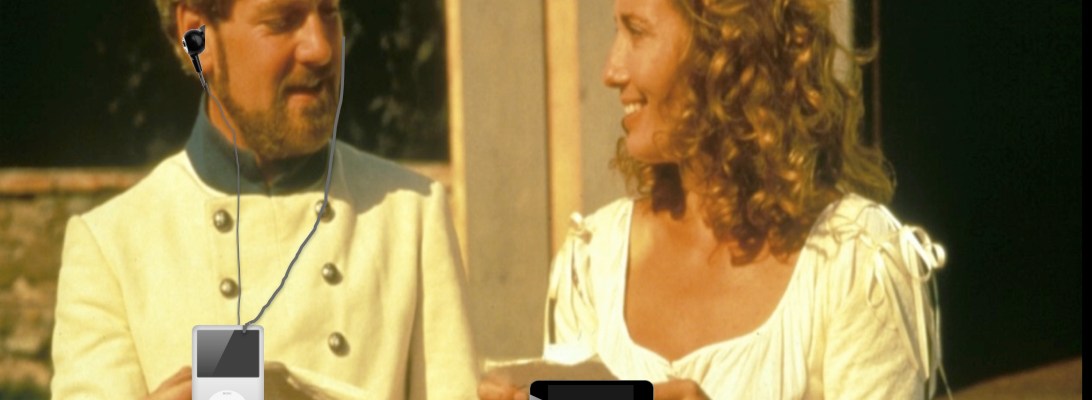
Have you ever met people who go around everywhere with their MP3 players and their earbuds? The kind of people who walk around playing their own personal soundtrack? Well, what do you think would happen if the characters from Much Ado did this, and you happened to glance at Benedick or Beatrice’s iPod? Well that’s what we’re going to pretend in a little game I like to call “Benedick’s Infinite Variety Playlist.” Below is a list of the major events in the play that happen to Benedick. The problem is: they’re all on shuffle. Your job is to figure which song matches which event, put them in chronological order, and submit your answer in the comments below. Later this week, you can play the same game with Beatrice’s playlist. Have fun and remember, as Shakespeare said: “If music be the food of love, play on!”
Events For Benedick in Much Ado About Nothing in random order (Match these with the songs from the playlist below)
Benedick and Beatrice have a brief fling and break up before the play begins
Benedick sees Beatrice and fights with her with his wits.
Benedick dances with Beatrice at the party.
Beatrice insults Benedick mercilessly at the party.
Don Pedro, Claudio, and Leonato claim they overheard Beatrice confessing her love to Benedick.
Benedick decides to be “horribly in love” with Beatrice.
Convinced that Beatrice loves him, Benedick tries to spruce up his appearance.
After the wedding scene, (where Claudio discraces Hero), Beatrice asks Benedick to “Kill Claudio.” Benedick must choose between being Claudio’s friend, and becoming a real man.
Benedick tries to coax Beatrice into admitting that she loves him
Benedick marries Beatrice
Enjoy this game, and leave me a comment if you think you know the correct order of the playlist (that is, the order of the sequence of events in this show).