Here is the last post on my series of 3 which examines the importance question of why should we read or see this play? In the last post I argued that, although the play is sometimes billed as a moral story, the characters engage in really reprehensible behavior- premarital sex, muder, and whining about their teenage problems. So the question is, if the play isn’t a moral parable, what can we gain from reading it?
Reason # 3- The Play Shows Truths About
the Human Condition.
Even though the play’s characters frequently do rash and sometimes foolish things, this only serves to make them more complex and realistic. The truth is, we all do foolish things when in love, and they all dramatically effect our lives, (sometimes for better or for worse).
The point is that the qualities we demonstrate when we’re in love, reveal who we truly are. Romeo is foolish, obsessed with his lover, sometimes selfish, and hot-blooded. He is also tender, caring, utterly without deceit or pretense, and committed to his beloved at any cost.
I believe this is why we really need to keep reading and watching this play. As Judy Dench said in the film “Shakespeare In Love,” the play shows the very truth and nature of love, not just the budding romances or passionate affairs, but dark obsessions, painful separations, family bonds, and even, “glooming peace,” as the Prince says at the end of the play. Shakespeare shows them all, not judging one to be better or worse, but demonstrating the feelings and the actions that arise in reaction to the powerful force of love.
So when you read this play, try to look beyond the peculiar language, the old-fashioned type and the flowery poetry. Inside you might see a reflection of yourself, what Shakespeare called, “the mirror up to nature.”
Most schools in the US and the UK study Romeo and Juliet at one time or another, so for this blog entry, I wanted to ask the question you might have asked at some point in your life:
“WHY DO WE HAVE TO READ THIS PLAY?”
I will answer this question in three posts, with three different responses, to try and make my answers as complete, and yet concise as possible: Reason #1: Shakespeare Himself Is Part Of the Educational Establishment.
From the beginning of American education, Shakespeare has influenced education. What follows is a brief history that hopefully helps explain why, even though he was born in England, Shakespeare is as American as it gets.
Prologue: Life Imitates Art
The first settlements in Virginia occurred in Shakespeare’s lifetime. After all, Virginia was named after Shakespeare’s ruler, the virgin queen Elizabeth. In 1609, a voyage to repopulate the Jamestown Settlement in Virginia hit a terrible storm and was shipwrecked in an island in the Bermudas. The survivors wrote down their story in a book called A Discovery of the Bermudas, Otherwise Called the Isle Of Devilsin 1610, which could have inspired Shakespeare to write The Tempest. Shakespeare wasn’t ignorant of the New World; he references America in The Comedy Of Errors, so it’s not impossible that Shakespeare based his last great play on this “Brave New World.”
The Beginning Of Shakespeare In American Education
In England during the 18th and 19th centuries, Shakespeare was considered a way of educating people in the Greco-Roman tradition, since his plays were based on such Roman authors as Plautus, Seneca, Plutarch, and Ovid (Saccio). Romeo & Juliet is a perfect example of Shakespeare borrowing from the older western traditions- he took the plot and characters from an Italian Renaissance story recorded in Mateo Bandello’s Novelle (1554). The concept of forbidden love though, is much older. Like many Renaissance stories, Romeo and Juliet has roots that go all the way back to the Trojan war, which according to Greek mythology, started with a man from Troy who dared to love a woman from his city’s mortal enemy. Our founding fathers were schooled in this tradition and they helped transplant Shakespeare to the new world.
Shakespeare Comes to America:
Picture of the first ever edition of Shakespeare printed in America, the 1795 Hopkinson Edition by Bioren and Madan
Our country’s early settlers were Puritans and Quakers, who disapproved of theatre in general and tried to have it banned. Nevertheless, many of the founding fathers loved Shakespeare and enjoyed reading his plays ; John Adams and Thomas Jefferson took a pilgrimage to Shakespeare’s birthplace, and George Washington even staged some of his plays (Behn). Even though he was an English playwright, most early Americans were quick to adopt Shakespeare as their own .
Shakespeare In the Classroom
In the 1830s, Shakespeare first appeared in American textbooks as something called “The McGuffey Reader,” a book that contained short snippets of text ranging from old nursery rhymes, to passages from Nathanial Hawthorne. In this sample, you can see that there is one passage from Shakespeare called: “Shylock: the pound of flesh” listed in the table of contents.
At the same time, going to Shakespearean plays and owning copies of Shakespeare’s works became more and more popular in the post Civil War period. As Mark Twain mentions in The Adventures of Huckelberry Finn, productions of Shakespeare were common to early settlers, which is why Twain writes the So-called Duke and Dauphin characters, who pose as actors and perform a perfectly awful rendition of a soliloquy:
To be, or not to be; that is the bare bodkin That makes calamity of so long life; For who would fardels bear, till Birnam Wood do come to Dunsinane, But that the fear of something after death Murders the innocent sleep, Great nature’s second course, And makes us rather sling arrows of outrageous fortune Than fly to others that we know not of . . . (The Adventures of Huckleberry Finn by Mark Twain).
As this passage indicates, even people in rural towns on the Mississippi knew the basics of Shakespeare. In fact, by the mid-19thcentury, you were more likely to see a Bible and a copy of Shakespeare’s works in an American home, than any other book (Source: Lawrence Levine, “Shakespeare In America”). For another funny example of Shakespeare in this period, check out this clip from the film My Darling Clementine, where an old English Shakespearean actor performs for cowboys, which was a common practice during the gold rush.
Shakespeare Goes to Harvard
In the 1870s and 80s, Shakespeare became part of the curriculum of many colleges and universities like Harvard, since studying Shakespeare taught undergraduates the critical thinking skills they would use if they chose to study law or psychology. After the universities let Shakespeare in, high schools integrated Shakespeare into the curriculum to prepare students for college. This is why we study Shakespeare in most high schools today; according to a recent study, about 84% of American high schools are required to read Romeo and Juliet (Source: Hoffman, Jeremy The Western Canon In Today’s High Schools).
To sum up, the first reason we read this play is because it helps us broaden our minds and connect to the wisdom of the past. Also, a huge amount of our culture is inexplicably tied to Shakespeare.
Levine, Lawrence:”William Shakespeare in America”
from Highbrow/Lowbrow: The Emergence of Cultural Hierarchy in America, Harvard University Press, 1998.
Saccio, Peter. Lecture 1: “Shakespeare Then and Now.” Shakespeare: Comedies, Histories and Tragedies. The Teaching Company, 2001. CD. Dartmouth College.
Waterson, Sam (Narrator) et. all. “The Father of the Man in America: Shakespeare in Civic life and Education.” Shakespeare in American Life, (radio documentary). Produced by Richard Paul. Originally airing on Public Radio International (PRI) stations April 2007.Retrieved 21st of August, 2012 from http://www.shakespeareinamericanlife.org/education/episode.cfm
That’s all for now, stay tuned for later posts this week!
I was doing a little web searching today and came across this incredible link: You can read a review of the Globe Theater’s production of “Much Ado About Nothing,” and you can stream it online, (very useful for those of us who don’t live in London)! I’ve provided the link below:
While I’m at it, I would also like to mention that as July winds down, I’ll be giving you reviews of some of my favorite Shakespeare on film productions of Much Ado in the next two days, including the new movie version directed by Joss Whedon!
Much Ado About Nothing is about upper class people preparing for a wedding, which means fashion is a frequent topic of their conversation. Below I’ve provided a few costume references from the play with definitions from Shakespeare’s Lexicon by Alexander Schmidt.
Elizabethan Cap
Cap- A loose-fitting headdress, or soft brimless head-dress.
“Hath not the world one man but he will wear his cap with suspicion?” (BENEDICK, I,I,)
“Doth not my wit become me rarely? “It is not seen enough, you should wear it in your cap” (MARGARET/ BEATRICE, Act III, Scene iv).
DOGBERRY Let him write the prince’s officer coxcomb” (DOGBERRY, Act IV, Scene ii).
Drawing of a doublet, an Elizabethan leather jacket
Doublet– A leather jacket worn outside one’s regular shirt.
And now will he lie ten nights awake, carving the fashion of a new doublet” (BENEDICK, Act II, Scene iii).
Authentic reproduction of of real doublet.
Jerkin– Long close-fitting jacket worn over or in the place of a doublet.
Codpiece (below)- cloth case or pocket worn by men at the front of breeches or hose.
Seest thou not, I say, what a deformed thief this fashion is? how giddily a’ turns about all the hot bloods between fourteen and five-and-thirty? Sometimes fashioning them like Pharaoh’s soldiers in the reeky painting, sometime like god Bel’s priests in the old church-window, sometime like the shaven Hercules in the smirched worm-eaten tapestry, where his codpiece seems as massy as his club? (MARGARET, Act III, Scene iii).
Sometimes entire passages in Much Ado About Nothing refer to fashion, as in this example from Act III, Scene iii:
BORACCIO: Thou knowest that the fashion of a doublet, or a hat, or a cloak, is nothing to a man.
CONRAD: Yes, it is apparel.
BORACHIO: I mean, the fashion.
CONRAD: Yes, the fashion is the fashion (Act III, Scene iii).
This passage tells a lot about Boraccio’s motivations, and also shows a lot about the role of fashion in the Elizabethan period. “Fashion” in this case refers not only to the clothing, (its fine craftsmanship and contemporary style), but also to its wealth. Back in the Elizabethan era, people showed off their wealth and status with the clothes they wear; they literally wore their money on their backs. When Boracchio refers to fashion being nothing to a man, he means that a man of wealth and property has no reason to worry about buying fancy clothes. This betrays the reason Boraccio wants to work for Don John- money, and aspirations of becoming a wealthy gentleman. Act III, Scene iii.
Close Reading- Act III, Scene ii
DON PEDRO: There is no appearance of fancy in him, unless it be a fancy that he hath to strange disguises; as, to be a Dutchman today, a Frenchman to-morrow, or in the shape of two countries at once, as, a German from the waist downward, all slops, and a Spaniard from the hip upward, no doublet. Unless he have a fancy to this foolery, as it appears he hath, he is no fool for fancy, as you would have it appear he is (Act III, Scene ii).
In this passage, Don Pedro observes Benedick and mockingly tries to get Benedick to confess that he is in love. Benedick has fallen in love with Beatrice and it has changed his behavior completely- including his manner of dress, which Pedro singles out as a sign of love. This is not unlike a similar passage in As You Like It, where Rosaline tells Orlando that disorder in dress is one of the signs of love. To understand Don Pedro’s remarks, one must first look at some of the European fashions of the time.
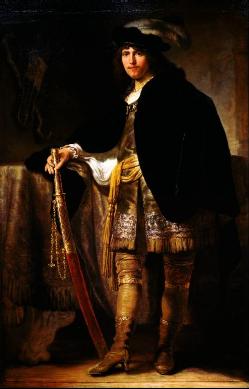
Ferdinand Bol, c. 1640, “Portrait of Youth With A Sword.”
Image 1: The Dutch
Consider this picture of a Dutch courtier by Ferdinand Bol, c. 1640. Notice that though he looks rich, his outfit is fairly austere, no exaggerated codpiece, pants that cover and do not emphasize the shape of the man’s thigh or legs. This is the demure image of the Dutch aristocrat, which is why the liberal prince makes fun of him.
This is an image of a French courtier from the Valois Tapestry (1576). This man’s outfit is practically the opposite of the smart, modest Dutchman. His hose are tight-fitting, decorated with fine embroidery to draw the eye, and his hose show off the shape of his leg. This would be like wearing leather pants today- this outfit is all about flash and sex appeal. Here is a sketch of German aristocrats from the late 16th century. The English liked to make fun of the baggy clothing of the Germans with their padded slops and their peascod belly doublets. These men look like their clothing is only designed to ward off Germany’s cold winters, rather than looking strong, sexy, or powerful.
Image #3: The Germans
German aristocrats from the late 16th century.
To the right is a picture of German slops, which, as the century wore on, got bigger,
flying canoe slops
and baggier. Going back to the passage quoted earlier, you’ll notice how the people that Pedro makes fun of are all foreigners, none of them are English or Italian. The English liked to make fun of the fashions in other countries, especially the Spanish and the French, (their political enemies). They made fun of the German and French for their slops in particular, probably because slops were so baggy; a man wearing them looked like he was concealing an erection. Pedro is implying Benedick has ‘something to hide,’ since he is thinking about Beatrice all day. Mercutio makes the same joke, when he makes fun of Romeo’s “French slop.”
Don Pedro’s comment about a doublet suggests that Benedick has been walking around with no jacket. This was considered a sign of madness and Ophelia uses it as evidence of Hamlet’s madness in Hamlet, Act II, Scene i: Notice how both passages shockingly refer to the unusual fashion of not keeping ones doublet in proper order. Once again, Pedro is subtly hinting to how Benedick must be in love based on his erratic behavior, which fits in with the stereotype of Spaniards as sex-crazed hot bloods. Spaniards did not Remember, Elizabethans had no heating systems to spare them from cold, so not wearing one’s doublet was very dangerous. Only a madman (and by extension, an unrequited lover), would engage in such self-destructive behavior. Thus, through Don Pedro’s subtle pokes at Benedick, the prince lets him know that he cannot hide his love for Beatrice; it has already manifest itself in his clothes.
As mentioned before, wealthy Elizabethans spent their money on clothes the way modern rich people spend money on yachts and home entertainment systems. Dukes and counts would buy tailor-made, beautifully embroidered clothes, and their outfits sometimes were as famous as the people who wore them.
This final quote from Act III, Scene IV illustrates this principle. The day of Hero’s wedding, her gentlewoman Margaret is comparing her gown to the famous dress of the Duchess of Milan:
By my troth, ‘s but a night-gown in respect of yours: cloth o’ gold, and cuts, and laced with silver, set with pearls, down sleeves, side sleeves, and skirts, round underborne with a bluish tinsel: but for a fine, quaint, graceful and excellent fashion, yours is worth ten on ‘t ( MARGARET, Much Ado, Act III, Scene iv).
Portrait of Christtine of Denmark, 1568
Margaret refers to a famous gown worn by Christine of Denmark, a real noblewoman who was immortalized in this portrait: This is a portrait of Christtine of Denmark, Dutchess of Milan from 1521-1590. Notice that, just like Margaret’s description, the cloth is cut with gold, the sleeves and gown are adorned with gold, silver, and pearls, and the dress itself is mostly black (the most expensive color to produce back in the 1590s). These were all common fashions for the upper class in the 16th century. Notice also that the cloth on the sleeves is slashed, (cut open) to reveal the much more expensive silk embroidered with silver and gold. Pearls were a symbol of virginity to the Elizabethans, and at this point, Chistine had been widowed twice over, which is why she is clutching the tassel with the pearl around it, as a symbolic assertion of her chastity. The image was scanned from the Weiss Gallery catalogue: A Noble Visage, Early Portraiture, 1545 – 1660, London, 2001.
I hope you’ve enjoyed this look at the material culture of Elizabethan England. If you would like more info on Elizabethan fashion, please leave a comment below