Crafting A Character: Malvolio

The venerated Shakespearean actor, Sir Antony Sher, once said with frustration while he was acting at the RSC that, “even the best Feste is less funny than the worst Malvolio.” I actually have a rare insight into these two roles since I’ve played them both! So allow me if you will to present you with some insights I’ve gained into these two characters that are very much polar opposites. Although they are as different as night and day, they form the central comic premise of the whole play, and have some truly hilarious moments!

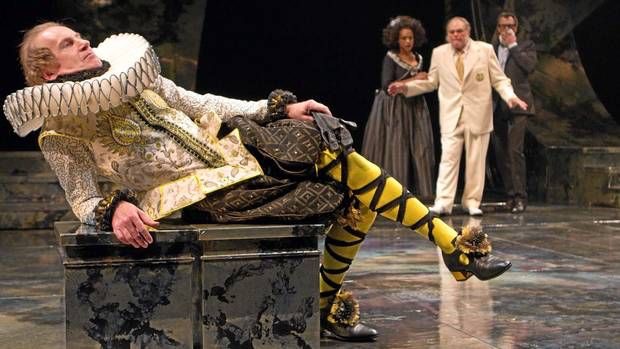
Me. as Malvolio, Wooster. High School 2002

I played Malvolio when I was a senior in high school; he was my first principal Shakespearean role. My director chose to set the play in the 1940s and he re-purposed the kingdom of Illyria as the Hotel Illyria, with Malvolio as the concierge or lead butler in charge of all the hotel maids and other housekeepers. This not only made the play more accessible to a 2002 audience, it also really helped me understand Malvolio’s role: he is first and foremost a snob who is obsessed with efficiency and pleasing his mistress Olivia (in this version the owner of the hotel). I would soon also discover that, although Malvolio is certainly snobby and can be a bit of a killjoy, he also has qualities that make him appealing to everyone who has ever felt put down or bullied, and that’s what makes him a complex and endearing character today.

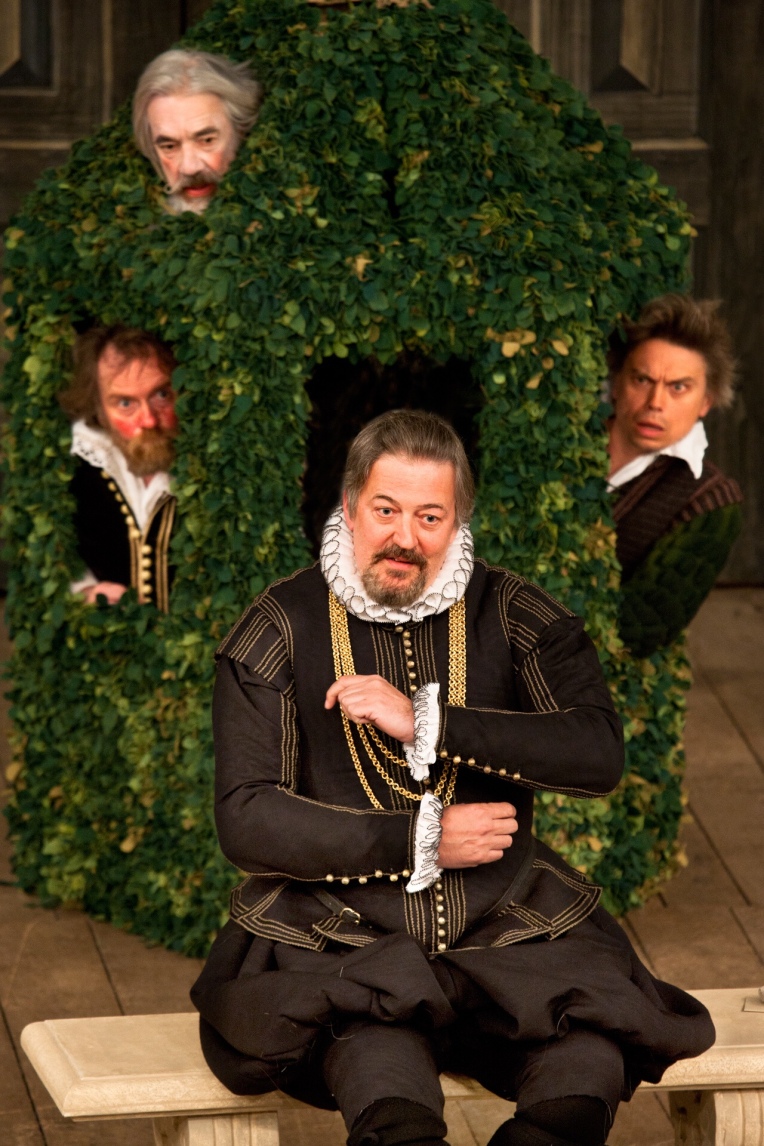
Richard Briars as Malvolio

Some notes on the character: Malvolio’s name means “unsatisfied desire”- somebody who aspires to be what he is not. I find the relationship between Feste and Malvolio interesting because the two are partially defined by how each one is unlike the other. Feste is a clown, hired by the nobles to help them have a good time. He is described as “a merry fellow who cares for nothing.” In other words, Feste never takes anything seriously, except making a living with his jokes and songs. Malvolio is the exact opposite- he is also a servant, but he is a steward, in charge of running the Countess Olivia’s household. As such, he is obsessed with efficiency, commanding respect, and pleasing his mistress through his obsequious manner.

Like the Joker and Batman, both characters live according to an opposing viewpoint; Feste is a chaotic, happy-go-lucky sort, while Malvolio has a strict code of behavior which he expects everyone to follow. Their opposing world views bring them into conflict every time they meet. Plus, in most productions Feste is wearing brightly colored clown apparel or “motley wear,” while Malvolio is dressed in black. I’m not saying Malvolio is anywhere near as cool as Batman, but Malvolio can be just as sanctimonious. His journey is how he goes from being the trusted household servant, to a raving madman, to at last the Spectre at the feast at Olivia’s wedding.

I think the appeal of the character, which balances out the aforementioned snobbery, is that Malvolio is also a nerd: he dreams of becoming a count, he tries to make friends, but he does so by working far too hard at his job and not knowing how to fit in. This is why we inevitably feel sorry for him at the end of the play when he begs to know why his tormentors have locked him in a dark room, treated him like a lunatic, and made him think his lady was in love with him only to utterly destroy his hopes. The balance between the Nerd and the Snob that makes Malvolio a universal and complex part, and that’s why some of history’s greatest actors have played it!

Prepping for the Role: Alec Guinness, Laurence Olivier, Patrick Stewart, Donald Sinden, Nigel Hawthorne, Richard Briars, Steven Fry- these are just some of the names of actors who have played this part over the years. The first actor to play the role was Shakespeare’s leading actor, Richard Burbage, who also played Richard III, Hamlet, and Macbeth. Here’s a sample from Burbage’s famous eulogy, which mentions some of his most famous parts:

A Funeral Elegy
On the Death of the Famous Actor, Richard Burbage,

He’s gone, and with him what a world are dead,
Friends, every one, and what a blank instead!

Tyrant Macbeth, with unwash’d, bloody hand,
We vainly now may hope to understand.
Brutus and Marcius henceforth must be dumb,
For ne’er thy like upon the stage shall come,
Vindex is gone, and what a loss was he!
Frankford, Brachiano, and Malevole.

One big decision that every Shakespearean actor needs to make is how to approach their role in a different way. To be honest, I was kind of a thief with my Malvolio- one of the first things I did was read a book by actor Sir Donald Sinden where he talks about how he delivered Malvolio’s first line, which occurs in Act I, Scene iii:

Olivia. What think you of this fool, Malvolio? doth he not mend?

Malvolio. Yes, and shall do till the pangs of death shake him:
infirmity, that decays the wise, doth ever make the 365
better fool (Act I, Scene v).

Donald Sinden and Judy Dench in Twelfth Night, RSC 1969

Sinden described his first line as a snobby “nyess,” as if he were simultaneously bored and embarrassed by Feste’s jokes. The director told me to act around Feste as if I were the villain in a Charlie Chaplin movie- basically to bully Feste and make him feel very small with my lines, in order to justify the revenge Feste innevitably takes on him. Like any character in Shakespeare, this is only one way to play the role, so you don’t have to agree with me.

The Gulling Scene

Malvolio’s most famous scene is called “The Gulling Scene,” the scene in which he’s tricked into thinking Olivia is in love with him. This is the moment where Malvolio goes from being a respectable prudish servant, into a raving madman. He enters full of dreams and plans to become “Count Malvolio” and creates an elaborate fantasy of what his life would be like if he married the Countess.

Annotated text of Twelfth Night from Shakespeare Navigators.com

Act II Scene v. From Shakespeare Navigators.com

No sooner does Malvolio compete his fantasy of marrying Olivia, when lo and behold, a letter from her suddenly appears! Of course, the audience knows it’s all a trap and even worse, Sir Toby, Sir Andrew, and a boy named Fabian are watching him! It’s a moment of exquisite comedy that’s nearly impossible to get wrong.

Malvolio and the Countess, 1840 by Daniel Maclise

One question I had when I did the scene was whether Malvolio really loves Olivia, or just loves her riches and her title. As a high schooler, I chose to believe that he really does have a crush on Olivia, but is too socially awkward to tell her. Having the letter is a chance to make his feelings known, which Malvolio can get very genuinely excited about! On the other hand, as you can see above, Malvolio might just be greedy to make himself even more respected and admired, and to have the power to throw out the likes of Sir Toby, Sir Andrew, and Maria. Malvolio’s revenge fantasy is also fun to watch, since we know he’ll be punished for it later.

Part of the fun involved in the scene is that it’s basically a “play within a play,” a device that Shakespeare used to great effect in Hamlet, A Midsummer Night’s Dream, Love’s Labor’s Lost, and both parts of Henry the Fourth. I think it’s the charm of seeing a character as he really is, Malvolio shows you his fantasies and creates a whole world in the middle of the orchard. Meanwhile, you feel complicit as you watch the people watching him, who could just as easily be part of your audience.Workshop on Twelfth Night and Bullying

On the other hand, the scene has also been called an example of bullying, since Sir Toby and Maria are using the letter to manipulate then humiliate Malvolio. Remember, Malvolio dresses like a fool and act like a fool in front of Olivia in Act III because he believes it will please the Coubtess. Basically Toby and Maria are Catfishing Malvolio, which can seriously hurt psychologically, as anyone who has been deceived over the internet knows. Plus, it ruins Malvolio’s reputation as you can see in this clip:

Again, as a teenager, I could certainly relate to a man making a fool of himself in a vain attempt to impress a girl. Seeing a man lose his head over a girl and then have her break his heart over a prank, is in some ways truly terrible to watch; even Olivia agrees by the end of the play that the joke has gone too far.

Malvolio. Madam, you have done me wrong,
Notorious wrong.

Olivia. Have I, Malvolio? no.

Malvolio. Lady, you have. Pray you, peruse that letter.
You must not now deny it is your hand:
Write from it, if you can, in hand or phrase;
Or say ’tis not your seal, nor your invention:
You can say none of this: well, grant it then
And tell me, in the modesty of honour,
Why you have given me such clear lights of favour,
Bade me come smiling and cross-garter’d to you,
To put on yellow stockings and to frown 2550
Upon Sir Toby and the lighter people;
And, acting this in an obedient hope,
Why have you suffer’d me to be imprison’d,
Kept in a dark house, visited by the priest,
And made the most notorious geck and gull
That e’er invention play’d on? tell me why!

Olivia. Alas, Malvolio, this is not my writing,
Though, I confess, much like the character
But out of question ’tis Maria’s hand.
And now I do bethink me, it was she 2560
First told me thou wast mad; then camest in smiling,
And in such forms which here were presupposed
Upon thee in the letter. Prithee, be content:
This practise hath most shrewdly pass’d upon thee;
But when we know the grounds and authors of it, 2565
Thou shalt be both the plaintiff and the judge
Of thine own cause.

That’s the tragic part of Malvolio’s journey. We’ve all known a Malvolio, and we’ve all been him from time to time. That’s what makes him such an enduring character.

Continue reading

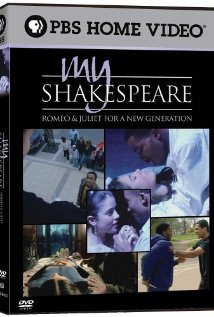
Shakespeare Review: My Shakespeare

On this page, I review a Shakespeare book, movie, or TV show that I feel has some kind of value, either as an interpretation of Shakespeare, or a means to learn more about the man and his writing. This post will introduce you to an incredible documentary, and in my view one of the best ways to encourage, excite, and challenge young people reading Romeo and Juliet Aptly titled, it is called, My Shakespeare.

  1. Name:My Shakespeare
  2. Year: 2004
  3. Director: Michael Waldman
  4. Ages:PG for frank discussions of violence, and occasional suggestive language.
  5. Media:Full length documentary, (available on Amazon and Netflix DVD)
  6. Recommendation: I’d recommend this to high school and college students, as well as all theater teachers and practitioners. A word of caution though- nearly everyone in the documentary speaks with various British accents (from posh London to poor Harlesden), and thus if you think your class might not be able to understand foreign accents, you might want a different version, or put on the subtitles.
  7. Premise: Director Patterson Joseph is a man on a mission- to prove that the people in his home town, (the poor, violence-ridden town of Harlesden England), that these same people can and will put on a production of Romeo and Juliet, in just four weeks. The cast has never acted before, and Patterson sometimes has to drag them kicking and screaming into rehearsals, but eventually they all learn that putting on a Shakespeare play can become an extremely personal experience. In the beginning, they are attempting Shakespeare, but by the end they live it. In between the action, there are interviews with Baz Luhrman, the celebrated director of the Leonardo Dicaprio film version of Romeo and Juliet back in 1996. Baz serves as a sort of chorus, explaining some of the challenges a director like Patterson will inevitably face as he and his actors bring the play to life.
  8. Repeated Ideas That Run Through the Documentary:
    1. You can do this- you can act, you can understand Shakespeare, you can finish something, you can show emotions, and you can direct.
    2. Shakespeare is able to tell stories that appeal to everyone, and here’s the proof.
    3. The best way to understand Shakespeare is to get on your feet and do it.
  9. Moments to watch for: Before I list my favorite moments in the documentary, I’d like to list the theatrical process by which Patterson and his company put on Romeo and Juliet. 
    • The Process Of Creating Romeo and Juliet:
      1. Auditions/ Improv Games (4 weeks to go)
      2. Table Work, where the actors read the script and talk about their characters.
      3. Paraphrasing the script and improv (9 days to go)
      4. Stage combat Rehearsals- prepping the fights.
      5. Opening Scene rehearsal on a basketball court.
      6. Vocal Rehearsal
      7. The Emotion Workshop (8 days to go) The actors try to tap into their own emotions to try and bring some real feelings into their parts.
      8. Death Scene Rehearsal in a Graveyard!
      9. Last minute changes (5 days to go)
      10. Globe theater rehearsal
      11. Nighttime Balcony Scene Rehearsal at the aptly named, “Shakespeare Road.”
      12. Tech Rehearsal at the Royal Academy Of Dramatic Arts.
      13. Speed Through Rehearsal/ The final rehearsal (1 day to go)
      14. Performance at the Royal Academy Of Dramatic Art
    • Now a look at some of my favorite parts of the documentary.
    1. The audition/ casting scene- In this scene you watch the future cast members explore the story of the play through improvisation, then you see their background through a series of headshots and dossiers. The whole cast is more diverse than any West End production: black, white, Christian, Muslim, young people and old people. Patterson’s casting choices alone makes this production fresh and relevant to our shrinking little world. A few cast members are refugees that came to England because of their countries’ own family feuds in Somalia and Afghanistan. Even more striking, Romeo and Juliet are very young- 18 and 22 respectively, which gives their love scenes an amazing truth and honesty. At first they think they have nothing in common with their characters, but in reality they have even more in common than most of us who read Romeo and Juliet.
    2. The table work scene where the cast learns about their characters You see Mustafa as Mercutio learn that Shakespeare can be funny, you see Jonathan as Romeo learn that some of Shakspeare’s words are still used today, and you see Muska just start to flirt with the idea of playing Juliet.
    3. Jonathan’s Story- Unlike most actors who have played Romeo, Jonathan Thomas has been in a real fight, and he describes it in brutal detail, even showing the scars he got from his stab wounds. Hearing his story gives his performance a truth and poignancy that I’ve never seen in any other version.
    4. The Balcony Scene Rehearsals- In this documentary the two leads perform the scene many times, in rehearsal where they talk about how hard it is to play love realistically, in Shakespeare’s Globe, where they see how it was done in Shakespeare’s day, in a modern balcony back in Harlesden, (on the appropriately named “Shakespeare Road,” and at last in the final performance. Few documentaries show just how hard it is to do a Shakespearean scene, particularly if it’s famous, and how many different ways a director and a pair of talented actors can play it and find new things each and every time.
    5. The scene where Patterson lets one of the actors go. Everyone in this production has to overcome obstacles, even the director; when one of his actors fails to perform, he simply has to drop the axe and recast one of his lead roles. Theater is hard work, and just like any job, the director has to take control and do what is necessary to make sure that the production is a success.
    6. Rehearsal at the Globe Theater On one very special day, the actors step onto the stage of the reconstructed Globe, and take a few tentative steps into the 1500s. Once in the space, they take to it like fish to water, playing with the audience, playing with projection, and their lines are infused with a special kind of energy that only arises from the boards of an Elizabethan stage. I found it interesting that when Jonathan was talking to Mark Rylance, the artistic director of the Globe, he asks what kind of man Shakespeare was, because he’s starting to see Shakespeare as a peer!
  1. My reaction: This documentary gives me hope every time I see it. Over and over again Patterson instills in his cast the idea of “Yes, you can,” yes, these people can understand Shakespeare, yes they can learn their lines, yes they can act, yes they can do something intelligent, and moving, and honest, and beautiful and what better play to bring that message across than Romeo and Juliet, which is full of youthful energy and excitement. My only complaint is the interviews with Baz Luhrman don’t really add much to the documentary side of things; Luhrman was really only there for name recognition, and he certainly knows less about Shakespeare than the RSC veteran Patterson. Nevertheless, the whole documentary Is nothing short of inspiring from beginning to end.
  2. Notable cast members
  1. Muska Khpal as Juliet. An 18 year- old Afghan refugee who came to England in 1996, without even speaking English, now playing one of the greatest characters in English literature! Like Juliet herself, Muska has very strict parents (who didn’t approve of her playing the part), and is at first is extremely shy towards Romeo, toward the play, and even the director, but when you hear her talk about her dream to return to Afghanistan and become a doctor, you can sense Juliet’s strength and independence.
  2. Jonathan Taylor 22 year-old Jonathan is a very charismatic and intelligent young man. After this production he became a professional actor. He speaks articulately about the experience of acting for the first time, reading Shakespeare for the first time, and even his own experiences with love and violence on the streets of Harlesden. He is also very talented and speaks the lines with an effortless panache. I found myself rooting for him the whole time, and the fact that I got to see this production spark his interest in acting and then to see him change and grow was truly inspiring.
  3. Mustafa as Mercutio Tiny, sparkle eyed Somali refugee. He is truly Mercurial- he frequently jokes and kids with the cast, yet at the same time, he is deathly serious when he talks about his life in Somalia- seeing people die in front of him. When he dies onstage, you know his performance is drawn from some real world experience.
  1. Grade: 5 Shakespeare globes.

Another Review: Films Media Group – “My Shakespeare: Romeo and Juliet for a New Generation:” http://www.films.com/ecTitleDetail.aspx?TitleID=20674&r=

Interview with the director, Joseph Patterson: http://www.theguardian.com/culture/2012/jul/01/shakespeare-and-me-paterson-joseph-julius-caesar

Where Did This Play Come From?

Poster for a production of “Romeo and Juliet,” that I worked on in 2012.

When I say that the story of Romeo and Juliet is timeless, I mean that the story’s roots go back almost to the beginnings of time. According to Sigmund Freud in Beyond the Pleasure Principle, the desire for love is inexplicably tied to the desires for creation, and destruction. These contradictory forces live deep in the human psyche, which explains why stories of doomed love have been re-interpreted throughout history. What follows is a short history of the stories that inspired Shakespeare, so you can see how this archetypal story has evolved into the one we still read today.

Ancient Sources

When Shakespeare was going to school in the late 1560s, Elizabethan boys were expected to read ancient Greek and Roman writers, who wrote many of the classical love stories listed below. We know that Shakespeare remembered of all these stories because he gives a brief homage to them in Ac II, Scene iv of Romeo and Juliet:

MERCUTIO

Now is he [Romeo] for the numbers
that Petrarch flowed in: Laura to his lady was but a
kitchen-wench; marry, she had a better love to
be-rhyme her; Dido a dowdy; Cleopatra a gipsy;
Helen and Hero hildings and harlots; Thisbe a grey
eye or so, but not to the purpose.

Mercutio’s opinion of these old love stories is that they are based on a false concept of true love, when in fact, love for Mercutio is merely lust and obsession.

Hero and Leander

Leander swimming across the Hellespont. Detail from a painting by Bernard Picart.

          • Author– Unknown (traditional Greek Myth)
          • Date Of Composition 1400- 300 BC (approx)
          • Plot– Hero, a prophetess of Aphrodite loves Leander, a young man from the other side of her temple across a river called the Hellespond. As a priestess, Hero is supposed to remain a virgin, but Leander convinces her to make love to him, and visits her several times by swimming across the Hellespond. Their affair comes to a tragic end when on one stormy night, Leander is overcome by the waves and drowns on his journey to be with his beloved Hero. Consumed with grief, Hero throws herself off the temple tower to be with him.
          • Moral– love (or at least lust), destroys and kills.

The Iliad

        • Author– Homer
        • Date Of Composition 800 BC (approx)
        • Plot– Paris, the prince of Troy abducts and ravishes Helen, the queen of Sparta in Greece, leading to a 10 year war between the Greeks and the Trojans. This war divides everyone in both countries, even the gods, leading to the question of whether love is more important to loyalty to one’s country or family.
        • Moral– Ambiguous- The Greeks fight the Trojans bravely, but only to destroy Troy. Whereas the Trojans are often more sympathetic than the Greeks, but their decision to protect Paris and Helen’s adulterous affair is very unwise. The characters in this story strive to answer the question of what is the most important thing in life- desire for power, fame, to protect one’s home, or love?

Tristan and Isolde

        • Authors– Various, including the French bards Thomas and Beroul
        • Date of Composition– somewhere around the 12th century AD.
        • Plot– Similar to the Trojan War story, but in a medieval context: a young English knight named Tristan meets the heroine, a princess from Ireland, who is engaged to his country’s king. Their passion is instant and fiery, (sometimes it is the result of a love potion they accidentally drank), but it also forces them to make a terrible choice- If Tristan carries off Isolde, he will be disobeying his king, destroying a peaceful alliance, and forcing England and Ireland to go to war. However, it is clear from the beginning that Isolde does not love the one-eyed English king, and  if she marries him, Isolde will be miserable her whole life. Tristan fights gallantly to protect both Isolde and her honor and it puts Tristan, the king, and Isolde into a torturous love triangle, which usually ends with Tristan and the king fighting to the death.
        • Morals
          1. Arranged marriages ruin everything,
          2. love is like a drug,
          3. “Bros before, [you know-what].”
        • Note– This story was also the root of the story of Lancelot in the Arthur myths. In the version created by Thomas Mallory in the 15th century, Lancelot falls in love with Queen Guineveere, and betrays King Arthur, whom he loves like a father. Lancelot’s adultery eventually destroys the fellowship of the Round Table, and allows Arthur’s wicked bastard son Mordred to kill Arthur and ruin Camelot.

Renaissance Sources

Here is a brief timeline of the narrative sources dating from 1530-1580 that Shakespeare used to create his own masterpiece. As you can see, they differ considerably from the ancient sources in plot, and overall morals.

Timeline Of the Narrative Sources of Romeo and Juliet:

Romeo and Giulietta

Da Porto's Novel "Newly found story of two noble lovers"-1530

        • Author– Luigi Da Porto in his novel Historia novellamente ritrovata di due nobili amanti (“Newly found story of two noble lovers”
        • Date of Composition- 1530
        • Background– Da Porto was a soldier and a brilliant story writer. Some claim that he based his tale on an earlier story, while some claim he based it on his falling in love with a girl at a masked ball. In any case, Da Porto was the first to set the story in Verona, created the characters of Mercutio and Benvolio, and also the first author to change the context of the story into two warring households, rather than great empires or kingdoms. This small change helps the audience sympathize with the lovers more, since they are not guilty of treason or adultery.
        • Plot– Two noble houses, the Montecchi and the Cappelletti are at war. The hero  Romeo meets Giulietta at a Carnival ball, which makes him forget about an unrequited love he has for an unnamed girl (the name Rosalind is Shakespeare’s invention).  The two lovers have several liasons over a much longer period than in Shakespeare’s play at Guilietta’s chamber window. Also, although they are married in secret and Romeo is banished just as in Shakespeare’s version, the character he kills is not related to Guilietta. However, the plot device of the sleeping potion and  Romeo’s suicide is also consistent with Shakespeare’s version of the story.

Romeus and Juliet

Arthur Brooke's Romeus and Juliet

        • Author– Matteo Bandello’s in his story Novelle,
          (translated into English) by Arthur Brooke in 1587.
        • Date of Composition– 1554, (translated in 1562, re-printed 1587)
        • Background– Bandello adapted Da Porto’s version of the story and developed the supporting characters, adding The Nurse, the Friar and the Apothecary, and developing Benvolio (without giving him a name).
        • Plot– This plot is almost exactly the same as Shakespeare’s play,but it does reveal some narrative details that Shakespeare omits. Bandello’s poem reveals the origin of the Capulet/ Monegue feud, as well as the ultimate fates of the surviving characters.
        • Moral– Like many other interpretations, the author (or at least the translator) seem to be struggling with the Christian taboo of premarital sex, which to some extent condemns the protagonists. In the English translation by Arthur Brooke, the Preface makes it very clear that Brooke is not condoning Romeus’ premarital sex or his blatant disregard for his parents’ authority. Brooke claims that the story is intended to show the actions of bad people being punished for their actions:

The good man’s example biddeth men to be good, and the evil man’s mischief warneth men not to be evil. To this good end serve all ill ends of ill beginnings. And to this end, good Reader, is this tragical matter written, to describe unto thee a couple of unfortunate lovers, thralling themselves to unhonest desire; neglecting the authority and advice of parents and friends; conferring their principal counsels with drunken gossips and superstitious friars (the naturally fit instruments of unchastity); attempting all adventures of peril for th’ attaining of their wished lust – (Brooke, Romeus and Juliet )

    • On the other hand, at the end of the poem, Bandello describes Romeus and Juliet’s love (or at least Brooke’s translation), as: “so perfect, sound, and so approvéd love,” which suggests that the author at least approve of the lover’s actions. One can almost imagine Italian passion fighting with English morality in the dueling pens of Brooke and Bandello. It was up to Shakespeare to try and resolve this conflict in his own version.

Romeo and Juliet

Romeo and Juliet 1st Quarto.

      • Author– William Shakespeare
      • Date of Composition 1593 (approximately)
      • Plot– One of the most interesting things about Shakespeare’s play is that he develops the characters of Mercutio, the Nurse, and Friar Lawrence, but deliberately omits certain plot elements such as why the feud began between the Capulets and Montegues, and what happened to The Apothecary, Nurse, and Friar Lawrence after the Prince found out about the lovers’ suicides. This effectively makes the Capulet/Montegue feud seem pointless, which allows the audience to focus more on the lovers. On the other hand, Shakespeare also compresses the time Romeo and Juliet know each other from 9 months as in Brooke’s version to 5 days, making the love affair seem even more rash. These changes in plot make the story much less a morality tale about morally wrong love, and more about the war between creative and destructive love that play in the human psyche.
        • Moral– As we’ve seen, most interpretations of the story condemn the lovers as rash, foolish, and adulterous. Shakespeare refuses to condemn or condone. That is Shakespeare’s great gift for storytelling- he doesn’t give us clear answers because he knows life is more complicated than that. He merely provides two sides of an issue and lets the reader sort it out for themselves.

How did Shakespeare get away with ripping off material this old? You’d think that, since every English schoolboy knew this story for over 1000 years, nobody would see this play since there would be no surprises. The answer is that Shakespeare writes primarily for characters, not plot. He infuses old characters like Romeo and Juliet with a new language that makes them more complete, more modern, and more timeless. That’s why stories like R&J, which was already known to Shakespeare’s audiences, are still entertaining and compelling, even after you read it 100 times, and see hundreds of different productions.

I hope this short history of the sources of Romeo and Juliet allows you to ponder the complex theories behind love and lust that authors have struggled to explain in the history of this story. Each age debates the values of love and whether it’s worth fighting or dying or killing for. Perhaps the best thing about Shakespeare’s version is that it tries to provide the most complete summary of the question, without giving us an answer, allowing us to marvel at how complex it is.

Thanks For Reading!

Shakespearean Student

Ira Glass Backtracks From “Shakespeare Sucks” Tweet.

I just saw on the “Tonight Show” a clip where Ira Glass from NPR retracts his statement on Twitter a week ago that “Shakespeare sucks,” after seeing a production of Shakespeare In the Park. Glass said to Jimmy Fallon that he immediately caught heat on the internet “Apparently Shakespeare has a huge internet presence.” To that i say, “Good job Shakespeare nerds!” As Fallon pointed out, Shakespeare is a rallying symbol to all smart people, and that’s why we need to defend him.

Enjoy this video, and enjoy watching Ira squirm.

By the way, if you’re interested in seeing John Lithgow in King Lear, here’s the official website: http://www.publictheater.org/en/Tickets/Calendar/PlayDetailsCollection/SITP/King-Lear/

Wrap Up On “Much Ado About Nothing”

Hello everyone!

Well, today is the last day of July, so I wanted to go out with a bang!

First of all I finally finished my Play of the Month Page for Much Ado About Nothing, so that’s up for you. Also, I’m going to post three reviews of Shakespearean movies. So enjoy this last look at Much Ado, while I prepare for my new play of the month!

  1. Review: Kenneth Branaugh’s “Much Ado About Nothing.”
  2. Review: Joss Whedon’s “Much Ado About Nothing.”
  3. Review: Shakespeare Retold: “Much Ado About Nothing.”
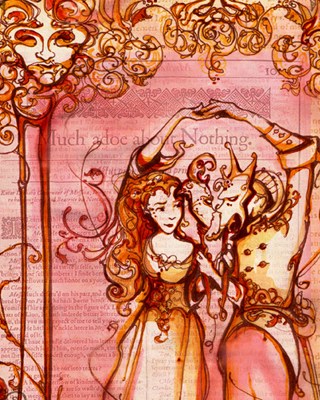
Artwork for “Much Ado About Nothing” by Elizabeth Schuch, reproduced with permission.

Review of Globe Theater Production of “Much Ado About Nothing”!

Hi Folks,

I was doing a little web searching today and came across this incredible link: You can read a review of the Globe Theater’s production of “Much Ado About Nothing,” and you can stream it online, (very useful for those of us who don’t live in London)! I’ve provided the link below:

https://players-shakespeare.com/globe-production-of-much-ado-about-nothing-to-be-reviewed/

While I’m at it, I would also like to mention that as July winds down, I’ll be giving you reviews of some of my favorite Shakespeare on film productions of Much Ado in the next two days, including the new movie version directed by Joss Whedon!

Stay tuned!

-Shakespeare Guru

Benedick and Beatrice’s Infinite Playlist, Part 2

Posted on May 8, 2012

Hello loyal subscribers and first time visitors!

If you missed my earlier post, this week I’ve created a little game for you to play at home: you try to match up the songs that express a fictional character’s personality with the events that happen to him/her through the course of play. Yesterday I posted a playlist for Benedick from Shakespeare’s Much Ado About Nothing, and today I’m going to post one for Beatrice. Your mission is to read the events that happen to Beatrice below, and figure out which songs on the playlist below correspond to these events. If you want to suggest more songs, please leave a comment below and I’ll create an extended playlist for the end of the week!  I’ll also post the correct results so you can see how well you did. Enjoy the game and, as Shakespeare said: “Play on!”

Paul Rycik 5/9/12

Events For Beatrice (Match these with the songs from the playlist below)

  1. Benedick and Beatrice have a brief fling and break up before the play begins

  2. Beatrice sees Benedick again at Leonato’s house and blows a flurry of words at him.

  3. Beatrice advises Hero not to worry about her wedding, but instead tells her to “Dance out your answer.”

  4. Beatrice dances with Benedick and pretends not to recognize him.

  5. Beatrice overhears Margaret, Hero, and Ursula ‘secretly confessing’ Benedick’s love for Beatrice.

  6. Beatrice is thunderstruck to discover that not only does Benedick love her, she loves him.

  7. Beatrice is furious at Claudio’s treatment of Hero, and the way men in general treat women.

  8. Beatrice challenges Benedick to prove his love to her by killing Claudio

  9. After soul searching and after Benedick challenges Claudio, Beatrice is on the mend.

  10. Having proved his worthiness to her like a chivalric soldier, Beatrice marries Benedick.

Benedick and Beatrice’s Infinite (Variety) Playlist

Benedick and Beatrice’s Infinite (Variety) Playlist

This is a game I created for a Shakespeare workshop back in 2012. I would recommend it for any teacher who wants to connect their students to a piece of literature: basically you make a list of songs that A: relate to the personality of a Shakespearean character, and B: relate to moments of the show.

Introduction:

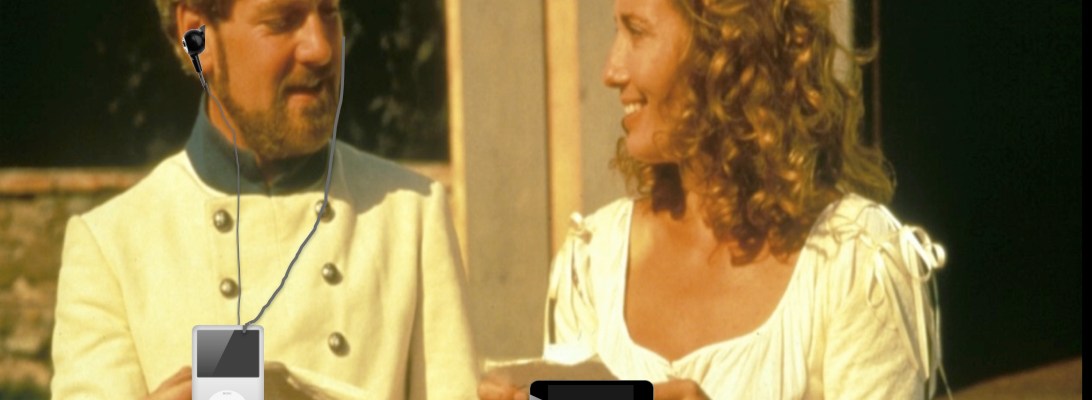
Have you ever met people who go around everywhere with their MP3 players and their earbuds? The kind of people who walk around playing their own personal soundtrack? Well, what do you think would happen if the characters from Much Ado did this, and you happened to glance at Benedick or Beatrice’s iPod? Well that’s what we’re going to pretend in a little game I like to call “Benedick’s Infinite Variety Playlist.” Below is a list of the major events in the play that happen to Benedick. The problem is: they’re all on shuffle. Your job is to figure which song matches which event, put them in chronological order, and submit your answer in the comments below. Later this week, you can play the same game with Beatrice’s playlist. Have fun and remember, as Shakespeare said: “If music be the food of love, play on!”

Events For Benedick in Much Ado About Nothing in random order (Match these with the songs from the playlist below)

  1. Benedick and Beatrice have a brief fling and break up before the play begins
  2. Benedick sees Beatrice and fights with her with his wits.
  3. Benedick dances with Beatrice at the party.
  4. Beatrice insults Benedick mercilessly at the party.
  5. Don Pedro, Claudio, and Leonato claim they overheard Beatrice confessing her love to Benedick.
  6. Benedick decides to be “horribly in love” with Beatrice.
  7. Convinced that Beatrice loves him, Benedick tries to spruce up his appearance.
  8. After the wedding scene, (where Claudio discraces Hero), Beatrice asks Benedick to “Kill Claudio.” Benedick must choose between being Claudio’s friend, and becoming a real man.
  9. Benedick tries to coax Beatrice into admitting that she loves him
  10. Benedick marries Beatrice

“The Fashion Is the Fashion:” An exploration of Costumes in “Much Ado About Nothing”

Much Ado About Nothing is about upper class people preparing for a wedding, which means fashion is a frequent topic of their conversation. Below I’ve provided a few costume references from the play with definitions from Shakespeare’s Lexicon by Alexander Schmidt.

Elizabethan Cap
Elizabethan Cap
  • Cap- A loose-fitting headdress, or soft brimless head-dress.
    1. “Hath not the world one man but he will wear his cap with suspicion?” (BENEDICK, I,I,)
    2. “Doth not my wit become me rarely? “It is not seen enough, you should wear it in your cap” (MARGARET/ BEATRICE, Act III, Scene iv).
A Fool or Jester's cap or Coxcomb
A Fool or Jester’s cap or Coxcomb
  • Coxcomb- The iconic fool or jester’s cap.
          1. DOGBERRY Let him write the prince’s officer coxcomb” (DOGBERRY, Act IV, Scene ii).
Drawing of a doublet, an Elizabethan leather jacket
  • Doublet– A leather jacket worn outside one’s regular shirt.
        • And now will he lie ten nights awake, carving the fashion of a new doublet” (BENEDICK, Act II, Scene iii).

457px-Doubletvanda

Authentic reproduction of of real doublet.

jerkins

        • Jerkin– Long close-fitting jacket worn over or in the place of a doublet.
        • Codpiece (below)- cloth case or pocket worn by men at the front of breeches or hose. codpiece11
  • Seest thou not, I say, what a deformed thief this fashion is? how giddily a’ turns about all the hot bloods between fourteen and five-and-thirty? Sometimes fashioning them like Pharaoh’s soldiers in the reeky painting, sometime like god Bel’s priests in the old church-window, sometime like the shaven Hercules in the smirched worm-eaten tapestry, where his codpiece seems as massy as his club? (MARGARET, Act III, Scene iii).

Sometimes entire passages in Much Ado About Nothing refer to fashion, as in this example from Act III, Scene iii:

BORACCIO: Thou knowest that the fashion of a doublet, or a hat, or a cloak, is nothing to a man.

CONRAD: Yes, it is apparel.

BORACHIO: I mean, the fashion.

CONRAD: Yes, the fashion is the fashion (Act III, Scene iii).

This passage tells a lot about Boraccio’s motivations, and also shows a lot about the role of fashion in the Elizabethan period. “Fashion” in this case refers not only to the clothing, (its fine craftsmanship and contemporary style), but also to its wealth. Back in the Elizabethan era, people showed off their wealth and status with the clothes they wear; they literally wore their money on their backs. When Boracchio refers to fashion being nothing to a man, he means that a man of wealth and property has no reason to worry about buying fancy clothes. This betrays the reason Boraccio wants to work for Don John- money, and aspirations of becoming a wealthy gentleman. Act III, Scene iii.

Close Reading- Act III, Scene ii

DON PEDRO: There is no appearance of fancy in him, unless it be a fancy that he hath to strange disguises; as, to be a Dutchman today, a Frenchman to-morrow, or in the shape of two countries at once, as, a German from the waist downward, all slops, and a Spaniard from the hip upward, no doublet. Unless he have a fancy to this foolery, as it appears he hath, he is no fool for fancy, as you would have it appear he is (Act III, Scene ii).

In this passage, Don Pedro observes Benedick and mockingly tries to get Benedick to confess that he is in love. Benedick has fallen in love with Beatrice and it has changed his behavior completely- including his manner of dress, which Pedro singles out as a sign of love. This is not unlike a similar passage in As You Like It, where Rosaline tells Orlando that disorder in dress is one of the signs of love. To understand Don Pedro’s remarks, one must first look at some of the European fashions of the time.

Ferdinand Bol, c. 1640, "Portrait of Youth With A Sword."
Ferdinand Bol, c. 1640, “Portrait of Youth With A Sword.”

Image 1: The Dutch

Consider this picture of a Dutch courtier by Ferdinand Bol, c. 1640. Notice that though he looks rich, his outfit is fairly austere, no exaggerated codpiece, pants that cover and do not emphasize the shape of the man’s thigh or legs. This is the demure image of the Dutch aristocrat, which is why the liberal prince makes fun of him.

This is an image of a French courtier from the Valois Tapestry (1576). This man’s outfit is practically the opposite of the smart, modest Dutchman. His hose are tight-fitting, decorated with fine embroidery to draw the eye, and his hose show off the shape of his leg. This would be like wearing leather pants today- this outfit is all about flash and sex appeal.  Here is a sketch of German aristocrats from the late 16th century. The English liked to make fun of the baggy clothing of the Germans with their padded slops and their peascod belly doublets. These men look like their clothing is only designed to ward off Germany’s cold winters, rather than looking strong, sexy, or powerful.

Image #3: The Germans

German aristocrats from the late 16th century.

To the right is a picture of German  slops, which, as the century wore on, got bigger,

flying canoe slops
flying canoe slops

and baggier. Going back to the passage quoted earlier, you’ll notice how the people that Pedro makes fun of are all foreigners, none of them are English or Italian. The English liked to make fun of the fashions in other countries, especially the Spanish and the French, (their political enemies). They made fun of the German and French for their slops in particular, probably because slops were so baggy; a man wearing them looked like he was concealing an erection. Pedro is implying Benedick has ‘something to hide,’ since he is thinking about Beatrice all day. Mercutio makes the same joke, when he makes fun of Romeo’s “French slop.”

Don Pedro’s comment about a doublet suggests that Benedick has been walking around with no jacket. This was considered a sign of madness and Ophelia uses it as evidence of Hamlet’s madness in Hamlet, Act II, Scene i: Notice how both passages shockingly refer to the unusual fashion of not keeping ones doublet in proper order. Once again, Pedro is subtly hinting to how Benedick must be in love based on his erratic behavior, which fits in with the stereotype of Spaniards as sex-crazed hot bloods. Spaniards did not Remember, Elizabethans had no heating systems to spare them from cold, so not wearing one’s doublet was very dangerous. Only a madman (and by extension, an unrequited lover), would engage in such self-destructive behavior. Thus, through Don Pedro’s subtle pokes at Benedick, the prince lets him know that he cannot hide his love for Beatrice; it has already manifest itself in his clothes.

As mentioned before, wealthy Elizabethans spent their money on clothes the way modern rich people spend money on yachts and home entertainment systems. Dukes and counts would buy tailor-made, beautifully embroidered clothes, and their outfits sometimes were as famous as the people who wore them.

This final quote from Act III, Scene IV illustrates this principle. The day of Hero’s wedding, her gentlewoman Margaret is comparing her gown to the famous dress of the Duchess of Milan:

By my troth, ‘s but a night-gown in respect of yours: cloth o’ gold, and cuts, and laced with silver, set with pearls, down sleeves, side sleeves, and skirts, round underborne with a bluish tinsel: but for a fine, quaint, graceful and excellent fashion, yours is worth ten on ‘t ( MARGARET, Much Ado, Act III, Scene iv).

Portrait of Christtine of Denmark, 1568

Margaret refers to a famous gown worn by Christine of Denmark, a real noblewoman who was immortalized in this portrait: This is a portrait of Christtine of Denmark, Dutchess of Milan from 1521-1590. Notice that, just like Margaret’s description, the cloth is cut with gold, the sleeves and gown are adorned with gold, silver, and pearls, and the dress itself is mostly black (the most expensive color to produce back in the 1590s). These were all common fashions for the upper class in the 16th century. Notice also that the cloth on the sleeves is slashed, (cut open) to reveal the much more expensive silk embroidered with silver and gold. Pearls were a symbol of virginity to the Elizabethans, and at this point, Chistine had been widowed twice over, which is why she is clutching the tassel with the pearl around it, as a symbolic assertion of her chastity. The image was scanned from the Weiss Gallery catalogue: A Noble Visage, Early Portraiture, 1545 – 1660, London, 2001.

I hope you’ve enjoyed this look at the material culture of Elizabethan England. If you would like more info on Elizabethan fashion, please leave a comment below