Here is the last post on my series of 3 which examines the importance question of why should we read or see this play? In the last post I argued that, although the play is sometimes billed as a moral story, the characters engage in really reprehensible behavior- premarital sex, muder, and whining about their teenage problems. So the question is, if the play isn’t a moral parable, what can we gain from reading it?
Reason # 3- The Play Shows Truths About
the Human Condition.
Even though the play’s characters frequently do rash and sometimes foolish things, this only serves to make them more complex and realistic. The truth is, we all do foolish things when in love, and they all dramatically effect our lives, (sometimes for better or for worse).
The point is that the qualities we demonstrate when we’re in love, reveal who we truly are. Romeo is foolish, obsessed with his lover, sometimes selfish, and hot-blooded. He is also tender, caring, utterly without deceit or pretense, and committed to his beloved at any cost.
I believe this is why we really need to keep reading and watching this play. As Judy Dench said in the film “Shakespeare In Love,” the play shows the very truth and nature of love, not just the budding romances or passionate affairs, but dark obsessions, painful separations, family bonds, and even, “glooming peace,” as the Prince says at the end of the play. Shakespeare shows them all, not judging one to be better or worse, but demonstrating the feelings and the actions that arise in reaction to the powerful force of love.
So when you read this play, try to look beyond the peculiar language, the old-fashioned type and the flowery poetry. Inside you might see a reflection of yourself, what Shakespeare called, “the mirror up to nature.”
Not only is it the first day of this month, it’s also a Shakespearean holiday! According to this passage from “Romeo and Juliet,” today is Juliet’s Birthday!
NURSE: Even or odd, of all days in the year,
Come Lammas Eve at night shall she be fourteen.
–Romeo and Juliet, Act I, Scene ii.
Lammas Eve, is a pagan holiday, also known as Lughnasa, a Celtic holiday traditionally held on August 1st, or the midway point between the summer solstice and the Equinox. It was a day celebrating harvests and the beginning of fall, and was celebrated through eating wheat, drinking wine and burning a giant wicker man in effigy, (the inspiration of the film of the same name, and the festival of Burning Man). By the way, not everyone appreciates this holiday, click here to see what I mean.
There is also another significance to Juliet’s birthday. It makes her a Leo, a star sign traditionally associated with the Sun. So, when Romeo calls her “The Sun,” there is a literal connection to her birth. Shakespeare makes many allusions to astrology in Romeo and Juliet, as a metaphor for fate.
In the next few days I’ll be talking about what these allusions mean and how they help people understand the play.
Much Ado About Nothing is about upper class people preparing for a wedding, which means fashion is a frequent topic of their conversation. Below I’ve provided a few costume references from the play with definitions from Shakespeare’s Lexicon by Alexander Schmidt.
Elizabethan Cap
Cap- A loose-fitting headdress, or soft brimless head-dress.
“Hath not the world one man but he will wear his cap with suspicion?” (BENEDICK, I,I,)
“Doth not my wit become me rarely? “It is not seen enough, you should wear it in your cap” (MARGARET/ BEATRICE, Act III, Scene iv).
DOGBERRY Let him write the prince’s officer coxcomb” (DOGBERRY, Act IV, Scene ii).
Drawing of a doublet, an Elizabethan leather jacket
Doublet– A leather jacket worn outside one’s regular shirt.
And now will he lie ten nights awake, carving the fashion of a new doublet” (BENEDICK, Act II, Scene iii).
Authentic reproduction of of real doublet.
Jerkin– Long close-fitting jacket worn over or in the place of a doublet.
Codpiece (below)- cloth case or pocket worn by men at the front of breeches or hose.
Seest thou not, I say, what a deformed thief this fashion is? how giddily a’ turns about all the hot bloods between fourteen and five-and-thirty? Sometimes fashioning them like Pharaoh’s soldiers in the reeky painting, sometime like god Bel’s priests in the old church-window, sometime like the shaven Hercules in the smirched worm-eaten tapestry, where his codpiece seems as massy as his club? (MARGARET, Act III, Scene iii).
Sometimes entire passages in Much Ado About Nothing refer to fashion, as in this example from Act III, Scene iii:
BORACCIO: Thou knowest that the fashion of a doublet, or a hat, or a cloak, is nothing to a man.
CONRAD: Yes, it is apparel.
BORACHIO: I mean, the fashion.
CONRAD: Yes, the fashion is the fashion (Act III, Scene iii).
This passage tells a lot about Boraccio’s motivations, and also shows a lot about the role of fashion in the Elizabethan period. “Fashion” in this case refers not only to the clothing, (its fine craftsmanship and contemporary style), but also to its wealth. Back in the Elizabethan era, people showed off their wealth and status with the clothes they wear; they literally wore their money on their backs. When Boracchio refers to fashion being nothing to a man, he means that a man of wealth and property has no reason to worry about buying fancy clothes. This betrays the reason Boraccio wants to work for Don John- money, and aspirations of becoming a wealthy gentleman. Act III, Scene iii.
Close Reading- Act III, Scene ii
DON PEDRO: There is no appearance of fancy in him, unless it be a fancy that he hath to strange disguises; as, to be a Dutchman today, a Frenchman to-morrow, or in the shape of two countries at once, as, a German from the waist downward, all slops, and a Spaniard from the hip upward, no doublet. Unless he have a fancy to this foolery, as it appears he hath, he is no fool for fancy, as you would have it appear he is (Act III, Scene ii).
In this passage, Don Pedro observes Benedick and mockingly tries to get Benedick to confess that he is in love. Benedick has fallen in love with Beatrice and it has changed his behavior completely- including his manner of dress, which Pedro singles out as a sign of love. This is not unlike a similar passage in As You Like It, where Rosaline tells Orlando that disorder in dress is one of the signs of love. To understand Don Pedro’s remarks, one must first look at some of the European fashions of the time.
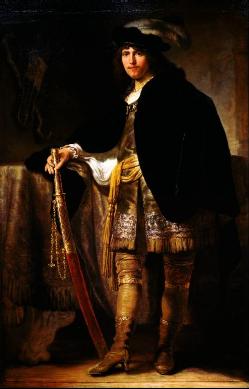
Ferdinand Bol, c. 1640, “Portrait of Youth With A Sword.”
Image 1: The Dutch
Consider this picture of a Dutch courtier by Ferdinand Bol, c. 1640. Notice that though he looks rich, his outfit is fairly austere, no exaggerated codpiece, pants that cover and do not emphasize the shape of the man’s thigh or legs. This is the demure image of the Dutch aristocrat, which is why the liberal prince makes fun of him.
This is an image of a French courtier from the Valois Tapestry (1576). This man’s outfit is practically the opposite of the smart, modest Dutchman. His hose are tight-fitting, decorated with fine embroidery to draw the eye, and his hose show off the shape of his leg. This would be like wearing leather pants today- this outfit is all about flash and sex appeal. Here is a sketch of German aristocrats from the late 16th century. The English liked to make fun of the baggy clothing of the Germans with their padded slops and their peascod belly doublets. These men look like their clothing is only designed to ward off Germany’s cold winters, rather than looking strong, sexy, or powerful.
Image #3: The Germans
German aristocrats from the late 16th century.
To the right is a picture of German slops, which, as the century wore on, got bigger,
flying canoe slops
and baggier. Going back to the passage quoted earlier, you’ll notice how the people that Pedro makes fun of are all foreigners, none of them are English or Italian. The English liked to make fun of the fashions in other countries, especially the Spanish and the French, (their political enemies). They made fun of the German and French for their slops in particular, probably because slops were so baggy; a man wearing them looked like he was concealing an erection. Pedro is implying Benedick has ‘something to hide,’ since he is thinking about Beatrice all day. Mercutio makes the same joke, when he makes fun of Romeo’s “French slop.”
Don Pedro’s comment about a doublet suggests that Benedick has been walking around with no jacket. This was considered a sign of madness and Ophelia uses it as evidence of Hamlet’s madness in Hamlet, Act II, Scene i: Notice how both passages shockingly refer to the unusual fashion of not keeping ones doublet in proper order. Once again, Pedro is subtly hinting to how Benedick must be in love based on his erratic behavior, which fits in with the stereotype of Spaniards as sex-crazed hot bloods. Spaniards did not Remember, Elizabethans had no heating systems to spare them from cold, so not wearing one’s doublet was very dangerous. Only a madman (and by extension, an unrequited lover), would engage in such self-destructive behavior. Thus, through Don Pedro’s subtle pokes at Benedick, the prince lets him know that he cannot hide his love for Beatrice; it has already manifest itself in his clothes.
As mentioned before, wealthy Elizabethans spent their money on clothes the way modern rich people spend money on yachts and home entertainment systems. Dukes and counts would buy tailor-made, beautifully embroidered clothes, and their outfits sometimes were as famous as the people who wore them.
This final quote from Act III, Scene IV illustrates this principle. The day of Hero’s wedding, her gentlewoman Margaret is comparing her gown to the famous dress of the Duchess of Milan:
By my troth, ‘s but a night-gown in respect of yours: cloth o’ gold, and cuts, and laced with silver, set with pearls, down sleeves, side sleeves, and skirts, round underborne with a bluish tinsel: but for a fine, quaint, graceful and excellent fashion, yours is worth ten on ‘t ( MARGARET, Much Ado, Act III, Scene iv).
Portrait of Christtine of Denmark, 1568
Margaret refers to a famous gown worn by Christine of Denmark, a real noblewoman who was immortalized in this portrait: This is a portrait of Christtine of Denmark, Dutchess of Milan from 1521-1590. Notice that, just like Margaret’s description, the cloth is cut with gold, the sleeves and gown are adorned with gold, silver, and pearls, and the dress itself is mostly black (the most expensive color to produce back in the 1590s). These were all common fashions for the upper class in the 16th century. Notice also that the cloth on the sleeves is slashed, (cut open) to reveal the much more expensive silk embroidered with silver and gold. Pearls were a symbol of virginity to the Elizabethans, and at this point, Chistine had been widowed twice over, which is why she is clutching the tassel with the pearl around it, as a symbolic assertion of her chastity. The image was scanned from the Weiss Gallery catalogue: A Noble Visage, Early Portraiture, 1545 – 1660, London, 2001.
I hope you’ve enjoyed this look at the material culture of Elizabethan England. If you would like more info on Elizabethan fashion, please leave a comment below
As promised, here is my review of the hot new Broadway musical “Something Rotten.”
Me posing in front of a colorful banner for “Something Rotten”
My reaction: I went into this show with the hope that it would be a witty, whimsical, musical salute to both Shakespeare and musicals, and it certainly was , but to my mind as a Shakespearean fan, I felt like it didn’t quite live up to its full potential. Yes it’s entertaining, yes it has some great acting and great performances, yes it boasts some glistening songs and scores of jokes, but the plot is a little recycled, the characters are hard to like at times, and the balance of Shakespeare and musicals is pretty tipped to one side.
The Theater
Something Rotten is entertaining from the moment you walk up to the door of the St. James Theater: I was greeted by colorful Elizabethan cartoon figures who voiced their take on the show via speech bubbles: “Song and dance at the same time? Blasphemous!” As I walked up the stairs to my seat in the Mezannine, I saw all kinds of Shakespearean merchandise in the lobby from magnets to T-Shirts, to signature candy bars and drinks, including one called “The Bloody Bard.” This raised my hopes that this show would show some love to Shakespeare in addition to musicals.
View from the audience of the curtain for “Something Rotten.”
As I took my seat, I gasped at the enormity before me: a huge Greek proscenium opening on a Pantheon like dome, complete with two painted muses on the ceiling, and three chandeliers that would tempt any Phantom of the Opera to deploy upon the audience. Below the dome was the set; an impressive recreation of an Elizabethan playhouse with its thatched roof, wooden galleries, and the banners that announce the start of the show. Once the lights dimmed, the orchestra began with trumpet and the ping of an old fashioned Tambor drum, which slowly evolved into the raucous jazzy tune “Welcome To the Renaissance.” The show had begun, and I was smiling already.
The Plot
As I’ve stated before, the premise is pretty simple. Two brothers, Nick and Nigel Bottom, (Brian D’Arcy James and John Cariani respectively), are struggling writers who are trying to make it in theater in London, constantly out classed by Shakespeare (Christian Borle), who used to be an actor in their company. Nick angrily curses out Shakespeare in song in the hilarious number: “God I Hate Shakespeare.”
Shakespeare is a flamboyant and stupendously successful writer with a leather doublet, killer abs, and a cocky smile. He knows he’s the best there is, and shows off by giving extravagant parties and poetry readings, complete with colored lights and pyrotechnics! Shakespeare also has an annoying habit of stealing lines and ideas from other writers; the second he looks at Portia he says, “Good name,” hinting at his use of her name for the heroine of The Merchant Of Venice. Borle is fantastic in his Shakespeare strut, and plays the Shakespeare rockstar persona to the hilt.
Both the Bottom brothers secretly envy Shakespeare; Nick for his money and success, Nigel for his skill at writing beautiful poetry. Nick worries how to make a living as a playwright, especially since he is also supporting his brother and his wife Beatrice (played excellently by Heidi Blickenstaff). Bea urges him not to worry and assures him that she is strong enough to get a job and help ease the burden of supporting his family in the song: “Right Hand Man,” (a wonderful satire of contemporary gender politics). “It’s 1595, we have a woman on the throne,” Beatrice tells her husband, “By 1600 a woman will be exactly as equal as a man.”
Nick doesn’t want his wife to have to work for him, but he can’t get out from under Shakespeare’s shadow. Desperate to turn his luck around, Nick pays a soothsayer (Brad Oscar) to tell him the future of musical theater. Oscar goes into a raucous musical number, “A Musical,” that “invents,” and parodies almost every musical of the last 50 years from A Chorus Line, to Rent, complete with an upbeat tune and kick-lines!
Bottom becomes convinced that he will create the great new musical that will rival Shakespeare’s plays in popularity, and he gets his brother and the Soothsayer to write it. He now imagines that for once, “Bottom’s Gonna Be On Top!”
Nigel Bottom, Nick’s brother, is an aspiring poet who dreams of creating a play that will show beauty and truth. Nigel’s poems put love in the heart of Portia, who adores both his poems, and Nigel himself. The only problem is her father Brother Jeremiah (Brooks Ashmanskas), is a Puritan, (as well as a closet homosexual). Jeremiah despises theater, and by extension, Nigel. The pair secretly meet to allow their love, and their love of poetry to blossom. They also have a wonderful duet, “We See The Light,” where they imagine getting Brother Jeremiah to believe in their love, which turns from tender Elizabethan ballad into a catchy Gospel tune.
I don’t want to give too much away but, in the end, the Bottom family and Shakespeare strike a deal- Shakespeare will still rule theater in England while the Bottoms get to be on top at last in America, where their new musicals will become the theater of the future.
If you already have seen the show, here are some Shakespeare jokes you might have missed:
The title “Something Rotten,” refers to a line from Hamlet where the guard Marcellus declares: “Something is rotten in the state of Denmark.”
The name Nick Bottom comes from one of Shakespeare’s characters; in A Midsummer Night’s Dream, he is an actor in an amateur theater troupe, who is magically transformed into a man with the head of a donkey. Through the play and the musical there are jokes about what an ass Bottom is both literally and figuratively.
The two female characters are also named after Shakespearean heroines: Beatrice, Bottom’s strong-willed wife is from Much Ado About Nothing, while Nigel’s sweetheart Portia appears in The Merchant of Venice, as does the Jewish moneylender Shylock.
In many of Shakespeare’s comedies women dress up as men to take on their jobs, just as Beatrice does for her husband Nick.
The villainous puritans who try to shut down Nick and Nigel’s musical are based on a real life religious group who did eventually pull down all the playhouses in London, and ban theater altogether. Fortunately for Shakespeare, they didn’t succeed in destroying the theater until 30 years after he was dead.
The brothers’ home land of Cornwall probably echoes that of the brothers Edmund and Edgar in Shakespeare’s tragedy of King Lear.
Many people have accused Shakespeare of stealing his work from other people over the years, and of course, this musical makes it one of his defining characteristics. I’ve written about this in the past, but to sum up my arguments- Shakespeare adapted, he didn’t steal.
The beautiful song: “To Thine Own Self Be True,” is a direct quote from Shakespeare’s play Hamlet; a bit of fatherly advice from Lord Polonius to Leartes.
(Spoiler Alert) Toby Belch, Shakespeare’s non-de-plume as he spies on Nick Bottom, is named after another of the real Shakespeare’s characters- a fat drunken knight from the play Twelfth Night.
The line “Son of York,” comes from Shakespeare’s Richard III.
(Spoiler alert) Ironically, in Shakespeare’s play of Merchant it is Portia, not Beatrice who disguises herself as a male lawyer and saves the heroes from death in the courtroom with her famous “The Quality Of Mercy Is Not Strained” speech, though Beatrice does so in Something Rotten.
(Spoiler Alert) The judge in the courtroom whom Shakespeare promises not to make fun of is named Falstaff, named after Shakespeare’s most celebrated comic character- another fat, drunken knight who has no moral code whatsoever!
(Spoiler alert) When the brothers are banished and sent to America with Shylock, this parodies a historical event in 1751, where a troupe of actors mounted one of the first ever theatrical productions in America, which happened to be Shakespeare’s Merchant of Venice.
This musical is a wonderful and entertaining show, but as I said before, I feel that some of it didn’t quite live up to my own expectations. I’ve decided to list my criticisms as a list so that you can choose to read or ignore it. After all, this is only my opinion, and I want you to make up your own mind.
I would argue that plot-wise, Something Rotten is basically The Producers set in 1595. The Bottom brothers who struggle to produce a play are quite obviously lifted from Mel Brooks’ Bialistock and Blume, and the fact that Brad Oscar, (who was in that musical), has such a big part in Something Rotten, is a dead giveaway. Plus the final scene that culminates in a courtroom is very derivative of the climax of The Producers. I feel that for a musical that bills itself as “A Very New Musical,” the creators belie this statement by ripping off one of the most popular musical of this century.
This is a small point, but I believe that there are far more musical jokes in Something Rotten than Shakespeare jokes. This could just have been my own experience, (surrounded as I was by high-school aged musical theater geeks), but I thought that the torrent of musical theater puns and quotes was simply too much. The audience ate it up and laughed so fast that I couldn’t hear a lot of the other jokes. I wish that the jokes were a little more spaced out, and that the balance was a little more toward Shakespeare instead of musicals.
The roles for women are small and the roles for minorities are nearly nonexistent- the only black actor is a minstrel (played superbly by Michael James Scott), who only gets one song, “Welcome To the Renaissance,” and doesn’t have any influence on the plot whatsoever. In Shakespeare’s plays, fools and minstrels were essential to understanding the plot and often helped comment on the action, so I thought not using his talent more was a huge missed opportunity. Likewise, Bea and Portia are great characters, but I wanted to see more of them in the play, and it would have been nice if they got a scene together.
Although Shakespeare is the antagonist, I found his scenes were the best, which arguably caused sort of a problem. I feel the writers couldn’t really pick a lane in terms of making it clear whom to root for- Bottom or Shakespeare. In many ways Nick Bottom is a jerk- he ignores his wife, he ridicules his brother, and his jealousy to Shakespeare (though understandable) is highly unappealing. By contrast, Shakespeare might be an egomaniac and a thief, but as he says in “It’s Hard to Be the Bard,” he’s just trying to live up to the adoration that his fans demand of him. The Bard is arguably more sympathetic because he is constantly trying to live up to his image as a genius. Like a lot of artists from Mozart to Bob Dylan, to Picasso, to George Lucas, Borle’s Shakespeare worries that he’s piqued too soon, and has nothing more to offer his public. Bottom never offers to help Shakespeare or ask him for advice on how to become a better writer, he just tries to steal Shakespeare’s success and justifies it with his insatiable jealousy. At least Max Bialistock was nice to Leo Bloom and encouraged him to follow his heart’s desire of being a producer, but Nick never even does that for Nigel. In short, I found it hard to enjoy the character of Nick Bottom, (who was supposed to be the hero), when he is never given an opportunity to be likable. Once again, Bottom is overshadowed by the Bard, but this time it’s his own fault.
Although I was a little disappointed with these issues, the show is incredibly entertaining, well-acted, and has great catchy songs. I certainly would recommend it to any musical theater fan with at least a touch of Shakespeare in their soul!
Stay tuned for a review of one of the greatest Shakespeare adaptations I’ve ever seen, the experiential theater piece, “Sleep No More.”
The banner for the new musical: “Something Rotten”
Well everyone, at last there’s a new Shakespearean musical on Broadway! It was nominated for 10 Tony’s and won Best Actor! I caught one of the numbers during the Tony awards on Sunday and I would highly recommend checking this musical out!
The show is set in the 1590s, when all of theater is dominated by a powerful playwright called “The Bard”, who can seemingly do no wrong, (obviously a nod to Shakespeare) . The show then, centers around his competition; two actors who conceive and create the world’s first musical, paying the Bard a backhanded compliment by implying that the only way to beat Shakespeare is to come up with something he hasn’t done before.
Not only do I love the show’s tongue-in cheek wit, I also enjoy the fact that it has some flirtation with real history- Shakespearean plays were actually put to music in the 1640s, as a way of getting around the Puritan’s laws against spoken dialogue in plays. More importantly, the show is a loving parody of both Broadway and Shakespeare and who doesn’t just love loving parody?
So for all of you musical Gleeks and Shakespeare Nerds, go see “Something Rotten” if you can. Below is a link to their official website:





 The banner for the new musical: “Something Rotten”
