

Uncategorized
Patrick Stewart: ‘I’d go straight home and drink until I passed out’ | Television | The Guardian
Watch “Feeding a Roman Legion | Posca & Laridum” on YouTube
If Ancient Rome had Twitter


“What Lenten Entertainment”

Shakespeare, Shrove Tuesday, and lent
What is Shrove Tuesday?
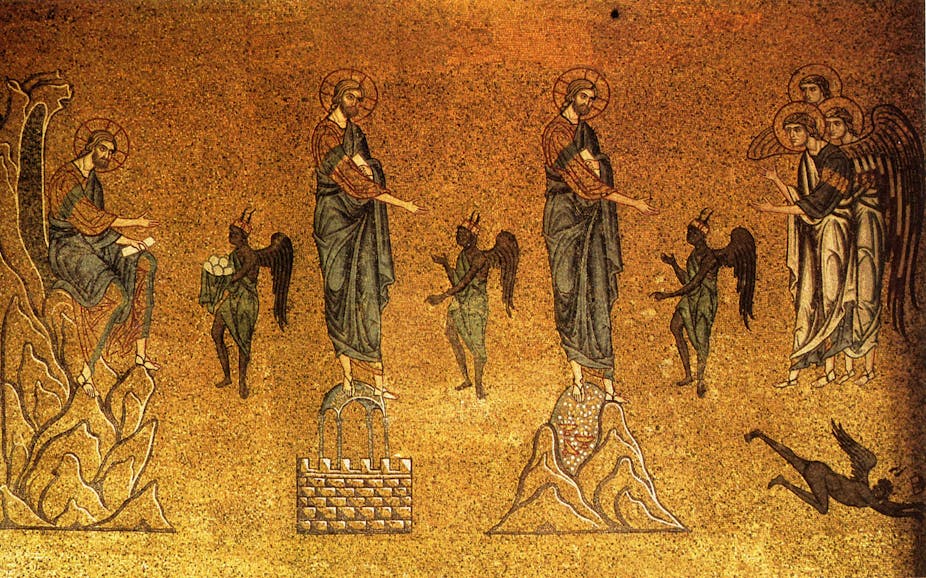
According to the Christian calendar, today (Tuesday) is Shrove Tuesday AKA fat Tuesday, AKA pancake day, AKA Fasnacht Day, (if you live in Pennsylvania ) It is the season that commemorates the time when Jesus Christ fasted in the desert for 40 days, before the holy week of Maudlin Thursday, Good Friday, and Easter Sunday. It is a time when believers give up a material comfort like sweets or fat, and meditate on Christ’s journey from Heaven to Earth and back.
Every aspect of the Easter story from Christ’s entry to Jerusalem to the Holy Thursday celebration of the Last Supper, to his death on the cross on Good Friday has been ritualized by the Catholic and many Protestant churches. Incidentally, Holy Thursday is determined by the Jewish calendar, which is in itself coordinated by the Paschal moon, the last full moon before the Vernal Equinox.
Growth and fertility; pain and pleasure, privation, and excess, things dying and things born. These extreme states of being and the dramatic stories of Christ’s passion are, of course, very good theater, so it’s no wonder that Shakespeare would choose to incorporate the themes and motifs of Shrove Tuesday into his plays.
Shakespeare and Shrove Tuesday

Shakespeare Loved Pancakes!
Shakespeare uses a lot of Christian imagery and theology in all of his plays but he also specifically refers to Shrove Tuesday, with its pancake suppers, use of theatrical disguise, and carefree attitude. He also refers to Lent, and the threadbare and lean times it represents.
In a general sense, a lot of Shakespeare’s plays deal with the swinging back-and-forth of Time, where society is simultaneously getting ready to purge itself of sin and deny itself pleasure. I thought I’d explore that by taking a look at some examples of text Shakespeare that deal with these themes.
First, let’s talk about Shrove Tuesday; in As You Like It, Touchstone makes reference to eating pancakes, traditional food for Shrove Tuesday in a lot of Christian communities. There are variations like donuts and fasnachts, but the idea is to eat up the fat and oil in your house. This is because to begin the start of length a time when Christians are supposed to abstain from fat, people would use the remaining oil and butter in their houses to have pancake suppers.

This modest pancake supper is one tradition of Shrove Tuesday, but there are many more elaborate ones. Shrove Tuesday goes by many names, but the most extreme and extravagant pre-Lent celebration is, of course, Mardi Gras. The celebration of Mardi gras in New Orleans is an offshoot of the Shrove Tuesday tradition, which is why it is often celebrated as an extravagant party with food, drink, and sometimes lewd behavior. Sometimes, Mardi Gras celebrations even incorporate Shakespeare plays as a theme:
Masks and Mardi Gras
As you can imagine getting the chance to purge yourself from sin and do things that you wish you wanted to do might make you a bit self-conscious, which is why traditionally in a lot of cultures mardi gras is celebrated by the wearing of masks. With a mask, revlers can hide their faces, and adopt an extreme personality, and indulge in dancing and drinking. Venice is another city famous for its Mardi Gras celebrations, and Shakespeare uses this tradition heavily in his play The Merchant Of Venice.
Shakespeare’s debt to Italy
Many of Shakespeare’s comic characters are directly inspired from character types created in a form of Italian comedy called “Commedia Del’Arte-” The Comedy of Art. These were short improvised vignettes where performers donned masks and acted improvised skits. Each actor spent years learning the voices and mannerisms of these stock characters like the scheming maid, (Columbina) the crafty servant (Arlequinno or Harlequin), or the greedy, dishonest innkeeper Brighella, who might have influenced Shylock himself. If you click on this website, there are some great scholarly articles about Commedia’s influence on Shakespeare, and how these characters helped forge all of his comedies, not just Merchant Of Venice.
Masks and Venetian culture
As this video from the Youtube historian Metatron explains, Commedia masks were just one of the masks that were front and center in Merchant Of Venice. Masks were part of Venetian society, not just during Carnival, which allowed Shakespeare to make masks part of the plot of Merchant Of Venice.
It’s not explicitly said, but I believe Shakespeare sets Act II of The Merchant Of Venice during a Carnival masquerade revel, where young men danced through the streets wearing masks. This might very well be during a carnival celebration, which means the play might very well be taking place during the twin seasons of Easter for Christians and Passover for Jews. This might very well be what Shakespeare was intending, as this clashing of religious dogma is at the heart of the play.
Shylock isn’t the only Commedia inspired character in Merchant. There’s also Graziano, Bassanio’s wild and raunchy friend. In this speech, he deftly parodies the duelling concepts of Shrove Tuesday and Lent, by promising to be austere, wise, and virtuous tomorrow, but not tonight, when he and his friend Lorenzo will be walking through the streets in their masks.
Bassanio. Why then you must. But hear thee, Gratiano;745
Thou art too wild, too rude and bold of voice;
Parts that become thee happily enough
And in such eyes as ours appear not faults;
But where thou art not known, why, there they show
Something too liberal. Pray thee, take pain750
To allay with some cold drops of modesty
Thy skipping spirit, lest through thy wild behavior
I be misconstrued in the place I go to,
And lose my hopes.
Gratiano. Signior Bassanio, hear me:755
If I do not put on a sober habit,
Talk with respect and swear but now and then,
Wear prayer-books in my pocket, look demurely,
Nay more, while grace is saying, hood mine eyes
Thus with my hat, and sigh and say 'amen,'760
Use all the observance of civility,
Like one well studied in a sad ostent
To please his grandam, never trust me more.
Bassanio. Well, we shall see your bearing.
Gratiano. Nay, but I bar to-night: you shall not gauge me765
By what we do to-night.
Bassanio. No, that were pity:
I would entreat you rather to put on
Your boldest suit of mirth, for we have friends
That purpose merriment. But fare you well:770
I have some business.
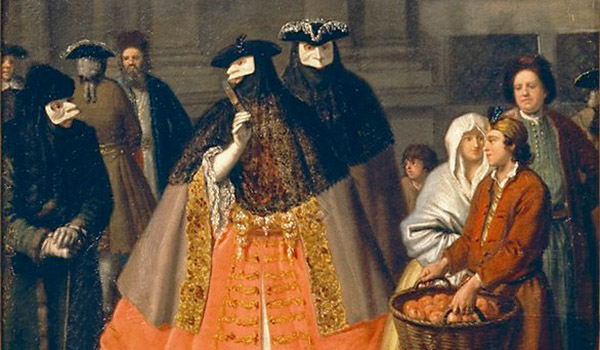
While Gratziano and his friends are playing masquerade outside, Shylock instructs his daughter Jessica to shut up his doors and do not let the maskers in, or even look at them.

It’s entirely possible that the play itself might very well conclude around the time of Easter which is especially significant considering that it ends with a scene that inverts, subverts, and questions the Passion story of Jesus.
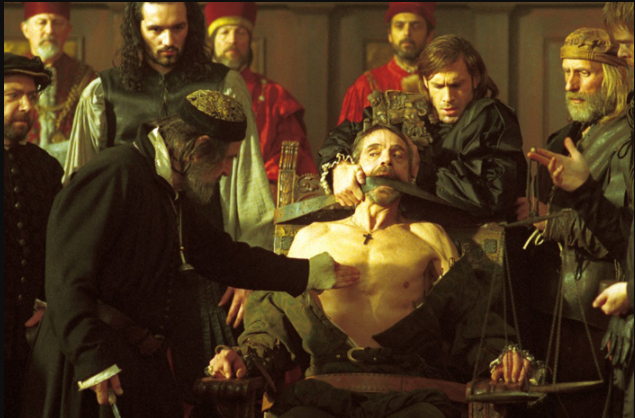

The courtroom scene from Merchant of Venice is almost a Passion Play in itself, where Shylock attempts to take a pound of flesh from the Christian Antonio, (who gives it as willingly as if he were Christ himself). Even though Jesus was crucified by Romans, for millennia the Jews were blamed for his death, and Shakespeare uses this anti-semetic imagery where Shylock stands in for the austerity of Mosaic law, rejecting the concept of divine Grace. Meanwhile, Portia is playing the judge, and she utters a poignant speech about mercy with almost God-like eloquence. This scene illustrates the established theological basis of Lent and Easter. According to Christian theology, the whole point of Lent is to remember and celebrate Christ’s sacrifice where we are redeemed from our sins. As she says, “We do pray for mercy, and that same prayer teaches us to render the deeds of mercy.” In a way, the sinful nature of mardi gras is not just a purging of human sin, it is also a way of acknowledging how far we fall short of God’s perfect ideals.
In that sense, Mardi Gras and Carnival are not a flouting or a rejection of Christian theology; it’s a reinforcement of it. Christians indulge in sin and acknowledge their sins the next day on Ash Wednesday, where they don black clothes and become contrite and this is our way of remembering Christ’s sacrifice and how necessary it was.
However, Shakespeare doesn’t have Antonio die like Christ, instead, it is Shylock the Jew who will metaphorically die and be reborn; he will convert to Christianity (and thus be dead to his former community), and his riches will give stability to Jessica and Lorenzo when Shylock dies. Shylock’s punishment at the end of the play is intentionally harsh and cruel, and many scholars have shown it as a demonstration of the limits of Christian mercy. Like the masks they put on every day, Venetian Christians seem pure and pious, but are inwardly corrupt and degenerate.
Shakespeare and Lent
You might have noticed that I used the word “purge” repeatedly in reference to what people do on carnival and mardi gras as a way of releasing their sins. The Purge movies do in fact have a basis in this concept. Traditionally the flowers that are part of purge days are actually given at Shrove tide. The Purge is also traditionally celebrated in mid March around the time of the vernal equinox, so the purge movies are a more extreme version of mardi gras, with the belief that the one illegal tendency people would indulge in alloed, would be murder, (which is a very bleak comment on human society).
What’s interesting is that Shakespeare creates his own sort of purging of society in his play Measure For Measure, and he creates a villain who is very much like an embodiment of um of lentin But
no man can is without sin and no and it is incredibly dangerous to assume that 1 Possibly making fun of her clothing and possibly also calling her a whore or a prostitute that that um you see it was traditional to eat Is the food a drink length until It’s a sexual It’s not as enjoyable and probably lower quality than the norm normal because of course the tradition of lent is a tradition of self denial and and in measure for measure he creates a character who is obsessed with his own piety and self denial the character of the judge Angelo in measure for measure he is a judge who is known for his piety and a society that is that it’s become too loose too loose to carnival ish and he is charged by the Duke who has chosen to Leave Vienna to with to become more dracodian to become more our strict and and legalistic and punish people use the fear of the law in order to command good behavior he sets the same standards for everybody else that he does for himself and that’s why the central conflict of the play is between him and Isabella whose brother who hasn’t committed any sins on stage but her brother Claudio is guilty of adultery well not no not guilty of adultery hes technically guilty of fornication in that he has consummated his marriage with the Woman before proceeding with the marriage rituals that I mentioned in my most recent Romeo Juliette portpost so hes being punished by 4 and a Kate for fornication fornication in in the the strictest and most technical definition of fornication he loves this woman he has made a pledge for her to be his wife legally they are married but it’s not good enough unless they make a formal request they get the consent of the parents and they and they are and they have a marriage ceremony performed in a church unless he does all of those things in Angelo’s mind he is guilty of fornication So you can see that Angelo has a stricter nature than most people would permit themselves and he is utterly and the concept of mercy is just as alien to hit him as it was to Shylock the main difference between the 2 characters that’s Angelo heights behind Christian piety not Jewish piety Ione and he turns out to be even more morally degenerate than Shylock because he is it is he is trying to manipulate uh manipulate Isabella in order to get her to sleep with him he wants to sleep with a nun because he thinks he deserves her he thinks that she is a reward for his piety
Angelo forgot what any person who celebrates mardi gras and ash Wednesday does that the purpose of lent is to remind ourselves that we are human know that we need mercy and to celebrate the sacrifice the Christ made so that we can continue to be human and not try to utter utterly lady destroy our imperfections that make us human so measure for meta The diconomy between Lynton and and a boccanelli or carnum Leonora carnival’s morals morals and in the end Isabella emerges from that crucible Victorious she defeats Angelo she exposes him as a failure as a failure she failure she ransoms her brother almost as definitely as Christ renziming humanity humanity and in the end she is offered the chance to either become a nun as she wanted or to become the Duke’s wife and therefore Queen of the whole country Taking a face value it looks like it seems like a fairy tale ending where this is the sort of person who should be governing somebody whose morality is tempered with mercy but but Shakespeare’s play is much Messier than that if you actually read it or see it performed formed it has Siri it’s a racist serious questions about how helpful oh helpful this this particular concept the concept is to women especially since Particularly when it comes to failings of the Flash in most productions I’ve seen you’ve Jew seen Juliet in measure for measure to for measure is as mocked and as disdained and is the and abused it’s viewed as Claudio is and Is life a reputation which is really all a woman had back in this period so Shakespeare does a good job of of showing the virtues of letting and carnival in Is illings of such rules it’s all very well and good to say we are allowed to be human man but very often women are set to higher standards than the men when it comes to if comes to standards of purity and piety

No hare, sir; unless a hare, sir, in a lenten pie,
that is something stale and hoar ere it be spent.
[Sings]
An old hare hoar,
And an old hare hoar,
Is very good meat in lent
But a hare that is hoar
Is too much for a score,
When it hoars ere it be spent.
Romeo, will you come to your father’s? we’ll
to dinner, thither.
–Mercutio, Romeo and Juliet
Lent and Measure FOr Measure
Conclusion
the Lenten season probably appealed to Shakespeare because much like “Twelfth Night” it is a season that momentarily subverts and then enforces the status quo. People indulge themselves in debauchery briefly, then commit themselves whole-heartedly to sobriety and piety. It shows the tendency towards the extreme in human nature, whether it be the grotesque, the sinful, the lusty, or even the austere. Like the masks at Carnival, we find these extremes of nature fascinating to watch as they dance before us and therefore, they also make for very good drama.
What If Romeo and Juliet got Married?

We all know that Romeo and Juliet married in secret because their feuding families made it impossible for them to publicly profess their love, but would it have been like if they were able to have a proper Italian Renaissance Wedding? As opposed to the small, intimate wedding that you see in the 2013 clip above, a wedding in 1590s Italy was a much more involved, lavish, and expensive affair.
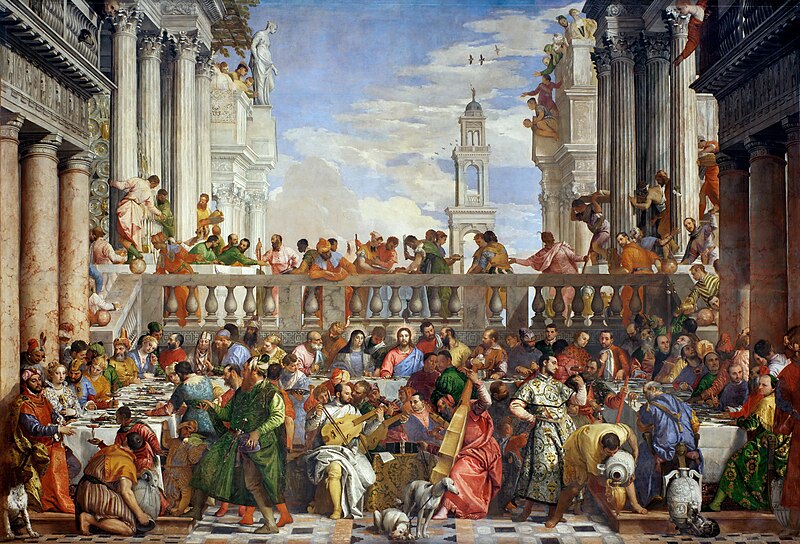
Paolo Veronese, 1563.
During the Renaissance period marriages, (which were also mergers), were potentially explosive moments, and lavish festivities may have diffused some of the tensions that might arise between families over dowry arrangements and other touchy subjects. The bridal procession might even face dangers from hostile mobs or individuals, as suggested by a Florentine statute from 1415, which forbade the throwing of stones or garbage at the home of the couple. Wedding processions were often compared to ancient triumphal processions. The idea of the wedding as a triumph is reflected in the imagery on cassoni (marriage chests) panels such as Apollonio di Giovanni’s Triumph of Scipio Africanus, known in several versions.
Deborah L. Krohn
The Bard Graduate Center
November 2008
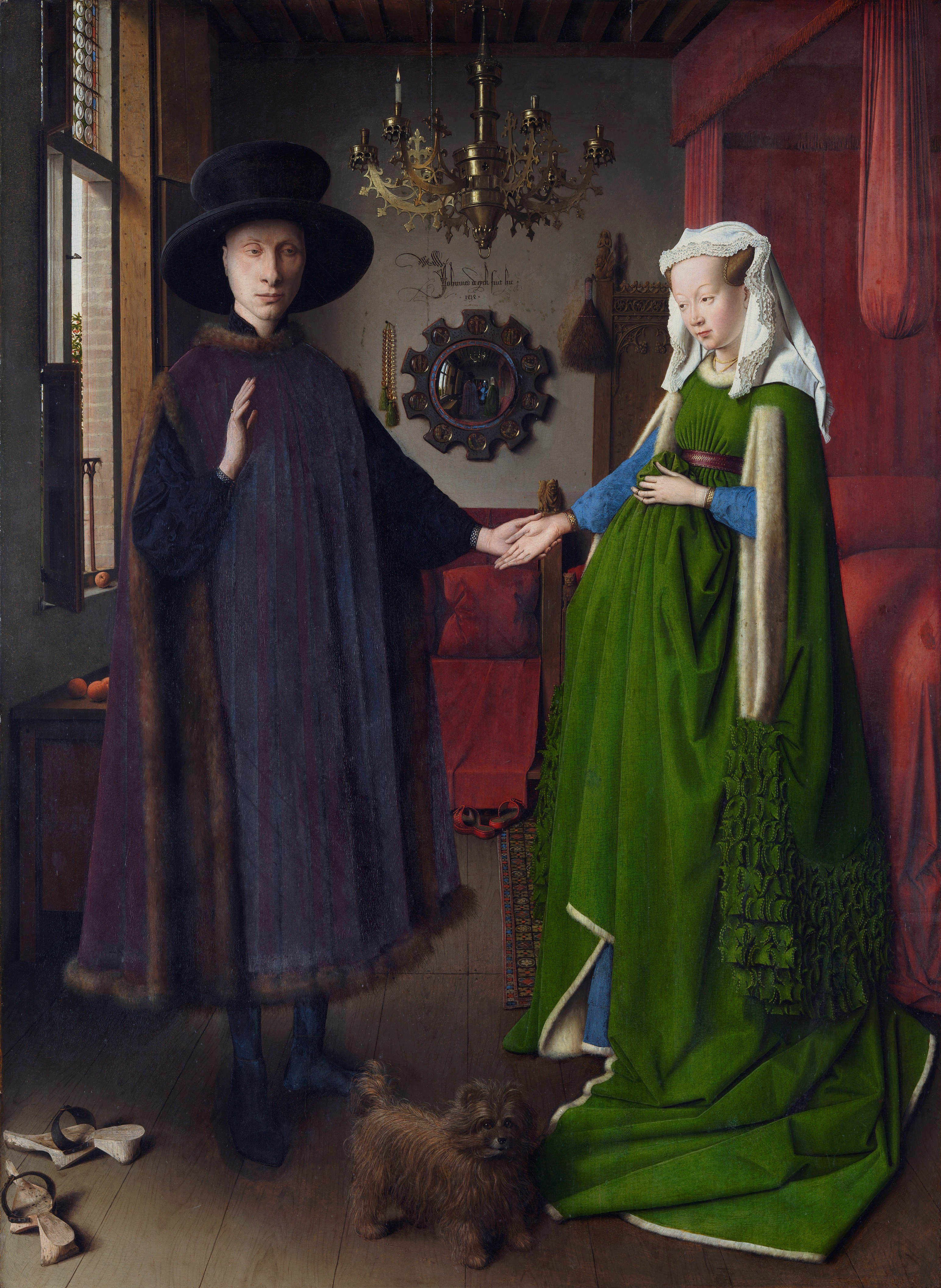
An Italian wedding had four rituals that were highly elaborate and each required a lot of food, drink, special clothes, and music. Part of the reason for this verbose process was the belief that marriage was simultaneously an economic arrangement, a formal promise of fidelity and affection, and a sacrament blessed by the church. In the article, “The Arnolfini Betrothal,” from the University of California, Hall traces the evolution of these ideas from pre-Christian Roman marriage traditions, and 17th century, Roman-catholic Italian tradition:
European ideas about marriage were profoundly influenced by ancient Roman precedent. Because intent was the most basic principle of Roman law, the great jurisconsults of the second and third centuries logically held that marriage was concluded by the consent of the parties, and Ulpian’s concise expression of this view, “Not cohabitation but consent makes a marriage,” came to be included among the legal maxims of the final section of the Digest in Justinian’s codification of the Roman law.[2] Roman lawyers termed this matrimonial consent affectio maritalis, or “conjugal affection,” by which they meant, not some momentary expression of assent as part of a marriage rite, but rather a continuing mental state, shared by the partners. From a juridical point of view, this permanent emotive condition constituted the marriage. The Digest also envisioned marriage in ideal terms as a lifelong association of husband and wife for the procreation of legitimate children. But if affectio maritalis ceased to exist, the requisite legal consent no longer prevailed, and a divorce could easily be arranged.[3]
The
- The Impalmamento– The joining of hands, a sort of ritual engagement
- The Sponsalia- The formal betrothal ceremony (a promise of marriage)
- The Matrimonium– The wedding contract and procession
- The Nozze- The church ceremony and feast!

The Cassone
One of the best ways I can illustrate that a wedding in Italian Renaissance Italy was essentially a socio-economic merging of families is to look at the custom of the cassone- an ornately carved box that the groom gave to the bride to keep her needlework and other possessions. It symbolized the transition from living in her parent’s house to her new husband’s house, and how essentially, she was a possession that was bought by the groom and taken to his home. To see more examples of a cassone, visit this website:
http://italian-needlework.blogspot.com/2011/10/italian-hope-chests-cassone.html
If Juliet had chosen to marry Paris instead of Romeo, the cassone would’ve made it abundantly clear to her that, just as Paris says: “Thy face is mine,” he feels he has bought her, money, body, and soul, and taken her and this elaborate casket to his home, till death do they part.
Impalmamemnto
The verb impalmare is equivalent to pledging one’s troth and originates from an old custom according to which the groom, as a confirmatory token of his marriage promise, grasped, touched, or poked the right hand or palm
of his future wife. Impalmamento signifies an engagement, a promise of marriage, specifically, as a confirmation of prior agreements, it signifies the early phase of the
long process of the marriage arrangement.
sponsalia

Much like how in Britain, handfasting rituals served as a serious promise or engagement of marriage, the Sponsalia was a formal promise of marriage before the actual ceremony. Incidently, according to “A History Of Matrimonial Institutions by George Elliott Howard, Romeo and Juliet’s marriage went this far, but no farther. This kind of promise of marriage had legal authority but was not recognized officially by the church. It also didn’t require witnesses or parental consent (Howard 339). A Sponsalia marriage could also only be dissolved if the bride or groom became a priest or nun, which is exactly what Friar Laurence offers to do for Juliet once Romeo dies:
Come, I’ll dispose of thee
Among a sisterhood of holy nuns:
Stay not to question, for the watch is coming;
Come, go, good Juliet,
[Noise again]
I dare no longer stay.
— Romeo and Juliet, Act V, Scene 3

Today, this would be the equivalent of getting a marriage license at city hall, rather than having a marriage ceremony.
matrimonium
Li emergenti bisogni matrimoniali – namely, the urgent necessity at the outset of marriage to adorn brides with extravagant clothing and jewelry, to decorate the nuptial chamber, and to arrange wedding festivities – entailed sizable expenditures of capital on the part of new husbands and their kin in Renaissance Florence. In a legal opinion written in 1400, the Florentine jurist Philippus de Corsinis observed that “even before sexual intercourse, it is necessary for the husband to shoulder the expenses for his wife’s clothing and other accessories, as well as other expenses related to the wedding.”2 In another opinion, Paulus de Castro, who taught and practiced law in early-fifteenth-century Florence, emphasized that in both Florence and Bologna the outfitting of the bride and expenses for the wed-ding consumed the whole dowry even before the couple had exchanged marriage vows and rings.-
Source: Kirshner, Julius. “2. Li Emergenti Bisogni Matrimoniali In Renaissance Florence”. Marriage, Dowry, and Citizenship in Late Medieval and Renaissance Italy, Toronto: University of Toronto Press, 2018, pp. 55-73. https://doi.org/10.3138/9781442664517-005
Wedding dress and bridegroom dress
Nozze
The wedding feast
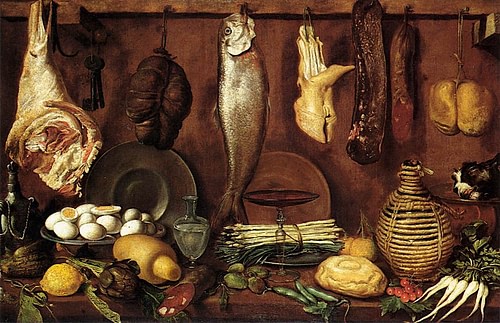
Since marriages were affairs for two families, their friends, etc. A wedding feast was a very involved and elaborate affair. On the Dutch Cooking site, ” Coquinaria” I found a reproduction of a summer wedding feast from 1546:
The menu for Wednesday 18 August 1546, on a meat day during Summer
Antipasti – Melloni (watermelons), cascio vecchio Parmigiano (old Parmesan cheese), quaglie arroste (grilled quails), vua moscatella (muscadines), crostate di piccioni (pie with pigeons), capretto (kid), limoni trinciati (cut lemons).
Alesso – Anadrine (duck?), capretto (again kid, or a mistake), pollastri stuffati con presciutto (stuffed chicken with ham), agresto (verjuice), sauor di verzure(sauce with greens?).
Frutte – Visciole con le suppe (morellos in soup -with bread), cascio marzolino (cheese from March?), pere (pears), persiche in vino (peaches in wine), nocchie (hazelnuts), finocchio (fennel).
Below is a recipe card I made with one of the recipes I found on the site:

Works Cited:
| 1. Giovanni Arnolfini’s Impalmamento | |
| Anna Eörsi1996, Oud Holland14 Views PaperRank: 1.7 |
2. MARRIAGE: ITALIAN RENAISSANCE STYLE by Donna Russo-Morin http://donnarussomorin.blogspot.com/2012/08/marriage-italian-renaissance-style.html#:~:text=An%20Italian%20Renaissance%20wedding%20ceremony,the%20matrimonium%2C%20and%20the%20nozze. Published Monday, August 27, 2012
3. Krohn, Deborah L. “Weddings in the Italian Renaissance.” In Heilbrunn Timeline of Art History. New York: The Metropolitan Museum of Art, 2000–. http://www.metmuseum.org/toah/hd/wedd/hd_wedd.htm (November 2008)
4. Hall, Edwin. The Arnolfini Betrothal: Medieval Marriage and the Enigma of Van Eyck’s Double Portrait. Berkeley: University of California Press, c1994 1994. http://ark.cdlib.org/ark:/13030/ft1d5nb0d9/
5. https://www.worldhistory.org/article/1578/food–drink-in-the-elizabethan-era/
6. Kirshner, Julius. “2. Li Emergenti Bisogni Matrimoniali In Renaissance Florence”. Marriage, Dowry, and Citizenship in Late Medieval and Renaissance Italy, Toronto: University of Toronto Press, 2018, pp. 55-73. https://doi.org/10.3138/9781442664517-005
7. Muusers, Christianne: A Recipe for Italian Crostini from the 16th Century: . Published online January 28th, 2005. https://coquinaria.nl/en/panunto/
 The Shakespearean Student