Shakespeare’s Greatest Mother Characters 

Happy Mothers Day!

This slideshow requires JavaScript.


I thought I would take a little time to showcase some of Shakespeare’s great mother characters. Some of these women are models of selflessness, compassion, and devotion to the children they take care of. Other ones… not so much. Just for fun, I also made some suggestions for Mother’s Day gifts if you had one of these mother’s on the list.
The Good Mothers
Countess of Roussilion from Alls Well That Ends Well

Though she is technically not the heroine Helena’s mother, the Countess is still a fantastic example of selflessness, support, and love. As she says “you never oppressed me with a mothers groans but I expressed to you mothers care.” She also encourages her foster daughter Helena to play doctor and save the King Of France from a deadly illness, giving her a job and a bright future!
Mother’s Day Gift: either some French Wine and cheese, or a Doc McStuffins for her future grandchild.
2. Hermione in The Winters Tale

Her husband arrests her for infidelity with no proof at all, while she’s still pregnant! Then she stands up in front of the entire court, having just given birth in prison, just to prove her child is a legitimate heir to the throne. Hermione is a mighty example of grace and courage under fire, as beautiful and strong as the statue she looks like at the end of the play. What more needs to be said!?

Mother’s Day Gift: Statue polish
3. Queen Elizabeth in Richard the Third

As you can see in my description, Elizabeth started out as a poor widow trying to get a better future for her children. Then she becomes the queen and takes a lot of crap from lords like Richard for her marriage, and her sons.
As Richard schemes to get the throne, Elizabeth is the only one who sees how dangerous he is, and how he will certainly try to kill her two sons to get it. To protect them from Richard, Elizabeth hides her sons in a church and tries her best to keep him away from them. The only problem is her husband made Richard Lord Protector, and responsible for everything connected to crowning the new king, (terrible judgment on his part).
Once her husband the king dies, Richard proclaims Elizabeth’s sons as bastards and makes himself king. He then has them secretly murdered in the Tower Of London. Even though Elizabeth can’t defend her sons for long, she identified the threat, and did her best to stop him. In this clip from the TV Series “The White Queen,” Elizabeth tries to get her sons released from the Tower, while her brother is oblivious to the danger they are in: https://youtu.be/5Y3qYeq0ok4
Though Elizabeth fails to protect her sons, she succeeds in saving her daughter. Richard knows that if his enemy Henry Tudor marries Elizabeth’s daughter (who is also named Elizabeth), he can lay claim to the throne and destroy Richard. The wicked king tries therefore, to marry his niece himself! Elizabeth refuses to pimp her daughter to the king and curses him for all of his heinous murders. Click here to see the epic battle of these two great characters in a scene from Ian McKellen’s movie version of Richard III. Look at the power and wit Elizabeth (Annette Benning), displays as she refuses to wed her daughter to Richard, (Ian McKellen).
https://youtu.be/dHqlTSCe18k
At the end of the scene, Elizabeth says she will persuade her daughter to marry the king, but she secretly marries the young princess to Henry Tudor, who becomes King Henry the Seventh after defeating Richard in battle. So Elizabeth succeeds in protecting her daughter and helped to start a dynasty of monarchs, including her granddaughter, Queen Elizabeth I.
Mothers Day Gift : Sweaters for her sons to wear in the tower.
Alternative Mother’s Day Gift: A baby monitor that works within the Tower Of London, so she won’t have to worry about her kids being slaughtered.
Queen Margaret in King Henry the Sixth Part III.

Though her methods are questionable, and her blood thirstiness legendary, Margaret still fights bravely to defend her son’s rightful claim to the English throne.
Video bio of Queen Margaret: https://youtu.be/hJnspEh99h4
Mother’s Day Gift: A dozen Red roses.
Cleopatra

The quintessential queen of Egypt is similar to Margaret in “the ends justify the means” category of mothers. Cleopatra will hook up with any powerful man to protect her son and heir to the throne. Cleopatra’s son, Cesarean is the love child that she had with Julius Caesar. After Caesar’s assassination, Cleopatra seduced Marc Antony, Caesar’s friend and a consul of Rome. Also, according to some historians, Cleo found a way to hide her son after Octavius Caesar tried to kill Cesarean and his mother. She reportedly sent him into hiding through secret tunnels underneath the city of Alexandria.
http://thevoiceofthezamorin.blogspot.com/2015/06/what-happened-to-son-of-queen-cleopatra.html?m=1
Mother’s Day Gift: A snake- proof brassiere.
Mediocre Moms
1. Thaisa in Pericles. A lot like her husband Pericles on my OK Dads list, Thaisa’s problem is that, though she clearly loves her children, she doesn’t see them for nearly 20 years. Granted, she doesn’t really know that they’re there they’re still alive but nonetheless, you would think that a good mother would at least check.
2. Constance in King John.

I wasn’t sure where to put her on this list, even though she demonstrates great love and affection for her son, (whom King John just murdered), the truth is that Constance doesn’t really do much for her son that we see during the play. https://youtu.be/fpAZju8RbiI
What Constance mainly has going for her is her supremely agonizing expressions of grief over her son’s death. Steven Greenblatt in his book Will in the World, suggests that her speeches might’ve been Shakespeare’s own horror and grief at the loss of his son, who died around the same time King John was supposedly written. https://www.spectator.co.uk/2015/06/is-the-globe-right-to-revive-shakespeares-king-john/
Mother’s Day Gift: barbershop coupon, have you seen that hair, honey?
Also on the ok mom list, Mistress Page in Merry Wives, and Lady Capulet In Romeo and Juliet.
Bad Moms

1. Tamara in Titus Andronicus. She’s called a ravenous tiger in the play, and it’s easy to see why. She encourages her own sons to rape a girl, (Titus’s daughter Lavinia), then murder Lavinia’s husband! As if that wasn’t enough, Tamara tells the boys to cut out Lavinia’s tongue and cut her hands off, so she can’t accuse them of their crimes. Later Tamara tells her lover Aaron to murder their illegitimate baby, so her husband the emperor won’t find out about the affair. Worst of all, Tamara leaves her sons alone with her mortal enemy, Titus which allows Titus to (spoiler alert )…….. kill her sons, chop them up in a pie and serve them to her. She accidentally eats her own sons!
Mothers Day Gift: a parenting book! Or if you’re really sick, a bib with a picture of her kids on it.
2. Dionyza In Pericles- This Queen is a show mom of the worst kind- She’s a Queen from a far off kingdom, tasked with raising her own children and King Pericles’ daughter Mariana. When Dionyza sees that Mariana is a better singer/ dancer/weaver, etc than her own daughter, she tries to kill her! https://youtu.be/z9UW-p7iEk
Mother’s Day Gift:ITonya on DVD,Tanya Harding’s mom and Dionyza should compare notes.
3. Queen in Cymbeline Similar kind of deal. She’s a wicked stepmother who wants to kill the heroine Imogen and make her own son Cloten the heir to the throne. Shakespeare didn’t give her a name, she’s that wicked!

The Queen in Cymbeline, Oregon Shakespeare Festival, 2013 http://www.stageandcinema.com/2013/08/06/cymbeline-oregon-shakespeare/
Mother’s Day Gift: A name.
Gertrude in Hamlet This one is very ambiguous. On the one hand, she loves her son, and tries to protect him from his wicked uncle Claudius. On the other hand, she married Claudius less than two months after her first husband died in mysterious circumstances . It’s never revealed in the play whether Gertrude was complicit in the old king’s murder, but when Hamlet Confronts her about the marriage, she is full of remorse.

Absent
To be honest, this list was easier to put together than my Fathers Day list, because there are fewer choices. In 9 Of Shakespeare’s plays, there are no mother characters at all:
Love’s Labor’s Lost
Midsummer Night’s Dream
The Comedy Of Errors
Two Gentlemen Of Verona
Measure For Measure
Twelfth Night
The Tempest
As You Like It
Merchant Of Venice
It’s hard to know how much Shakespeare knew about motherhood. From what we know about his life, he probably wasn’t around to see his wife Anne raise his two daughters in Stratford, since he spent most of his time in London writing and acting in his plays.
In any case, the thing that comes across in all the mother’s in Shakespeare’s plays is the level of sacrifice and selflessness that so many mothers demonstrate. Being a parent is tough, but the rewards are greater than even the Bard could ever explain.
Happy Mother’s Day Everyone!

Trump Family Attacks Shakespeare- Julius Caesar Protest

Donald Trump Jr tweeted two questions after the Julius Caesar play protest I posted over the weekend:

“When does art become political speech, and does it change things?”

I would like to try to answer these questions and by doing so, see if I can explain this fascinating moment in Shakespearean performance history.

Though this production raised new questions about art, and has raised passion from many people, it is not as radical as the protesters might think. Here is a list of historical points of reference to show you the many similarities between this protest and others throughout the history of Shakespearean performance:
1. This is not the first time a Shakespeare play has been seen as a spur to violence: In February of 1601, The Earl of Essex commissioned Shakespeare’s company to perform a scene of the deposing and killing of King Richard the Second one day before he attempted to overthrow queen Elizabeth, and make himself head of the English government.

Deposition by Augustine Phillips (one of Shakespeare’s actors), pleading that his company was innocent of treason.

Shakespeare’s company was exonerated, but Essex himself was tried convicted, and executed for high treason.

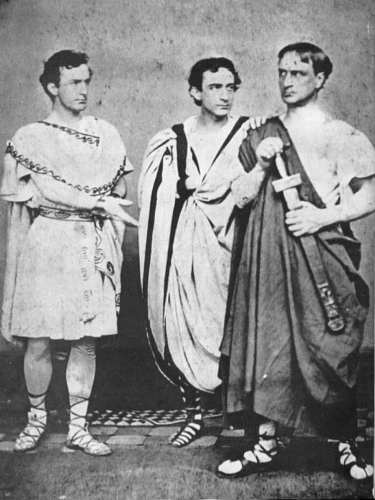
Similarly, when John Wilkes Booth assassinated President Lincoln in 1865, he had previously performed in Julius Caesar, and reportedly complained, (while on the run from the law), that “I am being hunted for what Brutus did so freely”

Source: New York Times Review. Now in both cases it is worth noting that Shakespeare’s play was not responsible for the death of a political figure, it was the people who interpreted his work that bear the responsibility themselves.

2. This play is also not the first time a director has portrayed Caesar as a contemporary president-

An Obama-like Caesar is murdered in The Acting Company’s 2012 production of “Caesar”

As many people have pointed out, in 2012 The Acting Company put on a production of Caesar with an Obama-esque version of the title character. No protests came from the left or right, though Caesar died in the exact same way- bloodily stabbed onstage. I would argue that these shows demonstrate that portraying Caesar as a contemporary figure does not itself incite violence. The audience knows that the figure of Caesar is simply meant as a link between Shakespeare and contemporary politics. This is how the director Oskar Eustis of the Shakespeare in the Park production defended himself against criticism of his staging: https://www.google.com/amp/s/mobile.nytimes.com/2017/06/13/theater/donald-trump-julius-caesar-oskar-eustis.amp.html

I frankly also find the disproportionate reaction to these two Caesars rather insulting. When Obama was in office, he got plenty of negative criticism that sometimes extended to threats of violence. If you click here you can see a threat by country music singer Ted Nugent who threatens to shoot the president with a machine gun. The double standard that threatening a president on the left has no consequences, but threatening a Republican president is worthy of scorn, derision, and its backers pulling their support, deeply hypocritical.

3. Thirdly, this is not the first time a Shakespeare play has depicted Trump negatively. If you look at the comments of my Trump villain post, a director mentioned his production of Henry the Sixth Part Two, in which an actor portrayed the character Jack Cade as Trump. Like Caesar, Cade also murdered in the course of the play. Clearly, portraying Donald Trump as a Shakespearean character is not what is unique here.

4. Though it is certainly true that the play depicts violence and the overthrow of a regime, it doesn’t endorse violence, and is not intended to glorify the murder of a president or even a demagogue like Caesar. As I will later discuss, this play can’t be an endorsement of violence, since everyone who commits violence is duly punished.

So why has this particular production, that uses a Caesar that resembles this president, gotten such a big reaction? Part of the issue admittedly is the timing. The protest specifically mentions the attempted murder of a GOP senator, which happened last week. It is only natural that, given this recent threat of violence, some would fear that this production might incite others to violence. Yet, as I said before, a thorough analysis of the play shows that it does not condone violence against a political leader.

Additionally, given today’s divisive political environment, it is understandable why an audience of right wing protesters might be concerned about this scene in which Caesar is murdered on stage. They may vey well think the play is wish fulfillment for those on the left, who might enjoy watching the bloody assassination of someone who is vey unpopular right now. However, let me emphatically point out that first of all, no one on the left has endorsed violence against Trump. If you look at the backlash to Kathy Griffin’s picture of herself holding a bloody makeshift Trump head, you can see that no one left or right has endorsed support for such a treasonous un-American act. Secondly, with regards to Caesar, the play’s message is actually nonviolent. When Brutus and Cassius kill Caesar, it starts a violent uprising that leads to anarchy, precisely the outcome the two Roman senators hoped to avoid. Seeing their designs fail would certainly discourage anyone attempting violence against a sitting authority figure.

Perhaps the best way I can prove this point is to remind everyone that Shakespeare himself lived in a monarchy. His theatre was strictly controlled by the government. If anyone in 1599 believed that Julius Caesar seemed to support the killing of queen Elizabeth, the play would have been burned and Shakespeare and his whole company would have been arrested and hanged.

https://youtu.be/Y7BtKlGGFKs

Also, people have criticized the murder of Caesar as “too realistic,” again believing that the gore is intended to glorify violence. In reality the violence of the murder is intended to incite revulsion and disgust. Look at Mark Antony’s reaction when he shows Caesar’s body to the crowd. https://youtu.be/tRceRJAz6_Q

I frankly think that the main reason why this production is getting bad press is because it’s a portrayal of President Trump, not Obama, not the historical Caesar, not Hitler, not even Trump before he was president, but the current president, that a group of people elected, and who believe that he supports their values.

I believe that the main reason Trump’s supporters are angry at this production is they feel an attack on him is an attack on them. The president’s supporters have shown repeatedly that they are willing to overlook almost anything to show their support of him. I imagine that they have no desire to see him as an autocrat and dictator, let alone entertain the notion that he might ever be taken down by his opponents.

The irony is that the real Caesar was a man of the people who died because his opponents thought he was an autocrat. The real Caesar helped create the modern calendar, gave money to the entire city, and according to Marc Antony, “When the poor hath cried, Caesar hath wept.” Trump is the exact opposite; he is a self-centered con artist who pretends to be a man of the people. As I predicted, after his inauguration, he has vowed to cut taxes on businesses like his own, put his family in positions of power, used diplomatic meetings and press conferences to sell his products, and obstructed justice when his FBI director tried to investigate him. With this in mind, it seems bizarre to claim that this production is designed to ridicule the right, since Trump is neither Julius Caesar, nor is he an embodiment of the political right. He only stands for his own interests. Therefore an attack on Trump is not an attack on conservative values.

So to go back to the beginning point, “When does art become political speech?” I would argue art always becomes political when it comments about our world, and this quality of art is essential for our society to function. We need a healthy dose of satire and critical thinking, and art can provide it to us. However, there is a difference between disagreeing with a play and openly shunning it onstage.

To address Mr. Trump’s second question, art doesn’t change things, people change things, so we need to temper our reactions, especially to art pieces like Julius Caesar. Remember, Caesar only died because people said he wanted to be king. Cinna the poet died because the mob said he should. This play warns us all to be careful and remain critical thinkers, or mob rule will result.

References

What depicting Julius Caesar as Donald Trump really means – CBS News

https://www.google.com/amp/s/www.theatlantic.com/amp/article/530037/

https://www.google.com/amp/s/mobile.nytimes.com/2017/06/12/theater/julius-caesar-shakespeare-donald-trump.amp.html

https://apple.news/AW6FmlDY3TEe4C97AG7UI4Q

Ted Nugent once said Obama should ‘suck on my machine gun.’ Now he wants to tone down ‘hateful rhetoric.’ – The Washington Post

View at Medium.com

https://apple.news/AE9eeH-L6TxeY1qJwq4Ur8w

Shakespeare’s Perfect Halloween Play

With just a few days left until Halloween, many of us will be anxious to put the candy bowl away, dim the lights, and watch a scary movie. I’d like to recommend my pic for the single best Shakespeare play for Halloween, and you might be surprised to learn which one it is:

It’s not Macbeth, despite its ghosts and witches, it’s not Hamlet, though it has a famous scene in a graveyard. In my opinion, the scariest, most horrific, most disturbing Shakespearean play is the ancient Roman revenge tragedy Titus Andronicus!

Titus Who?

Titus is the most violent, most outrageous play in the Shakespearean cannon and features murder, mutilation, cannibalism, (and even featured the first recorded trick or treating). It was also his first tragedy ever, written around 1590. Back in this period, Shakespeare’s theater was also the site of public executions and blood sports like Bear-baiting, so Shakespeare knew that gore sells. He also knew that people were reading the bloody tragedies of the Roman poet Seneca, so he created a play that out-does the Roman master of bloody violence!

So why have you not heard of it?

  • Too violent for school For most people, their first encounters with Shakespeare is in the classroom, and because of the violence in this play it’s definitely not appropriate for high school. The most famous atrocity in the play happens to Titus’ daughter, who is raped offstage. Then, to keep her from incriminating the men who raped her, the rapists cut off her hands and cut out her tongue. Quite a departure from the “Honey tongued” Shakespeare we see in the comedies and sonnets.
  • It’s vulgar: T.S. Eliot declared that Titus Andronicus is “one of the stupidest and most uninspired plays ever written.” For people who expect Shakespeare to be poetic and romantic, this play is a sad dissapointment.
  • It’s Over the top- People don’t just die in this play, they get butchered horror movie style! Some get stabbed and thrown in a pit, some get their limbs chopped off, one character is buried alive! Many scholars say that after one atrocity after another, the only way you can react to the horror onstage is to laugh. Look at this scene where the villain of the play, Aaron the Moor, confesses to a laundry list of hideous atrocities which he did just for the pleasure of being evil:

Scholars often compare the dark comedy of Titus to the films of Quentin Tarantino, who will murder his characters in grotesque, but funny ways. I won’t even give away the surprise ending where Titus and his daughter gets their revenge, but let’s just say that they would certainly agree with Tarantino that revenge is a dish, best served cold!

  • It might be racist As I mentioned in the clip above, the main villain of the play is a black man. Aaron, like Richard III is completely evil and unapologetic about it.  When I was studying Shakespeare in college, James Earl Jones, (Darth Vader himself) came to my school to talk about Shakespeare’s racially diverse characters. He argued though that nobody treats Aaron any differently until they learn about his heinous crimes and that the person who seems to hate Aaron’s blackness the most is himself. Look at this passage and see if you agree:

AARON

I go, Andronicus: and for thy hand

Look by and by to have thy sons with thee.
Aside Their heads, I mean.

O, how this villany
Doth fat me with the very thoughts of it!
Let fools do good, and fair men call for grace.
Aaron will have his soul black like his face (Titus, Act III, Scene 1).

Now the question to ask about Aaron and most of Shakespeare’s villains, is are they bad because they’re different (different race, differently abled, illegitimate birth), or did they become bad from people treating them badly?

Serious note– Even though productions often dramatize the violence and rape in Titus as over-the-top black comedy, this kind of rape and violence happens in real life, every day, particularly violence against women like Lavinia. One reason why this play is gaining popularity is sadly, that this kind of violence is more common in our current society with the shocking number of rapes committed in this country (1 in 5 women, according to the National Sexual Violence Resource Center), and the brutal murders in this play suggest many real-life atrocities such as Abu ghraib,

Plot summary and more at Schmoop.com

More at http://www.gradesaver.com/titus-andronicus/study-guide/summary

Review of Julie Taymor’s Titus

If you can’t get to the theater this Halloween and want to watch a production of Titus, you’re in luck: In 1999, Julie Taymor, famed director of the Broadway production of The Lion King, directed a film adaptation of Titus which I consider the single greatest Shakespearean film of all time. The movie captures the grotesque comedy of the play, while also visually showing the beauty of Shakespeare’s poetry. It also doesn’t get hung up on historical accuracy just because the play is set in Rome. Best of all, the cast in incredible: Anthony Hopkins, Jessica Langue, Alan Cumming, Harry Lennox and more. This cast knows how to do Shakespeare for the movies and their work shows in every scene. Interesting side note: Hopkins actually considered making this movie the last movie of his career, which explains his amazing glee and energy in the role of Titus. Below is a nice in-depth analysis of the film

Another good review comes from the French Shakespeare Society: https://shakespeare.revues.org/1558

And finally, a review from Roger Ebert: http://www.rogerebert.com/reviews/titus-2000

So that’s my two cents on Titus Andronicus. Happy Halloween everybody!

RIP Alan Rickman

Hung be the heavens with black, yield day to night! – William Shakespeare

One of the greatest classical actors of our time has gone to his great reward, which I hope includes a “good show” from Shakespeare himself. Most people know Alan Rickman as the slimy Professor Snape, or the evil Hans Gruber, or the cheating husband from “Love Actually,” but a generation ago he was a Shakespearean acting phenomenon at the Royal Shakespeare Company, playing such roles as Jaques, Hamlet, and Achilles. As much as I love Harry Potter, I think it’s wrong to remember such a versatile actor for only one role, so here’s a retrospective of his work that I found this morning. Guardian Tribute to Alan Rickman

“Good night sweet prince, and flights of angels sing thee to thy rest.”