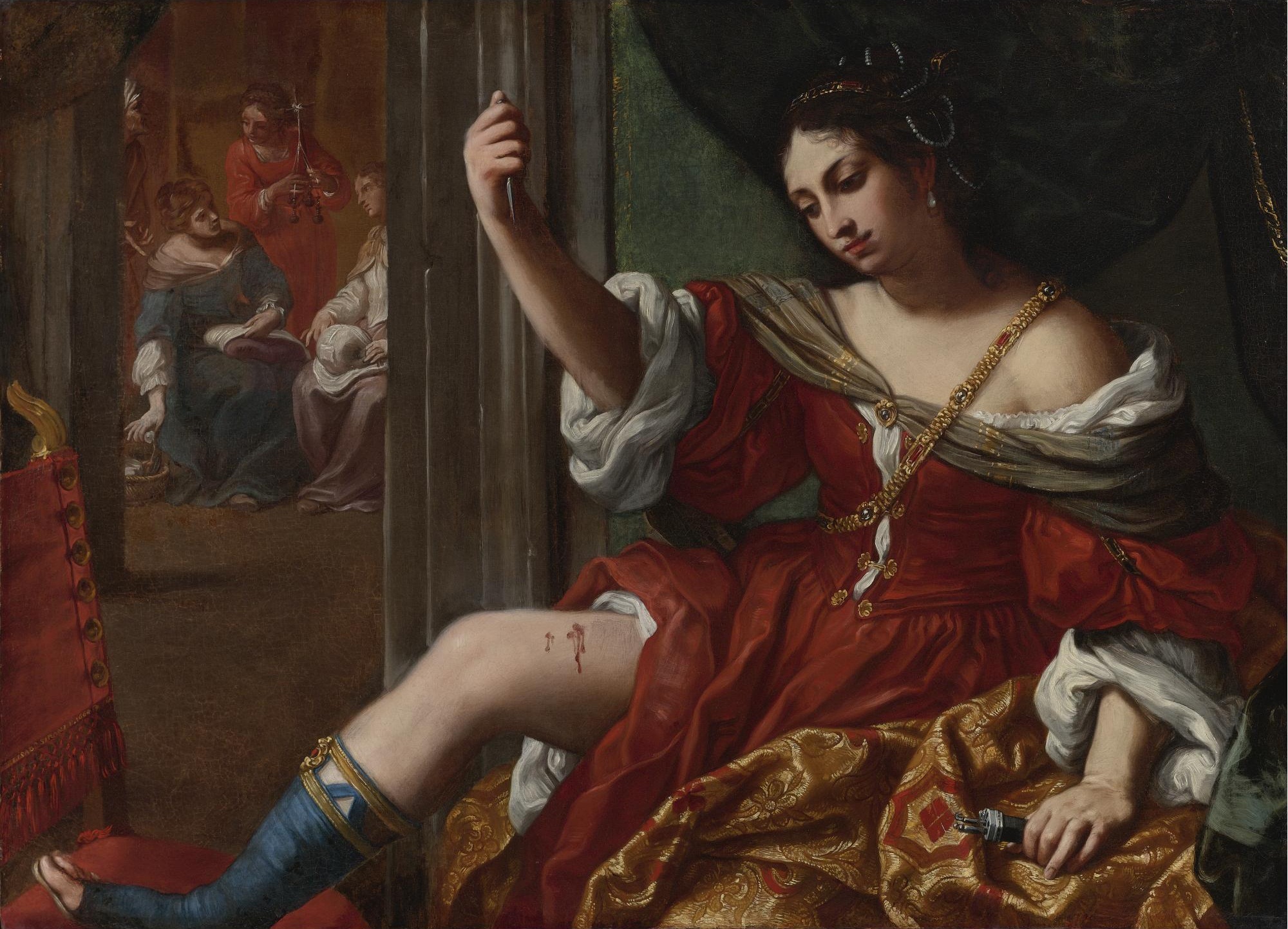
Elisabetta Sirani, Portia Wounding her Thigh, 1664, oil on canvas, 101 x 138 cm (Collezioni d’Arte e di Storia della Fondazione della Cassa di Risparmio, Bologna)The suicide of Porcia, Pierre Mignard. Museum of Fine Arts of Rennes, 1650.
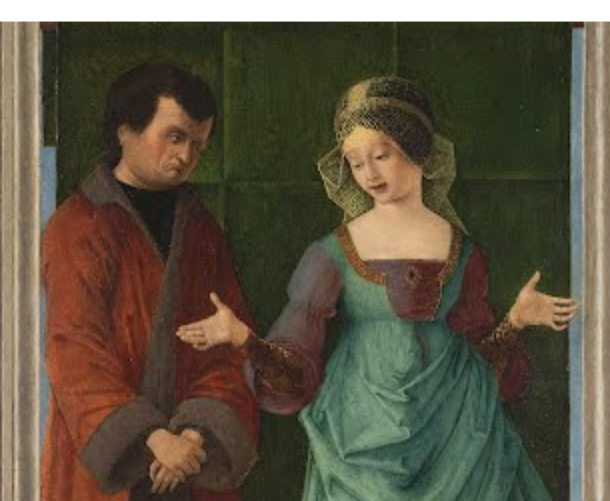
Portia (Or Porcia), was the wife of Marcus Brutus. Many ancient writers emphasize her courage, beauty, and devotion to her husband and Rome. Many painters and illustrators have chosen to depict her as a model of courage and grace.
Porcia, as has been said, was a daughter of Cato, and when Brutus, who was her cousin, took her to wife, she was not a virgin; she was, however, still very young, and had by her deceased husband17 a little son whose name was Bibulus. A small book containing memoirs of Brutus was written by him, and is still extant. 4 Porcia, being of an affectionate nature, fond of her husband, and full of sensible pride, did not try to question her husband about his secrets until she had put herself to the following test. 5 She took a little knife, such as barbers use to cut the finger nails, and after banishing all her attendants from her chamber, made a deep gash in her thigh, so that there was a copious flow of blood, and after a little while violent pains and chills and fever followed from the wound. 6 Seeing that Brutus was disturbed and greatly distressed, in the height of her anguish she spoke to him thus: 7 “Brutus, I am Cato’s daughter, and I was brought into thy house, not, like a mere concubine, to share thy bed and board merely, but to be a partner in thy joys, and a partner in thy troubles. 8 Thou, indeed, art faultless as a husband; but how can I show thee any grateful service if I am to share neither thy secret suffering nor the anxiety which craves a loyal confidant? 9 I know that woman’s nature is thought too weak to p155 endure a secret; but good rearing and excellent companionship go far towards strengthening the character, 10 and it is my happy lot to be both the daughter of Cato and the wife of Brutus. Before this I put less confidence in these advantages, but now I know that I am superior even to pain.” 11 Thus having spoken, she showed him her wound and explained her test; whereupon Brutus, amazed, and lifting his hands to heaven, prayed that he might succeed in his undertaking and thus show himself a worthy husband of Porcia. Then he sought to restore his wife. -Plutarch, Life of Brutus
She tried to conceal her distress, but a certain painting betrayed her, in spite of her noble spirit hitherto. 3 Its subject was Greek, — Andromache bidding farewell to Hector; she was taking from his arms their little son, while her eyes were fixed upon her husband. 4 When Porcia saw this, the image of her own sorrow presented by it caused her to burst into tears, and she would visit it many times a day and weep before it. 5 And when Acilius, one of the friends of Brutus, recited the verses containing Andromache’s words to Hector,
“But, Hector, thou to me art father and honoured mother
And brother; my tender husband, too, art thou,”
Brutus smiled and said: 6 “But I, certainly, have no mind to address Porcia in the words of Hector,
‘Ply loom and distaff and give orders to thy maids,’23
for though her body is not strong enough to perform such heroic tasks as men do, still, in spirit she is valiant in defence of her country, just as we are.” This story is told by Porcia’s son, Bibulus.
Portia marks a turning point in Shakespeare’s Roman female characters as we we go from more ‘traditional’ female characters, to ones who exemplify masculine virtues. Instead of women being subordinates to men’s affairs and keeping out of religion, politics, and the affairs of Roman society, Portia is a character who demands respect, and to share her husband’s dangers. Some ancient sources suggested possibly Portia might have been the one who inspired Brutus to kill Caesar, (more on that later), but in any case Portia is not a character who is subordinate to men, but who demands to be treated as a Roman citizen.
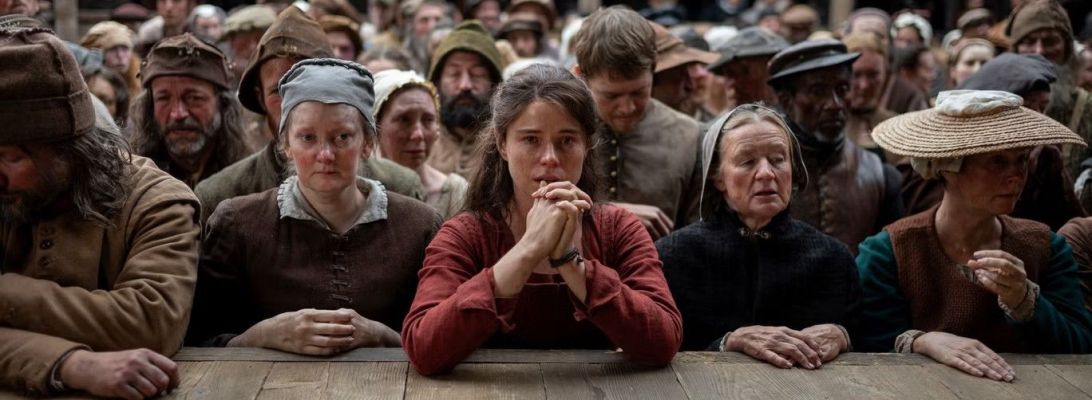
Let me begin with a special shout out to Jesse Buckley, the first Irish woman to win an Oscar for her portrayal of Shakespeare’s wife Anne ‘Agnes’ Hathaway in the movie Hamnet.
I promise I will write a full review soon, but for now here’s a behind the scenes look at the film:
In addition, here’s a link to my post on how Shakespeare depicts Irish culture in his plays
And finally, today is the anniversary of Marcus Brutus’ attempt to win over the Roman crowd, attempting to justify his tyrannicide. Here’s a scene from HBO’s Rome, in which Brutus surrenders to Caesar after the Battle of Pharsellus. In this scene, Caesar is played by Irish actor, Ciarán Hinds.
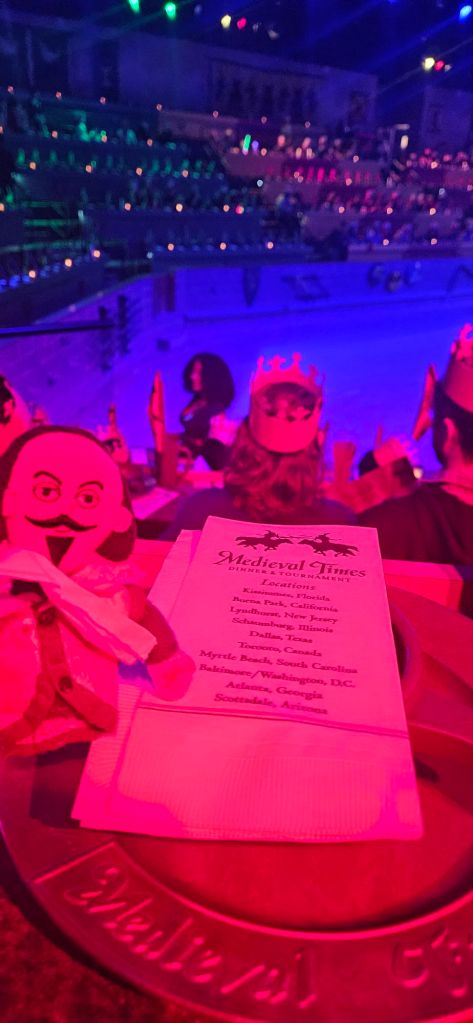
In many ways, Medieval Times is a campy, theme park-esque place. Done’t get me wrong, I love this place and puppet Shakespeare and I enjoyed it immensely, but from a historical perspective, Medieval Times has more in common with Disney Land than British history. That said, it still contains a nod to this ancient culture that praised and highly ritualized the concept of judicial combat.
The Court
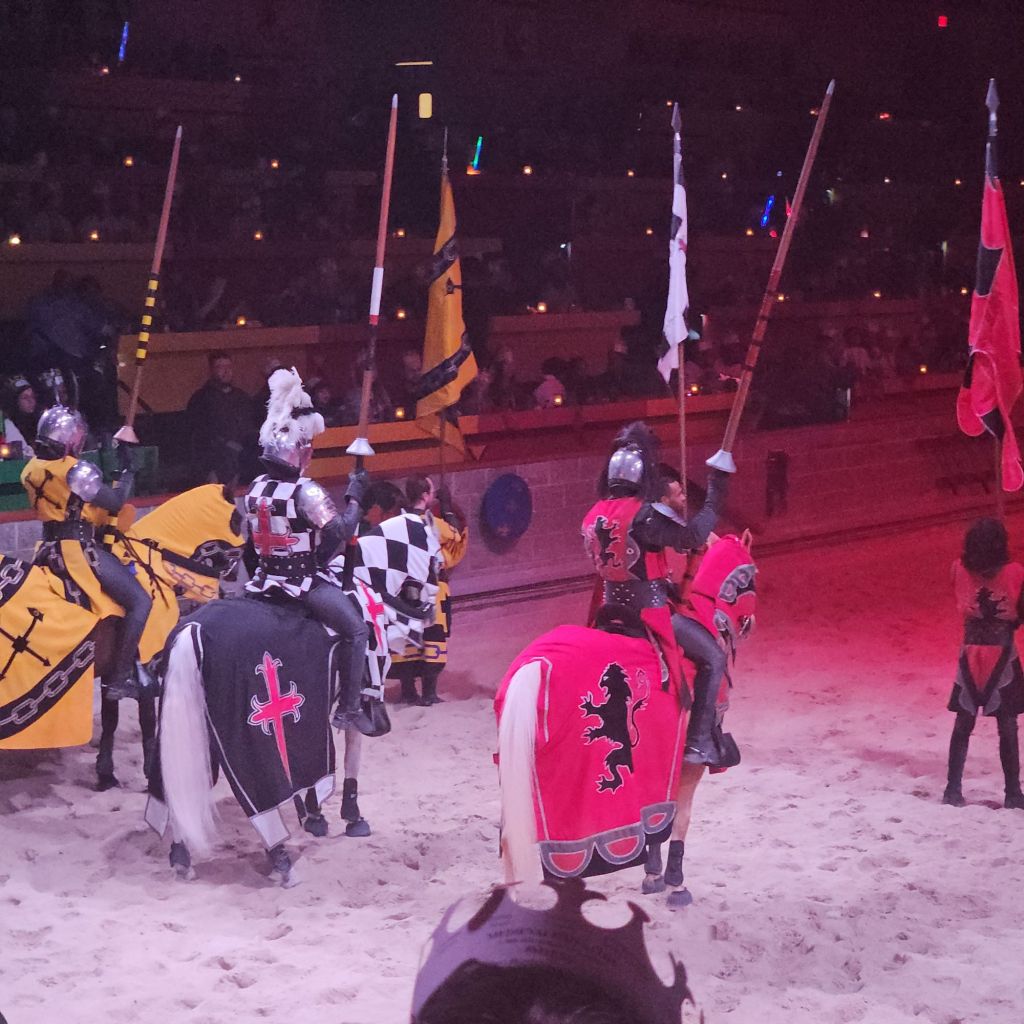
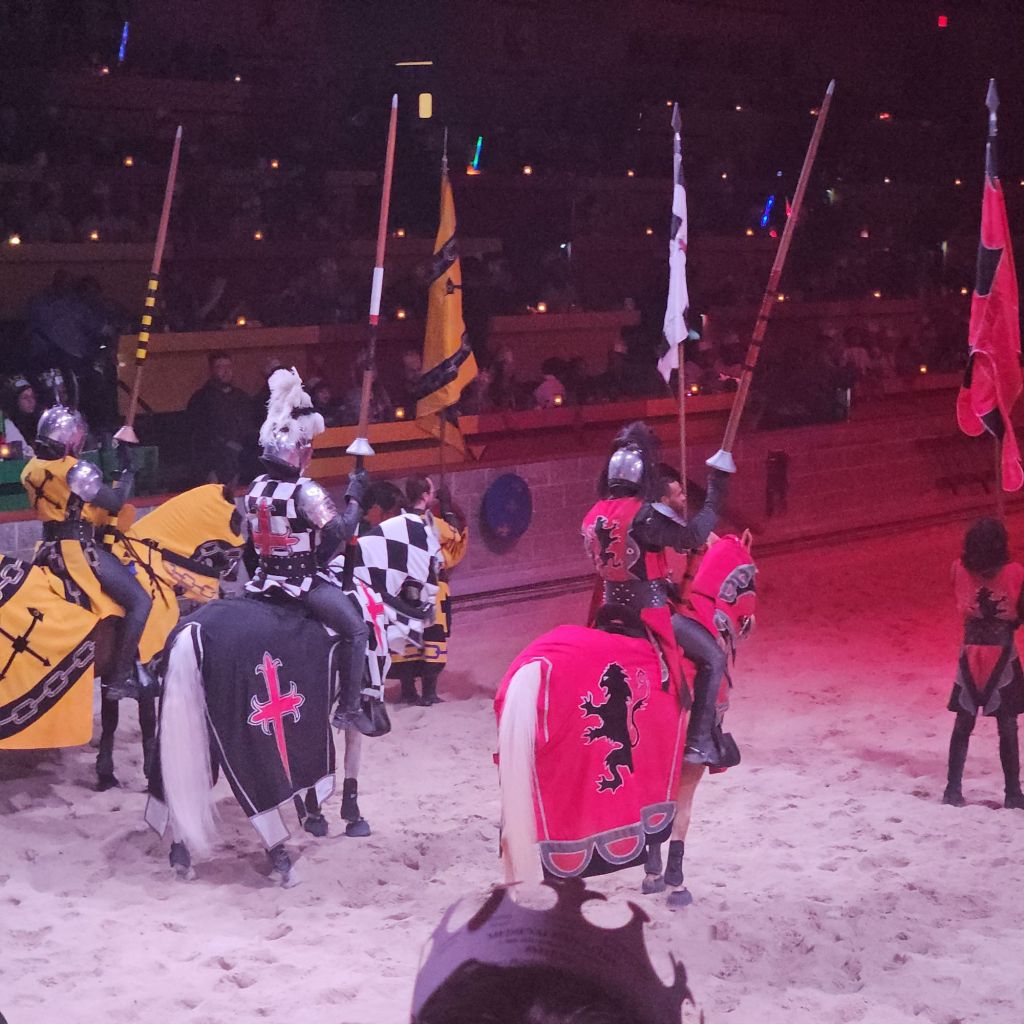
You are cast as a lord or lady, representing a fantasy kingdom (which corresponds to the color of the crown you wear). I was fortunate to get the Red crown for Valentines Day, and was seated right next to the King and Queen (more on that later). The hall was decorated with colored banners and each kingdom was introduced with trumpets and flags. The feast was a celebration of the uniting of all the surrounding kingdoms under the King and Queen. As the king and queen came out, everyone cheered and the royals toasted each kingdom and praised and thanked them all for their service to the crown. The monarchs then promised each lord and lady there a greater reward with sports, games, spectacles, and of course, the feast itself.
Feudalism
Map of the kingdoms in England during the Wars of the Roses
As I mentioned in my Game of Thrones post, a king’s main job was to unite all the lords in the land and get them swear fealty to him, binding the whole country under the crown. It was King Henry VI’s failure to keep the lords in line that resulted in the civil war known as the Wars of the Roses. Feasts like the one in Medieval Times, were essentially propaganda to keep the lords allied with the king. They demonstrated the power of the king and communicated loudly and clearly that the lands would be stronger together, as opposed to endless war. So, this kind of pageantry was political as well as entertaining, and the king and queen’s dialogue preserves the purpose of this kind of feast, which as a history nerd, I deeply appreciated.
Court Sport
While we waited for the feast, the knights entertained the court with displays of their skills and strength. They rode towards the quintain and hit it with their lances, threw spears at a target, and even their horses got a chance to trot without riders, showing how well trained they were.
The knights practice throwing spears at the target
The Joust
Shakespeare’s Pericles, Prince Of Tyre has a very elaborate and detailed depiction of how jousts worked in the Medieval and Renaissance eras. Shakespeare knew that the joust was the ultimate display of skill, chivarly, and the ideals of courtly love. Knights were portrayed as romantic heroes who fought for a simple favor from a lady such as a rose or handkerchief and each one defined himself by his strict code of honor and virtue. All these traditions are hightlighted in the scene where Pericles fights in a tournament to gain the love of the princess Taisa:
Enter A pavilion for the [p]reception of King, Princess, Lords, &c.

[Enter SIMONIDES, THAISA, Lords, and Attendants]

Simonides. Are the knights ready to begin the triumph?
First Lord. They are, my liege;750
And stay your coming to present themselves.
Simonides. Return them, we are ready; and our daughter,
In honour of whose birth these triumphs are,
Sits here, like beauty's child, whom nature gat
For men to see, and seeing wonder at.755
[Exit a Lord]

Thaisa. It pleaseth you, my royal father, to express
My commendations great, whose merit's less.
Simonides. It's fit it should be so; for princes are
A model which heaven makes like to itself:760
As jewels lose their glory if neglected,
So princes their renowns if not respected.
'Tis now your honour, daughter, to explain
The labour of each knight in his device.
Thaisa. Which, to preserve mine honour, I'll perform.765
[Enter a Knight; he passes over, and his Squire]
presents his shield to the Princess]
Simonides. Who is the first that doth prefer himself?
Thaisa. A knight of Sparta, my renowned father;
And the device he bears upon his shield770
Is a black Ethiope reaching at the sun
The word, 'Lux tua vita mihi.'
Simonides. He loves you well that holds his life of you.
[The Second Knight passes over]
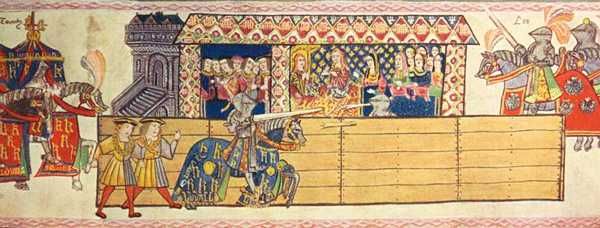
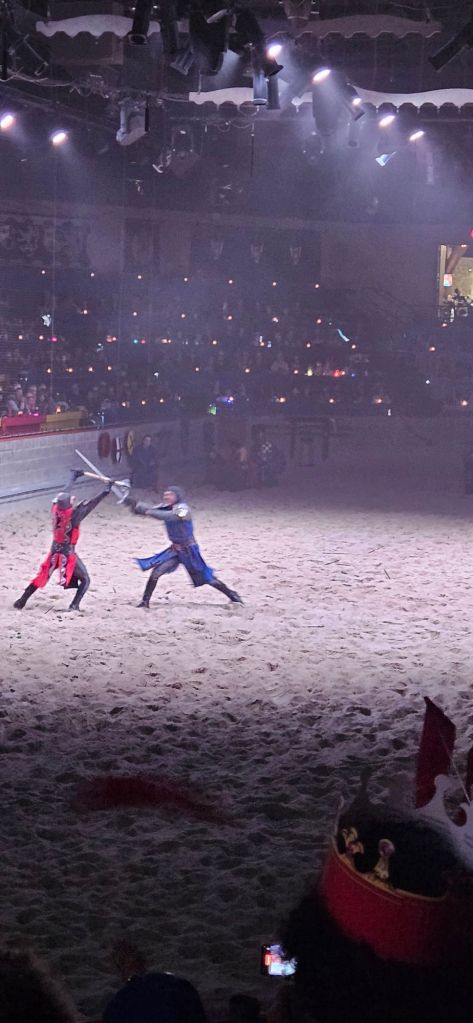
Chivalric ideals aside, the joust also had a practical purpose- it was a way for knights to train for war, an a way for them to win fame, money, and good reputations at court. As you can see in the photos above, the knights were separated by a wooden barrier called “the tilt wall.” Each knight was identified by the colorful designs on their banners, shields, and the blanket draped over the horse. Once the king or marshal threw down the warder, the knights charged headfirst at their opponents, armed with shields, lances, and full armor. Knights scored points for breaking lances and shields or by knocking other knights off their horses. Naturally, to create the most impressive display possible, all the knights at Medieval Times fell off their horses and no lances broke.
First, and most important, was the Joust Royal, or "tilting," in which mounted knights armed with lances charged at their opponents across a barrier.
This was followed by a "tourney" in which mounted knights ran at each other without a tilt barrier (as pictured here).>
Combatants armed with spears and swords also fought on foot over a barrier
Best, Michael. "Chivalry and Duels." Internet Shakespeare Editions, University of Victoria, 28 Sept. 2016, ise.uvic.ca/Foyer/citing. Accessed 30 Sept. 2016.
The Lance
The video above is from Weapons That Made Brittain, in which historian and reinactor Mike Loads, explains with vivid details, how Knights learned how to master the art of the Lance, and how the Lance became one of the most important weapons of the knight.
Duels
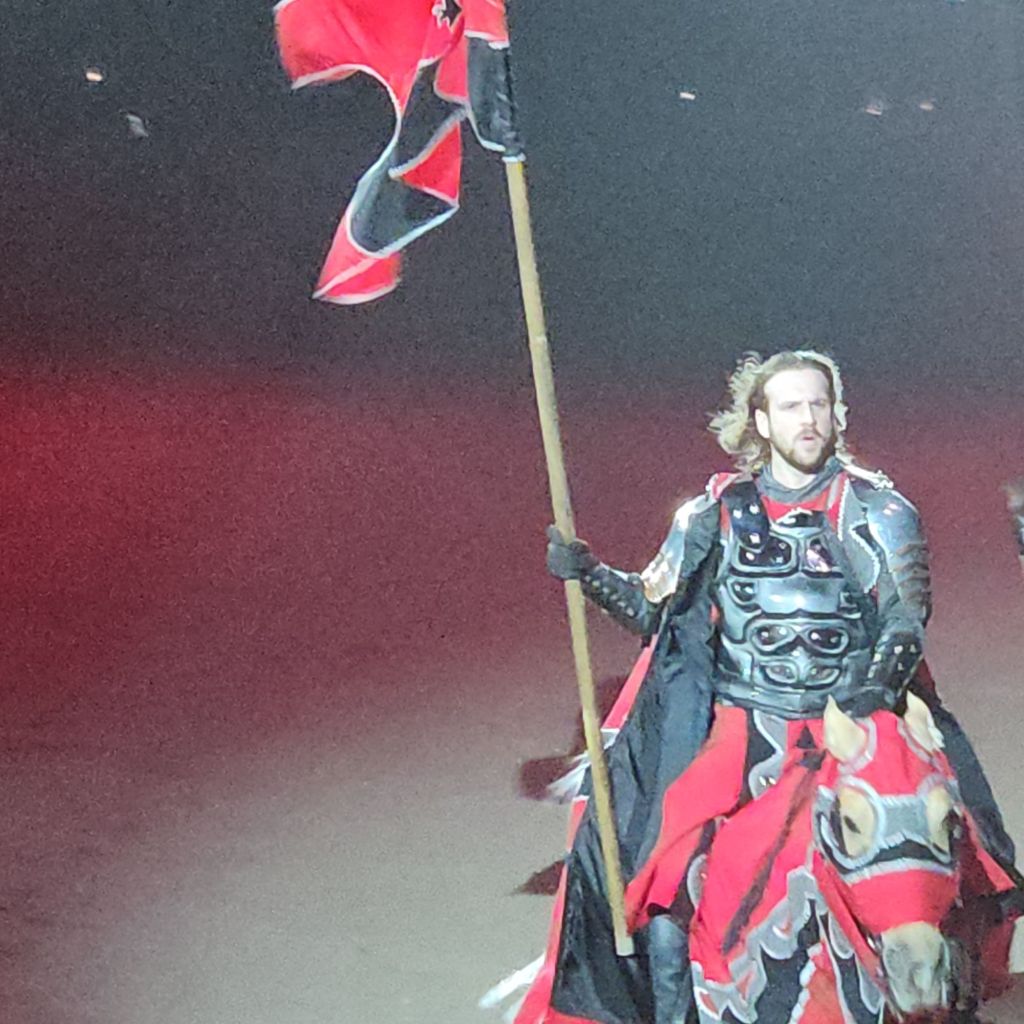
In the climax of the evening, the knights stopped fighting for sport, and started fighting for power! The Green Knight (as green with envy as his armor and horse), suddenly refused to dismount from his horse and began striking knights left and right. He then challenged the leadership of the king, threatening to rebel from the kingdom, along with his fellow knights! The king then decided to choose a champion to fight the Green Knight to the death! The Red Knight, (who as I mentioned before, represented my kingdom, and threw a rose as a favor to my family), picked up the glove of the envious Green Knight, thus signifying that he would be the champion, and fight for the fate of the kingdom!
Why the Green Knight?
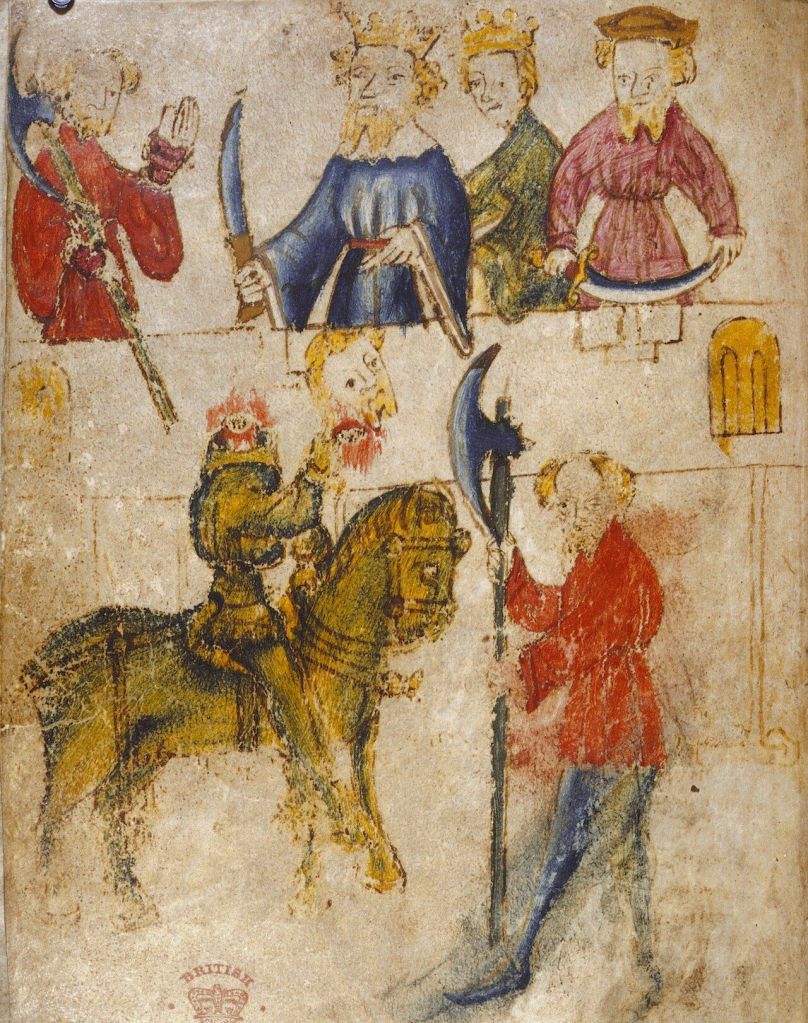
Illustration from Sir Gawain and the Green Knight, 14th century.
At the hall door comes a frightening figure, He must have been taller than anyone in the world: From the neck to the waist so huge and thick, And his loins and limbs so long and massive, That I would say he was half a giant on earth. But more than anything His color amazed them: A bold knight riding, The whole of him bright green.Sir Gawain and the Green Knight
In most (but not all) interviews and clips I’ve seen, the Green Knight is the bad guy- the one Knight whom almost everyone is supposed to root against. When I got home, I wondered why this was. After all, isn’t the black knight usually associated with villainy? My personal theory is that this is a subtle reference to the classic medieval story, Sir Gawain and the Green Knight. The eponymous Knight is supernaturally strong and able to even survive decapitation! He serves in the story, as the ultimate test for our young hero, Sir Gawain. I think the writers of Medieval Times definitely did their homework, making this Knight the antagonist.
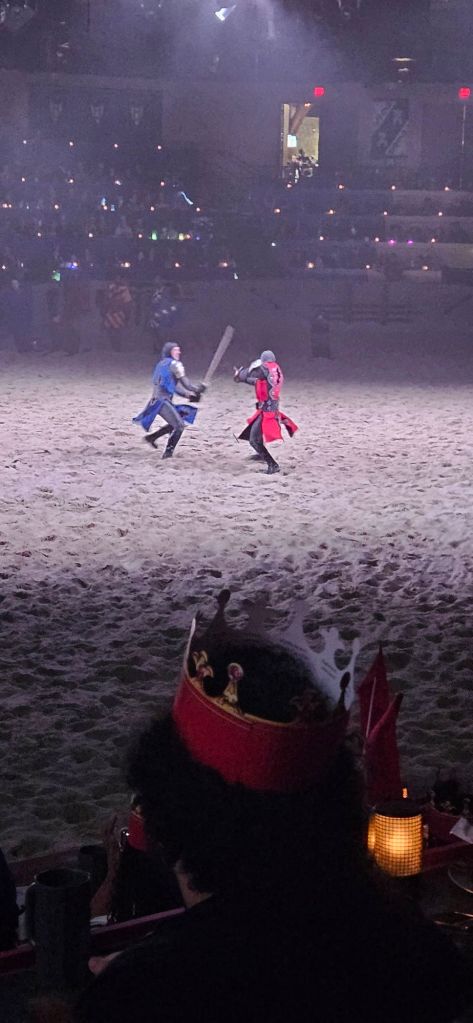
The duel began on horses, but quickly changed to single combat on foot. They fought with axes, maces, and of course swords.
Even though dueling was a bloody and dangerous pastime, it has a long history that even kings couldn’t erase. Back in Anglo-Saxon times, private disputes, (such as the murder of one’s father) could be settled through means of a duel. In this period, England was occupied by the Danes, (which we would now call Vikings), and several Viking practices of judicial combat survive. For example, the Hólmgangan, an elaborate duel between two people who fight within the perimeter of a cloak. These kinds of fights continued throughout medieval Europe and, like Medieval Times Shakespeare knew their devastating dramatic potential.
At the end of Shakespeare’s Hamlet, the revenge cycle between Hamlet, Leartes, and Fortinbras, comes to a close using a duel. Hamlet has murdered Leartes’ father but Hamlet did not intentionally kill him. This kind of legal dispute would certainly have been settled with a duel in Saxon times. This is one reason why Leartes scorns Hamlet’s offer of forgiveness at the beginning of the scene, and instead trusts in the outcome of the fight to prove his cause. Hamlet and Leartes begin fighting officially under the terms of a friendly fencing match, but it becomes clear early on that at least in the mind of Leartes, this is actually a blood-combat. Laertes is demanding blood for the death of his father, and like the Green Knight, his fight will decide the fate of the Danish throne.
Hamlet. Come for the third, Laertes! You but dally. Pray you pass with your best violence; I am afeard you make a wanton of me.
[Laertes wounds Hamlet; then] in scuffling, they change rapiers, [and Hamlet wounds Laertes].
[Laertes falls.]
By the Renaissance, dueling was highly controlled by traditions of honor and fair play. As Laertes admits, poisoning Hamlet and fighting him to the death without his knowledge would be considered treason, and highly dishonorable. The Green Knight does every possible thing to make the audience see him as the villain with his lack of courtesy, dirty tricks, and disdain for the king and queen. He is so dishonorable that, even Americans, who have nothing but disdain for monarchy and in real life, value independence and self-sovereignty, would rather take the side of the monarch and his stooge the Red Knight over the Green Knight, just because he refuses to play fair.
I’ve criticized Ms Swift in the past, offering praise for her work as a whole, but not when she tackled Romeo and Juliet in “Love Story.” So, when I heard she was making a new song specifically about Ophelia, the young ingenue role in Hamlet, I wasn’t sure what to think. I am pleased to report that Taylor Swift’s song has a masterful grasp of not only Shakespeare, but of many classic iconic ingenues (both real and fictional). And her album, Life of a Showgirl, has a salient point to make about relationships, love, and Ms Swift as a woman and artist.
And I of ladies, most deject and wretched, Have sucked the honey of his music vows. -Hamlet, Act III, Scene i.
Put quite simply, the fate of Shakespeare’s Ophelia is, bad. In Hamlet, Ophelia is the prince’s girlfriend. Over the course of the play, her brother Laertes leaves her for France and Hamlet breaks up with her before accidentally killing her father, Polonius. Ophelia cannot take the strain of all this misery, and she loses her mind, unable to communicate except through flowers or little songs, as this clip from Slings and Arrows shows:
Geoffrey Tennent (Paul Gross) explains Ophelia’s torment to young actress Claire
Once Ophelia loses her mind, she dies by drowning. Hamlet’s mother, Queen Gertrude relates how she was picking flowers for garlands (flower crowns), and the branch she was holding broke. She was then weighed down by her gown and sank into the river:
Gertrude: There is a willow grows aslant a brook, That shows his hoar leaves in the glassy stream. There with fantastic garlands did she come Of crowflowers, nettles, daisies, and long purples, There on the pendant boughs her coronet weeds Clamb’ring to hang, an envious sliver broke, When down her weedy trophies and herself Fell in the weeping brook. Her clothes spread wide And, mermaid-like, awhile they bore her up; Which time she chanted snatches of old tunes, As one incapable of her own distress, Or like a creature native and indued Unto that element; but long it could not be Till that her garments, heavy with their drink, Pull’d the poor wretch from her melodious lay To muddy death.
Hamlet, Act IV, Scene vii.
It’s unclear whether Ophelia committed suicide, died by accident, or if Gertrude actually mercy killed her to end her suffering. In any case, Ophelia lost her family, her mind, and eventually, her life.
Ophelia’s Songs
Like Taylor Swift herself, Ophelia deals with her pain through songs and they range from upbeat and pretty, to deeply nihilistic:
And will he not come again? And will he not come again? No, no, he is dead; Go to thy deathbed; He never will come again. His beard was as white as snow, All flaxen was his poll. He is gone, he is gone, And we cast away moan. God ‘a’mercy on his soul! And of all Christian souls, I pray God. God b’ wi’ you. -Hamlet Act IV, Scene v.
It’s the actress’ ultimate test to determine what these songs mean, (“Though this be madness, yet there’s method in it)”. I’ve seen some Ophelias who seem vapid, and consumed by melancholy. Others are full of rage, particularly at Hamlet and Claudius, since they are responsible for her dire fate. As you probably know, if you read my review of Branaugh’s Hamlet, my favorite Ophelia is Kate Winslet, who manages to be all of these and more. Her songs tell the story of a woman who followed her heart, and ended up broken for it; a fate Taylor Swift knows all too well.
TS’ Literary Allusions
The eldest daughter of a nobleman Ophelia lived in fantasy But love was a cold bed full of scorpions The venom stole her sanity And if you’d never come for me I might’ve lingered in purgatory You wrap around me like a chain, a crown, a vine Pulling me into the fire All that time I sat alone in my tower You were just honing your powers Now I can see it all (see it all) Late one night You dug me out of my grave and Saved my heart from the fate of Ophelia
The central conceit of the song is how an unnamed person stopped the speaker from suffering the same fate as Ophelia. The song suggests that Ophelia’s first mistake was that she was too naive “living in a fantasy.” One thing Ophelia’s father and brother repeatedly impress on her is that she cannot be the wife of a prince like Hamlet, since (like so many Disney characters), she isn’t actually royal. There is a deep danger to this unequal power dynamic, which explains her image of a bed full of scorpions, (which by the way, could be cribbed from Macbeth’s line “O full of scorpions is my mind, dear wife”).
It’s particularly interesting that Swift uses allusions, not just to Ophelia, but to other characters as well: Her imagery of venom and purgatory suggests the Ghost of Hamlet’s father, who alludes to being stung by a serpent, and who might be trapped in purgatory. Like Ophelia, the ghost is languishing and suffering because of a man’s crime. I love how she intertwines the ghost and Ophelia with the metaphor of a chain, crown, and vine. While the ghost suffers due to his crown and his chains, one would wish someone would come up to Ophelia with a rope or vine, to save her from her drowning death.
The final image I’d like to discuss is the notion of being pulled out of a grave. Obviously, the Ghost comes out of his grave, but so does Ophelia! In Act V, Scene i, her brother Laertes jumps into his sister’s open grave and fights with Hamlet over her corpse!
Laertes. Lay her i’ th’ earth; And from her fair and unpolluted flesh May violets spring! I tell thee, churlish priest, A minist’ring angel shall my sister be When thou liest howling.
Gertrude. Sweets to the sweet! Farewell. [Scatters flowers.] I hop’d thou shouldst have been my Hamlet’s wife;3580 I thought thy bride-bed to have deck’d, sweet maid, And not have strew’d thy grave.
Laertes. O, treble woe Fall ten times treble on that cursed head Whose wicked deed thy most ingenious sense Depriv’d thee of! Hold off the earth awhile, Till I have caught her once more in mine arms. [Leaps in the grave.] Now pile your dust upon the quick and dead Till of this flat a mountain you have made T’ o’ertop old Pelion or the skyish head Of blue Olympus.
Hamlet. [comes forward] What is he whose grief Bears such an emphasis? whose phrase of sorrow Conjures the wand’ring stars, and makes them stand Like wonder-wounded hearers? This is I, Hamlet the Dane. [Leaps in after Laertes.]
Hamlet. Thou pray’st not well. I prithee take thy fingers from my throat; For, though I am not splenitive and rash, Yet have I in me something dangerous, Which let thy wisdom fear. Hold off thy hand!
The question is, who is this mystery figure who metaphorically pulled Taylor Swift from her grave? To answer that, we need to look at the music video itself.
Imagery In The Video
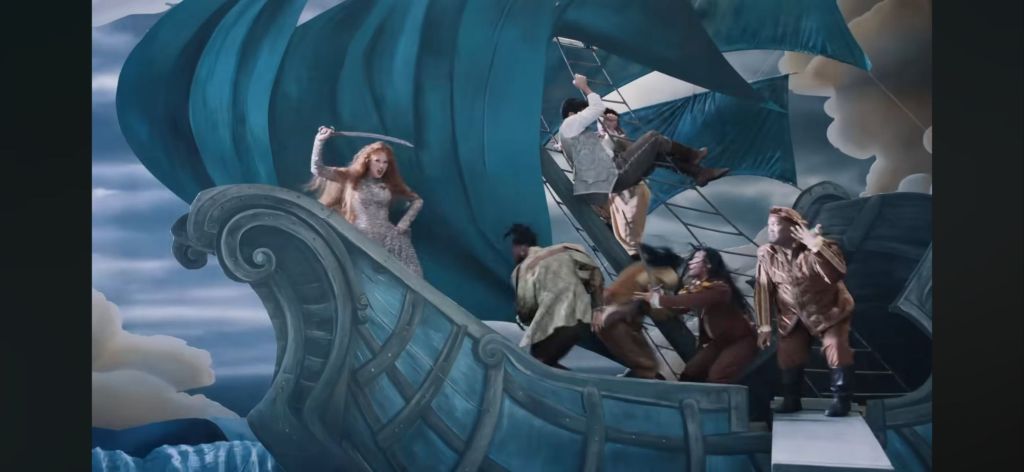
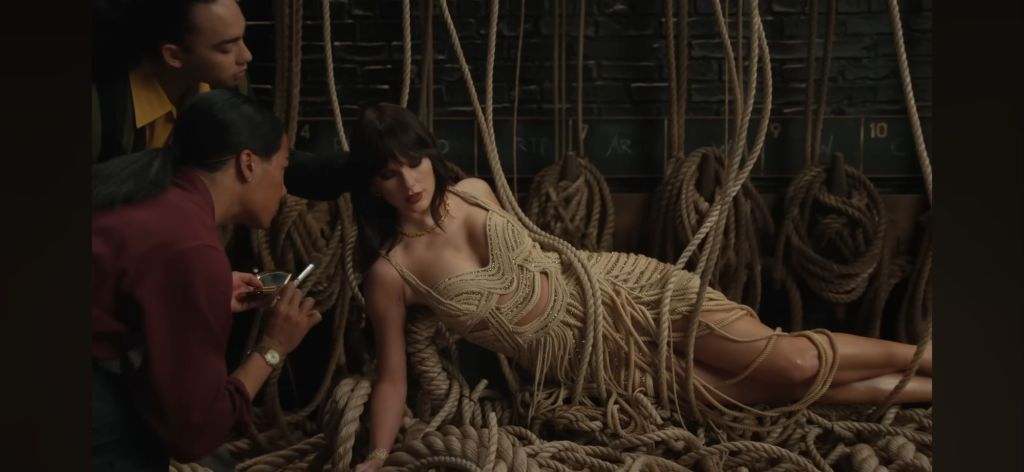
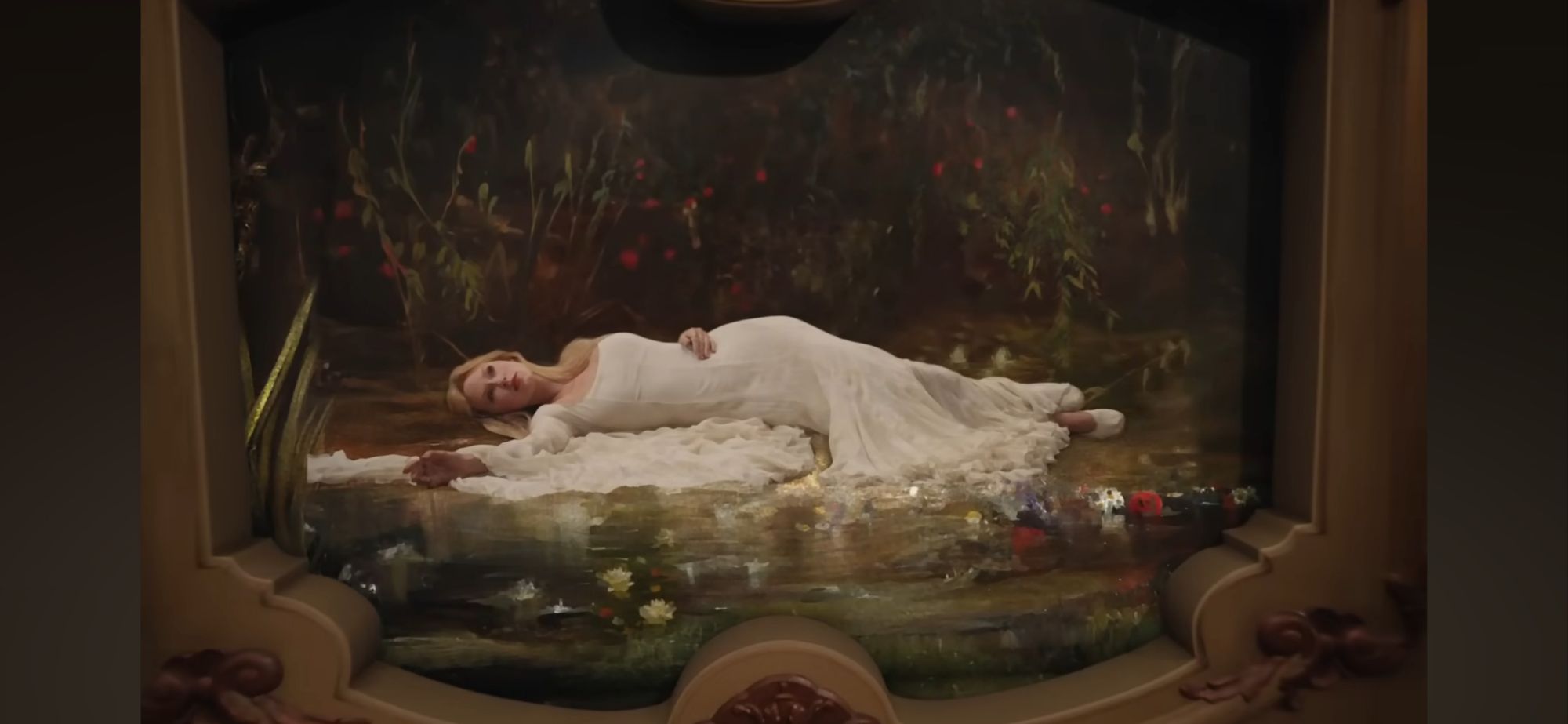
Taylor Swift poses as Ophelia in her 2025 music video Taylor stands her ground as a pirate/ siren in “The Fate of Ophelia”Taylor seems tied up backstage in The Fate Of OpheliaTaylor dons fiery red and seems happy to be a showgirl again
Taylor As Ophelia
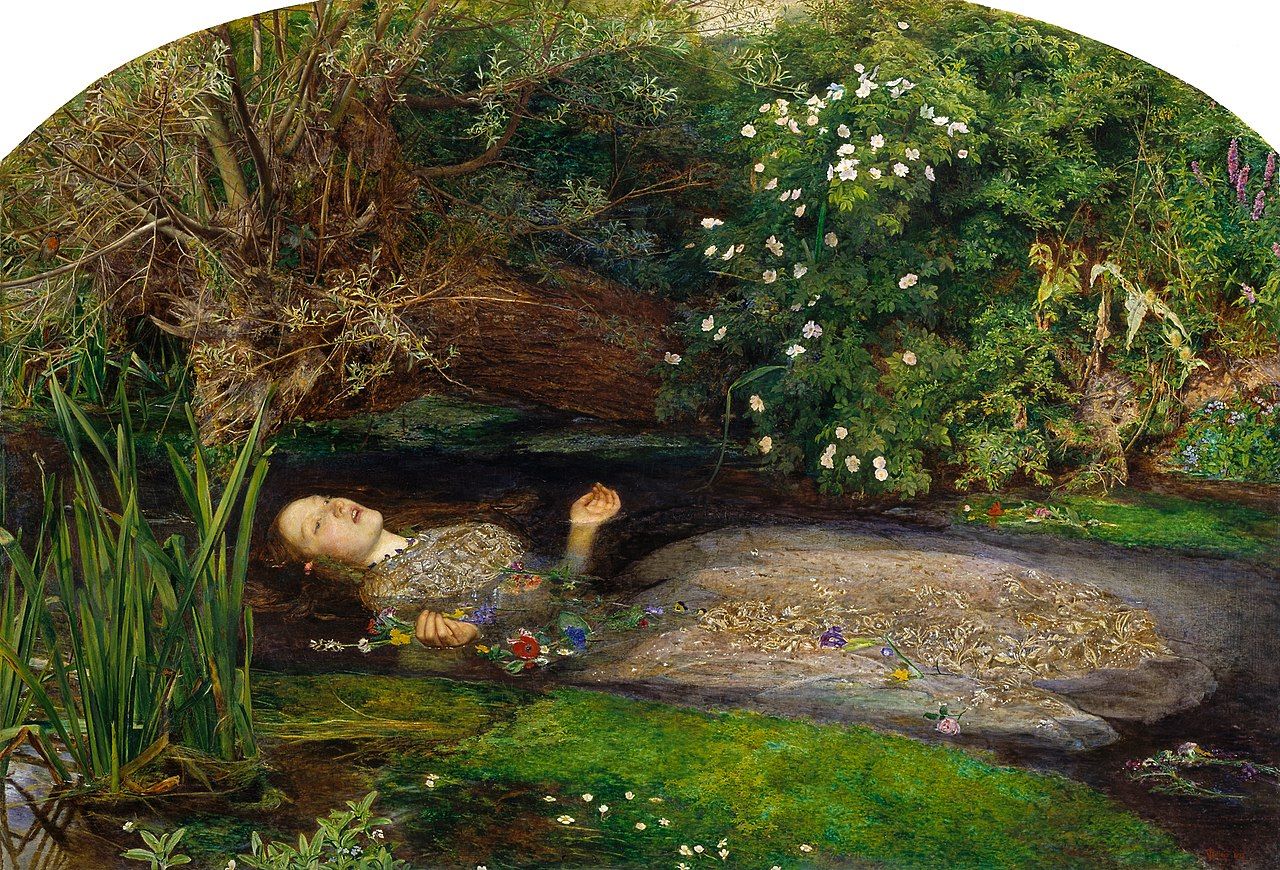
I certainly expected Taylor to appear in an Ophelia-like pose, and I suspected she’d base it on the famous 1851 painting Ophelia by John Everett Millais. For the record though, apparently the pose is based on a lesser-known painting by Friedrich Heyser from 1900 .
Ms Swift establishes who Ophelia is using a pose reminiscent of these late 19th and early 20th century paintings. They make Ophelia into a sort of fairy tale character. The lighting is bright and ethereal. The colors suggest a literal watercolor painting, which is important, given the motifs of water and fire in the song. Taylor seems placid, dreamy, and extremely passive.
Taylor as a mermaid/siren
Taylor as a Mermaid/ Siren
Taylor’s character keeps changing through the video- she goes from Ophelia “A creature incapable of her own distress,” into more active and more assertive characters. First, a mermaid. This isn’t so much of a departure from Shakespeare since, as you saw above, Gertrude compares her to a mermaid. Like Ophelia, mermaids are singers with strong connections to water, who sometimes give their lives for humans, (like in the iconic Hans Christian Anderson story The Little Mermaid).
Taylor stands her ground as a pirate/ siren in “The Fate of Ophelia”
However, in ancient Greek mythology, mermaids are known as sirens, and they can drive men mad with their songs. Taylor’s character has turned tables on Ophelia and is taking control of the men in her life in this image. She becomes a sort of siren/ pirate, using a sword to keep men at bay. This also echoes how, after being sent oversees, Hamlet himself boards a pirate ship and makes the pirates take him back to Denmark, so he can finally take revenge on Claudius. Of course, Taylor Swift wouldn’t settle for the supporting character of Ophelia, and has recast herself as the starring role.
Taylor seems tied up backstage in The Fate Of Ophelia
Waiting In the Wings
The title of Taylor’s album is The Life of a Showgirl, so the whole song is an homage to Taylor’s chameleon like persona, which evocatively, (and provocatively), come through in this shot. The strategic ropes and the bobbed haircut suggest a 1920s flapper, one of the most famous kinds of showgirls. In addition, Taylor is backstage in a dark theater, where ropes and pulleys are frequently used in stagecraft.
The shot and the album as a whole also explore the joys and sorrows of celebrity. Taylor is literally tied to the stage. Perhaps she sees herself as part of the scenery, not a real person. One might even recall how Prospero, one of Shakespeare’s self-insert characters, recalls how ephemeral the illusion of theater and film can be:
Our revels now are ended. These our actors, As I foretold you, were all spirits and1880 Are melted into air, into thin air: And, like the baseless fabric of this vision, The cloud-capp’d towers, the gorgeous palaces, The solemn temples, the great globe itself, Ye all which it inherit, shall dissolve1885 And, like this insubstantial pageant faded, Leave not a rack behind.
I interpret this image as Taylor enjoying the glamor and creativity of the limelight, but also feeling lonely and not totally fulfilling. A showgirl is still not totally alive, without an audience.
Taylor dons fiery red and seems happy to be a showgirl again
The Fire
At the climax of the song, Taylor’s persona becomes a dynamic showgirl in fiery red and orange; the complete opposite of the quiet and passive Ophelia. The song itself makes a reference to being pulled from the water into the fire- from cold, lonely death, to dazzling life. She seems to be happy to be a star and, for the first time, she is sharing the stage. Clearly, finding support and backup (pun intended), is what saves her from the fate of Ophelia. The question remains though, who saved her?
Ophelia In Art
Video from the Tate Modern art gallery about “Ophelia” by John Everett Millais
Ope not thy lips thou foolish one Nor turn to me thy face The blasts of heaven shall strike thee down ere I will give thee grace” –Elizabeth Siddall
Even famous paintings about Ophelia have a tragic story- I mentioned the famous John Millais painting, in which the model for Ophelia was a poet named Elizabeth Siddall. As you can see in the video above, Siddell modeled for Millais in a bathtub for hours in increasingly cold water, leaving her pale and her lips blue. Swift also alludes to Siddall in the shots where she herself is in a bathtub. Here yet again, we have a woman whose every action is dictated by a man, one who cares little for her physical and mental health.
Mystery Solved?
So, who is the mystery man who saved Taylor from the fate of Ophelia? Well, even though the song need not be autobiographical, since the song’s release coincides with her recent engagement, it’s easy to read the song as an ode to Taylor’s fiance, Travis Kelce.
My Take
I know I have been critical of TSs’ interpretation of Shakespeare in the past, but I think she nailed it this time. Her song, and album is a joyous celebration of a healthy relationship, one devoid of jealousy or control. Taylor is celebrating that she can truly be herself around Travis, and that means both her public persona as a superstar, and her private persona that is known only to Travis and herself. Ophelia represents the person Taylor feels pressured to be- a face frozen in time and cold water. Taylor wants a more active persona, and her fiance gives her the courage to do so!
Dream Album-
Now that Ms Swift has tackled both Romeo and Juliet, and Hamlet, I would adore it if she wrote songs for more iconic Shakespearean characters:
Antony and Cleopatra- who better to write about the original power couple than Tay Tay!
Twelfth Night- Both Viola and Taylor know what being a tomboy feels like
Lady Anne from Richard III Let’s be honest, Taylor is known for her celebrity feuds, and who had more beef than the Yorkists and the Lancastrians?
Do you agree with my analysis? If you were TS, what Shakespeare plays would you write about? Let me know in the comments!
Lots of teachers play this game and there are many Youtube videos of people playing it. Occassionally, even Shakespearean actors have played it:
There are also online quiz forms available on Quizlet and Gimkit. You can also show your students this video below:
Richard III and Henry Tudor- Bad Blood
Macbeth- Look What You Made Me Do
King Lear- Anti-hero
Lady Macbeth- No Body No Crime
Julius Caesar- My Tears Ricochet
Richard II- Castles Crumbling
Antony and Cleopatra- Style
Mercutio from “Romeo and Juliet”- 22 and “Shake it Off”
Goneril from “King Lear”- Blank Space
Do you agree with my list?
Teachers are increasingly seeing the value in analyzing Taylor Swift with their students to teach them about literature. What a gift Ms Swift has given us with this song!
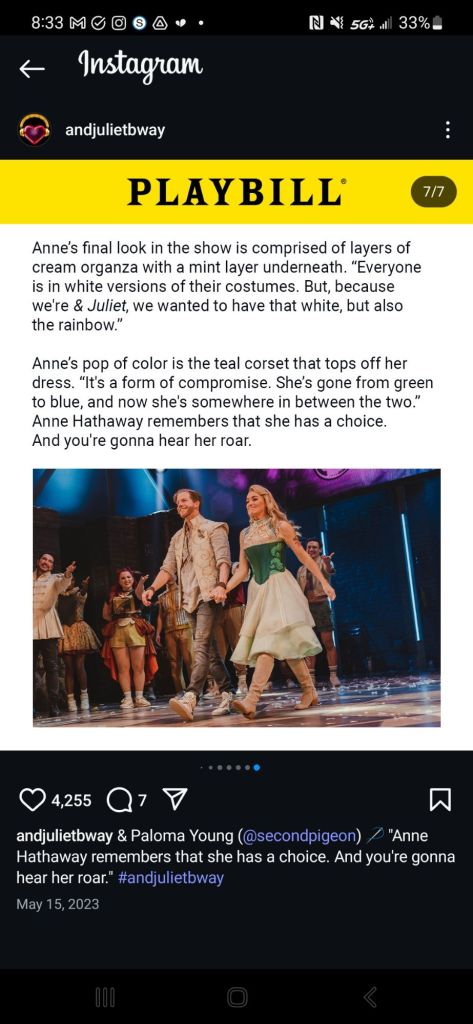
It’s around 1597 and Shakespeare is putting the finishing touches on his new play, Romeo and Juliet, when his wife Anne Hathaway arrives. Anne frankly, hates the double-suicide ending and takes Will’s quill. She then proceeds to write a new story where, after Romeo dies, Juliet packs up and flees with her Nurse and her two best friends to have a holiday in Paris (the city, not her ex-fiance).
To find a jukebox musical that is so self-aware in its writing, so humorous in the way it includes its songs through the narrative, and so blatantly charming, is a pure joy…and really, if you asked me to summarise this review into just a sentence it would be that: & Juliet is pure joy. –Carly Fisher
Stuff you Might have Missed
1609 collection of Shakespeare’s Sonnets, which were published without his permission.
Anne Hathaway Shakespeare- the sonnet Anne complains that Shakespeare never mentions her in his work, except once in sonnet 145, where he writes: “I hate, from hate away she threw, and saved my life saying, ‘not you’.”
Anne and the Second Best Bed– After breaking the fourth wall, Anne also complains that her husband left nothing to her in his will but “My second best bed with the furniture.” This is true, and some scholars have attempted to defend this choice, but it certainly doesn’t look good. In the myth of Shakespeare, this story has helped to construct the Shakespeare who cares more about his work than his wife. What’s interesting is that “&Juliet” helps address this myth and examines it. For more information about the myth of Anne and Will, click here to see my review of “Hamnet”
Yes, Juliet might be based on a historical character. One reason Will objects to his wife changing the play is that it violates the historical accuracy of the story. Like I said in my “Genesis of Romeo and Juliet,” the Capulets and Montegues might have been based on real political factions in Verona.
The Characters
The Music
All the songs in “& Juliet” came from one man- Max Martin, a Sweedish songwriter who has composed songs for Brittney Spears, Celene Dion, and The Backstreet Boys. These mega pop-hits were a huge part of my childhood, so seeing them combined with my favorite writer definitely tickled me and set off my nostalgia goggles. More importantly, it’s very interesting to see how the playwright David West Read turned these songs into a musical.
Setting “Romeo and Juliet” to pop music is by no means a new idea- “Gnomio and Juliet” underscored the whole movie with music by Elton John (who also produced the film). Making Shakespeare into a kind of rock or pop star is also not a new idea- Something Rotten and the musical version of “Shakespeare In Love” also did that. What is new is the concept of turning the story of Romeo and Juliet into a jukebox musical- a story where all the songs are pre-existing pop songs.
Normally I hate jukebox musicals- I find it irritating when producers take an artists’ songs and try to stitch them together into a coherent musical play. In normal musicals, the songs are designed to further the plot and help explain the characters’ internal and external conflicts. In my experience with most jukebox musicals, the songs feel like a waste of time, because the songs were never designed to tell an overarching story, so when they are integrated into a play, the story grinds to a halt. When it’s done badly, either you’re bored with the songs, or bored with the play.
With this in mind, I was prepared to dislike “&Juliet”. I was expecting either to hate the songs for slowing down the plot, or to hate the plot because I wanted to get back to the songs. But… miraculously, both the songs and the story WORKS! David West Read did a great job seeing the overarching themes of loss, love, and conflict within relationships within the music of Max Martin, and translate them into Romeo and Juliet- the iconic lovesick teenagers.
I’d like to highlight the incredible effect of one of these songs in the context of the play- “Hit Me Baby One More Time,” by Miller, made popular by Brittney Spears:
Oh, baby, baby The reason I breathe is you Boy, you got me blinded Oh, pretty baby There’s nothing that I wouldn’t do It’s not the way I planned it
It’s very clever that the writer gave this song to Juliet when she us at her most down and most self-destructive. She feels like her life is over without Romeo (her loneliness is killing her). What’s nice about this musical is that this moment is the beginning of Juliet’s arch, not the end.
Costumes
I could write a whole post about how clever the costumes are, and I will at a later date. Suffice it to say that they compliment the story and music by blending Elizabethan costumes with the sort of late 90s-early 2000s pop-star fashion favored by The Backstreet Boys, Katy Perry, and of course, Brittney Spears.
My Final Word
This show might not please everyone- hardcore Shakespeare nerds might find the concept hard to swallow, and honestly since the songs are mostly from the 90s and early 2000s, the music might be a little dated for a modern audience. Also, with the positive portrayal of homosexual relationships this show is DEFINATELY NOT FOR CONSERVATIVES. That said, it might do exactly what I’d hoped it would do- make fun of Shakespeare with care and in the process, get audiences to enjoy it anew.
In a world and in an age where everything is taken so seriously, it’s a complete delight to return to the idea of going to the theatre simply for fun and entertainment. Yes, the storyline is light and the line up of songs is a laundry list of bops, but in my opinion, there’s no problem in any of that! Quite the opposite! Packed to the brim with exceptional talent and some of Australia’s top dancers filling the ensemble…this is entertainment for entertainment’s sake and that is a lost art form in and of itself. – Carly Fisher
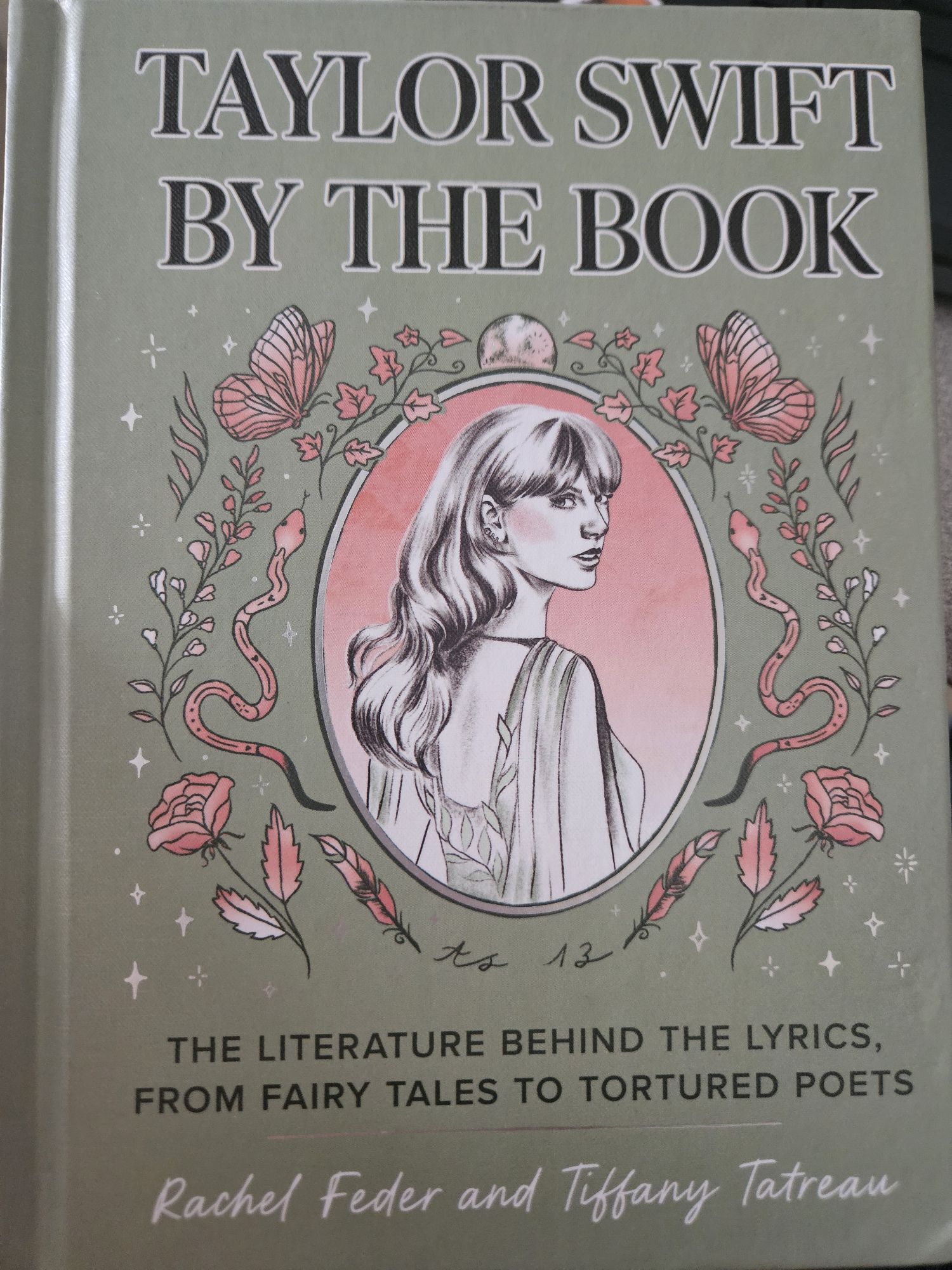
One of my colleagues at work showed me this book, and it really fired my imagination. Taylor Swift is one of the most if not THE MOST successful singer/songwriter of our era. Her songs go across multiple genres and tones and, like many writers, they often contain allusions to classical poetry, nursery rhymes, and occassionally even Shakespeare.
My own Reservations with Taylor
I’m not exactly a Swifite, and I know I’m running the risk of offending MILLIONS of people here by offering criticisms of Taylor Swift, but I honestly think it’s a good idea to be able to critique the things you love. In the past I’ve criticized Shakespeare’s plays, his characters, and even suggested that he might be racist. I would like to offer that, in the case of Love Story, Ms. Swift simplifies the plot of Romeo and Juliet, and leaves out its tragic elements, which kind of misses the point. As an allusion, it seems a little watered down. That said, I feel other TS songs are better, use their allusions more skillfully, and create a more coherent picture in the listeners’ mind. Dispite my issues with this one song, I heartily admit that Ms. Swift is prolific, talented, and has created songs that are classic works of art!
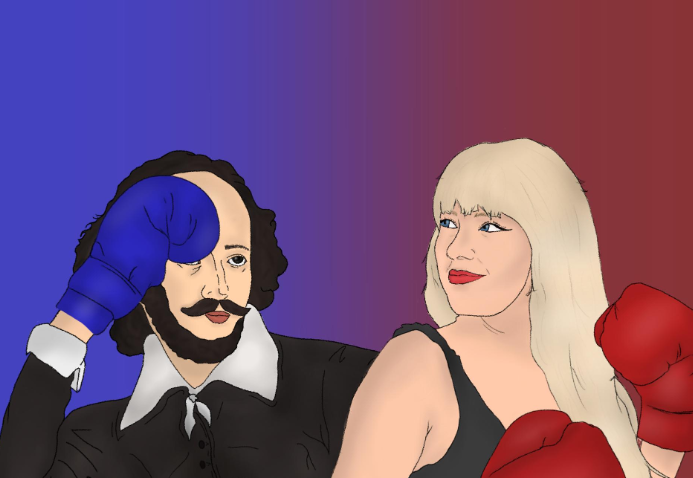
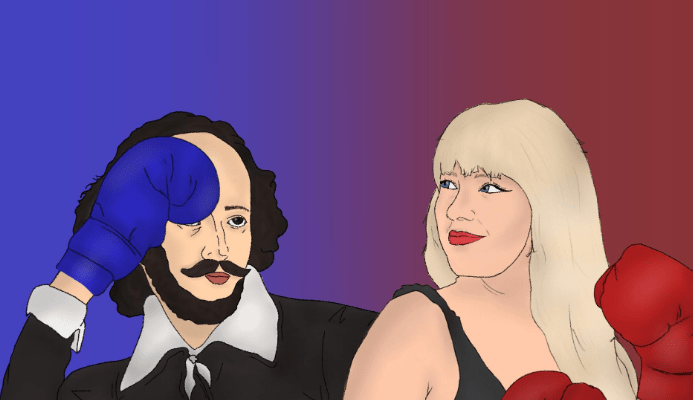
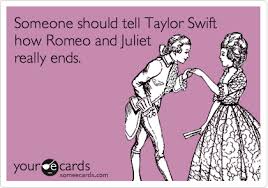
What I’m not interested in doing is getting into a “battle” where I try to justify Shakespeare as being better than Taylor Swift. When I see memes like the one above, it makes me immediately disengage with whoever posted it. I don’t want a Swiftie to talk in the comments about how Shakespeare was a talentless hack. Alternatively, I don’t want a Shakespeare nerd to dismiss Taylor as being infantile or any other critique. Both these writers had different goals, went about them differently, and achieved success in their own special ways. So now, let’s look at how Taylor Swift borrowed from different literary traditions to make her songs more dramatic, more visceral, more insightful, and more poetic.
Her Literary Allusions
Obviously, Love Story mentions Romeo and Juliet, as well as The Scarlet Letter and various princess stories. TS rarely makes direct references to Shakespeare in her work, but some scholars have suggested that there might be more oblique references in some of her songs. For instance, when I look at the lyrics of Willow, I can’t help wonder if she wasn’t at least partially inspired by Shakespeare’s song of the same name in Othello:
Wait for the signal and I’ll meet you after dark Show me the places where the others gave you scars Now this is an open-shut case Guess I should’ve known from the look on your face Every bait and switch was a work of art
The more that you say The less I know Wherever you stray I follow I’m begging for you to take my hand Wreck my plans That’s my man
I can’t hear this song and not hear the parallels with the Othello story- the speaker alludes to eloping with her beloved (which Desdemona nearly does in the first act), that he has scars (which Othello clearly does mentally and physically). In addition, I imagine the refrain as like a duet between Othello (who is reluctant to kill Desdemona), and Desdemona (who wants to leave Cyprus and have a normal married life with Othello:
Desdemona: The more that you say
The less I know
Othello: Wherever you stray
I follow
I'm begging for you to take my hand
Wreck my plans
Desdemona: That's my man

Even if Shakespeare isn't mentioned directly in many of Taylor's songs, like Shakespeare she often uses Greek myths, the Bible, and other popular works as allusions. Some scholars have suggested that both Shakespeare and TS write using their own experiences through the lenses of classical poetry and literature. Simmilar to how Shakespeare probably wrote Hamlet to deal with his grief over his son's death, Taylor writes songs about past relationships, feuds with pop stars, and her own evolution as an artist through the lens of Shakespeare, novels, poetry, and other works.
TS’s Poetry
Ms. Swift’s songs are more than just catchy beats with a few allusions stuffed in. Like Shakespeare, she makes use of alliterations, internal rhymes, clever metaphors, and strong rhythms that help her songs tell their stories clearly and effectively. As an exercise, I fed the lyrics to “Bad Blood” into a poetry analyzer and found a very interesting analysis:
The poem features a rhythmic and catchy structure, typical of song lyrics. The syllabic patterns vary but often maintain a consistent beat, enhancing its musical quality. The use of internal rhymes and alliteration (e.g., “mad love,” “bad blood”) adds to the flow and memorability. The stresses often fall on the first word of each line, creating a strong start and a compelling rhythm that engages the listener. The word choice in the poem is evocative and charged with emotion. Phrases like “bad blood,” “deep cut,” and “salt in the wound” create vivid imagery and convey the depth of the narrator’s pain. The use of questions, such as “Did you have to do this?” and “Did you think we’d be fine?” emphasizes feelings of confusion and hurt. –Studycorgi.com
I highly encourage students and teachers to do an analysis of both Shakespeare and Taylor Swift because studying one can help us appreciate the other. Similarly, learning the way each writer conveys ideas can help the reader become more creative!
Who Said It? Shakespeare or T.Swift?
Lots of teachers play this game and there are many Youtube videos of people playing it. Occassionally, even Shakespearean actors have played it:
There are also online quiz forms available on Quizlet and Gimkit. You can also show your students this video below:
What iF SHakespeare’s Characters were Swifties?
I posted on Reddit a while back to ask the internet which Swift songs would be great soundtracks for the lives of Shakespearean characters. This is sort of an outgrowth of my: Infinite (Variety) Playlist activity. Here are some of the results I got:
Mercutio from “Romeo and Juliet”- 22 and “Shake it Off”
Goneril from “King Lear”- Blank Space
Do you agree with my list?
I hope this post can help teachers see the value in analyzing Taylor Swift with their students, and help students in analyzing Shakespeare. I think the term “classic” applies to anything good enough to stand the test of time. Shakespeare has already passed that test, and based on her clever allusions, evocative wordplay, and emotionally-charged subjects, I believe Taylor Swift to be classic too!
Shakespeare actually lived during the settlement of Virginia, and the Pilgrims came to America just 4 years after he died. I wonder, if Shakespeare had lived, what he would have made of this American tradition?
Why no Coriolanus?? David Oyelowo is playing him at the National Theatre and it’s the one analysis of Shakespeare you don’t have! Please hurry! I’m seeing it on Friday!
User Noittickles, sent to me today
Well, with a request like that, how can I refuse!
Coriolanus is the only Shakespearean story about Republican Rome, which is to say, before Julius Caesar turned Rome into a dictatorship. The play has been called pro-democracy, pro-monarchy, fascist, Marxist, and many other things. In some ways, the play is rather simple and its verse isn’t much fun to read, but the questions it poses, and the way Coriolanus shows the clash between power and common people, makes it fascinating to think about.
The play’s title character is also the most opaque one Shakespeare ever wrote. Some say he is a war hero, undone by the mob. Some say he is a want-to-be dictator who hates the common people and wants to keep power among the military elite. Unlike Hamlet, Macbeth, or any of Shakespeare’s other tragic heroes, we never get a sense of his true intent, or his actual feelings on anything.
To illustrate this, let’s look at two very different interpretations of the same speech. In Act III, Scene iii, the tribunes (representatives of the commons in the Senate), have organized a smear campaign to prevent Coriolanus from becoming Consul, (the highest rank a Roman aristocrat could achieve before Emperor Augustus). Coriolanus is furious at the Tribunes, and vows to leave Rome to take his revenge on the city. Here’s the text of the speech:
Coriolanus. You common cry of curs! whose breath I hate
As reek o' the rotten fens, whose loves I prize
As the dead carcasses of unburied men
That do corrupt my air, I banish you;
And here remain with your uncertainty!
Let every feeble rumour shake your hearts!
Your enemies, with nodding of their plumes,
Fan you into despair! Have the power still
To banish your defenders; till at length
Your ignorance, which finds not till it feels,
Making not reservation of yourselves,
Still your own foes, deliver you as most
Abated captives to some nation
That won you without blows! Despising,
For you, the city, thus I turn my back:
There is a world elsewhere.
[Exeunt CORIOLANUS, COMINIUS, MENENIUS, Senators,]
and Patricians]
Aedile. The people's enemy is gone, is gone!
Citizens. Our enemy is banish'd! he is gone! Hoo! hoo!
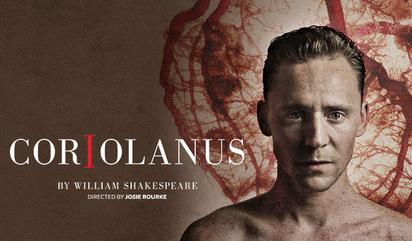
In the first speech, Tom Huddleston plays Coriolanus as a heroic soldier, disgusted and hurt by the lies of the scheming Tribunes:
Hiddleston chose to play Coriolanus not as a villain but as a frustrated demagogue- someone who wants to lead his people to greatness, whether they like it or not. Whether you approve of his methods, Hiddleston’s Caius Martius does care about the good of Rome. You can almost see the tears in his eyes as he leaves the city he loves, the city he bled for, and that has now betrayed him.
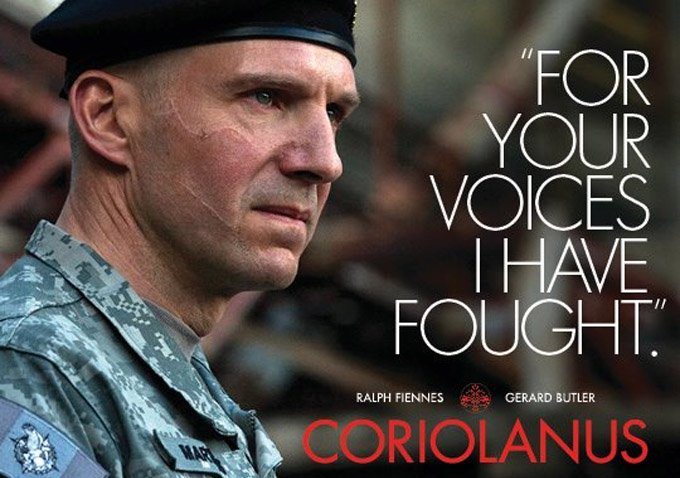
By Contrast, Ralph Fiennes takes a much more authoritarian and cruel route in the film Coriolanus, which Fiennes also directed:
Youtube critic Kyle Kallgren made the excellent case that Fiennes’ Coriolanus is first and foremost, a soldier. You could argue that perhaps Coriolanus has no political ambition whatsoever; he merely wants to keep fighting because war is all he knows. Maybe he purposefully sabotaged himself during his campaign for Consul, because all he wishes to rule is the battlefield:
Kalgren also highlights the “proto fascist” parts of Fiennes’ performance, since Fiennes himself has played Nazis, serial killers, and of course, Lord Voldemort, who is essentially a fascist dictator. Like Merchant of Venice, the Nazi party used Coriolanus as a propaganda tool, claiming that Caius’ fall from grace showed the failure of a weak democracy:
The poet deals with the problem of the people and its leader, he depicts the true nature of the leader in contrast to the aimless masses; he shows a people led in a false manner, a false democracy, whose exponents yield to the wishes of the people for egotistical reasons. Above these weaklings towers the figure of the true hero and leader, Coriolanus, who would like to guide the deceived people to its health in the same way as, in our days, Adolf Hitler would do with our beloved German Fatherland.
Martin Brunkhorst, “Shakespeare’s Coriolanus in Deutscher Bearbeitung. Quoted from Weida
It makes sense that fascists would gravitate towards a play about a seemingly virtuous Roman military leader. After all, the word “fascism” is an Italian word, coined by Benito Mussolini, to evoke the glory days of the Roman Empire- days when Roman society was based on military conquest under a strong leader. What these fascists fail to recognize is that Coriolanus is not a strong leader- he hates politics and is unable to gain any support from the people or from the elites in power. His inability to “play the game” of Roman politics, does make him appealing to some, but on the whole, his career is a disaster.
Some have chosen to interpret the story of Coriolanus as a sort of action-movie wish fulfillment- a man in a lawless society who uses his fists rather than words. Back in the 1990s, Steve Bannon (former advisor to President Donald Trump), wrote a hip-hop musical called: The Thing I Am, which re-interpreted the story of Coriolanus as a police captain who is trying to clean up downtown LA, which is embroiled in gang warfare. I find this interpretation paper-thin and not at all conducive to the spirit of the original play. It also has very racist and paternalistic undertones. You can read my review of it here:
Shakespeare refuses to be prescriptive on political or social issues. He tries to represent all sides of an issue and let the audience decide. With the rise of neo-fascist movements, sectarian violence, and the persistent questions surrounding police and military forces, Coriolanus is more relevant than ever. I haven’t seen this production at the National Theater, but I hope it calls attention to the various angles and points of view of the play- Coriolanus the war hero, Coriolanus the traitor, Coriolanus the soldier, Coriolanus the would-be-dictator. David Oyelowo is a fantastic Shakespearean actor, so I’m sure he can bring a great deal of complexity and nuance to this complicated man.
What I find interesting is that the trailer chooses to use this speech, when Coriolanus has defected to Rome’s enemies, the Volskies. He seems sorrowful, desperate, and afraid of what the Volskies will do to him, now that he is in their camp. One line that Oyelowo delivered exceptionally well was the line “Only the name remains.” I haven’t seen the whole play, but it seems THIS Coriolanus is concerned with the glory of his name living after him. The final question this play asks is, for such a complicated man, how will Coriolanus be remembered?
Well, there you go, Stopittickles! Hope you enjoyed this overview of the play Coriolanus. If you like this review, you might like to sign up for my online class on Julius Caesar via outschool.com:































 The Shakespearean Student