This story is my own invention, but it is based on historical fact and some ideas that could be inferred from Shakespeare’s life and career, composed for Friday the 13th, 2015. I hope you enjoy it.
November, 1603.

The bell tolled in St. Paul’s Churchyard, stopping the bustling crowd in their tracks. A solemn wind blew through the crowd, like there was some dark magic in the air. Though the old queen had died months ago, all god-fearing Englishmen were still in mourning for her death, and spared a thought for the virgin queen as they passed out the long nave of the church into the yard. William Shakespeare was in mourning as well, but not for the queen; he was worried about the future of his company; without the queen’s sanction and protection, the theaters might be closed for good this time, (not one of these Newsmongers who gossiped at Paul’s Walk seemed to know how the young King James would take to plays and theater. The young man had had a life more dramatic than anything Will hat put to parchment- mother executed, father murdered, fighting off plots and murder attempts his whole life. “They say his mother’s head whispered a prayer when it was cut off” one of the gossips had told Will. “I heard talk his father was killed by cannon,” another whispered.” Shakespeare began to think of his old play Henry the Fourth, where he himself played the character of Rumor, who spoke with a million tongues, and not one of them true. Suddenly, from over the Bard’s left shoulder, came a slow deep voice that overpowered all the rest: “I heard t’other day the king fears being killed by witchcraft.” The voice came from one of the booksellers in the square.

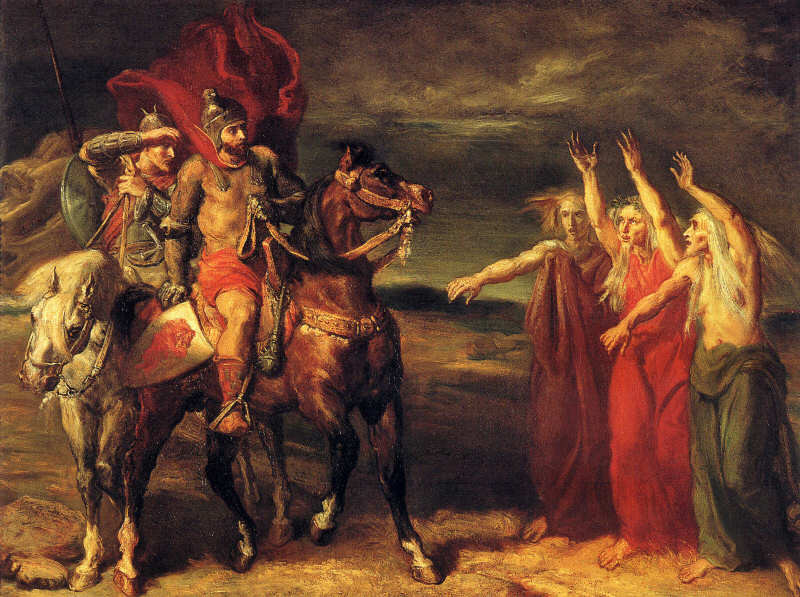
As a writer, Shakespeare often came to St. Paul’s to buy books from the stalls at Paul’s Churchyard. He knew many of the booksellers by name, but he’d never seen this one before. His chest and arms were big as an ale barrow and his beard was grizzled and split into two forks, but what the poet marked in the man most was his piercing eyes- ones that stared at him like fire from an oily taper- quick and dancing, with an excitement as fiery as his own. “Tis true, the king were nearly shipwrecked as a boy by a coven of witches. 13 there were, always 13. They gathered on Fridays for their cursed Witches’ Sabbaths, and summoned up storms to sink the royal barge. The elder witch spoke to the King at Holy Rood house and told his majesty prophesies. She knew all the privy conversations he had with his wife, though she’d never seen him before! His majesty gasped in wonder and had her hanged and burned.” “Fine tale, said the playwright.” “Aye,” said the fire-eyed seller, but the king fears most of all the Wyrd Sisters, who foretold the deaths of his ancestors at the hands of King Macbeth.”
Shakespeare began to smell a devise- to appease the king, he would write a play honoring James’ noble ancestors and condemning this Macbeth as a villain. Shakespeare knew this kind of historical flattery would work; his tragedy of King Richard III had been a great success and the old queen had made him a courtier soon afterwards. Now he just needed to get his hands on some Scottish history to concoct a new play for the King. “Have you a copy of the Chronicles of England and Scotland?” “Nay, me press be not ready yet for the latest edition. But the best story of King Macbeth is an ancient tome written by the Elder Witch herself. Few have seen it, and fewer live to tell its secrets. If ye travel to Scotland, look for the book in the hands of a woman with hair red as flame, and eyes sea-storm blue.” Shakespeare thanked the man, wrapped himself in his cloak, and left the shop in a huff. The bookseller pondered the poet and smiled: “Wicked flame from wicked smoke. Envy burns black beneath thy cloak.”
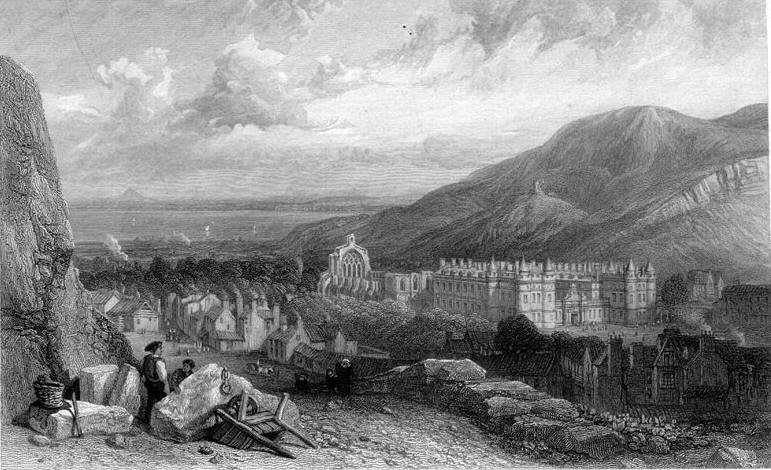
Over the Christmas holiday, Shakespeare’s company received a summons to court to perform some entertainments before the new King! The Chamberlain’s Men were delighted and Will was quite relieved. The King ordered the players to perform at Holy Rood house in Edinburgh, as his court was still in procession from Scotland to England. “Masters,” Will shouted, “Let us give the new king a taste of our quality, and may he pay handsomely for it!” Will and the other shareholders in the company decided on a series of plays to perform for the king, and began the journey to the wilds of Scotland. On Christmas morning they set up their temporary Tiring house within the great banquet hall for the performance, placing props and costumes behind a series of tapestries.
At suppertime the chamberlain gave word to light the candles within the hall, and signal the actors to perform the play, which Will had selected as King Henry the Fourth; a clever choice by Will since it depicted an old king passing the crown to a young and energetic monarch. As the king and courtiers processed, Will spied through the tapestry a haunted looking young woman at King James’ elbow, dressed in courtly gowns with a green veil on her head. The chamberlain directed everyone to their seats and announced the start of the play. To Will’s annoyance, he addressed the company “Mr. Shaxberd and company,” but there was no time to be annoyed or intrigued. “The play’s the thing,” Will muttered, and took his place backstage.
End of Part I.
Part II
The performance was a terrific success! The king himself applauded and promised to patronize the entire company. All of Will’s dreams seemed to be coming true! That night, as he and the other players were packing their belongings into a wagon and preparing to leave the castle in search of a nice, cheap inn for the night, a pale breathless messenger arrived and informed Will that the King wished to meet with him to commission work for their next court performance. Will dutifully walked back up the battlements and entered the castle.

The servant directed him, not back into the ante-chamber of the Great Hall, but up one of the staircases on the North East tower. This tower housed the royal bed chambers! What on Earth was a mere poet from Stratford doing up here? The servant’s candle cast strange shapes upon the walls and the flame blazed upward like some bronze blade. Shakespeare knew from the gossips that the King’s mother had watched her lover David Rizzio be murdered in this very tower- he was stabbed 56 times by jealous Scottish nobles who wished to marry the queen and take the throne. Gruesome images flickered in the poet’s mind. At last, they came to an archway with four adjacent chambers. Three were heavily guarded by English soldiers with halberds but the fourth was unprotected. Slowly, ever so slowly Shakespeare nodded to the servant, and stalked along the pathway. Before he could nock, the door swung open. Pausing a little, The Bard stepped inside.

The room looked like a mix between a library and a crypt with a cold stone wall, a small altarpiece that looked barely used, and several oak bookcases piled high to the ceiling. Once the playwright entered the room, the door shut without warning. He couldn’t see who shut it and the shock put something cold in his blood. Shakespeare’s eyes adjusted to the darkness of the room.Moonlight gave the place a silvery glow, until a shadow came out of the darkness and revealed itself as a woman’s face. Shakespeare could barely make out her features but it was clearly the woman he’d seen in the procession. The Moon made her red tresses shimmer and gleam, as if she were a fairy from one of the dark pools of legend. “I am Princess Elizabeth,” she replied in a voice that seemed more solemn than proud of her royal title. Recovering from his initial shock, the poet bowed low and counterfited his best courtier’s smile. “I am Master Will Shakespeare, at your service.”
“I know who you are. They call you the Bard of Avon. You’ve written sad stories of the deaths of kings, and woven yarns of the fairy queen,” the princess said in a hollow voice that chilled the poet to the core. “When I was little,” said the princess warming slightly, “My mother spoke of how Irish Bards could change their forms, and speak with the spirits of the dead. Sometimes they even outmatched witches who danced with the devil on Friday nights. You seek my family’s patronage?” “Yes”, said Shakespeare tentatively, “And may I prove worthy of such an honor.” “Beware your ambitions,” Elizabeth went on.
“My family has been torn apart by ambitious men. You know I take it that the chamber we stand in was where my grandmother watched her servant die. She lost the crown, and never saw her son again. Death stalks ambition in Scotland. Some say the Devil tempts men to dance with him on nights like this, and signs their name in his book. My ancestor Malcolm fought armies from Hell to keep his crown.” “From King Macbeth,” replied Shakespeare, (his breath finally returned). “I am the keeper of a history of that damned king, but I will not share it with anyone. He sold his soul to a witch to get the crown, and his book is full of spells that curse the reader. I brought you here so that you can lift our family’s curse with your writing. When you get my father’s patronage, do not feed his fears with stories of witches and prophesies or the curse will envelop the throne. Heed my warning, and do not look for the story of King Macbeth.”
As mysteriously as it had closed, the door opened again. The Bard bowed politely and left the chamber. As he left, he saw the Princess kneeling at the shrine at the corner of the room, eyes closed and meloncholy.
End of Part II.
Stay tuned for the final chapter tonight.
Happy Friday the 13th!