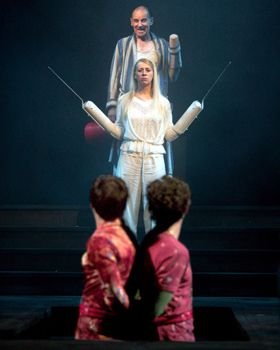
Review: A Midsummer Night’s Dream, (2021)

Trailer for Globe Theater’s 2021 production of A Midsummer Night’s Dream

What do you think of when you think of “Shakespeare?” What do you think of when you think of “A Midsummer Night’s Dream?” 

    Ruffs and Tights?

    Mostly white dudes?

    Elizabethan music?

    Dark night and moon?

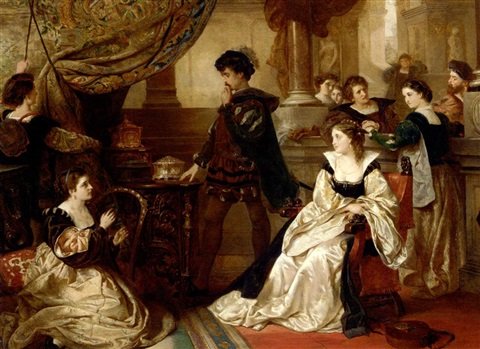
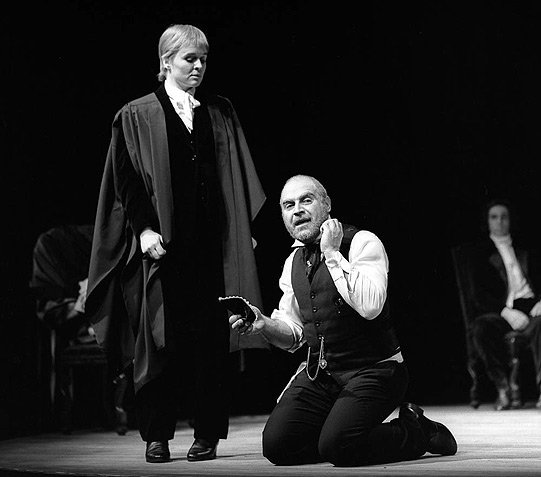
This production, directed by Michelle Terry, is gleefully throwing out every preconceived notion of what A Midsummer Night’s Dream can or should be. In terms of design, casting, music, and interpretation, it breaks all the rules, while still remaining true to the text. This allows the production to appeal to not only hard-core Shakespeare fans, but first time audiences and children too!

I got to see this production thanks to the Globe’s online streaming library. My mother kindly shared me a link to this recording from the summer of 2021. You can watch it yourself on: https://www.shakespearesglobe.com/watch/#full-length-productions

I would describe the concept behind the show as “Suggestive,” that is, it doesn’t belong to a literal time and place. Even though the play is set in Ancient Greece, the play refuses to be constrained by historical accuracy, which arguably, fits nicely with Shakespeare in particular, and the Globe itself; a modern building in a modern city, based on a 400-year-old building.

The music and costumes evoke a New Orleans Mardis Gras, a Pride parade, or a Spanish pinata with its bright colors, heavy use of fringes, and bright, energetic jazz music. The only people who don’t wear bright colors are the four lovers, which reflects their continuous frustration with being unable to marry the person they really want.

The show is also Color blind and gender blind, with women playing men’s parts and a cast with black, white, and mixed race actors. Terry’s direction also calls attention to the patriarchial, racist, and sexist elements of Athens which are often overlooked in other interpretations of Dream that I’ve seen or read about. Rather than being a hero, Theseus is a horny old man in a ludicrous pink uniform, looking like a cross between M. Bison and a Christmas nutcracker. To reinforce this point, the actor chose to perform one of Theseus’ most patriarchial speeches as a joke:

Theseus. What say you, Hermia? be advised fair maid:50
To you your father should be as a god;
One that composed your beauties, yea, and one
To whom you are but as a form in wax
By him imprinted and within his power
To leave the figure or disfigure it. -Midsummer Night's Dream, Act I, Scene i.

I’ve seen this speech heavily cut and played seriously, but never till now did I see it played to ridicule the ludicrous notion that women are in any way bound to worship their fathers.

In another nod to contemporary gender politics, the actress who plays Hippolyta and Titania chose to perform her role on crutches. As far as I can tell, this was a deliberate choice and not a result of real injury. There is a precedent for this: In 1984, Sir Antony Sher performed Richard iii on crutches because it highlighted the cruelty people with disabilities often suffer.
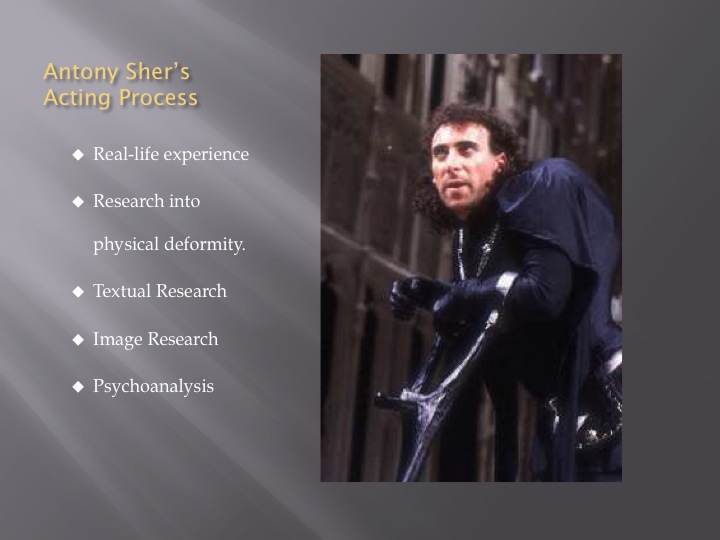
I could be wrong, but I think that the reason the actress was on crutches was a symbolic way of confronting the way gender politics can cripple women.

Many scholars have pointed out how Hippolyta rarely speaks despite the fact that she is supposed to be the powerful Queen of the Amazons, and Theseus’ fiance besides. Shakespeare makes it clear that their marriage was arranged as a political alliance after the Amazons lost to Athens in a war:

Hippolyta, I woo'd thee with my sword,
And won thy love, doing thee injuries;20
But I will wed thee in another key,
With pomp, with triumph and with revelling.

With this in mind, it makes sense to have Hippolyta on crutches as a result of her injuries. Those injuries might also explain her silence; she has lost her agency now that she is essentially Theseus’ prisoner. One might think of any number of war atrocious where women have been sold to powerful men over the centuries. In short, by putting Hippolyta on crutches, we see a glimpse into her tragic story that most productions just gloss over- that she has lost a war, been separated from her people, and is now her enemies’ prisoner through marriage.

I’ve come to expect high quality acting from The Globe Theater Company and this cast did not disappoint. As we watched it together, my family concluded that this was one of the best acted productions of Dream that we’ve ever seen, which between us has to be over 30 plus productions.

The delivery is crisp and fast paced. Every actor has taken these words and made them their own. They speak them as if they were written yesterday. One thing I love about the Globe is that the directors encourage this kind of fast paced delivery; with no distracting special effects or sets, the actors have to captivate the audience with their delivery of Shakespeare’s text, without being melodramatic or self-indulgent. I’m pleased to say that this cast does a fantastic job of telling this magical story in a compelling and very modern way.

I’ve shown my recording to kids, teens, adults, and my family, and everyone has a different reaction to the show. Maybe this isn’t quite your cup of tea, but the concept is sound, the acting is high caliber, and it utilizes the Globe’s unique qualities extremely well. 
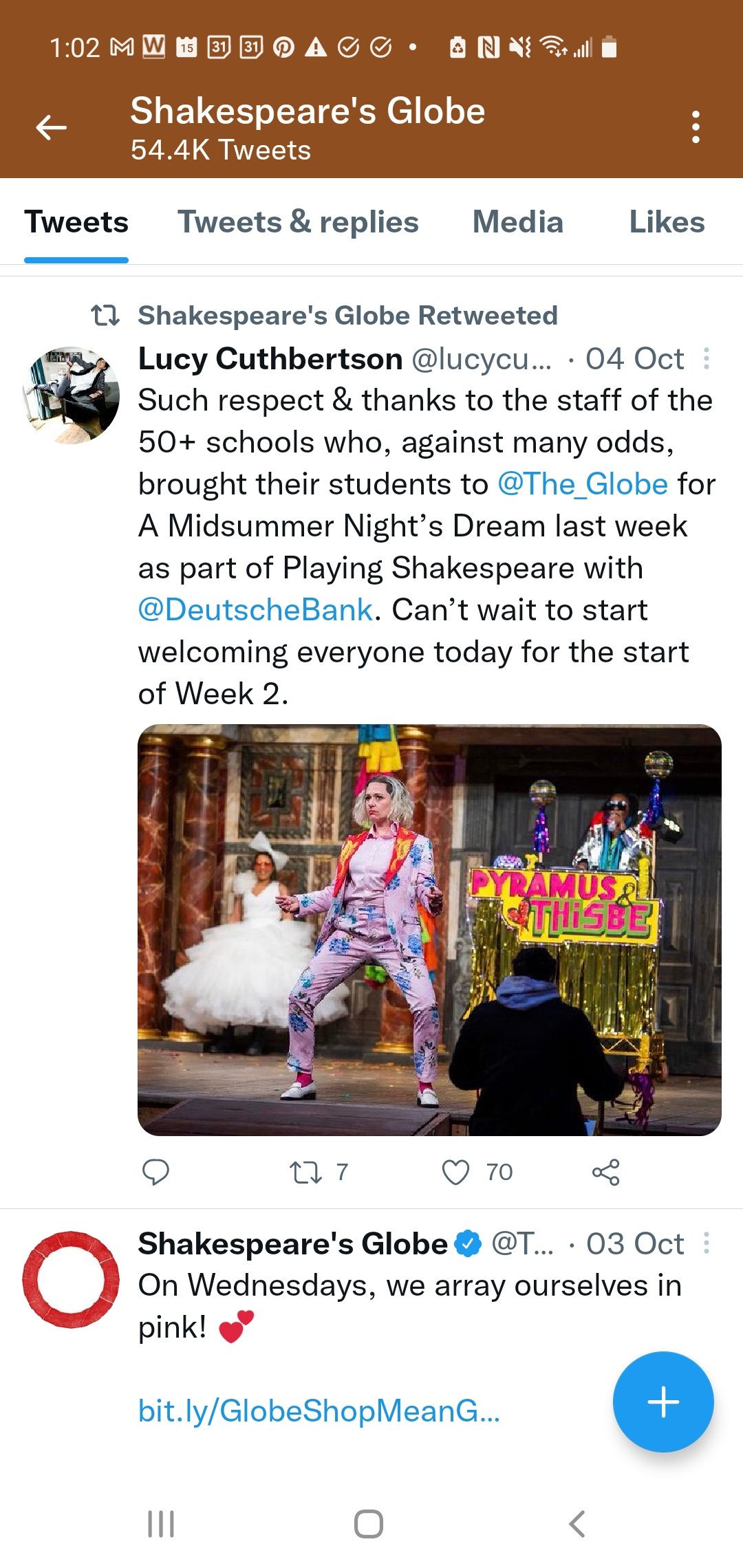


I personally didn’t care for Bottom just because I felt the actress was playing a very energetic part with too much sarcasm and tongue in cheek, but that’s mostly personal preference. I did however love Peter Quince, Snout, Snug, and the rest of the Mechanicals. Peter Quince is a rather thankless part but it’s great to see someone balance being a straight man trying to reign in Bottom’s antics. and an idiot who has no idea how to direct a company of actors, which the actress playing Quince did very well.

New Acting Course for Young Actors Starting September 12th, 2021.

Trailer for my 2021 Acting course via Outschool.com

I’ve been working on a remote learning class for Outschool.com where I take some of the audition advice I wrote in Creating A Character: Macbeth, and some of the other acting posts I’ve published over the years. This will be a weekly virtual acting course for kids ages 13-18, starting September 12th at 10AM EST.

This class will outline the tools and techniques of Shakespearean acting such as projection, articulation, and imagination. Each We’ll also go over Shakespeare’s own advice on acting in his play “Hamlet: Prince of Denmark.” The course will culminate with the students choosing their own Shakespearean monologues and scenes, which they can use going forward in auditions, school plays, and classes.

The best thing about the course is that each week builds on the previous week’s experience, but you don’t need to go to all of them. I’ll be flexible and work with the student’s schedule so everyone gets as much out of the class as possible.

If you’re interested in signing up, go to Outschool.com. If you have any questions, email me by clicking here:

Hope to see you online soon!

The Fashion Is the Fashion 3: The Merchant Of Venice

Thanks for recommending this topic. I really enjoyed researching it. Disclaimer: Although I have a degree in Renaissance literature, I don’t have a degree in world religions. I don’t pretend to be an expert in Judaism and I apologize if I have gotten any cultural details wrong. As I have written before, this play has been used to spread harmful stereotypes and misinformation against Jews and Muslims, and I have no desire to do so. So don’t take this information as a comprehensive guide to the lives of Jews or indeed any 16th century Venetians. What I do intend to do is analyze how costumes from the play can evoke the people and cultures of that time.

1. Background https://youtu.be/BvqZ0JUljfo

Venice in the 16th century was a lot like modern day Manhattan- a multicultural epicenter of trade and commerce. https://youtu.be/FNZa9qazTvc

Many productions have costumes that emphasize the wealth and privilege of the Venetian world, except for Shylock

As this video shows, Jews in 16th century Venice were segregated into separate communities known as ghettos. Although the Jews found ways to survive and thrive in this situation, they faced constant discrimination and harassment.

In a modern productions or a period production the costume has to reflect a single vision for the show. Watch this interview with Globe Costume coordinator Laura Rushton: https://youtu.be/PaZmAuKE-Jg

2. Men’s Fashion- Italian fashion was all the rage in Shakespeare’s day. Gone were the stiff woolen tunics of the Middle ages, in with brightly colored silks and leathers. Young Men wore leather jackets called doublets and tight pants that showed off their legs. In the hot sun of Venice, light linnen undershirts were wore underneath the doublet. Wealthy men would wear fine silks and their jackets had slashed sleeves to show off the fine embroidered silk underneath.

Joseph Fiennes’ costume as Bassanio in The Merchant of Venice

Servants- Servants were given distinctive clothes known as liveries by their masters, which for a man would typically be a distinct colorful jacket. Women like Narissa, who were high-ranking ladies maids, would wear hand me down clothes from their mistresses. So this is why in most productions I have seen, Narissa and Portia wear similar clothing. This also helps show the trust and respect they have for each other.

A Note On Masks:

Act II, Scene 5, takes place during Carnival, one of the most celebrated holidays of Venice, and it’s usually celebrated by people wearing brightly colored masks. This great video below from history YouTuber Metetron shows just a little bit of background on Venetian masks:

3. Women’s Fashion- The women in the play Merchant Of Venice are treated line birds in a cage, especially Portia who literally lives on an island and has to marry the man who wins her at a carnival! With the restrictions of garments like partlets, bodies, or corsets, if you wore the fashions of the period, you would feel like your lungs were birds in a cage!

Although the dress was richer and more ornate (reflecting the relative peace during this period), the clothing was much more physically restrictive than medieval dresses: https://youtu.be/KCeqG47LI1Y

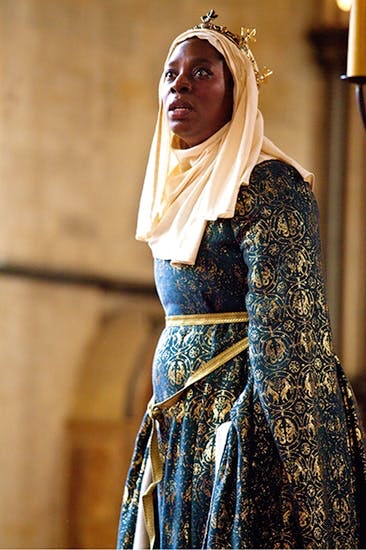
Costume for a production of King John. The fashion is reminiscent of the late 15th century. There is no corset, the dress helps shape the silhouette. Notice also the long sleeves.
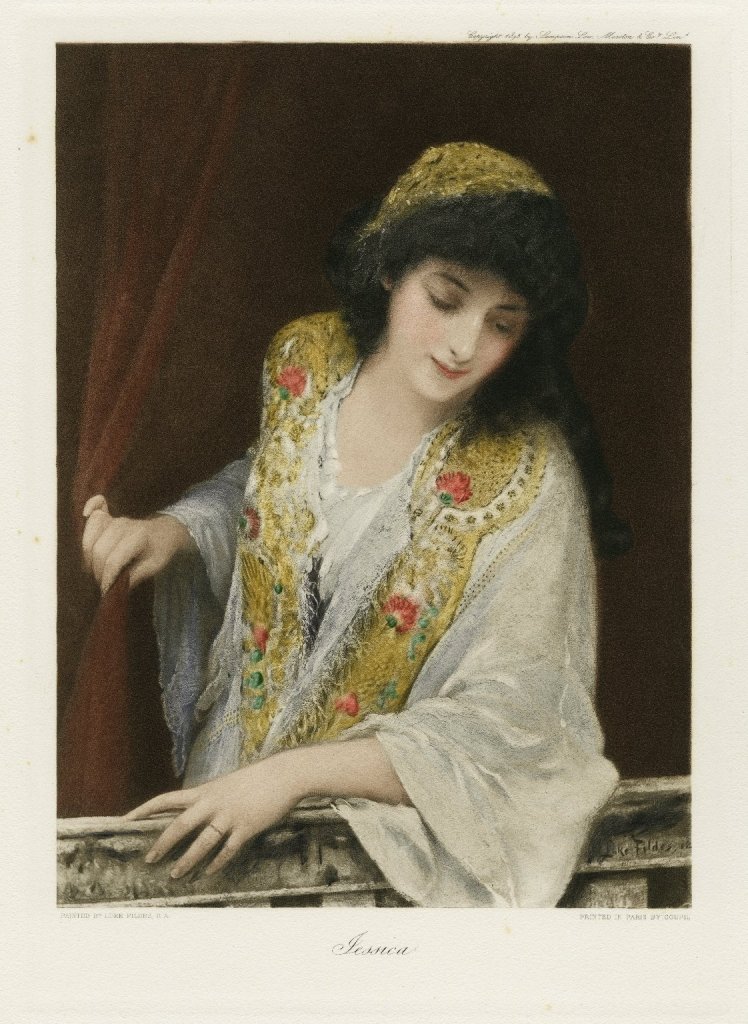
Jessica

Jessica- Though most productions have Shylock’s daughter dressing like the Christian women, there is a long history of distinctive clothing for Jewish women as well as men. Sadly, the only video I could find refers to 14th century clothes, I think this video is very informative and extremely thoughtful

4. Shylock

It’s worth noting that Shylock is not the central character in the story; the titular merchant is Antonio. Probably Shakespeare’s original audience saw him as a one dimensional villain for the audience to boo and hiss, then rejoice when he fails. He probably came onstage in 1596 wearing stereotypical red wig, a long gown, and a grotesquely oversized nose. The costume and performance gave the impression of someone foreign, alien, even demonic. This was one reason why some modern actors have balked at playing Shylock, as Patrick Stewart explains: https://youtu.be/7UOdMHW7J2Q

That said, Shakespeare clearly didn’t write him as one dimensional; he dominates the scenes he’s in and for centuries great actors have yearned to play Shylock over all the other characters. Slowly Shylock has become the focus of the play and the romantic comedy aspect has become less and less important in most modern productions. Like every great part, Shylock’s costume proclaims his social class, his background, and his relationship with other people.

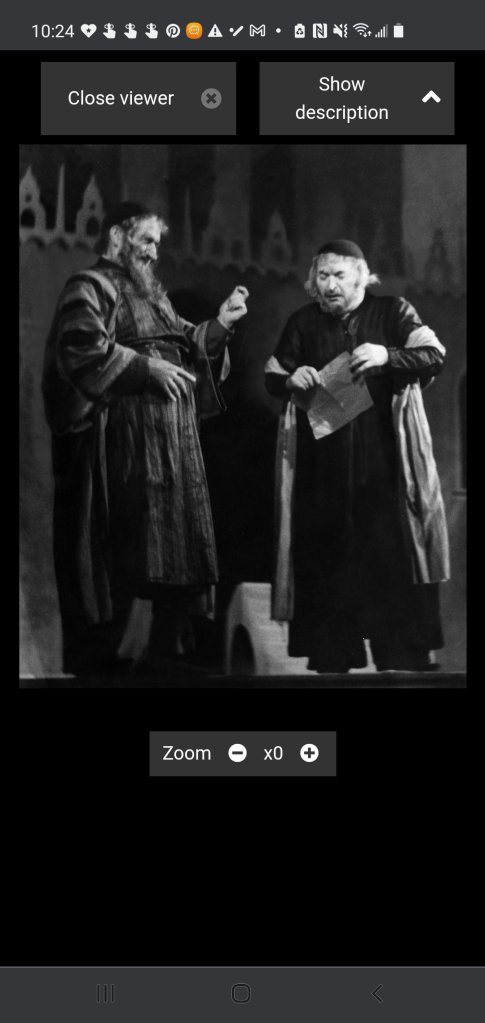
In the play, Shylock only refers to his clothes once, referring to the gown he wears as “My Jewish gaberdine.” A Gaberdine is a long cloak like the one in the painting above, but as you can see, Jews were not the only people wearing them.

Because of rampant antisemitism and fear of the growing influence of the Jewish community in the 16th century, the Senate and local magistrates segregated and kept constant watch on the Jews of Venice, and one way they did that was by forcing Jewish people to wear distinctive clothes.

According to the Online Jewish Museum:

Jews were forced to wear various markings on their clothing to identify themselves as Jews. In 1394 they had to wear a yellow badge, it was changed to a yellow hat in 1496 and to a red hat in 1500.

Charles Keen as Shylock

As Shylock grew in popularity with actors and audiences, actors played him with more nuance. Contrast the foreign looking gown in the previous picture, with Charles Keen in the 19th century.

That is not to say that all productions played Shylock as a fully formed human: in 1934, the Nazi Party sponsored a German production of Merchant with horror actor Werner Krauss, (famous for films like The Cabinet of Dr. Caligari) as Shylock. You’ll notice that the costume again emphasizes otherness, and exaggerates Jewish stereotypes.

Warner Krauss in the infamous 1934 production of Merchant sponsored by the Nazi party.

Patrick Stewart when he played Shylock in the 1970s, emphasized how Shylock is essentially an immigrant in his own country and played him with tattered clothes, a dirty bushy beard, and with an air of a stray dog. His clothes emphasise both his race’s oppression, while also telegraphing Shylock’s miserly attitude. Sir Patrick emphasized that his Shylock had lost so much in his life that he clings to Earthly wealth to feel in control of his life.

Patrick Stewart as Shylock
David Suchet as Shylock
David Suchet as Shylock, RSC.

By contrast, David Suchet. (famous for his portrayal of detective Hercule Poirot), chose a near polar opposite interpretation of Shylock at about the same time. The main difference between Suchet and Stewart could basically be summed up by this fact, Suchet is actually Jewish, Stewart is not.

Because Stewart was portraying a member of a community to which he didn’t belong, his portrayal downplayed Shylock’s Jewish identity since he didn’t want to make assumptions about what being Jewish is like. This is why Stewart gave his Shylock an over-refined accent and made sure his costume didn’t emphasize any stereotypical Jewish elements.

Since Suchet actually is Jewish, he did not shy away from portraying Shylock’s jewishness. His Shylock is proud of being Jewish but is well aware of how other people see him. He knows that he is othered by the other Venetians, and can use their fear and hatred of him as a weapon against them. Suchet also dressed his Shylock as well to do, but not gawdy to try and command respect from other people, but also carried around a walking stick to use as a weapon.

Ian McKellen
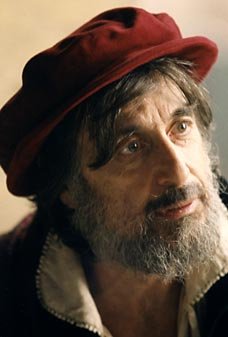
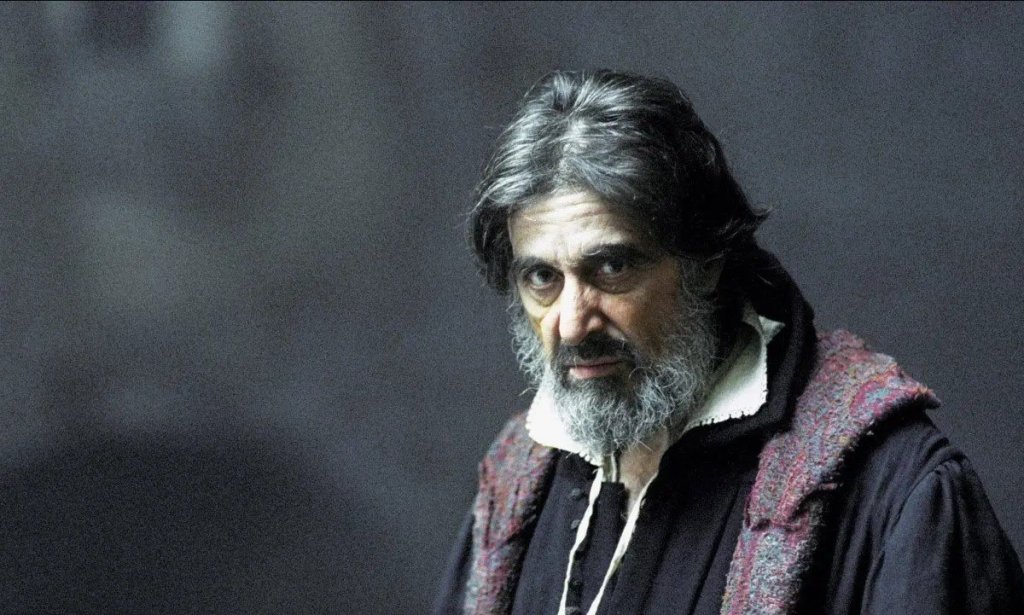
Al Pacino in the 2009 movie of Merchant, wearing the red hat that real Jews were required to wear in the 1590s.

6. Case study: the 2009 movie

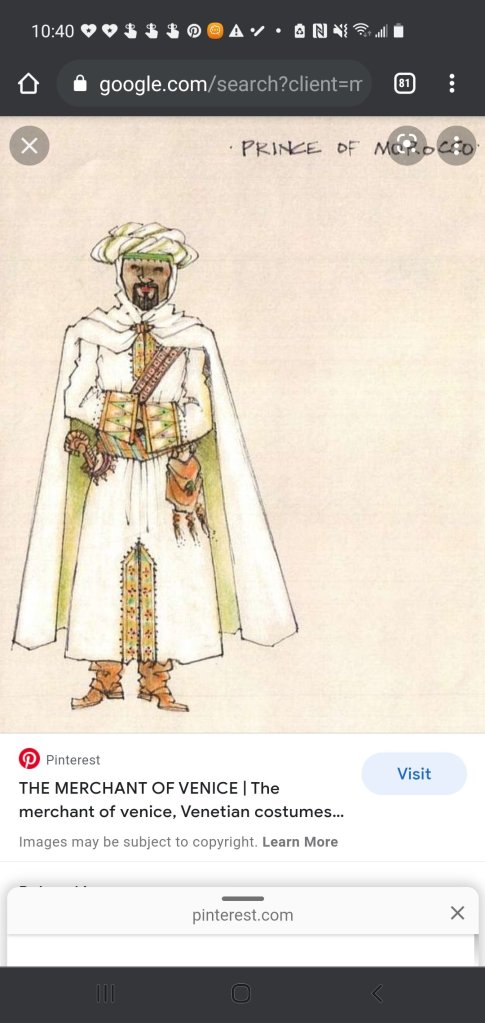
The Prince of Morrocco: In Act II, Scene 7, The Princes of Morrocco and Aaragon (A region of Spain), come to Portia’s home on the island of Belmont to try solve the riddle of the three caskets. In order to show the audience that these men are foreigners, their costumes have to be distinct from the Venetians. Take a look at this was accomplished in the 2004 movie:

The Prince of Morrocco (David Harewood) tries to guess the casket in the 2004 movie.

Mr. Harewood’s costume was inspired by the real Morroccon ambassador to Queen Elizabeth, Abd el-Ouahed ben Messaoud, who many scholars believe, might have also inspired Shakespeare to write Othello 6 years later.

Abd el-Ouahed ben Messaoud
Al Pacino dons the distinctive red cap that all Venetian Jews were required to wear in the 1590s.
Shylock after he converts to Christianity.

6. Works Cited

https://www.bl.uk/shakespeare/articles/a-jewish-reading-of-the-merchant-of-venice

Venetian Fashion in the 16th Century

https://en.wikipedia.org/wiki/1550%E2%80%931600_in_Western_European_fashion

1590-1599

Review: Gnomio and Juliet

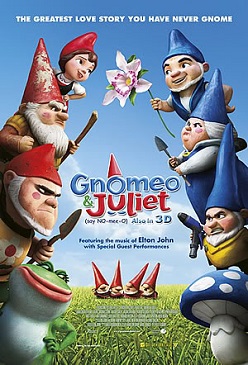
Gnomeo and Juliet

Theatrical poster for “Gnomio and Juliet,”

Like I said in the review for “Romeo and Juliet: Sealed With A Kiss,” adapting Shakespeare’s play for children seemed to me like an impossible undertaking, until I saw this film. This interpretation had all the romance and danger of Romeo and Juliet, with all the wry humor of Shrek. Before I present my thesis, I want to post a refutation of a review from a man I actually hold in very high esteem:

“You Wanted Me To Review Gnomio and Juliet, So I Did.” Kyle Kalgreen YouTube Video Essay.

I’ve watched all of Mr. Kalgreen’s reviews of Shakespeare on film, from Hamlet, to Ran, to Ralph Fiennes’ Coriolanus, and all but one of his reviews I genuinely loved. This is why I was so dissappointed when I saw this review. As his channel suggests, “Brows Held High” is mostly interested in high concept editions of Shakespeare and in a rare act of snobbery, Mr. Kalgren seems to turn his nose up at this movie, calling it essentially populist trash. He seems to say that the film misses the mark as a legitimate Shakespearean adaptation, and he’s not wrong. What he fails to notice though, is that is not the point of this movie. It’s purpose is not to be a faithful adaptation of Shakespeare, it’s a simplfied way of introducing children to Shakespeare.

This computer animated film is set in two adjoining houses in England, with two families of garden gnomes duking it out for supremacy. Though this seems like a ridiculous concept, it gives the film a great amount of charm, watching these two gnomes trot across the garden with their plaster feet, riding around on lawnmowers, and of course the fact that they are gnomes makes even Tybalt look cute.

Most importantly, unlike other ‘inanimate object comes to life’ movies, garden gnomes are able to be smashed. Unlike the nearly indestructable Woody or Lightning McQUeen- these characters can be smashed. It’s established in the first 10 minutes that both Gnomio and Juliet have parents that were smashed. This means that the audience is constantly worried for the safety of the characters, especially when they fight. This is a clever, kid-friendly shorthand that allows the audience to worry about the character’s mortality, without the gory realities of human death.

The characters are also handled with care and charm. Gnomeo is a cocky, self-assured gnome who first looks for adventure before finding love. Juliet is even more of a spitfire than her human counterpart, and is able to perform midnight catburgling into a nearby greenhouse. It’s their desire for fun and adventure that makes these two compatible, and makes their love easy for even a child to understand.

The film’s cleverness doesn’t stop there: the filmmakers inserted all kinds of Shakespearean jokes to make the play easier to understand and to entertain the audience. For example, the Capulet and Montegue households on “Verona Avenue” have the addresses 2B and another 2B crossed off, (punning on Hamlet’s most famous line). In addition, when we first meet Juliet, she argues with her father (voiced by Michael Caine) to let her off a small white platform that he forbids her from leaving. Because she’s a gnome, her father literally puts her on a pedestal, which beautifully illustrates the relationship between Juliet and Lord Capulet. In the play, this is hinted at, but not really explored, but in this version, it is front and center, and helps increase the drama.

Perhaps the most clever thing about Gnomeo and Juliet, is that the film makes you very aware that this is an homage, rather than a re-interpretation of the story. At the opening of the film, a tiny gnome with a ridiculously long hat says: “The story you’re about to see has been told before… A LOT.” This immediately reminds the audience that, although this film will give you the general idea of Shakespeare’s play, the real play is full of more violence and sex than a children’s movie will allow. At one point, Gnomeo even converses with an animated statue of Shakespeare himself, as a way of further conceding the homage, recognizing the difference between an adult-themed play, and a children’s movie, and hopefully, encouraging kids to see both versions.

What Does Shakespeare Say About Ireland 🇮🇪?

Happy St. Patrick’s Day! The Emerald Isle has long been a source of illumination for poet’s pens and Shakespeare was no exception. The Bard of Avon is indebted to Mother Ireland not only for the inspiration he took, but sadly for the pain he gave her back.

None of Shakespeare’s plays are set in Ireland, but he freely adapted elements from Irish folklore. English poet Edmund Spencer visited Ireland in the 1590s and adapted the folklore he picked up into his opera The Fairy Queen, which Shakespeare adapted into A Midsummer Night’s Dream

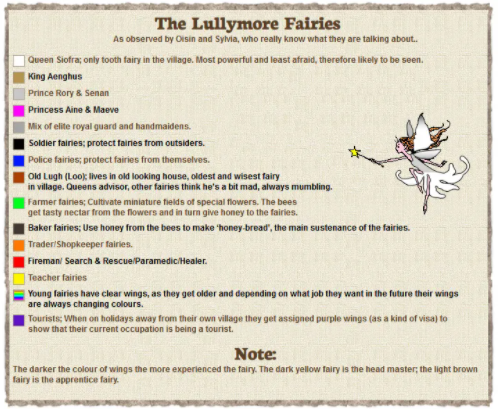
The Irish created and continue to tell many of the fairy legends and stories that we retell and adapt today. If you go to Lullymore park in Ireland, you can see a place that is essentially a “Fairy preserve.”

Types of fairies you can “spot” at the Lullymore Park in Ireland:

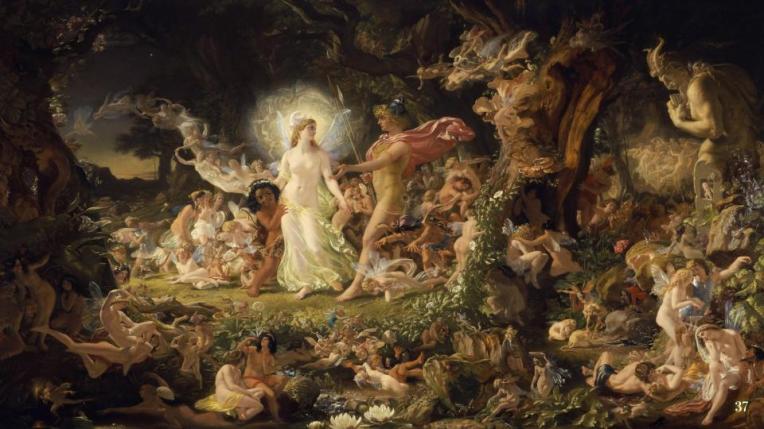
The old stories tell that Fairies are magical creatures who live in hollow places in the earth. Some are benevolent and help give rain and pleasant weather to the Earth, Like the king and Queen of the fairies, Oberon and Titania:

And the mazed world,
By their [the tides] increase, now knows not which is which:
And this same progeny of evils comes
From our debate, from our dissension;
We are their parents and original.
— Titania, (Queen of the Faries), A Midsummer Night’s Dream Act II, Scene i.
Titania in this speech shows great concern for nature, humanity, and the planet. She believes it is the responsibility of fairies, particularly herself and her husband Oberon, to control the elements and keep humans and fairies safe. Some fairies, however, are cruel and enjoy playing tricks on mortals, just like Puck in A Midsummer Night’s Dream, or Queen Mab in Romeo and Juliet.

.

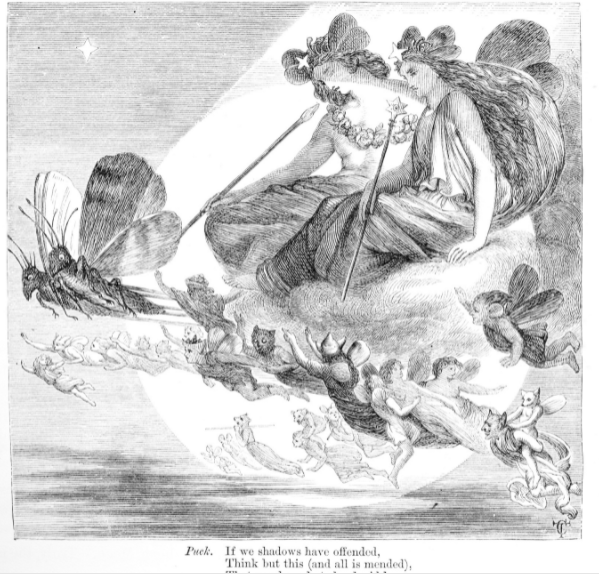
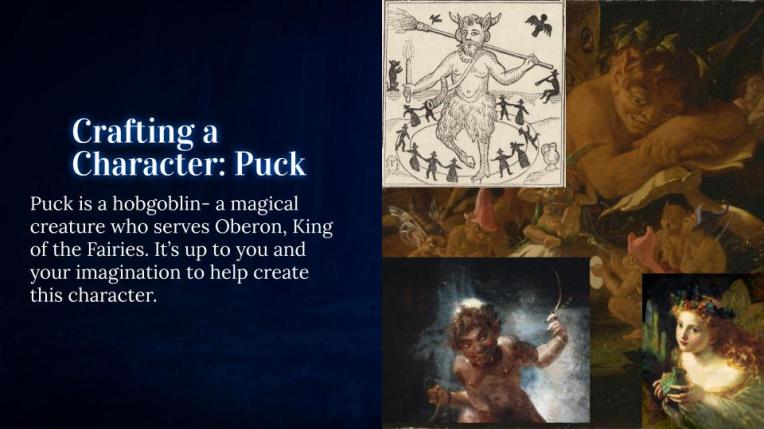
This is a short analysis I created of the tricks Puck plays on people in A Midsummer Night’s Dream, as part of my acting course on Ouschool.com. Note the different ways Puck is portrayed in photos as a satyr, a rotund elf, and sometimes as an almost- demon like figure.

Cringe-worthy Shakespeare: Shakespeare’s only Irish character, captain mcmorris in “Henry V”

When Shakespeare is racially insensitive towards people of color, the cringe-worthy writing is mercifully few and far between. With the exception of Aaron the Moor and Don Armada, there are only a few sporadic derogatory references to non-White Anglo-Saxon Protestants. Sadly though, Shakespeare might have permanently harmed the Irish through his character the Irish captain Macmorris in Henry the Fifth, his only Irish character.

According to The Irish Times, there is a longstanding stereotype that still exists in the British Isles that Irish people are violent, short-tempered, and essentially savages and Shakespeare might have invented this stereotype (or at least popularized it) when he wrote this scene from Henry the Fifth, Act III, Scene ii:

FLUELLEN
To the mines! tell you the duke, it is not so good
to come to the mines; for, look you, the mines is
not according to the disciplines of the war: the
concavities of it is not sufficient; for, look you,
the athversary, you may discuss unto the duke, look
you, is digt himself four yard under the
countermines: by Cheshu, I think a' will plough up
all, if there is not better directions.
GOWER
The Duke of Gloucester, to whom the order of the
siege is given, is altogether directed by an
Irishman, a very valiant gentleman, i' faith.
FLUELLEN
It is Captain Macmorris, is it not?
GOWER
I think it be.
FLUELLEN
By Cheshu, he is an ass, as in the world: I will
verify as much in his beard: be has no more
directions in the true disciplines of the wars, look
you, of the Roman disciplines, than is a puppy-dog.
Enter MACMORRIS and Captain JAMY
GOWER
Here a' comes; and the Scots captain, Captain Jamy, with him.
FLUELLEN
Captain Jamy is a marvellous falourous gentleman,
that is certain; and of great expedition and
knowledge in th' aunchient wars, upon my particular
knowledge of his directions: by Cheshu, he will
maintain his argument as well as any military man in
the world, in the disciplines of the pristine wars
of the Romans.
JAMY
I say gud-day, Captain Fluellen.
FLUELLEN
God-den to your worship, good Captain James.
GOWER
How now, Captain Macmorris! have you quit the
mines? have the pioneers given o'er?
MACMORRIS
By Chrish, la! tish ill done: the work ish give
over, the trompet sound the retreat. By my hand, I
swear, and my father's soul, the work ish ill done;
it ish give over: I would have blowed up the town, so
Chrish save me, la! in an hour: O, tish ill done,
tish ill done; by my hand, tish ill done!
FLUELLEN
Captain Macmorris, I beseech you now, will you
voutsafe me, look you, a few disputations with you,
as partly touching or concerning the disciplines of
the war, the Roman wars, in the way of argument,
look you, and friendly communication; partly to
satisfy my opinion, and partly for the satisfaction,
look you, of my mind, as touching the direction of
the military discipline; that is the point.
JAMY
It sall be vary gud, gud feith, gud captains bath:
and I sall quit you with gud leve, as I may pick
occasion; that sall I, marry.
MACMORRIS
It is no time to discourse, so Chrish save me: the
day is hot, and the weather, and the wars, and the
king, and the dukes: it is no time to discourse. The
town is beseeched, and the trumpet call us to the
breach; and we talk, and, be Chrish, do nothing:
'tis shame for us all: so God sa' me, 'tis shame to
stand still; it is shame, by my hand: and there is
throats to be cut, and works to be done; and there
ish nothing done, so Chrish sa' me, la!
JAMY
By the mess, ere theise eyes of mine take themselves
to slomber, ay'll de gud service, or ay'll lig i'
the grund for it; ay, or go to death; and ay'll pay
't as valourously as I may, that sall I suerly do,
that is the breff and the long. Marry, I wad full
fain hear some question 'tween you tway.
FLUELLEN
Captain Macmorris, I think, look you, under your
correction, there is not many of your nation--
MACMORRIS
Of my nation! What ish my nation? Ish a villain,
and a bastard, and a knave, and a rascal. What ish
my nation? Who talks of my nation?
FLUELLEN
Look you, if you take the matter otherwise than is
meant, Captain Macmorris, peradventure I shall think
you do not use me with that affability as in
discretion you ought to use me, look you: being as
good a man as yourself, both in the disciplines of
war, and in the derivation of my birth, and in
other particularities.
MACMORRIS
I do not know you so good a man as myself: so
Chrish save me, I will cut off your head.
GOWER
Gentlemen both, you will mistake each other.
JAMY
A! that's a foul fault.
A parley sounded
GOWER
The town sounds a parley.
FLUELLEN
Captain Macmorris, when there is more better
opportunity to be required, look you, I will be so
bold as to tell you I know the disciplines of war;
and there is an end.
Exeunt

Irish History and Shakespeare: The tempestous relationship between england and Ireland

The mayor and all his brethren in best sort,
Like to the senators of the antique Rome,
With the plebeians swarming at their heels,
Go forth and fetch their conquering Caesar in:
As, by a lower but loving likelihood,
Were now the general of our gracious empress,
As in good time he may, from Ireland coming,
Bringing rebellion broached on his sword,

Henry V, Act V Chorus

National Portrait Gallery painting of Robert Deveraux, 2nd Earl of Essex. Wikimedia Commons.
Robert Devereax, 2nd Earl of Essex (National Portrait Gallery)
Hugh, O’Neill, Earl of Tyronne

James Shapiro in his excellent book, A Year In The Life Of William Shakespeare, 1599, posits that contemporary affairs in Ireland might have inspired some of Shakespeare’s greatest plays in including Richard II, Henry V, and Julius Caesar. In 1594 the Earl of Tyrone began a rebellion in Ireland against the English, and in 1599, Queen Elizabeth dispatched the ambitious and chivalrous Earl of Essex to quell it. As you can see in the quote above, Shakespeare mentions Essex’s fight in his play of Henry V, which probably premiered at around the same time Essex was in Ireland.

The audience may have been watching Henry conquer France, but many would have been thinking about Elizabeth’s struggle to conquer Ireland.

BBC Radio 4 Extra – Shakespeare’s Restless World, Ireland: Failures in the Present – Transcript – Shakespeare’s Restless World – Programme 7

Though King Henry successfully conquered and united England and France, Essex failed spectacularly, and Elizabeth was deeply embarrassed by the whole scenario. She was also deeply alarmed by the popularity of Shakespeare’s tragedy Richard II, which shows onstage the deposing and killing of a king who had no children and failed to quell a rebellion in Ireland.

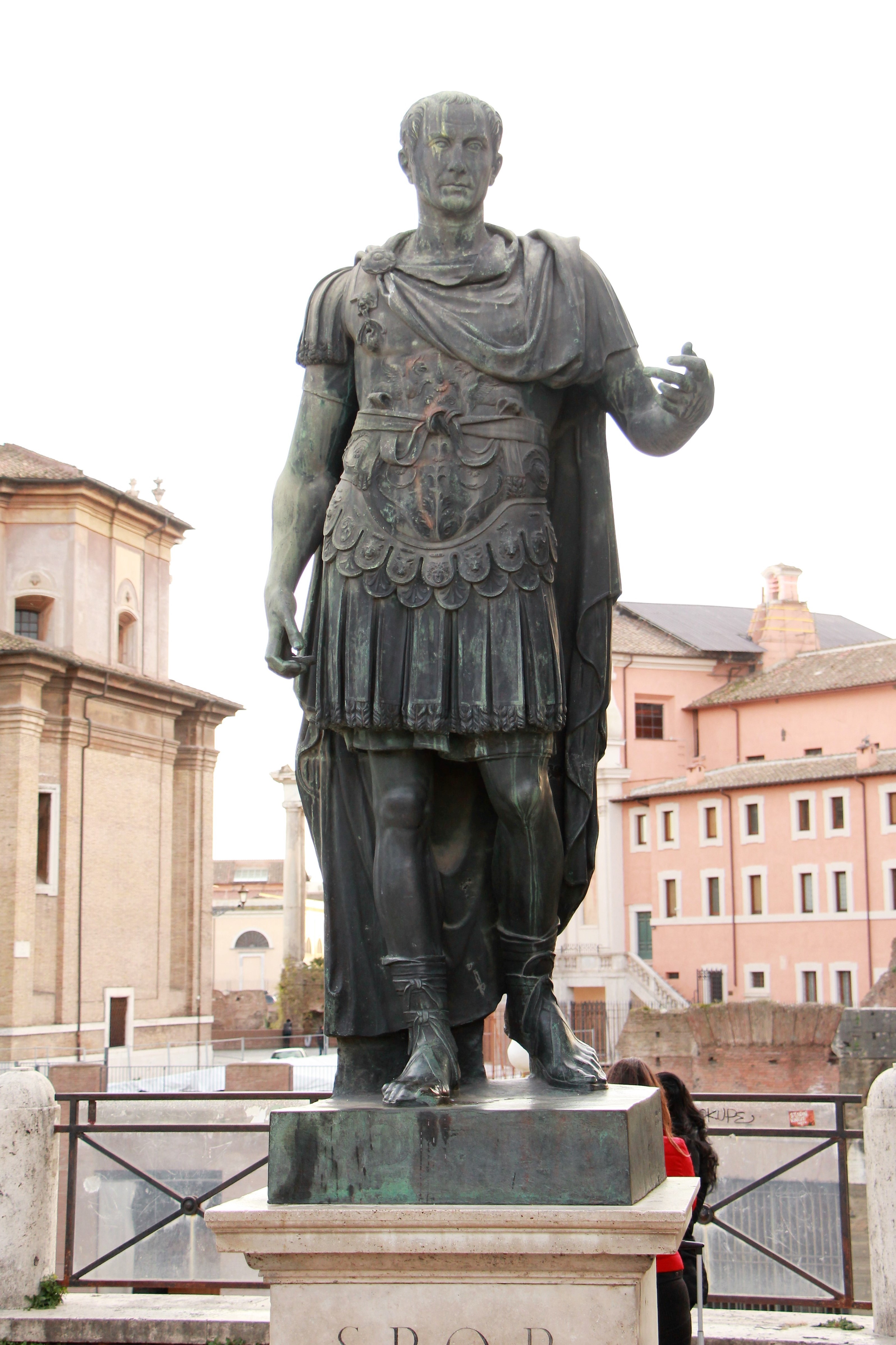
Elizabeth was worried about her subjects but she was also very worried about Essex overseas. Everyone, (including Shakespeare), remembered that 2,000 years ago, Julius Caesar went from him the Senate’s Consul General to dictator by amassing an army, then threatening to invade Rome under the pretense of helping to quell a foreign invasion. Caesar made his name by subjugating tribes in Gaul (modern-day France), and the Senate was worried that he would come home and use his army for a military coup. Look at the expressions on the faces of Cicero and Brutus when they see Caesar coming home in triumph in this scene from the HBO series Rome.

Elizabeth repeatedly attempted to curb Essex’s power while he was fighting in Ireland; she refused to give the Earl more troops for fear that he might be staging a potential coup. Her fears would later be proven right when in 1602, Essex attempted to head a rebellion and take the Crown for himself, but not before one of Essex’s friends commissioned Shakespeare’s company to portray the deposing and killing of King Richard II. Essex was trying to turn himself from a failed Henry V to a victorious Henry IV, and his queen into Richard II.

Left- deposition form the interrogation of Augustine Phillips, one of the actors in Shakespeare’s company about his company’s potential involvement with the Essex rebellion. Right- the hanging of Cinna the poet from Julius Caesar.

Shakespeare might have been inspired to write Julius Caesar after being an unwitting pawn in the political drama between Essex and the queen, and might have even created the character of Cinna the Poet as an analog for Shakespeare himself. In the play, Cinna the poet is mistaken for one of the conspirators by an angry mob and is murdered in the street. Perhaps Shakespeare created Cinna the Poet as a way of coping with the fear he must have had that people might mistake him for a radical, after his play Richard II briefly made him a walking target for those opposed to Essex’s rebellion. In any case, Julius Caesar eloquently documents the kind of anxiety of not knowing who could be trusted when it comes to politics, whether it be a populist warrior like Julius Caesar or Essex, or the Queen, privy council, or indeed Roman senate, and the whole thing started from a failed attempt to quell a rebellion in Ireland.

In summation, even though Shakespeare sets no plays in Ireland, Irish history and Irish culture are everywhere in his plays. England and Ireland are I are indeed separate islands but the cultural exchange between England and Ireland has inspired Shakespeare and many other great writers for centuries. After all Shakespeare’s most famous honorific, ‘the Bard of Avon’ comes from an ancient Irish tradition of semi-mystical poets, who in Irish folklore, were able to see the future and glimpse worlds that are unseen to ordinary mortals. What Shakespeare really felt about Ireland we don’t know but we do him but he does owe the Irish people a lot of thanks, and on this  Saint Patrick’s day, I honor their contribution to him and to him all the world

References:

Shapiro, James. A Year In the Life Of William Shakespeare, 1599. Chapter 6: Things Dying and Things Reborn.

https://www.bbc.co.uk/programmes/articles/3fLDRSY7r9rJhrVFWy99Mly/transcript-shakespeares-restless-world-programme-7

https://www.independent.ie/entertainment/theatre-arts/is-shakespeare-responsible-for-the-stage-irishman-34638347.html

https://www.irishtimes.com/culture/stage/what-ish-my-nation-shakespeare-s-irish-connections-1.2619173

Why Mean Girls Is Based On Julius Caesar

As you probably know if you subscribe to this blog, I love to review adaptations of Shakespeare, so imagine my delight when I realized that the classic teen comedy Mean Girls from 2004, (and the current Broadway show of the same name), is based on Julius Caesar! This movie doesn’t have Shakespearean dialogue or the names or locations, but the essence of the play is the same, albeit with a more modern ending.

https://www.broadway.com/videos/159888/backstage-at-mean-girls-with-erika-henningsen-episode-13-the-final-goodbye/#play

In Shakespeare’s play and Tina Fey’s script, the main antagonist is popular, and dangerous, and inspires fear and envy from everyone. Regina George and Caesar both rule their empires through their armies, intimidation, their wealth, and their supreme self-confidence. In addition, both names are associated with royalty- Regina in Latin means queen.

I didn’t realize that the movie has its roots in Julius Caesar until I saw this video from the YouTube channel The Take: https://youtu.be/FRfoEzZbK_Y. It was when I watched this video, that I realized Mean Girls character Janis was an analog for Shakespeare’s character Cassius, the man who sets the plot in motion to assassinate Caesar.

In the movie, Janis meets a well meaning girl and manipulates her into betraying Regina. Look at this clip where after Cady feels betrayed by Regina, Janis outlines her conspiracy, with a Roman sword in her hand! https://youtu.be/D0JMoa4QfA0

Like Cassius, Janis claims that once Regina is destroyed, the social order of the high school will change from a dictatorship to a democracy, but what she really wants is to supplant and replace Regina and make herself the new queen Bee. Even her name is a clue to her malevolent nature, she is named after the Roman god with two faces!

Sir Patrick Stewart as Cassius in the 1972 RSC production of Caesar

Similarly in Julius Caesar, Cassius convinces Brutus that once Caesar dies, Rome will be a republic again. In real life, Brutus was Caesar’s close friend, so Brutus agonizes over whether he is doing the right thing and whether he owes more loyalty to Rome, or his friend Caesar: https://youtu.be/IoDwXjKIenI

If Janis is Cassius, what about Brutus?

Cady Heron (played in the movie by Lindsay Lohan), is naive but intelligent. Like Brutus, she is manipulated and carefully chosen to betray the king. Janis chooses Cady because she’s pretty enough to get close to Regina, her looks are like social currency. Brutus’ social currency was his family: he was descended from the founder of the republic so he lent credibility to the conspiracy. He was also close in family to Caesar and Cassius.

In both stories once the monarch is destroyed, the power vacuum immediately starts to close; rather than change the social order, a new monarch arises. In Caesar, the second triumvirate takes over for the first, and Caesar’s nephew Augustus eventually becomes the supreme ruler of the Roman empire.

In Mean Girls, once Regina loses her social cache, Cady takes her place.

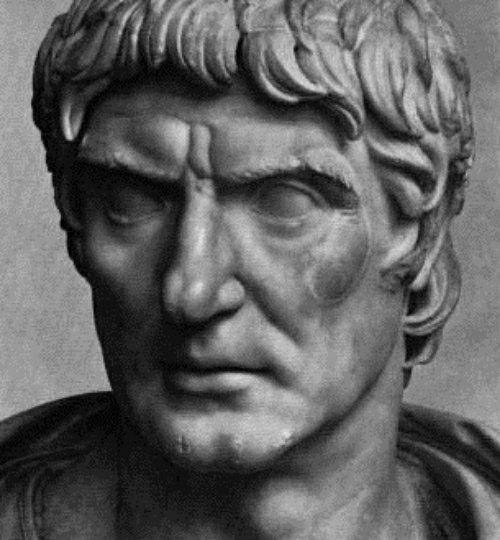
Then when Janis exposes Cady and Regina, she briefly basks in becoming a new Queen Bee- her revolution to overthrow a tyrant has paid off, bit now she is the tyrant herself. This actually mirrors the real Julius Caesar, who took power from the feared dictator Lucius Cornelius Sulla.

Bust of Sulla

Like Regina and her Burn Book, Sulla kept a list of people he saw as threats called the Proscriptions, only Sulla used it to execute the people on the list and seize their property. Caesar started his career as a populist soldier working for the Senate against Sulla and for the people, but became a dictator himself, the very thing he was sworn to oppose!

The movie does end on an encouraging note when the adults finally step up and address the terrible things that their students are doing, which has important lessons about bullying that every young person should see.

Tina Fey actually admitted that she herself was a Mean Girl in high school, so there’s a great deal of honesty when her character confronts the kids about the consequences of bullying each other.

Though the movie ends happily, the Cesarian parallels are not over; even though this high school has been democratized, the problems that created this Mean Girls autocracy remains. As you can see in the final minutes of the movie, a new crop of Plastics arrive just as the old group disbanded.https://youtu.be/LshX2God-wkIn four years when the regime changes again, will there be a new Caesar?

After rewatching clips from the movie, I realized that Tina Fey actually made a Caesar reference right there in the movie!

Mean Girls Clip- Gretchen quotes Cassius

In this clip, Gretchen is in English class, perfectly paraphrasing Cassius’ speech in Act I, Scene ii, even the part about Caesar being a colossus:

Cassius. Why, man, he doth bestride the narrow world

Like a Colossus, and we petty men

Walk under his huge legs and peep about

To find ourselves dishonourable graves.

Brutus and Caesar: what should be in that ‘Caesar’?

Why should that name be sounded more than yours?

Write them together, yours is as fair a name;

Sound them, it doth become the mouth as well;

Weigh them, it is as heavy; conjure with ’em,

Brutus will start a spirit as soon as Caesar.

Now, in the names of all the gods at once,

Upon what meat doth this our Caesar feed,

That he is grown so great? Age, thou art shamed!

Rome, thou hast lost the breed of noble bloods!

When went there by an age, since the great flood,

But it was famed with more than with one man?

When could they say till now, that talk’d of Rome,

That her wide walls encompass’d but one man?

Now is it Rome indeed and room enough,

When there is in it but one only man.

O, you and I have heard our fathers say,

There was a Brutus once that would have brook’d

The eternal devil to keep his state in Rome

As easily as a king. I.ii. 226-252.

Now I know Mean Girls is based more on a book and by Tina Fey’s own experiences than Shakespeare, but the point is that the next time you are bored and angry about having to read a play based on a guy who’s been dead for over 2,000 years, take a look at the lunch table next to you and you’ll see that things haven’t changed that much.

If you liked this post, please consider signing up for my online class, “The Violent Rhetoric Of Julius Caesar,”

The class breaks down some of the most famous speeches in Julius Caesar and gives you some tips and tricks on how to write persuasive speeches like Antony’s “Friends, Romans, Countrymen,” speech. Use these powers for good though, not to turn your school into a Mean Girls dictatorship! https://outschool.com/classes/84ee847d-19f3-45f8-9f25-81e688b8497d

There’s also a fully asynchronous version that you can do on your own time whenever you want:

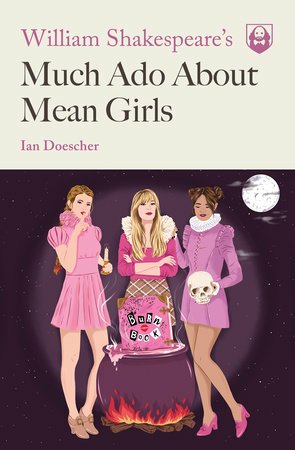
Finally, if you love Mean Girls and Shakespeare, check out Much Ado About Mean Girls by Ian Doescher, author of the William Shakespeare’s Star Wars trilogy.

How did Shakespeare Celebrate Halloween?

Let me begin by admitting that this post was harder to write than my Christmas post because pre Christian traditions are harder to pin down. In addition, to give you my standard disclaimer, I don’t believe it’s really possible to definitively know how or if Shakespeare celebrated Halloween, but since the history of Halloween is long and fascinating, and since Shakespeare’s plays influenced that history, I feel it’s worth exploring.

Part I: Origins of Halloween

Almost every culture on Earth has a middle fall celebration that calls to mind the bounty of the harvest, and the inevitable approach of winter. Most of our Halloween traditions are based on the ancient European festival of Samhuin.

What is Samhuin?

Over 2,000 years ago, the Celts inhabited much of the British Isles. They believed in many gods and spirits that controlled nature and the seasons. To thank the gods for the harvest the Celts gave them offerings like apples, and threw parties to celebrate the gods’ bounty.

When the Romans conquered the Celts, they co-opted some of their religious practices. For instance the tradition of giving apples as offerings to the Roman goddess Pomona. This tradition of course, evolved into our modern Halloween tradition of bobbing for apples. Honoring the harvest also went hand in hand with darker traditions; ones inspired by fear of death, decay, and evil spirits.

With the Sun dying and the Earth growing cold in late October, cultures like the Celts and the Romans feared that evil fairies and ghosts could cross over into our world. In particular the Celts believed that around the night of October 31st, the veil between the living and the dead was the thinnest.

Samhuinn was a liminal time between our world and the Otherworld. It’s a night when the souls of dead loved ones as well as spirits and fairies – the aos sí in Irish mythology and aes sídhe or sìth in Scottish mythology – could come through to visit. Deceased family members were honoured with seats at the evening feast, and offerings of milk and baked goods were left at the front door for the Fairies.

Source: https://theculturetrip.com/europe/united-kingdom/scotland/articles/edinburghs-samhuinn-fire-festival-and-the-origins-of-halloween/

At some point people decided to dress up as the spirits to ward them off, and this evolved into our modern day trick or treating.

These traditions did not die once England became Christian, (after it was conquered by the Romans), they simply translated into a different form. Halloween actually translates as “All Hallows Eve,” a Catholic celebration of of dressing up as pagan spirits and giving offerings of the harvest to honor Catholic saints as well as departed love ones.

Part II: What might Shakespeare have Done on Halloween?

Although Shakespeare never directly mentions Halloween, he lived in a world that kept many of these folk traditions alive. Shakespeare was the grandson of a farmer and his father was a devout Catholic, so he probably was brought up in these ancient Halloween traditions. He probably would have attended some kind of harvest festival to celebrate the bounty of the summer, and might have put food out for his departed family members.

Samhain is still heralded by the baking of kornigou, cakes baked in the shape of antlers to commemorate the god of winter shedding his ‘cuckold’ horns as he returns to his kingdom in the otherworld. On the Isle of Man in the Irish sea, the Manx celebrate Hop-tu-Naa, which is a celebration of the original New Year’s Eve and children dress as scary beings, carry turnips and go from home to home asking for sweets or money.

Source: https://theancientweb.com/2010/10/the-origins-of-halloween-part-1/

Call me a softie but I really like the idea of Shakespeare baking treats like soul cakes for neighborhood kids or telling scary stories about a bonfire. The kornigou is more commonly known as the Soul Cake, and it’s still popular today. It’s even been immortalized in song:

https://youtu.be/j35dvmdse9k

You can even make it yourself: www.cardamomdaysfood.com/recipe/soul-cakes/

Another tradition was dancing around ancient Celtic burial mounds. According to tradition, these mounds were home to spirits and Fairies, and could be portals to the land of the dead. In Irish folklore, poets and storytellers had the power to pass between these two realms. Maybe Shakespeare himself visited such a mound in his youth and was inspired to write about the fairy queen Titania and the hobgoblin Robin Goodfellow. Archeologists are still learning about these ancient ruins today (source: Smithson.com)

https://youtu.be/gnFv0D

Theater

The most tantalizing ancient Halloween tradition is mumming, a kind of amateur theater practiced by the ancient Celts. Like modern Sunday school plays the plays were a religious ritual designed goal to honor the gods and the harvest.

Mumming, a type of folk play, was used to tell traditional Samhuinn stories about battles or the winter goddess Cailleach (meaning “old hag”), who began winter by washing her hair in the whirlpool of Corryvreck.

For a modern example of this of these traditions you can look at the Edinburgh fire festival which preserves the kind of mumming that the Celts might have done on Samhuin and Shakespeare might have seen. It’s highly ritualistic, immersive, and the characters have spooky similarities to some of Shakespeare’s plays.

To give you an idea of how mumming might have influenced Shakespeare, watch this trailer for the 2017 Edinburgh Fire Festival:

https://youtu.be/z8NsvHontQA

What you can see in the trailer:

1. Keening- the wild women screaming as a way to lament, honor, and guide the dead. Characters like Constance in King John have many similar qualities.

2. The fight between the Summer King and the Winter Lord. Many Celtic stories dramatize the change of seasons from summer to winter as a battle. Even the duel between King Arthur and his young son Mordred could be seen in this context. In another interesting interpretation, Jennifer Lee Carroll in her book Haunt Me Still, interprets this mummers play as a pagan retelling of the story of Macbeth.

3. You can see brightly colored figures some designed to honor the changing of the seasons, and wild, animalistic people, presumably playing the roles of the Fairies, goblins, or other creatures that appear on Samhuin. It’s not much of a stretch to see these figures as the Fairies of Midsummer Night’s Dream, or the witches of Macbeth.

Part III: What did Shakespeare mention about Halloween?

Ghosts appear in five of Shakespeare’s plays. We see reference to all kinds of Fairies, goblins, and spirits and even a couple times people dressing up to ward off evil. In Titus Andronicus, the queen of the Goths disguises herself and her sons as spirits of revenge and go to Titus’ house to torment him, and then the old man Titus tricking them into coming to his house, where he takes his revenge.

One Shakespeare play that I think perfectly encapsulates the Halloween traditions of the English countryside is Merry Wives Of Windsor, specifically the scene in which Falstaff is tormented by a ghost story.

In the play, the fat, drunk knight Sir John Falstaff has been trying to seduce two married women, Mistress Page and Mistress Ford. Page devises a plan to scare and humiliate Falstaff, by dressing up her husband as the terrifying ghost of Herne the Hunter:

• 4.4 MISTRESS PAGE

• There is an old tale goes that Herne the hunter,

Sometime a keeper here in Windsor forest,

Doth all the winter-time, at still midnight,

Walk round about an oak, with great ragg’d horns;

And there he blasts the tree and takes the cattle

And makes milch-kine yield blood and shakes a chain

In a most hideous and dreadful manner:

You have heard of such a spirit, and well you know

The superstitious idle-headed eld

Received and did deliver to our age

This tale of Herne the hunter for a truth.

Herne the Hunter is a real medieval legend about a man who was hanged for poaching deer in Windsor park and now haunts the forest with horns on his head. Not only does Master Ford dress as Herne, The witty housewives dress the neighborhood children like Fairies and instruct them to pinch the fat knight and burn him with lit candles. Essentially this scene is a Shakespearean trick or treating moment with a ghost story to boot. Plus as Mistress Page mentioned, the ghost haunts Windsor towards the the oncoming of Winter, so it’s not entirely unlikely that it would be that this scene was originally played around the time of Halloween.

How did Shakespeare contribute?

Scholars describe Shakespeare’s mind like a magpie, taking myths, legends, history, and books to come up with his own plays. As you have seen, the ancient traditions of Halloween had a powerful effect on Shakespeare’s plays. But, did he contribute to those traditions himself? I would say yes in a big way. First of all the image of Hamlet holding a skull has inspired many other Halloween images:

David Tennant in Hamlet, RSC 2008

Jack Skellington in The Nightmare Before Christmas, 1993.

But I think Shakespeare’s greatest contribution to how we celebrate Halloween are centered within the witches of Macbeth.

Though Shakespeare by no means invented the concept of witchcraft, he did popularize the idea of the wicked witch, and helped form our modern view of what a witch is. The image he created in Macbeth

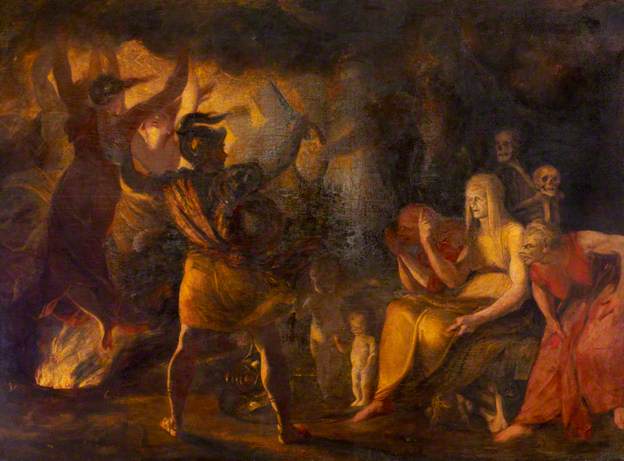
As you’ve seen, Shakespeare conjured the witches in Macbeth by infusing Celtic traditions like the wise woman with her chants and her cauldron, and infused her with the 17th century fear of witchcraft. Remember that Shakespeare’s patron King James was terrified of witchcraft and believed that he might be targeted by demonic forces. Shakespeare masterfully created some frightening witches that inspire Macbeth to do some terrible deeds, but adamantly deny that any harm will come to the English king, prophesying his bloodline will “Stretch out to the crack of doom.”

More than that, I would argue that the modern wicked witch would be all but silent without Shakespeare. When you think of what a witch might say, besides a series of high pitched cackling, what do you think of? Probably you think of this:

Or this:

Shakespeare’s bizarre and cryptic language helped inspire countless other interpretations of witches, and thus, a way for audiences to deal with the temptations that lurk in our hearts.

In conclusion, we don’t know how Shakespeare celebrated Halloween or even if he did to begin with; Halloween and Shakespeare’s life are both frought with mystery and legend, but one thing is dead certain; Halloween would not be the same without him. He absorbed the ancient rituals of the Celts and Romans and crafted some modern Halloween ideas and images that endure to this day.

Sources

https://www.historic-uk.com/CultureUK/Halloween/

https://www.bbc.co.uk/newsround/15169373

http://m.ncregister.com/daily-news/ghosts-and-the-catholic-church-pointing-to-the-permanence-of-the-soul


Thanks very much for reading! If you liked this post, please consider signing up for my new “Macbeth” online class via Outschool.com. One really fun part of the class will be an escape room where you use your knowledge of Macbeth to escape a cursed castle:

Teaching Titus through creepy cooking

Titus Andronicus is one of the most bloody, disgusting plays in Shakespeare. As this infographic from the Royal Shakespeare Company shows, there are tons of deaths and some of them are even the result of cannibalism!

One way to capture the macabre nature of this play in the classroom, (which some scholars see as a horror comedy), is to characterize it through cooking, after all, revenge is a dish best served cold.

Me in costume as Titus Androgynous, a crazy cooking show host who butchers two people in the same manner as Titus

So here are some ghoulish gourmet dishes and revolting recipes that you can share with your students to help them get into this tragic tale of violence, revenge, and cooking:

Idea 1: recipe cards

Design a recipe card like the ones in cooking magazines based on Titus speech where he murders Chiron and Demetrius

Idea 2: Create a menu that summarizes the play:

Act I:

Starter: Caesar Salad, toad in the hole

As the play begins, Caesar has died and Saturnine wants to devour his father’s empire. Enjoy this light salad in anticipation of far more bloody feasts to come.https://youtu.be/UxZ5NOkRwj0

Act II Scene 3: Breakfast:

Lamb Benedict

Lamb Benedict recipe I found on Reddit

While on an early morning hunting trip, Bassianus is slaughtered like a lamb by his own nephews. Enjoy this sweet treachery with a golden egg in the hole.

Act II, Scene 4: Main course:

Roast venison with all the trimmings

“As the deer that hath some unrecuring wound.”

“She was washed and cut and trimmed.”

Titus compares his daughter to a deer or welkin, and in the play’s most barbaric scene, the emperor’s sons ravish her and cut out her tongue. They enjoy the cruel rape and mutilation just like two starving lions enjoying their prey.

Act V:

Just desserts: people pot pie.

“More stern and bloody than the centaur’s feast,” A truly unforgettable dessert for this feast of carnage. The cook, Titus, reinvents the term rich food by cooking two emperor’s sons into pies.

Served cold, like revenge!

“Set him breast deep in Earth and famish him.”

Idea 3: Real Titus foods inspired by my favorite Halloween diy recipes

1. Lavinia’s tongue and hands

• horrific Halloween punch with ice cold hand cubes: https://youtu.be/XLYwcX7Ud-E

• Bloody lady fingers https://pin.it/xbnfxcs4bxbhsq

2. Titus hand: Hot dog fingers for Titus’ hand.

https://pin.it/ofn6cotybnvn4n

Or this grisly appetizer: cheese hand in prosciutto

3.

People Pies:

There are many horrific pie recipes on the internet, but for a busy teacher on a budget, I’m adapting this one from the YouTube channel Threadbanger: https://youtu.be/E6U6xUl3A5M. Don’t show this video to your students because there’s far too much cursing. That said this recipe is very cheap and it’s easy. He used only store bought items and no fancy cooking techniques, which means if you choose to bake it as a classroom activity, even your students can help make it. Here are some tips from the video to get the most horrible ppeople pie you can make:

• Use red filling like cherry or strawberry for filling.

• Use excess dough for a nose.

• Cut out little pieces of apple to make teeth

• Cut holes for the eyes and mouth

• The bloodier, the better!

Bone appetit!

Scavenger Hunt For Shakespeare’s Birthday!

https://gsch.se/game/99ef58a585e547cf9120f602970dfc20/share/

I designed this on an app called “GooseChase”, appropriate since Shakespeare invented the term!

If you click on the link, you can do a great scavenger hunt where you upload pictures or answer trivia questions for points, and of course they are all related to Shakespeare. If you have the app on your phone, search for Shakespeare Birthday Scavenger Hunt and enter the code: 2BON2B (Get it, to be or not to be)! You can also use the code NLEGVM. Let me know if you like it or if you cannot access the link.

Happy Hunting!