This is a 30 minute cartoon version of Macbeth originally produced for the BBC in 1992. It features Brian Cox as the voice of Macbeth (before he was the voice of McDonald’s), and Zoë Wanamaker as Lady Macbeth (before she was a witch who teaches at Hogwarts).
I like the way it portrays the horror imagery of the play in sort of a European-manga animation hybrid. Admittedly, there are better ones in the series, but this one is still pretty neat.
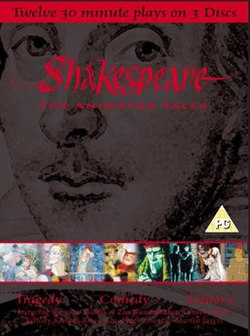
DVD box art for “Shakespeare the Animated Tales.”
To check out other episodes in the series, view this playlist:
In this 9 week course, students will discover Shakespeare’s greatest characters- Hamlet, Othello, Macbeth and others through games, dramatic readings, and interactive projects! -The class is designed to be ala carte- you can learn about all these plays, choose a specific play to focus on, or do the entire course. Each class will have a game of some kind, an engaging quiz, and a short explanation of the setting, characters, and motifs of one or more plays. Each class will also include a close reading of a famous speech.
Course Structure
Background on the Tragedies- the Wheel of Fortune
I will explain the basic structure of Elizabethan tragedies and the concept of Fortune, which is a motif Shakespeare uses in all of his tragedies. I will also debate the concept of “The Tragic Flaw:” the notion that otherwise good people are brought down by single character flaw. Finally, we will quickly summarize the premise behind all 11 of Shakespeare’s tragedies.
I will summarize Shakespeare’s two tragedies that are set in ancient Greece and provide commentary on their themes and ideas. I will also draw parallels between the Ancient Greek tragedies of Aeschylus and Euripides and Shakespeare, with a particular emphasis on the Greek philosopher Aristotle’s beliefs on the function of tragedy, which influenced every major drama for the last 2,000 years.
The Roman Plays- From Republic to Empire
We will take a bloody, backstabbing journey to ancient Rome, and discuss how Shakespeare shows through these four plays the dissolution of a republic into an empire. We will discuss the themes of democracy, dictatorship, mob rule, and savagery. Plays covered: Coriolanus, Julius Caesar, Antony and Cleopatra, and Titus Andronicus.
In addition to the character and his speeches, I’ll draw parallels to the history behind the play, including witchcraft in the Jacobean era, and the Gunpowder plot against the king!
“Othello”- The Lovers and the Devil
I will talk about how Shakespeare dramatizes race and prejudice in the context of Othello’s struggle with prejudice and his own jealousy.
“King Lear”- The Blind Fools and the Hermit
I will discuss the complex plot of Shakespeare’s tragedy about old age, blindness, betrayal, and families ripped apart by greed.
I will teach the students to think like a director and develop a concept for the characters, set, lights, etc. I’ll also briefly take you through famous productions of these great tragedies by the Royal Shakespeare Company and others.
Basics Of Stage Combat: Students will learn the basics of safely enacting a fight onstage, in preparation for a Shakespeare play. We will also learn about the history of sword fighting in the military and the duel.
Trailer for Basics of Stage Combat.
My daughter really enjoyed taking this class. She was actually able to use her sabre and try out her routine on her father. Paul is quite knowledgeable about Shakespeare and made the class really fun by teaching a fight scene from Romeo and Juliet. It is amazing watching her practice with Paul over Zoom. I hope Paul will have. more combat classes, it is a different way to learn Shakespeare.
IB, Parent
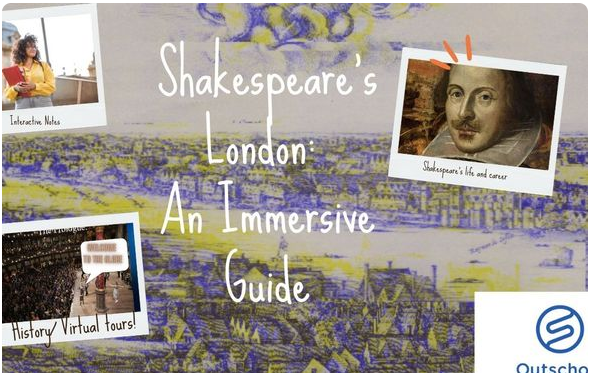
An Interactive Guide To Shakespeare’s London (New Class)
A virtual tour of Shakespeare’s London will get kids to interact with the culture of Elizabethan England.
Class Experience
To teach kids about the Elizabethan era and the background of Romeo and Juliet, The Instructor will interact with the class (via pre-recorded videos), pretending to be Shakespeare. The class, pretending to be actors in Romeo and Juliet, will get a virtual tour of The Globe Theater, Hampton Court Palace, and a virtual visit to an Elizabethan doctor's office. This activity is an immersive way for them to learn about the period, how it relates to the world of the play, and how Shakespeare changed theater.

The class will take the form of a guided WebQuest activity.  First, the students will get a worksheet that has a series of fill-in-the-blanks about Elizabethan society (below). The students will fill out this worksheet based on a Nearpod and in conjunction with a website I’ve made, https://sites.google.com/nebobcats.org/visit-to-elizabethan-london/home?authuser=0
Both the Nearpod and each webpage will have a virtual tour, a video, and text explaining some aspects of Elizabethan life. Before they go to each location, I will give a short introduction via prerecorded video:
Wizard Science
In this one-hour course, your child will discover the enchanting world of science through a series of magical experiments. Learn about such topics as Astronomy, Static Electricity, chemistry, and optical illusions.
In this one-hour course, students will learn and play games that will explore the history behind Christmas traditions. We will also discuss the themes, characters, and famous quotes from Shakespeare’s play “Twelfth Night.”
Since “Macbeth” is my Play of the Month, I’m offering a discount for my online class on the play. You can get $5 off my class “Macbeth: An Immersive Learning Experience” with coupon code HTHES6G3YH5 until Nov 4, 2022. Get started at https://outschool.com/classes/macbeth-an-immersive-learning-experience-xGKHeHgH and enter the coupon code at checkout.
To learn more about the class, watch the trailer above, and read my description of the escape room:
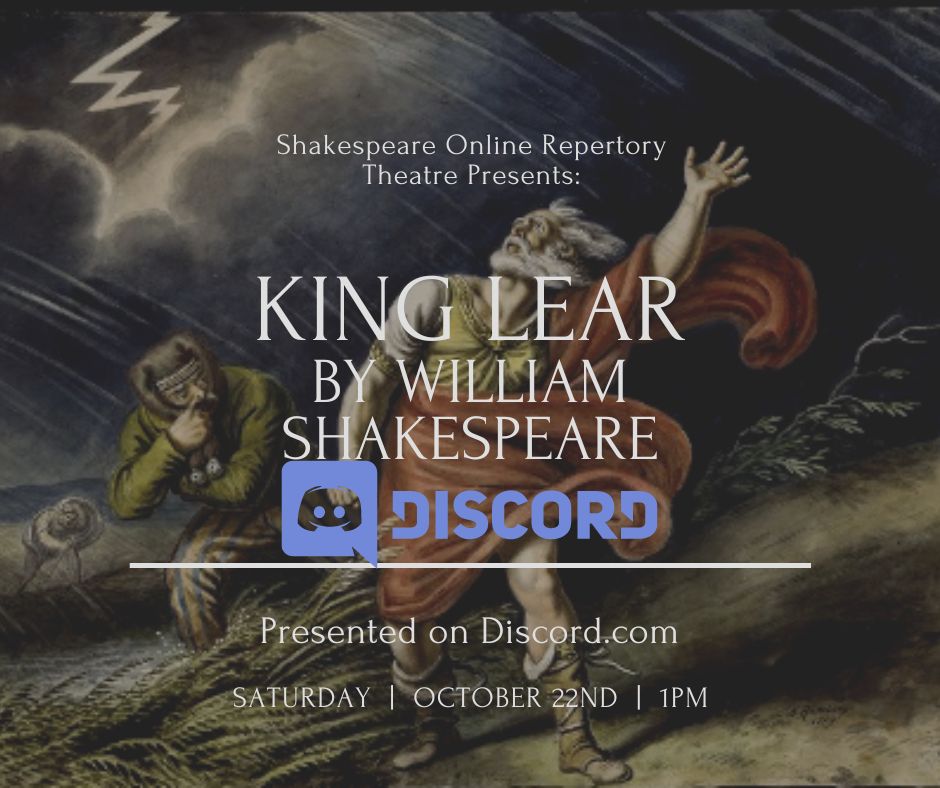
On October 22nd at 1PM EST, I’ll be joining the Shakespeare Online Repertory Theatre on Discord for an online dramatic reading of “The Tragedy of King Lear.” I’ll be playing The Earl Of Kent! Check it out on Discord.com! Below is also a link to a YouTube live stream of the show as well.
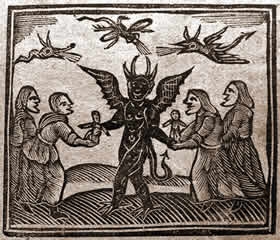
Woodcut from the witch trial of 1597, in which witches supposedly tried to drown King James I.
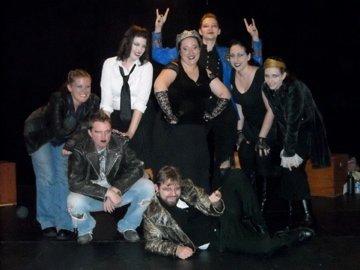
Me and the cast of “Macbeth,” 2009.
Guy Fawkes Day
Official logo of “Sleep No More”
For the spookiest and most cursed month of the year, I’ve chosen Shakespeare’s Macbeth as my play of the Month for October because it’s full of witches, ghosts, and other supernatural creatures. It also shows the terrible effects of fear on people’s minds. Plus, as I explained in my post on Shakespeare and Halloween, most Halloween witches would be all but silent without Macbeth’s witches.
I’m helping to direct a young actor playing Hamlet and we’re going over the “O That This Too Too Solid Flesh” speech. Going over the text, it occurred to me: what happened to Hamlet’s father?
Shakespeare makes it clear that Claudius poisoned Hamlet’s father with a vial of poison that he put in the king’s ear:
Sleeping within my orchard,
My custom always of the afternoon,
Upon my secure hour thy uncle stole,
With juice of cursed hebona in a vial,
And in the porches of my ears did pour
The leperous distilment; whose effect
Holds such an enmity with blood of man
That swift as quicksilver it courses through
The natural gates and alleys of the body. Hamlet, Act I, Scene v, lines 796-805.
The Ghost calls the poison “cursed hebannon,” which fis a poison that Shakespeare made up. Interestingly, Shakespeare’s original source for Hamlet makes no reference to poisoning, but that the king was stabbed in front of his own court. I think Shakespeare might have changed this simply because Queen Elizabeth was concerned about assassination herself, and Shakespeare didn’t want to make it look like he approved of assassination. Then again, maybe he changed it so that the murder didn’t seem like a repeat of Julius Caesar, (which Shakespeare’s company performed the year before Hamlet, (Source: New York Times, 1982).
The Ghost describes how, when the poison went through his ear canal, he experienced violent swelling, sores, and unimaginable pain. He actually compares himself to Lazarus, Jesus’ friend in the Bible who died of leprosy.
And with a sudden vigour it doth posset And curd, like eager droppings into milk, The thin and wholesome blood. So did it mine; And a most instant tetter bark’d about, Most lazar-like, with vile and loathsome crust All my smooth body. Hamlet, Act I, Scene v, lines 807-811.
Detail from “The Raising of Lazarus” by Rembrandt c. 1630
Sadly, Leprosy is still prevalent in third world countries so its symptoms are still very well understood: CONTENT WARNING: DISTURBING IMAGES IN THIS VIDEO
The poison is made up, but could such a poison actually exist? I found a wonderful article from the Journal of ENT (Ear, Nose, and Throat), where the author John Riddington Young posits the kinds of real-world poisons that might have this horrific effect on Hamlet’s father.
What actual poison was used? Shakespeare states, “the juice of cursed Hebenon” [6] but sadly, there is no such drug. Did he mean hemlock, or perhaps henbane? Laurence Olivier actually substitutes the name hemlock in his 1948 film. Belladonna, aconite and nicotine have all been suggested, but the most likely culprit is taxine from the yew tree. It is a deadly poison and its Old English name was heben. Shakespeare would certainly have known of it; he says in Richard II, archers bend ‘their bows of doubly fatal Eugh’ [7] (implying that apart from the arrows killing foes, there is an intrinsic toxicity in the wood).
I found a case study of a real case of Yew poisoning that emphasizes that it is incredibly fast-acting, “Fast as quicksilver”, that it can be misdiagnosed as another poison (like a snake bite, as Claudius later claims), and that it has no known antidote, the perfect way to kill a king:
. The taxine alkaloids (for example, taxine A, 2-deacetyltaxine A, isotaxine B, 1-deoxytaxine B) derived from p-dimethylaminohydroxycinnamic acid are the effective poisons of the yew [1]. In chemical terms, the compound is structurally related to veratrine, and the presence of an unsaturated lactone group makes this group of alkaloids similar to digitalis. Poisoning with the latter may be falsely diagnosed during a toxicological examination. Cardiac disturbances after intoxication by yew are ascribed mainly to the alkaloids paclitaxel and taxine B, affecting sodium/calcium permeability in cells [2]. The taxine alkaloid is absorbed through the digestive tract very rapidly, and the signs of poisoning manifest themselves after 30 to 90 minutes. An infusion made from 50 to 100g of needles is considered to be fatal [3–5], as no antidote is known.
So if you are playing Hamlet, in addition to the sadness and anger you feel after losing your father, you could also feel revulsion and pity at the painful, disgusting and cowardly way he was murdered. Truly, “MOST FOUL STRANGE AND MOST UNNATURAL.”



















 The Shakespearean Student