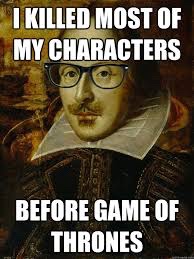
How Game Of Thrones is like a Shakespearean Play

I love Game Of Thrones! If you’ve ever read the books or seen the series on HBO, like me you might be amazed by the scale and complexity of the world author George RR Martin created. He wove together a rich tapestry of medieval history, legends, and yes, Shakespeare. He used some of Shakespeare’s plots, commented and expanded on his themes, and adapted some of his iconic characters into a very rich and in a way, very modern story. Today I’m going to examine the components of Martin’s narrative that he embroidered off of Shakespeare’s plots, themes, and characters. If you like my take on this, or if you disagree, please leave a comment below! If you have any suggestions for other popular works adapted from Shakespeare, let me know and I’ll review them on the blog!

Part I: Story

Shakespeare wrote four plays that chronicle a series of civil wars where powerful families battled each other for the crown of England. Like Game of Thrones, the conflict was mainly between the kingdoms in the North and South:
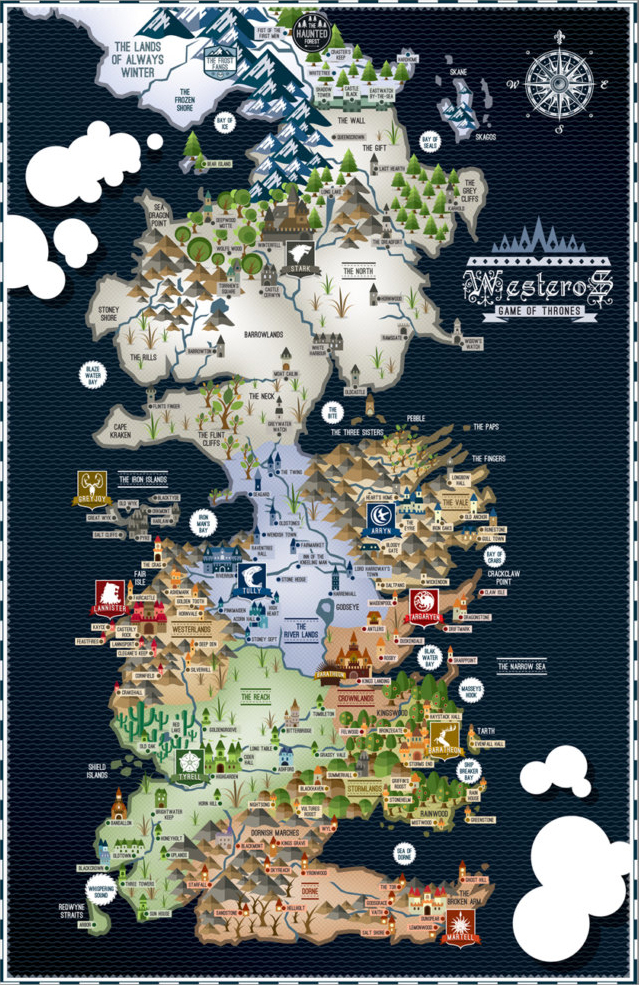
game-of-thrones-westeros-map-17x11-poster1

Shakespeare’s three parts of King Henry VI and Richard III chronicle the real struggle between the Yorkists in the north to take the crown from the Lancastrians in London in the South.
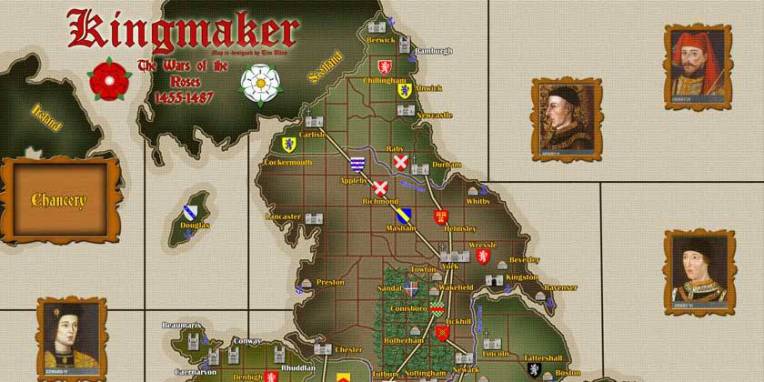
kmmap_final2-toponlyforfeaturedimageweb

Part II: Themes

Power corrupts, especially those who go seeking it.

The death of chivalry and honor in favor of political backstabbing.

King Henry VI has a speech where he watches a great battle while sitting on a molehill, watching the tide turn back and forth between his soldiers and the Yorkists. As with Game Of Thrones, the more blood each side has on its hands, the harder it becomes to decide whom to truly root for. In the end, it doesn’t seem to matter- kingdoms are won and lost as arbitrarily as a game. All it takes is time, and a good player to win.

The silence of the Gods. Shakespeare’s King Lear is constantly making oaths to his gods and asking them to punish his enemies. Likewise, Lear’s friend the Duke Of Gloucester, places his faith in the gods to protect Lear and punish the usurpers Goneril and Regan. Nevertheless, the action of King Lear doesn’t show any kind of divine judgement- Lear is exiled, goes mad, is sent to prison, and finally dies. Gloucester loses his sight, his lands, and dies randomly right after he is re-united with his son Edgar. In both King Lear and Game Of Thrones, there is a persistent question as to the nature of the gods, or even the surety of their existence.

King Lear mourns Cordelia’s death by

James Barry, c. 1786.

No where is this more apparent than at the end of the play King Lear, when, just as it seems that the Duke of Albany is about to reward the good people and punish the wicked, King Lear arrives howling, with the dead Cordelia in his arms. “Is this the promised end?” in horror at the gods’ apparent cruelty. https://youtu.be/7acLWsal1FU

In Game Of Thrones, the good characters pray to their old gods and new, but never seem to hear from them or sense their influence. Osha, the Wildling even suggests that the gods have no power in King’s Landing, where the special God’s Wood trees have been cut down.

Part III: Characters

Below is a list of my favorite GOT characters, with my interpretation of their Shakespearean roots.

Direwolf Logo

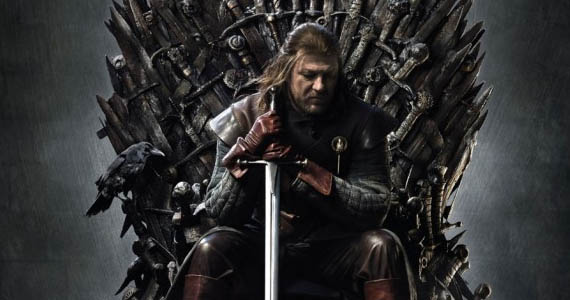
Ned Stark- Humphrey Duke of Gloucester from Henry VI, Part II

Duke Humphrey is a Yorkist from the north of England, just as Ned is Lord of Winterfell, a powerful kingdom in the north of Westeros. King Robert makes Ned Protector Of the Realm when he dies, which makes him king in all but name, and tasked with taking care of Robert’s young son Joffrey until he comes of age.
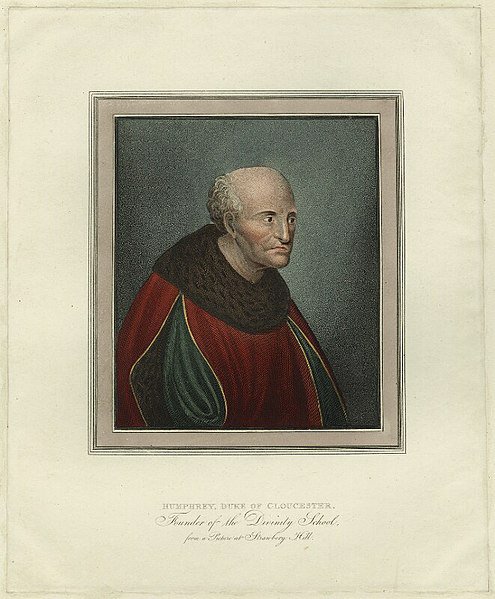
Portrait of the historical Humphrey, Duke of Gloucester from the National Portrait Gallery, artist unknown.

In Shakespeare’s Henry VI trilogy, King Henry the Fifth makes his brother Humphrey Lord Protector before he dies, to take care of England until his infant son Henry VI comes of age to rule. Like Ned, Humphrey is loyal, blunt, and only interested in keeping the realm at peace. In both Westminster and the Red Keep, all the lords are conniving and ambitious, and only interested in advancing themselves politically. These two lord protectors are the only ones with the good of the kingdom in mind.

Both Ned and Humphrey are betrayed and executed by those ambitious lords around them for the same reason; they stand in the way of the lords in their quest for power. In Henry VI, Part II, Henry’s ambitious queen Margaret starts a smear campaign against Humphrey’s wife, then pressures the King to force Gloucester to resign. As if that weren’t enough, Margaret also secretly conspires to murder the noble duke. Similarly, In Game of Thrones (Spoiler Alert), queen Circe puts her son on the throne and proclaims Ned a traitor. In both cases though, once the Lord Protector dies, the whole kingdom erupts in fights and arguments for the crown on all sides.
game-of-thrones

Ned Stark also resembles the heroes of Shakespeare’s Roman plays. He is cold and stoic as Brutus, and a devoted soldier like Titus Andronicus. Ned’s dire wolf is another connection with Shakespeare’s Roman plays; the wolf 🐺 is the symbol of the Roman Empire; packs of cold hunters who depend on each other for the survival of the family.

a213aaaff54aa5c4b2301ae21c4dc0ce

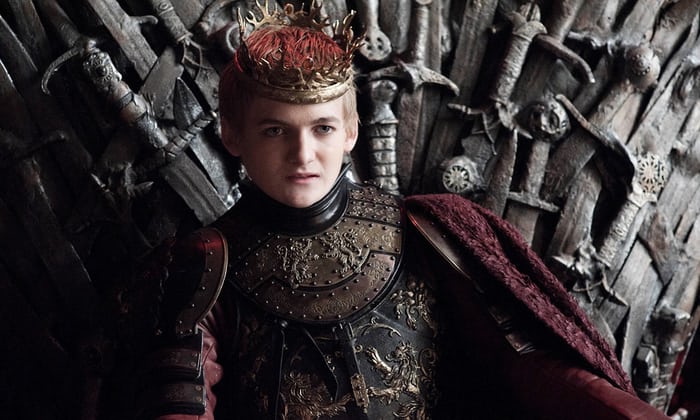
King Joffrey- Saturnine from Titus Andronicus– Joffrey is like the worst kind of tyrant- rash, proud, violent, and cruel. He lacks the maturity to make wise decisions and because of his privileged upbringing, he takes even the tiniest slight against him as an act of treason, and leaves a trail of heads in his wake. Worse still, he is easily manipulated by his mother Circe, who teaches him to act and feel superior to everyone else, and never care for the good of anyone but himself. In that way, he is very much like a Roman Emperor like Nero or Caligula, the real people whom Shakespeare adapted into the character of Emperor Saturnine in his play Titus Andronicus.
Joffrey

When we first meet Saturnine, he leads an angry mob into the streets of Rome, demanding to be made emperor, and threatening all out war if he doesn’t get his way. He also turns on the loyal soldier Titus, (who helped him win a war and win his crown), just because Titus wouldn’t give Saturnine his daughter in marriage. In the clip below from the 1999 movie Titus, Emperor Saturnine (Alan Cummings) is furious just because Titus wrote some mean scrolls about him, after Saturnine killed two of Titus’ sons, and banished a third.

Baratheon Stag

King Robert Baratheon- Edward IV from Richard III.

robert-edward_trans_NvBQzQNjv4Bqeo_i_u9APj8RuoebjoAHt0k9u7HhRJvuo-ZLenGRumA

◦ In the first book of the Game of Thrones series, Robert is the King of the Seven Kingdoms, having won a civil war to take it away from the Mad King Araes Targaryen. Edward in the play Richard III has just won the crown of England after a civil war against the mad King Henry VI. Both men were powerful warriors and used to be strong and handsome. People loved and feared him, but now the pressures of keeping the throne has literally consumed them.

Robert_slays_Rhaegar

P. 53

Next had come King Robert himself, with Lady Stark on his arm. The King was a great disappointment to Jon. His father had talked of him often: the peerless Robert Baratheon, demon of the Trident, the fiercest warrior of the realm, a giant among princes. Jon only saw a fat man, red-faced under his beard, sweating through his silks.

Jon had noticed that too. A bastard had to learn o notice things, to read the truth that people hid behind their eyes. Two seats away, the king had been drinking heavily all night. His broad face was flushed behind his black beard.

In this passage from Thomas More’s History Of Richard III, (Shakespeare’s primary source for the play), More chronicles how Edward went from a handsome young king, loved and feared by all, into a gluttonous, lecherous, sick old man, who was consumed by care.

He was a goodly personage, and very princely to behold: of heart, courageous; politic in counsel; in adversity nothing abashed; in prosperity, rather joyful than proud; in peace, just and merciful; in war, sharp and fierce; in the field, bold and hardy, and nevertheless, no further than wisdom would, adventurous. Whose wars whosoever would well consider, he shall no less commend his wisdom when he withdrew than his manhood when he vanquished. He was of visage lovely, of body mighty, strong, and clean made; however, in his latter days with over-liberal diet [1], he became somewhat corpulent and burly, and nonetheless not uncomely; he was of youth greatly given to fleshly wantonness, from which health of body in great prosperity and fortune, without a special grace, hardly refrains. This fault not greatly grieved the people, for one man’s pleasure could not stretch and extend to the displeasure of very many, and the fault was without violence, and besides that, in his latter days, it lessened and well left.

-Thomas More, History Of Richard III, c. 1513

There are also similarities in how the characters died. King Robert was killed by a wild boar, while King Edward was killed by his brother Richard, whose sign was a white boar. As a bonus, the stag that is the sigil of House Baratheon, is also the seal of King Richard II, the king who, in the Shakespearean tragedy that bears his name, started the civil war when he was murdered in the Tower Of London. Below is a picture of the famous Wilton Diptych, (Richard the Second’s private alter piece), which depicts the king and all the angels in heaven wearing a badge with a white stag on it.

wilton diptych

I’m not actually the first person to mention this connection between Robert Baratheon and Edward IV. In the British newspaper, The Guardian, the author compares several characters from Game Of Thrones, to historical English events: https://www.telegraph.co.uk/tv/0/game-of-thrones-vs-history-which-real-characters-and-events-insp/robert-baratheon-and-edward-iv/

littlefinger

Little Finger -Lucio from Measure For Measure, Iachimo from Cymbeline, Bawd from Pericles, etc. Shakespeare has a host of character like this lord of Westeros, the Master of Coin. He is cowardly and cynical, but he is also very clever and understands people’s weaknesses, especially sex. Like Bawd from Pericles, Little Finger has grown rich off brothels, and like many real life governments, he turns his prostitutes into spies. This gives him not only cash, but dirt on every lord in the 7 kingdoms. He only worries about Ned Stark, (who can’t be bought), and Vares the eunuch, who can’t be seduced. Little Finger is basically an oily politician and exploits the power of lust in the men of King’s Landing.

Direwolf Logo

Jon Snow– Edgar and Edmund in King Lear Philip the Bastard in King John.

◦ Snow is the illegitimate son of Ned Stark. He’s aware of what he is, so he joins thieves and rapers as a knight of the Night Watch to make a life for himself, just as Edgar becomes a mad beggar in King Lear once he is accused of attempted murder. He has few illusions and like all the base-born children in Shakespeare:

775

He was who he was, Jon Snow, bastard oath breaker motherless, friendless, and damned. For the rest of his life, however long that might be- he would be condemned to be an outsider, the silent man standing in the shadows who dares not speak his true name.”

◦ Shakespeare wrote several characters born out of wedlock such as Phillip Falconbridge in King John, and Edmund from King Lear.

Unlike Jon Snow, Edmund in King Lear uses deceitful and cruel cunning in order to advance his position in life. Snow doesn’t try to change the rules, but both of them know that no one is going to give them anything. Early in book one, Jon learns to accept the cruelty of the world, and to accept what he is:

Let me give you some council, bastard, never forget what you are, for surely the world will not. Make it your strength. Then it can never be your weakness. Armor yourself in it, and it will never be used to hurt you.

Song Of Ice And Fire, p. 57.

🦁 Tyrian Lannister –

Obviously he shares some parallels with Richard III, with his small size and the fact that he is the most hated member of a powerful family. In fact, Peter Dinklage who plays Tyrion played Richard the Third back in 2004.

12RICH.184

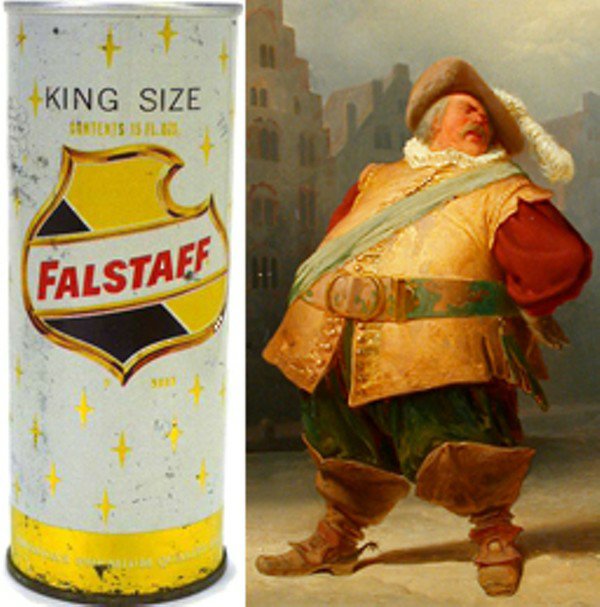
In terms of his personality however, Tyrion has neither the cruelty, nor the bitterness of Richard. For this reason, I would argue that Tyrion more closely resembles Sir John Falstaff.

Tyrion

◦ Like Falstaff, Tyrion laughs at his physical form as a way of disarming his enemies.

◦ Both Characters are famous for talking their way out of anything.

◦ Both characters are down on their luck for most of the books

Both characters are, ahem, fond of drink. Falstaff even has a beer named after him:

◦ Most Of all, Tyrion and Falstaff are survivors – they will do anything to stay alive, good or bad. They are also unapologetic about acting cowardly and deceitfully to avoid death. In Falstaff’s famous ‘Catechism speech,’ he mocks the concept of honor and how it frequently gets men killed.

FALSTAFF

‘Tis not due yet; I would be loath to pay him before
his day. What need I be so forward with him that
calls not on me? Well, ’tis no matter; honour pricks
me on. Yea, but how if honour prick me off when I
come on? how then? Can honour set to a leg? no: or
an arm? no: or take away the grief of a wound? no.
Honour hath no skill in surgery, then? no. What is
honour? a word. What is in that word honour? what
is that honour? air. A trim reckoning! Who hath it?
he that died o’ Wednesday. Doth he feel it? no.
Doth he hear it? no. ‘Tis insensible, then. Yea,
to the dead. But will it not live with the living?
no. Why? detraction will not suffer it. Therefore
I’ll none of it. Honour is a mere scutcheon: and so
ends my catechism.

Now observe this passage where Tyrion reacts to the death of a noble knight who was foolish enough to wear armor while crossing a river on a raft.

“Good my lord,” the messenger said. “Lord Brax was clad in plate-and-mail when his raft overturned. He was so gallant.” “He was a fool,” Tyrion thought, willing his cup and staring down into the wind depths. Crossing a river at night on a crude raft, wearing armor, with an enemy waiting on the other side–if that was gallantry, he would take cowardice every time. Song of Ice and Fire, 765.

My favorite part of the books is the way Martin writes the female characters. All the female characters are dealing with the fact that women have very little power or say in their society and they all use Shakespearean means or methods to get what they want.

🦁 Circe- Tamara and Lady Macbeth

img_7829

Circe

Just as her son Joffrey has the arrogance and sadistic cruelty of a Roman emperor, Circe is a mirror image of the cruel empress Tamara, Queen Of Goths in Titus Andronicus. Both women are attracted to power and motivated by revenge. Tamara wants revenge against General Titus, who executed her son in the war. After seducing and marrying the emperor, she uses her influence to execute two of Titus’ sons. She then uses her lover Aaron the Moor (with Whom she secretly has a child), to concoct a plot to rape and mutilate Titus’ daughter. And if that weren’t enough, she tries to drive him mad by appearing at his home dressed as the Roman goddess Revenge. In short, Tamara is a classic femme fatale, who raises above the social oppression of her sex by seducing powerful men, and stabbing them in the back.

Circe is also a femme fatale, though Martin gives her more time to explain her motivations than Shakespeare gives Tamara. Like the Queen Of Goths, Circe marries King Robert Baratheon, while secretly having a taboo affair, this time with her brother Jamie. The difference is that Circe kills not strictly for vengeance, but mainly to conceal the fact that her son Joffrey is actually the product of her incest in order to protect him and eventually make him king. This is why Circe kills Ned Stark, Jon Aron, and consents to the murder of all or Robert Baratheon’s true born sons.

Circe does desire revenge, but not against anyone in particular. Instead, she wants to repay the patriarchy that keeps her down simply because she is a woman. Quote about Circe when she talks about how jealous she is of Jamie. In that chapter we get a great sense of who Circe really is. Because she’s a twin, she compares herself to her brother, observing how Jamie was given on her glory and respect when he became a knight and a member of the King’s Guard, while she was sold off to king Robert at the age of twelve like a slave or a common whore. Why, Circe asks, if she looks so much like him and acts so much like him, is she treated so differently just because she’s a woman? In a perverse sort of way, her incest might be a misguided attempt to claim part of Jamie’s honor and power through sexual conquest. Both Tamara and Circe show how an oppressive patriarchy can plant truly destructive thorns in the hearts of women, and these two queens reap that bitter harvest by cutting down the men in power one by one.

like camera Circe is driven by her love for her children and her desire and her pride and desire for vengeance. She spends the first half of the place seducing the emperor to gain his favor and then when she is made empress she uses her power to systematically destroy Titus and his family. Similarly, Circe marries king Robert and then when he dies she makes her son she then kills Ned Stark guy in prisons his daughter tries to kill the second of and

Catelyn-

7c6044dd-c49c-4ce8-9188-74d3c4910a9d-2938-00000196573b9688

Hermione From The Winters Tale ❄️ 🐺

◦ Pious

◦ Kindness and mercy are her weapons as well as her will and devotion to her friends and family. Even Tyrion is impressed by her integrity.

🐺 Aria- Imogen from Cymbeline

◦ If it’s a mans world, pretend you are one! She learns to use a sword ⚔️ and uses her small size and gender to sneak away from her enemies.

🐉 Daenerys Targaryen- Cleopatra!

◦ Crafty and beautiful

◦ Uses her sexuality to gain a powerful man’s protection

◦ Her dragons 🐉 make her a goddess, elevating her beyond a woman and even a queen. In a society that opposed and ignored women, female monarchs needed to practically deify themselves in order to get the same respect as their male counterparts.

Just as the real Cleopatra claimed to be a descendant of the goddess Isis and Elizabeth I was part of the cult of the virgin queen, The Mother Of Dragons has a mythic power that commands fear and adoration.

Spoiler Alert

In the final chapter of book one, Daenerys tries to simultaneously say goodbye to her warrior husband Khal Drogo, and to get her few remaining soldiers to swear loyalty to her. She dresses him, she braids his hair, she puts him atop a pyre, and waits for a star to pass overhead to give his funeral a cosmic significance:

“This is a wedding too.”

The pyre shifted and the logs exploded as the fire touched their secret hearts. She could hear the screams of frighten horses and the voices of the Dothraki. “No,” she wanted to shout to him, “No my good knight, do not fear for me. The fire is mine. I am Daenerys Stormborn, daughter of dragons, bride of Dragons, Mother Of Dragons.”

This mirrors how, once Cleopatra loses Antony and knows that the Romans are coming to capture her, she says goodbye to Antony, and asserts herself as queen.

CLEOPATRA

Give me my robe, put on my crown; I have
Immortal longings in me: now no more
The juice of Egypt’s grape shall moist this lip:
Yare, yare, good Iras; quick. Methinks I hear
Antony call; I see him rouse himself
To praise my noble act; I hear him mock
The luck of Caesar, which the gods give men
To excuse their after wrath: husband, I come:
Now to that name my courage prove my title!
I am fire and air; my other elements
I give to baser life.

Have I the aspic in my lips? Dost fall?
If thou and nature can so gently part,
The stroke of death is as a lover’s pinch,
Which hurts, and is desired. Dost thou lie still?
If thus thou vanishest, thou tell’st the world
It is not worth leave-taking. Antony and Cleopatra, Act V, Scene ii.

Dany does the same thing. She lights the pyre to help her husband ascend to the heavens, taking his place among the stars. Then, she sits on top of the pyre along with her three dragon eggs. Miraculously, she survives the fire and the dragons hatch, thus establishing her as the true heir of House Targarean and the Mother Of Dragons.

After witnessing the queen embracing her serpentine children, the blood riders that swore oaths to defend her husband swear again to defend her, promising to help her win the Iron Throne. Her power to command loyalty can win her the throne, and unlike Robert, keep it!

There are enough comparisons between Shakespeare and GOt that one playwright even adapted Shakespeare to resemble a Game Of Thrones story. Below is a poster of

Play Of Thrones, an adaption Of The Henry VI plays that, as I’ve mentioned, are full of characters and scenes similar to Game Of Thrones:

http://philwillmott.org/play-of-thrones-shakespeare-that-inspired-game-of-thrones.html

In conclusion, these two works prove that Shakespeare has a timeless appeal that has inspired countless writers to adapt his stories and characters.

Shakespeare’s Greatest Mother Characters 

Happy Mothers Day!

This slideshow requires JavaScript.


I thought I would take a little time to showcase some of Shakespeare’s great mother characters. Some of these women are models of selflessness, compassion, and devotion to the children they take care of. Other ones… not so much. Just for fun, I also made some suggestions for Mother’s Day gifts if you had one of these mother’s on the list.
The Good Mothers
Countess of Roussilion from Alls Well That Ends Well

Though she is technically not the heroine Helena’s mother, the Countess is still a fantastic example of selflessness, support, and love. As she says “you never oppressed me with a mothers groans but I expressed to you mothers care.” She also encourages her foster daughter Helena to play doctor and save the King Of France from a deadly illness, giving her a job and a bright future!
Mother’s Day Gift: either some French Wine and cheese, or a Doc McStuffins for her future grandchild.
2. Hermione in The Winters Tale

Her husband arrests her for infidelity with no proof at all, while she’s still pregnant! Then she stands up in front of the entire court, having just given birth in prison, just to prove her child is a legitimate heir to the throne. Hermione is a mighty example of grace and courage under fire, as beautiful and strong as the statue she looks like at the end of the play. What more needs to be said!?

Mother’s Day Gift: Statue polish
3. Queen Elizabeth in Richard the Third

As you can see in my description, Elizabeth started out as a poor widow trying to get a better future for her children. Then she becomes the queen and takes a lot of crap from lords like Richard for her marriage, and her sons.
As Richard schemes to get the throne, Elizabeth is the only one who sees how dangerous he is, and how he will certainly try to kill her two sons to get it. To protect them from Richard, Elizabeth hides her sons in a church and tries her best to keep him away from them. The only problem is her husband made Richard Lord Protector, and responsible for everything connected to crowning the new king, (terrible judgment on his part).
Once her husband the king dies, Richard proclaims Elizabeth’s sons as bastards and makes himself king. He then has them secretly murdered in the Tower Of London. Even though Elizabeth can’t defend her sons for long, she identified the threat, and did her best to stop him. In this clip from the TV Series “The White Queen,” Elizabeth tries to get her sons released from the Tower, while her brother is oblivious to the danger they are in: https://youtu.be/5Y3qYeq0ok4
Though Elizabeth fails to protect her sons, she succeeds in saving her daughter. Richard knows that if his enemy Henry Tudor marries Elizabeth’s daughter (who is also named Elizabeth), he can lay claim to the throne and destroy Richard. The wicked king tries therefore, to marry his niece himself! Elizabeth refuses to pimp her daughter to the king and curses him for all of his heinous murders. Click here to see the epic battle of these two great characters in a scene from Ian McKellen’s movie version of Richard III. Look at the power and wit Elizabeth (Annette Benning), displays as she refuses to wed her daughter to Richard, (Ian McKellen).
https://youtu.be/dHqlTSCe18k
At the end of the scene, Elizabeth says she will persuade her daughter to marry the king, but she secretly marries the young princess to Henry Tudor, who becomes King Henry the Seventh after defeating Richard in battle. So Elizabeth succeeds in protecting her daughter and helped to start a dynasty of monarchs, including her granddaughter, Queen Elizabeth I.
Mothers Day Gift : Sweaters for her sons to wear in the tower.
Alternative Mother’s Day Gift: A baby monitor that works within the Tower Of London, so she won’t have to worry about her kids being slaughtered.
Queen Margaret in King Henry the Sixth Part III.

Though her methods are questionable, and her blood thirstiness legendary, Margaret still fights bravely to defend her son’s rightful claim to the English throne.
Video bio of Queen Margaret: https://youtu.be/hJnspEh99h4
Mother’s Day Gift: A dozen Red roses.
Cleopatra

The quintessential queen of Egypt is similar to Margaret in “the ends justify the means” category of mothers. Cleopatra will hook up with any powerful man to protect her son and heir to the throne. Cleopatra’s son, Cesarean is the love child that she had with Julius Caesar. After Caesar’s assassination, Cleopatra seduced Marc Antony, Caesar’s friend and a consul of Rome. Also, according to some historians, Cleo found a way to hide her son after Octavius Caesar tried to kill Cesarean and his mother. She reportedly sent him into hiding through secret tunnels underneath the city of Alexandria.
http://thevoiceofthezamorin.blogspot.com/2015/06/what-happened-to-son-of-queen-cleopatra.html?m=1
Mother’s Day Gift: A snake- proof brassiere.
Mediocre Moms
1. Thaisa in Pericles. A lot like her husband Pericles on my OK Dads list, Thaisa’s problem is that, though she clearly loves her children, she doesn’t see them for nearly 20 years. Granted, she doesn’t really know that they’re there they’re still alive but nonetheless, you would think that a good mother would at least check.
2. Constance in King John.

I wasn’t sure where to put her on this list, even though she demonstrates great love and affection for her son, (whom King John just murdered), the truth is that Constance doesn’t really do much for her son that we see during the play. https://youtu.be/fpAZju8RbiI
What Constance mainly has going for her is her supremely agonizing expressions of grief over her son’s death. Steven Greenblatt in his book Will in the World, suggests that her speeches might’ve been Shakespeare’s own horror and grief at the loss of his son, who died around the same time King John was supposedly written. https://www.spectator.co.uk/2015/06/is-the-globe-right-to-revive-shakespeares-king-john/
Mother’s Day Gift: barbershop coupon, have you seen that hair, honey?
Also on the ok mom list, Mistress Page in Merry Wives, and Lady Capulet In Romeo and Juliet.
Bad Moms

1. Tamara in Titus Andronicus. She’s called a ravenous tiger in the play, and it’s easy to see why. She encourages her own sons to rape a girl, (Titus’s daughter Lavinia), then murder Lavinia’s husband! As if that wasn’t enough, Tamara tells the boys to cut out Lavinia’s tongue and cut her hands off, so she can’t accuse them of their crimes. Later Tamara tells her lover Aaron to murder their illegitimate baby, so her husband the emperor won’t find out about the affair. Worst of all, Tamara leaves her sons alone with her mortal enemy, Titus which allows Titus to (spoiler alert )…….. kill her sons, chop them up in a pie and serve them to her. She accidentally eats her own sons!
Mothers Day Gift: a parenting book! Or if you’re really sick, a bib with a picture of her kids on it.
2. Dionyza In Pericles- This Queen is a show mom of the worst kind- She’s a Queen from a far off kingdom, tasked with raising her own children and King Pericles’ daughter Mariana. When Dionyza sees that Mariana is a better singer/ dancer/weaver, etc than her own daughter, she tries to kill her! https://youtu.be/z9UW-p7iEk
Mother’s Day Gift:ITonya on DVD,Tanya Harding’s mom and Dionyza should compare notes.
3. Queen in Cymbeline Similar kind of deal. She’s a wicked stepmother who wants to kill the heroine Imogen and make her own son Cloten the heir to the throne. Shakespeare didn’t give her a name, she’s that wicked!

The Queen in Cymbeline, Oregon Shakespeare Festival, 2013 http://www.stageandcinema.com/2013/08/06/cymbeline-oregon-shakespeare/
Mother’s Day Gift: A name.
Gertrude in Hamlet This one is very ambiguous. On the one hand, she loves her son, and tries to protect him from his wicked uncle Claudius. On the other hand, she married Claudius less than two months after her first husband died in mysterious circumstances . It’s never revealed in the play whether Gertrude was complicit in the old king’s murder, but when Hamlet Confronts her about the marriage, she is full of remorse.

Absent
To be honest, this list was easier to put together than my Fathers Day list, because there are fewer choices. In 9 Of Shakespeare’s plays, there are no mother characters at all:
Love’s Labor’s Lost
Midsummer Night’s Dream
The Comedy Of Errors
Two Gentlemen Of Verona
Measure For Measure
Twelfth Night
The Tempest
As You Like It
Merchant Of Venice
It’s hard to know how much Shakespeare knew about motherhood. From what we know about his life, he probably wasn’t around to see his wife Anne raise his two daughters in Stratford, since he spent most of his time in London writing and acting in his plays.
In any case, the thing that comes across in all the mother’s in Shakespeare’s plays is the level of sacrifice and selflessness that so many mothers demonstrate. Being a parent is tough, but the rewards are greater than even the Bard could ever explain.
Happy Mother’s Day Everyone!

Close Reading: Friends, Romans, Countrymen

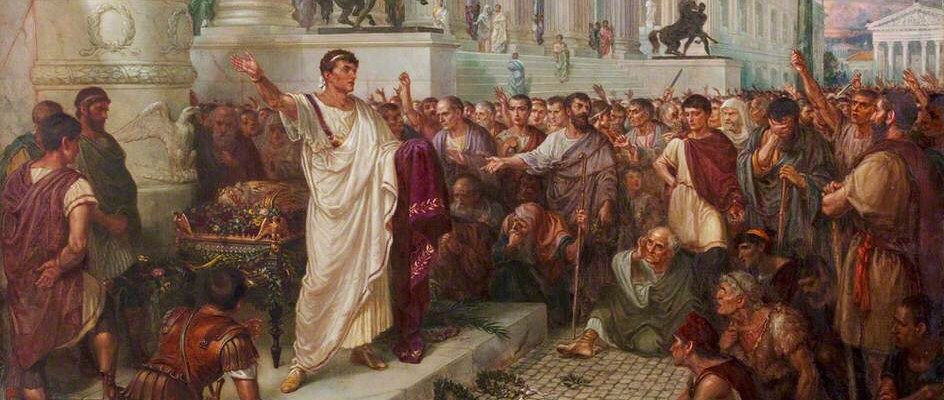
Today I’m going to do an analysis of one of the most famous speeches in all of Shakespeare: Antony’s Funeral Speech in Act III, Scene ii of Julius Caesar, commonly known as the “Friends, Romans, Countrymen” speech.

I. Given Circumstances

Antony is already in a very precarious position. His best friend Julius Caesar was murdered by the senators of Rome. Antony wants vengeance, but he can’t do so by himself. He’s also surrounded by a mob, and Brutus just got them on his side with a very convincing speech. They already hate Antony and Caesar. His goal- win them back. Here is a clip of Brutus (James Mason) speaking to the crowd from the Joseph Mankewitz movie version of Julius Caesar:

So the stakes are very high for Antony: If he succeeds, the crowd will avenge Caesar, and Antony will take control of Rome. If he fails, he will be lynched by an angry mob.

II. Textual Clues

If you notice in the text of the speech below, Antony never overtly says: “Brutus was a liar and a traitor, and Caesar must be avenged,” but that is exactly what he gets the crowd to do. So how does he get them to do so, right after Brutus got them on his side?

Antony. You gentle Romans,— 1615

Citizens. Peace, ho! let us hear him.

Antony. Friends, Romans, countrymen, lend me your ears;

I come to bury Caesar, not to praise him.

The evil that men do lives after them;

The good is oft interred with their bones; 1620

So let it be with Caesar. The noble Brutus

Hath told you Caesar was ambitious:

If it were so, it was a grievous fault,

And grievously hath Caesar answer’d it.

Here, under leave of Brutus and the rest— 1625

For Brutus is an honourable man;

So are they all, all honourable men—

Come I to speak in Caesar’s funeral.

He was my friend, faithful and just to me:

But Brutus says he was ambitious; 1630

And Brutus is an honourable man.

He hath brought many captives home to Rome

Whose ransoms did the general coffers fill:

Did this in Caesar seem ambitious?

When that the poor have cried, Caesar hath wept: 1635

Ambition should be made of sterner stuff:

Yet Brutus says he was ambitious;

And Brutus is an honourable man.

You all did see that on the Lupercal

I thrice presented him a kingly crown, 1640

Which he did thrice refuse: was this ambition?

Yet Brutus says he was ambitious;

And, sure, he is an honourable man.

I speak not to disprove what Brutus spoke,

But here I am to speak what I do know. 1645

You all did love him once, not without cause:

What cause withholds you then, to mourn for him?

O judgment! thou art fled to brutish beasts,

And men have lost their reason. Bear with me;

My heart is in the coffin there with Caesar, 1650

And I must pause till it come back to me.

First Citizen. Methinks there is much reason in his sayings. Julius Caesar Act III, Scene ii.

The two main methods Shakespeare uses to infuse Antony’s speech with powerful persuasive energy are the way he writes the verse, and his command of rhetoric.

A. Verse

The greatest gift Shakespeare ever gave his actors was to write his plays in blank verse. It not only tells you which words are important to stress, it gives you clues about the character’s emotional journey; just as a person’s heartbeat can indicate their changes in mood, a subtle change in verse often betrays the character’s pulse and state of mind. Antony uses his own emotions and his powers of persuasion to manipulate the crowd, so his verse helps show how he changes the pulse of the Roman mob.

I could write a whole post on the verse in this page, which I don’t need to do, since The Shakespeare Resource Center did it for me: http://www.bardweb.net/content/readings/caesar/lines.html What I will do is draw attention to some major changes in the verse and put my own interpretations on how Antony is using the verse to persuade the crowd:

  1. The first line of the speech grabs your attention. It is not a standard iambic pentameter line, which makes it rhythmically more interesting. In the movie version, Marlin Brando as Antony shouts each word to demand the crowd to just lend him their attention for a little while. He uses the verse to emphasize Antony’s frustration.
  2. “The Evil that men do, lives after them”- Notice that the words evil and men are in the stressed position. Antony might be making a subconscious attempt to say Brutus and the other evil men who took the life of Caesar are living, when they deserve to die.
  3. If it were so..” Again, Antony might be making a subtle jab at the conspirators. Brutus said Caesar was ambitious and Antony agrees that ambition is worthy of death, but he also adds an If, to plant the seeds of doubt in the crowd’s minds. To drive it home, the word if is in the stressed position, making it impossible for the crowd to not consider the possibility that Caesar wasn’t ambitious, and thus, didn’t deserve to be murdered.

B. Rhetoric

One reason why this speech is so famous is its clever use of rhetoric, the art of persuasive speaking. Back in ancient Rome, aristocrats like Antony were groomed since birth in the art of persuasive speech. Shakespeare himself studied rhetoric at school, so he knew how to write powerful persuasive speeches. Here’s a basic breakdown of the tactics Antony and Shakespeare use in the speech:

Ethos, Pathos, and Logos

The three basic ingredients of any persuasive speech are Ethos, Pathos, and Logos. Ethos is an appeal to the audience based on the speaker’s authority. Pathos is an appeal to the emotions of the crowd, and Logos is an appeal to facts and or reason. Both Brutus and Antony employ these three rhetorical tactics, but Antony doesn’t just appeal to his audience, he manipulates them to commit mutiny and mob rule.

Logos Antony has very few facts or logical information in his speech. His major argument is that again, since Caesar wasn’t ambitious, (which is very hard to prove), his death was a crime. Antony cites as proof the time Cæsar refused a crown at the Lupercal, but since that was a public performance, it’s hardly a reliable indication of Caesar’s true feelings.

You see logos as a rhetorical technique all the time whenever you watch a commercial citing leading medical studies, or a political debate where one person uses facts to justify his or her position. If you look at Hillary Clinton during the 2016 Presidental Debate, she frequently cited statistics to back up her political positions

Ethos-

Ethos is an argument based on the speaker’s authority. Brutus’ main tactic in his speech is to establish himself as Caesar’s friend and Rome’s. He says that he didn’t kill Caesar out of malice, but because he cared more about the people of Rome.

BRUTUS: If there be any in this assembly, any dear friend of Caesar’s, to him I say, that Brutus’ love to Caesar was no less than his. If then that friend demand why Brutus rose against Caesar, this is my answer:

–Not that I loved Caesar less, but that I loved Rome more. JC, III.ii.

Antony employs the exact same tactics, establishing himself as Caesar’s friend and telling the crowd that, as Caesar’s friend, Antony believes that Caesar did not deserve his murder. His use of Ethos therefore, helps Antony refute Brutus’ main claim.

Again, the 2016 debate is another excellent way of showing ethos in action. Hillary Clinton and Brutus frequently cited their political experience and their strength of character to justify their views. There’s an excellent article that examines Hillary’s use of Ethos in her political rhetoric: https://eidolon.pub/hillary-clintons-rhetorical-persona-9af06a3c4b03

Pathos

Pathos is the most frequently used rhetorical tactic: the appeal to emotion. Donald Trump uses this constantly, as you can see in this clip from the 2016 debate:

https://youtu.be/wMuyBOeSQVs

Pathos is bit more of a dirty trick than Ethos and Logos, which is why Brutus doesn’t use it much. As scholar Andy Gurr writes:

Brutus is a stern philosopher and thinker. His faith in reason fails to secure the crowd from Antony’s disingenuous appeal to their affections, which uses sharp sarcasm and some twisted facts.

Antony’s major appeals to emotion:

  • His grief over losing Caesar
  • His painting of Cæsar as a generous, faithful friend
  • Shaming the crowd for not mourning Caesar’s death
  • Appeal to piety by showing the body funeral reverence.
  • His use of Caesar’s bloody body and mantle to provoke outrage from the citizens.
  • His use of Caesar’s will to make the crowd grateful to Caesar, and furious at Brutus.

Rhetorical Devices

If Ethos, Pathos, and Logos are the strategies of rhetorical arguments, rhetorical devices are the artillery. If you check out the website Silva Rhetoricae, (The Forest Of Rhetoric), you can read about the hundreds of individual rhetorical devices that politicians have used in speeches and debates since ancient history. I will summarize here the main ones Antony uses over and over again in “Friends, Romans, Countrymen.” For another more compete analysis, click here: https://eavice.wordpress.com/2011/02/05/jv-rhetorical-devices-in-antonys-funerary-speech-from-shakespeares-julius-caesar/

  • Irony The way Antony keeps repeating “Brutus is an honorable man,” is a particularly sinister form of irony, which here means to imply the opposite of what you have said to mock or discredit your opponent. The irony is that the more Antony repeats this idea that Brutus is honorable, the more the crowd will question it. If Brutus were truly honorable, he would not need Antony to remind them. Of course, Brutus can still be honorable whether Anthony mentions it or not, but this repetition, coupled with Antony’s subtle rebuttals Of Brutus’ arguments, manages to shatter both Brutus’ motives, and his good name, at least in the eyes of his countrymen.
  • Antimetabole is the clever use of the same word in two different ways. Antony manages to work it in twice in this speech:
  • “If it were so, it was a grievous fault,
  • And grievously hath Caesar answer’d it.”
  • “You all did love him once, not without cause: What cause withholds you then, to mourn for him?”
  • Rhetorical question This is the most famous rhetorical device which by the way in Antony’s day would have been known as Erotema. Antony asks a series of questions designed to refute the notion that Caesar was ambitious, from his mercy to his captives, to Caesar’s tenderness to the poor, and of course his refusal to take the crown during the Lupercal. Each question calls Brutus’ claims into question and seeds doubt in the crowd.

Performance Notes with link to Globe performance

https://youtu.be/1RL8Wg-b8k

Unlike most Shakespearean plays, with Julius Caesar, we have an eyewitness account of how the play was originally performed. Swiss student Thomas Platter wrote a long description of watching the play at the original Globe Theatre in 1599. This is a translation that I found on The Shakespeare Blog:

On September 21st after lunch, about two o’clock, I and my party crossed the water, and there in the house with the thatched roof witnessed an excellent performance of the tragedy of the first Emperor Julius Caesar, with a cast of some fifteen people; when the play was over they danced very marvellously and gracefully together as is their wont, two dressed as men and two as women…

Thus daily at two in the afternoon, London has sometimes three plays running in different places, competing with each other, and those which play best obtain most spectators.

The playhouses are so constructed that they play on a raised platform, so that everyone has a good view. There are different galleries and places, however, where the seating is better and more comfortable and therefore more expensive. For whoever cares to stand below only pays one English penny, but if he wishes to sit he enters by another door, and pays another penny, while if he desires to sit in the most comfortable seats which are cushioned, where he not only sees everything well, but can also be seen, then he pays yet another English penny at another door. And during the performance food and drink are carried round the audience, so that for what one cares to pay one may also have refreshment.

The actors are most expensively costumed for it is the English usage for eminent Lords or Knights at their decease to bequeath and leave almost the best of their clothes to their serving men, which it is unseemly for the latter to wear, so that they offer them for sale for a small sum of money to the actors.

Thomas Platter, 1599, reprinted from: http://theshakespeareblog.com/2012/09/thomas-platters-visit-to-shakespeares-theatre/

So the conclusions we can draw based on Platter’s account include that Antony was standing on a mostly bare stage with a thatched roof, raised slightly off the ground. We can also guess that, since the merchants were selling beer, fruits, and ale, that the audience might have been drunk or throwing things at the actors.

As Platter notes, and this page from Shakespeare’s First Folio confirms, there were only 15 actors in the original cast, so Shakespeare’s company didn’t have a huge cast to play the gigantic crowd in the Roman street. In all probability, the audience is the mob, and Antony is talking right to them when he calls them “Friends, Romans, Countrymen.” I believe that the audience was probably encouraged to shout, chant, boo, cheer, and become a part of the performance which is important to emphasize when talking about how to portray this scene onstage. A director can choose whether or not to make the audience part of the action in a production of Julius Caesar, which can allow the audience to get a visceral understanding of the persuasive power of politicians like Brutus and Antony. Alternatively, the director can choose instead to have actors play the crowd, and allow the audience to scrutinize the crowd as well as the politicians.

In conclusion, the reason this speech is famous is Shakespeare did an excellent job of encapsulating the power of persuassive speech that the real Antony must have had, as he in no small way used that power to spur the Roman crowd to mutiny and vengeance, and began to turn his country from a dying republic into a mighty empire.

If you liked this post, please consider signing up for my online class where I cover the rhetorical devices in Julius Caesar and compare them with several other famous speeches. Register now at http://www.outschool.com

For a fascinating look at how a modern cast of actors helps to create this scene, check out this documentary: Unlocking the Scene from the Royal Shakespeare Company’s production in 2012, with Patterson Joseph as Brutus, and Ray Fearon as Antony:

◦ Interview with Patterson Joseph and Ray Fearon RSC: https://youtu.be/v5UTRSzuajo

And here is a clip of the final scene as it was performed at the Royal Shakespeare Company:

References

1. Annotated Julius Caesar: https://sites.google.com/site/annotatedjuliuscaesar/act-3/3-2-57-109

2. Folger Shakespeare Library: Julius Caesar Lesson Plan: https://teachingshakespeareblog.folger.edu/2014/04/29/friends-romans-teachers-send-me-your-speeches/

3. Silva Rhetoric http://rhetoric.byu.edu/

3. Rhetoric in Marc Antony Speech

https://www.google.com/amp/s/eavice.wordpress.com/2011/02/05/jv-rhetorical-devices-in-antonys-funerary-speech-from-shakespeares-julius-caesar/amp/

4. Shakespeare Resource Center: http://www.bardweb.net/content/readings/caesar/lines.html

Why Mechant Of Venice is the Perfect Play For the Holidays 

The Merchant Of Venice is unquestionably Shakespeare’s most controversial play- it covers such topics as anti-semitism, religious hypocrisy, racism, slavery, and the meaning of justice and mercy. As I have written before, few people read this play in school, but I believe that it has many lessons to teach our children. I also believe its lessons are also very much a part of the Christmas/ Hanukkah/ Kwanza holiday season, and here’s why:

Short summary

Famous quotes

  • All that glitters is not gold.
  • Hath not a Jew Eyes
  • The quality of mercy is not strained

You may very well wonder why this play about greed and prejudice reflects the warm holiday spirit. I would argue that, like cold winter snow, this play emphasizes the importance and the need for compassion, humanity, and generosity because without it society becomes truly frigid.

Merchant Of Venice takes an unflinching look at greed, prejudice, and religious hypocrisy, while at the same time retaining a hope for peace on Earth and goodwill towards men.

One of the best ways I can justify the connection between Merchant and the holidays is by comparing it to the quintessential Christmas story, Charles Dickens’ A Christmas Carol. In terms of tone, themes and especially characters, these two classics are very close indeed. Shylock is an ancestor of Scrooge- in addition to both being money lenders, both men are miserly, cold, and willing to destroy lives for wealth. Shylock even has a ghost that comes back to haunt him. Shylock mentions a ring that he got from his late wife Leah, similar to how Scrooge lost his only love, Belle. Just as Scrooge is a counterexample of everything that Christmas stands for, Shylock’s greediness, cruelty, and hatred of the people around him make him a figure to avoid, no matter what holiday you celebrate.

Merchant also raises questions about materialism, which we should all consider around the holidays. Shylock especially mentions this in quotes like: “You take my life when you take the means whereby I live.”

The themes of Merchant also reflect a modern multicultural holiday season. In one example which I wrote about before, The Prince Of Morocco has a great speech that calls to mind the concept of kuchijagulia, or self determination, one of the 7 principles of Kwanzaa.

According to the official Kwanza website, kuchijagulia means, “To speak up for oneself,” and Morocco definitely does that:

Mislike me not for my complexion,

The shadow’d livery of the burnish’d sun,

To whom I am a neighbour and near bred.

Bring me the fairest creature northward born,

Where Phoebus’ fire scarce thaws the icicles,

And let us make incision for your love,

To prove whose blood is reddest, his or mine.

I tell thee, lady, this aspect of mine

Hath fear’d the valiant: by my love I swear

The best-regarded virgins of our clime

Have loved it too: I would not change this hue,

Except to steal your thoughts, my gentle queen. Merchant Of Venice, Act II, Scene I.

Moracco’s unwillingness to change who he is makes him a model of the kind of pride African Americans celebrate during Kwanza. In addition Shylock, the Jewish moneylender, is also very proud of his heritage. His famous quip: “Sufferance is the badge of all our tribe,” expresses perfectly the resilience of the Jewish people, which of course is the central point of Hanukkah.

When it comes to Christmas, Antonio demonstrates a Christ- like self sacrifice, when he lets himself be arrested and nearly killed by Shylock.

Bassanio. Good cheer, Antonio! What, man, courage yet!

▪ The Jew shall have my flesh, blood, bones and all, 2045

▪ Ere thou shalt lose for me one drop of blood.

Antonio. I am a tainted wether of the flock,

▪ Meetest for death: the weakest kind of fruit

▪ Drops earliest to the ground; and so let me

▪ You cannot better be employ’d, Bassanio, 2050

▪ Than to live still and write mine epitaph.

While Antonio’s actions mirror Christ’s sacrifice. Portia’s famous “The Quality Of Mercy Is Not Strained,” speech, goes to the heart of the reason why Christ came to earth; to grant mercy to the sinners who would be damned otherwise

Portia. Do you confess the bond?

Antonio. I do.

Portia. Then must the Jew be merciful.

Shylock. On what compulsion must I? tell me that.

Portia. The quality of mercy is not strain’d, 2125

▪ It droppeth as the gentle rain from heaven

▪ Upon the place beneath: it is twice blest;

▪ It blesseth him that gives and him that takes:

▪ ‘Tis mightiest in the mightiest: it becomes

▪ The throned monarch better than his crown; 2130

▪ His sceptre shows the force of temporal power,

▪ The attribute to awe and majesty,

▪ Wherein doth sit the dread and fear of kings;

▪ But mercy is above this sceptred sway;

▪ It is enthroned in the hearts of kings, 2135

▪ It is an attribute to God himself;

▪ And earthly power doth then show likest God’s

▪ When mercy seasons justice. Therefore, Jew,

▪ Though justice be thy plea, consider this,

▪ That, in the course of justice, none of us 2140

▪ Should see salvation: we do pray for mercy;

▪ And that same prayer doth teach us all to render

▪ The deeds of mercy. Merchant Of Venice, Act IV Scene I.

Shakespeare no doubt wrote these characters to reflect the Christian values many people celebrate at Christmas. Meanwhile the play’s comic subplot with Bassanio and Portia teaches Christians about generosity and mercy. As I have written before, the character Bassanio is the moral center of the play, and his journey mirrors many characters in classic Christmas stories who learn about giving and receiving, the true meaning of Christmas.

In Act III, Scene ii, Bassanio participates in the highest stakes Secret Santa gift exchange ever: three boxes of gold, silver, and lead are set before him.

If Bassanio picks the right gift, he will be rich, powerful, and married to a beautiful woman, but the winning box is inscribed with a warning: “Who chooses me must give and hazard all he has.” Bassanio wins the gift auction, which means he may marry the beautiful Portia, but he gives her the choice to marry him or not: https://youtu.be/6IFSMgggS8k

[Music, whilst BASSANIO comments on the caskets to himself]

Bassanio. So may the outward shows be least themselves: 1440

The world is still deceived with ornament.

▪ In law, what plea so tainted and corrupt,

▪ But, being seasoned with a gracious voice,

▪ Obscures the show of evil? In religion,

▪ What damned error, but some sober brow 1445

▪ Will bless it and approve it with a text,

▪ Hiding the grossness with fair ornament?

▪ There is no vice so simple but assumes

▪ Some mark of virtue on his outward parts:

▪ How many cowards, whose hearts are all as false 1450
Look on beauty, 1455

▪ And you shall see ’tis purchased by the weight;

▪ Which therein works a miracle in nature,

▪ Therefore, thou gaudy gold,

▪ Hard food for Midas, I will none of thee;

▪ Nor none of thee, thou pale and common drudge 1470

▪ ‘Tween man and man: but thou, thou meagre lead,

▪ Which rather threatenest than dost promise aught,

▪ Thy paleness moves me more than eloquence;

▪ And here choose I; joy be the conseque

[Reads] 1500

▪ You that choose not by the view,

▪ Chance as fair and choose as true!

▪ Since this fortune falls to you,

▪ Be content and seek no new,

▪ If you be well pleased with this 1505

▪ And hold your fortune for your bliss,

▪ Turn you where your lady is

▪ And claim her with a loving kiss.

▪ A gentle scroll. Fair lady, by your leave;

▪ I come by note, to give and to receive. 1510

▪ Like one of two contending in a prize,

▪ That thinks he hath done well in people’s eyes,

▪ Hearing applause and universal shout,

▪ Giddy in spirit, still gazing in a doubt

▪ Whether these pearls of praise be his or no; 1515

▪ So, thrice fair lady, stand I, even so;

▪ As doubtful whether what I see be true,

▪ Until confirm’d, sign’d, ratified by you. Merchant of Venice Act III, Scene ii.

Like the story The Gift Of the Magi, Bassanio prizes Portia’s love, and is willing to give her all he has in return, which is what separates him from the other suitors. Bassanio also understands it’s not the physical gift that is really the gift, it’s the love that it represents that really matters, which allows him to look past the outward appearance of the lead chest. Having gratitude for the gifts we receive and pledging our love to others is something that everyone should remember at Christmas and all festive occasions.

In Conclusion, it isn’t cheery, and it is not as hopeful as most holiday stories, but in the season when people of all faiths celebrate together, Merchant Of Venice is a great reminder of our shared humanity and how we can show love and mercy to our fellow people.

Resources:
Merchant Of Venice Website: http://www.themerchantinvenice.org

Book– Will in the world by Steven Greenblatt- An amazing analysis of Shakespeare’s life and career. The chapter “Laughter At the Scaffold,” traces the link between Merchant Of Venice and the real life treatment of Jews in the 16th century

Book/ TV- Playing Shakespeare by John Barton.

MovieMerchant Of Venice 2004 Movie starring Al Pacino. I like the way the director films the drama documentary style, using a single handheld camera in most of the shots. Pacino is very good at playing Shylock as a bitter, cynical old man who is trying to survive in a powerful Christian country.

Official Kwanza website: http://www.officialkwanzaawebsite.org/NguzoSaba.shtml

http://internetshakespeare.uvic.ca/m/lifetimes/plays/the%20merchant%20of%20venice/mershylock.html

Shakespeare on Ghosts

Since Halloween is right around the corner, and since this is a huge topic in Shakespeare, I would like to talk a little bit about Shakespeare’s treatment of the living impaired, specters, spirits, in a word GHOSTS.

Ghosts appear in five Shakespearean plays: Julius Caesar, Hamlet, Richard the Third, Macbeth and Cymbeline. In all but one of these plays, and in many other Elizabethan and Jacobean dramas, a ghost is a murdered person who needs someone to avenge their deaths. Their function is to warn the hero of the play to revenge their deaths, and/ or to torment their murderers.

Ghosts have been part of western drama almost as long as there have been ghost stories. After all, the Greek and Roman plays that Shakespeare emulated often mention ghosts as warnings from above and below the world is in some kind of chaos. Most of the time, the kind of play in which you see a ghost is a Revenge Tragedy, plays like The Spanish Tragedy, Locrine, Shakespeare’s Hamlet, and even the Disney movie of The Lion King.


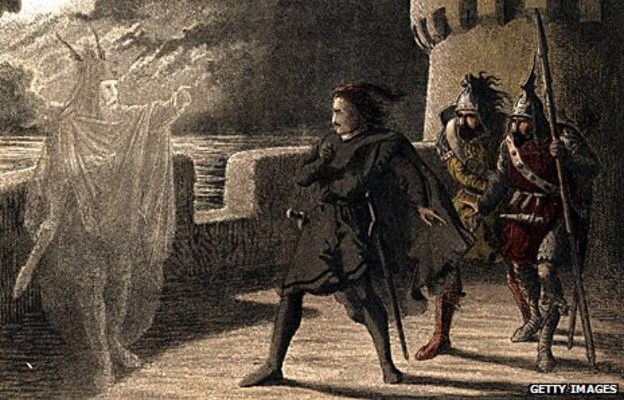
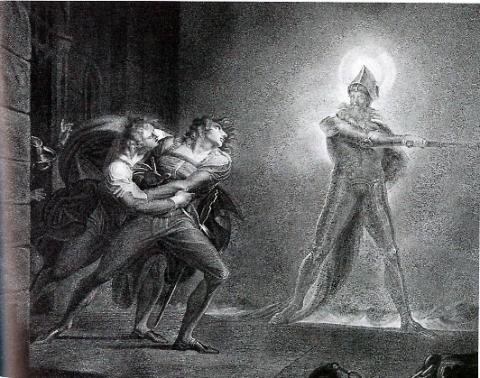
The most potent example of a Shakespearean ghost is definitely the ghost of Hamlet’s father. I actually played this role and, rumor has it, so did Shakespeare himself! Hamlet’s father appears as a ghost two months after his death, and soon after his brother Claudius marries his widow Gertrude. The ghost’s purpose in the play is to get his son’s attention so that he can correct the terrible regicide that Claudius committed, allowing the Ghost to Rest In Peace.

Shakespeare describes the ghost as a pale, sorrowful figure, dressed in full armor. The ghost only speaks to his son in the play, and he begins with a strange and terrifying description of the afterlife:

Ghost: I am thy father’s spirit,

Doom’d for a certain term to walk the night,

And for the day confin’d to fast in fires,

Till the foul crimes done in my days of nature

Are burnt and purg’d away. But that I am forbid

To tell the secrets of my prison house,

I could a tale unfold whose lightest word

Would harrow up thy soul, freeze thy young blood,

Make thy two eyes, like stars, start from their spheres,

Thy knotted and combined locks to part,

And each particular hair to stand on end

Like quills upon the fretful porcupine.

But this eternal blazon must not be

To ears of flesh and blood Hamlet Act I, Scene v.

Many scholars believe that the tormenting realm of fire that the ghost describes is actually Purgatory, an old Catholic concept that explains where the souls of the dead go if they are neither evil enough for Hell, or good enough for Heaven. It’s also the place where people go who didn’t confess their sins before death, which was the ghost’s fate since Claudius poisoned him while sleeping.

Though neither Hamlet nor his father explicitly say it, there is a strong implication that Hamlet must avenge his father by killing Claudius, which will presumably release the Ghost from Purgatory allowing it to ascend to Heaven.

Some suggest that the ghost is a manifestation of Hamlet’s superego:

Psychologist Ernest Jones (who studied under Signund Freud) in his book Hamlet And Oedipusbelieved Hamlet had an unresolved Oedipus complex and couldn’t bring himself to revenge because Claudius had achieved the very goals Hamlet himself secretly desires to kill his father and marry his mother

Faced with his guilt and lack of moral integrity Hamlet could have created a supernatural superego to spur him to revenge. As Freud describes it, the superego

The superego is the ethical component of the personality and provides the moral standards by which the ego operates. The superego’s criticisms, prohibitions, and inhibitions form a person’s conscience, and its positive aspirations and ideals represent one’s idealized self-image, or “ego ideal.”

In essence, since (in Jones’ view), Hamlet is too morally corrupt to be an effective avenger for his father, Hamlet imagines the ghost to help justify his revenge to himself. This is of course, only one way of interpreting the ghost and Hamlet as a whole. There is no right or wrong interpretation for any of Shakespeare’s characters, but it is a testament to Shakespeare’s genius that, 400 years after his own death, his ghostly writings helped inspire one the architects of modern psychology.

Ghosts Of Torment

The ghost of Banquo in Macbeth and the ghosts that plague Richard the Third the night before his battle help quicken the murderous kings’ his downward spiral. Macbeth becomes more and more paranoid, and therefore easier for his foes to defeat.

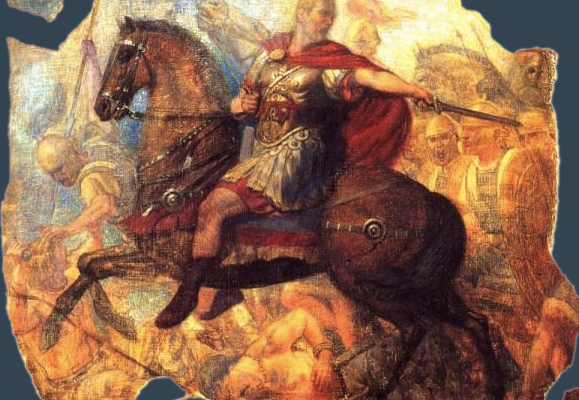
When Julius Caesar’s Ghost appears to Brutus, he does so the night before his final battle- the battle of Philippi, where Brutus was defeated and committed suicide.

When Richard III sees the ghosts of all the people he murdered, it not only terrifies him, it splits his soul in half! According to Sir Thomas More, Richard couldn’t sleep the night before his final battle at Bosworth Field. Shakespeare gives Richard a strange soliloquy where the ghosts awaken his conscience and awaken him from a fearful dream:

[The Ghosts vanish]

[KING RICHARD III starts out of his dream]

Richard III (Duke of Gloucester). Give me another horse: bind up my wounds.

Have mercy, Jesu!—Soft! I did but dream.

O coward conscience, how dost thou afflict me!

The lights burn blue. It is now dead midnight.

Cold fearful drops stand on my trembling flesh.

What do I fear? myself? there’s none else by:

Richard loves Richard; that is, I am I.

Is there a murderer here? No. Yes, I am:

Then fly. What, from myself? Great reason why:

Lest I revenge. What, myself upon myself?

Alack. I love myself. Wherefore? for any good

That I myself have done unto myself?

O, no! alas, I rather hate myself

For hateful deeds committed by myself!

I am a villain: yet I lie. I am not.

Fool, of thyself speak well: fool, do not flatter.

My conscience hath a thousand several tongues,
And every tongue brings in a several tale,

And every tale condemns me for a villain.

Perjury, perjury, in the high’st degree

Murder, stem murder, in the direst degree;

I shall despair. There is no creature loves me;

And if I die, no soul shall pity me:

Nay, wherefore should they, since that I myself

Find in myself no pity to myself? Richard III, Act V, Scene iii.

In these plays, the ghosts are a form of spectral punishment; the punishment of a guilty Conscience.

Shakespearean Friendly Ghosts

The only friendly Shakespearean ghosts appear in Shakespeare’s play Cymbeline and these ghosts appear before the god Jupiter to plead for their descendant, Posthumous Leonidas. They beg Jupiter, the most powerful Roman god, to end Posthumous’ suffering.

Like the witches in Macbeth, ghosts in Shakespeare are mysterious and sometimes frightening – they are sort of a mirror for how we see ourselves, our lives, and our hopes to be remembered after death; the final words Hamlet’s father utters before disappearing into the morning mist are: “Adieu, adieu, remember me.”

Thanks for reading! If you enjoyed this post, please consider signing up for my Outschool class: “Macbeth: An Immersive Horror Experience.” I perform live as the ghost of William Shakespeare and tell the story of Macbeth in an entertaining and spooky way.

For More Information:

https://www.bl.uk/shakespeare/articles/ghosts-in-shakespeare

https://www.bard.org/study-guides/ghosts-witches-and-shakespeare

Animated Richard III, 20:00 the ghosts appear:

References:

Greenblatt, Steven Hamlet In Purgatory 2001. Princeton University Press. Link: file:///Users/jrycik/Downloads/Hamlet-in-Purgatory-Princeton-Classics.pdf

Jones, Earnest, Hamlet and Oedipus.

https://people.ucsc.edu/~vktonay/migrated/psyc179d/HamletOedipus.pdf

Open Source Shakespeare, Cymbeline:

https://www.opensourceshakespeare.org/views/plays/play_view.php?WorkID=cymbeline&Act=5&Scene=4&Scope=scene&LineHighlight=3243#3243

http://www.markedbyteachers.com/gcse/english/which-version-of-the-hamlet-ghost-scene-act-1-scene-5-was-the-most-effective-and-why.html

Pearlman, E. Hamlet: Critical Essays: The Invention Of the Ghost. https://books.google.com/books?id=jdfWAQAAQBAJ&pg=PA71&lpg=PA71&dq=ghost+that+shrieked+hamlet+revenge&source=bl&ots=KY68gIrh2V&sig=MjEr2NxLQ7T4c2xW1QscrmdeMkc&hl=en&sa=X&ved=0ahUKEwiR5o6M4I_XAhUK0oMKHQIJBeAQ6AEIKDAA#v=onepage&q=ghost%20that%20shrieked%20hamlet%20revenge&f=false

https://www.shmoop.com/hamlet/ghost.html

https://www.jstor.org/stable/pdf/456606.pdf?refreqid=excelsior%3A3f62aed88fb9e9b9a8f8e462186ff95c

The Witches Of Macbeth

Happy Halloween everybody!

Tonight I’d like to discuss some of the spookiest, most enigmatic, and above all WEIRDEST characters in Shakespeare: the Three Weird Sisters in Macbeth.

1. Who are they?

Every production has to answer who the witches are, and many have very different answers. Are they temptress? Are they evil agents controlling Macbeth?Furies trying to destroy Macbeth?

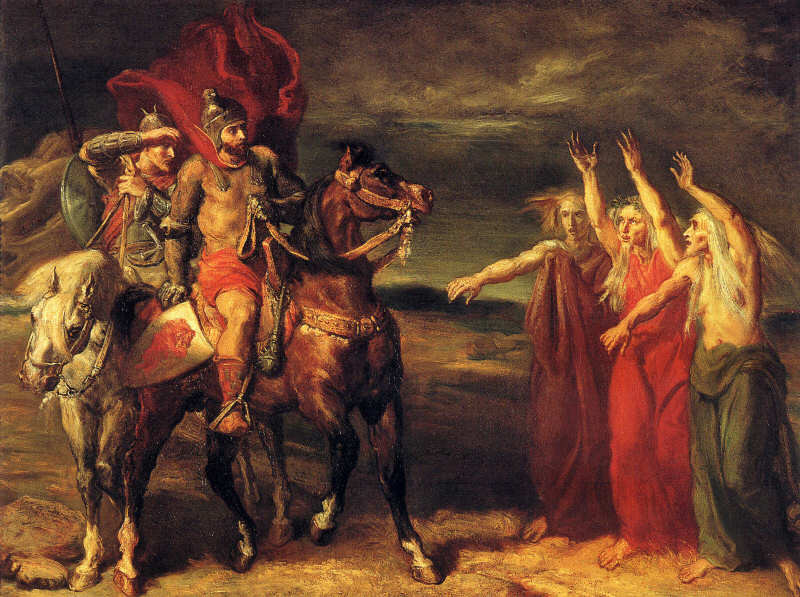
I would argue in their basic form the witches are harbingers of change. Their very name “Wyrd Sisters” refers to an old Anglo Saxon concept of fate or destiny. Whether or not they have any effect on Macbeth mind or soul, they point the finger at him and say “things are going to change for you.” Then, he either makes the choices that determine his fate, or they change his fate for him.

“Macbeth and Banquo First Encounter the Witches,” Théodore Chassériau, 1854.

Macbeth meets the witches on a heath, which means land that is literally out of bounds– the wild, untamed wilderness, which the old Anglo Saxons believed was the lair of many cursed spirits and monsters. This could symbolize Macbeth’ sin or transgressions, slowly turning into a murderer, usurper, and a tyrant. It could also symbolize the chaos in Macbeth’s life.

What Do They Look Like?

Shakespeare’s descriptions of the witches are highly contradictory- they seem to be floating, yet on the ground, they seem to be women, but they have beards! They don’t look Earthly, but here they are on the Earth. This gives them an other worldly quality that keeps us guessing as to who they are, and helps them tempt Macbeth more easily.

BANQUO
What are these
So wither’d and so wild in their attire,
That look not like the inhabitants o’ the earth,
And yet are on’t? Live you? or are you aught
That man may question? You seem to understand me,
By each at once her chappy finger laying
Upon her skinny lips: you should be women,
And yet your beards forbid me to interpret
That you are so.

MACBETH
Speak, if you can: what are you? (Act I, Scene iii).

The Witches’ Language:
You know from my earlier posts that the norm for Shakespearean characters is to speak in iambic pentameter- 10 syllable lines of unrhymed poetry that sounds like a normal heartbeat. The witches break these norms- they generally speak in Trochaic Tetrameter- 8 syllable lines with the off beat emphasized. The witches are literally offbeat, and that’s why their speeches are unsettling. Look at the contrast between a normal iambic line like:

“In sooth I know not why I am so sad.” (Merchant Of Venice I,i).

and

Dou-ble Dou-ble, Toil and Tro-ble.

Fire burn and Caul-dren Bu-ble. (Macbeth, Act IV, Scene i).

For more info on the verse forms of the Witches, click here:

The witches also speak their prophesies in a vague, ambiguous manner They like to play with obscuring their prophesies with lines that make Macbeth think one thing, but the opposite is true. The famous example here is when they claim Macbeth will never be vanquished “until Birnam Wood comes to Dunsinane Hill.” Macbeth assumes this means he’s invincible, but it actually means that the enemy carry wood from the forrest. This is called Equivocation.

Witches and mythology

Illustration from William Blake's
Illustration from William Blake’s “Europe a Prophecy,” 1794.

1. During the reign of King James, the modern witch hunt began; the king was fascinated with witches and even wrote a book called Daemonology on how to identify and destroy them. This was the era where people believed that witchcraft, rather than a pagan religious practice, was a forbidden craft that could only come from a pact with the devil. However, Shakespeare borrows from both Satanic and early pagan ritual in the characters of his witches.

2. Shakespeare took a couple of details about witchcraft from ancient Celtic and Greek mythology. First of all, the use of a cauldron. In Celtic myth, a cauldron is a symbol of rebirth and was sometimes used to resurrect the dead, just as the witches do in IV i. Of course, the ideal time for raising the spirits was on the feast of the pagan god Samhain, at the point where the veil between the living and dead was the thinnest. The feast took place on October 31st, our modern day Halloween!

Illustration of witches and their familiar spirits, 1647.

3. Familiar spirits In Act I, the witches speak to animal spirits called familiar spirits, which call to them and tell them where to go. King James himself wrote about how the witches found and communicated with these spirits.

Hecate.
In Act IV, Hecate, Ancient Greek goddess of magic appears. She is clearly the lord of all the witches, and is very displeased that they are riddling with Macbeth. Maybe not all witches believe in giving out prophesies that can destroy the Scottish monarchy. Hecate was always enigmatic in myths- she was born one of the Titans who opposed the gods, but frequently changed sides. More then being two faced, she was often portrayed as having three faces! Shakespeare refers to her frequently as “Triple Hecate.”

“The Triple Hecate,” by William Blake, 1794.

For more information on this mysterious goddess, consult the video below, (WARNING, ADULT-ONLY CONTENT).

In conclusion, the witches are meant to be ambiguous because the play examines the source of evil- whether it is inspired by other people, or if it comes from one’s own heart. The witches can be either or both, depending on how you want to tell the story, which is why they act and speak in contradictory ways.

Thanks for reading! If you enjoyed this posting, please consider signing up for my online class, “Macbeth: An Immersive Horror Experience.” I tell you the story of Macbeth and you get to play through an escape room, where you must solve the witches’ puzzles or be added to their Cauldron!

A Few More Updates

Hi folks!

I’ve now finished my work on Romeo and Juliet, and this October, I’m taking a little time to talk about two of Shakespeare’s spookiest plays- Macbeth, and Julius Caesar. Right now, the Royal Shakespeare Company is putting on a very inventive production of the play, and I’d like to talk a little about this interpretation. You can read about it here: http://www.telegraph.co.uk/culture/theatre/theatre-reviews/9317659/Julius-Caesar-Royal-Shakespeare-Theatre-Stratford-upon-Avon-review.html 

You can read my analysis of Julius Caesar here.

Here are some posts I’ve got waiting in the wings:

  1. A spooky Shakespeare Stories related to Julius Caesar, and the assassination of President Lincoln!
  2. Analysis of the speeches in Julius Caesar (podcast, hopefully).
  3. Play of the Month for Macbeth.
  4. Explanation of the curse of Macbeth.
  5. Review of “Haunt Me Still,” the sequel to “Interred WIth Their Bones” by Jennifer Lee Carrel.

Stay tuned!

Sleep No More Review

This was without a doubt, the most incredible theater experience I’ve ever had. It was scary, interactive, exciting, clever, sexy, and even a little disturbing, but without a doubt it was incredible, original, and true Shakespearean theater.

Before you read the review though, a word of caution-

WARNING: this is a production where, the less you know about it, the better your experience will be. I will provide a basic outline of the production, and give you an insight into what I experienced, but I would urge you to see the show yourself without any preconceptions, so if you want to keep the mystery going that surrounds this production, I suggest you stop reading…

RIGHT

NOW.

Alright, if you’ve chosen to keep reading, that means you want to know more, so more I shall give you. Going from the general to the specific, I’m going to talk a bit about what the show is, then describe the experience a bit, and then offer some tips for people who have never gone before.

url-2

Sleep No More is not the traditional kind of theater- there is no proscenium, no stage, no seats, and only one platform. It’s what theater teachers like my wife call “Experiential Theater.” The way she explains it, it’s theater that exists as an event. Rather than sitting and watching, you actively follow the action and you can get so close to the actors you can, (and sometimes will), touch them.

The play was conceived by an English company called Punchdrunk Theater Company, who took over an old 6 story warehouse on West 27th Street in New York City, and turned it into a fictional hotel/bar called the “McKittrick Hotel.” The play, (which is done entirely without dialogue), is a re-imagination of both Macbeth, and the novel Rebecca by Daphne Du Maurier, set in the 1930s. The audience is admitted on the ground floor and are permitted to go freely through the 6 floor set and watch the actors perform. Different actors perform on different floors and interact with other actors at different times, and the audience may watch any scene or actor they wish.

The title of the play comes from this passage from Macbeth:

imgres-3

The Experience

As I said before, this a very freeing and very active kind of theater. The only division between you and the actors is that you will wear a face mask. Your role is basically to be an anonymous spectator at an event that unfolds before you, an event full of madness, sex, murder, and mayhem. I would describe it as sort of like living in the strange orgy scene in Eyes Wide Shut, or that scene in The Shining where Shelly Duvall runs through rooms of the hotel and keeps seeing bizarre sights.

From the moment you enter the incredibly detailed hotel, you know you are in a place that was dangerous, dark, and chaotic. You wonder if the people are crazy, or if the building itself is crazy.

As an audience member, you set the pace of your experience as you wonder through the hotels’ infirmary, library, parlor, bath, ballroom, balcony, patio, and dark forest (masterfully designed by Alexandria Challer). Eventually the actors will find you and you choose whether to follow them or wait for something else to come along. When I first entered the hotel, I spent a few minutes looking at the set- reading a hotel guest list, or examining a jar in the pantry, or staring at animal carcasses in the trophy room.  Eventually  though, I found a story unfold before me, and I rushed to follow it.

Because none of the actors talk, this play is not Macbeth, unless you want it to be, it is not Rebecca by Daphne Du Maurier, unless you want it to be. YOU determine what your experience is. The great, (and famously crazy) theater theorist Antonin Artaud once said, “Text is a prison.” If that’s true, then Sleep No More has set its actors free: their movements convey the story through mime, ballet, gestures, and occasional words. This freedom from the restrictions of text means that it’s up to you to truly piece a story together, and you will find that story can alter, change, and sometimes disappear into mist.

How is This Story Macbeth? (Spoilers Ahead)

One of the most common complaints I read online from people who saw the show is that they didn’t understand the connection between Sleep No More and Macbeth. I don’t want to give too much away because I feel that part of the fun in this production is trying to figure out the connection yourself, but I will provide you with a few scenes to look for, to give you some clues on how to connect this physical theater piece with Shakespeare’s play:

Scenes to look for:

  1. In the bedchamber on the 3rd floor, there is a bathtub on a small platform. On the steps leading up to the tub I saw a letter that contains this text from Shakespeare:

They met me in the day of success: and I have
learned by the perfectest report, they have more in
them than mortal knowledge. When I burned in desire
to question them further, they made themselves air,
into which they vanished. Whiles I stood rapt in
the wonder of it, came missives from the king, who
all-hailed me ‘Thane of Cawdor;’ by which title,
before, these weird sisters saluted me, and referred
me to the coming on of time, with ‘Hail, king that
shalt be!’ This have I thought good to deliver
thee, my dearest partner of greatness, that thou
mightst not lose the dues of rejoicing, by being
ignorant of what greatness is promised thee. Lay it
to thy heart, and farewell.

Macbeth

This was the first definite evidence I had that the performance was inspired by Shakespeare besides the title of the play. A woman in a beautiful ball gown entered and read the note, pacing the whole time. Suddenly a handsome, red headed man came in. Like the Macbeths in Shakespeare, the body language between these two was hot and fierce; at times passionate and sexual, at times violent and animalistic. Lady Macbeth uses her body and her caresses to tempt her husband to murder, as the one in Shakespeare seduces him with her words. He trembles, turns away, brushes her off. Then, when she persists they struggle- clawing and slapping, even throwing each other across the bed, but in the end, exhausted, he slumps. She, victorious, leaves the room, looking like a queen already.

2. Alone in his room, Macbeth contemplates his dire murder. He leaves the warmth of the bedchamber and enters a dark, moon-lit forrest with a few gravestones. I followed him out into the forrest, knowing that what he does now will probably be an interpretation of Macbeth’s two most famous soliloquies: “If It Were Done When Tis Done” (Act I, Scene vii), and the famous Dagger Speech from Act II, Scene ii. Since the actor didn’t talk, he had to convey Macbeth’s inner torture with his body. I saw him going up to a statue of the Virgin Mary, beating his fists and chest against the hard stone. It was clear to me that this symbolized Macbeth’s struggle between morality and desire. He staggered away from the statue and stopped at a stone pathway that led back to the bedroom. Macbeth then put his hands on the stones, lifted his body up pull-up like, and kicked his legs in a futile attempt of motion. I immediately thought of Macbeth’s line:

I have no spur
To prick the sides of my intent, but only
Vaulting ambition, which o’erleaps itself
And falls on the other (Macbeth I,vii).

It was clear that the actor was showing how Macbeth cannot bring himself to kill, yet is too ambitious to let go of the desire to kill and this is what manifested in his tortured body. He then turned toward me and the other audience members and I saw his expression change. He looked around, worried, even frightened, as if he saw something he couldn’t believe. It wasn’t clear to me at first, but now I’m pretty sure that he was looking at the dagger from his famous soliloquy, and it was US. He ran from the forrest, and we charged after him like a swarm of angry bees! We found him in a corridor on the 2nd floor, where he again hoisted his body up against an old fireplace, inverting himself with his legs sticking up, and his head below, like an upside down cross. He then stretched his hands out and waved them frantically. Two frightened audience members took them and helped him hoist himself down. When Macbeth got to his feet, he proceeded to a darkly lit chamber where another man lay sleeping…

3. In a small bar on the 1st floor, I saw Macbeth with two women and one man. They all wore black lipstick and had crazed and hungry looks in their eyes. The music sped up to a crazed pace and the movements erupted into a terrifying orgy of sights and sounds. A strobe light pulsed showing me glimpses of the frightening spectacle, which included the two women stripping their clothes, the man putting on the head of a goat, and one of the women pulling out an infant covered with blood, and holding it in triumph over Macbeth’s head. At this moment I realized that these gruesome creatures must be the witches, and that they were foretelling Macbeth’s destiny as they do in Act IV. They also brought out a tree, which signified the prophesy that Macbeth will never be vanquished until Birnam Wood walks to Dunsinane Hill. To be honest, I don’t remember much after that, I was probably still in shock!

4. Back in the forrest, I encountered a small brick structure that looked like a tower, with a woman looking out of it expectantly. She beckoned me to come inside. When I did, I saw that she was dressed in a nurses’ uniform, and she was looking at a doctor with concern. Inside the tower was a small operating room with a circular table in the center, and two rows of seats above it. The doctor was injecting some kind of drug into his arm, which made it twitch in spasms. The two of them walked into the forrest and through a door into a room that looked like a small train station with platforms and travel posters on the walls. Lady Macbeth was there, wondering aimlessly. I instantly identified this moment as the famous sleepwalking scene, where Lady Macbeth contemplates the crimes to which she has become accessory. Usually the actress conveys her guilt by washing imaginary blood off her hands, but in this case she chose to interact with people, specifically, ME. She held out her hands to me, I took them. She looked into my eyes with a haunted look on her face. Then she whispered in my ear: “The thane of Fife had a wife, and she was beautiful.” I could see that this woman felt alone and afraid, with no one to talk to. She was no longer the powerful figure throwing her husband across the bed. This was what had driven her mad, and her madness allowed her to see me and the rest of us in the audience. She looked upon us with looks of disgust and terror, as if we were the ghosts of the people she killed, and ran away somewhere we couldn’t follow. We never saw her again (until the ghostly finale).

Those were just a few pieces that I witnessed. I won’t give away how it ended, but I will tell you that the show ended in a dining room on a tableau that reminded me of a cross between Da Vinci’s The Last Supper, and the banquet scene of Macbeth. 

When I talked to my wife, (who also came to the show, but was in a different audience group from me), she told me that there were many other scenes that were clearly inspired by Rebecca; she encountered a woman that she figured out was the ghoulish housekeeper Ms Danvers. She also had an intense meeting with the long-suffering Mrs. DeWinter, who gave her a locket and told her to keep it always. Finally, my wife revealed to me the startling fact that (Spoiler Alert), the same woman who plays the infamous Rebecca, dressed in a red flowing gown, also becomes Hecate, the goddess of black magic in Macbeth!

These performances are athletic, well thought-out, and incredibly nuanced. If you take some time to familiarize yourself with the stories of Macbeth and Rebecca, you can understand how the actors are interpreting the stories through dance, mime, and interactions with the set, props, and occasionally, the audience themselves.

I’d now like to conclude this review with my own pieces of advice for those of you who choose to see the show:

  1. Yes, wear comfy shoes. Almost everyone will tell you to bring comfortable shoes and they’re right- if you don’t want to lose the thread of a story, you have to be quick. Macbeth in particular is fast and nimble as a tiger, and you have to run fast to keep up with him.
  2. Find a person that interests you. I think some people make the mistake of staying in one place too long and ignoring the actors. This is physical theater, so try to find an actor to follow.
  3. Pretend you are a ghost if it helps Remember, murder and insanity are here, and you have a chance to see what it looks like and how it moves. Look right into the actor’s eyes and embrace your power to haunt these lost souls. Don’t be afraid to get close to them, and stay there as long as possible.
  4. If you do read Macbeth or Rebecca beforehand, it can be useful to memorize a few lines or moments and look for them in the performance. I can tell you for a fact that these actors meticulously planned their performances to give physical life to these two great works of literature. Look for a gesture, a glance, or a prop that jogs your memory and puts you into this hybrid world of Shakespeare and Du Maurier.
  5. The actors can sense if you are interested in interacting with them. If you seem scared or apprehensive, they will respect your space and not get close to you, but if you show them you are brave enough, they will extend a hand, or come toward you and give you a theater experience you will never forget.
  6. Leave your loved ones behind. Nothing was more fun to me than talking about my experience with my wife after the show and piecing our nights together. Even though the same show was going on the whole time, we saw different people, to different rooms, and had very different reactions.
  7. If an actor disappears, don’t wait for them. Sometimes you’ll follow an actorrl and they’ll duck into a corridor, or go behind a locked door, or a sentinel in a black mask will block your path. Now the story is over, and you are alone. Now you must choose again where to go, and try and uncover the sense of this horror.
  8. If you get to go to the 6th floor, consider yourself very lucky. Only a few people get to see it. My wife said she saw one person go up there. He was on an elevator with a small group. As they reached the top floor, a hotel porter let him off, then extended an arm, to indicate no one else would be admitted. Even the man’s girlfriend was blocked by the porter, who then explained, “This experience is best undertaken, alone.”

Well, I hope this whetted your appetite somewhat. Like I said this show is incredible, and very different from the kind of theater we generally think of, and that’s what makes it engaging and exciting. However, there is violence, nudity, and gruesome imagery onstage so it is definitely not for children. If you are interested in learning more, you can visit the Sleep No More website: www.sleepnomore.com/

Until next time,

Sleep Well.