The Merchant Of Venice is unquestionably Shakespeare’s most controversial play- it covers such topics as anti-semitism, religious hypocrisy, racism, slavery, and the meaning of justice and mercy. As I have written before, few people read this play in school, but I believe that it has many lessons to teach our children. I also believe its lessons are also very much a part of the Christmas/ Hanukkah/ Kwanza holiday season, and here’s why:
Short summary
Famous quotes
All that glitters is not gold.
Hath not a Jew Eyes
The quality of mercy is not strained
You may very well wonder why this play about greed and prejudice reflects the warm holiday spirit. I would argue that, like cold winter snow, this play emphasizes the importance and the need for compassion, humanity, and generosity because without it society becomes truly frigid.
Merchant Of Venice takes an unflinching look at greed, prejudice, and religious hypocrisy, while at the same time retaining a hope for peace on Earth and goodwill towards men.
One of the best ways I can justify the connection between Merchant and the holidays is by comparing it to the quintessential Christmas story, Charles Dickens’ A Christmas Carol. In terms of tone, themes and especially characters, these two classics are very close indeed. Shylock is an ancestor of Scrooge- in addition to both being money lenders, both men are miserly, cold, and willing to destroy lives for wealth. Shylock even has a ghost that comes back to haunt him. Shylock mentions a ring that he got from his late wife Leah, similar to how Scrooge lost his only love, Belle. Just as Scrooge is a counterexample of everything that Christmas stands for, Shylock’s greediness, cruelty, and hatred of the people around him make him a figure to avoid, no matter what holiday you celebrate.
Merchant also raises questions about materialism, which we should all consider around the holidays. Shylock especially mentions this in quotes like: “You take my life when you take the means whereby I live.”
The themes of Merchant also reflect a modern multicultural holiday season. In one example which I wrote about before, The Prince Of Morocco has a great speech that calls to mind the concept of kuchijagulia, or self determination, one of the 7 principles of Kwanzaa.
According to the official Kwanza website, kuchijagulia means, “To speak up for oneself,” and Morocco definitely does that:
Mislike me not for my complexion,
The shadow’d livery of the burnish’d sun,
To whom I am a neighbour and near bred.
Bring me the fairest creature northward born,
Where Phoebus’ fire scarce thaws the icicles,
And let us make incision for your love,
To prove whose blood is reddest, his or mine.
I tell thee, lady, this aspect of mine
Hath fear’d the valiant: by my love I swear
The best-regarded virgins of our clime
Have loved it too: I would not change this hue,
Except to steal your thoughts, my gentle queen. Merchant Of Venice, Act II, Scene I.
Moracco’s unwillingness to change who he is makes him a model of the kind of pride African Americans celebrate during Kwanza. In addition Shylock, the Jewish moneylender, is also very proud of his heritage. His famous quip: “Sufferance is the badge of all our tribe,” expresses perfectly the resilience of the Jewish people, which of course is the central point of Hanukkah.
When it comes to Christmas, Antonio demonstrates a Christ- like self sacrifice, when he lets himself be arrested and nearly killed by Shylock.
▪Bassanio. Good cheer, Antonio! What, man, courage yet!
▪ The Jew shall have my flesh, blood, bones and all, 2045
While Antonio’s actions mirror Christ’s sacrifice. Portia’s famous “The Quality Of Mercy Is Not Strained,” speech, goes to the heart of the reason why Christ came to earth; to grant mercy to the sinners who would be damned otherwise
▪Shylock. On what compulsion must I? tell me that.
▪Portia. The quality of mercy is not strain’d, 2125
▪ It droppeth as the gentle rain from heaven
▪ Upon the place beneath: it is twice blest;
▪ It blesseth him that gives and him that takes:
▪ ‘Tis mightiest in the mightiest: it becomes
▪ The throned monarch better than his crown; 2130
▪ His sceptre shows the force of temporal power,
▪ The attribute to awe and majesty,
▪ Wherein doth sit the dread and fear of kings;
▪ But mercy is above this sceptred sway;
▪ It is enthroned in the hearts of kings, 2135
▪ It is an attribute to God himself;
▪ And earthly power doth then show likest God’s
▪ When mercy seasons justice. Therefore, Jew,
▪ Though justice be thy plea, consider this,
▪ That, in the course of justice, none of us 2140
▪ Should see salvation: we do pray for mercy;
▪ And that same prayer doth teach us all to render
▪ The deeds of mercy. Merchant Of Venice, Act IV Scene I.
Shakespeare no doubt wrote these characters to reflect the Christian values many people celebrate at Christmas. Meanwhile the play’s comic subplot with Bassanio and Portia teaches Christians about generosity and mercy. As I have written before, the character Bassanio is the moral center of the play, and his journey mirrors many characters in classic Christmas stories who learn about giving and receiving, the true meaning of Christmas.
In Act III, Scene ii, Bassanio participates in the highest stakes Secret Santa gift exchange ever: three boxes of gold, silver, and lead are set before him.
If Bassanio picks the right gift, he will be rich, powerful, and married to a beautiful woman, but the winning box is inscribed with a warning: “Who chooses me must give and hazard all he has.” Bassanio wins the gift auction, which means he may marry the beautiful Portia, but he gives her the choice to marry him or not: https://youtu.be/6IFSMgggS8k
[Music, whilst BASSANIO comments on the caskets to himself]
▪Bassanio. So may the outward shows be least themselves: 1440
The world is still deceived with ornament.
▪ In law, what plea so tainted and corrupt,
▪ But, being seasoned with a gracious voice,
▪ Obscures the show of evil? In religion,
▪ What damned error, but some sober brow 1445
▪ Will bless it and approve it with a text,
▪ Hiding the grossness with fair ornament?
▪ There is no vice so simple but assumes
▪ Some mark of virtue on his outward parts:
▪ How many cowards, whose hearts are all as false 1450
Look on beauty, 1455
▪ And you shall see ’tis purchased by the weight;
▪ Which therein works a miracle in nature,
▪ Therefore, thou gaudy gold,
▪ Hard food for Midas, I will none of thee;
▪ Nor none of thee, thou pale and common drudge 1470
▪ ‘Tween man and man: but thou, thou meagre lead,
▪ Which rather threatenest than dost promise aught,
▪ Thy paleness moves me more than eloquence;
▪ And here choose I; joy be the conseque
[Reads] 1500
▪ You that choose not by the view,
▪ Chance as fair and choose as true!
▪ Since this fortune falls to you,
▪ Be content and seek no new,
▪ If you be well pleased with this 1505
▪ And hold your fortune for your bliss,
▪ Turn you where your lady is
▪ And claim her with a loving kiss.
▪ A gentle scroll. Fair lady, by your leave;
▪ I come by note, to give and to receive. 1510
▪ Like one of two contending in a prize,
▪ That thinks he hath done well in people’s eyes,
▪ Hearing applause and universal shout,
▪ Giddy in spirit, still gazing in a doubt
▪ Whether these pearls of praise be his or no; 1515
▪ So, thrice fair lady, stand I, even so;
▪ As doubtful whether what I see be true,
▪ Until confirm’d, sign’d, ratified by you. Merchant of Venice Act III, Scene ii.
Like the story The Gift Of the Magi, Bassanio prizes Portia’s love, and is willing to give her all he has in return, which is what separates him from the other suitors. Bassanio also understands it’s not the physical gift that is really the gift, it’s the love that it represents that really matters, which allows him to look past the outward appearance of the lead chest. Having gratitude for the gifts we receive and pledging our love to others is something that everyone should remember at Christmas and all festive occasions.
In Conclusion, it isn’t cheery, and it is not as hopeful as most holiday stories, but in the season when people of all faiths celebrate together, Merchant Of Venice is a great reminder of our shared humanity and how we can show love and mercy to our fellow people.
Book– Will in the world by Steven Greenblatt- An amazing analysis of Shakespeare’s life and career. The chapter “Laughter At the Scaffold,” traces the link between Merchant Of Venice and the real life treatment of Jews in the 16th century
Book/ TV- Playing Shakespeare by John Barton.
Movie– Merchant Of Venice 2004 Movie starring Al Pacino. I like the way the director films the drama documentary style, using a single handheld camera in most of the shots. Pacino is very good at playing Shylock as a bitter, cynical old man who is trying to survive in a powerful Christian country.
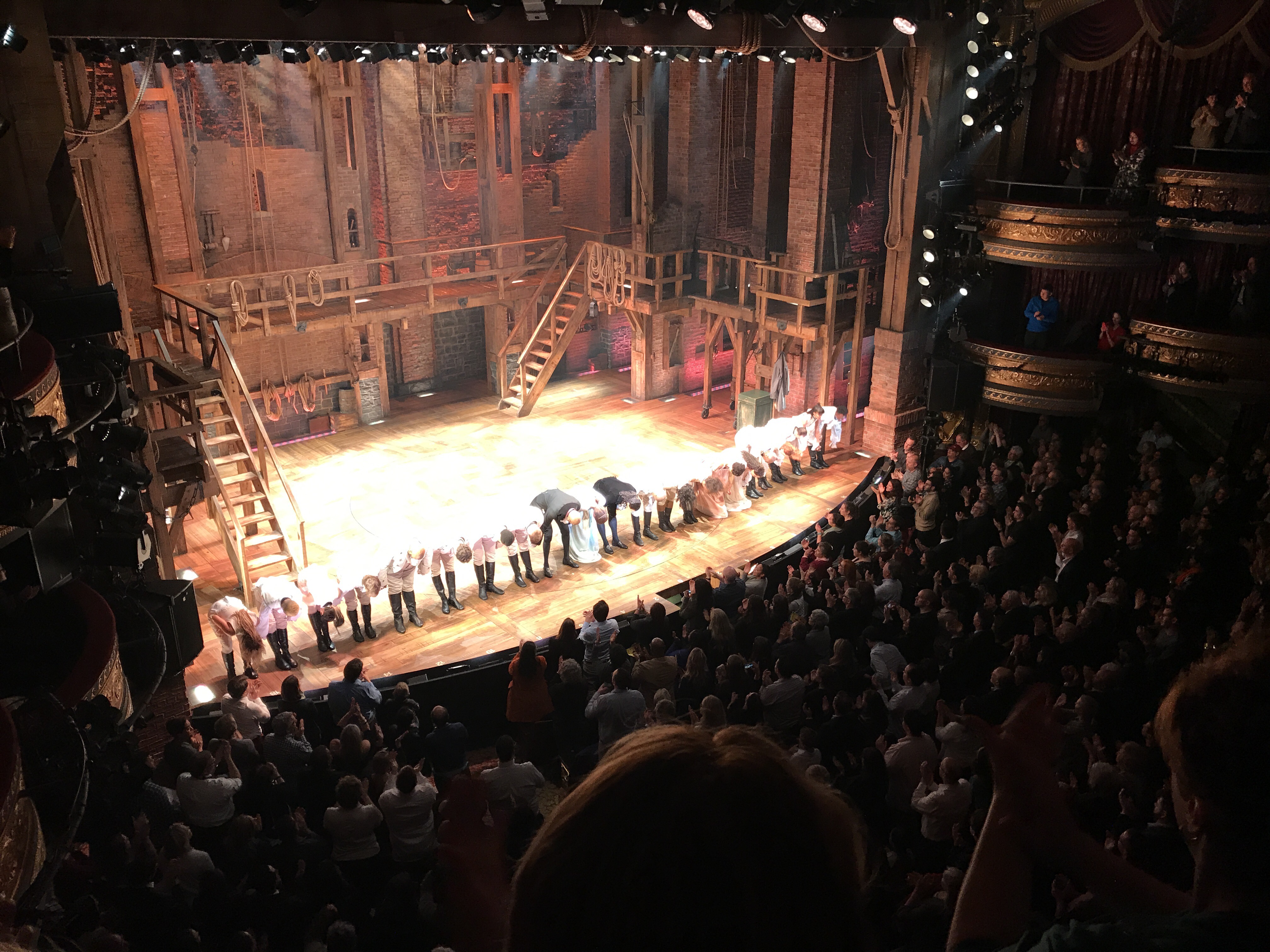
If you have two ears, you’re probably familiar with the Broadway Musical Hamilton. It swept the Tonys, has opened up touring productions across the country, and there’s already talk of a movie.
This historic American musical was the brainchild of writer Lin Manuel Miranda, who also originated the role of Alexander Hamilton.
The show is incredibly smart, creative, and delves into the seminal moments of American history.
What’s really exciting to me is that Hamilton also has a depth and complexity that mirrors some of Shakespeare’s greatest plays, specifically the history plays.
Between about 1590 and 1613, Shakespeare wrote 10 plays about the lives of English kings, from the vain Richard the Second to the heroic Henry the Fifth, to the diabolical Richard the Third. Here is a list of Shakespearean history plays, with links to online study guides, listed in chronological order by reign, not publication date.
Are these Shakespearean history plays historically accurate by our standards? No, not by a long shot, though Shakespeare is only partially to blame for that. While Lin Manuel-Miranda had Hamilton’s own essays, his letters from friends and loved ones, and of course, every American history book at his disposal, Shakespeare’s sources were few, and mostly propaganda. They were, (to paraphrase Napoleon and Benjamin Franklin), “A series of lies, composed by winners, to excuse their hanging of the losers.”
Shakespeare’s genius however, was to turn these two-dimensional propaganda stories into three dimensional characters with which we can all identify. Miranda did the same thing in reverse- distilling his wealth of historical information into a universal story of a man’s quest for the American Dream. Hamilton went from being an immigrant, to a soldier, to a pioneer in American law, government, and finance and the musical reflects his struggle to achieve his dreams through each stage of his life. It is also a love song from America to a man who dreamed of a future for America, one not dissimilar to the ode Shakespeare wrote to his “Star of England,” Henry the Fifth. The greatest compliment I can give Miranda is to say that he created an American musical, with the scale and breadth of Shakespeare.
Part I: War and Peace
In Shakespeare’s histories, particularly the first tetracycle of plays that include Richard the Second, the three parts of Henry VI, and Richard, III, there is a constant shift between war and peace, as scholar Robert Hunter observes. These plays cover the 200 year period of Wars of the Roses, and the end of the Hundred Years War. In all of these plays there are some very violent and very opportunistic young men who see war as an opportunity to rise above their stations. In war, they win glory in death, honor, respect, and status in life. However, in peacetime, they have “no delight to pass away the time,” as Richard III observes, and they struggle to survive in the political landscape of peace.
Hamilton is a man of this same mold: When we first meet him, he is a poor immigrant from the West Indies with no title or money to improve his status. He spends the first third of the musical wishing he could become a commander in the Revolutionary War, especially in the song: “My Shot”
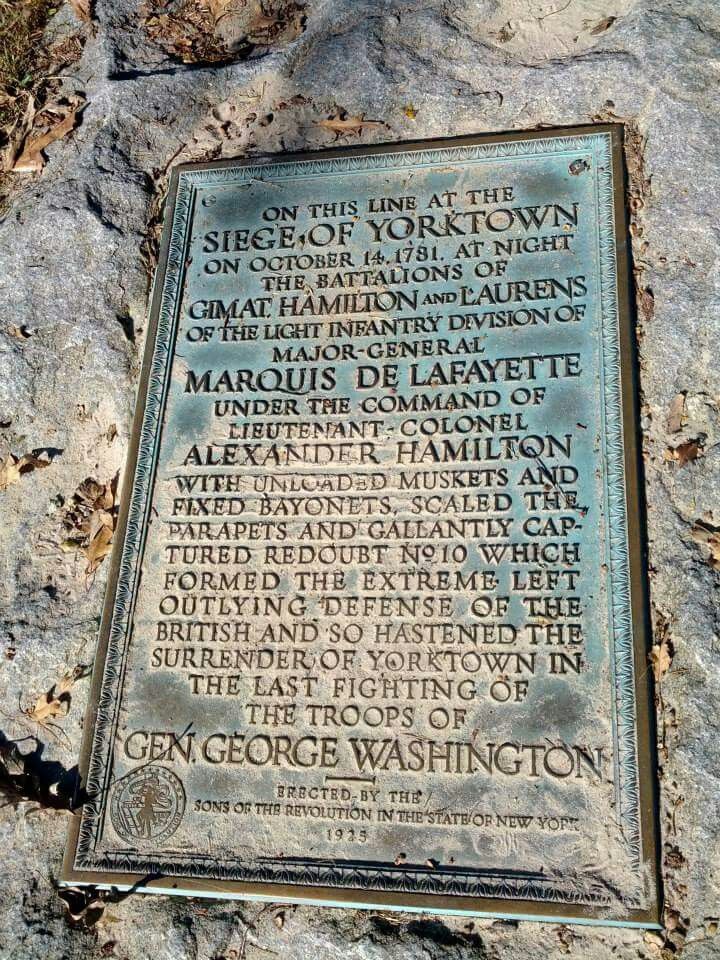
Once Hamilton joins the revolution, his fortunes start to improve; he becomes George Washington’s aide-de-camp, then becomes a war hero in the Battle of Yorktown, and marries Eliza Schyler, daughter of one of the wealthiest men in America.
Hamilton in war bears similarities to Shakespearean characters like Hotspur, Richard Duke of York, and even Richard III; people who see war as a chance to either die in glory, or become honored, wealthy, and powerful.
Unfortunately for Hamilton, he fares less well once the war ends. Even though he becomes Washington’s first Secretary Of the Treasury, his success and closeness to now-President Washington makes him a walking target to his political adversaries. Even worse, his ambition and inability to compromise makes Hamilton equally vulnerable to people who see him as a loudmouth, an elitist, and a would-be demagogue who wants to control America’s finances and live like a king, similar to the way the British Prime Minister controls England’s finances.
The character Hamilton resembles most in peacetime is Cardinal Wolsey in Shakespeare’s Henry VIII.
I happen to know a lot about this character since I played him back in 2008. Wolsey controlled Henry VIII’s finances and was hated by most of Henry’s court because he was the son of a poor butcher in Essex, and became the king’s right-hand man. Throughout Shakespeare’s play, the lords of court are whispering about how Wolsey really controls the government; they even call him the ‘king cardinal’!
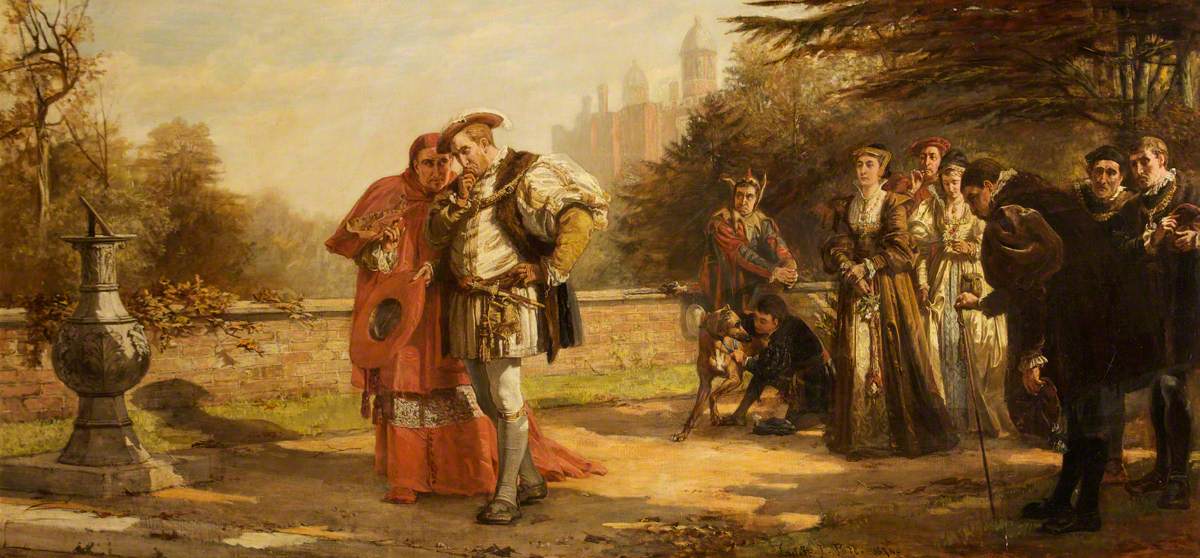
The real life Wolsey appears to have been hated just as much by Henry’s lords. Just look at the faces of the people of the court in this painting of the king and Wolsey by Laslett John Pott; the lords on the right are clearly jealous of Wolsey’s closeness to the king.
Laslett John Pott, The Dismissal of Cardinal Wolsey, 1874
In both plays, Washington and King Henry are treated like gods- invulnerable, aloof, and completely above reproach.
Whenever anything bad happens in the play or musical, the legislature blames Wolsey and Hamilton, not the King or the President. Also, in both plays each one falls from grace and is destroyed by his enemies when the king and president no longer supports their right-hand-men.
Wolsey and Hamilton both fall because of their position as the financial advisor, which makes them a target to their enemies. Both are accused of using their country’s finances to enhance their personal wealth, which leads him to scandal and disgrace.
In Henry the Eighth , Wolsey is certainly guilty of conspiring to use his country’s wealth to line his own pockets- he pays the cardinals in Rome to influence their vote in the hopes that he will become the next Pope!
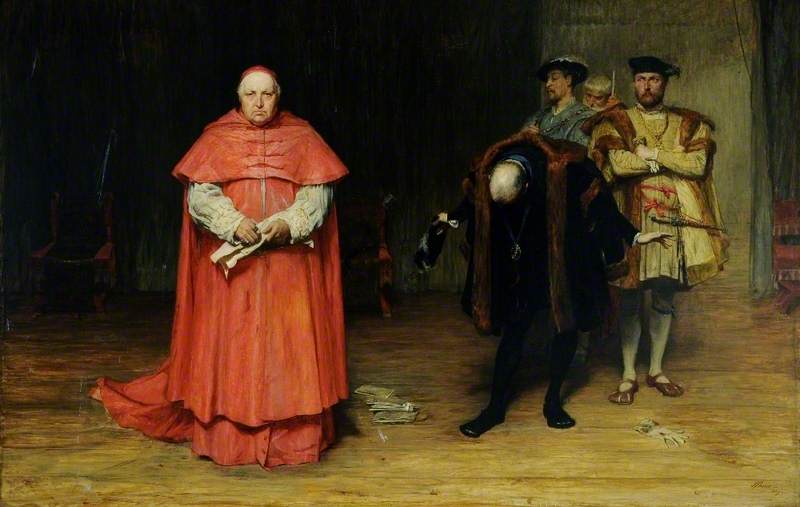
John Pettie: The Disgrace of Cardinal Wolsey, 1869
CARDINAL WOLSEY
What should this mean?
What sudden anger’s this? how have I reap’d it?
He parted frowning from me, as if ruin
Leap’d from his eyes: so looks the chafed lion
Upon the daring huntsman that has gall’d him
Then makes him nothing. I must read this paper;
I fear, the story of his anger. ‘Tis so;
This paper has undone me: ’tis the account
Of all that world of wealth I have drawn together
For mine own ends; indeed, to gain the popedom,
And fee my friends in Rome. O negligence!
Fit for a fool to fall by: what cross devil
Made me put this main secret in the packet
I sent the king? Is there no way to cure this?
No new device to beat this from his brains?
I know ’twill stir him strongly; yet I know
A way, if it take right, in spite of fortune
Will bring me off again. What’s this? ‘To the Pope!’
The letter, as I live, with all the business
I writ to’s holiness. Nay then, farewell!
I have touch’d the highest point of all my greatness;
And, from that full meridian of my glory,
I haste now to my setting: I shall fall
Like a bright exhalation in the evening,
And no man see me more. Henry the Eighth Act III, Scene ii.
Again, though Wolsey is guilty, like Hamilton he also used his financial genius to bring England into a new age of prosperity after centuries of war. The Tudors were some of the richest and most powerful monarchs in British history, and Wolsey helped establish their dynasty, but thanks to his enemies, he is turned out of court in disgrace:
O Cromwell, Cromwell!
Had I but served my God with half the zeal
I served my king, he would not in mine age
Have left me naked to mine enemies. Henry VIII, Act III, Scene ii.
Hamilton is also accused of embezzling his wealth by his enemies, including James Madison, and Thomas Jefferson
Hamilton’s enemies argue that his banking system benefits New York, where Hamilton was part of the House Of Representatives, as well as the Constitutional Convention. The main difference between Wolsey and Hamilton is that he didn’t embezzle America’s money, he is actually guilty of a far worse sin- adultery. Hamilton is accused of having an affair, and embezzling funds to keep it quiet, which he denies in a spectacular fashion:
In both plays, the moment where the main character begins to fall is dramatized in a stirring, metaphor-rich soliloquy. Wolsey compares himself to the Sun, who, once he reaches the zenith of the sky, has nowhere to go but down to the west, and set into night.
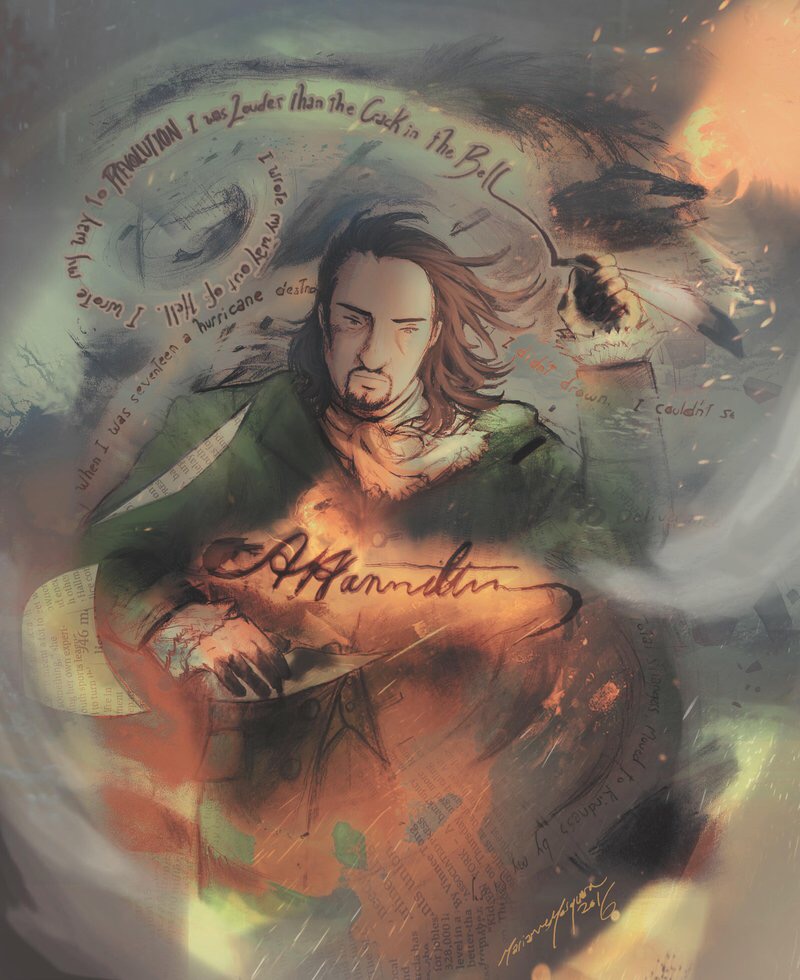
Hurricane From “Hamilton: An American Musical. Reposted from Deviant Art.com
Hamilton compares his situation to being in the eye of a hurricane, a particularly apt metaphor, since the real Alexander Hamilton’s house was destroyed by a hurricane in 1772. In addition, Lin Manuel Miranda‘s parents come from Puerto Rico an island that has, (and continues to be,) ravaged by hurricanes.
In the song, “Hurricane,” Hamilton remembers that when he lost everything as a boy in 1772, he beat the hurricane by writing a letter which was published in the newspaper, and inspired so much pity that the residents of the island raised enough money to send Alexander to America.
Later in the song, Hamilton decides to try to soothe the political hurricane that has engulfed him by writing a pamphlet, admitting the affair, but denying any embezzlement. Eventually the scandal destroys Hamilton’s career, but it doesn’t destroy his life; for that we have to look at the Shakespearean rivalry between Hamilton and Aaron Burr.
Part II- The Duel: Hamilton and Burr V Henry and Hotspur.
Aaron Burr and Hamilton keep meeting at important moments in the show, as if their fates are intertwined like gods in some kind of Greek tragedy.
Hamilton and Burr appear as polar opposites in the musical. Hamilton is fiery, opinionated, uncompromising, and highly principled. He ruffles feathers, but his supporters know where he stands. Burr is the opposite. He keeps his views to himself, and waits for the most opportune time to act on anything. Throughout the play, Hamilton and Burr hate and admire different things about each other. Hamilton admits that Burr’s cool practicality helps him to practice the law and succeed in politics, while Burr admires Hamilton’s energy and his ability to work and write as if his life depends on it, especially in the song “The Room Where It Happens.”
After Hamilton endorses Jefferson in the election of 1800, Burr loses the race, and the job of Vice President. In the musical, he blames Hamilton, and their grievance grows into a deadly conflict.
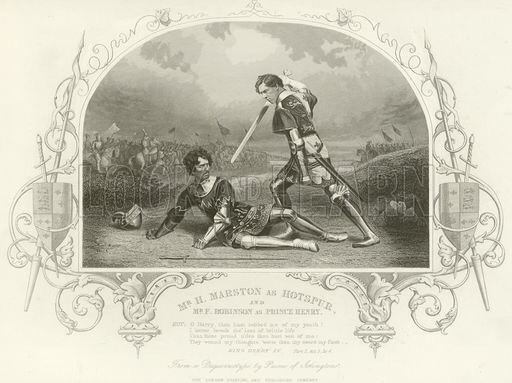
The rivalry between Hamilton and Aaron Burr mirrors many characters in Shakespeare, but the two I want to focus on here are Hotspur and Prince Hal from Henry the Fourth Part One
As this video from the Royal Shakespeare Company shows, these two combatants meet only once in the play, but they are constantly compared to each other by the other characters, who talk about them as if they were twins, (they even have the same first name)! Even the king remarks that his son could have been switched at birth with Hotspur.
Prince Henry (known as Hal in the play), is the heir to the throne. Like Burr in Hamilton, Hal is methodical, cool, keeps his feelings to himself, and is known by some as a Machiavellian politician. Hotspur, (or Henry Percy), is his opposite. Like Hamilton he is fiery, eloquent, and not afraid to die for his cause, which in Hotspur’s case is to supplant the royal family and correct what he believes is an unjust usurpation by Hal’s father, King Henry the Fourth.
In the scene below, the two men seem hungry to not only kill one another, but to win honor and fame as the man who killed the valiant Henry. Whether it’s Henry Percy, or Prince Henry who will die, is something they can only find out by dueling to the death.
HOTSPUR
If I mistake not, thou art Harry Monmouth.
PRINCE HENRY
Thou speak’st as if I would deny my name.
HOTSPUR
My name is Harry Percy.
PRINCE HENRY
Why, then I see
A very valiant rebel of the name.
I am the Prince of Wales; and think not, Percy,
To share with me in glory any more:
Two stars keep not their motion in one sphere;
Nor can one England brook a double reign,
Of Harry Percy and the Prince of Wales.
HOTSPUR
Nor shall it, Harry; for the hour is come
To end the one of us; and would to God
Thy name in arms were now as great as mine!
PRINCE HENRY
I’ll make it greater ere I part from thee;
And all the budding honours on thy crest
I’ll crop, to make a garland for my head.
HOTSPUR
I can no longer brook thy vanities.
They fight, HOTSPUR is wounded, and falls
HOTSPUR
O, Harry, thou hast robb’d me of my youth!
I better brook the loss of brittle life
Than those proud titles thou hast won of me;
They wound my thoughts worse than sword my flesh:
But thought’s the slave of life, and life time’s fool;
And time, that takes survey of all the world,
Must have a stop. O, I could prophesy,
But that the earthy and cold hand of death
Lies on my tongue: no, Percy, thou art dust
And food for– Dies.
Hamilton’s duel is also a matter of honor; Alexander wants to defend his statements against Burr, while Burr wants to stop Hamilton from frustrating his political career. Here is how their duel plays out in the musical Hamilton:
Just like Burr, Prince Hal feels remorse after killing his worthy adversary.
PRINCE HENRY
For worms, brave Percy: fare thee well, great heart!
Ill-weaved ambition, how much art thou shrunk!
When that this body did contain a spirit,
A kingdom for it was too small a bound;
But now two paces of the vilest earth
Is room enough: this earth that bears thee dead
Bears not alive so stout a gentleman.
If thou wert sensible of courtesy,
I should not make so dear a show of zeal:
But let my favours hide thy mangled face;
And, even in thy behalf, I’ll thank myself
For doing these fair rites of tenderness.
Adieu, and take thy praise with thee to heaven!
Thy ignominy sleep with thee in the grave. Henry IV, Part I, Act V, Scene iv.
III. The Times
In both Hamilton and all of Shakespeare’s history plays, the characters know that they are living during important events and their actions will become part of the history of their country, and none more than Washington. In the song, “History has its eyes on you,” he warns Hamilton that, try as one might, a man’s history and destiny is to some extent, out of his control, which echoes one of King Henry the Fourth’s most bleak realizations:
Henry IV. O God! that one might read the book of fate,
And see the revolution of the times
And changes fill the cup of alteration
With divers liquors! O, if this were seen,
The happiest youth, viewing his progress through,
What perils past, what crosses to ensue,
Would shut the book and sit him down and die. Henry IV, Part II, Act III, Scene i.
Washington is keenly aware of his legacy and does his best to protect it. In Shakespeare’s Henry IV,the king also lies awake trying to figure out how to deal with the problems of his kingdom, which is why Shakespeare gives him the famous line “Uneasy lies the head that wears the crown.” Likewise, Richard II, makes a famous speech where he mentions how many kings have a gruesome legacy of dying violently:
As we see the whole story of Hamilton’s life, his fate changes constantly and his legacy shifts in every scene of the show: immigrant, war-hero, celebrated writer, Secretary of the Treasury, but then, once he published The Reynolds Pamphlet, Hamilton went from famous to infamous. After After Burr murdered him in the duel, Hamilton might have been utterly forgotten, in spite of all his great accomplishments. This is a key theme in all history and tragedies; the desire of every man to create a lasting legacy for himself, and thus transcend mortality.
The women who tell the story
Fortunately for Hamilton, the women of his story also help to preserve it. Historically, most of Hamilton’s archives were preserved by his wife Eliza Schyler, and she and her sisters help shape the story from the beginning to the end of the show. Hamilton’s sister in law Angelica sets up this theme by literally rewinding the scene of her first meeting with Alexander, and then retelling how she and Hamilton met from her own point of view.
Once her sister marries Hamilton, Eliza Schuyler asks to “be part of the narrative.” She knows she married a important man and that his life will someday become part of American history. Eliza wants to be a part of that historic narrative.
When Hamilton commits adultery and writes the Reynolds pamphlet though, Eliza is so hurt and scandalized that she rescinds her requests. In the song “Burn,” she destroys her love letters from before the affair, and all correspondence she had with Alexander when he revealed it. Lin Manuel Miranda explained that he wrote the song this way because no records during this period survived, so he invents the notion of Eliza destroying them as a dramatic device, to heighten her estrangement from her husband. Though this is a contrivance, it does re-enforce how, when part of the story is lost, it twists and destroys part of our impression of a person. Shakespeare knew this too; Henry Tudor went to great lengths to destroy the legacy of his predecessor Richard the Third, and literally repainted him as a deformed tyrant. Shakespeare couldn’t escape the narrative of Richard as a monster when he wrote his history play and sadly helped to perpetuate it to this day.
At the end of the play though, Eliza changes her mind yet again, as the final song I placed earlier shows, Eliza spends the last 50 years of her life to preserving and protecting her husband’s name, as well as Washington, all the founding fathers, and children who can grow up knowing that story at her orphanage. This song illustrates clearly that in the end, a man’s story is defined by the people who tell it, and Hamilton is fortunate to have such a creative, energetic and talented writer/ actor in Lin Manuel Miranda, and the cast of Hamilton, to preserve the story in such a Shakespearean way.
Bravo.
Educational links related to Hamilton:
Books
Hamilton: The Revolution by Lin-Manuel Miranda, Jeremy McCarter. A complete libretto of the show, with notes on its creative conception.
Alexander Hamilton by Ron Chernow. This is the book that inspired Lin Manuel Miranda to create the show. It is a stirring, well-researched historical biography.
Since Halloween is right around the corner, and since this is a huge topic in Shakespeare, I would like to talk a little bit about Shakespeare’s treatment of the living impaired, specters, spirits, in a word GHOSTS.
Ghosts appear in five Shakespearean plays: Julius Caesar, Hamlet, Richard the Third, Macbeth and Cymbeline. In all but one of these plays, and in many other Elizabethan and Jacobean dramas, a ghost is a murdered person who needs someone to avenge their deaths. Their function is to warn the hero of the play to revenge their deaths, and/ or to torment their murderers.
Ghosts have been part of western drama almost as long as there have been ghost stories. After all, the Greek and Roman plays that Shakespeare emulated often mention ghosts as warnings from above and below the world is in some kind of chaos. Most of the time, the kind of play in which you see a ghost is a Revenge Tragedy, plays like The Spanish Tragedy, Locrine, Shakespeare’s Hamlet, and even the Disney movie of The Lion King.
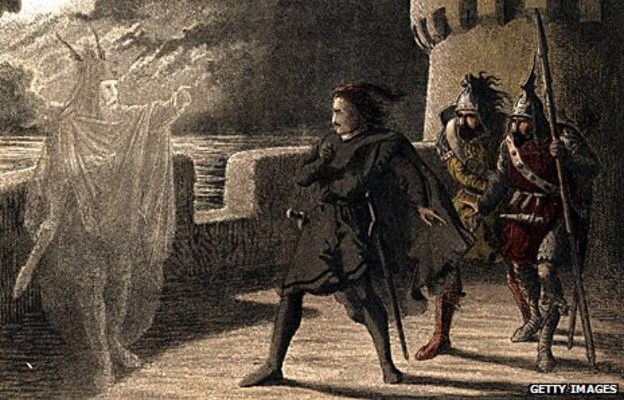
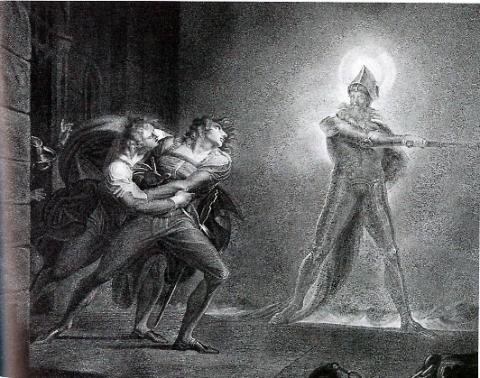
The most potent example of a Shakespearean ghost is definitely the ghost of Hamlet’s father. I actually played this role and, rumor has it, so did Shakespeare himself! Hamlet’s father appears as a ghost two months after his death, and soon after his brother Claudius marries his widow Gertrude. The ghost’s purpose in the play is to get his son’s attention so that he can correct the terrible regicide that Claudius committed, allowing the Ghost to Rest In Peace.
Shakespeare describes the ghost as a pale, sorrowful figure, dressed in full armor. The ghost only speaks to his son in the play, and he begins with a strange and terrifying description of the afterlife:
Make thy two eyes, like stars, start from their spheres,
Thy knotted and combined locks to part,
And each particular hair to stand on end
Like quills upon the fretful porcupine.
But this eternal blazon must not be
To ears of flesh and blood Hamlet Act I, Scene v.
Many scholars believe that the tormenting realm of fire that the ghost describes is actually Purgatory, an old Catholic concept that explains where the souls of the dead go if they are neither evil enough for Hell, or good enough for Heaven. It’s also the place where people go who didn’t confess their sins before death, which was the ghost’s fate since Claudius poisoned him while sleeping.
Though neither Hamlet nor his father explicitly say it, there is a strong implication that Hamlet must avenge his father by killing Claudius, which will presumably release the Ghost from Purgatory allowing it to ascend to Heaven.
Some suggest that the ghost is a manifestation of Hamlet’s superego:
Psychologist Ernest Jones (who studied under Signund Freud) in his book Hamlet And Oedipusbelieved Hamlet had an unresolved Oedipus complex and couldn’t bring himself to revenge because Claudius had achieved the very goals Hamlet himself secretly desires to kill his father and marry his mother
Faced with his guilt and lack of moral integrity Hamlet could have created a supernatural superego to spur him to revenge. As Freud describes it, the superego
The superego is the ethical component of the personality and provides the moral standards by which the ego operates. The superego’s criticisms, prohibitions, and inhibitions form a person’s conscience, and its positive aspirations and ideals represent one’s idealized self-image, or “ego ideal.”
In essence, since (in Jones’ view), Hamlet is too morally corrupt to be an effective avenger for his father, Hamlet imagines the ghost to help justify his revenge to himself. This is of course, only one way of interpreting the ghost and Hamlet as a whole. There is no right or wrong interpretation for any of Shakespeare’s characters, but it is a testament to Shakespeare’s genius that, 400 years after his own death, his ghostly writings helped inspire one the architects of modern psychology.
Ghosts Of Torment
The ghost of Banquo in Macbeth and the ghosts that plague Richard the Third the night before his battle help quicken the murderous kings’ his downward spiral. Macbeth becomes more and more paranoid, and therefore easier for his foes to defeat.
When Julius Caesar’s Ghost appears to Brutus, he does so the night before his final battle- the battle of Philippi, where Brutus was defeated and committed suicide.
When Richard III sees the ghosts of all the people he murdered, it not only terrifies him, it splits his soul in half! According to Sir Thomas More, Richard couldn’t sleep the night before his final battle at Bosworth Field. Shakespeare gives Richard a strange soliloquy where the ghosts awaken his conscience and awaken him from a fearful dream:
Fool, of thyself speak well: fool, do not flatter.
My conscience hath a thousand several tongues,
And every tongue brings in a several tale,
And every tale condemns me for a villain.
Perjury, perjury, in the high’st degree
Murder, stem murder, in the direst degree;
I shall despair. There is no creature loves me;
And if I die, no soul shall pity me:
Nay, wherefore should they, since that I myself
Find in myself no pity to myself? Richard III, Act V, Scene iii.
In these plays, the ghosts are a form of spectral punishment; the punishment of a guilty Conscience.
Shakespearean Friendly Ghosts
The only friendly Shakespearean ghosts appear in Shakespeare’s play Cymbeline and these ghosts appear before the god Jupiter to plead for their descendant, Posthumous Leonidas. They beg Jupiter, the most powerful Roman god, to end Posthumous’ suffering.
Like the witches in Macbeth, ghosts in Shakespeare are mysterious and sometimes frightening – they are sort of a mirror for how we see ourselves, our lives, and our hopes to be remembered after death; the final words Hamlet’s father utters before disappearing into the morning mist are: “Adieu, adieu, remember me.”
Thanks for reading! If you enjoyed this post, please consider signing up for my Outschool class: “Macbeth: An Immersive Horror Experience.” I perform live as the ghost of William Shakespeare and tell the story of Macbeth in an entertaining and spooky way.
Greenblatt, Steven Hamlet In Purgatory 2001. Princeton University Press. Link: file:///Users/jrycik/Downloads/Hamlet-in-Purgatory-Princeton-Classics.pdf
Well, it happened. A man whom I have described as a villain of Shakespearean proportions is now the president. You might have read in my Richard III post that I had hoped that the election would play out like the history play about a deformed tyrannical king with bad hair. What I forgot when I made that prediction was that the king in question, Richard III, does become king for a little while.
Here’s another way of putting it. I found it on the Facebook page of a friend of mine, Austin Tichnor of The Reduced Shakespeare Company:
I don’t want to talk too much about devisive politics because I feel that the country and the world is hurting too much because of people who want to reduce the world into “my party,” “my country,” and turn everything and everyone else into “the other.”
What I want to talk about in this post, is what I hope for our new president, some words of wisdom from The Bard, and maybe some words of healing for those people who feel like “the other,” starting with some of the people I might have offended with my earlier posts.
Why Donald Trump is like Henry V, (we hope).
A lot of people are full of anxiety right now because nobody is really sure what kind of president Trump will be; will he follow through with his campaign promises? Will he take power from those in Washington and give it to the people, as he said in his inaugural address? How much will his past life as a real-estate tycoon influence his work as president? This uncertain climate reminds me very much of the end of Shakespeare’s Henry IV, Part II, where the old king dies leaving the kingdom to his son. Thus far, the prince, (known as Hal to his friends), has been wasting his time drinking in a bar in Eastcheap with his disreputable friend, Sir John Falstaff. Watch this scene where he and Falstaff mock the king and trade insults with each other:
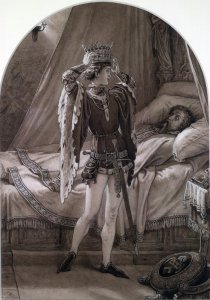
But, on his deathbed the real king summons his son and knocks some sense into him, demanding that he take the job of running the country seriously. In Act IV, Scene v, the prince, (thinking his father is dead) tries on his father’s crown right before King Henry wakes up and curses his son with a long and terrible speech. Below is King Henry’s deep rebuke of his son Hal, detailing his fears of what will happen when the prince becomes king.
Prince Hal tries on his father’s crown. Henry IV, Part II. Act IV, Scene v.
KING HENRY:
What! canst thou not forbear me half an hour?
Then get thee gone and dig my grave thyself,
And bid the merry bells ring to thine ear
That thou art crowned, not that I am dead.
Pluck down my officers, break my decrees;
For now a time is come to mock at form:
Harry the Fifth is crown’d: up, vanity!
Down, royal state! all you sage counsellors, hence!
And to the English court assemble now,
From every region, apes of idleness!
Now, neighbour confines, purge you of your scum:
Have you a ruffian that will swear, drink, dance,
Revel the night, rob, murder, and commit
The oldest sins the newest kind of ways?
Be happy, he will trouble you no more;
England shall double gild his treble guilt,
England shall give him office, honour, might;
For the fifth Harry from curb’d licence plucks
The muzzle of restraint, and the wild dog
Shall flesh his tooth on every innocent.
O my poor kingdom, sick with civil blows!
When that my care could not withhold thy riots,
What wilt thou do when riot is thy care?
O, thou wilt be a wilderness again,
Peopled with wolves, thy old inhabitants! King Henry IV, Part II, Act IV Scene v.
I have to wonder if Obama feels a little like King Henry, since Trump has promised to repeal Obamacare, reverse many of his executive orders, and put his own “Mad Dog” ruffians in charge of the country. I also find it ironic that King Henry is worried about foreign ruffians becoming part of English society, while Trump is worried about keeping them out of America.
The good news is that Prince Hal eventually became a wise and effective ruler. In the play that bears his name, King Henry V united his country, and achieved a famous victory over the French. Everyone in the play was shocked and amazed by how he transformed himself from a drunk into an effective king. Trump has that same opportunity; although his poll numbers are low right now, he can prove his commitment to the job and amaze the country.
This is what I’m sure all of America hopes Trump will do for the country, although I have trouble believing that it will actually happen. It seems more likely to me that he will exploit his position to help his businesses, just as he has done his entire career, and he already shows signs of doing now. It seems unlikely that he will achieve anything that will protect the dignity of Americans, or achieve prosperity for anyone but himself.
I believe that the best we can hope for with Trump is a presidency that mirrors one of Shakespeare’s most mediocre kings. Richard II, who stole land away from his nobles because he believed being king gave him God’s permission to do whatever he wants. Trump was practically quoting Richard, when people wondered about his many potential conflicts of interests between the presidency and his business empire. Moments like this make me and many others like me curse the way businessmen-turned-politicians can give away America’s dignity dollar by dollar, as John of Gaunt famously cursed in Richard II:
JOHN OF GAUNT
Methinks I am a prophet new inspired
And thus expiring do foretell of him:
His rash fierce blaze of riot cannot last,
For violent fires soon burn out themselves;
Small showers last long, but sudden storms are short;
He tires betimes that spurs too fast betimes;
With eager feeding food doth choke the feeder:
Light vanity, insatiate cormorant,
Consuming means, soon preys upon itself.
This royal throne of kings, this scepter’d isle,
This earth of majesty, this seat of Mars,
This other Eden, demi-paradise,
This fortress built by Nature for herself
Against infection and the hand of war,
This happy breed of men, this little world,
This precious stone set in the silver sea,
Which serves it in the office of a wall,
Or as a moat defensive to a house,
Against the envy of less happier lands,
This blessed plot, this earth, this realm, this England,
This nurse, this teeming womb of royal kings,
This land of such dear souls, this dear dear land,
Dear for her reputation through the world,
Is now leased out, I die pronouncing it,
Like to a tenement or pelting farm:
England, bound in with the triumphant sea
Whose rocky shore beats back the envious siege
Of watery Neptune, is now bound in with shame,
With inky blots and rotten parchment bonds:
That England, that was wont to conquer others,
Hath made a shameful conquest of itself.
Ah, would the scandal vanish with my life,
How happy then were my ensuing death! Richard II, Act II, Scene i.
If you’re like me and millions of other people around the country who don’t have a lot of faith in this new government, the question becomes, “What do we do now?”
I believe that once again, Shakespeare can offer words of wisdom and comfort in this moment of doubt and uncertainty. One quote I keep coming back to is from a play you’ve likely never heard of- The History Of Sir Thomas More. You won’t see this text in any collected edition of Shakespeare, because the play is actually unfinished. Only a tiny portion of it survives, and it was never published. It has the incredible distinction to be one of the only surviving play manuscripts from Shakespeare’s day, and if he did write it (which no one can definitively prove), it is the only play written in his own handwriting. Even if Shakespeare did not have a hand in writing it, it is one of the most poignant speeches I’ve ever read, and it has an incredible message for our nation and for the entire world.
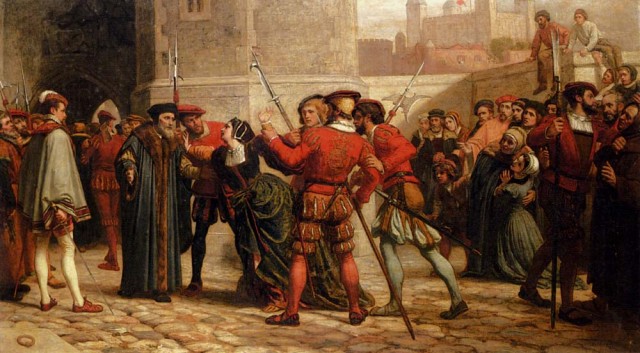
Sir Thomas More (left in the gown), attempting to control a riot.
First, a little background. Sir Thomas More was a real man who worked as Chancellor of England under Henry VIII. He was famously executed for refusing to support the king’s divorce of Queen Katherine Of Aragon because of his devout Catholic beliefs, and for that reason he is still considered a man of great principle and honor. The scene which Shakespeare allegedly helped write however, takes place earlier, when More was just a sheriff of London.
In the speech below, More is trying to break up a riot where a mob of people are trying to murder a group of immigrants from the country, accusing them of stealing jobs from Englishmen, (sound familiar)? More pleads with them to show compassion and to be open to other points of view. Here is More’s speech, performed by Sir Ian McKellen.
Here’s the text of the speech:
Imagine that you see the wretched strangers,
Their babies at their backs and their poor luggage,
Plodding to the ports and coasts for transportation,
And that you sit as kings in your desires,
Authority quite silent by your brawl,
And you in ruff of your opinions clothed;
What had you got? I’ll tell you: you had taught
How insolence and strong hand should prevail,
How order should be quelled; and by this pattern
Not one of you should live an aged man,
For other ruffians, as their fancies wrought,
With self same hand, self reasons, and self right,
Would shark on you, and men like ravenous fishes
Would feed on one another….
Say now the king
Should so much come too short of your great trespass
As but to banish you, whether would you go?
What country, by the nature of your error,
Should give you harbour? go you to France or Flanders,
To any German province, to Spain or Portugal,
Nay, any where that not adheres to England,
Why, you must needs be strangers: would you be pleased
To find a nation of such barbarous temper,
That, breaking out in hideous violence,
Would not afford you an abode on earth,
Whet their detested knives against your throats,
Spurn you like dogs, and like as if that God
Owed not nor made not you, nor that the claimants
Were not all appropriate to your comforts,
But chartered unto them, what would you think
To be thus used? this is the strangers case;
And this your mountainish inhumanity.
Sir Thomas More, Act II, Scene 4.
Finally, here’s a link to view the original manuscript, which is on display in the British Library in London.
The obvious condemnation of xenophobia and hatred of immigrants in More’s speech is obvious, so I won’t belabor it, but it’s worth noting that this problem has been going on for over 400 years. What I’d like to focus on is what More says at the end: when a nation erupts into violence against immigrants it cheapens itself and the world takes notice. Also, it is the job of those in authority to protect, not stay silent when such attacks take place. This is why we need to think carefully about Trump’s proposals regarding immigrants, Muslims , and other such “strangers.”
In a more general sense, I feel that in our divided nation, we all are feeling like strangers. Whether you’re a man or a woman, Democrat or Republican, Caucasian or Non-Caucasian, many thousands of people in this nation all seem to feel that someone is treating them like “strangers,” and our task, all of us, as Americans and human beings, is to “take the stranger’s case,” by looking at other people’s points of view with compassion and an open mind. That, by the way was made Shakespeare a great writer; his own ability to see into the minds of kings and peasants, women and warriors, ghosts and gods.
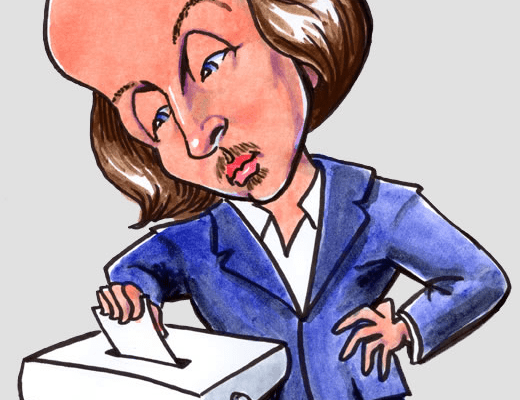
So here’s the big question: whom would Shakespeare vote for? I believe he would vote for whomever would try to learn from the lives of these strangers, and use his or her authority to protect their right to speak their minds. Deciding who that person is, is a task I leave to you.
In 2011, I wrote a graduate thesis about some of the challenges of playing Shakespeare’s Richard III, specifically those related to playing his deformity. What follows in this post is an adaptation of the presentation I gave at the American Shakespeare Center’s Blackfriars Playhouse, in Staunton Virginia. I gave this presentation with the help of my actors, Matt Carter, Jemma Levy, Amanda Noel Allen, and David Santangello. I also interviewed live onstage, one of the ASC’s greatest actors John Harrell and his director Thadd McQuade, about a unique production of Richard that he performed for the company back in 2002. What follows is the script I wrote for the presentation, as well as the video and Powepoint slides I projected for the audience, to help you see my work in performance. You can also consult a website I designed for the ASC’s production of Henry VI, Part III, where Richard was played by actor Ben Curns.
PRESENTATION SCRIPT
MATT CARTER:
Now is the winter of our discontent Made glorious summer by this sun of York; And all the clouds that lour’d upon our house In the deep bosom of the ocean buried. But I, that am not shaped for sportive tricks, Nor made to court an amorous looking-glass; I, that am curtail’d of this fair proportion, Cheated of feature by dissembling nature, Deformed, unfinish’d, sent before my time Into this breathing world, scarce half made up,
And that so lamely and unfashionable That dogs bark at me as I halt by them.
Why, I, in this weak piping time of peace, Have no delight to pass away the time, Unless to spy my shadow in the sun And descant on mine own deformity: Applause, he sits on one of the gallant stools.
Section 1: Introduction
PAUL:
Many of you recognize those famous lines from the opening soliloquy of Richard III, ably delivered by Matt Carter. Did you notice the ways Matt was moving and the qualities of his voice? Tonight, my actors and I will show you some of the choices actors have made in playing the deformity of Richard III. Deformity and Richard are so closely linked that I would argue that it is the central driving force of the character. The different performances we will discuss show changes in views on deformity, as well as changing theories on the actor’s craft.
Every actor is interested in the human body, every actor is interested in how the mind and body work together, and most importantly, how to present the mind and body of a character to an audience in a clear and articulate way. No matter how the actor decides to represent it, Richard’s deformity of mind and body are essential to the understanding of the character. In his first soliloquy, in the play Henry the Sixth, Part III, he expresses a deep pain, sorrow and bitterness at being denied a normal body. As Jemma delivers this speech, ask yourself- do you pity him? Does this man have a reason to be angry?
JEMMA LEVY:
Why, love forswore me in my mother’s womb: And, for I should not deal in her soft laws, She did corrupt frail nature with some bribe, To shrink mine arm up like a wither’d shrub; To make an enviousmountain on my back, Where sits deformity to mock my body; To shape my legs of an unequal size; To disproportion me in every part, And am I then a man to be beloved? O monstrous fault, to harbour such a thought!
Henry VI, Part III, Act III, Scene i.
PAUL:
In this speech, like the previous one, Richard expresses the belief that his deformity was a curse, laid on by his mother. During the Renaissance, people believed that deformity was a mark of evil and a sign of being cursed by God. Like the Mark of Cain in the Bible, Richard’s deformity signifies that he was “determined,” (presumably by God), to prove a villain.” The deformity also gives Richard psychological motivation. Lacking a normal body, Richard is hungry for revenge, and in search of something to elevate himself above more fortunate people- power.
Section 2: Burbage
PAUL: The first Richard was almost certainly Richard Burbage, Shakespeare’s star actor. Burbage was associated with the role long after his death.
DAVID SANTAGELLO:
‘A funerall Elegy on the death of the famous Actor Richard Burbage:
Who died on Saturday in Lent, the 13th of March 1618′
No more young Hamlet though but scant of breath
Shall cry revenge for his dear father’s death:
Edward shall lack a representative,
And Crookback, as befits, shall cease to live.”
PAUL:
Unfortunately, we have no information on how Burbage played the deformity, but we have one clue as to how his performance might have been received, in the form of an apocryphal story from the diary of law student John Manningham, on 13 March 1602:
AMANDA:
Upon a time when [Richard] Burbage played Richard III,
There was a citizen grew so far in liking with him that before she went from the play,
She appointed him to come that night unto her by the name of Richard III.
Shakespeare, overhearing their conclusion, went before, was entertained, and at his game ere Burbage came.
The message being brought that Richard III was at the door,
Shakespeare caused return to be made that ‘William the Conqueror was before Richard III.’
PAUL:
Although this story is apocryphal, it does hit upon other features of Richard’s deformity- his supreme confidence, and his beast-like sexuality. Scholars have pointed out that Richard’s lack of scruples, (the result of being born deformed), makes him completely focused and confident. Likewise, his non-conformity to traditional standards of beauty could also be seen as a rebellion against societal norms, and thus, a strange aphrodisiac. This dark creature, without a recognizable human shape, manages to exert a dark pull on the audience.
Section 3: Cibber
Surprisingly, for nearly 300 years, portrayals of Richard III have been heavily influenced by an obscure author who was not even Shakespeare’s contemporary
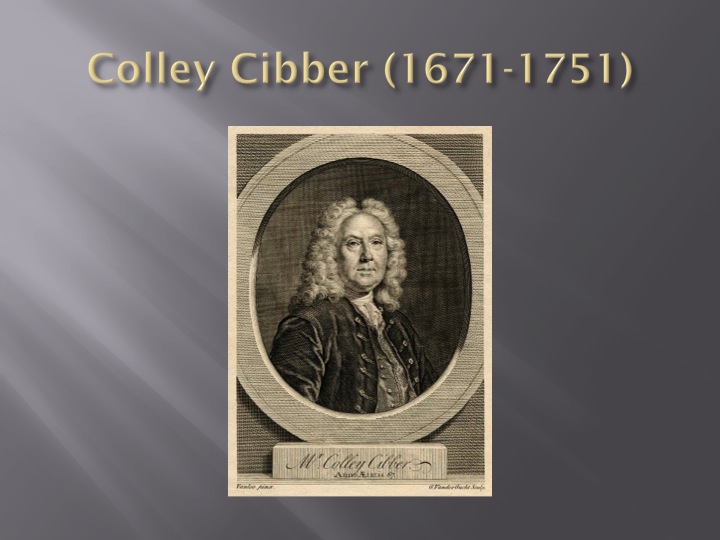
During the Restoration of theater in the 17th century Shakespeare’s plays were largely out of fashion, condemned by critics as “too vulgar for this refined age,” and playwrights began to rewrite and adapt them. The most successful adaptation of Richard the Third, came from poet-laureate Colley Cibber in 1671. Cibber’s text interpreted the story as one man’s evil rise to the crown, not the culminating story of the Wars of The Roses. Cibber cut most of the history involved. He condensed scenes, omitted others, and gave Richard 10% more of the dialogue, then Shakespeare. Cibber’s text also re-emphasizes the importance of deformity to Richard’s character- adding 8 more uses of the words “deformed,” or “ugly.” To further the point, Cibber inserted text from other Shakespeare plays that speak about Richard’s deformity, such as the Henry VI speech spoken earlier. Cibber freely cut-and pasted from Shakespeare’s histories, which can be demonstrated in this speech where the Lady Anne mourns for the death of Henry the Sixth, using lines written by Shakespeare for the funeral of King Henry the Fifth:
AMANDA:
Hung be the heavens with black, yield day to night! Comets, importing change of times and states, Brandish your firey tresses in the sky, And with them scourge the bad revolting stars That have consented unto Henry’s death!
O be accursed, the hand that shed his blood
Accursed the head that had the heart to do it! If ever he have wife, let her be made More miserable by the life of him As I am made by Edward’s death and thine!
PAUL:
Cibber also wrote his own speeches for Richard, such as this one where Richard resolves to woo Lady Anne in spite of his deformity:
JOHN HARRELL:
But see! My love appears. Look where she shines
Through her dark veil of rainy sorrows
Tis true, my form perhaps may little move her;
But I’ve a tongue shall wheedle with the devil.
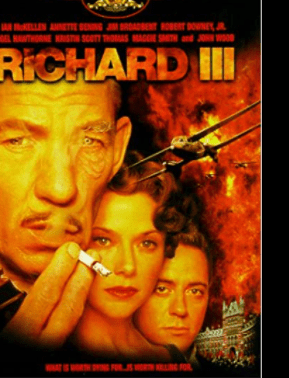
PAUL: Cibber’s text was extremely popular with actors because it raised Richard’s importance to a star role. Actors such as David Garrick made their debut as Cibber’s Richard, and some of Cibber’s editorital choices still survive in the two movie versions of Richard by Ian McKellen and Laurence Olivier.
Section 4: Olivier
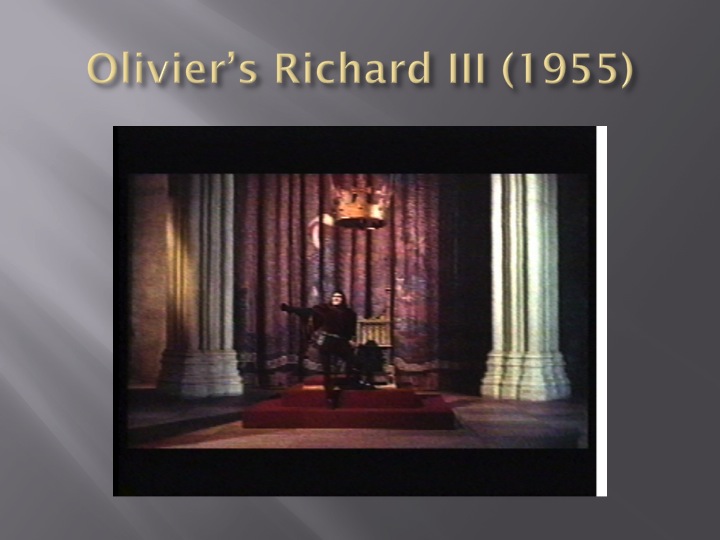
Olivier, in the 20th century was considered the definitive Richard. In his film version he emphasizes Richard’s evil and deceptive nature. He uses the character’s physical disabilities (as well as various cinematic techniques) to reveal his moral depravity.
The Crown of England- the tremolos and the large crown that appears in the beginning, middle, and end of the film. Homage to Cibber.
CINEMATIC USE OF DEFORMITY
Long camera angles as he limps away, exposing hump and limp
Shadowy silhouette
In this shot, Richard slinks away from the camera, leaving his bizarre silhouette to unfurl like a snake
In this shot, Richard bends over to whisper evil thoughts into the king’s ear.
Finally, in this shot, we see the shadow of Richard’s head, as he stares into the cell of his brother Clarence, as he plans his murder. We see through this shot, Richard looms as a great evil presence.
Section 5: Sher
After Olivier, actors abandoned the approach of making Richard into a monster, and favored a more human, natural approach.
The role of Richard III however, presents unique challenges for actors attempting to do this; they are attempting to do something un-natural by playing a deformity that they do not actually have. Thus they are attempting to play something “un-natural” within the precepts of naturalistic acting.. Antony Sher’s massive preparation for the role, using Method acting techniques, included both a thorough research into the physical effects of real disability, and a deep examination of its psychological effects.
Used Method acting techniques to create the role:
Real-life experience- Crutches came from his own real injury.
Research into physical deformity.
Textual Research
Image Research. He used Margaret’s text to create a visual design for his character, a bottled spider.
Psychoanalysis- brought Shakespeare’s text to a real psychiatrist to “put Richard on the couch.”
Sher’s technique led him to go into a deep, psychological probing of Richard’s mind. He viewed the deformity as a source of deep pain, through which we can identify with Richard as a human being.
Listen to how David, applying Method-inspired text analysis, conveys Richard’s human emotions.
DAVID:
But I, that am not shaped for sportive tricks, Nor made to court an amorous looking-glass; I, that am rudely stamp’d, and want love’s majesty To strut before a wanton ambling nymph; I, that am curtail’d of this fair proportion, Cheated of feature by dissembling nature, Deformed, unfinish’d, sent before my time Into this breathing world, scarce half made up, And that so lamely and unfashionable That dogs bark at me as I halt by them;
PAUL: Sher’s massive preparation for the role represent the limits that an able bodied actor could go to portray a disability he himself did not have.
Section 6: From Sher to Harrell
Sher’s Richard created an unexpected backlash from disabled community.
One response to this: a number of Richards played by disabled actors.
Henry Holden in 2007. Like Sher, on crutches, only he needed them.
Peter Dinklage played the role with none of the traditional deformities.
His size was a kind of disability, as it literally hindered him from taking the crown–
He was tangled in his robes,
Couldn’t reach the throne.
Critics writing about the performance claimed watching him was more real. You weren’t watching a performance, you watched a real man, with a real struggle.
Another response is approaching the deformity from a more stylized perspective.
This was the approach favored by Thadd McQuade.
The essence of this performance was watching a man struggle through life trying to overcome obstacles and find a place for himself in the world, a struggle that is the essence of all tragedy.
Section 7: 10 minute interview with Thadd and John.
Both– Explain the way you chose to represent deformity (bowling ball) and why.
John- I got an email from actor JP Schiedler, (who was in the production) who said “ As I recall John was very interested in working inside of some form of restriction which forced his body to adapt, struggle and physically change how he could deal with the world around him which the ball did.” If this is true, I’d like you to talk about this idea- why was it important for you to have something that restricted you? I want to get an idea of how you saw the physicality of Richard and how it is important to the character.
Thadd, when I interviewed you, you mentioned that doing the play naturalistically can actually be off-putting because an able-bodied actor will never completely pull off the deformity. I want you to repeat some of that to explain the virtues of a more presentational Richard.
Both- How did your techniques contribute to a better understanding of the play for the audience?
Conclusion: Richard’s deformities and disabilities are both physical and psychological. They are the driving force in his life. Portraying Richard’s deformity is a microcosm of the challenges that face all actors: making choices of how to explore the mind and body of a character. Watching an actor take on the challenge of portraying this man’s struggles. This struggle is the essence of tragedy and watching an actor take on the challenge of creates powerful and poignant theatre.
This app looks incredible, listen to this satisfied customer:
So far, the only play on the app is “The Tempest,” but hopefully if enough people buy it, it’ll expand and encompass all the plays. I hope you’ll check it out!
Introducing our new Play of the Month: Shakespeare’s dark history play about murder and corruption, Richard III. First, a short presentation I made that introduces the characters and themes of the play.
Second, a quick, funny summary of the play from the Reduced Shakespeare Company
And finally, this incredible animated version of the play, which looks like a stained-glass window come to life!
Well, Christmas is almost here; soon many of us will be traveling home to celebrate the holidays with our families, enjoying parties, presents, carols, and decorations. However, our modern traditions weren’t always the norm for people who celebrate Christmas. In the interest of historical curiosity, we here at Shakespearean Student would like to talk a little bit about how William Shakespeare might’ve celebrated Christmas!
As with everything in Shakespeare’s life, many times scholars have nothing but “what if’s” to go on, because few records exist, there were no photos from the period, and very few documents survive related to Shakespeare. He also kept no journals or diaries to record what his life might’ve been like. However, based in the holiday traditions of England that have lingered on to this day, we can surmise what Christmas might’ve been like in the late 16th century.
Part 1: Stratford
Shakespeare was born in 1564, in the town of Stratford-Upon-Avon in the county of Warwickshire England. As I mentioned earlier, Shakespeare would not have known many of our modern Christmas traditions. The Christmas Tree as we know it didn’t come into being until Queen Victoria’s reign, (and she certainly didn’t light hers with electric lights). Victoria also invented the idea of putting presents under the tree. I’m not an expert on Christmas, but my research would indicate that probably Elizabethans like Shakespeare didn’t even give out presents on Christmas Day! Instead, in country towns like Stratford in Tudor times, Christmas was a time of feasting, singing, caroling, and theatre!
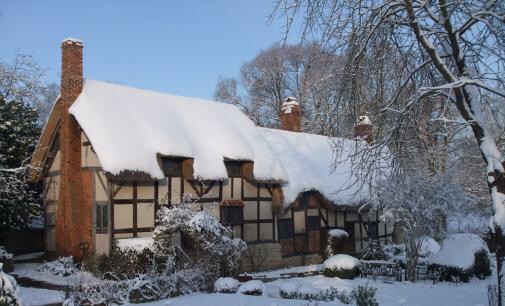
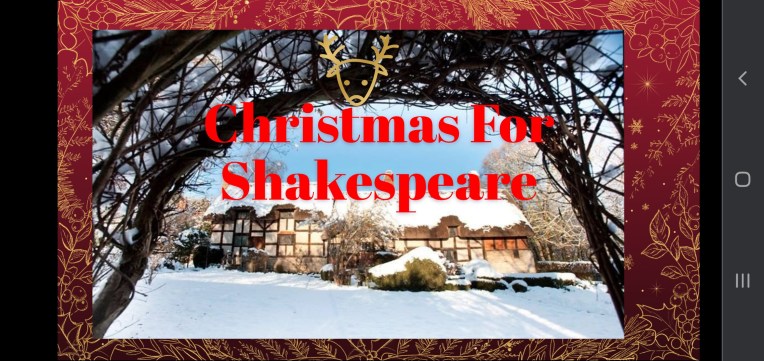
The Shakespeare family home at Christmas
The Christmas season in Shakespeare’s day usually extended from Christmas Eve to the twelfth night after Christmas also known as Twelfth Night or Epithany. Common people usually decorated their homes with holly and ivy, and celebrated Christmas Eve by lighting their homes with candles and by burning the Yule log, an ancient tradition dating back over 1,000 years when the Vikings controlled most of England. It was a symbol of light and warmth in the darkest time of the year.
Replica of Shakespeare’s kitchen.
Feasting-
Roast goose was a staple of the common man’s feast at Christmas. In 1588, Queen Elizabeth commanded the whole country to consume geese to commemorate England’s victory over the Spanish Armada. Other traditional fare included plum porridge, beer or ale, and the most celebrated Christmas beverage of all: Wassail!
Wasailing-
The old tradition of caroling comes from an ancient pagan holiday tradition of showing charity to the poor at the winter solstice. People would go door to door asking for alms and occasionally a warm beverage. This ancient practice evolved into caroling and Wasailing!
The word “wassail” is an old Celtic word that means “lambswool,” it refers to the fact that the drink is covered with a thin foam that looks kind of like the wool of a sheep. It is also derived from the Anglo-Saxon “wassail,” which means “be in health,” so it is simultaneously a drink, a toast, and an explanation of what the drink looks like.
Like our modern-day caroling, people would sing and dance going door to door asking for a traditional glass of wassail or a mince pie. A mince pie is a traditional meat pie that is often filled with 12 different ingredients to symbolize the 12 days of Christmas.
Mince pies were popular with both peasants and kings, and contains both fruit and different types of meat including rabbit chicken duck and hare.
Wasailing also has its roots in ancient pagan holidays and that’s why it’s often accompanied with a traditional Morris dance, where the dancers are waving handkerchiefs, knocking sticks together and dancing with brightly colored ribbons. This was a great tradition back in the small towns and shires of England and continues to this very day. Below you’ll find a video where you can make some wassail yourself! I Just a note that in this recipe, the cook has left out the alcohol and has also left out the egg which is necessary to create the foamy lambswool. Nonetheless I think it’s a very good recipe and I welcome you to try it for yourself.
Plays–
As the mayor’s son, young William had a VIP pass to see all traveling actors who came to town. Shakespeare’s dad would’ve decided who got to perform at the guild halls and local inns, so he and his son would’ve watched private performances of all the shows first. After that, John Shakespeare decided who got to perform, and who would be sent away. In addition to professional troupes at Christmas, craftsmen in Will’s hometown people in Warwickshire would come together and put on a show! These amateur dramatic pieces were known as Mystery Plays.
Mystery Plays got their name from the old meaning of mystery: a trade or skill. Much like modern nativity plays or community theaters, every year all the craftsmen from the town would put on a series of short shows derived from Bible stories at Christmas time, and showcase their crafts as well as their acting talents. For example the goldsmiths were in charge of the Three Wise Men story.
We know that Shakespeare liked these plays because he refers to one in particular many, many times: The play of King Herod. in the Bible, Herod The Great is fearful of the baby Jesus and sends his soldiers to kill any young baby that they can find in the city of Jerusalem. Very often when Shakespeare refers to any of his villainous characters he describes them as Herod-like.
The Mysteries were printed during Shakespeare’s lifetime and people in York, Coventry, and Wakefield England still perform them today! Here’s a video of a little girl who performed in the York Mystery play last year:
I hope you enjoyed this little sojourn into the ancient traditions of the common folk back in Shakespeare’s England.
If you liked this post, please consider signing up for my new online class, “What Was Christmas Like For William Shakespeare?” I’ll go further into the traditions of Elizabethan Christmas and add some insight into Shakespeare’s play “Twelfth Night.” Register now at Outschool.com!
This story is my own invention, but it is based on historical fact and some ideas that could be inferred from Shakespeare’s life and career, composed for Friday the 13th, 2015. I hope you enjoy it.
November, 1603.
The bell tolled in St. Paul’s Churchyard, stopping the bustling crowd in their tracks. A solemn wind blew through the crowd, like there was some dark magic in the air. Though the old queen had died months ago, all god-fearing Englishmen were still in mourning for her death, and spared a thought for the virgin queen as they passed out the long nave of the church into the yard. William Shakespeare was in mourning as well, but not for the queen; he was worried about the future of his company; without the queen’s sanction and protection, the theaters might be closed for good this time, (not one of these Newsmongers who gossiped at Paul’s Walk seemed to know how the young King James would take to plays and theater. The young man had had a life more dramatic than anything Will hat put to parchment- mother executed, father murdered, fighting off plots and murder attempts his whole life. “They say his mother’s head whispered a prayer when it was cut off” one of the gossips had told Will. “I heard talk his father was killed by cannon,” another whispered.” Shakespeare began to think of his old play Henry the Fourth, where he himself played the character of Rumor, who spoke with a million tongues, and not one of them true. Suddenly, from over the Bard’s left shoulder, came a slow deep voice that overpowered all the rest: “I heard t’other day the king fears being killed by witchcraft.” The voice came from one of the booksellers in the square.
Woodcut from the witch trial of 1597, in which witches supposedly tried to drown King James I.
As a writer, Shakespeare often came to St. Paul’s to buy books from the stalls at Paul’s Churchyard. He knew many of the booksellers by name, but he’d never seen this one before. His chest and arms were big as an ale barrow and his beard was grizzled and split into two forks, but what the poet marked in the man most was his piercing eyes- ones that stared at him like fire from an oily taper- quick and dancing, with an excitement as fiery as his own. “Tis true, the king were nearly shipwrecked as a boy by a coven of witches. 13 there were, always 13. They gathered on Fridays for their cursed Witches’ Sabbaths, and summoned up storms to sink the royal barge. The elder witch spoke to the King at Holy Rood house and told his majesty prophesies. She knew all the privy conversations he had with his wife, though she’d never seen him before! His majesty gasped in wonder and had her hanged and burned.” “Fine tale, said the playwright.” “Aye,” said the fire-eyed seller, but the king fears most of all the Wyrd Sisters, who foretold the deaths of his ancestors at the hands of King Macbeth.”
Shakespeare began to smell a devise- to appease the king, he would write a play honoring James’ noble ancestors and condemning this Macbeth as a villain. Shakespeare knew this kind of historical flattery would work; his tragedy of King Richard III had been a great success and the old queen had made him a courtier soon afterwards. Now he just needed to get his hands on some Scottish history to concoct a new play for the King. “Have you a copy of the Chronicles of England and Scotland?” “Nay, me press be not ready yet for the latest edition. But the best story of King Macbeth is an ancient tome written by the Elder Witch herself. Few have seen it, and fewer live to tell its secrets. If ye travel to Scotland, look for the book in the hands of a woman with hair red as flame, and eyes sea-storm blue.” Shakespeare thanked the man, wrapped himself in his cloak, and left the shop in a huff. The bookseller pondered the poet and smiled: “Wicked flame from wicked smoke. Envy burns black beneath thy cloak.”
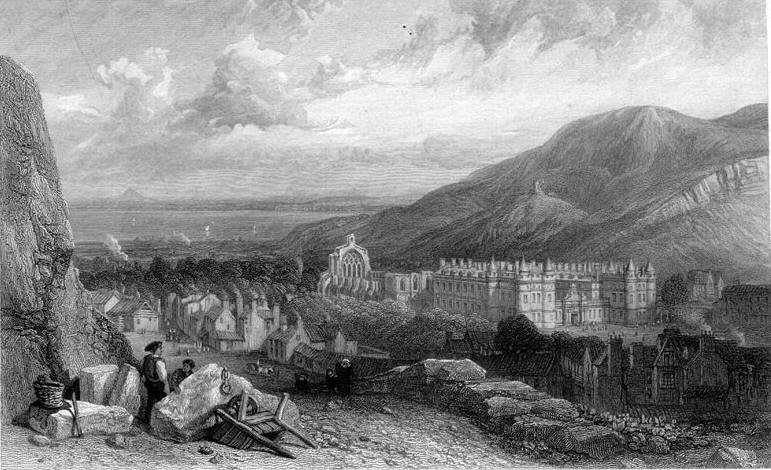
Holyrood House or “Holy Cross Palace” as it looked in Shakespeare’s day from Calton Hill in Edinburgh.
Over the Christmas holiday, Shakespeare’s company received a summons to court to perform some entertainments before the new King! The Chamberlain’s Men were delighted and Will was quite relieved. The King ordered the players to perform at Holy Rood house in Edinburgh, as his court was still in procession from Scotland to England. “Masters,” Will shouted, “Let us give the new king a taste of our quality, and may he pay handsomely for it!” Will and the other shareholders in the company decided on a series of plays to perform for the king, and began the journey to the wilds of Scotland. On Christmas morning they set up their temporary Tiring house within the great banquet hall for the performance, placing props and costumes behind a series of tapestries.
At suppertime the chamberlain gave word to light the candles within the hall, and signal the actors to perform the play, which Will had selected as King Henry the Fourth; a clever choice by Will since it depicted an old king passing the crown to a young and energetic monarch. As the king and courtiers processed, Will spied through the tapestry a haunted looking young woman at King James’ elbow, dressed in courtly gowns with a green veil on her head. The chamberlain directed everyone to their seats and announced the start of the play. To Will’s annoyance, he addressed the company “Mr. Shaxberd and company,” but there was no time to be annoyed or intrigued. “The play’s the thing,” Will muttered, and took his place backstage.
End of Part I.
Part II
The performance was a terrific success! The king himself applauded and promised to patronize the entire company. All of Will’s dreams seemed to be coming true! That night, as he and the other players were packing their belongings into a wagon and preparing to leave the castle in search of a nice, cheap inn for the night, a pale breathless messenger arrived and informed Will that the King wished to meet with him to commission work for their next court performance. Will dutifully walked back up the battlements and entered the castle.
“The Murder of David Rizzio” by William Allen, 1883.
The servant directed him, not back into the ante-chamber of the Great Hall, but up one of the staircases on the North East tower. This tower housed the royal bed chambers! What on Earth was a mere poet from Stratford doing up here? The servant’s candle cast strange shapes upon the walls and the flame blazed upward like some bronze blade. Shakespeare knew from the gossips that the King’s mother had watched her lover David Rizzio be murdered in this very tower- he was stabbed 56 times by jealous Scottish nobles who wished to marry the queen and take the throne. Gruesome images flickered in the poet’s mind. At last, they came to an archway with four adjacent chambers. Three were heavily guarded by English soldiers with halberds but the fourth was unprotected. Slowly, ever so slowly Shakespeare nodded to the servant, and stalked along the pathway. Before he could nock, the door swung open. Pausing a little, The Bard stepped inside.
The room looked like a mix between a library and a crypt with a cold stone wall, a small altarpiece that looked barely used, and several oak bookcases piled high to the ceiling. Once the playwright entered the room, the door shut without warning. He couldn’t see who shut it and the shock put something cold in his blood. Shakespeare’s eyes adjusted to the darkness of the room.Moonlight gave the place a silvery glow, until a shadow came out of the darkness and revealed itself as a woman’s face. Shakespeare could barely make out her features but it was clearly the woman he’d seen in the procession. The Moon made her red tresses shimmer and gleam, as if she were a fairy from one of the dark pools of legend. “I am Princess Elizabeth,” she replied in a voice that seemed more solemn than proud of her royal title. Recovering from his initial shock, the poet bowed low and counterfited his best courtier’s smile. “I am Master Will Shakespeare, at your service.”
“I know who you are. They call you the Bard of Avon. You’ve written sad stories of the deaths of kings, and woven yarns of the fairy queen,” the princess said in a hollow voice that chilled the poet to the core. “When I was little,” said the princess warming slightly, “My mother spoke of how Irish Bards could change their forms, and speak with the spirits of the dead. Sometimes they even outmatched witches who danced with the devil on Friday nights. You seek my family’s patronage?” “Yes”, said Shakespeare tentatively, “And may I prove worthy of such an honor.” “Beware your ambitions,” Elizabeth went on.
“My family has been torn apart by ambitious men. You know I take it that the chamber we stand in was where my grandmother watched her servant die. She lost the crown, and never saw her son again. Death stalks ambition in Scotland. Some say the Devil tempts men to dance with him on nights like this, and signs their name in his book. My ancestor Malcolm fought armies from Hell to keep his crown.” “From King Macbeth,” replied Shakespeare, (his breath finally returned). “I am the keeper of a history of that damned king, but I will not share it with anyone. He sold his soul to a witch to get the crown, and his book is full of spells that curse the reader. I brought you here so that you can lift our family’s curse with your writing. When you get my father’s patronage, do not feed his fears with stories of witches and prophesies or the curse will envelop the throne. Heed my warning, and do not look for the story of King Macbeth.”
As mysteriously as it had closed, the door opened again. The Bard bowed politely and left the chamber. As he left, he saw the Princess kneeling at the shrine at the corner of the room, eyes closed and meloncholy.


















![Candleglow%20PR%20small[1]](https://shakespeareanstudent.com/wp-content/uploads/2015/12/candleglow20pr20small1.jpg?w=764)






 The Shakespearean Student