
I just got a copy of the Shakespeare Game in honor of Shakespeare’s birthday! Here are a few reviews and videos!
https://boardgamegeek.com/boardgame/365920/shakespeare-game

I just got a copy of the Shakespeare Game in honor of Shakespeare’s birthday! Here are a few reviews and videos!
https://boardgamegeek.com/boardgame/365920/shakespeare-game

Happy Black History Month Everyone! Today I’m paying tribute to a great actor and activist, Mr. Ira Aldridge (1807-1867).
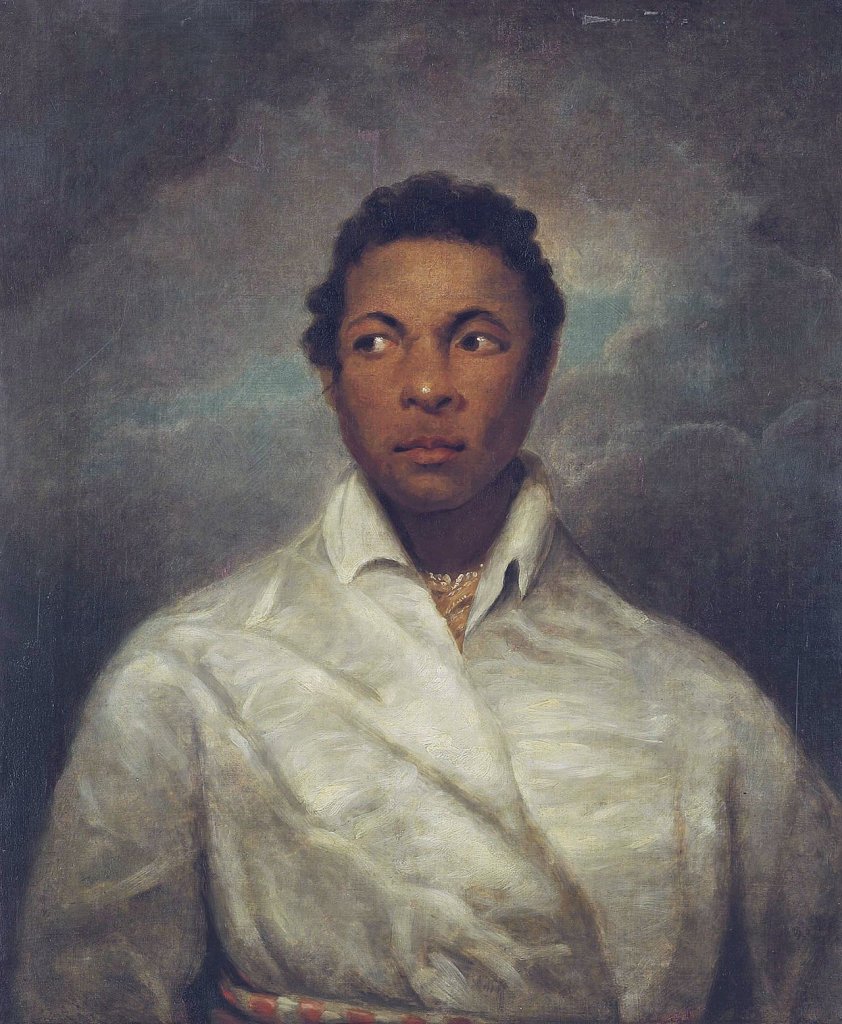
Mr Ira Aldridge was not only a great actor but also an influential figure in the abolitionist movement. He rose from the depths of discrimination and dehumanization to become a famous, respected international actor. Furthermore, his life was marked by creating new opportunities for himself and other people of color.

True feeling and just expression are not confined to any clime or colour.
Ira Adridge
Born in New York in 1807, Mr. Aldridge had dreams to found an all-black theater even as a teenager. His first job was with William Brown’s African Theatre, the first African American theater company. However, discrimination and racism blocked Mr. Aldridge from success in New York, when another theater manager “hired thugs to beat up the actors”. The theatre subsequently burned down and the actors were abused by the New York police. Undaunted, Aldridge decided to take his talents to England, boarding a ship, and arriving in the early 1820s. (Howard, qtd in Thorpe 1). Even though he faced discrimination and violence as a child, Mr. Aldridge would not be deterred. Soon his skill as a Shakespearean actor would soon command respect from all.3.) He refused to be defined by the color of his skin, but by his skill as an actor.

In order to become a professional actor, Ira Aldridge boarded a ship to London and became a Shakespearean actor in the early 1820s. He not only became the first black actor to play the role of Othello, he also played other roles such as Shylock in The Merchant of Venice, Gambia in The Slave, and other roles that denounced the evils of slavery:
Aldridge chose to play a lot of anti-slavery roles, including Othello, as well as the standard lead parts in the repertoire,” said Tony Howard, professor of English at Warwick University.

Not only did his performances call attention to the evils of slavery, they also challenged preconceived notions of what black people were capable of. As you can see in this reproduction of Mr. Aldridge’s 1851 tour advertisements, Ira Aldridge chose to bill himself as “The African Roscius,” a reference to an ancient Roman actor. His performances were heralded for his poise and dignity. The Leeds Times highlights “The passions he admirably portrayed in the human breast.”

No sooner did the Moor make his appearance, than I felt myself, I confess it, instantly subjugated, not by the terrible and menacing look of the hero, but by the naturalness, calm dignity, and by the stamp of power and force that he manifested.
Ira Aldridge
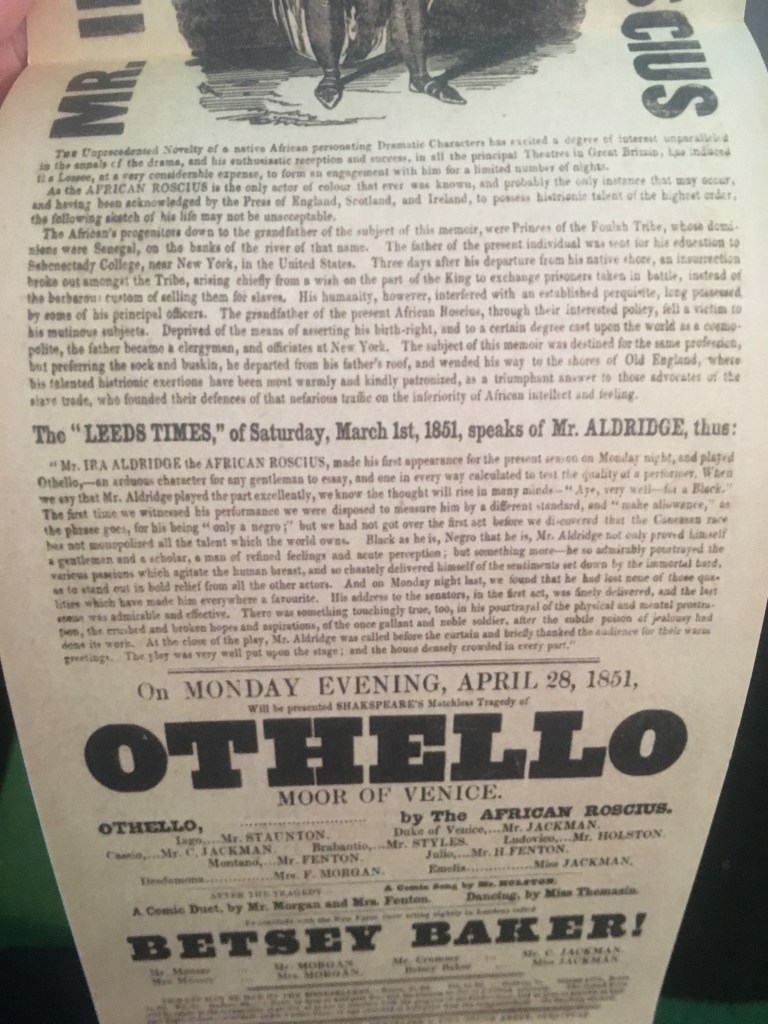
From 1820 to his death in 1867, Mr. Aldridge toured more than 250 theatres across Britain and Ireland, and more than 225 theatres in Europe. Though he had much more success in Europe, Mr. Aldridge still had to confront prejudices. According to ArtUK.org:
One scathing (and racist) review for The Times claimed that: ‘His figure is unlucky for the stage; he is baker-knee’d and narrow-chested; and owing to the shape of his lips it is utterly impossible for him to pronounce English in such a manner as to satisfy even the fastidious ears of the gallery.’
https://artuk.org/discover/stories/ira-aldridge-a-brief-visual-history-of-the-black-shakespearean-actor
Thus, Aldridge’s performances confronted and challenged racist views of whether or not a real black person could play Othello, subtly changing the hearts and minds of the European public, at a time when the question of slavery threatened to rip Europe, (and later the United States) apart.
Although Aldridge didn’t arrive in Britain with the sole purpose of promoting the abolitionist movement, his impressive skill, charisma and oratory capabilities inevitably swayed public opinion. He became known for directly addressing the audience about the injustices of slavery on the closing night of his play at a given theatre (Source: https://artuk.org/discover/stories/ira-aldridge-a-brief-visual-history-of-the-black-shakespearean-actor )
As I’ve written before, Shakespeare has a complicated relationship with the American Civil War, and ironically, many people in the Civil War were Shakespearean actors. More importantly, England at this time was deeply divided about whether or not to support the Union or the Confederacy. England was embroiled in the cotton trade with America, and thus had an economic incentive to support the South. At the same time, public opinion was very much against slavery at the time, and Aldridge helped keep England’s public within that mindset.

Ira Aldridge cared about abolitionism and making life better for black people, especially actors. Not only did he speak out against slavery onstage, he also helped change hearts and minds in local communities. According to ArtUK, in 1828, Mr. Aldridge was approached by Sir Skears Rew to become the new manager of the Coventry Theater. He was the first black man to manage an English theater. Aldridge became a beloved member of the community of Coventry and may have helped inspire the community to petition Parliament to abolish slavery. EThus, Mr. Aldridge’s success in Europe helped open doors for European black actors and encouraged the abolitionist movement, while his sympathetic portrayals of former slaves and oppressed peoples helped change hearts and minds.
“Aldridge has always interested black stars, but the wider influence he had is not well known,” said Howard. “Robeson was a great fan of his, and when he came to London to play Othello in 1930 at the Savoy, he put on an exhibition about Aldridge in respect of his memory.”
Vanessa Thorpe: “From 19th-century black pioneer to cultural ambassador of Coventry.” The Guardian, November 12th, 2016. https://www.theguardian.com/uk-news/2016/nov/13/black-theatre-ira-aldridge-coventry-slavery
For nearly 100 years, actors and devotees of Mr. Aldridge have been inspired by his life. As the quote above indicates, the next great American Shakespearean Paul Robeson helped build his career on Aldridge’s success; being the first black man to play Othello on the American stage, and eventually touring Europe himself as an actor and a distinguished opera singer. Click below to read more about how Aldridge inspired generations of black actors, and his tours helped bring Shakespeare to many previously unknown European countries.
https://www.shakespeare.org.uk/explore-shakespeare/blogs/legacy-ira-aldridge/
In modern films and plays, Mr. Aldridge is remembered as a hero, and rightfully so. In the play “Red Velvet,” actor Adrian Lester plays Aldridge and highlights his struggles and successful contributions to the theatre. He was not only a great actor but a dignified and courageous champion of the rights of all people. I’m proud to conclude my black history month posts with this review of the life and career of a man who inspires all Shakespeareans and turned his profession into a powerful call for change.
Stratford-upon-Avon’s first Black Othellos
https://www.folger.edu/blogs/shakespeare-and-beyond/ira-aldridge/
https://www.chicagoshakes.com/education/teaching_resources/teacher_handbooks/red_velvet/ira_aldridge

In this virtual version of my popular “Macbeth” course, you will engage with William Shakespeare himself and learn about his play in a fun, spooky, and interactive way!
Unlike my previous “Macbeth” course, all teacher interactions will be done through the use of pre-recorded video.
Through a combination of multimedia lectures, online games, and a digital escape room, students will delve into the plot, characters, and themes of “Macbeth.” The class is designed to be interactive, fun, smart, and spooky.
The class is organized into five parts using a combination of Nearpod, online games, videos, and a digital escape room.

You will play a video where William Shakespeare (played by me), will introduce the plot, characters, and literary terms in the play, “Macbeth,” The video will feature graphics, video, and recordings that will explain the plot and who the characters are, and their significance to the plot. Shakespeare will also take time to define a series of vocabulary terms like “soliloquy” and “tragic flaw,” terms that explain his unique writing style and how he constructed his tragedies.
After the video, students will participate in a group quiz via Nearpod. The quiz will cover the vocabulary words the students just learned, as well as the characters. and see their scores that will show how well they applied their knowledge from Part I.


Students will learn via Nearpod and Youtube about the English King James I, the monarch for whom Shakespeare wrote “Macbeth.” First, the students will read 1-3 slides with some historical details about the king. Then the students will watch a funny parody song about the life of the Stuart monarchs and answer questions about King James’ life. The section will conclude with slides and a virtual tour of Parliament about the infamous Gunpowder Plot, where an assassin tried to blow up the English government!


Using Nearpod, students will delve into the tragic history of the persecution of witches, which Shakespeare incorporated into “Macbeth.” The students will then read an article about the characters of the witches and answer open-ended questions on Nearpod. Next, the students will read an article about the alleged ‘Curse of Macbeth,’ and learn about the long-standing theater superstition. The class will conclude with an online game via Scratch, where you play as Macbeth and deliver the famous Dagger Speech before going to kill the king.


As you know, I’ve played Macbeth professionally and have written articles about the experience. Using Nearpod slides, online articles, and a Youtube video of Sir Ian McKellen, students will deconstruct the process of creating a Shakespearean character, and how actors make famous speeches fresh and alive.
Part V: The Digital Escape Room (Spoiler Free Version)
In a combination video/ website, Shakespeare will direct the students to a digital Escape Room, a game where students pretend that the witches from Macbeth have trapped them and Shakespeare in a cursed castle, and the only way to get out is to finish a series of puzzles that cover the characters and vocabulary they learned. The Escape Room will include word searches, decoding ciphers, a sinister forest, and a clever interpretation of the famous dagger speech. The video is designed so Shakespeare allows you to solve the problems independently, or with him guiding you through them. Each puzzle you solve, you enter in a Google Form, getting you one step closer to escaping the cursed castle.


Richard the Second: “Non sans Droit?” by Paul Rycik
The motto which I titled this post means “Not Without Right.” I chose it because it’s Shakespeare’s family motto, but also because in my view, Richard the Second is a play about the Divine right of kings; it asks whether kings are appointed by God, and if so, does that mean that they are free to do what they want, and whether or not they can be deposed. Today I want to examine how these questions are addressed in the play. I’ll do this by showing you passages from the text on video with a few notes by me. These recordings are by the Royal Shakespeare Company, England’s premiere acting troupe.
Picture #1- The Wilton Diptych
http://www.nationalgallery.org.uk/cgi-bin/WebObjects.dll/CollectionPublisher.woa/wa/work?workNumber=NG4451
This picture from the National Gallery in London illustrates admirably how Richard, who was the son of the Black Prince, the greatest warrior in English history, truly believed he was appointed by God. It depicts the 10 year-old king in full golden robes, being blessed by the Baby Jesus, the Virgin Mary, John the Baptist, Edward the Confessor, and St. Edmund. As I said before, Richard was only 10 when he was crowned; he believed he was God’s representative his whole life.
Video #1– Act IV, Scene I David Tennent playing Richard the Second
This is a recording of the famous Deposition Scene in which Richard must give his crown up to Henry Bolingbroke. It is clear from the text that Richard considers this not only treason but a form of blasphemy. This is evidenced in such passages where Richard compares himself to Jesus, another king betrayed by his followers.
“So Judas did to Christ, but he in 12 found truth in all but one, I in 12,00 none,”
Richard is in no doubt that he is appointed by God, and anyone who tries to question or depose him is damned.
Other characters take differing views on the divine right- the gardeners don’t believe in divine right- to them, a kingdom is ruled by men, not divine incarnations. They are pragmatic and think Richard’s claims foolish
Video #2 Act II, scene I- Patrick Stewart speaking as John of Gaunt
John of Gaunt believed in divine right, that’s why he killed Woodstock. In this famous speech, Gaunt reveals his passion for England, how he believes it has a special place among nations, and that a king’s duty is to protect it. But, when Richard sells land, Gaunt is forced to question how can a king be divine if his actions are wrong. He even suggests that Richard is no longer worthy of his royal blood: “O, spare me not, my brother Edward’s son; that blood already, like the pelican, hast thou tapped out and drunkenly caroused.”
Picture #2 Henry Bolingbroke from the 1975 production of Richard II
Bolingbroke’s motives are secret throughout the play. We don’t know if he always intended to seize the crown, whether he was forced to by his followers, or if he was forced to because Richard put him in an impossible position- his father’s lands seized by the crown and himself an exile. Equally enigmatic is if Bolingbroke believes in divine right. If he does, Bolingbroke must feel unimaginable guilt, especially in the scene when Richard is deposed. (Act IV, i) In the scene, Richard warns Bolingbroke that God will damn him for betraying his king, “The deposing of a king and cracking the strong warrant of an oath, marked with a blot, damned in the book of heaven.”
Once Richard is dead, Bolingbroke is forever shaken, paranoid, and fearful of assassination. My thinking is that Bolingbroke did believe that what he did was truly terrible and he spends the rest of his life mourning over it. This is why in the next play, Henry IV, Bolingbroke, now the king, says one of the most famous lines Shakespeare ever wrote: “Uneasy is the head that wears the crown.”
As you can see- there are several differing viewpoints on the issue of divine right- some people believe in it, some don’t. Thus the issue is never resolved because no one is proven right. I’ve written before that on controversial issues, Shakespeare never presents one view stronger than the other; he gives voice to every side of an issue and merely shows the conflict that happens when these characters fight with each other. It is up to the audience to choose sides.
Interesting Side note: The Deposition Scene I referred to earlier has a very disreputable history- it was considered anti-government because the censors claimed it favored the deposing of kings. One of the Queen’s favorite lords, the Earl of Essex ordered the scene played on February 7th, 1601 for that purpose. He planned to use it to rally the people and start an armed rebellion against the queen. Shakespeare’s entire company was arrested and interrogated as co-conspirators. Fortunately, they got away with it, as this document shows:
Document: Examination of Augustine Phillips, February 17, 1601

Shakespeare’s company claimed that the only reason they put on the play was that the lords offered more cash than the usual fee for performing at court. They got the government to buy their story, but, (as scholar Michael Wood claims), maybe the Queen wasn’t fooled- she asked them to perform the same play, right before Essex’s execution. When he died, she was reported as saying: “I am Richard the Second, know ye not that.”
If you liked this post, you might enjoy signing up for my course on Shakespeare’s History Plays on Outschool.com. Click the link below to sign up:


I love the BBC Kids show “Horrible Histories,” based on the books by Terry Deary (who also appears in the show). The show is a Monty-Python like variety show that jumps from various periods in English history, (primarily), while highlighting the “gory, ghastly, mean and cruel,” elements of history that our teachers tend to gloss over.
One period of history in which the show excels at satirizing is the Tudor period; devoting several songs, sketches, and animations to the reigns of Mary I, Good Queen Bess, and of course, Henry VIII. Here are some of my favorite clips from the series, with Ben Willbond as Henry VIII:

During Shakespeare’s life time, the wives of Henry VIII were bit players at best. With the exception of Katherine of Aragon and Anne Boleyn (who in most narratives have often been cast as either virgins or whores), the lives of Jane Seymore, Anne of Cleaves, Catherine Howard and Catherine Parr were barely told until the 20th century, where new feminist scholarship sparked renewed interest in these women and how they lived.
TV series like The Tudors, movies like The Other Boleyn Girl, and of course books and documentaries by
Let husbands know
Their wives have sense like them: they see and smell
And have their palates both for sweet and sour,
As husbands have. Emilia, “Othello,” Act IV, Scene iii.
Well, I can’t yet give an objective view of the plot and characters of “Six,” because I haven’t seen it…(yet). But until then, let’s just say that like “Hamilton,” it is great to see history be recontextualized and shared in such an accessible way. We all know that European history is dominated by the names of white guys- king whoever, duke what’s-his name. To see important women in history be given a voice by a multi-ethnic cast is a great way to make it acessible.
Bravo.
Educational links related to the six wives of Henry VIII:
Books
TV:
Web:
https://www.history.com/news/henry-viii-wives
https://sixonbroadway.com/about.php
Resources on Shakespeare’s History Plays:
Books
TV:
The Tudors (TV Show- HBO 2007)
“The Six Wives of Henry VIII” (BBC, 1970)
Websites
Tomorrow in honor of Thanksgiving, I’ll be talking about the smash-hit Broadway show “Six,” a musical history retelling of the lives of the six wives of Henry VIII. In preparation, watch this excellent documentary about the Tudor Dynasty!

