As you probably know, I love to review children’s adaptations of Shakespeare (whether direct or indirect). “The Lion King,” (Hamlet), “Encanto” (King Lear), and of course, the many adaptations of “Romeo and Juliet,” are mainstays on this website: Gnomio and Juliet, Romeo and Juliet: Sealed With A Kiss, even Pocahontas have their basic plot and characters firmly rooted in Verona Italy.
Then one day by chance, I found this book in a local park, and I knew I had to review it!
THe Premise
This is a simple re-telling of the story of Shakespeare’s play that focuses on just the young lovers. You feel for these cute little animals and in a way, making them a kitty and a dog smitten with puppy love, makes them more understandable and sympathetic than Shakespeare’s youthful teenagers, who indulge in violent delights without using their human reason.
What It Keeps
The Story
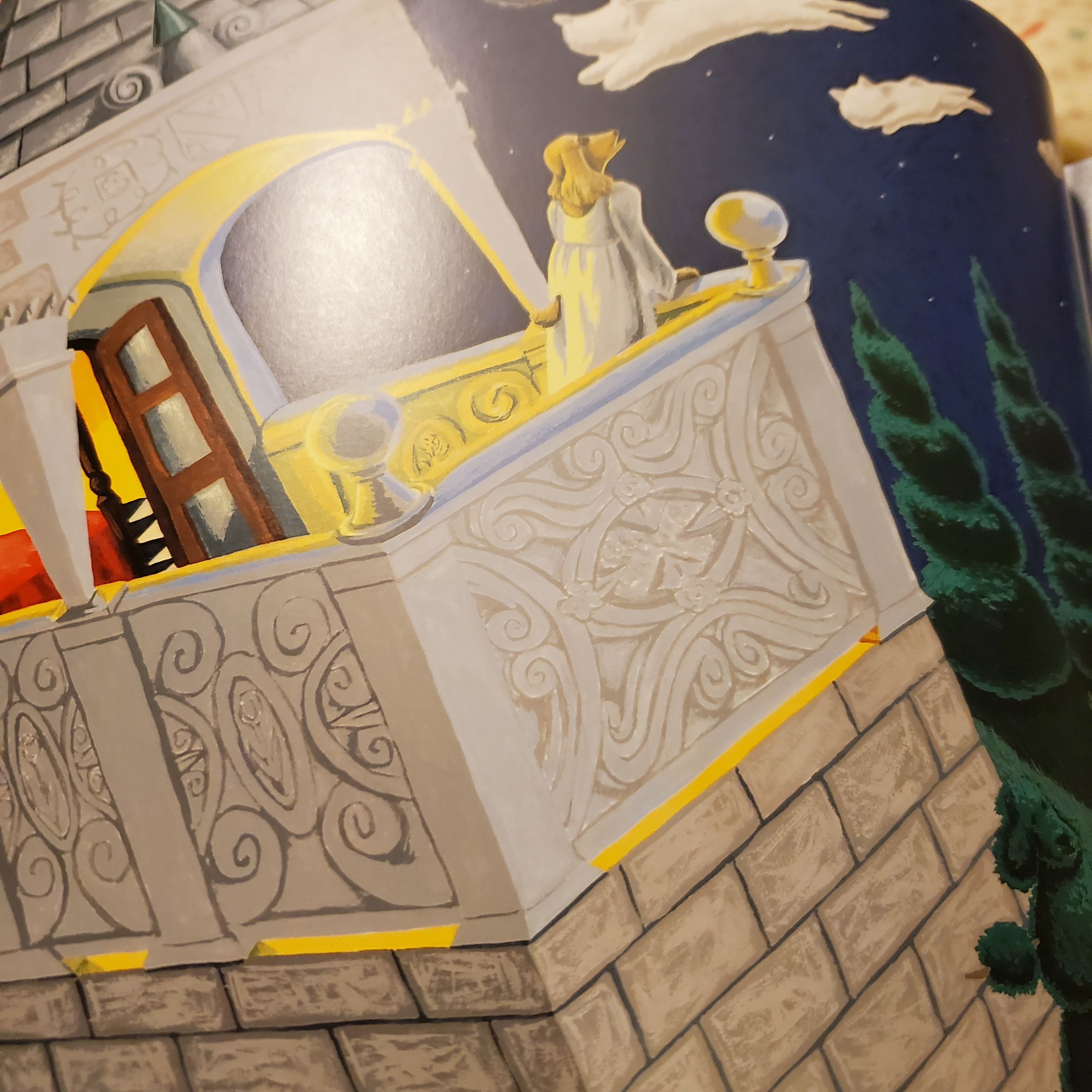
The book keeps the feud between the two families, has the young lovers meet in disguise at a ball, fall in love on a balcony, get married, and amazingly, DIE! Laden still manages to tell the story in a kid-friendly way, though giving it tragic weight.
THe Language
The book opens with a rhyming prologue, which, although it isn’t in sonnet form, has the same function as Shakespeare’s prologue- to explain the plot before we see it played out in the book, thus giving the whole story a sense of dramatic irony. Plus, as you can see, Laden also imitates Shakespeare’s love of wordplay with metaphors and puns, (a tale of tails), and alliteration to give the dialogue some wit and effervescence. Reading it gave me giggles like I’d just popped open some champagne.
What it changes: Spoiler alert
All throughout, Laden makes small changes to simplify the plot and remove characters that don’t directly impact the main plot. The characters of Lord/Lady Capulet and Lord/Lady Montegue, The Nurse, Paris, Peter, the servants, and the friars are completely absent, turning an already brief play into an even more compressed story.
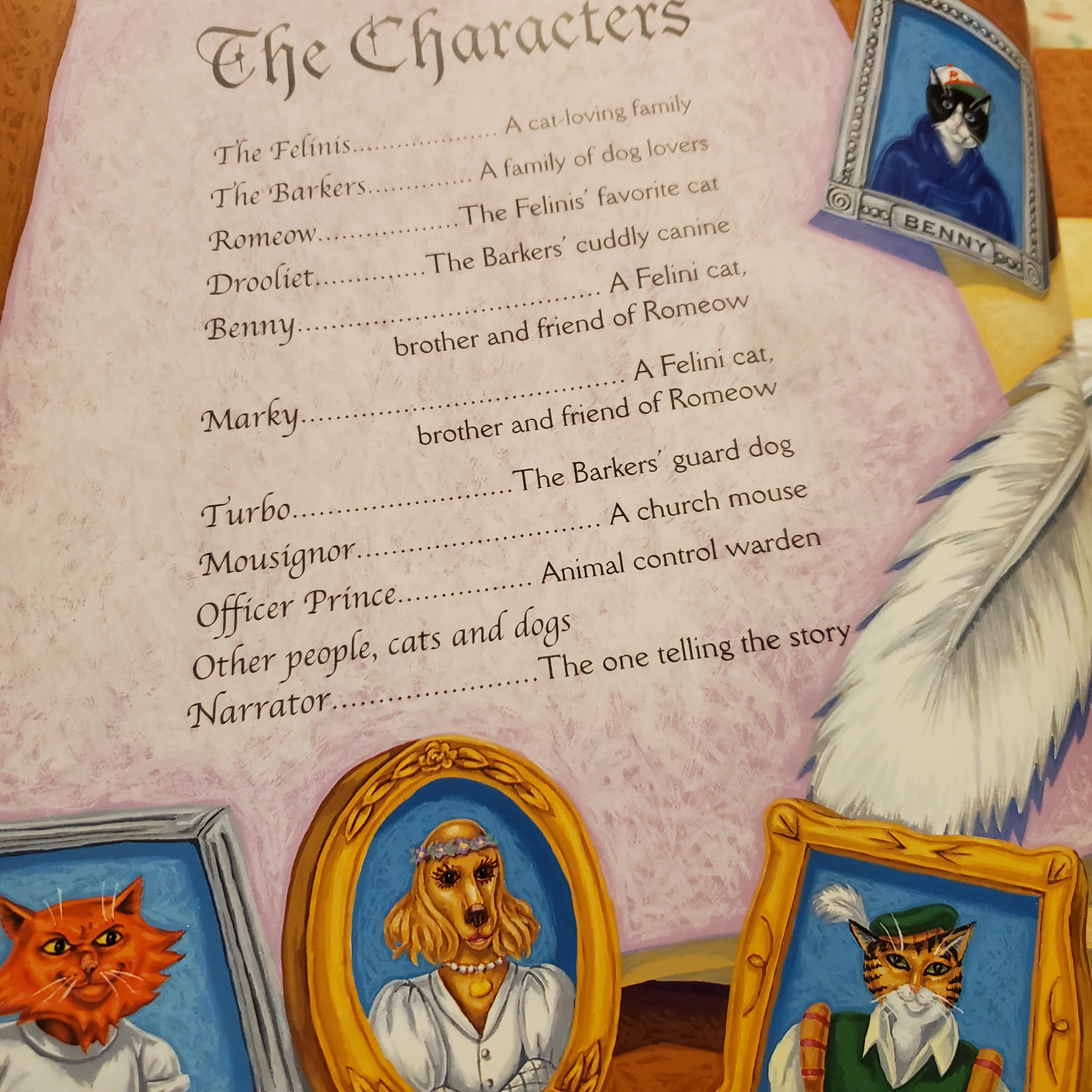
Like a lot of animal retellings I’ve seen of this story, the author recasts the human leads as animals that are natural enemies- in this case, cats and dogs. This makes the story easier for kids to understand- as I’ve said before, it’s often difficult to keep track of who belongs to which house in Shakespeare’s version. All you need to know is that Romeo and his brothers are cats and Juliet’s family are dogs.
Funnily enough, my daughter actually complained that the story would’ve been better if Juliet were a cat instead of Romeo, which I agree with for very specific reasons. The character of Tybalt is named after a character from a prose story called “Reynard the Fox,” who had the epithet, Prince of CATS. Mercutio annoys Tybalt by taunting him with this title before challenging him to a duel:
Tybalt: What would you with me?
Mercutio: Good Prince of Cats, nothing but one of your nine lives! Romeo and Juliet, Act III, Scene i.
It would’ve been a funny Shakespeare easter egg to have Juliet and Tybalt be portrayed as cats, but I understand why they went with dogs- Drooliet is a hilarious pun, and having Tybalt be a vicious, rabid dog helps set him up as a fearsome antagonist.
I suppose you’re wondering, how can the author keep Shakespeare’s tragic ending in a children’s book? Well, like Shroedinger’s cat, she manages to make Romeow die and not die at the same time. He gives Drooliet one of his 9 lives, allowing them both to ‘die’ and then come back for a happy ending. It’s a brilliant way to nod at the original, while also keeping the kid-friendly tone.
My Reaction
This book is really fun and very enjoyable for kids, parents, and teachers who want to introduce kids to Shakespeare at an early age!
Just below you can watch the book being read by actress Hayle Duff:
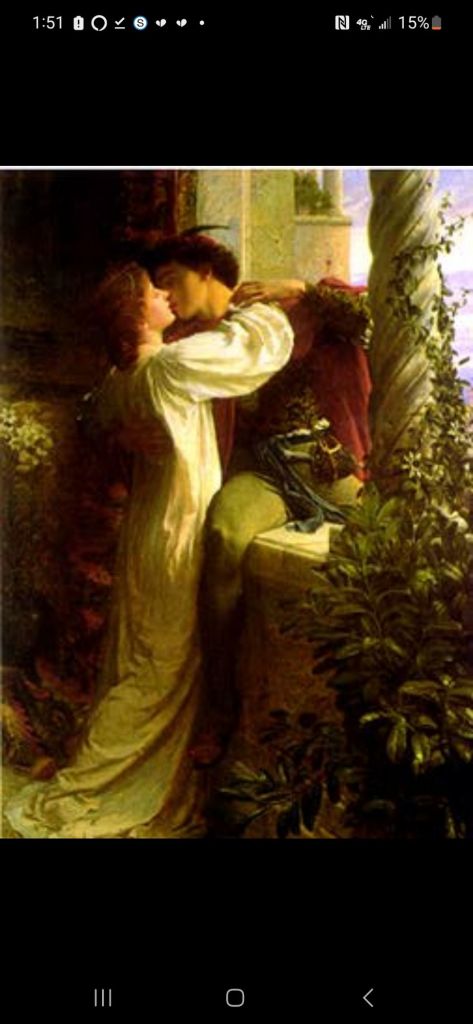
Costumes from thr 1968 Romeo and Juliet FilmOlivia Hussey as Juliet, 1968.“Romeo and Juliet” by Francis Dicksee, 1884.Juliet- Glibe Theater 2007
I’ve seen four live productions of Romeo and Juliet, (5 if you include West Side Story). I’ve also watched four films (6 if you include West Side Story and Gnomio and Juliet) and one thing that I’ve noticed again and again, and again is that you can tell the whole story of the play with clothing. This is a story about families who are part of opposite factions whose children secretly meet, marry, die, and fuse the families into one, and their clothes can show each step of that journey.
The feud Nearly every story about a conflict or war uses contrasting colors to show the different factions. Sometimes even real wars become famous for the clothes of the opposing armies. The Revolutionary War between the redcoats and the blue and gold Continentals, the American Civil War between the Rebel Grays and the Yankee Bluebellies. In almost every production I’ve ever seen, the feud in Romeo and Juliet is also demonstrated by the opposing factions wearing distinctive clothing.
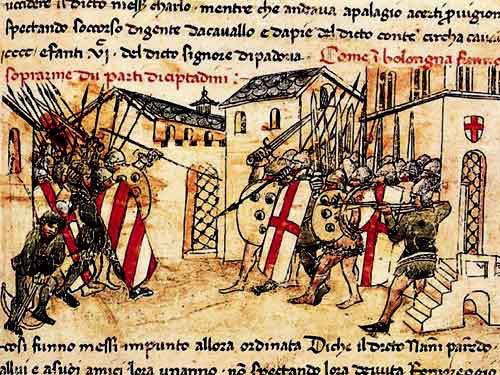
Historically, warring factions in Itally during the period the original Romeo and Juliet is set, wore distinctive clothes and banners as well. . In this medieval drawing, you can see Italians in the Ghibelline faction, who were loyal to the Holy Roman Empire, fighting the Guelph faction (red cross), who supported the Pope. Powerful families were constantly fighting and taking sides in the Guelf vs. ghibelines conflict in Verona, which might have inspired the Capulet Montegue feud in Romeo and Juliet.
Even the servants of the nobles got roped into these conflicts, and they literally wore their loyalties on their sleeves. The servants wore a kind of uniform or livery to show what household they belonged to. The servants Gregory and Sampson owe their jobs to Lord Capulet, and are willing to fight to protect his honor. Perhaps Shakespeare started the play with these servants to make this distinction very obvious. Here’s a short overview on Italian Liveries from the Metropolitan Museum of Art:
In 1966, director Franco Zepherelli set a trend with his iconic use of color in his movie. He chose to make the Capulets wear warm tones while the Montegues wore blue and silver. Juliet (Olivia Hussey) wore a gorgeous red dress that made her look youthful, passionate, and lovely, while Tybalt (Michael York), wore red, orange, and black to emphasize his anger, and jealousy (which has been associated for centuries with the color orange). By contrast, the Montagues like Romeo (Leonard Whiting) wore blue, making him look peaceful and cool. These color choices not only clearly indicate who belongs to which contrasting factions, but also help telegraph the character’s personalities. Look at the way these costumes make the two lovers stand out even when they’re surrounded by people at the Capulet ball:
Dance scene from the iconic 1968 film of Romeo and Juliet, directed by Franco Zeffirelli.Poster for “Gnomio and Juliet, 2011
Zepherilli’s color choices were most blatantly exploited in the kids film Gnomio and Juliet, where they did away with the names Capulet and Montegue altogether, and just called the two groups of gnomes the Reds and the Blues.
The Dance
To get Romeo and Juliet to meet and fall in love, Shakespeare gives them a dance scene for them to meet and fall in love. He further makes it clear that when they first meet, Romeo is in disguise. The original source Shakespeare used made the dance a carnival ball, (which even today is celebrated in Italy with masks). Most productions today have Romeo wearing a mask or some other costume so that he is not easily recognizable as a Montague. Masks are a big part of Italian culture, especially in Venice during Carnival:
In the 1996 movie, Baz Luhrman creates a bacchanal costume party, where nobody wears masks but the costumes help telegraph important character points. Mercutio is dressed in drag, which not only displays his vibrant personality but also conveniently distracts everyone from the fact that Romeo is at the Capulet party with no mask on.
Capulet is dressed like a Roman emperor, which emphasizes his role as the patriarch of the Capulet family. Juliet (Claire Danes) is dressed as an angel, to emphasize the celestial imagery Shakespeare uses to describe her. Finally, Romeo (Leonardo DiCaprio) is dressed as a crusader knight because of the dialogue in the play when he first meets Juliet:
Romeo. [To JULIET] If I profane with my unworthiest hand
This holy shrine, the gentle fine is this:720
My lips, two blushing pilgrims, ready stand
To smooth that rough touch with a tender kiss.
Juliet. Good pilgrim, you do wrong your hand too much,
Which mannerly devotion shows in this;
For saints have hands that pilgrims' hands do touch,725
And palm to palm is holy palmers' kiss.
Romeo. Have not saints lips, and holy palmers too?
Juliet. Ay, pilgrim, lips that they must use in prayer.
Romeo. O, then, dear saint, let lips do what hands do;
They pray, grant thou, lest faith turn to despair.730
Juliet. Saints do not move, though grant for prayers' sake.
Romeo. Then move not, while my prayer's effect I take.
Thus from my lips, by yours, my sin is purged.
Juliet. Then have my lips the sin that they have took.
Romeo. Sin from thy lips? O trespass sweetly urged!735
Give me my sin again.
Juliet. You kiss by the book. Romeo and Juliet, Act I, Scene V, Lines 719-737.
Notice that Romeo calls Juliet a saint, and later an angel in the famous balcony scene, which explains her costume at the ball. Juliet refers to Romoe as a Pilgrim, which is a cheeky comment on his crusader knight costume. In the Crusades, crusader knights made pilgrimages to the holy land, with the hope that God (and presumably, his angels) would forgive their sins. Romeo’s name even means “Pilgrim.” Luhrman makes clever nods to Shakespeare’s text by dressing Romeo and Juliet in this way, and gives the dialogue a bit of a playful roleplay as the characters make jokes about each other’s costumes- Romeo hopes that he will go on a pilgrimage and that this angel will take his sin with a kiss.
In Gnomio and Juliet, the titular characters meet in a different kind of disguise. Rather than going to a dance with their family, they are both simultaneously trying to sneak into a garden and steal a flower, so they are both wearing black, ninja-inspired outfits. Their black clothing helps them meet and interact without fear of retribution from their parents (since they do not yet know that they are supposed to be enemies. The ninja clothes also establishes that for these two gnomes, love of adventure unites them. Alas though, it doesn’t last; Juliet finds out that Gnomio is a Blue, when they both accidentally fall in a pool, stripping their warpaint off and revealing who they are.
Trailer for “West Side Story,” (2021) directed by Steven Spielberg.
Sometimes the dance shows a fundamental difference between the lovers and the feuding factions. West Side Story is a 20th-century musical that re-imagines the feuding families as juvenile street gangs, who like their Veronese counterparts, wear contrasting colors. The Jets (who represent the Montagues) wear Blue and yellow, while the Sharks (Capulets), wear red and black. The gang members continue wearing these colors on the night of the high school dance, except for Tony and Maria (the Romeo and Juliet analogs). In most productions I’ve seen, (including the 2021 movie), these young lovers wear white throughout the majority of the play, to emphasize the purity of their feelings, and their rejection of violence. Thus, unlike Shakespeare’s version of the story, West Side Story makes the lovers unquestionably purer are more peaceful than Shakespeare’s Romeo and Juliet, and their clothing makes this clear.
Romeo (John Warren), meets Juliet (Alesia Lawson) in the 2010 Ashland University production of “Romeo and Juliet,” directed by Ric Goodwin.
The Merging of the family (8:30-11:00)
Costume Designer Charlene in the 2006 AU production deliberately had the characters change clothes when they get married. Juliet was wearing the same iconic red dress as Olivia Hussey for the first two acts of the play but then changed into a pale blue gown that matches Romeo. The clothes re-enforce the idea that the marriage represents Romeo and Juliet abandoning their family’s conflicts, and simply showing their true colors.
Two sets of costumes for Juliet in the 2006 Ashland University Production. Pull the slider bar left to see how Juliet’s costume changes from the start of the show to the end.
Another way of getting everyone in the family to subconsciously unite in grief would be to costume everyone wearing black except Romeo and Juliet. At the end of the play, The Capulets are already mourning Juliet, (because she faked her death in Act IV), and the Montegues are already mourning Lady Montegue (who died offstage). Just by these circumstances, everyone could come onstage wearing black, uniting in their grief, which is further solidified when they see their children dead onstage.
Not all productions choose to costume the characters like warring factions, but nevertheless, any theatrical production’s costumes must telegraph something about the characters. In these production slides for a production I worked on in 2012, the costumes reflect the distinct personality of each character and show a class difference between the Montagues and the Capulets.
The 2013 Film: Costumes Done Badly
The 2013 movie is more concerned with showing off the beauty of the actor’s faces, and the literal jewels than the clothes:
Most of the actors and costumes are literally in the dark for most of the film, probably because the film was financed by the Swarofski Crystal company, who literally wanted the film to sparkle. Ultimately, like most jewelry, I thought the film was pretty to look at, but the costumes and cinematography had little utilitarian value. The costumes and visual didn’t tell the story efficiently, but mainly was designed to distract the audience with the beauty of the sets, costumes and the attractive young actors. The only thing I liked was a subtle choice to make Juliet’s mask reminiscent of Medusa, the monster in Greek Myth, who could turn people to stone with a look. I liked that the film was subtly implying that love, at first sight, can be lethal.













 The Shakespearean Student