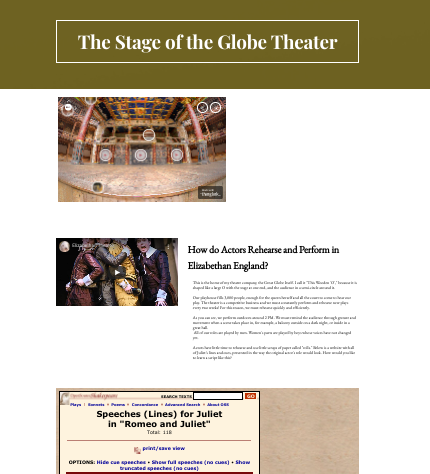
I’m working on several educational projects at the moment and I’m proud to share this one with you. It’s what I call a virtual tour of Shakespeare’s London. The teacher I’m working with said she wanted to teach the kids about the culture of Elizabethan London as he was writing Romeo and Juliet. Naturally with the pandemic a field trip was out of the question, (for multiple reasons), but I wanted to create a visually interesting tour of the places Shakespeare knew and worked and try to imagine his perspective and how that might have informed the characters and themes of Romeo and Juliet.
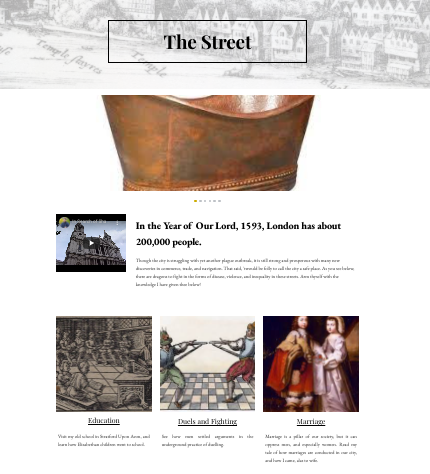
So I created this: a website written as if Shakespeare himself is taking you on a tour of his London in the year 1593, the year where, as far as we know, he had just completed writing Romeo and Juliet. 1593 was also the middle of another outbreak of Bubonic Plague. It has virtual tours of Shakespeare’s Globe Theater, Hampton Court Palace, Shakespeare’s Grammar School, and a quiz where you can pretend you’re in the Elizabethan doctor’s office.
For the class I’m helping, the students will fill out a worksheet as they navigate the website so they learn from the material at their own pace. If you’re interested, leave a comment and I’ll post the worksheet so you can use it in your classroom.
My hope is that this website can be a resource for anyone trying to connect with Romeo and Juliet and trying to learn from the culture of Elizabethan London. Shakespeare was a product of his time and his experiences must have had an influence on what he wrote. Even if they didn’t, they certainly influenced the people who saw the play and he knew that it would. So I hope it can help you understand a little bit more about the world of this famous play, and the context of the world that created it.
For Shakespeare’s Birthday, I thought I would discuss his most famous speech what is arguably his greatest play. Hamlet, Prince of Denmark was written in 1600, the pinnacle/ middle of Shakespeare’s career, after Julius Caesar but before Macbeth.
David Tennent as Hamlet. Royal Shakespeare Company, 2010.
To Be Or Not To Be has intrigued and mystified people for centuries. It is full of ambiguous imagery, haunting images, and solemn contemplative ideas. I’m going to try and break the speech down first like an intellectual argument, but I will also give you some of my interpretation of Hamlet’s thoughts and feelings. Shakespeare’s genius is creating a speech that gives plenty for the reader to interpret,, but it’s up to the reader to decide what’s happening in the speech.
Just a refresher of the plot:
1. The king has died and been seen as a ghost
2. He tells his son Hamlet that he was murdered by his brother Claudius, who killed him to become king and marry Hamlets mother, Gertrude.
Hamlet is trying to determine if the ghost is telling the truth and if so, how can Hamlet revenge the death of his father?
The speech occurs right in the middle of the play. Hamlet has been acting strange and the king is worried. He hides behind a tapestry right before Hamlet enters. He then delivers this famous and highly cryptic speech:
Ham. To be, or not to be, that is the Question:
Whether 'tis Nobler in the minde to suffer
The Slings and Arrowes of outragious Fortune,
Or to take Armes against a Sea of troubles,
And by opposing end them: to dye, to sleepe
No more; and by a sleepe, to say we end
The Heart-ake, and the thousand Naturall shockes
That Flesh is heyre too? 'Tis a consummation
Deuoutly to be wish'd. To dye to sleepe,
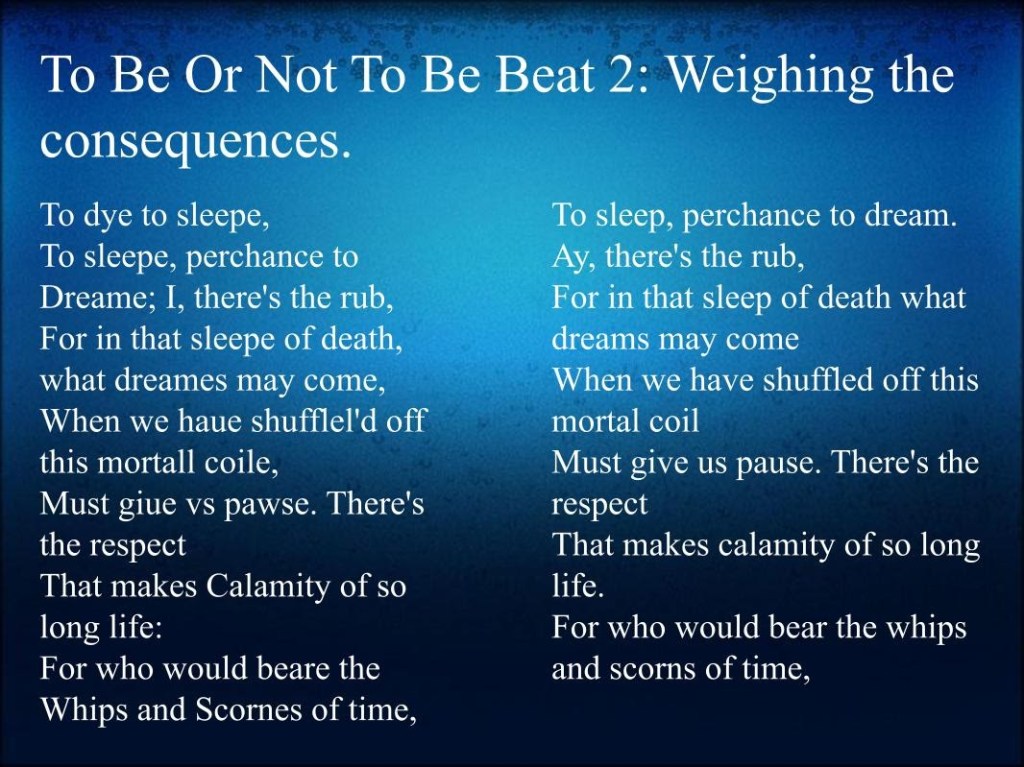
To sleepe, perchance to Dreame; I, there's the rub,
For in that sleepe of death, what dreames may come,
When we haue shufflel'd off this mortall coile,
Must giue vs pawse. There's the respect
That makes Calamity of so long life:
For who would beare the Whips and Scornes of time,
The Oppressors wrong, the poore mans Contumely,
The pangs of dispriz'd Loue, the Lawes delay,
The insolence of Office, and the Spurnes
That patient merit of the vnworthy takes,
When he himselfe might his Quietus make
With a bare Bodkin? Who would these Fardles beare
To grunt and sweat vnder a weary life,
But that the dread of something after death,
The vndiscouered Countrey, from whose Borne
No Traueller returnes, Puzels the will,
And makes vs rather beare those illes we haue,
Then flye to others that we know not of.
Thus Conscience does make Cowards of vs all,
And thus the Natiue hew of Resolution
Is sicklied o're, with the pale cast of Thought,
And enterprizes of great pith and moment,
With this regard their Currants turne away,
And loose the name of Action. Soft you now,
Now before I talk about the context of the speech, I want to deconstruct it as an intellectual argument. Hamlet is grappling with something huge, and he is weighing the consequences of his potential actions. Remember, Hamlet is a prince, but he is also a college student, so he turns his choice into an intellectual argument.
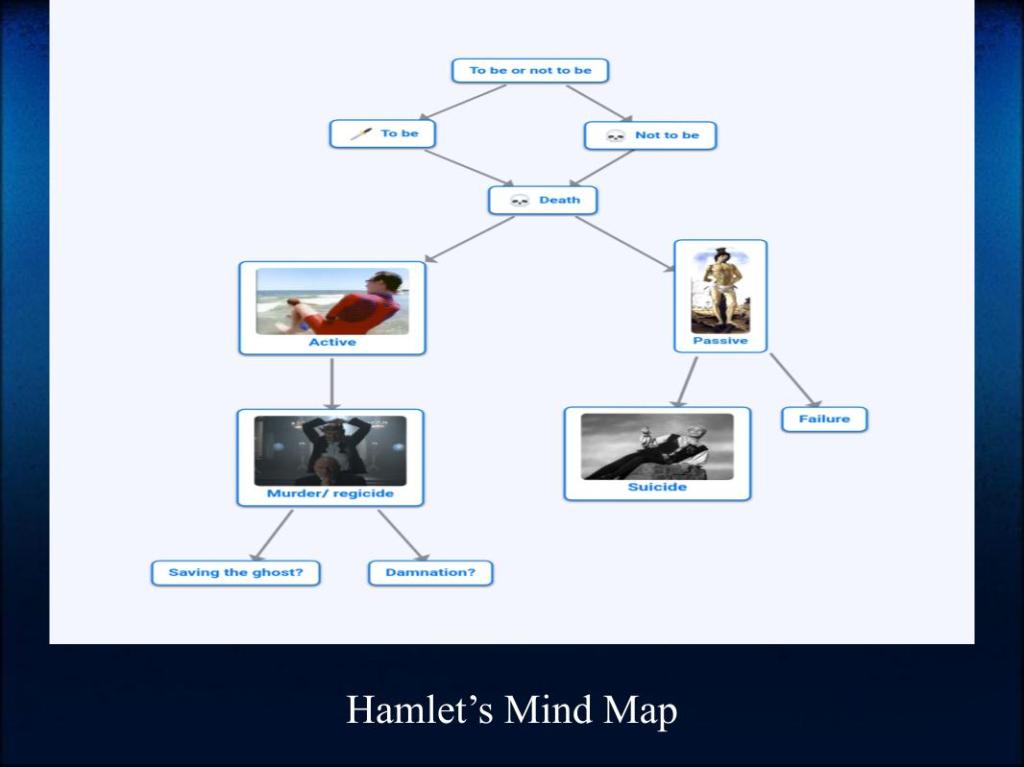
If you look at the speech as an argument, it hinges on two points- to be or not to be.
One is passive and one is active
Both actions are potentially lethal, as evidenced by the two metaphors Hamlet describes later.
Contrary to popular belief, I believe that this speech is not just about suicide. It’s about the choice between suicide and murder, (in this case killing Claudius).
Three Speeches- Macbeth, and Hamlet
Lets discuss the two central images at the start of this speech. One is active- fighting (“taking arms”), and one is passive (“to suffer…”). Both choices have a similar outcome- death. No one can fight the sea, and arrows are just as lethal.
Let’s look at the speech again, and turn it into a series of beats using the conjunctions “and, but, and or,” The speech has 6 beats. What he’s thinking about or feeling is open to interpretation, but the argument definitely changes at these points. First the thesis:
This beat sets up the two options (murder and suicide). Why do I think this? Because it’s similar to two other speeches: https://youtu.be/nq3hcs1yFKw
It’s worth noting that about the same time, Shakespeare wrote three great soliloquis; Hamlet’s “To Be Or Not To Be,” Macbeth’s “If It Were Done,” and Brutus’ “It must be by his death.” All three speeches have some notable commonalities:
All three speeches are in passive voice; the would be murderer wishes he didn’t have to kill someone, but wants the victim dead nonetheless.
Refuse to mention the name of the man who will die.
Refuse to say ‘murder’
Personify death in abstract terms.
When I noticed the commonalities between the speeches, I came to realize that all of them are about murder, not just suicide. I think Hamlet alone contemplates suicide as well as murder, possibly because unlike Brutus and Macbeth, Hamlet is not at all sure he’s doing the right thing.
Beat 1 The Nerve: Hamlet is working himself up for something; either murder or suicide. It’s ambiguous which one he starts with, and largely depends upon the actor’s interpretation.
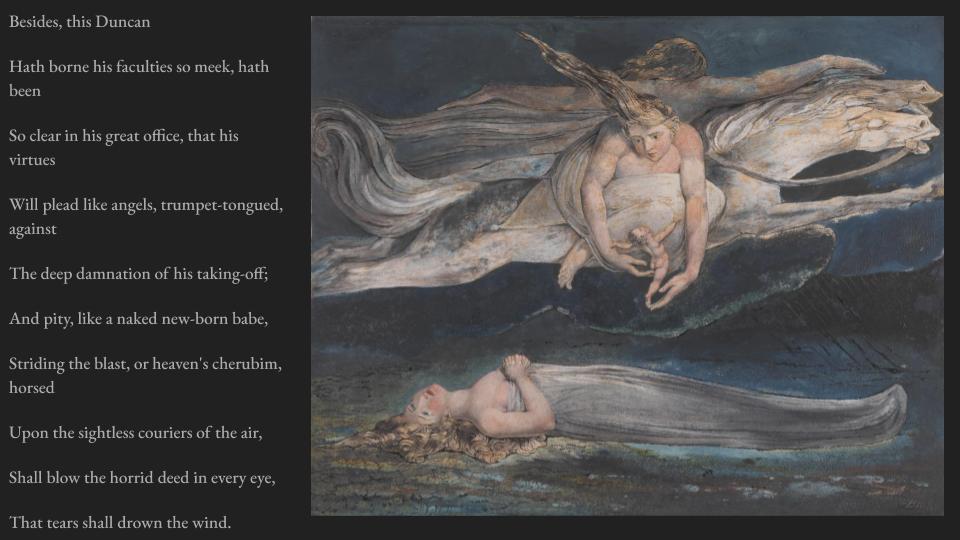
Beat 2The Consequences Whether Hamlet kills the king or himself, either way he could die and when he does, his soul will have to answer for his actions. This is similar to Macbeth, who worries that his foul murder will be exposed and judged by “Heaven’s cherubim, horses upon the sightless couriers of the air.”
“PITY,” by William Blake, alongside the text of Macbeth’s soliloquy from Act I, Scene 7.
“There’s the rub”- there’s the catch.
“Coil” refers to a snake skin. The line characterizes death as shedding an earthly body, something that seems all too easy to do. It’s an uncomfortable image because it makes death look all too easy. It also calls to mind the story of Gilgamesh, who had a flower that would grant him immortality, but a snake stole it, which is why snakes cam shed their skin, seemingly growing young again forever.
This beat is where Hamlet seems smothered in his frustrations with life.. Rather than making a decision, he’s sidetracked with a laundry list of universal problems. His energy seems up, but it’s unclear why.
When I performed this portion of the speech, I realized that everything Hamlet refers to, Claudius has done: he has oppressed and wronged the kingdom, he has delayed the law, and he has hindered Hamlet’s love for Ophelia by letting Polonius deny Hamlet’s access to her. Perhaps the laundry list is designed to psych him up- listing all the reasons Claudius deserves to die, (without tipping him off).
Beat 4: The Downward Spiral
Once again Hamlet is thwarted by the concept of Death and divine judgment. He seems to imply that everyone is scared into compliance with the threat of death.
The Conclusion:
Hamlet’s conclusion is that he has no conclusion. He can’t kill himself because his conscience tells him that God is against it, and he cannot kill Claudius because of fear of death or damnation.
When he says “The native hue of resolution,” he means red, (as in blood), is curtailed, cut off by the very thought of Deaths pale scythe.
Interpretations:
Mel Gibson plays Hamlet as a sort of man in mourning. He is as close to the action movie hero as Hamlet gets with his large, imposing physique and brutal looking medieval sword:
Speaking of action heroes, the whole movie Last Action Hero has a reoccurring motif of nodding to Hamlet. The avenging hero archetype is the prototype for every action movie, every superhero, (and most kung fu), and it began with Shakespeare’s Hamlet. This is why it’s hilarious that Schwarzeneger portrays him in Last Action Hero- the movie is a loving parody of every single action star since the original- Hamlet.
Why Else might Hamlet be so cryptic?
Not all versions are about suicide or murder
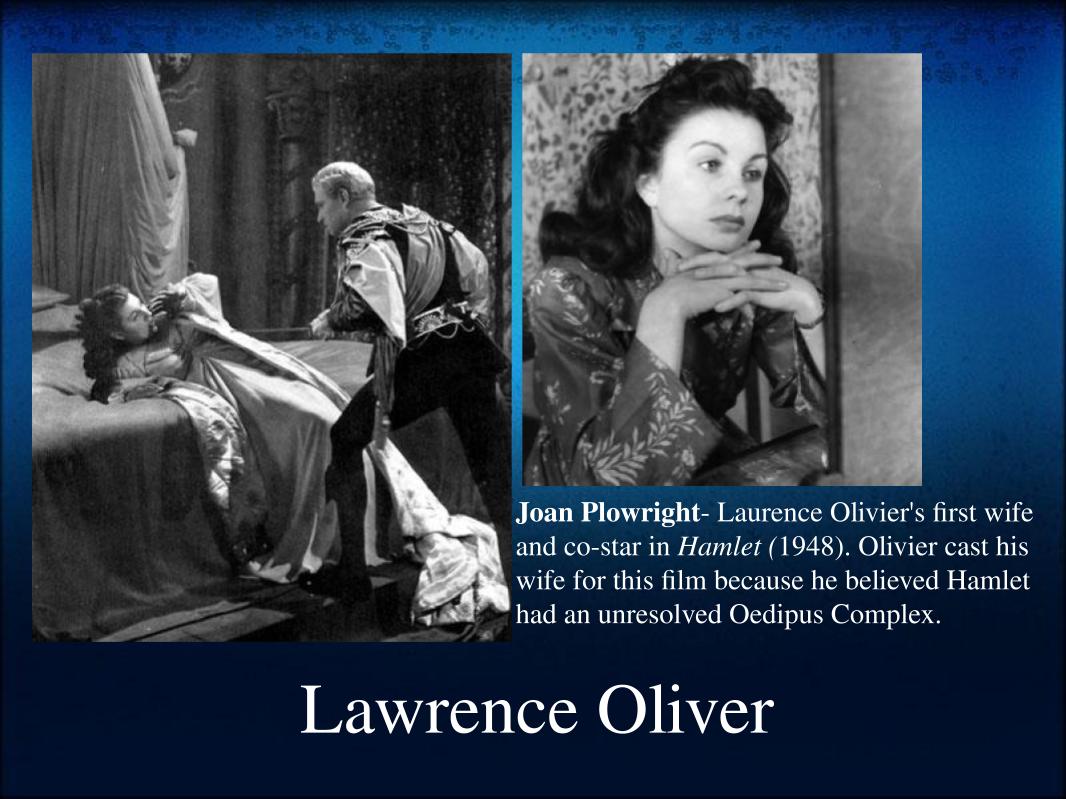
Lawrence Olivier believed that Hamlet has an Oedipus complex, and therefore has an unconscious desire to murder his father and sleep with this mother, which is why he considered himself unworthy to avenge his father’s death. In Olivier’s To Be, you can almost see his Hamlet aroused by his own Oedipal fantasies and then recoiling with disgust right before he says the line: “Perchance to dream.”
Kenneth Branaugh’s Hamlet centers around court intrigue. In contrast with Oliver’s Gothic Elsinore, his is bright and baroque, but it’s full of two way mirrors. Half the film is either large shots with lots of people watching public performances or POV shots of people being watched.
Branaugh’s interpretation of “To Be,” focuses on the possibility that Hamlet knows that Claudius is watching him through the two way mirror- he frightens him, puzzles, him, but in the end, never gives Claudius a clue as to his true intentions.
Murder or suicide?
the speech is not only famous for its universality but its evocative imagery, clear (albeit cryptic) construction, and heightened circumstances.
Shakespeare is able to give us a complete character without giving everything away, which allows anyone to reinterpret the character their own way. That is why Shakespeare’s characters endure.
My purpose with this post is to provide some hope and comfort by showing how Shakespeare and other Elizabethans dealt with epidemics and survived. The thing to remember is, although we are dealing with a pandemic, we are still far better prepared for it than any time in history. Furthermore, I want to draw on lessons from the past to offer hope and wisdom for people going through an epidemic.
Side note: Shakespeare refers to several diseases in his plays including “The plague,” (Bubonic Plague), “The Pox,” (syphilis), “Dropsy,” (edema), and “Falling sickness,” (epilepsy). I will mainly focus on the plague because of its strong connection to both Shakespeare’s life and career, as well as the continuing anxiety it causes to this day. I am also focusing on the plague to try and make parallels with Covid 19, a disease that, while less lethal and harder to detect, is still a pandemic that like the plague has transformed much of daily life since its inception, and could continue to grow, abate, and revive if we as a society aren’t careful.
Shakespeare’s plays also frequently allude to plagues and plague imagery, especially his most famous play, Romeo and Juliet.
First of all plague is an important plot element; an outbreak of plague prevents Romeo from getting the message that Juliet is alive, so plague inadvertently kills them both.
Plague also serves as a motif for the destructive forces that lead to the play’s tragic conclusion. After Mercutio curses “A plague on both your houses,” his death sets the events in motion that kills most of the principal the characters, as if his curse somehow infected all of them with a deadly virus.
Immortal Longings Artwork for “Romeo and Juliet” by Elizabeth Schuh, used with permission.
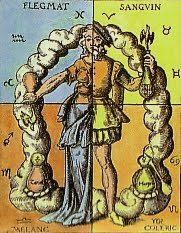
Shakespeare exploited a unique cultural knowledge of plagues to help his audience engage with Romeo and Juliet. If you click on the link to my presentation above, you’ll see that Elizabethans believed that four liquids called humors controlled health and behavior. A humorous man was someone who was out of ballance with the humours and thus was ridiculous for failing to control his emotions. The humor choler was associated with anger and in dangerous imbalances was thought to cause terrible fevers and even plague. Hence, when characters like Romeo and Tybalt get angry, his audience knew that one way or another, that anger will kill them.
Medieval illustration of the four humours. Top left to bottom right; Phlegm, Blood (Sanguine), Melancholy, (black bile), and choler (yellow bile).
Shakespeare also uses plague as a metaphor for the hate of the two families that infects and kills the young lovers, as well as Tybalt, Paris, and Mercutio.
The play was first published in 1595, two years after a plague outbreak so bad that the theaters were all closed, so Shakespeare’s audience had a visceral reaction to this plague imagery when they saw it in the theater, especially after a year of being quarantined away from the theaters because of that exact same disease!
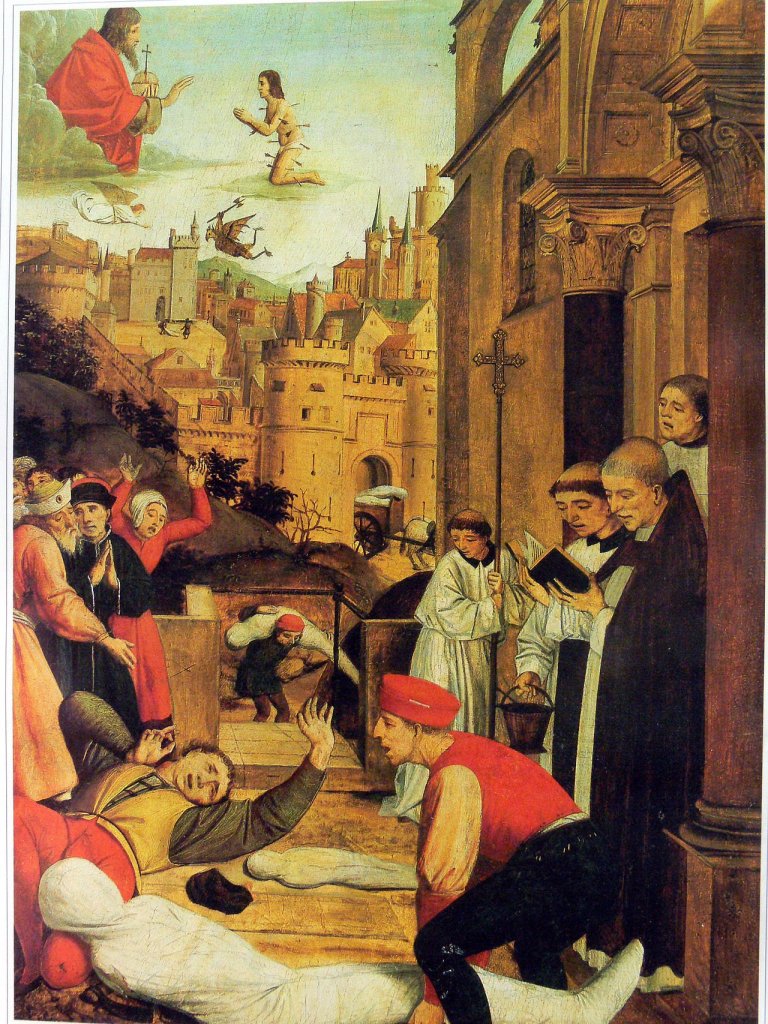
Saint Sebastian pleads with Jesus for the life of a gravedigger afflicted by plague during the Plague of Justinian. (Josse Lieferinxe, c. 1497–1499)
“Scourge and Minister”
Some of Shakespeare’s plays mention plague indirectly in relation to its perceived nature as a divine punishment. Since the very beginning of the plague,, writers, clergy, and many others perceived the plague as a divine punishment, designed to destroy the wicked, like the 10th plague in the Bible that decimated the enslaving Egyptians.
To “scourge oneself” is also a verb for whipping. In the 14th century, a group a people called the flaggelants, who voluntarily scourged themselves in the hope that God would end the disease as a result of their suffering.
Shakespeare uses both meanings of scourge in many of his plays. In Henry IV, the king is filled with remorse for usurping the throne from King Richard, and worries that his future progeny will become a scourge upon him:
I know not whether God will have it so,
For some displeasing service I have done,
That, in his secret doom, out of my blood
He’ll breed revengement and a scourge for me;
King Henry IV, Part I, Act III, Scene ii.
Sometimes a scourge is a person sent to destroy a sinful person or group of people. Shakespeare refers to the character of Richard III several times as a scourge upon the families who fought in the Wars Of The Roses.
In Shakespeare’s first cycle of four history plays, we see the families of York and Lancaster take turns usurping the throne, and committing numerous acts of murder, treason, and blasphemy. In the play that bears his name, Richard III kills the Yorkist royal family and then is murdered himself by Henry Tudor, systematically destroying the families of York and Lancaster. Thus, in Shakespeare’s propaganda version of history, he depicts Richard as a scourge who purges the throne of usurper and traitors, paving the way for the “virtuous,” Henry Tudor and his dynasty.
The ending shot of the BBC’s 1978 TV version of “Richard III.”
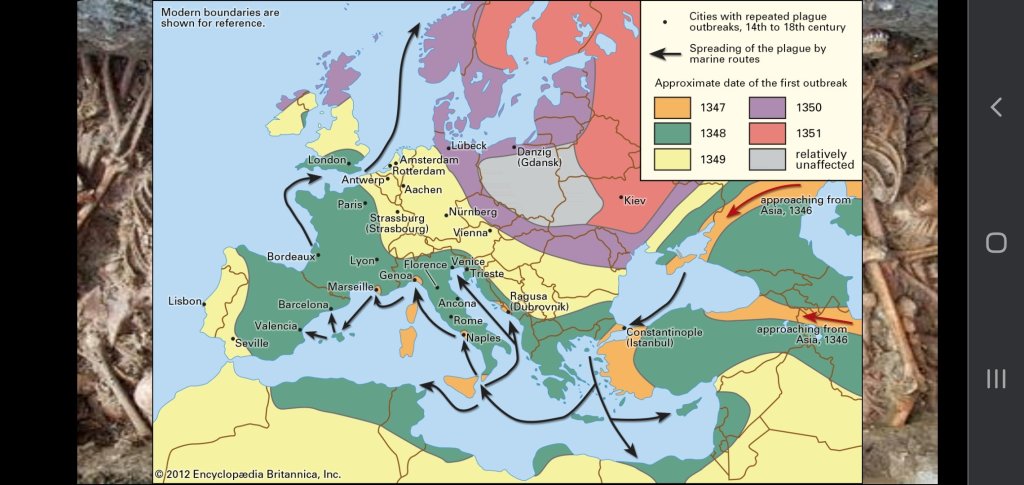
The Real Plague The black death, also known as Bubonic Plague, was first documented in 1347. Like Covid 19 it was first discovered in China, though it might not have originated there. Some historians argue that the Huns might have carried the plague into China and trade routes from the East carried it into Europe. By 1349 it reached England.
Everyone knew what to look for from those infected with the plague: first came fevers and chills. The next stage was the appearance of small red boils on the neck, in the armpit or groin. These lumps, were called buboes, (hence the term Bubonic Plague)
The buboes grew larger and darker in colour as the disease grew worse. From there the victim would begin to spit blood, which also contaminated with plague germs, making anyone able to spread the disease by coughing. The final stage of the illness was small, red spots on the stomach and other parts of the body caused by internal bleeding, and finally death.
We see death coming into our midst like black smoke, a plague which cuts off the young, a rootless phantom which has no mercy or fair countenance. Woe is me for the shilling in the armpit. . . It is an ugly eruption that comes with unseemly haste. It is a grievous ornament that breaks out in a rash. The early ornaments of black death.-Jevan Gethin, poet who died from plague in 1349.
Detail from The Temptation of St Anthony, 1512. Note the swollen buboes on the stomach, arms, and legs.
John Flynn, an Irish Friar described the plague in apocalyptic terms, writing a journal for posterity, but expressed doubt that ” Any of the race of Adam would even survive.” With the horrifying spread of the epidemic, it is not hard to understand why Flynn felt that way: In 1348, there were 100,000 people living in London, but after the plague spread, the city lost 300 people every day!
Quarentines: The word quarantine is Italian for 40 days. It refers to the Venetian practice of taking suspected plague victims to an island for 40 days before allowing them to enter Venice or other populated areas. The rationale was that in the Bible, the number 40 occurs many times when a person or group of people require some form of purification; the 40 days of flooding in Genesis, the 40 years that the Jews journey to the promised land, and the 40 days of fasting Christ endured before he began his ministry to name a few examples. Bubonic plague has an incubation period of less than 40 days so the quarantine actually worked- people would go to the island, then the disease would run its course and not spread out as long as it was contained. The problem was that these quarantines were also essentially leper colonies and without treatment, the infected were basically sent to die.
Social distancing in Elizabethan England–
By 1564, the year Shakespeare was born, there had been several outbreaks, but also a system designated to contain the disease. The rich went to the country. Plague bodies were burned. Theaters were closed to keep the disease from spreading. There were also body inspectors, (similar to coroner’s or death investigators today,) who inspected the bodies to look for the cause, then burned them and the clothes. Funerals for plague victims were held at night, to discourage crowds from attending, similar to our own practice of encouraging people to shop and go outside during non-peak hours.
“Treating” it: The biggest comfort I can give here is to remind people that although like the plague, we are dealing with a disease with no known cure, we still have a much better understanding of how to treat viruses than our Elizabethan forebears. Some of the “cures,” from Shakespeare’s day are downright silly, when they aren’t expensive, dangerous, and above all, ineffective.
Real plague “cures” • Kill cats and dogs • A poultice made of Marigold flowers and eggs • Arsenic powder (which is highly toxic) • Crushed emerald powder. • Pluck a chicken and place its rear end on the patient’s buboes, known as the Vicary Method.
To bring the aftermath of the plague into a modern context, I’d like to allude to some comments from the news. Recently a few Republicans have alluded that the cost of people staying home from work would cause irreparable harm to the American economy, and alluded to the notion that a few deaths might actually benefit the economy as a whole, including Texas Lieutenant Governor Dan Patrick and Republican pundit Glenn Beck. Now at first glance these comments are gruesome and heartless, but they have a veneer of historical precedent: some people did prosper because of the black death. Laborers could charge more from their landlords simply because most of them had died, and some younger men managed to skirt the laws of primogeniture and inherit their families’ wealth because of the death of their oldest siblings. Shakespeare himself was the third child of Mary and John Shakespeare, but his elder siblings both perished due to plague. Again, to be fair to these Republicans, there is a historical facet to their arguments, however this is a very narrow and very incomplete version of history.
https://youtu.be/QNo-r20wqqg Looking forward from the first century after the Black Death, the loss of life and resources was devastating for the workforce and caused a series of catastrophes for centuries to come. Though some peasants benefited from the lack of serfs, the depleted workforce meant work became harder and more expensive, and the coming centuries were plagued again by revolts, wars, and famine.
Wat Tyler, leader of the Peasants Revolt, rides out to negotiate with King Richard’s army.
Just 30 years after the first outbreak of plague in England, the peasants rose in revolt against their lords for the first time in 300 years, in no small part, due to the hardships caused by the plague.
Portrait of King Richard the Second
The king who punished the peasants was Richard Richard the Second, whom Shakespeare famously dramatized as an arrogant, egomaniacal, incompetent man-child who was eventually deposed and executed in the Tower of London. I think certain people who are tempted to “make sacrifices,” to protect the American economy would do well to look at this historical tragedy and avoid the political consequences of this kind of thinking.
In conclusion, though we are dealing with a frightening pandemic that we currently don’t know how to treat, we can take comfort from the fact that our forebears faced far worse diseases and survived. History has shown that social distancing works and that basic sanitation and the tireless work of healers and scientists can slow a disease, cause it to ebb, and eventually irradicate it. But until science discovers a treatment for Covid-19, it is up to all of us to flatten the curve for the sake of our country, world, and our future.
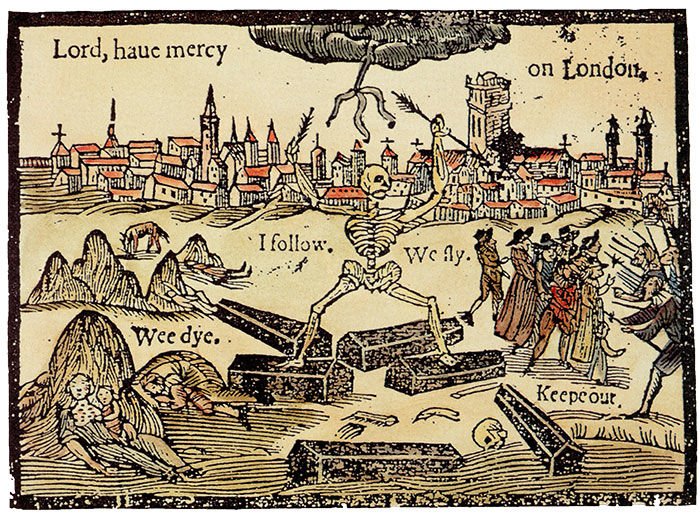
Plague woodcut. Note the wealthy people on the right who fled the plague, and the poor families dying on the left.
Like I have said, the working poor as a whole, suffered greatly because of the plague, especially since they were denied the means to avoid it. They lived in tightly packed, unsanitary environments and were unable to leave them without their lord’s permission, whereas we have a choice. This why it is crucial that we all do our part by staying away from crowds, observing proper hygiene, and offering support to our healthcare workers who are on the front lines of this war against coronavirus, and for whom we all pray for to stay healthy in turn.
Titus Andronicus is one of the most bloody, disgusting plays in Shakespeare. As this infographic from the Royal Shakespeare Company shows, there are tons of deaths and some of them are even the result of cannibalism!
One way to capture the macabre nature of this play in the classroom, (which some scholars see as a horror comedy), is to characterize it through cooking, after all, revenge is a dish best served cold.
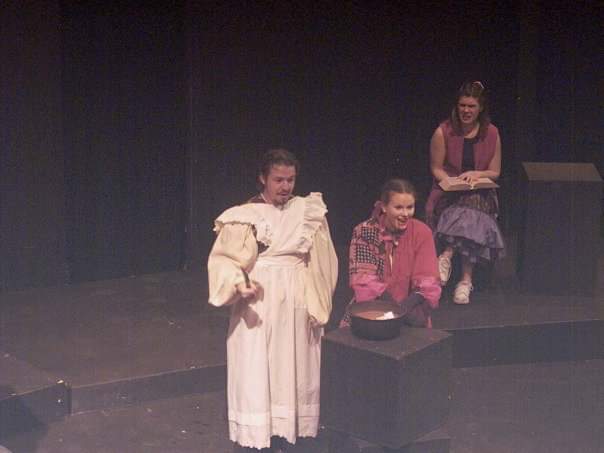
Me in costume as Titus Androgynous, a crazy cooking show host who butchers two people in the same manner as Titus
So here are some ghoulish gourmet dishes and revolting recipes that you can share with your students to help them get into this tragic tale of violence, revenge, and cooking:
Idea 1: recipe cards
Design a recipe card like the ones in cooking magazines based on Titus speech where he murders Chiron and Demetrius
Idea 2: Create a menu that summarizes the play:
Act I:
Starter: Caesar Salad, toad in the hole
As the play begins, Caesar has died and Saturnine wants to devour his father’s empire. Enjoy this light salad in anticipation of far more bloody feasts to come.https://youtu.be/UxZ5NOkRwj0
Act II Scene 3: Breakfast:
Lamb Benedict
Lamb Benedict recipe I found on Reddit
While on an early morning hunting trip, Bassianus is slaughtered like a lamb by his own nephews. Enjoy this sweet treachery with a golden egg in the hole.
Act II, Scene 4: Main course:
Roast venison with all the trimmings
“As the deer that hath some unrecuring wound.”
“She was washed and cut and trimmed.”
Titus compares his daughter to a deer or welkin, and in the play’s most barbaric scene, the emperor’s sons ravish her and cut out her tongue. They enjoy the cruel rape and mutilation just like two starving lions enjoying their prey.
Act V:
Just desserts: people pot pie.
“More stern and bloody than the centaur’s feast,” A truly unforgettable dessert for this feast of carnage. The cook, Titus, reinvents the term rich food by cooking two emperor’s sons into pies.
Served cold, like revenge!
“Set him breast deep in Earth and famish him.”
Idea 3: Real Titus foods inspired by my favorite Halloween diy recipes
Or this grisly appetizer: cheese hand in prosciutto
3.
People Pies:
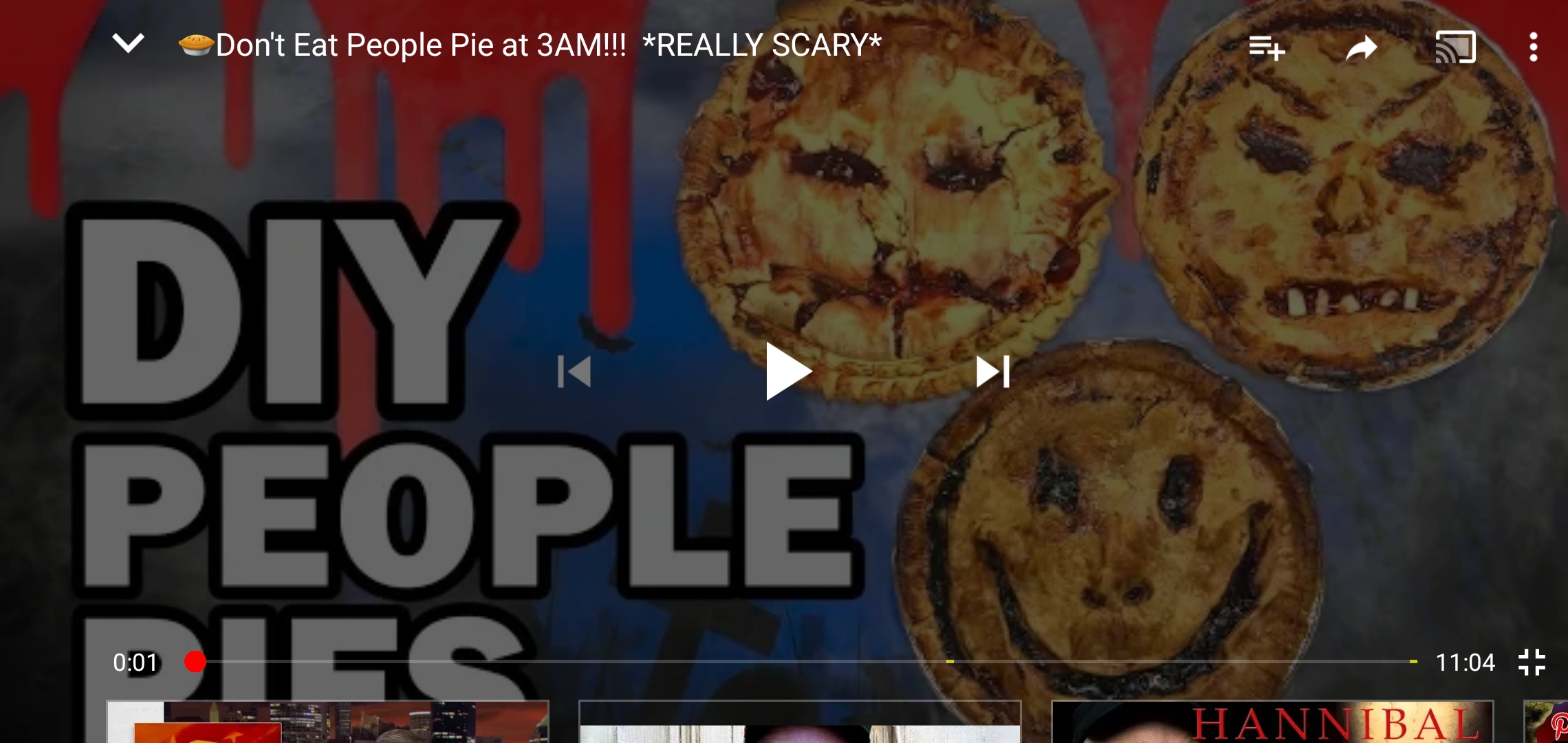
There are many horrific pie recipes on the internet, but for a busy teacher on a budget, I’m adapting this one from the YouTube channel Threadbanger: https://youtu.be/E6U6xUl3A5M. Don’t show this video to your students because there’s far too much cursing. That said this recipe is very cheap and it’s easy. He used only store bought items and no fancy cooking techniques, which means if you choose to bake it as a classroom activity, even your students can help make it. Here are some tips from the video to get the most horrible ppeople pie you can make:
• Use red filling like cherry or strawberry for filling.














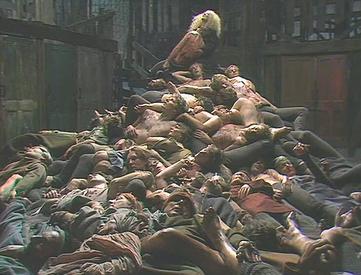



 • Plague carts like in Monty Python (Dreary) carried plague bodies out of the city and burned them.






 The Shakespearean Student