Is Percy Jackson Hamlet?

I’m really excited about the Disney Plus release of the Percy Jackson TV show. My family and I are really enjoying it and I think it’s a very good adaptation, (much more faithful than the previous movie versions). The tone is darker, the characters are better fleshed out, and also there’s a much more nuanced take on Percy’s character, which I believe is at the core of the series. The movie is essentially just a fetch quest where Percy is going from location A to location B looking for various magic items and fighting monsters. Movie Percy is a very static character but in the books and the show, they keep all of those journeys but also delve into his complicated relationship with the gods, his own insecurities growing up without a father, and his overwhelming feeling that this world of gods and mortals is fundamentally flawed and that he is the one to fix it.

“Families are messy. Immortal families are eternally messy. Sometimes the best we can do is to remind each other that we’re related for better or for worse…and try to keep the maiming and killing to a minimum.”

-Percy Jackson, The Sea of Monsters


In short, what makes the show great is that it emphasizes the elements of the book that make it a classic story of a young man who is trying to find his place in the world and complete the quest that his father set for him. Of course, once I started watching it, my Shakespeare Brain activated, and I immediately compared him to Shakespeare’s ultimate example of a hero trying to complete a quest given to him by an absent father- Hamlet.
So today I’ll Talk about why I think Percy Jackson is actually a descendant of Hamlet or rather that Hamlet and Percy Jackson are both descendants of the same common ancestor in Greek mythology and touch on what these classic stories can say to us today.

1. The Plot

AI Art I created of Percy Jackson. Nightcreator.com.

As I touched on earlier, there are some glaring similarities between the plots of Percy Jackson and Hamlet- we have a young man who has who hates his stepfather, who is deeply protective of his mother, who goes on a magical quest given to him by his father, (who cannot directly aid him because he’s not physically there). In Percy Jackson, his father is a god- the ancient Greek water god Poseidon, while Hamlet’s father is a ghost. Both heroes have to deal with treachery, uncover a plot, avert potential wars, and get caught up in great military and political power schemes. While Hamlet is trying to restore the rightful heir to the throne (himself), Percy is trying to avoid a war between the gods. Both heroes have stoic sidekicks- Hamlet has Horatio whereas Percy has Annabeth and his friend Grover the Satyr. Hamlet’s friend l Horatio is kind of like a combination of Annabeth’s intelligence and Grover’s kindness and empathy. Finally, both stories conclude in a duel (spoiler alert) where they fight against a near-impossible adversary, and in the end, succeed in their quest, although in Hamlet’s case, he does so at the cost of his own life.

The main difference between these stories is connected to tone and genre- Hamlet is a revenge play, and most Revenge tragedies end in the death of the avenger. Percy Jackson is an adventure quest so based on the conventions, he can succeed, survive, and go off to fight another day. Nevertheless, in terms of the broad outline, the plots are very similar. I would argue this is probably because Hamlet has its roots in many ancient mythological stories like Oedipus, Orestes, and of course, the Danish Viking myth of Amleth. I would argue that both Percy Jackson and Hamlet have a very clear direct common ancestor: the ancient Greek myth of …

2. A Common Ancestor- Perseus

https://prezi.com/btk3m_bamkmh/hamlets-monomyth/

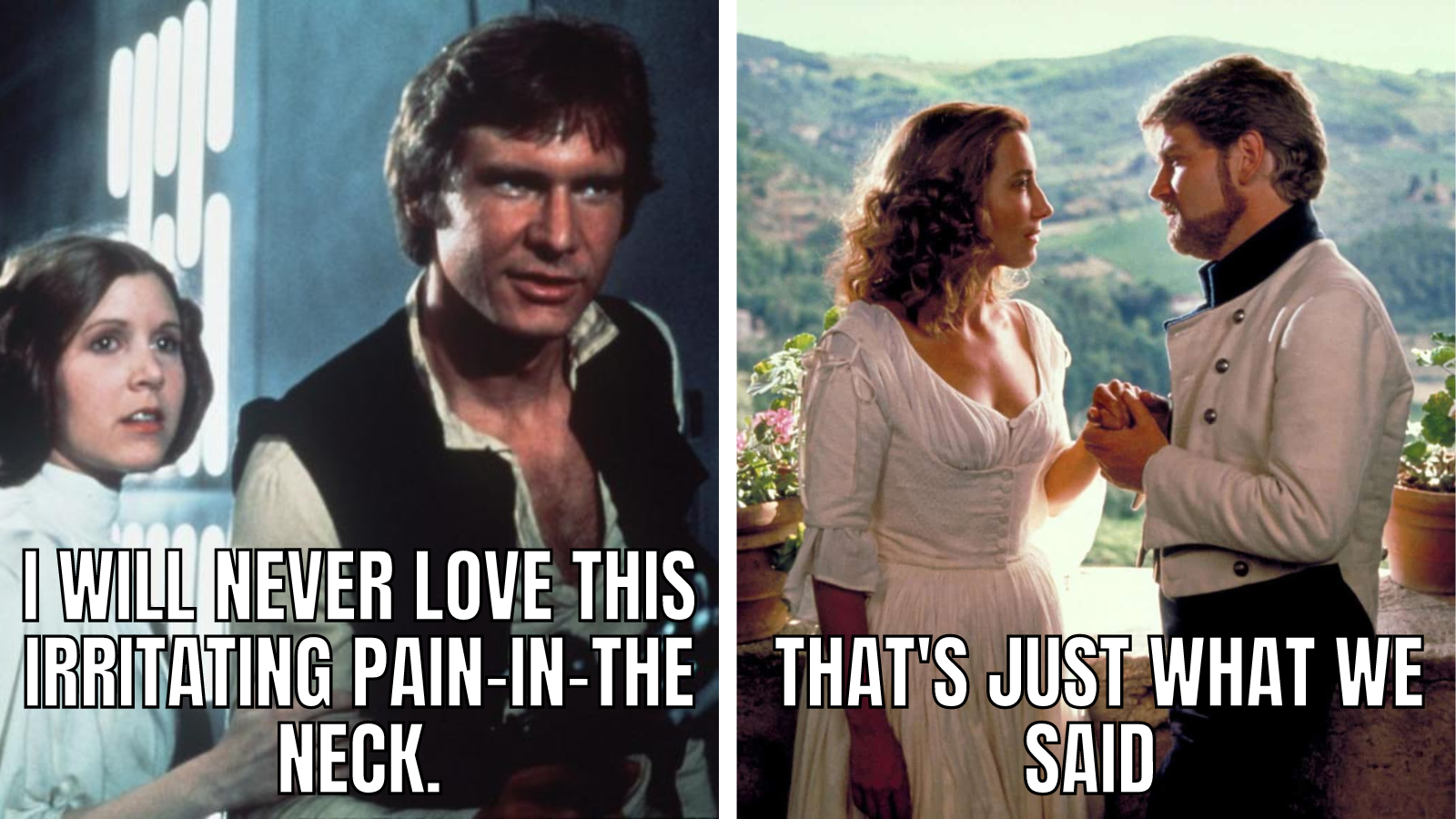
As this funny cartoon illustrates, the plots of Percy Jackson and Hamlet can be seen as a modern incarnation of the Perseus myth, from the villainous stepfather to the hero’s protective feelings to the mother to the magical quest to get rid of a stepfather who takes away his birthright. These plot elements follow a very similar formula; as Jake also alluded to, all three of these stories are part of what writers and scholars like to call the monomyth or the “Hero’s journey,” a concept in mythology and storytelling that has inspired works such as Percy Jackson, Star Wars, and many others.

What Is the Monomyth?

Crash Course Mythology- The Monomyth

In 1949, scholar Joseph Campbell wrote a book called “The Hero With a Thousand Faces,” which posited that every culture has stories that fit into universal archetypes- that essentially all human cultures have unique stories, but also call to mind universal truths about humanity. He then distilled the common archetypes and plot tropes of these myths into something called “The monomyth” or “The Hero’s Journey,” a 17-step process that is at the core of many ancient myths, modern adventure stories, or revenge stories such as Hamlet. Below are some of the common tropes of the Hero’s Journey. When you see it spelled out like this, it is very clear that both Hamlet, Percy Jackson, and Perseus follow the Monomyth formula:

Infographic of the Monomyth from David R. Jolly.com

Part I: The Call To Adventure:

Where’s the glory in repeating what others have done?

The Lightining Thief

Every Greek hero starts with a call to adventure- Theseus finds his father’s sword and sets out to find him. Oedipus needs to lift the plague on Thebes, and Hamlet needs to find out why his father’s ghost has returned.

A Half-Blood of the eldest gods, Shall reach sixteen against all odds
And see the world in endless sleep
The Hero’s soul, cursed blade shall reap
A single choice shall end his days
Olympus to preserve or raze.

The Oracle- Sea of Mosters

Part II: Refusing the Call

If my life is going to mean anything, I have to live it myself.

The Lighting Thief

I won’t go looking for trouble. I usually don’t have to

Neither Hamlet nor Percy outright refuse to go on their quests, but both experience doubts. Percy, looking at how the gods have cursed and fought and betrayed each other, wonders whether or not they deserve his help:

Percy watches the story of the gods in the Tunnel of Love (Episode 5, Disney Plus 2024.)

Hamlet on the other hand, is so worried that the ghost is trying to deceive him into killing an innocent man, that he nearly kills himself in the most famous speech in all of Shakespeare.

Part III: Supernatural Aide

Supernatural Aid – A magical helper appears or becomes known

Go on with what your heart tells you, or you will lose all.

The Nereiads, Lighting Thief Chapter 17

Both Percy and Perseus get help from the gods- magical weapons, advice, etc. Hamlet gets the revelation from his father that his uncle killed him and how. What sets Hamlet apart from any number of myths is that, since there’s no tangible evidence that his father was there, Hamlet is not sure if his father helped him, or if he is going insane.

Suspecting and knowing are not the same.

-The Lighting Thief

Crossing the first threshold

In Perseus, the first threshold would be when he leaves Acrisius’ palace and sails to the island of Cerebos. In Percy Jackson, this would be when he leaves Yancy Academy and goes to Camp Half-Blood, and in Hamlet, it would be when he meets the ghost.

My fate cries out, and makes each petty artery in this body as hardy as the Nemian Lion’s mane. Still am I called!

Hamlet, Act I, Scene iii.

Belly of THe BEast

There’s always a part of the story when a character feels they are in too deep. Sometimes it’s a literal belly of the beast- Pinocchio and the whale, Luke Skywalker and the Sarlaac pit, Frodo when he reaches Mordor, and Agent K in Men In Black when he literally gets eaten by the Bug. In Percy Jackson, it would definitely be when he journeys to Hades, like many Greek heroes like Orpheus or Hercules.

I’d love to tell you I had some deep revelation on my way down, that I came to terms with my own mortality, laughed in the face of death, et cetera.

The truth? My only thought was: Aaaaggghhhhh!.

Usually, the belly of the beast occurs near the climax of the story- the ultimate test of the hero’s courage and resolve. For Hamlet, this would be the duel with Laertes- he’s in a situation where Claudius has total control of what he does.

“You weren’t able to talk sense into him?”
“Well, we kind of tried to kill each other in a duel to the death.”
“I see. You tried the diplomatic approach.” (The Sea of Monsters)

I’ll get into a deeper summary of the steps of the Hero’s journey on my podcast later this month, but to summarize, the Hero’s Journey is essentially a story of growth, maturity, and enlightenment. It’s not a coincidence that all three of these heroes are young men who leave home and then return to confront an evil stepfather or uncle. Campbell regarded the Hero’s journey as a metaphor for young men growing up, learning about themselves, gaining confidence in themselves and their abilities, and taking their rightful place in society by displacing a corrupt older authority figure. This is also why these stories often resonate with young people, and why storytellers like Disney often use the Hero’s Journey as a template for children’s movies.

These universal stories of growing up, maturity, and a life worth living have always inspired people and even though the stories have different purposes and the plots take different forms, the core of what makes them universal remains the same.

Shakespearean Wisdom for the Sixth Night Of Hanukkah

I found this wonderful short clip from Dr. James Allen Jones, a Shakespearean scholar and actor who draws parallels between the miracle of Hanukkah and this passage from Othello:

Duke of Venice: Let me speak like yourself, and lay a sentence,
Which, as a grise or step, may help these lovers
Into your favour.
When remedies are past, the griefs are ended
By seeing the worst, which late on hopes depended.
To mourn a mischief that is past and gone
Is the next way to draw new mischief on.
What cannot be preserved when fortune takes
Patience her injury a mockery makes.
The robb'd that smiles steals something from the thief;
He robs himself that spends a bootless grief.
Othello, Act I, Scene iii, lines 547-558

The Context

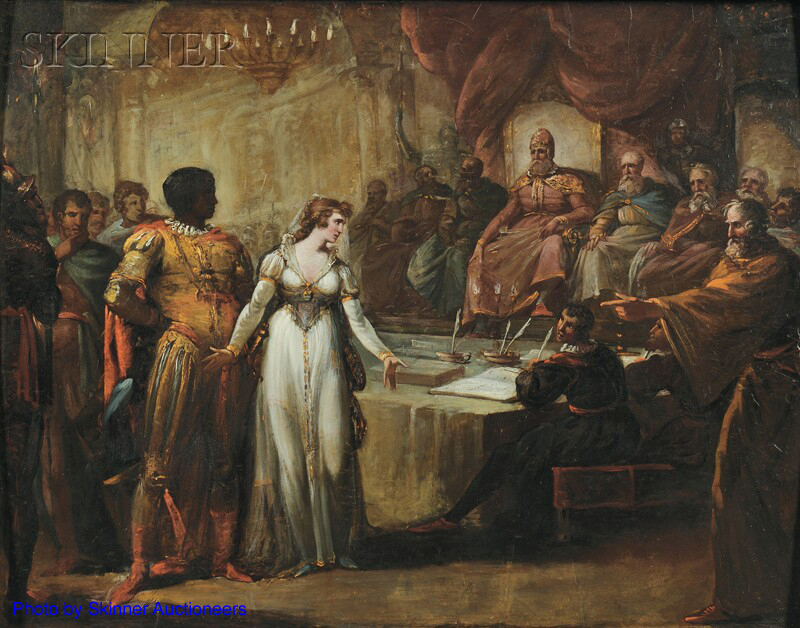
Desdemona has married Othello, but her father Brabantio cannot comprehend why a woman like her would disobey him, much less marry a black man. He is actually convinced that Othello must have used drugs or witchcraft to seduce Desdemona, and calls both of them to court before the Duke. The Duke hears the argument patiently and concludes that Desdemona’s love for Othello is genuine. In the lines above he speaks to Brabantio giving him friendly advice as if he were Brabantio’s conscience, (or the sense of judgment that he so clearly lacks). The Duke urges this father to let go of his “grief” over losing his daughter because it will only invite further suffering.

Sadly Brabantio doesn’t take this advice at all, and ‘warns’ Othello that she could just as easily betray him as she betrayed her father. Arguably, this plants the first seeds of doubt and jealousy in Othello’s mind, the seeds with Iago so carefully cultivates.

The miracle of Hanukkah is that the Israelites were able to see clearly who they were and preserve their culture in the face of annihilation. Sadly, the characters in Othello are all blinded- blinded by racism (Brabantio, Iago), lust, (Rodrigo), love (Desdemona), and jealousy (Othello). I thought Dr. Jones drew some very interesting parallels between Shakespeare and Hanukkah, and I’m happy to share them with you:

The original post: https://rebooting.com/article/the-miracle-of-shakespeare/

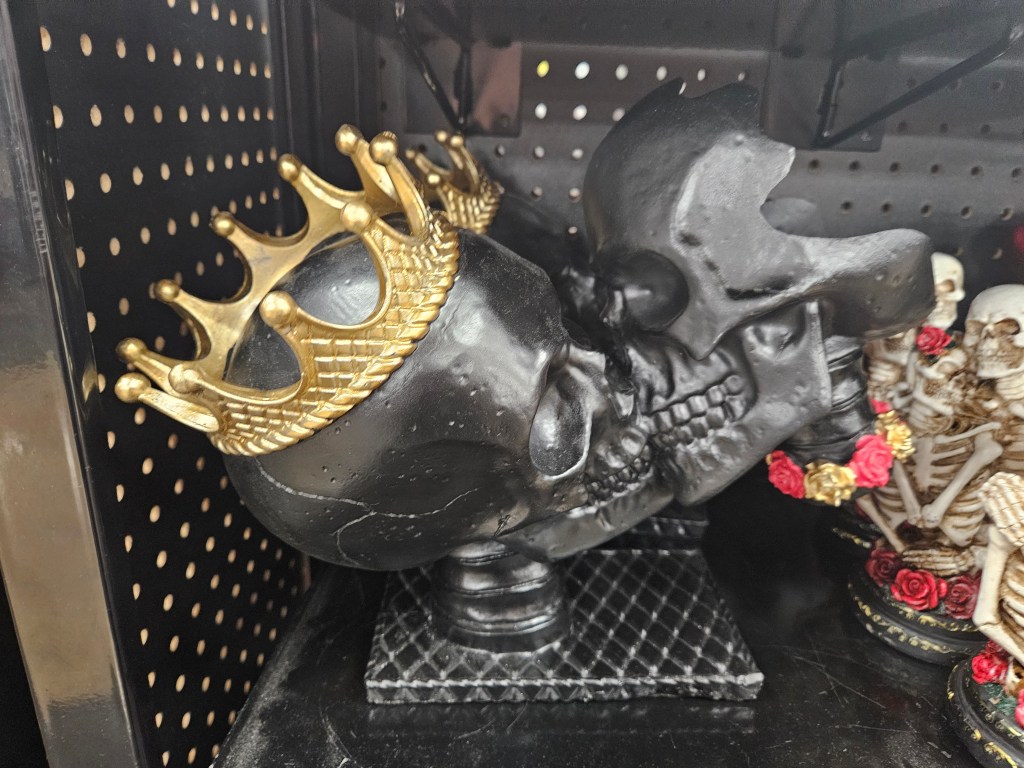
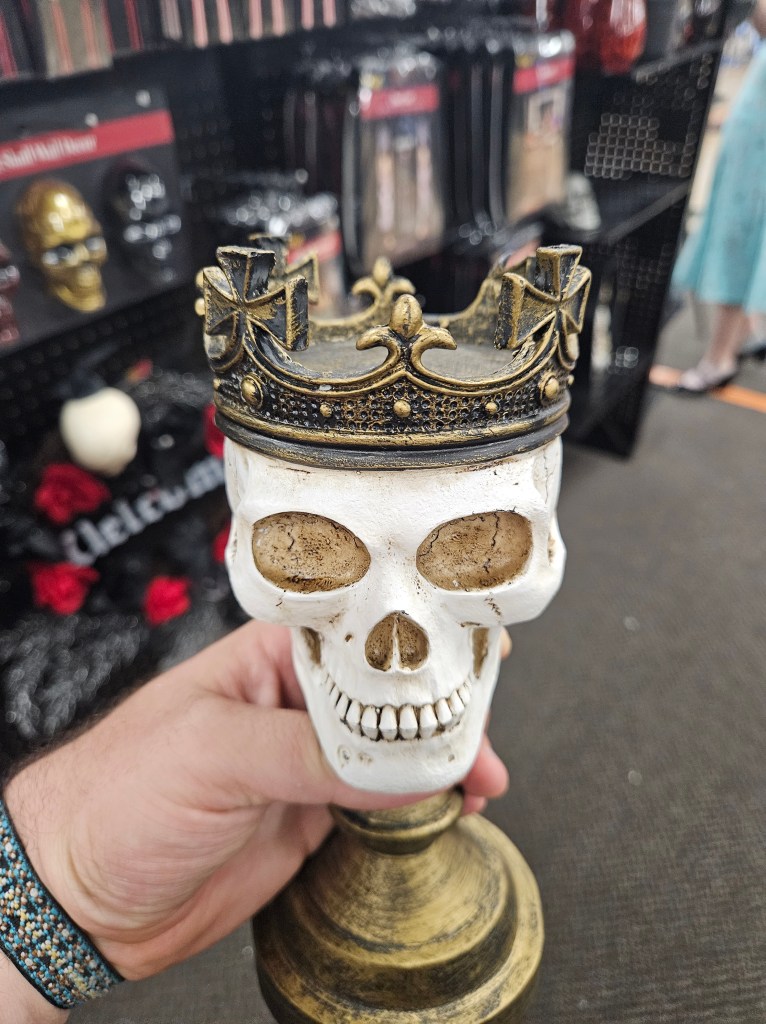
Spirit Halloween and Shakespeare

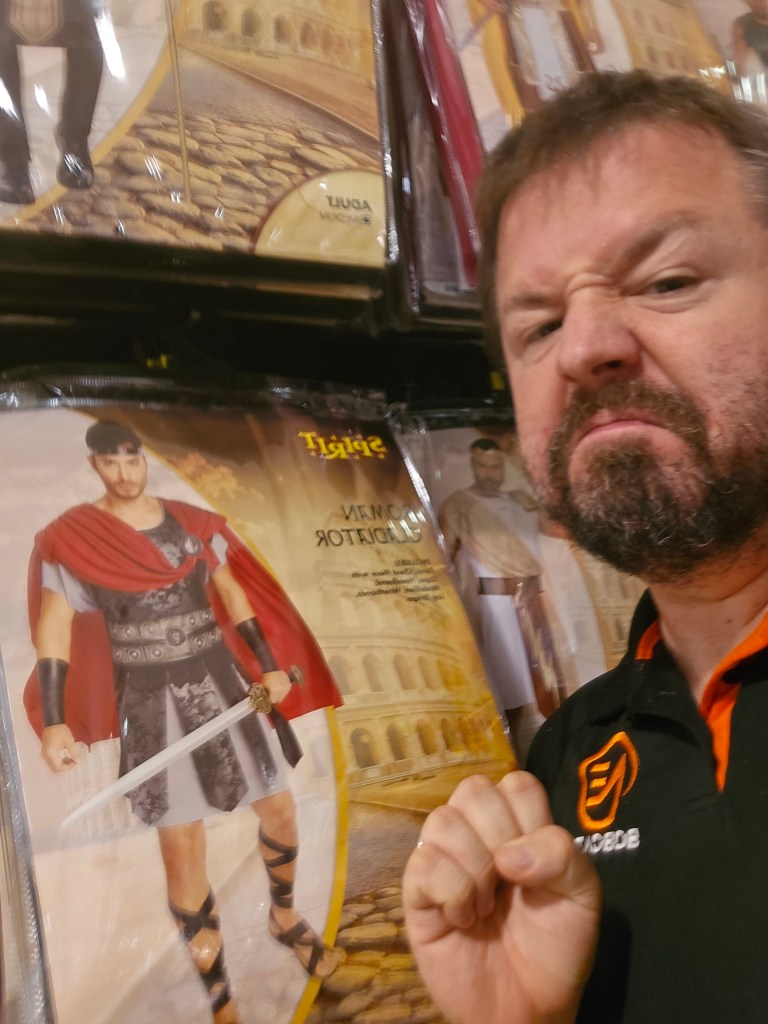
I’ve written before that Shakespeare helped influence Halloween as we know it- the images of holding skulls, witches chanting over a cauldron, and even ghosts coming back to plague their murderers all have Shakespearean roots. Exhibit A is how these images and tropes can even be found in beloved Halloween costume stores like Spirit Halloween!

If you like creepy Halloween activities and Shakespeare, please sign up for my fully online, fully asynchronous class: “An Immersive Guide To Shakespeare’s Macbeth!” The class features a digital escape room, an interactive quiz, and a special, undead guest!

Get $10 off my class “An Interactive Guide to Shakespeare’s “Macbeth” ” with coupon code HTHES4NHCN10 until Nov 3, 2023. Get started at https://outschool.com/classes/an-interactive-guide-to-shakespeares-macbeth-jp7TIh9B and enter the coupon code at checkout.

Dramatic PLay In Classes

Hi everyone,

I know I haven’t posted in a while. I’ve been working on my education certification so I’ve been pretty busy. My last project was about using theater as an educational tool, so I thought I’d reprint it here. I’ll add some notes later on to show how this can be adapted to Shakespeare, but for now, hopefully, this can be an interesting look at theater as a way for children to cope with trauma, etc.

INTRODUCTION

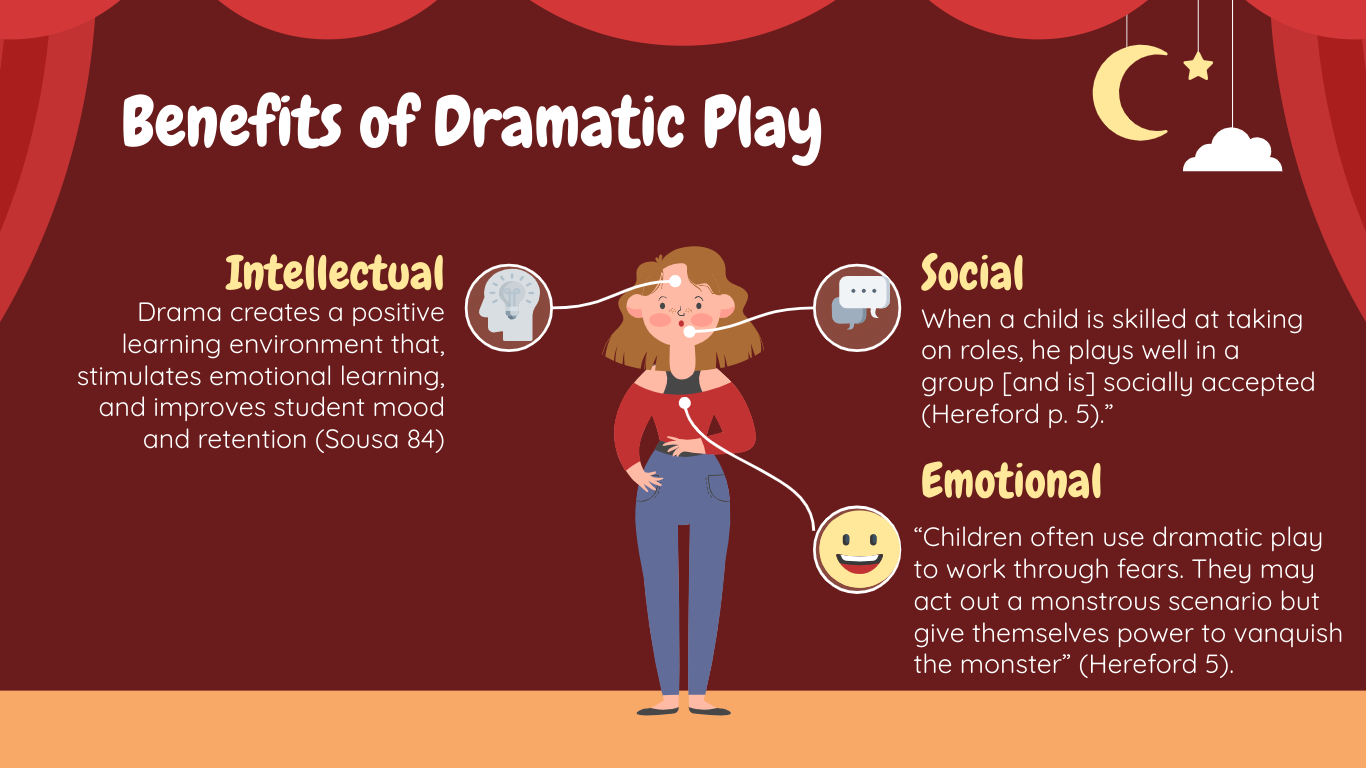
Numerous studies from educators, neuroscientists, and nonprofit organizations have demonstrated that children’s brains benefit from the arts. According to David A. Sousa in his book How the Brain Learns, human beings have used art forms as teaching from the very beginning of civilization, and every child’s early development can benefit from the kind of imaginative play that children naturally engage in:

Much of what young children do as play- singing, drawing, dancing…engages all the senses and helps wire the brain for successful learning. When children enter school, these art activities need to be continued and enhanced. The cognitive areas are developed as the child learns songs and rhymes. The dancing and movements during play develop gross motor skills, and the sum of these activities enhances emotional well-being.

(Sousa 215)

One method to continue this kind of artistic learning in a classroom is dramatic play or drama therapy: using theatrical games and techniques as a teaching tool. This paper will demonstrate how educators have used dramatic play to improve socio/emotional learning, as well as cognitive development. In particular, the studies and books cited in this paper will argue that a dramatic play intervention in schools would be beneficial to students who are facing challenges due to emotional disorders.

After reviewing case studies in drama therapy and reading literature on dramatic play, the author of this paper is convinced that a dramatic therapy intervention could and should be available to children with emotional disorders. The goal of the intervention is to help students with emotional disorders through creative play, dramatic exploration, textual analysis, and roleplay-based problem-solving. The suggested intervention would help students confront their problems in a safe way and help them develop problem-solving strategies over the course of a few weeks.

WHAT IS DRAMATIC PLAY?

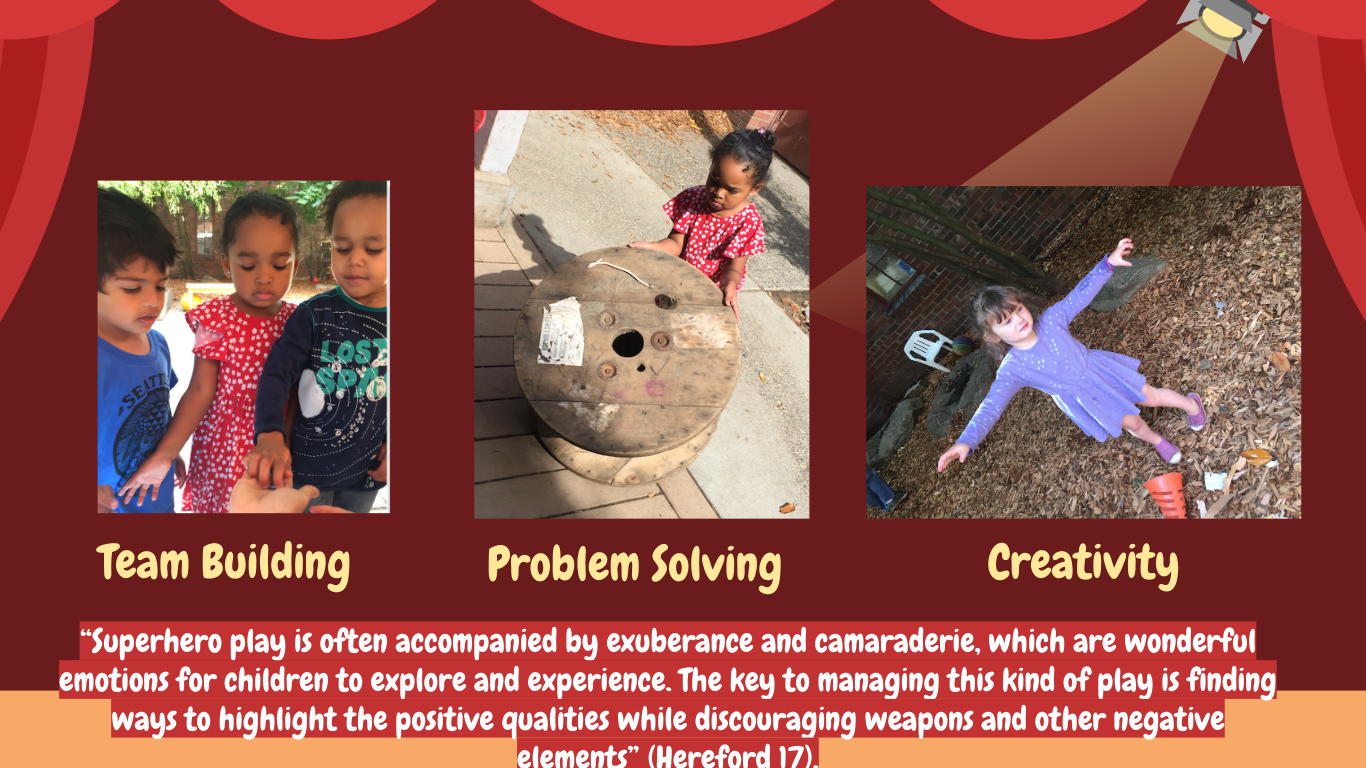
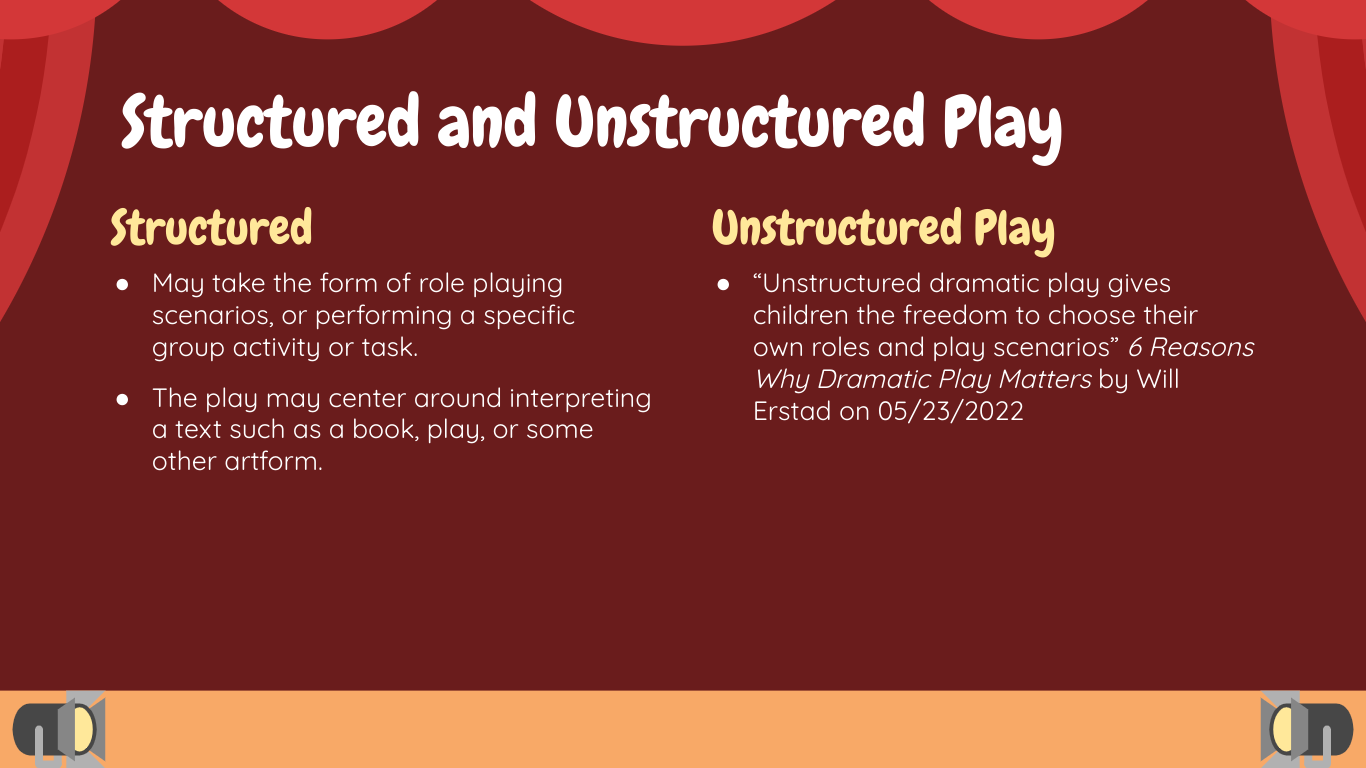
According to West Governor’s University, dramatic play involves students taking on roles and acting them out to explore themselves and their surroundings. WGU’s website identifies two basic types of dramatic play- structured and unstructured. In the case of structured play, it may take the form of roleplaying scenarios, or performing a specific group activity or task. Finally, the play may center around interpreting a text such as a book, play, or some other artform. The roles the students play need not be a pre-written story. When students take on these roles to play, they may better understand their real-life roles and how to perform them in real life.
In her 2015 article, Analysis of Three Approaches in Dramatherapy, Ivana Lessner Listiakova compares and contrasts three approaches of drama therapy: Role Theory, Psychodrama, and Developmental Transformation. In all three approaches, participants may gain a new understanding of themselves and a healthy way of processing their emotions. Within Role Theory, participants examine Jungian archetypal roles and counter roles within themselves by embodying them. In Psychodrama, participants enact moments from their own lives and have emotional and mental epiphanies by looking at those moments with a critical eye. Finally, in Developmental Transformation, participants arrive at roles and stories organically through a sort of “improvised series of encounters,” rather than a set story that is agreed upon beforehand. Listiakova emphasizes that these approaches work within psychotherapy because rather than the direct uncomfortable confrontations found in traditional therapy, dramatherapy uses the theater’s distance from the client and the metaphorical nature of storytelling to allow clients to see the issues and emotions that they face in their lives in a new light.

HOW DRAMATIC PLAY BENEFITS CHILDREN WITH EMOTIONAL DISORDERS.

A study by Roundabout Dramatherapy in 2013 in the journal Dramatherapy (Godfrey 20-28), demonstrates how drama therapy can specifically benefit developmental disorders like Autistic Spectrum Disorders (ASD). Roundabout is a London-based charity aimed at improving the lives of children on the Autism Spectrum. Through a collaboration with Emma Godfrey, (a psychotherapist and drama therapist), this article chronicled the success of its drama therapy sessions over three primary schools and five secondary schools. Before and after each program of drama therapy, teachers, parents, and students submitted evaluations and questionnaires to Roundabout.

The students showed marked improvement in the following specific areas: [processing}f, working with peers, social skills, structure, and anxiety. Most children on the Autism spectrum struggle with these very skills, therefore this kind of play was incredibly useful for these students. The activities encouraged at Roundabout developed specific life skills such as saying hello and goodbye and relaxation techniques to quell anxiety:

Dramatherapy is particularly appropriate for this client group as it develops social skills and supports the expression of feelings through structured work that helps reduce anxiety. The dramatherapist can model clear, expressive communication, as well as facilitate the development of relationships with others, which gives participants numerous opportunities to rehearse and replay social skills until they are learned and integrated into behavior. (Godfrey 21)

Godfrey’s study showed that students with ASD benefited from modeled play, in which the teachers rehearsed and practiced important life skills in class that taught the students how to compensate for their inability to intuit social cues. As this quote from a parent whose child was part of the study illustrates, dramatherapy can help ASD students gain a better understanding of themselves, how to interact with people, and help them develop tools to engage with others and control their anxiety and other forms of emotional stress:

It has really helped him to understand his emotions and friendships more. At times he has found it challenging but it’s been great for him to do that in a safe and caring environment where the people running it understand his issues (Godfrey 25).

The sources cited above confirm that students with emotional disorders can benefit from different forms of dramatic play and develop coping mechanisms and skills to help enrich and improve their lives.

DISCUSSION AND RECOMMENDATION

As the literature previously demonstrates, dramatic play is an excellent educational tool to help students process their emotions and prevent anxiety through role-playing while promoting social, emotional, and physical health. The author’s suggested interventions, like the study by Roundabout, would carefully monitor child development as students engaged in formal and informal activities to help develop social skills, reduce anxiety, and develop emotional coping skills.

A potential format for the intervention would be to start with unstructured drama games designed to engage the children’s imagination, and promote positive emotion. The teacher would then move into a check-in-check-out therapy to guide the students into thinking about their feelings and social situations that the therapy would address. The class could then turn to role-play and role theory, where students would explore sources of stress, anxiety, or difficulty in a safe roleplay-based setting. The session might then conclude with a creative group project such as superhero play, or reading and acting out a storybook or text, (with emphasis on books that promote healthy social and emotional behavior).

The work of Sousa, Godfrey, Hereford, and others indicates that dramatic play can be a powerful method to improve the lives of children with emotional disorders, and their techniques would translate well to children with anxiety, Autism Spectrum Disorders, or depression. The potential intervention described in this paper would use these techniques effectively to benefit children with these and other emotional disorders. Since the onset of COVID-19 in 2020, mental health has been a big concern in schools, and cases of ASD have been increasing over the last few decades (Godfrey 21). There has never been a greater need for mental health interventions in classrooms, and dramatic play is a particularly effective method to help the growing number of children who require intervention.

Works Cited

Brooks, A. (2015). 5 Reasons Dramatic Play Matters for Child Development | Rasmussen College. Rasmussen.edu. https://www.rasmussen.edu/degrees/education/blog/why-dramatic-play-matters/

Dramatic Play: What It Is and Why It’s Important. (2021, November 5). Western Governors University. https://www.wgu.edu/blog/dramatic-play-what-is-why-important2111.html#close

Godfrey, E., & Haythorne, D. (2013). Benefits of Dramatherapy for Autism Spectrum Disorder: A Qualitative Analysis of Feedback from Parents and Teachers of Clients Attending Roundabout Dramatherapy Sessions in Schools. Dramatherapy, 35(1), 20–28. https://doi.org/10.1080/02630672.2013.773131

Kissinger, K. (2017). Anti-bias education in the early childhood classroom : hand in hand, step by step. Routledge.

Laurence, M., & Curtis, D. (2019, December 1). Look, Listen, Learn. “We Are Power Rangers!” Learning from Children’s Dramatic Play | NAEYC. Www.naeyc.org. https://www.naeyc.org/resources/pubs/tyc/dec2019/childrens-dramatic-play

Nancy Jo Hereford, & Schall, J. (1991). Learning Through Play. Scholastic Inc.

Sousa, D. A. (2017). How the Brain Learns (5th ed.). Corwin, A Sage Publishing Company.

The Awesome World of “Six” Part II: Full Review Of the Show

I am just ecstatic to talk about this year’s hit Broadway Musical Six. It swept the Tonys, and has opened up touring productions across the country, and I JUST GOT TO SEE IT!

Part I: The Concept: A Historemix.

Welcome to the show, to the histo-remix
Switching up the flow as we add the prefix
Everybody knows that we used to be six wives

The cast of Six “Ex Wives”

This vibrant, clever retelling of Tudor her-story was created by TOBY MARLOW & LUCY MOSS in association with the Chicago Shakespeare Festival. The show is incredibly smart, and creative, and delves into the lives of some fascinating women, re-told as a singing contest with the characters singing their lives for you to judge what it was like being the queen of England and living with the turbulent and fickle Henry VIII.

What really appeals to me in this show is that like Hamilton, the musical takes these six semi-mythical women and tells their story in a way that is fresh and exciting. It bridges the gap between Tudor History and the modern-day by equating being a queen with being a celebrity, with all the drama of ambitious parents, romantic drama, public opinion, and even being exploited and sexualized by a male-dominated society. This comes across in the music, the costumes, the lyrics, and even the lighting!

Why “Six” Slaps

The costumes are brilliant and iconic. Catherine Of Aragon is like a cross between Beyonce, a saint, and a medieval knight. The lighting is incredible! You could tell the whole story using the lighting design as it pulsates, dances, changes into different colors, turns into different shapes, and finally flashes the name of the show in triumphant gold letters.

One particularly brilliant way the music works in “Six” is the fact that it uses the song “Greensleeves” as a motif both musically and thematically. One big theme of the show is how, unlike Henry VIII, most of the history of his six queens is lost and replaced by legends and even songs. The first line of the show is the famous rhyme about their fates: “Divorced. Beheaded. Died. Divorced. Beheaded. Survived.” As the video above helps illustrate, Marlowe and Moss know that most people only know the rhyme about their deaths and the myth that Henry wrote a song about one of them; that their lives are overshadowed by their deaths and the misconceptions that people have written over the years. Howard Ho points out how the song musically forces itself into the first number, “Ex Wives,” but by the end of the show, the six queens break free from these musical bars! You can hear the change of key and notes during this performance at the Tonys, which puts the opening number and closing reprise together.

The Cast of “Six” perform live at the 2021 Tony Awards.

But how do the queens go from “one word in a stupid rhyme,” to a group of powerful, individual queens singing in harmony, without the man who made them famous? That’s what the solo numbers in “Six” do so incredibly well- tell each queen’s solo stories as rocking ballads, hilarious dis-tracks, soulful love songs, and… well stay tuned.

Part II: The Women and Their Queenspirations

1. Catherine of Aragon

Catherine of Aragon was Henry’s first wife and is still universally beloved, even though Henry decided to divorce her. As the epitome of a stand-alone power queen, it makes sense that Six modeled her character, costume, and songs after Beyonce, with a Shakira-inspired Spanish beat for good measure:

My favorite thing about her solo, “No Way” is how the writers paraphrase her real-life speech during the divorce trial in 1529. Below are the lyrics and the real speech:

You’ve got me down on my knees
Please tell me what you think I’ve done wrong
Been humble, been loyal, I’ve tried
To swallow my pride all along
If you can just explain
A single thing I’ve done to cause you pain, I’ll go

(spoken)
No?

[sung]
You’ve got nothing to say

I’m not going away
There’s no way

Alas, Sir, where have I offended you? Or what occasion have you of displeasure, that you intend to put me from you? I take God and all the world to witness that I have been to you a true, humble and obedient wife, ever conformable to your will and pleasure. This twenty years and more I have been your true wife, and whether it be true or no, I put it to your conscience.

— Katherine of Aragon, 1529

2. Anne Boleyn

In some ways, the version of Anne Boleyn in “Six” is less a pop version of the real queen and more of a commentary on the nature of celebrity. If you watch the video, you can see how in life she was admired for her beauty and fashion but hated for her comments on Queen Katherine, her scandalous love affairs, and her brash nature. This explains the spiky pop-punk princess look they gave her, (which evidently resonates with many audiences since I saw at least two girls cosplaying as Anne in the audience). Sort of like a celebrity who gets canceled on Twitter or Princess Diana, Anne shows how a person can be undone when they dare challenge an established order, especially the Royal Family.

After the show, I found it a bit weird that they portrayed Anne Boleyn as a jetsetting airhead, but then again she is one of the best-known queens in history, so they can get away with it. In reality, Anne Boleyn was highly educated and a member of an ambitious and social climbing family who basically pushed her to woo Henry. As you can see in this clip from “Anne Of A Thousand Days,” Henry and Anne’s family bullied her constantly to become the King’s mistress after HE ALREADY GOT HER SISTER PREGNANT, so Anne knew that the only way to keep Henry from ruining her life was to convince him to divorce Katherine of Aragon and marry her.

Of course, this strategy didn’t save Anne in the end, which says more about how cruel Henry VIII was, chewing up women and spitting them out in his ravenous quest for a son. So is this an accurate portrayal of Anne’s life? No. Is it fun, ABSOLUTELY!

III. Jane Seymore

I’m more than I seem, or am I?

“Six” The Musical.

This version of Jane Seymore was inspired by Adele, so appropriately, she has a heart-wrenching power ballad about her turbulent relationship with Henry. Sadly, we don’t know much about Jane’s real life, so the song takes some liberties. If you go to the Hampton Court Website, you can actually vote as to whether Jane was a devoted wife or a social climbing gold-digger. Probably the real woman was something even more complicated, though we’ll never know for sure.

IV. Anne of Cleaves

Anne of Cleaves is the funniest part of the show! Many of us have heard the story that Henry divorced Anne after he found her ‘ugly.’ What “Six The Musical” does is amend the story, by pointing out that after he divorced her, Henry gave her a castle and a huge retainer, allowing her to live like a queen, without being married to a king! Accordingly, her song is a Rhianna-style dis track that shows off her awesome lifestyle, and spits in Henry’s stupid face!

As fun as this, rags-to-riches story is, the truth is less fun- Anne was the sister of a German duke, so Henry’s lord Chancellor Thomas Cromwell probably forced Henry to marry her for diplomatic reasons (source: Hampton Court: “Anne of Cleaves”). Naturally, Henry didn’t like being told what to do- I suspect he resented Anne before even meeting her because he didn’t get to pick her himself.

As for whether Anne was actually ugly, the truth is really surprising- Henry actually disguised himself as a peasant during a masked ball when he first courted Anne, and she found him repulsive. At the time, Henry was 49 years old, and in very poor health. As such, he was intermittently impotent and blamed his inability to conceive a child with her on her supposed ugliness to save face.

Even though Anne in the show hates Henry, in reality, once the marriage was annulled, Anne and Henry remained good friends for years! She attended his next wedding to Katherine Howard, and, just like in the show, Henry treated her much better after the divorce:

‘YOU SHALL FIND US A PERFECT FRIEND, CONTENT TO REPUTE YOU AS OUR DEAREST SISTER. WE SHALL, WITHIN FIVE OR SIX DAYS …DETERMINE YOUR STATE MINDING TO ENDOW YOU WITH £4000 OF YEARLY REVENUE…YOUR LOVING BROTHER AND FRIEND.’

Henry VIII, 1548, six months after their wedding, when the annullment went through.

V. Katherine Howard

Without question, Katherine Howard is portrayed as the most tragic of Henry’s six wives and her song is a huge sucker punch. The writers never let you forget that Katherine’s first affair was when she was 13, and she died at age 19. Like Anne Boleyn and Jane Seymore, Henry picked Katherine for his queen among his ladies in waiting and her song “All You Wanna Do” satirizes his and many other men’s lustful appetites. The song begins as a raunchy, sexy pop ballad in the vein of Britney Spears’ “Toxic” and “Womanizer” about Katherine Howard’s love affairs, but then devolves into a cry for help, as Katherine confesses how she was abused, used, and manipulated by the men in her life, (including her own cousin Thomas Culpepper) until she was beheaded in 1542. It masterfully satires both Henry’s cruelty and the hypersexualization of teenage pop stars which certainly took its toll on Britney Spears and Ariana Grande, Katherine’s major ‘Queenspirations.’

VI. Katherine Parr

Historically, Katherine Parr had to turn away her fiancee Thomas Seymore (just like Anne Boleyn was previously engaged to Henry Percy) once the king set his eyes on her for his wife, so her song is a sad, soulful Alicia Keys-inspired bittersweet song where she tearfully says goodbye to Thomas to spare his feelings and probably his life.
Not only does this song once again show how Henry’s selfishness and his lust ruined the lives of the women he married, (as well as the men who already wanted to marry them), but it also sets up the main idea of the show:

His-Story overthrown

In the final number, the wives turn the tables on Henry- they have spent centuries being defined by him, but in reality, he is just as much defined by them! Going forward, history should not define these great women as just, “The Six Wives of Henry the Eighth,” but to celebrate their individual lives and contributions to history. Katherine Parr mentions this when she points out that in life, she fought to allow women to be educated, she wrote books, and was a scholar of theology. Historically, Henry and Katherine would argue about religion and he nearly executed her after she disagreed on points of theology, but Katherine kept her life by claiming she was “Not disagreeing with [him], but simply learning from [him].”

Remember that I was a writer
I wrote books and psalms and meditations

Fought for female education
So all my women can independently study scripture
I even got a woman to paint my picture
Why can’t I tell that story?
‘Cause in history
I’m fixed as one of six
And without him
I disappear
We all disappear

Genius Annotation2 contributors

I Don’t Need Your Love is sung by Catherine Parr in SIX: The Musical. The first part of the song refers to her love of Thomas Seymour, whom she probably wanted to marry rather than Henry (and did marry after Henry’s death). However, the song also protests at the fact that women are often defined by their relationship with men, rather than as people in their own right. Catherine wants to be remembered for what she did, rather than the men she married or loved.

Katherine Parr, Six.

The final number completes the idea of the ‘historemix’ by having the Six queens/pop stars come up with a re-imagined happy ending for themselves, one that doesn’t include the pain that Henry inflicted on them: Katherine A becomes a singing nun, (like Whoopi Goldberg in Sister Act), while Anne Boleyn starts writing lyrics for Shakespeare (which is a fun idea since he does mention “Greensleeves” twice). Jane Seymore forms a band with her many surviving children, Katherine Howard goes solo, and Katherine Parr joins the other queens in a supergroup. It’s not at all historical, but it is a fun and sweet way to put an epilogue on these (mostly) tragic lives.

It’s odd, however, that the show invents an epilogue instead of talking about the six queen’s greatest legacy- Queens Elizabeth and Mary I. For a show that wants to highlight the often-forgotten legacy of these queens, it is an odd oversight. Remember Catherine and Anne gave birth to queens who eventually ruled England without a king. Jane Seymore gave birth to a king, and Catherine Parr helped raise them and restored them to the line of succession- She’s the reason her stepdaughters were able to become queens in the first place.

My issues with the epilogue aside, it is great to see history be recontextualized and shared in such an accessible way. We all know that European history is dominated by the names of white guys- king whoever, duke what’s-his name. To see important women in history be given a voice by a multi-ethnic cast is a great way to make it resonate, and using the metaphor of pop stars works extremely well in this context- these women mostly didn’t choose stardom, but they deserve it for what they went through.

Brava.

Educational links related to the six wives of Henry VIII:

Books

TV:

Web:
https://www.history.com/news/henry-viii-wives

https://sixonbroadway.com/about.php

https://www.hrp.org.uk/hampton-court-palace/history-and-stories/anne-of-cleves/

Resources on Shakespeare’s History Plays:

Books

  1. Shakespeare English Kings by Peter Saccio. Published Apr. 2000. Preview available: https://books.google.com/books?id=ATHBz3aaGn4C
  2. Shakespeare, Our Contemporary by Jan Kott. Available online at https://books.google.com/books/about/Shakespeare_Our_Contemporary.html?id=QIrdQfCMnfQC
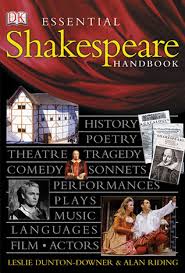
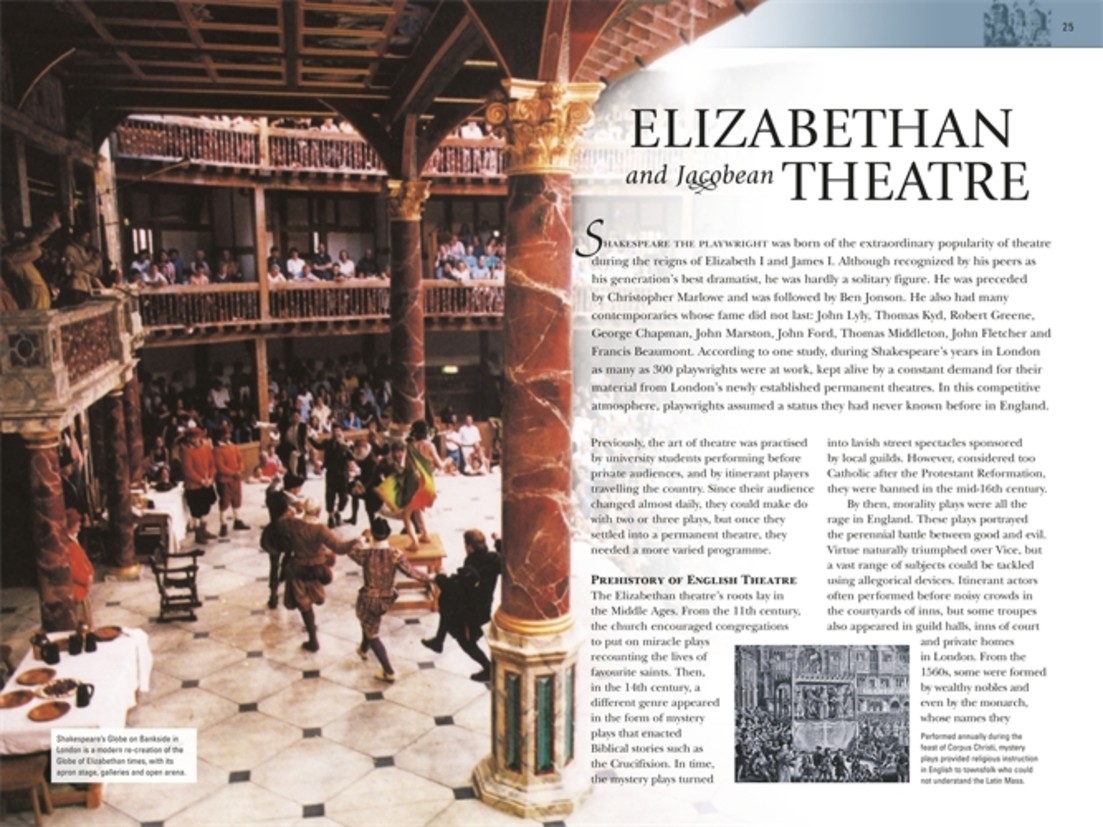
  3. The Essential Shakespeare Handbook
  4. The Essential Shakespeare Handbook by Leslie Dunton-Downer and Alan Riding Published: 16 Jan 2013.
    77ace26dfdee4259bf48d6eed1a59d57
  5. Will In the World by Prof. Steven Greenblatt, Harvard University. September 17, 2004. Preview available https://www.amazon.com/Will-World-How-Shakespeare-Became/dp/1847922961

TV:

The Tudors (TV Show- HBO 2007)

“The Six Wives of Henry VIII” (BBC, 1970)

Websites

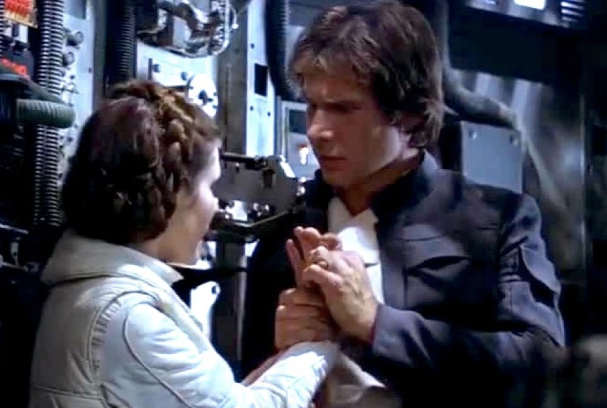
New Podcast: William Shakespeare’s Star Wars Part II: THe Journey of Han and Leia

Greetings and welcome to part 2 of my podcast on The Empire Striketh back, the 5th installment in the William Shakespeare’s Star Wars Series.

Last time I mentioned Luke’s journey and how Droesher adapts the cinematic quality into Elizabethan drama through soliloquies.This time, I’m going to talk about the other main characters, Han and Leia. In my opinion, Doescher writes their journey much better and gives them lots of good romantic and comedic dialogue. I am also privileged that this time I will have some help with the voices- two professional actors, Hal Jourdan and Janine Ashley have graciously agreed to be part of this podcast, lending their voices to Han, Leia, the Wampa, and Luke. I’m grateful for their involvement and would love for you to check out their other work onstage. Below are some Youtube clips I made using their voices. Enjoy!

Review: Edward II by Christopher Marlowe

For Pride Month, I’d like to draw some focus to a celebrated LGBTQ film, based on a play that, while not Shakespearean, it was by one of Shakespeare’s contemporaries and one who influenced Shakespeare a lot. This film, Edward II, directed by Derek Jarman, was based on the play of the same name by Christopher Marlowe (1564-1593). The film came out in 1991, during the AIDS crisis, when gay and lesbian people were not only fighting for their lives against a devastating epidemic but also for acceptance from the heterosexual community. This film is not only a striking, well-acted, well-directed adaptation of Marlowe’s play; it is also an encapsulation of the fears, struggles, and anxieties of the LGBTQ+ community at the time.

Plot Summary/ Great Quotes

Biography Of King Edward II

Edward II was the son of the infamous King Edward I, aka, Edward the Longshanks, the Scottish Hammer. He lived from 1307-1327 – until he was assassinated.

Fact Vs. Fiction

Peter Hanley as Prince Edward in “Braveheart” (1995) directed by Mel Gibson.

Aside from a few historical footnotes, I’m betting that when we think of Edward II, we mostly think of this portrayal in the 1995 film Braveheart. Frankly, most contemporary accounts of Edward II’s reign are similar to this portrayal- vain, spoiled, weak, deluded, and an utter disgrace to his warrior father. One of his greatest embarrassments was his army’s catastrophic defeat at the Battle of Bannockburn in 1314. Edward’s sources mainly portray him as weak and feeble compared to his father, but we have to remember that this was a cruel, warlike society with very little place for anyone who didn’t conform to stereotypical masculine virtues. Probably in the minds of the English court, Edward’s homosexuality was linked with his failures as a king. It was up to Jarman’s production to make Edward feel more like a real man, and not just a gay stereotype.

Play Vs. Movie

In the play, it’s ambiguous whether Galveston really loves Edward, or if he’s using him for the king’s power and protection. In the movie, Galveston is definitely using Edward, making the king’s fawning all the more pathetic and tragic. As his son asks: “Why do you love him when all the world hates him?” This makes our sympathies teter between Edward and his court- we wish Edward would open his eyes and get rid of Galveston, but at the same time, who hasn’t been blinded by love? At the same time, Galveston has been hurting the country, and taking Edward away from his court and his queen. Like many other stories of monarchs in love, including the real-life story of our current king, there is a constant tension in the court between the monarch’s personal desires, and his or her responsibilities to the country.

Biography of Marlowe

Edward II and Richard II

Many scholars believe that Marlowe’s play helped influence Shakespeare’s Richard II, as they both center around weak, sometimes effeminate kings that fall prey to the machinations of other lords. In Shakespeare’s play, it is possible to play Richard as being in love with some of his favorite courtiers, but nothing is explicit. Obviously, Marlowe was much more overt in Edward’s love for Gaveston. To demonstrate how these plays are similar, here’s Ian McKellen playing Richard II:

Is this play Homophobic?

On the one hand, the story shows Edward as effeminate, weak-willed, and poor in judgment which does align with offensive homosexual stereotypes. On the other hand, the other lords of the court are portrayed as cruel and intolerant, and Jarman definitely makes Mortimer a cruel and homophobic individual. In addition, when Edward’s son Edward III, who famously conquered England and France, he is shown in the movie wearing drag, which clearly shows that a member of the LGBTQ community need not be weak or ineffective. It also shows that Edward III has inherited his mother’s strength, not his father’s weakness.

Sources

https://www.luminarium.org/encyclopedia/edward2.htm

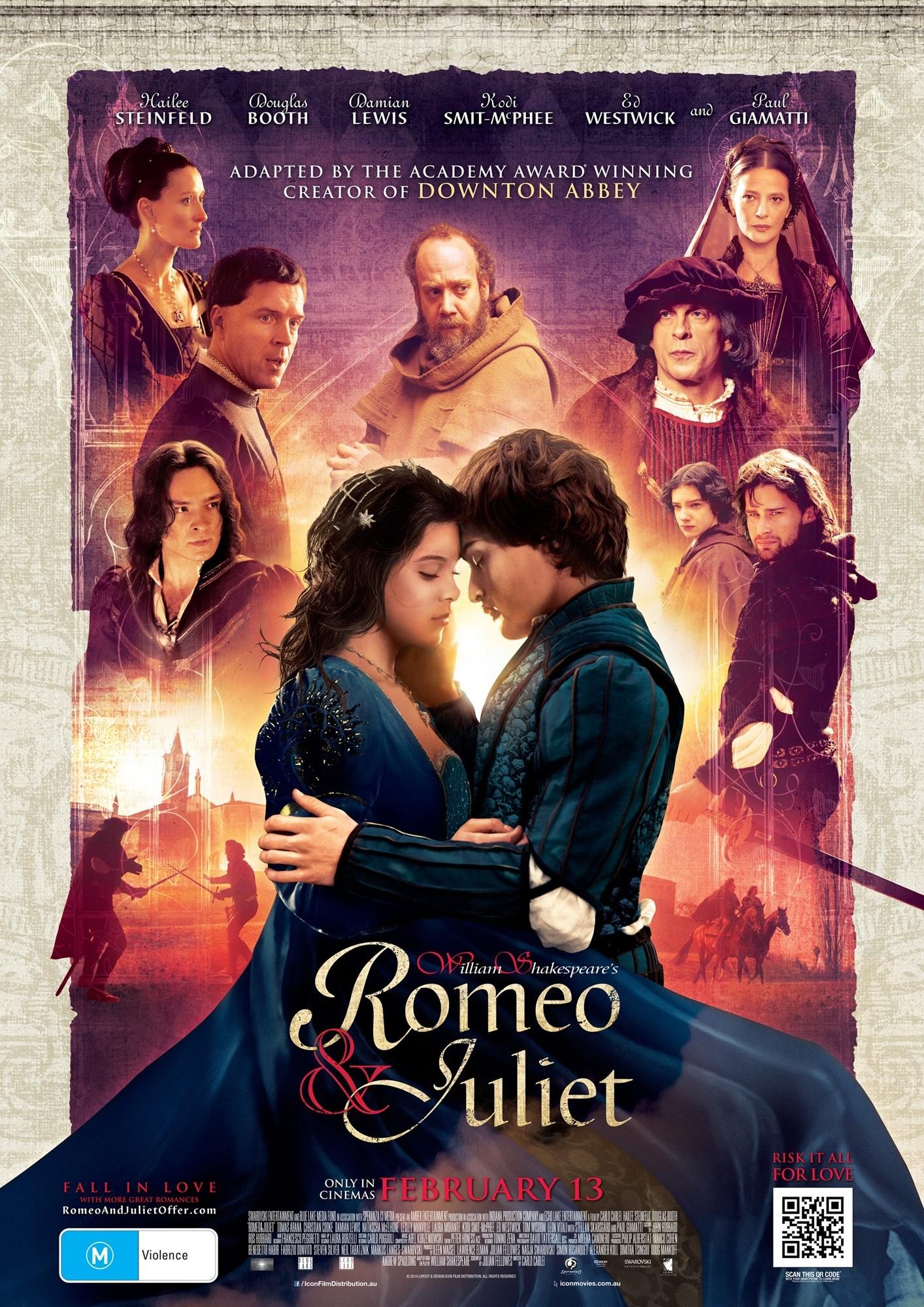
Review: Romeo and Juliet, 2013

 a sufficiently entertaining, adamantly old-fashioned adaptation that follows the play’s general outline without ever rising to the passionate intensity of its star-cross’d crazy kids

By Manohla Dargis, New York Times Review 2013

Romeo and Juliet is still taught more than any other text in American high schools, and since it’s a play not a book, teachers will inevitably want to show a movie in class to show some of the action to the students. Since this is the most recent high-profile film version of Romeo and Juliet, it seems inevitable that this will be the one teachers will show to students, so I will try to review this film from the point of view of an educator, not a Shakespeare fan.

The Concept

This film was financed by the Swarosvski Crystal Company and in the words of their own chairperson, the film is an extension of the Swarosvki brand. So if I were to describe this film’s concept it would be to dazzle the viewers with expensive costumes, exotic locations, beautiful visuals, and young, attractive actors:

To be clear, I agree with the director that Shakespeare should be updated every few years to keep it fresh and relevant. However, I would argue that this film doesn’t go far enough to make this concept fresh, and this version is destined to age poorly. Without a unique view of the play other than- “love is pretty”, the film lacks vision and is not very distinct. That said, it perhaps is a good way to introduce young people to the play, as we’ll see below:

Changes to The Plot

The Act I Tournament

The film opens, not with two servants fighting (yet), but with a tournament between the Monaegues and Capulets, where they joust instead of fight to avoid bloodshed. It is a striking image to be sure, and it is less confusing than starting a fight over biting a thumb, but it is a little odd that the Prince has this tournament to avoid street fights, and then they wind up fighting anyway over the results of the tournament. It works within the story but it makes the Prince seem dumb and it adds little to the story other than spectacle.

The Dialogue

As you can see from this clip, the dialogue of this film is changed liberally. The writers change Shakespeare’s lines to make them sound less Shakespearean. They also heavily cut the speeches to shorten the duration of the film. Cutting long speeches and substituting a word here and there is pretty standard for most Shakespeare movies, but what I find really irritating in this film is the number of lines that they add. It’s generally understood in Shakespeare that a director or actor can subtly change a few lines in a play- change pronouns, change an archaic word or two to make it easier for an audience, but this movie has the dubious record for most lines added to a Shakespeare movie. Some of these lines are paraphrases of the Shakespearean text, like all the dialogue of Sampson and Friar Laurence’s speech explaining the sleeping drug plan to Juliet. Some of the additions are character lines, like the scene where Benvolio admits he wants to woo Rosaline, (which to be fair, is an interesting change and I don’t mind it). Finally, some of the lines are designed to summarize speeches that the script cuts.

I know I sound like a purist here, but I feel that if you’re going to do Romeo and Juliet, use the text of Romeo and Juliet, and don’t change it unless it’s absolutely necessary. If you’re going to do an adaptation like Gnomio and Juliet or Tromeo and Juliet, you can throw out the Shakespearean dialogue and play around with dialogue using the plot and characters Shakespeare wrote. This film does neither- it mangles Shakespeare’s text but rigidly adheres to the story and characters, so it fails to pick a lane between faithful depiction or creative adaptation.

Small changes:

  1. Mercutio is a Montegue now. This matters because in Shakespeare’s version, he was related to the Prince, which is why the Prince takes pity on Romeo for avenging Tybalt’s death. Changing his allegiance robs his death of some of the tragedy that he was a neutral party who got caught up in other people’s quarrels.
  2. Tybalt is in love with his cousin Juliet, (which admittedly I’ve seen in other productions). It gives him more motivation to hate Romeo and makes him even more distasteful to the audience.
  3. Sampson and Gregory appear, but they are not named, nor do they bite a thumb.
  4. Benvolio’s role is merged with Balthazar and the actor is the youngest person in the cast. I honestly like this change a lot- Balthazar is a great character but he is functionally identical to Benvolio in the plot, so merging the two parts makes a lot of sense. Both Balthazar and Benvolio spend the play looking out for Romeo yet Benvolio disappears once Tybalt dies, so giving the actor Balthazar’s lines is a welcome change. Now Benvolio is literally with Romeo to the end, which makes us feel sorry for Romeo and his best friend.
  5. Benvolio is in love with Rosaline and makes a play for her after Romeo falls in love with Juliet. This might be a subtle nod to their relationship in the novel “Romeo’s Ex.”
  6. Rosaline is Juliet’s cousin now, which is not mentioned in Shakespeare’s version.
  7. Rosaline actually speaks, remarking on the foolish nature of silly Romeo, the Montague, and the Capulets. She still has no effect on the plot though, and her dialogue adds nothing.

Concerns for Teachers

If you are a teacher, I would recommend you show parts of the movie, specifically the fights and some of the action in the second half rather than the whole thing, but once you read the rest of this review, you can draw your own conclusions. As I mentioned before the Shakespearean dialogue is heavily cut, new ‘modern’ dialogue is added in, and even some of the action is also changed. Because of this, DO NOT TRY to read the play along with this film, as your students will get extremely frustrated. In my class, I actually played a game where the students write down what the movie changed from the play to try and get them to engage with it. I would also recommend asking questions or quizzing the students on the plot or the famous lines since those are more or less intact.

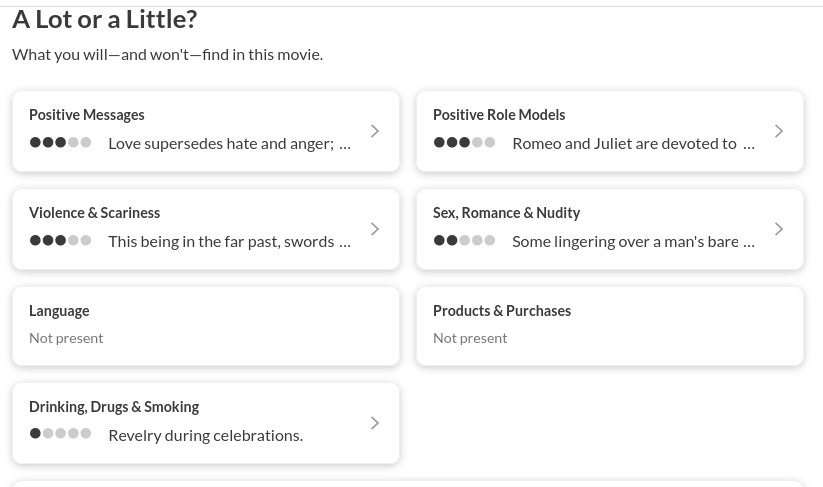
According to Common Sense Media, the film is relatively tame for students, (which of course was one of the goals of making it), so the violence is toned down, there is little nudity and little cursing (there actually is a little PG-13 language added near the beginning, but not much).

Screenshot from a review of the 2013 film from Common Sense Media: https://www.commonsensemedia.org/movie-reviews/romeo-and-juliet-2013

The Production

Though the film is populated with English and American actors, the majority of the crew is Italian and principal photography was done in Italy, both on-location in places like Verona, Mantua, Rome, and other Italian locations.

Historical Context

The original story of Romeo and Juliet is set in the 1400s but based on the references to Early Modern fashion and music, we can assume Shakespeare set his version around 1593- (the year it was probably written). This production, based on its fashion and architecture is probably set around the early Baroque period, (c. 1600).

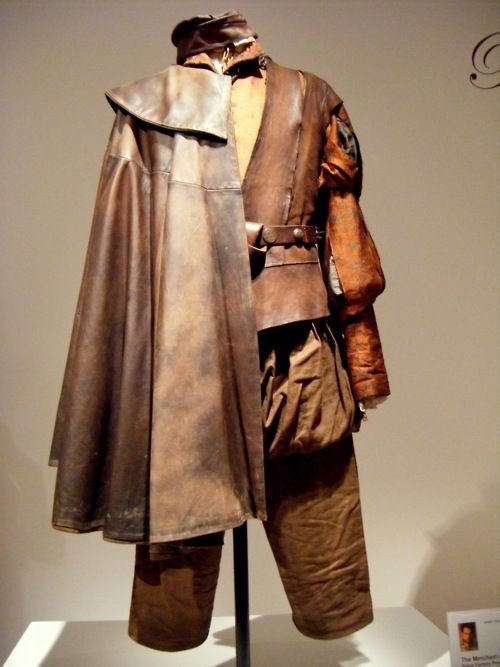
This time period was notable for abandoning neck and sleeve ruffs in favor of lace or linen collars (Source: https://fashionintherenaissance.weebly.com/fashion-timeline.html) . The famous pumpkin pants were also replaced with less fussy breeches as well. All these fashion choices are in the Romeo and Juliet movie and it’s fascinating to look at the choices they made for the film in behind-the-scenes documentaries. I shouldn’t be surprised here, but studying this period made me enjoy the film more- I lost myself in the spectacle and ignored their handling of the story.

The Costumes

Costume featurette from Romeo and Juliet (2013)

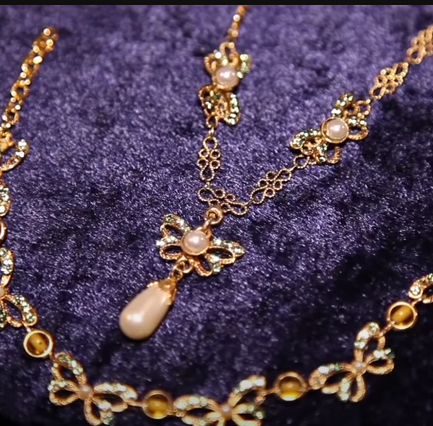
As you can see from the close-ups above, the Swarovski Crystal company definitely showed off some of their wares in Juliet’s costume. In fact, Swarovski sells a version of Juliet’s wedding ring.

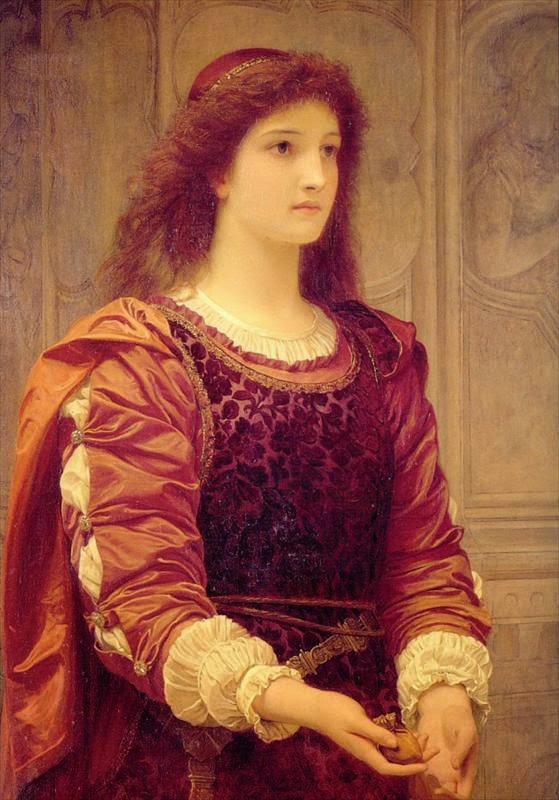
You can also see in these costume renderings the influence of Pre-Raphelite artwork on the costumes, like this famous painting by Francis Dicksee (1884).

Frank Dicksee. Romeo and Juliet, 1884

The Sets

Many of the street locations for Romeo and Juliet were filmed at Cinecitta Studios in Italy, but as you can see from this behind-the-scenes footage, most of the film was filmed on location in beautiful real-life baroque buildings in Italy:

The Locations

Many of the locations remind me of the high baroque architecture of the celebrated Italian sculptor and architect Gian-Lorenzo Bernini (1598-1680), who had his own Romeo and Juliet-style drama in terms of sordid love affairs, duels, and exiles:

The film was shot in some of the real locations of the play; MantuaCaprarola, Lazio; Cinecittà, Rome; and in Verona.[14]

One location I found very interesting to research was the Grotto of Sacro Speco in Subiaco, which was the location for Friar Laurence’s cell. This is a very holy site to many Catholics- it is the celebrated Cave of St. Benedict, the founder of the Benedictine monks. Friar Laurence is a Franciscan monk so this isn’t entirely accurate, but it does provide some wonderful religious eye candy during the scenes at his cell, and it does beautify the wedding scene.

The Music (rant alert)

THE MUSIC NEEDS TO SHUT UP! Especially in the love scenes, the music is too loud and drowns out the dialogue. I personally find it irritating that the score makes so much use of the piano, which wasn’t invented until 1700, since the movie is trying to be historically accurate. To be fair, the loud piano is actually the sound department’s fault, but the fact that pianos didn’t exist at this time took me out almost as much as the overpowering score, (which somehow won two International Film Music Critics Awards (IFMCA)!

The Cast

Reviewers usually love to rag on whoever plays Romeo and Juliet. It’s kind of a no-win scenario here- If they’re young, they’re inexperienced and thus, don’t know how to speak Shakespeare. If they’re older, they’re too old and shouldn’t have been cast in such a youthful role. So rather than falling into that trap, I’ll be positive about the casting and say what I like about the performances, while criticizing the direction, because I feel that in general, the acting in this film is fine, but there are some odd choices that the director should’ve thought twice about.

Romeo (Douglas Booth)

Booth might actually be my favorite film Romeo- he’s beautiful to look at, sweet, impulsive, naive, everything Romeo should be. He also knows how to deliver Shakespeare and can convey complex ideas through poetry. I could argue that he lacks the rage that Romeo should have when killing Tybalt, but I don’t think that’s what he was going for this Romeo is a good guy who is too sheltered and lacks proper guidance, so he makes rash choices because nobody is there to tell him why they are.

Juliet (Hailiee Steinfeld)

I don’t fault Ms. Steinfeld for this, but her worst scenes are sadly, the most famous. Her delivery during the Act I dance and the famous balcony scene is monotonous and dull. I think the director told her to act as if love put her in a trance, but the effect is that she sounds like she’s half asleep. Again, I know she can do Shakespeare because her scenes with the Nurse and Lord Capulet are much better; she’s passionate, articulate, and full of emotion. I think the director failed to give her proper direction to play a love scene realistically, and intentionally slowed the scene down so the audience could pick out the famous lines.

Lord Capulet

Some people argue that Lord Capulet is actually a good dad, but not this film. As I’ll show you later, this film is trying to play up the forbidden love aspect of the story, and what is more classic than an angry, disapproving father? To this end, even though Damien Lewis starts out jovial and sweet to Juliet, by Act III he is full of resentment and rage:

Damien Lewis as Lord Capulet, in a scene from Act III, Scene v

Tybalt (Edward Westwick)

Ed Westwick steals the show every time he’s on screen. He knows how to speak the Shakespearean lines and he makes the added lines sound Shakespearean (which is to say, actually good). With his fiery gaze and his thick, deep voice, he reminds me of a young Mark Strong and is equally good at playing smarmy yet compelling antagonists. You love to hate this guy, yet you feel sorry when he dies.

Friar Laurence (Paul Giamatti)

Giamatti rivals Pete Postlethwaite for my favorite Friar Laurence. He was a perfect choice and he has an effortless Shakespearean delivery. I think it’s telling that his lines of dialogue are the least altered from Shakespeare- the director knew Giamatti could make them work without any alteration. He also has a great rapport with both Douglas Booth and Hailee Steinfeld.

Moments to Watch For:

This film does well at portraying the forces that rip Romeo and Juliet apart- Tybalt’s maniacal hatred of the Montagues, Lord Capulet’s scheme to marry Juliet, and the influence of maligning fate. For this reason, the film is actually better in the second half, once the romance is over and the tragedy sets in. Again, a lot of this is due to the excellent performances of Ed Westwick as Tybalt, and Paul Giamatti as Friar Laurence, who frantically strains his brain to help the lovers and is thwarted at every turn. I wonder if, since the film was adapted by the creator of Downton Abbey, in which Giamatti starred, the writer placed most of the success of the film on Giamatti’s shoulders, intentionally or not.

My Reaction: Shakespeare for Twi-hards.

Forgive me for getting a little conspiracy-theory-ey here but, since the Twilight saga concluded in 2012 and this film came out the next year, I suspect that this Romeo and Juliet was partially produced to cash in on the success of Twilight. After all, Twilight: New Moon is full of references to Romeo and Juliet:

As the video below demonstrates, Twilight and Romeo and Juliet are both examples of Petrachian love, which is to say, love thwarted, so similar themes and tropes are baked into both stories.

There are also stylistic similarities to how this particular Romeo and Juliet are filmed, such as the lush landscapes, the prevalence of piano in the score, the heavy uses of glamour shots, and even some of the Italian locations evoke Twilight:

Worst of all, I feel that this film tried to make Hailee Steinfeld, an Academy Award-nominated actress, try to act like Bella Swan in the Balcony scene. I think this is why the first half of the film drags and seems slow and dull- it is trying to emulate Twilight’s visual style and forces the actors to adopt a “Twilight School of Acting.”

So in conclusion, the film is uneven- it has talented people working on it, but I think the studio and the company were a little preoccupied with selling the film to a specific group of young people. Does it work for classrooms? For now, but I worry that this version won’t connect with young people for long, and because of its lack of focus and clear direction, it will probably go the way of Twilight– a brief cultural blip that is pretty to look at, but that is quickly forgotten.

Title image for my online course on “Romeo and Juliet.”

If you like this analysis, you might be interested in signing up for one of my Outschool Course on Romeo and Juliet Link down below. Share this class with a friend and you will get $20 USD off!

https://outschool.com/classes/shakespeares-comic-plays-868BR5hg?sectionUid=420e2feb-050f-456b-8d06-6510f6b9ad2c&usid=MaRDyJ13&signup=true&utm_campaign=share_activity_link

Comparing Coronations, or “Who Wore It Best” (Royals Edition)?

O ceremony, show me but thy worth!
What is thy soul of adoration?
Art thou aught else but place, degree and form,
Creating awe and fear in other men?
Wherein thou art less happy being fear'd
Than they in fearing.
What drink'st thou oft, instead of homage sweet,
But poison'd flattery? O, be sick, great greatness,
And bid thy ceremony give thee cure!
Think'st thou the fiery fever will go out
With titles blown from adulation?
Will it give place to flexure and low bending?
Canst thou, when thou command'st the beggar's knee,
Command the health of it? No, thou proud dream,
That play'st so subtly with a king's repose;
I am a king that find thee, and I know
'Tis not the balm, the sceptre and the ball,
The sword, the mace, the crown imperial,
The intertissued robe of gold and pearl,
The farced title running 'fore the king,
The throne he sits on, nor the tide of pomp
That beats upon the high shore of this world,
No, not all these, thrice-gorgeous ceremony Henry V, Act IV, Scene i.

As this quote from Shakespeare's Henry V, there are many different cermonial customs and adornments that the British monarchs have used to adorn and elevate their kings and queens. Today I'm going to compare and contrast King Charles III and his mother Queen Elizabeth II, then I'll compare these coronations with the monarch who lived during most of Shakespeare's life: Queen Elizabeth I.

Part I: Queen Elizabeth II vs. Charles I

All my information for this section comes from this fascinating article from the Washington Post, which compares and contrasts King Charles’ coronation on May 6th, 2022, with his mother’s, which occurred on June 2, 1953:

https://www.washingtonpost.com/photography/interactive/2023/visual-comparison-coronations-queen-elizabeth-king-charles/

THe Balm

Close up of the canopy raised while the king was annointed

Both Charles and Elizabeth were anointed with holy oil- an ancient tradition signifying God’s favor. The tradition goes all the way back to the Bible, where the book of First Kings details the procedure of anointing King Solomon:

And the king said to them, “Take with you the servants of your lord and have Solomon my son ride on my own mule, and bring him down to Gihon.  

And let Zadok the priest and Nathan the prophet there anoint him king over Israel. Then blow the trumpet and say, ‘Long live King Solomon!’  You shall then come up after him, and he shall come and sit on my throne, 

1 Kings Chapter 1, Verses 33-35

King George the Third commissioned composer Georg Friedrich Handel (famous for “The Messiah”) to write an anthem for his coronation based on this Biblical passage in 1761 This song has been a tradition during English coronations for the past 300 years, and as you can see in the video below, it was played when King Charles and Queen Elizabeth were privately anointed behind the canopy you see below.

The Scepter

The scepter is called the Sovereign’s Scepter and it is on display in the Tower of London as part of the Crown Jewels. For more information, go to Royal Collection.org:

https://www.rct.uk/collection/themes/Trails/the-crown-jewels-coronation-regalia

The Ball

The ball in this passage refers to the globus cruciger or ‘the orb and the cross.’ This is a symbol of the king’s status as the head of the Church Of England, which began with Elizabeth I’s father, Henry VIII. The orb telegraphs Christ as the true ruler of the world, and the English monarch as his representative on Earth.

The Sword (and) the Mace

A mace used to be a concussive weapon used in battle against knights in shining armor. Since armor is hard to penetrate, medieval warriors tried to cause blunt force trauma and concussion in their enemies using maces. Since those more violent beginnings, the mace has evolved into a symbol of the King’s power and is used at the opening of Parliament. There are three swords that lords used to herald the King during the coronation- the two swords of Justice, and the Curtana or ‘Sword of Mercy,’ so called, because its blade is broken, making it a ceremonial object of peace, rather than a practical weapon.

King Charles’ own sword is called the Sword of State- it is a steel sword gilded with silver, and the handle is wooden, gilded with gold. It symbolizes the monarch’s commitment to knightly virtues, and it is used to create people as knights.

The Crown

St. Edward’s crown is adorned with diamonds, furs, and over 2,000 diamonds! This crown, along with the sword of state, dates back to the 1660s, after the monarchy was briefly abolished, though the crown still has had its share of problems over the centuries, including being stolen!

The Robe(s)

Much like how during graduation ceremonies people wear special robes to signify the transition from one state of being to another, British monarchs have worn multiple robes to show their apotheosis from a prince to the sovereign head of the country.

The Robe of Estate

The robe of Estate is the long, sumptuous robe of the sovereign; a symbol of his or her wealth. Charles wore his at the end of the ceremony after the crown was placed on his head.

Traditionally, the Robe of Estate is a very specific shade of purple called Tyrian Purple. It is again, a symbol of wealth because it was very labor-intensive and expensive to produce. This is one of the reasons why purple is a color associated with wealth and status:

Charles in his red surcoat
Left- Royal portrait of Queen Elizabeth in her purple Robe of Estate by Sir Herbert James Gunn. Right- King Charles in his crimson Robe of Estate

Elizabeth’s purple Robe of Estate will now be worn by Queen Camilla, Charles’ wife. It is 6 1/2 meters long, weighs 15 pounds, and took 12 seamstresses 3,500 hours to complete, (source: Historic UK).

Queen Camilla in her Robe of State

THe THrone

The oldest part of the ceremony will without question be the throne- a plain-looking piece of oak that is over 700 years old! St. Edward’s Throne has been part of coronation ceremonies since King Edward I, (aka Edward Longshanks from Braveheart) in around 1200 AD. Surely there is no greater symbol of royal continuity- the monarchs in Shakespeare’s history plays actually sat on this throne. Any king or queen who touches this piece of furniture must get a sense of the ancient traditions of the monarchy.

King Charles III sits on St. Edmund’s throne, holding the scepters.

The Tide of Pomp (Royal Processions)

The royal coach parked in front of Westminster Abbey

It’s been a tradition ever since the Middle ages for the new king or queen to travel from their home palace through the county so people can see them on their way to be crowned at Westminster Abbey. Long ago, this was a multi-day journey full of public festivals and entertainment that allowed the whole country to get a rare glimpse of the new monarch. By contrast, King Charles and Queen Camila only traveled 1.3 miles from Buckingham Palace to Westminster.

Image compare of King Charles III and his queen Camilla with his mother and father during Queen Elizabeth’s coronation in 1953.

Part II: Queen Elizabeth the First’s Coronation, January 14th, 1558.

The Procession

After the death of Mary the First, Elizabeth’s sister,

Royal portrait of the coronation of Queen Elizabeth I.

An Account of the Coronation

Like her namesake and the new king, Queen Elizabeth I was crowned at Westminster on January 15, 1558. Unlike them, however, the ceremony was performed in Latin and English by a Catholic bishop. Obviously, since Elizabeth was crowned during the Protestant Reformation, there was a lot of controversy about the liturgy. Some accounts aren’t sure what parts of the Catholic were read, but we do know Elizabeth took the oath, wore a similar golden robe to Charles and Elizabeth II, and was given the balm and scepter just like them. Here is a primary source account from an ambassador from the town of Mantua, Italy:

“The Queen was received under the canopy by the Archbishop and another Bishop, they having previously perfumed her with incense, giving her the holy water and the pax, the choristers singing; then the Earl of Rutland followed her Majesty with a plain naked sword without any point, signifying Ireland, which has never been conquered; then came the Earl of Exeter with the second sword; the third was borne by Viscount Montagu; the Earl of Arundel, having been made Lord Steward and High Constable for that day, carried the fourth (sword) of royal justice, with its gilt scabbard loaded with pearls. The orb was carried by the Duke of Norfolk, Lord Marshal, and in advance were knights clad in the ducal fashion, carrying the three crowns, they being the three Kings-at-arms; they bore the three sceptres, with their three crowns of iron, of silver, and of gold on their heads, and in their hands three naked iron swords, signifying the three titles of England, France, and Ireland..”

— Il Schifanoya, royal ambassador from Mantua

‘And whereas your request is that I should continue your good lady and be Queen, be ye ensured that I will be as good unto you as ever Queen was unto her people. No will in me can lack, neither do I trust shall there lack any power. And persuade yourselves that for the safety and quietness of you all I will not spare if need be to spend my blood. God thank you all.’ _Queen Elizabeth I

Elizabeth’s ring

References:

https://www.rct.uk/collection/404386/queen-elizabeth-ii-1926-2022-in-coronation-robes