Book Review: William Shakespeare and the Globe

Video Book Review:

Content: 

This is a story of two boys, centuries apart, but united by their love of theater in general, and the Globe Theater in particular. The first is William Shakespeare, whose story Aliki tells from his birth, to his boyhood days, to his rise to prominence in the theater. The second is Sam Wannamaker, the man who spearheaded the project of re-building the Globe Theater from 1949 to the first performance of the Globe in June of 1997. 

Aliki tells this story in the format of an Elizabethan play, dividing it into five acts. Acts I-4 tell the story of Shakespeare’s life while Act V focuses on Sam Wannamaker pursuing his dream. The book concludes with a chronology of Shakespeare’s plays, and a table of his most famous words and expressions, illustrated with adorable characters.

Illustrations: Medium and Style of Illustration

Like many of her books, Aliki’s illustrations are layered and detailed. She uses ink pen outlines to draw her characters, but then fills them in with bright, vibrant colors. She then painstakingly shades them using the crosshatching technique, to create textures that are complex but have a hand-drawn almost impressionistic feel. The characters aren’t ultra-realistic, and the color palette is limited mainly to bright primaries and warm browns, making it look like a child’s box of crayons or colored pencils. This book is designed to appeal to children with its hand-drawn quality. 

Format:
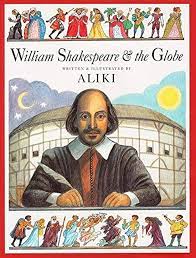
Cover- The cover makes the subject of the book clear to the audience. We see Shakespeare and Globe Theater, but also illustrated moments from his plays. This helps establish that this is not only a biography, it is an introduction to Shakespeare’s plays and poems as well.

Front Matter: The book opens with four pages of quotes from Shakespeare’s plays illustrated with fairies, pipers, and Elizabethan men and women. There is no half-title, no frontispiece and no Half title verso.

Title page verso (copyright page) In the center of the copyright page is an Illustration of Shakespeare standing atop a globe, over the famous lines: “All the world’s a stage, and all the men and women merely players.”  Below the quote in very small letters is the copyright date, a short summary, the ISBN data, card catalog information, and the typography information.

Title Page The title is laid out on a white background with a thin black border. Below the title is an image of a boy (presumably Sam Wanamaker), assembling a paper model of Shakespeare’s globe, with a portrait of Shakespeare in the background. This helps establish that this biography focuses on both Shakespeare and Wanamaker, and makes the reader excited to see the real Globe brought to life in full illustration.

Table of Contents As stated before, the book is organized like an Elizabethan play, so rather than Chapter 1, etc. the book has five Acts with 1-4 scenes in them. Each chapter in the table of contents is labeled with a description that sets the scene; either a location (like London, Stratford, The Globe), or what will happen in the scene (such as “Building” or “Uncovering”). The table then details four appendices that are part of the back matter. 

Preface:  The Preface is referred in the book as an aside, (an Elizabethan theater term meaning something spoken between a character and the audience). This preface acknowledges that, because of the lack of surviving historical information on William Shakespeare, Aliki, like many Shakespearean biographers, has to use some guesswork to fill out the narrative of his life. A second preface (referred to as a Prologue), introduces the story of the book, (namely the lives of Will Shakespeare and Sam Wanamaker). This preface mimics how in Shakespeare’s plays, a prologue would tell the audience what would happen before the narrative started.

Back Matter/ Appendices: There are four appendices in the back matter- A table of Shakespeare’s collected works, a timeline of the book’s events from 1564-1999,  an illustrated list of Shakespearean words and expressions, and finally a list of Shakespearean sites to visit in London and Shakespeare’s home town of Stratford Upon Avon. These appendices show the reader that Shakespeare has an important role in history and in the English language, and encourage the reader to learn more about him. 

Value As an Educational Tool

This story not only tells Shakespeare’s life, it also introduces the reader to his plays and his influence on the English language through the illustrations and frequent Shakespearean quotations. The reader also gains an insight into Elizabethan life and culture by following Will’s journey from Stratford to London. Finally, by juxtaposing Shakespeare’s life with Sam Wannamaker’s, the reader sees Shakespeare through Sam’s eyes as he works his whole life to restore Shakespeare’s Globe to its former glory. The reader develops a love of Shakespeare, (or at least an empathetic respect), and may feel empowered to read more about Shakespeare, see his plays or maybe even become a Shakespearean artist in the future. In short, Aliki’s book brings the world of Shakespeare to young readers in a way that is beautiful to look at, full of insight, and with enough supplemental materials to encourage them to learn more.

Overall Impression:

Like Prospero’s magic in The Tempest, this story is magically told- it is not intended to create a totally realistic representation of Elizabethan life, but to give an exciting, colorful impression of Will’s life and work to the reader. Due to the scant historical details of Will’s life, Aliki chose not to do a standard biography, but, like Shakespeare’s own history plays, to tell a historically authentic story, rooted in truth that brings a time and a place to life, while portraying it an exciting and visually appealing way.

Citation:

Aliki. (2000). William Shakespeare & the Globe. HarperCollins Publishers. 

Shakespeare and the Color Blue

I’ve been reading this wonderful picture book about the history of the color blue- a color that evokes deep emotions and has a rich and sometimes tragic history. Here’s a video of the book being read:

Blue: A History of the Color As Deep As the Sea and Wide As the Sky by Nana Ekua Brew-Hammond

The book won the 2023 Orbis Pictus Award for Best Nonfiction For Children:

In identifying an “outstanding” book for children, the committee members will consider the following:

• Accuracy of presentation in both text and illustrative material, as well as appropriate documentation, avoidance of anthropomorphism and teleology, distinction between fact and theory, and balanced treatment.
• Organization of material (e.g., general to specific; specific to general) that contributes to clarity and accessibility.
• Style of writing that is engaging and distinctive in its use of language.
• Style of illustration that is engaging, informative, and complementary to the text.
• Appropriateness of book design based on the topic or subject and with respect to the different age groups for which the topic or subject may be appropriate.
• Potential contribution to the K-8 curriculum.

National Council of Teachers of English Website: Orbis Pictus Website.

As I mentioned in my Coronation post, the colors blue and purple have been associated with power (earthly or heavenly) because for centuries they have been hard to produce, and the book tells that history extremely well while highlighting the people and cultures that created those dyes by harvesting shellfish and collecting indigo plants:

A few good reasons to appreciate the color blue. Throughout history, humans have captured, cultivated, and coaxed the color blue out of everything from mollusks to rocks to plants. In this fascinating exploration of our relationship to this once-precious color, Brew-Hammond begins by discussing its elusive nature: Seawater is blue, but the color disappears when water is cupped in ones hand; similarly, crushing iris petals yields blue, but the hue quickly dissipates when soaked in water. Readers learn that the earliest known use of blue dates back to about 4500 B.C.E. in Afghanistans Sar-e-Sang Valley and that ancient Egyptians used it, too. But blue has been found worldwide. It was extracted from the bellies of particular shellfish in coastal Japan, Central America, the Mediterranean, and Mexico and harvested from plants in Africa, Asia, the Caribbean, and the Americas. Because of its rarity, blue has been considered a royal color reserved for use by the wealthy and privileged. Laced with insights, Brew-Hammonds meditative verse covers a wide range of cultures, time periods, and geographical locations, while Minters mesmerizing images highlight the significance of blue to diverse groups of people through culturally specific visuals such as hairstyles and clothing design. The highly textured backgrounds add life and movement to the focal images in the foreground. (This book was reviewed digitally.)Stunning and informativeand as profoundly rich as the color blue. (authors note, facts about blue, selected sources)

Kirkus Reviws

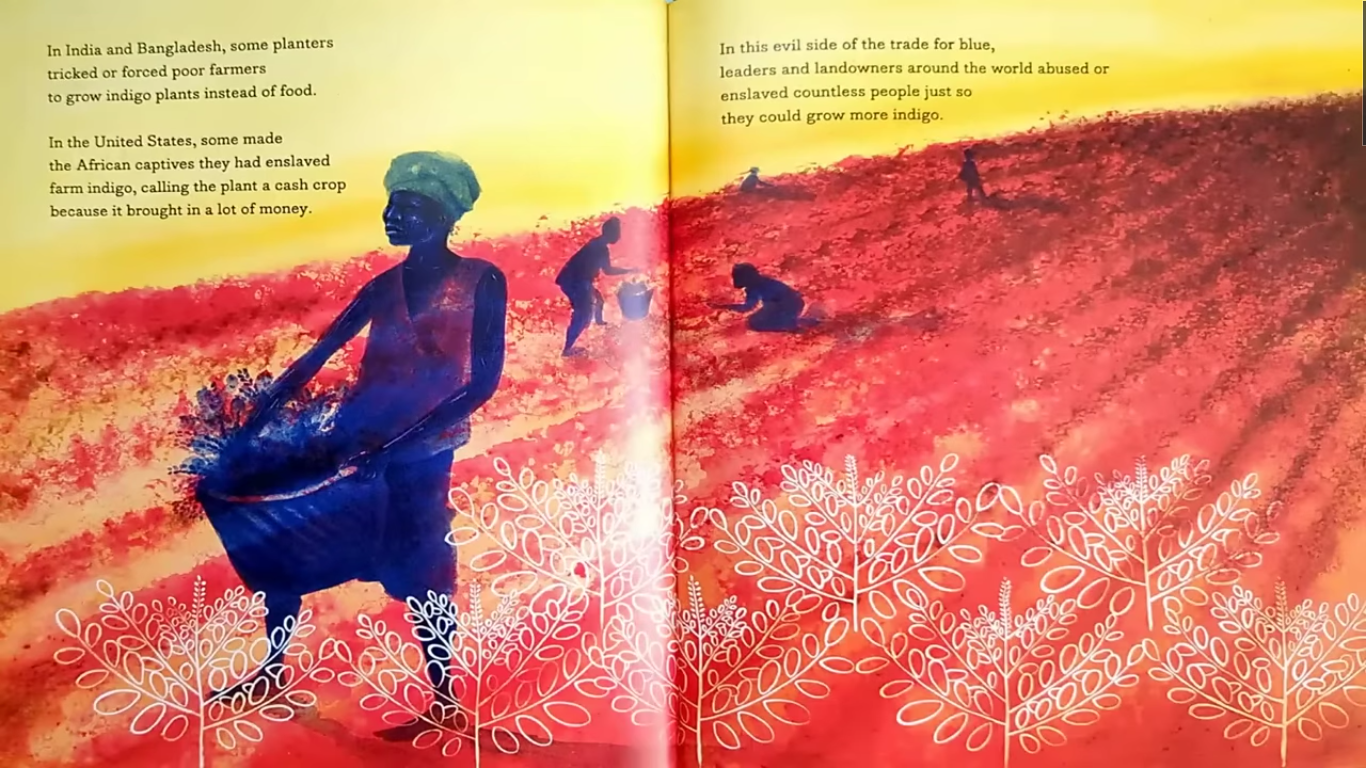
As the review above shows, the book doesn’t focus on European royals or colonialist countries that bought and wore blue clothing, it focuses on the countries that make blue in places like Africa, Asia, and Central or South America. It also doesn’t disguise the fact that the slave trade in America was partially used to gather indigo plants, which the illustrator poignantly represents on the page where slaves are painted with blue dye- they lived and died for the color of their skin, and for the color they were forced to cultivate.

Fortunately, the book doesn’t end on the exploitation of people for the sake of a color, it also celebrates the triumph of science as chemist Adolph Von Baeyer labors to develop an artificial dye- one that would make such backbreaking labor unnecessary. Von Baeyer began working in 1865, the same year the American Civil War ended.

So what does this have to do with Shakespeare?

Brew-Hammond explores the history and culture surrounding blue powders and dyes, a rare and prized commodity until recently. She details how the ancient Egyptians ground lapis lazuli rocks from Afghanistan to make blue pigment for royals; later, sea snails were used by dyers until the indigo plant became a more practical solution for large quantities; and finally, Adolf von Baeyer created chemical blue, which led to widespread availability of this color. She also touches on some concepts and emotions associated with this hue: feeling blue (sad), blues music, out of the blue (unexpected), royal blue, and blue ribbons (extraordinary). Minter’s acrylic-wash illustrations depict predominantly Black figures, a nod to the key role played by West African dyers in developing these tinctures, and the importance of enslaved Africans whose toil made possible the North American indigo industry. Blue tints appear in every spread, but often as a spotlight color; reds, yellows, and greens do the heavy lifting, allowing the blue tones to stand out. A fascinating look at an underreported topic.

Kay Weisman (Booklist)

What’s really wonderful about this book is that it doesn’t just detail the history of the color blue, it also delves into its poetic history- the way we use blue as an adjective, in expressions, and many other daily occurrences. Terms like ‘feeling blue,’ or ‘blue blood,’ and the connotations of the sky and ocean make blue a color that is grand and vast, but hard to catch. This quality of tantalizing beauty has inspired many poets, including Shakespeare:

 CLEOPATRA: Here
My bluest veins to kiss; a hand that kings
Have lipp’d, and trembled kissing.

Antony and Cleopatra
  • RosalindThere is none of my uncle’s marks upon you; he taught me
    how to know a man in love; in which cage of rushes I am sure you
    are not prisoner.1455
  • OrlandoWhat were his marks?
  • RosalindA lean cheek, which you have not; a blue eye and sunken,
    which you have not; 
As You Like It

Under these windows, white and azure laced
With blue of heaven’s own tinct. 

Cymbeline

Now pile your dust upon the quick and dead
Till of this flat a mountain you have made
T’ o’ertop old Pelion or the skyish head
Of blue Olympus.

Hamlet

Also, apparently, there is a shade of blue CALLED “SHAKESPEARE!”

So, I hope you enjoyed this look into the complex history and mystery of the color blue. Like Shakespeare, blue is mysterious but pervasive- hard to pin down in history books, but admired and celebrated to this very day.

Review: Romeow and Drooliet by Nina Laden

As you probably know, I love to review children’s adaptations of Shakespeare (whether direct or indirect). “The Lion King,” (Hamlet), “Encanto” (King Lear), and of course, the many adaptations of “Romeo and Juliet,” are mainstays on this website: Gnomio and Juliet, Romeo and Juliet: Sealed With A Kiss, even Pocahontas have their basic plot and characters firmly rooted in Verona Italy.

Then one day by chance, I found this book in a local park, and I knew I had to review it!

THe Premise

This is a simple re-telling of the story of Shakespeare’s play that focuses on just the young lovers. You feel for these cute little animals and in a way, making them a kitty and a dog smitten with puppy love, makes them more understandable and sympathetic than Shakespeare’s youthful teenagers, who indulge in violent delights without using their human reason.

What It Keeps

The Story

The book keeps the feud between the two families, has the young lovers meet in disguise at a ball, fall in love on a balcony, get married, and amazingly, DIE! Laden still manages to tell the story in a kid-friendly way, though giving it tragic weight.

THe Language

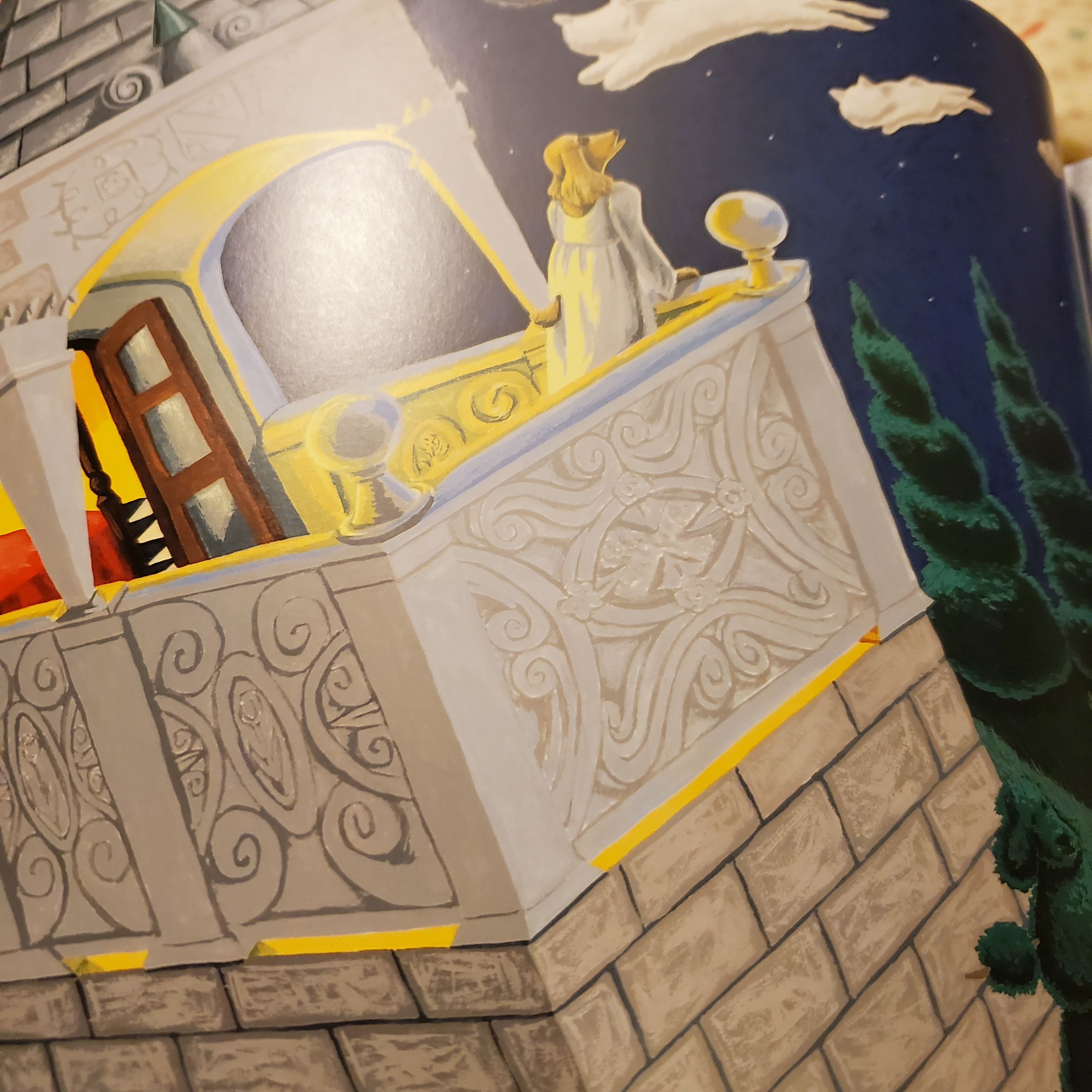
The book opens with a rhyming prologue, which, although it isn’t in sonnet form, has the same function as Shakespeare’s prologue- to explain the plot before we see it played out in the book, thus giving the whole story a sense of dramatic irony. Plus, as you can see, Laden also imitates Shakespeare’s love of wordplay with metaphors and puns, (a tale of tails), and alliteration to give the dialogue some wit and effervescence. Reading it gave me giggles like I’d just popped open some champagne.

What it changes: Spoiler alert

All throughout, Laden makes small changes to simplify the plot and remove characters that don’t directly impact the main plot. The characters of Lord/Lady Capulet and Lord/Lady Montegue, The Nurse, Paris, Peter, the servants, and the friars are completely absent, turning an already brief play into an even more compressed story.

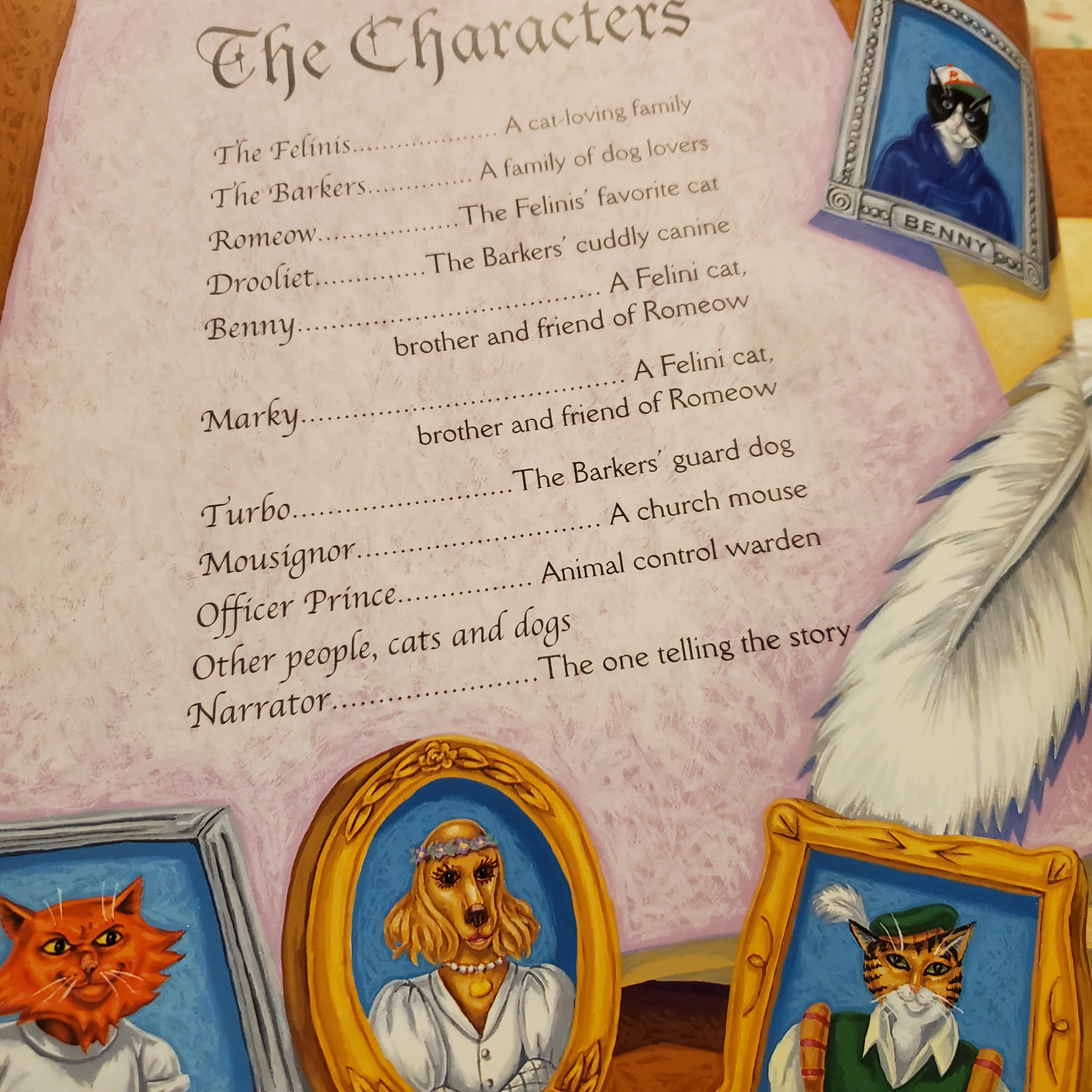
Like a lot of animal retellings I’ve seen of this story, the author recasts the human leads as animals that are natural enemies- in this case, cats and dogs. This makes the story easier for kids to understand- as I’ve said before, it’s often difficult to keep track of who belongs to which house in Shakespeare’s version. All you need to know is that Romeo and his brothers are cats and Juliet’s family are dogs.

Funnily enough, my daughter actually complained that the story would’ve been better if Juliet were a cat instead of Romeo, which I agree with for very specific reasons. The character of Tybalt is named after a character from a prose story called “Reynard the Fox,” who had the epithet, Prince of CATS. Mercutio annoys Tybalt by taunting him with this title before challenging him to a duel:

Tybalt: What would you with me?
Mercutio: Good Prince of Cats, nothing but one of your nine lives! Romeo and Juliet, Act III, Scene i.

It would’ve been a funny Shakespeare easter egg to have Juliet and Tybalt be portrayed as cats, but I understand why they went with dogs- Drooliet is a hilarious pun, and having Tybalt be a vicious, rabid dog helps set him up as a fearsome antagonist.

I suppose you’re wondering, how can the author keep Shakespeare’s tragic ending in a children’s book? Well, like Shroedinger’s cat, she manages to make Romeow die and not die at the same time. He gives Drooliet one of his 9 lives, allowing them both to ‘die’ and then come back for a happy ending. It’s a brilliant way to nod at the original, while also keeping the kid-friendly tone.

My Reaction

This book is really fun and very enjoyable for kids, parents, and teachers who want to introduce kids to Shakespeare at an early age!

Just below you can watch the book being read by actress Hayle Duff:

Free teaching guide from the SAG-Aftra Foundation