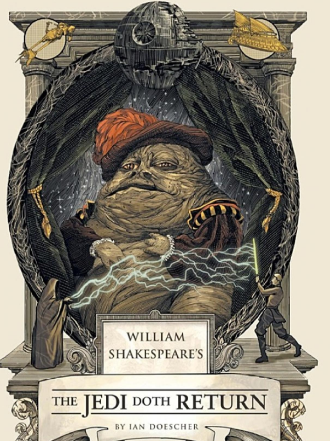
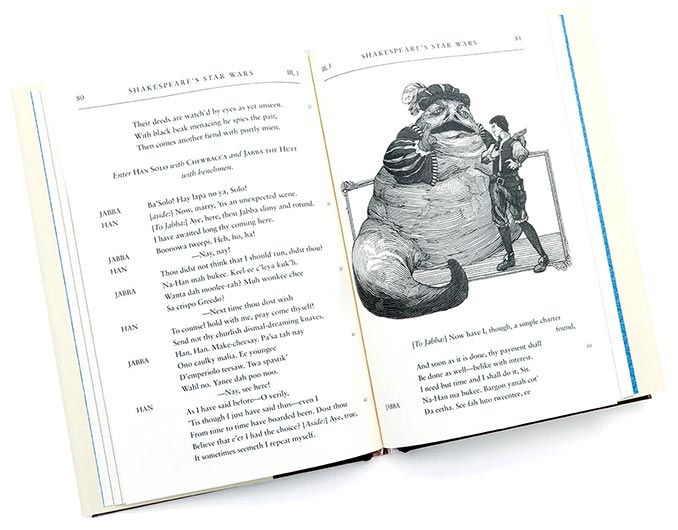
William Shakespeare’s Star Wars is a series of parody plays written by Ian Doescher that takes the prose screenplays of the Star Wars story and transforms them into Elizabethan verse. Last time I mentioned how much I loved the cheeky references to Shakespeare and Star Wars, and how Doescher adapts the cinematic quality into Elizabethan drama very well. In my podcast, I also emphasized the way Doescher gives each character verbose Shakespearean language that works very well for radio and theater:
My podcast episode where I do dramatic readings of “Verily A New Hope.”
I must confess, Return of the Jedi is my favorite Star Wars movie. I’ve seen all 9 films and it’s still my favorite. I adore the effects, the tight storytelling, the emotional farewells, and the dramatic victories. What I want to do with this post, (and the accompanying podcast), is to see whether this edition captures what I love about Jedi. The short answer is- no. It doesn’t capture it, IT EXPANDS IT! In many ways this play is Doescher’s triumph- he manages to capture the tone and characters of Star Wars perfectly, and makes the Shakespearean style his own!
Notes about the play
The first play in the series, “Verily, A New Hope,” took plot and structure inspiration from Henry V; it tells the story as an epic heroic story of Luke’s heroic deeds, much like how Henry V is about a king who grows from boy to man.
The second play “The Empire Striketh Back,” takes inspiration from Hamlet and Macbeth to explore Luke’s temptation by the Dark Side of the Force. It also uses Much Ado About Nothing as an inspiration for the burgeoning relationship between Han and Leia
I would argue that “Jedi Doth Return” is a mixture of all the other plays Doescher took inspiration from. Unlike the previous plays, this feels less like a parody, and more like an adaptation. I feel that Doescher has finally become so comfortable writing in the Shakespearean style, that he rarely needs to flat out parody lines and speeches, and simply uses Shakespearean dialogue to tell the story.
Moments to Watch for:
The Language
I’ll discuss the language of Jedi in greater detail in my podcast, but I’d like to highlight one or two here.
Extended metaphors:
Vader: It is the role I play, my destiny—
The grand performance for which I am made.
Come, author of the dark side of the Force,
Make me the servant of thy quill and write
The tale wherein my son and I are seal’d As one.
Come, take mine ev’ry doubt from me,
 And fashion from my heart of flesh and wires
A perfect actor: callous, cold, and harsh.
Let this, the second Death Star, be the stage,
And all the galaxy be setting to
The greatest moment of my narrative:

The scene in which the Empire’s fight is won
Whilst I decide the Fate of mine own son - The Jedi Doth Return Act I, Scene i
3. Parody Lines
The biggest appeal of William Shakespeare’s Star Wars is the fact that it is a parody, and I’ve said for many years that parody and gentle riffing on Shakespeare is a great way to get students to overcome their fear of Shakespeare and engage with him. Students who know Star Wars but don’t know Shakespeare will recognize the familiar characters and plots of the movies and then see how Shakespeare’s language tells the story anew. Similarly, people who know Shakespeare will recognize the way Doescher re-tools famous Shakespeare quotes to give to characters in the Star Wars Universe, like here, where he spoofs the famous “All the World’s A Stage” speech:
In the Educator’s guide, which I’ve attached below, Doescher tells you exactly which lines he has parodied and the plots of the original plays so the students can learn about Shakespeare through these famous speeches. Orson Wells once said: “We sit through Shakespeare to recognize the quotations,” and this edition gives us thrilling space battle, wonderful characters, and witty dialogue to keep us entertained while we wait.
Characterizations
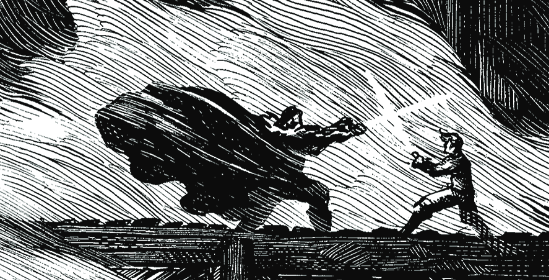
What I love the most about the movie and the play is that it’s a very character-driven story. Instead of long trench runs with pilots we’ve never met, we get duels to the death between characters we’ve known for years. At its heart, Jedi is the story of the Skywalker family reuniting after Darth Vader ripped it apart. It’s also the culmination of Luke growing from a boy to a man. Doescher does an incredible job voicing these characters through the verse, and his use of the language helps highlight each character’s struggle and journey.
Luke/ Vader
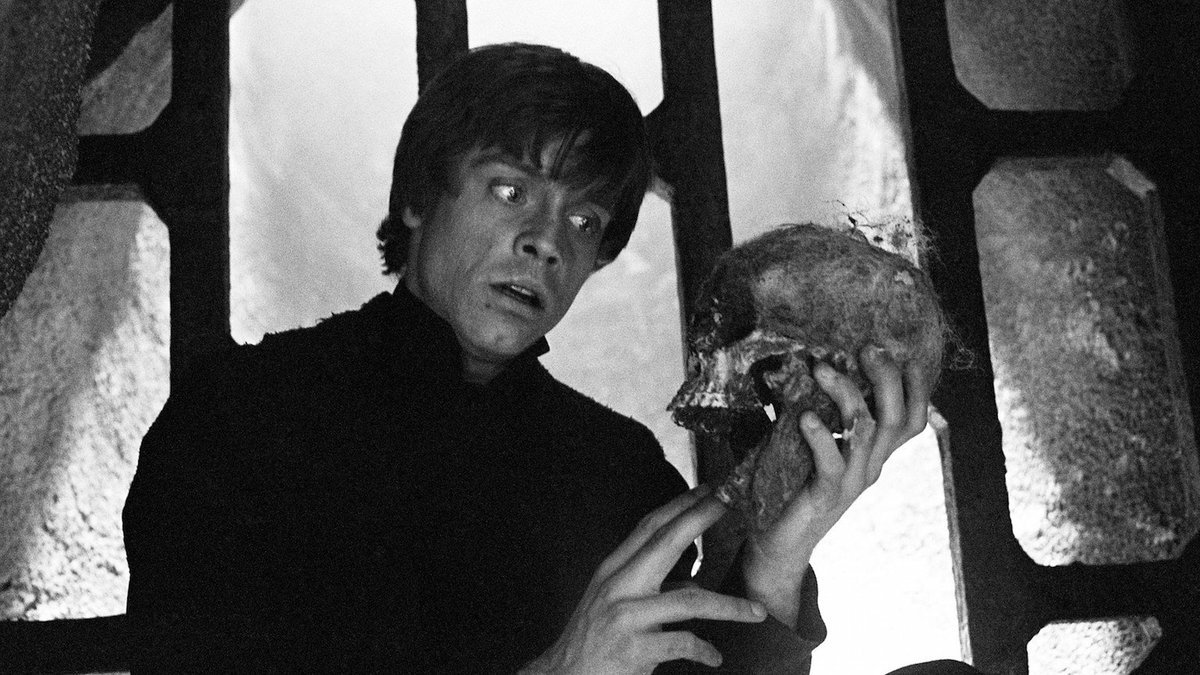
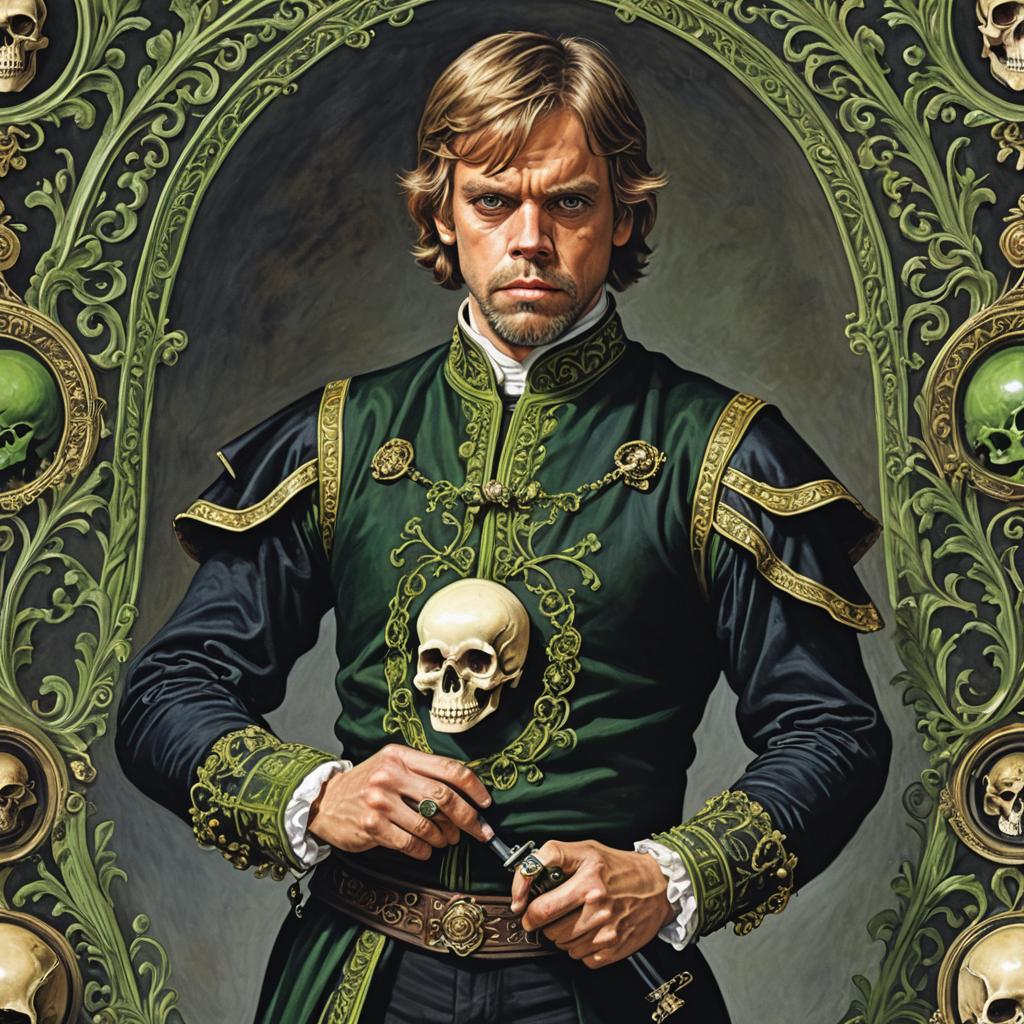
Left- production photo of Mark Hamil holding a skull Yorrick-style. Right- AI art I created of Luke as Hamlet.
Luke has more of a duality in this story- sometimes his speeches are hopeful, positive, and full of decisive language, while other times he is bitter, angry, and mournful. This is a perfect characterization for a young man whom the Emperor hopes to turn to the Dark Side, and these speeches excellently bring out his character. Sometimes Luke even repeats lines spoken by Vader and the Emperor just to drive this point home.
Emperor
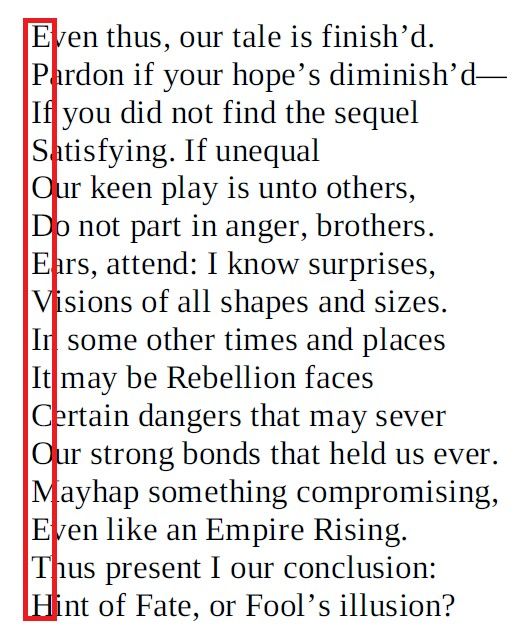
A speech from “Jedi Doth Return.” Notice how the ideas run on past the ends of lines and how long each sentence is
As for Emperor Palpatine, his speech is similar to Claudius in Hamlet in the sense that he has many run-on lines that only get to the point at the very end. This man knows he has the ea of the entire galaxy, so he can afford to make people wait for him to finish talking. As Luke himself says: “Your overconfidence is your weakness,” and Doescher does a great job conveying that weakness through the language.
Leia/ Han
My favorite part of The Empire Striketh Back was how Doescher conveys the love between Han and Leia. In that play/ movie, it was done through irritating each other in public, and soliloquizing in private. In Jedi, Han and Leia are more of a couple, supporting each other in their fights and the language has more of a romantic tone.
Han (Hal Jourdan) and Leia (Janine Ashley) finally confess their love in this scene.
My Criticism
To sum up, Jedi is a milestone in the William Shakespeare’s Star Wars Series where Ian Doescher learned how to make the language his own, rather than borrowing lines and phrases from Shakespeare. It’s a pity there aren’t more books in this series…. right?
If you enjoyed the accompanying podcast episode to this post, please consider subscribing and donating to help me continue making fun and educational content like this!
It’s a moment of tragic irony, worthy of King Lear himself that the actor who played Snape died before the actor who played Dumbledore, but here we are. I’m saddened to say that we’ve lost another beloved Shakespeare and Harry Potter actors.
Michael Gambon (
Gambon was born in Ireland in 1940. His first Shakespeare role was in a production of “Othello” at the Gates Theater in Dublin Ireland. He went on to win an Olivier Award, a BAFTA, several SAG awards, and was knighted in 1988.
Sir Michael became accomplished both on TV, in movies, and on stage. He played many of Shakespeare’s greatest roles, including a famous performance as King Lear with Antony Sher at the Royal Shakespeare Company. Here are some highlights of his stage work:
Now before I go on, I’d like to address the elephant in the room, or rather the MEME in the room:
I’ve never understood the animosity that Gambon got for changing the interpretation of this line, and no one seems to have a real explanation for why he changed it from the book. So this is all speculative, but as a Shakespeare actor myself, I want to provide some rational explanations that while you might not like his choice, you hopefully won’t come to the conclusion that it was the “Worst mistake ever.”
1. If You Don’t Change Something, You’re Not Doing Your JOb
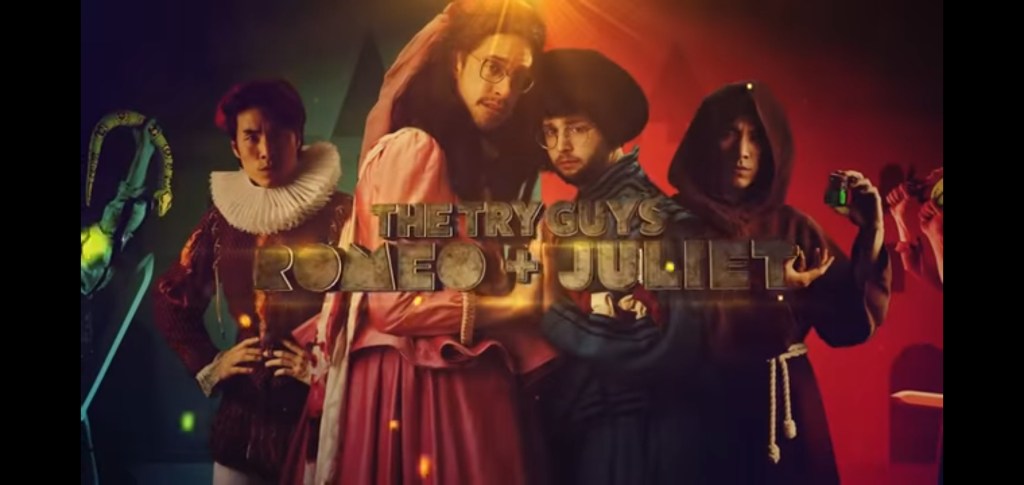
I was excited from the beginning to hear that the Try guys were going to bring Shakespeare to YouTube in a way that was fun and accessible. My expectations were that they would make fun of the play with care; I was hoping that they wouldn’t mock Shakespeare, (or mock people who like Shakespeare). I was also hoping that they would critique the characters without outright mocking them and find ways to make the play connect to modern audiences. I think they achieved all those things and more!
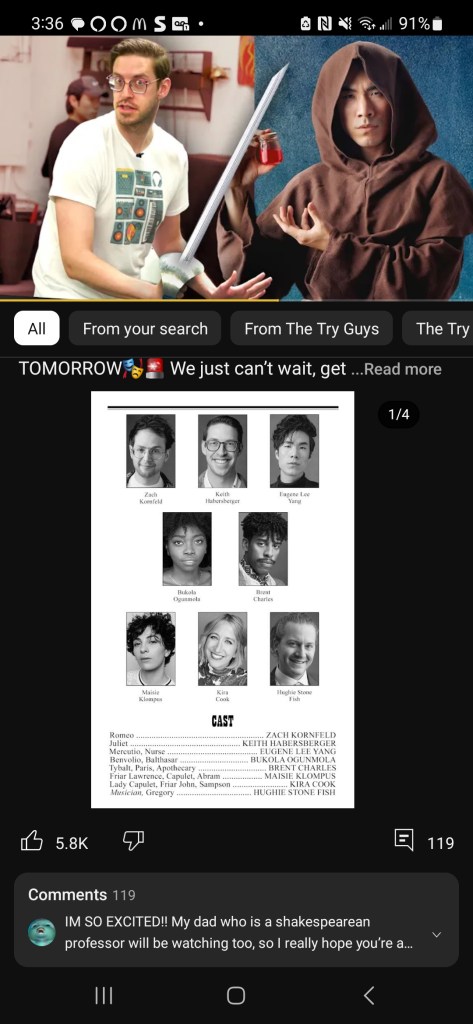
Zach Kornfield, Eugene Yang, and Keith Habersberger known collectively as “The Try Guys” are a group of friends who seek out new experiences and share them with the world. They thrive on taking themselves out of their comfort zone and learning about the world through experiencing it firsthand in a funny, lighthearted way. As I said before, what could be more adventurous, daring, informative, and out of YouTube’s comfort zone than doing Shakespeare?
In a series of videos they explored Elizabethan clothing, stage combat, learning how to speak Shakespearean verse, and finally on August 10th, 2023, they performed “Romeo and Juliet” live on Youtube, with suggestions from the audience! With this post, I will discuss the evolution from these three videos, to the final show, which I got to see live on YouTube. I will discuss what I think worked, what didn’t, and how this production might influence future Shakespeare productions going forward!
Podcast About the SHow:
My Top Ten Moments:
Background on the Show
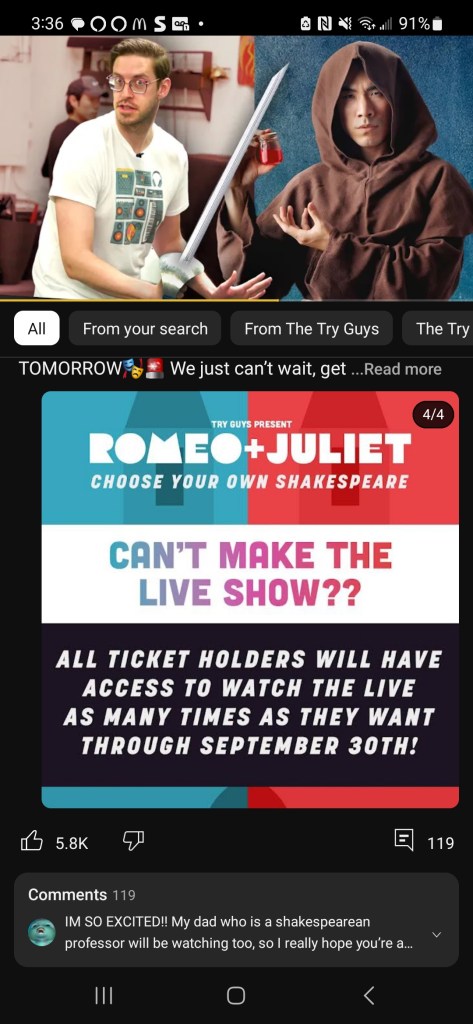
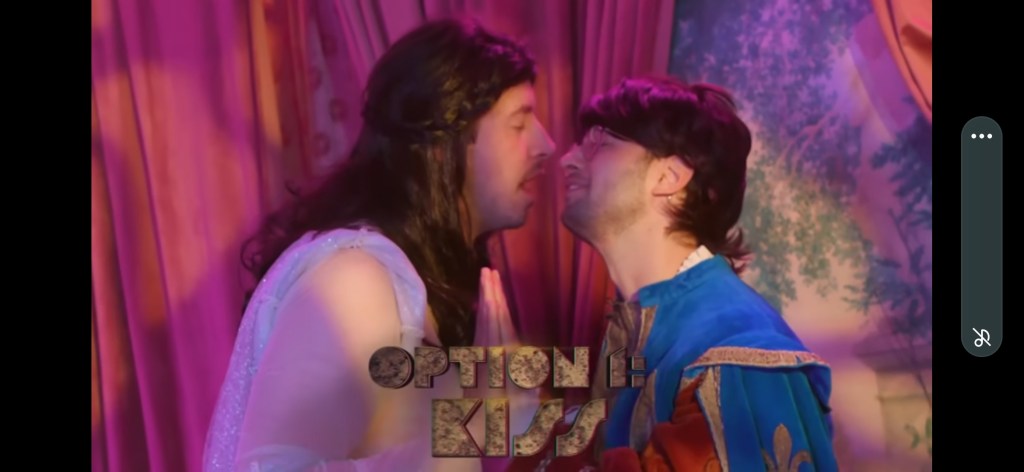
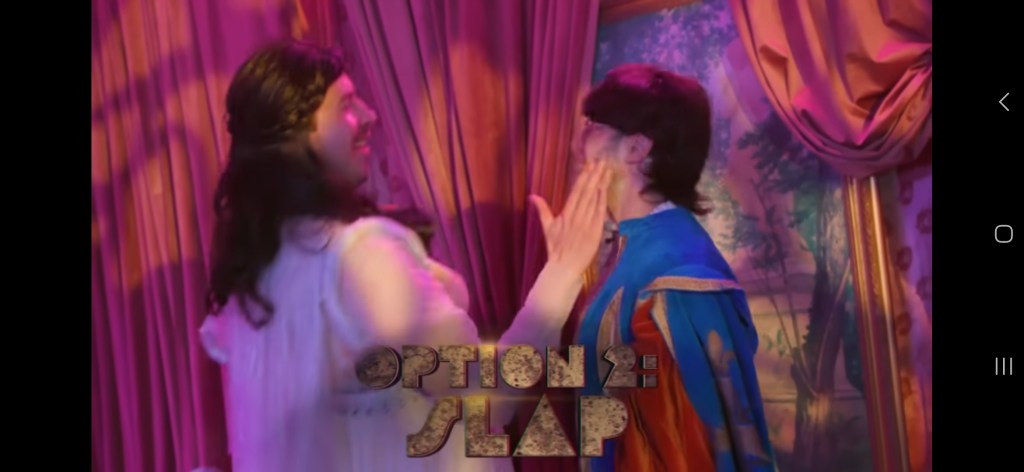
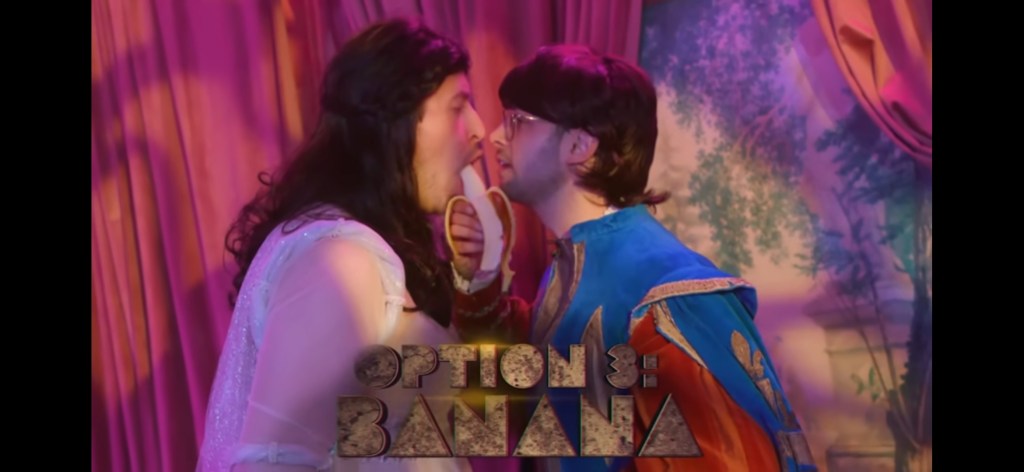
The original pitch for the play made it sound like a live YouTube event, but they made it even better by including a voting option where viewers could change some of the action and chose for instance, if they fought with swords or some other object, thus engaging the audience the whole time. This is what made this experience unique, (perhaps more than any other production), and I think in many ways this production could be an inspiration to educators and theater practitioners! My main critcism of the show is that, though it can be enjoyed by almost anybody, it is definitely not suitable for children, and nobody could get away with showing it in a classroom environment.
Costumes and Sets
The set for “Romeo and Juliet,” seems like an ordinary YouTube TV studio, in that it’s fairly small and it does not suggest any particular period. It kind of suggests somewhat of a dream-like environment; there are cardboard cut outs with some clouds, the lighting is warm with a few pink colors . Most of all it reminds me of a fractured fairytale more than classic tragedy, (which I suppose is clever in itself because it sets up that the Try Guys are going to fracture Shakespeare the same way people like the Muppets fractured fairy tales.
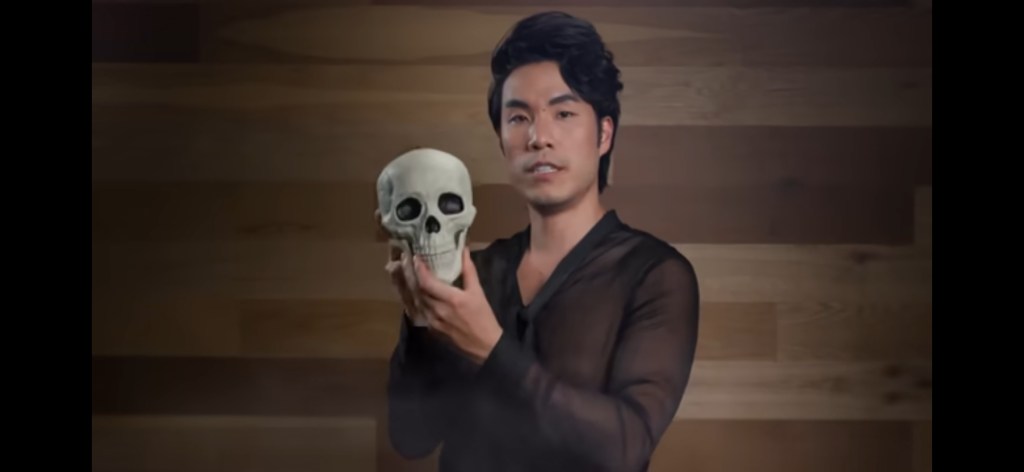
The costumes don’t seem as elaborate or historically accurate as the ones in the previous video, which is a shame because it would’ve been really nice to see the Try Guys walk, fight, and dance in the same costumes that they experimented with in the previous video. That said, the costumes certainly are functional within the story. Eugene as Mercutio has a stylish striking black outfit that certainly suggests somebody you don’t want to mess with. Zach as Romeo has an amusing long wig (romantically disheveled of course) and a blue doublet (though I miss the pumpkin pants in the previous video). As in other productions, the Montegues wear blue and the Capulets mostly wear red. I would be surprised if the director had seen the famous Franco Zephirelli film (or at least Gnomio and Juliet).
The director Keith Habersberger also keeps the best costumes for himself both as the Prince and Juliet; he’s wearing a beautiful ordinate gold costume as the Prince and Juliet herself has lovely rose-colored gowns. Even her shift in Act Four is it’s tasteful. I’ll talk more about Keith’s portrayal of Juliet later, but let’s just say that the clothes do not make him look like a man in women’s garb, they make him look like Juliet.
Stage Combat
The stage combat episode is great, and as a Stage Combat junkie myself, I watch a lot of channels like Skalgrim, Forged In Fire, HEMA videos, and of course my own stage combat videos. Consuming this combat content, I know that there are lots of avenues for education and for entertainment watching these 3 guys who have never done sage combat before, try out swords. I was very delighted to see them putter around with swords and then learn a short stage combat scene in which they then put on put their own spin on by improvising a scene where Romeo & Juliet sword fight with a guy who cut the cut in front of them while they were trying to get ice Cream. The video is fun, ludicrous, but also it’s just as informative as videos from the Folger Shakespeare Library.
Unfortunately, The Try Guys didn’t make much use of the swordplay they learned in this video during the final performance. Imagine my disappointment when, during the climactic duel between Tybalt and Mercutio, the audience voted to replace the swords with…something that was definitely NSFW. I’ll discuss this choice in depth later on my podcast but let’s just say it made the training they did in the previous episode seem like a waste of time.
The Cameos
Did you hear about this guy Romeo? He’s the talk of the town
Link Neal from Good Mythical Morning
One aspect of the production that I deeply loved was that instead of doing the whole play, The Try Guys did a 90-minute abridged version using multiple narrators to fill in with bits of exposition and commentary. The Reduced Shakespeare Company did this before in their show, but since The Try Guys are very popular in the YouTube Community, they got a bunch of their fellow Youtubers to be their narrators like Rhett and Link, Smosh Games, Rosario Pansino from Nerdy Nummies, and Mat Pat from Game Theory. It was absolutely delightful to hear more of my favorite YouTubers talk about my favorite writer, each one telling the story with their own brand of humor!
Romeo runs to Friar Laurence, mascara all smeared!
Manny Mua
The Performances:
Finally, let’s talk about the acting in the final performance and how the Try Guys succeded in bringing Shakespeare to You Tube.
Keith Habensburger as Juliet
Keith carries the show as Juliet. As he mentions in the video above, he has performed in Shakespeare before, and his passion for performing shines. It’s actually a bit shocking to see him drop his usual persona as an easy-going funny guy and become a tragic heroine! In addition, he has a clear vision for the character- I suspected that he would probably exploit the comedy of him being a man playing a woman and being taller than Zach and he does in the earlier scenes, but once Tybalt dies, Keith plays Juliet absolutely straight- he is absolutely committed to playing Juliet’s anguish and desperation and it’s really moving to watch!
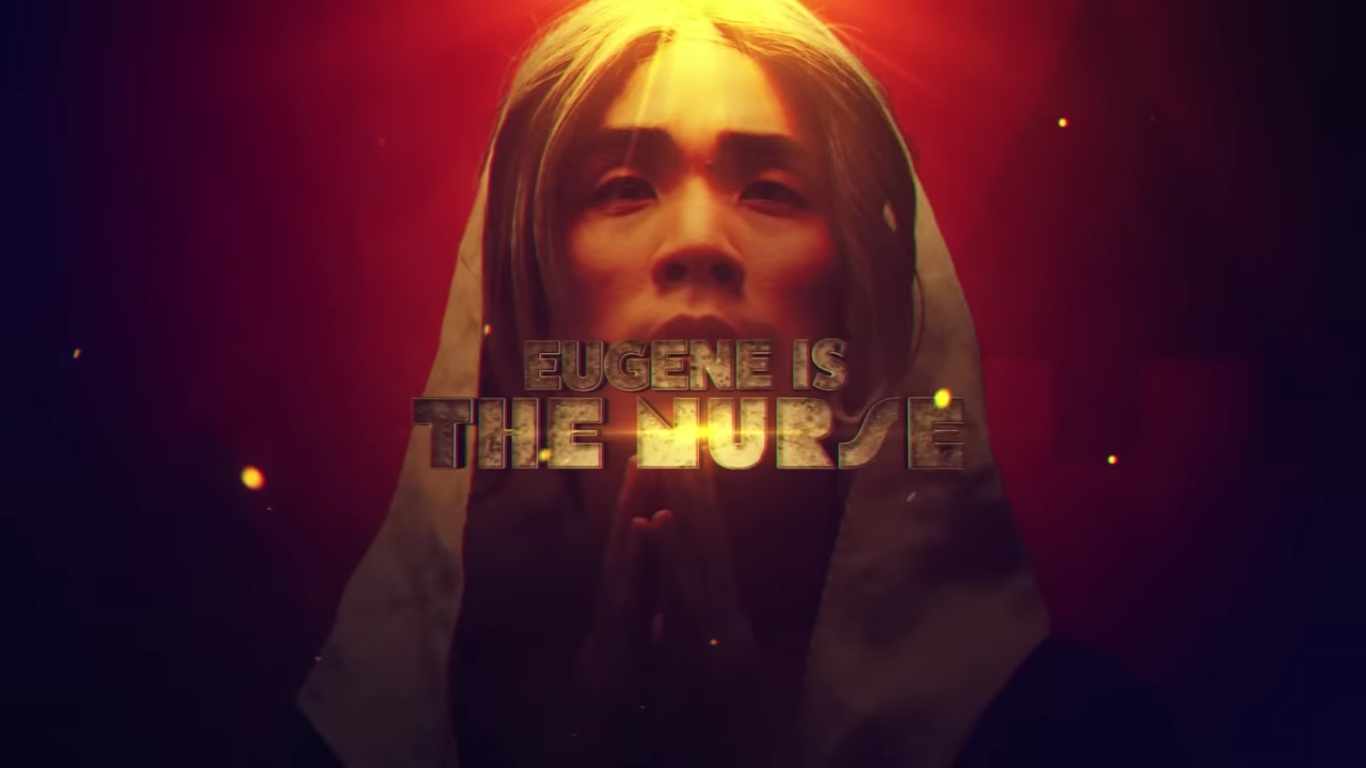
Eugene As The Nurse/ Mercutio
Eugene was a natural choice for Mercutio- his Try Guys persona is very much the wild card, sometimes friendly and sometimes fierce and he clearly loves Shakespearean language as you can see in the earlier video where he plays Edmund from “King Lear.” Honestly, though, I think his performances in the final play are a bit under-dramatized- I don’t quite know what he was going for as either The Nurse or Mercutio, which might be a result of limited time or lack of direction. That said, he does a good job for having never done Shakespeare professionally before.
Zach as Romeo or “A Bro wearing Hose”
Zach admits in the Shakespeare Acadamy video that he doesn’t “get Shakespeare,” and I get the sense that he doesn’t really like Romeo, so his performance seems like an intentional parody of romantic leading men. Honestly, this is fine. Romeo isn’t my favorite Shakespearean character either, and yes, The Try Guys are treating this as a real show, but at the same time it is still an experiment; they are trying something they wouldn’t normally do, so Zach is dealing with the awkwardness of playing Romeo with the same self-deprecating sense of humor that he uses when baking without a recipe or trying ballet. He knows that he would never get cast as Romeo in real life, so he’s having a laugh while he does it onstage, all the while being the best Romeo he can be.
The Format
One of the biggest challenges any Shakespeare practitioner has to face with a modern audience is the problem of engagement. The age of social media has changed how we consume content- we don’t passively watch anymore, we engage with it, comment on it, share it, and sometimes even manipulate it for ourselves. In Shakespeare’s day, there was no division between actors and audiences so in a way, his plays work well for this kind of live choose-the-outcome YouTube Event and I’m interested to see if it influences future performances going forward. In any case, I’m grateful that I was able to see this fun-frenetic, once-in-a-lifetime evening of live theater!
If you would like to learn Shakespeare like the Try Guys, I have a series of online clases in acting, stage combat, Shakespearean comedies, tragedies, and of course, “Romeo and Juliet.” You can enroll in one of these classes now or schedule one with me by visiting my Outschool.com page:
As I was writing William Shakespeare’s The Empire Striketh Back, I was surprised to realize I had made more references to Shakespeare’s Much Ado About Nothing than any other play. Much Ado is a comedy—probably my favorite of Shakespeare’s comedies—so it was strange that lines from it kept popping up in the darkest of the original Star Wars® trilogy.
William Shakespeare’s Star Wars is a series of parody plays written by Ian Doescher that takes the prose screenplays of the Star Wars story and transforms them into Elizabethan verse. Last time I mentioned how much I loved the cheeky references to Shakespeare and Star Wars, and how Doescher adapts the cinematic quality into Elizabethan drama very well. In my podcast, I also emphasized the way Doescher gives each character verbose Shakespearan language that works very well for radio and theater:
My podcast episode where I do dramatic readings of “Verily A New Hope.”
What I want to do with this post, (and the accompanying podcast), is to see whether this edition captures the fun, the clever wordplay, and the Shakespearean storytelling of “A New Hope,” with the second installment of the series, and if it helps to capture the shift in tone between the two movies, as Luke is tempted by the dark side and Han is betrayed and frozen by Lando.
Notes about the play
The first play in the series, “Verily, A New Hope,” took plot and structure inspiration from Henry V; it tells the story as an epic heroic story of Luke’s heroic deeds, much like how Henry V is about a king who grows from boy to man.
By the playwright’s own admission, the dialogue is stuffed with lots of re-purposed quotes from Much AdoAbout Nothing, Shakespeare’s comedy of a womanizing, self-centered soldier who becomes a devoted husband. This is appropriate since the Leia/ Han plot within the play and movie starts out with them bickering like Beatrice and Benedick. Doescher says this was an accident, but I think he might have subconsciously taken inspiration from their love affair to help structure the dialogue. In the accompanying podcast episode, I talk more about how the use of Much Ado quotes helped to flesh out the characters of Luke, Leia, and especially Han.
Structure
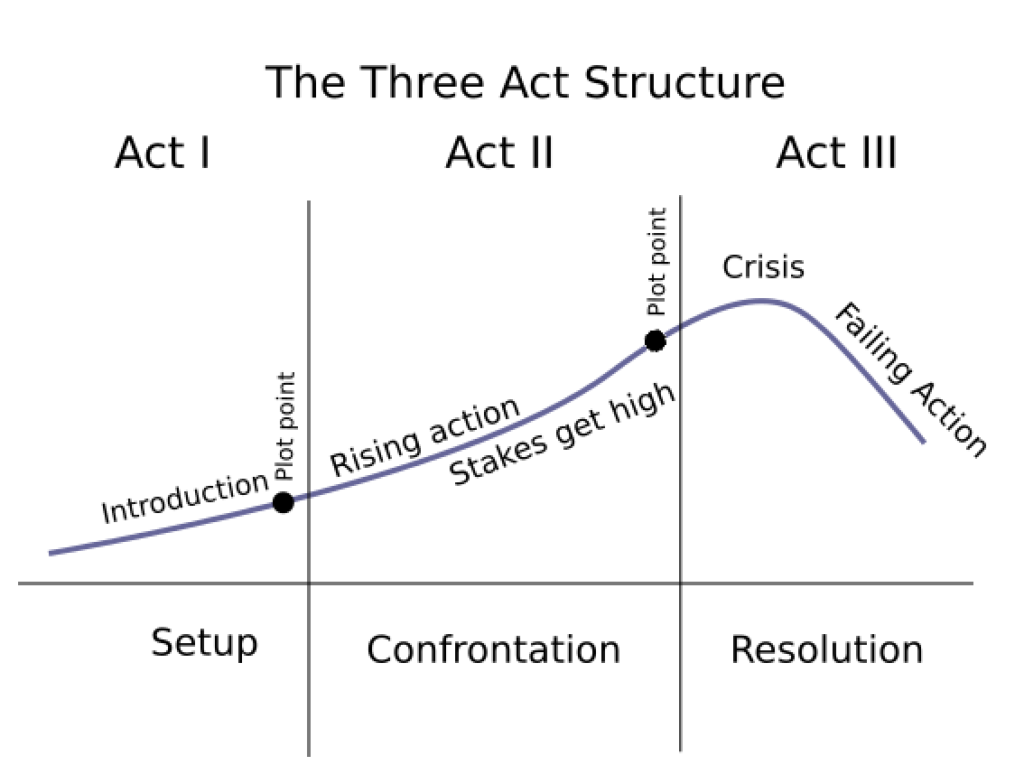
Movies and plays follow a similar structure where the action starts at a static place, tension rises, and finally, things get resolved at the end. A lot of the same elements are in both issues. The main difference is how they are arranged. Let’s see how Doescher translated the three-act structure of a screenplay, to the five-act structure of an Elizabethan tragedy.
A Chorus is a short speech where a character who is not part of the action of the play introduces the plot. It functions the same way as the famous title crawl at the beginning of Star Wars.
I mentioned last time that “Verily: A New Hope” uses choruses liberally, which is appropriate because the tone of this story is so much darker, and since the action follows the journeys of Han and Luke so closely Ian doesn’t use choruses as much. I suspect this is partly because unlike The Empire Strikes Back, A New Hope jumped around more between planets and locations and used wipes and other transitions heavily:
Below is a link to the Royal Shakespeare Company’s Learning Zone, where you can learn about the language of the Henry V chorus.
The literary technique of stichomythia has characters who speak at more or less the same time, using slightly different forms of dialogue. Doescher uses this well as a staging device by having Vader and Luke speak similar lines as Luke plummets down the shaft after losing his lightsaber duel:
These similar lines highlight the connection these two have (no spoilers), and also emphasize that, though the actors might be physically close onstage, their characters are meant to be far apart; they wouldn’t be saying this to each other.
In Romeo and Juliet, there’s an excellent example of stichomythia in Act IV, Scene iv, right after Juliet’s parents and Nurse discovers her, apparently dead. There is a long series of laments by her parents and nurse where they are shocked and horrified at her sudden death:
Lady Capulet. Accursed, unhappy, wretched, hateful day! 2702 Most miserable hour that e’er time saw In lasting labour of his pilgrimage! But one, poor one, one poor and loving child, But one thing to rejoice and solace in, And cruel death hath catch’d it from my sight!
Nurse. O woe! O woful, woful, woful day! Most lamentable day, most woful day, That ever, ever, I did yet behold!2710 O day! O day! O day! O hateful day! Never was seen so black a day as this: O woful day, O woful day!
Paris. Beguiled, divorced, wronged, spited, slain! Most detestable death, by thee beguil’d,2715 By cruel cruel thee quite overthrown! O love! O life! not life, but love in death!
Capulet. Despised, distressed, hated, martyr’d, kill’d! Uncomfortable time, why camest thou now To murder, murder our solemnity?2720 O child! O child! my soul, and not my child! Dead art thou! Alack! my child is dead; And with my child my joys are buried.
Romeo and Juliet, Act IV, Scene v lines 2702-2723.
When I played Friar Laurence and the cast and I rehearsed this scene, the actors playing the Nurse and Juliet’s parents were struck by how similar the lines are and worried that these long passages of laments would get tedious to an audience. I realized by looking at the similar lines, the similar words (especially at the ends of lines), and the fact that Friar Laurence interrupts them at the end, led me to believe that these lines are meant to be spoken AT THE SAME TIME. This creates an effect of organized chaos where the actors seem to be wailing and ranting, but are actually speaking a carefully composed quartet of grief. Thus Doescher cleverly mimics Shakespeare’s use of stichomythia to convey Vader and Luke’s physical distance, and complementary feelings at the same time.
3. Parody Lines
The biggest appeal of William Shakespeare’s Star Wars is the fact that it is a parody, and I’ve said for many years that parody and gentle riffing on Shakespeare is a great way to get students to overcome their fear of Shakespeare and engage with him. Students who know Star Wars but don’t know Shakespeare will recognize the familiar characters and plots of the movies and then see how Shakespeare’s language tells the story anew. Similarly, people who know Shakespeare will recognize the way Doescher re-tools famous Shakespeare quotes to give to characters in the Star Wars Universe, like here, where he spoofs the intentionally bad speech of Snug the Joiner and gives it to the Wampa from Empire Strikes Back:
Peter Keavy as Snug the Joyner in “A Midsummer Night’s Dream,” 2017.
In the Educator’s guide, which I’ve attached below, Doescher tells you exactly which lines he has parodied and the plots of the original plays so the students can learn about Shakespeare through these famous speeches. Orson Wells once said that “We sit through Shakespeare in order to recognize the quotations,” and this edition gives us thrilling space battle, wonderful characters, and witty dialogue to keep us entertained while we wait.
Staged moments
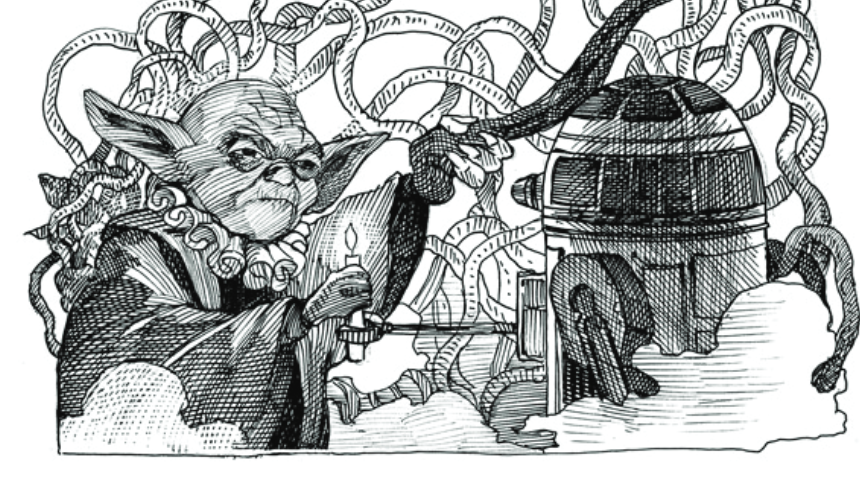
As Doescher worked his way through all nine installments of Star Wars, he continued to expand and experiment with his storytelling. There are a couple of moments in “Empire” that work only onstage such as the aforementioned moment of stichomythia after the lightsaber duel, and the scene in Act II, Scene ii where the Imperial Walkers known as AT-ATs actually speak to each other onstage. Like the French in Henry V, it’s interesting to see the battle from the enemy’s point of view, albeit a highly biased one. I won’t reprint it here for copyright reasons, but I will put this funny sketch in as a placeholder:
My Criticism
Although I loved “Verily, A New Hope,” I feel that Doescher didn’t go far enough to adapt the dialogue in interesting ways and play with the stagecraft of Star Wars to make it more distinct from the film and the first installment. My favorite moment of the play was the Wampa speech which was great because it not only parodies one of my favorite speeches in “A Midsummer Night’s Dream, it also made the Wampa attack tonally distinct from the film- the film is tense and grim, while the Wampa speech is funny and charming. I wish Doescher had embraced the parody and silly tone he shows in this speech and applied it more to the rest of the play; we already know Empire is the darkest installment of the series, but that doesn’t mean it needs to be played like that the whole time.
What I think works best in the film is the romantic comedy between Han and Leia; Doescher does a wonderful job pointing out the parallels between Han and Leia and Benedick and Beatrice which is not only fun, but helps Star Wars fans appreciate the comedy of Much Ado About Nothing even more. This is why I’m glad Doescher took painstaking notes on how he parodied Much Ado and other plays in the guide below:
If you enjoyed the accompanying podcast episode to this post, please consider subscribing and donating to help me continue making fun and educational content like this!
As of right now, if you want to help support the work I do here and my podcast, you can sign up for monthly donations. I have a lot of new ideas for the podcast, but I can’t do them without your support, so please consider being a supporter now!
If you go to my podcast website, there’s now a button that says “Support this Podcast,” where you can choose your monthly rate of contribution, from $9.99 per month to as low as $1 per month! If enough people support this podcast, I’ll start taking requests and giving out rewards to my generous supporters. In short, if you support me, I’ll create content designed to your interests so you can feel that this is YOUR podcast.
Thanks for reading, and please consider donating today!
The global phenomenon “Five Nights At Freddie’s” (FNAF) has spawned 11 major games, spinoff games, 19 books, countless comics, and a big Hollywood movie premiering this week:
My video podcast on FNAF
One other thing this franchise has spawned is ENDLESS FAN THEORIES. I admit, when I first heard of this jump-scare-based game with haunted animatronics, I viewed it as a silly novelty- a clever way to create cheap horror using monsters who jump out at you in a dark room… then I saw this:
2023- The Game Theorist Youtube show tells the entire chronology of the FNAF saga.
The YouTube channel Game Theory, which has been analyzing and dissecting the games for the last 8 years finally created a complete chronology of the games’ lore. Like a lot of the best horror stories like Dracula and “Sleep No More,” the game scatters a lot of its lore throughout the game in the form of mini-games, security guard notebooks, newspaper clippings, and of course, the iconic, nervous late-night phone calls that your character (a nameless night watchman) receives from a mysterious character known only as THE PHONE GUY.
This story is truly the stuff of nightmares- serial killers, murdered children, ghosts, possessed robots, broken families, and unending quests for revenge from beyond the grave. Of course, a few of these tropes Mr. Shakespeare would be very familiar with, so I thought I’d delve into some of the themes, tropes, and ideas that link these two franchises. My goal is to get fans of the video game to understand that, since Shakespeare and Scott Cawthorne (the creator of the game) use a lot of the same horror plots and ideas, that, if you can understand FNAF you can understand Shakespeare!
Part I: The mad scientist- William Afton Vs. William Shakespeare’s Prospero
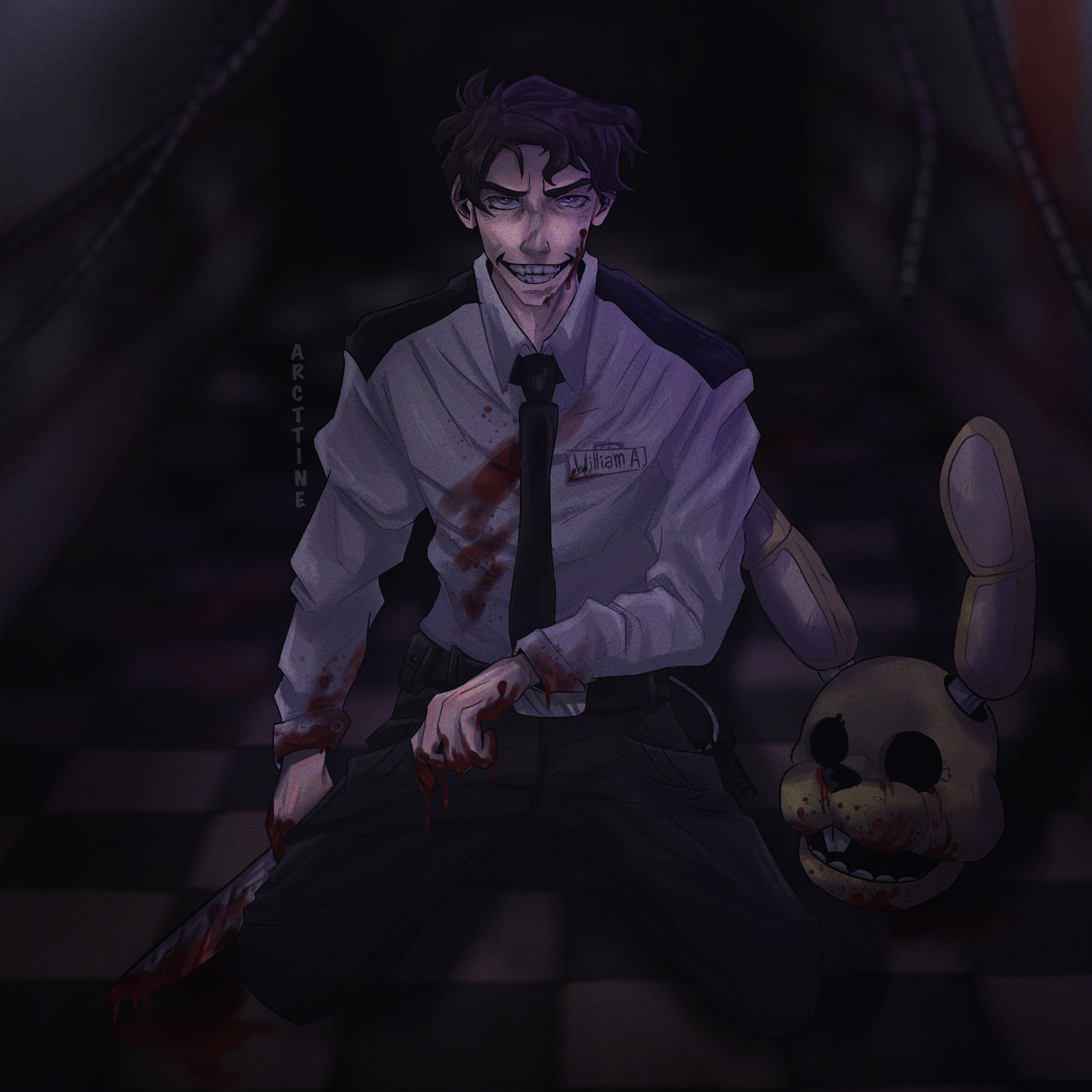
The story of Five Nights At Freddie’s revolves around its main antagonist- a genius roboticist-turned-serial killer named William Afton, who starts out as a successful businessman and children’s entertainer obsessed with bringing his creations to life. Any horror fan will tell you that this is an automatic sign of a villain because he is trying to master the skill that only God possesses- the ability to create life.
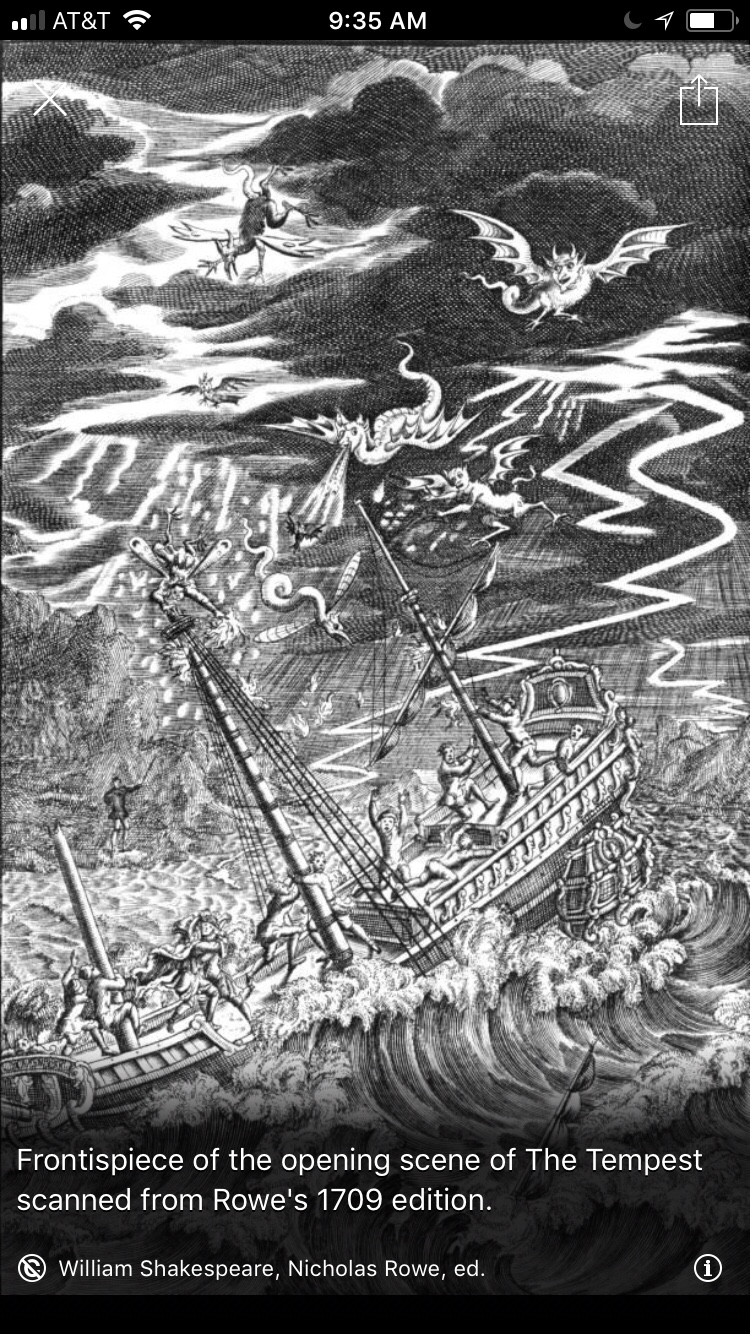
In Shakespeare’s final play, The Tempest, the hero is a brilliant magician who, after his brother exiles him to a desert island, masters many crafts considered unnatural for the 1600s:
I have bedimm'd
The noontide sun, call'd forth the mutinous winds,
And 'twixt the green sea and the azured vault
Set roaring war: to the dread rattling thunder
Have I given fire and rifted Jove's stout oak
With his own bolt; the strong-based promontory
Have I made shake and by the spurs pluck'd up
The pine and cedar: graves at my command
Have waked their sleepers, oped, and let 'em forth
By my so potent art.
The Tempest, Act V, Scene i, Lines 2063-
Like I discussed in my post on Shakespeare and Star Trek, Prospero’s magic is both benevolent and terrifying. He uses it to rescue himself and his daughter Miranda from the island, and he creates beautiful visions of gods and angelic music for Miranda and her young lover Sebastian, but he also creates nightmarish visions to torment his enemies:
Both Afton and Prospero are motivated by revenge against the men who betrayed them. In Afton’s case it’s his rival/ partner Henry Emily who bankrupted his business and later got him fired from his own company. Afton torments Henry by murdering his daughter and ruining his business by luring kids to their death inside the pizzeria, disguised as one of the animatronic characters. Afton also figures out how to torment people using sound alone, like Prospero does to his slave Caliban:
Caliban. All the infections that the sun sucks up
From bogs, fens, flats, on Prosper fall and make him
By inch-meal a disease! His spirits hear me
And yet I needs must curse.
For every trifle are they set upon me;
Sometime like apes that mow and chatter at me
And after bite me, then like hedgehogs which
Lie tumbling in my barefoot way and mount
Their pricks at my footfall; sometime am I
All wound with adders who with cloven tongues
Do hiss me into madness.
Here comes a spirit of his, and to torment me! The Tempest, Act II, Scene ii.
Prospero isn’t a killer, but like Afton, he has learned the secret to life after death, which makes him powerful and dangerous. Even more unsettling, both men are on an endless quest for revenge and torment men whom they saw as brothers. Other Shakespearean characters take their lust for revenge to the same dark place Afton did- the murder of children.
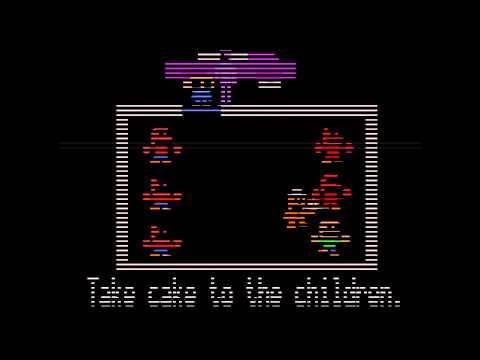
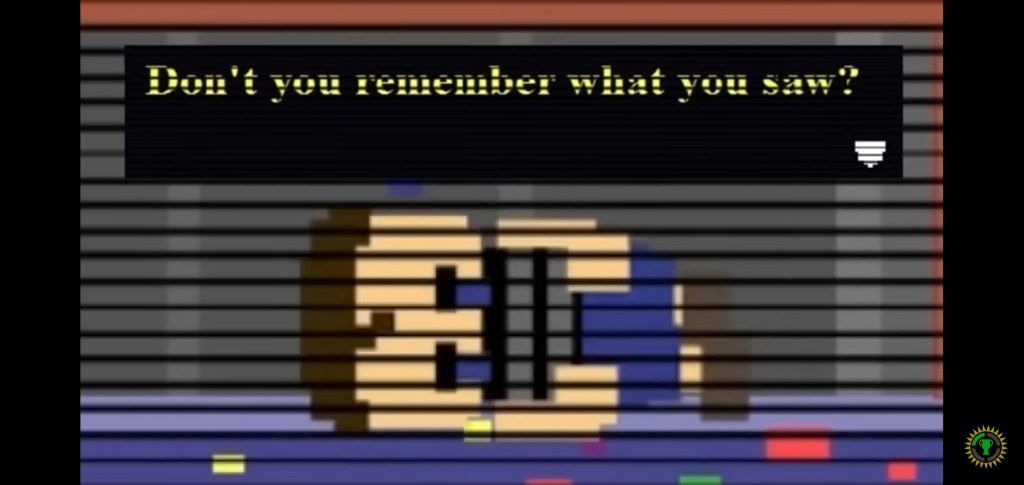
For the first four games, Afton isn’t directly part of the game- he’s merely mentioned in pieces of the lore. Frequently we see 8- bit re-enactments of his crimes in a series of mini-games, where he appears as a faceless, purple killer.
Screenshot of William’s first murder of Henry’s daughter Charlie outside of the pizzeria.
Why purple though? It’s true that purple is associated with royalty, and sometimes associated with villainy, (since it isn’t a color found much in nature). I think though, there might be a deeper, more macabre meaning to this color associated with this killer: It is a scientific fact that human blood, when it is shed and deprived of oxygen, actually turns purple:
The colors of arterial and venous blood are different. Oxygenated (arterial) blood is bright red, while dexoygenated (venous) blood is dark reddish-purple
Shakespeare was very aware of this medical fact. He lived in an age where traitors’ heads were placed on spikes on London Bridge, and people would pay to watch wild dogs attack bears (the FNAF of his time). Shakespeare makes many gory references to murderers watching red blood turn purple:
I make as good use of it as many a man doth of a Death’s-head or a memento mori: I never see thy face but I think upon hell-fire and Dives that lived in purple;
Henry IV, Part I, Act III, Scene iii.
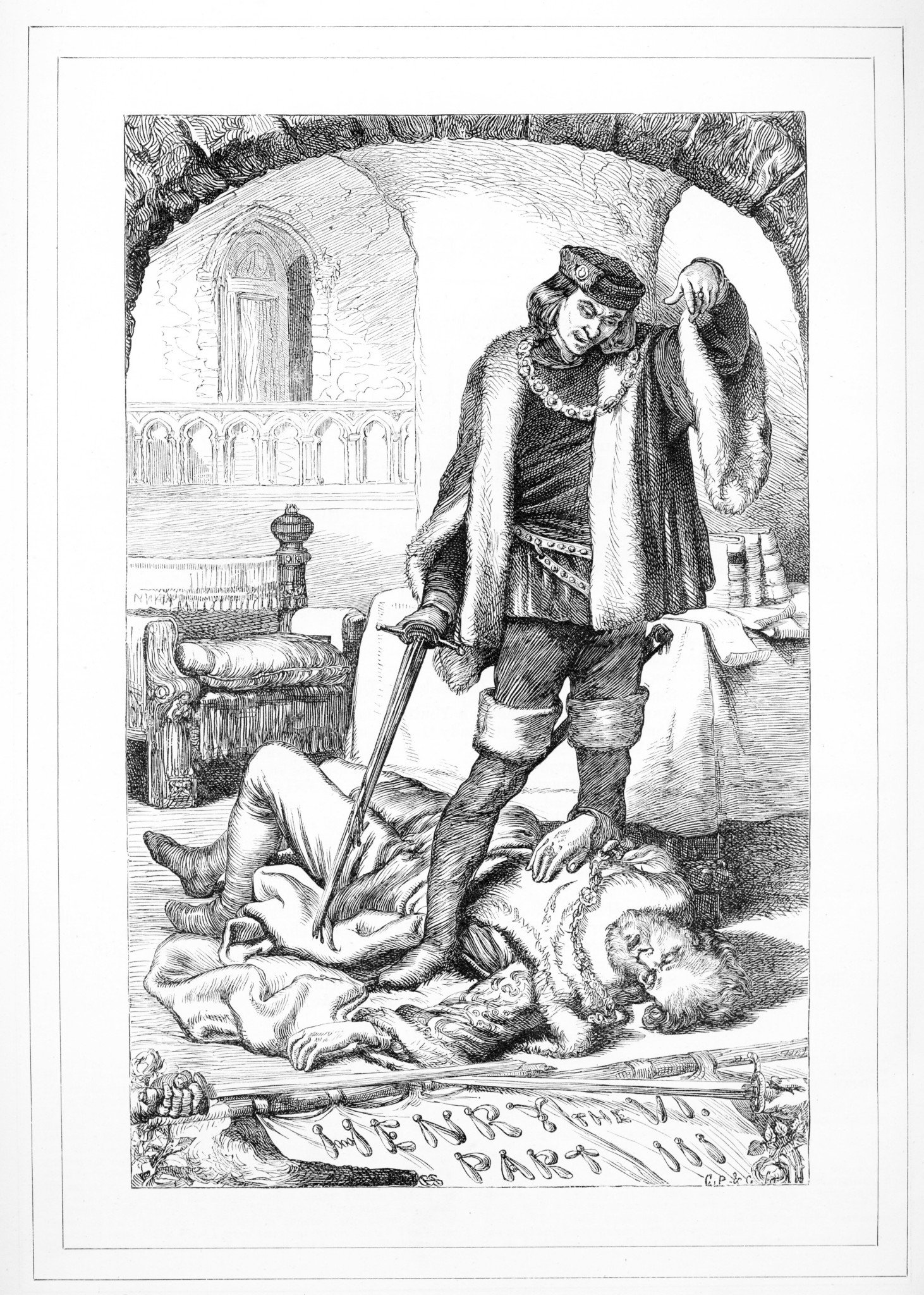
Woe above woe! grief more than common grief! O that my death would stay these ruthful deeds! O pity, pity, gentle heaven, pity! The red rose and the white are on his face, The fatal colours of our striving houses: The one his purple blood right well resembles;
Henry VI, Part III, Act II, Scene v.
Now, whilst your purpled hands do reek and smoke,
Julius Caesar Act III, Scene i.
With purple falchion, painted to the hilt In blood of those that had encounter’d him:
Henry VI, Part III, Act II, Scene v (Richard of Gloucester)
This last quote is spoken by Richard of Gloucester, who, in the play that bears his name, becomes King Richard III, Shakespeare’s most irredeemable villain. Just like William Afton, he kills without remorse and dispatches anyone who gets in his way on the path to the crown. In addition, like many of Shakespeare’s villains, his turn to pure evil occurs right after he does the unthinkable- when he murders children.
Richard (Ian McKellen), orders the secret murder of his nephews in the tower in order to keep his crown.
Throughout the rest of the play, Richard kills a lot of his political and personal enemies and we go along with them because he’s the protagonist. But once he murders the princes, who have done nothing to harm him or anyone else, Richard crosses the line from anti-hero to monstrous villain. It is also at this part of the play when his victims begin to take their revenge… FROM BEYOND THE GRAVE!
Part III: The ghostly revenge story
I’ve written before that in Shakespeare, ghosts are usually murder victims either out for revenge, or trying to convince a living person to avenge their death. Likewise, in the subsequent games, Affton’s victims possess the animatronics, seeking to kill their murderer!
One of the creepiest scenes in Shakespeare comes when Richard III is visited the night before his final battle by the ghosts of all the people he’s killed:
Similarly, when Macbeth murders his friend Banquo (and attempts to murder his young son Fleance), he is visited by Banquo’s ghost, during a party, no less! Even more ironic, look at the language Macbeth uses when he sees the ghost:
Approach thou like the rugged Russian bear, The arm’d rhinoceros, or the Hyrcan tiger; Take any shape but that, and my firm nerves Shall never tremble: or be alive again.
It’s truly ironic that, while in FNAF, the ghosts of Afton’s slaughtered children appear in the forms of angry animatronics, shaped like fearsome animals, Macbeth would rather see the fearsome animal, than the ghost of the man he murdered! Though Macbeth himself doesn’t fear bears, in both FNAF and Shakespeare, bears and other animals have long had a symbolism associated with wrath, anger, and taking bitter vengeance on the wicked.
Part IV: The Forrest of Beasts
1930s-style ad for the original Fredbear’s Singin’ Show, where a real dancing bear entertained travelers.
Bear Baiting
Even the animals in FNAF have some significance that Shakespeare has touched on in some of his plays, especially bears. In many renaissance and medieval sources, bears are symbols of wrath, revenge, and fierce protectors of children. Both Shakespeare and FNAF exploit this symbolism, and both the game and Shakespearean plays create horrifying beastly images in stories of revenge.
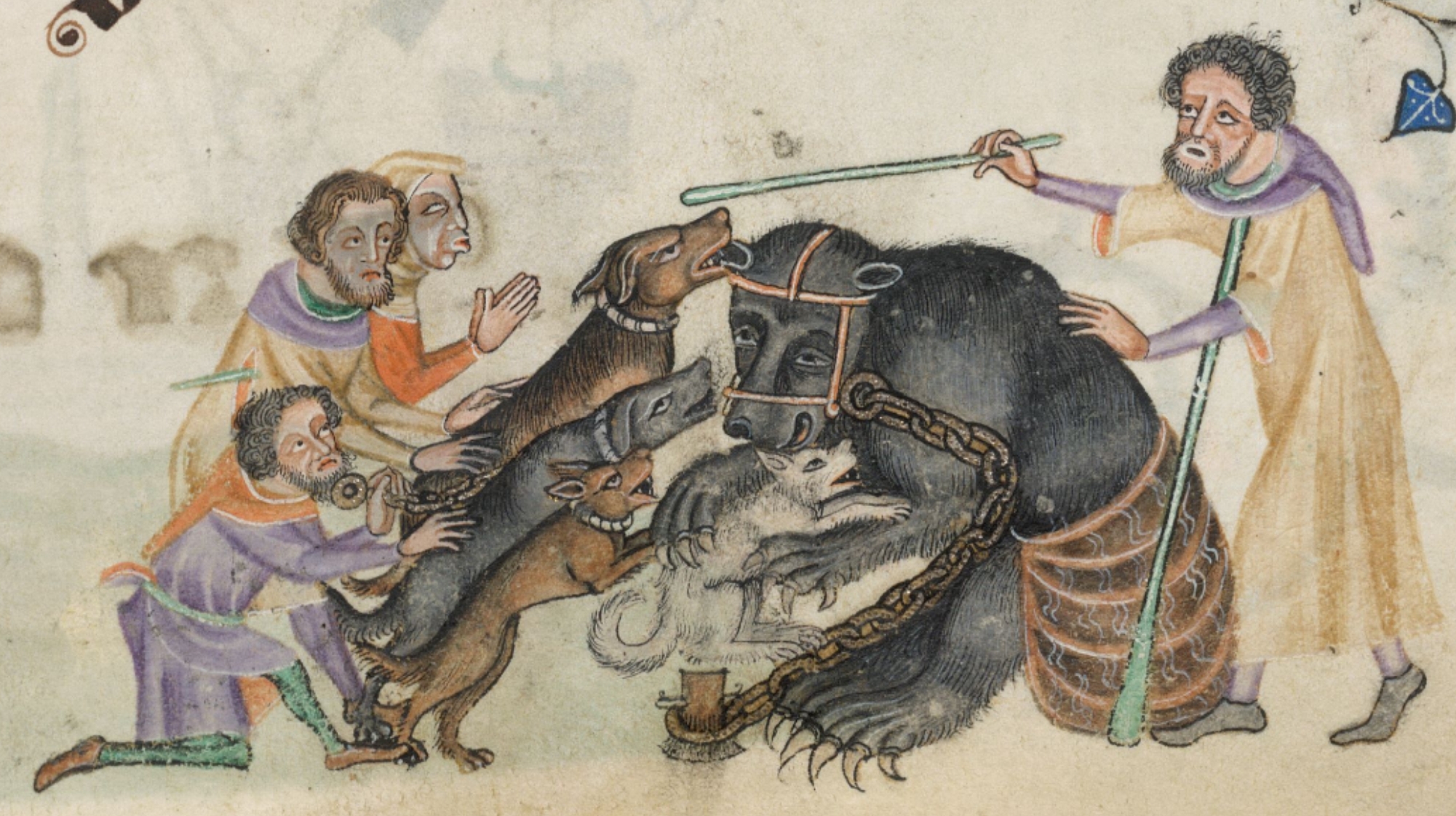
Just like the Fredbear singin’ show, Elizabethans liked to watch real bears perform onstage, sometimes as dancers, but also IN BLOODY FIGHTS TO THE DEATH. In the 1590s, there was a popular sport called “Bear baiting,” where bears would be chained, sometimes to a pole, and set on by vicious dogs. The ‘sport’ was watching to see who would prevail- the fierce and free dogs, or the powerful, bound bear.
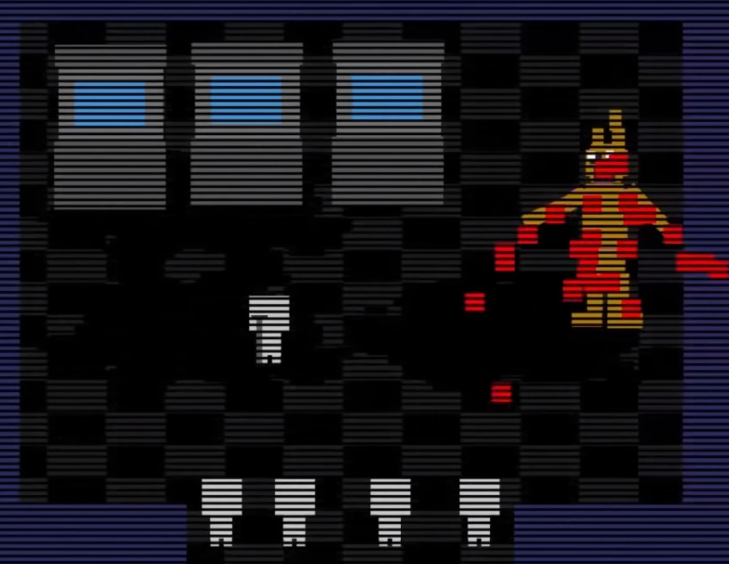
As you can see from this close-up of Wenceslaus Hollar’s famous Panorama Of London (1647), we know that Shakespeare had to pass bear beating pits on his way to the Globe all the time, (you can see ‘Beer bayting’ or bear beating, written on the playhouse on the left, and Shakespeare’s Globe Theater on the right). Not only that, Shakespeare writes about the bloody sport frequently in his plays. When Macbeth knows he’s losing the battle with Malcolm, he compares himself to a bear, tied to a stake, forced to fight until his last breath. It calls to mind the moment in the game when the ghosts shed their animatronic skins and attack William directly, while he’s trapped in the Springtrap suit.
The ghosts of Afton’s original five victims gang up on him, possibly causing his golden Bonnie suit to malfunction, and kill him… for now.
It’s worth noting that when the ghosts kill Afton, he’s wearing his Golden Bonnie suit. As Mat Pat mentioned, yes it is the disguise he wore to commit his crimes, but it is also symbolic of who Afton has become- a beastly, inhuman creature who looks friendly on the outside, but inside is cold and robotic on the inside. This also calls to mind the beast symbolism in the aforementioned ghost scene from Richard III. The real King Richard III used a boar as his royal sigil, and Shakespeare exploits that beast imagery by comparing Richard to a bloody, rooting hog, grown fat on the blood of his victims. Richard doesn’t wear a pig suit, but he does wear his cruelty and bloodlust literally as a badge of honor!
In both the games and the plays, the ghosts become a manifestation of the murderer’s guilty conscience, and beast-like imagery is used to convey how cruel and beast-like the murderer has become. Macbeth and Richard don’t dress like beasts, but they do kill like them.
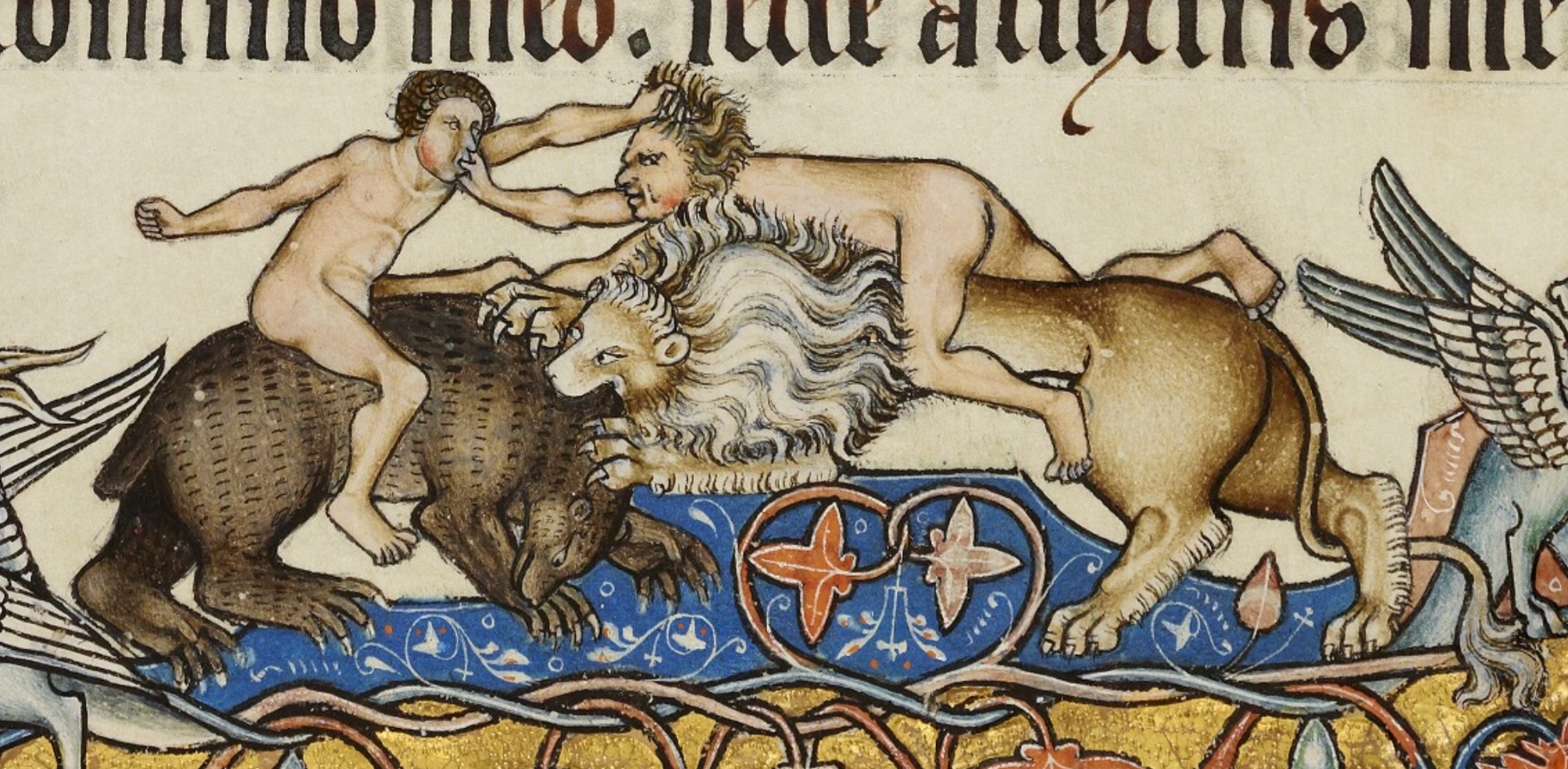
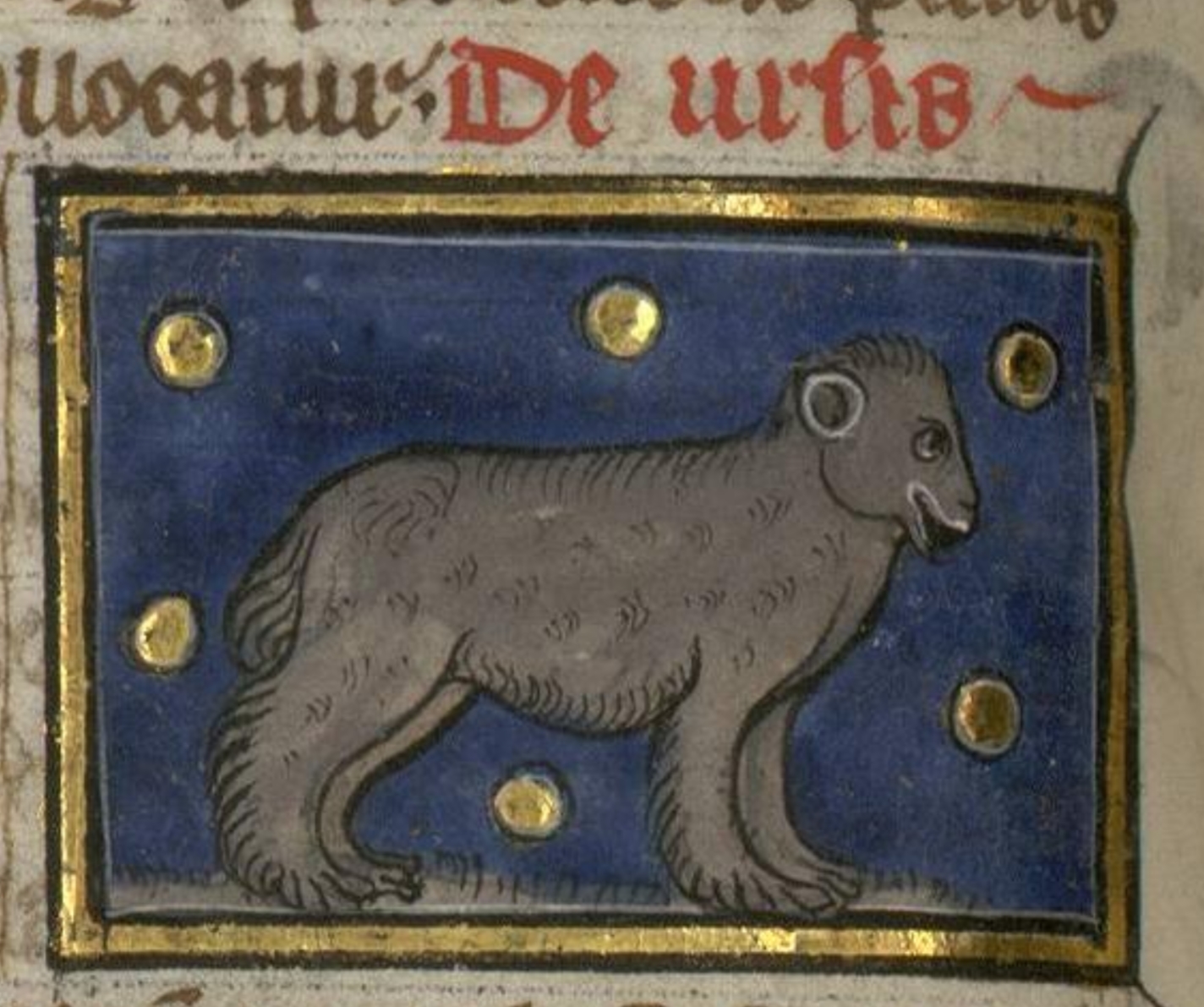
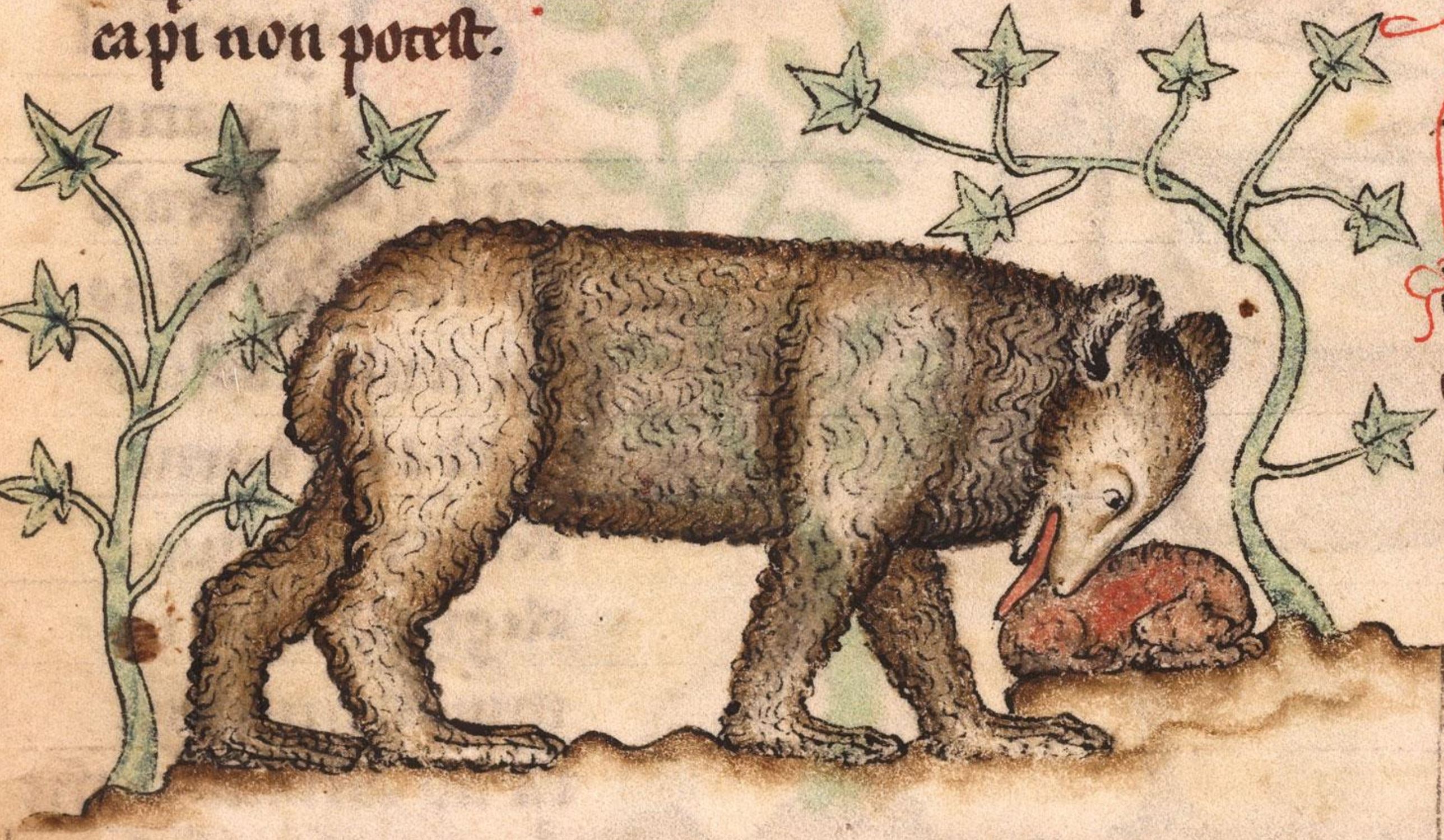
A bear fighting a lion, while both are ridden by naked men viciously fighting each other. Marginal illustration from a psalter.A very shaggy bear.The bear’s cub is born as a lump of flesh; the bear has to lick it into its proper shape.Two bears fight with a unicorn, a scene not described in any bestiary. Marginal illustration.
The beast imagery also extends to the concept of revenge. One big theme in Five Nights At Freddie’s is the concept that revenge, (whether justified or not), is blind and indiscriminately destructive. Even though the five ghosts that possess the animatronics are justifiably angry for being murdered, they don’t just try to kill Afton- they attack any poor soul who sticks around the pizzeria at night. Like Hamlet, who wants to avenge his father’s murder, but kills the wrong people, the five souls trapped in their metal cages have a noble goal- protect the children in the pizzeria, and destroy Afton, but they are full of beastlike rage and are unable to see friends from foes. This kind of blind rage reminds me of how real bears will fight off anyone whom they perceive as a threat. In medieval manuscripts, bears are tender to their cubs and literally form them out of little hairy lumps by licking them into shape. At the same time, they are powerful, deadly, and violent to anyone that threatens the cubs.
This kind of blind violence is something Shakespeare explores a lot in his history plays and his tragedies. Every time he talks about a society going wrong, he describes it as if it were populated with beasts, not humans. In Timon of Athens, the titular character, having left Athens to go live in the woods, laments to his frenemy, the cynical philosopher Apemantus, how his city has become like a collection of beasts:
Timon. What wouldst thou do with the world, Apemantus, if it lay in thy power?
Apemantus. Give it the beasts, to be rid of the men.
Timon. Wouldst thou have thyself fall in the confusion of2025 men, and remain a beast with the beasts?
Timon. A beastly ambition, which the gods grant thee t’ attain to! If thou wert the lion, the fox would beguile thee; if thou wert the lamb, the fox would eat three: if thou wert the fox, the lion would suspect thee, when peradventure thou wert accused by the ass: if thou wert the wolf, thy greediness would afflict thee, and oft thou shouldst hazard thy life for thy dinner: wert thou a bear, thou wouldst be killed by the horse: What beast couldst thou be, that2045 were not subject to a beast? and what a beast art thou already, that seest not thy loss in transformation!
Apemantus. If thou couldst please me with speaking to me, thou mightst have hit upon it here: the commonwealth of2050 Athens is become a forest of beasts.
Timon. How has the ass broke the wall, that thou art out of the city? Timon Of Athens, Act IV, Scene iii.
In short, the history of horror, which Shakespeare helped shape in plays like Macbeth, Richard III, Hamlet, and others, has a lot of classic tropes and the Five Nights At Freddie’s games exploit them quite well; tropes like supernatural vengeance, the death of innocents, beast-like killers, and unquiet ghosts. What works the best about this franchise is that it tells its lore like a mystery, slowly revealing Afton’s gruesome crimes over multiple installments. I wonder if someone has ever applied this to Shakespeare…
Shameless plug: Romeo and Juliet Murder Mystery
I’m proud to announce that I’ve just been approved to present a fully online, fully immersive murder mystery-style game, where you play as a detective trying to solve the mysterious death of Juliet Capulet! This is a really cool mixture of Shakespeare and forensics science as you examine crime scenes, look for clues, interrogate suspects, and untangle the story of Romeo and Juliet, and it even takes place over the course of five nights! Classes start March 17th. Register now at www.outschool.com!
Would Shakespeare enjoy playing FNAF well, who knows, but I do like to think he would appreciate the lore, if not the jump scares……
For the final class of my course on Shakespeare’s Tragedies, I’m coaching two young actors on a pair of tragic speeches I’ve selected, and I thought I’d share some of that work with you. The first is a speech by Lady Macbeth that comes from Act I, Scene v, which I discussed in another post. But today, I’m going to talk about the second one, Iago’s soliloquy in Act II, Scene iii.
The Text
Iago. And what’s he then that says I play the villain? When this advice is free I give and honest, Probal to thinking and indeed the course1490 To win the Moor again? For ’tis most easy The inclining Desdemona to subdue In any honest suit: she’s framed as fruitful As the free elements. And then for her To win the Moor—were’t to renounce his baptism,1495 All seals and symbols of redeemed sin, His soul is so enfetter’d to her love, That she may make, unmake, do what she list, Even as her appetite shall play the god With his weak function. How am I then a villain1500 To counsel Cassio to this parallel course, Directly to his good? Divinity of hell! When devils will the blackest sins put on, They do suggest at first with heavenly shows, As I do now: for whiles this honest fool1505 Plies Desdemona to repair his fortunes And she for him pleads strongly to the Moor, I’ll pour this pestilence into his ear, That she repeals him for her body’s lust; And by how much she strives to do him good,1510 She shall undo her credit with the Moor. So will I turn her virtue into pitch, And out of her own goodness make the net That shall enmesh them all. Othello, Act II, Scene iii Lines 1488- 1513.
The Given Circumstances
Iago has begun his plan to humiliate Cassio and destroy Othello and Desdemona by getting Cassio drunk and sending Roderigo to fight with him. Alone in soliloquy, Iago explains how his advice to Cassio, to ask Desdemona to plead Othello on his behalf, is in reality the pin that will set off an explosion of distrust and pain for all of them:
Traditional Interpretations
Slide from my course on Shakespeare’s tragedies. Outschool, 2022
Iago poisons Othello’s mind by deceiving him into thinking his wife is unfaithful. He also manipulates the lusts and prejudices of those around him. These actions, coupled with a number of passages where he brings up Satanic or hellish imagery, are why many productions portray Iago as if he were The Devil himself, and explain his hatred for Othello as nothing more than desire to do evil for its own sakee; what the poet Colridge called: “Motiveless malignity.”
It is true that Iago speaks and acts like The Devil through the course of the play, but that doesn’t mean he thinks like a devil. Any actor will tell you that ‘motive-less malignity,’ is impossible to play. An actor has to construct a reason for why his character behaves this way. Below are some interviews and quotes from great Iagos who explain how they justified Iago’s evil and tried their best to find the man within the monster.
Iago is an easy part to bring off and rarely fails to impress. I am not the first to realise that there is no need to act the underlying falsity of the man rather to play “honest Iago” on all occasions. “Do not smile or sneer or glower — try to impress even the audience with your sincerity”: Edwin Booth. As Iago confides the truth to the audience (as always in Shakespeare), they are privy to his deceit and the gulling of Roderigo, Cassio, Desdemona and Othello himself. It is an unfair advantage and early on Willard accused me of trying to get the audience on my side against him. I explained that I didn’t need to try — Shakespeare had organised it that the villain’s part should be the audience’s portal into the action. The history of the play records many more serious misunderstandings between the Moor and his Ancient.
Iago loves to turn holy things on their head, and he revels in it with phrases like: “Divninity of Hell,”
“Do and Undo” and the notion of turning virtue into pitch, a substance that defiles what it touches.
Puns, Assonence, and Alliteration
In this speech especially, Iago likes to play with similar-sounding words “Fool” and “Fortune,” as well as sounds within those words like “Plied/Plead” and “Pour/Moor.” Iago’s soliloquy shows off that his ability to manipulate language as well as his ability to manipulate people.
Iago. And what's he then,
That saies I play the Villaine?
When this aduise is free I giue, and honest,
Proball to thinking, and indeed the course
To win the Moore againe.
For 'tis most easie
Th'inclyning Desdemona to subdue
In any honest Suite. She's fram'd as fruitefull
As the free Elements. And then for her
To win the Moore, were to renownce his Baptisme,
All Seales, and Simbols of redeemed sin:
His Soule is so enfetter'd to her Loue,
That she may make, vnmake, do what she list,
Euen as her Appetite shall play the God,
With his weake Function. How am I then a Villaine,
To Counsell Cassio to this paralell course,
Directly to his good? Diuinitie of hell,
When diuels will the blackest sinnes put on,
They do suggest at first with heauenly shewes,
As I do now. For whiles this honest Foole
Plies Desdemona, to repaire his Fortune,
And she for him, pleades strongly to the Moore,
Ile powre this pestilence into his eare:
That she repeales him, for her bodies Lust'
And by how much she striues to do him good,
She shall vndo her Credite with the Moore.
So will I turne her vertue into pitch,
And out of her owne goodnesse make the Net,
That shall en-mash them all. First Folio Transcription from Internet Shakespeare Editions
For the first 13 lines, Iago’s verse is uneven and has a lot of run on lines. It almost seems like he’s speaking in prose, which is to say, that he is speaking from his mind, but not his heart. Then, right at the line: “Divinity of Hell,” the tone changes, the verse is slower and more deliberate. Now Iago is letting his real feelings out- his narcisism, his sadistic glee, his mysogyny and his utter hatred of everyone in the play.
Questions to consider
Again, what is the real reason Iago hates Othello? Jealousy? Lust? Envy?
How does Iago feel about this plot? Does it give him pleasure? Pain? What will destroying Othello accomplish for him?
Our Interpretation
The Moor, howbeit that I endure him not, Is of a constant, loving, noble nature,1090 And I dare think he’ll prove to Desdemona A most dear husband. Now, I do love her too; Not out of absolute lust, though peradventure I stand accountant for as great a sin,
In this interpretation, I believe Iago really actually loves Desdemona and hates Othello for taking her away from him. His unrequited love also manifests itself as a bitter hatred toward her. In our culture, men who love women but are unable to possess them are demeaned and mocked with terms like ‘simp,’ ‘incel,’ ‘loser,’ or even ‘cuck.’ With this in mind, I think Iago’s devilish imagery is based on being denied love. Like Lucifer, I feel Iago lost paradise when he lost Desdemona, and now hates everyone who takes her away from him, including himself.
For the final class of my course on Shakespeare’s Tragedies, I’m coaching two young actors on a pair of tragic speeches I’ve selected, and I thought I’d share some of that work with you. The first is a speech by Lady Macbeth that comes from Act I, Scene v. In this speech, Lady Macbeth prays to dark spirits to make her cold and remorseless, so that she can convince her husband to kill the king, and take the throne.
The Text
Lady Macbeth. The raven himself is hoarse That croaks the fatal entrance of Duncan Under my battlements. Come, you spirits390 That tend on mortal thoughts, unsex me here, And fill me from the crown to the toe top-full Of direst cruelty! make thick my blood; Stop up the access and passage to remorse, That no compunctious visitings of nature395 Shake my fell purpose, nor keep peace between The effect and it! Come to my woman’s breasts, And take my milk for gall, you murdering ministers, Wherever in your sightless substances You wait on nature’s mischief! Come, thick night,400 And pall thee in the dunnest smoke of hell, That my keen knife see not the wound it makes, Nor heaven peep through the blanket of the dark, To cry ‘Hold, hold!’ Macbeth, Act I, Scene v, Lines 388-403.
The Given Circumstances
Lady Macbeth has just received a letter from her husband. That letter informs her the witches prophesied he would be king. Soon after she’s finished reading it, another messenger, (hoarse and out of breath), tells her that King Duncan will be staying at her castle tonight! Lady Macbeth immediately sees this as the perfect opportunity to make her husband king, by plotting to murder Duncan as he sleeps under her roof.
Traditional Interpretations
I’ve seen at least six productions of “Macbeth” and when it comes to this scene I think the main interpretations I see are either that Lady Macbeth is gleefully evil, or highly sexual. While it is true that she is praying to dark spirits, and her language when she speaks to Macbeth is sexually charged, I feel that these are not the only options when playing this character.
Francis McDormad
I love the regal poise of Francis in this 2021 movie. She is utterly in control and has absolutely no qualms about murder. I get the sense that she’s more praying to Mercury to get her to speak daggers to her husband, instead of to Lucifer to help her use one. She even has knives coming out of her ears (look at those earings!) This Lady Macbeth doesn’t seem evil in the sense of a cartoon villain. She’s just a woman in a violent society who believes that regicide is an acceptable way to sieze power. I think in this world, might makes right.
By contrast, Judy Dench in the 1979 RSC production is also very human. Her spirits are like… well spirits. You get the sense that she’s taking a swig of liquid courage to get her to go through with these actions which SHE KNOWS ARE WRONG.
Literary Devices
Imagery
“The Triple Hecate,” by William Blake, 1794.
Ravens in Greek and Norse myths were birds of prophecy and associated with the goddess of magic, Hecate (who appears in the play in Act IV). Ravens often appeared to announce deaths or execution. The speech is also full of imagery that rejects traditionally ‘feminine’ virtues. Lady Macbeth seems to associate womanhood with kindness, mercy, pity, and remorse and thus attempts to shed her femininity to accomplish her cruel objective of killing Duncan.
Verse
The Rauen himselfe is hoarse,
That croakes the fatall entrance of Duncan
Vnder my Battlements. Come you Spirits,
That tend on mortall thoughts, vnsex me here,
And fill me from the Crowne to the Toe, top-full
Of direst Crueltie: make thick my blood,
Stop vp th'accesse, and passage to Remorse,
That no compunctious visitings of Nature
Shake my fell purpose, nor keepe peace betweene
Th'effect, and hit. Come to my Womans Brests,
And take my Milke for Gall, you murth'ring Ministers,
Where-euer, in your sightlesse substances,
You wait on Natures Mischiefe. Come thick Night,
And pall thee in the dunnest smoake of Hell,
That my keene Knife see not the Wound it makes,
Nor Heauen peepe through the Blanket of the darke,
To cry, hold, hold. Macbeth, Act I, Scene v, First Folio Reprint from Internet Shakespeare Editions.
It’s interesting to note that (in the First Folio text) this speech is only three sentences long. It is a constant build up of energy with only three stops. In addition, Shakespeare puts the most important words, at the end of each line. Almost every line ends with something Lady M wants to kill, such as Duncan, or wants to kill within herself (peace, remorse, nature, Woman(hood). The verse also has commands strewn about in the beginnings and ends of lines. The question is, how confident does Lady Macbeth feel while giving them?
Questions to consider
One of the biggest questions I have with this play is why Lady Macbeth and her husband want to be king and queen anyway? After all, Shakespeare has written plenty of plays that detail how hard and stressful (uneasy) it is to be king. Plus, Macbeth is already a trusted lord and friend of the king, why would he want to damn himself to get a job he knows isn’t his to take? I think that, especially now in the 21st century, it’s very important to have a coherent motive for why the Macbeths are willing to kill for the crown.
Our Interpretation
Looking over the text, my actress sensed a deep loneliness in Lady Macbeth and a haunted feeling that makes her seem desperate to change her life. I thought about how insomnia and paranoid fears are repeated motifs in the play, as well as character traits found in both Macbeth and later Lady Macbeth. Then I thought- Macbeth is a soldier; his wife has probably had to spend years wondering if he is going to come home and imagining what kind of terrible death he might suffer on the battlefield While the king sits safely at home. Perhaps she sees killing the king as a form of revenge for all the fear and sleepless nights she’s experienced, and an attempt to protect her husband from war, by safely placing him on the throne. Maybe she sees this as the only way to make sure her beloved husband never dies in battle. Therefore, instead of watching an evil woman become more evil, you’re watching a good woman, (with good intentions), damn herself for love, which I would argue is a much more active and dynamic choice.


























 The Shakespearean Student