What Does Shakespeare Say About Ireland 🇮🇪?

Happy St. Patrick’s Day! The Emerald Isle has long been a source of illumination for poet’s pens and Shakespeare was no exception. The Bard of Avon is indebted to Mother Ireland not only for the inspiration he took, but sadly for the pain he gave her back.

None of Shakespeare’s plays are set in Ireland, but he freely adapted elements from Irish folklore. English poet Edmund Spencer visited Ireland in the 1590s and adapted the folklore he picked up into his opera The Fairy Queen, which Shakespeare adapted into A Midsummer Night’s Dream

The Irish created and continue to tell many of the fairy legends and stories that we retell and adapt today. If you go to Lullymore park in Ireland, you can see a place that is essentially a “Fairy preserve.”
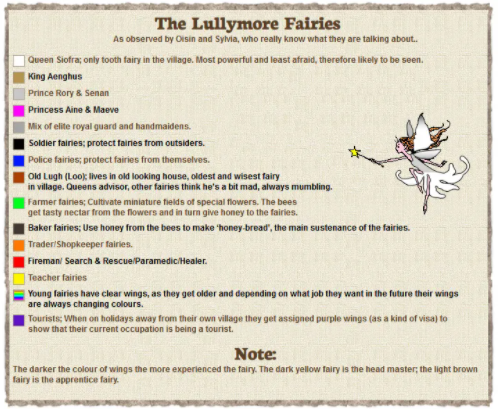
Types of fairies you can “spot” at the Lullymore Park in Ireland:

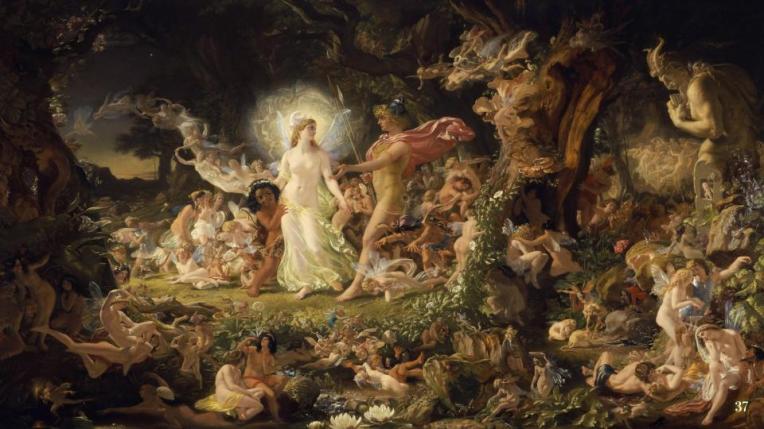
The old stories tell that Fairies are magical creatures who live in hollow places in the earth. Some are benevolent and help give rain and pleasant weather to the Earth, Like the king and Queen of the fairies, Oberon and Titania:

And the mazed world,
By their [the tides] increase, now knows not which is which:
And this same progeny of evils comes
From our debate, from our dissension;
We are their parents and original.

— Titania, (Queen of the Faries), A Midsummer Night’s Dream Act II, Scene i.
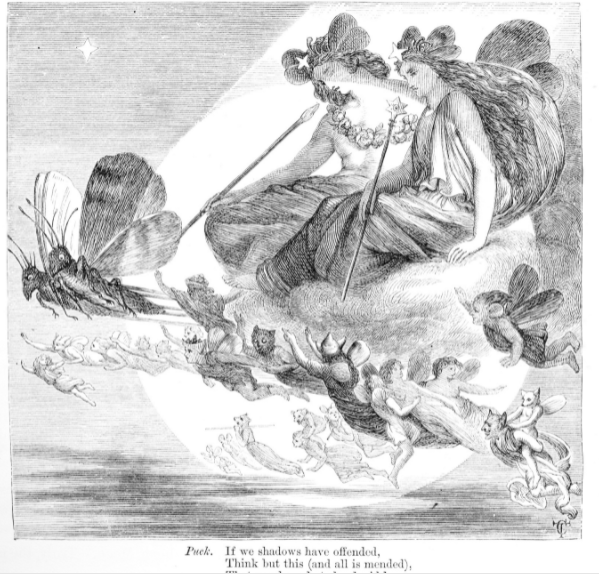
Titania in this speech shows great concern for nature, humanity, and the planet. She believes it is the responsibility of fairies, particularly herself and her husband Oberon, to control the elements and keep humans and fairies safe. Some fairies, however, are cruel and enjoy playing tricks on mortals, just like Puck in A Midsummer Night’s Dream, or Queen Mab in Romeo and Juliet.
.

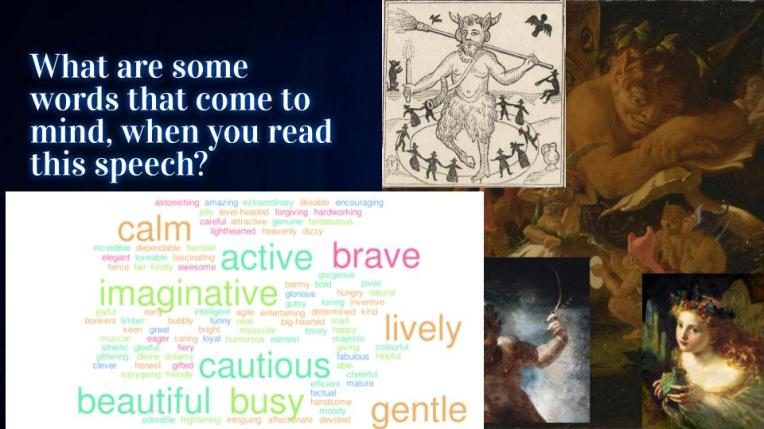
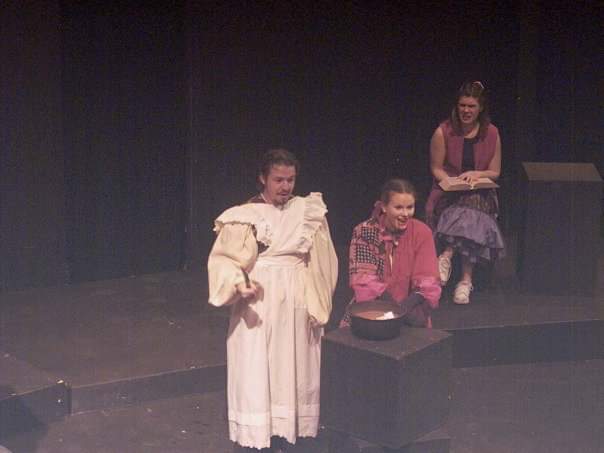
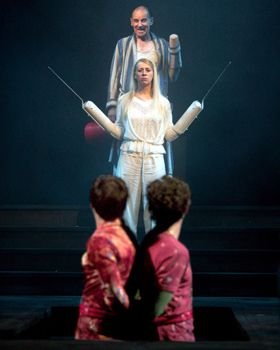
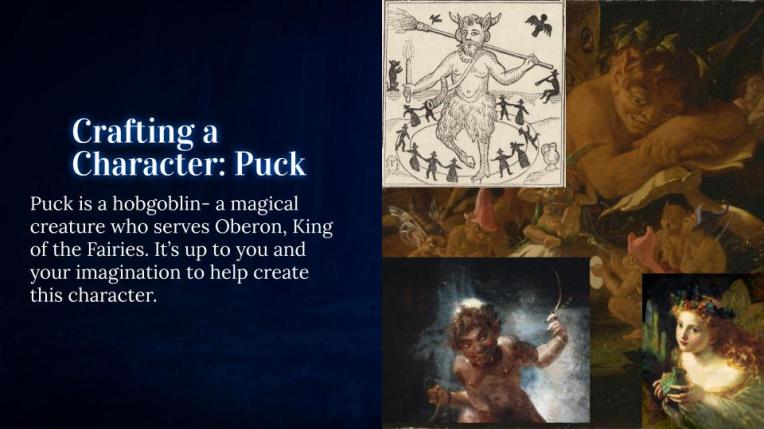
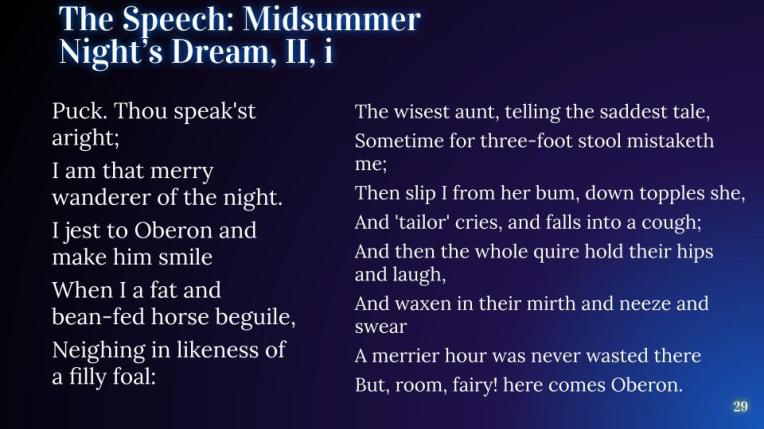
This is a short analysis I created of the tricks Puck plays on people in A Midsummer Night’s Dream, as part of my acting course on Ouschool.com. Note the different ways Puck is portrayed in photos as a satyr, a rotund elf, and sometimes as an almost- demon like figure.

Cringe-worthy Shakespeare: Shakespeare’s only Irish character, captain mcmorris in “Henry V”

When Shakespeare is racially insensitive towards people of color, the cringe-worthy writing is mercifully few and far between. With the exception of Aaron the Moor and Don Armada, there are only a few sporadic derogatory references to non-White Anglo-Saxon Protestants. Sadly though, Shakespeare might have permanently harmed the Irish through his character the Irish captain Macmorris in Henry the Fifth, his only Irish character.

According to The Irish Times, there is a longstanding stereotype that still exists in the British Isles that Irish people are violent, short-tempered, and essentially savages and Shakespeare might have invented this stereotype (or at least popularized it) when he wrote this scene from Henry the Fifth, Act III, Scene ii:

FLUELLEN
To the mines! tell you the duke, it is not so good
to come to the mines; for, look you, the mines is
not according to the disciplines of the war: the
concavities of it is not sufficient; for, look you,
the athversary, you may discuss unto the duke, look
you, is digt himself four yard under the
countermines: by Cheshu, I think a' will plough up
all, if there is not better directions.
GOWER
The Duke of Gloucester, to whom the order of the
siege is given, is altogether directed by an
Irishman, a very valiant gentleman, i' faith.
FLUELLEN
It is Captain Macmorris, is it not?
GOWER
I think it be.
FLUELLEN
By Cheshu, he is an ass, as in the world: I will
verify as much in his beard: be has no more
directions in the true disciplines of the wars, look
you, of the Roman disciplines, than is a puppy-dog.
Enter MACMORRIS and Captain JAMY
GOWER
Here a' comes; and the Scots captain, Captain Jamy, with him.
FLUELLEN
Captain Jamy is a marvellous falourous gentleman,
that is certain; and of great expedition and
knowledge in th' aunchient wars, upon my particular
knowledge of his directions: by Cheshu, he will
maintain his argument as well as any military man in
the world, in the disciplines of the pristine wars
of the Romans.
JAMY
I say gud-day, Captain Fluellen.
FLUELLEN
God-den to your worship, good Captain James.
GOWER
How now, Captain Macmorris! have you quit the
mines? have the pioneers given o'er?
MACMORRIS
By Chrish, la! tish ill done: the work ish give
over, the trompet sound the retreat. By my hand, I
swear, and my father's soul, the work ish ill done;
it ish give over: I would have blowed up the town, so
Chrish save me, la! in an hour: O, tish ill done,
tish ill done; by my hand, tish ill done!
FLUELLEN
Captain Macmorris, I beseech you now, will you
voutsafe me, look you, a few disputations with you,
as partly touching or concerning the disciplines of
the war, the Roman wars, in the way of argument,
look you, and friendly communication; partly to
satisfy my opinion, and partly for the satisfaction,
look you, of my mind, as touching the direction of
the military discipline; that is the point.
JAMY
It sall be vary gud, gud feith, gud captains bath:
and I sall quit you with gud leve, as I may pick
occasion; that sall I, marry.
MACMORRIS
It is no time to discourse, so Chrish save me: the
day is hot, and the weather, and the wars, and the
king, and the dukes: it is no time to discourse. The
town is beseeched, and the trumpet call us to the
breach; and we talk, and, be Chrish, do nothing:
'tis shame for us all: so God sa' me, 'tis shame to
stand still; it is shame, by my hand: and there is
throats to be cut, and works to be done; and there
ish nothing done, so Chrish sa' me, la!
JAMY
By the mess, ere theise eyes of mine take themselves
to slomber, ay'll de gud service, or ay'll lig i'
the grund for it; ay, or go to death; and ay'll pay
't as valourously as I may, that sall I suerly do,
that is the breff and the long. Marry, I wad full
fain hear some question 'tween you tway.
FLUELLEN
Captain Macmorris, I think, look you, under your
correction, there is not many of your nation--
MACMORRIS
Of my nation! What ish my nation? Ish a villain,
and a bastard, and a knave, and a rascal. What ish
my nation? Who talks of my nation?
FLUELLEN
Look you, if you take the matter otherwise than is
meant, Captain Macmorris, peradventure I shall think
you do not use me with that affability as in
discretion you ought to use me, look you: being as
good a man as yourself, both in the disciplines of
war, and in the derivation of my birth, and in
other particularities.
MACMORRIS
I do not know you so good a man as myself: so
Chrish save me, I will cut off your head.
GOWER
Gentlemen both, you will mistake each other.
JAMY
A! that's a foul fault.
A parley sounded
GOWER
The town sounds a parley.
FLUELLEN
Captain Macmorris, when there is more better
opportunity to be required, look you, I will be so
bold as to tell you I know the disciplines of war;
and there is an end.
Exeunt

Irish History and Shakespeare: The tempestous relationship between england and Ireland

The mayor and all his brethren in best sort,
Like to the senators of the antique Rome,
With the plebeians swarming at their heels,
Go forth and fetch their conquering Caesar in:
As, by a lower but loving likelihood,
Were now the general of our gracious empress,
As in good time he may, from Ireland coming,
Bringing rebellion broached on his sword,

Henry V, Act V Chorus

National Portrait Gallery painting of Robert Deveraux, 2nd Earl of Essex. Wikimedia Commons.
Robert Devereax, 2nd Earl of Essex (National Portrait Gallery)
Hugh, O’Neill, Earl of Tyronne

James Shapiro in his excellent book, A Year In The Life Of William Shakespeare, 1599, posits that contemporary affairs in Ireland might have inspired some of Shakespeare’s greatest plays in including Richard II, Henry V, and Julius Caesar. In 1594 the Earl of Tyrone began a rebellion in Ireland against the English, and in 1599, Queen Elizabeth dispatched the ambitious and chivalrous Earl of Essex to quell it. As you can see in the quote above, Shakespeare mentions Essex’s fight in his play of Henry V, which probably premiered at around the same time Essex was in Ireland.

The audience may have been watching Henry conquer France, but many would have been thinking about Elizabeth’s struggle to conquer Ireland.

BBC Radio 4 Extra – Shakespeare’s Restless World, Ireland: Failures in the Present – Transcript – Shakespeare’s Restless World – Programme 7

Though King Henry successfully conquered and united England and France, Essex failed spectacularly, and Elizabeth was deeply embarrassed by the whole scenario. She was also deeply alarmed by the popularity of Shakespeare’s tragedy Richard II, which shows onstage the deposing and killing of a king who had no children and failed to quell a rebellion in Ireland.

Elizabeth was worried about her subjects but she was also very worried about Essex overseas. Everyone, (including Shakespeare), remembered that 2,000 years ago, Julius Caesar went from him the Senate’s Consul General to dictator by amassing an army, then threatening to invade Rome under the pretense of helping to quell a foreign invasion. Caesar made his name by subjugating tribes in Gaul (modern-day France), and the Senate was worried that he would come home and use his army for a military coup. Look at the expressions on the faces of Cicero and Brutus when they see Caesar coming home in triumph in this scene from the HBO series Rome.

Elizabeth repeatedly attempted to curb Essex’s power while he was fighting in Ireland; she refused to give the Earl more troops for fear that he might be staging a potential coup. Her fears would later be proven right when in 1602, Essex attempted to head a rebellion and take the Crown for himself, but not before one of Essex’s friends commissioned Shakespeare’s company to portray the deposing and killing of King Richard II. Essex was trying to turn himself from a failed Henry V to a victorious Henry IV, and his queen into Richard II.

Left- deposition form the interrogation of Augustine Phillips, one of the actors in Shakespeare’s company about his company’s potential involvement with the Essex rebellion. Right- the hanging of Cinna the poet from Julius Caesar.

Shakespeare might have been inspired to write Julius Caesar after being an unwitting pawn in the political drama between Essex and the queen, and might have even created the character of Cinna the Poet as an analog for Shakespeare himself. In the play, Cinna the poet is mistaken for one of the conspirators by an angry mob and is murdered in the street. Perhaps Shakespeare created Cinna the Poet as a way of coping with the fear he must have had that people might mistake him for a radical, after his play Richard II briefly made him a walking target for those opposed to Essex’s rebellion. In any case, Julius Caesar eloquently documents the kind of anxiety of not knowing who could be trusted when it comes to politics, whether it be a populist warrior like Julius Caesar or Essex, or the Queen, privy council, or indeed Roman senate, and the whole thing started from a failed attempt to quell a rebellion in Ireland.

In summation, even though Shakespeare sets no plays in Ireland, Irish history and Irish culture are everywhere in his plays. England and Ireland are I are indeed separate islands but the cultural exchange between England and Ireland has inspired Shakespeare and many other great writers for centuries. After all Shakespeare’s most famous honorific, ‘the Bard of Avon’ comes from an ancient Irish tradition of semi-mystical poets, who in Irish folklore, were able to see the future and glimpse worlds that are unseen to ordinary mortals. What Shakespeare really felt about Ireland we don’t know but we do him but he does owe the Irish people a lot of thanks, and on this  Saint Patrick’s day, I honor their contribution to him and to him all the world

References:

Shapiro, James. A Year In the Life Of William Shakespeare, 1599. Chapter 6: Things Dying and Things Reborn.

https://www.bbc.co.uk/programmes/articles/3fLDRSY7r9rJhrVFWy99Mly/transcript-shakespeares-restless-world-programme-7

https://www.independent.ie/entertainment/theatre-arts/is-shakespeare-responsible-for-the-stage-irishman-34638347.html

https://www.irishtimes.com/culture/stage/what-ish-my-nation-shakespeare-s-irish-connections-1.2619173

How to Throw a Fairies Themed Midsummer Night Dream Party (Quarantine Safe Edition)

Happy Midsummer everyone! Wednesday June 24rth is the Midsummer festival, which means as you go to sleep that night, I wish you all Midsummer Night Dreams! Before that though, I welcome you to party like it’s the court of King Oberon, and here are some ideas:

Background: What Are Fairies?

The story of Fairies has many authors that come from multiple folkloric traditions. The Greeks had nymphs, the Romans had cupid, and the English and Germans had…


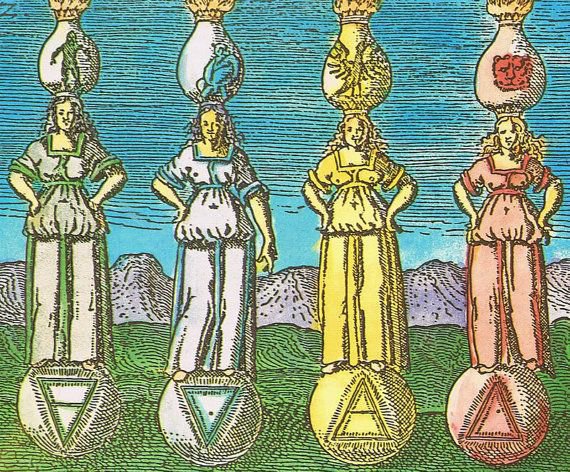
1.  According to Paracelsus, fairies are elemental spirits that help control the Earth’s four elements: Silfs (air), gnomes (Earth), Salamanders (fire), and  Undines (water).
2. In some versions, they are household creatures that interact with humans
3. Some cultures call them demoted Angels, not good enough for Heaven, but not bad enough for Hell.

So you can see there are lots of traditions that contribute to our modern concept of the fairy, and plenty of ideas to adapt into your party!

Part One: The Invitation:

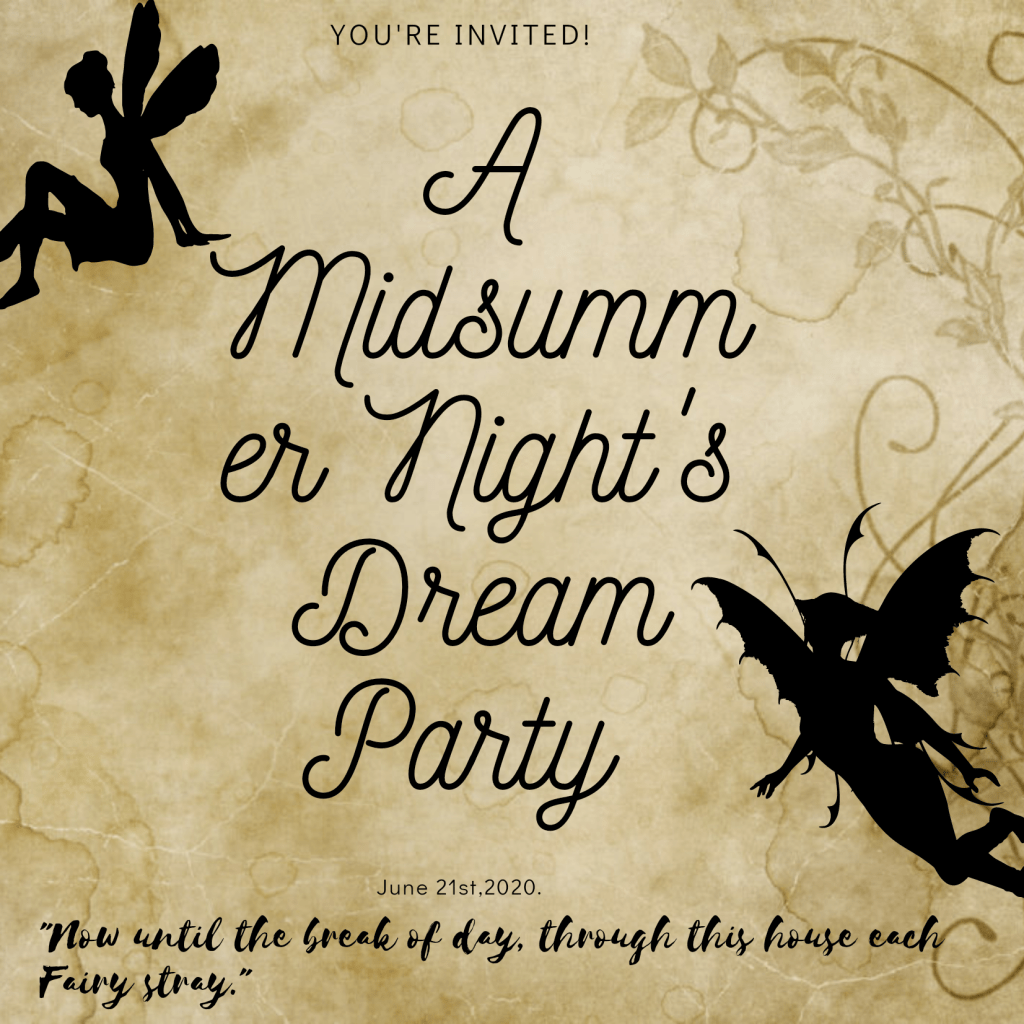
There’s a ton of free fairy clip art and fairy designs online. Below is an invitation I created for free with an app called Canva and a parchment background picture I found online.

1. Pixie invitations
2. Immortal Longings

Second card design I created on Canva.

You probably also know that I am a huge fan of the website Immortal Longings because of their excellent Shakespearean art and they sell cards too. You can buy the cards or download the pictures on their website.

Shakespearean Greeting Cards from Immortal Longings.com


Part Two: Decorations
Fairy

Fairy Dens Right now the Royal Shakespeare Company is making DIY Fairy decorations including a Fairy Den that you can share with your family and friends:

What is a Fairy Den? Fairies in folklore are closely tied to the Ancient Celts and Druids, who believed that Fairies live in hollow places underground. A fairy den is a homemade den that imitates the ancient fairy hollows.

Workshop on Fairy Dens and Fairy Lanterns: https://youtu.be/KC7CbPPIrjs

Fairy lights from IKEA

In addition to fairy dens, there are tons of fairy lights, fairy coloring books, and other fairy crafts you can find. Here is a fairy lantern my wife made using pickle jars!

First paint the jars with white paint and cut out paper fairies to paste around the inside of the jar (we used tackey glue). You can also stick star stickers on the inside of the jars.
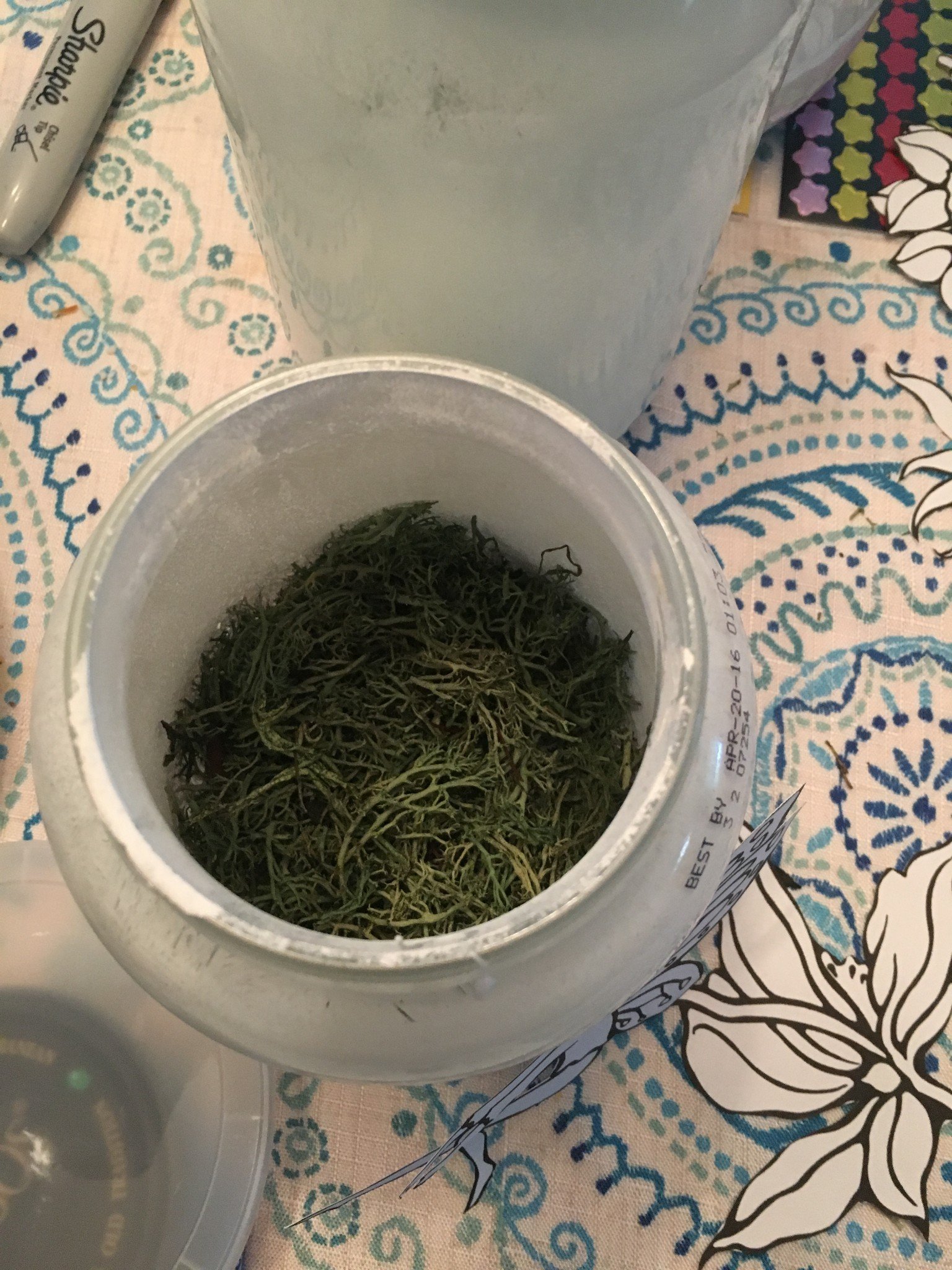
For added realism, you can glue fake moss to the bottom of the jar. We got this from our local dollar store.
Put a small battery powered LED light inside.
Turn on the LED lights and take the lanterns somewhere dark.
Detail of the fairy lights.


Part ThreeThe Feast

Since the Fairies in Midsummer are woodland spirits, almost any forest or camping themed recipes can be adapted. Here are some ideas that my wife and I made for our own fairy themed party.

Snail sandwiches

Hedgehog cheese ball.


Hedgehog cheese ball:

Fruit wands with yogurt dip


Dessert

Chocolate GardenCake from How to Cook That: https://youtu.be/JidhdxiSsnQ

Fairy bread: For those of you who don’t live in Australia or New Zealand, Fairy bread is white bread covered in

https://www.allrecipes.com/recipe/80934/fairy-bread/

Homemade Fairy bread


Music

  • Dance of the Sugarplum Fairies

Games

1.  Pin the tail on the Bottom.

2. Love potion: Similar to follow the leader or musical chairs. A group of people lie down and pretend to sleep. Then someone plays Puck by putting a real or pretend flower in one of the player’s hands. The Puck then yells “Awake,” and sets a timer or plays some music. The object of the game is for everyone to chase after the flower and get it before time runs out.

Costumes:

Make some printable donkey masks for Bottom, flower crowns for the fairies, and don’t forget your wings!

Well, that’s my advice, happy  Midsummer everyone!

Sources:
Tolkein, JRR. On Fairy Stories

Shakespeare On Epidemics

My purpose with this post is to provide some hope and comfort by showing how Shakespeare and other Elizabethans dealt with epidemics and survived. The thing to remember is, although we are dealing with a pandemic, we are still far better prepared for it than any time in history. Furthermore, I want to draw on lessons from the past to offer hope and wisdom for people going through an epidemic.

Side note: Shakespeare refers to several diseases in his plays including “The plague,” (Bubonic Plague), “The Pox,” (syphilis), “Dropsy,” (edema), and “Falling sickness,” (epilepsy). I will mainly focus on the plague because of its strong connection to both Shakespeare’s life and career, as well as the continuing anxiety it causes to this day. I am also focusing on the plague to try and make parallels with Covid 19, a disease that, while less lethal and harder to detect, is still a pandemic that like the plague has transformed much of daily life since its inception, and could continue to grow, abate, and revive if we as a society aren’t careful.


Shakespeare’s plays also frequently allude to plagues and plague imagery, especially his most famous play, Romeo and Juliet.

First of all plague is an important plot element; an outbreak of plague prevents Romeo from getting the message that Juliet is alive, so plague inadvertently kills them both.

Plague also serves as a motif for the destructive forces that lead to the play’s tragic conclusion. After Mercutio curses “A plague on both your houses,” his death sets the events in motion that kills most of the principal the characters, as if his curse somehow infected all of them with a deadly virus.

Immortal Longings Artwork for “Romeo and Juliet” by Elizabeth Schuh, used with permission.

https://www.slideshare.net/mobile/PaulHricik/the-universe-of-romeo-and-juliet-by-paul-hricik


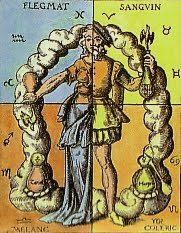
Shakespeare exploited a unique cultural knowledge of plagues to help his audience engage with Romeo and Juliet. If you click on the link to my presentation above, you’ll see that Elizabethans believed that four liquids called humors controlled health and behavior. A humorous man was someone who was out of ballance with the humours and thus was ridiculous for failing to control his emotions. The humor choler was associated with anger and in dangerous imbalances was thought to cause terrible fevers and even plague. Hence, when characters like Romeo and Tybalt get angry, his audience knew that one way or another, that anger will kill them.

Medieval illustration of the four humours. Top left to bottom right; Phlegm, Blood (Sanguine), Melancholy, (black bile), and choler (yellow bile).


Shakespeare also uses plague as a metaphor for the hate of the two families that infects and kills the young lovers, as well as Tybalt, Paris, and Mercutio.

The play was first published in 1595, two years after a plague outbreak so bad that the theaters were all closed, so Shakespeare’s audience had a visceral reaction to this plague imagery when they saw it in the theater, especially after a year of being quarantined away from the theaters because of that exact same disease!

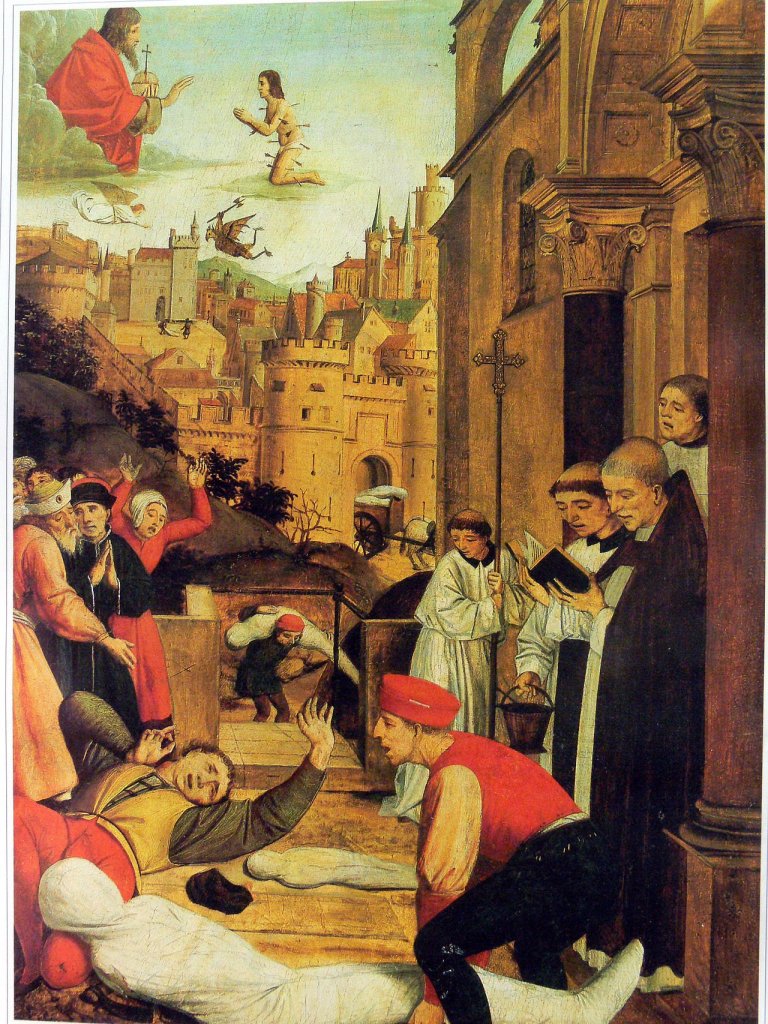
Saint Sebastian pleads with Jesus for the life of a gravedigger afflicted by plague during the Plague of Justinian. (Josse Lieferinxe, c. 1497–1499)

“Scourge and Minister”

Some of Shakespeare’s plays mention plague indirectly in relation to its perceived nature as a divine punishment. Since the very beginning of the plague,, writers, clergy, and many others perceived the plague as a divine punishment, designed to destroy the wicked, like the 10th plague in the Bible that decimated the enslaving Egyptians.

To “scourge oneself” is also a verb for whipping. In the 14th century, a group a people called the flaggelants, who voluntarily scourged themselves in the hope that God would end the disease as a result of their suffering.

Woodcut of flagellants (Nuremberg Chronicle, 1493).


Shakespeare uses both meanings of scourge in many of his plays. In Henry IV, the king is filled with remorse for usurping the throne from King Richard, and worries that his future progeny will become a scourge upon him:

I know not whether God will have it so,

For some displeasing service I have done,

That, in his secret doom, out of my blood

He’ll breed revengement and a scourge for me;

King Henry IV, Part I, Act III, Scene ii.

Sometimes a scourge is a person sent to destroy a sinful person or group of people. Shakespeare refers to the character of Richard III several times as a scourge upon the families who fought in the Wars Of The Roses.

In Shakespeare’s first cycle of four history plays, we see the families of York and Lancaster take turns usurping the throne, and committing numerous acts of murder, treason, and blasphemy. In the play that bears his name, Richard III kills the Yorkist royal family and then is murdered himself by Henry Tudor, systematically destroying the families of York and Lancaster. Thus, in Shakespeare’s propaganda version of history, he depicts Richard as a scourge who purges the throne of usurper and traitors, paving the way for the “virtuous,” Henry Tudor and his dynasty.

The ending shot of the BBC’s 1978 TV version of “Richard III.”

The Real Plague
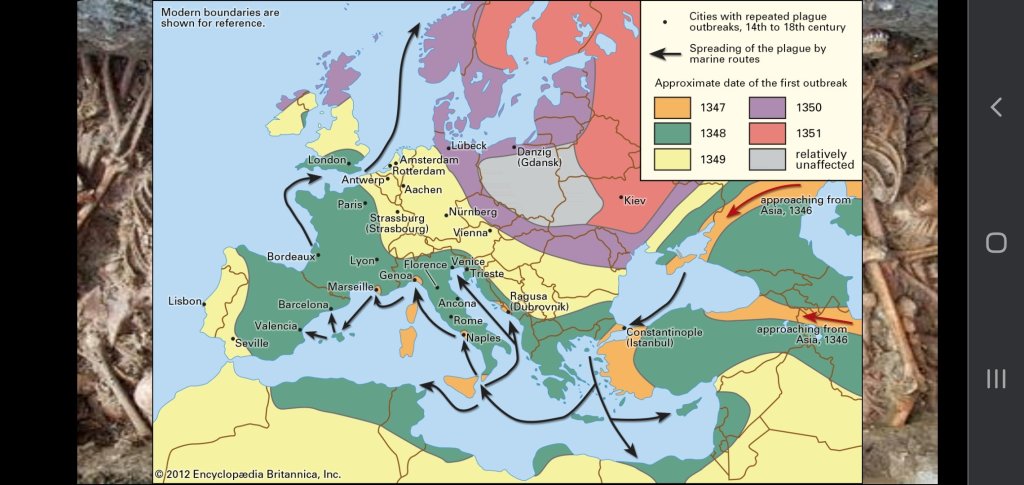
The black death, also known as Bubonic Plague, was first documented in 1347. Like Covid 19 it was first discovered in China, though it might not have originated there. Some historians argue that the Huns might have carried the plague into China and trade routes from the East carried it into Europe. By 1349 it reached England.


Everyone knew what to look for from those infected with the plague: first came fevers and chills. The next stage was the appearance of small red boils on the neck, in the armpit or groin. These lumps, were called buboes, (hence the term Bubonic Plague)

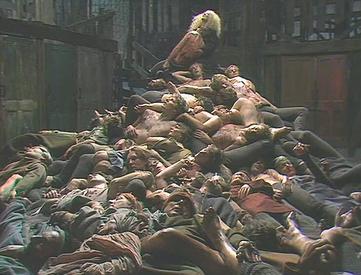
The buboes grew larger and darker in colour as the disease grew worse. From there the victim would begin to spit blood, which also contaminated with plague germs, making anyone able to spread the disease by coughing. The final stage of the illness was small, red spots on the stomach and other parts of the body caused by internal bleeding, and finally death.

We see death coming into our midst like black smoke, a plague which cuts off the young, a rootless phantom which has no mercy or fair countenance. Woe is me for the shilling in the armpit. . . It is an ugly eruption that comes with unseemly haste. It is a grievous ornament that breaks out in a rash. The early ornaments of black death.-Jevan Gethin, poet who died from plague in 1349.

Detail from The Temptation of St Anthony, 1512. Note the swollen buboes on the stomach, arms, and legs.

John Flynn, an Irish Friar described the plague in apocalyptic terms, writing a journal for posterity, but expressed doubt that ” Any of the race of Adam would even survive.” With the horrifying spread of the epidemic, it is not hard to understand why Flynn felt that way: In 1348, there were 100,000 people living in London, but after the plague spread, the city lost 300 people every day!

https://www.google.com/amp/s/www.history.com/.amp/news/quarantine-black-death-medievalContainment/ “treatments”Plague carts like in Monty Python (Dreary) carried plague bodies out of the city and burned them.
• In France, bodies were thrown in rivers (Deary)

  • Quarentines: The word quarantine is Italian for 40 days. It refers to the Venetian practice of taking suspected plague victims to an island for 40 days before allowing them to enter Venice or other populated areas. The rationale was that in the Bible, the number 40 occurs many times when a person or group of people require some form of purification; the 40 days of flooding in Genesis, the 40 years that the Jews journey to the promised land, and the 40 days of fasting Christ endured before he began his ministry to name a few examples. Bubonic plague has an incubation period of less than 40 days so the quarantine actually worked- people would go to the island, then the disease would run its course and not spread out as long as it was contained. The problem was that these quarantines were also essentially leper colonies and without treatment, the infected were basically sent to die.

Social distancing in Elizabethan England

By 1564, the year Shakespeare was born, there had been several outbreaks, but also a system designated to contain the disease. The rich went to the country. Plague bodies were burned. Theaters were closed to keep the disease from spreading. There were also body inspectors, (similar to coroner’s or death investigators today,) who inspected the bodies to look for the cause, then burned them and the clothes. Funerals for plague victims were held at night, to discourage crowds from attending, similar to our own practice of encouraging people to shop and go outside during non-peak hours.

Treating” it: The biggest comfort I can give here is to remind people that although like the plague, we are dealing with a disease with no known cure, we still have a much better understanding of how to treat viruses than our Elizabethan forebears. Some of the “cures,” from Shakespeare’s day are downright silly, when they aren’t expensive, dangerous, and above all, ineffective.

Real plague “cures”
• Kill cats and dogs
• A poultice made of Marigold flowers and eggs
• Arsenic powder (which is highly toxic)
• Crushed emerald powder.
• Pluck a chicken and place its rear end on the patient’s buboes, known as the Vicary Method.

To bring the aftermath of the plague into a modern context, I’d like to allude to some comments from the news. Recently a few Republicans have alluded that the cost of people staying home from work would cause irreparable harm to the American economy, and alluded to the notion that a few deaths might actually benefit the economy as a whole, including Texas Lieutenant Governor Dan Patrick and Republican pundit Glenn Beck.
Now at first glance these comments are gruesome and heartless, but they have a veneer of historical precedent: some people did prosper because of the black death. Laborers could charge more from their landlords simply because most of them had died, and some younger men managed to skirt the laws of primogeniture and inherit their families’ wealth because of the death of their oldest siblings. Shakespeare himself was the third child of Mary and John Shakespeare, but his elder siblings both perished due to plague. Again, to be fair to these Republicans, there is a historical facet to their arguments, however this is a very narrow and very incomplete version of history.


https://youtu.be/QNo-r20wqqg
Looking forward from the first century after the Black Death, the loss of life and resources was devastating for the workforce and caused a series of catastrophes for centuries to come. Though some peasants benefited from the lack of serfs, the depleted workforce meant work became harder and more expensive, and the coming centuries were plagued again by revolts, wars, and famine.

Wat Tyler, leader of the Peasants Revolt, rides out to negotiate with King Richard’s army.

Just 30 years after the first outbreak of plague in England, the peasants rose in revolt against their lords for the first time in 300 years, in no small part, due to the hardships caused by the plague.

Portrait of King Richard the Second

The king who punished the peasants was Richard Richard the Second, whom Shakespeare famously dramatized as an arrogant, egomaniacal, incompetent man-child who was eventually deposed and executed in the Tower of London. I think certain people who are tempted to “make sacrifices,” to protect the American economy would do well to look at this historical tragedy and avoid the political consequences of this kind of thinking.

In conclusion, though we are dealing with a frightening pandemic that we currently don’t know how to treat, we can take comfort from the fact that our forebears faced far worse diseases and survived. History has shown that social distancing works and that basic sanitation and the tireless work of healers and scientists can slow a disease, cause it to ebb, and eventually irradicate it. But until science discovers a treatment for Covid-19, it is up to all of us to flatten the curve for the sake of our country, world, and our future.

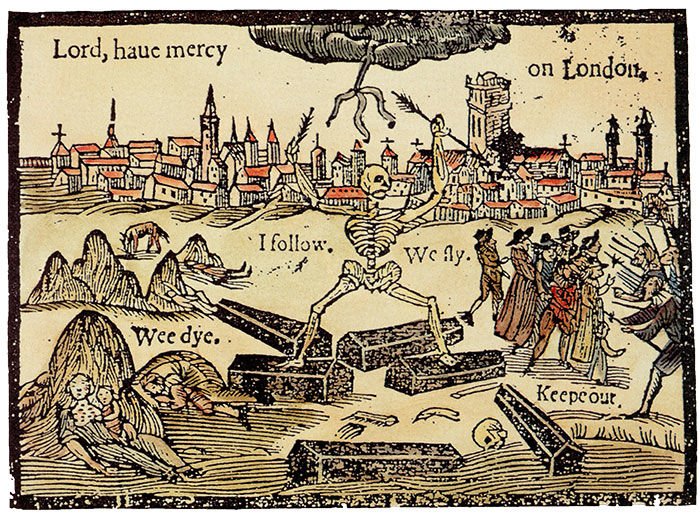
Plague woodcut. Note the wealthy people on the right who fled the plague, and the poor families dying on the left.

Like I have said, the working poor as a whole, suffered greatly because of the plague, especially since they were denied the means to avoid it. They lived in tightly packed, unsanitary environments and were unable to leave them without their lord’s permission, whereas we have a choice. This why it is crucial that we all do our part by staying away from crowds, observing proper hygiene, and offering support to our healthcare workers who are on the front lines of this war against coronavirus, and for whom we all pray for to stay healthy in turn.

Continue reading

Crafting a Character: Brutus

Happy Ides of March every one. I hope you have enjoyed all the posts for my Roman week. If I have time, I will try to post a few more, since I have not touched on Cymbaline or Titus Andronicus.This will not be an in depth character analysis. I won’t go into every scene and speech of Brutus’. My goal is to look at the history and the actions of Brutus in the play to show why he is such an amazing and ambigous character.

Marcus Brutus was born in 85 BC. Shakespeare’s source for the play, Plutarch’s lives of the Noble Greeks and Romans, mentions that his desire to kill Caesar might have been tied to his family: Brutus’ ancestor was Lucius Junius Brutus, the man who drove out the last king of Rome, and first consul. Below is the famous painting of Lucius foiling a plot to restore the monarchy, but to do so, he had to sentence his own sons to death:

Jaques Louis David, The Lictors Bring to Brutus the Bodies of His Sons, 1789.

https://www.khanacademy.org/humanities/monarchy-enlightenment/neo-classicism/v/david-the-lictors-returning-to-brutus-the-bodies-of-his-sons-1789

This was how seriously the Brutus family took defending the Roman Republic, they valued it even beyond their own family.

Brutus’ mother was Servilia, half sister of Caesar’s longtime critic, the senator Cato. He even married Cato’s daughter Portia! So you can see that once Caesar starts acting like a king, Brutus must have felt a tremendous amount of pressure from his Family to stay true to his Republican ideology. On the other hand, Servillia was actually Caesar’s mistress and Brutus owed his life to Caesar. After Brutus fought against Casesar, they reconciled after the Battle of Pharsalus in 48 BC:

Most of those who were taken alive Caesar incorporated in his legions, and to many men of prominence he granted immunity. One of these was Brutus, who afterwards slew him. Caesar was distressed, we are told, when Brutus was not to be found, but when he was brought into his presence safe and sound, was pleased beyond measure- Plutarch, retrieved from: http://penelope.uchicago.edu/Thayer/E/Roman/Texts/Plutarch/Lives/Caesar*.html

Despite his close ties to Caesar, Brutus chose to betray and assassinate him, so the question remains, why?

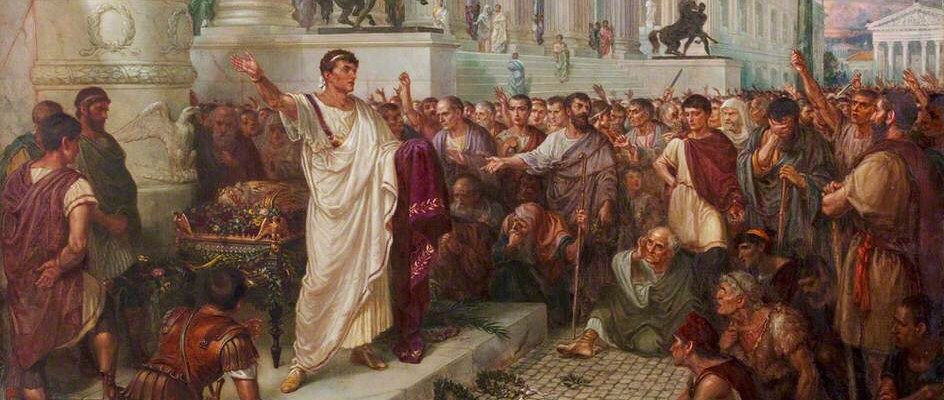
In the play and in Plutarch, Brutus is persuaded by Cassius Longinus, his brother in law and colleague in the Roman Senate. As you remember from my post on “Friends, Romans, Countrymen,” there are three basic kinds of persuasive speech, and Cassius uses all three:

1. Ethos “If you do know that I do fawn on men, and hold them hard, and after scandal them… then hold me dangerous.”

2. Logos- Cassius points out a series of embarrassing stories about Caesar that set up the following argument:

• Caesar is weak and frail

• Gods cannot be frail

• Why is Caesar treated like a god?

3. Pathos

• The people

• Fear of tyranny

• Brutus’ family honor- this is the real knife that kills any doubt Brutus had. Cassius reminds Brutus of his ancestor Lucius and how he would rather die than see a king in Rome again.

The soliloquy

Brutus. It must be by his death: and for my part,
I know no personal cause to spurn at him,

But for the general. He would be crown’d:
How that might change his nature, there’s the question.
It is the bright day that brings forth the adder;
And that craves wary walking. Crown him?—that;—
And then, I grant, we put a sting in him,
That at his will he may do danger with.
The abuse of greatness is, when it disjoins
Remorse from power: and, to speak truth of Caesar,
I have not known when his affections sway’d
More than his reason. But ’tis a common proof,
That lowliness is young ambition’s ladder,
Whereto the climber-upward turns his face;
But when he once attains the upmost round.
He then unto the ladder turns his back,
Looks in the clouds, scorning the base degrees
By which he did ascend. So Caesar may.
Then, lest he may, prevent. And, since the quarrel
Will bear no colour for the thing he is,
Fashion it thus; that what he is, augmented,
Would run to these and these extremities:
And therefore think him as a serpent’s egg
Which, hatch’d, would, as his kind, grow mischievous,
And kill him in the shell.

• This speech is a direct predecessor for “To be or not to be,” and Macbeth’s “If it were done,” soliloquy. https://youtu.be/IoDwXjKIenI

  • All three speakers are talking about murder and can’t bring themselves to say either the word murder, nor mention the name of the man who will die.

• All references to murder are in passive voice, as if Brutus wishes a lightning bolt would kill Caesar, so he doesn’t have to accept the responsibility of killing.

•Compared to Hamlet and Macbeth, Brutus’ text is flat, The speech depends on the actor to show the torment in his soul.

  • One question that the actor must answer for himself is, is Brutus really concerned for the well being of Rome, or does he want Caesar dead for another reason?

After the soliloquy, Brutus throws himself into the role of head conspirator: https://youtu.be/ibzqdoV-BcU https://youtu.be/ibzqdoV-BcU

You can see in this video that Brutus speaks eloquently about how just the cause is and how only Caesar will die. This illustrates that Brutus is well spoken but not pragmatic. As we all know, Marc Anthony eventually gets the crowd to turn on Brutus and will become part of the army that hunts him and Cassius down. The dramatic irony is what helps the argument that Brutus is the real tragic hero of this play.

The murder and its aftermath

The rest as they say, is history. On March 15th, 44 BC, Brutus and the conspirators stabbed Caesar 17 times. In the play, before Caesar dies, he utters the famous line, “Et tu, Brute? Then fall Caesar!”

The line stands out because it is the only time anyone in this Roman play speaks in Latin. Now, I have heard a compelling argument from Professor J. Rufus Fears, that this might actually be a misquote, and what Caesar really said will amaze you. As I have mentioned, Brutus’ mother was Caesar’s mistress and the two of them were very close. At the time of Caesar’s death he was 40, while Caesar was 16 years his senior. Why did Caesar forgive Brutus fighing against him? Is it not possible that what he actually said was: “Et tu, son?” That’s a question for directors and actors, but it does heighten Brutus’ emotional conflic. Much like his ancestor Lucius, Marcus Brutus is caught between his ideals and his family.

During the funeral, Brutus has a very well crafted speech where he lays out his reasons for killing Caesar. He sets himself up as the friend of Rome. This video from the Royal Shakespeare Company explores the techniques that Brutus uses to get the crowd on his side: https://youtu.be/nyPlvuv8SSk

After Antony makes his speech however, the mob burns Brutus’ house and even slaughters a man just because he shares a name with one of the conspirators. Brutus and Cassius take their armies and flee Rome, and prepare to take on Antony and Octavian. The adversity Cassius and Brutus go through pushes them together and they behave like brothers; they fight and reconcile constantly: https://youtu.be/K9EAxjVC22M

In a way, these men are two sides of the same coin: Cassius is fiery but pragmatic while Brutus is stoic and idealistic. It’s like a tragedy in and of itself that these men weren’t melded into one man with Brutus’ heart and Cassius’ mind.

Is Brutus A Traitor?

Unlike Macbeth, Shakespeare’s text leaves it ambiguous as to whether Brutus was right or wrong to kill Caesar. Even Antony, who leads an army against him, ends the play by calling Brutus “The noblest Roman of them all.” Shakespeare also gives us few clues to Brutus’ motivations other than the speech I quoted earlier. Mainly we have to go on Brutus’ actions and their consequences.

One moment that I think perfectly encapsulates the ambiguity of Brutus’ actions is the moment where he’s visited by Caesar’s ghost. In other tragedies like Macbeth and Richard III, the villain is tormented by the ghost or ghosts of people he murdered. The ghost serves as a manifestation of the murderer’s guilty conscience and torments him before his death. When Brutus sees Caesar, he does not follow this trope. He isn’t horrified, not struck by guilt, in fact, he wishes that the ghost would stay longer.

Julius Caesar by William Shakespeare

Julius Caesar book cover

MENU

In Act 4, why does Caesar’s ghost appear? I don’t understand why Caesar’s ghost shows up. I dont understand the significance of that scene.

Expert Answers info

JUANAMAC

eNotes educator

| CERTIFIED EDUCATOR

Shakespeare, as other Elizabethan writers, uses the idea of ghosts in his plays usually as a foreshadowing of events to come. In “Hamlet,” Hamlet has to deal with working out what to do with his father’s request for revenge, and also, whether the ghost is indeed his father. In “Macbeth“, Macbeth has to deal with the Ghost of Banquo showing up to dinner, literally haunting him. In “Richard III“, Richard deals with the ghosts of the men he has wronged right at the start of the play.

This haunting is significant also in “Julius Caesar“. The Ghost of Julius arrives on the eve of battle to literally haunt Brutus. Brutus had hoped that by killing Caesar he would enact change in Rome, however, the Roman Empire goes on, as does the reign of Caesar (albeit, a new Caesar).

As Brutus goes into battle, and the battle doesn’t go his way, he again turns to Julius Caesar, blaming him for the outcome of the battle,

O Julius Caesar, thou art mighty yet!
Thy spirit walks abroad, and turns our swords
In our own proper entrails. (5.3.94–96)

Shakespeare’s ghosts are visible to one person (as well as the audience, clearly) so those who react to the ghost are the ones who are supposed to learn from the arrival of the ghost, heeding the message from beyond the grave.

Enter the Ghost of CAESAR

How ill this taper burns! Ha! who comes here?
I think it is the weakness of mine eyes
That shapes this monstrous apparition.
It comes upon me. Art thou any thing?
Art thou some god, some angel, or some devil,
That makest my blood cold and my hair to stare?
Speak to me what thou art.

GHOST

Thy evil spirit, Brutus.

BRUTUS

Why comest thou?

GHOST

To tell thee thou shalt see me at Philippi.

BRUTUS

Well; then I shall see thee again?

GHOST

Ay, at Philippi.

BRUTUS

Why, I will see thee at Philippi, then.

Exit Ghost

Now I have taken heart thou vanishest.
Ill spirit, I would hold more talk with thee.

The ghost itself also resists the clearcut definition as a sign of a guilty conscience. It doesn’t accuse Brutus of murder, it doesn’t curse in fact, all the ghost says is that Brutus will see him at Philippi. Unlike Richard III or Macbeth, the ghost utters no curses or scare Brutus out of his mind.

The only conclusion that Brutus gleans is that his end is near. According to Dr. John Langdon, many Elizabethan ghosts serve as a shorthand to indicate that the play’s denouement is on its way. Brutus seems aware of this as well- he knows that if he sees a ghost, he’s likely to be one soon. Yet the reality of his impending death doesnt change Brutus; he doesn’t express remorse like Richard III or hopelessness like Macbeth, if anything his stocism and seeming world weariness makes him seem more like a hero like Hamlet during his “Not a whit, we defy augery,” speech. This passive embrace of fate is at the core Brutus and it illustrates how hard it is to truly decide if he is a villain or a hero.

Though Shakespeare wrote the character of Brutus as ambiguous, over the centuries many artists and cultures have passed judgment on Brutus. Dante in his book Inferno example places Brutus and Cassius in the lowest circle of Hell, who along with Judas Iscariot, are being forever devoured by Satan himself, imagined below in a medieval illustration as a three-headed beast. You can see the name Brut in the head on the right.

By contrast, during the French Revolution, many statesmen referred to Brutus as a hero for his noble attempt to destroy a corrupt monarchy.

One day men will be astonished by the fact that humanity in the eighteenth century was less advanced than in the time of Caesar. Then a tyrant was slain in the midst of the Senate with no formalities but thirty blows of a dagger and with no other law save the liberty of Rome Louis Antoine de Saint-Just, November 13th, 1792, (2 months before the execution of Louis XVI).

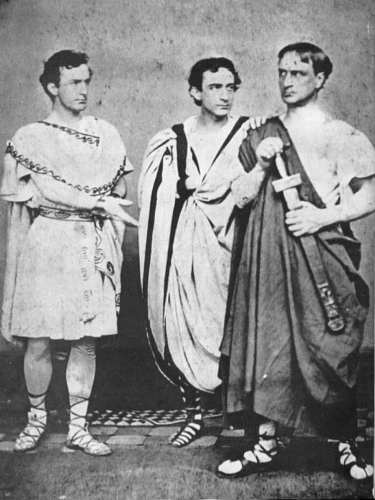
As I have written before, in the 20th and 21st centuries, America has a somewhat more complex relationship with the character of Brutus. On the one hand, America was founded on the principle of resisting tyranny; it’s even on the state flag of Virginia, which is why some early productions of the play make Brutus a hero. On the other hand, as you see above, rebels and traitors like John Wilkes Booth have also taken inspiration from Brutus. His father and brother’s middle name was Brutus and all three brothers performed in the play one year before John turned theater performance into American tragedy.

Like Brutus, Booth seemed amazed with the world’s reaction to his deed, for after he assassinated the president, he wrote this in his journal:

[W]ith every man’s hand against me, I am here in despair. And why; For doing what Brutus was honored for … And yet I for striking down a greater tyrant than they ever knew am looked upon as a common cutthroat.”

John Wilkes Booth, April 21, 1865.

The most recent controversy over Brutus’ actions is the 2017 Shakespeare in the Park production of Caesar directed by Oscar Eustis. As I wrote before, when portraying Caesar as an American president, it tends to anger the political party of his supporters, but the play shows how unplanned political violence can destabilize a country. In these productions, Brutus seems a bit of a well meaning dupe or an naive patsy acting out of fear. On the other hand in cultures that have suffered many violent uprisings, Brutus is a figure that is all to common in places like Uganda, Iran, and the Taliban controlled world: https://youtu.be/5HU8SA33j2w

Brutus is a great character because Shakespeare keeps enough of his motives in the dark to allow for new interpretations, but also showing a man with relatable desires and fears get swept up in a dangerous and unpredictable time.

Teaching Titus through creepy cooking

Titus Andronicus is one of the most bloody, disgusting plays in Shakespeare. As this infographic from the Royal Shakespeare Company shows, there are tons of deaths and some of them are even the result of cannibalism!

One way to capture the macabre nature of this play in the classroom, (which some scholars see as a horror comedy), is to characterize it through cooking, after all, revenge is a dish best served cold.

Me in costume as Titus Androgynous, a crazy cooking show host who butchers two people in the same manner as Titus

So here are some ghoulish gourmet dishes and revolting recipes that you can share with your students to help them get into this tragic tale of violence, revenge, and cooking:

Idea 1: recipe cards

Design a recipe card like the ones in cooking magazines based on Titus speech where he murders Chiron and Demetrius

Idea 2: Create a menu that summarizes the play:

Act I:

Starter: Caesar Salad, toad in the hole

As the play begins, Caesar has died and Saturnine wants to devour his father’s empire. Enjoy this light salad in anticipation of far more bloody feasts to come.https://youtu.be/UxZ5NOkRwj0

Act II Scene 3: Breakfast:

Lamb Benedict

Lamb Benedict recipe I found on Reddit

While on an early morning hunting trip, Bassianus is slaughtered like a lamb by his own nephews. Enjoy this sweet treachery with a golden egg in the hole.

Act II, Scene 4: Main course:

Roast venison with all the trimmings

“As the deer that hath some unrecuring wound.”

“She was washed and cut and trimmed.”

Titus compares his daughter to a deer or welkin, and in the play’s most barbaric scene, the emperor’s sons ravish her and cut out her tongue. They enjoy the cruel rape and mutilation just like two starving lions enjoying their prey.

Act V:

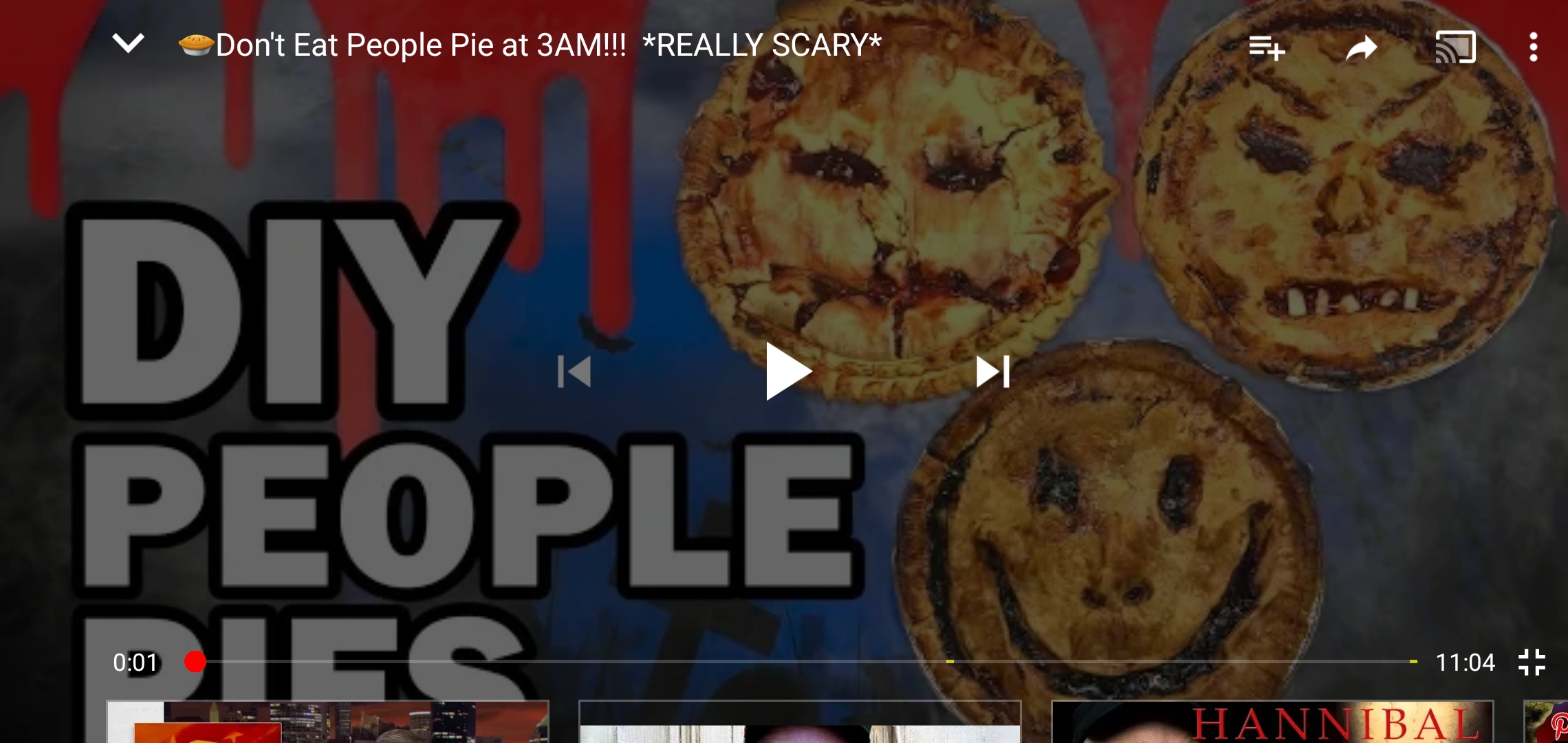
Just desserts: people pot pie.

“More stern and bloody than the centaur’s feast,” A truly unforgettable dessert for this feast of carnage. The cook, Titus, reinvents the term rich food by cooking two emperor’s sons into pies.

Served cold, like revenge!

“Set him breast deep in Earth and famish him.”

Idea 3: Real Titus foods inspired by my favorite Halloween diy recipes

1. Lavinia’s tongue and hands

• horrific Halloween punch with ice cold hand cubes: https://youtu.be/XLYwcX7Ud-E

• Bloody lady fingers https://pin.it/xbnfxcs4bxbhsq

2. Titus hand: Hot dog fingers for Titus’ hand.

https://pin.it/ofn6cotybnvn4n

Or this grisly appetizer: cheese hand in prosciutto

3.

People Pies:

There are many horrific pie recipes on the internet, but for a busy teacher on a budget, I’m adapting this one from the YouTube channel Threadbanger: https://youtu.be/E6U6xUl3A5M. Don’t show this video to your students because there’s far too much cursing. That said this recipe is very cheap and it’s easy. He used only store bought items and no fancy cooking techniques, which means if you choose to bake it as a classroom activity, even your students can help make it. Here are some tips from the video to get the most horrible ppeople pie you can make:

• Use red filling like cherry or strawberry for filling.

• Use excess dough for a nose.

• Cut out little pieces of apple to make teeth

• Cut holes for the eyes and mouth

• The bloodier, the better!

Bone appetit!

Close Reading: Friends, Romans, Countrymen

Today I’m going to do an analysis of one of the most famous speeches in all of Shakespeare: Antony’s Funeral Speech in Act III, Scene ii of Julius Caesar, commonly known as the “Friends, Romans, Countrymen” speech.

I. Given Circumstances

Antony is already in a very precarious position. His best friend Julius Caesar was murdered by the senators of Rome. Antony wants vengeance, but he can’t do so by himself. He’s also surrounded by a mob, and Brutus just got them on his side with a very convincing speech. They already hate Antony and Caesar. His goal- win them back. Here is a clip of Brutus (James Mason) speaking to the crowd from the Joseph Mankewitz movie version of Julius Caesar:

So the stakes are very high for Antony: If he succeeds, the crowd will avenge Caesar, and Antony will take control of Rome. If he fails, he will be lynched by an angry mob.

II. Textual Clues

If you notice in the text of the speech below, Antony never overtly says: “Brutus was a liar and a traitor, and Caesar must be avenged,” but that is exactly what he gets the crowd to do. So how does he get them to do so, right after Brutus got them on his side?

Antony. You gentle Romans,— 1615

Citizens. Peace, ho! let us hear him.

Antony. Friends, Romans, countrymen, lend me your ears;

I come to bury Caesar, not to praise him.

The evil that men do lives after them;

The good is oft interred with their bones; 1620

So let it be with Caesar. The noble Brutus

Hath told you Caesar was ambitious:

If it were so, it was a grievous fault,

And grievously hath Caesar answer’d it.

Here, under leave of Brutus and the rest— 1625

For Brutus is an honourable man;

So are they all, all honourable men—

Come I to speak in Caesar’s funeral.

He was my friend, faithful and just to me:

But Brutus says he was ambitious; 1630

And Brutus is an honourable man.

He hath brought many captives home to Rome

Whose ransoms did the general coffers fill:

Did this in Caesar seem ambitious?

When that the poor have cried, Caesar hath wept: 1635

Ambition should be made of sterner stuff:

Yet Brutus says he was ambitious;

And Brutus is an honourable man.

You all did see that on the Lupercal

I thrice presented him a kingly crown, 1640

Which he did thrice refuse: was this ambition?

Yet Brutus says he was ambitious;

And, sure, he is an honourable man.

I speak not to disprove what Brutus spoke,

But here I am to speak what I do know. 1645

You all did love him once, not without cause:

What cause withholds you then, to mourn for him?

O judgment! thou art fled to brutish beasts,

And men have lost their reason. Bear with me;

My heart is in the coffin there with Caesar, 1650

And I must pause till it come back to me.

First Citizen. Methinks there is much reason in his sayings. Julius Caesar Act III, Scene ii.

The two main methods Shakespeare uses to infuse Antony’s speech with powerful persuasive energy are the way he writes the verse, and his command of rhetoric.

A. Verse

The greatest gift Shakespeare ever gave his actors was to write his plays in blank verse. It not only tells you which words are important to stress, it gives you clues about the character’s emotional journey; just as a person’s heartbeat can indicate their changes in mood, a subtle change in verse often betrays the character’s pulse and state of mind. Antony uses his own emotions and his powers of persuasion to manipulate the crowd, so his verse helps show how he changes the pulse of the Roman mob.

I could write a whole post on the verse in this page, which I don’t need to do, since The Shakespeare Resource Center did it for me: http://www.bardweb.net/content/readings/caesar/lines.html What I will do is draw attention to some major changes in the verse and put my own interpretations on how Antony is using the verse to persuade the crowd:

  1. The first line of the speech grabs your attention. It is not a standard iambic pentameter line, which makes it rhythmically more interesting. In the movie version, Marlin Brando as Antony shouts each word to demand the crowd to just lend him their attention for a little while. He uses the verse to emphasize Antony’s frustration.
  2. “The Evil that men do, lives after them”- Notice that the words evil and men are in the stressed position. Antony might be making a subconscious attempt to say Brutus and the other evil men who took the life of Caesar are living, when they deserve to die.
  3. If it were so..” Again, Antony might be making a subtle jab at the conspirators. Brutus said Caesar was ambitious and Antony agrees that ambition is worthy of death, but he also adds an If, to plant the seeds of doubt in the crowd’s minds. To drive it home, the word if is in the stressed position, making it impossible for the crowd to not consider the possibility that Caesar wasn’t ambitious, and thus, didn’t deserve to be murdered.

B. Rhetoric

One reason why this speech is so famous is its clever use of rhetoric, the art of persuasive speaking. Back in ancient Rome, aristocrats like Antony were groomed since birth in the art of persuasive speech. Shakespeare himself studied rhetoric at school, so he knew how to write powerful persuasive speeches. Here’s a basic breakdown of the tactics Antony and Shakespeare use in the speech:

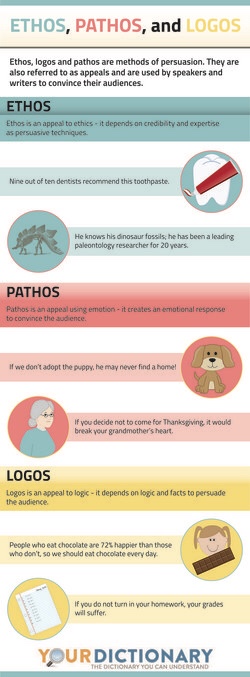
Ethos, Pathos, and Logos

The three basic ingredients of any persuasive speech are Ethos, Pathos, and Logos. Ethos is an appeal to the audience based on the speaker’s authority. Pathos is an appeal to the emotions of the crowd, and Logos is an appeal to facts and or reason. Both Brutus and Antony employ these three rhetorical tactics, but Antony doesn’t just appeal to his audience, he manipulates them to commit mutiny and mob rule.

Logos Antony has very few facts or logical information in his speech. His major argument is that again, since Caesar wasn’t ambitious, (which is very hard to prove), his death was a crime. Antony cites as proof the time Cæsar refused a crown at the Lupercal, but since that was a public performance, it’s hardly a reliable indication of Caesar’s true feelings.

You see logos as a rhetorical technique all the time whenever you watch a commercial citing leading medical studies, or a political debate where one person uses facts to justify his or her position. If you look at Hillary Clinton during the 2016 Presidental Debate, she frequently cited statistics to back up her political positions

Ethos-

Ethos is an argument based on the speaker’s authority. Brutus’ main tactic in his speech is to establish himself as Caesar’s friend and Rome’s. He says that he didn’t kill Caesar out of malice, but because he cared more about the people of Rome.

BRUTUS: If there be any in this assembly, any dear friend of Caesar’s, to him I say, that Brutus’ love to Caesar was no less than his. If then that friend demand why Brutus rose against Caesar, this is my answer:

–Not that I loved Caesar less, but that I loved Rome more. JC, III.ii.

Antony employs the exact same tactics, establishing himself as Caesar’s friend and telling the crowd that, as Caesar’s friend, Antony believes that Caesar did not deserve his murder. His use of Ethos therefore, helps Antony refute Brutus’ main claim.

Again, the 2016 debate is another excellent way of showing ethos in action. Hillary Clinton and Brutus frequently cited their political experience and their strength of character to justify their views. There’s an excellent article that examines Hillary’s use of Ethos in her political rhetoric: https://eidolon.pub/hillary-clintons-rhetorical-persona-9af06a3c4b03

Pathos

Pathos is the most frequently used rhetorical tactic: the appeal to emotion. Donald Trump uses this constantly, as you can see in this clip from the 2016 debate:

https://youtu.be/wMuyBOeSQVs

Pathos is bit more of a dirty trick than Ethos and Logos, which is why Brutus doesn’t use it much. As scholar Andy Gurr writes:

Brutus is a stern philosopher and thinker. His faith in reason fails to secure the crowd from Antony’s disingenuous appeal to their affections, which uses sharp sarcasm and some twisted facts.

Antony’s major appeals to emotion:

  • His grief over losing Caesar
  • His painting of Cæsar as a generous, faithful friend
  • Shaming the crowd for not mourning Caesar’s death
  • Appeal to piety by showing the body funeral reverence.
  • His use of Caesar’s bloody body and mantle to provoke outrage from the citizens.
  • His use of Caesar’s will to make the crowd grateful to Caesar, and furious at Brutus.

Rhetorical Devices

If Ethos, Pathos, and Logos are the strategies of rhetorical arguments, rhetorical devices are the artillery. If you check out the website Silva Rhetoricae, (The Forest Of Rhetoric), you can read about the hundreds of individual rhetorical devices that politicians have used in speeches and debates since ancient history. I will summarize here the main ones Antony uses over and over again in “Friends, Romans, Countrymen.” For another more compete analysis, click here: https://eavice.wordpress.com/2011/02/05/jv-rhetorical-devices-in-antonys-funerary-speech-from-shakespeares-julius-caesar/

  • Irony The way Antony keeps repeating “Brutus is an honorable man,” is a particularly sinister form of irony, which here means to imply the opposite of what you have said to mock or discredit your opponent. The irony is that the more Antony repeats this idea that Brutus is honorable, the more the crowd will question it. If Brutus were truly honorable, he would not need Antony to remind them. Of course, Brutus can still be honorable whether Anthony mentions it or not, but this repetition, coupled with Antony’s subtle rebuttals Of Brutus’ arguments, manages to shatter both Brutus’ motives, and his good name, at least in the eyes of his countrymen.
  • Antimetabole is the clever use of the same word in two different ways. Antony manages to work it in twice in this speech:
  • “If it were so, it was a grievous fault,
  • And grievously hath Caesar answer’d it.”
  • “You all did love him once, not without cause: What cause withholds you then, to mourn for him?”
  • Rhetorical question This is the most famous rhetorical device which by the way in Antony’s day would have been known as Erotema. Antony asks a series of questions designed to refute the notion that Caesar was ambitious, from his mercy to his captives, to Caesar’s tenderness to the poor, and of course his refusal to take the crown during the Lupercal. Each question calls Brutus’ claims into question and seeds doubt in the crowd.

Performance Notes with link to Globe performance

https://youtu.be/1RL8Wg-b8k

Unlike most Shakespearean plays, with Julius Caesar, we have an eyewitness account of how the play was originally performed. Swiss student Thomas Platter wrote a long description of watching the play at the original Globe Theatre in 1599. This is a translation that I found on The Shakespeare Blog:

On September 21st after lunch, about two o’clock, I and my party crossed the water, and there in the house with the thatched roof witnessed an excellent performance of the tragedy of the first Emperor Julius Caesar, with a cast of some fifteen people; when the play was over they danced very marvellously and gracefully together as is their wont, two dressed as men and two as women…

Thus daily at two in the afternoon, London has sometimes three plays running in different places, competing with each other, and those which play best obtain most spectators.

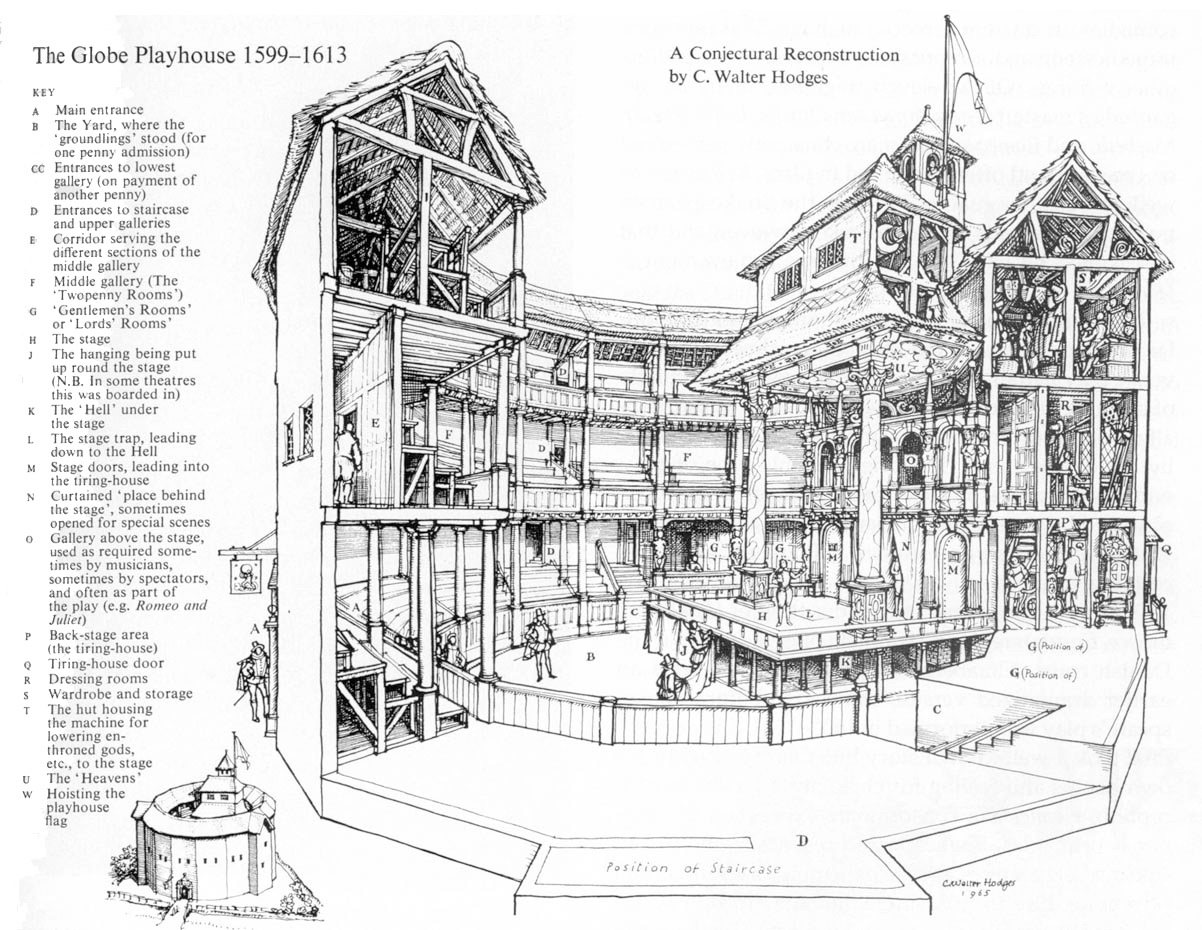
The playhouses are so constructed that they play on a raised platform, so that everyone has a good view. There are different galleries and places, however, where the seating is better and more comfortable and therefore more expensive. For whoever cares to stand below only pays one English penny, but if he wishes to sit he enters by another door, and pays another penny, while if he desires to sit in the most comfortable seats which are cushioned, where he not only sees everything well, but can also be seen, then he pays yet another English penny at another door. And during the performance food and drink are carried round the audience, so that for what one cares to pay one may also have refreshment.

The actors are most expensively costumed for it is the English usage for eminent Lords or Knights at their decease to bequeath and leave almost the best of their clothes to their serving men, which it is unseemly for the latter to wear, so that they offer them for sale for a small sum of money to the actors.

Thomas Platter, 1599, reprinted from: http://theshakespeareblog.com/2012/09/thomas-platters-visit-to-shakespeares-theatre/

So the conclusions we can draw based on Platter’s account include that Antony was standing on a mostly bare stage with a thatched roof, raised slightly off the ground. We can also guess that, since the merchants were selling beer, fruits, and ale, that the audience might have been drunk or throwing things at the actors.

As Platter notes, and this page from Shakespeare’s First Folio confirms, there were only 15 actors in the original cast, so Shakespeare’s company didn’t have a huge cast to play the gigantic crowd in the Roman street. In all probability, the audience is the mob, and Antony is talking right to them when he calls them “Friends, Romans, Countrymen.” I believe that the audience was probably encouraged to shout, chant, boo, cheer, and become a part of the performance which is important to emphasize when talking about how to portray this scene onstage. A director can choose whether or not to make the audience part of the action in a production of Julius Caesar, which can allow the audience to get a visceral understanding of the persuasive power of politicians like Brutus and Antony. Alternatively, the director can choose instead to have actors play the crowd, and allow the audience to scrutinize the crowd as well as the politicians.

In conclusion, the reason this speech is famous is Shakespeare did an excellent job of encapsulating the power of persuassive speech that the real Antony must have had, as he in no small way used that power to spur the Roman crowd to mutiny and vengeance, and began to turn his country from a dying republic into a mighty empire.

If you liked this post, please consider signing up for my online class where I cover the rhetorical devices in Julius Caesar and compare them with several other famous speeches. Register now at http://www.outschool.com

For a fascinating look at how a modern cast of actors helps to create this scene, check out this documentary: Unlocking the Scene from the Royal Shakespeare Company’s production in 2012, with Patterson Joseph as Brutus, and Ray Fearon as Antony:

◦ Interview with Patterson Joseph and Ray Fearon RSC: https://youtu.be/v5UTRSzuajo

And here is a clip of the final scene as it was performed at the Royal Shakespeare Company:

References

1. Annotated Julius Caesar: https://sites.google.com/site/annotatedjuliuscaesar/act-3/3-2-57-109

2. Folger Shakespeare Library: Julius Caesar Lesson Plan: https://teachingshakespeareblog.folger.edu/2014/04/29/friends-romans-teachers-send-me-your-speeches/

3. Silva Rhetoric http://rhetoric.byu.edu/

3. Rhetoric in Marc Antony Speech

https://www.google.com/amp/s/eavice.wordpress.com/2011/02/05/jv-rhetorical-devices-in-antonys-funerary-speech-from-shakespeares-julius-caesar/amp/

4. Shakespeare Resource Center: http://www.bardweb.net/content/readings/caesar/lines.html

Why Mechant Of Venice is the Perfect Play For the Holidays 

The Merchant Of Venice is unquestionably Shakespeare’s most controversial play- it covers such topics as anti-semitism, religious hypocrisy, racism, slavery, and the meaning of justice and mercy. As I have written before, few people read this play in school, but I believe that it has many lessons to teach our children. I also believe its lessons are also very much a part of the Christmas/ Hanukkah/ Kwanza holiday season, and here’s why:

Short summary

Famous quotes

  • All that glitters is not gold.
  • Hath not a Jew Eyes
  • The quality of mercy is not strained

You may very well wonder why this play about greed and prejudice reflects the warm holiday spirit. I would argue that, like cold winter snow, this play emphasizes the importance and the need for compassion, humanity, and generosity because without it society becomes truly frigid.

Merchant Of Venice takes an unflinching look at greed, prejudice, and religious hypocrisy, while at the same time retaining a hope for peace on Earth and goodwill towards men.

One of the best ways I can justify the connection between Merchant and the holidays is by comparing it to the quintessential Christmas story, Charles Dickens’ A Christmas Carol. In terms of tone, themes and especially characters, these two classics are very close indeed. Shylock is an ancestor of Scrooge- in addition to both being money lenders, both men are miserly, cold, and willing to destroy lives for wealth. Shylock even has a ghost that comes back to haunt him. Shylock mentions a ring that he got from his late wife Leah, similar to how Scrooge lost his only love, Belle. Just as Scrooge is a counterexample of everything that Christmas stands for, Shylock’s greediness, cruelty, and hatred of the people around him make him a figure to avoid, no matter what holiday you celebrate.

Merchant also raises questions about materialism, which we should all consider around the holidays. Shylock especially mentions this in quotes like: “You take my life when you take the means whereby I live.”

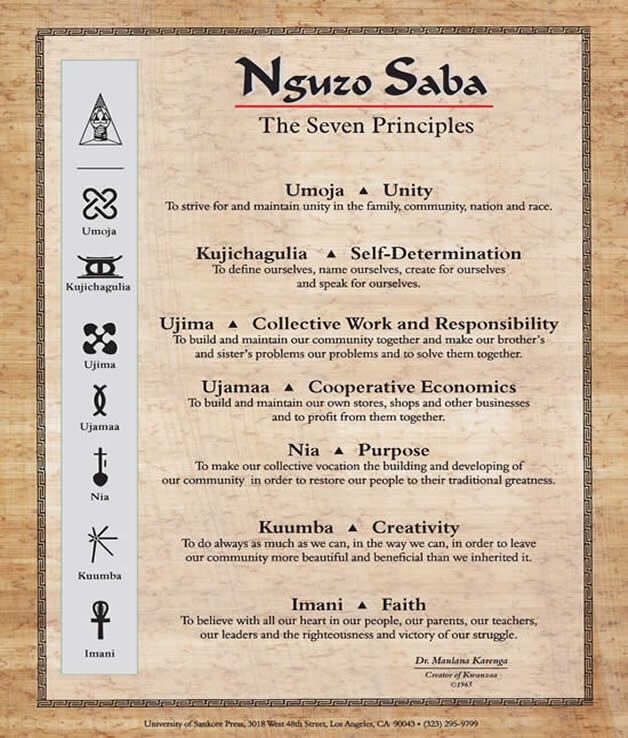
The themes of Merchant also reflect a modern multicultural holiday season. In one example which I wrote about before, The Prince Of Morocco has a great speech that calls to mind the concept of kuchijagulia, or self determination, one of the 7 principles of Kwanzaa.

According to the official Kwanza website, kuchijagulia means, “To speak up for oneself,” and Morocco definitely does that:

Mislike me not for my complexion,

The shadow’d livery of the burnish’d sun,

To whom I am a neighbour and near bred.

Bring me the fairest creature northward born,

Where Phoebus’ fire scarce thaws the icicles,

And let us make incision for your love,

To prove whose blood is reddest, his or mine.

I tell thee, lady, this aspect of mine

Hath fear’d the valiant: by my love I swear

The best-regarded virgins of our clime

Have loved it too: I would not change this hue,

Except to steal your thoughts, my gentle queen. Merchant Of Venice, Act II, Scene I.

Moracco’s unwillingness to change who he is makes him a model of the kind of pride African Americans celebrate during Kwanza. In addition Shylock, the Jewish moneylender, is also very proud of his heritage. His famous quip: “Sufferance is the badge of all our tribe,” expresses perfectly the resilience of the Jewish people, which of course is the central point of Hanukkah.

When it comes to Christmas, Antonio demonstrates a Christ- like self sacrifice, when he lets himself be arrested and nearly killed by Shylock.

Bassanio. Good cheer, Antonio! What, man, courage yet!

▪ The Jew shall have my flesh, blood, bones and all, 2045

▪ Ere thou shalt lose for me one drop of blood.

Antonio. I am a tainted wether of the flock,

▪ Meetest for death: the weakest kind of fruit

▪ Drops earliest to the ground; and so let me

▪ You cannot better be employ’d, Bassanio, 2050

▪ Than to live still and write mine epitaph.

While Antonio’s actions mirror Christ’s sacrifice. Portia’s famous “The Quality Of Mercy Is Not Strained,” speech, goes to the heart of the reason why Christ came to earth; to grant mercy to the sinners who would be damned otherwise

Portia. Do you confess the bond?

Antonio. I do.

Portia. Then must the Jew be merciful.

Shylock. On what compulsion must I? tell me that.

Portia. The quality of mercy is not strain’d, 2125

▪ It droppeth as the gentle rain from heaven

▪ Upon the place beneath: it is twice blest;

▪ It blesseth him that gives and him that takes:

▪ ‘Tis mightiest in the mightiest: it becomes

▪ The throned monarch better than his crown; 2130

▪ His sceptre shows the force of temporal power,

▪ The attribute to awe and majesty,

▪ Wherein doth sit the dread and fear of kings;

▪ But mercy is above this sceptred sway;

▪ It is enthroned in the hearts of kings, 2135

▪ It is an attribute to God himself;

▪ And earthly power doth then show likest God’s

▪ When mercy seasons justice. Therefore, Jew,

▪ Though justice be thy plea, consider this,

▪ That, in the course of justice, none of us 2140

▪ Should see salvation: we do pray for mercy;

▪ And that same prayer doth teach us all to render

▪ The deeds of mercy. Merchant Of Venice, Act IV Scene I.

Shakespeare no doubt wrote these characters to reflect the Christian values many people celebrate at Christmas. Meanwhile the play’s comic subplot with Bassanio and Portia teaches Christians about generosity and mercy. As I have written before, the character Bassanio is the moral center of the play, and his journey mirrors many characters in classic Christmas stories who learn about giving and receiving, the true meaning of Christmas.

In Act III, Scene ii, Bassanio participates in the highest stakes Secret Santa gift exchange ever: three boxes of gold, silver, and lead are set before him.

If Bassanio picks the right gift, he will be rich, powerful, and married to a beautiful woman, but the winning box is inscribed with a warning: “Who chooses me must give and hazard all he has.” Bassanio wins the gift auction, which means he may marry the beautiful Portia, but he gives her the choice to marry him or not: https://youtu.be/6IFSMgggS8k

[Music, whilst BASSANIO comments on the caskets to himself]

Bassanio. So may the outward shows be least themselves: 1440

The world is still deceived with ornament.

▪ In law, what plea so tainted and corrupt,

▪ But, being seasoned with a gracious voice,

▪ Obscures the show of evil? In religion,

▪ What damned error, but some sober brow 1445

▪ Will bless it and approve it with a text,

▪ Hiding the grossness with fair ornament?

▪ There is no vice so simple but assumes

▪ Some mark of virtue on his outward parts:

▪ How many cowards, whose hearts are all as false 1450
Look on beauty, 1455

▪ And you shall see ’tis purchased by the weight;

▪ Which therein works a miracle in nature,

▪ Therefore, thou gaudy gold,

▪ Hard food for Midas, I will none of thee;

▪ Nor none of thee, thou pale and common drudge 1470

▪ ‘Tween man and man: but thou, thou meagre lead,

▪ Which rather threatenest than dost promise aught,

▪ Thy paleness moves me more than eloquence;

▪ And here choose I; joy be the conseque

[Reads] 1500

▪ You that choose not by the view,

▪ Chance as fair and choose as true!

▪ Since this fortune falls to you,

▪ Be content and seek no new,

▪ If you be well pleased with this 1505

▪ And hold your fortune for your bliss,

▪ Turn you where your lady is

▪ And claim her with a loving kiss.

▪ A gentle scroll. Fair lady, by your leave;

▪ I come by note, to give and to receive. 1510

▪ Like one of two contending in a prize,

▪ That thinks he hath done well in people’s eyes,

▪ Hearing applause and universal shout,

▪ Giddy in spirit, still gazing in a doubt

▪ Whether these pearls of praise be his or no; 1515

▪ So, thrice fair lady, stand I, even so;

▪ As doubtful whether what I see be true,

▪ Until confirm’d, sign’d, ratified by you. Merchant of Venice Act III, Scene ii.

Like the story The Gift Of the Magi, Bassanio prizes Portia’s love, and is willing to give her all he has in return, which is what separates him from the other suitors. Bassanio also understands it’s not the physical gift that is really the gift, it’s the love that it represents that really matters, which allows him to look past the outward appearance of the lead chest. Having gratitude for the gifts we receive and pledging our love to others is something that everyone should remember at Christmas and all festive occasions.

In Conclusion, it isn’t cheery, and it is not as hopeful as most holiday stories, but in the season when people of all faiths celebrate together, Merchant Of Venice is a great reminder of our shared humanity and how we can show love and mercy to our fellow people.

Resources:
Merchant Of Venice Website: http://www.themerchantinvenice.org

Book– Will in the world by Steven Greenblatt- An amazing analysis of Shakespeare’s life and career. The chapter “Laughter At the Scaffold,” traces the link between Merchant Of Venice and the real life treatment of Jews in the 16th century

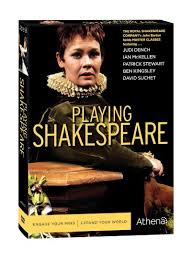
Book/ TV- Playing Shakespeare by John Barton.

MovieMerchant Of Venice 2004 Movie starring Al Pacino. I like the way the director films the drama documentary style, using a single handheld camera in most of the shots. Pacino is very good at playing Shylock as a bitter, cynical old man who is trying to survive in a powerful Christian country.

Official Kwanza website: http://www.officialkwanzaawebsite.org/NguzoSaba.shtml

http://internetshakespeare.uvic.ca/m/lifetimes/plays/the%20merchant%20of%20venice/mershylock.html

Shakespeare on Ghosts

Since Halloween is right around the corner, and since this is a huge topic in Shakespeare, I would like to talk a little bit about Shakespeare’s treatment of the living impaired, specters, spirits, in a word GHOSTS.

Ghosts appear in five Shakespearean plays: Julius Caesar, Hamlet, Richard the Third, Macbeth and Cymbeline. In all but one of these plays, and in many other Elizabethan and Jacobean dramas, a ghost is a murdered person who needs someone to avenge their deaths. Their function is to warn the hero of the play to revenge their deaths, and/ or to torment their murderers.

Ghosts have been part of western drama almost as long as there have been ghost stories. After all, the Greek and Roman plays that Shakespeare emulated often mention ghosts as warnings from above and below the world is in some kind of chaos. Most of the time, the kind of play in which you see a ghost is a Revenge Tragedy, plays like The Spanish Tragedy, Locrine, Shakespeare’s Hamlet, and even the Disney movie of The Lion King.


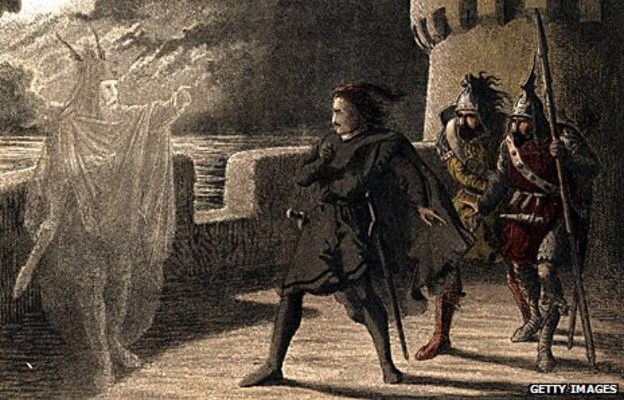
The most potent example of a Shakespearean ghost is definitely the ghost of Hamlet’s father. I actually played this role and, rumor has it, so did Shakespeare himself! Hamlet’s father appears as a ghost two months after his death, and soon after his brother Claudius marries his widow Gertrude. The ghost’s purpose in the play is to get his son’s attention so that he can correct the terrible regicide that Claudius committed, allowing the Ghost to Rest In Peace.

Shakespeare describes the ghost as a pale, sorrowful figure, dressed in full armor. The ghost only speaks to his son in the play, and he begins with a strange and terrifying description of the afterlife:

Ghost: I am thy father’s spirit,

Doom’d for a certain term to walk the night,

And for the day confin’d to fast in fires,

Till the foul crimes done in my days of nature

Are burnt and purg’d away. But that I am forbid

To tell the secrets of my prison house,

I could a tale unfold whose lightest word

Would harrow up thy soul, freeze thy young blood,

Make thy two eyes, like stars, start from their spheres,

Thy knotted and combined locks to part,

And each particular hair to stand on end

Like quills upon the fretful porcupine.

But this eternal blazon must not be

To ears of flesh and blood Hamlet Act I, Scene v.

Many scholars believe that the tormenting realm of fire that the ghost describes is actually Purgatory, an old Catholic concept that explains where the souls of the dead go if they are neither evil enough for Hell, or good enough for Heaven. It’s also the place where people go who didn’t confess their sins before death, which was the ghost’s fate since Claudius poisoned him while sleeping.

Though neither Hamlet nor his father explicitly say it, there is a strong implication that Hamlet must avenge his father by killing Claudius, which will presumably release the Ghost from Purgatory allowing it to ascend to Heaven.

Some suggest that the ghost is a manifestation of Hamlet’s superego:

Psychologist Ernest Jones (who studied under Signund Freud) in his book Hamlet And Oedipusbelieved Hamlet had an unresolved Oedipus complex and couldn’t bring himself to revenge because Claudius had achieved the very goals Hamlet himself secretly desires to kill his father and marry his mother

Faced with his guilt and lack of moral integrity Hamlet could have created a supernatural superego to spur him to revenge. As Freud describes it, the superego

The superego is the ethical component of the personality and provides the moral standards by which the ego operates. The superego’s criticisms, prohibitions, and inhibitions form a person’s conscience, and its positive aspirations and ideals represent one’s idealized self-image, or “ego ideal.”

In essence, since (in Jones’ view), Hamlet is too morally corrupt to be an effective avenger for his father, Hamlet imagines the ghost to help justify his revenge to himself. This is of course, only one way of interpreting the ghost and Hamlet as a whole. There is no right or wrong interpretation for any of Shakespeare’s characters, but it is a testament to Shakespeare’s genius that, 400 years after his own death, his ghostly writings helped inspire one the architects of modern psychology.

Ghosts Of Torment

The ghost of Banquo in Macbeth and the ghosts that plague Richard the Third the night before his battle help quicken the murderous kings’ his downward spiral. Macbeth becomes more and more paranoid, and therefore easier for his foes to defeat.

When Julius Caesar’s Ghost appears to Brutus, he does so the night before his final battle- the battle of Philippi, where Brutus was defeated and committed suicide.

When Richard III sees the ghosts of all the people he murdered, it not only terrifies him, it splits his soul in half! According to Sir Thomas More, Richard couldn’t sleep the night before his final battle at Bosworth Field. Shakespeare gives Richard a strange soliloquy where the ghosts awaken his conscience and awaken him from a fearful dream:

[The Ghosts vanish]

[KING RICHARD III starts out of his dream]

Richard III (Duke of Gloucester). Give me another horse: bind up my wounds.

Have mercy, Jesu!—Soft! I did but dream.

O coward conscience, how dost thou afflict me!

The lights burn blue. It is now dead midnight.

Cold fearful drops stand on my trembling flesh.

What do I fear? myself? there’s none else by:

Richard loves Richard; that is, I am I.

Is there a murderer here? No. Yes, I am:

Then fly. What, from myself? Great reason why:

Lest I revenge. What, myself upon myself?

Alack. I love myself. Wherefore? for any good

That I myself have done unto myself?

O, no! alas, I rather hate myself

For hateful deeds committed by myself!

I am a villain: yet I lie. I am not.

Fool, of thyself speak well: fool, do not flatter.

My conscience hath a thousand several tongues,
And every tongue brings in a several tale,

And every tale condemns me for a villain.

Perjury, perjury, in the high’st degree

Murder, stem murder, in the direst degree;

I shall despair. There is no creature loves me;

And if I die, no soul shall pity me:

Nay, wherefore should they, since that I myself

Find in myself no pity to myself? Richard III, Act V, Scene iii.

In these plays, the ghosts are a form of spectral punishment; the punishment of a guilty Conscience.

Shakespearean Friendly Ghosts

The only friendly Shakespearean ghosts appear in Shakespeare’s play Cymbeline and these ghosts appear before the god Jupiter to plead for their descendant, Posthumous Leonidas. They beg Jupiter, the most powerful Roman god, to end Posthumous’ suffering.

Like the witches in Macbeth, ghosts in Shakespeare are mysterious and sometimes frightening – they are sort of a mirror for how we see ourselves, our lives, and our hopes to be remembered after death; the final words Hamlet’s father utters before disappearing into the morning mist are: “Adieu, adieu, remember me.”

Thanks for reading! If you enjoyed this post, please consider signing up for my Outschool class: “Macbeth: An Immersive Horror Experience.” I perform live as the ghost of William Shakespeare and tell the story of Macbeth in an entertaining and spooky way.

For More Information:

https://www.bl.uk/shakespeare/articles/ghosts-in-shakespeare

https://www.bard.org/study-guides/ghosts-witches-and-shakespeare

Animated Richard III, 20:00 the ghosts appear:

References:

Greenblatt, Steven Hamlet In Purgatory 2001. Princeton University Press. Link: file:///Users/jrycik/Downloads/Hamlet-in-Purgatory-Princeton-Classics.pdf

Jones, Earnest, Hamlet and Oedipus.

https://people.ucsc.edu/~vktonay/migrated/psyc179d/HamletOedipus.pdf

Open Source Shakespeare, Cymbeline:

https://www.opensourceshakespeare.org/views/plays/play_view.php?WorkID=cymbeline&Act=5&Scene=4&Scope=scene&LineHighlight=3243#3243

http://www.markedbyteachers.com/gcse/english/which-version-of-the-hamlet-ghost-scene-act-1-scene-5-was-the-most-effective-and-why.html

Pearlman, E. Hamlet: Critical Essays: The Invention Of the Ghost. https://books.google.com/books?id=jdfWAQAAQBAJ&pg=PA71&lpg=PA71&dq=ghost+that+shrieked+hamlet+revenge&source=bl&ots=KY68gIrh2V&sig=MjEr2NxLQ7T4c2xW1QscrmdeMkc&hl=en&sa=X&ved=0ahUKEwiR5o6M4I_XAhUK0oMKHQIJBeAQ6AEIKDAA#v=onepage&q=ghost%20that%20shrieked%20hamlet%20revenge&f=false

https://www.shmoop.com/hamlet/ghost.html

https://www.jstor.org/stable/pdf/456606.pdf?refreqid=excelsior%3A3f62aed88fb9e9b9a8f8e462186ff95c