

1590s
Review: Kenneth Branaugh’s Henry V

Since July is my month to celebrate Shakespeare’s Henry V, I’d like to talk about one of the most celebrated versions of the play, Kenneth Branaugh’s Academy Award Winning film from 1989.
The Concept
Like many directors trying to re-adapt an old story, Branaugh began by looking at Sir Laurence Olivier’s 1944 movie version of Henry V, deliberately inverting a lot of Olivier’s choices.
Olivier’s version has a framing device where the audience watches the play in a movie-set recreation of the Globe Theater, (since Henry V was probably the first play ever performed when the Globe originally opened in 1599). For the first 30 minutes, you are not watching a movie but a filmed play, albeit one where your fellow audience members are dressed in costumes from 1599.

While watching the play within a movie, and seeing ‘audience members’ clap and cheer for Henry, and boo and hiss the French, you get a keen sense of the theatrical illusion of the play, and its importance to English patriotism in 1599. This makes sense since the film itself was commissioned by Winston Churchill to help raise morale during the D-day invasion in 1944.
While Olivier’s film is theatrical and patriotic, Branaugh’s is cinematic and introspective. His film opens on an empty movie set with the Chorus (Derek Jacobi), giving us a tour of the set. He laments that, even with all the cinematic wizardry of modern movies, this movie cannot capture the true glory of Henry V.
Branaugh’s performance as the titular king is also quite different from Olivier’s. While Olvier is jovial and charismatic, Branaugh’s King Henry switches between cold and calculating, to intensely passionate. This isn’t to say that his acting is bad; but that Branaugh’s King Henry is a self-conscious actor. The king changes his performance to suit the scenario he’s in: diplomatic and calculating in the throne room, demented and violent on the battlefield, calm and confident with his troops, and pious and merciful in victory.
When I studied the play in college, my teacher posited whether Henry V is a Machiavellian king, and I think Branaugh’s certainly is, in that he knows kingship is a job; one that requires the king to constantly playing roles to get what he wants from people- love, awe, respect, or fear. He’s so good at acting, he even teaches his soldiers how to act like fearesome warriors in his famous “Once More Unto The Breach” speech.
What really sets Branaugh’s movie apart from Olivier’s is the way he handles battles. Again, Olivier in 1944 wanted to raise morale during WW2, when British soldiers were actually invading France to supplant a tyrant. Branaugh in 1989, had seen the world’s response to the Vietnam War, and the decades-long violence in his home country of Ireland. Therefore his version literally takes a dim view of war in general.
Branaugh’s world is not colorful or cheerful- the council scenes are full of candlelit shadows. Branaugh’s fireside chat with his soldiers is a smoky, shadowy look into the terror of men who know they must fight and die tomorrow. Look at the excellent performance of Michael Williams (Judy Dench’s late husband), who takes the king to task while looking at the campfire, almost as if he can see the fires of hell, coming for the English:
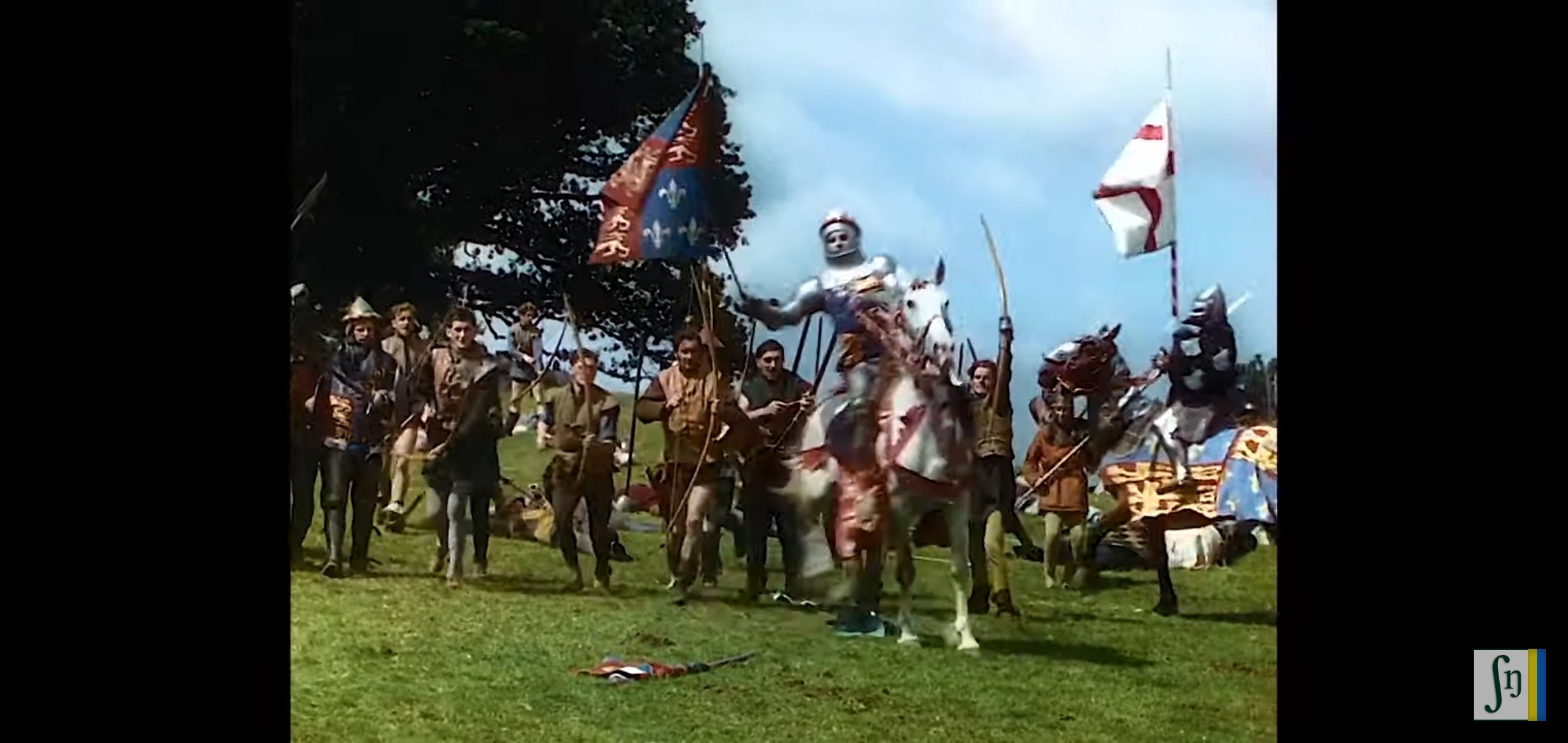

The most striking difference between the two films is how both directors stage The Battle of Agincourt. Olivier’s is a sun-kissed charge on white horses. Branaugh’s is a grimy, mud-stained mess, overcast with a fog of moral ambiguity. Even though the English win, they are meant to question whether or not they have been fighting for a worthy cause. Even after the King proclaims victory for God and country, and the music swells with the gorgeous notes of Non Nobis Dominine (composed and sung by Patrick Doyle), Branaugh has a long tracking shot of all the bodies slain on both sides in the battle. This is the film in a nutshell- a wonderfully acted, exciting, cleverly done thrill ride, that still pulls back and shows the inherently grim and destructive nature of war, that defiles all it touches.
The Plot Of the Play
- King Henry takes the throne in 1413 after his father dies. No one thinks he will run the country effectively.
- The Dauphin (the French Prince) provokes Henry into declaring war with France, (thus allowing him to claim the right of his predecessor, King Edward III).
- Henry fends off the French at Harfleur, despite the fact that they are shooting at him with cannons.
- Henry’s army starts getting sick. Henry decides to start heading back to Calais
- The French raise a massive army and it marches towards Agincourt. Mountjoy the French herald warns Henry he will be annihilated and urges him to pay the French a ransom if he is captured. Henry refuses and marches his troops to battle the French at Agincourt.
- Against all odds, Henry’s army defeats the French at Agincourt, with only about 30 English deaths, and over 10,000 French.
Henry and the French King make peace, and the play ends on a joyous celebration of peace and matrimony, though the Chorus also reminds us that once King Henry dies, his son will lose France and England will be torn apart by civil war.
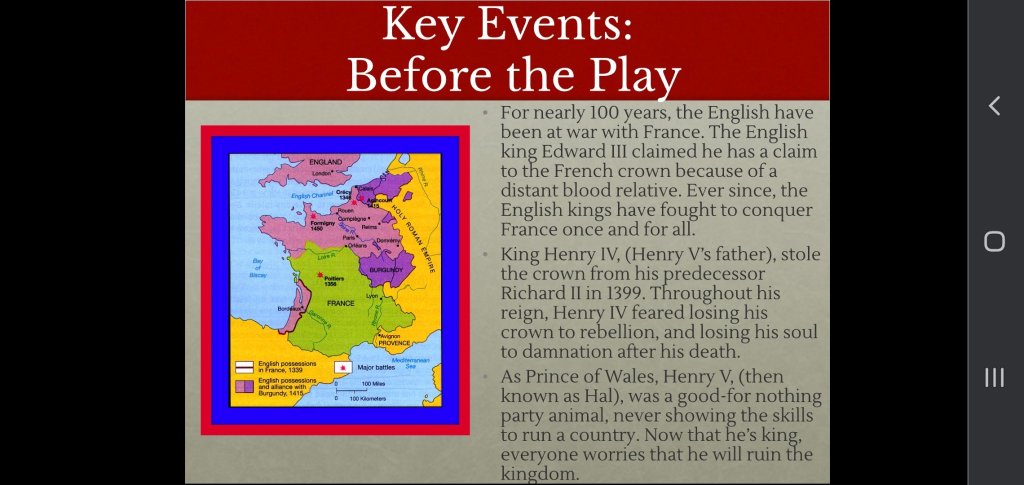
Historical Context
My Favorite Moments
I love Branaugh’s performance and his take on the Battle of Agincourt, but I’d be remiss if I didn’t mention some of the other performances and moments of the play.
- Armed Ultimatum: In this wonderful scene, we first see the overconfidence of the French, especially the hot-tempered Dauphin (Michael Maloney), who admits that he deliberately goaded Henry into declaring war because he wishes to personally fight with King Henry. His father the King, (played by Paul Scoffield) is a timid, melancholic individual, (historians often called him Charles the Mad), and he seems like an easily manipulated monarch, ripe for conquest by King Henry. We then see the imposing figure of the Duke of Exeter (Brian Blessed), who comes in full plate armor to warn the French that though the French outnumber the English, the English are a hardy and powerful people, and that King Henry will not stop until all of France is his.
Supporting Cast
Branaugh mainly casts his movies out of his Renaissance Acting theater troupe, which is why in almost all his movies you see familiar faces like Brian Blessed, Derek Jakobi, Richard Clifford, Richard Easton Michael Maloney, Paul Gregory and Geraldine McEwan. As someone who’s seen all of Branaugh’s Shakespeare movies, I get the curious sensation that I know these people, trust them, and find myself rooting for them since I saw them in other roles. Maybe Branaugh hoped his longtime viewers would be concerned for the lives of his “Band of Brothers.”
Welcome additions include Micheil Williams as Williams, as well as his wife Judy Dench as Mistress Quickly. These actors are just as home playing grubby common English peasants as they are playing kings and queens.
Emma Thompson and Geraldine McEwan sparkle onscreen as the French Princess Katherine and her maid Alice. The first time I saw the film, their French was so good, I didn’t believe it was really them! Likewise, the awkward wooing scene between Thompson and Branaugh (who were married at the time) is so charming, you forget all the violence and atrocities that happened on both sides earlier, and giddily enjoy their romantic banter.
My Reaction
In short, Branaugh created, at least for now, the definitive Henry V for our times. It is a world where war is not glamorous and rarely just. Where common men die and rich men survive, though they must carry their sins on their back,( just as Branaugh carries the young boy played by Christian Bale). Yet it is also a story about the power of great leaders overcoming adversity, caring for their subjects, and doing the best they can to bring peace and stability to their people.
Bonus: Here’s an interview with Branaugh about the process of creating the film:
Watch “Henry V – The Complete Shakespeare – HD Restored Edition” on YouTube
Watch “Shakespeare, Film and Kenneth Branagh – BHH Classic” on YouTube
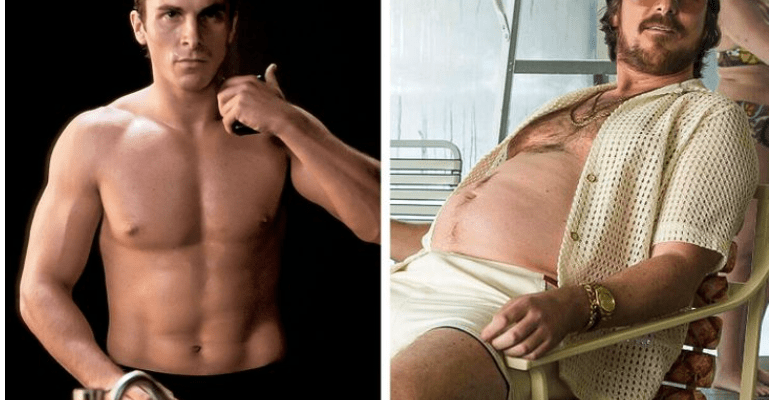
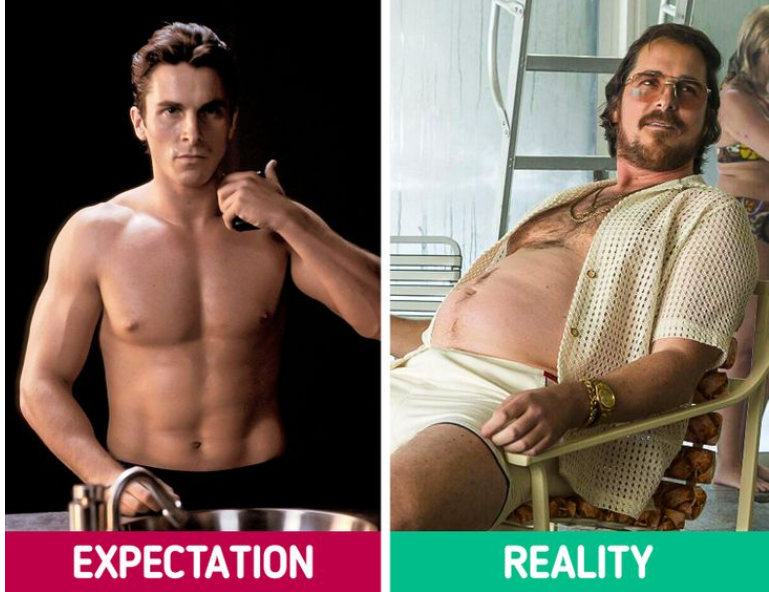
Can I transform my Dad Bod into a medieval Warrior?
https://darebee.com/workouts/knight-workout.html
Happy New Year everyone!
I’m going to be honest, I have a dad-Bod. I try to stay in shape by doing workouts at home and going to the gym, but recently it’s been a bit of a chore.
So like many of us this January, I’m trying to get in shape. So I decided to combine my love of Shakespeare, and make some workouts inspired by medieval Knights!

Every day I’ll do some kind of warrior workout 💪, whether it’s a Spartan Warrior workout from the app on my phone, this medieval knight workout I found online, or a rapier drill like the one below. I’ll also log my calories and try to stay away from processed foods and sugar. After all, King Henry didn’t eat them so I shouldn’t either.
https://www.mentalfloss.com/article/86084/10-workout-tips-14th-century-knight

I’ll let you know what progress I make on Twitter and Instagram. If you’re interested or have suggestions, leave a comment below! Hoo rah!
Week 1:
3 fighter workouts
Rapier Drills

A. 50-100 target lunges ( include redoubles and gathering steps).
B. Cutting drill (Start in first guard, advance and draw through)
C. Cut-thrust combo
D. Footwork Drill: Advance/ Retreat step, Redouble, Gathering Step
E. Passing Lunge
Hqppy Father’s Day From Shakespearean Student!

Hello everyone!
Happy Father’s Day! I’ve been teaching a number of classes these past few days so I haven’t had much time to post but in honor of Father’s Day- here’s a bunch of my favorite past Father’s Day posts:
- Shakespearean Father’s Day Cards: Find some nice Shakespearean sentiment to show your Shakespearean dad how much you care.

- 2. Bios of William Shakespeare and John Shakespeare Both Shakespeare and his father had children, and both worked hard to make a better life for their offspring, so I thought I’d tell you some of their life stories so you can learn more about these great men.

- 3. My Picks For Top 5 Best and Worst Dads in Shakespeare I’ve gone through the entire cannon from As You Like It to Alls Well That Ends Well, and picked out the dads whom I think deserve recognition either as great or terrible parents. Who will take the coveted #1 Shakespeare Dad prize? Stay tuned to find out!

I’ll also be sharing some great memes and reviews on Instagram and my podcast next week.
Graphic Novel Review: The Manga Shakespeare: “The Merchant of Venice.”
Shakespeare Review



In this section, I review a Shakespeare book, movie, or TV show that I feel has some kind of value, either as an interpretation of Shakespeare, or a means to learn more about the man and his writing.
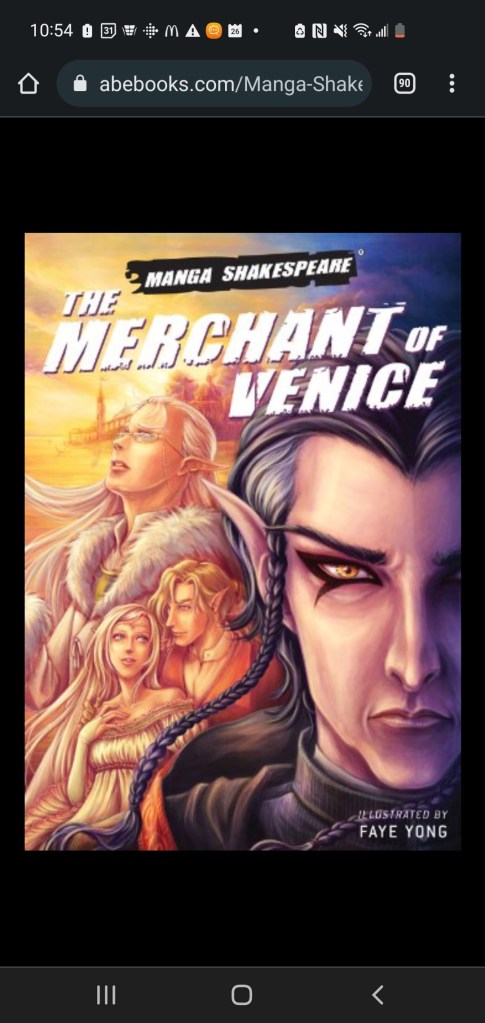
- Name: The Manga Shakespeare– “Merchant Of Venice,” Illustrated by Faye Yong.
- Media: Graphic Novel compilation, with accompanying website https://www.mangashakespeare.com/titles/merchant.html
- Ages: Adult/ Teen. There’s some PG-13 language, and the subject matter touches on racism and anti-Semitism, so it shouldn’t be read by really young kids.
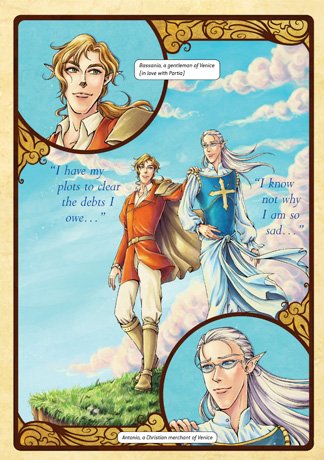
- Premise: Like the Midsummer Night’s Dream edition I already reviewed, this is the full play with Manga inspired illustrations. However, unlike Midsummer, this book is more conceptual. It reinterprets all the characters as either fairies, aliens, mermaids or merman, or some other fantasy characters. It is literally a fairy tale, which I find a fascinating concept for a number of reasons. That said, like any interpretation of Merchant, this choice is somewhat controversial for reasons I will get into below.
“A friend of mine said she got married in Venice and described it as like being in an RPG.”
Faye Yong, Illustrator for “The Manga Shakespeare: Merchant Of Venice.”
-“RPG” Technopedia
What Does Role-Playing Game (RPG) Mean?
A role-playing game (RPG) is a genre of video game where the gamer controls a fictional character (or characters) that undertakes a quest in an imaginary world.
Defining RPGs is very challenging due to the range of hybrid genres that have RPG elements.
Traditional role-playing video games shared five basic elements:
The ability to improve your character over the course of the game by increasing his statistics or levels.
A menu-based combat system with several choices of skills, spells, and active powers as well as an active inventory system with wearable equipment such as armors and weapons.
A central quest that runs throughout the game as a storyline and additional (and usually optional) side quests.
The ability to interact with elements of the environment or storyline through additional abilities (e.g. lockpicking, disarming traps, communication skills, etc.)
The existence of certain character classes that define the characteristics, skills, abilities, and spells of a character (e.g. wizard, thief, warrior, etc.)
My reaction: I honestly don’t know what to think about the way the comic depicts races. In the interview above, illustrator Faye Yong explains how she chose a fantasy aesthetic for the graphic novel.
She read the script and represented the characters like the Prince of Aaragon, the Prince of Morocco, and re-interpreted them as fantasy characters. A good example is the Prince of Aragon. As you can see in this scene from the 2004 movie, Shakespeare portrays Aaragon as a vain, shallow person. Incidently, Aaragon is a province of Spain, over which the English just won a major naval victory, so Shakespeare makes this character a mockable popinjay since the Spanish were still the mortal enemies of the English:
Fay Yong wanted to heighten Aaragon’s vanity, so she made him a beautiful creature with long, flowing hair.
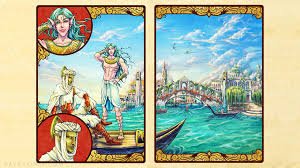
This is telling: Yong immersed herself with Shakespeare’s text, but she didn’t really delve into the real world context. She wasn’t interested in the real cultures of Aaragon, Morrocco, or even Venice, but to take Shakespeare’s impression of these cultures, and use Japanese style animation to tell Shakespeare’s story.
For most of the play, this approach works quite well. After all, Shakespeare depicts Portia and her home in Belmont as an almost ethereal place, where men come from far and wide to see this magical kingdom, and Portias father gets a prophetic vision on his death bed that makes him alter his will so that only someone who can decipher his riddle will get to marry Portia and inherit her estate. Like I said, the scenes in Belmont work very well as a Manga comic, particularly Bassanio’s Zelda-style fetch quest where he has to choose the right casket to marry Portia. I hope someone someday turns this idea into a real game.
However, the scenes in Venice don’t work as well because Shakespeare wrote them with a clear understanding of the real Venice, and the tensions between the Jewish and Christian communities. Details like Antonio’s anti-Semitism, Shylock’s fury at his daughter marrying a Christian, and Portia’s own racism and anti-Semitism is frankly erased when you view it out of the context of the real Venice.
Another example of questionable racial re-interpretation is theThe Prince of Morrocco, who like Aaragon, is a suitor to Portia who likewise fails to choose the proper casket and win Portia.
In Yong’s version, Morocco has green, rather than brown skin now, (sort of like Piccolo from Dragon Ball Z), which is problematic because we associate green with sickliness and that makes this speech of Morocco’s even more problematic:
Mislike me not for my complexion,
The shadow'd livery of the burnish'd sun,
To whom I am a neighbour and near bred.
Bring me the fairest creature northward born,
Where Phoebus' fire scarce thaws the icicles,
And let us make incision for your love,
To prove whose blood is reddest, his or mine
Not surprisingly, the most controversial illustration choices center around Shylock the Jewish moneylender. As I’ve written before, Shylock has always been a controversial figure, and this comic interprets him in a way I find simultaneously simplistic and highly thought-provoking.
Faye Yong has stated that she wanted to make Shylock look the same as the Christian characters, but that his garb would reflect a sort of “dark elf” aesthetic. She describes him as the sort of fantasy character that worships the moon, rather than the sun. On the one hand, I applaud her for not giving into the old Jewish stereotypes like red hair, hook noses, etc. I also have to admit that Shylock is sort of a dark vengeful figure (he is after all, the villain), so making him a dark elf works on the surface.
On the other hand, again, without the context of anti-Semetism, and the complex relationship between Jews and Christians in the 16th century, much of the Shakespearean text is devoid of meaning. Perhaps this is an attempt to make the play more easily accessible to young readers like teenagers, and I applaud that, but as I wrote in my post about why everyone should read or teach this play, learning about the historical context of real Jews is this play’s great gift, and that is lost in this version.
On the other hand, depicting Shylock like some kind of dark elf or warlock actually brings to life a very real aspect of anti-Semetic prejudice that many people overlook today: for most of western history, many of our stereotypes of Jews were interlinked with our stereotypes about witches!
Jewish Stereotypes and the Occult
So, ironically, much the same way Ian McKellen’s Richard III helped modernize the complex medieval politics of the 15th century, seeing Shylock as a semi-mystical, possibly occult figure, actually brings to light some of the prejudices that real Jews in the 16th century faced!
In conclusion, Merchant Of Venice is extremely hard to adapt in a comic book context, and some aspects are a little lost in translation. That said, it is gorgeous to look at, and it has a great visual shorthand that enlivens Shakespeare’s text in a unique and appealing way.
Recommendation: I’d recommend this book to all mature fans of Shakespeare, anime, Manga, D&D, or any kind of nerd stuff!

Grade: 3 Shakespeare globes.
- Official Website:
Graphic Novel Review: The Manga Shakespeare: “A Midsummer Night’s Dream.”
Shakespeare Review


In this section, I review a Shakespeare book, movie, or TV show that I feel has some kind of value, either as an interpretation of Shakespeare, or a means to learn more about the man and his writing.
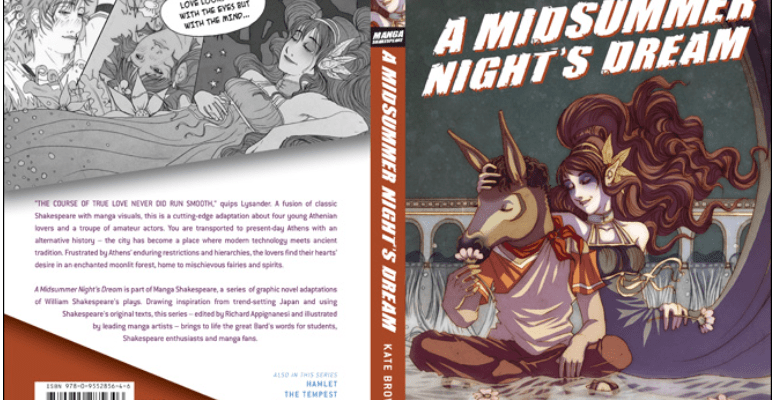
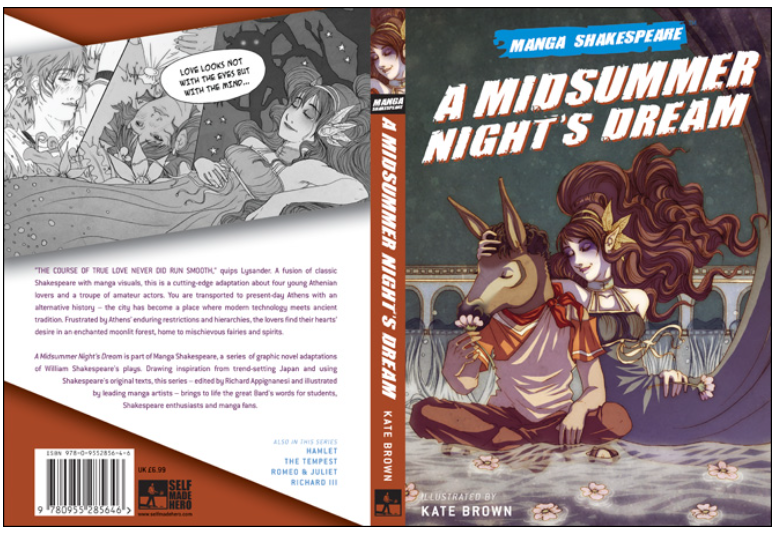
- Name: The Manga Shakespeare: “A Midsummer Night’s Dream.
- Media: Graphic Novel compilation, with accompanying website https://www.mangashakespeare.com/titles/midsummer.html
- Ages: Pre Teen- Adult. No violence or explicit imagery, but the visual format might be confusing for younger viewers.
- Premise:
My reaction:
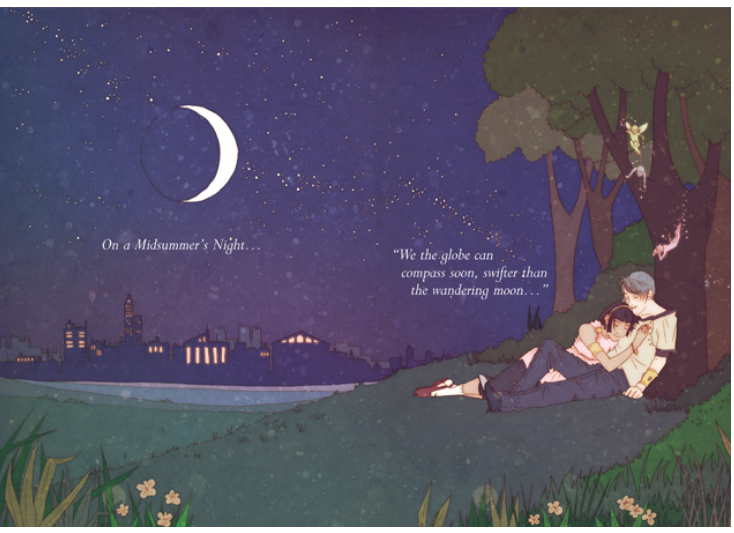
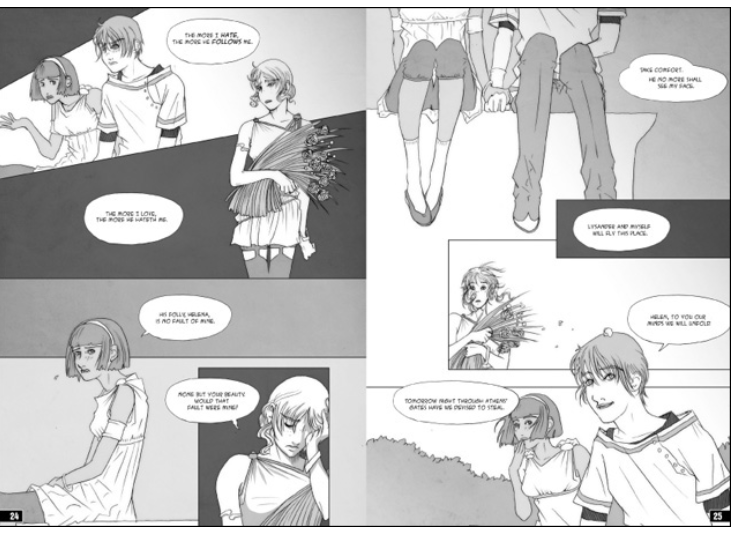
This series is very creative and in general, has a distinct and exciting style that works well for Shakespeare, though I would argue that “Midsummer” is one of the weaker ones in the series. The character designs are somewhat generic, and although the emotions are clearly conveyed, I feel that the style doesn’t clearly show who these people are or the different environments in the play- Athens, the Woods, and the Court.
Basic Details:
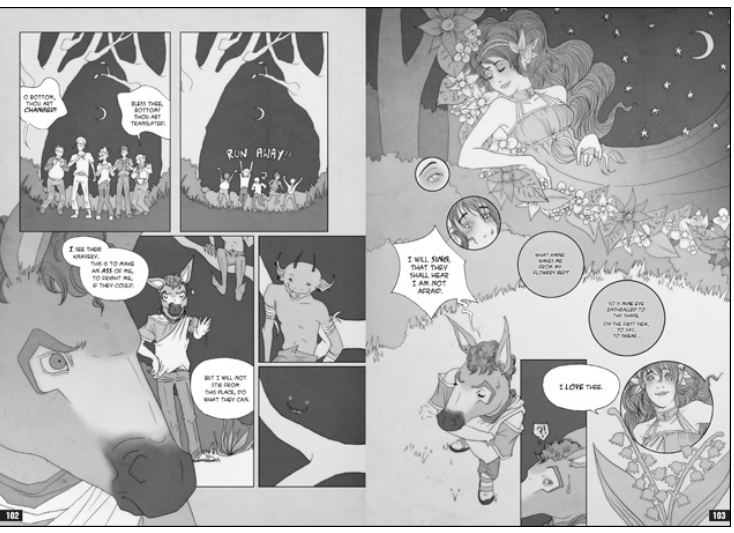
Sometimes the over-the top nature of manga drawings works well with this play. When Helena is mooning over Demetrius, we can see highlights in her eyes that work very well within the big-eyed, expressive style of Manga. By contrast, some other characters like Oberon are drawn very sharply, making him appear stern and even grim.
Another thing the style of pictures does is to literally illustrate the poetic passages of the For example, when Titania delivers her “These are the forgeries of jealousy,” speech, the images of the text compliment her concerns that the king and queen of the fairies are effecting the natural world.
Critique
I enjoy how well the characters convey emotions in this version because they help convey the meaning of the text. However, I think this visual style is too austere and sharp for such a vibrant, silly, colorful play. I wish the style of Manga didn’t dictate that most of the pages are black and white, because some color in the fairy scenes would add some much-needed magic.
Recommendation: This book is a good resource for classrooms exploring the text of “A Midsummer Night’s Dream,” but honestly I wouldn’t read it for pleasure.
Grade: 2 1/2 Shakespeare globes.
- Official Website: https://www.mangashakespeare.com/titles/midsummer.html
Crafting a Character: Don John IN “Much Ado About Nothing.”

http://openairshakespearenrv.com/2012/04/17/crafting-a-character-by-paul-rycik/
It’s always a great privilege to play a Shakespearean character, but especially to play one of Shakespeare’s villains. Playing Don John in this production is a great deal of fun, especially creating a character from the ground up. What follows is a short account of my process of creating this character, which, as I always do no matter what character I’m creating, begins with the text.
Don John only really talks about himself in one scene, Act I, Scene iii. This is the only scene in which Don John hints at the reason why he is so unhappy:
DON JOHN
“I cannot hide what I am:
I must be sad when I have cause and smile
at no man’s jests, eat when I have stomach and wait
for no man’s leisure, sleep when I am drowsy and
tend on no man’s business, laugh when I am merry and
claw no man in his humour.”
— Much Ado About Nothing, Act I, Scene iii

Looking at the speech, the first thing I noticed is that it is all in prose, which is usually an indicator that the character is not speaking from his heart. Instead of making a confession of his true emotions, Don John tends to dominate the conversation and hit his listener over the head with his argument. Benedick and Beatrice also speak in prose when they are making fun of each other, but this kind of prose is much more terse and cynical.
Looking closer at the language of the speech, I also noticed the repeated usage of the word ‘no.’ In this speech Don John refuses to accommodate anybody, he reserves the right to ignore anyone, take from anyone, and irritate anyone he wishes without a thought for anyone’s feelings. Essentially, in this speech, he is refusing any kind of social grace or social interaction. Two kinds of people exhibit this kind of pattern; petulant children, and sociopaths.
Since Don John is an illegitimate child, he has probably been denied a normal, loving childhood, which can stunt his emotional growth. Like Edmund in King Lear, I decided that Don John doesn’t believe in any kind of love, except love for himself. Without the love of others, he refuses to give or show any himself, and only seeks to enhance his own ego, which explains Don John’s pointless war against his brother to improve his political status. This lust for power became my overall objective for the character which manifests itself in Don John’s utter contempt for everyone but himself, and the cruelty he shows to Claudio and the other people in the play.

However, I also made a decision that, unlike Keanu Reeves’ portrayal of Don John in the film version of Much Ado, I didn’t want him to just be a repellant psychopath that would be unpleasant to watch. I decided early on that I wanted to find a way to insert some comedy into the role. This is why I decided that when Don John complains about his melancholy and his unfulfilled desires, he pouts like a young child. I then summarized my concept for the role in four distinguishing characteristics:
- Egotistical
- Petulant
- Cruel
- Childish
Having established my character’s motivation and his overall personality traits, I concentrated on developing a voice and physicality. I thought to myself, “What person or character has these characters?” Then I saw this:
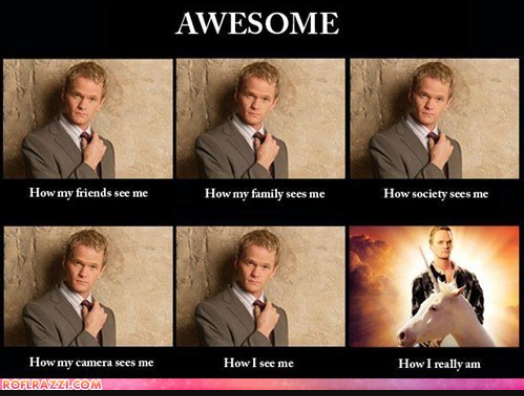
Neil Patrick’s character Barney Stinson on How I Met Your Mother, matched these characteristics perfectly. He is a self-obsessed low level sociopath who sleeps with lots of women without loving any of them. He is also an illegitimate child who never knew his father, just like Don John. I therefore decided to borrow some mannerisms from Barney.
After watching a few episodes of the show, I noticed a few interesting details in the way Barney acts that I wished to replicate:
Posture- Barney’s posture is absolutely straight. He gives the impression of growing straight up out of the ground, which gives the impression of supreme confidence and arrogance. To keep my posture straight, I did yoga every day to keep my back and legs strong. I used a straight posture whenever Don John is in public but when he is alone and pouting, I let my shoulders hunch like Richard Nixon to give the impression that Don John, (like most bullies), suffers from extremely poor self-esteem, and his displays of ego are merely a front.
Facial quirks

- Eyebrows: As you can see in the photo above, Neil Patrick Harris can move his eyebrows independently, which allows him to appear incredulous or mischievous with a sly move of the eyebrow. It just so happens that I can move my eyebrows independently as well, so I use this in moment
- The Chin: A lot of NPH’s acting comes from his chin. When he’s feeling very proud of himself, he thrusts his chin in the air like a lightning rod, absorbing mystical energy from the heavens. When he is feeling wicked, he chocks his head to the side and pops his chin out. I adopted these motions for moments in which Don John is plotting something.
Gestures
Since Don John is upper class, he doesn’t need big gestures; the more upper class someone is the less they need to work to get people’s attention. However being the selfish brat that he is, his gestures are very flashy. I adopted subtle, fluid gestures that come from the wrist and only used full body gestures when the character is angry, or when he is playing up his own ego. In the video on the left, there’s a short rehearsal of a scene I did with Amanda Cash Snediker. At one point, when I want Tiarra Hairston to light Amanda’s cigarette, all I do is snap my fingers.
Voice
The iconic voice of a 1920s announcer is a reedy-voiced tenor with a slight slur in his words with a slight smile to his mouth. This kind of world-weary, loud-mouthed voice is exactly what I wanted to convey in Don John’s voice.

Costume “Let’s Suit up”
Just like Barney, I believe Don John is obsessed with his appearance. I looked up male fashions in the 1920s. Looking at this picture of Edward Beale McLean, (head of the Washington Post from 1916-1933), I saw a suit worth replicating. I found a great black pinstripe suit.

I also looked for a uniform that I thought would seem menacing and appropriately gawdy.
For More Info On Male Fashion from the 1920s, click on this link:
http://mens-fashion.lovetoknow.com/Men’s_Fashion_in_the_1920s.
 The Shakespearean Student
