Lovely piece of comedy, but I better not see this quoted in anyone’s term papers!
http://community.sparknotes.com/2016/12/07/every-shakespeare-play-summed-up-in-a-single-sentence/#

Lovely piece of comedy, but I better not see this quoted in anyone’s term papers!
http://community.sparknotes.com/2016/12/07/every-shakespeare-play-summed-up-in-a-single-sentence/#
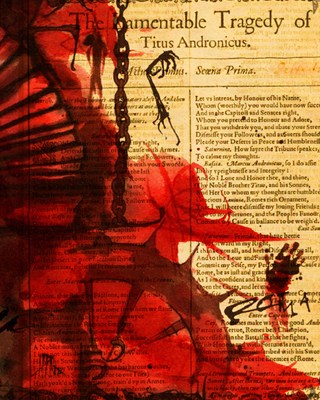
With just a few days left until Halloween, many of us will be anxious to put the candy bowl away, dim the lights, and watch a scary movie. I’d like to recommend my pic for the single best Shakespeare play for Halloween, and you might be surprised to learn which one it is:
It’s not Macbeth, despite its ghosts and witches, it’s not Hamlet, though it has a famous scene in a graveyard. In my opinion, the scariest, most horrific, most disturbing Shakespearean play is the ancient Roman revenge tragedy Titus Andronicus!
Titus Who?
Titus is the most violent, most outrageous play in the Shakespearean cannon and features murder, mutilation, cannibalism, (and even featured the first recorded trick or treating). It was also his first tragedy ever, written around 1590. Back in this period, Shakespeare’s theater was also the site of public executions and blood sports like Bear-baiting, so Shakespeare knew that gore sells. He also knew that people were reading the bloody tragedies of the Roman poet Seneca, so he created a play that out-does the Roman master of bloody violence!
So why have you not heard of it?
Scholars often compare the dark comedy of Titus to the films of Quentin Tarantino, who will murder his characters in grotesque, but funny ways. I won’t even give away the surprise ending where Titus and his daughter gets their revenge, but let’s just say that they would certainly agree with Tarantino that revenge is a dish, best served cold!
AARON
Look by and by to have thy sons with thee.
Aside Their heads, I mean.
O, how this villany
Doth fat me with the very thoughts of it!
Let fools do good, and fair men call for grace.
Aaron will have his soul black like his face (Titus, Act III, Scene 1).
Now the question to ask about Aaron and most of Shakespeare’s villains, is are they bad because they’re different (different race, differently abled, illegitimate birth), or did they become bad from people treating them badly?
Serious note– Even though productions often dramatize the violence and rape in Titus as over-the-top black comedy, this kind of rape and violence happens in real life, every day, particularly violence against women like Lavinia. One reason why this play is gaining popularity is sadly, that this kind of violence is more common in our current society with the shocking number of rapes committed in this country (1 in 5 women, according to the National Sexual Violence Resource Center), and the brutal murders in this play suggest many real-life atrocities such as Abu ghraib,
Plot summary and more at Schmoop.com
More at http://www.gradesaver.com/titus-andronicus/study-guide/summary
Review of Julie Taymor’s Titus
If you can’t get to the theater this Halloween and want to watch a production of Titus, you’re in luck: In 1999, Julie Taymor, famed director of the Broadway production of The Lion King, directed a film adaptation of Titus which I consider the single greatest Shakespearean film of all time. The movie captures the grotesque comedy of the play, while also visually showing the beauty of Shakespeare’s poetry. It also doesn’t get hung up on historical accuracy just because the play is set in Rome. Best of all, the cast in incredible: Anthony Hopkins, Jessica Langue, Alan Cumming, Harry Lennox and more. This cast knows how to do Shakespeare for the movies and their work shows in every scene. Interesting side note: Hopkins actually considered making this movie the last movie of his career, which explains his amazing glee and energy in the role of Titus. Below is a nice in-depth analysis of the film
Another good review comes from the French Shakespeare Society: https://shakespeare.revues.org/1558
And finally, a review from Roger Ebert: http://www.rogerebert.com/reviews/titus-2000
So that’s my two cents on Titus Andronicus. Happy Halloween everybody!


In 2011, I wrote a graduate thesis about some of the challenges of playing Shakespeare’s Richard III, specifically those related to playing his deformity. What follows in this post is an adaptation of the presentation I gave at the American Shakespeare Center’s Blackfriars Playhouse, in Staunton Virginia. I gave this presentation with the help of my actors, Matt Carter, Jemma Levy, Amanda Noel Allen, and David Santangello. I also interviewed live onstage, one of the ASC’s greatest actors John Harrell and his director Thadd McQuade, about a unique production of Richard that he performed for the company back in 2002. What follows is the script I wrote for the presentation, as well as the video and Powepoint slides I projected for the audience, to help you see my work in performance. You can also consult a website I designed for the ASC’s production of Henry VI, Part III, where Richard was played by actor Ben Curns.
MATT CARTER:
Now is the winter of our discontent
Made glorious summer by this sun of York;
And all the clouds that lour’d upon our house
In the deep bosom of the ocean buried.
But I, that am not shaped for sportive tricks,
Nor made to court an amorous looking-glass;
I, that am curtail’d of this fair proportion,
Cheated of feature by dissembling nature,
Deformed, unfinish’d, sent before my time
Into this breathing world, scarce half made up,
And that so lamely and unfashionable
That dogs bark at me as I halt by them.
Why, I, in this weak piping time of peace,
Have no delight to pass away the time,
Unless to spy my shadow in the sun
And descant on mine own deformity: Applause, he sits on one of the gallant stools.
Section 1: Introduction

PAUL:
Many of you recognize those famous lines from the opening soliloquy of Richard III, ably delivered by Matt Carter. Did you notice the ways Matt was moving and the qualities of his voice? Tonight, my actors and I will show you some of the choices actors have made in playing the deformity of Richard III. Deformity and Richard are so closely linked that I would argue that it is the central driving force of the character. The different performances we will discuss show changes in views on deformity, as well as changing theories on the actor’s craft.
Every actor is interested in the human body, every actor is interested in how the mind and body work together, and most importantly, how to present the mind and body of a character to an audience in a clear and articulate way. No matter how the actor decides to represent it, Richard’s deformity of mind and body are essential to the understanding of the character. In his first soliloquy, in the play Henry the Sixth, Part III, he expresses a deep pain, sorrow and bitterness at being denied a normal body. As Jemma delivers this speech, ask yourself- do you pity him? Does this man have a reason to be angry?
JEMMA LEVY:
Why, love forswore me in my mother’s womb:
And, for I should not deal in her soft laws,
She did corrupt frail nature with some bribe,
To shrink mine arm up like a wither’d shrub;
To make an enviousmountain on my back,
Where sits deformity to mock my body;
To shape my legs of an unequal size;
To disproportion me in every part,
And am I then a man to be beloved?
O monstrous fault, to harbour such a thought!
Henry VI, Part III, Act III, Scene i.
PAUL:
In this speech, like the previous one, Richard expresses the belief that his deformity was a curse, laid on by his mother. During the Renaissance, people believed that deformity was a mark of evil and a sign of being cursed by God. Like the Mark of Cain in the Bible, Richard’s deformity signifies that he was “determined,” (presumably by God), to prove a villain.” The deformity also gives Richard psychological motivation. Lacking a normal body, Richard is hungry for revenge, and in search of something to elevate himself above more fortunate people- power.
Section 2: Burbage
PAUL: The first Richard was almost certainly Richard Burbage, Shakespeare’s star actor. Burbage was associated with the role long after his death.
DAVID SANTAGELLO:
‘A funerall Elegy on the death of the famous Actor Richard Burbage:
Who died on Saturday in Lent, the 13th of March 1618′
No more young Hamlet though but scant of breath
Shall cry revenge for his dear father’s death:
Edward shall lack a representative,
And Crookback, as befits, shall cease to live.”
PAUL:
Unfortunately, we have no information on how Burbage played the deformity, but we have one clue as to how his performance might have been received, in the form of an apocryphal story from the diary of law student John Manningham, on 13 March 1602:
AMANDA:
Upon a time when [Richard] Burbage played Richard III,
There was a citizen grew so far in liking with him that before she went from the play,
She appointed him to come that night unto her by the name of Richard III.
Shakespeare, overhearing their conclusion, went before, was entertained, and at his game ere Burbage came.
The message being brought that Richard III was at the door,
Shakespeare caused return to be made that ‘William the Conqueror was before Richard III.’

PAUL:
Although this story is apocryphal, it does hit upon other features of Richard’s deformity- his supreme confidence, and his beast-like sexuality. Scholars have pointed out that Richard’s lack of scruples, (the result of being born deformed), makes him completely focused and confident. Likewise, his non-conformity to traditional standards of beauty could also be seen as a rebellion against societal norms, and thus, a strange aphrodisiac. This dark creature, without a recognizable human shape, manages to exert a dark pull on the audience.
Section 3: Cibber
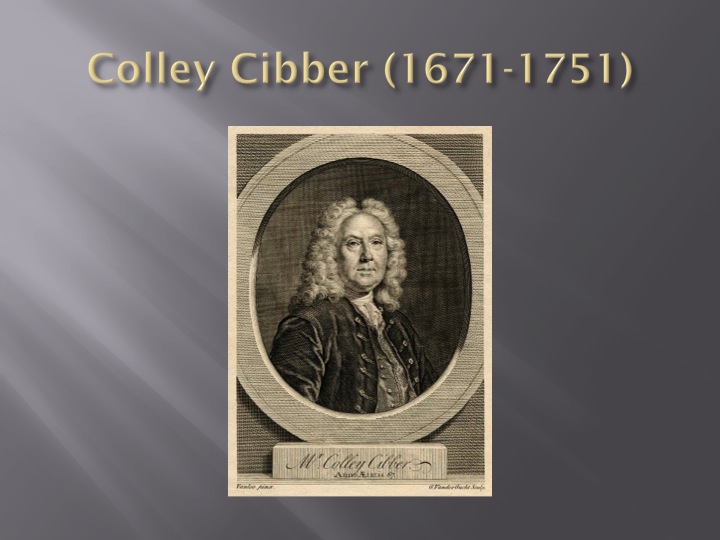
Surprisingly, for nearly 300 years, portrayals of Richard III have been heavily influenced by an obscure author who was not even Shakespeare’s contemporary
During the Restoration of theater in the 17th century Shakespeare’s plays were largely out of fashion, condemned by critics as “too vulgar for this refined age,” and playwrights began to rewrite and adapt them. The most successful adaptation of Richard the Third, came from poet-laureate Colley Cibber in 1671. Cibber’s text interpreted the story as one man’s evil rise to the crown, not the culminating story of the Wars of The Roses. Cibber cut most of the history involved. He condensed scenes, omitted others, and gave Richard 10% more of the dialogue, then Shakespeare. Cibber’s text also re-emphasizes the importance of deformity to Richard’s character- adding 8 more uses of the words “deformed,” or “ugly.” To further the point, Cibber inserted text from other Shakespeare plays that speak about Richard’s deformity, such as the Henry VI speech spoken earlier. Cibber freely cut-and pasted from Shakespeare’s histories, which can be demonstrated in this speech where the Lady Anne mourns for the death of Henry the Sixth, using lines written by Shakespeare for the funeral of King Henry the Fifth:
AMANDA:
Hung be the heavens with black, yield day to night!
Comets, importing change of times and states,
Brandish your firey tresses in the sky,
And with them scourge the bad revolting stars
That have consented unto Henry’s death!O be accursed, the hand that shed his blood
Accursed the head that had the heart to do it!
If ever he have wife, let her be made
More miserable by the life of him
As I am made by Edward’s death and thine!
PAUL:
Cibber also wrote his own speeches for Richard, such as this one where Richard resolves to woo Lady Anne in spite of his deformity:
JOHN HARRELL:
But see! My love appears. Look where she shines
Through her dark veil of rainy sorrows
Tis true, my form perhaps may little move her;
But I’ve a tongue shall wheedle with the devil.
PAUL: Cibber’s text was extremely popular with actors because it raised Richard’s importance to a star role. Actors such as David Garrick made their debut as Cibber’s Richard, and some of Cibber’s editorital choices still survive in the two movie versions of Richard by Ian McKellen and Laurence Olivier.


Section 4: Olivier
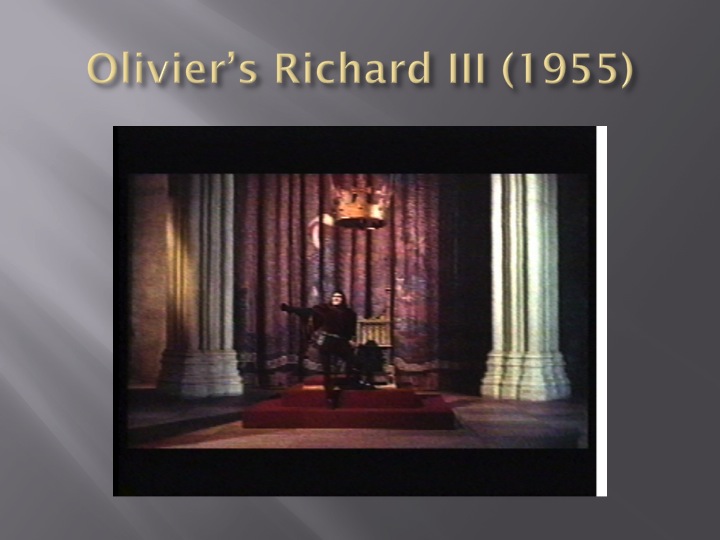
Olivier, in the 20th century was considered the definitive Richard. In his film version he emphasizes Richard’s evil and deceptive nature. He uses the character’s physical disabilities (as well as various cinematic techniques) to reveal his moral depravity.

Section 5: Sher

After Olivier, actors abandoned the approach of making Richard into a monster, and favored a more human, natural approach.
The role of Richard III however, presents unique challenges for actors attempting to do this; they are attempting to do something un-natural by playing a deformity that they do not actually have. Thus they are attempting to play something “un-natural” within the precepts of naturalistic acting.. Antony Sher’s massive preparation for the role, using Method acting techniques, included both a thorough research into the physical effects of real disability, and a deep examination of its psychological effects.

DAVID:
But I, that am not shaped for sportive tricks,
Nor made to court an amorous looking-glass;
I, that am rudely stamp’d, and want love’s majesty
To strut before a wanton ambling nymph;
I, that am curtail’d of this fair proportion,
Cheated of feature by dissembling nature,
Deformed, unfinish’d, sent before my time
Into this breathing world, scarce half made up,
And that so lamely and unfashionable
That dogs bark at me as I halt by them;
PAUL: Sher’s massive preparation for the role represent the limits that an able bodied actor could go to portray a disability he himself did not have.
Section 6: From Sher to Harrell


Section 7: 10 minute interview with Thadd and John.

Both– Explain the way you chose to represent deformity (bowling ball) and why.
Conclusion: Richard’s deformities and disabilities are both physical and psychological. They are the driving force in his life. Portraying Richard’s deformity is a microcosm of the challenges that face all actors: making choices of how to explore the mind and body of a character. Watching an actor take on the challenge of portraying this man’s struggles. This struggle is the essence of tragedy and watching an actor take on the challenge of creates powerful and poignant theatre.

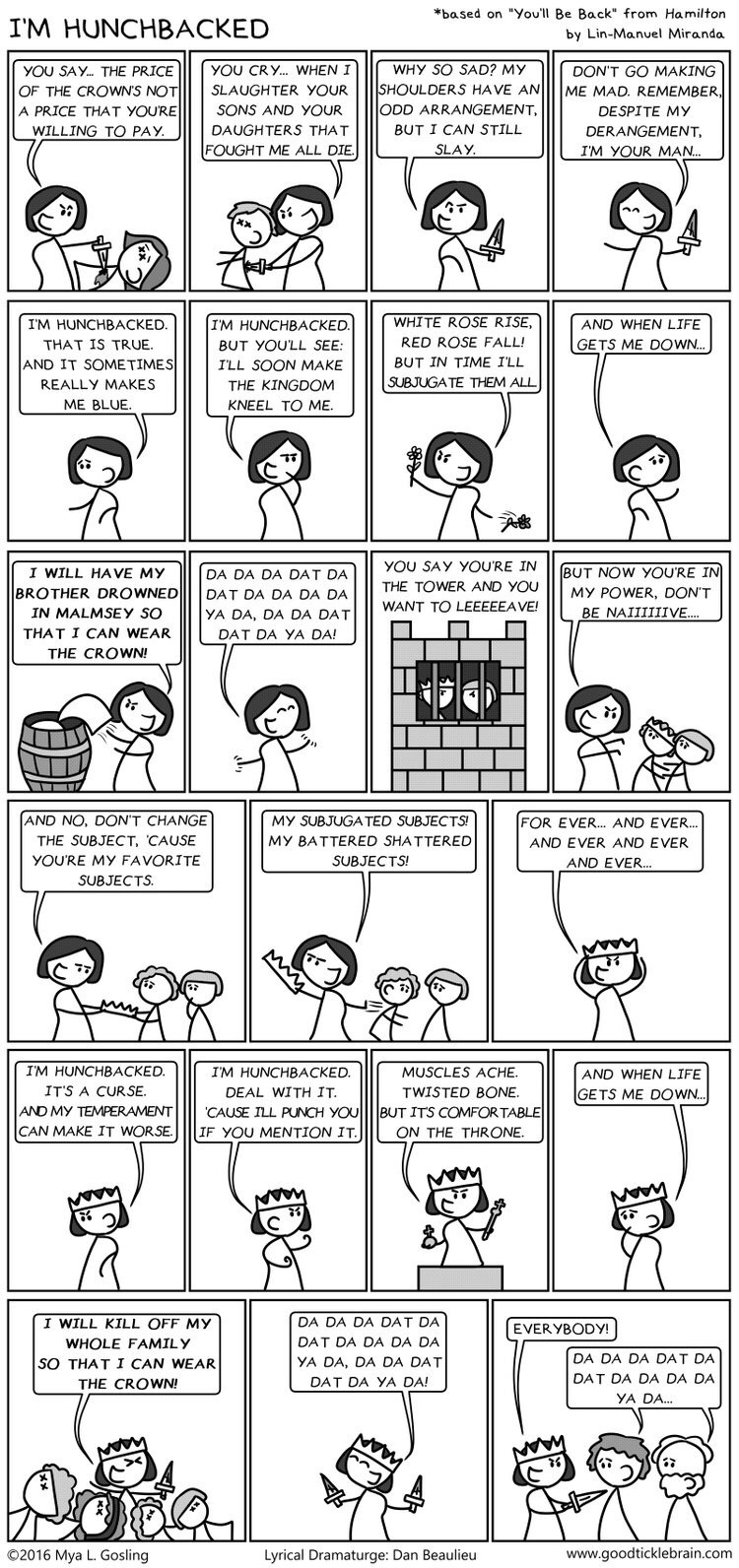
As you know, I’m a huge fan of Shakespeare and the Broadway musical “Hamilton,” so I was delighted when I saw this post on “Good Tickle Brain!”
Original Post Here: check them out for Shakespearean humor!

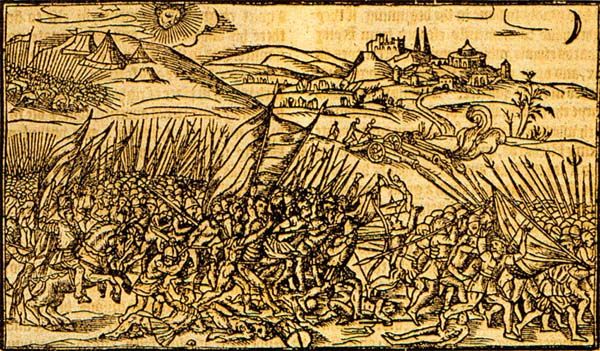
To begin wrapping up our Richard III month, I thought it might be appropriate to speak a little about the battle that ended the real Richard’s life, the Battle of Bosworth Field, August 22, 1485.
What does Shakespeare Say about the battle:
KING RICHARD III
Come, bustle, bustle; caparison my horse.
Call up Lord Stanley, bid him bring his power:
I will lead forth my soldiers to the plain,
And thus my battle shall be ordered:
My foreward shall be drawn out all in length,
Consisting equally of horse and foot;
Our archers shall be placed in the midst
John Duke of Norfolk, Thomas Earl of Surrey, Shall have the leading of this foot and horse. They thus directed, we will follow In the main battle, whose puissance on either side Shall be well winged with our chiefest horse. This, and Saint George to boot!
What think’st thou, Norfolk?
NORFOLK
A good direction, warlike sovereign.
Richard III, Act V, Scene iii.
This speech matches very well with what the chronicles mention about the battle. In those days the English archers were more deadly than their cavalry, so Richard probably wanted to pick off as many soldiers as possible with the archers, then mow the rest down with his charge toward Henry.
Contemporary Accounts, (courtesy of the Richard III Society). The most complete, and unbiased account I could find was Polydore Virgil, which is also likely the one from which Shakespeare got his information. You’ll notice that it mentions the long line of foot soldiers and horsemen, and the mention of the Duke of Norfolk commanding one of Richard’s forces.

‘The day after King Richard, well furnished in all things, drew his whole army out of their encampments, and arrayed his battle-line, extended at such a wonderful length, and composed of footmen and horsemen packed together in such a way that the mass of armed men struck terror in the hearts of the distant onlookers. In the front he placed the archers, like a most strong bulwark, appointing as their leader John, duke of Norfolk. To the rear of this long battle-line followed the king himself, with a select force of soldiers.‘Meanwhile … early in the morning [Henry Tudor] commanded his soldiery to set to arms, and at the same time sent to Thomas Stanley, who now approached the place of the fight, midway between the two armies, to come in with his forces, so that the men could be put in formation. He answered that Henry should set his own men in line, while he would be at hand with his army in proper array. Since this reply was given contrary to what was expected, and to what the opportunity of the time and greatness of the cause demanded, Henry became rather anxious and began to lose heart. Nevertheless without delay he arranged his men, from necessity, in this fashion. He drew up a simple battle-line on account of the fewness of his men. In front of the line he placed archers, putting the earl of Oxford in command; to defend it on the right wing he positioned Gilbert Talbot, and on the left wing in truth he placed John Savage. He himself, relying on the aid of Thomas Stanley, followed with one company of horsemen and a few foot-soldiers. For all in all the number of soldiers was scarcely 5,000, not counting the Stanleyites of whom about 3,000 were in the battle under the leadership of William Stanley. The king’s forces were at least twice as many.
 ‘Thus the battle-line on each side was arrayed. As soon as the two armies came within sight of each other, the soldiers donned their helms and prepared for the battle, waiting for the signal to attack with attentive ears. There was a marsh between them, which Henry deliberately left on his right, to serve his men as a defensive wall. In doing this he simultaneously put the sun behind him. The king, as soon as he saw the enemy advance past the marsh, ordered his men to charge. Suddenly raising a great shout they attacked first with arrows, and their opponents, in no wise holding back from the fight, returned the fire fiercely. When it came to close quarters, however, the dealing was done with swords.‘In the mean time the earl of Oxford, afraid that in the fighting his men would be surrounded by the multitude, gave out the order through the ranks that no soldier should go more than ten feet from the standards.

When in response to the command all the men massed together and drew back a little from the fray, their opponents, suspecting a trick, took fright and broke off from the fighting for a while. In truth many, who wished the king damned rather than saved, were not reluctant to do so, and for that reason fought less stoutly. Then the earl of Oxford on the one part, with tightly grouped units, attacked the enemy afresh, and the others in the other part pressing together in wedge formation renewed the battle.

While the battle thus raged between the front lines in both sectors, Richard learnt, first from spies, that Henry was some way off with a few armed men as his retinue, and then, as the latter drew nearer, recognised him more certainly from his standards. Inflamed with anger, he spurred his horse, and road against him from the other side, beyond the battle line. Henry saw Richard come upon him, and since all hope of safety lay in arms, he eagerly offered himself for this contest. In the first charge Richard killed several men; toppled Henry’s standard, along with the standard-bearer William Brandon; contended with John Cheney, a man of surpassing bravery, who stood in his way, and thrust him to the ground with great force; and made a path for himself through the press of steel.
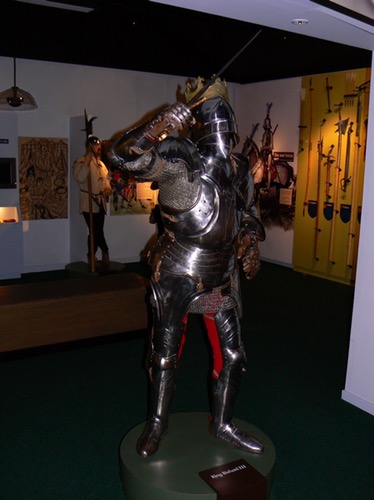
‘Nevertheless Henry held out against the attack longer than his troops, who now almost despaired of victory, had thought likely. Then, behold, William Stanley came in support with 3,000 men. Indeed it was at this point that, with the rest of his men taking to their heels, Richard was slain fighting in the thickest of the press. Meanwhile the earl of Oxford, after a brief struggle, likewise quickly put to flight the remainder of the troops who fought in the front line, a great number of whom were killed in the rout. Yet many more, who supported Richard out of fear and not out of their own will, purposely held off from the battle, and departed unharmed, as men who desired not the safety but the destruction of the prince whom they detested. About 1,000 men were slain, including from the nobility John duke of Norfolk, Walter Lord Ferrers, Robert Brackenbury, Richard Radcliffe and several others. Two days after at Leicester, William Catesby, lawyer, with a few associates, was executed. Among those that took to their heels, Francis Lord Lovell, Humphrey Stafford, with Thomas his brother, and many companions, fled into the sanctuary of St. John which is near Colchester, a town on the Essex coast. There was a huge number of captives, for when Richard was killed, all men threw down their weapons, and freely submitted themselves to Henry’s obedience, which the majority would have done at the outset, if with Richard’s scouts rushing back and forth it had been possible. Amongst them the chief was Henry earl of Northumberland and Thomas earl of Surrey. The latter was put in prison, whree he remained for a long time, the former was received in favour as a friend at heart. Henry lost in the battle scarcely a hundred soldiers, amongst whom one notable was William Brandon, who bore Henry’s battle standard. The battle was fought on the 11th day before the kalends of September, in the year of man’s salvation 1486, and the struggle lasted more than two hours.
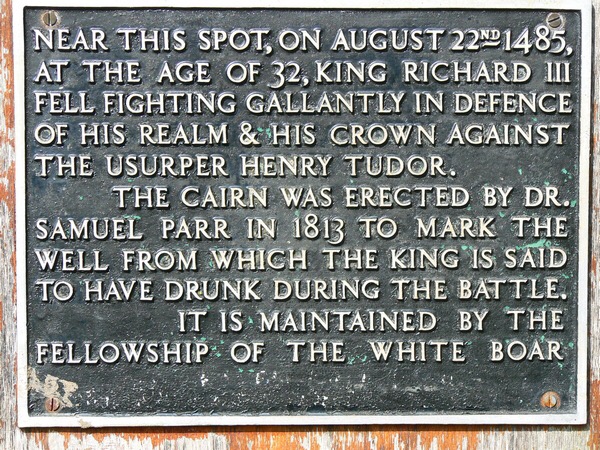
‘The report is that Richard could have saved himself by flight. His companions, seeing from the very outset of the battle that the soldiers were wielding their arms feebly and sluggishly, and that some were secretly deserting, suspected treason, and urged him to flee. When his cause obviously began to falter, they brought him a swift horse. Yet he, who was not unaware that the people hated him, setting aside hope of all future success, allegedly replied, such was the great fierceness and force of his mind, that that very day he would make an end either of war or life. Knowing for certain that that day would either deliver him a pacified realm thenceforward or else take it away forever, he went into the fray wearing the royal crown, so that he might thereby make either a beginning or an end of his reign. Thus the miserable man suddenly had such an end as customarily befalls them that for justice, divine law and virtue substitue wilfulness, impiety and depravity. To be sure, these are far more forcible object-lessons than the voices of men to deter those persons who allow no time to pass free from some wickedness, cruelty, or mischief.

‘Immediately after gaining victory, Henry gave thanks to Almighty God with many prayers. Then filled with unbelievable happiness, he took himself to the nearest hill, where after he had congratulated his soldiers and ordered them to care for the wounded and bury the slain, he gave eternal thanks to his captains, promising that he would remember their good services. In the mean time the soldiers saluted him as king with a great shout, applauding him with most willing hearts. Seeing this, Thomas Stanley immediately placed Richard’s crown, found among the spoil, on his head, as though he had become king by command of the people, acclaimed in the ancestral manner; and that was the first omen of his felicity.’

-Polydore Virgil, c. 1500. Reprinted from the Richard III Society:
http://www.r3.org/richard-iii/the-battle-of-bosworth/bosworth-contemporary-tudor-accounts/
What most people can agree:

Above- infographic of Richard’s battle wounds, courtesy of Lifescience.com
To conclude, even Shakespeare admits that Richard was a great commander, who lost the battle when his own soldiers betrayed him, and he was piteously murdered by the man who took over the crown from him. It’s a good thing that the real King Richard’s remains were discovered in 2012, and we now know more about the real man in addition to the myth.
RIP Richard.
I was going to review this movie, but I’m quite impressed by Mr. Galgren of Channel Awesome’s take on it. I think this review is a great summary of how this movie cleverly adapts Shakespeare’s play in a 20th century context, and how incredible Sir Ian’s performance is! Enjoy the review, and see the movie if you get the chance!

Here’s a lovely website designed to help you learn about Richard’s first soliloquy by interacting with Sir Ian McKellen himself!
First, a video to see it in action:
As a bonus, here’s a review of Sir Ian’s new app, Heuristic Shakespeare:

http://www.avclub.com/article/ian-mckellen-launches-app-make-shakespeare-easier–236049
This app looks incredible, listen to this satisfied customer:
So far, the only play on the app is “The Tempest,” but hopefully if enough people buy it, it’ll expand and encompass all the plays. I hope you’ll check it out!

This amazing BBC series does all of Shakespeare’s histories, and for Richard III, they cast one of the greatest young Shakespearean actors: Benedick Cumberbatch!
The Hollow Crown: Richard III
As a bonus, here is an interview with the star, explaining why the play is still relevant today:

Before we continue our exploration of Shakespeare’s “Richard the Third,” I would be remiss if I didn’t spend a little time talking a little about the real Richard Plantagenet, Duke Of Gloucester and king of England from 1483-1485. I have to get this out of the way first and foremost: although “Richard III” is classified as a history play, most of the facts in it are untrue, or severely exaggerated. In this post I will try to separate the character from the man to try and make clear what Shakespeare changed from history and why.
First, a video bio I created:
The facts are these:
-He was a real English monarch who reigned 1483-1485.
– Richard was the younger brother of King Edward IV, and helped his brother take the crown away from King Henry VI, in a series of battles known as The Wars Of the Roses.
– The battles got their name because Richard’s family (the House Of York), used a white rose as its symbol, while King Henry’s faction used a red rose.
– Like Ned Stark in Game of Thrones, Richard was the undesputed “Warden Of the North,” in charge of crushing a potential Scottish invasion.
– In April of 1483, Richard’s brother King Edward IV died. As Lord Protector of England, Richard was entrusted to take care of the country, and Edward’s two sons (the new heirs to the throne). In late May, Richard arrested three lords on suspicion of treason while he guided the two princes to London. Within one month, the two princes were publicly declared illegitimate by the Archbishop, thus making Richard the new king.
– Sometime during Richard’s two year reign, Edward’s sons disappeared. Many believe they were murdered and Shakespeare’s sources named James Tyrrell and Michael Forrest as the murderers, acting under King Richard’s orders. In 1674, the skeletons of two boys believed to be the princes were discovered in the Tower Of London. The remains were interred by King Charles II. So far, nobody has confirmed if the remains belong to the princes or what happened to the young boys.
-Richard was defeated and murdered by Henry Tudor, Earl of Richmond at the Battle Of Bosworth Field on August 22, 1485. His successor founded the House Of Tudor which included Henry VIII, Mary I, Edward VI, and Queen Elizabeth I.
-in 2015, historian Phillipa Langley discovered King Richard’s remains in a parking lot in Leicester
Few contemporary sources survive from Richard’s day, so it’s unknown whether Richard did kill the princes. Even more mysterious, although he did work to depose a king, oppress the Scots, and take the throne from Edward’s kids, some sources claim Richard was actually a just and good king. In the lack of facts, Richard’s legend continues to grow
Reality check
 -After finding his skeleton, scientists discovered that Richard was not deformed, although he did have scoliosis. Thomas Moore added the hump, while Shakespeare added the withered arm.
– There is no physical evidence that Richard killed the two princes, and many others wanted them dead, including Henry Tudor himself!
-Richard also probably was a good king according to some contemporary accounts, as you can see in this video with Monty Python’s Terry Jones:
Why were the facts twisted?
– Shakespeare’s main source was a history by Sir Thomas More, who was 12 at the time of Richard’s reign. More was Henry VIII’s royal chancellor, so he couldn’t afford to be nice to Richard either. More’s history set the groundwork for Shakespeare’s portrayal of Richard as a deformed monster.
The point is, people have known for centuries that Shakespeare’s Richard is no more true than the myth of Robin Hood. Even Laurence Olivier admits before his film even starts that this story has been “scorned in proof thousands of times.” Nevertheless, like Robin Hood, this story is part of the fabric of English society, and it still has value as a cautionary tale about corrupt governments, and how one man may lose his soul (and a horse) in pursuit of power and revenge.
Even today, people continue to gain power by manipulating fear, hatred, and religion, which is why we as a society need Shakespeare’s Richard. The play is so universal it was re interpreted in 2007 as “Richard III: an Arab tragedy.” Shakespeare’s Richard is so close to today’s dirty politicians that we have TV shows on both sides of the Atlantic inspired by him, (more on that later). And Richard himself is so compelling a character that centuries of great actors, cartoon characters, and even occasional rock stars have wanted to emulate him.
The lesson of the story is that a single demagogue can gain control of a corrupt system if we let him. Hitler, Saddam, Trump. It’s no accident that Olivier chose to play Richard right as the war was ending in Europe, and his popularity in that role rose exponentially after post war Britain saw the parallels between the “honey words” of Richard, which captivated England, to Hitler’s fiery rhetoric, which nearly destroyed it. The larger point through all four plays of Shakespeare’s history cycle, (not just “Richard III,”) is that greed and cruelty within one family can lead to chaos on a large scale, especially when it’s the royal family.
For more information:
Books:
Websites:
The Richard III Society: Official website of the society dedicated to preserving the memory of Richard III.
Historic UK: Short biographies of English Monarchs
Leicester Cathedral’s Richard III Page: http://kingrichardinleicester.com See pictures and read about Richard’s final resting place, and how his remains were found, and re-interred.
Westminster Abbey- The tomb of most English kings and queens for over 1,000 years:
http://www.westminster-abbey.org/our-history/royals?start_rank=1
 The Shakespearean Student