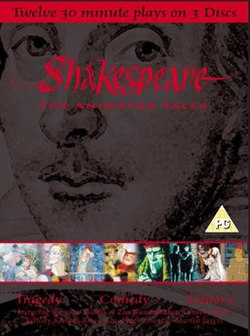
This is a 30 minute cartoon version of Macbeth originally produced for the BBC in 1992. It features Brian Cox as the voice of Macbeth (before he was the voice of McDonald’s), and Zoë Wanamaker as Lady Macbeth (before she was a witch who teaches at Hogwarts).
I like the way it portrays the horror imagery of the play in sort of a European-manga animation hybrid. Admittedly, there are better ones in the series, but this one is still pretty neat.
DVD box art for “Shakespeare the Animated Tales.”
To check out other episodes in the series, view this playlist:
While I’m gearing up for my course on Shakespeare’s tragedies, I’m gathering resources to explain what tragedy is and why it’s important, and you can’t talk about tragedy without talking about Aristotle’s Poetics, the first major work of theater criticism that has influenced writers and critics for 2,000 years. It also inspired “pity and fear” from anyone who ever had to write a paper about it!
As you can see from the crash course video above, Aristotle helped define what makes something a tragedy, what elements good tragedy possesses, and props up Sophecles play Oedipus as the ideal example of tragedy. This was also the play that influenced Hamlet,Titus Andronicus, Julius Caesar, Coriolanus, and many others.
Tragedy, then, is an imitation of an action that is serious, complete, and of a certain magnitude; in language embellished with each kind of artistic ornament, the several kinds being found in separate parts of the play; in the form of action, not of narrative; through pity and fear effecting the proper purgation of these emotions. By ‘language embellished,’ I mean language into which rhythm, ‘harmony,’ and song enter. By ‘the several kinds in separate parts,’ I mean, that some parts are rendered through the medium of verse alone, others again with the aid of song.
Every Tragedy, therefore, must have six parts, which parts determine its quality—namely, Plot, Character, Diction, Thought, Spectacle, Song. Two of the parts constitute the medium of imitation, one the manner, and three the objects of imitation. And these complete the list. These elements have been employed, we may say, by the poets to a man; in fact, every play contains Spectacular elements as well as Character, Plot, Diction, Song, and Thought.
Aristotle, The Poetics, c. 3rd century BCE
Translator: S. H. Butcher Release Date: November 3, 2008 [EBook #1974] Last Updated: January 22, 2013. Gutenberg.org.
Full text of Aristotle’s Poetics, (Project Gutenberg)
If you’d like to hear me analyse the poetics and explain how it applies to Shakespeare, sign up for my class on Shakespeare’s tragedies. Get $10 off my class “Shakespeare’s Tragedies: The Fates of Men and Nations” with coupon code HTHESG5B2Q10 until Dec 31, 2022. Get started at https://outschool.com/classes/shakespeares-tragedies-the-fates-of-men-and-nations-xKCYUkC9 and enter the coupon code at checkout. If you’d like to hear me analyze the poetics and explain how it applies to Shakespeare, sign up for my class on Shakespeare’s tragedies. There’s a $10 discount for anyone who uses this coupon code:
In this 9 week course, students will discover Shakespeare’s greatest characters- Hamlet, Othello, Macbeth and others through games, dramatic readings, and interactive projects! -The class is designed to be ala carte- you can learn about all these plays, choose a specific play to focus on, or do the entire course. Each class will have a game of some kind, an engaging quiz, and a short explanation of the setting, characters, and motifs of one or more plays. Each class will also include a close reading of a famous speech.
Course Structure
Background on the Tragedies- the Wheel of Fortune
I will explain the basic structure of Elizabethan tragedies and the concept of Fortune, which is a motif Shakespeare uses in all of his tragedies. I will also debate the concept of “The Tragic Flaw:” the notion that otherwise good people are brought down by single character flaw. Finally, we will quickly summarize the premise behind all 11 of Shakespeare’s tragedies.
I will summarize Shakespeare’s two tragedies that are set in ancient Greece and provide commentary on their themes and ideas. I will also draw parallels between the Ancient Greek tragedies of Aeschylus and Euripides and Shakespeare, with a particular emphasis on the Greek philosopher Aristotle’s beliefs on the function of tragedy, which influenced every major drama for the last 2,000 years.
The Roman Plays- From Republic to Empire
We will take a bloody, backstabbing journey to ancient Rome, and discuss how Shakespeare shows through these four plays the dissolution of a republic into an empire. We will discuss the themes of democracy, dictatorship, mob rule, and savagery. Plays covered: Coriolanus, Julius Caesar, Antony and Cleopatra, and Titus Andronicus.
In addition to the character and his speeches, I’ll draw parallels to the history behind the play, including witchcraft in the Jacobean era, and the Gunpowder plot against the king!
“Othello”- The Lovers and the Devil
I will talk about how Shakespeare dramatizes race and prejudice in the context of Othello’s struggle with prejudice and his own jealousy.
“King Lear”- The Blind Fools and the Hermit
I will discuss the complex plot of Shakespeare’s tragedy about old age, blindness, betrayal, and families ripped apart by greed.
I will teach the students to think like a director and develop a concept for the characters, set, lights, etc. I’ll also briefly take you through famous productions of these great tragedies by the Royal Shakespeare Company and others.
Basics Of Stage Combat: Students will learn the basics of safely enacting a fight onstage, in preparation for a Shakespeare play. We will also learn about the history of sword fighting in the military and the duel.
Trailer for Basics of Stage Combat.
My daughter really enjoyed taking this class. She was actually able to use her sabre and try out her routine on her father. Paul is quite knowledgeable about Shakespeare and made the class really fun by teaching a fight scene from Romeo and Juliet. It is amazing watching her practice with Paul over Zoom. I hope Paul will have. more combat classes, it is a different way to learn Shakespeare.
IB, Parent
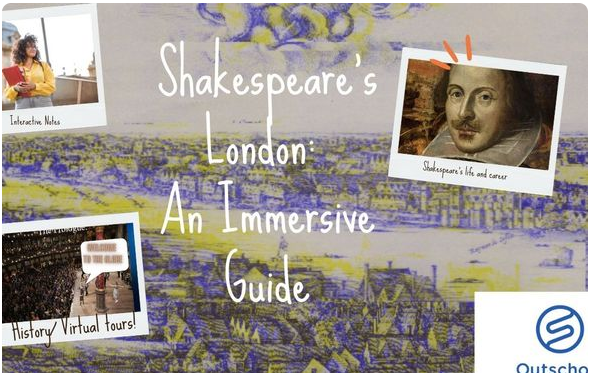
An Interactive Guide To Shakespeare’s London (New Class)
A virtual tour of Shakespeare’s London will get kids to interact with the culture of Elizabethan England.
Class Experience
To teach kids about the Elizabethan era and the background of Romeo and Juliet, The Instructor will interact with the class (via pre-recorded videos), pretending to be Shakespeare. The class, pretending to be actors in Romeo and Juliet, will get a virtual tour of The Globe Theater, Hampton Court Palace, and a virtual visit to an Elizabethan doctor's office. This activity is an immersive way for them to learn about the period, how it relates to the world of the play, and how Shakespeare changed theater.

The class will take the form of a guided WebQuest activity.  First, the students will get a worksheet that has a series of fill-in-the-blanks about Elizabethan society (below). The students will fill out this worksheet based on a Nearpod and in conjunction with a website I’ve made, https://sites.google.com/nebobcats.org/visit-to-elizabethan-london/home?authuser=0
Both the Nearpod and each webpage will have a virtual tour, a video, and text explaining some aspects of Elizabethan life. Before they go to each location, I will give a short introduction via prerecorded video:
Wizard Science
In this one-hour course, your child will discover the enchanting world of science through a series of magical experiments. Learn about such topics as Astronomy, Static Electricity, chemistry, and optical illusions.
In this one-hour course, students will learn and play games that will explore the history behind Christmas traditions. We will also discuss the themes, characters, and famous quotes from Shakespeare’s play “Twelfth Night.”
Since “Macbeth” is my Play of the Month, I’m offering a discount for my online class on the play. You can get $5 off my class “Macbeth: An Immersive Learning Experience” with coupon code HTHES6G3YH5 until Nov 4, 2022. Get started at https://outschool.com/classes/macbeth-an-immersive-learning-experience-xGKHeHgH and enter the coupon code at checkout.
To learn more about the class, watch the trailer above, and read my description of the escape room:
Geraint Wyn Davies as “Macbeth”Darren’s “Chess PawnOliver plays Banquo’s Ghost
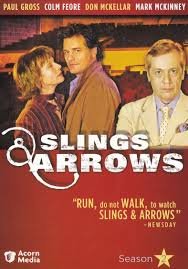
Slings And Arrows is a Canadian sitcom about a theater festival loosely based on the Stratford Shakespeare Festival in Ontario. Its hero, Geoffrey Tennant (Paul Gross), in addition to dealing with the seemingly endless problems (or should I say, “Slings and Arrows?”) mounting a Shakespeare play, is also worried he’s going mad, since he keeps seeing the ghost of his old mentor/ director Oliver Wells (Stephen Ouimette). For a recap of Season One, click here to read my review.
The premise of the Series
I describe this show as a funny, tragic, bittersweet comedy about drama. It’s The Office for Shakespeare Nerds!
Season 2 Retrospective
Whereas Season One was sometimes extremely dramatic and raw, Season Two is much more relaxed; it feels a little bit more like The Office for Shakespeare nerds. Each episode focuses much more on the work-a-day frustrations of running a theater. We see it through multiple perspectives and even multiple shows- we see one director not being able to complete Romeo and Juliet, we see another trying to cast for Pirates of Penzance, and finally we see Geoffrey trying to fulfill Oliver’s posthumous concept for Macbeth.
“You just need to sell more tickets.”
“It’s not that simple, we’re talking about THEATER!”
Season Two doesn’t just focus on the artistic side. The theater is going broke, and Richard is begging for money from sponsors and the government. Susan Coyne as the overworked Executive Assitant Anna also has her hands full taking calls, organizing the schedule, and of course her new additional frustration with the internship program.
Grace Lynn Kuhn as Emily sobs contritely in front of Geoffrey (Paul Gross)
This particularly made me laugh the first time I saw the show because at the time, I was interning for the American Shakespeare Center. I know what it’s like to feel like if you’re out of your depth but excited, thinking that this is going to be your big break, (while also being keenly aware that your job is mostly obviously getting coffee and writing notes in the prompt book). I have to give a shout-out to Grace Lynn Kung who plays intern Emily Wu; she does a great job of portraying this mixture of anxiety and youthful desire to please.
To be brief, this season has a much greater level of authenticity and realism that shows the series graduating from a soap opera into a real workplace comedy.
The Cast
Paul Gross as Geoffrey Tennet
In the first three episodes, Geoffrey is afraid to put on Macbeth because he thinks that Oliver will come back. Just like Season one, Geoffrey is still not sure whether Oliver is actually a ghost or is actually a manifestation of Geoffrey’s madness. As he continues to work on the production, he and Oliver quarrel as conflicting directors, and their private struggles as friends and colleagues even spill over into rehearsals, which threatens the production itself.
Gerand Wynt Davies as Henry Breedlove
Geraint Wyn Davies as Henry Breedlove, onstage as Macbeth
The main curse in this production is the old guard of actors who are threatened by Jeffrey’s leadership; they got used to Oliver’s more relaxed style and they do not want Geoffrey shaking things up. Chiefly among them is Brian Cabbott and Henry Breedlove played by Geraint Wyn Davies, (who is really a classically trained actor from the Royal Shakespeare Company). Brian starts out by playing Claudius in Hamlet in the tail end to Season One. He’s disrespectful to Geoffrey and criticizes him to his face. Like Prince Hal dismissing Falstaff, Geoffrey dismisses Brian from the company.
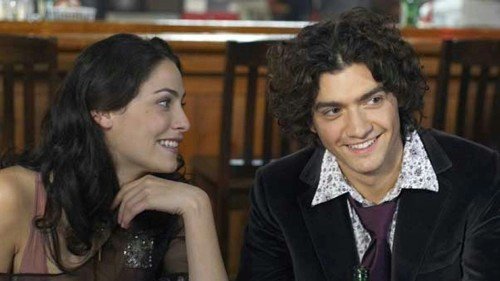
One theme of Macbeth that is echoed again and again in Season two is middle-aged people feeling threatened by the young. It’s shown in Geoffrey’s clashes with Henry and Brian, with Richard being seduced by the hotshot young marketers at Froghammer, and especially with Darren Nichols, who is forced to direct Romeo and Juliet, and clashes with the young and idealistic Sarah (Joanne Kelly). She gives a passionate performance both as Juliet and as a young actress who desperately wants to do her best, and actually asks Geoffrey to direct her behind Darren’s back, as this adorable scene illustrates:
What’s great about this scene is it doesn’t just set up the star-crossed romance between Sarah and her costar; it also cleverly points out the similarities between Macbeth, and Romeo and Juliet. As you see at the end, Geoffrey is inspired by Sarah’s performance and it carries over to how he directs Henry and Ellen in Macbeth. Both couples are impulsive and reactive- they love pitting themselves against the world, and that is one reason why their affairs end in tragedy. Many scholars echo this interpretation, that if Romeo and Juliet had lived, they might have become the Macbeths. Seeing the balance between backstage drama, clever Shakespearean commentary, brilliant Shakespearean acting, and workplace comedy is at the heart of why this show works, and it’s handled masterfully in each and every episode of Season 2.
My favorite episodes
Episode 1: Season’s End
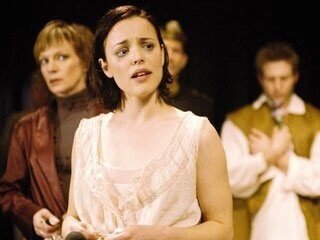
The Departure of Rachel McAdams As Kate
Rachel McAdams as Kate playing Ophelia in Season 1.
In the first episode, there is the tearful goodbye of Luke Kirby and Rachel McAdams, mirroring the fact that, as big Hollywood stars the two of them were unable to continue for a second season, even though everyone involved from the cast to the creators wishes they could. The life imitates art aspect of this episode makes it particularly tearful and sad to watch and yet it is a thoughtful and deeply well-earned sendoff.
Episode 2: Fallow Time
One of my favorite episodes is technically the Christmas episode of the show, and as such, Oliver gives Geoffrey a gift- he leaves him costume sketches, set designs, and notes on the play’s concept, which the ghost of Oliver explains in detail to Geoffrey and the audience. Maybe this kind of glimpse into the nitty gritty of theatrical concepts will only appeal to theater nerds, but I truly love it.
Episode 4: Fair Is Foul and Foul is Fair
While all the drama onstage is going on, Anna is getting some romantic attention from a playwright, unaware that (SPOILER ALERT), he’s using her for ideas for his script. In a way, this subplot shows us another aspect of Macbeth and Romeo and Juliet; in both these stories, the men use women for their own gain. Romeo arguably is using Juliet to play out his romantic fantasies, and Macbeth certainly depends on Lady Macbeth’s courage and cunning in order to go through with their plan to kill the king. Not surprisingly, all three romances end in tragedy.
Meanwhile on the stage during Macbeth rehearsals, Geoffrey is trying to get an organic, serious performance out of Henry, but he thinks he knows more than his director so Geoffrey has no choice but to fire him as he did Brian.
Episode 5: Steeped In Blood
S
In this episode Geoffrey puts the lovable understudy Jerry onstage as Macbeth. What’s interesting in this episode is, while Henry plays Macbeth as a larger-than-life soldier, Jerry plays him as sort of an everyman, letting himself be seduced by power and delusions of grandeur. Looking back, I actually owe a lot to this episode, since it helped inspire my own interpretation of Macbeth.
Episode Six: Birnam Wood
If I were going to pick one episode of Slings And Arrows for the time capsule, one episode of the show to stick up against every other show ever made, it would be “Birnam Wood.” I don’t honestly know if this is the best episode of the show—the series finale proper is probably that—but it’s my favorite episode of the show. It makes me cackle with delight, thrill with excitement, and smile with sympathy every time I watch it.
The season finale gives us a fully formed version of Macbeth and Romeo and Juliet: we get to see the designs, the technical rehearsals, the marketing, everything that the whole season was building up to into, not one but two complete theatrical performances!
First, Geoffrey cooks up an elaborate scheme to touch Darren’s heart and get him to scrap his cynical concept for Romeo and Juliet.
Geoffrey tricks Darren into re-directing “Romeo and Juliet”
As you can see, the scheme works, and Darren has an epiphany during tech rehearsals.
Darren has an epithany during tech for “Romeo and Juliet.”
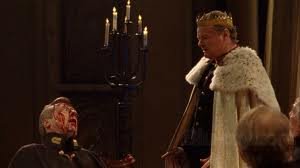
In the show’s climax, for 20 minutes we get to see Henry perform as Macbeth and Ellen as Lady M. Geoffrey reluctantly re-hires Henry, but he refuses to let him walk all over him or his production. I won’t go into spoilers, but let’s just say Henry finally learns his lesson, with a little help from Oliver:
As I said last time, anyone who’s ever had a boring office job loves and recognizes the characters from “The Office,” while those of us in the theater recognize the crazy directors, the hopeful understudies, the divas, and the money-grubbing management. What’s great about this season is that, while Season one focused on them all broken apart, this season has them all coming together, using their talents to put on two excellent shows. After seeing the characters grow and change professionally and personally, we feel like proud parents and this fictional theater company feels more like a family, but any family can be broken… stay tuned.
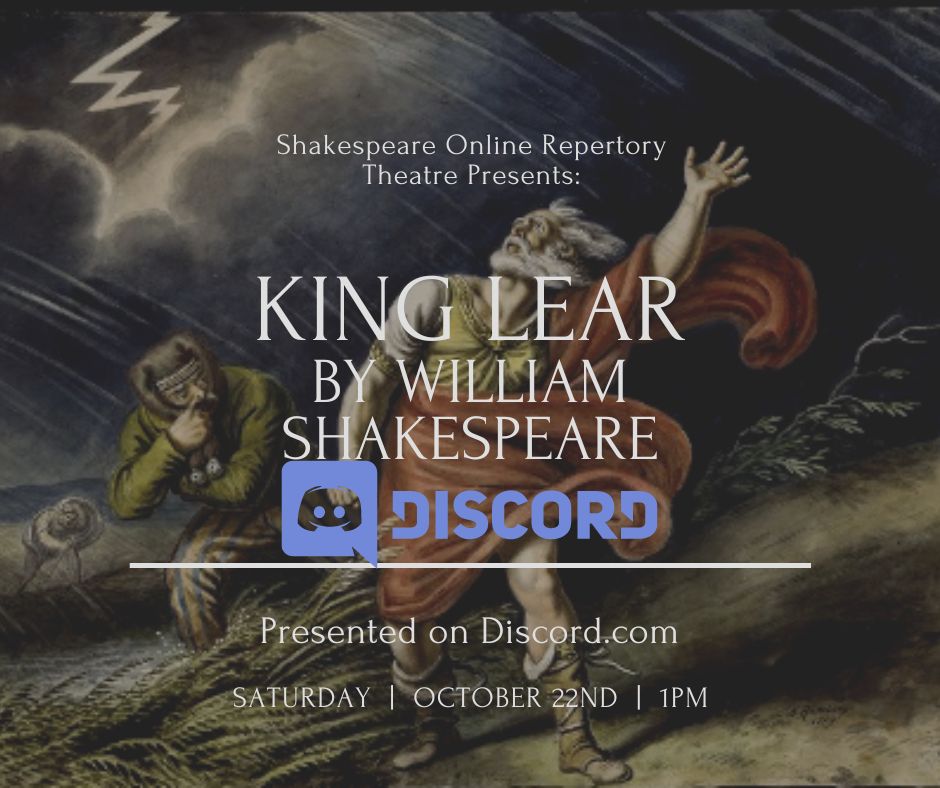
On October 22nd at 1PM EST, I’ll be joining the Shakespeare Online Repertory Theatre on Discord for an online dramatic reading of “The Tragedy of King Lear.” I’ll be playing The Earl Of Kent! Check it out on Discord.com! Below is also a link to a YouTube live stream of the show as well.
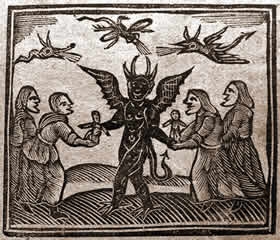
Woodcut from the witch trial of 1597, in which witches supposedly tried to drown King James I.
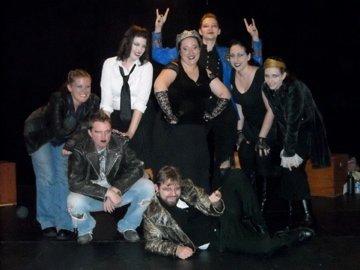
Me and the cast of “Macbeth,” 2009.
Guy Fawkes Day
Official logo of “Sleep No More”
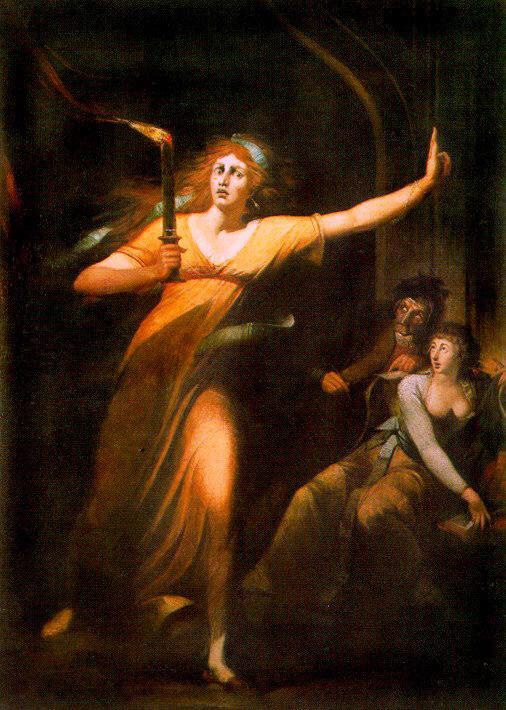
For the spookiest and most cursed month of the year, I’ve chosen Shakespeare’s Macbeth as my play of the Month for October because it’s full of witches, ghosts, and other supernatural creatures. It also shows the terrible effects of fear on people’s minds. Plus, as I explained in my post on Shakespeare and Halloween, most Halloween witches would be all but silent without Macbeth’s witches.





















 The Shakespearean Student