“Let us sit upon the ground, and tell… THE MOST MESSED UP, MACABRE, EVIL SHAKESPEARE STORIES EVER!”
I have three macabre stories that are 100% true relating to Shakespearean plays, just in time for Halloween!
Lithograph of a demon tempting John Wilkes Booth, created by John McGee in 1865.Tale #1: Life Assassinates Art. Everyone knows John Wilkes Booth was an actor who murdered President Abraham Lincoln at Fords Theater, on April 14th 1865. However, not too many know that he was a Shakespearean actor, and that his experience with the Bard’s play of Julius Caesar, might have encouraged Booth’s murderous hand!
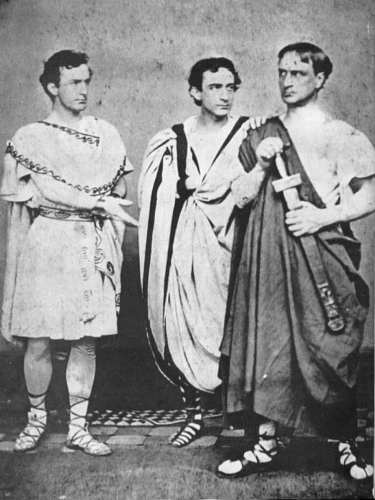
The whole Booth family were a Shakespearean theatrical dynasty; John Wilkes and his two brothers, Edwin and Junius-Brutus Booth Jr were professional actors. The three brothers only appeared together onstage once: in a benefit performance of Julius Caesar- which as you know from my previous posts, is a play where the noble Roman Brutus becomes the head of a conspiracy to assassinate a dictator in the name of peace and freedom. Booth’s father coincidentally was Junius Brutus Booth, and many scholars suspect that Brutus’ son might have taken inspiration from this ancient Roman assassin. In John Wilkes Booth’s mind, Lincoln was a tyrant oppressing the south, and it was up to him to “nobly” sacrifice himself for the good of the Republic.
Photo from the 1864 benefit performance of “Julius Caesar,” starring John Wilkes Booth, Edwin Booth, and Junius Brutus Booth Jr (left to right).In the photo on the left, you can see the three Booth brothers onstage as Julius Caesar. In a true twist of fate, John Wilkes did not play one of the conspirators Brutus or Cassius, (who stab Caesar in the back), but Marc Antony, the man who spoke for Caesar at his funeral and incited all Rome to avenge his murder. Five months after this photo was taken, Booth shot Lincoln onstage at Ford’s Theater, and shouted in Latin: “Thus shall it be to all tyrants.”
And the Julius Caesar parallels don’t stop there: just as Caesar’s wife had dreams predicting his murder, President Lincoln was haunted by dreams that warned him of his own death which he told his own wife, Mary Todd Lincoln. Days before the assassination, Lincoln himself had a terrifying vision:
“About ten days ago, I retired late. I soon began to dream. There seemed to be a death-like stillness about me. Then I heard subdued sobs, as if a number of people were weeping. I thought I left my bed and wandered downstairs. There the silence was broken by the same pitiful sobbing, but the mourners were invisible. I went from room to room; no living person was in sight, but the same mournful sounds of distress met me as I passed along.
“It was light in all the rooms; every object was familiar to me, but where were all the people who were grieving as if their hearts would break? I was puzzled and alarmed. What could be the meaning of all this? Determined to find the cause of a state of things so mysterious and so shocking, I kept on until I arrived at the East Room, which I entered. Before me was a catafalque, on which rested a corpse wrapped in funeral vestments. Around it were stationed soldiers who were acting as guards; and there was a throng of people, some gazing mournfully upon the corpse, whose face was covered, others weeping pitifully.
” ‘Who is dead in the White House?’, I demanded of one of the soldiers.
” ‘The President’, was his answer, ‘He was killed by an assassin.’
“Then came a loud burst of grief from the crowd, which awoke me from my dream. I slept no more that night; and although it was only a dream, I have been strangely annoyed by it ever since.” (reprinted from http://www.prairieghosts.com/a_lincoln.html).
The tragic tale of Lincoln mirrors in many ways the assassination of Caesar, a man who to some was a tyrant and to many was a savior. Surely few other moments from history demonstrate Shakespeare’s poignancy, in a more gruesome and macabre way.
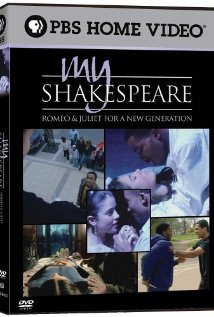
On this page, I review a Shakespeare book, movie, or TV show that I feel has some kind of value, either as an interpretation of Shakespeare, or a means to learn more about the man and his writing. This post will introduce you to an incredible documentary, and in my view one of the best ways to encourage, excite, and challenge young people reading Romeo and Juliet Aptly titled, it is called, My Shakespeare.
Name:My Shakespeare
Year: 2004
Director: Michael Waldman
Ages:PG for frank discussions of violence, and occasional suggestive language.
Media:Full length documentary, (available on Amazon and Netflix DVD)
Recommendation: I’d recommend this to high school and college students, as well as all theater teachers and practitioners. A word of caution though- nearly everyone in the documentary speaks with various British accents (from posh London to poor Harlesden), and thus if you think your class might not be able to understand foreign accents, you might want a different version, or put on the subtitles.
Premise: Director Patterson Joseph is a man on a mission- to prove that the people in his home town, (the poor, violence-ridden town of Harlesden England), that these same people can and will put on a production of Romeo and Juliet, in just four weeks. The cast has never acted before, and Patterson sometimes has to drag them kicking and screaming into rehearsals, but eventually they all learn that putting on a Shakespeare play can become an extremely personal experience. In the beginning, they are attempting Shakespeare, but by the end they live it. In between the action, there are interviews with Baz Luhrman, the celebrated director of the Leonardo Dicaprio film version of Romeo and Juliet back in 1996. Baz serves as a sort of chorus, explaining some of the challenges a director like Patterson will inevitably face as he and his actors bring the play to life.
Repeated Ideas That Run Through the Documentary:
You can do this- you can act, you can understand Shakespeare, you can finish something, you can show emotions, and you can direct.
Shakespeare is able to tell stories that appeal to everyone, and here’s the proof.
The best way to understand Shakespeare is to get on your feet and do it.
Moments to watch for: Before I list my favorite moments in the documentary, I’d like to list the theatrical process by which Patterson and his company put on Romeo and Juliet.
The Process Of Creating Romeo and Juliet:
Auditions/ ImprovGames (4 weeks to go)
Table Work, where the actors read the script and talk about their characters.
Paraphrasing the script and improv (9 days to go)
Stage combat Rehearsals- prepping the fights.
Opening Scene rehearsal on a basketball court.
Vocal Rehearsal
The Emotion Workshop (8 days to go) The actors try to tap into their own emotions to try and bring some real feelings into their parts.
Death Scene Rehearsal in a Graveyard!
Last minute changes (5 days to go)
Globe theater rehearsal
Nighttime Balcony Scene Rehearsal at the aptly named, “Shakespeare Road.”
Tech Rehearsal at the Royal Academy Of Dramatic Arts.
Speed Through Rehearsal/ The final rehearsal (1 day to go)
Performance at the Royal Academy Of Dramatic Art
Now a look at some of my favorite parts of the documentary.
The audition/ casting scene- In this scene you watch the future cast members explore the story of the play through improvisation, then you see their background through a series of headshots and dossiers. The whole cast is more diverse than any West End production: black, white, Christian, Muslim, young people and old people. Patterson’s casting choices alone makes this production fresh and relevant to our shrinking little world. A few cast members are refugees that came to England because of their countries’ own family feuds in Somalia and Afghanistan. Even more striking, Romeo and Juliet are very young- 18 and 22 respectively, which gives their love scenes an amazing truth and honesty. At first they think they have nothing in common with their characters, but in reality they have even more in common than most of us who read Romeo and Juliet.
The table work scene where the cast learns about their characters You see Mustafa as Mercutio learn that Shakespeare can be funny, you see Jonathan as Romeo learn that some of Shakspeare’s words are still used today, and you see Muska just start to flirt with the idea of playing Juliet.
Jonathan’s Story- Unlike most actors who have played Romeo, Jonathan Thomas has been in a real fight, and he describes it in brutal detail, even showing the scars he got from his stab wounds. Hearing his story gives his performance a truth and poignancy that I’ve never seen in any other version.
The Balcony Scene Rehearsals- In this documentary the two leads perform the scene many times, in rehearsal where they talk about how hard it is to play love realistically, in Shakespeare’s Globe, where they see how it was done in Shakespeare’s day, in a modern balcony back in Harlesden, (on the appropriately named “Shakespeare Road,” and at last in the final performance. Few documentaries show just how hard it is to do a Shakespearean scene, particularly if it’s famous, and how many different ways a director and a pair of talented actors can play it and find new things each and every time.
The scene where Patterson lets one of the actors go. Everyone in this production has to overcome obstacles, even the director; when one of his actors fails to perform, he simply has to drop the axe and recast one of his lead roles. Theater is hard work, and just like any job, the director has to take control and do what is necessary to make sure that the production is a success.
Rehearsal at the Globe Theater On one very special day, the actors step onto the stage of the reconstructed Globe, and take a few tentative steps into the 1500s. Once in the space, they take to it like fish to water, playing with the audience, playing with projection, and their lines are infused with a special kind of energy that only arises from the boards of an Elizabethan stage. I found it interesting that when Jonathan was talking to Mark Rylance, the artistic director of the Globe, he asks what kind of man Shakespeare was, because he’s starting to see Shakespeare as a peer!
My reaction: This documentary gives me hope every time I see it. Over and over again Patterson instills in his cast the idea of “Yes, you can,” yes, these people can understand Shakespeare, yes they can learn their lines, yes they can act, yes they can do something intelligent, and moving, and honest, and beautiful and what better play to bring that message across than Romeo and Juliet, which is full of youthful energy and excitement. My only complaint is the interviews with Baz Luhrman don’t really add much to the documentary side of things; Luhrman was really only there for name recognition, and he certainly knows less about Shakespeare than the RSC veteran Patterson. Nevertheless, the whole documentary Is nothing short of inspiring from beginning to end.
Notable cast members
Muska Khpal as Juliet. An 18 year- old Afghan refugee who came to England in 1996, without even speaking English, now playing one of the greatest characters in English literature! Like Juliet herself, Muska has very strict parents (who didn’t approve of her playing the part), and is at first is extremely shy towards Romeo, toward the play, and even the director, but when you hear her talk about her dream to return to Afghanistan and become a doctor, you can sense Juliet’s strength and independence.
Jonathan Taylor 22 year-old Jonathan is a very charismatic and intelligent young man. After this production he became a professional actor. He speaks articulately about the experience of acting for the first time, reading Shakespeare for the first time, and even his own experiences with love and violence on the streets of Harlesden. He is also very talented and speaks the lines with an effortless panache. I found myself rooting for him the whole time, and the fact that I got to see this production spark his interest in acting and then to see him change and grow was truly inspiring.
Mustafa as Mercutio Tiny, sparkle eyed Somali refugee. He is truly Mercurial- he frequently jokes and kids with the cast, yet at the same time, he is deathly serious when he talks about his life in Somalia- seeing people die in front of him. When he dies onstage, you know his performance is drawn from some real world experience.
If you’ve read any of my last four posts, hopefully I gave you some insight as to the literary sources of Shakespeare’s Romeo and Juliet, and a little bit of what Shakespeare accomplished in writing the play, so now I’d like to focus on what was going on when Shakespeare wrote it; what was going on in his own life and his career. Unfortunately, nobody knows when Shakespeare’s company first performed Romeo and Juliet, but since it was published in 1597, it must have been written sometime between 1593, and 1596.
Above- Video Bio of Shakespeare by me!
In 1593, Shakespeare was in a bit of a creative slump; all the London theaters were closed down, thanks to an outbreak of Bubonic Plague Shakespeare knew intimately the pain, fear, and heartbreak that plague could bring- At age 7, he saw his sister Anne die in April 4, 1579. Anne Shakespeare was 8 years old.
In addition, Shakespeare had gained success from his four English history plays,, but great tragedy had never been his forte. In fact, although he was a commercial success, Shakespeare wasn’t respected much in his own artistic community. In 1592, Robert Greene, a well-known smarty-pants dramatist in 1593, saw that his plays were getting passed over by theatre goers in favor of Shakespeare, who was an uneducated ACTOR!!! This set Greene’s teeth on edge, and he published an insulting pamphlet which slyly satirizes Shakespeare as:
“An upstart Crow, beautified with our feathers, that with his Tygers hart wrapt in a Players hyde, supposes he is as well able to bombast out a blanke verse as the best of you: and being an absolute Iohannes fac totum, is in his owne conceit the onely Shake-scene in a countrey
-Robert Greene, Greenes, Groats-worth of Witte, Bought With a Nillion Of Repentance (with original spelling) [1592].
More criticism ensued from Shakespeare’s distant relative, a poet and Jesuit missionary named Robert Southwell. Because of his Catholic beliefs, Southwell was an outlaw and a traitor to the Queen, yet he continued to try and convert England back to Catholicism with everything he did and wrote. Somewhere between his secret arrival in England in 1586, and his capture, torture, and execution in 1595, Southwell wrote a dedicatory essay addressed “To my poet cousin, Master W.S,”
the text of the title page is reprinted below:
Worthy Cousin, Poets by abusing their talents and making the follies and fainings of love the subject of their base endeavors, have so discredited this faculty (ability) that a poet, a lover, and a liar are but three words of one signification.
Southwell’s speech strongly echoes the speech Shakespeare gives to Theseus in his play A Midsummer Night’sDream, especially the comment where Theseus claims “The lunatic, the lover, and the poet are of imagination all compact.” We don’t know how much influence Southwell had on Shakespeare, but in any case, it’s clear that around 1593, Shakespeare was trying to establish himself as a true Renaissance writer, which meant writing great poetry and not just crowd-pleasing histories full of blood and gore.
So Shakespeare had to face two great challenges- to defend his art from his detractors, and to make a living without the theatre in a time of plague. To pay his rent, he took a job writing poetry for the Earl of Southampton, Henry Wriothesley (pronounced “Rizely,” left). By all accounts, the Earl was a spoiled, vain pretty- boy who loved patronizing poets. To please Wriothesley, Shakespeare composed two long epic poems, “Venus and Adonis,” and “The Rape Of Lucrece,” classical stories inspired by Shakespeare’s favorite Roman poet, Ovid.
According to The Poetry Foundation, a lot of the themes and language devices Shakespeare employed in these two poems contributed greatly to Romeo and Juliet. Most notably, Shakespeare’s use of the concept of forbidden love, his creation of strong, tragic heroines who conquer their predicaments in their deaths, Shakespeare’s use of paradox to describe impossible situations, and perhaps, in the case of Adonis, a model for the character of Romeo:
it features an innocent hero, Adonis, who encounters a world in which the precepts he has acquired from his education are tested in the surprising school of experience. His knowledge of love, inevitably, is not firsthand (“I have heard it is a life in death, / That laughs and weeps, and all but with a breath.”
In these two poems Shakespeare was refining his craft, and examining questions about the nature of love. In Venus and Adonis, the title characters explore love as a giddy romp through the forest, but their relationship ends with a tragic accident when a wild boar kills Adonis. In The Rape Of Lucreece, Shakespeare shows the destructive quality of male desire, and the nobility of self-possessed women. I think that Romeo and Juliet would not have existed without Shakespeare making a meditation on his craft, on the nature of love, and the fragility of human life.
Shakespeare’s Romeo and Juliet
As you saw from my post last week, Romeo and Juliet wasn’t a new story- it had appeared as a poem in 1587 and in several versions before that. When Shakespeare adapted the story, he used his new-found powers of poetic language to make the story more alive, more beautiful, and to make the characters more complete.
What Did Shakespeare Do Differently With His Version Of the Story?
Plot- Generally, Shakespeare keeps the same plot as the poem version of the play, but compresses characters, times, and speeds the action along faster.
Shakespeare compresses the story to 5 days, making the love affair even more passionate and volatile.
He changes the Capulet’s feast from a Christmas celebration to a summer’s feast, making the time of year hot and dangerous.
He makes Juliet 13 instead of 16 as she was in the poem.
He makes Peter Capulet’s servant, instead of Romeo’s.
Themes- Shakespeare, more than most poets who have interpreted this story, refuses to put the blame squarely on Romeo and Juliet, which is why he invents thematic devices to put the blame on chance, fate, or possibly an angry God.
Plague Themes– In the 16th century, plagues were viewed as a consequence of angering God. The fact that Mercutio curses the two warring families with “A plague on both your houses,” suggests that the lover’s deaths was a just punishment from God, or at least a horrible instance of random chance.
Importance of Fate- Romeo and Juliet are first described as “Star-crossed lovers,” which means their destinies are intertwined, and determined by an unlucky star, (like being crossed by a black cat). In addition, Medieval and renaissance poets often invoked the goddess Fortuna, who guides people’s destinies and controls whether they have good fortune or bad fortune. Some said this destiny was written in the stars, as Romeo angrily denounces after he hears of Juliet’s death:
“Is it even so? Then I DEFY you stars!”
Shakespeare uses these thematic devices to make the fates of Romeo and Juliet less clear and more open to interpretation. Without a clear-cut moral, Shakespeare’s audiences could make up their own minds.
The Language Of Romeo and Juliet
Steven Greenblatt, editor of the Norton Anthology of Shakespeare’s plays, points out the amazing variety of wordplay and language devices in Romeo and Juliet, which Shakespeare employs to allow characters to insult each other (like verbal artillery), to curse, to mock, to impress, and in the case of Romeo and Juliet themselves, “To create a new Heaven and a new Earth” (Norton, 889). Romeo and Juliet are unable to be together due to their feuding families, so through poetic imagery they turn their situation into paradise and turn each other into gods. Romeo turns Juliet into the Sun, the force that sustains all life on Earth, and Juliet asks God to:
Take him and cut him out in little stars,
And he will make the face of heaven so fine
That all the world will be in love with night
And pay no worship to the garish sun (R&J III.i).
Antithesis-To characterize the powerful and contradictory forces at work in the hearts of the characters, Shakespeare frequently has them speak using antithesis- putting two opposite terms next to each other, such as in the phrase,“Why then, O brawling love, O loving hate, O anything of nothing first create” (R&J, I. i).
One big way Shakespeare uses antithesis is the repeated imagery of night and day. Night stands for beauty, danger, love, and hidden love, as in the example from Act III above, and from the phrase: “I have night’s cloak to hide them from my eyes,” from the Balcony Scene. Day on the other hand, is associated with fighting, unpleasantness, and rudeness, like in the example above, where Juliet describes the Sun as “garish” or rude. In fact, the first time the word “day” is used in the play, Shakespeare follows it with the rhyme, “fray,” which immediately sets up how the day means hotblooded violence.
One final example occurs in Act IV, Scene v, where Romeo has slipped into Juliet’s bedroom during the night, where Romeo laments how, as it comes closer to day time, the time for him to leave draws near:
JULIET: O, now be gone; more light and light it grows. ROMEO More light and light; more dark and dark our woes!
I could go on talking about Shakespeare’s literary devices, but the important thing is that, to establish himself as a great Rennaisance poet, Shakespeare put his love of language in this play more than he had ever done before, and it shows in every line.
What was the first performance like?
Above is the trailer for a production of Romeo and Juliet at the re-built Globe Theatre in 1999, which illustrates how this production relied thoroughly on the imagination of the audience.
Just like us at Open Air Shakespeare NRV, the first production of Romeo and Juliet was outdoors during the afternoon, (we know from the records of the time that plays took place about 2PM most of the time).
There were minimal props and scenery, no lighting and few sound effects, and the actors were able to talk directly to the audience.
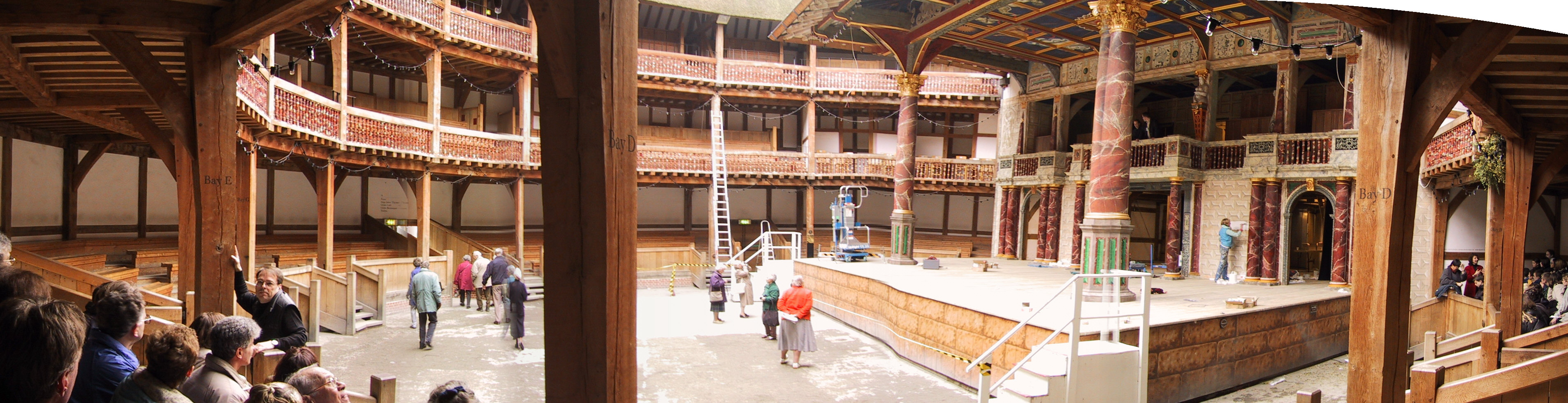
Another important thing about Elizabethan performance is the multiple levels of the audience. As you can see, audience members can stand on a semi-circle around the stage. These audience members were called “groundlings,” and they paid a penny to stand through the show. For another penny, audience members sat on wooden planks like the people in the foregrounds. The upper galleries were a little less expensive, since they were further away from the stage, and the most expensive seats of all were The Lord’s Rooms (far right just below the roof of the stage). The Lord’s Rooms allowed wealthy patrons to be seen by everyone in the house, showing off their aristocratic status. The Lord’s Rooms also doubled as a musicians gallery, and also as Juliet’s balcony, as you can see in this video
The backstage facade area that the actors went through for costume changes was called the Tiring House, where at the end of the play, they would push out Juliet on a stone slab, to represent her tomb.
Without question, Romeo and Juliet was popular in Shakespeare’s lifetime;
It was printed in 1597, two more times during Shakespeare’s lifetime, then it was printed four more times between 1622, and 1637. It would probably have continued printing continuously till this day, if not for the Puritans abolishing theater in 1642.
The same year Shakespeare first performed the play, we know he became a shareholder in the Chamberlain’s Men, which meant he not only got a salary for writing and performing, he also got a share in the profits.
Critics praised Shakespeare’s poetry, calling him “The poet of the heart-robbing line.”
So, to sum up, Shakespeare composed this masterpiece during a very turbulent time- he was unable to act, the theaters were closed. He was no doubt afraid of being killed by the plague, and all the while he was being plagued by critics. When he wrote the play, he expanded his art and craft to a new and unheard of degree, ensuring his place in history as the finest dramatist in the English-speaking world. It was truly a labor of love.
– Shakespearean Student
Most schools in the US and the UK study Romeo and Juliet at one time or another, so for this blog entry, I wanted to ask the question you might have asked at some point in your life:
“WHY DO WE HAVE TO READ THIS PLAY?”
I will answer this question in three posts, with three different responses, to try and make my answers as complete, and yet concise as possible: Reason #1: Shakespeare Himself Is Part Of the Educational Establishment.
From the beginning of American education, Shakespeare has influenced education. What follows is a brief history that hopefully helps explain why, even though he was born in England, Shakespeare is as American as it gets.
Prologue: Life Imitates Art
The first settlements in Virginia occurred in Shakespeare’s lifetime. After all, Virginia was named after Shakespeare’s ruler, the virgin queen Elizabeth. In 1609, a voyage to repopulate the Jamestown Settlement in Virginia hit a terrible storm and was shipwrecked in an island in the Bermudas. The survivors wrote down their story in a book called A Discovery of the Bermudas, Otherwise Called the Isle Of Devilsin 1610, which could have inspired Shakespeare to write The Tempest. Shakespeare wasn’t ignorant of the New World; he references America in The Comedy Of Errors, so it’s not impossible that Shakespeare based his last great play on this “Brave New World.”
The Beginning Of Shakespeare In American Education
In England during the 18th and 19th centuries, Shakespeare was considered a way of educating people in the Greco-Roman tradition, since his plays were based on such Roman authors as Plautus, Seneca, Plutarch, and Ovid (Saccio). Romeo & Juliet is a perfect example of Shakespeare borrowing from the older western traditions- he took the plot and characters from an Italian Renaissance story recorded in Mateo Bandello’s Novelle (1554). The concept of forbidden love though, is much older. Like many Renaissance stories, Romeo and Juliet has roots that go all the way back to the Trojan war, which according to Greek mythology, started with a man from Troy who dared to love a woman from his city’s mortal enemy. Our founding fathers were schooled in this tradition and they helped transplant Shakespeare to the new world.
Shakespeare Comes to America:
Picture of the first ever edition of Shakespeare printed in America, the 1795 Hopkinson Edition by Bioren and Madan
Our country’s early settlers were Puritans and Quakers, who disapproved of theatre in general and tried to have it banned. Nevertheless, many of the founding fathers loved Shakespeare and enjoyed reading his plays ; John Adams and Thomas Jefferson took a pilgrimage to Shakespeare’s birthplace, and George Washington even staged some of his plays (Behn). Even though he was an English playwright, most early Americans were quick to adopt Shakespeare as their own .
Shakespeare In the Classroom
In the 1830s, Shakespeare first appeared in American textbooks as something called “The McGuffey Reader,” a book that contained short snippets of text ranging from old nursery rhymes, to passages from Nathanial Hawthorne. In this sample, you can see that there is one passage from Shakespeare called: “Shylock: the pound of flesh” listed in the table of contents.
At the same time, going to Shakespearean plays and owning copies of Shakespeare’s works became more and more popular in the post Civil War period. As Mark Twain mentions in The Adventures of Huckelberry Finn, productions of Shakespeare were common to early settlers, which is why Twain writes the So-called Duke and Dauphin characters, who pose as actors and perform a perfectly awful rendition of a soliloquy:
To be, or not to be; that is the bare bodkin That makes calamity of so long life; For who would fardels bear, till Birnam Wood do come to Dunsinane, But that the fear of something after death Murders the innocent sleep, Great nature’s second course, And makes us rather sling arrows of outrageous fortune Than fly to others that we know not of . . . (The Adventures of Huckleberry Finn by Mark Twain).
As this passage indicates, even people in rural towns on the Mississippi knew the basics of Shakespeare. In fact, by the mid-19thcentury, you were more likely to see a Bible and a copy of Shakespeare’s works in an American home, than any other book (Source: Lawrence Levine, “Shakespeare In America”). For another funny example of Shakespeare in this period, check out this clip from the film My Darling Clementine, where an old English Shakespearean actor performs for cowboys, which was a common practice during the gold rush.
Shakespeare Goes to Harvard
In the 1870s and 80s, Shakespeare became part of the curriculum of many colleges and universities like Harvard, since studying Shakespeare taught undergraduates the critical thinking skills they would use if they chose to study law or psychology. After the universities let Shakespeare in, high schools integrated Shakespeare into the curriculum to prepare students for college. This is why we study Shakespeare in most high schools today; according to a recent study, about 84% of American high schools are required to read Romeo and Juliet (Source: Hoffman, Jeremy The Western Canon In Today’s High Schools).
To sum up, the first reason we read this play is because it helps us broaden our minds and connect to the wisdom of the past. Also, a huge amount of our culture is inexplicably tied to Shakespeare.
Levine, Lawrence:”William Shakespeare in America”
from Highbrow/Lowbrow: The Emergence of Cultural Hierarchy in America, Harvard University Press, 1998.
Saccio, Peter. Lecture 1: “Shakespeare Then and Now.” Shakespeare: Comedies, Histories and Tragedies. The Teaching Company, 2001. CD. Dartmouth College.
Waterson, Sam (Narrator) et. all. “The Father of the Man in America: Shakespeare in Civic life and Education.” Shakespeare in American Life, (radio documentary). Produced by Richard Paul. Originally airing on Public Radio International (PRI) stations April 2007.Retrieved 21st of August, 2012 from http://www.shakespeareinamericanlife.org/education/episode.cfm
That’s all for now, stay tuned for later posts this week!
This was without a doubt, the most incredible theater experience I’ve ever had. It was scary, interactive, exciting, clever, sexy, and even a little disturbing, but without a doubt it was incredible, original, and true Shakespearean theater.
Before you read the review though, a word of caution-
WARNING: this is a production where, the less you know about it, the better your experience will be. I will provide a basic outline of the production, and give you an insight into what I experienced, but I would urge you to see the show yourself without any preconceptions, so if you want to keep the mystery going that surrounds this production, I suggest you stop reading…
RIGHT
NOW.
Alright, if you’ve chosen to keep reading, that means you want to know more, so more I shall give you. Going from the general to the specific, I’m going to talk a bit about what the show is, then describe the experience a bit, and then offer some tips for people who have never gone before.
Sleep No More is not the traditional kind of theater- there is no proscenium, no stage, no seats, and only one platform. It’s what theater teachers like my wife call “Experiential Theater.” The way she explains it, it’s theater that exists as an event. Rather than sitting and watching, you actively follow the action and you can get so close to the actors you can, (and sometimes will), touch them.
The play was conceived by an English company called Punchdrunk Theater Company, who took over an old 6 story warehouse on West 27th Street in New York City, and turned it into a fictional hotel/bar called the “McKittrick Hotel.” The play, (which is done entirely without dialogue), is a re-imagination of both Macbeth, and the novel Rebecca by Daphne Du Maurier, set in the 1930s. The audience is admitted on the ground floor and are permitted to go freely through the 6 floor set and watch the actors perform. Different actors perform on different floors and interact with other actors at different times, and the audience may watch any scene or actor they wish.
The title of the play comes from this passage from Macbeth:
The Experience
As I said before, this a very freeing and very active kind of theater. The only division between you and the actors is that you will wear a face mask. Your role is basically to be an anonymous spectator at an event that unfolds before you, an event full of madness, sex, murder, and mayhem. I would describe it as sort of like living in the strange orgy scene in Eyes Wide Shut, or that scene in The Shining where Shelly Duvall runs through rooms of the hotel and keeps seeing bizarre sights.
From the moment you enter the incredibly detailed hotel, you know you are in a place that was dangerous, dark, and chaotic. You wonder if the people are crazy, or if the building itself is crazy.
As an audience member, you set the pace of your experience as you wonder through the hotels’ infirmary, library, parlor, bath, ballroom, balcony, patio, and dark forest (masterfully designed by Alexandria Challer). Eventually the actors will find you and you choose whether to follow them or wait for something else to come along. When I first entered the hotel, I spent a few minutes looking at the set- reading a hotel guest list, or examining a jar in the pantry, or staring at animal carcasses in the trophy room. Eventually though, I found a story unfold before me, and I rushed to follow it.
Because none of the actors talk, this play is not Macbeth, unless you want it to be, it is not Rebecca by Daphne Du Maurier, unless you want it to be. YOU determine what your experience is. The great, (and famously crazy) theater theorist Antonin Artaud once said, “Text is a prison.” If that’s true, then Sleep No More has set its actors free: their movements convey the story through mime, ballet, gestures, and occasional words. This freedom from the restrictions of text means that it’s up to you to truly piece a story together, and you will find that story can alter, change, and sometimes disappear into mist.
How is This Story Macbeth? (Spoilers Ahead)
One of the most common complaints I read online from people who saw the show is that they didn’t understand the connection between Sleep No More and Macbeth. I don’t want to give too much away because I feel that part of the fun in this production is trying to figure out the connection yourself, but I will provide you with a few scenes to look for, to give you some clues on how to connect this physical theater piece with Shakespeare’s play:
Scenes to look for:
In the bedchamber on the 3rd floor, there is a bathtub on a small platform. On the steps leading up to the tub I saw a letter that contains this text from Shakespeare:
They met me in the day of success: and I have
learned by the perfectest report, they have more in
them than mortal knowledge. When I burned in desire
to question them further, they made themselves air,
into which they vanished. Whiles I stood rapt in
the wonder of it, came missives from the king, who
all-hailed me ‘Thane of Cawdor;’ by which title,
before, these weird sisters saluted me, and referred
me to the coming on of time, with ‘Hail, king that
shalt be!’ This have I thought good to deliver
thee, my dearest partner of greatness, that thou
mightst not lose the dues of rejoicing, by being
ignorant of what greatness is promised thee. Lay it
to thy heart, and farewell.
–Macbeth
This was the first definite evidence I had that the performance was inspired by Shakespeare besides the title of the play. A woman in a beautiful ball gown entered and read the note, pacing the whole time. Suddenly a handsome, red headed man came in. Like the Macbeths in Shakespeare, the body language between these two was hot and fierce; at times passionate and sexual, at times violent and animalistic. Lady Macbeth uses her body and her caresses to tempt her husband to murder, as the one in Shakespeare seduces him with her words. He trembles, turns away, brushes her off. Then, when she persists they struggle- clawing and slapping, even throwing each other across the bed, but in the end, exhausted, he slumps. She, victorious, leaves the room, looking like a queen already.
2. Alone in his room, Macbeth contemplates his dire murder. He leaves the warmth of the bedchamber and enters a dark, moon-lit forrest with a few gravestones. I followed him out into the forrest, knowing that what he does now will probably be an interpretation of Macbeth’s two most famous soliloquies: “If It Were Done When Tis Done” (Act I, Scene vii), and the famous Dagger Speech from Act II, Scene ii. Since the actor didn’t talk, he had to convey Macbeth’s inner torture with his body. I saw him going up to a statue of the Virgin Mary, beating his fists and chest against the hard stone. It was clear to me that this symbolized Macbeth’s struggle between morality and desire. He staggered away from the statue and stopped at a stone pathway that led back to the bedroom. Macbeth then put his hands on the stones, lifted his body up pull-up like, and kicked his legs in a futile attempt of motion. I immediately thought of Macbeth’s line:
I have no spur To prick the sides of my intent, but only Vaulting ambition, which o’erleaps itself And falls on the other (Macbeth I,vii).
It was clear that the actor was showing how Macbeth cannot bring himself to kill, yet is too ambitious to let go of the desire to kill and this is what manifested in his tortured body. He then turned toward me and the other audience members and I saw his expression change. He looked around, worried, even frightened, as if he saw something he couldn’t believe. It wasn’t clear to me at first, but now I’m pretty sure that he was looking at the dagger from his famous soliloquy, and it was US. He ran from the forrest, and we charged after him like a swarm of angry bees! We found him in a corridor on the 2nd floor, where he again hoisted his body up against an old fireplace, inverting himself with his legs sticking up, and his head below, like an upside down cross. He then stretched his hands out and waved them frantically. Two frightened audience members took them and helped him hoist himself down. When Macbeth got to his feet, he proceeded to a darkly lit chamber where another man lay sleeping…
3. In a small bar on the 1st floor, I saw Macbeth with two women and one man. They all wore black lipstick and had crazed and hungry looks in their eyes. The music sped up to a crazed pace and the movements erupted into a terrifying orgy of sights and sounds. A strobe light pulsed showing me glimpses of the frightening spectacle, which included the two women stripping their clothes, the man putting on the head of a goat, and one of the women pulling out an infant covered with blood, and holding it in triumph over Macbeth’s head. At this moment I realized that these gruesome creatures must be the witches, and that they were foretelling Macbeth’s destiny as they do in Act IV. They also brought out a tree, which signified the prophesy that Macbeth will never be vanquished until Birnam Wood walks to Dunsinane Hill. To be honest, I don’t remember much after that, I was probably still in shock!
4. Back in the forrest, I encountered a small brick structure that looked like a tower, with a woman looking out of it expectantly. She beckoned me to come inside. When I did, I saw that she was dressed in a nurses’ uniform, and she was looking at a doctor with concern. Inside the tower was a small operating room with a circular table in the center, and two rows of seats above it. The doctor was injecting some kind of drug into his arm, which made it twitch in spasms. The two of them walked into the forrest and through a door into a room that looked like a small train station with platforms and travel posters on the walls. Lady Macbeth was there, wondering aimlessly. I instantly identified this moment as the famous sleepwalking scene, where Lady Macbeth contemplates the crimes to which she has become accessory. Usually the actress conveys her guilt by washing imaginary blood off her hands, but in this case she chose to interact with people, specifically, ME. She held out her hands to me, I took them. She looked into my eyes with a haunted look on her face. Then she whispered in my ear: “The thane of Fife had a wife, and she was beautiful.” I could see that this woman felt alone and afraid, with no one to talk to. She was no longer the powerful figure throwing her husband across the bed. This was what had driven her mad, and her madness allowed her to see me and the rest of us in the audience. She looked upon us with looks of disgust and terror, as if we were the ghosts of the people she killed, and ran away somewhere we couldn’t follow. We never saw her again (until the ghostly finale).
Those were just a few pieces that I witnessed. I won’t give away how it ended, but I will tell you that the show ended in a dining room on a tableau that reminded me of a cross between Da Vinci’s The Last Supper, and the banquet scene of Macbeth.
When I talked to my wife, (who also came to the show, but was in a different audience group from me), she told me that there were many other scenes that were clearly inspired by Rebecca; she encountered a woman that she figured out was the ghoulish housekeeper Ms Danvers. She also had an intense meeting with the long-suffering Mrs. DeWinter, who gave her a locket and told her to keep it always. Finally, my wife revealed to me the startling fact that (Spoiler Alert), the same woman who plays the infamous Rebecca, dressed in a red flowing gown, also becomes Hecate, the goddess of black magic in Macbeth!
These performances are athletic, well thought-out, and incredibly nuanced. If you take some time to familiarize yourself with the stories of Macbeth and Rebecca, you can understand how the actors are interpreting the stories through dance, mime, and interactions with the set, props, and occasionally, the audience themselves.
I’d now like to conclude this review with my own pieces of advice for those of you who choose to see the show:
Yes, wear comfy shoes. Almost everyone will tell you to bring comfortable shoes and they’re right- if you don’t want to lose the thread of a story, you have to be quick. Macbeth in particular is fast and nimble as a tiger, and you have to run fast to keep up with him.
Find a person that interests you. I think some people make the mistake of staying in one place too long and ignoring the actors. This is physical theater, so try to find an actor to follow.
Pretend you are a ghost if it helps Remember, murder and insanity are here, and you have a chance to see what it looks like and how it moves. Look right into the actor’s eyes and embrace your power to haunt these lost souls. Don’t be afraid to get close to them, and stay there as long as possible.
If you do read Macbeth or Rebecca beforehand, it can be useful to memorize a few lines or moments and look for them in the performance. I can tell you for a fact that these actors meticulously planned their performances to give physical life to these two great works of literature. Look for a gesture, a glance, or a prop that jogs your memory and puts you into this hybrid world of Shakespeare and Du Maurier.
The actors can sense if you are interested in interacting with them. If you seem scared or apprehensive, they will respect your space and not get close to you, but if you show them you are brave enough, they will extend a hand, or come toward you and give you a theater experience you will never forget.
Leave your loved ones behind. Nothing was more fun to me than talking about my experience with my wife after the show and piecing our nights together. Even though the same show was going on the whole time, we saw different people, to different rooms, and had very different reactions.
If an actor disappears, don’t wait for them. Sometimes you’ll follow an actorrl and they’ll duck into a corridor, or go behind a locked door, or a sentinel in a black mask will block your path. Now the story is over, and you are alone. Now you must choose again where to go, and try and uncover the sense of this horror.
If you get to go to the 6th floor, consider yourself very lucky. Only a few people get to see it. My wife said she saw one person go up there. He was on an elevator with a small group. As they reached the top floor, a hotel porter let him off, then extended an arm, to indicate no one else would be admitted. Even the man’s girlfriend was blocked by the porter, who then explained, “This experience is best undertaken, alone.”
Well, I hope this whetted your appetite somewhat. Like I said this show is incredible, and very different from the kind of theater we generally think of, and that’s what makes it engaging and exciting. However, there is violence, nudity, and gruesome imagery onstage so it is definitely not for children. If you are interested in learning more, you can visit the Sleep No More website: www.sleepnomore.com/
I realize Father’s day was last weekend, but I thought I’d like to cap off that week of posts with one final insight into Shakespearean fathers, only today they won’t be fictional! Today I’ll be sharing with you some details from the lives of William Shakespeare and his father, John Shakespeare. We’ve been talking about good, bad, and dad dads, so after reading this post, what do you think- were these men good fathers, or not?
-Bio of John Shakespeare c1530—to 1601
Ancestry-
Shakespeare Family Tree
John Shakespeare was born around the year 1530 (exact records no longer exist). He came from a long line of prominent farmers in Snitterfield, and moved to Stratford Upon Avon in Warwickshire, in the year 1557 John married Mary Arden, who also came from pretty posh country stock; records trace the Arden family back before the Norman conquest in 1066!
John and Mary’s children
Altogether, John and Mary had 8 children (see the family tree above.)
Sadly, their 2 eldest daughters Margaret and Anne died in infancy, making William the eldest child, and the son and heir of his father’s wealth.
William’s brother Edmund became an actor, while his sister Joan took over John’s old house.
Shakespeare was born in 1564 in a modest house on Henley Street, which still stands today!
The house on Henley Street, where Shakespeare was born in 1564. Click here to learn more about Shakespeare’s birthplace.
Mayor, Bailiff, Glover When John and Mary moved to Stratford, John established himself as a great fixture of the community- he started as the local glover, and rose to the highly respected office of town ale taster (no, I’m not kidding). At the height of his career, John became Mayor of Stratford, and an Alderman- a town counsilor who helped make decisions like whether or not to let local theater troupes come to town! Maybe John took his young son to watch the travelling players and helped inspire Will’s lifelong love of theater.
Teach Your Children Well Shakespeare got to go to one of the first ever public schools in England, where he learned English history, poetry, and the art of persuasive speech, everything he needed to become the great writer he would become.
Brogger not Blogger As I mentioned in my first post, Shakespeare’s dad had an illegal side business as a wool dealer. All wool was controlled by the English government, so selling it directly to people was a crime, and eventually John Shakespeare was caught. Fortunately, the fine he paid wasn’t enough to ruin him financially…yet.
Closet Catholic The biggest financial problem John Shakespeare faced was his religious beliefs. In 1757, archeologists unearthed a pamphlet where John confessed to be a secret Catholic in a society where the Church of England was the national religion. Scholar Michael Wood believes that John’s Catholicism led to financial ruin; he refused to go to Episcopal church and had to pay crippling fines every time he failed to appear.
John’s Descent At the same time, John’s debts kept mounting and he was afraid to go to the town council house for fear of more collectors, even though he was the mayor. The final blow came in 1576, when John was booted off the town council.
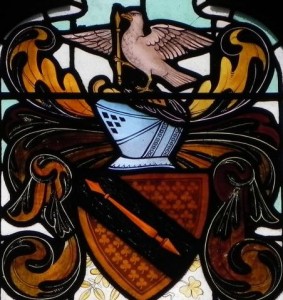
Son of Fortune John’s son William would eventually repair the family dignity when he became a success. In 1596, William made himself, and all the male members of his family gentlemen, by applying for a coat of arms. Below is a picture of Shakespeare’s family crest.
Shakespeare’s coat of arms, as depicted in the Folger Shakespeare Library window.
John Shakespeare died in 1601, shortly after his son’s play Hamlet was published. Willmight have honored his father’s memory by playing the Ghost of Hamlet’s father.
-Bio of William Shakespeare as a Father 1564-1616.
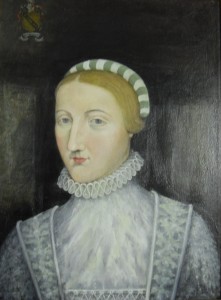
Oil reproduction by Roger Dunn of an alleged drawing of Anne Hathaway. Reproduced with Permission, Shakespeare’ Birthplace Trust. Click on the picture to find out more about this work of art!
Roger Dunn BA
Wedding Bells In 1582,Will married Anne Hathaway (not the Oscar winning actress from Les Miserables, although that one has shown some love for Shakespeare too. Based on the timeline, it’s very likely that Anne was already pregnant when William married her. Some claim that the Bard was basically in a “shotgun” marriage, but nobody has proven otherwise. We do know that he wrote a sonnet to her on their wedding day, click here to read it!
Shakespeare’s Children Shakespeare and Anne had three kids (Judith, Susanna, Hamnet) Susanna was born in 1583, while the twins were born 5 years later.
Hit the Road! Sometime around 1590, Shakespeare moved to London and must’ve gotten a job with a theater company. Unfortunately, no records survive between the birth of Shakespeare’s children, and his first success as a playwright in 1592, which is why scholars refer to this period as “The Lost Years.” It was probably a tough life for the Shakespeares, with the father away in the city while they were cooped up in Stratford with their grandparents.
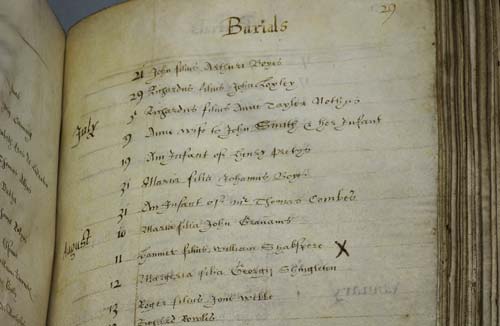
RIP Hamnet. Shakespeare’s only son died August 9th He was away in London at the time, and undoubtedly the news was a terrible shock.
Will’s daughters Shakespeare had two girls, Judith and Susanna. Naturally, it’s hard to tell anything about Shakespeare’s personal feelings, but looking at his plays and his future actions, Shakespeare must have really loved his girls. Many of his later plays explore the relationships between fathers and daughters, and as you’ve probably noticed, most of the fathers on my previous countdowns have at least 1 girl. Shakespeare was preoccupied with his daughter’s futures and helped them find husbands, Susanna Shakespeare was arrested for refusing to take protestant communion Susannah married Dr. John Hall, a respected puritan physician. She also bore William his only grandchild, Elizabeth Barnard (pictured below).
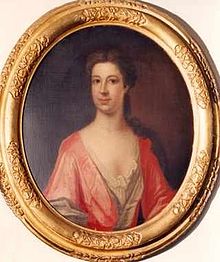
Elizabeth Hall, 1608-1680. Shakespeare’s granddaughter.
Will clearly loved his daughters, especially his daughter Susanna. His last 5 plays were about fathers trying their best to improve their daughter’s lives. In his will he gave his daughter Susannah 100 pounds of English money, as well as a dowry To his other daughter Judith he left 30 pounds, all of his silver, and permitted her to live in one of his houses on Henley street.
FMI:
by Michael Wood: A fantastic documentary/ book/ website, which looks at the life of William Shakespeare and his work. On this website is an interactive timeline that shows pictures of the places Shakespeare lived and worked, and the documents with his name on them: http://www.pbs.org/shakespeare/events/
Will In the World by Steven Greenblatt: A great biography of Shakespeare by a celebrated Harvard scholar and editor of tne Norton Shakespeare edition. Click here for a review: http://books.wwnorton.com/books/Will-in-the-World/.
So that ends my posts on Shakespeare and Father’s Day. Stay tuned for another post about a very interesting holiday!
Illustration of the Shakespeare family, wife and children, 1890.
Shakespeare himself was a father, and he frequently wrote about the dynamic between fathers and their children. There are many different types of fathers in Shakespeare’s 40 plus plays, and this week I’m ranking them in terms of three categories: Good Dads, Bad Dads, and “Dad Dads.” You’ve probably already read the “Worst Dad” post, so now we’re looking at the good, and the not so good. I used the following criteria when choosing the top 5 dads in each categories:
The Good Dads
Are supportive for their kids
Try to keep their children happy
Offer help and advice, especially on their children’s future.
Are willing to sacrifice themselves
They let their children become their own people.
The Bad Dads
Treat their children as property
Have little to no interest in their children
Put their children in danger
Subject their children to abuse
In some cases, they murder them!
The “Dad” Dads
Are basically good hearted, but they have some kind of flaw that prevents them from becoming really good parents.
In my view, are the most human, modern dads on the list.
I’ve chosen to award these dads a necktie, something every ok dad needs.
Now, onto the Dad Dads:
5. Aegean from The Comedy Of Errors. Aegean wonders around for 20 years looking for his lost children, which I call devoted parenting, but a little aimless and undisciplined. I therefore award Aegean two ties with little anchors on them, to remind him to stay in one place and wait for his sons to find him!
Alexandre Bida, “The death of Lord and John Talbott,” 1895
4. Lord Talbott from Henry the Sixth Part I. Talbott is the hero of the English fight against the French at the close of the Hundred Years War. He goes toe to toe with Joan of Arc on numerous occasions. He also raises a fine and valliant son, John Talbott who is also a warrior. The two die bravely in a siege against the French, rather than surrendering, or leaving the other to die. Talbott is clearly also devoted to his child, but his career choice doesn’t allow his son to grow up in a safe environment! I therefore award Talbott two ties with little English and French flags on them.
The Ghost of Hamlet’s Father by William Blake, 1806.
3. The Ghost Of Hamlet’s Father from Hamlet/ Portia’s Dad from Merchant Of Venice. Both these parents die before their plays begin, yet they still try to improve their children’s lives from beyond the grave! The Ghost helps Hamlet become king of Denmark, and Portia’s dad tries to help her find a good husband, (one who will love her for something besides her beauty or riches). Although these parents achieve their goals, waiting this long to help their kids seems a bit like absentee parenting! I therefore award these posthumous parents ties with little skulls on them.
2
. King Henry IV, from King Henry IV King Henry is the classic career dad, one who wants his son Hal (the future King Henry V), to follow in his footsteps. The two have a terrible fight when Henry thinks Hal is trying to steal his crown on his deathbed! Eventually though, father and son reconcile, and dad even gives the future king some last minute advice; if you fight a war with France it’ll help secure your crown, which Hal does and succeeds! I therefore award King Henry a tie with little crowns on it, hoping that nobody with a dagger ties tries to steal it when he’s sleeping!
1. Prince Pericles from Pericles Pericles is another busy dad- King Antiocus tries to murder him, and he has to leave his own kingdom. Then he gets shipwrecked 3 times! In fact, his only daughter is born onboard a ship in the middle of a storm! Pericles raises the girl for a number of years, but then has to leave again, and guess what, he gets shipwrecked AGAIN! He eventually finds his daughter and they live happily ever after, but you kind of get the idea that Pericles is a little accident-prone, which keeps him from being on the Best Dads list. Sorry Pericles, but at least you get a tie with, what else, Boats on it! Maybe next Fathers Day, someone will get you a life preserver.
And now at Long LAST, the BEST Dads in Shakespeare!
Aaron fights to protect his baby child.
5. Aaron the Moor from Titus Andronicus. Ironically, one of the worst villains in Shakespeare is also one of the best fathers. Aaron is fiercely protective of his child, even threatening people at sword point if they dare come near his baby. He also plans out the child’s future and is willing to give his own life for a promise that Lucius will protect and nourish his son. He may be a monster to everyone else, but to his baby, Aaron is simply, a good dad!
4. The Old Shepherd from The Winter’s Tale. This character is a very mirror of generosity and kindness; not only does he take care of his son The Clown, he adopts a poor discarded child, the princess Perdita, with no obligation to do so. He raises her for 16 years and constantly brags about her to the entire town. She becomes a beautiful, wise, and modest girl who fills her adopted father with pride because of his good parenting. Even when Perdita meets her real father, she speaks of The Old Shepherd with real filial affection “Oh my poor father.”
3.
Lord Capulet, from Romeo and Juliet. I know this was a controversial choice, and I discuss my choice in detail on my podcast, but I’ll sum up my major arguments here:
Even though a lot of actors choose to have him smack Juliet around, there’s no mention of it in Shakespeare’s text. The most he ever does is threaten to strike her, but the stage directions never indicate he does it. Capulet is clearly more bark than bite.
From the very beginning of the play, Capulet has shown that he cares about Juliet, and wants her to marry for love, not money.
Lord Capulet hovers and frets constantly when Juliet tells him she will marry Paris, staying up late to plan the wedding! I ask you, does that sound like a tyrannical father? I wonder sometimes if Lord Capulet would’ve forgiven Juliet for marrying Romeo if she had just told him. In any case, based on my criteria above, Capulet is a good dad, bad tempered, yes, but fundamentally concerned for the welfare of his children.
3. Prospero fromThe Tempest I chose this high spot for Prospero mainly because he seems to have the most success of any other dad in the cannon. Like Pericles, he too is shipwrecked with his daughter, but Prospero stays with Miranda, raises her alone, teaches her everything she knows, and calls her an angel that helped preserve his life. Prospero cares so much for his daughter that he refuses to give into despair, even though he’s lost his wife, his dukedom, and his home.
Prospero also hatches a plan to get him and Miranda off the island, to get his dukedom back, and to get her married to a handsome prince name Ferdinand, and he succeeds with every one of these endeavors, even though it takes 12 years. Prospero gets extra points for his patience and his wisdom, but I have to admit he’s a bit of a control freak; he demands that Miranda listen to him and obey him no matter what, and he warns Ferdinand that there will be dire consequences if he dare try to do anything illicit with his daughter before the wedding. In addition, there’s no denying that Prospero is also acting out of self interest- he wants to become duke again, and he wants revenge against his enemies and that’s partially why he raises a tempest, (or a huge storm), instead of just sending a message back to Milan.
1.
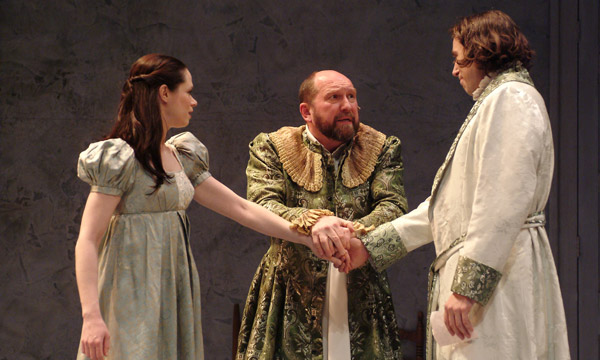
Simonides grants permission for Pericles to wed his daughter. Production shot from Mary Zimmerman’s 2006 production of “Pericles.”
King Simonedes from Pericles, Prince Of Tyre You might forget this character because he only has a short time onstage, but I defy anyone to come up with a better father. He’s kind, supportive, stable, funny, and has a wonderful relationship with his daughter Thaisa. Above all, Simonedes actually listens to his child and does everything in his power to help her when she decides she wants to marry Pericles. Also, like Prospero, Simonedes pretends to object to the marriage, but you kind of get the sense that, rather than testing the affection of the couple, he’s actually just playing a joke on them. You can hear a “gotcha” and a fatherly wink in the final line of the speech in Act II, where he pretends to object to their marriage:
Congratulations to all our fabulous fictional fathers! Thank you for reading, and see you soon!
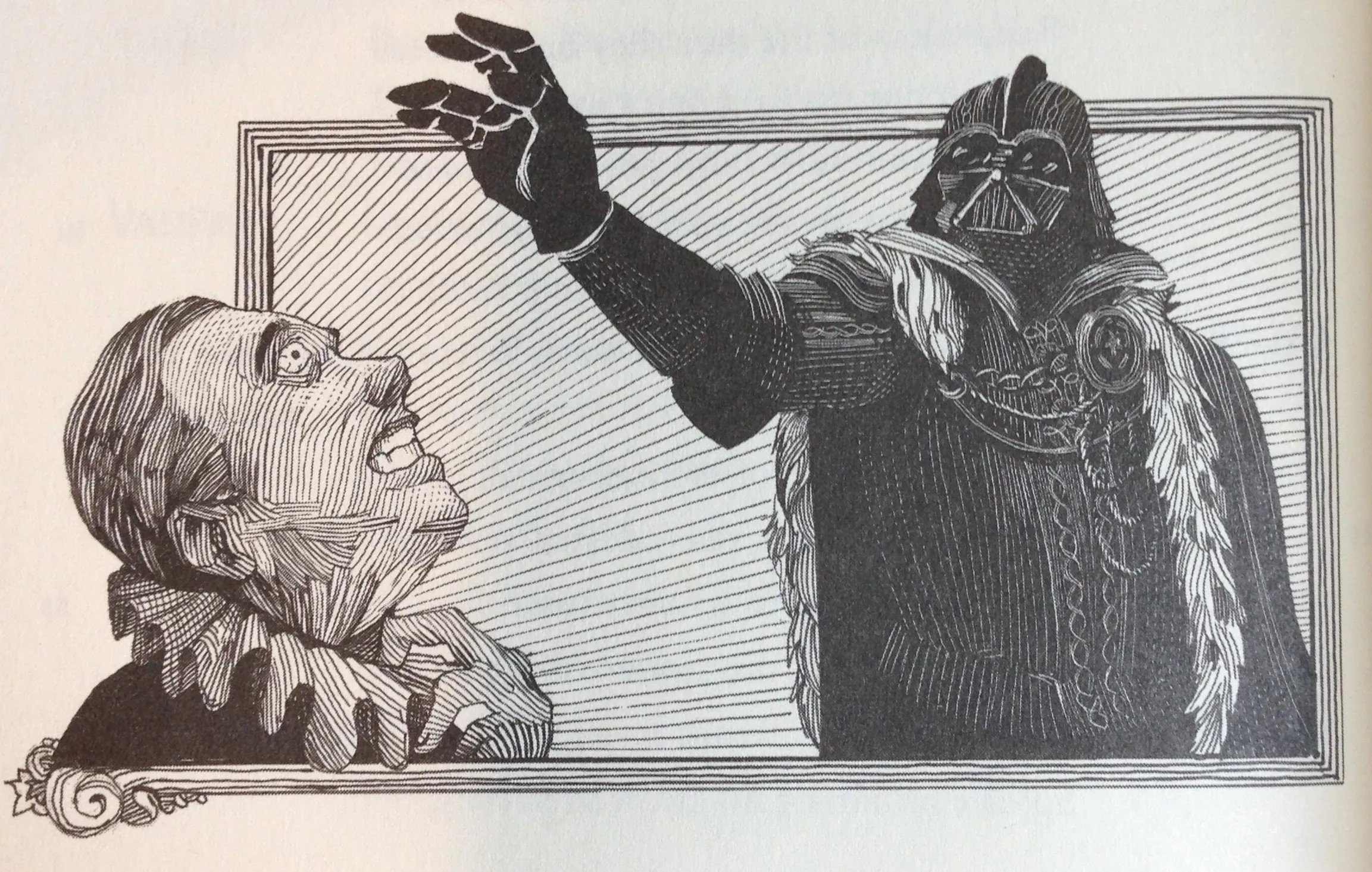
Illustration from “William Shakespeare’s Star Wars”
Play review: William Shakespeare’s Star Wars
Since Monday was May the Fourth, and since I got some encouraging comments about the previous post, I’m happy to review one of the most interesting Shakespeare spin-offs I’ve ever encountered: William Shakespeare’s Star Wars by Ian Doescher. For those of you who haven’t heard of this play, it’s basically the script of Star Wars put into Shakespearean verse. The writer clearly loves both Shakespeare and Star Wars, and puts lots of cheeky Shakespearean references in the text, such as Luke Skywalker parodying Hamlet as he steals a Stormtrooper’s uniform and Yorrick-like, holds up the helmet to his face:
“Alas poor Stormtrooper, I knew ye not,” (Doescher IV, vi, 1) The play lends itself perfectly for performance in an Elizabethan playhouse with its sparse stage directions and an Elizabethan chorus that comments on the action and tells the audience whenever action occurs offstage, such as when the Death Star gunners prepare their mighty laser to destroy the planet Alderon. I certainly got a kick out of reading this play since I too am a huge Shakespeare/ Star Wars fan. However, since this blog is meant to help us learn and appreciate Shakespeare, the question is, does this play have any value to Shakespearean students? At first I wasn’t sure, but now I say yes!
Before I read the play, I was a little apprehensive as I’ve seen Shakespearean gimmicks fall flat before; I once saw a dreadful production of Macbeth where the whole cast was made up to look like zombies for absolutely no purpose except to cash in on the zombie fad. So at first, I wondered, “Why bother translate Star Wars into Shakespearean language”? As I read on though, I realized what the author had done was give readers a rare glimpse into how Shakespeare himself wrote.
This helps prove one thing I’ve always felt about teaching Shakespeare- parody and gentle satire are a great way to deconstruct his plays into something a little easier to grasp. As I said before, Doescher’s play is full of tiny bite-size portions of real Shakespearean dialogue that allow you to digest some of The Bard’s most famous lines. Also, he’s following the same ‘recipe’ Shakespeare used in his plays and speeches, so I’m going to deconstruct some of the Shakespearean elements that Doescher employed to concoct this Shakespeare/Sci-fi classic hybrid. I’ll focus on the first play in the series: Verily A New Hope, but you can find these components in all of the plays in the Star Wars Saga.
Iambic pentameter- the most obvious difference between the original Star wars is that Doescher took the dialogue and put it into the same poetic meter Shakespeare used. For those who don’t know, Iambic pentameter is a kind of unrhymed poetry with 10 syllables per line. Each line also has 5 stressed beats that strike like a heart beat- Da DUM Da DUM Da DUM Da DUM Da DUM. To keep the emphasis on the right syllables, sometimes the writer has to shift the syntax or add and subtract words to get them to fit. This is why instead of the famous: “A long time ago, in a galaxy far, far away,” the Prologue at the beginning says:
“ In time so long ago begins our play,
In star-crossed galaxy far, far away.”
Doescher’s time-consuming process of translating a prose movie script into blank verse poetry is exactly Shakespeare did when he wrote his plays, only instead of movie scripts, he took the chronicles of English history to become Hamlet, Macbeth, Lear, and many others. With all the work involved in crafting poetry like this, it’s no wonder he didn’t have time to think up an original story!
Telling the audience what you’re doing- As I said last week, one thing to keep in mind when you read Shakespeare is that his plays were performed outdoors with no microphones, in an audience of nearly 3,000 people! It must have been extremely hard to see or hear the action onstage. Shakespeare tried to solve this problem by having characters announce what they’re doing, which would be tedious, if he didn’t also know how to spice up the dialogue with lines that reveal the character’s emotional state, like when Lord Capulet says: “My fingers itch,” to warn his daughter he’s about to hit her. Doescher captures this extremely well in the speech where Vader lifts up the Rebel Leader and begins to choke him to death:
I turn to thee, thou rebel. Aye, I lift
Thy head above my own. Thou canst now choose
To keep thy secrets lock’d safe in that head
Or else to keep thy head, and thus thy life (Doescher I, ii 6-10).
This passage explains to the reader or playgoer that Vader has lifted the man over his head, (demonstrating his cruelty and his strength), and subtly plays on the fact that Vader is looking at his head, wants the knowledge in his head, and will crush his head if the Rebel doesn’t cooperate. Shakespeare’s Richard III makes a similar threat: “Villain, set down the corpse, or by St. Paul, I’ll make a corpse of him that disobeys!”
The Aside One thing Shakespeare does that few modern writers ever do is have characters talk directly to the audience; thus establishing an intimate relationship between you and a person who is confiding their secrets in you. The most striking example of this in Shakespeare’s Star Wars is R2D2, who in the movie never spoke at all, but made cute little electronic beeps and whirrs. Having R2 speak gives the reader an unexpected closeness because R2 never speaks to anyone else.
Personification Shakespeare is really good at finding a clever visual metaphor for an abstract idea, and will write speeches or dialogue where characters explore the nature of that idea, a meditation if you will. One of my favorite examples from Shakespeare’s Star Wars is the scene in which Luke and his uncle debate about whether Luke will stay on the farm. Luke compares himself to a bird that’s trying to fly away, while his uncle uses farm metaphors to try and keep him to stay:
OWEN: Wilt thou here in the desert yet desert? Tis only one more season.
LUKE: Now cracks a hopeful heart, when by the land,
A man’s ambitions firmly grounded are:
So shall a bird ne’er learn to fly or soar
When wings are clipp’d by crops and roots and soil.
It’s really very clever the way Doescher mimicks Shakespeare’s wordplay here. Luke is like a bird because he’s a pilot and longs to fly. Owen is a farmer on a desert and is worried about Luke deserting him. We get a clear picture of their relationship from this scene.
Chorus Shakespeare sometimes uses a Chorus to tell us what is going on in plays where the location shifts from place to place- it’s a time honored device in epic storytelling. Nowadays we use a Chorus too, we just call it a Narrator. The difference is that a Chorus also can explain the tone and the mood of the action onstage, so that you can imagine it in your own mind. Take a look at this passage where the chorus describes the famous Star Wars Cantina:
Now mark thee well, good viewer, what you see,
The creatures gather round the central bar
While hammerheads and hornéd monsters talk.
A band composed of aliens bizarre:
This is the great cantina- thou may’st gawk! (III, I, 45-49).
You can see how, unlike a narrator who would just tell you there are a bunch of aliens here, the Chorus describes the sights and sounds of the bar so you can imagine it yourself. The Chorus in Shakespeare’s Henry the Fifth explicitly states that the audience needs to use their imagination to fill out the story of Henry’s conquest of France.
The soliloquy A soliloquy is a speech spoken by a character alone on stage. It often has to do with a complex dilemma such as Hamlet’s “To Be Or Not To Be.”
In Shakespeare’s Star Wars, Luke and Vader have the most soliloquis and with good reason- they have the most complicated emotional journeys- Luke goes from a simple farmboy from Tatooine to a Jedi Knight, while Vader goes from a Jedi to a Sith to a father. Shakespeare’s greatest power is his ability to put complex emotional journeys like these into speeches that the characters share right with us. I loved both these speeches too much to choose, so I’m going to talk about of both. The first is a soliloquy Vader speaks after he kills the Rebel leader:
And so another dies by my own hand,
This hand, which now encas’d in blackness is
O that the fingers of this wretched hand
Had not the pain of suffring ever known. Droescher I.ii, 27-30
This speech reminds me very much of Richard III, one of Shakespeare’s greatest villains. Richard, like Vader, has his life story told in 6 installments where he slowly becomes an evil mastermind. The images of this speech conjure up parts of Vader’s life story: how he lost his hand in Episode II and now has a robotic hand in a black glove. The speech also conjures the fact that his master the Emperor is able to shoot lightning from his hands, and of course, how Vader himself is able to kill by merely gesturing with his hand. Richard has a speech where he talks about all the people he’s killed to become king, and how he now has to kill even more to stay king:
I must be married to my brother’s daughter, Or else my kingdom stands on brittle glass. Murder her brothers, and then marry her! Uncertain way of gain! But I am in So far in blood that sin will pluck on sin: Tear-falling pity dwells not in this eye (Richard III, Act IV, Scene i)
Luke has another speech where he talks about his destiny staring at the twin suns of Tatooine, but I won’t spoil that one for you! Needless to say, it’s awesome. I bring it up because In the movie, it was John Williams’ job to literally underscore Luke’s emotions as the music swelled. Shakespeare’s gift on the other hand was to put powerful emotions and thoughts into carefully composed soliloquys that sound like music when spoken well.
So as you can see, the author’s loving parody of Shakespeare allows us a rare glimpse of how the Bard wrote; his cleverness at adapting stories, his use of verse, wordplay, metaphor, personification, choruses, and his unique ability to write characters that talk to us as if we were in on their deepest secrets.



















 The Shakespearean Student