

Special Occasion

Posts 📫 for the first night of Hanukkah 🕎

This week I’ll be celebrating Hanukkah with a series of posts and podcasts about Shakespeare’s only play to feature Jewish characters The Merchant Of Venice. I’ll have a new post about the play this week, and hopefully a podcast episode, but in the meantime, here are some of the post’s I’ve written in the past about the Merchant Of Venice.
1. Play of the Month: Merchant Of Venice
My First Children’s Astronomy Class

Happy Thanksgiving 2021
Activities for Students and Teachers: Macbeth Escape Room
I made a digital escape room for Macbeth, as part of my Outschool.com class, “Macbeth: An Immersive Educational Experience,” which you can register for at a discount this week only. I’m presenting this digital escape room as an activity for teachers to teach their student’s knowledge of the plot of the play and use their observation and research skills to escape from a “cursed castle.”
What Is a digital escape room?
In a normal escape room, you are locked in a room and have to follow clues and solve puzzles in order to find a series of keys, codes, and combinations to unlock the door and get out of the room. In a digital escape room, you solve online puzzles and use passwords and key codes to unlock some kind of digital content.
My escape room is designed to test your knowledge of the play, give you a chance to learn about the history behind it. Most escape rooms use the a variety of locks such as:
- Standard combination locks
- Direction locks (where the lock has arrows taht you have to push in the correct direction, in the right order).
- Color locks (where we put different colors in a sequence.
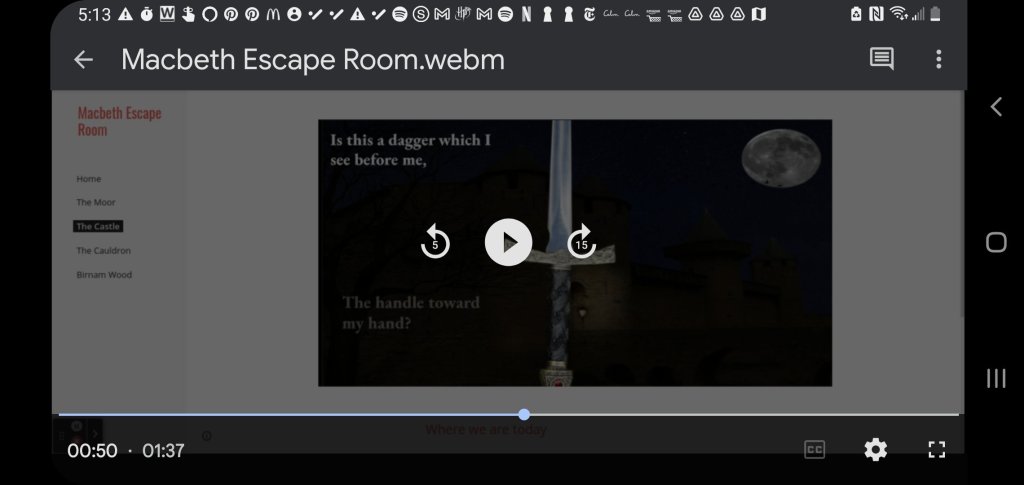
A digital escape room uses these concepts and adapts them to work within the context of a website or other digital experience. For example, I made a direction lock based on the direction a dagger points and made a short animation of a dagger with the text of Macbeth’s famous dagger speech.

The student has to surf through five webpages to find the answers to the puzzles, then imputs the answer in a Google form. Once he or she unlocks all six puzzles, they are permitted to leave the witches’ castle. Here’s a preview of the puzzles:
Part I: The Gate

There’s a website called Flippity which allows you to make little online puzzles so I embedded it on one page of my website. In this case, it has six locks that you have to unlock by typing answers to trivia questions related to “Macbeth,” such as “What object appeared to Macbeth before he killed the king?” The final lock requires you to read a short article on the curse of Macbeth, so you can enter it on the website.
Part II: The Magic Mirror
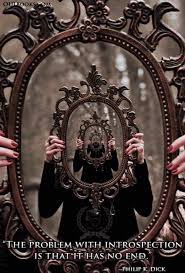
There’s a website called a magic mirror, which if you click on the mirror, it hyperlinks to an image that spells out the next answer for the Google form.
Part III: Birnam Wood
I wanted to teach the students about verse scantion and what an iambic pentamer iine is. I wanted to get the class to learn the pattern of unaccented beats (which Shakespeare scholars mark with a U), and accented beats marked with a /, as in the couplet below:
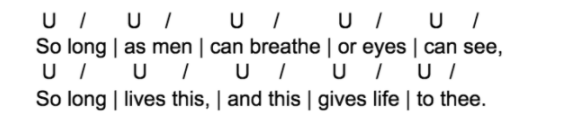
To get the students to practice making an iambic pentameter line, I embedded a Google Slides presentation in the website which has pictures of unarmed and armed soldiers. A key indicates that you are to count the soldiers and input the U/U/ pattern into the Google Form:
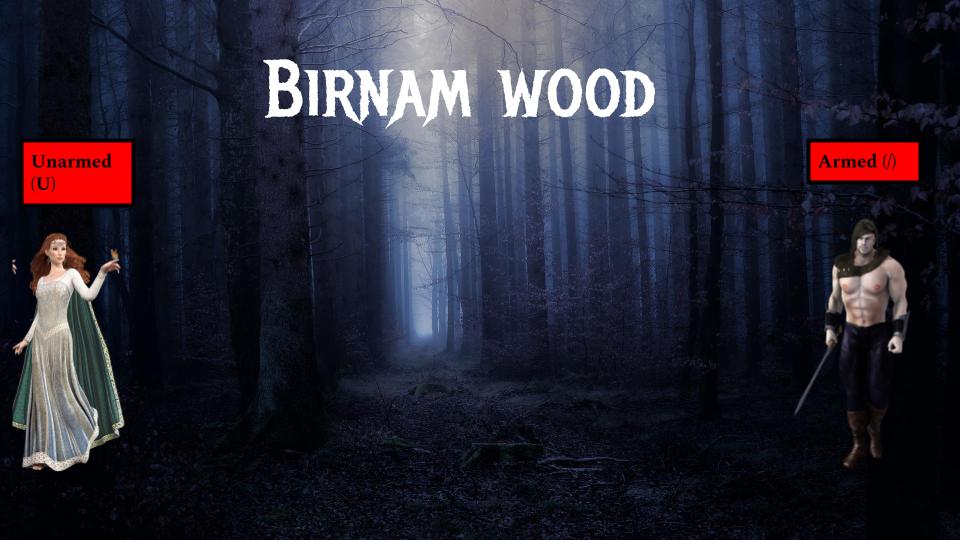
So, there’s a preview of the Digital Escape Room I hope this inspires you to try this type of activity in your class. If you want to use this activity, shoot me an email and I’ll give you a teacher’s guide. Please also consider signing up for my Outschool.com class!
New Outschool Course: Macbeth

Just in time for October, I’m offering an online class for kids ages 13-18 about Shakespeare’s most spooky and cursed play:
If you follow this blog you know I’ve written a lot about this play before. Though this class will be more like a game where I teach the class using multimedia, games, and a digital escape room!
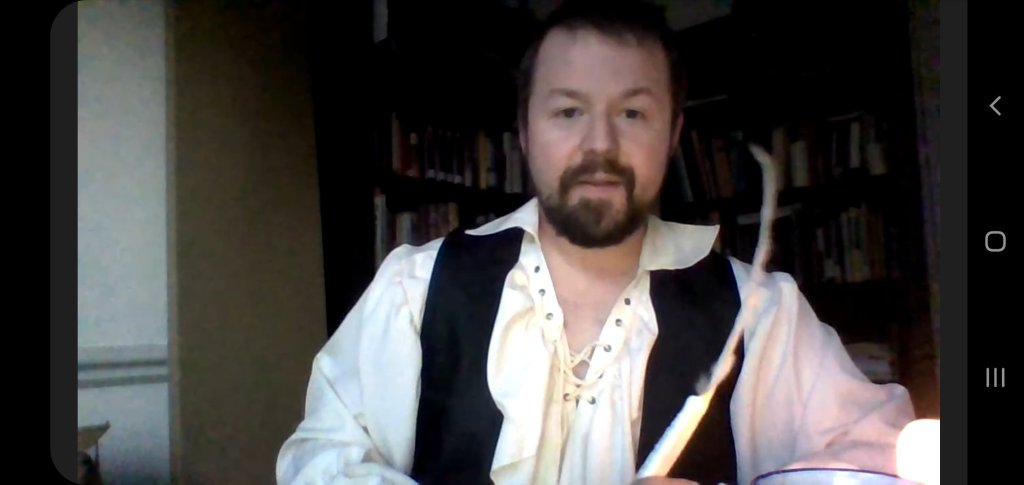
I’ll start by speaking to the students in character as Shakespeare, and tell them the story of Macbeth using a multimedia presentation.
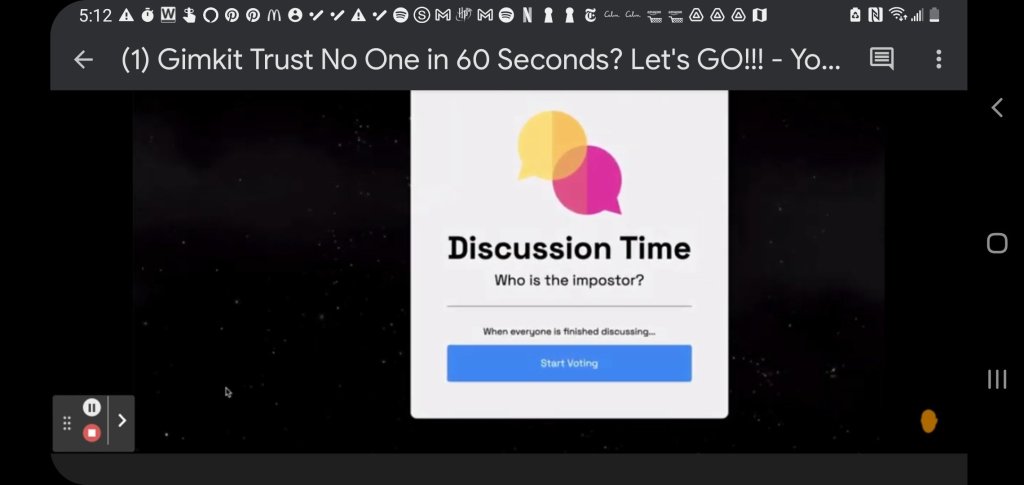
I will then test the students’ knowledge with a fun quiz that was inspired by the popular mobile game Among Us. As you know, the game is similar to a scene from the play, so I thought it would be an appropriate way to test the kids’ knowledge.
The final part of the class is a digital escape room I’ve created. I don’t want to give too much away, and you can’t play it unless you sign up for the class, but let’s just say it’s fun, spooky, educational, and challenging!
If you want to sign up now, the course is available every weekend in October, and then by request after that. Register now at Outschool.com. if you take the course, please leave me a good review.
Hope to see you soon!
New TV Adaptation Of Romeo and Juliet

PBS is going to show (and hopefully stream), the National Theater’s production of Romeo and Juliet Friday, to help celebrate William Shakespeare’s birthday.
The production stars Jessie Buckley as Juliet, and Josh O’Connor as Romeo, who recently won a Golden Globe for his portrayal of the young Prince Charles
After playing another doomed lover whose family won’t allow him to be with the woman he wants, I look forward to seeing him bring his passion and skill to Shakespeare.

Jessie Buckley as Juliet, and Josh O’Connor as Romeo. National Theater, 2021
Shakespeare On Epidemics

My purpose with this post is to provide some hope and comfort by showing how Shakespeare and other Elizabethans dealt with epidemics and survived. The thing to remember is, although we are dealing with a pandemic, we are still far better prepared for it than any time in history. Furthermore, I want to draw on lessons from the past to offer hope and wisdom for people going through an epidemic.
Side note: Shakespeare refers to several diseases in his plays including “The plague,” (Bubonic Plague), “The Pox,” (syphilis), “Dropsy,” (edema), and “Falling sickness,” (epilepsy). I will mainly focus on the plague because of its strong connection to both Shakespeare’s life and career, as well as the continuing anxiety it causes to this day. I am also focusing on the plague to try and make parallels with Covid 19, a disease that, while less lethal and harder to detect, is still a pandemic that like the plague has transformed much of daily life since its inception, and could continue to grow, abate, and revive if we as a society aren’t careful.
Shakespeare’s plays also frequently allude to plagues and plague imagery, especially his most famous play, Romeo and Juliet.

First of all plague is an important plot element; an outbreak of plague prevents Romeo from getting the message that Juliet is alive, so plague inadvertently kills them both.
Plague also serves as a motif for the destructive forces that lead to the play’s tragic conclusion. After Mercutio curses “A plague on both your houses,” his death sets the events in motion that kills most of the principal the characters, as if his curse somehow infected all of them with a deadly virus.


https://www.slideshare.net/mobile/PaulHricik/the-universe-of-romeo-and-juliet-by-paul-hricik
Shakespeare exploited a unique cultural knowledge of plagues to help his audience engage with Romeo and Juliet. If you click on the link to my presentation above, you’ll see that Elizabethans believed that four liquids called humors controlled health and behavior. A humorous man was someone who was out of ballance with the humours and thus was ridiculous for failing to control his emotions. The humor choler was associated with anger and in dangerous imbalances was thought to cause terrible fevers and even plague. Hence, when characters like Romeo and Tybalt get angry, his audience knew that one way or another, that anger will kill them.
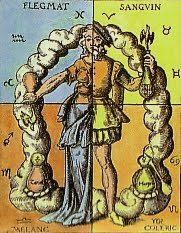
Shakespeare also uses plague as a metaphor for the hate of the two families that infects and kills the young lovers, as well as Tybalt, Paris, and Mercutio.
The play was first published in 1595, two years after a plague outbreak so bad that the theaters were all closed, so Shakespeare’s audience had a visceral reaction to this plague imagery when they saw it in the theater, especially after a year of being quarantined away from the theaters because of that exact same disease!
“Scourge and Minister”
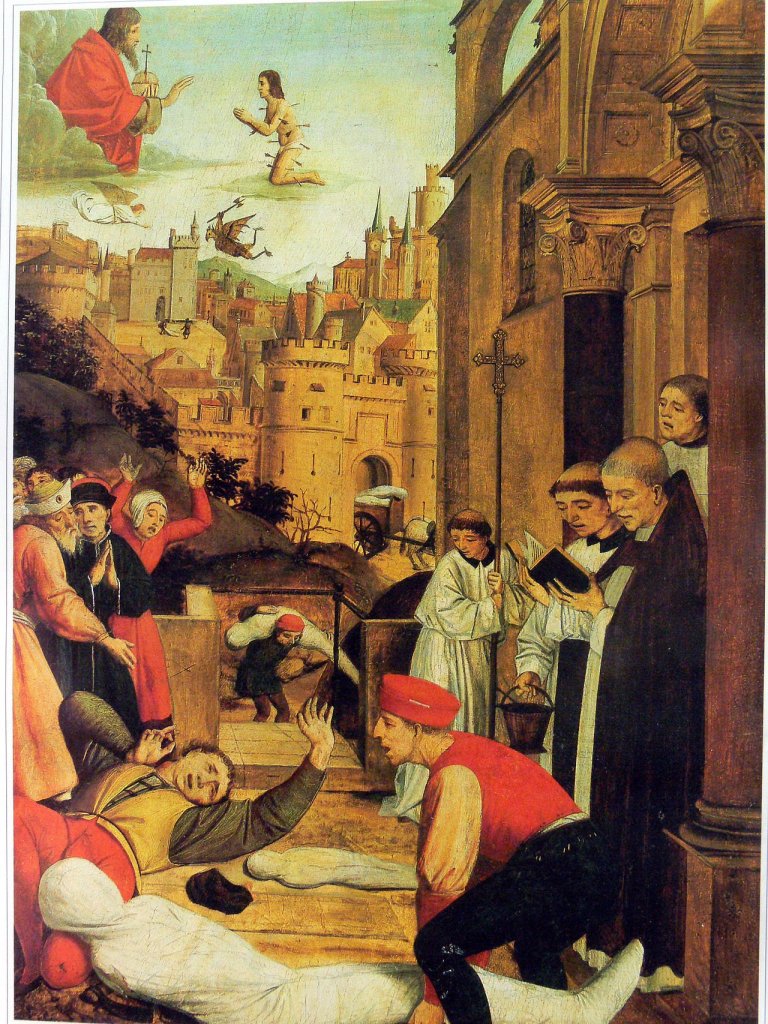
Some of Shakespeare’s plays mention plague indirectly in relation to its perceived nature as a divine punishment. Since the very beginning of the plague,, writers, clergy, and many others perceived the plague as a divine punishment, designed to destroy the wicked, like the 10th plague in the Bible that decimated the enslaving Egyptians.
To “scourge oneself” is also a verb for whipping. In the 14th century, a group a people called the flaggelants, who voluntarily scourged themselves in the hope that God would end the disease as a result of their suffering.

Shakespeare uses both meanings of scourge in many of his plays. In Henry IV, the king is filled with remorse for usurping the throne from King Richard, and worries that his future progeny will become a scourge upon him:
I know not whether God will have it so,
For some displeasing service I have done,
That, in his secret doom, out of my blood
He’ll breed revengement and a scourge for me;
King Henry IV, Part I, Act III, Scene ii.
Sometimes a scourge is a person sent to destroy a sinful person or group of people. Shakespeare refers to the character of Richard III several times as a scourge upon the families who fought in the Wars Of The Roses.
In Shakespeare’s first cycle of four history plays, we see the families of York and Lancaster take turns usurping the throne, and committing numerous acts of murder, treason, and blasphemy. In the play that bears his name, Richard III kills the Yorkist royal family and then is murdered himself by Henry Tudor, systematically destroying the families of York and Lancaster. Thus, in Shakespeare’s propaganda version of history, he depicts Richard as a scourge who purges the throne of usurper and traitors, paving the way for the “virtuous,” Henry Tudor and his dynasty.

The Real Plague
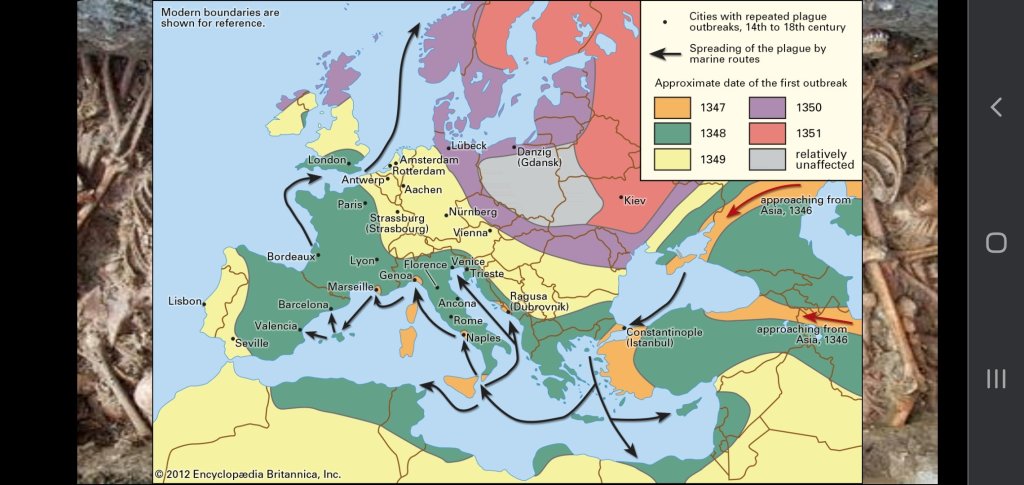
The black death, also known as Bubonic Plague, was first documented in 1347. Like Covid 19 it was first discovered in China, though it might not have originated there. Some historians argue that the Huns might have carried the plague into China and trade routes from the East carried it into Europe. By 1349 it reached England.
Everyone knew what to look for from those infected with the plague: first came fevers and chills. The next stage was the appearance of small red boils on the neck, in the armpit or groin. These lumps, were called buboes, (hence the term Bubonic Plague)
The buboes grew larger and darker in colour as the disease grew worse. From there the victim would begin to spit blood, which also contaminated with plague germs, making anyone able to spread the disease by coughing. The final stage of the illness was small, red spots on the stomach and other parts of the body caused by internal bleeding, and finally death.

We see death coming into our midst like black smoke, a plague which cuts off the young, a rootless phantom which has no mercy or fair countenance. Woe is me for the shilling in the armpit. . . It is an ugly eruption that comes with unseemly haste. It is a grievous ornament that breaks out in a rash. The early ornaments of black death.-Jevan Gethin, poet who died from plague in 1349.

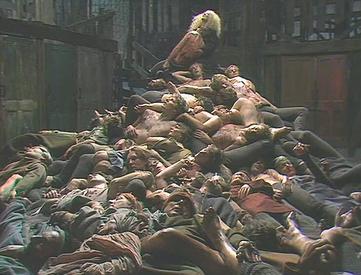
John Flynn, an Irish Friar described the plague in apocalyptic terms, writing a journal for posterity, but expressed doubt that ” Any of the race of Adam would even survive.” With the horrifying spread of the epidemic, it is not hard to understand why Flynn felt that way: In 1348, there were 100,000 people living in London, but after the plague spread, the city lost 300 people every day!
https://www.google.com/amp/s/www.history.com/.amp/news/quarantine-black-death-medievalContainment/ “treatments” • Plague carts like in Monty Python (Dreary) carried plague bodies out of the city and burned them.
• In France, bodies were thrown in rivers (Deary)
- Quarentines: The word quarantine is Italian for 40 days. It refers to the Venetian practice of taking suspected plague victims to an island for 40 days before allowing them to enter Venice or other populated areas. The rationale was that in the Bible, the number 40 occurs many times when a person or group of people require some form of purification; the 40 days of flooding in Genesis, the 40 years that the Jews journey to the promised land, and the 40 days of fasting Christ endured before he began his ministry to name a few examples. Bubonic plague has an incubation period of less than 40 days so the quarantine actually worked- people would go to the island, then the disease would run its course and not spread out as long as it was contained. The problem was that these quarantines were also essentially leper colonies and without treatment, the infected were basically sent to die.
Social distancing in Elizabethan England–
By 1564, the year Shakespeare was born, there had been several outbreaks, but also a system designated to contain the disease. The rich went to the country. Plague bodies were burned. Theaters were closed to keep the disease from spreading. There were also body inspectors, (similar to coroner’s or death investigators today,) who inspected the bodies to look for the cause, then burned them and the clothes. Funerals for plague victims were held at night, to discourage crowds from attending, similar to our own practice of encouraging people to shop and go outside during non-peak hours.
“Treating” it: The biggest comfort I can give here is to remind people that although like the plague, we are dealing with a disease with no known cure, we still have a much better understanding of how to treat viruses than our Elizabethan forebears. Some of the “cures,” from Shakespeare’s day are downright silly, when they aren’t expensive, dangerous, and above all, ineffective.
Real plague “cures”
• Kill cats and dogs
• A poultice made of Marigold flowers and eggs
• Arsenic powder (which is highly toxic)
• Crushed emerald powder.
• Pluck a chicken and place its rear end on the patient’s buboes, known as the Vicary Method.

To bring the aftermath of the plague into a modern context, I’d like to allude to some comments from the news. Recently a few Republicans have alluded that the cost of people staying home from work would cause irreparable harm to the American economy, and alluded to the notion that a few deaths might actually benefit the economy as a whole, including Texas Lieutenant Governor Dan Patrick and Republican pundit Glenn Beck.
Now at first glance these comments are gruesome and heartless, but they have a veneer of historical precedent: some people did prosper because of the black death. Laborers could charge more from their landlords simply because most of them had died, and some younger men managed to skirt the laws of primogeniture and inherit their families’ wealth because of the death of their oldest siblings. Shakespeare himself was the third child of Mary and John Shakespeare, but his elder siblings both perished due to plague. Again, to be fair to these Republicans, there is a historical facet to their arguments, however this is a very narrow and very incomplete version of history.
https://youtu.be/QNo-r20wqqg
Looking forward from the first century after the Black Death, the loss of life and resources was devastating for the workforce and caused a series of catastrophes for centuries to come. Though some peasants benefited from the lack of serfs, the depleted workforce meant work became harder and more expensive, and the coming centuries were plagued again by revolts, wars, and famine.

Just 30 years after the first outbreak of plague in England, the peasants rose in revolt against their lords for the first time in 300 years, in no small part, due to the hardships caused by the plague.

The king who punished the peasants was Richard Richard the Second, whom Shakespeare famously dramatized as an arrogant, egomaniacal, incompetent man-child who was eventually deposed and executed in the Tower of London. I think certain people who are tempted to “make sacrifices,” to protect the American economy would do well to look at this historical tragedy and avoid the political consequences of this kind of thinking.
In conclusion, though we are dealing with a frightening pandemic that we currently don’t know how to treat, we can take comfort from the fact that our forebears faced far worse diseases and survived. History has shown that social distancing works and that basic sanitation and the tireless work of healers and scientists can slow a disease, cause it to ebb, and eventually irradicate it. But until science discovers a treatment for Covid-19, it is up to all of us to flatten the curve for the sake of our country, world, and our future.
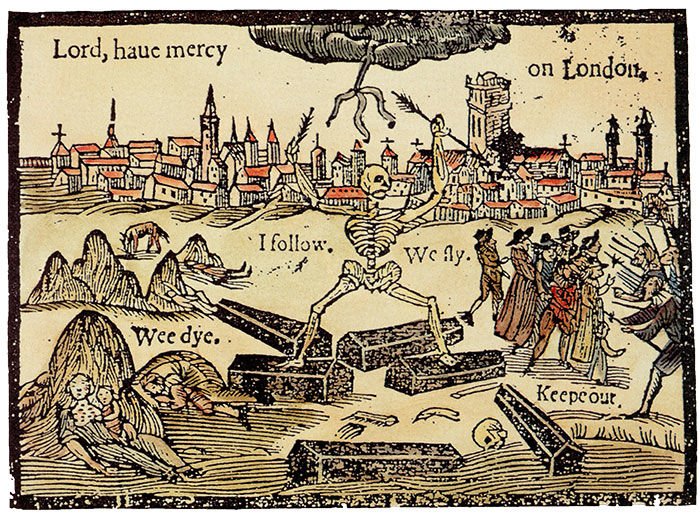
Like I have said, the working poor as a whole, suffered greatly because of the plague, especially since they were denied the means to avoid it. They lived in tightly packed, unsanitary environments and were unable to leave them without their lord’s permission, whereas we have a choice. This why it is crucial that we all do our part by staying away from crowds, observing proper hygiene, and offering support to our healthcare workers who are on the front lines of this war against coronavirus, and for whom we all pray for to stay healthy in turn.
Continue readingHow did Shakespeare Celebrate Halloween?


Let me begin by admitting that this post was harder to write than my Christmas post because pre Christian traditions are harder to pin down. In addition, to give you my standard disclaimer, I don’t believe it’s really possible to definitively know how or if Shakespeare celebrated Halloween, but since the history of Halloween is long and fascinating, and since Shakespeare’s plays influenced that history, I feel it’s worth exploring.
Part I: Origins of Halloween
Almost every culture on Earth has a middle fall celebration that calls to mind the bounty of the harvest, and the inevitable approach of winter. Most of our Halloween traditions are based on the ancient European festival of Samhuin.
What is Samhuin?
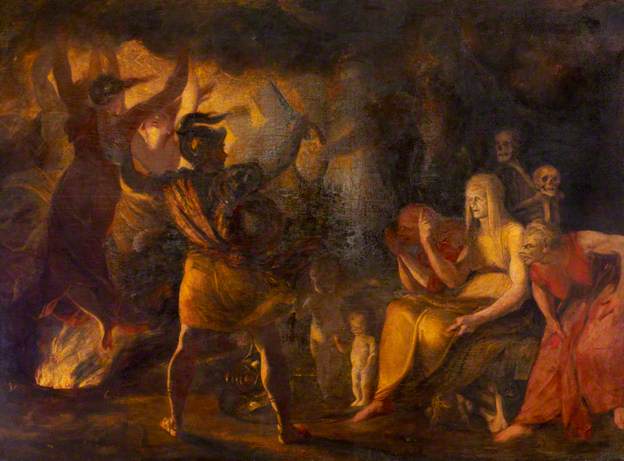
Over 2,000 years ago, the Celts inhabited much of the British Isles. They believed in many gods and spirits that controlled nature and the seasons. To thank the gods for the harvest the Celts gave them offerings like apples, and threw parties to celebrate the gods’ bounty.
When the Romans conquered the Celts, they co-opted some of their religious practices. For instance the tradition of giving apples as offerings to the Roman goddess Pomona. This tradition of course, evolved into our modern Halloween tradition of bobbing for apples. Honoring the harvest also went hand in hand with darker traditions; ones inspired by fear of death, decay, and evil spirits.
With the Sun dying and the Earth growing cold in late October, cultures like the Celts and the Romans feared that evil fairies and ghosts could cross over into our world. In particular the Celts believed that around the night of October 31st, the veil between the living and the dead was the thinnest.
Samhuinn was a liminal time between our world and the Otherworld. It’s a night when the souls of dead loved ones as well as spirits and fairies – the aos sí in Irish mythology and aes sídhe or sìth in Scottish mythology – could come through to visit. Deceased family members were honoured with seats at the evening feast, and offerings of milk and baked goods were left at the front door for the Fairies.
At some point people decided to dress up as the spirits to ward them off, and this evolved into our modern day trick or treating.
These traditions did not die once England became Christian, (after it was conquered by the Romans), they simply translated into a different form. Halloween actually translates as “All Hallows Eve,” a Catholic celebration of of dressing up as pagan spirits and giving offerings of the harvest to honor Catholic saints as well as departed love ones.
Part II: What might Shakespeare have Done on Halloween?
Although Shakespeare never directly mentions Halloween, he lived in a world that kept many of these folk traditions alive. Shakespeare was the grandson of a farmer and his father was a devout Catholic, so he probably was brought up in these ancient Halloween traditions. He probably would have attended some kind of harvest festival to celebrate the bounty of the summer, and might have put food out for his departed family members.
Samhain is still heralded by the baking of kornigou, cakes baked in the shape of antlers to commemorate the god of winter shedding his ‘cuckold’ horns as he returns to his kingdom in the otherworld. On the Isle of Man in the Irish sea, the Manx celebrate Hop-tu-Naa, which is a celebration of the original New Year’s Eve and children dress as scary beings, carry turnips and go from home to home asking for sweets or money.
Source: https://theancientweb.com/2010/10/the-origins-of-halloween-part-1/
Call me a softie but I really like the idea of Shakespeare baking treats like soul cakes for neighborhood kids or telling scary stories about a bonfire. The kornigou is more commonly known as the Soul Cake, and it’s still popular today. It’s even been immortalized in song:
You can even make it yourself: www.cardamomdaysfood.com/recipe/soul-cakes/
Another tradition was dancing around ancient Celtic burial mounds. According to tradition, these mounds were home to spirits and Fairies, and could be portals to the land of the dead. In Irish folklore, poets and storytellers had the power to pass between these two realms. Maybe Shakespeare himself visited such a mound in his youth and was inspired to write about the fairy queen Titania and the hobgoblin Robin Goodfellow. Archeologists are still learning about these ancient ruins today (source: Smithson.com)
• Theater
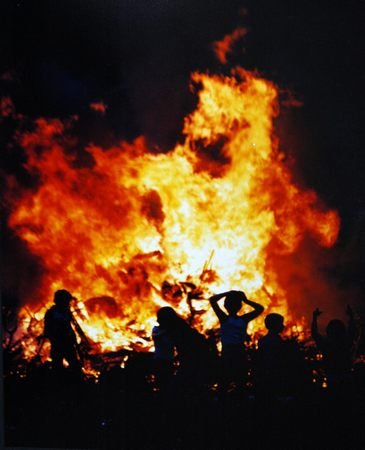
The most tantalizing ancient Halloween tradition is mumming, a kind of amateur theater practiced by the ancient Celts. Like modern Sunday school plays the plays were a religious ritual designed goal to honor the gods and the harvest.
Mumming, a type of folk play, was used to tell traditional Samhuinn stories about battles or the winter goddess Cailleach (meaning “old hag”), who began winter by washing her hair in the whirlpool of Corryvreck.
For a modern example of this of these traditions you can look at the Edinburgh fire festival which preserves the kind of mumming that the Celts might have done on Samhuin and Shakespeare might have seen. It’s highly ritualistic, immersive, and the characters have spooky similarities to some of Shakespeare’s plays.
To give you an idea of how mumming might have influenced Shakespeare, watch this trailer for the 2017 Edinburgh Fire Festival:
• What you can see in the trailer:
1. Keening- the wild women screaming as a way to lament, honor, and guide the dead. Characters like Constance in King John have many similar qualities.
2. The fight between the Summer King and the Winter Lord. Many Celtic stories dramatize the change of seasons from summer to winter as a battle. Even the duel between King Arthur and his young son Mordred could be seen in this context. In another interesting interpretation, Jennifer Lee Carroll in her book Haunt Me Still, interprets this mummers play as a pagan retelling of the story of Macbeth.
3. You can see brightly colored figures some designed to honor the changing of the seasons, and wild, animalistic people, presumably playing the roles of the Fairies, goblins, or other creatures that appear on Samhuin. It’s not much of a stretch to see these figures as the Fairies of Midsummer Night’s Dream, or the witches of Macbeth.
Part III: What did Shakespeare mention about Halloween?

Ghosts appear in five of Shakespeare’s plays. We see reference to all kinds of Fairies, goblins, and spirits and even a couple times people dressing up to ward off evil. In Titus Andronicus, the queen of the Goths disguises herself and her sons as spirits of revenge and go to Titus’ house to torment him, and then the old man Titus tricking them into coming to his house, where he takes his revenge.

One Shakespeare play that I think perfectly encapsulates the Halloween traditions of the English countryside is Merry Wives Of Windsor, specifically the scene in which Falstaff is tormented by a ghost story.
In the play, the fat, drunk knight Sir John Falstaff has been trying to seduce two married women, Mistress Page and Mistress Ford. Page devises a plan to scare and humiliate Falstaff, by dressing up her husband as the terrifying ghost of Herne the Hunter:
• 4.4 MISTRESS PAGE
• There is an old tale goes that Herne the hunter,
Sometime a keeper here in Windsor forest,
Doth all the winter-time, at still midnight,
Walk round about an oak, with great ragg’d horns;
And there he blasts the tree and takes the cattle
And makes milch-kine yield blood and shakes a chain
In a most hideous and dreadful manner:
You have heard of such a spirit, and well you know
The superstitious idle-headed eld
Received and did deliver to our age
This tale of Herne the hunter for a truth.
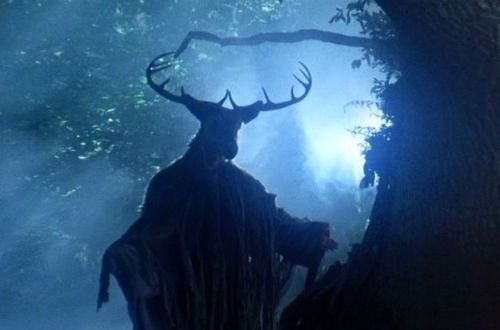
Herne the Hunter is a real medieval legend about a man who was hanged for poaching deer in Windsor park and now haunts the forest with horns on his head. Not only does Master Ford dress as Herne, The witty housewives dress the neighborhood children like Fairies and instruct them to pinch the fat knight and burn him with lit candles. Essentially this scene is a Shakespearean trick or treating moment with a ghost story to boot. Plus as Mistress Page mentioned, the ghost haunts Windsor towards the the oncoming of Winter, so it’s not entirely unlikely that it would be that this scene was originally played around the time of Halloween.

How did Shakespeare contribute?

Scholars describe Shakespeare’s mind like a magpie, taking myths, legends, history, and books to come up with his own plays. As you have seen, the ancient traditions of Halloween had a powerful effect on Shakespeare’s plays. But, did he contribute to those traditions himself? I would say yes in a big way. First of all the image of Hamlet holding a skull has inspired many other Halloween images:

David Tennant in Hamlet, RSC 2008
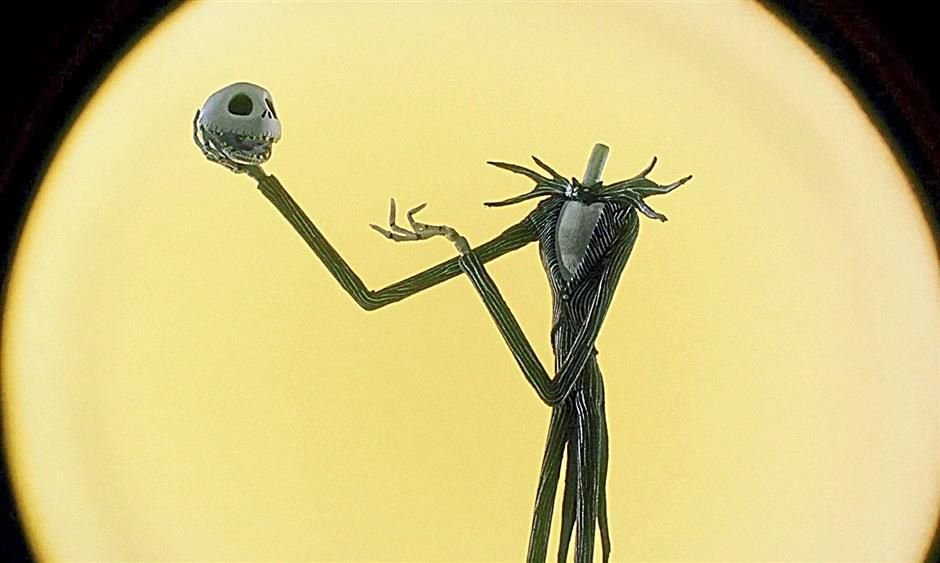
Jack Skellington in The Nightmare Before Christmas, 1993.
But I think Shakespeare’s greatest contribution to how we celebrate Halloween are centered within the witches of Macbeth.

Though Shakespeare by no means invented the concept of witchcraft, he did popularize the idea of the wicked witch, and helped form our modern view of what a witch is. The image he created in Macbeth

More than that, I would argue that the modern wicked witch would be all but silent without Shakespeare. When you think of what a witch might say, besides a series of high pitched cackling, what do you think of? Probably you think of this:

Or this:

Shakespeare’s bizarre and cryptic language helped inspire countless other interpretations of witches, and thus, a way for audiences to deal with the temptations that lurk in our hearts.



In conclusion, we don’t know how Shakespeare celebrated Halloween or even if he did to begin with; Halloween and Shakespeare’s life are both frought with mystery and legend, but one thing is dead certain; Halloween would not be the same without him. He absorbed the ancient rituals of the Celts and Romans and crafted some modern Halloween ideas and images that endure to this day.
Sources
https://www.historic-uk.com/CultureUK/Halloween/
https://www.bbc.co.uk/newsround/15169373
Thanks very much for reading! If you liked this post, please consider signing up for my new “Macbeth” online class via Outschool.com. One really fun part of the class will be an escape room where you use your knowledge of Macbeth to escape a cursed castle:

 The Shakespearean Student