As you probably know, I love to review children’s adaptations of Shakespeare (whether direct or indirect). “The Lion King,” (Hamlet), “Encanto” (King Lear), and of course, the many adaptations of “Romeo and Juliet,” are mainstays on this website: Gnomio and Juliet, Romeo and Juliet: Sealed With A Kiss, even Pocahontas have their basic plot and characters firmly rooted in Verona Italy.
Then one day by chance, I found this book in a local park, and I knew I had to review it!
THe Premise
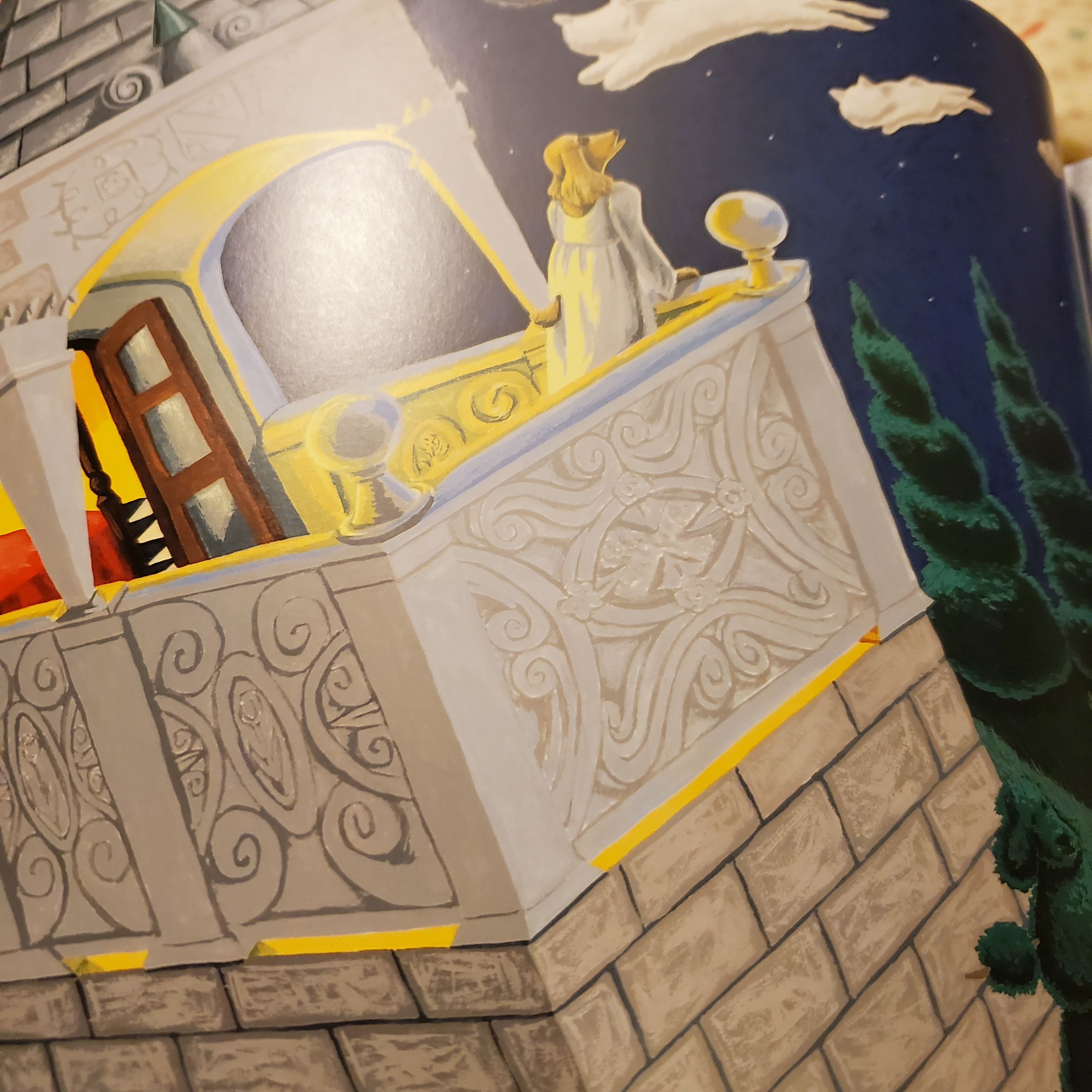
This is a simple re-telling of the story of Shakespeare’s play that focuses on just the young lovers. You feel for these cute little animals and in a way, making them a kitty and a dog smitten with puppy love, makes them more understandable and sympathetic than Shakespeare’s youthful teenagers, who indulge in violent delights without using their human reason.
What It Keeps
The Story
The book keeps the feud between the two families, has the young lovers meet in disguise at a ball, fall in love on a balcony, get married, and amazingly, DIE! Laden still manages to tell the story in a kid-friendly way, though giving it tragic weight.
THe Language
The book opens with a rhyming prologue, which, although it isn’t in sonnet form, has the same function as Shakespeare’s prologue- to explain the plot before we see it played out in the book, thus giving the whole story a sense of dramatic irony. Plus, as you can see, Laden also imitates Shakespeare’s love of wordplay with metaphors and puns, (a tale of tails), and alliteration to give the dialogue some wit and effervescence. Reading it gave me giggles like I’d just popped open some champagne.
What it changes: Spoiler alert
All throughout, Laden makes small changes to simplify the plot and remove characters that don’t directly impact the main plot. The characters of Lord/Lady Capulet and Lord/Lady Montegue, The Nurse, Paris, Peter, the servants, and the friars are completely absent, turning an already brief play into an even more compressed story.
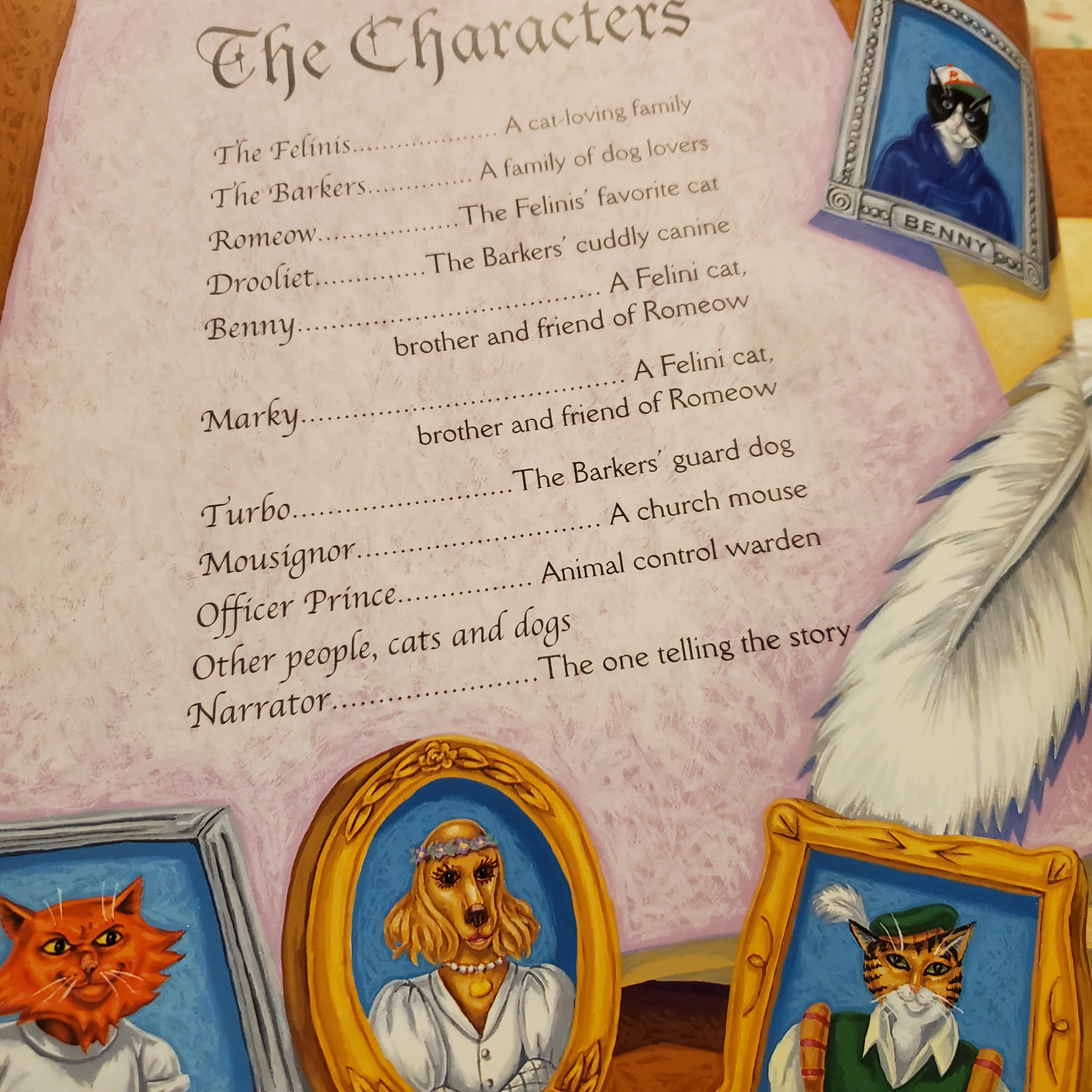
Like a lot of animal retellings I’ve seen of this story, the author recasts the human leads as animals that are natural enemies- in this case, cats and dogs. This makes the story easier for kids to understand- as I’ve said before, it’s often difficult to keep track of who belongs to which house in Shakespeare’s version. All you need to know is that Romeo and his brothers are cats and Juliet’s family are dogs.
Funnily enough, my daughter actually complained that the story would’ve been better if Juliet were a cat instead of Romeo, which I agree with for very specific reasons. The character of Tybalt is named after a character from a prose story called “Reynard the Fox,” who had the epithet, Prince of CATS. Mercutio annoys Tybalt by taunting him with this title before challenging him to a duel:
Tybalt: What would you with me?
Mercutio: Good Prince of Cats, nothing but one of your nine lives! Romeo and Juliet, Act III, Scene i.
It would’ve been a funny Shakespeare easter egg to have Juliet and Tybalt be portrayed as cats, but I understand why they went with dogs- Drooliet is a hilarious pun, and having Tybalt be a vicious, rabid dog helps set him up as a fearsome antagonist.
I suppose you’re wondering, how can the author keep Shakespeare’s tragic ending in a children’s book? Well, like Shroedinger’s cat, she manages to make Romeow die and not die at the same time. He gives Drooliet one of his 9 lives, allowing them both to ‘die’ and then come back for a happy ending. It’s a brilliant way to nod at the original, while also keeping the kid-friendly tone.
My Reaction
This book is really fun and very enjoyable for kids, parents, and teachers who want to introduce kids to Shakespeare at an early age!
Just below you can watch the book being read by actress Hayle Duff:
In this section, I review a Shakespeare book, movie, or TV show that I feel has some kind of value, either as an interpretation of Shakespeare, or a means to learn more about the man and his writing.
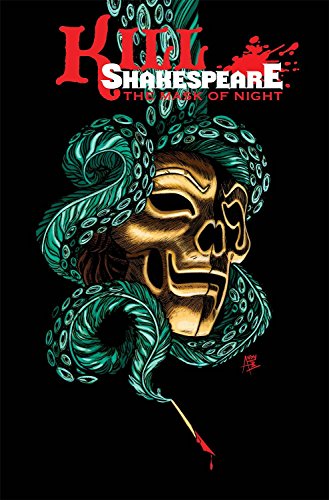
Name: Kill Shakespeare (Vol. 4) by Connor McCreery and Anthony Del Col
Ages: Adult/ Teen. There’s some PG-13 language and a lot of fighting and gore, so it’s not really for kids
Premise: William Shakespeare is more than just a simple playwright- he has a magic quill that brings his characters to life. Some of the characters worship him like a god or like a father. Many others, (as the title implies), want him dead. A faction of outlaw heroes who call themselves The Prodigals are trying to protect Shakespeare, including Juliet and Hamlet, but in this volume, they’ll have to face raging seas, bloodthirsty pirates, and the mind-altering effects of the island in Volume 3, which has pushed them all to near-madness.
My reaction: Volumes 1&2 were framed as a civil war between the heroes and villains of the Shakespeare canon- basically an Infinity War for Shakespeare nerds. This volume is in the context of a high-seas pirate adventure. It has a lot of cool fights and the drama between Cesario and Viola is great, but honestly, I thought it was poorly paced. Maybe it’s my personal taste, but it’s hard to keep myself invested in the story when everyone is stuck on a boat.
Basic Details:
As I said in my review of Volume 2, what I like the most about this graphic novel is that the characters are consistent with how the real Shakespeare wrote him, yet they make different choices in the graphic novel. They also grow and play off each other in many interesting ways. Here are some examples:
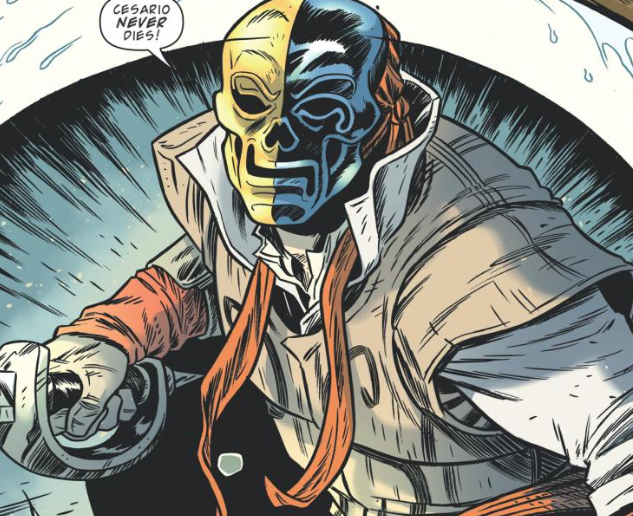
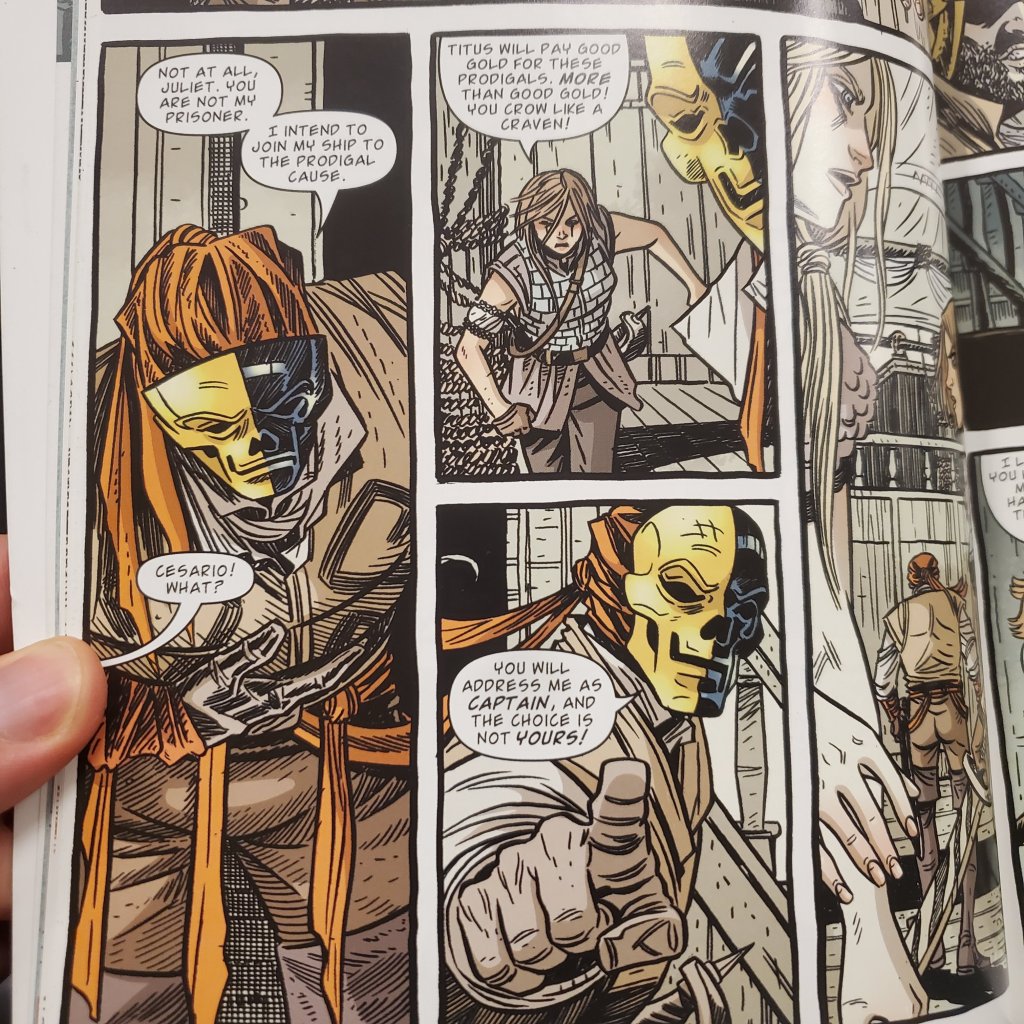
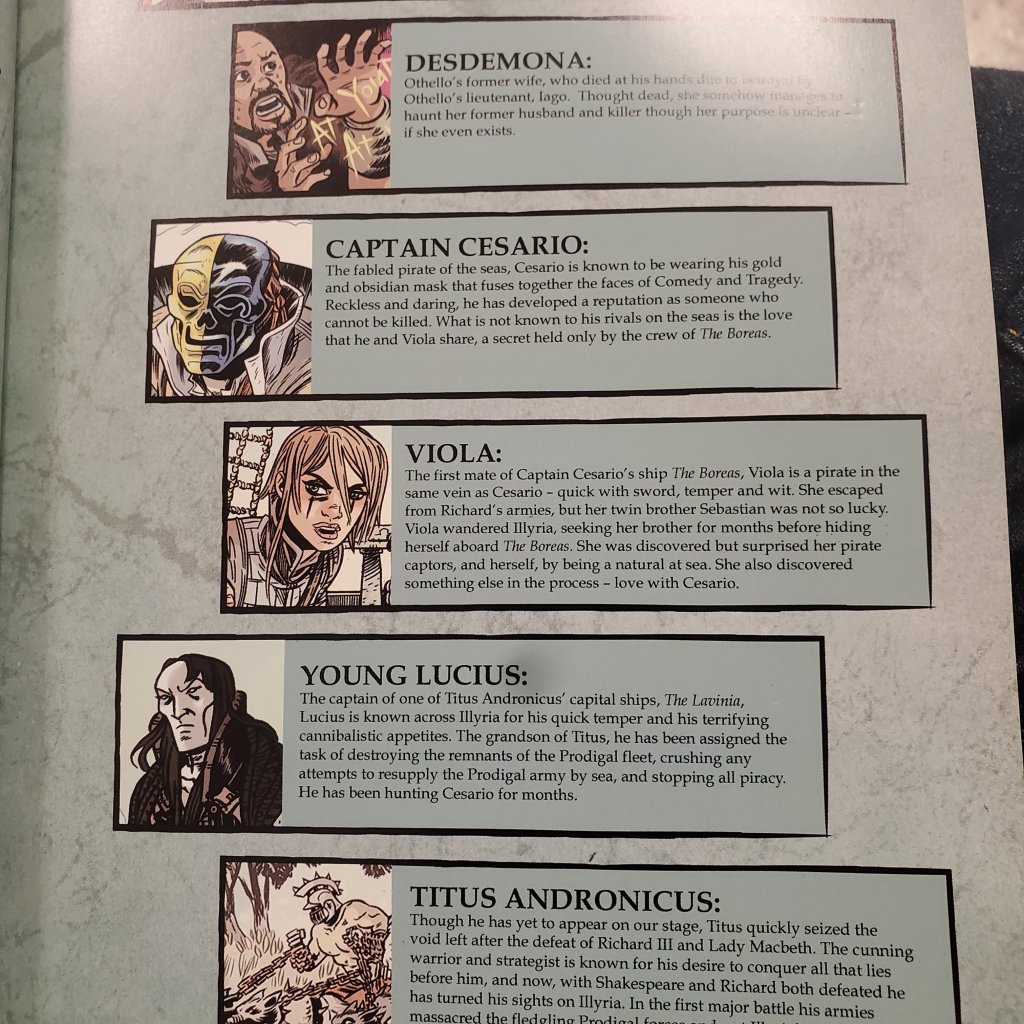
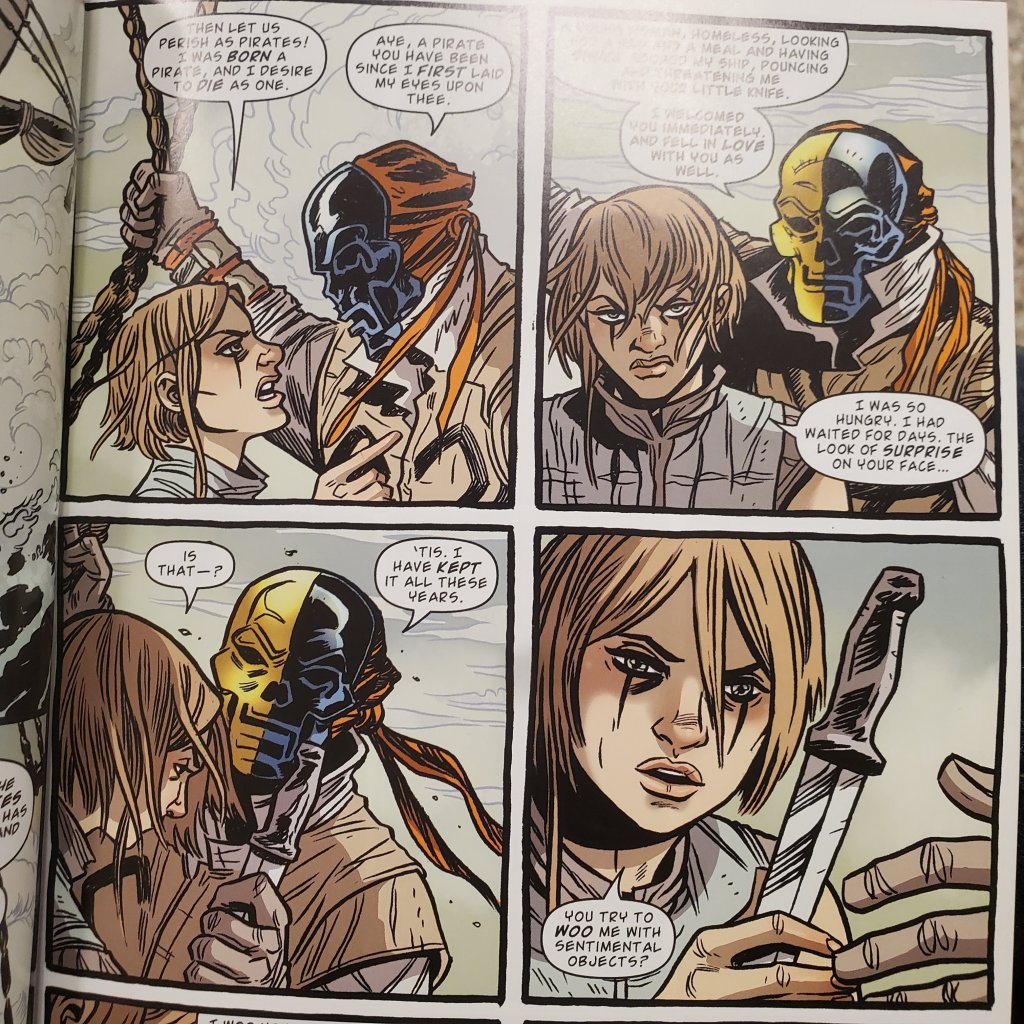
Most of the drama of the graphic novel centers around Captain Cesario, a dashing rogue pirate, and his first mate/ girlfriend Viola. The main characters from Volume 2, (Shakespeare, Hamlet, Juliet, and Othello), have escaped the effects of the island run by the mad wizard Prospero, but are still shell-shocked at feeling the terrifying psychic effects of that island. This is a clever plot device that basically makes it makes all the characters unnecessary except for Hamlet and Juliet. You could look at this installment as the story of 2 couples, (dare I say twin couples) where Viola and Cesario are fighting over whether or not to join Shakespeare and the other Prodigals, to remain on the high sea as pirates, or to betray them and become ingratiated with the fearsome cannibal-pirate Lucius Andronicus.
I won’t give too much away (there are some spoilers), but let’s just say that the relationships in Volume 2 have been tested to the breaking point; Hamlet and Juliet are having extreme problems, (almost as bad as Hamlet and Ophelia). Viola and Cesario are also fighting constantly. In addition, the ship is constantly under threat from the feared pirate Lucius Andronicus. Will the characters solve their internal conflicts before a mutiny breaks out? Or will they all be cut to pieces by the cannibal Lucius? On this boat, tempests are not kind, and salt waves are fresh with DEATH!
Shakespeare Easter Eggs
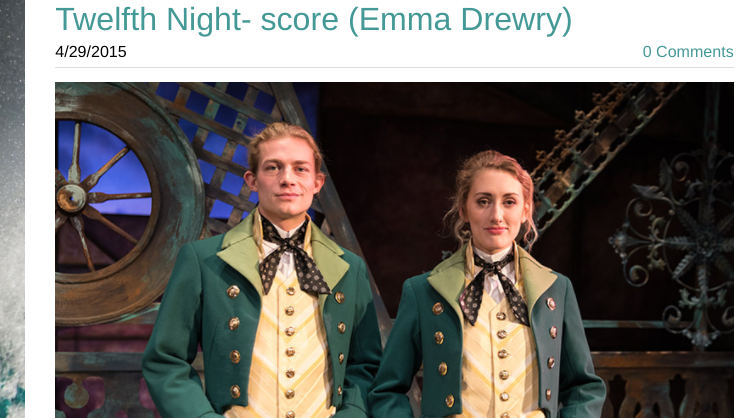
Kill Shakespeare, Volume 4 is largely based on Shakespeare’s Twelfth Night, which, although it mainly focuses on the courts of Duke Orsino and Countess Olivia, does have aspects of pirates, deception, and lovers quarreling. It is interesting (and I give the writers credit) for taking a light-hearted comedy with songs and dances and turning it into a swashbuckling pirate adventure; that takes real imagination, yet it works with the text; the first time we see Viola she is shipwrecked and the captain that saves her life is arrested offstage. This prompts Viola to disguise herself by wearing her twin brothers’ clothes and donning the non-de-plume Cesario, to freely behave like a man in a man’s world. Shakespeare already made Viola’s fate intertwined with the sea, so it makes sense that she might want to be a pirate. Kill Shakespeare takes Viola’s two identities and makes them two separate people, both intertwined with a love of the sea.
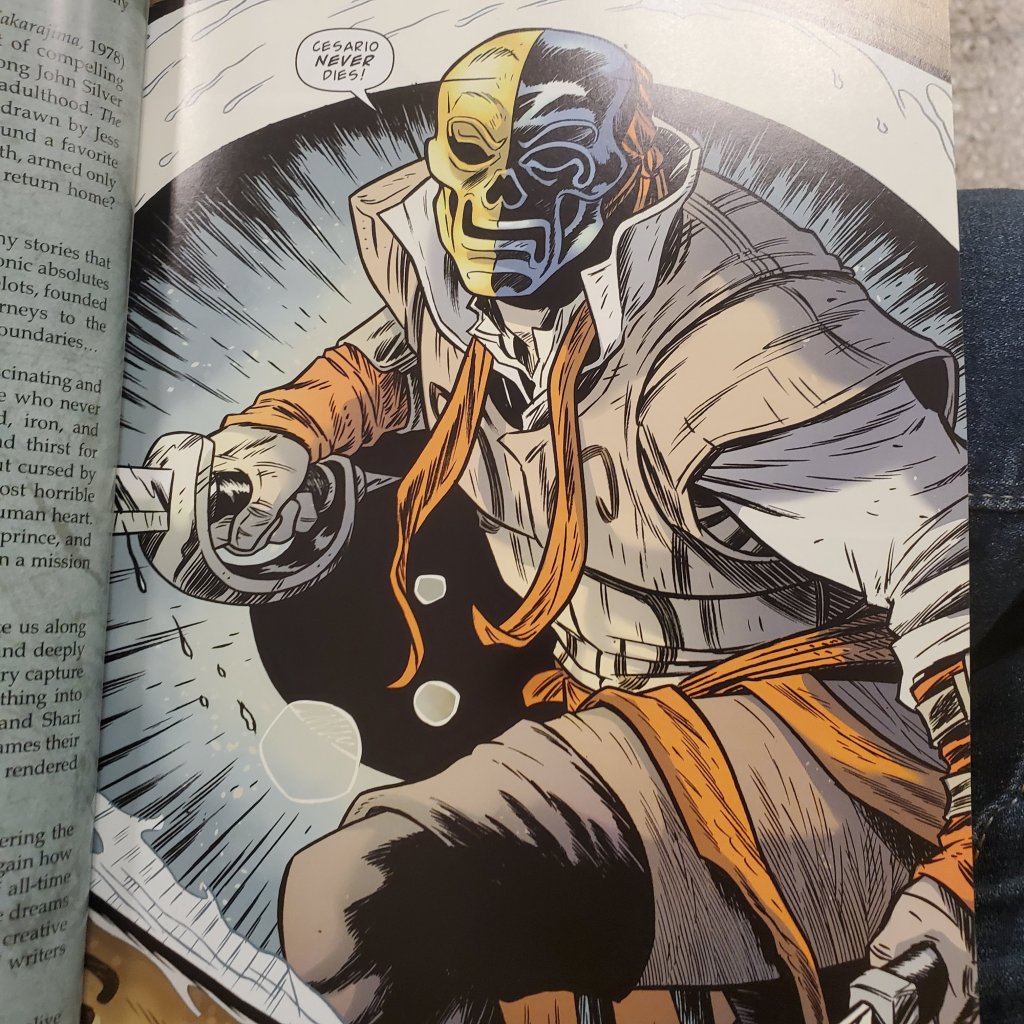
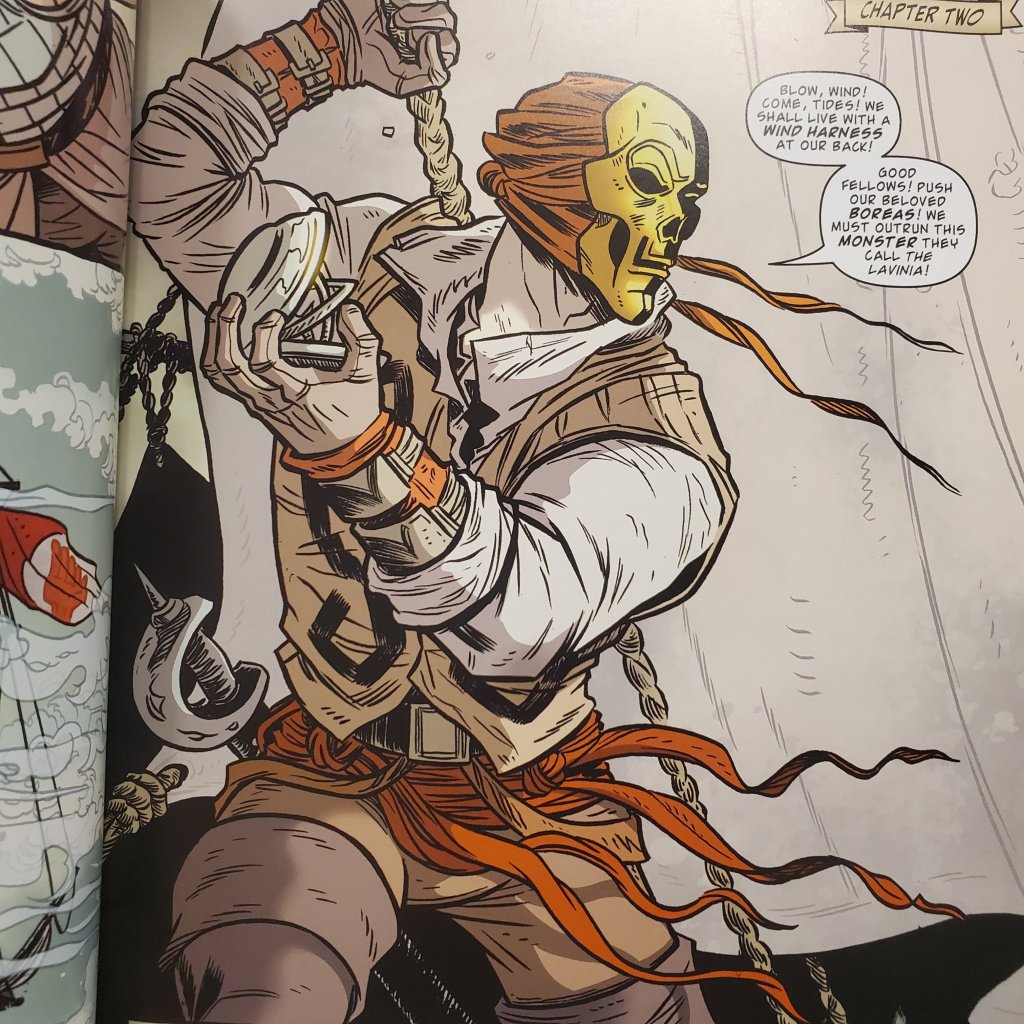
The graphic novel also conflates and expands other pirate characters from the play; there’s another captain in the play named Antonio who saves Viola’s brother Sebastian and is accused of being a pirate, While Viola in Twelfth Night is a noblewoman who out of necessity disguises herself as a man and becomes a servant to a Duke, Viola in this version is trying to escape being a noblewoman and becomes a pirate by choice. Meanwhile, Antonio, who denies being a pirate, is changed into the roguish Cesario, who loves Viola as much as Antonio loves her brother Sebastian in the play. Like Antonio, Cesario cares about Viola’s well-being and is willing to sacrifice everything to keep her safe, even being a pirate. This causes friction between the two since again, Viola wants to continue to be a pirate and would rather die than give it up. Their conflicting roles as shipmates and soulmates keep them at odds during the play, sort of like how Cesario’s mask is split down the middle; half tragic, and half comic.
Critique
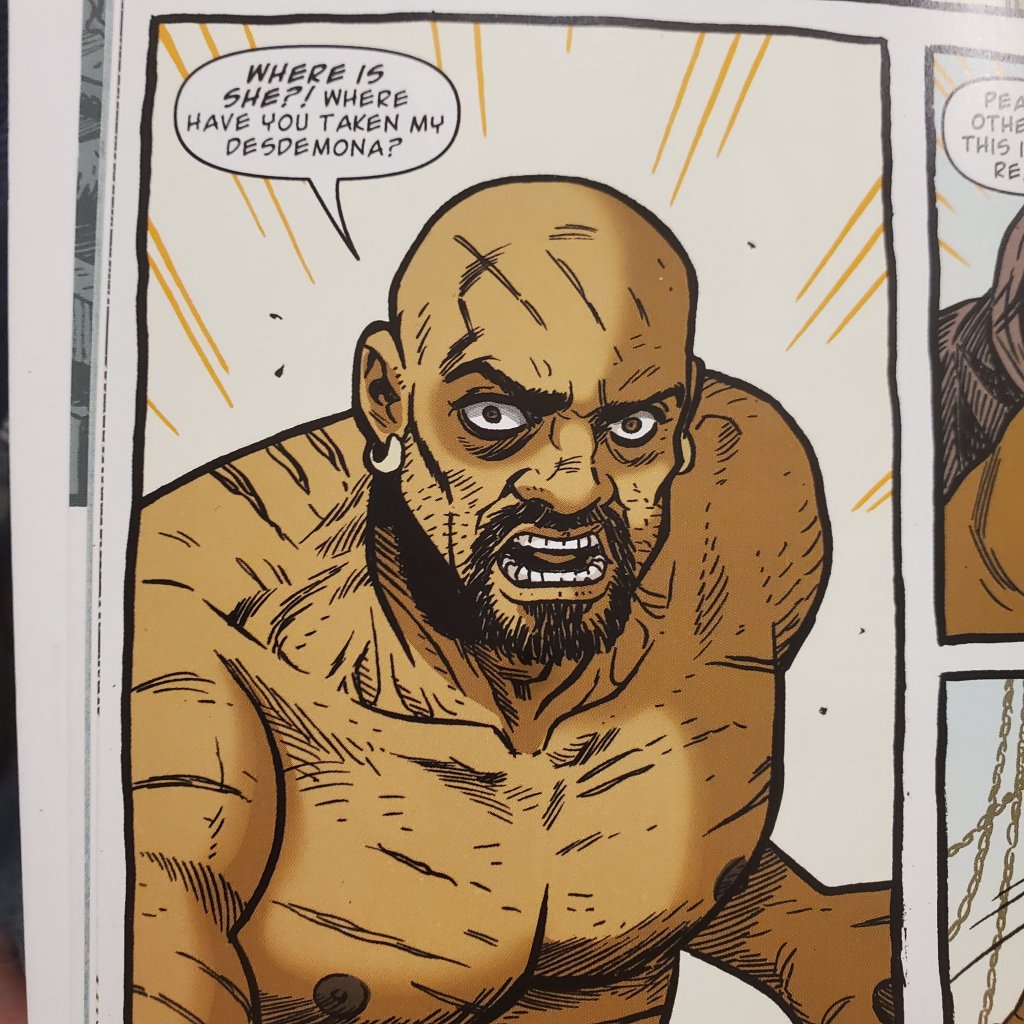
I think this graphic novel is poorly paced. Most of the first half consists of Cesario and Viola arguing about what to do with Shakespeare and the rest of the Prodigals. Their drama is good, but it supersedes everybody else, and I found myself wondering what was going to happen to Shakespeare and the rest, and wishing that they’d got more focus. Othello is reduced to a plot device because he is madly searching for Desdemona, whom he killed during the events of Shakespeare’s play. Othello is no longer the honest, loyal friend to Juliet that he was in the previous editions; now he’s more like The Incredible Hulk, filled with animalistic rage and unable to be controlled except by the love of his friend Juliet. In some ways, Othello was the most likable character in the previous volumes so I hated to see him like this.
In addition, the constant couples’ bickering gets a little bit tedious; I suppose that’s inevitable when you take all the comic elements out of Twelfth Night, (Sir Toby and Feste are back in Volume One, and Malvolio, Fabian, and Olivia are nowhere to be seen). I did enjoy the ending where Viola resolves her conflict with Cesario much the same way Viola solves the problem of her being Cesario in the play. I also like the way that they built up the antagonist Lucius from Titus Andronicus. Lucius is a good choice for a villain in this world because he’s seen some truly horrible things in his own play like his father mutilating people, his brothers and sister murdered, and the worst pie recipe of all time. Making Lucius a bloodthirsty, cannibalistic pirate is a great choice. Still, I wish they spent more time fighting with him instead of sailing away from him. In short, the characters are as compelling as ever but the action is lagging and the drama is reduced to mostly petty couple squabbling. I would like to see this series pick up in a more action-packed version more in keeping with a graphic novel.
Recommendation: I’d recommend this book to all mature fans of Shakespeare, anime, Manga, D&D, or any kind of nerd stuff!
Tomorrow is the first session of my course on Shakespeaere’s tragedies! I’m so excited to teach this great group whom I’ve worked with before. To mark this occasion, I present this silly, catchy, and informative song about the tragic fates of Cleopatra, Juliet, Hamlet, and others.
Title page for my course on Shakespeare’s Tragedies
If you want to sign up for this course or request a private session, you can do so at http://www.outschool.com, or by scanning the QR code below:
Basics Of Stage Combat: Students will learn the basics of safely enacting a fight onstage, in preparation for a Shakespeare play. We will also learn about the history of sword fighting in the military and the duel.
Trailer for Basics of Stage Combat.
My daughter really enjoyed taking this class. She was actually able to use her sabre and try out her routine on her father. Paul is quite knowledgeable about Shakespeare and made the class really fun by teaching a fight scene from Romeo and Juliet. It is amazing watching her practice with Paul over Zoom. I hope Paul will have. more combat classes, it is a different way to learn Shakespeare.
IB, Parent
An Interactive Guide To Shakespeare’s London (New Class)
A virtual tour of Shakespeare’s London will get kids to interact with the culture of Elizabethan England.
Class Experience
To teach kids about the Elizabethan era and the background of Romeo and Juliet, The Instructor will interact with the class (via pre-recorded videos), pretending to be Shakespeare. The class, pretending to be actors in Romeo and Juliet, will get a virtual tour of The Globe Theater, Hampton Court Palace, and a virtual visit to an Elizabethan doctor's office. This activity is an immersive way for them to learn about the period, how it relates to the world of the play, and how Shakespeare changed theater.

The class will take the form of a guided WebQuest activity.  First, the students will get a worksheet that has a series of fill-in-the-blanks about Elizabethan society (below). The students will fill out this worksheet based on a Nearpod and in conjunction with a website I’ve made, https://sites.google.com/nebobcats.org/visit-to-elizabethan-london/home?authuser=0
Both the Nearpod and each webpage will have a virtual tour, a video, and text explaining some aspects of Elizabethan life. Before they go to each location, I will give a short introduction via prerecorded video:
Wizard Science
In this one-hour course, your child will discover the enchanting world of science through a series of magical experiments. Learn about such topics as Astronomy, Static Electricity, chemistry, and optical illusions.
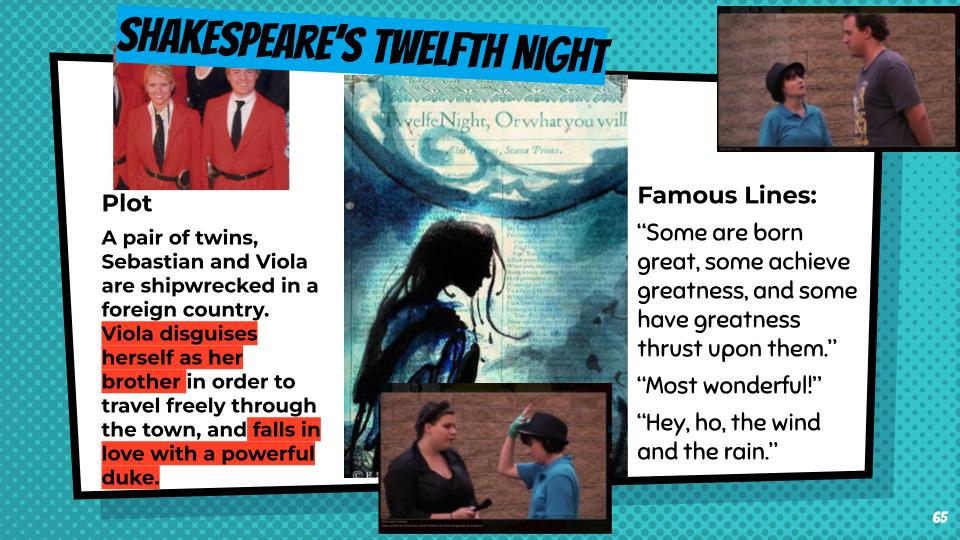
In this one-hour course, students will learn and play games that will explore the history behind Christmas traditions. We will also discuss the themes, characters, and famous quotes from Shakespeare’s play “Twelfth Night.”
In this section, I review a Shakespeare book, movie, or TV show that I feel has some kind of value, either as an interpretation of Shakespeare, or a means to learn more about the man and his writing.
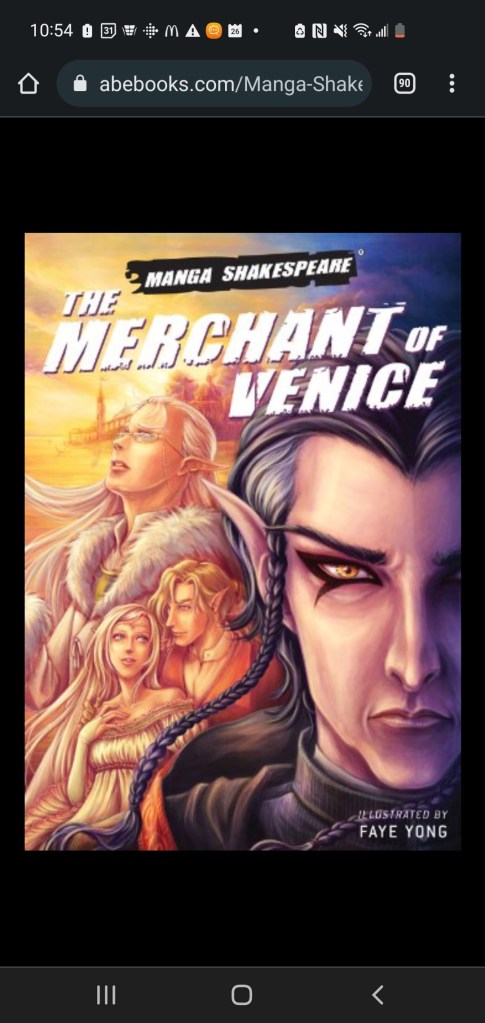
Name: The Manga Shakespeare– “Merchant Of Venice,” Illustrated by Faye Yong.
Ages: Adult/ Teen. There’s some PG-13 language, and the subject matter touches on racism and anti-Semitism, so it shouldn’t be read by really young kids.
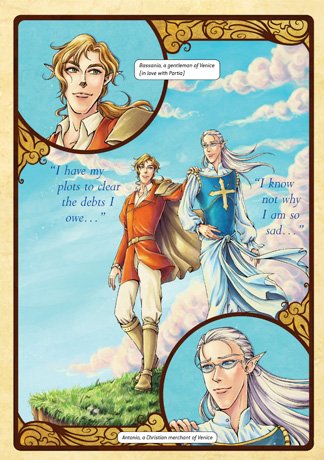
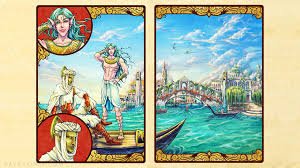
Premise: Like the Midsummer Night’s Dream edition I already reviewed, this is the full play with Manga inspired illustrations. However, unlike Midsummer, this book is more conceptual. It reinterprets all the characters as either fairies, aliens, mermaids or merman, or some other fantasy characters. It is literally a fairy tale, which I find a fascinating concept for a number of reasons. That said, like any interpretation of Merchant, this choice is somewhat controversial for reasons I will get into below.
“A friend of mine said she got married in Venice and described it as like being in an RPG.”
Faye Yong, Illustrator for “The Manga Shakespeare: Merchant Of Venice.”
What Does Role-Playing Game (RPG) Mean? A role-playing game (RPG) is a genre of video game where the gamer controls a fictional character (or characters) that undertakes a quest in an imaginary world.
Defining RPGs is very challenging due to the range of hybrid genres that have RPG elements.
Traditional role-playing video games shared five basic elements:
The ability to improve your character over the course of the game by increasing his statistics or levels.
A menu-based combat system with several choices of skills, spells, and active powers as well as an active inventory system with wearable equipment such as armors and weapons.
A central quest that runs throughout the game as a storyline and additional (and usually optional) side quests.
The ability to interact with elements of the environment or storyline through additional abilities (e.g. lockpicking, disarming traps, communication skills, etc.)
The existence of certain character classes that define the characteristics, skills, abilities, and spells of a character (e.g. wizard, thief, warrior, etc.)
-“RPG” Technopedia
My reaction: I honestly don’t know what to think about the way the comic depicts races. In the interview above, illustrator Faye Yong explains how she chose a fantasy aesthetic for the graphic novel.
She read the script and represented the characters like the Prince of Aaragon, the Prince of Morocco, and re-interpreted them as fantasy characters. A good example is the Prince of Aragon. As you can see in this scene from the 2004 movie, Shakespeare portrays Aaragon as a vain, shallow person. Incidently, Aaragon is a province of Spain, over which the English just won a major naval victory, so Shakespeare makes this character a mockable popinjay since the Spanish were still the mortal enemies of the English:
Fay Yong wanted to heighten Aaragon’s vanity, so she made him a beautiful creature with long, flowing hair.
This is telling: Yong immersed herself with Shakespeare’s text, but she didn’t really delve into the real world context. She wasn’t interested in the real cultures of Aaragon, Morrocco, or even Venice, but to take Shakespeare’s impression of these cultures, and use Japanese style animation to tell Shakespeare’s story. For most of the play, this approach works quite well. After all, Shakespeare depicts Portia and her home in Belmont as an almost ethereal place, where men come from far and wide to see this magical kingdom, and Portias father gets a prophetic vision on his death bed that makes him alter his will so that only someone who can decipher his riddle will get to marry Portia and inherit her estate. Like I said, the scenes in Belmont work very well as a Manga comic, particularly Bassanio’s Zelda-style fetch quest where he has to choose the right casket to marry Portia. I hope someone someday turns this idea into a real game.
Faye Yong (the illustrator of “Merchant,” shows how she designed and drew the character Portia).
However, the scenes in Venice don’t work as well because Shakespeare wrote them with a clear understanding of the real Venice, and the tensions between the Jewish and Christian communities. Details like Antonio’s anti-Semitism, Shylock’s fury at his daughter marrying a Christian, and Portia’s own racism and anti-Semitism is frankly erased when you view it out of the context of the real Venice.
Another example of questionable racial re-interpretation is theThe Prince of Morrocco, who like Aaragon, is a suitor to Portia who likewise fails to choose the proper casket and win Portia.
In Yong’s version, Morocco has green, rather than brown skin now, (sort of like Piccolo from Dragon Ball Z), which is problematic because we associate green with sickliness and that makes this speech of Morocco’s even more problematic:
Mislike me not for my complexion,
The shadow'd livery of the burnish'd sun,
To whom I am a neighbour and near bred.
Bring me the fairest creature northward born,
Where Phoebus' fire scarce thaws the icicles,
And let us make incision for your love,
To prove whose blood is reddest, his or mine
Not surprisingly, the most controversial illustration choices center around Shylock the Jewish moneylender. As I’ve written before, Shylock has always been a controversial figure, and this comic interprets him in a way I find simultaneously simplistic and highly thought-provoking.
Faye Yong has stated that she wanted to make Shylock look the same as the Christian characters, but that his garb would reflect a sort of “dark elf” aesthetic. She describes him as the sort of fantasy character that worships the moon, rather than the sun. On the one hand, I applaud her for not giving into the old Jewish stereotypes like red hair, hook noses, etc. I also have to admit that Shylock is sort of a dark vengeful figure (he is after all, the villain), so making him a dark elf works on the surface.
On the other hand, again, without the context of anti-Semetism, and the complex relationship between Jews and Christians in the 16th century, much of the Shakespearean text is devoid of meaning. Perhaps this is an attempt to make the play more easily accessible to young readers like teenagers, and I applaud that, but as I wrote in my post about why everyone should read or teach this play, learning about the historical context of real Jews is this play’s great gift, and that is lost in this version.
On the other hand, depicting Shylock like some kind of dark elf or warlock actually brings to life a very real aspect of anti-Semetic prejudice that many people overlook today: for most of western history, many of our stereotypes of Jews were interlinked with our stereotypes about witches!
Jewish Stereotypes and the Occult
So, ironically, much the same way Ian McKellen’s Richard III helped modernize the complex medieval politics of the 15th century, seeing Shylock as a semi-mystical, possibly occult figure, actually brings to light some of the prejudices that real Jews in the 16th century faced!
In conclusion, Merchant Of Venice is extremely hard to adapt in a comic book context, and some aspects are a little lost in translation. That said, it is gorgeous to look at, and it has a great visual shorthand that enlivens Shakespeare’s text in a unique and appealing way.
Recommendation: I’d recommend this book to all mature fans of Shakespeare, anime, Manga, D&D, or any kind of nerd stuff!
In this section, I review a Shakespeare book, movie, or TV show that I feel has some kind of value, either as an interpretation of Shakespeare, or a means to learn more about the man and his writing.
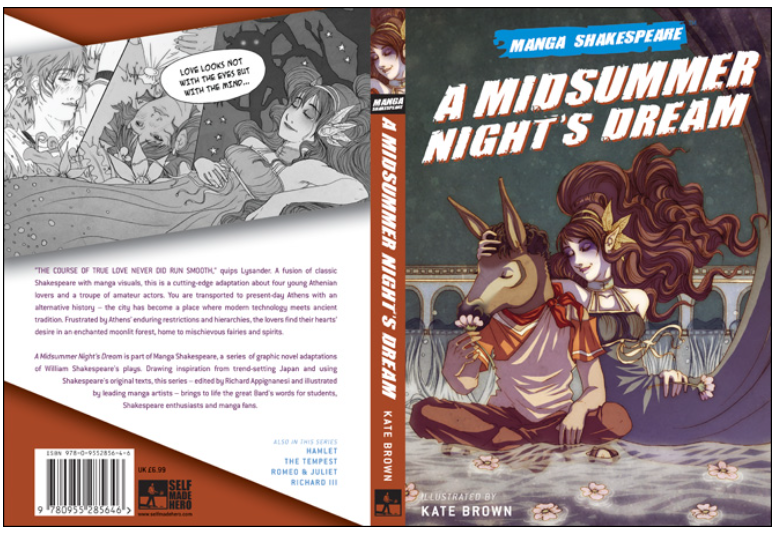
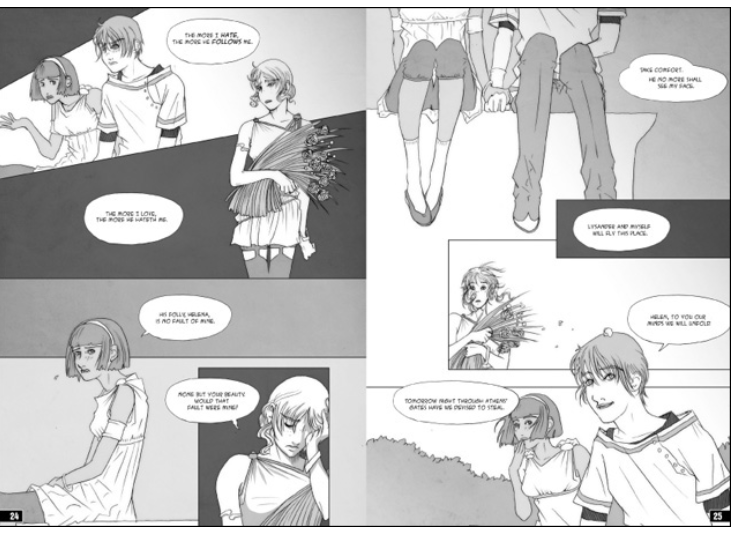
Name: The Manga Shakespeare: “A Midsummer Night’s Dream.
Ages: Pre Teen- Adult. No violence or explicit imagery, but the visual format might be confusing for younger viewers.
Premise:
My reaction:
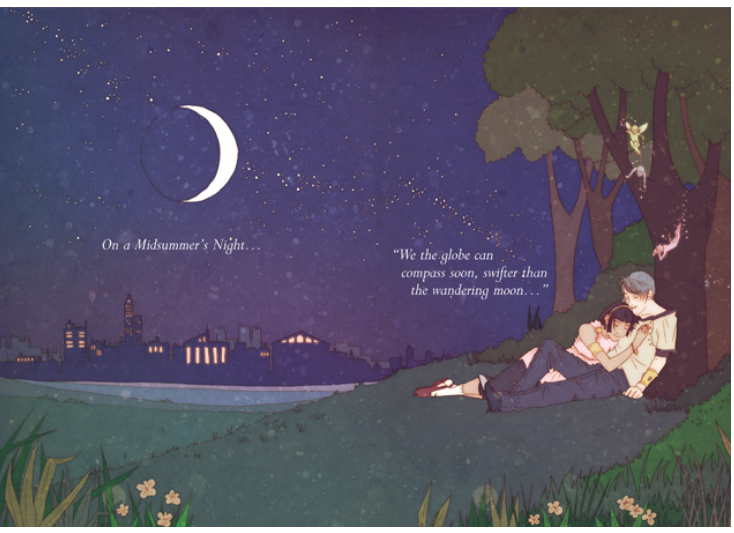
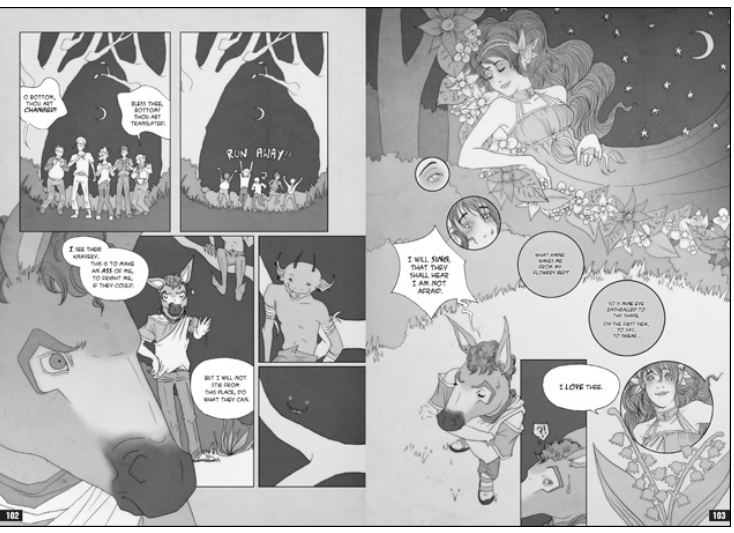
This series is very creative and in general, has a distinct and exciting style that works well for Shakespeare, though I would argue that “Midsummer” is one of the weaker ones in the series. The character designs are somewhat generic, and although the emotions are clearly conveyed, I feel that the style doesn’t clearly show who these people are or the different environments in the play- Athens, the Woods, and the Court.
Basic Details:
Sometimes the over-the top nature of manga drawings works well with this play. When Helena is mooning over Demetrius, we can see highlights in her eyes that work very well within the big-eyed, expressive style of Manga. By contrast, some other characters like Oberon are drawn very sharply, making him appear stern and even grim.
Another thing the style of pictures does is to literally illustrate the poetic passages of the For example, when Titania delivers her “These are the forgeries of jealousy,” speech, the images of the text compliment her concerns that the king and queen of the fairies are effecting the natural world.
Critique
I enjoy how well the characters convey emotions in this version because they help convey the meaning of the text. However, I think this visual style is too austere and sharp for such a vibrant, silly, colorful play. I wish the style of Manga didn’t dictate that most of the pages are black and white, because some color in the fairy scenes would add some much-needed magic.
Recommendation: This book is a good resource for classrooms exploring the text of “A Midsummer Night’s Dream,” but honestly I wouldn’t read it for pleasure.




















 The Shakespearean Student