In this section, I review a Shakespeare book, movie, or TV show that I feel has some kind of value, either as an interpretation of Shakespeare, or a means to learn more about the man and his writing.
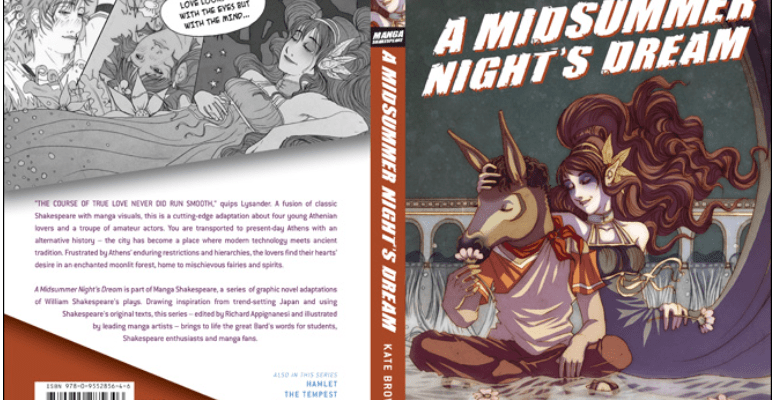
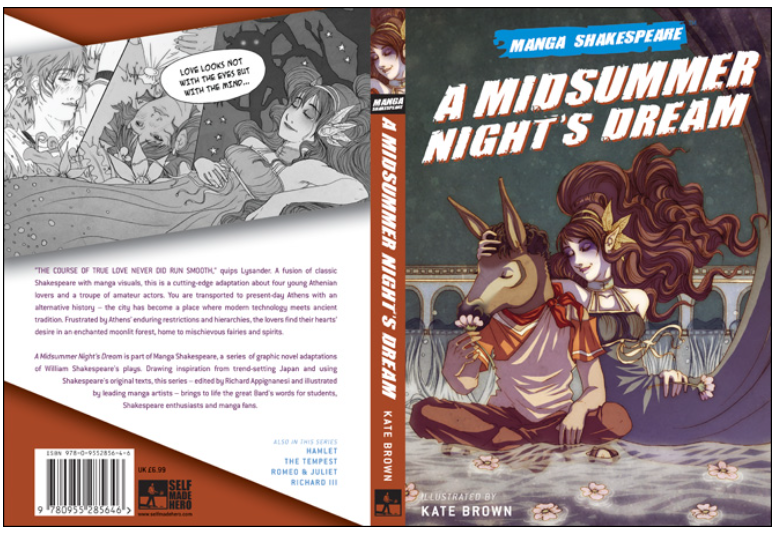
Name: The Manga Shakespeare: “A Midsummer Night’s Dream.
Ages: Pre Teen- Adult. No violence or explicit imagery, but the visual format might be confusing for younger viewers.
Premise:
My reaction:
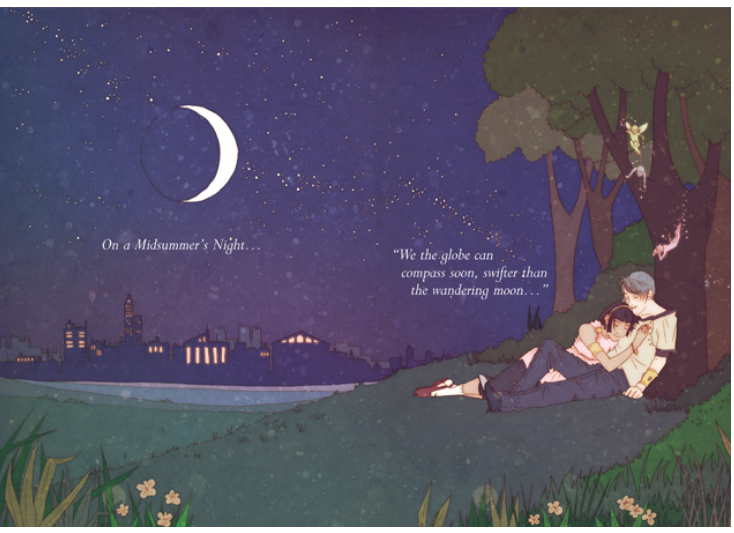
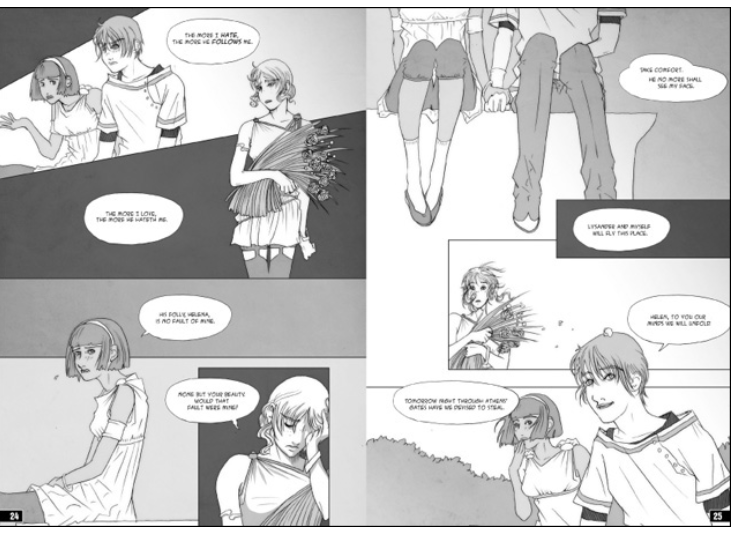
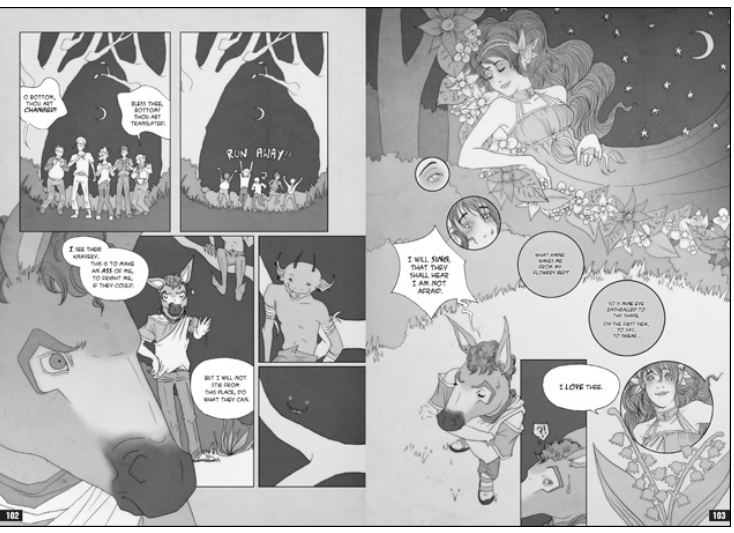
This series is very creative and in general, has a distinct and exciting style that works well for Shakespeare, though I would argue that “Midsummer” is one of the weaker ones in the series. The character designs are somewhat generic, and although the emotions are clearly conveyed, I feel that the style doesn’t clearly show who these people are or the different environments in the play- Athens, the Woods, and the Court.
Basic Details:
Sometimes the over-the top nature of manga drawings works well with this play. When Helena is mooning over Demetrius, we can see highlights in her eyes that work very well within the big-eyed, expressive style of Manga. By contrast, some other characters like Oberon are drawn very sharply, making him appear stern and even grim.
Another thing the style of pictures does is to literally illustrate the poetic passages of the For example, when Titania delivers her “These are the forgeries of jealousy,” speech, the images of the text compliment her concerns that the king and queen of the fairies are effecting the natural world.
Critique
I enjoy how well the characters convey emotions in this version because they help convey the meaning of the text. However, I think this visual style is too austere and sharp for such a vibrant, silly, colorful play. I wish the style of Manga didn’t dictate that most of the pages are black and white, because some color in the fairy scenes would add some much-needed magic.
Recommendation: This book is a good resource for classrooms exploring the text of “A Midsummer Night’s Dream,” but honestly I wouldn’t read it for pleasure.
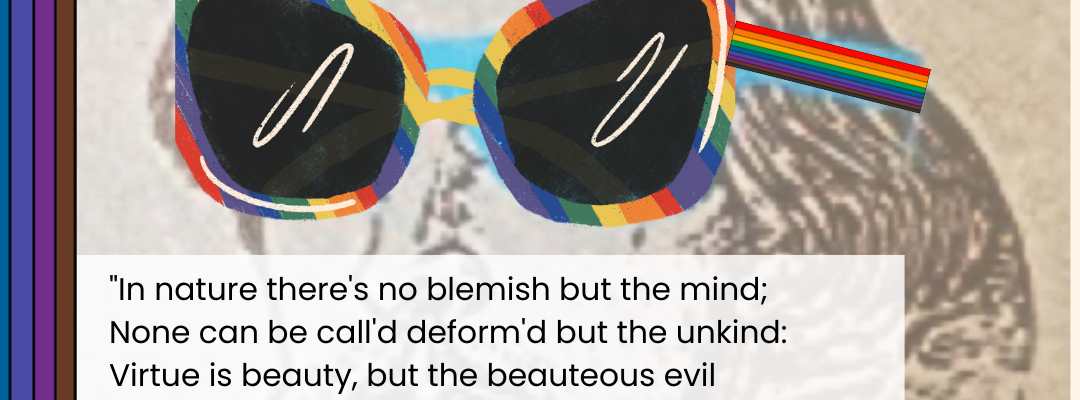
Happy Pride Month everyone! This month I’m going to concentrate on “A Midsummer Night’s Dream,” more info on Shakespeare’s comedies, and a few little nerdy analyses, but first I wanted to extend a friendly hand to members of the LGBTQ+ community, whom arguably Shakespeare has celebrated in some of his writing, especially in Midsummer and the other comedies.
The quote on the featured photo comes from “Twelfth Night.” The character Antonio repeatedly mentions how much he loves Sebastian (Viola’s twin brother). He shows a great amount of courage and devotion. Sadly, Sebastian doesn’t reciprocate his feelings, but he is grateful to Antonio, and tries to help him when he gets in trouble.
If you’re interested in queer readings and queer coding in Shakespeare, enjoy this video analysis from Kyle Kalgren and Rantasmo- a scholar who delves into queer representation in popular media:
Let me know if you’d like me to cover more of this topic. I admittedly, haven’t read many Queer Theory papers on Shakespeare, but it’s a fascinating and wide-ranging topic. It also helps develop the case that, as Rantasmo puts it: “If we truly believe (and I do) that Shakespeare is a universal writer, then his plays should be able to speak to all races, cultures, and all forms of love.”
In this section, I review a Shakespeare book, movie, or TV show that I feel has some kind of value, either as an interpretation of Shakespeare, or a means to learn more about the man and his writing.
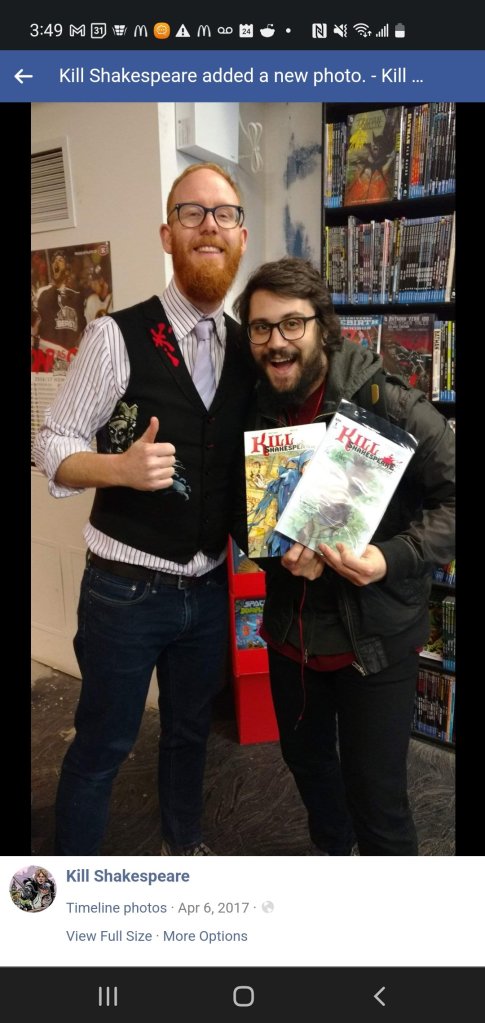
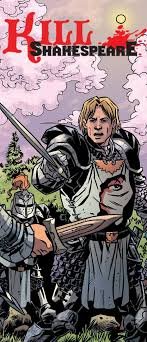
Name: Kill Shakespeare (Vol. 2) by Connor McCreery and Anthony Del Col
Ages: Adult/ Teen. There’s some PG-13 language and a lot of fighting and gore, so it’s not really for kids
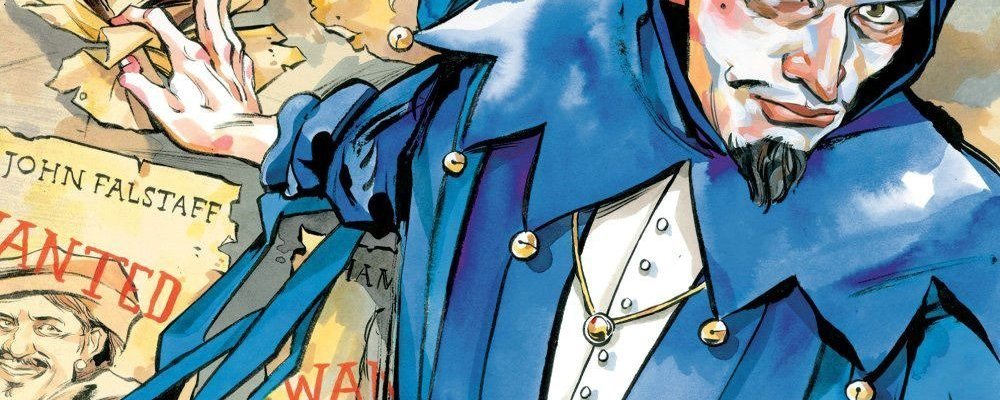
Premise: William Shakespeare is more than just a simple playwright- he has a magic quill that brings his characters to life. Some of the characters worship him like a god or like a father. Unfortunately, others (namely, the villain characters), are unhappy with their stories and want revenge, causing a civil war led by Richard III, Macbeth, Lady Macbeth, and Iago (who is once again, betraying Othello). Our heroes include Juliet, Othello, Falstaff, Hamlet, and Captain Cesario (who is actually Viola from Twelfth Night in disguise). Can the heroes defeat the villains? Can Shakespeare save his precious creations from destroying each other before it’s too late?
My reaction: In essence, this graphic novel is like Season 4 of one of my favorite TV shows, Once Upon A Time. The premise is that an ordinary writer is given the power to create living characters, some good and some evil. In fact, in Once Upon A Time Lore, Shakespeare WAS one of the Authors in the OUAT universe
Basic Details:
The main difference between Once Upon A Time and Kill Shakespeare is that the action is far more violent, and the characters have one main quality- ANGST. As I said, the villains are not happy with Shakespeare, which makes perfect sense. Macbeth famously called his life a “Tale told by an idiot,” and Richard III loves to blame his problems on either God, or his mother, since one or both of them cursed him with deformity and love of wickedness. It makes complete sense that these characters would rage against their creators. The heroes (especially the tragic ones) are also struggling with their sad pasts and trying to reconcile their feelings for Shakespeare. Is he their god? Is he their father? If so, is he a good one or a bad one?
What I like the most about this graphic novel is that the characters are consistent with how the real Shakespeare wrote him, yet they make different choices in the graphic novel. They also grow and play off each other in many interesting ways. Here are some examples:
Juliet in this version is much more of a fighter than a lover. She is a general of all the heroic Shakespearean characters and uses her hope and her wits to rally the troops. That said, she still misses Romeo, who died from the poison just like in Shakespeare’s version, and still has love in her heart. I won’t give anything away but, let’s just say that this time she climbs someone else’s balcony.
Falstaff This might be my favorite change in this version. Falstaff is still witty and gluttonous, but in this version, he’s on a bit of a redemption arc. He commits himself to fight with the rebels and even has faith in Shakespeare and the people around him. Plus, just like his moments with Prince Hal, Falstaff forms a father-son bond with Hamlet in this version, which is really fun to watch. It’s like they took everything bad about Falstaff and metaphorically ‘trimmed the fat.’
Hamlet (AKA The Shadow King in this version), is still brooding over the loss of his father, his murder of Polonius, and his loss of Ophelia. He has once again been thrust into a quest that he’s not sure he can complete- fighting King Richard, finding Shakespeare, and convincing him to help the heroes. That said, he is still capable of warmth, humor, and even romance (no spoilers).
MAJOR SPOILER ALERT
William Shakespeare
In Volume 2, Shakespeare is a jaded mentor figure who has retreated to an enchanted forest after failing to protect his creations. His arc is very similar to Luke Skywalker in The Last Jedi, in that he made a major mistake, failed to live up to the impossibly high standards people had for him, and hides away at the bottom of a bottle. He now has to choose whether to take responsibility for his creations or stay hidden away alone. I love this arc, I love the scene where he talks to Hamlet, and I love the way they develop his character.
Critique
It’s a small point, but with the exception of Falstaff and Viola, the comic characters in Shakespeare (at least in Volume 2), don’t have much to do. Feste and Sir Toby Belch appear as traveling players but they barely interact with the tragic leads. I think this was to keep the tone of the novel consistent, but honestly, I do kind of wish they had broken up some of the tragedy with some more comedy.
Recommendation: I’d recommend this book to all mature fans of Shakespeare, anime, Manga, D&D, or any kind of nerd stuff!
It’s always a great privilege to play a Shakespearean character, but especially to play one of Shakespeare’s villains. Playing Don John in this production is a great deal of fun, especially creating a character from the ground up. What follows is a short account of my process of creating this character, which, as I always do no matter what character I’m creating, begins with the text.
Don John only really talks about himself in one scene, Act I, Scene iii. This is the only scene in which Don John hints at the reason why he is so unhappy:
DON JOHN
“I cannot hide what I am:
I must be sad when I have cause and smile
at no man’s jests, eat when I have stomach and wait
for no man’s leisure, sleep when I am drowsy and
tend on no man’s business, laugh when I am merry and
claw no man in his humour.”
— Much Ado About Nothing, Act I, Scene iii
Looking at the speech, the first thing I noticed is that it is all in prose, which is usually an indicator that the character is not speaking from his heart. Instead of making a confession of his true emotions, Don John tends to dominate the conversation and hit his listener over the head with his argument. Benedick and Beatrice also speak in prose when they are making fun of each other, but this kind of prose is much more terse and cynical.
Looking closer at the language of the speech, I also noticed the repeated usage of the word ‘no.’ In this speech Don John refuses to accommodate anybody, he reserves the right to ignore anyone, take from anyone, and irritate anyone he wishes without a thought for anyone’s feelings. Essentially, in this speech, he is refusing any kind of social grace or social interaction. Two kinds of people exhibit this kind of pattern; petulant children, and sociopaths.
Since Don John is an illegitimate child, he has probably been denied a normal, loving childhood, which can stunt his emotional growth. Like Edmund in King Lear, I decided that Don John doesn’t believe in any kind of love, except love for himself. Without the love of others, he refuses to give or show any himself, and only seeks to enhance his own ego, which explains Don John’s pointless war against his brother to improve his political status. This lust for power became my overall objective for the character which manifests itself in Don John’s utter contempt for everyone but himself, and the cruelty he shows to Claudio and the other people in the play.
However, I also made a decision that, unlike Keanu Reeves’ portrayal of Don John in the film version of Much Ado, I didn’t want him to just be a repellant psychopath that would be unpleasant to watch. I decided early on that I wanted to find a way to insert some comedy into the role. This is why I decided that when Don John complains about his melancholy and his unfulfilled desires, he pouts like a young child. I then summarized my concept for the role in four distinguishing characteristics:
Egotistical
Petulant
Cruel
Childish
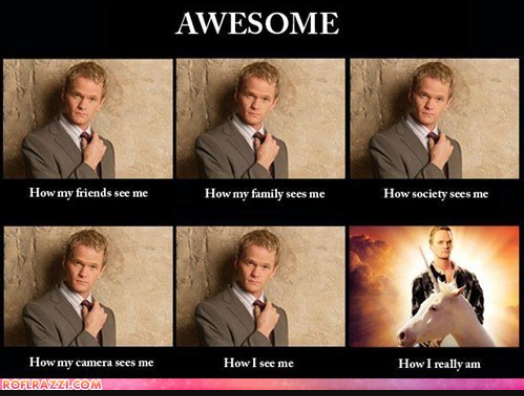
Having established my character’s motivation and his overall personality traits, I concentrated on developing a voice and physicality. I thought to myself, “What person or character has these characters?” Then I saw this:
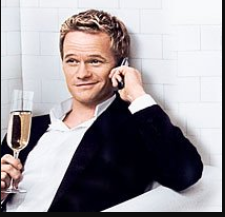
Meme about Barney Stinson in “How I Met Your Mother,” as portrayed by Neil Patrick Harris
Neil Patrick’s character Barney Stinson on How I Met Your Mother, matched these characteristics perfectly. He is a self-obsessed low level sociopath who sleeps with lots of women without loving any of them. He is also an illegitimate child who never knew his father, just like Don John. I therefore decided to borrow some mannerisms from Barney.
After watching a few episodes of the show, I noticed a few interesting details in the way Barney acts that I wished to replicate:
Posture- Barney’s posture is absolutely straight. He gives the impression of growing straight up out of the ground, which gives the impression of supreme confidence and arrogance. To keep my posture straight, I did yoga every day to keep my back and legs strong. I used a straight posture whenever Don John is in public but when he is alone and pouting, I let my shoulders hunch like Richard Nixon to give the impression that Don John, (like most bullies), suffers from extremely poor self-esteem, and his displays of ego are merely a front.
Facial quirks
Eyebrows: As you can see in the photo above, Neil Patrick Harris can move his eyebrows independently, which allows him to appear incredulous or mischievous with a sly move of the eyebrow. It just so happens that I can move my eyebrows independently as well, so I use this in moment
The Chin: A lot of NPH’s acting comes from his chin. When he’s feeling very proud of himself, he thrusts his chin in the air like a lightning rod, absorbing mystical energy from the heavens. When he is feeling wicked, he chocks his head to the side and pops his chin out. I adopted these motions for moments in which Don John is plotting something.
Gestures
Rehearsal footage of Act I, Scene iii.
Since Don John is upper class, he doesn’t need big gestures; the more upper class someone is the less they need to work to get people’s attention. However being the selfish brat that he is, his gestures are very flashy. I adopted subtle, fluid gestures that come from the wrist and only used full body gestures when the character is angry, or when he is playing up his own ego. In the video on the left, there’s a short rehearsal of a scene I did with Amanda Cash Snediker. At one point, when I want Tiarra Hairston to light Amanda’s cigarette, all I do is snap my fingers.
Voice
The iconic voice of a 1920s announcer is a reedy-voiced tenor with a slight slur in his words with a slight smile to his mouth. This kind of world-weary, loud-mouthed voice is exactly what I wanted to convey in Don John’s voice.
Costume “Let’s Suit up”
Just like Barney, I believe Don John is obsessed with his appearance. I looked up male fashions in the 1920s. Looking at this picture of Edward Beale McLean, (head of the Washington Post from 1916-1933), I saw a suit worth replicating. I found a great black pinstripe suit.
Paul Rycik as Don Jon, 2012. (Photo by Darren Van Dyke)
I also looked for a uniform that I thought would seem menacing and appropriately gawdy.
For More Info On Male Fashion from the 1920s, click on this link:
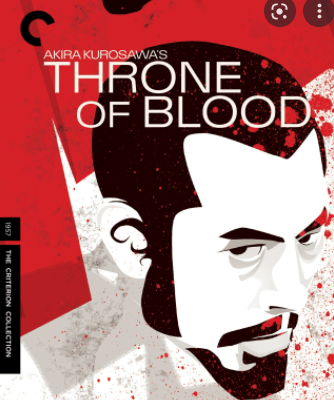
One of the most celebrated international film versions of Shakespeare comes from Japanese director Akira Kurasawa, (1910-1998). The innovative filmmaker is famous for combining Shakespeare with traditional forms of Japanese theater like Kabuki and Noh. Kurasawa’smost celebrated film was his film Throne of Blood, (1957), which was a fusion of Shakespeare’s Macbeth with Japanese Noh theater.
In 1978, a “holiday special’ was released under the Star Wars umbrella. Today it is universally panned as the worst Star Wars product ever conceived. It is tonally completely different from Star Wars and it spends most of its time either in a bar on Tatooine or on Kashik with Chewbacca’s family; characters we don’t know, can’t understand, and have no influence on the larger Star Wars Universe!
The only bright spot in this tragic black hole of a time-wasting special, (at least according to most of the internet), was that this special brought back the character of Boba Fett, the cool, anti-heroic bounty hunter who is constantly deceiving our heroes. As you can see, they changed the format into a cartoon, so that’s a little bizarre, but it was nice to see an old friend in this otherwise who’s who of lame new characters.
THIS WAS NOT A NEW IDEA, EVEN FOR 1978,
In around 1598 (allegedly), Queen Elizabeth the first asked William Shakespeare to write a comedy about Sir John Falstaff, the fat cowardly comic center of the Henry IV plays. The Queen wanted to see a comedy about Falstaff in love, which Shakespeare allegedly completed in a few short weeks.
Ant the result, was the Star Wars Holiday Special of the Shakespearean Cannon.
Unlike Henry IV, which is a complex history play about rebels going up against an empire (Henry IV claimed part of France so that counts :), Merry Wives a silly comedy set in the country town of Windsor. Just like the Holiday Special, Shakespeare’s comedy has a totally different tone than the other plays that feature Falstaff.
I think Shakespeare wisely didn’t try to make Falstaff a romantic figure- that would be absolute character assassination. What he does instead is take Falstaff’s ability to sweet-talk women and his penchant for thievery, and make the play about his attempts to seduce two virtuous housewives and steal their money. Just like how Boba Fett was not changed into a good-guy to pander to audiences (yet), but instead, Lucas made him a cunning deceiver who tries to sell out our heroes to Darth Vader.
Though Falstaff himself works within the context of the play, most of the new comic characters are very dated and not very funny. Dr. Caius and the Welshman are written with outrageous accents making them as incomprehensible as alien bit players in Star Wars. Frankly, I’d rather kiss a Wookie than listen to these losers try to woo Mistress Page’s daughter. It’s like Shakespeare cut and pasted the worst scenes from Taming Of The Shrew and added a French accent.
Even more boring are the scenes at the Garter Inn- a place that must’ve had significance for knights in the 1590s, but nowadays is somewhat forgettable, (like the Cantina, deal with it NERDS!)
The one really good part of the play is this scene in Act II, Scene I where Mistress Page and Mistress Ford simultaneously receive letters of “love,” (which really means ‘I want sex and your money), from Falstaff. The ladies are incensed for a couple of really good reasons:
A. It’s Falstaff- a fat, old, penniless knight who is well known as a drunk.
B. They’re already married, and he has the pudding guts to assume they’d betray their husbands.
C. If they were to cheat on their husbands, THEY WOULDN’T DO IT WITH FALSTAFF
D. The love poem he writes them is terrible. If he wanted these virtuous wives to cheat on their husbands for someone as completely undeserving as him, he could’ve at least put some effort into it!
I would also argue that the worst thing about the Holiday Special became the best thing about Merry Wives: the songs!
The most egregious change to the tone of Star Wars that the Holiday Special made was putting in a bunch of terrible musical performances by people like Jefferson Starship (get it?) to make the special more of a variety show with the Star Wars characters slapped on top of it like a sticker on a lunch box. Now we know what it sounds like when Princess Leia sings a song that clearly required a second draft:
Luckily for Shakespeare, instead of Jefferson Starship, he got opera composer Otto Nikoli, who saved this mostly terrible play by turning it into a charming opera! Look at this duet from Act I!
A lot of the more absurd plot points of Merry Wives work extremely well as musical comedy shtick, and Falstaff himself works very well as a big basso profundo
So if you go to see Merry Wives, know that it’s not a very good play by Shakespearean standards. It’s silly, kind of pointless, and not a very good addition to the story of Falstaff, but much like the Star Wars Holiday Special, it’s sure to make you laugh:















 The Shakespearean Student
