I made a digital escape room for Macbeth, as part of my Outschool.com class, “Macbeth: An Immersive Educational Experience,” which you can register for at a discount this week only. I’m presenting this digital escape room as an activity for teachers to teach their student’s knowledge of the plot of the play and use their observation and research skills to escape from a “cursed castle.”
What Is a digital escape room?
In a normal escape room, you are locked in a room and have to follow clues and solve puzzles in order to find a series of keys, codes, and combinations to unlock the door and get out of the room. In a digital escape room, you solve online puzzles and use passwords and key codes to unlock some kind of digital content.
My escape room is designed to test your knowledge of the play, give you a chance to learn about the history behind it. Most escape rooms use the a variety of locks such as:
Standard combination locks
Direction locks (where the lock has arrows taht you have to push in the correct direction, in the right order).
Color locks (where we put different colors in a sequence.
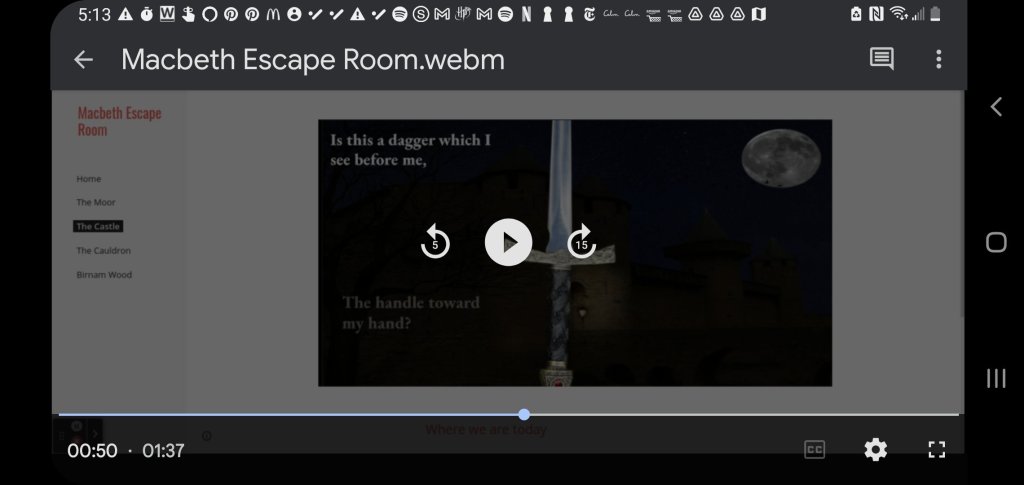
A digital escape room uses these concepts and adapts them to work within the context of a website or other digital experience. For example, I made a direction lock based on the direction a dagger points and made a short animation of a dagger with the text of Macbeth’s famous dagger speech.
The student has to surf through five webpages to find the answers to the puzzles, then imputs the answer in a Google form. Once he or she unlocks all six puzzles, they are permitted to leave the witches’ castle. Here’s a preview of the puzzles:
Part I: The Gate
There’s a website called Flippity which allows you to make little online puzzles so I embedded it on one page of my website. In this case, it has six locks that you have to unlock by typing answers to trivia questions related to “Macbeth,” such as “What object appeared to Macbeth before he killed the king?” The final lock requires you to read a short article on the curse of Macbeth, so you can enter it on the website.
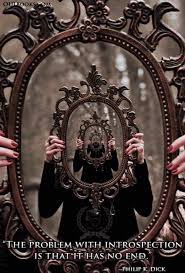
Part II: The Magic Mirror
There’s a website called a magic mirror, which if you click on the mirror, it hyperlinks to an image that spells out the next answer for the Google form.
Part III: Birnam Wood
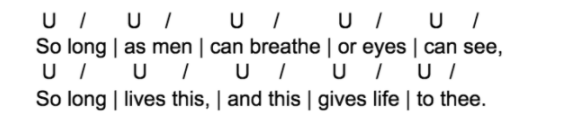
I wanted to teach the students about verse scantion and what an iambic pentamer iine is. I wanted to get the class to learn the pattern of unaccented beats (which Shakespeare scholars mark with a U), and accented beats marked with a /, as in the couplet below:
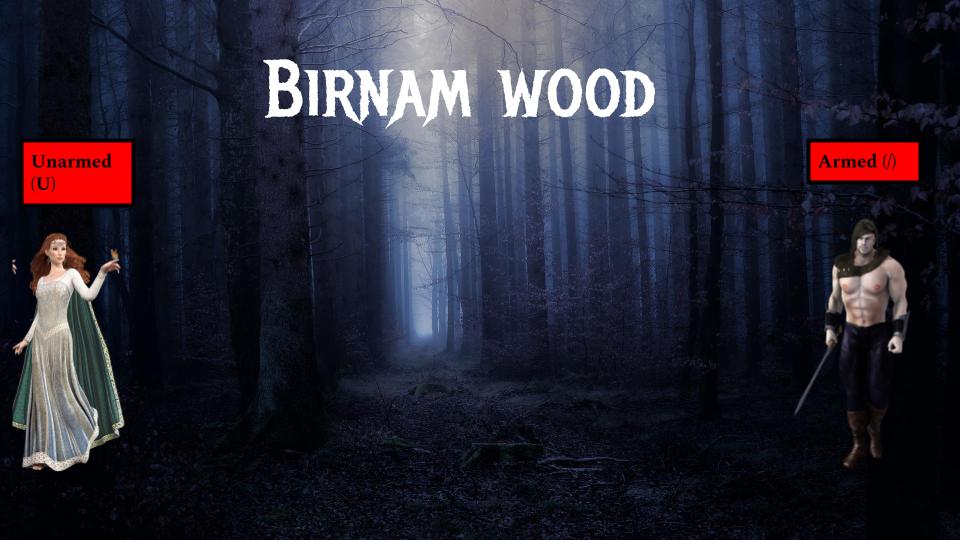
To get the students to practice making an iambic pentameter line, I embedded a Google Slides presentation in the website which has pictures of unarmed and armed soldiers. A key indicates that you are to count the soldiers and input the U/U/ pattern into the Google Form:
Screenshot from my Birnam Wood Activity.
So, there’s a preview of the Digital Escape Room I hope this inspires you to try this type of activity in your class. If you want to use this activity, shoot me an email and I’ll give you a teacher’s guide. Please also consider signing up for my Outschool.com class!
This video is part of my Outschool course “Macbeth: An Immersive Horror Experience.” I use it to explain the plot of the play before playing a game and an escape room to test the student’s knowledge. Let me know in the comments what you think of it, and if you like it, please consider signing up for the course on Outschool.com
Just in time for October, I’m offering an online class for kids ages 13-18 about Shakespeare’s most spooky and cursed play:
If you follow this blog you know I’ve written a lot about this play before. Though this class will be more like a game where I teach the class using multimedia, games, and a digital escape room!
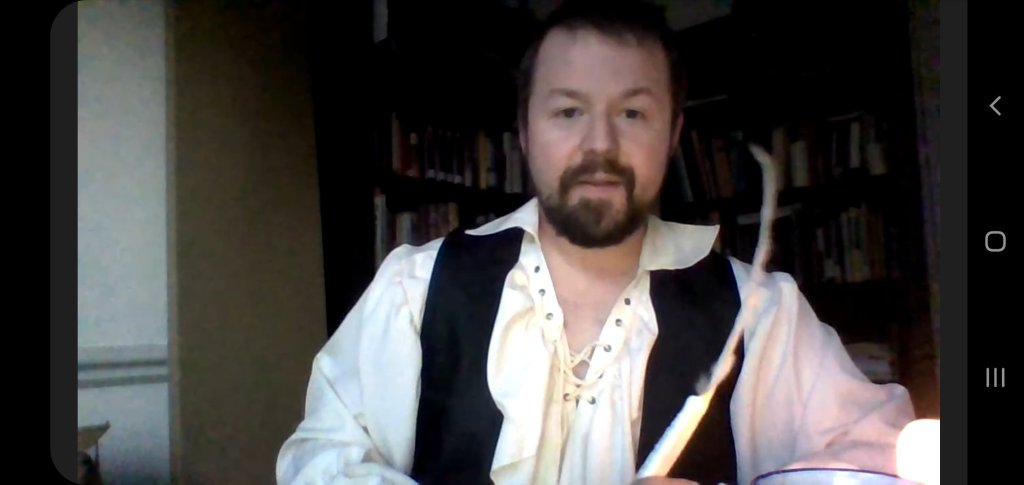
Me in my Shakespeare gatb
I’ll start by speaking to the students in character as Shakespeare, and tell them the story of Macbeth using a multimedia presentation.
I will then test the students’ knowledge with a fun quiz that was inspired by the popular mobile game Among Us. As you know, the game is similar to a scene from the play, so I thought it would be an appropriate way to test the kids’ knowledge.
Screenshot from the Gimkit game “Trust No One.” Like Among Us, players need to figure out who the Imposter is, but they greatly increase the chances of surviving if they answer the quiz questions correctly.
The final part of the class is a digital escape room I’ve created. I don’t want to give too much away, and you can’t play it unless you sign up for the class, but let’s just say it’s fun, spooky, educational, and challenging!
Screenshot from my Macbeth Escape Room.
If you want to sign up now, the course is available every weekend in October, and then by request after that. Register now at Outschool.com. if you take the course, please leave me a good review.
Thanks for recommending this topic. I really enjoyed researching it. Disclaimer: Although I have a degree in Renaissance literature, I don’t have a degree in world religions. I don’t pretend to be an expert in Judaism and I apologize if I have gotten any cultural details wrong. As I have written before, this play has been used to spread harmful stereotypes and misinformation against Jews and Muslims, and I have no desire to do so. So don’t take this information as a comprehensive guide to the lives of Jews or indeed any 16th century Venetians. What I do intend to do is analyze how costumes from the play can evoke the people and cultures of that time.
Venice in the 16th century was a lot like modern day Manhattan- a multicultural epicenter of trade and commerce. https://youtu.be/FNZa9qazTvc
Many productions have costumes that emphasize the wealth and privilege of the Venetian world, except for Shylock
As this video shows, Jews in 16th century Venice were segregated into separate communities known as ghettos. Although the Jews found ways to survive and thrive in this situation, they faced constant discrimination and harassment.
In a modern productions or a period production the costume has to reflect a single vision for the show. Watch this interview with Globe Costume coordinator Laura Rushton: https://youtu.be/PaZmAuKE-Jg
2. Men’s Fashion- Italian fashion was all the rage in Shakespeare’s day. Gone were the stiff woolen tunics of the Middle ages, in with brightly colored silks and leathers. Young Men wore leather jackets called doublets and tight pants that showed off their legs. In the hot sun of Venice, light linnen undershirts were wore underneath the doublet. Wealthy men would wear fine silks and their jackets had slashed sleeves to show off the fine embroidered silk underneath.
Joseph Fiennes’ costume as Bassanio in The Merchant of Venice
Servants- Servants were given distinctive clothes known as liveries by their masters, which for a man would typically be a distinct colorful jacket. Women like Narissa, who were high-ranking ladies maids, would wear hand me down clothes from their mistresses. So this is why in most productions I have seen, Narissa and Portia wear similar clothing. This also helps show the trust and respect they have for each other.
A Note On Masks:
Act II, Scene 5, takes place during Carnival, one of the most celebrated holidays of Venice, and it’s usually celebrated by people wearing brightly colored masks. This great video below from history YouTuber Metetron shows just a little bit of background on Venetian masks:
3. Women’s Fashion- The women in the play Merchant Of Venice are treated line birds in a cage, especially Portia who literally lives on an island and has to marry the man who wins her at a carnival! With the restrictions of garments like partlets, bodies, or corsets, if you wore the fashions of the period, you would feel like your lungs were birds in a cage!
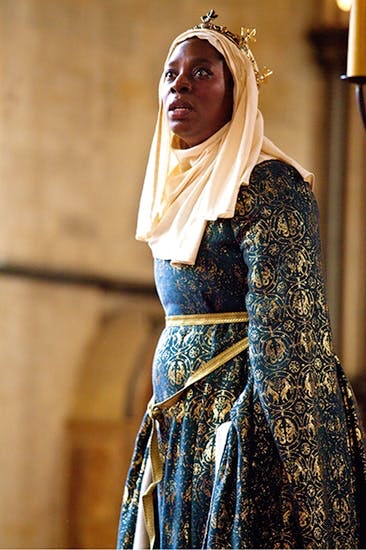
Although the dress was richer and more ornate (reflecting the relative peace during this period), the clothing was much more physically restrictive than medieval dresses: https://youtu.be/KCeqG47LI1Y
Costume for a production of King John. The fashion is reminiscent of the late 15th century. There is no corset, the dress helps shape the silhouette. Notice also the long sleeves.Jessica
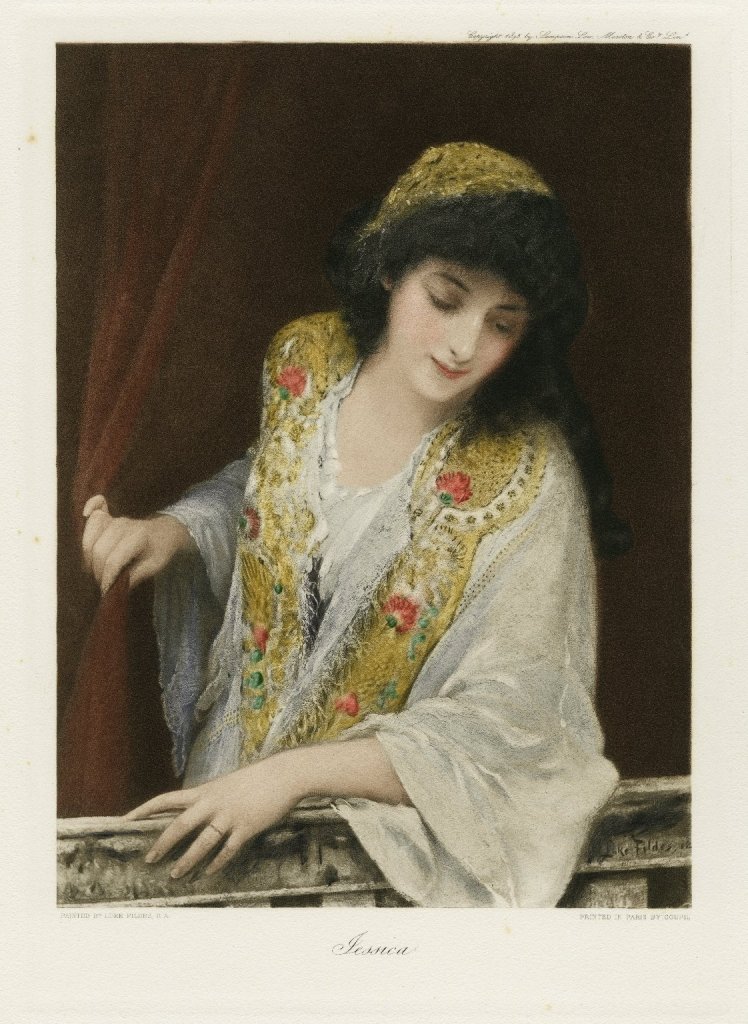
Jessica- Though most productions have Shylock’s daughter dressing like the Christian women, there is a long history of distinctive clothing for Jewish women as well as men. Sadly, the only video I could find refers to 14th century clothes, I think this video is very informative and extremely thoughtful
4. Shylock
It’s worth noting that Shylock is not the central character in the story; the titular merchant is Antonio. Probably Shakespeare’s original audience saw him as a one dimensional villain for the audience to boo and hiss, then rejoice when he fails. He probably came onstage in 1596 wearing stereotypical red wig, a long gown, and a grotesquely oversized nose. The costume and performance gave the impression of someone foreign, alien, even demonic. This was one reason why some modern actors have balked at playing Shylock, as Patrick Stewart explains: https://youtu.be/7UOdMHW7J2Q
That said, Shakespeare clearly didn’t write him as one dimensional; he dominates the scenes he’s in and for centuries great actors have yearned to play Shylock over all the other characters. Slowly Shylock has become the focus of the play and the romantic comedy aspect has become less and less important in most modern productions. Like every great part, Shylock’s costume proclaims his social class, his background, and his relationship with other people.
In the play, Shylock only refers to his clothes once, referring to the gown he wears as “My Jewish gaberdine.” A Gaberdine is a long cloak like the one in the painting above, but as you can see, Jews were not the only people wearing them.
Because of rampant antisemitism and fear of the growing influence of the Jewish community in the 16th century, the Senate and local magistrates segregated and kept constant watch on the Jews of Venice, and one way they did that was by forcing Jewish people to wear distinctive clothes.
According to the Online Jewish Museum:
Jews were forced to wear various markings on their clothing to identify themselves as Jews. In 1394 they had to wear a yellow badge, it was changed to a yellow hat in 1496 and to a red hat in 1500.
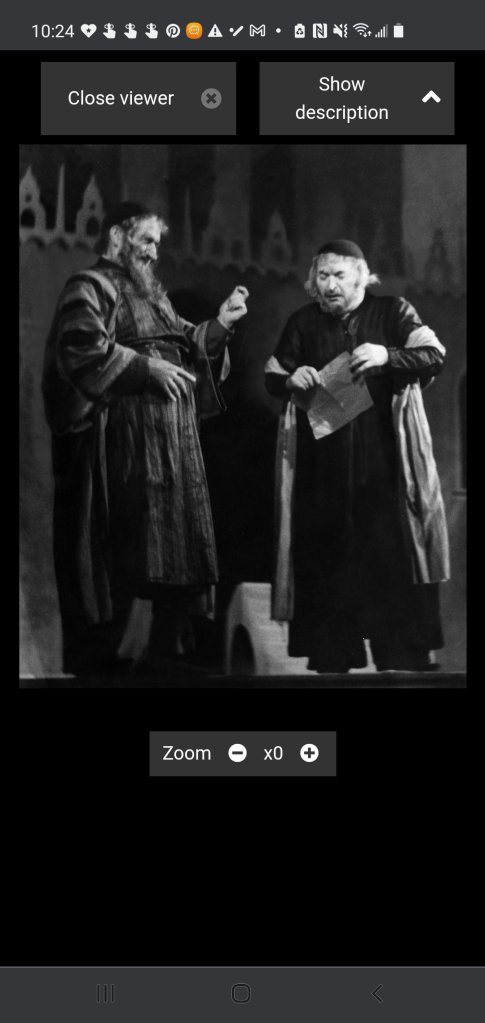
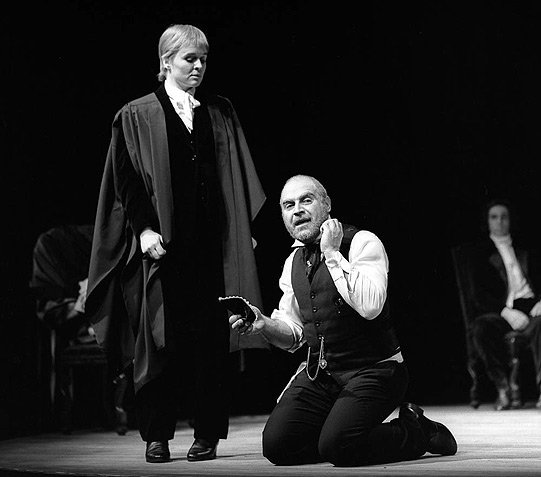
Charles Keen as Shylock
As Shylock grew in popularity with actors and audiences, actors played him with more nuance. Contrast the foreign looking gown in the previous picture, with Charles Keen in the 19th century.
That is not to say that all productions played Shylock as a fully formed human: in 1934, the Nazi Party sponsored a German production of Merchant with horror actor Werner Krauss, (famous for films like The Cabinet of Dr. Caligari) asShylock. You’ll notice that the costume again emphasizes otherness, and exaggerates Jewish stereotypes.
Warner Krauss in the infamous 1934 production of Merchant sponsored by the Nazi party.
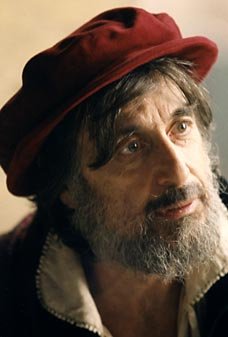
Patrick Stewart when he played Shylock in the 1970s, emphasized how Shylock is essentially an immigrant in his own country and played him with tattered clothes, a dirty bushy beard, and with an air of a stray dog. His clothes emphasise both his race’s oppression, while also telegraphing Shylock’s miserly attitude. Sir Patrick emphasized that his Shylock had lost so much in his life that he clings to Earthly wealth to feel in control of his life.
Patrick Stewart as Shylock David Suchet as Shylock David Suchet as Shylock, RSC.
By contrast, David Suchet. (famous for his portrayal of detective Hercule Poirot), chose a near polar opposite interpretation of Shylock at about the same time. The main difference between Suchet and Stewart could basically be summed up by this fact, Suchet is actually Jewish, Stewart is not.
Because Stewart was portraying a member of a community to which he didn’t belong, his portrayal downplayed Shylock’s Jewish identity since he didn’t want to make assumptions about what being Jewish is like. This is why Stewart gave his Shylock an over-refined accent and made sure his costume didn’t emphasize any stereotypical Jewish elements.
Since Suchet actually is Jewish, he did not shy away from portraying Shylock’s jewishness. His Shylock is proud of being Jewish but is well aware of how other people see him. He knows that he is othered by the other Venetians, and can use their fear and hatred of him as a weapon against them. Suchet also dressed his Shylock as well to do, but not gawdy to try and command respect from other people, but also carried around a walking stick to use as a weapon.
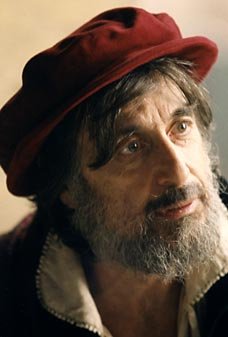
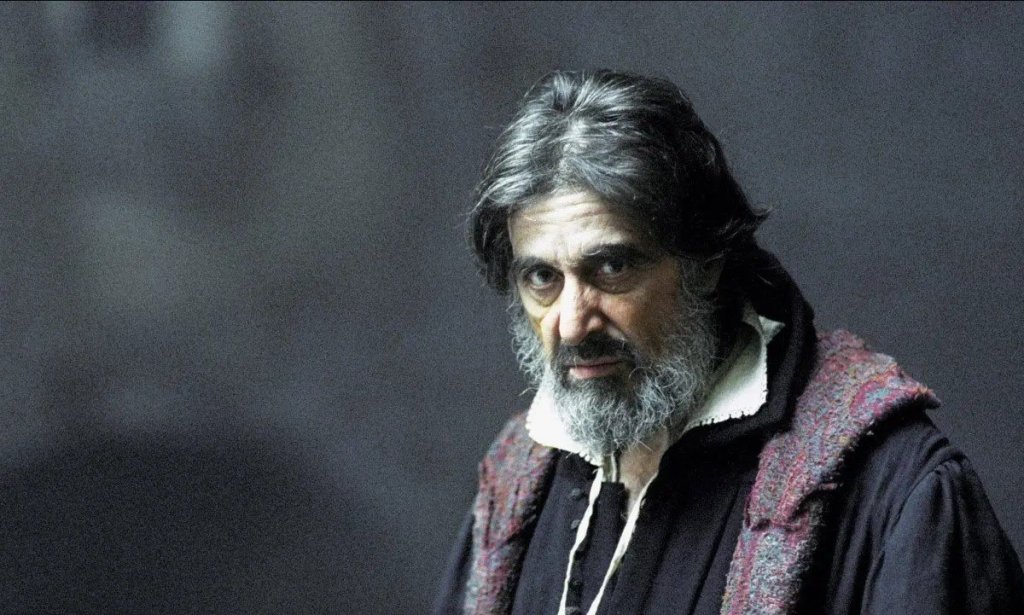
Ian McKellen Al Pacino in the 2009 movie of Merchant, wearing the red hat that real Jews were required to wear in the 1590s.
6. Case study: the 2009 movie
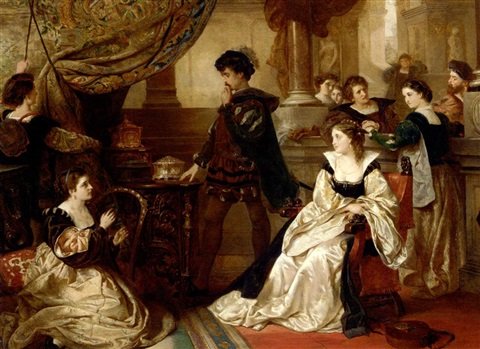
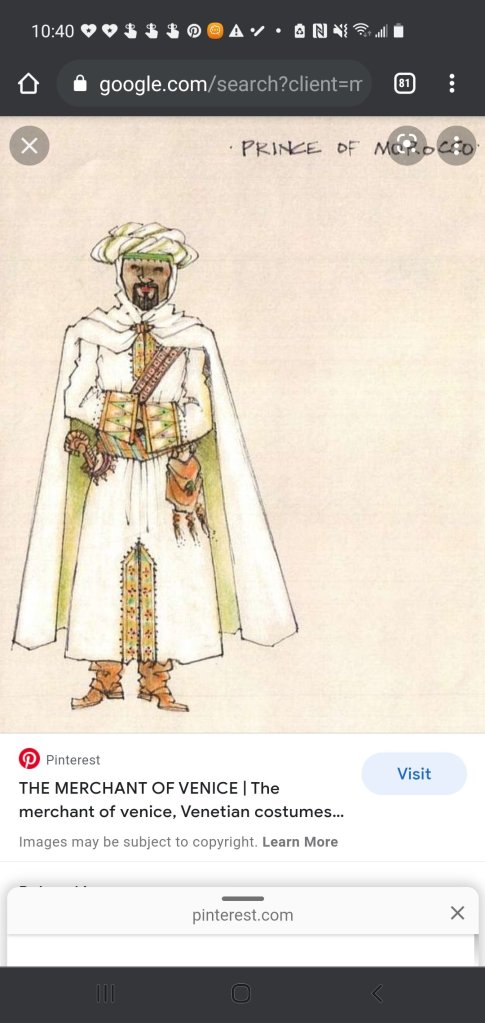
The Prince of Morrocco: In Act II, Scene 7, The Princes of Morrocco and Aaragon (A region of Spain), come to Portia’s home on the island of Belmont to try solve the riddle of the three caskets. In order to show the audience that these men are foreigners, their costumes have to be distinct from the Venetians. Take a look at this was accomplished in the 2004 movie:
The Prince of Morrocco (David Harewood) tries to guess the casket in the 2004 movie.
Mr. Harewood’s costume was inspired by the real Morroccon ambassador to Queen Elizabeth, Abd el-Ouahed ben Messaoud, who many scholars believe, might have also inspired Shakespeare to write Othello 6 years later.
Abd el-Ouahed ben MessaoudAl Pacino dons the distinctive red cap that all Venetian Jews were required to wear in the 1590s.Shylock after he converts to Christianity.
I’m working this summer with the good people at Outschool, an online learning platform for kids ages 3-18. I’m designing a series of Shakespeare classes that you can sign up for. We’ll be doing acting exercises, reading Shakespeare’s text, and making Shakespeare props Cost is $3 per child.
The course is ala carte, that is, you can sign up for as many courses as you like. Each course builds on the last one, but you don’t have to have taken the previous ones to enjoy any one particular course Let me know in the comments which class(es) you are interested in, and/or what suggestions you might have. I can’t wait to hear what you think about these summer Shakespeare courses, and I hope to see you online soon!
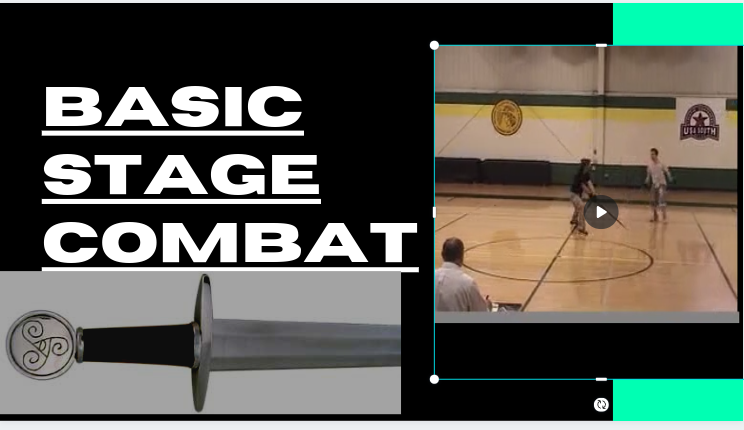
1. Introduction to Shakespeare- (enrollment here: https://outschool.com/classes/introduction-to-shakespeare-or-how-i-learned-to-love-the-bard-UoHH5fes?sectionUid=973060db-f857-461a-a23a-f1476203a544&showDetails=true) We’ll talk about why Shakespeare is so famous and learn about his life and career. Then we’ll do some fun quizzes that you can earn prizes based on how well you pay attention! 2. How to write ✍ like Shakespeare (Enrollment here: https://outschool.com/classes/how-to-write-like-shakespeare-0HuPq1Cg?sectionUid=4243af25-ba41-4724-82a2-61bd7c7d862e&showDetails=true) – Have you ever wanted to woo your sweetheart or write the next bestselling play? Well, this course will cover the secrets of Shakespeare’s writing. We’ll cover how to write romantic poems, the structure of Shakespeare’s plays, and you’ll get to write your own Shakespearean speeches! 3. Intro to Shakespearean acting Practical tips and tricks for your next Shakespeare audition. 4. Shakespeare’s villains We’ll look at the darkest and creepiest Shakespearean characters and see why they still fascinate us today! 5. The Violent Rhetoric Of Shakespeare’s Julius Caesar (Registration Here: https://outschool.com/classes/the-violent-rhetoric-of-julius-caesar-fkMLbAtA?sectionUid=1f9220cd-8c28-438d-9799-8479494353a4&showDetails=true#usMaRDyJ13) In this one-time course, students will analyze the rhetoric and persuasive power in two speeches from Shakespeare’s “Julius Caesar” 6. Intro to Romeo and Juliet – Get a leg up on your next English class with this fun, frenetic look through the characters, themes, and story of Shakespeare’s most popular, and most-taught play. 7. Basics Of Stage Combat (Registration here: https://outschool.com/classes/1120ada2-047d-4b0f-84f6-5eb4b0f7dc66/schedule#usMaRDyJ13– I’ll teach the kids about Elizabethan street fighting, and the basics of stage combat. 8. The Balcony Scene of Romeo and Juliet– It’s been called the greatest love scene of all time, but why? I’ll explain the imagery, the poetic language, and give you a chance to make your own love poetry! 9. Insults and Shakespeare You’ll craft your own Shakespeare insults and engage in a (respectful), beat down with your classmates! Along the way, we’ll talk about how insults escalate to violence in Shakespeare’s Romeo and Juliet. 10. The Iconic imagery of Romeo and Juliet We’ll look at some beautiful paintings, songs, and other works of art that build on Shakespeare’s poetic imagery. 11. Romeo and Juliet and pedagogy Shakespeare is uniquely challenging to get kids to engage with. I’ll give you some of my resources, games, and activities to help you delve into the play in your next class.
If you like these courses, let me know by leaving a comment below. If you’re interested in signing up, visit my teacher profile page: https://outschool.com/teachers/The-Shakespearean-Student. New classes will be added every week, and I’ll work around your schedule when planning the dates and times. Hopefully this will be a great chance for me to share my expertise with a young group of future Shakespearean students!
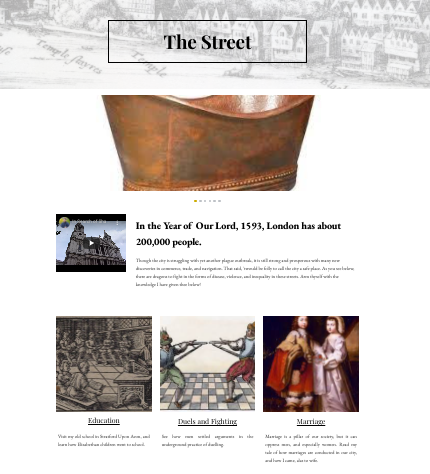
I’m working on several educational projects at the moment and I’m proud to share this one with you. It’s what I call a virtual tour of Shakespeare’s London. The teacher I’m working with said she wanted to teach the kids about the culture of Elizabethan London as he was writing Romeo and Juliet. Naturally with the pandemic a field trip was out of the question, (for multiple reasons), but I wanted to create a visually interesting tour of the places Shakespeare knew and worked and try to imagine his perspective and how that might have informed the characters and themes of Romeo and Juliet.
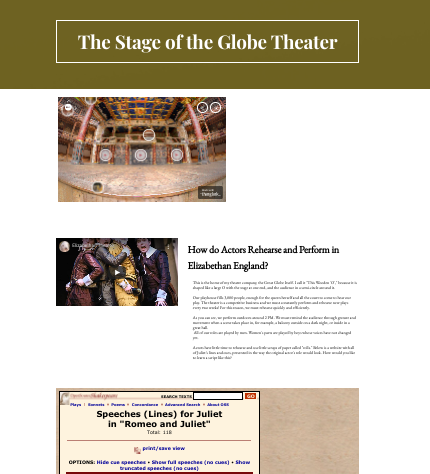
So I created this: a website written as if Shakespeare himself is taking you on a tour of his London in the year 1593, the year where, as far as we know, he had just completed writing Romeo and Juliet. 1593 was also the middle of another outbreak of Bubonic Plague. It has virtual tours of Shakespeare’s Globe Theater, Hampton Court Palace, Shakespeare’s Grammar School, and a quiz where you can pretend you’re in the Elizabethan doctor’s office.
For the class I’m helping, the students will fill out a worksheet as they navigate the website so they learn from the material at their own pace. If you’re interested, leave a comment and I’ll post the worksheet so you can use it in your classroom.
My hope is that this website can be a resource for anyone trying to connect with Romeo and Juliet and trying to learn from the culture of Elizabethan London. Shakespeare was a product of his time and his experiences must have had an influence on what he wrote. Even if they didn’t, they certainly influenced the people who saw the play and he knew that it would. So I hope it can help you understand a little bit more about the world of this famous play, and the context of the world that created it.
Happy St. Patrick’s Day! The Emerald Isle has long been a source of illumination for poet’s pens and Shakespeare was no exception. The Bard of Avon is indebted to Mother Ireland not only for the inspiration he took, but sadly for the pain he gave her back.
None of Shakespeare’s plays are set in Ireland, but he freely adapted elements from Irish folklore. English poet Edmund Spencer visited Ireland in the 1590s and adapted the folklore he picked up into his opera The Fairy Queen, which Shakespeare adapted into A Midsummer Night’s Dream
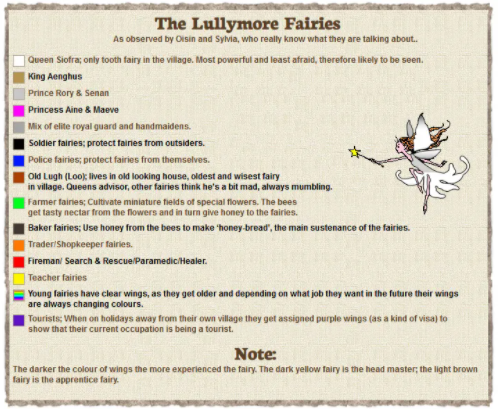
The Irish created and continue to tell many of the fairy legends and stories that we retell and adapt today. If you go to Lullymore park in Ireland, you can see a place that is essentially a “Fairy preserve.”
Types of fairies you can “spot” at the Lullymore Park in Ireland:
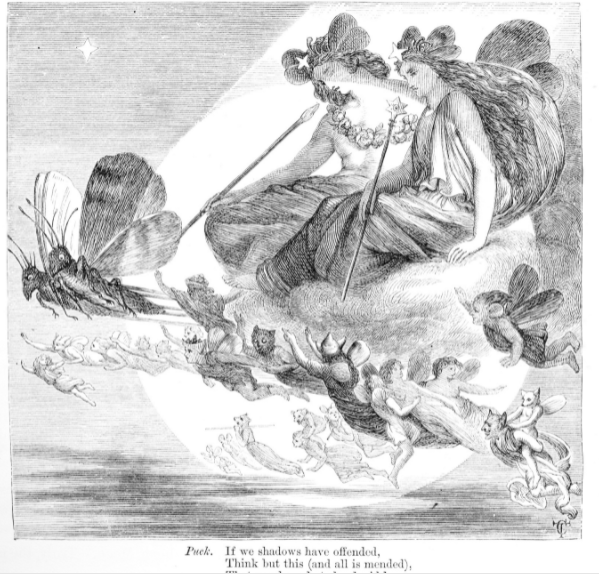
The old stories tell that Fairies are magical creatures who live in hollow places in the earth. Some are benevolent and help give rain and pleasant weather to the Earth, Like the king and Queen of the fairies, Oberon and Titania:
And the mazed world, By their [the tides] increase, now knows not which is which: And this same progeny of evils comes From our debate, from our dissension; We are their parents and original.
— Titania, (Queen of the Faries), A Midsummer Night’s Dream Act II, Scene i.
Titania in this speech shows great concern for nature, humanity, and the planet. She believes it is the responsibility of fairies, particularly herself and her husband Oberon, to control the elements and keep humans and fairies safe. Some fairies, however, are cruel and enjoy playing tricks on mortals, just like Puck in A Midsummer Night’s Dream, or Queen Mab in Romeo and Juliet.
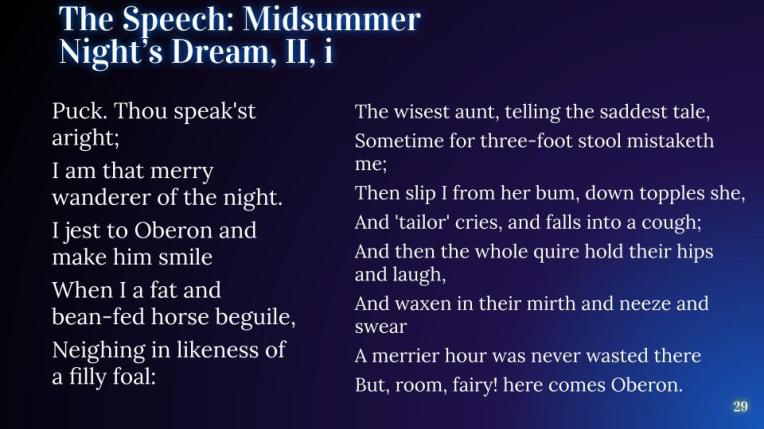
Close reading of Puck’s speech (MND II, i)
Close reading of Puck’s speech (MND II, i)
Close reading of Puck’s speech (MND II, i)
Close reading of Puck’s speech (MND II, i)
Close reading of Puck’s speech (MND II, i)
.
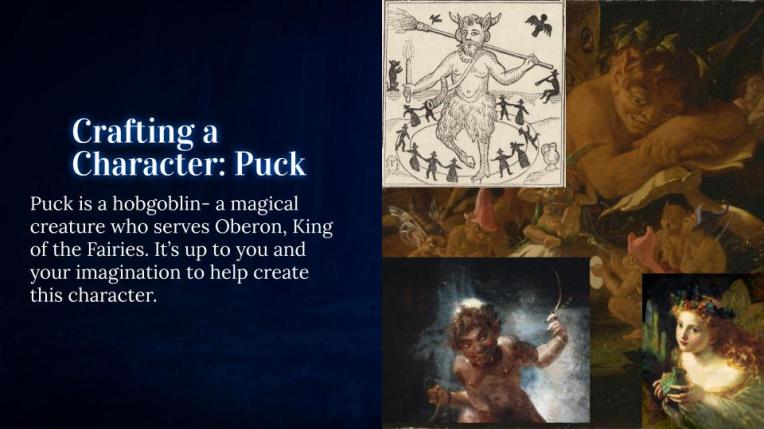
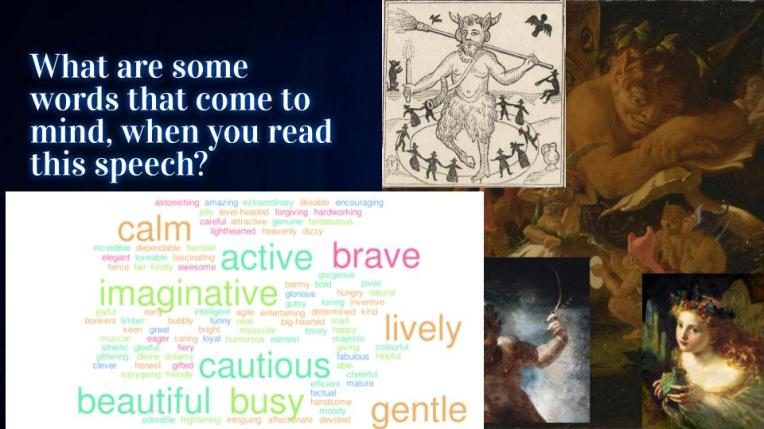
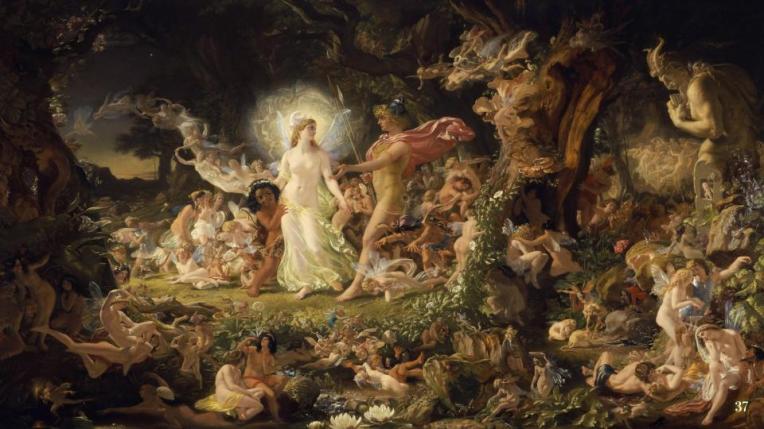
This is a short analysis I created of the tricks Puck plays on people in A Midsummer Night’s Dream, as part of my acting course on Ouschool.com. Note the different ways Puck is portrayed in photos as a satyr, a rotund elf, and sometimes as an almost- demon like figure.
Cringe-worthy Shakespeare: Shakespeare’s only Irish character, captain mcmorris in “Henry V”
When Shakespeare is racially insensitive towards people of color, the cringe-worthy writing is mercifully few and far between. With the exception of Aaron the Moor and Don Armada, there are only a few sporadic derogatory references to non-White Anglo-Saxon Protestants. Sadly though, Shakespeare might have permanently harmed the Irish through his character the Irish captain Macmorris in Henry the Fifth, his only Irish character.
According to The Irish Times, there is a longstanding stereotype that still exists in the British Isles that Irish people are violent, short-tempered, and essentially savages and Shakespeare might have invented this stereotype (or at least popularized it) when he wrote this scene from Henry the Fifth, Act III, Scene ii:
FLUELLEN
 To the mines! tell you the duke, it is not so good
 to come to the mines; for, look you, the mines is
 not according to the disciplines of the war: the
 concavities of it is not sufficient; for, look you,
 the athversary, you may discuss unto the duke, look
 you, is digt himself four yard under the
 countermines: by Cheshu, I think a' will plough up
 all, if there is not better directions.
 GOWER
 The Duke of Gloucester, to whom the order of the
 siege is given, is altogether directed by an
 Irishman, a very valiant gentleman, i' faith.
 FLUELLEN
 It is Captain Macmorris, is it not?
 GOWER
 I think it be.
 FLUELLEN
 By Cheshu, he is an ass, as in the world: I will
 verify as much in his beard: be has no more
 directions in the true disciplines of the wars, look
 you, of the Roman disciplines, than is a puppy-dog.
 Enter MACMORRIS and Captain JAMY
 GOWER
 Here a' comes; and the Scots captain, Captain Jamy, with him.
 FLUELLEN
 Captain Jamy is a marvellous falourous gentleman,
 that is certain; and of great expedition and
 knowledge in th' aunchient wars, upon my particular
 knowledge of his directions: by Cheshu, he will
 maintain his argument as well as any military man in
 the world, in the disciplines of the pristine wars
 of the Romans.
 JAMY
 I say gud-day, Captain Fluellen.
 FLUELLEN
 God-den to your worship, good Captain James.
 GOWER
 How now, Captain Macmorris! have you quit the
 mines? have the pioneers given o'er?
 MACMORRIS
 By Chrish, la! tish ill done: the work ish give
 over, the trompet sound the retreat. By my hand, I
 swear, and my father's soul, the work ish ill done;
 it ish give over: I would have blowed up the town, so
 Chrish save me, la! in an hour: O, tish ill done,
 tish ill done; by my hand, tish ill done!
 FLUELLEN
 Captain Macmorris, I beseech you now, will you
 voutsafe me, look you, a few disputations with you,
 as partly touching or concerning the disciplines of
 the war, the Roman wars, in the way of argument,
 look you, and friendly communication; partly to
 satisfy my opinion, and partly for the satisfaction,
 look you, of my mind, as touching the direction of
 the military discipline; that is the point.
 JAMY
 It sall be vary gud, gud feith, gud captains bath:
 and I sall quit you with gud leve, as I may pick
 occasion; that sall I, marry.
 MACMORRIS
 It is no time to discourse, so Chrish save me: the
 day is hot, and the weather, and the wars, and the
 king, and the dukes: it is no time to discourse. The
 town is beseeched, and the trumpet call us to the
 breach; and we talk, and, be Chrish, do nothing:
 'tis shame for us all: so God sa' me, 'tis shame to
 stand still; it is shame, by my hand: and there is
 throats to be cut, and works to be done; and there
 ish nothing done, so Chrish sa' me, la!
 JAMY
 By the mess, ere theise eyes of mine take themselves
 to slomber, ay'll de gud service, or ay'll lig i'
 the grund for it; ay, or go to death; and ay'll pay
 't as valourously as I may, that sall I suerly do,
 that is the breff and the long. Marry, I wad full
 fain hear some question 'tween you tway.
 FLUELLEN
 Captain Macmorris, I think, look you, under your
 correction, there is not many of your nation--
 MACMORRIS
 Of my nation! What ish my nation? Ish a villain,
 and a bastard, and a knave, and a rascal. What ish
 my nation? Who talks of my nation?
 FLUELLEN
 Look you, if you take the matter otherwise than is
 meant, Captain Macmorris, peradventure I shall think
 you do not use me with that affability as in
 discretion you ought to use me, look you: being as
 good a man as yourself, both in the disciplines of
 war, and in the derivation of my birth, and in
 other particularities.
 MACMORRIS
 I do not know you so good a man as myself: so
 Chrish save me, I will cut off your head.
 GOWER
 Gentlemen both, you will mistake each other.
 JAMY
 A! that's a foul fault.
 A parley sounded
 GOWER
 The town sounds a parley.
 FLUELLEN
 Captain Macmorris, when there is more better
 opportunity to be required, look you, I will be so
 bold as to tell you I know the disciplines of war;
 and there is an end.
 Exeunt
Irish History and Shakespeare: The tempestous relationship between england and Ireland
The mayor and all his brethren in best sort, Like to the senators of the antique Rome, With the plebeians swarming at their heels, Go forth and fetch their conquering Caesar in: As, by a lower but loving likelihood, Were now the general of our gracious empress, As in good time he may, from Ireland coming, Bringing rebellion broached on his sword,
Henry V, Act V Chorus
Robert Devereax, 2nd Earl of Essex (National Portrait Gallery)Hugh, O’Neill, Earl of Tyronne
James Shapiro in his excellent book, A Year In The Life Of William Shakespeare, 1599, posits that contemporary affairs in Ireland might have inspired some of Shakespeare’s greatest plays in including Richard II, Henry V, and Julius Caesar. In 1594 the Earl of Tyrone began a rebellion in Ireland against the English, and in 1599, Queen Elizabeth dispatched the ambitious and chivalrous Earl of Essex to quell it. As you can see in the quote above, Shakespeare mentions Essex’s fight in his play of Henry V, which probably premiered at around the same time Essex was in Ireland.
The audience may have been watching Henry conquer France, but many would have been thinking about Elizabeth’s struggle to conquer Ireland.
BBC Radio 4 Extra – Shakespeare’s Restless World, Ireland: Failures in the Present – Transcript – Shakespeare’s Restless World – Programme 7
Though King Henry successfully conquered and united England and France, Essex failed spectacularly, and Elizabeth was deeply embarrassed by the whole scenario. She was also deeply alarmed by the popularity of Shakespeare’s tragedy Richard II, which shows onstage the deposing and killing of a king who had no children and failed to quell a rebellion in Ireland.
Elizabeth was worried about her subjects but she was also very worried about Essex overseas. Everyone, (including Shakespeare), remembered that 2,000 years ago, Julius Caesar went from him the Senate’s Consul General to dictator by amassing an army, then threatening to invade Rome under the pretense of helping to quell a foreign invasion. Caesar made his name by subjugating tribes in Gaul (modern-day France), and the Senate was worried that he would come home and use his army for a military coup. Look at the expressions on the faces of Cicero and Brutus when they see Caesar coming home in triumph in this scene from the HBO series Rome.
Elizabeth repeatedly attempted to curb Essex’s power while he was fighting in Ireland; she refused to give the Earl more troops for fear that he might be staging a potential coup. Her fears would later be proven right when in 1602, Essex attempted to head a rebellion and take the Crown for himself, but not before one of Essex’s friends commissioned Shakespeare’s company to portray the deposing and killing of King Richard II. Essex was trying to turn himself from a failed Henry V to a victorious Henry IV, and his queen into Richard II.
Left- deposition form the interrogation of Augustine Phillips, one of the actors in Shakespeare’s company about his company’s potential involvement with the Essex rebellion. Right- the hanging of Cinna the poet from Julius Caesar.
Shakespeare might have been inspired to write Julius Caesar after being an unwitting pawn in the political drama between Essex and the queen, and might have even created the character of Cinna the Poet as an analog for Shakespeare himself. In the play, Cinna the poet is mistaken for one of the conspirators by an angry mob and is murdered in the street. Perhaps Shakespeare created Cinna the Poet as a way of coping with the fear he must have had that people might mistake him for a radical, after his play Richard II briefly made him a walking target for those opposed to Essex’s rebellion. In any case, Julius Caesar eloquently documents the kind of anxiety of not knowing who could be trusted when it comes to politics, whether it be a populist warrior like Julius Caesar or Essex, or the Queen, privy council, or indeed Roman senate, and the whole thing started from a failed attempt to quell a rebellion in Ireland.
In summation, even though Shakespeare sets no plays in Ireland, Irish history and Irish culture are everywhere in his plays. England and Ireland are I are indeed separate islands but the cultural exchange between England and Ireland has inspired Shakespeare and many other great writers for centuries. After all Shakespeare’s most famous honorific, ‘the Bard of Avon’ comes from an ancient Irish tradition of semi-mystical poets, who in Irish folklore, were able to see the future and glimpse worlds that are unseen to ordinary mortals. What Shakespeare really felt about Ireland we don’t know but we do him but he does owe the Irish people a lot of thanks, and on this Saint Patrick’s day, I honor their contribution to him and to him all the world
References:
Shapiro, James. A Year In the Life Of William Shakespeare, 1599. Chapter 6: Things Dying and Things Reborn.
I’m giving a lecture Sunday about “Macbeth” and its relation to real magical traditions. Accordingly, I’ve looked up records of real witchcraft trials. Below is a database of cases from 1602-1635. “Macbeth” was supposedly written around 1605, so these cases are pretty close to the time period. It’s a fascinating, and sometimes gruesome look at the methods used to try people (mostly women) for an “invisible crime,” around the same time Shakespeare was dramatizing that crime onstage: http://witching.org/production/brimstone/detail.php?mode=city&city=London%20(Newgate%20Prison).
Happy Midsummer everyone! Wednesday June 24rth is the Midsummer festival, which means as you go to sleep that night, I wish you all Midsummer Night Dreams! Before that though, I welcome you to party like it’s the court of King Oberon, and here are some ideas:
Background: What Are Fairies?
The story of Fairies has many authors that come from multiple folkloric traditions. The Greeks had nymphs, the Romans had cupid, and the English and Germans had…
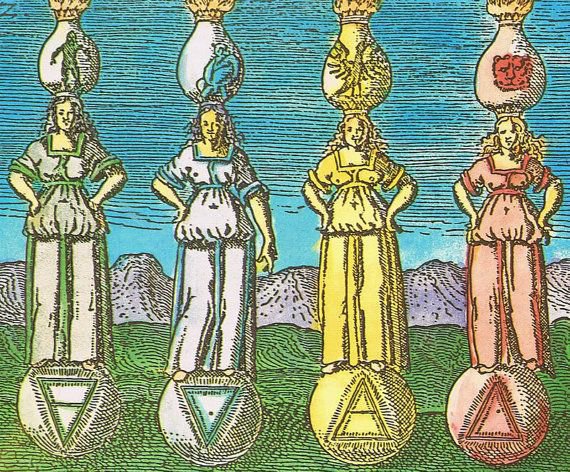
1. According to Paracelsus, fairies are elemental spirits that help control the Earth’s four elements: Silfs (air), gnomes (Earth), Salamanders (fire), and Undines (water). 2. In some versions, they are household creatures that interact with humans 3. Some cultures call them demoted Angels, not good enough for Heaven, but not bad enough for Hell.
So you can see there are lots of traditions that contribute to our modern concept of the fairy, and plenty of ideas to adapt into your party!
Part One: The Invitation:
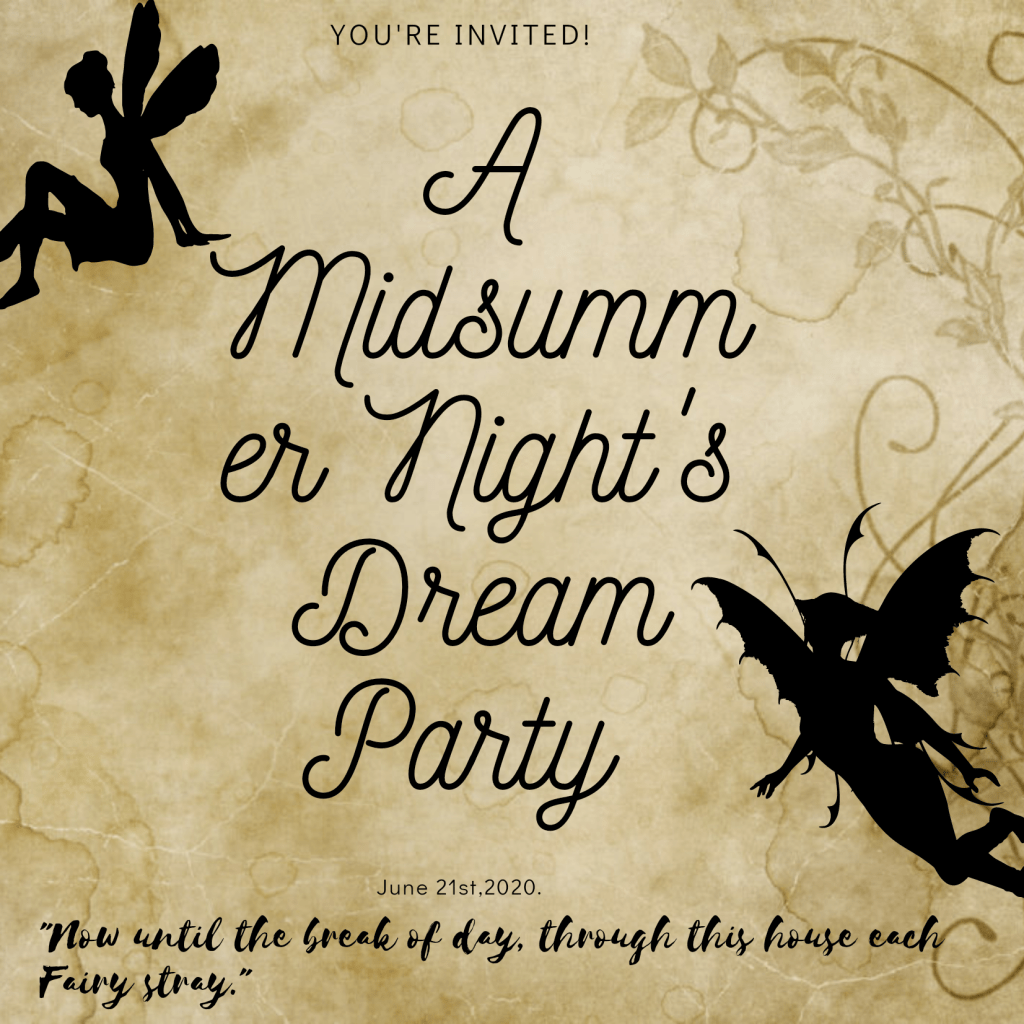
There’s a ton of free fairy clip art and fairy designs online. Below is an invitation I created for free with an app called Canva and a parchment background picture I found online.
1. Pixie invitations 2. Immortal Longings
Second card design I created on Canva.
You probably also know that I am a huge fan of the website Immortal Longings because of their excellent Shakespearean art and they sell cards too. You can buy the cards or download the pictures on their website.
Shakespearean Greeting Cards from Immortal Longings.com
Part Two: Decorations Fairy
Fairy Dens Right now the Royal Shakespeare Company is making DIY Fairy decorations including a Fairy Den that you can share with your family and friends:
What is a Fairy Den? Fairies in folklore are closely tied to the Ancient Celts and Druids, who believed that Fairies live in hollow places underground. A fairy den is a homemade den that imitates the ancient fairy hollows.
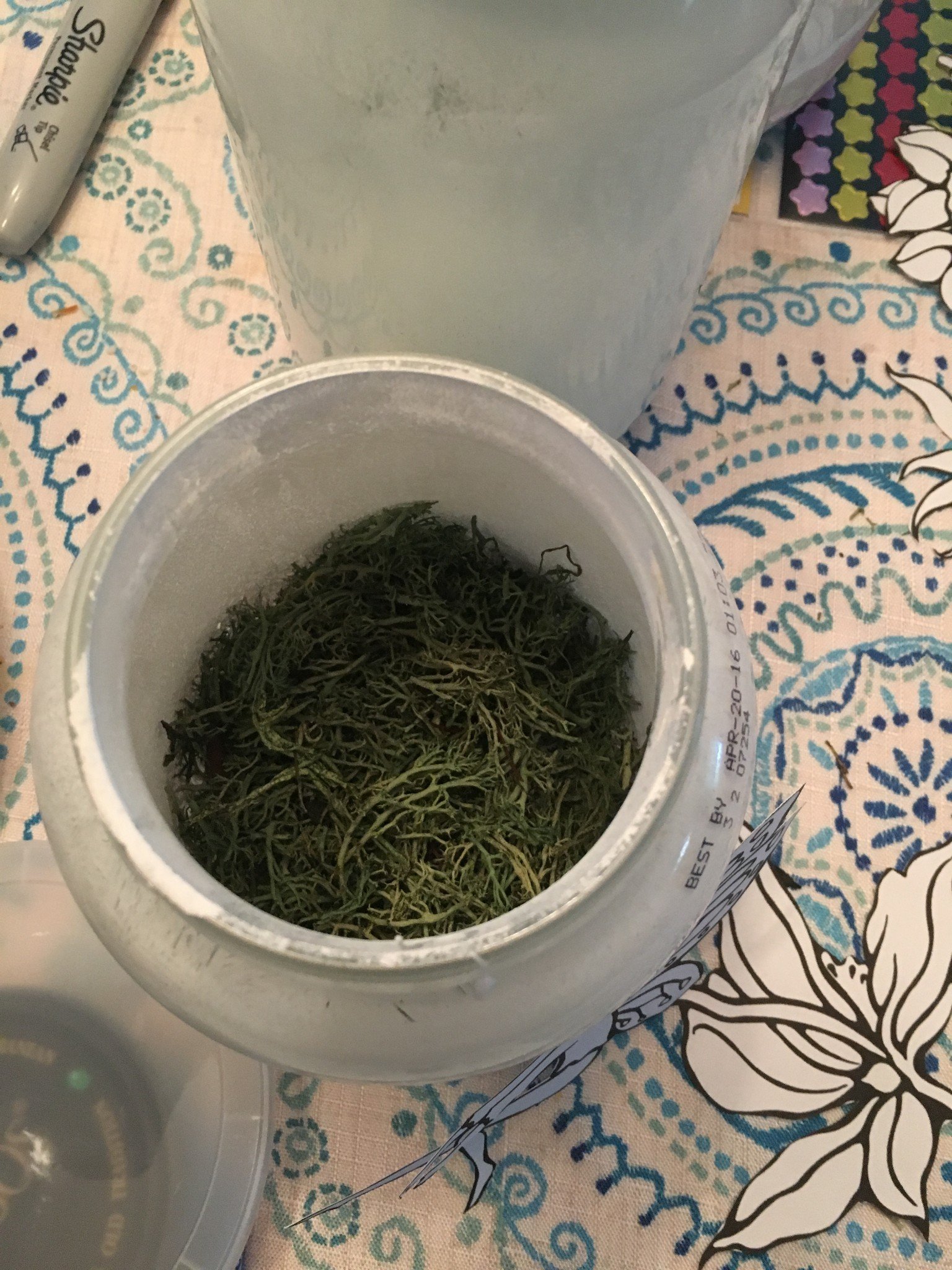
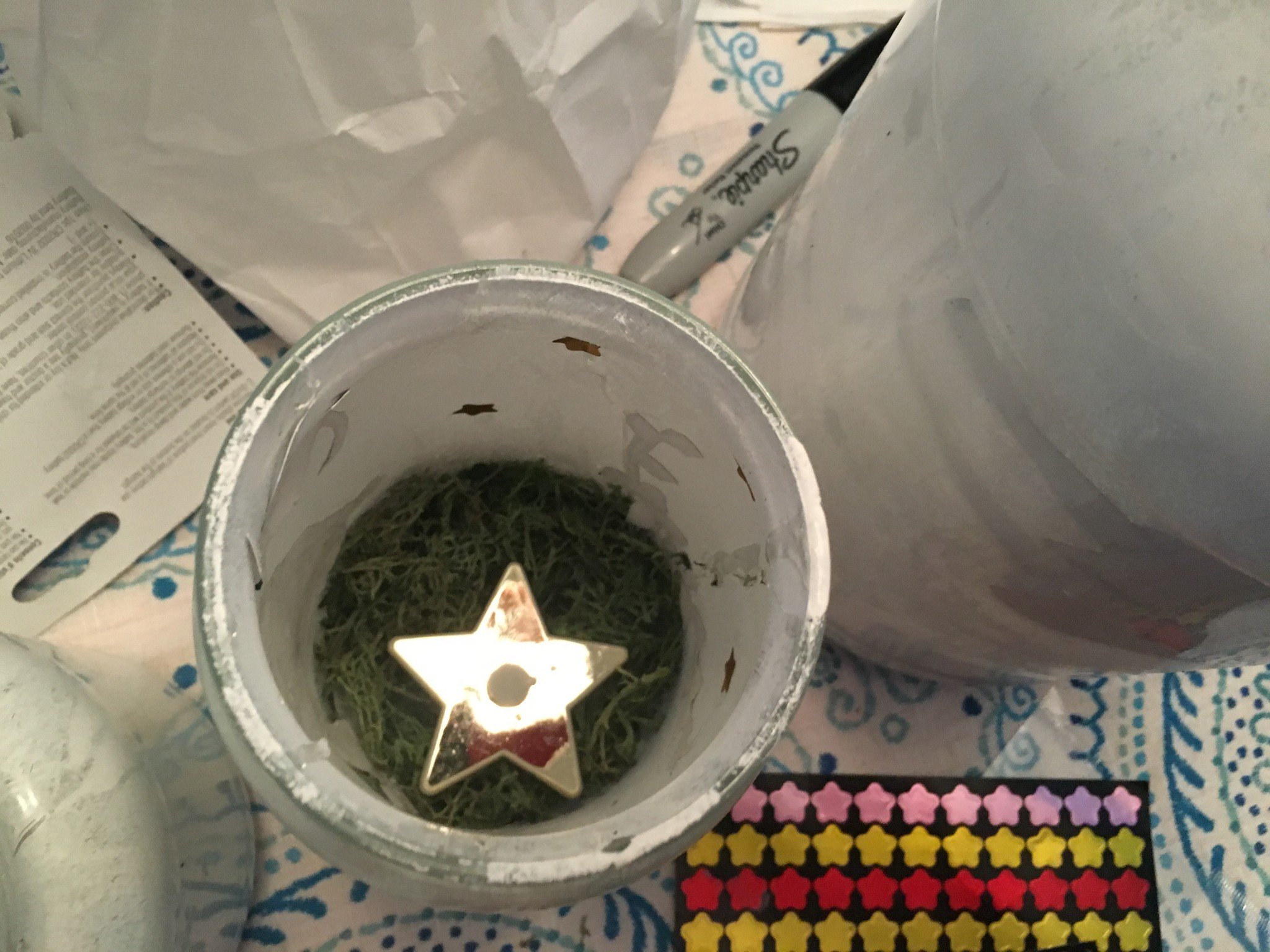
In addition to fairy dens, there are tons of fairy lights, fairy coloring books, and other fairy crafts you can find. Here is a fairy lantern my wife made using pickle jars!
First paint the jars with white paint and cut out paper fairies to paste around the inside of the jar (we used tackey glue). You can also stick star stickers on the inside of the jars.For added realism, you can glue fake moss to the bottom of the jar. We got this from our local dollar store.Put a small battery powered LED light inside.Turn on the LED lights and take the lanterns somewhere dark.Detail of the fairy lights.
Part Three: The Feast
Since the Fairies in Midsummer are woodland spirits, almost any forest or camping themed recipes can be adapted. Here are some ideas that my wife and I made for our own fairy themed party.
2. Love potion: Similar to follow the leader or musical chairs. A group of people lie down and pretend to sleep. Then someone plays Puck by putting a real or pretend flower in one of the player’s hands. The Puck then yells “Awake,” and sets a timer or plays some music. The object of the game is for everyone to chase after the flower and get it before time runs out.
Costumes:
Make some printable donkey masks for Bottom, flower crowns for the fairies, and don’t forget your wings!

































 The Shakespearean Student